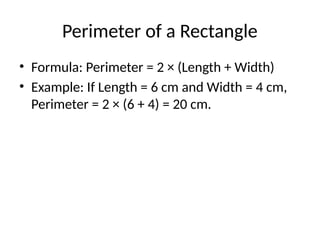
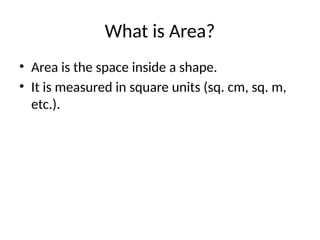
Area and perimeter are fundamental concepts in geometry, widely used in mathematics, engineering, architecture, and everyday life. The perimeter of a shape refers to the total length of its boundary, while the area represents the amount of space enclosed within that boundary. These concepts help in determining the size and extent of two-dimensional figures, making them essential for various real-world applications such as land measurement, construction, and design.
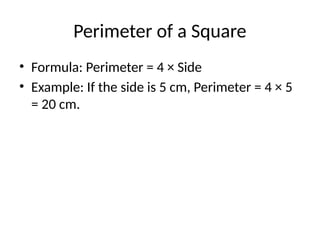
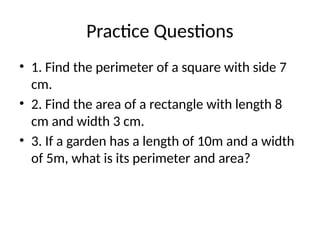
The perimeter of a shape is calculated by summing up the lengths of all its sides. For regular polygons, where all sides are of equal length, the perimeter is simply the length of one side multiplied by the total number of sides. For irregular shapes, the perimeter is determined by adding the lengths of all individual sides. The perimeter of a circle, known as the circumference, is found using the formula C = 2πr or C = πd, where r is the radius and d is the diameter. Knowing the perimeter is crucial in situations like fencing a garden, laying out a track, or framing a picture.
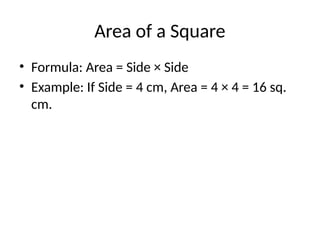
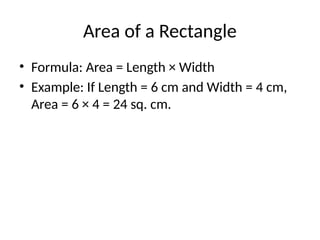
The area of a shape measures the surface it covers. Different geometric shapes have different formulas for calculating area. For instance, the area of a rectangle is given by A = length × width, while the area of a triangle is A = ½ × base × height. Similarly, the area of a circle is A = πr², and for more complex shapes, specific formulas or integration techniques may be required. Understanding area is important for determining floor space in buildings, painting walls, or designing fabric patterns.
The relationship between area and perimeter varies based on the shape. Two figures can have the same perimeter but different areas, or vice versa. For example, a rectangle with a perimeter of 20 cm can have multiple combinations of length and width, leading to different areas. This is particularly significant in optimization problems where maximizing area while minimizing perimeter is necessary, such as designing enclosures or packaging.
In real-life applications, both area and perimeter play a crucial role. In architecture and construction, builders need to know the area of floors, walls, and ceilings to estimate material requirements accurately. Similarly, farmers use perimeter calculations to fence their fields, while city planners use area measurements to allocate land for parks, buildings, and roads. Even in sports, determining the area of a field or court ensures proper measurements for fair play.
Advanced mathematical techniques, such as calculus, can be used to find areas of irregular shapes when traditional formulas do not apply. For example, integration helps in calculating the area under curves in physics and economics. Additionally, computer-aided design (CAD) software relies on area and perimeter calculations for creating accurate blueprints and models.
In conclusion, area and perimeter are essential geometric concepts with diverse applications in mathematics and real-world scenarios.