Arduino Microcontrollers
What do they do?
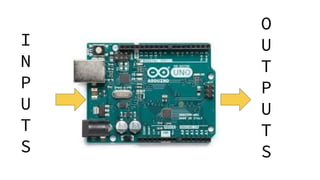
They are like a blender: you put ingredients in, it
mixes up and leaves a new product
I
N
P
U
T
S
O
U
T
P
U
T
S
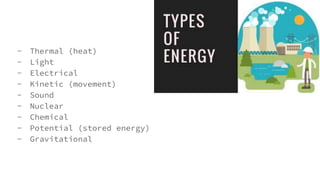
- Thermal (heat)
- Light
- Electrical
- Kinetic (movement)
- Sound
- Nuclear
- Chemical
- Potential (stored energy)
- Gravitational
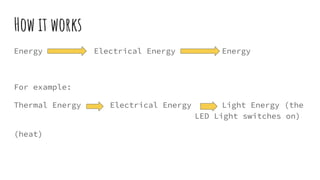
How it works
Energy Electrical Energy Energy
For example:
Thermal Energy Electrical Energy Light Energy (the
LED Light switches on)
(heat)
What are sensors?
They are your inputs:
- Temperature sensor
- Pressure sensor
- Ambient light sensor
- Microphone (sound) sensor
- Ultrasonic (distance) sensor
They interact with the environment so the arduino can
process the information and create a digital signal
Analog
Input examples
- Putting a finger on a button
- A light on a sensor
- Increasing temperature from a heater
Output examples
- Activating a motor
- Turning on a LED light
- Turning down the heating
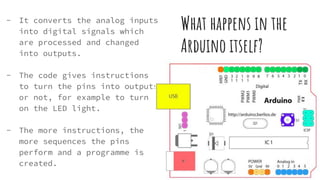
What happens in the
Arduino itself?
- It converts the analog inputs
into digital signals which
are processed and changed
into outputs.
- The code gives instructions
to turn the pins into outputs
or not, for example to turn
on the LED light.
- The more instructions, the
more sequences the pins
perform and a programme is
created.
What are the outputs?
What happens when you input information and it is processed.
Examples:
- A LED Light
- A motor (an object moves)
- A resistance
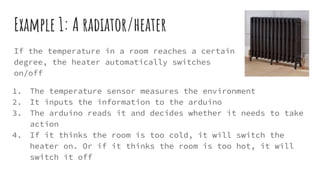
Example 1: A radiator/heater
If the temperature in a room reaches a certain
degree, the heater automatically switches
on/off
1. The temperature sensor measures the environment
2. It inputs the information to the arduino
3. The arduino reads it and decides whether it needs to take
action
4. If it thinks the room is too cold, it will switch the
heater on. Or if it thinks the room is too hot, it will
switch it off
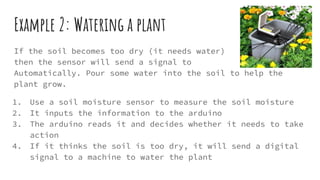
Example 2: Watering a plant
If the soil becomes too dry (it needs water)
then the sensor will send a signal to
Automatically. Pour some water into the soil to help the
plant grow.
1. Use a soil moisture sensor to measure the soil moisture
2. It inputs the information to the arduino
3. The arduino reads it and decides whether it needs to take
action
4. If it thinks the soil is too dry, it will send a digital
signal to a machine to water the plant
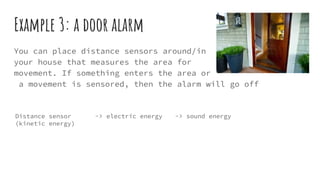
Example 3: a door alarm
You can place distance sensors around/in
your house that measures the area for
movement. If something enters the area or
a movement is sensored, then the alarm will go off
Distance sensor -> electric energy -> sound energy
(kinetic energy)

Arduino Microcontrollers.pdf

  • 1.
  • 2.
    They are likea blender: you put ingredients in, it mixes up and leaves a new product
  • 3.
  • 4.
    - Thermal (heat) -Light - Electrical - Kinetic (movement) - Sound - Nuclear - Chemical - Potential (stored energy) - Gravitational
  • 5.
    How it works EnergyElectrical Energy Energy For example: Thermal Energy Electrical Energy Light Energy (the LED Light switches on) (heat)
  • 6.
    What are sensors? Theyare your inputs: - Temperature sensor - Pressure sensor - Ambient light sensor - Microphone (sound) sensor - Ultrasonic (distance) sensor They interact with the environment so the arduino can process the information and create a digital signal Analog
  • 7.
    Input examples - Puttinga finger on a button - A light on a sensor - Increasing temperature from a heater Output examples - Activating a motor - Turning on a LED light - Turning down the heating
  • 8.
    What happens inthe Arduino itself? - It converts the analog inputs into digital signals which are processed and changed into outputs. - The code gives instructions to turn the pins into outputs or not, for example to turn on the LED light. - The more instructions, the more sequences the pins perform and a programme is created.
  • 9.
    What are theoutputs? What happens when you input information and it is processed. Examples: - A LED Light - A motor (an object moves) - A resistance
  • 10.
    Example 1: Aradiator/heater If the temperature in a room reaches a certain degree, the heater automatically switches on/off 1. The temperature sensor measures the environment 2. It inputs the information to the arduino 3. The arduino reads it and decides whether it needs to take action 4. If it thinks the room is too cold, it will switch the heater on. Or if it thinks the room is too hot, it will switch it off
  • 11.
    Example 2: Wateringa plant If the soil becomes too dry (it needs water) then the sensor will send a signal to Automatically. Pour some water into the soil to help the plant grow. 1. Use a soil moisture sensor to measure the soil moisture 2. It inputs the information to the arduino 3. The arduino reads it and decides whether it needs to take action 4. If it thinks the soil is too dry, it will send a digital signal to a machine to water the plant
  • 12.
    Example 3: adoor alarm You can place distance sensors around/in your house that measures the area for movement. If something enters the area or a movement is sensored, then the alarm will go off Distance sensor -> electric energy -> sound energy (kinetic energy)