Architecting Dependable Systems V 1st Edition Paulo Verssimo
Architecting Dependable Systems V 1st Edition Paulo Verssimo
Architecting Dependable Systems V 1st Edition Paulo Verssimo
Architecting Dependable Systems V 1st Edition Paulo Verssimo
Architecting Dependable Systems V 1st Edition Paulo Verssimo
1.
Architecting Dependable SystemsV 1st Edition
Paulo Verssimo download
https://ebookbell.com/product/architecting-dependable-
systems-v-1st-edition-paulo-verssimo-11848662
Explore and download more ebooks at ebookbell.com
2.
Here are somerecommended products that we believe you will be
interested in. You can click the link to download.
Architecting Dependable Systems Vii 1st Edition Themistoklis Bourdenas
https://ebookbell.com/product/architecting-dependable-systems-vii-1st-
edition-themistoklis-bourdenas-2022710
Architecting Dependable Systems Vi 1st Edition Ricardo Jimenezperis
https://ebookbell.com/product/architecting-dependable-systems-vi-1st-
edition-ricardo-jimenezperis-2023342
Architecting Dependable Systems Vii 1st Edition Themistoklis Bourdenas
https://ebookbell.com/product/architecting-dependable-systems-vii-1st-
edition-themistoklis-bourdenas-4140684
Architecting Dependable Systems 1st Edition Paulo Esteves Verssimo
https://ebookbell.com/product/architecting-dependable-systems-1st-
edition-paulo-esteves-verssimo-1184834
3.
Architecting Dependable SystemsIii 1st Edition Nikolaos Georgantas
https://ebookbell.com/product/architecting-dependable-systems-iii-1st-
edition-nikolaos-georgantas-1225972
Architecting Dependable Systems Iv 1st Edition Joyce L Tokar Auth
https://ebookbell.com/product/architecting-dependable-systems-iv-1st-
edition-joyce-l-tokar-auth-4240002
Architecting Dependable Systems Ii 1st Edition Michel Wermelinger
https://ebookbell.com/product/architecting-dependable-systems-ii-1st-
edition-michel-wermelinger-1532742
Dependable Iot For Human And Industry Modeling Architecting
Implementation Vyacheslav Kharchenko
https://ebookbell.com/product/dependable-iot-for-human-and-industry-
modeling-architecting-implementation-vyacheslav-kharchenko-11052240
Architecting A Knowledgebased Platform For Design Engineering 40
Zhenjun Ming
https://ebookbell.com/product/architecting-a-knowledgebased-platform-
for-design-engineering-40-zhenjun-ming-46703900
5.
Lecture Notes inComputer Science 5135
Commenced Publication in 1973
Founding and Former Series Editors:
Gerhard Goos, Juris Hartmanis, and Jan van Leeuwen
Editorial Board
David Hutchison
Lancaster University, UK
Takeo Kanade
Carnegie Mellon University, Pittsburgh, PA, USA
Josef Kittler
University of Surrey, Guildford, UK
Jon M. Kleinberg
Cornell University, Ithaca, NY, USA
Alfred Kobsa
University of California, Irvine, CA, USA
Friedemann Mattern
ETH Zurich, Switzerland
John C. Mitchell
Stanford University, CA, USA
Moni Naor
Weizmann Institute of Science, Rehovot, Israel
Oscar Nierstrasz
University of Bern, Switzerland
C. Pandu Rangan
Indian Institute of Technology, Madras, India
Bernhard Steffen
University of Dortmund, Germany
Madhu Sudan
Massachusetts Institute of Technology, MA, USA
Demetri Terzopoulos
University of California, Los Angeles, CA, USA
Doug Tygar
University of California, Berkeley, CA, USA
Gerhard Weikum
Max-Planck Institute of Computer Science, Saarbruecken, Germany
6.
Rogério de LemosFelicita Di Giandomenico
Cristina Gacek Henry Muccini
Marlon Vieira (Eds.)
Architecting
Dependable
Systems V
1 3
Preface
This is thefifth book in a series on Architecting Dependable Systems we started six
years ago that brings together issues related to software architectures and the depend-
ability of systems. This book includes expanded and peer-reviewed papers based on
the selected contributions to two workshops, and a number of invited papers written
by recognized experts in the area. The two workshops were: the Workshop on Archi-
tecting Dependable Systems (WADS) organized at the 2007 International Conference
on Dependable Systems and Networks (DSN 2007), and the Third Workshop on the
Role of Software Architecture for Testing and Analysis organized as part of a feder-
ated conference on Component-Based Software Engineering and Software Architec-
ture (CompArch 2007).
Identification of the system structure (i.e., architecture) early in its development
process makes it easier for the developers to make crucial decisions about system
properties and to justify them before moving to the design or implementation stages.
Moreover, the architectural level views support abstracting away from details of the
system, thus facilitating the understanding of broader system concerns. One of the
benefits of a well-structured system is the reduction of its overall complexity, which in
turn leads to a more dependable system. System dependability is defined as the reli-
ance that can be justifiably placed on the service delivered by the system. It has be-
come an essential aspect of computer systems as everyday life increasingly depends
on software. It is therefore a matter for concern that dependability issues are usually
left until too late in the process of system development.
Making decisions and reasoning about structure happen at different levels of ab-
straction throughout the software development cycle. Reasoning about dependability
at the architectural level has recently been in the focus of researchers and practitioners
because of the complexity of emerging applications. From the perspective of software
engineering, traditionally striving to build software systems that are fault-free, archi-
tectural consideration of dependability requires the acceptance of the fact that system
models need to reflect that it is impossible to avoid or foresee all faults. This requires
novel notations, methods and techniques providing the necessary support for reason-
ing about faults (including fault avoidance, fault tolerance, fault removal and fault
forecasting) at the architectural level.
This book comes as a result of bringing together research communities of software
architectures and dependability, and addresses issues that are currently relevant to
improving the state of the art in architecting dependable systems. The book consists of
three parts: “Critical Infrastructures,” “Rigorous Design and Fault Tolerance,” and
“Verification and Validation.”
The first part entitled “Critical Infrastructures” includes six papers focusing on
various aspects of architecting critical infrastructures. The structuring of software
systems at the architectural level is especially fundamental for the development of
critical infrastructures. Nowadays, public health, economy, security and quality of life
9.
VIII Preface
heavily dependon the resiliency of a number of critical infrastructures, including
energy, telecommunications, transportation, emergency services and many others. The
technological advances and the necessity for improved efficiency resulted in increas-
ingly automated and interlinked infrastructures, with consequences on increased vul-
nerabilities to accidental and human-made faults. Addressing the development of such
systems with rigorous methodologies and evolutionary approaches at an architectural
level has high potential to enhance dependability and resiliency in these critical sec-
tors. In recognition of this emerging necessity, this book includes a specific part on
architecting critical infrastructures. The six contributions grouped in this section focus
on architecting critical infrastructures at both the system design level, where intrusion
tolerant architectures, virtualization, improved middleware technologies and efficient
communication infrastructures are addressed, and at the verification and validation
level, where the problem of modeling and understanding interdependencies among
interlinked critical infrastructures is tackled.
The first paper in this part, “The CRUTIAL Architecture for Critical Information
Infrastructures,” is by P. Verissimo, N. Neves, M. Correia, Y. Deswarte, A. Abou El
Kalam, A. Bondavalli and A. Daidone. In this paper the authors highlight the suscep-
tibility of critical information infrastructures to computer-borne attacks and faults.
They discuss how to overcome these problems and propose a generic architecture as
well as a set of techniques and algorithms aiming at achieving resilience of critical
information infrastructures to faults and attacks in an automatic way.
The paper “A Middleware Improved Technology (MIT) to Mitigate Interdepend-
encies Between Critical Infrastructures” by C. Balducelli, A. Di Pietro, L. Lavalle and
G. Vicoli deals with new middleware technologies (MIT) to support co-ordination
among different large complex critical infrastructures (LCCI). The objective is to
mitigate interdependency effects so as to enhance the resilience and survivability of
LCCIs. The features provided by the MIT technology, as well as the adopted reference
architecture and an experimental environment for testing purposes, are overviewed.
The paper is developed in the framework of the EU IRRIIS project, which aims at
protecting critical infrastructures in the energy and telecommunication domains.
S. Chiaradonna, F. Di Giandomenico and P. Lollini contribute to the book with the
paper “Evaluation of Critical Infrastructures: Challenges and Viable Approaches.”
This paper introduces critical infrastructures with a focus on the challenges for evalua-
tion. Furthermore, it provides initial results from a Moebius modeling framework to
evaluate failures in the ICT infrastructure of an electric power system. The experience
gained by the authors in a European project is reported and discussed.
The fourth paper, written by A. Daidone, S. Chiaradonna, A. Bondavalli and P.
Verissimo is entitled “Analysis of a Redundant Architecture for Critical Infrastructure
Protection.” In the CRUTIAL reference architecture each LAN is connected to the
WAN through a special interconnection and filtering device. Replica rejuvenation
strategy applied to these devices is based on both periodic (proactive) recoveries and
on event-triggered (reactive) recoveries, seeking perpetual unattended correct opera-
tion. This paper analyzes the redundant architecture of these devices by evaluating
how effective the trade-off between proactive and reactive recoveries is, identifying
the relevant parameters of the architecture and finding the best parameter setup.
10.
Preface IX
The fifthpaper in this part, “A Robust Semantic Overlay Network for Microgrid
Control Applications,” is by G. Deconinck, T. Rigole, H. Beitollahi, R. Duan, B.
Nauwelaers, E. Van Lil, J. Driesen, R. Belmans and G. Dondossola. In this paper the
authors present Agora, which is a semantic overlay network that allows one to effi-
ciently route queries in overlay networks. The routing is related to microgrid control,
and the semantics is based on an XML description of the static and dynamic character-
istics of the intelligent electronic devices. It is robust against changes, and provides
graceful degradation in case of unrecovered failures.
The paper “Architecting Dependable and Secure Systems Using Virtualization” by
B. Jansen, H. V. Ramasamy, M. Schunter and A. Tanner explores the emerging virtu-
alzation approach, through which the real hardware system configuration is abstracted
from, to enhance systems dependability and security. A practical realization of a sub-
set of the proposed enhancements, namely, intrusion detection and protection, using
the Xen open-source virtual machine monitor (VMM) is detailed. In such a context,
the impact of virtualization on node reliability is quantified using combinatorial mod-
eling. The results of these analyses constitute useful guidelines on design options to
effective leveraging of virtualization to system dependability purposes. They also
triggered further improvements by the authors on the VMM design.
The second part of this book is entitled “Rigorous Design and Fault Tolerance” and
contains three papers.
The paper “Model-Based Approaches for Dependability in Ad-Hoc Mobile Net-
works and Services” by G. Pinter, Z. Micskei, A. Kovi, Z. Egel, I. Kocsis, G. Huszerl
and A. Pataricza reports the authors’ research activity to architect dependable, distrib-
uted systems through a model-driven design approach. The ad-hoc mobile networks
context adopted by the EU Hidenets project is specifically addressed. Contributions
include the construction of the UML model of the Hidenets platform, the construction
of a metamodel of the applications running on the platform, the UML profile for the
metamodel as well as the definition of a set of design patterns to support the imple-
mentation of applications built for the Hidenets platform using the defined profile.
In the paper “Design, Implementation and Deployment of State Machines Using a
Generative Approach”, G. N.C. Kirby, A. Dearle and S.J. Norcross present an ap-
proach to designing and implementing a distributed system as a family of related finite
state machines, generated from a single abstract model. The state machine family
formalizes the interactions between the components of the distributed system, allow-
ing increased confidence in correctness. The feasibility of the proposed approach was
demonstrated in the context of a Byzantine fault-tolerant commit protocol used in a
distributed storage system.
The third paper in this part, “Handling Emergent Nondeterminism in Replicated
Services,” is written by J. Slember and P. Narasimhan. This paper presents Midas, an
approach to identifying and addressing multiple sources of nondeterminism in a
multi-service replicated distributed architecture. Midas involves a combination of
compile-time dependency, concurrency and nondeterminism analyses, followed by the
performance-sensitive compensation of nondeterminism at runtime.
Part three of the book is on “Verification and Validation” and includes five papers
focusing on approaches to architecture level verification, validation, analysis and
evaluation.
11.
X Preface
This partstarts with a paper by M. H. Diallo, L. Naslavsky, T. A. Alspaugh, H. Ziv
and D. J. Richardson that is entitled “Toward Architecture Evaluation Through Ontol-
ogy-Based Requirements-Level Scenario.” The paper describes an approach for evalu-
ating whether a candidate architecture dependably satisfies stakeholder requirements
expressed in requirements-level scenarios. The approach maps scenarios expressing
both functional requirements and quality attributes of the system, to architectural ele-
ments through an ontology of requirements-level event classes and domain entities.
This in turn provides a clear connection between stakeholder requirements and archi-
tectural solutions to address them.
In their paper entitled “Combining Formal Verification and Testing for Correct
Legacy Component Integration in Mechatronic UML,” H. Giese, S. Henkler and
M. Hirsch present a combined use of testing and formal verification for verifying
complex real-time component-based systems that include legacy components. The
approach is motivated by the need of sufficiently validating the integration of real-
time, embedded, and legacy components, and by the claim that a testing phase alone,
when applied to such a domain, cannot provide enough guarantees. Thus, the ap-
proach proposed here is composed of many steps: a behavioral model of embedded
legacy components is derived from the existing interface description; then, such an
initial model is submitted to formal verification; if the verification step identifies a
failure, the produced counterexample is used to test the legacy component; the execu-
tion information is used for refining the behavioral model of the legacy components;
the new synthesized behavior is then the starting point for the next iteration. In sum-
mary, while formal verification is used for verifying components interactions, local
testing of the legacy components is used to refine the behavioral model.
S. Wang, G. S. Avrunin and L. A. Clarke, in their paper “Plug-and-Play Architectural
Design and Verification,” focus on software plug-and-play architectural design. They
propose an approach that allows designers to experiment with alternative design choices
of component interactions in a plug-and-play manner. The paper describes how to design
and present plug-in-play components using a set of notations to show classified compo-
nent interactions; furthermore it provides details of how reusable formal models can be
created for the connector building blocks. This approach is particularly useful to specify
and present different component connection relationships.
In the fourth paper, entitled “Data Flow-based Validation of Web Services Compo-
sitions: Perspectives and Examples,” C. Bartolini, A. Bertolino, E. Marchetti and
I. Parissis describe the use of data flow modeling for testing composite Web services
(WSs). The central problem on testing WSs is that the dynamic binding of services
makes it impractical to test in advance all the concrete service combinations that can
be involved in a workflow. By considering in an explicit way a model of how data are
expected to be exchanged between the combined services, it is possible to check
whether desired properties are satisfied or also to test whether the implemented Web
services composition (WSCs) complies with that model. The authors discuss ways in
which, depending on the information available, the flow of data in WSCs can be use-
fully referred to for verification and validation purposes.
The fifth paper, by T. Kettu, E. Kruse, M. Larsson and G. Mustapic, is entitled “Using
Architecture Analysis to Evolve Complex Industrial Systems.” This paper from industry
provides practical advice on how to reconstruct the architecture of existing software
12.
Preface XI
systems bycombining the use of tools and the existing knowledge within the organiza-
tion. The authors claim that to obtain an up-to-date view of the system and prevent
expensive mistakes during system evolution, it is fundamental to obtain an up-to-date
view of the architecture of the system. The paper is based on experiences from two cases
related to industrial automation.
Architecting dependable systems is now a well-recognized area, attracting interest
and contributions from many researchers. We are certain that this book will prove
valuable for both developers designing complex applications and researchers building
techniques supporting this. We are grateful to many people that made this book possi-
ble. Our thanks go to the authors of the contributions for their excellent work, the
DSN 2007 WADS and CompArch 2007 ROSATEA participants for their active par-
ticipation in the discussions, and Alfred Hofmann from Springer for believing in the
idea of a book series on this important topic and for helping us to get it published.
Last but not least, we appreciate very much the efforts of our reviewers who helped us
in ensuring the high quality of the contributions. They are Sascha Konrad, Tao Xie,
Graham Kirby, Rick Kazman, Simona Bernardi, Istvan Majzik, Bedir Tekinerdogan,
Miguel Correia, Gergely Pinter, Silvano Chiaradonna, Stephan Storck, Sandro Bolo-
gna, Santosh Shrivastava, Paolo Lollini, Alan Hartman, Giovanna Dondossola, Nuno
Neves, Sasikumar Punnekkat, Mauro Gaspari, Holger Giese, Eda Marchetti, Kristina
Lundqvist, Paris Avgeriou, Luciano Baresi, Andrea Polini, Joseph Slember, Andreas
Ulrich, Andrea Bondavalli, Suzanne Embury, Jerry Gao, Roberto Baldoni, Daniel
Paulish, Stephan Storck, and several anonymous reviewers.
June 2008 Rogério de Lemos
Felicita Di Giandomenico
Cristina Gacek
Henry Muccini
Marlon Vieira
13.
Foreword
Innovative, high-impact researchresults in the sciences and engineering may seem to
an outsider to have sprung forth from a vacuum, but in truth, they are the result of
novel combinations of known ideas. The right conditions to produce such results are
often created through the intentional mixing of different communities, each with its
own point of view.
For six years now, the Workshop on Architecting Dependable Systems (WADS)
has brought together two distinct and very different communities, the software archi-
tecture and dependability communities, in order to provide a seedbed for the growth
of new ideas concerning the design, construction, and validation of large-scale soft-
ware-based systems that must be dependable. The importance of bringing together
these communities has steadily grown during this period, as our society’s dependence
on information-technology-based systems continues to grow and as the amount of
software in such systems increases.
This volume in the series focuses on methods for designing and validating critical
infrastructures, both from an application-driven, top-down perspective and from a
bottom-up, technology-driven perspective. In both cases, the authors include people
from both the dependability and security community and the software architecture
community. The discussion at the associated workshop at the IEEE/IFIP Dependable
Systems and Networks meeting was lively, and the revised and expanded papers pre-
sented in this volume capture the results of those discussions, and some of the excite-
ment of the exchanges that day.
I applaud Rogério de Lemos, Felicita Di Giandomenico, Cristina Gacek, Henry
Muccini, and Marlon Vieira for their work in putting together this volume, and in their
long-standing organization of the WADS series. In bringing together people from both
the software architecture and dependability communities in a sustained way each year,
they are engaging in a community-building effort that could have a significant payoff:
the creation of the ability to architect software-based systems that are dependable by
design, and remain dependable when configured in different ways throughout their
range of use and lifecycle.
Such community-building is hard work, but its value is immense. I look forward
to seeing the ongoing efforts that are reflected in this volume bear fruit for many years
to come.
June 2008 William H. Sanders
14.
Table of Contents
Part1. Critical Infrastructures
The CRUTIAL Architecture for Critical Information Infrastructures . . . . 1
Paulo Verı́ssimo, Nuno F. Neves, Miguel P. Correia, Yves Deswarte,
A. Abou El Kalam, Andrea Bondavalli, and Alessandro Daidone
A Middleware Improved Technology (MIT) to Mitigate
Interdependencies between Critical Infrastructures . . . . . . . . . . . . . . . . . . . 28
Claudio Balducelli, Antonio Di Pietro, Luisa Lavalle, and
Giordano Vicoli
Evaluation of Critical Infrastructures: Challenges and Viable
Approaches . . . . . . . . . . . . . . . . . . . . . . . . . . . . . . . . . . . . . . . . . . . . . . . . . . . . . 52
Silvano Chiaradonna, Felicita Di Giandomenico, and Paolo Lollini
Analysis of a Redundant Architecture for Critical Infrastructure
Protection . . . . . . . . . . . . . . . . . . . . . . . . . . . . . . . . . . . . . . . . . . . . . . . . . . . . . . 78
Alessandro Daidone, Silvano Chiaradonna, Andrea Bondavalli, and
Paulo Verı́ssimo
A Robust Semantic Overlay Network for Microgrid Control
Applications. . . . . . . . . . . . . . . . . . . . . . . . . . . . . . . . . . . . . . . . . . . . . . . . . . . . . 101
Geert Deconinck, Koen Vanthournout, Hakem Beitollahi,
Zhifeng Qui, Rui Duan, Bart Nauwelaers, Emmanuel Van Lil,
Johan Driesen, and Ronnie Belmans
Architecting Dependable and Secure Systems Using
Virtualization . . . . . . . . . . . . . . . . . . . . . . . . . . . . . . . . . . . . . . . . . . . . . . . . . . . 124
Bernhard Jansen, HariGovind V. Ramasamy,
Matthias Schunter, and Axel Tanner
Part 2. Rigorous Design/Fault Tolerance
Model-Based Approaches for Dependability in Ad-Hoc Mobile Networks
and Services . . . . . . . . . . . . . . . . . . . . . . . . . . . . . . . . . . . . . . . . . . . . . . . . . . . . 150
Gergely Pintér, Zoltán Micskei, András Kövi, Zoltán Égel,
Imre Kocsis, Gábor Huszerl, and András Pataricza
Design, Implementation and Deployment of State Machines Using a
Generative Approach . . . . . . . . . . . . . . . . . . . . . . . . . . . . . . . . . . . . . . . . . . . . . 175
Graham N.C. Kirby, Alan Dearle, and Stuart J. Norcross
Handling Emergent Nondeterminism in Replicated Services. . . . . . . . . . . . 199
Joseph Slember and Priya Narasimhan
15.
XIV Table ofContents
Part 3. Verification and Validation
Toward Architecture Evaluation through Ontology-Based
Requirements-Level Scenarios. . . . . . . . . . . . . . . . . . . . . . . . . . . . . . . . . . . . . . 225
Mamadou H. Diallo, Leila Naslavsky, Thomas A. Alspaugh,
Hadar Ziv, and Debra J. Richardson
Combining Formal Verification and Testing for Correct Legacy
Component Integrationin Mechatronic UML . . . . . . . . . . . . . . . . . . . . . . . . . 248
Holger Giese, Stefan Henkler, and Martin Hirsch
Plug-and-Play Architectural Design and Verification . . . . . . . . . . . . . . . . . . 273
Shangzhu Wang, George S. Avrunin, and Lori A. Clarke
Data Flow-Based Validation of Web Services Compositions:
Perspectives and Examples . . . . . . . . . . . . . . . . . . . . . . . . . . . . . . . . . . . . . . . . 298
Cesare Bartolini, Antonia Bertolino, Eda Marchetti, and
Ioannis Parissis
Using Architecture Analysis to Evolve Complex Industrial Systems . . . . . 326
Tommy Kettu, Eckhard Kruse, Magnus Larsson, and
Goran Mustapic
Author Index . . . . . . . . . . . . . . . . . . . . . . . . . . . . . . . . . . . . . . . . . . . . . . . . . . 343
16.
The CRUTIAL Architecture
forCritical Information Infrastructures
Paulo Verı́ssimo1
, Nuno F. Neves1
, Miguel Correia1
, Yves Deswarte2
,
A. Abou El Kalam3, Andrea Bondavalli4, and Alessandro Daidone4
1Universidade de Lisboa, FCUL
Lisboa, Portugal
2LAAS-CNRS 3IRIT, ENSEEIHT-INPT, Université de Toulouse
4University of Florence
Florence, Italy
{pjv,nuno,mpc}@di.fc.ul.pt, yves.deswarte@laas.fr,
anas.abouelkalam@enseeiht.fr, bondavalli@unifi.it,
daidone@dsi.unifi.it
Abstract. In this chapter we discuss the susceptibility of critical information in-
frastructures to computer-borne attacks and faults, mainly due to their largely
computerized nature, and to the pervasive interconnection of systems all over
the world. We discuss how to overcome these problems and achieve resilience
of critical information infrastructures, through adequate architectural constructs.
The architecture we propose is generic and may come to be useful as a reference
for modern critical information infrastructures. We discuss four main aspects:
trusted components which induce prevention; middleware devices that achieve
runtime automatic tolerance and protection; trustworthiness monitoring mecha-
nisms detecting and adapting to non-predicted situations; organization-level se-
curity policies and access control models capable of securing global information
flows.
1 Introduction
The largely computerized nature of critical infrastructures on the one hand, and the per-
vasive interconnection of systems all over the world, on the other hand, have generated
one of the most fascinating current problems of computer science and control engineer-
ing: how to achieve resilience of critical information infrastructures. In this chapter, we
are concerned with the susceptibility of the latter to computer-borne attacks and faults,
i.e., with the protection of these infrastructures.
We propose an architecture and a set of techniques and algorithms aiming at achiev-
ing resilience to faults and attacks in an automatic way. Although we focus on the
computer systems behind electrical utility infrastructures as an example, the architec-
ture we propose is generic and may come to be useful as a reference for modern critical
information infrastructures.
This work was mainly supported by the EC, through project IST-FP6-STREP 027513 (CRU-
TIAL) and NoE IST-4-026764-NOE (ReSIST), by the FCT through the Large-Scale Informatic
Systems Laboratory (LaSIGE) and the CMU-Portugal partnership.
R. de Lemos et al. (Eds.): Architecting Dependable Systems V, LNCS 5135, pp. 1–27, 2008.
c
Springer-Verlag Berlin Heidelberg 2008
17.
2 P. Verı́ssimoet al.
It is worthwhile recapitulating some of the reasoning behind the blueprint ofthis archi-
tecture, recently published [23]. Although inspired by previousintrusion-tolerantsystem
architectures, the CRUTIAL architecture was largely influenced by two facts. Firstly, the
factthatCriticalInformation Infrastructures(CII)featurealotoflegacy subsystems(con-
trollers, sensors, actuators, etc.). Secondly, the fact that conventional security and pro-
tection techniques can bring serious problems, when directly applied to CII controlling
devices, by preventing their effective operation. Although they are very practical prob-
lems, we will show ahead that they yielded in fact very interesting research challenges.
Another relevant fact was that our belief that the crucial problems in critical infor-
mation infrastructures lie with the forest, not the trees, has been confirmed everyday
as new incidents have occurred. That is, the problem is mostly created by the generic
and non-structured network interconnection of CIIs, which bring several facets of expo-
sure impossible to address at individual level. Whilst it seems today non-controversial
that such a status quo brings a considerable level of threat, to our knowledge there had
been no previous attempt at addressing the problem through the definition of a ref-
erence model of a critical information infrastructure distributed systems architecture.
One which, by construction, would lay the basic foundations for the necessary global
resilience against abnormal situations. Our conjecture was that such a model would
be highly constructive, for it would form a structured framework for (1) conceiving the
right balance between prevention and removal of vulnerabilities and attacks; (2) achiev-
ing tolerance of remaining potential intrusions and designed-in faults; and (3) enabling
adaptation and self-awareness mechanisms to overcome unforeseen situations. In this
chapter, we will report some advances in this area.
Finally, and in a related manner, we conjectured that any solution, to be effective, has
to involve automatic control of macroscopic command and information flows, occurring
essentially between the several realms composing the critical information infrastructure
architecture (both intra- and inter-organizations), with the purpose of securing appro-
priate system-level properties, at organizational level. This has to be addressed, in an
automatic way, through innovative access control models that understand the organiza-
tional reality, and are thus capable of translating the related high-level security policies
into the adequate technical mechanisms such as access control matrices and firewall
filter rule-sets.
The chapter is organized as follows: Section 2 does the Architecture Description.
Then, the Protection Strategies and Services are introduced in Section 3, followed by
the Trustworthiness Monitoring Services in Section 4. The chapter concludes with a
discussion on Access Control for Critical Information Infrastructures, in Section 5.
2 Architecture Description
The CRUTIAL architecture encompasses four aspects. (i) Architectural configurations
featuring trusted components in key places, which a priori induce prevention of some
faults, and of certain attack and vulnerability combinations. (ii) Middleware devices
that achieve runtime automatic tolerance of remaining faults and intrusions, supply-
ing trusted services out of non-trustworthy components. (iii) Trustworthiness monitor-
ing mechanisms detecting situations not predicted and/or beyond assumptions made,
18.
The CRUTIAL Architecturefor Critical Information Infrastructures 3
and adaptation mechanisms to survive those situations. (iv) organization-level security
policies and access control models capable of securing information flows with different
criticality within/in/out of a CII. It is important to point out that the notion of CII is hard
to formalize. The generic idea is that the CII is the computer systems (or ICT) part of a
critical infrastructure, which is the working definition that we use in this chapter.
Intrusion tolerance mechanisms are selectively used in the CRUTIAL architecture,
to build layers of progressively more trusted components and middleware subsystems,
from baseline untrusted components (nodes, networks). This leads to an automation
of the process of building trust: for example, at lower layers, basic intrusion tolerance
mechanisms are used to construct a trustworthy communication subsystem, which can
then be trusted by upper layers to securely communicate amongst participants with-
out bothering about network intrusion threats. Middleware services and protocols in
the architecture use distinct techniques that address different levels of criticality of the
architecture, such as randomization and wormholes, software or hardware implemen-
tations, and support a diverse set of requirements from the applications: dynamic and
static groups; synchronous, partially-synchronous, and asynchronous execution; toler-
ance from benign accidental faults to malicious coordinated attacks.
CRUTIAL Information Switches (CIS) route the information to and from LANs with
different criticality levels, wherever they are in the infrastructure: intranet, SCADA, In-
ternet gateway. In fact, a lot of the protection and intrusion resilience reside in this class
of components that interconnect the several LANs comprising a CRUTIAL architecture.
But they are more than mere TCP/IP routers: in a simplistic way they could be seen as
sophisticated circuit or application level firewalls combined with equally sophisticated
intrusion detectors, connected by distributed protocols. Collectively they act as a set of
servers providing distributed services relevant to solving our problem: achieving control
of the command and information flow, and securing a set of system-level properties.
Monitoring and diagnosis can be performed at several levels, through diverse mech-
anisms: CIS self-diagnosis, the diagnosis inside the CIS as part of the fault tolerance
policy of the CIS itself; diagnosis on other components in the system (making assump-
tions on the security policy applied inside the CIS); diagnosis on the LANs and their
nodes; diagnostic information gained by processing the security policy decisions, inter-
preting them as error detections. The collected information may be used in order both
to take local decisions and to coordinate CIS activities.
Access control is a key issue. Although several organizationsare normally involved and
have to cooperate in the operation of a CII, from the access control point of view, each
organization in a CII should keep its independence and responsibility on its assets and
personnel. We propose that: each organization defines its own security policy (accord-
ing to the OrBAC model), and enforce it with its own authentication and authorization
means; the organizations cooperate through web services, and for each web service, a
contract is signed between the provider and the client; this contract is translated in secu-
rity rules (expressed within the Poly-OrBAC model),these rules being implementedwith
the involved CIS, and enforced at each step of web service interaction; the interactions
are recorded into logs by each involved CIS, and these logs can serve as evidence in case
of dispute: each organization stay liable of all actions initiated by its own personnel.
19.
4 P. Verı́ssimoet al.
2.1 Key Architecture Aspects
The CRUTIAL architecture, despite inspired by previous intrusion-tolerant reference
architectures like MAFTIA [22], extends them significantly to attend the specific chal-
lenges of the critical information infrastructure problem, for example, legacy, global
access control, and above all non-stop operation and resilience.
Given the severity of threats expected, some key components are built using archi-
tectural hybridization methods in order to achieve extremely high robustness:
– Trusted-trustworthy operation [22] is an architectural paradigm whereby compo-
nents prevent the occurrence of some failure modes by construction, so that their
resistance to faults and hackers can justifiably be trusted. In other words, some
special-purpose components are constructed in such a way that we can argue that
they are always secure, so that they can provide a small set of services useful to
support intrusion tolerance in the rest of the system. This concept is in line with,
but richer than, recent technological concepts like trusted computing or trusted plat-
form modules.
Another interesting aspect of this work is related with the mechanisms that we had
to develop, to preserve the large legacy composition of CII and keep changes to a min-
imum:
– Fully-transparent intrusion tolerance aims at preserving the complete illusion of
a standard system to legacy components. It is implemented by innovative replica
control and communication algorithms. Any SCADA and corporate network tech-
nologies stay unchanged, the only modification foreseen being the requirement of
IPsec at communication level, but this is considered a trend anyway [4].
Another innovative aspect of this work is our approach to achieve resilience. This
goes further to mere intrusion tolerance, and can be seen as a specialization of this
kind of architecture to critical infrastructures. The problem is addressed through two
paradigms:
– Proactive-resilience to achieve exhaustion-safety [20], and ensure perpetual, non-
stop operation despite the continuous production of faults and intrusions. This is not
a requirement of many intrusion-tolerant systems, but it is definitely of importance
for unattended operation, as is desired of the control part of CII.
– Trustworthiness monitoring to perform surveillance of the coverage stability of the
system, that is, of whether it is still performing inside the assumed fault envelope
or beyond assumptions made [2]. In the latter case, dependable adaptation mecha-
nisms are triggered to stabilize coverage and thus, the operational guarantees. This
is of extreme importance for situations of instability, either caused by accidental
events or malicious attacks, and we believe it can be a key to lower the risk of
cascading and/or escalating failures.
Finally, the desired control of the information flows is partly performed through ad-
vanced protection mechanisms:
20.
The CRUTIAL Architecturefor Critical Information Infrastructures 5
– the OrBAC firewall is an adaptation of the classical firewall rule-set operation to en-
force an organization-based access control model (OrBAC) [11] for implementing
global-level security policies. OrBAC allows the expression of security policy rules
as high level abstractions, and it is of importance for homogenizing the diverse se-
curity policies of organizations involved in a CII into one policy that controls the
global information flow.
In summary, the mechanisms and algorithms in place achieve system-level properties
of the following classes: trustworthiness or resistance to faults and intrusions (i.e., se-
curity and dependability); timeliness, in the sense of meeting timing constraints raised
by real world control and supervision; coverage stability, to ensure that variation or
degradation of assumptions remains within a bounded envelope; dependable adaptabil-
ity, to achieve predictability in uncertain conditions; resilience, read as correctness and
continuity of service even beyond assumptions made.
2.2 Main Building Blocks
The overall picture of a CRUTIAL system, shown in Figure 1, was detailed in [23].
C I S
W A N
C o r p o r a t e
N e t w o r k
S u b s t a t i o n B
C I S
C I S
S t a t i o n
N e t w o r k
P
P
S i t e
S i t e
S i t e
S i t e
C 1
S i t e
P L C
C I S
P L C
C o n t r o l
N e t w o r k
I n t e r n e t
C I S
C I S
C 2
H i s t o r i a n
S u b s t a t i o n A
S u b s t a t i o n C
H i s t o r i a n N e t w o r k
P r o c e s s N e t w o r k
U t i l i t y N e t w o r k
Fig. 1. CRUTIAL overall architecture (WAN-of-LANs connected by CIS)
We view the system as a WAN-of-LANs. There is a global interconnection network,
the WAN, that switches packets through generic devices that we call CRUTIAL Infor-
mation Switches (CIS), which in a simplistic way could be seen as sophisticated circuit
or application level firewalls combined with equally sophisticated intrusion detectors,
connected by distributed protocols. The WAN is a logical entity operated by the CII
operator companies, which may or may not use parts of public network as physical
support. A LAN is a logical unit that may or may not have physical reality (e.g., LAN
segments vs. Virtual LANs (VLANs)). More than one LAN can be connected by the
21.
6 P. Verı́ssimoet al.
same CIS. All traffic originates from and goes to a LAN. As example LANs, the reader
can envision: the administrative clients and the servers LANs; the operational (SCADA)
clients and servers LANs; the engineering clients and servers LANs; the PSTN modem
access LANs; the Internet and extranet access LANs; an historian network (to store
monitoring data); etc.
CIS collectively act as a set of servers providing distributed services relevant to solv-
ing our problem: achieving control of the command and information flow, and secur-
ing a set of necessary system-level properties. In consequence, no traffic set to enjoy
CRUTIAL-level protection can go from one LAN to another without crossing a CIS.
3 Protection Strategies and Services
We now discuss the failure assumptions underpinning the architecture design, concern-
ing the main architectural devices: WAN, LAN, CIS. Shadowing in the figure symbol-
izes untrusted areas:
– The WAN interconnect (heavily shadowed) is assumed to have arbitrary behavior,
which is akin to saying it can be totally compromised.
– The CII facilities (lightly shadowed) are assumed to have varying faulty behavior,
from arbitrary to crash failure.
– Inside the facilities, the LAN is the unit of failure. This is akin to assuming that
some LANs will be completely trusted (e.g., by construction, or by recursive use
of intrusion tolerance), whereas other LANs may even be arbitrary (e.g., in conse-
quence of insider threats).
– Overall, we assume that faults (accidental, attacks, intrusions) continuously occur
during the life-time of the system, the only limit being that a maximum number of
f malicious (or arbitrary) faults can occur within a given interval. Note that this is
weaker than assuming that only f faults may occur during the whole life-time of
the system.
– CIS components are trusted to securely switch information flows as a service to
edge LANs as clients.
– LANs trust the services provided by the CIS, but are not necessarily trusted by the
latter.
The assumptions described above have a few implications on the protection strategies
chosen. Let us start by the CIS construction:
– The CIS is a main target to any hacker having understood the CRUTIAL architec-
ture, since the CIS is supposed to be a trusted component. We recognize this threat
by assuming that a number of CIS or components thereof can be corrupted.
– In order to be trusted, the CIS must be trustworthy. As such, the CIS itself must
be made intrusion-tolerant, prevent resource exhaustion providing perpetual oper-
ation (i.e., can not stop), and be resilient against assumption coverage uncertainty,
providing survivability.
– The CIS is thus implemented as a set of redundant units (multiple-box physically
replicated hardware units, or single-box logically replicated software units), de-
pending on the level of resilience to attain.
22.
The CRUTIAL Architecturefor Critical Information Infrastructures 7
– Given the nature of malicious faults, which can be made common-mode, CIS con-
struction and or reconfiguration may be based on diversity techniques (ex. n-version
programming, obfuscation, etc.).
– The CIS also has proactive recovery mechanisms, so that each component is peri-
odically rejuvenated in such a way that if it suffered an intrusion, then the intrusion
is no longer present after the rejuvenation process.
– The CIS is further monitored by special run-time trustworthiness monitoring mech-
anisms, which make sophisticated sanity checks. Reactive recovery may for exam-
ple be triggered immediately an successful attack or failure is detected. Adaptation
mechanisms may also be parameterized by these monitors.
H u m a n O p e r a t o r
A t t a c k e r
S t a t i o n C o m p u t e r
N o n - I n T o l C I S
( a ) N o n - i n t r u s i o n - t o l e r a n t C I S ( b ) I n t r u s i o n - t o l e r a n t C I S
C o n t r o l N e t w o r k
n o r m a l t r a f f i c
u n a u t h o r i z e d
t r a f f i c
u n a u t h o r i z e d
t r a f f i c ! !
H u m a n O p e r a t o r
S t a t i o n C o m p u t e r
I n t r u s i o n - T o l e r a n t C I S
p h y s i c a l o r l o g i c a l r e p l i c a t i o n C o n t r o l N e t w o r k
n o r m a l t r a f f i c
n o r m a l
t r a f f i c
u n a u t h o r i z e d
t r a f f i c
A t t a c k e r
Fig. 2. Building trust in CRUTIAL (CIS level)
As exemplified in Figure 2a, a simplex (i.e., non intrusion-tolerant) CIS, once at-
tacked, becomes under the control of the attacker and can fail. In the figure, attack
traffic will go through the compromised CIS and hit the station computer and control
networks in the CII. On the other hand, an intrusion-tolerant CIS (Figure 2b) despite
corruption of one or more components, will continue providing correct service, as long
as not more than a quorum f of component failures occur. CIS can be physically or log-
ically replicated, examples of this incremental intrusion tolerance strategy are discussed
in [1]. The figure shows a triple with a corrupted replica (f = 1): despite attacked by
unauthorized traffic, voting between all replicas discards these messages, only letting
normal traffic through to the station computer.
Let us look at the services running in or among CIS:
– The local services implemented on the CIS servers enjoy the CIS intrusion tol-
erance to secure the desired properties in the presence of malicious traffic and/or
commands.
– The distributed services implemented on sets of CIS servers are subject to possibly
Byzantine attacks. In consequence, cooperating CIS must be interconnected with
intrusion-tolerant protocols, in order to correctly implement the desired services.
Consider that the CIS boxes in the next figures represent intrusion-tolerant logical
CIS. That is, to any services running locally on top of a logical CIS, the latter appears as
being fail-controlled, in a good example of recursive use of intrusion-tolerance featured
by this architecture. As exemplified in Figure 3a, services running on an intrusion-
tolerant CIS are trusted to run correctly, despite faults or attacks. As such, these services
are trusted-trustworthy, that is, trusted because they are trustworthy.
23.
8 P. Verı́ssimoet al.
( a ) T r u s t e d L o c a l C I S S e r v i c e s
C I S
C I S
( b ) T r u s t e d G l o b a l C I S S e r v i c e s
U n t r u s t e d U t i l i t y
N e t w o r k
C I S
H u m a n O p e r a t o r
A t t a c k e r
S t a t i o n C o m p u t e r
l o c a l
t r u s t e d - t r u s t w o r t h
s e r v i c e s
C o n t r o l N e t w o r k
n o r m a l t r a f f i c
u n a u t h o r i z e d
t r a f f i c
n o r m a l
t r a f f i c
F a c i l i t y
d i s t r i b u t e d
t r u s t e d - t r u s t w o r t h y
s e r v i c e s
T r u s t e d -
T r u s t w o r t h y
C I S
Fig. 3. Building trust in CRUTIAL (WAN level): a) Trusted Local CIS Services; b) Trusted Global
CIS Services
On the other hand, some services may need to be run cooperatively amongst CIS,
and thus be subject to attacks at the WAN interconnect level. If one generalizes the
distributed intrusion tolerance concept to CIS interconnection, one will run specialized
intrusion-tolerant algorithms amongst CIS, which end-up achieving what is portrayed
in Figure 3b: a trusted-trustworthy communication fabric amongst CIS, overcoming the
initial untrusted basic WAN interconnect.
4 Trustworthiness Monitoring Services
The main diagnostic problems that can be found in a modern power grid distributed
infrastructure as CRUTIAL are the following:
– The use of SCADA sub-systems which were not designed to be widely distributed
and remotely accessed, and that do not cover security issues (they grew-up as stand-
alone systems). SCADA systems are not going to be redesigned or rebuilt, so they
cannot be modified in order to comply with the information infrastructure needs.
– Some of the components/sub-systems used within the infrastructure already imple-
ment monitoring and/or recovery techniques that could in some way work “against”
the needs of the infrastructure itself. It is hence necessary to coordinate all the mon-
itoring and/or recovery activities in order to favor the infrastructure needs (some-
times despite of component/sub-system needs).
– The use of large grained components: there are many interactions among sub-
components, so it is difficult to link a single error with a well focused fault. Two
kind of actions may follow: i) if the detected error is severe enough to require
immediate action, then determine the set of all components that could harbor the
originating fault, as well as the specific commands able to bring each component
to a correct, consistent state; ii) otherwise, if it is not beneficial, as soon as an er-
ror (or deviation) is observed, to immediately declare an entire component “failed”
and to proceed to repairing or replacing it; it is thus better to collect streams of data
about error symptoms and deviation detection, and proceed to fault assessment by
observing component behavior over time.
24.
The CRUTIAL Architecturefor Critical Information Infrastructures 9
– The heterogeneity of the environment where diagnosis is performed: many differ-
ent entities will coexist in the system, so each component needs specific diagnos-
tic solutions (station sub-systems need to exchange values in order to perform the
secondary power control, whilst the substation web service provides visibility of
selected information over internet).
– The goodness of a componentcould be related to the quality of the service provided,
rather than on the absence of faults.
– The infrastructure has to be distributed by its very nature, so it is exposed to com-
munication and coordination problems, as well as to those caused by hardware or
operating system ones; it is not possible to manage these problems at the compo-
nent level, but it is necessary to do that at middleware level (or at least at application
level). In order to provide fault tolerance to distributed component based applica-
tions, it is necessary to implement mechanisms which take into account the fault
tolerance policies implemented by the different components within the system, and
to add the necessary coordination support for the management of fault tolerance at
application level.
4.1 The Diagnosis Framework
The diagnosis framework adopted to tackle these challenges involves the following ac-
tors (see Figure 4):
Component
Monitored
Detection
Deviation
behavior
observable external
hidden internal state
observation of external behavior
Diagnosis
State MC internal state based
on imperfect information
judgement about the
Imperfect accuracy
Incomplete coverage
symbols describing the
perceived MC external behavior
MC
SD
DD
Fig. 4. The diagnosis framework
Monitored Component (MC). It is the system component under diagnosis. The mon-
itored component, when first introduced in the system, works properly; during sys-
tem lifetime, the monitored component could be affected by some faults that might
compromise its functional behavior. The internal healthy state1 of the component
1 The “internal state” is something related to the component situation with respect to faults; there
is no relationship between the above “internal state” and the possible component states related
with the work performed by the component itself.
25.
10 P. Verı́ssimoet al.
is therefore “hidden”, whilst the external behavior is “observable”. Since the same
observed incorrect behavior could be caused by different faults, it is an ambiguous
indicator of the healthy internal health state of the component itself.
Deviation Detection (DD). It is the entity introduced in the system in order to observe
the monitored component external behavior and to judge whether it is suitable or
not. Unsuitable component behavior could be the result of the manifestation of an
internal or external fault affecting the monitored component or it could be deter-
mined by a change in the requirements of the application that is using the compo-
nent monitored services. In the literature on fault tolerance, a wide variety of error
detection mechanisms are available, which are classified in different categories ac-
cording to several criteria, among which the type of checks they perform, the im-
plementation support (hw or sw), the system components they are tailored to, the
applicability time (on-line or off-line) [19]. The deviation detection mechanism has
indeed incomplete coverage and imperfect accuracy, so it can raise false positives
(when it detects an inexistent deviation) and false negatives (when it does not detect
an existent deviation). In critical systems both false positives and false negatives are
undesired: false positives led to an early depletion of system resources, while false
negatives drastically decrease the system dependability.
State Diagnosis (SD). Basing on information coming from the deviation detection me-
chanism, the state diagnosis mechanism has to guess the internal state of the com-
ponent. Deviation detection information is an imperfect judgment describing the
instantaneous external behavior of the monitored component; the state diagnosis
mechanism has to trace the monitored component deviations over time in order to
decide whether the monitored component services continue to be beneficial or not
for the rest of the system, deviations notwithstanding.
The diagnosis framework requires two information flows:
– MC↔DD: the deviation detection mechanism has to observe the monitored com-
ponent.
– DD↔SD: the state diagnosis mechanism has to collect deviation detections per-
formed by the deviation detection mechanism.
Each of the above information flows could be managed following a proactive or a re-
active schema: in the proactive schema, the entity interested in fresh information has to
ask for it, whilst in the reactive schema the entity that generates information has to send
it to the entity interested in it. More interaction patterns can be found in [17].
The above solutions have different balances in terms of QoS vs. cost of the data fed
to the SD mechanism: continuous monitoring is very costly and probably too aggressive
in terms of the overhead it induces on the system; buffered asynchronous monitoring
is cheaper then the continuous monitoring for the interaction cost, but requires storing
capabilities in the DD mechanism and negatively affect the promptness of the SD; the
failure triggered synchronous monitoring combines the advantages of the continuous
monitoring (timeliness of the input data and no need for storage) and of the buffered
asynchronous monitoring (reduction in communication cost), but can be impaired by
omission faults in the DD.
26.
The CRUTIAL Architecturefor Critical Information Infrastructures 11
The traditional diagnostic problem is the identification of failed components in a
usually large set of homogeneous ones; fine grained components are the target of diag-
nosis, therefore, one-shot diagnosis of a collected syndrome2 is performed. Literature
shows that many over-time diagnostic mechanisms are available; each approach can be
mapped on the schema presented earlier and described involving only one component
and its deviation detection mechanisms. Two approaches are relevant:
Heuristic diagnosis. Heuristics are typically simple mechanisms suggested by intu-
itive reasoning and then validated by experiments or models. Most heuristic diag-
nosis solution are based on a count-and-threshold approach [14], as exemplified
by alpha-count [3] a heuristic designed to discriminate whether a monitored com-
ponent is affected by a transient fault (the component is healthy but is temporally
behaving bad) or by a permanent fault (the component is physically damaged and
need maintenance). The idea behind the alpha-count heuristic consists in counting
error signals collected over time, raising an alarm when the counter passes a prede-
fine threshold. When non-error signals are collected, the counter is decreased using
a decreasing factor. Suppose J(t) is a Boolean error signal coming from the devia-
tion detection mechanism at time t (“0” means no-error detected, “1” means error
detected) and suppose that K is the internal parameter that decreases the counter
value when a “no-error” signal is collected; the alpha counter α(t) is formally de-
fined as follow:
α(0) = 0
α(t) =
α(t −1)·K if J(t) = 0
α(t −1)+1 if J(t) = 1
(0 ≤ K ≤ 1)
Every time the counter is evaluated, it is also compared with a predefined threshold
value αt in order to discriminate if an alarm has to be raised (α(t) ≥ αt) or not
(α(t) αt). Extended analyzes about parameter tuning are available in [3] while
applications and variants are described in [2] [18].
Probabilistic diagnosis. Probabilistic diagnosis mechanisms (e.g. [6] based on HMM
- Hidden Markov Models and [16] based on Bayesian inference) are tailored to
evaluate the probabilities of the monitored component being in each of the “inter-
nal” state envisioned in the fault model, based on symbols coming from the devi-
ation detection mechanism. Probabilistic diagnostic mechanisms compute a state
occupancy probability vector f(t) at time t, using the symbols coming from the
deviation detection mechanism at time t and the state occupancy probability vector
f(t −1) at time t −1. The idea behind probabilistic diagnosis is to use the Bayesian
inference. Suppose to have a conjecture x on which we are uncertain (we believe
in x being true with probability p(x)); we aim to update our belief in x when some
new, relevant evidence is observed. Both evidence and conjecture are described as
events, that is, subsets of the set of all the possible outcomes of some experiment.
Using the Bayes’ theorem we can write that in general:
p(x|evidence)· p(evidence) = p(evidence|x)· p(x)
2 A syndrome is a vector of Boolean deviation detection results.
27.
12 P. Verı́ssimoet al.
Interpreting the left-most probability in the above equation as the “posterior” proba-
bility of conjecture x (taking into account the observed evidence) and the right-most
probability as the “prior” probability of conjecture x, we can write
pposterior(x|evidence) =
pprior(x)· p(evidence|x)
p(evidence)
Given a set C of mutually exclusive conjectures such that their union has proba-
bility 1 (e.g. healthy states of a monitored component), the above formula allows
us to update the posterior probability of conjecture x given some evidence (e.g. the
outcome of deviation detection) using the following formula:
pposterior(x|evidence) =
pprior(x)· p(evidence|x)
∑cong∈C pprior(cong)· p(evidence|cong)
Both approaches solve the problem with the same computational cost, but diagnosis
based on HMM accounts for higher modularity and relies on a richer framework to
solve diagnostic problems (e.g., helps in case of incomplete information on the involved
parameters).
Diagnosis activity has to be performed at different granularity levels (Fault Replace-
ment Unit), depending on the controllability of control on the monitored component
(e.g., when dealing with COTS and legacy subsystems) and on the cost/efficacy ratio
of the detection/diagnosis/reconfiguration operations. On one side, fine grained diagno-
sis is very helpful since it allows replacement of smaller parts of the system, avoiding
wasting still useful subparts of the components under diagnosis. However, fine grained
diagnosis incurs in higher costs from the point of view of setting up diagnosis activities.
Opposite trends are instead shown by a coarse grained approach.
When diagnosis needs to be performed in a large system it is not practical to have a
centralized SD entity that has to gather and analyze all the deviation detections in order
to diagnose the system; this kind of centralized state diagnosis should be ultra-reliable
and communication links to all the parts of the system should be guaranteed. Therefore,
methods for distributed diagnosis are mandatory in which every system node decides
independently about the system (e.g. which are the healthy nodes and which the faulty
ones).
Considering a distributed system comprised by completely connected nodes, the Hy-
brid Fault-Effect Model [28] can be assumed, so that all fault classification is based on
a local classification of fault-effects (to the extent permitted by the deviation detection
mechanism of the sub-system itself) and on a global classification, thus developing a
global opinion on the fault-effect. Diagnosis is thus performed using a two-phase ap-
proach on a concurrent, on-line and continual basis:
1. Local detection and diagnosis, aiming to diagnose the sub-system itself.
2. Global information collection and global diagnosis, obtained through exchange of
local diagnosis. Since each sub-system may have a different perception of the errors
observed on the remote sub-systems, each node has some private values (the results
of private diagnosis on remote sub-systems) and the goal is to ensure consistent
information exchange and agreement against Byzantine behavior. An agreement
(or consensus) algorithm is thus needed in order to solve the problem.
28.
The CRUTIAL Architecturefor Critical Information Infrastructures 13
In the general case, the necessary conditions to achieve consensus in spite of up to f
arbitrarily faulty nodes are:
– at least 3f +1 nodes in the system.
– at least f +1 rounds of message exchange.
Under the assumption of authenticated messages [8], which can be copied and for-
warded but not altered without detection, the condition on the minimal number of nodes
can be relaxed to f +2.
4.2 Diagnosis in CRUTIAL
The CRUTIAL infrastructure is organized as a WAN-of-LANs (see Section 2.2), where
each LAN is connected to the WAN by a CIS. Given that the computers inside the
LANs cannot be modified/updated, all the diagnosis activity has to be performed inside
the CIS. The following diagnosis scenarios arise:
– CIS self-diagnosis (local view): CIS monitors both itself (e.g. to diagnose hardware
or software faults) and its LAN (e.g. to “measure” its level of trustworthiness).
– CIS distributed diagnosis (global view): CISes construct a common view about
the “state” of a certain CIS in the infrastructure (e.g. related to the liveness and
trustworthiness of a specific CIS)
CIS Self-Diagnosis. From a local viewpoint the CIS is a sophisticated application level
firewall (combined with equally sophisticated intrusion detectors) which is required to:
– be intrusion-tolerant;
– prevent resource exhaustion providing perpetual operation;
– be resilient against fault assumption coverage uncertainty providing survivability.
In order to comply with the above requirements, the CIS has a hybrid architecture and
is replicated (with diversity) in n replicas. Each CIS replica is built using a synchronous
and secure local wormhole and an asynchronous and insecure payload.
Two monitoring/failure detection scenarios arise:
1. internal monitoring: monitoring performed inside a single replica, trying to detect
local failures;
2. external monitoring: monitoring performed on the perceived behavior of the other
replicas.
The internal monitoring has to be performed on the following components/services (so
far, components/services that need to be monitored were not definitely identified):
– Hardware components (e.g. network interfaces, processing units, memory mod-
ules...) which are supporting the replica. The monitoring activity on these com-
ponents makes sense only when physical replication is used; in case of logical
replication, these components need to be monitored in the host system running
the replicas.
29.
14 P. Verı́ssimoet al.
– Software components belonging to several architectural levels in the payload or in
the operating system.
Several signals coming from many architectural levels are collected and processed over
time: an example of signal coming from low architectural levels (O.S.) is related to a
CPU fan that is working too slow or a temperature sensor that is signaling the CPU is too
warm. An example of signal coming from a higher architectural level is an application-
generated exceptions or error return code.
The internal monitoring activity has hence to identify compound system conditions
which could require diverse corrective actions; for example, repeated application errors
could be interpreted as manifestation of software aging requiring rejuvenation, or could
be correlated with lower level signals (the CPU is too warm because the CPU fan is
working too slow), requiring another kind of reconfiguration (e.g. replacing the CPU
fan). The rationale behind internal monitoring and failure detection is to try to stop the
replica before it starts to behave incorrectly.
The external monitoring is performed by each replica on the perceived behavior of
the other replicas, given that a replica is not guaranteed to always behave correctly.
The monitoring activity is performed at service level, so that each service is in charge
of detecting whether its peers running in the other replicas seem correct or not. An
example of middleware service monitoring its peers on other replicas is the Protection
Service.
CIS LAN Diagnosis. The CIS monitors over time the nodes in its protected LAN
to evaluate their trustworthiness. The evaluated trustworthiness level is used to request
maintenance actions on the protected node (e.g. replacing hardware, refreshing the soft-
ware, changing passwords...).
A trustworthiness indicator for each protected node N is defined (it could be multi-
dimensional) and modified based on the following events:
– the instance of the security policy applied within the CIS itself to the outgoing
traffic detects that N is trying to violate the security policy (e.g. trying to send
something without being allowed to do it);
– the instance of the security policy running on a remote CIS detects that a message
sent by N to one of its protected nodes was rejected. The CIS distinguishes whether
an incoming packet really comes from a station computer (instead from an hacker
in the WAN) using the LAN Traffic Labeling service (the CIS protecting the source
node signs the label). The signed label is hence a proof of the source of the packet.
The LAN Diagnosis service collects over time the above detections in order to evaluate
the trustworthiness indicator of each protected node. If protected trustworthiness indi-
cator of node N goes over a given threshold, the LAN Diagnosis service alerts its peers
about N being un-trustable (so that they can possibly take adequate countermeasures).
CIS Distributed Diagnosis. The several replicas that made up a single CIS are re-
quired to perform the same operations; this simplifies somewhat the task of checking
their correctness on the run. Each single CIS, as seen from the WAN, is a different logi-
cal entity, in terms of actions, services and requests toward other CISes. In the ordinary
30.
The CRUTIAL Architecturefor Critical Information Infrastructures 15
information flow there is no simple comparison rule check that can be performed, to
catch on the fly a mischievous partner. On the other hand, if a CIS becomes compro-
mised, internal redundancy and resilient architecture notwithstanding, then necessarily
the basic hypothesis on the fault occurrence has been broken: more than f replicas are
out of order together. Of course, this is the catastrophic case, whose probability has to
be lowered down to a target level by choosing proper redundancy figures. However, a
local catastrophe (regarding a single LAN controlled by a compromised CIS) not nec-
essarily should imply the downing of the entire system. In fact, on the WAN side, all
CISes attempt to maintain a common view of two parametric descriptors its partners’
health: Liveness and Trustworthiness.
Liveness is checked in two ways: i) passively, by monitoring normal network traffic
from the target; ii) if the former is not frequent enough, exert a form of resilient ping, by
means of a simple challenge/response protocol. Trustworthiness is built up by checking
the formal correctness of the messages coming from the target, as well from any access
violation detected by the Protection Service.
5 Access Control for Critical Information Infrastructures
Because Critical Information Infrastructures (CII) become more and more complex and
accessible via the Internet, they are more and more vulnerable to security threats. More-
over, due to the interdependencies between CIIs, simple failures can have dramatic
consequences. In this context, security issues in CIIs become obvious and serious. Sev-
eral works was dedicated to study the causes; the results have shown that one of the
most common problems is the lack of specific security policies, in particular in modern
SCADA environments [12].
Basically, a security policy is defined by the Common Criteria as the set of laws,
rules, and practices that regulate how an organization manages, protects, and dis-
tributes sensitive information [15]. In this respect, a security policy is specified through:
the security objectives that must be satisfied, e.g., “classified information must not be
disclosed to a competing organization”; and the rules expressing how the system may
evolve in a secure way, e.g., “the owner of an information is allowed to grant a read
access right on its data to other organizations”.
Nevertheless, by itself, the security policy does not guarantee a secure and correct
functioning of the system. The security policy can indeed be badly designed or in-
tentionally / accidentally violated. Consequently, it is important to express the policy
according to a security model; a model helps to: abstract the policy and handle its com-
plexity; represent the secure states of a system (i.e., states that satisfies the security
objectives) as well as the way in which the system may evolve; verify the consistency
of the security policy and detect the possible conflicting situations; etc.
Addressing these issues, this work progressively derives an access control model, a
secure architecture and applies our approach to secure CIIs. To do so, we first identify
the security requirements of a CII and we confront them to existing access control
models. Note that even if we take our examples from electric power grid, the same
approach and results can be applied to any kind of CII.
31.
16 P. Verı́ssimoet al.
Globally, a CII can be seen as a WAN connecting several organizations involving
different actors and stakeholders (e.g., power generation companies, substations, en-
ergy authorities, maintenance service providers, transmission and distribution system
operators) and various LANs. LANs are composed of one or more logical and phys-
ical systems and are interconnected through specific Switches, called CIS (CRUTIAL
Information Switches). The general architecture is presented in Section 2.
In this respect, we can identify some security-related requirements such as:
1. Secure cooperation between different organizations, possibly mutually suspicious,
with different features, functioning rules and policies.
2. Loosely coupled organizations: each organization controls its own security policy,
applications, etc., while respecting the global functioning of the whole system. In
other words, we need a global security policy that manages the communication
between partner organizations while keeping each CII responsible for its own assets
and users.
3. Coherence and consistency: as no SCADA system operates in isolation, the global
as well as local security policies should be compatible.
4. Decentralization: it is desirable that the enforcement and administration of the se-
curity policies be decentralized. Actually, a centralized approach is not interesting
since CIIs involve the cooperation between independent organizations. Inversely,
handling the collaboration between the organization subsystems while keeping
some local self-determination seems more interesting.
5. Heterogeneity: the different CII organizations have their own structure, services,
OS, and local objects. These entities’ structures may be different from an organiza-
tion to another.
6. Granularity vs. scalability: on the one hand, security rules must be extensible in
size, structure, and number of organizations; on the other hand, internal authen-
tication as well as local access controls should be managed by each organization
separately.
7. Fine-grained access control: access decisions should take the context (e.g., specific
situations, time and location constraints) into account. Moreover, as the context
may change often and as certain reactivity is required in these systems, organiza-
tions should support dynamic access rights.
8. Users-friendliness and easiness of rules administration: as the global system links
several organizations geographically distributed and as it handles a large amount
of information and a big number of user, the access right management should be
sufficiently user-friendly to manage this complexity without introducing errors.
9. Remote accesses: as organizations control large installations, the security policy
should define if and how outsiders and users from a partner organization can con-
nect to the automation system and to resources belonging to each organization. For
example, it is important to define how vendors can access the system remotely for
off-site maintenance and product upgrades, but also how other organizations par-
ticipating in the CII can access local resources.
10. Compliance with the specific regulation: for example, in the United-States, NERC
1200 [5] specifies requirements for cyber-security related to electric utilities.
11. Confidentiality, integrity and availability: contrarily to other systems where mostly
confidentiality (military systems), integrity (financial systems) or availability is
32.
The CRUTIAL Architecturefor Critical Information Infrastructures 17
needed, in the organization we often need these three properties (confidentiality
of each organization’s data, e.g., invitation of tenders, but also integrity and avail-
ability of data such as the voltage/frequency measurements).
12. Enforcement of permissions, explicit interdictions as well as obligation rules. In
fact, explicit prohibitions can be particularly useful as we have decentralized poli-
cies where each administrator does not have details about the other parts of the
system. Moreover, explicit prohibitions can also specify exceptions or limits the
propagation of permissions in case of hierarchies. Similarly, obligations can be
useful to impose some internal / external, manual / automatic actions that should be
carried out by users or automatically by the system itself.
13. The security policy must be vendor- and manufacturer-independent. As technolo-
gies change and new acquisitions occur, the policy must remain effective. When
vendor- or technology-specific statements are used, the maintenance burden for the
policy increases. Then, the policy would be changed any time there is a new pur-
chase or an advance in technology. If the security policy is not updated, it becomes
obsolete, which would not be acceptable in such systems.
14. Audit and assessment: the security policy will define the logging requirements such
as what will be logged, when, where, etc. In particular, an audit will determine if
the protections which are detailed in the policy are being correctly put in practice
on the system; it also checks if the contracts / agreements established by the partner
organizations are well-respected.
To satisfy these requirements, we propose a secure architecture where each orga-
nization defines its own security policy and enforces it into its CISs (see Section 2).
CISs are thus responsible for checking if local actions are in accordance with internal
security policies, but also if inter-organization flows are done according to the global
policy and to the contracts established by partner organization. Finally, CISs keep log
files as evidence in case of abuse or conflict. In this respect, the first question that arises
is how the security policies will be specified and what security model will be adapted
to organizations?
An analysis of classical access control policies and models shows that unfortunately,
none of these policies and models satisfies the CIIs security-related requirements. For
instance, HRU represents the relationships between the subjects, the objects and the ac-
tions by a matrix M [9]. M(s,o) represents the action that s is allowed to carry out on o.
It is thus necessary to enumerate all the triples (s,o,a) that correspond to permissions
defined by the policy, which is very complex in large systems. Moreover, when new en-
tities are added to or removed from the system, it is necessary to update the policy, still
adding to the complexity. Consequently, models associated to discretionary access con-
trol policies (including HRU) are not capable of managing huge, multi-organizational
and decentralized systems such as CIIs.
Role Based-Access Control (RBAC) is more flexible: roles are assigned to users,
permissions are assigned to roles and users acquire permissions by playing roles [7].
Even if RBAC is suitable for a large range of organizations, it does not cover all the
requirements of a CII, in particular it does not define how users of an organization can
play roles in another organization.
33.
18 P. Verı́ssimoet al.
5.1 OrBAC
In [11] we have defined the OrBAC (Organization-based Access Control) model as an
extension of RBAC that details permissions while remaining implementation indepen-
dent. Our first goal was to express the security policy with abstract entities only, and
thus to separate the representation of the security policy from its implementation. In-
deed, OrBAC is based on roles as the abstraction of users (like in RBAC [7]), views
as the abstraction of objects (like in VBAC [24]), and activities as the abstraction of
actions (like in TBAC [21]).
Actually, in OrBAC, an organization is a structured group of active entities, in which
subjects play specific roles; an activity is a group of one or more actions; a view is a
group of one or more objects; and a context is a specific situation that conditions the
validity of a rule.
As a user can play several roles in several organizations, the Role entity is used
to structure the link between the subjects and the organizations. In fact, contrarily to
RBAC that considers a binary relation between roles and subjects, OrBAC consider the
ternary relationship Empower (org, r, s): it means that org employs subject s in role r. In
the same way, the objects that satisfy a common property in a certain organization are
specified through views (the Use(org, view, object) relationship), and activities are used
to abstract actions in organizations (the Consider (org, activity, action) relationship)
(Figure 5).
Now, once the relationships between the different system’ entities are defined, we can
specify the security rules. Actually, an OrBAC security rules have the Permission (org,
r, v, a, c) form: in the context c, organization org grants role r the permission to perform
activity a on view v. Obligation and Prohibition are defined similarly (Obligation (org;
r; v; a; c) and Prohibition (org, r, v, a, c)).
Actually, two security levels can be distinguished in OrBAC (Figure 5):
– Abstract level: the security administrator defines security rules through abstract en-
tities (roles, activities, views) without worrying about how each organization im-
plements these entities.
– Concrete level: when a user requests an access, concrete authorizations are granted
(or not) to him according to the concerned rules, the organization, the played role,
the instantiated view / activity, and the current parameters (e.g., the context).
The derivation of permissions (i.e., runtime instantiation of security rules) can be
formally expressed as indicated in (Figure 5):
∀org ∈ Organization,∀s ∈ Subject,∀α ∈ Action,∀o ∈ Object, ∀r ∈ Role, ∀a ∈ Activity,
∀v ∈ View, ∀c ∈ Context
Permission(org, r, v, a, c) ∧ // a security rule in its abstract form
Empower(org, s, r) ∧ // in org, the role r is played by a subject s
Consider(org, α, a) ∧ // in org, the activity a correspond to an action α
Use(org, o, v) ∧ // in org, the view w corresponds to an object o
Hold(org, s, α, o, c) // in org, the context c is true for s, α and o
→ is-permitted(s, α, o) // runtime decision allowing s carrying out α on o
This rule means: if in a certain organization, a security rule specifies that “role r can
carry out the activity a on the v when the context c is True”; if “r is assigned to subject
34.
The CRUTIAL Architecturefor Critical Information Infrastructures 19
Fig. 5. The ORBAC model
s”; if “action α is a part of a”; if “object o is part of v” and, if “the context c is True;
Then s is allowed to carry out α on o.
As rules are expressed only through abstract entities, OrBAC is able to specify the
security policies of several collaborating and heterogeneous organizations (e.g., in a
CII), if they are considered as “sub-organizations” of a “global organization” with a
single OrBAC policy. In fact, the same role, e.g., “operator”, can be played by several
users belonging to different sub-organizations; the same view, e.g., “TechnicalFile”,
can designate a TF-Table or a TF1.xml; and the same activity “read” could correspond
in a particular sub-organization to a “SELECT” action (if the sub-organization has a
database system) while in another sub-organization it may specify an OpenXMLfile()
action.
In our context, OrBAC present several benefits and satisfies several security require-
ments of CIIs:
– Rules expressiveness: OrBAC defines permissions, interdictions, obligations, and
constraints (by means of contextual conditions).
– Abstraction of the security policy: OrBAC has a structured expression of the policy;
it separates the specification of the policy from its implementation. Consequently,
OrBAC greatly reduces the cost of administering security policies as well as making
the process less error-prone.
– Scalability: thanks to its abstraction levels, OrBAC has no limitation in size or
capacity. It can define an extensible and huge policy. It is then easily applicable to
large-scale environments.
– Loose coupling: each sub-system can manage its own local OrBAC security policy,
as far as it respects the global policy.
– Evolvable: a local policy in OrBAC is evolvable. It easily handles changes in orga-
nizations.
– User-friendly: the specification and update of a local OrBAC security policy is
easily managed at the local organization level.
– Standardized: OrBAC has a growing community. Many research tracks are being
conducted (see www.orbac.org).
35.
20 P. Verı́ssimoet al.
However, OrBAC is centralized and does not handle collaborations between orga-
nizations, while these aspects are very important in CIIs. In fact, as OrBAC security
rules have the Permission(org, r, v, a, c) form, it is not possible to represent rules that
involve several independent organizations, or even, autonomous sub-organizations of
a particular collaborative system. Moreover, it is impossible (for the same reason) to
associate permissions to users belonging to other partner-organizations. As a result, if
we can assume that OrBAC provides a framework for expressing the security policies
of several organizations, it is unfortunately only adapted to centralized structures and
does not cover the distribution, collaboration and interoperability needs of current CIIs.
Moreover, the enforcement of the policy to access control mechanisms is not treated
in OrBAC. It is thus necessary to describe suitable architecture and implementation of
the studied system’s security.
To cover these limitations, we suggest enhancing OrBAC with new concepts and
calling on some mechanisms of the Web Services (WS) technology [10]. In fact, WS
is a set of technologies that provide platform-independent protocols and standards used
for exchanging heterogeneous interoperable data services. Software applications writ-
ten in various programming languages and running on various platforms can use WS to
exchange data over computer networks in a manner similar to inter-process communica-
tion on a single computer. WS also provide a common infrastructure and services (e.g.,
middleware) for data access, integration, provisioning, cataloging and security. These
functionalities are made possible through the use of open standards, such as: XML for
exchanging heterogeneous data in a common information format [26]; SOAP acts as a
data transport mechanism to send data between applications in one or several operating
systems [25]; WSDL is used to describe the services that an organization (e.g., a CII)
offers and to provide a way for individuals and other organizations to access those ser-
vices [27]; UDDI is an XML-based registry/directory for businesses worldwide, which
enables businesses to list themselves and their services on the Internet and discover
each other [13].
Web services (WS) have several benefits that could be interesting in our context:
– Interoperability and heterogeneity: WS support data exchanges between different
platforms.
– Resources sharing: WS are adapted to applications where organizations share their
resources.
– Standardized mechanisms: WS use open protocols and standards (e.g., HTTP,
XML).
– Easiness: a small amount of code and resources is necessary to develop and carry
out a WS.
– Compatibility with OrBAC: it is easy to couple web services with OrBAC.
5.2 PolyOrBAC
At this stage, we have demonstrated that OrBAC as well as WS could be suitable for
CIIs. The question that takes place is: how adapting OrBAC as well as WS mechanisms
to specify and enforce secure collaboration between CIIs. To answer this question,
36.
The CRUTIAL Architecturefor Critical Information Infrastructures 21
we have defined the PolyOrBAC [10], a global access control model that can be per-
fectly applied to CIIs.
Actually, PolyOrBAC distinguishes two phases:
First phase publication and negotiation of collaboration rules as well as the corre-
sponding access control rules. First, each organization determines which resources it
will offer to external partners. Web services are then developed on application servers,
and referenced on the Web Interface to be accessible to external users.
Second, when an organization publishes its WS at the UDDI registry, the other or-
ganizations can contact it to express their wish to use the WS. To highlight the Poly-
OrBAC concepts, let us take a simple example where organization B offers WS1, and
organization A is interested in using WS1 (Figure 6).
Third, A and B negotiate and come to an agreement concerning the use of WS1. Then,
A and B establish a contract and jointly define security rules concerning the access
to WS1. These security rules are registered – according to an OrBAC format – in a
database (connected to the A and B’s CIS) containing the Security policy. For instance,
if the agreement between A and B is “users from A have the permission to consult B’s
measurements in the emergency context”, B should:
– have (or create) a rule that grants the permission to a certain role (e.g., Operator)
to consult its measurements: Permission(B, Operator, Measurements, Consulting,
Emergency); note that every user playing the Operator role will have this permission
– create a “virtual user” PartnerA that represents A for its use of WS1
– add the Empower(B, PartnerA, Operator) association to its rule base.
In parallel, A creates locally a “virtual object” WS1 image which represents WS1, and
adds a rule in its OrBAC base to define which of A’s roles can invoke WS1 image to use
WS1.
Second phase: runtime access to remote services.
Let us first precise that we use an AAA (Authentication, Authorization and Account-
ing) architecture: we separate authentication from authorization; we distinguish access
control decision from permissions enforcement; and we keep access logs in CISs. Ba-
sically, if a user from A (let us note it Alice) wants to carry out an activity, she is first
authenticated by A. Then, protection mechanisms of A check if the OrBAC security
policy (of A) allows this activity. We suppose that this activity contains local as well
as external accesses (e.g., invocation of B’s WS1). Local accesses should be controlled
according to A’s policy, while the WS1’s invocation is both controlled by A’s policy (Al-
ice must play a role that is permitted to invoke WS1 image), and by B’s CIS, according
to the contract established between A and B. If both controls grant the invocation, the
execution of WS1 is executed under the control of B’s OrBAC policy (in B, PartnerA
plays role Operator that is permitted to consult measurements).
More precisely, when Alice is authenticated and authorized (by A’s policy) to in-
voke WS1, an XML-based authorization ticket “T1” is generated (based on the positive
decision) and granted to Alice.
T1 contains the access-related information such as: the virtual user played by Alice:
“PartnerA”; Alice’s organization: “A”; the contract ID; the requested service: “WS1”;
the invoked method, e.g., “Select”; and a timestamp to prevent replay attacks.
37.
22 P. Verı́ssimoet al.
Note that T1 is delivered to any user (from A) allowed to access to WS1 (e.g., Jean,
Alice). When Alice presents its request as well as T1 (as a proof) to B, B’s CIS ex-
tracts the T1’s parameters, and processes the request. By consulting its security rules,
B associates the Operator role to the virtual user “PartnerA” according to Empower(B,
PartnerA, Operator)3. Finally, the access decision is done according to Permission(B,
Operator, Measurements, Consulting, Emergency) ∧gmpower(B, PartnerA, Operator).
PolyOrBAC offers several benefits:
– Peer to peer approach: we use a decentralized architecture where organizationsmu-
tually negotiate their common rules; each organization is responsible for its users
authentication and is liable for their use of other organizations’ services; it also
controls the access to its own resources and services.
– Independence: all security rules are specified in OrBAC independently by each
organization, and the organizations remain loosely coupled (through jointly agreed
rules, expressed by contracts).
– Information non-disclosure: the WS technology allows communications between
organizations without intimate knowledge of each other’s IT systems; moreover,
even if remote accesses are possible, it is not necessary to know the internal struc-
ture of the other organizations.
– Extensible structure: the OrBAC extensibility and the WS standards facilitate the
management and the integration of new organizations (with their users, data, ser-
vices, policy, etc.).
5.3 A Scenario
Let us now apply PolyOrBAC to a real electric power grid scenario: in emergency con-
ditions, the TS CC (Transmission System Control Center) can trigger load shedding
on the DS (Distribution System) to activate defense plan actions (e.g., load shedding
activities) on the Distribution Grid. More precisely, the TS CC (Transmission System
Control Center) monitors the Electric Power System and elaborates some potentially
emergency conditions that could be remedied with opportune load shedding commands
applied to particular areas of the Grid.
Actually, as indicated in Figure 6, during normal operation, the Distribution Sub-
stations (DSS) send signals and measurements (voltage, Frequency, etc.) to the Trans-
mission System Control Center TS CC (via the Distribution System Control Center DS
CC); in the same way, the Transmission Substations (TSS) send signals and measure-
ments (voltage, frequency, etc.) to the TS CC (steps 1, 2 and 3 in Figure 6).
At the TS CC level, when the TSO (Transmission System Operator) detects that
a load shedding may be needed in the near future, it sends an arming request to the
Distribution System CC (step 4 in Figure 6).
Consequently, the DSO (Distribution System Operator) selects which distribution
substations (DSS) must be armed (these substations are those on which the load shed-
ding will apply if a load shedding is necessary), and then sends arming commands to
3 Let us recall that Empower(B, PartnerA, Operator) has been added after the negotiation phase
(phase 1).
38.
The CRUTIAL Architecturefor Critical Information Infrastructures 23
Fig. 6. The exchanged commands and signals
Fig. 7. The different WS invocations
those DSS. The DSO has naturally the permission to arm or disarm any DSS in the
depending area of the DS CC.
If a Transmission SS (TSS) detects an emergency, it triggers (sends) a load shedding
command to all the distribution substations (DSS) of its area. Of course, only the DSS
already armed will execute the load shedding command.
In this scenario, we distinguish four organizations (TS CC, a TSS, DS CC and a
DSS), two roles (TSO and DSO) and four web services (Figure 7): Arming Request,
Arming Activation, Confirmed Arming and Load Shedding Activation.
Basically, when negotiating the provision/use of WS1 between TS CC and DS CC,
on the one hand, TS CC locally stores the WSDL description file and creates a new
object as a local image of WS1 (whose actions correspond to WS1 invocations), and on
the other hand, DS CC creates a virtual user (playing a role authorized to invoke WS1)
to represent TS CC.
39.
24 P. Verı́ssimoet al.
Table 1. The different WS of our scenario
WS1-Arming Request Provider: DS CC
Client: a user (TSO) or a process at TS CC
WS2-Arming Activation Provider: DSS
Client: DSO or a virtual user at DS CC
WS3-Confirmed Arming Provider: TSS
Client: a virtual user at TS CC
WS4-Load Shedding Activation Provider: DSS
Client: a user (automatic controller) at TSS
Moreover, TS CC adds local rules allowing Alice, a user playing the role TSO, to in-
voke WS1 image: Empower(TS CC, Alice, TSO), and Permission(TS CC, TSO, Access,
TSO Distribution Circuits, Emergency). In this respect, when Alice requests the access
to WS1, the access decision is done according to the following rule:
Permission(TS CC, TSO, Access, TSO Distribution Circuits, Emergency) ∧
Empower(TS CC, Alice, TSO) ∧
Consider(TS CC, rwx, Access) ∧
Use(TS CC, WS1-Image, TSO Distribution Circuits) ∧
Hold(TS CC, Alice, rwx, WS1 Image, emergency) ∧
→ is-permitted(Alice, rwx, WS1 Image)
Besides, at the DS CC side, two rules are added: Empower(DS CC, Virtual User1,
Operator) and Permission(DS CC, Operator, Access, DSO Distribution Circuits, emer-
gency). Consequently, when Alice invokes WS1 Image, this invocation is transmitted
to the DS CC by activating a process (running for Virtual User1) which invokes WS1.
This access is checked according to DS CC’s policy and is granted according to the
rule:
Permission(DS CC, Operator, Access, DSO Distribution Circuits, Emergency) ∧
Empower(DS CC, Virtual User1, Operator) ∧
Consider(DS CC, rwx, Access) ∧
Use(DS CC, WS1, TSO Distribution Circuits) ∧
Hold(DS CC, Virtual User1, rwx, WS1, emergency) ∧
→ is-permitted(Alice, Virtual User1, WS1)
The other Web Services are negotiated and activated in the same way. This example
shows that PolyOrBAC is a convenient framework for the security of Critical Informa-
tion Infrastructures.
6 Conclusion
The chapter presented a distributed systems architecture for resilient critical informa-
tion infrastructures, with respect to both accidental faults and malicious attacks and in-
trusions. Several aspects, such as design decisions and innovative mechanisms, were
40.
The CRUTIAL Architecturefor Critical Information Infrastructures 25
discussed and explained, in order to guide the reader through the making of such
architectures.
The rationale for this work was based on three fundamental propositions: classical
security and/or safety techniques alone will not be enough to solve the problem; any
effective solution has to involve automatic control of macroscopic command and infor-
mation flows between the LANs composing the CII; and, the unifying paradigm should
be a reference architecture of “resilient critical information infrastructures” performing
the integration of the different realms of a CII system.
The proposed solution encompasses a range of mechanisms of incremental effective-
ness, to address from the lower to the highest criticality operations in a CII. Architec-
tural configurations with trusted components in key places induce prevention of some
attacks. Middleware software attains automatic tolerance of the remaining faults and
intrusions. Trustworthiness enforcing and monitoring mechanisms allow unforeseen
adaptation to extremely critical, not predicted situations, beyond the initial assumptions
made.
Functionally, the information flow is controlled by basic mechanisms of the firewall
and intrusion detection type, complemented and parameterized by organization-level
security policies and access control models, capable of securing information flows with
different criticality within a CII and in/out of it.
Some of the services running in CIS may require some degree of timeliness, given
that SCADA implies synchrony, and this is a hard problem with malicious faults, so we
plan to do research in this issue. We also take into account that these systems should
operate non-stop, a hard problem with resource exhaustion, since the continued produc-
tion of faults during the life-time of a perpetual execution system leads to the inevitable
exhaustion of the quorum of nodes needed for correct operation.
Acknowledgements
CRUTIAL is a project of the IST programme of the European Commission. Several
institutions participate to the project: CESI RICERCA (Italy), FCUL (Portugal), CNR-
ISTI (Italy), LAAS-CNRS (France), K.U.Leuven-ELECTA (Belgium), CNIT (Italy).
Details about the project can be found at: http://crutial.cesiricerca.it/.
We warmly thank our partners at the project for many discussions on the topics of the
chapter. We also thank our colleagues and students in our research groups for their
collaboration and feedback on this work.
References
1. Bessani, A.N., Sousa, P., Correia, M., Neves, N.F., Verissimo, P.: Intrusion-tolerant protection
for critical infrastructures. DI/FCUL TR 07–8, Department of Informatics, University of
Lisbon (April 2007)
2. Bondavalli, A., Chiaradonna, S., Cotroneo, D., Romano, L.: Effective fault treatment for
improving the dependability of COTS- and legacy-based applications. IEEE Transactions on
Dependable and Secure Computing 1(4), 223–237 (2004)
41.
26 P. Verı́ssimoet al.
3. Bondavalli, A., Chiaradonna, S., Di Giandomenico, F., Grandoni, F.: Threshold-based mech-
anisms to discriminate transient from intermittent faults. IEEE Transactions on Comput-
ers 49(3), 230–245 (2000)
4. Byres, E., Karsch, J., Carter, J.: NISCC good practice guide on firewall deployment for
SCADA and process control networks. Technical report, NISCC, Revision 1.4 (February
2005)
5. North American Electric Reliability Council. Urgent action standard 1200 (2003)
6. Daidone, A., Di Giandomenico, F., Bondavalli, A., Chiaradonna, S.: Hidden Markov models
as a support for diagnosis: Formalization of the problem and synthesis of the solution. In:
25th IEEE Symposium on Reliable Distributed Systems (SRDS 2006), pp. 245–256 (October
2006)
7. Ferraiolo, D., Sandhu, R., Gavrila, S., Kuhn, D., Chandramouli, R.: A proposed standard
for role-based access control. ACM Transactions on Information and System Security 4(3)
(2001)
8. Gong, L., Lincoln, P., Rushby, J.: Byzantine agreement with authentication: Observations
and applications in tolerating hybrid and link faults. Dependable Computing for Critical Ap-
plications, IFIP WG 10.4, preliminary proceedings 5, 79–90 (1995)
9. Harrison, M.A., Ruzzo, W.L., Ullman, J.D.: Protection in operating systems. Communica-
tions of the ACM 19(8), 461–471 (1976)
10. El Kalam, A.A., Deswarte, Y., Baina, A., Kaaniche, M.: Access control for collaborative sys-
tems: A web services based approach. In: Proceedings of the IEEE International Conference
on Web Services, pp. 1064–1071 (2007)
11. El Kalam, A.A., Elbaida, R., Balbiani, P., Benferhat, S., Cuppens, F., Deswarte, Y., Miége,
A., Saurel, C., Trouessin, G.: Organization-based access control. In: IEEE 4th International
Workshop on Policies for Distributed Systems and Networks, pp. 277–288 (June 2003)
12. Kilman, D., Stamp, J.: Framework for SCADA security policy. Technical report, Sandia Cor-
poration (2005)
13. Lala, J.H. (ed.): Foundations of Intrusion Tolerant Systems. IEEE Computer Society Press,
Los Alamitos (2003)
14. Mongardi, G.: Dependable computing for railway control systems. In: Proceedings of the
International Conference on Dependable Computing for Critical Applications, pp. 255–277
(1993)
15. International Standards Organization. ISO/IEC Standard 15408-1, Common Criteria for In-
formation Technology Security Evaluation, Part 1: Introduction and general model 3 (July
2005)
16. Pizza, M., Strigini, L., Bondavalli, A., Di Giandomenico, F.: Optimal discrimination between
transient and permanent faults. In: Proceedings of the 3rd IEEE High Assurance System
Engineering Symposium, pp. 214–223 (1998)
17. Romano, L., Bondavalli, A., Chiaradonna, S., Cotroneo, D.: Implementation of threshold-
based diagnostic mechanisms for COTS-based applications. In: Proceedings of the 21st IEEE
Symposium on Reliable Distributed Systems, pp. 296–303, October 13-16 (2002)
18. Serafini, M., Bondavalli, A., Suri, N.: Online diagnosis and recovery: On the choice and
impact of tuning parameters. IEEE Transactions on Dependable and Secure Computing 4(4),
295–312 (2007)
19. Siewiorek, D.P., Swartz, R.S.: Reliable Computer Systems: Design and Evaluation. A.K.
Peters (1998)
20. Sousa, P., Neves, N.F., Verissimo, P.: How resilient are distributed f fault/intrusion-tolerant
systems? In: Proceedings of the IEEE International Conference on Dependable Systems and
Networks (June 2005)
21. Thomas, R., Sandhu, R.: Task-based authorization controls. In: Proceedings of the 11th IFIP
Working Conference on Database Security, pp. 166–181 (1997)
42.
The CRUTIAL Architecturefor Critical Information Infrastructures 27
22. Verissimo, P., Neves, N.F., Cachin, C., Poritz, J., Powell, D., Deswarte, Y., Stroud, R., Welch,
I.: Intrusion-tolerant middleware: The road to automatic security. IEEE Security Pri-
vacy 4(4), 54–62 (2006)
23. Verissimo, P., Neves, N.F., Correia, M.: The CRUTIAL reference critical information infras-
tructure architecture: A blueprint. International Journal of System of Systems Engineering
(to appear, 2008)
24. Vitek, J., Jensen, C.: A view-based access control model for CORBA. In: Vitek, J. (ed.)
Secure Internet Programming. LNCS, vol. 1603. Springer, Heidelberg (1999)
25. W3C. SOAP, version 1.2. W3C Recommendation (June 2003)
26. W3C. Extensible markup language (XML). W3C Recommendation (February 2004)
27. W3C. WSDL, version 2.0. W3C Candidate Recommendation (March 2006)
28. Walter, C.J., Lincoln, P., Suri, N.: Formally verified on-line diagnosis. IEEE Transactions
Software Engineering 23(11), 684–721 (1997)
A MIT toMitigate Interdependencies between Critical Infrastructures 29
critical services. In this case the survivability of the system is not preserved only by
its internal components but also by the resources received by other external systems;
this resources cannot be furnished by the internal system components.
In the last years it was recognized that Large Complex Critical Infrastructures
(LCCIs) [1], are complex systems that suffer of major instability problem today re-
spect to the past. This problem is increasing today because the degree of connectivity
between LCCIs is also increasing.
2 The Interdependency Problem
The interdependency problem is considered by the emergency management institu-
tions and communities, and its significance has increased since governments and
citizens became aware that services furnished by power distribution networks, tele-
communication networks, transport infrastructures and other key resources are actu-
ally more critical, and these LCCIs are today more interconnected respect than in the
past. To maintain their style of living, modern societies are more dependent on their
critical infrastructures; but, ironically, the actual ICT advances do not reduce the
critical infrastructures instability problem. Some new types of emerging vulnerabili-
ties are producing a strong impact in the future emergency management practices and
in the social security strategies.
The need for protecting critical infrastructures becomes more important also as a
consequence of the so-called ‘cascading effect’, caused by mutual interdependencies
[1] of the networks. There are different causes and external conditions that contribute
to augment such type of interdependency. When we consider critical infrastructures,
we have to take into account that they are not simply ‘physical’ plants and networks.
In fact, they contain not only a physical layer, but are also made of ‘cyber’ compo-
nents and systems, and include human organisations that manage and supervise the
daily operations of the infrastructure.
2.1 Interdependencies in the Physical Layer
If we look at physical layer only, as the example of fig 1 for an electricity network, it
is possible to understand some “intrinsic” instability problems.
Fig. 1 shows a simple electrical transport network, as it is described in the IEEE
Transaction paper [2]. The basic elements in the network are:
o the “generators”, that are different types of power production plants
(Oil/Steam, Coal/Steam, Hydro, Nuclear etc.) and represent the points in
which energy is produced,
o the “loads” that represent the points in which power is consumed (by a city
distribution network, by an industry or by a railway energy substation),
o the “nodes” that represent the points where power flow coming from the
generators is dispatched to the loads,
o the “lines” that represent the electrical cables used to transport energy be-
tween different nodes .
45.
30 C. Balducelliet al.
Fig. 1. A simple electrical transport network
Different portions of the network generally work at different voltage levels, and are
interfaced with “transformers”.
The stable working condition of such system may be easily explained in the same
way as the stability of a tandem bike on which more cyclists are pedalling[3].
Every cyclists on the bike have to pedal at the same frequency since all sprockets
are connected with same chain. Also in the electrical network all generators (turbines)
have to rotate at the same frequency to maintain constant (50 hertz) the electrical
power frequency.
If some cyclists are simply sitting on the bike and do not pedal they could be com-
pared to the loads of the electrical network; in fact they are points in which the energy
produced by the other cyclists is consumed. To keep constant the speed of the bike the
total force of the active cyclists (total generation) has to be the same as the total
power absorbed by the passive cyclists (total loads).
It could be noted that the chain between the cyclists may be slightly elastic; it
means that an angle difference may exist between the pedals positions of the different
cyclists. The same phenomena happens in the electrical network when a phase angle
exists between active and reactive generated power, and all the generators have to
work in such way to reduce as much as possible these phase angles differences. For
the bike system a great angle difference indicates that some cyclist pedals too slowly
and some other too fast. In the electrical transmission network the angle difference
indicates an insufficient power production in some part of the network and a surplus
of production in some other parts. In such situation, for the bike and for the network
system as well, some instability conditions could arise.
It is interesting to note that, in the previous condition, the instability level of the
tandem bike system increases much if the bike speed is low (bike oscillations can
arise), and, on the contrary, decreases when the speed of the bike increases.
In the same way, also the electrical network system results more vulnerable, due to
such instability problem, when the electrical production and consumption is low. The
Italian electrical black-out of September 2003, mainly determined by the too high
46.
A MIT toMitigate Interdependencies between Critical Infrastructures 31
power imported flow from foreign countries, happened during the night, the period in
which the internal energy production (and consumption) is low; in such occasion the
Italian energy operator (GRTN) said that the same black out may be avoided during
the day, when the production and consumption are higher.
From the above considerations we can learn the following lesson: to work in a safe
condition, whatever the considered system is, the system operator have to maintain its
parameters near the nominal working states.
But the electrical networks are not managed by a single operator; the electrical sys-
tem operators have no possibility to control in a single place the complete working
status of the network, because more portions of such network are distributed on dif-
ferent countries that could have different management strategies. In addition, the
recent globalisation of the energy markets makes more complex the management of
such type of interconnected networks.
Generally the electrical system operator of a certain nation have to decides or plan
the day before what generators (production plants) will be used the day after to satisfy
the internal energy consumption and the external requests. This is imposed by the fact
that it is not possible to execute rapid start-ups or shut-downs of the production plants.
Depending on the plant typologies these procedures may require long times (hours)
for the execution.
In the energy field new possibilities were recently introduced for distributed gen-
eration of renewable energy like solar energy or wind. But the power transmission
networks and their control and supervisory systems are not ready to manage these
new autonomous energy producers that introduce additional instability inside the
electrical system. In fact is not always possible to forecast with sufficient accuracy
where and when the weather conditions requested by the renewable energy production
plants will be available. This types of plants have a “degree of autonomy” that is not
always compatible with the need to maintain the whole system in a safe condition (far
from the instability zones).
The consequence of the serious incident, which originated in the North German
electrical grid during the night of 6 November 2006 was simply the European grid
separation in three large islands; but, during this contingency, Europe risked a very
large blackout, involving a lot of countries. One of the reasons of this incident was
attributed to voltage instabilities caused by the wind energy production plants, in-
stalled in the North of Germany by autonomous energy providers.
The free energy market imposes today also the necessity to sell and acquire energy
from different countries during some time periods that are determined by economical
reasons, but that do not take in account the systems instability constraints.
2.2 Interdependencies in the Cyber Layer
When we speak about Critical Infrastructure instabilities we have consider not only
faults that arise in the physical layer of the infrastructure but also anomalies that could
happen on the cyber and the organisational layers [4].
In the fig. 2 is illustrated a situation in which an interdependency problem occurs
between an electrical and a telecom infrastructure, caused by some loss of the services
that this two infrastructures exchange each other. Some substations of the electrical
infrastructure furnish the power (services 1 and 2) necessary for some telecom
47.
32 C. Balducelliet al.
gateway switching devices that control the voice and data traffic in a regional area.
Failures or anomalies of these devices may have some consequences, as a decreasing
of data transport services (service 3) of switching devices of an urban area that are
utilised by the Control Centres of the electrical company.
Also if this may not cause immediate consequences on the electrical network, due
to the impossibility for the electrical operator to supervise and tele-control the net-
work, any other fault event on the electrical grid will not detected and properly man-
aged, so that a general cascading failure of the grid will be possible.
Fig. 2. Interdependencies caused by mutual services exchange
The above example describes as the control and supervisory system functionalities,
designed to allow the operators to maintain the physical network far from well known
instability zones, can be indirectly attacked by the effects of interdependencies be-
tween LCCIs.
New instabilities appear today also in the human organisations managing infra-
structures. In the global world this is generated by the necessity to reduce the organ-
isational and industrial costs, that for a company are determined by the competition
with other companies.
The globalisation of the markets and the competition make both computer systems
and human organisations more vulnerable and exposed to external threats.
Sources of instabilities in the cyber layers of LCCIs are also caused by loss of em-
ployers or industry operators with critical skills. The introduction of a new generation
of information/control systems often requires more knowledge/expertise about these
new technologies. But frequently, the companies are afraid about the introduction of
new technologies, and at the same time, the oldest ones are not competitive anymore.
To reduce personnel cost, many energy distribution companies promote the utilisa-
tion of ‘remote’ maintenance of devices and cyber components utilising the internet
connectivity. But this new type of connectivity can be used also by malicious users or
cyber-terrorists to damage the network functionality.
48.
A MIT toMitigate Interdependencies between Critical Infrastructures 33
2.3 How to Solve the Interdependency Problem
For these reasons the LCCIs SCADA1
systems have been improved with additional
components able to reduce/mitigate the interdependency effects caused by failures at
physical, cyber or organisational level, generated also by external attacks.
In this paper we propose to reduce such systems instabilities with additional tools
aimed to improve the coordination between the different organisations that manage
critical networks and infrastructures.
It is well known that inside every infrastructure many procedures, tools and re-
sources are available for the operators to prevent and manage crisis or instability
events. But every infrastructure operator normally looks only inside his own infra-
structure and has the primary goal to protect it against failures and disruptions.
Anyway actually the infrastructures are more and more interconnected; they produce
services and materials that are utilised by other infrastructures; as illustrated in the
above section the lack of a certain service inside a local infrastructure may produce
failure inside remote one that, if consequently fails, could produce additional damage
inside the local one. While for the instability problems encountered inside single
plants, the local operators are generally trained to maintain the system inside the op-
erative zones, far from well known instability regions, interdependency is a new in-
stability phenomena, affecting sets of coupled infrastructure, for which the operators
have not sufficient information and knowledge.
To front this new type of instability is necessary to improve the co-operation and
the information sharing between different infrastructure owners about the status of
critical services that are essential for the survival of the coupled infrastructures.
There are two main types of information that have to be exchanged to mitigate the
possible instabilities arising from interdependency problems:
1. Info about quality and continuity of services: the infrastructure that acts as service
provider informs the service consumer about the quality and the continuity of the
service delivery. Information can not only be related to actual service delivery but
also to “future service delivery”. Information related to future service delivery
may be accompanied with a probability of occurrence. One purpose is that the
service provider can inform the service consumer of possible future problems to
give the service consumer sufficient time to take mitigation measures.
2. Negotiation info: in this case the service provider and the service consumer nego-
tiate the terms of possible service degradations. One party sends a proposal to the
other one. Proposals contain suggestions concerning the minimum quality of ser-
vice levels for certain services, time spans and locations. The other partner can
then accept or reject each proposal. Negotiation messages are always exchanged
in both ways. There are different possibilities how negotiation can start. For ex-
ample, an electricity distributor has to disconnect a certain area for some time but
he is flexible with the exact time. He can suggest possible times for the discon-
nection and a telecommunication provider can choose one of the options. Another
possibility is that a service consumer sends, as a reaction to an information about
quality of certain services for the next future, a preference list with the most im-
portant services. These preferences can be considered during recovery crisis and
recovery phases.
49.
34 C. Balducelliet al.
3 The MIT Technology
3.1 General Overview
The MIT Technology, we are going to present in this paragraph, has been proposed
inside the EU Integrated Project IRRIIS [5] which aims at protecting of critical
infrastructures (CIs) like energy supply or telecommunication system.
This project will provide a technological system named MIT (Middleware Im-
proved Technology) which is composed of a collection of software components that
facilitates IT-based communication between different infrastructures and different
infrastructure providers. By supporting recovery actions and increasing service
stability in case of critical situations, MIT components will substantially enhance the
security of large complex critical infrastructures. MIT system will be able to:
• Reduce the chance that failures spread (prevention),
• Limit cascading effect (mitigation),
• Improve situational awareness (prevention and response and recovery).
Prevention, by detecting and mitigating threats, is without any doubt the first and
the best way to avoid disasters or minimise their impact by accelerated reaction capa-
bilities. Mitigation will try to reduce the impact and extend of failures as soon as they
occur. Response after critical situation should be both automatic and manual.
Recovery is a very important topic to reduce failure/outage time and thus increase
security. Recovery actions shall be done as fast as possible and using an effective
order. This requires situational awareness of the availability of other infrastructure
capabilities and the status of one’s own. The Recovery functions of the MIT system
should give an estimation of time to return in stable phase.
There are a lot of dependencies and interdependencies also within some LCCIs.
For example, within Electricity LCCI, data transmission to and from control centre
needs communication and this, as it has been said, will be even more crucial in dis-
tributed generation. Anyway, prevention of failures caused by (inter)dependency
effects would benefit also from improved resilience of each LCCIs, i.e., reducing risk
of failures within an LCCI. To some extent, cross-sector technology and tools which
clearly provide other CI sectors with better resilience are subject for MIT as well,
while focus will be set on dependencies and interdependencies between different
infrastructures.
Moreover, MIT aims at providing a valuable solution; thus all existing tools and
processes which are implemented within an LCCI to reduce risk will be at the base for
further MIT to improve resilience.
3.2 MIT Architecture
The starting point to define an architecture for MIT System is the following picture:
The small box in the picture represents the MIT System installed in each LCCI.
Each MIT System is composed by the following components:
o Communication Components (light circles in Figure 3)
o Add-On Components (black circles in Figure 3)
50.
A MIT toMitigate Interdependencies between Critical Infrastructures 35
Fig. 3. Interdependencies caused by mutual services exchange
o Database, files (log files, configuration files), GUI (not represented in
Figure 3)
o Other resources as Run-Time Environments, Servers (not represented in
Figure 3)
The communications in the above MIT general architecture should be implemented
making use of a client-server paradigm without a centralized server. This means that
each MIT System will communicate with other MIT Systems sending and/or receiv-
ing information through the client server paradigm. A MIT System that start the
communication sending an information or a request assumes the role of Client. The
MIT System that receives an information or a request assumes the role of Server.
Each MIT System can assume Client or Server role depending on the operation it has
to execute.
The above picture shows an example of six LCCIs. Each LCCI has its own MIT
System (small box). Each MIT System is composed by Add-On Components and by
Communications Components. The black bidirectional arrows means that the com-
munications can happen in both directions: for example MIT 1 of LCCI 1 can send an
information to MIT 2 of LCCI 2 or MIT 2 of LCCI 2 can send information to MIT 1
of LCCI 1. Following the previous example, in the first case MIT 1 has a Client role
and MIT 2 has a Server role while in the second case MIT 2 has a Client role and MIT
1 has a Server role.
The advantages of this solution are: there is not a central server so there is not a
node of this network to maintain in terms of software/hardware maintenance and in
terms of authority. The central solution introduces a new node in the network so it
potentially introduces an additional vulnerability.
The drawbacks of these solutions are: introducing and removing MIT Systems in
this network is not simple and each MIT System should be updated and re-configured.
Since each MIT System contains all the logic of MIT Communication System, each
MIT software upgrade will cause the upgrade of each MIT System.
After the description of the general architecture of MIT, the following paragraph
will focus on a brief introduction of each MIT Add-On Component.
51.
36 C. Balducelliet al.
3.3 MIT Add-On Components
It has been already stated that MIT aims at reducing the risk of failures due to de-
pendency and interdependency, by preventing or at least by mitigating them and sup-
porting the recovery process. But what are the threats to be prevented or mitigated?
And what actions have to be taken to cope with them?
According to earlier studies [6][7], the most likely reasons for severe incidents are
extraordinary natural conditions (for example, earthquakes, floods or hurricanes),
malicious attacks, and human errors.
In effective mitigation against natural disasters, very often, the keyword is “col-
laboration”. Incidents of this kind lead very often to quite complex situations, where
most likely a failure storm, instead of one single failure, happens. Despite how good
recovery and continuity plans in place be, mutual support between critical infrastruc-
tures is always needed to take care of people’s safety and homeland security. So,
helpful add-on components should support consultation and co-ordinated actions
between neighbouring infrastructure systems for the establishment of effective mitiga-
tion measures, as well as early warning notification of coming threat, whenever
possible.
Against malicious attacks, which include both cyber attacks and malicious opera-
tion, add-on MIT components shall improve security by preventing or at least detect-
ing them as early as possible. Security weaknesses in one infrastructure decrease
security of all the dependent LCCIs, so it is both a dependability and dependency
issue. Of course, basic cyber security administration (like closing open ports) is not
task of MIT.
Against human errors, there is a need for supporting the operator with situational
awareness and emergency handling, especially about the state of neighbouring sys-
tems his own LCCI is dependent on and about consequences of these dependencies.
To sum up, the following general actions are needed to prevent or mitigate disrupt
of operation in home LCCI and neighbouring ones:
- PREVENT, if possible, the incident to avoid its impact on dependent infrastruc-
tures;
- PROVIDE EARLY WARNING of deteriorating system conditions to the opera-
tor, so that he can take corrective actions;
- DETECT AS EARLY AS POSSIBLE the incident and NOTIFY it to the de-
pendent infrastructures so that neighbouring operators can take pre-emptive ac-
tion to limit the cascading effect of disturbances;
- ESTIMATE the probability of disrupt of his own LCCI operation due to internal
causes and NOTIFY, if requested, to the dependent infrastructures;
- ASSESS THE own infrastructure RISK due to information about neighbouring
status so that operator can take pre-emptive action to limit the cascading effect
of disturbances;
- HANDLE THE EMERGENCY, if needed by negotiating co-ordinated actions;
- RECOVERY support/awareness.
The mentioned functionalities have been developed into particular components.
Figure 3 shows MIT Communication Components and MIT Add-On Components.
52.
A MIT toMitigate Interdependencies between Critical Infrastructures 37
The following general classes of functions (Figure 4) have been identified for MIT
Add-On Components:
• Internal assessment (situation awareness about home LCCI) to build situ-
ational information based on internal LCCI.
• Risk assessment (situation awareness about home LCCI and neighbouring
LCCIs) to correlate the internal status of the LCCI with the statuses of the
neighbouring LCCIs to estimate the probability of occurrence of undesirable
event based on both internal and neighbouring status.
• Emergency management (computer supported systems to manage the con-
tingencies) to support the operator while handling the emergency, both by
decision support and by recovery support; to support the local LCCI operator
in the negotiation process with operators or the neighbouring LCCIs during
an emergency.
• Information sharing to ensure that information will be efficiently shared,
and that LCCIs authorized procedures are considered to filter information, to
be shared, to publish filtered information and to subscribe and read the pub-
lished information.
• Risk Management (additional off-line tools to improve risk management
situations).
Fig. 4. MIT Add-On Components functional architecture
For each class of functions the following Add-On Components have been identi-
fied in Table 1:
Information Publisher (IPU) and Information Subscriber and Reader (ISR) just
support communication among neighbouring LCCIs. As they use commercial tech-
nologies, their description is out of the scope of this paper.
53.
38 C. Balducelliet al.
Table 1. List of the Add-on components
Tools to Extract LCCI Functional Status – TEFS (Internal Assessment)
Risk Estimator – RE (Risk Assessment)
Incident Knoledge Database –IKA (Risk Assessment)
Assessment of Cascading/Escalating Effects – ACEE (Emergency Management)
Display of Emergency Management Procedures – DEMP (Emergency Management)
NEGotiator – NEG (Emergency Management)
Information PUblisher – IPU (Information Sharing)
Information Filtering – IFI (Information Sharing)
Information Subscriber and Reader – ISR (Information Sharing)
The following sections go into detail of the other add-on components rationale and
requirements.
Tool to Extract LCCI Functional Status (TEFS)
LCCIs are interested in being informed about some parameters of the neighbouring
LCCIs status, actually both known status and foreseen one in a reasonable lapse of
time. On the other side, operators often claim to be overwhelmed by a large amount of
information and disable most of the features of the tools they have in order to have
manageable information, but in this way they underutilise them. Moreover, this is
extremely true in case of emergency, when a lot of alarms are raised by tools in place
and it gets challenging to extract/correlate/filter relevant information. In that case, an
operator has to confirm simultaneously more than 100 different alarms. As there is no
filter on the importance of the information, it can happen that the operator also con-
firms “the” important information without realising it and taking appropriate coun-
termeasures.
In many sectors, most of the required information is already available as it is pro-
vided by existing tools (often more than one, each of them carrying out a different
analysis to cover a different aspect of the global picture). However, it needs to be
collected and aggregated to obtain state and status information, as well as planned
maintenance work, required by neighbouring LCCI(s).
A tool able to interface with existing tools and merge their output in order to have a
clear and complete picture taking into account various functional statuses is needed.
This add-on component is mandatory to provide information to dependent LCCIs
after being filtered to fulfil privacy and security requirements as well as bi-lateral
agreements and run-time requests.
This tool will carry out data fusion of cross-sector/multi-analysis already available
data in order to identify relevant current functional statuses (in service/out of service
and/or quality of service if relevant) and expected ones in the near future. Depending
on the requested reaction time of the operator, data of different time ranges may be
required. Functional status should also take into account scheduled and on-going
maintenance, as well as expected restoration time, as dependent LCCIs could make
proper arrangement to cope with the loss of service, if any.
54.
A MIT toMitigate Interdependencies between Critical Infrastructures 39
Information to be provided may include:
o LCCI part (line etc) details: Name and Location
o Confidence about information: this field states if information provided is
Known / Estimated
o Severity: Warning/Alert/Alarm
o Functional Status: InService/OutOfService/QoS (if relevant, to say that
agreed service level is not fully available)
o Risk of service reduction
o Cause of the declared Functional Status (in case of OutOfService or QoS less
than expected/agreed) and expected time needed for it
o Expected Restoration Time
Information from different sources will be correlated and filtered, if needed, in or-
der to have just one picture.
For the electrical power sector and whenever else it applies, the CIM (Common In-
formation Model) IEC 61970 standard shall be used as output format.
It’s worth noting that as it can contain sensitive information, the output of this tool
must be filtered according to bilateral agreements before being notified to legitimate
LCCIs. Moreover, it must be not accessible by unauthorised people.
Two versions of this tool, one for electrical power sector and one for telecommuni-
cation sector, shall be provided, as different LCCIs have different parameters to be
monitored to get the global picture and different tools available.
Risk Estimator (RE)
The key assumption in the rationale of this add-on component is that sometimes a
specific condition itself is not critical, but it becomes critical if some coincidences
happen. For example, SCADA requires some network traffic for tele-monitoring and
supervisory telecontrol, which grows significantly in case of failures as a lot amount
of alarms will be sent by the remote control units. If a Telco operator, for maintenance
reasons, halves the available bandwidth for a power grid SCADA, power operation
will not be impacted in case of normal operation, but that reduction may be a big issue
in case of a failure situation, especially for communication with IPP in distribution
This add-on component will estimate immediate risk and potential cascading
and/or escalating effects. Estimation could take into account:
o real-time info (internal assessment)
o status information from other LCCI(s)
o planning information
o scheduled maintenance
o information from the web (weather forecast, strikes, events…)
o other information resources.
To provide an added value, it may need to query/interface to existing tools. To ac-
complish its job, estimation could be based on:
o correlation rules - for example, it could check if some values (or trends) com-
ing from neighbouring LCCIs are higher than threshold or if an outage is
possible and backup batteries are not available
129: Ἐκζητέω, ῶ,(ἐκ ζητέω)
to seek out, investigate diligently, scrutinise,
1 Pe. 1.10; to ask for, beseech earnestly, He.
12.17; to seek diligently or earnestly after,
Ac. 15.17. Ro. 3.11. He. 11.6; fr. the Heb. to
require, exact, demand, Lu. 11.50, 51. L.G.
130: Ἐκθαμβέομαι, οῦμαι,
to be amazed, astonished, awe-struck, Mar.
9.15; 14.33; 16.5, 6: from
131: Ἔκθαμβος, ου, ὁ, ἡ, (ἐκ θάμβος)
amazed, awe-struck, Ac. 3.11. L.G.
132: Ἔκθετος, ου, ὁ, ἡ, τό, ον, (ἐκτίθημι)
exposed, cast out, abandoned, Ac. 7.19.
133: Ἐκκαθαίρω, (ἐκ καθαίρω)
f. αρῶ, a.1. ηρα, later, ᾱρα,
to cleanse thoroughly, purify, 2 Ti. 2.21; to
purge out, eliminate, 1 Co. 5.7.
134: Ἐκκαίομαι, (ἐκκαίω, to kindle up, ἐκ καίω)
a.1. pass. ἐξεκαύθην,
to blaze out; to be inflamed, Ro. 1.27.
135: Ἐκκακέω, ῶ, (ἐκ κακός)
f. ήσω,
to lose spirits, to be faint-hearted, despond,
Ep. 3.13; to faint, to flag, be remiss, indolent,
slothful, Lu. 18.1. Gal. 6.9. 2 Co. 4.1, 16. 2
Thes. 3.13. L.G.
136: Ἐκκεντέω, ῶ, (ἐκ κεντέω)
f. ήσω,
to stab, pierce deeply, transfix, Jno. 19.37.
Re. 1.7. L.G.
137: Ἐκκλάω, (ἐκ κλάω)
f. άσω, a.1. pass. ἐξεκλάσθην,
to break off, Ro. 11.17, 19, 20.
138: Ἐκκλείω, (ἐκ κλείω)
f. είσω,
57.
57
to shut out,exclude; to shut off, separate,
insulate, Gal. 4.17; to leave no place for,
eliminate, Ro. 3.27.
139: Ἐκκλησία, ας, ἡ, (ἐκκαλέω, to summon forth)
a popular assembly, Ac. 19.32, 39, 41; in
N.T., the congregation of the children of
Israel, Ac. 7.38; transferred to the Christian
body, of which the congregation of Israel was
a figure, the church, 1 Co. 12.28. Col 1.18, et
al.; a local portion of the church, a local
church, Ro. 16.1, et al.; a Christian
congregation, 1 Co. 14.4, et al.
140: Ἐκκλίνω, (ἐκ κλίνω)
f. ινῶ,
to deflect, deviate, Ro. 3.12; to decline or
turn away from, avoid, Ro. 16.17. 1 Pe. 3.11.
141: Ἐκκολυμβάω, ῶ, (ἐκ κολυμβάω)
f. ήσω,
to swin out to land, Ac. 27.42.
142: Ἐκκομίζω, (ἐκ κομίζω)
f. ίσω,
to carry, bring out; especially, to carry out a
corpse for burial, Lu. 7.12.
143: Ἐκκόπτω, (ἐκ κόπτω)
f. ψω,
to cut out; to cut off, Mat. 3.10; 5.30, et al.;
met. to cut off occasion, remove, prevent, 2
Co. 11.12; to render ineffectual, 1 Pe. 3.7.
144: Ἐκκρέμαμαι, (ἐκ κρέμαμαι)
to hang upon a speaker, fondly listen to, be
earnestly attentive, Lu. 19.48.
145: Ἐκλαλέω, ῶ (ἐκ λαλέω)
f. ήσω,
to speak out; to tell, utter, divulge, Ac. 23.22.
146: Ἐκλάμπω, (ἐκ λάμπω)
f. ψω,
58.
to shine outor forth, be resplendent, Mat.
13.43.
147: Ἐκλανθάνω, (ἐκ λανθάνω)
to make to forget, quite; mid. ἐκλανθάνομαι,
p. ἐκλέλησμαι, to forget entirely, He. 12.5.
148: Ἐκλέγω,
f. ξε,
to pick out; in N.T., mid. ἐκλέγομαι, a.1.
ἐξελεξάμην, to choose, select, Lu. 6.13;
10.42, et al.; in N.T., to choose out as the
receipients of special favour and privilege,
Ac. 13.17. 1 Co. 1.27, et al.
149: Ἐκλείπω, (ἐκ λείπω)
f. ψω,
intrans., to fail, Lu. 22.32; to come to an end,
He. 1.12; to be defunct, die, Lu. 16.9.
150: Ἐκλεκτός, ή, όν, (ἐκλέγομαι)
chosen out, selected; in N.T., chosen as a
recipient of special privilege, elect, Col. 3.12,
et al.; specially beloved, Lu. 23.35;
possessed of prime excellence, exalted, 1 Ti.
5.21; choice, precious, 1 Pe. 2.4, 6.
151: Ἐκλογή, ῆς, ἡ, (same)
the act of choosing out, election; in N.T.,
election to privilege by divine grace, Ro.
11.5, et al.; ἡ ἐκλογή, the aggregate of those
who are chosen, the elect, Ro. 11.7; ἐκλογῆς,
equivalent to ἐκλεκτόν, by Hebraism, Ac.
9.15.
152: Ἐκλύομαι, (ἐκλύω, to loosen, debilitate, ἐκ
λύω)
to be weary, exhausted, faint, Mat. 9.36;
15.32. Mar. 8.3. Gal. 6.9; to faint, despond,
He. 12.3, 5.
153: Ἐκμάσσω, (ἐκ μάσσω)
f. ξω,
59.
to wipe off;to wipe dry, Lu. 7.38, 44. Jno.
11.2; 12.3; 13.5.
154: Ἐκμυκτηρίζω, (ἐκ μυκτηρίζω, fr. μυκτήρ,
the nose)
f. ίσω,
to mock, deride, scoff at, Lu. 16.14; 23.35.
155: Ἐκνέω,
f. ἐκνεύσομαι, a.1. ἐξένευσα,
pr. to swim out, to escape by swimming;
hence, generally, to escape, get clear of a
place, Jno. 5.18; though ἐκνεύσας, in this
place, may be referred to ἐκνεύω, to deviate,
withdraw.
156: Ἐκνήφω, (ἐκ νήφω)
f. ψω,
pr. to awake sober after intoxication; met. to
shake off mental bewilderment, to return to a
right mode of thinking, feeling, acting, c. 1
Co. 15.34.
157: Ἑκούσιος, α, ον, ου, ὁ, ἡ, (ἑκών)
voluntary, spontaneous, Phile. 14. whence
158: Ἑκουσίως,
adv. voluntarily, spontaneously, He. 10.26. 1
Pe. 5.2.
159: Ἔκπᾰλαι, (ἐκ πάλαι)
adv. of old, long since, 2 Pe. 2.3; 3.5. L.G.
160: Ἐκπειράζω, (ἐκ πειράζω)
f. άσω,
to tempt, put to the proof, Mat. 4.7. Lu. 4.12.
1 Co. 10.9; to try, sound, Lu. 10.25. L.G.
161: Ἐκπέμπω, (ἐκ πέμπω)
f. ψω,
to send out, or away, Ac. 13.4; 17.10.
162: Ἐκπερισσῶς, (strengthened fr. περισσῶς)
adv. exceedingly, vehemently, v.r. Mar. 14.31.
163: Ἐκπετάννῡμι, (ἐκ πετάννυμι)
60.
58
f. άσω,
to stretchforth, expand, extend, Ro. 10.21.
(ᾱ)
164: Ἐκπηδάω, ῶ, (ἐκ πηδάω, to leap, spring)
f. ήσω,
to leap forth, rush out, v.r. Ac. 14.14.
165: Ἐκπίπτω,
f. πεσοῦμαι, p. πέπτωκα, a.1. εξέπεσα, a.2.
ἐξέπεσον,
to fall off or from, Mar. 13.25. Ac. 12.7;
27.32, et al.; met. to fall from, forfeit, lose,
Gal. 5.4. 2 Pe. 3.17. Re. 2.5; to be cast
ashore, Ac. 27.17, 26, 29; to fall to the
ground, be fruitless, ineffectual, Ro. 9.6; to
cease, come to an end, 1 Co. 13.8.
166: Ἐκπλέω, (ἐκ πλέω)
f. εύσομαι, a.1. ἐξέπλευσα,
to sail out or from a place, Ac. 15.39; 18.18;
20.6.
167: Ἐκπληρόω, ῶ (ἐκ πληρόω)
f. ώσω,
to fill out, complete, fill up; met. to fulfil,
perform, accomplish, Ac. 13.32: whence
168: Ἐκπλήρωσις, εως, ἡ,
pr. a filling up, completion; hence, a fulfilling,
accomplishment, Ac. 21.26. L.G.
169: Ἐκπλήσσω, v. ττω, (ἐκ πλήσσω)
f. ξω, a.2. pass. ἐξεπλάγην,
pr. to strike out of; hence, to strike out of
one's wits, to astound, amaze; pass. Mat.
7.28; 13.54, et al.
170: Ἐκπνέω, ῶ, (ἐκ πνέω)
f. ευσω εύσομαι,
to breathe out; to expire, die, Mar. 15.37, 39.
Lu. 23.46.
171: Ἐκπορεύομαι, (ἐκ πορεύομαι)
61.
f. εύσομαι,
to gofrom or out of a place, depart from,
Mar. 11.19; 13.1, et al.; to be voided, Mar.
7.19; to be cast out, Mat. 17.21; to proceed
from, be spoken, Mat. 4.4; 15.11, et al.; to
burst forth, Re. 4.5; to be spread abroad, Lu.
4.37; to flow out, Re. 22.1; fr. the Heb.
ἐκπορ. καὶ εἰσπορ. see εἰσέρχομαι, Ac. 9.28.
172: Ἐκπορνεύω, (ἐκ πορνεύω)
f. εύσω,
to be given to fornication, Jude 7. L.G.
173: Ἐκπτύω, (ἐκ πτύω)
f. ύσω ύσομαι,
to spit out; met. to reject, Gal. 4.14. (ῠ).
174: Ἐκριζόω, ῶ, (ἐκ ῥιζόω)
f. ώσε,
to root up, eradicate, Mat. 13.29; 15.13. Lu.
17.6. Jude 12. L.G.
175: Ἔκστᾰσις, εως, ἡ, (ἐξίστημι)
pr. a displacement; hence, a displacement of
the mind from its ordinary state and self-
possession; amazement, astonishment, Mar.
5.42; excess of fear; fear, terror, Mar. 16.8.
Lu. 5.26. Ac. 3.10; in N.T., an ecstasy, a
trance, Ac. 10.10; 11.5; 22.17.
176: Ἐκστρέφω, (ἐκ στρέφω)
f. ψω, p. pass. ἐξέστραμμαι,
pr. to turn out of, to turn inside out; hence,
to change entirely; in N.T., pass. to be
perverted, Tit. 3.11.
177: Ἐκταράσσω, (ἐκ ταράσσω)
f. ξω,
to disturb, disquiet, throw into confusion, Ac.
16.20.
178: Ἐκτείνω, (ἐκ τείνω, to stretch)
f. τενῶ,
62.
to stretch out,Mat. 8.3; 12.13, et al.; to lay
hands on any one, Lu. 22.53; to exert power
and energy, Ac. 4.30; to cast out, let down
an anchor, Ac. 27.30.
179: Ἐκτελέω, ῶ, (ἐκ τελέω)
f. έσω,
to bring quite to an end, to finish, complete,
Lu. 14.29, 30.
180: Ἐκτένεια, ας, ἡ, (ἐκτενής)
pr. extension; in N.T., intenseness,
intentness; ἐν ἐκτενείᾳ, intently, assiduously,
Ac. 26.7. L.G.
181: Ἐκτενέστερον,
adv. very earnestly, Lu. 22.44; pr. neut.
comp. of
182: Ἐκτενής, έος, ὁ, ἡ, τό, -ές, (ἐκτείνω)
pr. extended; met. intense, earnest, fervent,
Ac. 12.5. 1 Pe. 4.8: whence
183: Ἐκτενῶς,
adv. intensely, fervently, earnestly, 1 Pe.
1.22.
184: Ἐκτίθημι, (ἐκ τίθημι)
f. ἐκθήσω,
pr. to place outside, put forth; to expose an
infant, Ac. 7.21; met. to set forth, declare,
explain, Ac. 11.4; 18.26; 28.23.
185: Ἐκτινάσσω, (ἐκ τινάσσω, to shake)
f. ξω,
to shake out, shake off, Mat. 10.14. Mar.
6.11, et al.
186: Ἕκτος, ην, ον, (ἕξ)
sixth, Mat. 20.5; 27.45, et al.
187: Ἐκτός, (ἐκ)
adv. without, on the outside; τὸ ἐκτός, the
exterior, outside, Mat. 23.26; met. besides,
63.
Ac. 26.22. 1Co. 15.27; ἐκτὸς εἰ μή, unless,
except, 1 Co. 14.5, et al.
188: Ἐκτρέπω, (ἐκ τρέπω)
f. ψω, a.2. pass. ἐξετράπην,
to turn out or aside, He. 12.13; mid. to turn
away or aside, swerve, 1 Ti. 1.6; 5.15. 2 Ti.
4.4; to turn from, avoid, 1 Ti. 6.20.
189: Ἐκτρέφω, (ἐκ τρέφω)
f. ἐκθρέψω,
to nourish, promote health and strength, Ep.
5.29; to bring up, educate, Ep. 6.4.
190: Ἔκτρωμα, ατος, τό, (ἐκτιτρώσκω, to cause
abortion)
an abortion, fœtus prematurely born, 1 Co.
15.8.
191: Ἐκφέρω, (ἐκ φέρω)
f. ἐξοίσω, a.1. ἐξήνεγκα, a.2 ἐξήνεγκον,
to bring forth, carry out, Lu. 15.22. Ac. 5.15.
1 Ti. 6.7; to carry out for burial, Ac. 5.6, 9,
10; to produce, yield, He. 6.8.
192: Ἐκφεύγω, (ἐκ φεύγω)
f. ξομαι, a.2. ἐξέφυγον, p. ἐκπέφευγα,
intrans., to flee out, to make an escape, Ac.
16.27; 19.16; trans., to escape, avoid, Lu.
21.36. Ro. 2.3, et al.
193: Ἐκφοβέω, ῶ, (ἐκ φοβέω)
f. ήσω,
to terrify, 2 Co. 10.9
194: Ἔκφοβος, ου, ὁ, ἡ, (ἐκ φόβος)
affrighted, Mar. 9.6. He. 12.21.
195: Ἐκφύω, (ἐκ φύω)
f. ύσω,
to generate; to put forth, shoot, Mat. 24.32.
Mar. 13.28. (ῠ, ῡσ–)
196: Ἐκχέω,
64.
59
f. ἐκχέω, orἐκχεῶ, a.1. ἐξέχεα, p. ἐκκέχῠκα,
pass. p. ἐκκέχῠμαι, a.1. ἐξεχύθην,
to pour out, Re. 16.1, 2.3, et al.; to shed
blood, Mat. 26.28. Mar. 14.24, et al.; pass. to
gush out, Ac. 1.18; to spill, scatter, Mat. 9.17.
Jno. 2.15; met. to give largely, bestow
liberally, Ac. 2.17, 18, 33; 10.45, et al.; pass.
to rush headlong into any thing, be
abandoned to, Jude 11.
197: Ἐκχύνω,
a later form equivalent to ἐκχέω. Mat. 23.35,
et al.
198: Ἐκχωρέω, ῶ, (ἐκ χωρέω)
f. ήσω,
to go out, depart from, flee, Lu. 21.21.
199: Ἐκψύχω,
f. ξω,
to expire, give up the ghost, Ac. 5.5, 10;
12.23. (ῡ)
200: Ἑκών, οῦσα, όν,
willing, voluntary, Ro. 8.20. 1 Co. 9.17.
201: Ἐλαία, ας, ἡ,
an olive tree, Mat. 21.1; 24.3, et al.; an olive,
fruit of the olive tree, Ja. 3.12: whence
202: Ἔλαιον, ου, τό,
olive oil, oil, Mat. 25.3, 4, 8. Mar. 6.13, et al.
203: Ἐλαιών, ῶνος, ὁ,
an olive garden; in N.T., the mount Olivet,
Ac. 1.12.
204: Ἐλάσσων, v. ττως, ονος, ὁ, ἡ, τό, -ον, (comp.
of old word ἐλαχύς)
less; less in age, younger, Ro. 9.12; less in
dignity, inferior, He. 7.7; less in quality,
inferior, worse, Jno. 2.10: whence
205: Ἔλαττον, (pr. neut. of preced.)
adv. less, 1 Ti. 5.9.
65.
206: Ἐλαττονέω, ῶ,
f.ήσω, a.1. ἠλαττόνησα,
trans. to make less; intrans. to be less,
inferior; to have too little, want, lack, 2 Co.
8.15. L.G.
207: Ἐλαττόω, ῶ,
f. ώσω, p. pass. ἠλαττωμαι,
to make less or inferior, He. 2.7; pass. to be
made less or inferior, He. 2.9; to decline in
importance, Jno. 3.30.
208: Ἐλαύνω,
f. ἐλάσω, p. ἐλήλακα,
to drive, urge forward, spur on, Lu. 8.29. Ja.
3.4. 2 Pe. 2.17; to impel a vessel by oars, to
row, Mar. 6.48. Jno. 6.19.
209: Ἐλαφρία, ας, ἡ,
lightness in weight; hence, lightness of mind,
thoughtlessness, levity, 2 Co. 1.17: (L.G.)
from
210: Ἐλαφρός, ά, όν,
light, not heavy, Mat. 11.30. 2 Co. 4.17.
211: Ἐλάχιστος, η, ον, (sup. of μικρός, fr. ἐλαχύς)
smallest, least, Mat. 2.6; 5.19, et al.
212: Ἐλαχιστότερος, α, ον, (comp. of preced.)
far less, far inferior, Ep. 3.8. L.G.
213: Ἐλεγμός, οῦ, ὁ,
a later equivalent to ἔλεγχος. v.r. 2 Ti. 3.16.
214: Ἔλεγξις, εως, ἡ, (a later form for ἔλεγχος)
reproof, confutation, 2 Pe. 2.16.
215: Ἔλεγχος, ου, ὁ, (ἐλέγχω)
pr. a trial in order to proof, a proof; meton. a
certain persuasion, He. 11.1; reproof,
refutation, 2 Ti. 3.16: from
216: Ἐλέγχω,
f. ξχ, a.1. ἤλεγξα, a.1. pass. ἠλέγχθην,
66.
to convict, Jno.8.9, 46; to refute, confute, 1
Co. 14.24. Tit. 1.9; to detect, lay bare,
expose, Jno. 3.20. Ep 5.11, 13; to put to
shame; to reprove, reprehend, rebuke, Mat.
18.15. Lu. 3.19. 1 Ti. 5.20; to discipline,
correct by chastisement, chastise, He. 12.5.
Re. 3.19.
217: Ἐλεεινός, ή, όν, (ἔλεος)
pitiable, wretched, miserable, 1 Co. 15.19.
Re. 3.17.
218: Ἐλεέω, ῶ, (fr. same)
f. ήσω, a.1. ἠλέησα, p. pass. ἠλέημαι, a.1.
pass. ἠλεήθην,
to pity, commiserate, have compassion on;
pass. to receive pity, experience compassion,
Mat. 5.7; 9.27; 15.22, et al.; to be gracious
to any one, show gracious favour and saving
mercy towards; pass. to be an object of
gracious favour and saving mercy, Ro. 9.15,
16, 18; 11.30, 31, 32, et al.; spc. to obtain
pardon and forgiveness, 1 Ti. 1.13, 16.
219: Ἐλεημοσύνη, ης, ἡ,
pity, compassion, in N.T., alms, almsgiving,
Mat. 6.2, 3, 4. Lu. 11.41, et al.: from
220: Ἐλεήμων, ονος, ὁ, ἡ, (ἐλεέω)
merciful, pitiful, compassionate, Mat. 5.7. He.
2.17.
221: Ἔλεος, ου, ὁ, in N.T. έους, τό,
pity, mercy, compassion, Mat. 9.13; 12.7. Lu.
1.50, 78; et al.; meton. benefit which results
from compassion, kindness, mercies,
blessings, Lu. 1.54, 58, 72; 10.37. Ro. 9.23,
et al.
222: Ἐλευθερία, ας, ἡ,
liberty, freedom, 1 Co. 10.29. Gal. 2.4, et al.:
from
67.
60
223: Ἐλεύθερος, α,ον,
free, in a state of freedom as opposed to
slavery, 1 Co. 12.13. Gal. 3.28, et al.; free,
exempt, Mat. 17.26. 1 Co. 7.39, et al.;
unrestricted, unfettered, 1 Co. 9.1; free from
the dominion of sin, c. Jno. 8.36. Ro. 6.20;
free in the possession of Gospel privileges, 1
Pe. 2.16: whence
224: Ἐλευθερόω, ῶ,
f. ώσω,
to free, set free, Jno. 32.36. Ro. 6.18, 22, et
al.
225: Ἔλευσις, εως, ἡ, (obs. ἐλεύθω)
a coming, advent, Ac. 7.52. L.G.
226: Ἐλεφάντῐνος, η, ον, (ἐλέφας, ivory)
ivory, made of ivory, Re. 18.12.
227: Ἑλίσσω,
f. ξω,
to roll, fold up, as garments, He. 1.12.
228: Ἐλκος, εος, τό,
pr. a wound; hence, an ulcer, sore, Lu. 16.21.
Re. 16.2, 11: hence,
229: Ἐλκόω, ῶ,
f. ώσω,
to ulcerate, exulcerate; pass. to be afflicted
with ulcers, Lu. 16.20.
230: Ἕλκω, L.G. ἑλκύω,
imp. εἵλκον, f. ύσω, a.1. εἵλκῠσα,
to draw, drag, Jno. 21.6, 11. Ac. 16.19;
21.30. Ja. 2.6; to draw a sword, unsheath,
Jno. 18.10; met. to draw mentally and
morally, Jno. 6.44; 12.32.
231: Ἑλλάς, άδος, ἡ,
Hellas, Greece; in N.T., the southern portion
of Greece as distinguished from Macedonia,
Ac. 20.2.
68.
232: Ἕλλην, ηνος,ὁ,
a Greek, Ac. 18.17. Ro. 1.14; one not a Jew,
a gentile, Ac. 14.1; 16.1, 3, et al.
233: Ἑλληνικός, ή, όν,
Greek, Grecian, Lu. 23.28. Re. 9.11.
234: Ἑλληνίς, ίδος, ἡ,
a female Greek, Mar. 7.26. Ac. 17.12.
235: Ἑλληνιστής, οῦ, ὁ, (ἑλληνίζω, to imitate the
Greeks)
pr. one who uses the language and follows
the customs of the Greeks; in N.T., a Jew by
blood but a native of a Greek-speaking
country, Ac. 6.1; 9.29.
236: Ἑλληνιστί,
adv. in the Greek language, Jno. 19.20. Ac.
21.37.
237: Ἐλλογέω, ῶ, (ἐν λόγος)
f. ήσω,
to enter in an account, to put to one's
account, Phile. 18; in N.T., to impute, Ro.
5.13.
238: Ἐλπίζω,
f. ίσω, At. ιῶ, p. ἤλπικα, a.1. ἤλπισα,
to hope, expect, Lu. 23.8; 24.21, et al.; to
repose hope and confidence in, trust,
confide, Mat. 12.21. Jno. 5.45, et al.: from
239: Ἐλπις, ίδος, ἡ,
pr. expectation; hope, Ac. 24.15. Ro. 5.4, et
al.; meton. the object of hope, thing hoped
for, Ro. 8.24. Gal. 5.5, et al.; the author or
source of hope, Col. 1.27. 1 Ti. 1.1, et al.;
trust, confidence, 1 Pe. 1.21; ἐπ' ἐλπίδι, in
security, with a guarantee, Ac. 2.26. Ro.
8.20.
240: Ἐλωί, (Aram. אלהי)
69.
my God, Mar.15.34.
241: Ἐμαυτοῦ, ῆς, οῦ, (ἐμοῦ αὐτοῦ)
reflective pron. myself, mei, ipsius, Lu. 7.7.
Jno. 5.31, et al.
242: Ἐμβαίνω, (ἐν βαίνω)
f. ἐμβήσομαι, a.2. ἐνέβην,
to step in; to go on board a ship, embark,
Mat. 8.23; 9.1; 13.2. et al.
243: Ἐμβάλλω, (ἐν βάλλω)
f. βαλῶ, a.2. ἐνέβαλον,
to cast into, Lu. 12.5.
244: Ἐμβάπτω, (ἐν βάπτω)
f. ψω,
to dip in, Mat. 26.23. Jno. 13.26; mid.
ἐμβάπτομαι, to dip for food in a dish, Mar.
14.20.
245: Ἐμβατεύω, (ἐν βαίνω)
f. εύσω,
pr. to step into or upon; met. to search into,
investigate; to pry into intrusively, Co. 2.18.
246: Ἐμβιβάζω, (ἐν βιβάζω)
f. άσω,
to cause to step into or upon; to set in or
upon; especially, to put on board, Ac. 27.6.
247: Ἐμβλέπω, (ἐν βλέπω)
f. ψω,
to look attentively, gaze earnestly at an
object, followed by εἰς, Mar. 6.26. Ac. 1.11;
to direct a glance, to look searchingly or
significantly, at a person, followed by the
dat., Mar. 10.21; 14.67. Lu. 22.16, et al.;
absol. to see clearly, Mar. 8.25. Ac. 22.11.
248: Ἐμβριμάομαι, ῶμαι, (ἐν βριμάομαι, to
snort)
f. ήσομαι,
70.
61
to be greatlyfretted or agitated, Jno. 11.33;
to charge or forbid sternly or vehemently,
Mat. 9.30. Mar. 1.43; to express indignation,
to censure, Mar. 14.5.
249: Ἐμέω, ῶ,
f. έσω,
to vomit, Re. 3.16.
250: Ἐμμαίνομαι, (ἐν μαίνομαι)
f. ανοῦμαι,
to be mad against, be furious towards, Ac.
26.11. L.G.
251: Ἐμμένω, (ἐν μένω)
f. ενῶ,
pr. to remain in a place; met. to abide by, to
continue firm in, perservere in, Ac. 14.22.
Gal. 3.10. He. 8.9.
252: Ἐμός, ή, όν,
possessive adj. of the first pers., my, mine,
Jno. 7.16; 8.37, et al.
253: Ἐμπαιγμονή, ῆς, ἡ, (ἐμπαίζω)
mocking, scoffing, derision, v.r. 2 Pe. 3.3.
N.T.
254: Ἐμπαιγμός, οῦ, ὁ,
mocking, scoffing, scorn, He. 11.36: (L.G.)
from
255: Ἐμπαίζω, (ἐν παίζω)
f. αίξω,
to play upon, deride, mock, treat with scorn
and contumely, Mat. 20.19; 27.29, et al.; by
impl. to illude, delude, deceive, Mat. 2.16:
whence
256: Ἐμπαίκτης, ου, ὁ,
a mocker, derider, scoffer, 2 Pe. 3.3. Jude 18.
L.G.
257: Ἐμπεριπατέω, ῶ, (ἐν περιπατέω)
f. ήσω,
71.
pr. to walkabout in a place; met. in N.T., to
live among, be conversant with, 2 Co. 6.16.
258: Ἐμπίπλημι, ἐμπιπλάω, ῶ, (ἐν πίμπλημι)
f. ἐμπλήσω, a.1. pass ἐνεπλήσθην,
to fill, Ac. 14.17; pass. to be satisfied,
satiated, full, Lu. 1.53; 6.25. Jno. 6.12; met.
to have full enjoyment of, Ro. 15.24.
259: Ἐμπίπρημι,
f. πρήσω,
to set on fire, to burn, Mat. 22.7.
260: Ἐμπίπτω, (ἐν πίπτω)
f. πεσοῦμαι, a.2. ἐνέπεσον,
to fall into, Mat. 12.11. Lu. 14.5; to
encounter, Lu. 10.36; to be involved in, 1 Ti.
3.6, 7; 6.9; εἰς χεῖρας, to fall under the
chastisement of, He. 10.31.
261: Ἐμπλέκω, (ἐν πλέκω)
f. ξω,
pr. to intertwine; met. to implicate, entangle,
involve; pass. to be implicated, involved, or
to entangle one's self in, 2 Ti. 2.4. 2 Pe.
2.20.
262: Ἐμπλοκή, ῆς, ἡ, (ἐμπλέκω)
braiding or plaiting of hair, 1 Pe. 3.3. L.G.
263: Ἐμπνέω, (ἐν πνέω)
f. εύσω,
to breathe into or upon; to respire, breathe;
met. to breathe of, be animated with the
spirit of, Ac. 9.1.
264: Ἐμπορεύομαι, (ἐν πορεύομαι)
f. εύσομαι,
to travel; to travel for business' sake; to
trade, traffic, Ja. 4.13; by impl. to make a
gain of, deceive for one's own advantage, 2
Pe. 2.3: whence
265: Ἐμπορία, ας, ἡ,
72.
traffic, trade, Mat.22.5.
266: Ἐμπόριον,
a mart, market-place, emporium; meton.
traffic, Jno. 2.16.
267: Ἔμπορος, ου, ὁ,
a passenger by sea; a traveller; one who
travels about for traffic, a merchant, Mat.
13.45. Re. 18.3, 11, 15, 23.
268: Ἔμπροσθεν,
adv., used also as a prep., before, in front of,
Lu. 19.4. Phi. 3.14; before, in the presence
of, in the face of, Mat. 5.24; 23.14; before,
previous to, Jno. 1.15, 27, 30; fr. the Heb. in
the sight or estimation of, Mat. 11.26; 18.14,
et al.
269: Ἐμπτύω, (ἐν πτύω)
f. ύσω,
to spit upon, Mat. 26.67; 27.30, et al. (ῡω,
ῠσω) L.G.
270: Ἐμφᾰνής, έος, οῦς, ὁ, ἡ, τό, -ές, (ἐν
φαίνω)
apparent, conspicuous, obvious to the sight,
Ac. 10.40; met. manifest, known,
comprehended, Ro. 10.20: whence
271: Ἐμφανίζω,
f. ίσω, a.1. ἐνεφάνισα,
to cause to appear clearly; to communicate,
report, Ac. 23.15, 22; to lay an information,
Ac. 24.1; 25.2, 15; to manifest, intimate
plainly, He. 11.14; to reveal, make known,
Jno. 14.21, 22; pass. to appear, be visible,
Mat. 27.53; to present one's self, He. 9.24.
272: Ἔμφοβος, ου, ὁ, ἡ, (ἐν φόβος)
terrible; in N.T., terrified, affrighted, Lu. 24.5,
37. Ac. 10.4; 22.9, et al.
273: Ἐμφῡσάω, ῶ, (ἐν φυσάω, to breathe)
73.
62
f. ήσω,
to blowor breath into, inflate; in N.T., to
breathe upon, Jno. 20.22.
274: Ἔμφῠτος, ου, ὁ, ἡ, (ἐν φύω)
implanted, ingrafted, infixed, Ja. 1.21.
275: Ἐν,
prep. pr. referring to place, in, Mat. 8.6. Mar.
12.26. Re. 6.6, et al. freq.; upon, Lu. 8.32, et
al.; among, Mat. 11.11, et al.; before, in the
presence of, Mar. 8.38, et al.; in the sight,
estimation of, 1 Co. 14.11, et al.; before,
judicially, 1 Co. 6.2; in, of state, occupation,
habit, Mat. 21.22. Lu. 7.25. Ro. 4.10, et al.;
in the case of, Mat. 17.12, et al.; in respect
of, Lu. 1.7. 1 Co. 1.7, et al.; on occasion of,
on the ground of, Mat. 6.7. Lu. 1.21, et al.;
used of the thing by which an oath is made,
Mat. 5.34, et al.; of the instrument, means,
efficient cause, Ro. 12.21. Ac. 4.12, et al.;
equipped with, furnished with, 1 Co. 4.21.
He. 9.25, et al.; arrayed with, accompanied
by, Lu. 14.31. Ju. 14, et al.; of time, during,
in the course of, Mat. 2.1, et al.; in N.T., of
demoniacal possession, possessed by, Mar.
5.2, et al.
276: Ἐναγκαλίζομαι, (ἐν ἀγκάλη)
f. ισομαι,
to take into or embrace in one's arms, Mar.
9.36; 10.16. L.G.
277: Ἐνάλιος, ία, ιον, ου, ὁ, ἡ, (ἐν ἅλς)
marine, living in the sea, Ja. 3.7.
278: Ἔναντι, (ἐν ἀντί)
adv. over against, in the presence of, Lu. 1.8.
L.G.
279: Ἐναντίον, (pr. neut. of ἐναντίος)
74.
before, in thepresence of, Mar. 2.12. Lu.
20.26. Ac. 8.32; fr. the Heb. in the sight or
estimation of, Ac. 7.10; with τοῦ Θεοῦ, an
intensive expression, Lu. 24.19.
280: Ἐναντίος, α, ον, (ἐν ἀντί)
opposite to, over against, Mar. 15.39;
contrary, as the wind, Mat. 14.24. Ac. 26.9;
28.17. 1 Thes. 2.15; ὁ ἐξ ἐναντίας, an
adverse party, enemy, Tit. 2.8; adverse,
hostile, counter, 1 Thes. 2.15.
281: Ἐνάρχομαι, (ἐν ἄρχομαι)
f. ξομαι,
to begin, commence, Gal. 3.3. Phi. 1.6.
282: Ἔνατος,
see ἔννατος
283: Ἐνδεής, έος, οῦς, ὁ, ἡ, (ἐνδέω)
indigent, poor, needy, Ac. 4.34.
284: Ἔνδειγμα, ατος, τό,
a token, evidence, proof, 2 Thes. 1.5: from
285: Ἐνδείκνῠμαι, (mid. of ἐνδείκνῠμι, to point
out)
f. δείξομαι,
to manifest, display, Ro. 9.17, 22. He. 6.10,
et al.; to give outward proof of, Ro. 2.15; to
display a certain bearing towards a person;
hence, to perpetrate openly, 2 Ti. 4.14:
whence
286: Ἑνδειξις, εως, ἡ,
a pointing out; met. manifestation, public
declaration, Ro. 3.25, 26; a token, sign,
proof, i.q. ἔνδειγμα, 2 Co. 8.24. Phi. 1.28.
287: Ἕνδεκα, οἱ, αἱ, τά, (εἷς, ἕν δέκα)
eleven, Mat. 28.16. Mar. 16.14, et al.:
whence
288: Ἑνδέκατος, άτη, ατον,
eleventh, Mat. 20.6, 9. Re. 21.20.
75.
289: Ἐνδέχεται, impers.(ἐνδέχομαι, to admit)
it is possible, Lu. 13.33.
290: Ἐνδημέω, ῶ, (ἐν δῆμος)
f. ήσω,
to dwell in a place, to be at home, 2 Co. 5.6,
8, 9.
291: Ἐνδιδύσκα,
a later form, equivalent to ἐνδύω, Lu. 8.27;
16.19; v.r. Mar. 15.17.
292: Ἔνδῐκος, ου, ὁ, ἡ, (ἐν δίκη)
fair, just, Ro. 3.8. He. 2.2.
293: Ἐνδόμησις, εως, ἡ, (ἐνδομέω)
pr. a thing built in; in N.T., a building,
structure, Re. 21.18. L.G.
294: Ἐνδοξάζω, (ἐν δοξάζω)
f. άσω,
to invest with glory; pass. to be glorified, to
be made a subject of glorification, 2 Thes.
1.10, 12. S.
295: Ἔνδοξος, ου, ὁ, ἡ, (ἐν δόξα)
honoured, 1 Co. 4.10; notable, memorable,
Lu. 13.17; splendid, gorgeous, Lu. 7.25; in
unsullied array, Ep. 5.27.
296: Ἔνδῠμα, ατος, τό, (ἐνδύω)
clothing, a garment, Mat. 6.25, 28; 22.11,
12, et al.; in particular, an outer garment,
cloak, mantle, Mat. 3.4. L.G.
297: Ἐνδυναμόω, ῶ, (ἐν δύναμις)
f. ώσω,
to empower, invigorate, Phi. 4.13. 1 Ti. 1.12.
2 Ti. 4.17; mid. to summon up vigour, put
forth energy, Ep. 6.10. 2 Ti. 2.1; pass. to
acquire strength, be invigorated, be strong,
Ac. 9.22. Ep. 6.20. He. 11.34. N.T.
298: Ἐνδύω ἐνδύνω, (ἐν δύω)
f. ύσω,
76.
63
to enter, 2Ti. 3.6; to put on, clothe, invest,
array, Mat. 27.31. Mar. 15.17, 20; mid. clothe
one's self, be clothed or invested, Mat. 22.11;
27.31, et al.; trop. to be invested with
spiritual gifts, graces, or character, Lu. 24.49.
Ro. 13.14, et al. (ῠω, ῡνω, ῡσω): whence
299: Ἔνδῠσις, εως, ἡ,
a putting on, or wearing of clothes, 1 Pe. 3.3.
300: Ἐνέδρα, ας, ἡ, (ἐν ἕδρα)
pr. a sitting in or on a spot; an ambush,
ambuscade or lying in wait, Ac. 23.16; 25.3:
whence
301: Ἐνεδρεύω,
f. εύσω,
to lie in wait or ambush for, Ac. 23.21; to
endeavour to entrap, Lu. 11.54.
302: Ἔνεδρον, ου, τό,
i.q. ἐνέδρα Ac. 23.16. N.T.
303: Ἐνειλέω, ῶ (ἐν εἱλεω)
f. ήσω,
to inwrap, envelope, Mar. 15.46.
304: Ἔνειμι, (ἐν εἰμί)
to be in or within; τὰ ἐνόντα, those things
which are within, Lu. 11.41.
305: Ἕνεκα, v. ἕνεκεν, v. εἵνεκεν,
adv. on account of, for the sake of, by reason
of, Mat. 5.10, 11; 10.18, 39, et al.
306: Ἐνέργεια, ας, ἡ, (ἐνεργής)
energy, efficacy, power, Phi. 3.21. Col. 2.12;
active energy, operation, Ep. 4.16. Col. 1.29,
et al.
307: Ἐνεργέω, (fr. same)
f. ήσω, a.1. ἐνήργνσα,
to effect, 1 Co. 12.6, 11. Gal. 3.5. Ep. 1.11,
20. Phi. 2.13; absol. to be active, Mat. 14.2.
Mar. 6.14. Ep 2.2; in N.T., to communicate
77.
energy and efficiency,Gal. 2.8; pass. to be
called into activity, be actively developed,
take effect, Ro. 7.5. 2 Co. 1.6, et al.;
ἐνεργουμίνη, Ja. 5.16, full of energy, fervent:
whence
308: Ἐνέργημα, ατος, τό,
an effect, thing effected, 1 Co. 12.6;
operation, working, 1 Co. 12.10. L.G.
309: Ἐνεργής, έος, οῦς, ὁ, ἡ, (ἐν ἔργον)
active, Phile. 6; efficient, energetic, He. 4.12;
adapted to accomplish a thing, effectual, 1
Co. 16.9
310: Ἐνευλογέω, ῶ, (ἐν εὐλογέω)
f. ήσω,
to bless in respect of, or by means of, Ac.
3.25. Gal. 3.8. S.
311: Ἐνέχω, (ἐν ἔχω)
f. ξω, imperf. ἐνεῖχον,
to hold within; to fix upon; in N.T., intrans.
(scil. χόλον) to entertain a grudge against,
Mar. 6.19; to be exasperated against, Lu.
11.53; pass. to be entangled, held fast in,
Gal. 5.1.
312: Ἐνθάδε, (ἔνθα, here, δε, an enclitic
particle)
adv. pr. hither, to this place, Jno. 4.15, 16, et
al.; also, here, in this place, Lu. 24.41, et al.
313: Ἔνθεν, (ἐν)
adv. hence, from this place, v.r. Lu. 16.26.
314: Ἐνθῡμέομαι, οῦμαι, (ἐν θυμός)
f. ήσομαι, a.1. ἐνεθυμήθην,
to ponder in one's mind, think of, meditate
on, Mat. 1.20; 9.4 Ac. 10.19: whence
315: Ἐνθύμησις, εως, ἡ,
the act of thought, cogitation, reflection, Mat.
9.4; 12.25. He. 4.12; the result of thought,
78.
invention, device, Ac.17.29.
316: Ἔνι, (for ἔνεστι, fr. ἔνειμι)
there is in, there is contained, there exits,
Gal. 3.28, ter. Col. 3.11. Ja. 1.17.
317: Ἐνιαυτός, οῦ, ὁ, (ἔνος)
a year, more particularly as being a cycle of
seasons, and in respect of its revolution, Jno.
11.49, 51; 18.13, et al.; in N.T., an era, Lu.
4.19.
318: Ἐνίστημι, (ἐν ἵστημι)
f. ἐνστήσω,
to place in or upon; intrans. p. ἐνέστηκα,
part. ἐνεστηκώς ἐνεστώς, f. ἐνστήσομαι, to
stand close upon; to be at hand, impend, to
be present, Ro. 8.38. 2 Thes. 2.2, et al.
319: Ἐνισχύω, (ἐν ἰσχύω)
f. ύσω,
to strengthen, impart strength and vigour,
Lu. 22.43; intrans. to gain, acquire, or
recover strength and vigour, be
strengthened, Ac. 9.19 (ῡσ).
320: Ἔννᾰτος, v. ἔνᾰτος, άτη, ον,
ninth, Mat. 20.5. Re. 21.20, et al.: from
321: Ἐννέα, οἱ, αἱ, τά,
nine, Lu. 17.17.
322: Ἐννενήκοντα, οἱ, αἱ, τά,
ninety.
323: Ἐννενηκονταεννέα, οἱ, αἱ, τά, (fr. two
preced.)
ninety-nine, Mat. 18.12, 13. Lu. 15.4, 7.
324: Ἐννεός, οῦ, ὁ, ἐνεός,
stupid; dumb; struck dumb with amazement,
bewildered, stupified, Ac. 9.7.
325: Ἐννεύω, (ἐν νεύω)
f. εύσω,
79.
64
to nod at,signify by a nod; to make signs; to
intimate by signs, Lu. 1.62.
326: Ἔννοια, ας, ἡ, (ἐν νοέω, νοῦς)
notion, idea; thought, purpose, intention, He.
4.12. 1 Pe. 4.1.
327: Ἔννομος, ου, ὁ, ἡ, (ἐν νόμος)
within law, lawful, legal, Ac. 19.39; in N.T.,
subject or under a law, obedient to a law, 1
Co. 9.21.
328: Ἔννῠχος, ου, ὁ, ἡ, (ἐν νύξ)
nocturnal; neut. ἔννυχον, as an adv., by
night, Mar. 1.35.
329: Ἐνοικέω, ῶ, (ἐν οἰκέω)
to dwell in, inhabit; in N.T., met. to be
indwelling spiritually, Ro.8.11. Col. 3.16. 2 Ti.
1.14; to be infixed mentally, 2 Ti. 1.5; of the
Deity, to be specially present, 2 Co. 6.16.
330: Ἑνότης, τητος, ἡ, (εἷς, ἑνός)
oneness, unity, Ep. 4.3, 13.
331: Ἐνοχλέω, ῶ, (ἐν ὀχλέω)
f. ήσω,
to trouble, annoy; to be a trouble, He. 12.15.
332: Ἔνοχος, ου, ὁ, ἡ, (ἐνέχω)
held in or by; subjected to, He. 2.15;
obnoxious, liable to, Mat. 5.21, 22; 26.66.
Mar. 3.29; 14.64; an offender against, 1 Co.
11.27. Ja. 2.10.
333: Ἔνταλμα, ατος, τό, (ἐντελλομαι)
equivalent to ἐντολύ, a precept,
commandment, ordinance, Mat. 15.9. Mar.
7.7. Col. 2.22. S.
334: Ἐνταφιάζω, (ἐντάφιος, θάπτω)
f. άσω,
to prepare a body for burial, Mat. 26.12;
absol. to make the ordinary preprations for
burial, Jno. 19.40: (L.G.) whence
80.
335: Ἐνταφιασμός, οῦ,ὁ,
the preparation of a corpse for burial, Mar.
14.8. Jno. 12.7. N.T.
336: Ἐντέλλομαι,
f. τελοῦμαι, a.1. ἐνετειλάμην, p. ἐντέταλμαι,
to enjoin, charge, command, Mat. 4.6; 15.4;
17.9, et al.; to direct, Mat. 19.7. Mar. 10.3.
337: Ἐντεῦθεν,
adv. hence, from this place, Mat. 17.20. Lu.
4.9, et al.; ἐντεῦθεω καὶ ἐντεῦθεν, hence and
hence, on each side, Re. 22.2; hence from
this cause, Ja. 4.1.
338: Ἔντευξις, εως, ἡ, (ἐντυγχάνω)
pr. a meeting with; hence, converse, address;
prayer, supplication, intercession, 1 Ti. 2.1;
4.5.
339: Ἔντῑμος, ου, ὁ, ἡ, (ἐν τιμή)
honoured, estimable, dear, Lu. 7.2; 14.8. Phi.
2.29; highly valued, precious, costly, 1 Pe.
2.4, 6.
340: Ἐντολή, ῆς, ἡ, (ἐντέλλομαι)
an injunction; a precept, commandment,
Mat. 5.19; 15.3, 6; instruction in one's duties,
1 Ti. 6.14. 2 Pe. 2.21; a command, direction,
Jno. 10.18. Ac. 17.15; an edict, Jno. 11.57; a
direction, Mar. 10.5; a commission,
instructions committed to any one to be
proclaimed, a charge, Jno. 12.49, 50, et al.
341: Ἐντόπιος, ου, ὁ, ἡ, (ἐν τόπος)
i.q. ἔντοπος, in or of a place; an inhabitant,
citizen, Ac. 21.12.
342: Ἐντός, (ἐν)
adv. inside, within, Lu. 17.21; τὸ ἐντός, the
interior, inside, Mat. 23.26.
343: Ἐντρέπω, (ἐν τρέπω)
f. ψω,
81.
pr. to turnone back upon himself; hence, to
put to shame, make ashamed; mid.
ἐντρέπομαι, f. ἐντραπήσομαι, a.2.
ἐνετραπόμην, to revere, revenence, regard,
Mat. 21.37. Mar. 12.6, et al.; absol. to feel
shame, be put to shame, 2 Thes. 3.14. Tit.
2.8.
344: Ἐντρέφω, (ἐν τρέφω)
f. ἐνθρέψω,
to nourish in, bring up or educate in; pass. to
be imbued, 1 Ti. 4.6.
345: Ἔντρομος, ου, ὀ, ἡ, (ἐν τρόμος)
trembling, terrifed, Ac. 7.32; 16.29. He.
12.21. L.G.
346: Ἐντροπή, ῆς, ἡ, (ἐντρέπω)
reverence; in N.T., shame, 1 Co. 6.5; 15.34.
347: Ἐντρυφάω, ῶ, (ἐν τρυφάω)
f. ήσω,
to live luxuriously, riot, revel, 2 Pe. 2.13.
348: Ἐντυγχάνω, (ἐν τυγχάνω)
f. τεύξομαι, a.2. ἐνετῠχον,
to fall in with, meet; to have converse with,
address; to address or apply to any one, Ac.
25.24; ὑμέρ τινος, to intercede for any one,
plead the cause of, Ro. 8.27, 34. He. 7.25;
κατά τινος, to address a representative or
suit against any one, to accuse, complain of,
Ro. 11.2.
349: Ἐντυλίσσω, (ἐν τυλίσσω)
f. ξω, p. pass. ἐντετύλιγμαι,
to wrap up in, inwrap, envelope, Mat. 27.59.
Lu. 23.53; to wrap up, roll or fold together,
Jno. 20.7.
350: Ἐντυπόω, ῶ, (ἐν τυπόω, fr. τύπος, an
impress)
f. ώσω,
82.
65
to impress afigure, instamp, engrave, 2 Co.
3.7.
351: Ἐνυβρίζω, (ἐν ὕβρις)
f. ίσω,
to insult, outrage, contemn, He. 10.29.
352: Ἐνυπνιάζω,
f. άσω, ἐνυπνιάζομαι, f. ἐνυπνιασθήσομαι,
to dream; in N.T., to receive some
supernatural impression or information in a
dream, Ac. 2.17; to cherish vain opinions,
Jude 8: from
353: Ἐνύπνιον, ου, τό, (pr. neut. of ἐνύπνιος,
presented during sleep, fr. ἐν ὕπνος)
a dream; in N.T., a supernatural suggestion
or impression receive during sleep, a vision,
Ac. 2.17.
354: Ἐνώπιον, (pr. neut. of ἐνώπιος, in sight or
front)
adv. before, in the presence of, Lu. 5.25;
8.47; in front of, Re. 4.5, 6; immediately
preceding as a forerunner, Lu. 1.17. Re.
16.19; fr. the Heb. in the presence of,
metaphysically, i.e. in the sphere of sensation
or thought, Lu. 12.9; 15.10. Ac. 10.31; in the
eyes of, in the judgment of, Lu. 16.15; 24.11.
Ac. 4.19, et al. L.G.
355: Ἐνωτίζομαιν, (ἐν οὖς)
f. ίσομαι, a.1. ἐνωτισάμην,
to give ear, listen, hearken to, Ac. 2.14. L.G.
356: Ἐξ,
see ἐκ.
357: Ἕξ, οἱ, αἱ, τά,
six, Mat. 17.1. Mar. 9.2, et al.
358: Ἐξαγγέλλω, (ἐξ ἀγγέλλω)
f. γελῶ
83.
to tell forth,divulge, publish; to declare
abroad, celebrate, 1 Pe. 2.9.
359: Ἐξαγοράζω, (ἐξ ἀγοράζω)
f. άσω,
to buy out of the hands of a person; to
redeem, set free, Gal. 3.13; mid. to redeem,
buy off, to secure for one's self or one's own
use; to rescue from loss or misapplication,
Ep. 5.16. Col. 4.5. L.G.
360: Ἐξάγω, (ἐξ ἄγω)
f. ξω, a.2. ἐξήγαγον,
to bring or lead forth, conduct out of, Mar.
8.23; 15.20. Lu. 24.50, et al.
361: Ἐξαιρέω, ῶ, (ἐξ αἰρέω)
f. ήσω, a.2. ἐξεῖλον,
to take out of; to pluck out, tear out, Mat.
5.29; 18.9; mid. to take out of, select,
choose, Ac. 26.17; to rescue, deliver, Ac.
7.10, 34; 12.11; 23.27. Gal. 1.4.
362: Ἐξαίρω, (ἐξ αἴρω)
f. αρῶ,
pr. to lift up out of; in N.T., to remove, eject,
1 Co. 5.2, 13.
363: Ἐξαιτέω, ῶ, (ἐξ αἰτέω)
f. ήσω,
to ask for from; to demand; mid. to demand
for one's self, Lu. 22.31; also, to obtain by
asking.
364: Ἐξαίφνης, (ἐξ αἴφνης)
suddenly, unexpectedly, Mar. 13.36, et al.
365: Ἐξακολουθέω, ῶ, (ἐξ ἀκολουθέω)
f. ήσω,
to follow out; to imitate, 2 Pe. 2.2, 15; to
observe as a guide, 2 Pe. 1.16. L.G.
366: Ἑξακόσιοι, αι, α, (ἕξ ἑκατόν)
six hundred, Re. 13.18; 14.20.
84.
367: Ἐξαλείφω, (ἐξ ἀλείφω)
f. ψω,
pr. to anoint or smear over; to wipe off or
away, Re. 7.17; 21.4; to blot out, obliterate,
expunge, Col. 2.14. Re. 3.5; met. to wipe out
guilt, Ac. 3.19.
368: Ἐξάλλομαι, (ἐξ ἅλλομαι)
f. αλοῦμαι,
to leap or spring up or forth, Ac. 3.8.
369: Ἐξανάστᾰσις, εως, ἡ, (ἐξ ἀνάστασις)
a raising up; a dislodgment; a rising up; a
resurrection from the dead, Phi. 3.11.
370: Ἐξανατέλλω, (ἐξ ἀνατέλλω)
f. τελῶ,
to raise up, make to spring up; intrans. to
rise up, sprout, spring up or forth, Mat. 13.5.
Mar. 4.5.
371: Ἐξανίστημι, (ἐξ ἀνίστημι)
f. ἐξαναστήσω,
to cause to rise up, raise up; fr. the Heb. to
cause to exist, Mar. 12.19. Lu. 20.28; intrans.
a.2. ἀνέστην, to rise up from, stand forth, Ac.
15.5.
372: Ἐξαπατάω, ῶ, (ἐξ ἀπατάω)
f. ήσω,
pr. to deceive thoroughly; to deceive, delude,
beguile, Ro. 7.11; 16.18. 1 Co. 3.18, et al.
373: Ἐξάπῐνα,
adv., a later form for ἐξαπίνης, suddenly,
immediately, unexpectedly, Mar. 9.8.
374: Ἐξαπορέω, ῶ, ἐξαπορέομαι, οῦμαι, (ἐξ
ἀπορέω)
f. ήσομαι,
to be in the utmost perplexity or despair, 2
Co. 1.8; 4.8. L.G.
375: Ἐξαποστέλλω, (ἐξ ἀποστέλλω)
85.
f. στελῶ,
to sendout or forth; to send away, dismiss,
Lu. 1.53, et al.; to dispatch on a service or
agency, Ac. 7.12, et al.; to send forth as a
pervading influence, Gal. 4.6.
376: Ἐξαρτίζω, (ἐξ ἄρτιος)
f. ίσω, p. pass. ἐξήρτισμαι,
to equip or furnish completely, 2 Ti. 3.17; to
complete time, Ac. 21.5. L.G.
377: Ἐξαστράπτω, (ἐξ ἀστράπτω)
f. ψω,
pr. to flash forth; hence, to glisten, Lu. 9.29.
378: Ἐξαυτῆς, (ἐξ αὐτῆς, sc. τῆς ὥρας)
adv. lit. at the very time; presently, instantly,
immediately, Mar. 6.25. Ac. 10.33; 11.11, et
al.
379: Ἐξεγείρω, (ἐξ ἐγείρω)
f. γερῶ,
to excite, arouse from sleep; to raise up from
the dead, 1 Co. 6.14; to raise up into
existence, or, into a certain condition, Ro.
9.17.
380: Ἔξειμι, (ἐξ εἶμι)
imperf. ἐξᾐειν, inf. ἐξιέναι, part. ἐξιών,
to go out or forth, Ac. 13.42; to depart, Ac.
17.15; 20.7; ἐπὶ τῆν γῆν, to get to land, from
the water, Ac. 27.43.
381: Ἐξελέγχω, (ἐξ ἐλέγχω)
f. ξω,
to search thoroughly, to test; to convict; by
impl. to punish, Jude 15.
382: Ἐξέλκω, (ἐξ ἕλκω)
f. ξω,
to draw or drag out; met. to withdraw, allure,
hurry away, Ja. 1.14.
383: Ἐξέραμα, ατος, τό, (ἐξεράω, to vomit)
86.
66
vomit, 2 Pe.2.22. L.G.
384: Ἐξερευνάω, ῶ, (ἐξ ἐρευνάω)
f. ήσω,
to search out, to examine closely, 1 Pe. 1.10.
385: Ἐξέρχομαι, (ἐξ ἔρχομαι)
f. ἐξελεύσομαι, a.2. ἐξῆλθον, p. ἐξελήλυθα,
to go or come out of; to come out, Mat.
5.26; 8.34, et al.; to proceed, emanate, take
rise from, Mat. 2.6; 15.18. 1 Co. 14.36, et
al.; to come abroad, 1 Jno. 4.1, et al.; to go
forth, go away, depart, Mat. 9.31. Lu. 5.8, et
al.; to escape, Jno. 10.39; to pass away,
come to an end, Ac. 16.19.
386: Ἔξεστι
impers., part. ἐξόν, it is possible; it is
permitted, it is lawful, Mat. 12.2, 4, et al.
387: Ἐξετάζω, (ἐξ ἐτάζω, to inquire, examine)
f. άσω,
to search out; to inquire by interrogation,
examine strictly, Mat. 2.8; 10.11; to
interrogate, Jno. 21.12.
388: Ἐξηγέομαι, οῦμαι, (ἐξ ἡγέομαι)
f. ήσομαι,
to be a leader; to detail, to set forth in
language; to tell, narrate, recount, Lu. 24.35.
Ac. 10.8, et al.; to make known, reveal, Jno.
1.18.
389: Ἑξήκοντα, οἱ, αἱ, τά, (ἕξ)
sixty, Mat. 13.8, 23, et al.
390: Ἑξῆς,
adv. successively, in order; in N.T., with the
art., ὁ, ἡ, τό ἑξῆς, next, Lu. 7.11; 9.37, et al.
391: Ἐξηχέω, ῶ, (ἐξ ἠχέω)
f. ήσω, p. pass. ἐξήχημαι,
to make to sound forth or abroad; pass. to
sound forth, be promulgated, 1 Thes. 1.8.
87.
Welcome to ourwebsite – the perfect destination for book lovers and
knowledge seekers. We believe that every book holds a new world,
offering opportunities for learning, discovery, and personal growth.
That’s why we are dedicated to bringing you a diverse collection of
books, ranging from classic literature and specialized publications to
self-development guides and children's books.
More than just a book-buying platform, we strive to be a bridge
connecting you with timeless cultural and intellectual values. With an
elegant, user-friendly interface and a smart search system, you can
quickly find the books that best suit your interests. Additionally,
our special promotions and home delivery services help you save time
and fully enjoy the joy of reading.
Join us on a journey of knowledge exploration, passion nurturing, and
personal growth every day!
ebookbell.com





![2 P. Verı́ssimo et al.
It is worthwhile recapitulating some of the reasoning behind the blueprint ofthis archi-
tecture, recently published [23]. Although inspired by previousintrusion-tolerantsystem
architectures, the CRUTIAL architecture was largely influenced by two facts. Firstly, the
factthatCriticalInformation Infrastructures(CII)featurealotoflegacy subsystems(con-
trollers, sensors, actuators, etc.). Secondly, the fact that conventional security and pro-
tection techniques can bring serious problems, when directly applied to CII controlling
devices, by preventing their effective operation. Although they are very practical prob-
lems, we will show ahead that they yielded in fact very interesting research challenges.
Another relevant fact was that our belief that the crucial problems in critical infor-
mation infrastructures lie with the forest, not the trees, has been confirmed everyday
as new incidents have occurred. That is, the problem is mostly created by the generic
and non-structured network interconnection of CIIs, which bring several facets of expo-
sure impossible to address at individual level. Whilst it seems today non-controversial
that such a status quo brings a considerable level of threat, to our knowledge there had
been no previous attempt at addressing the problem through the definition of a ref-
erence model of a critical information infrastructure distributed systems architecture.
One which, by construction, would lay the basic foundations for the necessary global
resilience against abnormal situations. Our conjecture was that such a model would
be highly constructive, for it would form a structured framework for (1) conceiving the
right balance between prevention and removal of vulnerabilities and attacks; (2) achiev-
ing tolerance of remaining potential intrusions and designed-in faults; and (3) enabling
adaptation and self-awareness mechanisms to overcome unforeseen situations. In this
chapter, we will report some advances in this area.
Finally, and in a related manner, we conjectured that any solution, to be effective, has
to involve automatic control of macroscopic command and information flows, occurring
essentially between the several realms composing the critical information infrastructure
architecture (both intra- and inter-organizations), with the purpose of securing appro-
priate system-level properties, at organizational level. This has to be addressed, in an
automatic way, through innovative access control models that understand the organiza-
tional reality, and are thus capable of translating the related high-level security policies
into the adequate technical mechanisms such as access control matrices and firewall
filter rule-sets.
The chapter is organized as follows: Section 2 does the Architecture Description.
Then, the Protection Strategies and Services are introduced in Section 3, followed by
the Trustworthiness Monitoring Services in Section 4. The chapter concludes with a
discussion on Access Control for Critical Information Infrastructures, in Section 5.
2 Architecture Description
The CRUTIAL architecture encompasses four aspects. (i) Architectural configurations
featuring trusted components in key places, which a priori induce prevention of some
faults, and of certain attack and vulnerability combinations. (ii) Middleware devices
that achieve runtime automatic tolerance of remaining faults and intrusions, supply-
ing trusted services out of non-trustworthy components. (iii) Trustworthiness monitor-
ing mechanisms detecting situations not predicted and/or beyond assumptions made,](https://image.slidesharecdn.com/5924331-250627081016-44167e97/85/Architecting-Dependable-Systems-V-1st-Edition-Paulo-Verssimo-17-320.jpg)
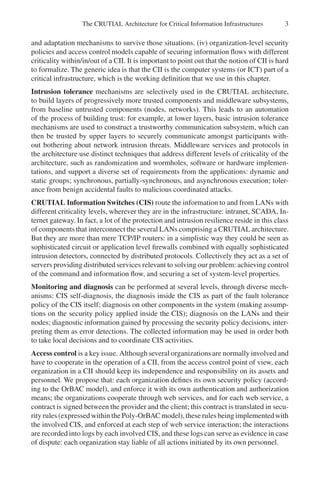
![4 P. Verı́ssimo et al.
2.1 Key Architecture Aspects
The CRUTIAL architecture, despite inspired by previous intrusion-tolerant reference
architectures like MAFTIA [22], extends them significantly to attend the specific chal-
lenges of the critical information infrastructure problem, for example, legacy, global
access control, and above all non-stop operation and resilience.
Given the severity of threats expected, some key components are built using archi-
tectural hybridization methods in order to achieve extremely high robustness:
– Trusted-trustworthy operation [22] is an architectural paradigm whereby compo-
nents prevent the occurrence of some failure modes by construction, so that their
resistance to faults and hackers can justifiably be trusted. In other words, some
special-purpose components are constructed in such a way that we can argue that
they are always secure, so that they can provide a small set of services useful to
support intrusion tolerance in the rest of the system. This concept is in line with,
but richer than, recent technological concepts like trusted computing or trusted plat-
form modules.
Another interesting aspect of this work is related with the mechanisms that we had
to develop, to preserve the large legacy composition of CII and keep changes to a min-
imum:
– Fully-transparent intrusion tolerance aims at preserving the complete illusion of
a standard system to legacy components. It is implemented by innovative replica
control and communication algorithms. Any SCADA and corporate network tech-
nologies stay unchanged, the only modification foreseen being the requirement of
IPsec at communication level, but this is considered a trend anyway [4].
Another innovative aspect of this work is our approach to achieve resilience. This
goes further to mere intrusion tolerance, and can be seen as a specialization of this
kind of architecture to critical infrastructures. The problem is addressed through two
paradigms:
– Proactive-resilience to achieve exhaustion-safety [20], and ensure perpetual, non-
stop operation despite the continuous production of faults and intrusions. This is not
a requirement of many intrusion-tolerant systems, but it is definitely of importance
for unattended operation, as is desired of the control part of CII.
– Trustworthiness monitoring to perform surveillance of the coverage stability of the
system, that is, of whether it is still performing inside the assumed fault envelope
or beyond assumptions made [2]. In the latter case, dependable adaptation mecha-
nisms are triggered to stabilize coverage and thus, the operational guarantees. This
is of extreme importance for situations of instability, either caused by accidental
events or malicious attacks, and we believe it can be a key to lower the risk of
cascading and/or escalating failures.
Finally, the desired control of the information flows is partly performed through ad-
vanced protection mechanisms:](https://image.slidesharecdn.com/5924331-250627081016-44167e97/85/Architecting-Dependable-Systems-V-1st-Edition-Paulo-Verssimo-19-320.jpg)
![The CRUTIAL Architecture for Critical Information Infrastructures 5
– the OrBAC firewall is an adaptation of the classical firewall rule-set operation to en-
force an organization-based access control model (OrBAC) [11] for implementing
global-level security policies. OrBAC allows the expression of security policy rules
as high level abstractions, and it is of importance for homogenizing the diverse se-
curity policies of organizations involved in a CII into one policy that controls the
global information flow.
In summary, the mechanisms and algorithms in place achieve system-level properties
of the following classes: trustworthiness or resistance to faults and intrusions (i.e., se-
curity and dependability); timeliness, in the sense of meeting timing constraints raised
by real world control and supervision; coverage stability, to ensure that variation or
degradation of assumptions remains within a bounded envelope; dependable adaptabil-
ity, to achieve predictability in uncertain conditions; resilience, read as correctness and
continuity of service even beyond assumptions made.
2.2 Main Building Blocks
The overall picture of a CRUTIAL system, shown in Figure 1, was detailed in [23].
C I S
W A N
C o r p o r a t e
N e t w o r k
S u b s t a t i o n B
C I S
C I S
S t a t i o n
N e t w o r k
P
P
S i t e
S i t e
S i t e
S i t e
C 1
S i t e
P L C
C I S
P L C
C o n t r o l
N e t w o r k
I n t e r n e t
C I S
C I S
C 2
H i s t o r i a n
S u b s t a t i o n A
S u b s t a t i o n C
H i s t o r i a n N e t w o r k
P r o c e s s N e t w o r k
U t i l i t y N e t w o r k
Fig. 1. CRUTIAL overall architecture (WAN-of-LANs connected by CIS)
We view the system as a WAN-of-LANs. There is a global interconnection network,
the WAN, that switches packets through generic devices that we call CRUTIAL Infor-
mation Switches (CIS), which in a simplistic way could be seen as sophisticated circuit
or application level firewalls combined with equally sophisticated intrusion detectors,
connected by distributed protocols. The WAN is a logical entity operated by the CII
operator companies, which may or may not use parts of public network as physical
support. A LAN is a logical unit that may or may not have physical reality (e.g., LAN
segments vs. Virtual LANs (VLANs)). More than one LAN can be connected by the](https://image.slidesharecdn.com/5924331-250627081016-44167e97/85/Architecting-Dependable-Systems-V-1st-Edition-Paulo-Verssimo-20-320.jpg)
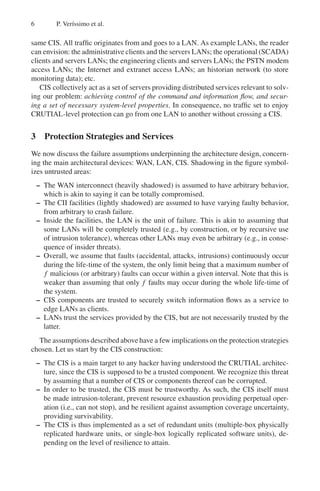
![The CRUTIAL Architecture for Critical Information Infrastructures 7
– Given the nature of malicious faults, which can be made common-mode, CIS con-
struction and or reconfiguration may be based on diversity techniques (ex. n-version
programming, obfuscation, etc.).
– The CIS also has proactive recovery mechanisms, so that each component is peri-
odically rejuvenated in such a way that if it suffered an intrusion, then the intrusion
is no longer present after the rejuvenation process.
– The CIS is further monitored by special run-time trustworthiness monitoring mech-
anisms, which make sophisticated sanity checks. Reactive recovery may for exam-
ple be triggered immediately an successful attack or failure is detected. Adaptation
mechanisms may also be parameterized by these monitors.
H u m a n O p e r a t o r
A t t a c k e r
S t a t i o n C o m p u t e r
N o n - I n T o l C I S
( a ) N o n - i n t r u s i o n - t o l e r a n t C I S ( b ) I n t r u s i o n - t o l e r a n t C I S
C o n t r o l N e t w o r k
n o r m a l t r a f f i c
u n a u t h o r i z e d
t r a f f i c
u n a u t h o r i z e d
t r a f f i c ! !
H u m a n O p e r a t o r
S t a t i o n C o m p u t e r
I n t r u s i o n - T o l e r a n t C I S
p h y s i c a l o r l o g i c a l r e p l i c a t i o n C o n t r o l N e t w o r k
n o r m a l t r a f f i c
n o r m a l
t r a f f i c
u n a u t h o r i z e d
t r a f f i c
A t t a c k e r
Fig. 2. Building trust in CRUTIAL (CIS level)
As exemplified in Figure 2a, a simplex (i.e., non intrusion-tolerant) CIS, once at-
tacked, becomes under the control of the attacker and can fail. In the figure, attack
traffic will go through the compromised CIS and hit the station computer and control
networks in the CII. On the other hand, an intrusion-tolerant CIS (Figure 2b) despite
corruption of one or more components, will continue providing correct service, as long
as not more than a quorum f of component failures occur. CIS can be physically or log-
ically replicated, examples of this incremental intrusion tolerance strategy are discussed
in [1]. The figure shows a triple with a corrupted replica (f = 1): despite attacked by
unauthorized traffic, voting between all replicas discards these messages, only letting
normal traffic through to the station computer.
Let us look at the services running in or among CIS:
– The local services implemented on the CIS servers enjoy the CIS intrusion tol-
erance to secure the desired properties in the presence of malicious traffic and/or
commands.
– The distributed services implemented on sets of CIS servers are subject to possibly
Byzantine attacks. In consequence, cooperating CIS must be interconnected with
intrusion-tolerant protocols, in order to correctly implement the desired services.
Consider that the CIS boxes in the next figures represent intrusion-tolerant logical
CIS. That is, to any services running locally on top of a logical CIS, the latter appears as
being fail-controlled, in a good example of recursive use of intrusion-tolerance featured
by this architecture. As exemplified in Figure 3a, services running on an intrusion-
tolerant CIS are trusted to run correctly, despite faults or attacks. As such, these services
are trusted-trustworthy, that is, trusted because they are trustworthy.](https://image.slidesharecdn.com/5924331-250627081016-44167e97/85/Architecting-Dependable-Systems-V-1st-Edition-Paulo-Verssimo-22-320.jpg)

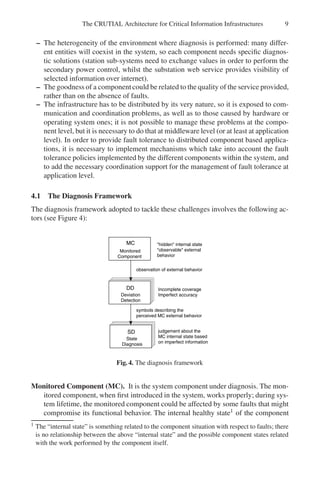
![10 P. Verı́ssimo et al.
is therefore “hidden”, whilst the external behavior is “observable”. Since the same
observed incorrect behavior could be caused by different faults, it is an ambiguous
indicator of the healthy internal health state of the component itself.
Deviation Detection (DD). It is the entity introduced in the system in order to observe
the monitored component external behavior and to judge whether it is suitable or
not. Unsuitable component behavior could be the result of the manifestation of an
internal or external fault affecting the monitored component or it could be deter-
mined by a change in the requirements of the application that is using the compo-
nent monitored services. In the literature on fault tolerance, a wide variety of error
detection mechanisms are available, which are classified in different categories ac-
cording to several criteria, among which the type of checks they perform, the im-
plementation support (hw or sw), the system components they are tailored to, the
applicability time (on-line or off-line) [19]. The deviation detection mechanism has
indeed incomplete coverage and imperfect accuracy, so it can raise false positives
(when it detects an inexistent deviation) and false negatives (when it does not detect
an existent deviation). In critical systems both false positives and false negatives are
undesired: false positives led to an early depletion of system resources, while false
negatives drastically decrease the system dependability.
State Diagnosis (SD). Basing on information coming from the deviation detection me-
chanism, the state diagnosis mechanism has to guess the internal state of the com-
ponent. Deviation detection information is an imperfect judgment describing the
instantaneous external behavior of the monitored component; the state diagnosis
mechanism has to trace the monitored component deviations over time in order to
decide whether the monitored component services continue to be beneficial or not
for the rest of the system, deviations notwithstanding.
The diagnosis framework requires two information flows:
– MC↔DD: the deviation detection mechanism has to observe the monitored com-
ponent.
– DD↔SD: the state diagnosis mechanism has to collect deviation detections per-
formed by the deviation detection mechanism.
Each of the above information flows could be managed following a proactive or a re-
active schema: in the proactive schema, the entity interested in fresh information has to
ask for it, whilst in the reactive schema the entity that generates information has to send
it to the entity interested in it. More interaction patterns can be found in [17].
The above solutions have different balances in terms of QoS vs. cost of the data fed
to the SD mechanism: continuous monitoring is very costly and probably too aggressive
in terms of the overhead it induces on the system; buffered asynchronous monitoring
is cheaper then the continuous monitoring for the interaction cost, but requires storing
capabilities in the DD mechanism and negatively affect the promptness of the SD; the
failure triggered synchronous monitoring combines the advantages of the continuous
monitoring (timeliness of the input data and no need for storage) and of the buffered
asynchronous monitoring (reduction in communication cost), but can be impaired by
omission faults in the DD.](https://image.slidesharecdn.com/5924331-250627081016-44167e97/85/Architecting-Dependable-Systems-V-1st-Edition-Paulo-Verssimo-25-320.jpg)
![The CRUTIAL Architecture for Critical Information Infrastructures 11
The traditional diagnostic problem is the identification of failed components in a
usually large set of homogeneous ones; fine grained components are the target of diag-
nosis, therefore, one-shot diagnosis of a collected syndrome2 is performed. Literature
shows that many over-time diagnostic mechanisms are available; each approach can be
mapped on the schema presented earlier and described involving only one component
and its deviation detection mechanisms. Two approaches are relevant:
Heuristic diagnosis. Heuristics are typically simple mechanisms suggested by intu-
itive reasoning and then validated by experiments or models. Most heuristic diag-
nosis solution are based on a count-and-threshold approach [14], as exemplified
by alpha-count [3] a heuristic designed to discriminate whether a monitored com-
ponent is affected by a transient fault (the component is healthy but is temporally
behaving bad) or by a permanent fault (the component is physically damaged and
need maintenance). The idea behind the alpha-count heuristic consists in counting
error signals collected over time, raising an alarm when the counter passes a prede-
fine threshold. When non-error signals are collected, the counter is decreased using
a decreasing factor. Suppose J(t) is a Boolean error signal coming from the devia-
tion detection mechanism at time t (“0” means no-error detected, “1” means error
detected) and suppose that K is the internal parameter that decreases the counter
value when a “no-error” signal is collected; the alpha counter α(t) is formally de-
fined as follow:
α(0) = 0
α(t) =
α(t −1)·K if J(t) = 0
α(t −1)+1 if J(t) = 1
(0 ≤ K ≤ 1)
Every time the counter is evaluated, it is also compared with a predefined threshold
value αt in order to discriminate if an alarm has to be raised (α(t) ≥ αt) or not
(α(t) αt). Extended analyzes about parameter tuning are available in [3] while
applications and variants are described in [2] [18].
Probabilistic diagnosis. Probabilistic diagnosis mechanisms (e.g. [6] based on HMM
- Hidden Markov Models and [16] based on Bayesian inference) are tailored to
evaluate the probabilities of the monitored component being in each of the “inter-
nal” state envisioned in the fault model, based on symbols coming from the devi-
ation detection mechanism. Probabilistic diagnostic mechanisms compute a state
occupancy probability vector f(t) at time t, using the symbols coming from the
deviation detection mechanism at time t and the state occupancy probability vector
f(t −1) at time t −1. The idea behind probabilistic diagnosis is to use the Bayesian
inference. Suppose to have a conjecture x on which we are uncertain (we believe
in x being true with probability p(x)); we aim to update our belief in x when some
new, relevant evidence is observed. Both evidence and conjecture are described as
events, that is, subsets of the set of all the possible outcomes of some experiment.
Using the Bayes’ theorem we can write that in general:
p(x|evidence)· p(evidence) = p(evidence|x)· p(x)
2 A syndrome is a vector of Boolean deviation detection results.](https://image.slidesharecdn.com/5924331-250627081016-44167e97/85/Architecting-Dependable-Systems-V-1st-Edition-Paulo-Verssimo-26-320.jpg)
![12 P. Verı́ssimo et al.
Interpreting the left-most probability in the above equation as the “posterior” proba-
bility of conjecture x (taking into account the observed evidence) and the right-most
probability as the “prior” probability of conjecture x, we can write
pposterior(x|evidence) =
pprior(x)· p(evidence|x)
p(evidence)
Given a set C of mutually exclusive conjectures such that their union has proba-
bility 1 (e.g. healthy states of a monitored component), the above formula allows
us to update the posterior probability of conjecture x given some evidence (e.g. the
outcome of deviation detection) using the following formula:
pposterior(x|evidence) =
pprior(x)· p(evidence|x)
∑cong∈C pprior(cong)· p(evidence|cong)
Both approaches solve the problem with the same computational cost, but diagnosis
based on HMM accounts for higher modularity and relies on a richer framework to
solve diagnostic problems (e.g., helps in case of incomplete information on the involved
parameters).
Diagnosis activity has to be performed at different granularity levels (Fault Replace-
ment Unit), depending on the controllability of control on the monitored component
(e.g., when dealing with COTS and legacy subsystems) and on the cost/efficacy ratio
of the detection/diagnosis/reconfiguration operations. On one side, fine grained diagno-
sis is very helpful since it allows replacement of smaller parts of the system, avoiding
wasting still useful subparts of the components under diagnosis. However, fine grained
diagnosis incurs in higher costs from the point of view of setting up diagnosis activities.
Opposite trends are instead shown by a coarse grained approach.
When diagnosis needs to be performed in a large system it is not practical to have a
centralized SD entity that has to gather and analyze all the deviation detections in order
to diagnose the system; this kind of centralized state diagnosis should be ultra-reliable
and communication links to all the parts of the system should be guaranteed. Therefore,
methods for distributed diagnosis are mandatory in which every system node decides
independently about the system (e.g. which are the healthy nodes and which the faulty
ones).
Considering a distributed system comprised by completely connected nodes, the Hy-
brid Fault-Effect Model [28] can be assumed, so that all fault classification is based on
a local classification of fault-effects (to the extent permitted by the deviation detection
mechanism of the sub-system itself) and on a global classification, thus developing a
global opinion on the fault-effect. Diagnosis is thus performed using a two-phase ap-
proach on a concurrent, on-line and continual basis:
1. Local detection and diagnosis, aiming to diagnose the sub-system itself.
2. Global information collection and global diagnosis, obtained through exchange of
local diagnosis. Since each sub-system may have a different perception of the errors
observed on the remote sub-systems, each node has some private values (the results
of private diagnosis on remote sub-systems) and the goal is to ensure consistent
information exchange and agreement against Byzantine behavior. An agreement
(or consensus) algorithm is thus needed in order to solve the problem.](https://image.slidesharecdn.com/5924331-250627081016-44167e97/85/Architecting-Dependable-Systems-V-1st-Edition-Paulo-Verssimo-27-320.jpg)
![The CRUTIAL Architecture for Critical Information Infrastructures 13
In the general case, the necessary conditions to achieve consensus in spite of up to f
arbitrarily faulty nodes are:
– at least 3f +1 nodes in the system.
– at least f +1 rounds of message exchange.
Under the assumption of authenticated messages [8], which can be copied and for-
warded but not altered without detection, the condition on the minimal number of nodes
can be relaxed to f +2.
4.2 Diagnosis in CRUTIAL
The CRUTIAL infrastructure is organized as a WAN-of-LANs (see Section 2.2), where
each LAN is connected to the WAN by a CIS. Given that the computers inside the
LANs cannot be modified/updated, all the diagnosis activity has to be performed inside
the CIS. The following diagnosis scenarios arise:
– CIS self-diagnosis (local view): CIS monitors both itself (e.g. to diagnose hardware
or software faults) and its LAN (e.g. to “measure” its level of trustworthiness).
– CIS distributed diagnosis (global view): CISes construct a common view about
the “state” of a certain CIS in the infrastructure (e.g. related to the liveness and
trustworthiness of a specific CIS)
CIS Self-Diagnosis. From a local viewpoint the CIS is a sophisticated application level
firewall (combined with equally sophisticated intrusion detectors) which is required to:
– be intrusion-tolerant;
– prevent resource exhaustion providing perpetual operation;
– be resilient against fault assumption coverage uncertainty providing survivability.
In order to comply with the above requirements, the CIS has a hybrid architecture and
is replicated (with diversity) in n replicas. Each CIS replica is built using a synchronous
and secure local wormhole and an asynchronous and insecure payload.
Two monitoring/failure detection scenarios arise:
1. internal monitoring: monitoring performed inside a single replica, trying to detect
local failures;
2. external monitoring: monitoring performed on the perceived behavior of the other
replicas.
The internal monitoring has to be performed on the following components/services (so
far, components/services that need to be monitored were not definitely identified):
– Hardware components (e.g. network interfaces, processing units, memory mod-
ules...) which are supporting the replica. The monitoring activity on these com-
ponents makes sense only when physical replication is used; in case of logical
replication, these components need to be monitored in the host system running
the replicas.](https://image.slidesharecdn.com/5924331-250627081016-44167e97/85/Architecting-Dependable-Systems-V-1st-Edition-Paulo-Verssimo-28-320.jpg)
![The CRUTIAL Architecture for Critical Information Infrastructures 15
information flow there is no simple comparison rule check that can be performed, to
catch on the fly a mischievous partner. On the other hand, if a CIS becomes compro-
mised, internal redundancy and resilient architecture notwithstanding, then necessarily
the basic hypothesis on the fault occurrence has been broken: more than f replicas are
out of order together. Of course, this is the catastrophic case, whose probability has to
be lowered down to a target level by choosing proper redundancy figures. However, a
local catastrophe (regarding a single LAN controlled by a compromised CIS) not nec-
essarily should imply the downing of the entire system. In fact, on the WAN side, all
CISes attempt to maintain a common view of two parametric descriptors its partners’
health: Liveness and Trustworthiness.
Liveness is checked in two ways: i) passively, by monitoring normal network traffic
from the target; ii) if the former is not frequent enough, exert a form of resilient ping, by
means of a simple challenge/response protocol. Trustworthiness is built up by checking
the formal correctness of the messages coming from the target, as well from any access
violation detected by the Protection Service.
5 Access Control for Critical Information Infrastructures
Because Critical Information Infrastructures (CII) become more and more complex and
accessible via the Internet, they are more and more vulnerable to security threats. More-
over, due to the interdependencies between CIIs, simple failures can have dramatic
consequences. In this context, security issues in CIIs become obvious and serious. Sev-
eral works was dedicated to study the causes; the results have shown that one of the
most common problems is the lack of specific security policies, in particular in modern
SCADA environments [12].
Basically, a security policy is defined by the Common Criteria as the set of laws,
rules, and practices that regulate how an organization manages, protects, and dis-
tributes sensitive information [15]. In this respect, a security policy is specified through:
the security objectives that must be satisfied, e.g., “classified information must not be
disclosed to a competing organization”; and the rules expressing how the system may
evolve in a secure way, e.g., “the owner of an information is allowed to grant a read
access right on its data to other organizations”.
Nevertheless, by itself, the security policy does not guarantee a secure and correct
functioning of the system. The security policy can indeed be badly designed or in-
tentionally / accidentally violated. Consequently, it is important to express the policy
according to a security model; a model helps to: abstract the policy and handle its com-
plexity; represent the secure states of a system (i.e., states that satisfies the security
objectives) as well as the way in which the system may evolve; verify the consistency
of the security policy and detect the possible conflicting situations; etc.
Addressing these issues, this work progressively derives an access control model, a
secure architecture and applies our approach to secure CIIs. To do so, we first identify
the security requirements of a CII and we confront them to existing access control
models. Note that even if we take our examples from electric power grid, the same
approach and results can be applied to any kind of CII.](https://image.slidesharecdn.com/5924331-250627081016-44167e97/85/Architecting-Dependable-Systems-V-1st-Edition-Paulo-Verssimo-30-320.jpg)
![16 P. Verı́ssimo et al.
Globally, a CII can be seen as a WAN connecting several organizations involving
different actors and stakeholders (e.g., power generation companies, substations, en-
ergy authorities, maintenance service providers, transmission and distribution system
operators) and various LANs. LANs are composed of one or more logical and phys-
ical systems and are interconnected through specific Switches, called CIS (CRUTIAL
Information Switches). The general architecture is presented in Section 2.
In this respect, we can identify some security-related requirements such as:
1. Secure cooperation between different organizations, possibly mutually suspicious,
with different features, functioning rules and policies.
2. Loosely coupled organizations: each organization controls its own security policy,
applications, etc., while respecting the global functioning of the whole system. In
other words, we need a global security policy that manages the communication
between partner organizations while keeping each CII responsible for its own assets
and users.
3. Coherence and consistency: as no SCADA system operates in isolation, the global
as well as local security policies should be compatible.
4. Decentralization: it is desirable that the enforcement and administration of the se-
curity policies be decentralized. Actually, a centralized approach is not interesting
since CIIs involve the cooperation between independent organizations. Inversely,
handling the collaboration between the organization subsystems while keeping
some local self-determination seems more interesting.
5. Heterogeneity: the different CII organizations have their own structure, services,
OS, and local objects. These entities’ structures may be different from an organiza-
tion to another.
6. Granularity vs. scalability: on the one hand, security rules must be extensible in
size, structure, and number of organizations; on the other hand, internal authen-
tication as well as local access controls should be managed by each organization
separately.
7. Fine-grained access control: access decisions should take the context (e.g., specific
situations, time and location constraints) into account. Moreover, as the context
may change often and as certain reactivity is required in these systems, organiza-
tions should support dynamic access rights.
8. Users-friendliness and easiness of rules administration: as the global system links
several organizations geographically distributed and as it handles a large amount
of information and a big number of user, the access right management should be
sufficiently user-friendly to manage this complexity without introducing errors.
9. Remote accesses: as organizations control large installations, the security policy
should define if and how outsiders and users from a partner organization can con-
nect to the automation system and to resources belonging to each organization. For
example, it is important to define how vendors can access the system remotely for
off-site maintenance and product upgrades, but also how other organizations par-
ticipating in the CII can access local resources.
10. Compliance with the specific regulation: for example, in the United-States, NERC
1200 [5] specifies requirements for cyber-security related to electric utilities.
11. Confidentiality, integrity and availability: contrarily to other systems where mostly
confidentiality (military systems), integrity (financial systems) or availability is](https://image.slidesharecdn.com/5924331-250627081016-44167e97/85/Architecting-Dependable-Systems-V-1st-Edition-Paulo-Verssimo-31-320.jpg)
![The CRUTIAL Architecture for Critical Information Infrastructures 17
needed, in the organization we often need these three properties (confidentiality
of each organization’s data, e.g., invitation of tenders, but also integrity and avail-
ability of data such as the voltage/frequency measurements).
12. Enforcement of permissions, explicit interdictions as well as obligation rules. In
fact, explicit prohibitions can be particularly useful as we have decentralized poli-
cies where each administrator does not have details about the other parts of the
system. Moreover, explicit prohibitions can also specify exceptions or limits the
propagation of permissions in case of hierarchies. Similarly, obligations can be
useful to impose some internal / external, manual / automatic actions that should be
carried out by users or automatically by the system itself.
13. The security policy must be vendor- and manufacturer-independent. As technolo-
gies change and new acquisitions occur, the policy must remain effective. When
vendor- or technology-specific statements are used, the maintenance burden for the
policy increases. Then, the policy would be changed any time there is a new pur-
chase or an advance in technology. If the security policy is not updated, it becomes
obsolete, which would not be acceptable in such systems.
14. Audit and assessment: the security policy will define the logging requirements such
as what will be logged, when, where, etc. In particular, an audit will determine if
the protections which are detailed in the policy are being correctly put in practice
on the system; it also checks if the contracts / agreements established by the partner
organizations are well-respected.
To satisfy these requirements, we propose a secure architecture where each orga-
nization defines its own security policy and enforces it into its CISs (see Section 2).
CISs are thus responsible for checking if local actions are in accordance with internal
security policies, but also if inter-organization flows are done according to the global
policy and to the contracts established by partner organization. Finally, CISs keep log
files as evidence in case of abuse or conflict. In this respect, the first question that arises
is how the security policies will be specified and what security model will be adapted
to organizations?
An analysis of classical access control policies and models shows that unfortunately,
none of these policies and models satisfies the CIIs security-related requirements. For
instance, HRU represents the relationships between the subjects, the objects and the ac-
tions by a matrix M [9]. M(s,o) represents the action that s is allowed to carry out on o.
It is thus necessary to enumerate all the triples (s,o,a) that correspond to permissions
defined by the policy, which is very complex in large systems. Moreover, when new en-
tities are added to or removed from the system, it is necessary to update the policy, still
adding to the complexity. Consequently, models associated to discretionary access con-
trol policies (including HRU) are not capable of managing huge, multi-organizational
and decentralized systems such as CIIs.
Role Based-Access Control (RBAC) is more flexible: roles are assigned to users,
permissions are assigned to roles and users acquire permissions by playing roles [7].
Even if RBAC is suitable for a large range of organizations, it does not cover all the
requirements of a CII, in particular it does not define how users of an organization can
play roles in another organization.](https://image.slidesharecdn.com/5924331-250627081016-44167e97/85/Architecting-Dependable-Systems-V-1st-Edition-Paulo-Verssimo-32-320.jpg)
![18 P. Verı́ssimo et al.
5.1 OrBAC
In [11] we have defined the OrBAC (Organization-based Access Control) model as an
extension of RBAC that details permissions while remaining implementation indepen-
dent. Our first goal was to express the security policy with abstract entities only, and
thus to separate the representation of the security policy from its implementation. In-
deed, OrBAC is based on roles as the abstraction of users (like in RBAC [7]), views
as the abstraction of objects (like in VBAC [24]), and activities as the abstraction of
actions (like in TBAC [21]).
Actually, in OrBAC, an organization is a structured group of active entities, in which
subjects play specific roles; an activity is a group of one or more actions; a view is a
group of one or more objects; and a context is a specific situation that conditions the
validity of a rule.
As a user can play several roles in several organizations, the Role entity is used
to structure the link between the subjects and the organizations. In fact, contrarily to
RBAC that considers a binary relation between roles and subjects, OrBAC consider the
ternary relationship Empower (org, r, s): it means that org employs subject s in role r. In
the same way, the objects that satisfy a common property in a certain organization are
specified through views (the Use(org, view, object) relationship), and activities are used
to abstract actions in organizations (the Consider (org, activity, action) relationship)
(Figure 5).
Now, once the relationships between the different system’ entities are defined, we can
specify the security rules. Actually, an OrBAC security rules have the Permission (org,
r, v, a, c) form: in the context c, organization org grants role r the permission to perform
activity a on view v. Obligation and Prohibition are defined similarly (Obligation (org;
r; v; a; c) and Prohibition (org, r, v, a, c)).
Actually, two security levels can be distinguished in OrBAC (Figure 5):
– Abstract level: the security administrator defines security rules through abstract en-
tities (roles, activities, views) without worrying about how each organization im-
plements these entities.
– Concrete level: when a user requests an access, concrete authorizations are granted
(or not) to him according to the concerned rules, the organization, the played role,
the instantiated view / activity, and the current parameters (e.g., the context).
The derivation of permissions (i.e., runtime instantiation of security rules) can be
formally expressed as indicated in (Figure 5):
∀org ∈ Organization,∀s ∈ Subject,∀α ∈ Action,∀o ∈ Object, ∀r ∈ Role, ∀a ∈ Activity,
∀v ∈ View, ∀c ∈ Context
Permission(org, r, v, a, c) ∧ // a security rule in its abstract form
Empower(org, s, r) ∧ // in org, the role r is played by a subject s
Consider(org, α, a) ∧ // in org, the activity a correspond to an action α
Use(org, o, v) ∧ // in org, the view w corresponds to an object o
Hold(org, s, α, o, c) // in org, the context c is true for s, α and o
→ is-permitted(s, α, o) // runtime decision allowing s carrying out α on o
This rule means: if in a certain organization, a security rule specifies that “role r can
carry out the activity a on the v when the context c is True”; if “r is assigned to subject](https://image.slidesharecdn.com/5924331-250627081016-44167e97/85/Architecting-Dependable-Systems-V-1st-Edition-Paulo-Verssimo-33-320.jpg)
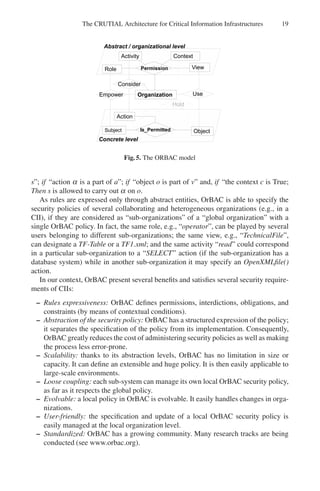
![20 P. Verı́ssimo et al.
However, OrBAC is centralized and does not handle collaborations between orga-
nizations, while these aspects are very important in CIIs. In fact, as OrBAC security
rules have the Permission(org, r, v, a, c) form, it is not possible to represent rules that
involve several independent organizations, or even, autonomous sub-organizations of
a particular collaborative system. Moreover, it is impossible (for the same reason) to
associate permissions to users belonging to other partner-organizations. As a result, if
we can assume that OrBAC provides a framework for expressing the security policies
of several organizations, it is unfortunately only adapted to centralized structures and
does not cover the distribution, collaboration and interoperability needs of current CIIs.
Moreover, the enforcement of the policy to access control mechanisms is not treated
in OrBAC. It is thus necessary to describe suitable architecture and implementation of
the studied system’s security.
To cover these limitations, we suggest enhancing OrBAC with new concepts and
calling on some mechanisms of the Web Services (WS) technology [10]. In fact, WS
is a set of technologies that provide platform-independent protocols and standards used
for exchanging heterogeneous interoperable data services. Software applications writ-
ten in various programming languages and running on various platforms can use WS to
exchange data over computer networks in a manner similar to inter-process communica-
tion on a single computer. WS also provide a common infrastructure and services (e.g.,
middleware) for data access, integration, provisioning, cataloging and security. These
functionalities are made possible through the use of open standards, such as: XML for
exchanging heterogeneous data in a common information format [26]; SOAP acts as a
data transport mechanism to send data between applications in one or several operating
systems [25]; WSDL is used to describe the services that an organization (e.g., a CII)
offers and to provide a way for individuals and other organizations to access those ser-
vices [27]; UDDI is an XML-based registry/directory for businesses worldwide, which
enables businesses to list themselves and their services on the Internet and discover
each other [13].
Web services (WS) have several benefits that could be interesting in our context:
– Interoperability and heterogeneity: WS support data exchanges between different
platforms.
– Resources sharing: WS are adapted to applications where organizations share their
resources.
– Standardized mechanisms: WS use open protocols and standards (e.g., HTTP,
XML).
– Easiness: a small amount of code and resources is necessary to develop and carry
out a WS.
– Compatibility with OrBAC: it is easy to couple web services with OrBAC.
5.2 PolyOrBAC
At this stage, we have demonstrated that OrBAC as well as WS could be suitable for
CIIs. The question that takes place is: how adapting OrBAC as well as WS mechanisms
to specify and enforce secure collaboration between CIIs. To answer this question,](https://image.slidesharecdn.com/5924331-250627081016-44167e97/85/Architecting-Dependable-Systems-V-1st-Edition-Paulo-Verssimo-35-320.jpg)
![The CRUTIAL Architecture for Critical Information Infrastructures 21
we have defined the PolyOrBAC [10], a global access control model that can be per-
fectly applied to CIIs.
Actually, PolyOrBAC distinguishes two phases:
First phase publication and negotiation of collaboration rules as well as the corre-
sponding access control rules. First, each organization determines which resources it
will offer to external partners. Web services are then developed on application servers,
and referenced on the Web Interface to be accessible to external users.
Second, when an organization publishes its WS at the UDDI registry, the other or-
ganizations can contact it to express their wish to use the WS. To highlight the Poly-
OrBAC concepts, let us take a simple example where organization B offers WS1, and
organization A is interested in using WS1 (Figure 6).
Third, A and B negotiate and come to an agreement concerning the use of WS1. Then,
A and B establish a contract and jointly define security rules concerning the access
to WS1. These security rules are registered – according to an OrBAC format – in a
database (connected to the A and B’s CIS) containing the Security policy. For instance,
if the agreement between A and B is “users from A have the permission to consult B’s
measurements in the emergency context”, B should:
– have (or create) a rule that grants the permission to a certain role (e.g., Operator)
to consult its measurements: Permission(B, Operator, Measurements, Consulting,
Emergency); note that every user playing the Operator role will have this permission
– create a “virtual user” PartnerA that represents A for its use of WS1
– add the Empower(B, PartnerA, Operator) association to its rule base.
In parallel, A creates locally a “virtual object” WS1 image which represents WS1, and
adds a rule in its OrBAC base to define which of A’s roles can invoke WS1 image to use
WS1.
Second phase: runtime access to remote services.
Let us first precise that we use an AAA (Authentication, Authorization and Account-
ing) architecture: we separate authentication from authorization; we distinguish access
control decision from permissions enforcement; and we keep access logs in CISs. Ba-
sically, if a user from A (let us note it Alice) wants to carry out an activity, she is first
authenticated by A. Then, protection mechanisms of A check if the OrBAC security
policy (of A) allows this activity. We suppose that this activity contains local as well
as external accesses (e.g., invocation of B’s WS1). Local accesses should be controlled
according to A’s policy, while the WS1’s invocation is both controlled by A’s policy (Al-
ice must play a role that is permitted to invoke WS1 image), and by B’s CIS, according
to the contract established between A and B. If both controls grant the invocation, the
execution of WS1 is executed under the control of B’s OrBAC policy (in B, PartnerA
plays role Operator that is permitted to consult measurements).
More precisely, when Alice is authenticated and authorized (by A’s policy) to in-
voke WS1, an XML-based authorization ticket “T1” is generated (based on the positive
decision) and granted to Alice.
T1 contains the access-related information such as: the virtual user played by Alice:
“PartnerA”; Alice’s organization: “A”; the contract ID; the requested service: “WS1”;
the invoked method, e.g., “Select”; and a timestamp to prevent replay attacks.](https://image.slidesharecdn.com/5924331-250627081016-44167e97/85/Architecting-Dependable-Systems-V-1st-Edition-Paulo-Verssimo-36-320.jpg)
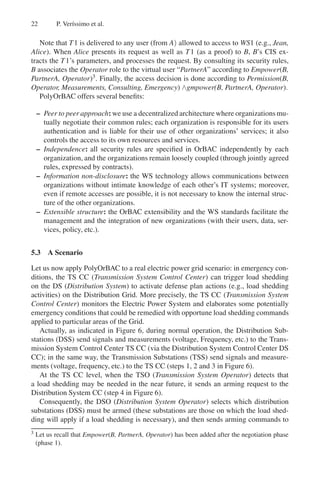
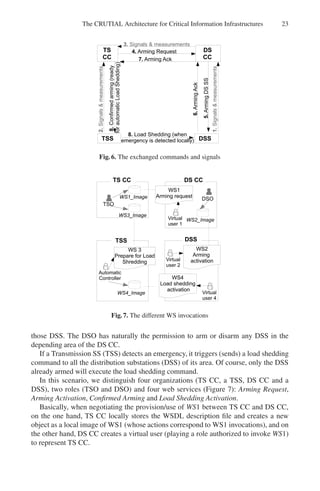
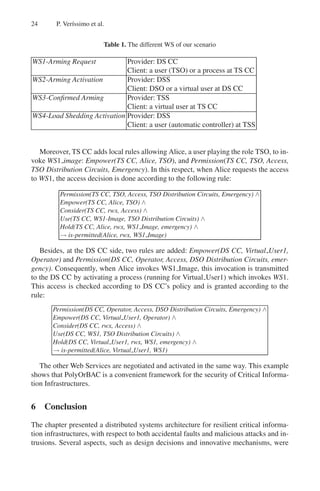
![A MIT to Mitigate Interdependencies between Critical Infrastructures 29
critical services. In this case the survivability of the system is not preserved only by
its internal components but also by the resources received by other external systems;
this resources cannot be furnished by the internal system components.
In the last years it was recognized that Large Complex Critical Infrastructures
(LCCIs) [1], are complex systems that suffer of major instability problem today re-
spect to the past. This problem is increasing today because the degree of connectivity
between LCCIs is also increasing.
2 The Interdependency Problem
The interdependency problem is considered by the emergency management institu-
tions and communities, and its significance has increased since governments and
citizens became aware that services furnished by power distribution networks, tele-
communication networks, transport infrastructures and other key resources are actu-
ally more critical, and these LCCIs are today more interconnected respect than in the
past. To maintain their style of living, modern societies are more dependent on their
critical infrastructures; but, ironically, the actual ICT advances do not reduce the
critical infrastructures instability problem. Some new types of emerging vulnerabili-
ties are producing a strong impact in the future emergency management practices and
in the social security strategies.
The need for protecting critical infrastructures becomes more important also as a
consequence of the so-called ‘cascading effect’, caused by mutual interdependencies
[1] of the networks. There are different causes and external conditions that contribute
to augment such type of interdependency. When we consider critical infrastructures,
we have to take into account that they are not simply ‘physical’ plants and networks.
In fact, they contain not only a physical layer, but are also made of ‘cyber’ compo-
nents and systems, and include human organisations that manage and supervise the
daily operations of the infrastructure.
2.1 Interdependencies in the Physical Layer
If we look at physical layer only, as the example of fig 1 for an electricity network, it
is possible to understand some “intrinsic” instability problems.
Fig. 1 shows a simple electrical transport network, as it is described in the IEEE
Transaction paper [2]. The basic elements in the network are:
o the “generators”, that are different types of power production plants
(Oil/Steam, Coal/Steam, Hydro, Nuclear etc.) and represent the points in
which energy is produced,
o the “loads” that represent the points in which power is consumed (by a city
distribution network, by an industry or by a railway energy substation),
o the “nodes” that represent the points where power flow coming from the
generators is dispatched to the loads,
o the “lines” that represent the electrical cables used to transport energy be-
tween different nodes .](https://image.slidesharecdn.com/5924331-250627081016-44167e97/85/Architecting-Dependable-Systems-V-1st-Edition-Paulo-Verssimo-44-320.jpg)
![30 C. Balducelli et al.
Fig. 1. A simple electrical transport network
Different portions of the network generally work at different voltage levels, and are
interfaced with “transformers”.
The stable working condition of such system may be easily explained in the same
way as the stability of a tandem bike on which more cyclists are pedalling[3].
Every cyclists on the bike have to pedal at the same frequency since all sprockets
are connected with same chain. Also in the electrical network all generators (turbines)
have to rotate at the same frequency to maintain constant (50 hertz) the electrical
power frequency.
If some cyclists are simply sitting on the bike and do not pedal they could be com-
pared to the loads of the electrical network; in fact they are points in which the energy
produced by the other cyclists is consumed. To keep constant the speed of the bike the
total force of the active cyclists (total generation) has to be the same as the total
power absorbed by the passive cyclists (total loads).
It could be noted that the chain between the cyclists may be slightly elastic; it
means that an angle difference may exist between the pedals positions of the different
cyclists. The same phenomena happens in the electrical network when a phase angle
exists between active and reactive generated power, and all the generators have to
work in such way to reduce as much as possible these phase angles differences. For
the bike system a great angle difference indicates that some cyclist pedals too slowly
and some other too fast. In the electrical transmission network the angle difference
indicates an insufficient power production in some part of the network and a surplus
of production in some other parts. In such situation, for the bike and for the network
system as well, some instability conditions could arise.
It is interesting to note that, in the previous condition, the instability level of the
tandem bike system increases much if the bike speed is low (bike oscillations can
arise), and, on the contrary, decreases when the speed of the bike increases.
In the same way, also the electrical network system results more vulnerable, due to
such instability problem, when the electrical production and consumption is low. The
Italian electrical black-out of September 2003, mainly determined by the too high](https://image.slidesharecdn.com/5924331-250627081016-44167e97/85/Architecting-Dependable-Systems-V-1st-Edition-Paulo-Verssimo-45-320.jpg)
![A MIT to Mitigate Interdependencies between Critical Infrastructures 31
power imported flow from foreign countries, happened during the night, the period in
which the internal energy production (and consumption) is low; in such occasion the
Italian energy operator (GRTN) said that the same black out may be avoided during
the day, when the production and consumption are higher.
From the above considerations we can learn the following lesson: to work in a safe
condition, whatever the considered system is, the system operator have to maintain its
parameters near the nominal working states.
But the electrical networks are not managed by a single operator; the electrical sys-
tem operators have no possibility to control in a single place the complete working
status of the network, because more portions of such network are distributed on dif-
ferent countries that could have different management strategies. In addition, the
recent globalisation of the energy markets makes more complex the management of
such type of interconnected networks.
Generally the electrical system operator of a certain nation have to decides or plan
the day before what generators (production plants) will be used the day after to satisfy
the internal energy consumption and the external requests. This is imposed by the fact
that it is not possible to execute rapid start-ups or shut-downs of the production plants.
Depending on the plant typologies these procedures may require long times (hours)
for the execution.
In the energy field new possibilities were recently introduced for distributed gen-
eration of renewable energy like solar energy or wind. But the power transmission
networks and their control and supervisory systems are not ready to manage these
new autonomous energy producers that introduce additional instability inside the
electrical system. In fact is not always possible to forecast with sufficient accuracy
where and when the weather conditions requested by the renewable energy production
plants will be available. This types of plants have a “degree of autonomy” that is not
always compatible with the need to maintain the whole system in a safe condition (far
from the instability zones).
The consequence of the serious incident, which originated in the North German
electrical grid during the night of 6 November 2006 was simply the European grid
separation in three large islands; but, during this contingency, Europe risked a very
large blackout, involving a lot of countries. One of the reasons of this incident was
attributed to voltage instabilities caused by the wind energy production plants, in-
stalled in the North of Germany by autonomous energy providers.
The free energy market imposes today also the necessity to sell and acquire energy
from different countries during some time periods that are determined by economical
reasons, but that do not take in account the systems instability constraints.
2.2 Interdependencies in the Cyber Layer
When we speak about Critical Infrastructure instabilities we have consider not only
faults that arise in the physical layer of the infrastructure but also anomalies that could
happen on the cyber and the organisational layers [4].
In the fig. 2 is illustrated a situation in which an interdependency problem occurs
between an electrical and a telecom infrastructure, caused by some loss of the services
that this two infrastructures exchange each other. Some substations of the electrical
infrastructure furnish the power (services 1 and 2) necessary for some telecom](https://image.slidesharecdn.com/5924331-250627081016-44167e97/85/Architecting-Dependable-Systems-V-1st-Edition-Paulo-Verssimo-46-320.jpg)
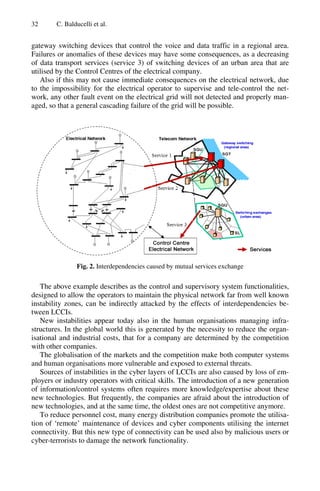
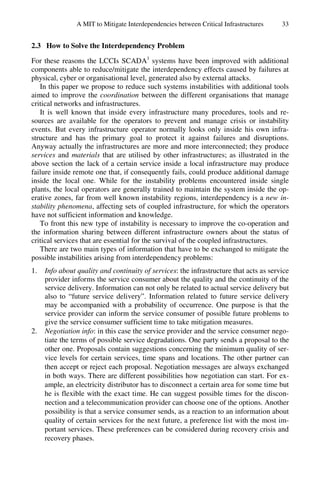
![34 C. Balducelli et al.
3 The MIT Technology
3.1 General Overview
The MIT Technology, we are going to present in this paragraph, has been proposed
inside the EU Integrated Project IRRIIS [5] which aims at protecting of critical
infrastructures (CIs) like energy supply or telecommunication system.
This project will provide a technological system named MIT (Middleware Im-
proved Technology) which is composed of a collection of software components that
facilitates IT-based communication between different infrastructures and different
infrastructure providers. By supporting recovery actions and increasing service
stability in case of critical situations, MIT components will substantially enhance the
security of large complex critical infrastructures. MIT system will be able to:
• Reduce the chance that failures spread (prevention),
• Limit cascading effect (mitigation),
• Improve situational awareness (prevention and response and recovery).
Prevention, by detecting and mitigating threats, is without any doubt the first and
the best way to avoid disasters or minimise their impact by accelerated reaction capa-
bilities. Mitigation will try to reduce the impact and extend of failures as soon as they
occur. Response after critical situation should be both automatic and manual.
Recovery is a very important topic to reduce failure/outage time and thus increase
security. Recovery actions shall be done as fast as possible and using an effective
order. This requires situational awareness of the availability of other infrastructure
capabilities and the status of one’s own. The Recovery functions of the MIT system
should give an estimation of time to return in stable phase.
There are a lot of dependencies and interdependencies also within some LCCIs.
For example, within Electricity LCCI, data transmission to and from control centre
needs communication and this, as it has been said, will be even more crucial in dis-
tributed generation. Anyway, prevention of failures caused by (inter)dependency
effects would benefit also from improved resilience of each LCCIs, i.e., reducing risk
of failures within an LCCI. To some extent, cross-sector technology and tools which
clearly provide other CI sectors with better resilience are subject for MIT as well,
while focus will be set on dependencies and interdependencies between different
infrastructures.
Moreover, MIT aims at providing a valuable solution; thus all existing tools and
processes which are implemented within an LCCI to reduce risk will be at the base for
further MIT to improve resilience.
3.2 MIT Architecture
The starting point to define an architecture for MIT System is the following picture:
The small box in the picture represents the MIT System installed in each LCCI.
Each MIT System is composed by the following components:
o Communication Components (light circles in Figure 3)
o Add-On Components (black circles in Figure 3)](https://image.slidesharecdn.com/5924331-250627081016-44167e97/85/Architecting-Dependable-Systems-V-1st-Edition-Paulo-Verssimo-49-320.jpg)
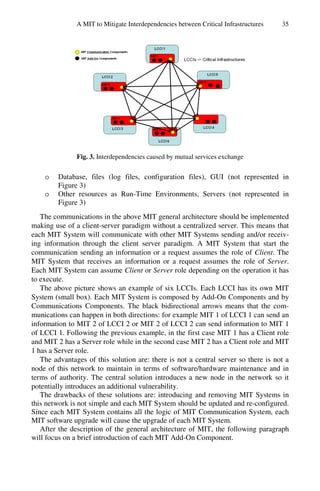
![36 C. Balducelli et al.
3.3 MIT Add-On Components
It has been already stated that MIT aims at reducing the risk of failures due to de-
pendency and interdependency, by preventing or at least by mitigating them and sup-
porting the recovery process. But what are the threats to be prevented or mitigated?
And what actions have to be taken to cope with them?
According to earlier studies [6][7], the most likely reasons for severe incidents are
extraordinary natural conditions (for example, earthquakes, floods or hurricanes),
malicious attacks, and human errors.
In effective mitigation against natural disasters, very often, the keyword is “col-
laboration”. Incidents of this kind lead very often to quite complex situations, where
most likely a failure storm, instead of one single failure, happens. Despite how good
recovery and continuity plans in place be, mutual support between critical infrastruc-
tures is always needed to take care of people’s safety and homeland security. So,
helpful add-on components should support consultation and co-ordinated actions
between neighbouring infrastructure systems for the establishment of effective mitiga-
tion measures, as well as early warning notification of coming threat, whenever
possible.
Against malicious attacks, which include both cyber attacks and malicious opera-
tion, add-on MIT components shall improve security by preventing or at least detect-
ing them as early as possible. Security weaknesses in one infrastructure decrease
security of all the dependent LCCIs, so it is both a dependability and dependency
issue. Of course, basic cyber security administration (like closing open ports) is not
task of MIT.
Against human errors, there is a need for supporting the operator with situational
awareness and emergency handling, especially about the state of neighbouring sys-
tems his own LCCI is dependent on and about consequences of these dependencies.
To sum up, the following general actions are needed to prevent or mitigate disrupt
of operation in home LCCI and neighbouring ones:
- PREVENT, if possible, the incident to avoid its impact on dependent infrastruc-
tures;
- PROVIDE EARLY WARNING of deteriorating system conditions to the opera-
tor, so that he can take corrective actions;
- DETECT AS EARLY AS POSSIBLE the incident and NOTIFY it to the de-
pendent infrastructures so that neighbouring operators can take pre-emptive ac-
tion to limit the cascading effect of disturbances;
- ESTIMATE the probability of disrupt of his own LCCI operation due to internal
causes and NOTIFY, if requested, to the dependent infrastructures;
- ASSESS THE own infrastructure RISK due to information about neighbouring
status so that operator can take pre-emptive action to limit the cascading effect
of disturbances;
- HANDLE THE EMERGENCY, if needed by negotiating co-ordinated actions;
- RECOVERY support/awareness.
The mentioned functionalities have been developed into particular components.
Figure 3 shows MIT Communication Components and MIT Add-On Components.](https://image.slidesharecdn.com/5924331-250627081016-44167e97/85/Architecting-Dependable-Systems-V-1st-Edition-Paulo-Verssimo-51-320.jpg)
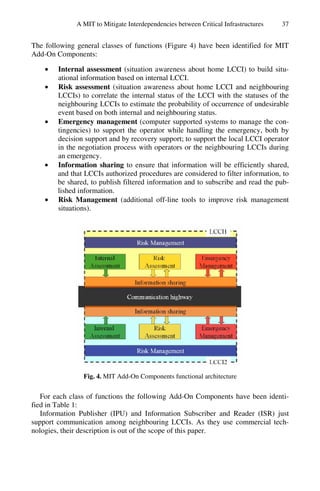
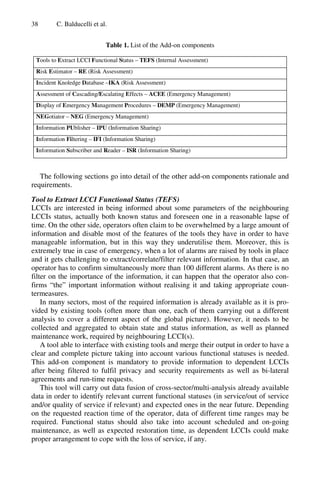
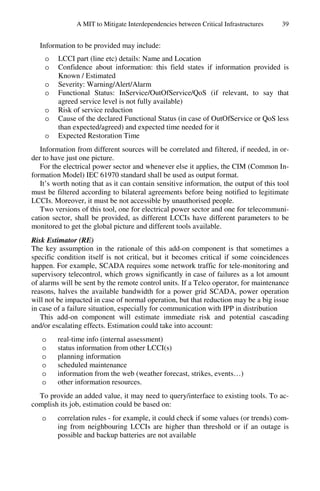








![Separation of concerns is a design concept [Dij82] that suggests that any com...](https://cdn.slidesharecdn.com/ss_thumbnails/272547621-250624182023-7f9053e3-thumbnail.jpg?width=640&height=640&fit=bounds)


