Indian Institute of Management
Ahmedabad
One Mission, Multiple Roads:
Aravind Eye Care System in 2009
How do we grow keeping at par with the best eye hospitals in the world,
yet keeping our mission? That is our challenge now.
– Dr. P. Namperumalsamy
The year 2008-2009 was one Aravind Eye Care System (AECS) could be proud of. AECS had
received the prestigious Bill & Melinda Gates Award for Global Health; for the first time this
award had been given to an organization not working in the realms of communicable
diseases or population control. AECS had also been acknowledged by the Clinton Global
Initiative in its Annual Meeting held in September 2008 when the former US President, Bill
Clinton, personally introduced AECS’s work in the field of Diabetic Retinopathy (DR).
Thought leaders like C.K. Prahalad had recognized its contribution in bringing out an
innovative and influential model to deliver quality eye care to the bottom of the pyramid in
his highly acclaimed book, The Fortune at the Bottom of the Pyramid1. The hospitals under the
Aravind Eye Care System had done 309,015 surgeries in all in 2008-09, the highest number in
its history. Of these, 162,809 were for free patients.
When the case writer revisited AECS in 2009, nearly six years after writing the first case on
it2, he found that much had happened besides sheer growth. Its legendary founder, Dr. G.
Venkataswamy (Dr. V) was no more (he passed away on July 7, 2006). The Pondicherry
hospital had become fully functional. A new research facility, Dr. G. Venkataswamy Eye
Research Institute had been commissioned on October 1, 2008. A new facility was about to
be finished in Madurai where the existing clinics, operating theatres and in-patient wards
would be shifted; the old building would be for out patients and administrative services. Its
manufacturing arm, Aurolab, had moved into a sparking new facility, in anticipation of
future growth. AECS had set up 31 Vision Centres and five Community Eye Clinics in
different parts of rural Tamil Nadu as a part of its outreach programme. It had also started
an initiative, in a limited way, called Aravind Managed Eye Care Services (AMECS) to
manage other hospitals without owning them.
1 Prahalad, C.K. (2004), The Fortune at the Bottom of the Pyramid: Eradicating Poverty through Profits. New Jersey:
Wharton Publishing.
2 Manikutty, S. and Vohra, N. (2004), “Aravind Eye Care System: Giving the Most Precious Gift”. Case material,
Indian Institute of Management, Ahmedabad, Case # BP0299.
Prepared by Prof. S. Manikutty, Indian Institute of Management, Ahmedabad as a basis for class
discussion. Cases are not designed to present illustrations of correct or incorrect handling of
administrative problems. The case writer wishes to place on record his gratitude to Dr.
Namperumalsamy, Dr. Natchiar, Mr. Thulasiraj, Dr. S. Aravind, Dr. Kim, Ms. Dhivya and Ms. Veni of
the Aravind Eye Care System for their enthusiasm and cooperation that made this case possible.
Cases of the Indian Institute of Management, Ahmedabad, are prepared as a basis for classroom
discussion. They are not designed to present illustrations of either correct or incorrect handling of
administrative problems.
© 2010 by Indian Institute of Management, Ahmedabad.
IIMA/BP0333
I
N
S
P
E
C
T
I
O
N
Initiative in its Annual Meeting held in September 2008 when
I
N
S
P
E
C
T
I
O
N
Initiative in its Annual Meeting held in September 2008 when
’s work in the field of Diabetic Retinopathy
I
N
S
P
E
C
T
I
O
N
’s work in the field of Diabetic Retinopathy
had recognized its contribution
I
N
S
P
E
C
T
I
O
N
had recognized its contribution
innovative and influential model to deliver quality eye care to the bottom of the pyramid
I
N
S
P
E
C
T
I
O
N
innovative and influential model to deliver quality eye care to the bottom of the pyramid
The Fortune at the Bottom of the Pyramid
I
N
S
P
E
C
T
I
O
N
The Fortune at the Bottom of the Pyramid
Care System had done 309,015 surgeries in all in 2008-09, the highest number in
I
N
S
P
E
C
T
I
O
N
Care System had done 309,015 surgeries in all in 2008-09, the highest number in
162,809 were for free patients.
I
N
S
P
E
C
T
I
O
N
162,809 were for free patients.
in 2009, nearly six years after writing the first case on
I
N
S
P
E
C
T
I
O
N
in 2009, nearly six years after writing the first case on
had happened besides
I
N
S
P
E
C
T
I
O
N
had happened besides sheer
I
N
S
P
E
C
T
I
O
N
sheer
Venkataswamy (Dr. V) was no more (he passed away
I
N
S
P
E
C
T
I
O
N
Venkataswamy (Dr. V) was no more (he passed away
fully functional. A new research facility, Dr. G. Venkataswamy Eye
I
N
S
P
E
C
T
I
O
N
fully functional. A new research facility, Dr. G. Venkataswamy Eye
ad been commissioned on October
I
N
S
P
E
C
T
I
O
N
ad been commissioned on October
where
I
N
S
P
E
C
T
I
O
N
where the
I
N
S
P
E
C
T
I
O
N
the existing
I
N
S
P
E
C
T
I
O
N
existing
I
N
S
P
E
C
T
I
O
N
clinics, operating theatres and
I
N
S
P
E
C
T
I
O
N
clinics, operating theatres and
the old building would be for out patients and administrative services. Its
I
N
S
P
E
C
T
I
O
N
the old building would be for out patients and administrative services. Its
nufacturing arm, Aurolab
I
N
S
P
E
C
T
I
O
N
nufacturing arm, Aurolab,
I
N
S
P
E
C
T
I
O
N
, had moved into a sparking new facility, in anticipation of
I
N
S
P
E
C
T
I
O
N
had moved into a sparking new facility, in anticipation of
S had set up 31 Vision Centres and five Community Eye Clinics in
I
N
S
P
E
C
T
I
O
N
S had set up 31 Vision Centres and five Community Eye Clinics in
different parts of rural Tamil Nadu as a part of its outreach programme. It had also sta
I
N
S
P
E
C
T
I
O
N
different parts of rural Tamil Nadu as a part of its outreach programme. It had also sta
an initiative, in a limited way, called Aravind Managed Eye Care Services (AMECS) to
I
N
S
P
E
C
T
I
O
N
an initiative, in a limited way, called Aravind Managed Eye Care Services (AMECS) to
hospitals without owning them.
I
N
S
P
E
C
T
I
O
N
hospitals without owning them.
I
N
S
P
E
C
T
I
O
N
Prahalad, C.K. (2004),
I
N
S
P
E
C
T
I
O
N
Prahalad, C.K. (2004), The Fortune at the Bottom of the Pyramid: Eradicating Poverty through Profits
I
N
S
P
E
C
T
I
O
N
The Fortune at the Bottom of the Pyramid: Eradicating Poverty through Profits
Wharton Publishing.
I
N
S
P
E
C
T
I
O
N
Wharton Publishing.
, S. and Vohra, N. (2004), “Aravind Eye
I
N
S
P
E
C
T
I
O
N
, S. and Vohra, N. (2004), “Aravind Eye
Indian Institute of Management, Ahmedabad, Case # BP0299.
I
N
S
P
E
C
T
I
O
N
Indian Institute of Management, Ahmedabad, Case # BP0299.
I
N
S
P
E
C
T
I
O
N
Prepared
I
N
S
P
E
C
T
I
O
N
Prepared by Prof. S. Manikutty, Indian Institute of Management, Ahmedabad as a basis for class
I
N
S
P
E
C
T
I
O
N
by Prof. S. Manikutty, Indian Institute of Management, Ahmedabad as a basis for class
I
N
S
P
E
C
T
I
O
N
scussion. Cases are not designed to present illustrations of correct or incorrect handling of
I
N
S
P
E
C
T
I
O
N
scussion. Cases are not designed to present illustrations of correct or incorrect handling of
administrative problems. The case writer wishes to place on record his gratitude to Dr.
I
N
S
P
E
C
T
I
O
N
administrative problems. The case writer wishes to place on record his gratitude to Dr.
Namperumalsamy, Dr. Natchiar, Mr. Thulasiraj, Dr. S. Aravind, Dr. Kim, Ms.
I
N
S
P
E
C
T
I
O
N
Namperumalsamy, Dr. Natchiar, Mr. Thulasiraj, Dr. S. Aravind, Dr. Kim, Ms.
the Aravind Eye
I
N
S
P
E
C
T
I
O
N
the Aravind Eye
Cases of the Indian Institute of Management, Ahmedabad, are prepared as a basis for classroom
I
N
S
P
E
C
T
I
O
N
Cases of the Indian Institute of Management, Ahmedabad, are prepared as a basis for classroom
I
N
S
P
E
C
T
I
O
N
discussion. They are not designed to presen
I
N
S
P
E
C
T
I
O
N
discussion. They are not designed to presen
administrative problems.
I
N
S
P
E
C
T
I
O
N
administrative problems.
C
O
P
Y
C
O
P
Y
Aravind Eye Care System in 2009
C
O
P
Y
Aravind Eye Care System in 2009
How do we grow keeping at par with the best eye hospitals in the world,
C
O
P
Y
How do we grow keeping at par with the best eye hospitals in the world,
hat is our challenge now.
C
O
P
Y
hat is our challenge now.
–
C
O
P
Y
– Dr. P. Namperumalsamy
C
O
P
Y
Dr. P. Namperumalsamy
) could be proud of.
C
O
P
Y
) could be proud of.
da Gates Award for Global Health
C
O
P
Y
da Gates Award for Global Health;
C
O
P
Y
; for
C
O
P
Y
for the first time this
C
O
P
Y
the first time this
given to an organization not working in the realms of communicable
C
O
P
Y
given to an organization not working in the realms of communicable
acknowledged by the Clinton Global
C
O
P
Y
acknowledged by the Clinton Global
the
C
O
P
Y
the former US President, Bill
C
O
P
Y
former US President, Bill
C
O
P
Y
IIMA/BP033
C
O
P
Y
IIMA/BP033
This document is authorized for personal use only by V V S N V PRASAD CHUNDRU, of BITS Pilani till 22nd January ,2018. It shall not be reproduced or distributed without express written permission
from Indian Institute of Management, Ahmedabad.
2 of 30 IIMA/BP0333
These actions and initiatives were in response to certain fundamental changes in the
environment. Its mission, articulated by Dr. V. in the simple but powerful statement,
“Elimination of needless blindness” continued to be the same, and all the key people at
AECS were in agreement that this should continue. But, as seen from the quote at the
beginning of this case, Dr. P. Namperumalsamy (Dr. Nam), who had succeeded Dr. V. as the
Chief Executive, was faced with the challenge of choosing the path that would help them to
move closer towards achieving this mission, ensure further growth and enable them to
deliver high quality eye care.
Aravind Eye Care System: Historical Perspective
Aravind Eye Care System had its beginnings in 1976 when Dr. V. started a modest 11-bed
hospital, named Aravind Eye Hospital at Madurai, the temple town in Tamil Nadu, India.
Dr. V. was a remarkable person. He had joined the Army Medical Camps after securing a
MBBS degree in 1944, but was discharged in 1948 due to arthritis. Rheumatoid arthritis had
crippled his fingers completely. However, by sheer perseverance and will power, he not
only started to write but also started wielding the surgeon’s scalpel again. He then joined the
government service as an eye surgeon and rose to become the Head of the Department of
Ophthalmology at the Government Medical College, Madurai. During his service, he
pioneered state level programmes to address blindness through mobile eye camps. Despite
his arthritic fingers, he trained himself to do microsurgery and in the technique of
Intraocular Lens (IOL) insertion.
After his superannuation (retirement) in 1976, he started a modest 11 bed hospital with his
personal savings. From the beginning, a policy was put in place – there would be paying as
well as free patients. Paying patients would be charged only moderately and not more than
comparable hospitals in the city. Viability was ensured through close control of costs, high
productivity of doctors and achieving high volumes.
Dr. V. was profoundly influenced by Mahatma Gandhi and Sri Aurobindo Ghosh, the sage
philosopher who founded the famous ashram in Pondicherry. A strong need to give to
society was imbibed in Dr. V. The name “Aravind” in the Aravind Eye Hospital was chosen
to honour Sri Aurobindo. Dr. V. wrote:
Many people often ask me: What made me take up a task of such magnitude at the age of 58? I
guess I drew my inspiration from the legacy of our great forefathers… Besides, there were
inspirational leaders like Mahatma Gandhi and Sri Aurobindo whose philosophy and way of
life influenced many. Naturally I felt impelled to give something back to this great land of
ours.3
Values and a certain degree of spirituality were vital components of AECS. All doctors,
nurses and staff were expected to show politeness to patients, visitors and whoever they
interacted with, as also among themselves. No matter how poor a patient was, he/she had
to be treated with respect. The pictures of Aurobindo and the Mother were ubiquitous, and
the hospital also had a meditation room. Aurobindo’s teachings were continuously
disseminated and reinforced, and as Mr. R.D. Thulasiraj, the Executive Director of Lions
Aravind Institute of Community Ophthalmology (LAICO) and IT and Systems Director,
Corporate Office, observed:
Our operational model is heavily dependent on work culture and values. The systems are
built on our basic values.
3 Aravind Eye Care System (2001). “Promises to Keep." Madurai: Aravind Eye Care System.
I
N
S
P
E
C
T
I
O
N
government service as an eye surgeon and rose to become the Head of the Department of
I
N
S
P
E
C
T
I
O
N
government service as an eye surgeon and rose to become the Head of the Department of
thalmology at the Government Medical College, Madurai. During his service, he
I
N
S
P
E
C
T
I
O
N
thalmology at the Government Medical College, Madurai. During his service, he
state level programmes to address blindness through mobile eye camps. Despite
I
N
S
P
E
C
T
I
O
N
state level programmes to address blindness through mobile eye camps. Despite
his arthritic fingers, he trained himself to do microsurgery and in the technique of
I
N
S
P
E
C
T
I
O
N
his arthritic fingers, he trained himself to do microsurgery and in the technique of
After his superannuation (retirement) in 1976, he started
I
N
S
P
E
C
T
I
O
N
After his superannuation (retirement) in 1976, he started a
I
N
S
P
E
C
T
I
O
N
a modest
I
N
S
P
E
C
T
I
O
Nmodest
personal savings. From the beginning, a policy was put in place
I
N
S
P
E
C
T
I
O
N
personal savings. From the beginning, a policy was put in place
well as free patients. Paying patients would be charged only moderately and not more than
I
N
S
P
E
C
T
I
O
N
well as free patients. Paying patients would be charged only moderately and not more than
comparable hospitals in the city. Viability was ensured through close control of costs, high
I
N
S
P
E
C
T
I
O
N
comparable hospitals in the city. Viability was ensured through close control of costs, high
productivity of doctors and achieving
I
N
S
P
E
C
T
I
O
N
productivity of doctors and achieving high
I
N
S
P
E
C
T
I
O
N
high volumes.
I
N
S
P
E
C
T
I
O
N
volumes.
Dr. V. was profoundly influenced by Mahatma Gandhi and Sri Aurobindo Ghosh, the sage
I
N
S
P
E
C
T
I
O
N
Dr. V. was profoundly influenced by Mahatma Gandhi and Sri Aurobindo Ghosh, the sage
philosopher who founded the famous ashram in Pondicherry. A strong need to give to
I
N
S
P
E
C
T
I
O
N
philosopher who founded the famous ashram in Pondicherry. A strong need to give to
I
N
S
P
E
C
T
I
O
N
society was imbibed in Dr. V
I
N
S
P
E
C
T
I
O
N
society was imbibed in Dr. V.
I
N
S
P
E
C
T
I
O
N
. The name
I
N
S
P
E
C
T
I
O
N
The name “Aravind”
I
N
S
P
E
C
T
I
O
N
“Aravind”
Dr. V. wrote:
I
N
S
P
E
C
T
I
O
N
Dr. V. wrote:
Many people often ask me: What made me take up a task of such magnitude at the age of 58? I
I
N
S
P
E
C
T
I
O
N
Many people often ask me: What made me take up a task of such magnitude at the age of 58? I
guess I drew my inspir
I
N
S
P
E
C
T
I
O
N
guess I drew my inspiration from the legacy of our great forefathers… Besides, there were
I
N
S
P
E
C
T
I
O
N
ation from the legacy of our great forefathers… Besides, there were
inspirational leaders like Mahatma Gandhi and Sri Aurobindo whose philosophy and way of
I
N
S
P
E
C
T
I
O
N
inspirational leaders like Mahatma Gandhi and Sri Aurobindo whose philosophy and way of
life influenced many. Naturally I felt impelled to give something back to this great land of
I
N
S
P
E
C
T
I
O
N
life influenced many. Naturally I felt impelled to give something back to this great land of
Values and a certain
I
N
S
P
E
C
T
I
O
N
Values and a certain degree of
I
N
S
P
E
C
T
I
O
N
degree of
nurses and staff
I
N
S
P
E
C
T
I
O
N
nurses and staff were expected to show politeness
I
N
S
P
E
C
T
I
O
N
were expected to show politeness
interacted with, as also among themselves. No matter how poor a patient was
I
N
S
P
E
C
T
I
O
N
interacted with, as also among themselves. No matter how poor a patient was
to be treated with respect. The pictures of Aurobindo and the Mother were ubiquitous, and
I
N
S
P
E
C
T
I
O
N
to be treated with respect. The pictures of Aurobindo and the Mother were ubiquitous, and
I
N
S
P
E
C
T
I
O
N
the hospital
I
N
S
P
E
C
T
I
O
N
the hospital also
I
N
S
P
E
C
T
I
O
N
also had
I
N
S
P
E
C
T
I
O
N
had
disseminated and reinforced, and as Mr. R.D.
I
N
S
P
E
C
T
I
O
N
disseminated and reinforced, and as Mr. R.D.
Aravind Institute of Community Op
I
N
S
P
E
C
T
I
O
N
Aravind Institute of Community Op
Corporate
I
N
S
P
E
C
T
I
O
N
Corporate O
I
N
S
P
E
C
T
I
O
N
Office,
I
N
S
P
E
C
T
I
O
N
ffice,
Our operational model is heavily dependent on work culture and values. The systems are
I
N
S
P
E
C
T
I
O
N
Our operational model is heavily dependent on work culture and values. The systems are
built on
I
N
S
P
E
C
T
I
O
N
built on
C
O
P
Y
by Dr. V. in the simple but powerful statement,
C
O
P
Y
by Dr. V. in the simple but powerful statement,
of needless blindness” continued to be the same, and all the key people at
C
O
P
Y
of needless blindness” continued to be the same, and all the key people at
were in agreement that this should continue. But, as seen from the quote at the
C
O
P
Y
were in agreement that this should continue. But, as seen from the quote at the
succeeded Dr. V.
C
O
P
Y
succeeded Dr. V. as the
C
O
P
Y
as the
of choosing the path that would help them to
C
O
P
Y
of choosing the path that would help them to
and
C
O
P
Y
and enable them to
C
O
P
Y
enable them to
. started a
C
O
P
Y
. started a modest
C
O
P
Y
modest
hospital, named Aravind Eye Hospital at Madurai, the temple town in Tamil Nadu
C
O
P
Y
hospital, named Aravind Eye Hospital at Madurai, the temple town in Tamil Nadu
He had joined the Army Medical Camps after
C
O
P
Y
He had joined the Army Medical Camps after
in 1944, but was discharged in 1948 due to arthritis. Rheumatoid arthritis had
C
O
P
Y
in 1944, but was discharged in 1948 due to arthritis. Rheumatoid arthritis had
crippled his fingers completely. However, by sheer perseverance and will power, he not
C
O
P
Y
crippled his fingers completely. However, by sheer perseverance and will power, he not
the surgeon’s scalpel
C
O
P
Y
the surgeon’s scalpel again
C
O
P
Y
again. He then joined the
C
O
P
Y
. He then joined the
government service as an eye surgeon and rose to become the Head of the Department of
C
O
P
Y
government service as an eye surgeon and rose to become the Head of the Department of
thalmology at the Government Medical College, Madurai. During his service, he
C
O
P
Y
thalmology at the Government Medical College, Madurai. During his service, he
This document is authorized for personal use only by V V S N V PRASAD CHUNDRU, of BITS Pilani till 22nd January ,2018. It shall not be reproduced or distributed without express written permission
from Indian Institute of Management, Ahmedabad.
3 of 30 IIMA/BP0333
AECS had developed a unique approach to meet its mission. Since the majority of incidence
of blindness was due to cataract, it focused on cataract surgery. They found this procedure
to be amenable to a high degree of standardization, and established a unique two-bed
system of operation in which the surgeon moved between two beds (for details see the
earlier case, “Aravind Eye Care System: Giving the Most Precious Gift”4) had been
developed at AECS. By this system, AECS could achieve a consistent productivity rate of 25
surgeries/day/doctor5, when the general rate in other hospitals was just about 5-6. Though
its patient rooms, doctors’ rooms, outpatient (OP) area, etc., were Spartan but functional, the
medical and surgical equipment used at AECS were of the highest quality. Its success in
bringing down the cost of surgeries was also due to its success in manufacturing IOLs in-
house. The cost of imported lens was US $ 80 whereas the ones manufactured by Aurolab
cost only $ 5.
Due to its two-bed system of surgery and later low cost of IOL, AECS could conduct
surgeries at a very competitive price, and do about 60 per cent of its surgeries free or almost
free6. In 2003, the cost for a base level IOL cataract surgery was only `3,800 (or $ 80). Even
with a phaco-emulsification procedure, and with foldable acrylic three piece IOL (these were
optional), the cost was only `12,500 if the patient chose to stay in the general ward, and
`14,900 if he/she chose an air conditioned room. Recent trends were for the patients to opt
for surgery as outpatients.
AECS gained a name quickly and grew fast. By 1997, it was performing 123,095 surgeries
per year, and had 975,868 outpatient visits. By 2003, these figures were 202,066 and 1.45
million7, of which 123,579 in surgery and 688,584 outpatients (including camp outpatients)
were treated free.
Despite such a high percentage of free patients, AECS had been creating a sizeable surplus,
the net surplus being about 50 per cent of the total income. For example, in 2002-03, it had a
surplus of `219 million out of an income of `423.7 million. AECS’s growth was fully funded
by the accumulated surplus; AECS never needed to go to banks for financing its expansion8
except in the initial years when personal properties were pledged to get a bank loan for
building the first hospital.
Its expansion was spectacular. In 1977, a 30 bed hospital was opened. In 1978, a 70 bed
hospital exclusively meant for free patients was built. The hospital presently used for paying
patients was built in 1981 with 250 beds (80,000 sq. ft. over five floors) and all the clinics
were housed there. In 1984, a new 350 bed free patient hospital was built, and AEH,
Madurai progressively expanded to house 1100 free beds and 415 paying beds by 2003. In
1985, a 100 bed hospital was built at Theni, Dr. Nam’s birth place; in 1988, a 400 bed hospital
at Tirunelveli; in 1997, an 874 bed hospital at Coimbatore; and in 2004, a 750 bed hospital at
Pondicherry. By 2003, AECS hospitals had a total of 3,649 beds between the five units
(Madurai, Theni, Tirunelveli, Coimbatore, and Pondicherry), of which 2850 were for free
and 799 were for paying patients. After the Pondicherry hospital, AECS did not build any
4 Op. Cit., Case BP0299.
5 Actually, per half day, from 7 AM to 1 PM. No operations were conducted in the afternoons.
6 For eye camp patients brought to the hospitals, the treatment was fully free, but the Government gave a certain
grant (Rs.500 per patient in 2003; Rs.750 now), but in large number of cases the process and paperwork needed to
avail this grant posed a major hurdle. For the walk-in free patients, there was a nominal charge of Rs.500 per patient
in 2003 (now Rs.750).
7 All figures from data given by AECS. See also the earlier case on Aravind Eye Care System, BP0299, Exhibit 5.
8 AECS was wholly owned and operated by a non profit organization, Govel Trust. Hence the surplus could go only
to fund AECS’s activities.
I
N
S
P
E
C
T
I
O
N
if the patient chose to stay in the general ward,
I
N
S
P
E
C
T
I
O
N
if the patient chose to stay in the general ward,
Recent trends were for the patients to
I
N
S
P
E
C
T
I
O
N
Recent trends were for the patients to
By 1997, it was performing 123,095 surgeries
I
N
S
P
E
C
T
I
O
N
By 1997, it was performing 123,095 surgeries
visits. By 2003, these figures were 202,066 and 1.45
I
N
S
P
E
C
T
I
O
N
visits. By 2003, these figures were 202,066 and 1.45
in surgery and 688,584 outpatients
I
N
S
P
E
C
T
I
O
N
in surgery and 688,584 outpatients
Despite such a high percentage of free patients,
I
N
S
P
E
C
T
I
O
N
Despite such a high percentage of free patients, AE
I
N
S
P
E
C
T
I
O
N
AEC
I
N
S
P
E
C
T
I
O
N
CS
I
N
S
P
E
C
T
I
O
N
S
cent of
I
N
S
P
E
C
T
I
O
N
cent of the
I
N
S
P
E
C
T
I
O
N
the total income. For example, in 2002
I
N
S
P
E
C
T
I
O
N
total income. For example, in 2002
ion out of an income of
I
N
S
P
E
C
T
I
O
N
ion out of an income of `
I
N
S
P
E
C
T
I
O
N
`423.7 million.
I
N
S
P
E
C
T
I
O
N
423.7 million.
surplus; AE
I
N
S
P
E
C
T
I
O
N
surplus; AEC
I
N
S
P
E
C
T
I
O
N
CS never needed to go to banks for financing its expansion
I
N
S
P
E
C
T
I
O
N
S never needed to go to banks for financing its expansion
years when personal properties were pledged to get a bank loan for
I
N
S
P
E
C
T
I
O
N
years when personal properties were pledged to get a bank loan for
Its expansion was spectacular. In 1977, a 30 bed hospital was opened. In 1978, a 70 bed
I
N
S
P
E
C
T
I
O
N
Its expansion was spectacular. In 1977, a 30 bed hospital was opened. In 1978, a 70 bed
hospital exclusively meant for free patients was built. The hospital
I
N
S
P
E
C
T
I
O
N
hospital exclusively meant for free patients was built. The hospital
was built in 1981 with 250 beds (80,000 sq. ft. over five floors) and all the clinics
I
N
S
P
E
C
T
I
O
N
was built in 1981 with 250 beds (80,000 sq. ft. over five floors) and all the clinics
were housed there
I
N
S
P
E
C
T
I
O
N
were housed there. In 1984, a new 350 bed free patient hospital was built
I
N
S
P
E
C
T
I
O
N
. In 1984, a new 350 bed free patient hospital was built
Madurai progressively expanded to
I
N
S
P
E
C
T
I
O
N
Madurai progressively expanded to
1985, a 100 bed hospital was built at Theni, Dr. Nam’s birth place; in 1988, a 400 bed hospital
I
N
S
P
E
C
T
I
O
N
1985, a 100 bed hospital was built at Theni, Dr. Nam’s birth place; in 1988, a 400 bed hospital
at Tirunelveli; in 1997, a
I
N
S
P
E
C
T
I
O
N
at Tirunelveli; in 1997, an
I
N
S
P
E
C
T
I
O
N
n 874 bed hospital
I
N
S
P
E
C
T
I
O
N
874 bed hospital
I
N
S
P
E
C
T
I
O
N
Pondicherry. By 2003,
I
N
S
P
E
C
T
I
O
N
Pondicherry. By 2003, AE
I
N
S
P
E
C
T
I
O
N
AE
(Madurai, Theni, Tirunelveli, Coimbatore
I
N
S
P
E
C
T
I
O
N
(Madurai, Theni, Tirunelveli, Coimbatore
and 799
I
N
S
P
E
C
T
I
O
N
and 799 were
I
N
S
P
E
C
T
I
O
N
were for paying patients.
I
N
S
P
E
C
T
I
O
N
for paying patients.
I
N
S
P
E
C
T
I
O
N
Op. Cit.
I
N
S
P
E
C
T
I
O
N
Op. Cit., Case BP0299.
I
N
S
P
E
C
T
I
O
N
, Case BP0299.
Ac
I
N
S
P
E
C
T
I
O
N
Actually, per half day, from 7 AM to 1 PM. No operations were conducted in the afternoons.
I
N
S
P
E
C
T
I
O
N
tually, per half day, from 7 AM to 1 PM. No operations were conducted in the afternoons.
6
I
N
S
P
E
C
T
I
O
N
6 For eye camp patients brought to the hospitals, the treatment was fully free, but the Government gave a certain
I
N
S
P
E
C
T
I
O
N
For eye camp patients brought to the hospitals, the treatment was fully free, but the Government gave a certain
grant (Rs.500 per patient in 2003; Rs.750 now), but i
I
N
S
P
E
C
T
I
O
N
grant (Rs.500 per patient in 2003; Rs.750 now), but i
avail this grant pose
I
N
S
P
E
C
T
I
O
N
avail this grant pose
in 2003 (now Rs.750).
I
N
S
P
E
C
T
I
O
N
in 2003 (now Rs.750).
All figures from data given by AECS. See also the earlier case on Aravind Eye Care System, BP0299, Exhibit 5.
I
N
S
P
E
C
T
I
O
N
All figures from data given by AECS. See also the earlier case on Aravind Eye Care System, BP0299, Exhibit 5.
C
O
P
Y
They found this procedure
C
O
P
Y
They found this procedure
a unique two
C
O
P
Y
a unique two-
C
O
P
Y
-bed
C
O
P
Y
bed
of operation in which the surgeon moved between two beds (for details see the
C
O
P
Y
of operation in which the surgeon moved between two beds (for details see the
earlier case, “Aravind Eye Care System: Giving the Most Precious Gift”
C
O
P
Y
earlier case, “Aravind Eye Care System: Giving the Most Precious Gift”4
C
O
P
Y
4)
C
O
P
Y
) had been
C
O
P
Y
had been
productivi
C
O
P
Y
productivit
C
O
P
Y
ty rate of
C
O
P
Y
y rate of 25
C
O
P
Y
25
rate in other hospitals was just about 5
C
O
P
Y
rate in other hospitals was just about 5-6.
C
O
P
Y
-6. Though
C
O
P
Y
Though
partan but functional
C
O
P
Y
partan but functional,
C
O
P
Y
,
were of the highest quality. Its success in
C
O
P
Y
were of the highest quality. Its success in
was also due to its success in manufactur
C
O
P
Y
was also due to its success in manufacturing
C
O
P
Y
ing IOLs in
C
O
P
Y
IOLs in
The cost of imported lens was US $ 80 whereas the ones manufactured by
C
O
P
Y
The cost of imported lens was US $ 80 whereas the ones manufactured by A
C
O
P
Y
A
cost of IOL,
C
O
P
Y
cost of IOL, AECS
C
O
P
Y
AECS could conduct
C
O
P
Y
could conduct
cent of its surgeries free
C
O
P
Y
cent of its surgeries free
In 2003, the cost for a base level IOL cataract surgery was only
C
O
P
Y
In 2003, the cost for a base level IOL cataract surgery was only `
C
O
P
Y
`3,800 (or $ 80). Even
C
O
P
Y
3,800 (or $ 80). Even
crylic
C
O
P
Y
crylic three
C
O
P
Y
three piece IOL (these
C
O
P
Y
piece IOL (these
if the patient chose to stay in the general ward,
C
O
P
Y
if the patient chose to stay in the general ward,
This document is authorized for personal use only by V V S N V PRASAD CHUNDRU, of BITS Pilani till 22nd January ,2018. It shall not be reproduced or distributed without express written permission
from Indian Institute of Management, Ahmedabad.
4 of 30 IIMA/BP0333
new hospitals or increase the bed capacity till 2009. Then it set up a new free patients’ unit in
Tirunelveli and a new paying patients’ hospital was being built at Madurai. In both
instances, the beds from the existing units were to be shifted to the new units thus releasing
space to expand the outpatient services. Thus as on 2009, the bed capacity had not changed
much from 2003.
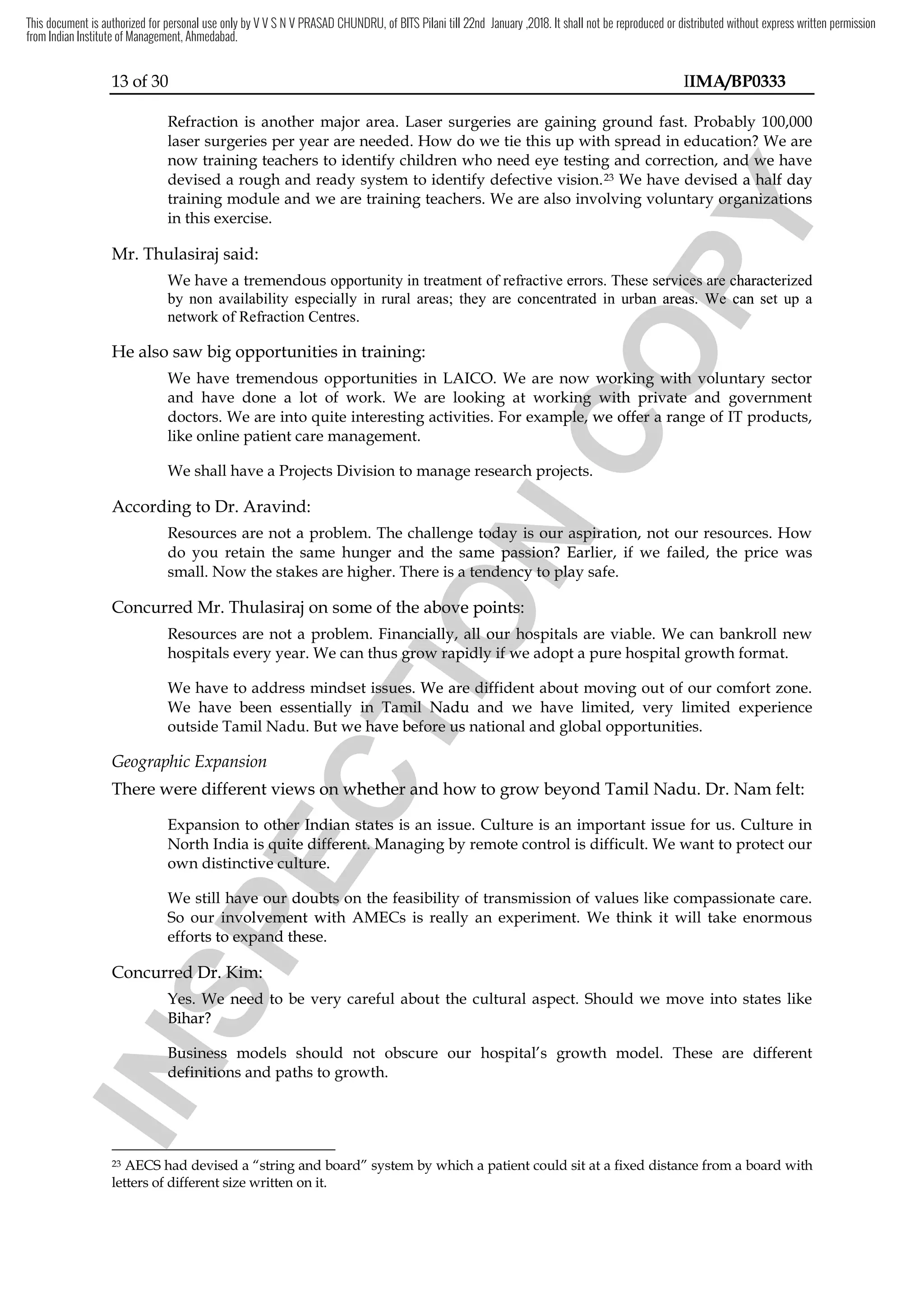
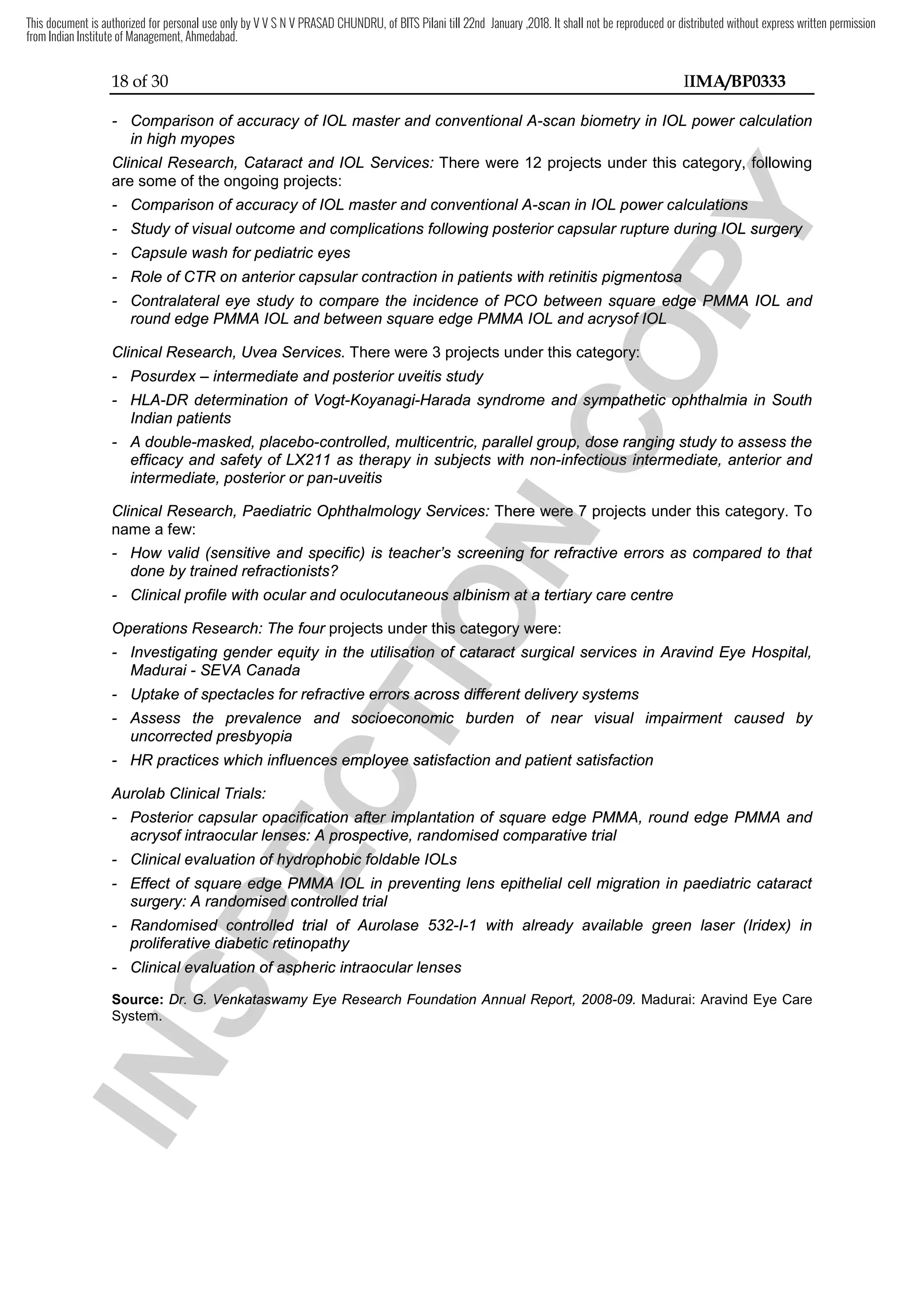
Exhibit 1 gives the number of beds in different units, as on 2009. It may be noted that AECS
did not consider the number of beds to be an important parameter, since most cataract
patients were now discharged the same day, and treated as out patients. Over the years, the
mats (counted as beds earlier) in the free patients’ hospital had been converted to regular
cots, and the average length of stay of a patient had reduced. Many patients even opted for
surgeries as outpatients. Hence for AECS the number of surgeries done was a more
meaningful indicator of its impact than the mere number of beds.
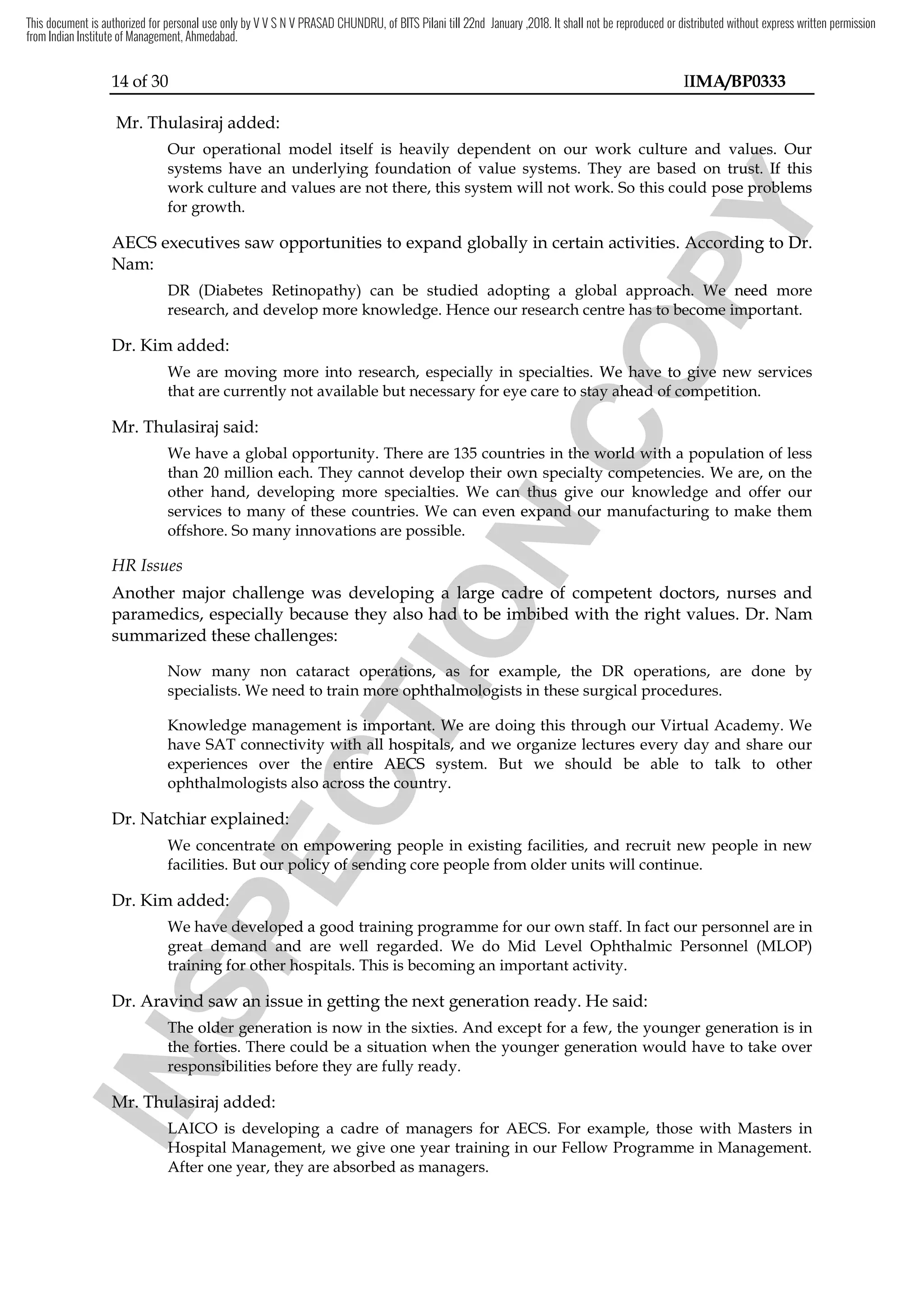
Exhibit 2 gives the number of surgeries done and the number of paying and free outpatients
from 1997-2009.
In consonance with its mission, AECS conducted a number of outreach activities. Of these,
eye camps were the most important for they symbolized the organization’s determination to
reach out to the people in the villages. The eye camps were of different types, but the most
important were the comprehensive eye camps, where complete examination of eyes was
done, spectacles prescribed and delivered on the spot in about 70 per cent of the cases, in
addition to checking for diabetes and giving nutrition advice. In 2009 (April 1, 2008 to March
31, 2009), AECS conducted 1,319 such camps, and 314,780 patients were examined in these
camps. Those needing surgeries were brought to the main hospitals in buses (AECS did not
conduct any surgeries at the camp site), and after the surgery and recuperation, the patients
were dropped back in their villages in buses. To enable delivery of spectacles on the spot, a
stock of spectacles with commonly prescribed powers, was taken to the camps. For glasses
that could not be delivered on the spot, they were made in Madurai and sent to them by
courier9. In 2008-09, out of 299,923 patients examined, glasses were advised to 59,248
persons, of whom 49,112 were ordered by the patients. Of these, 37,348 were delivered on
the spot.
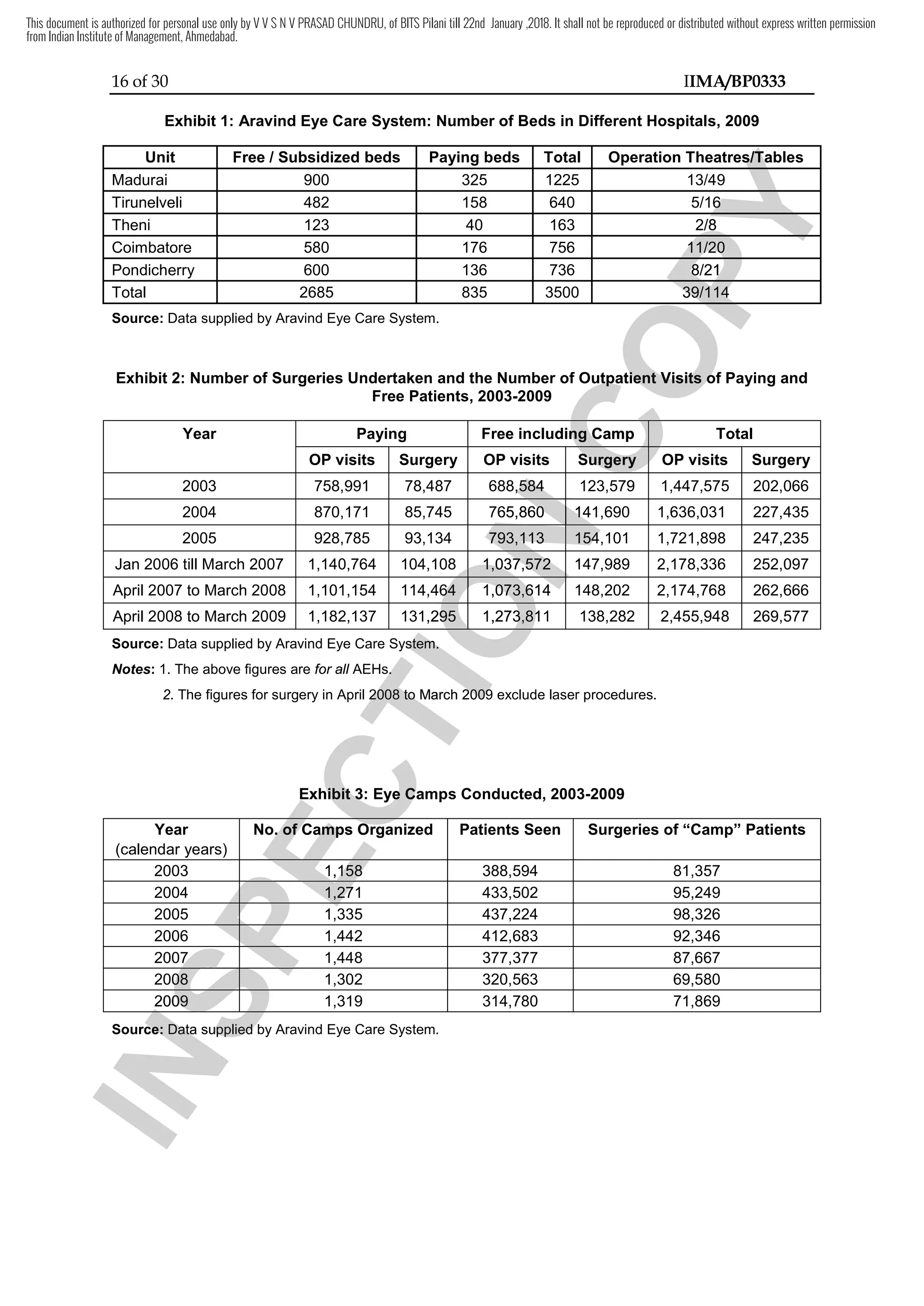
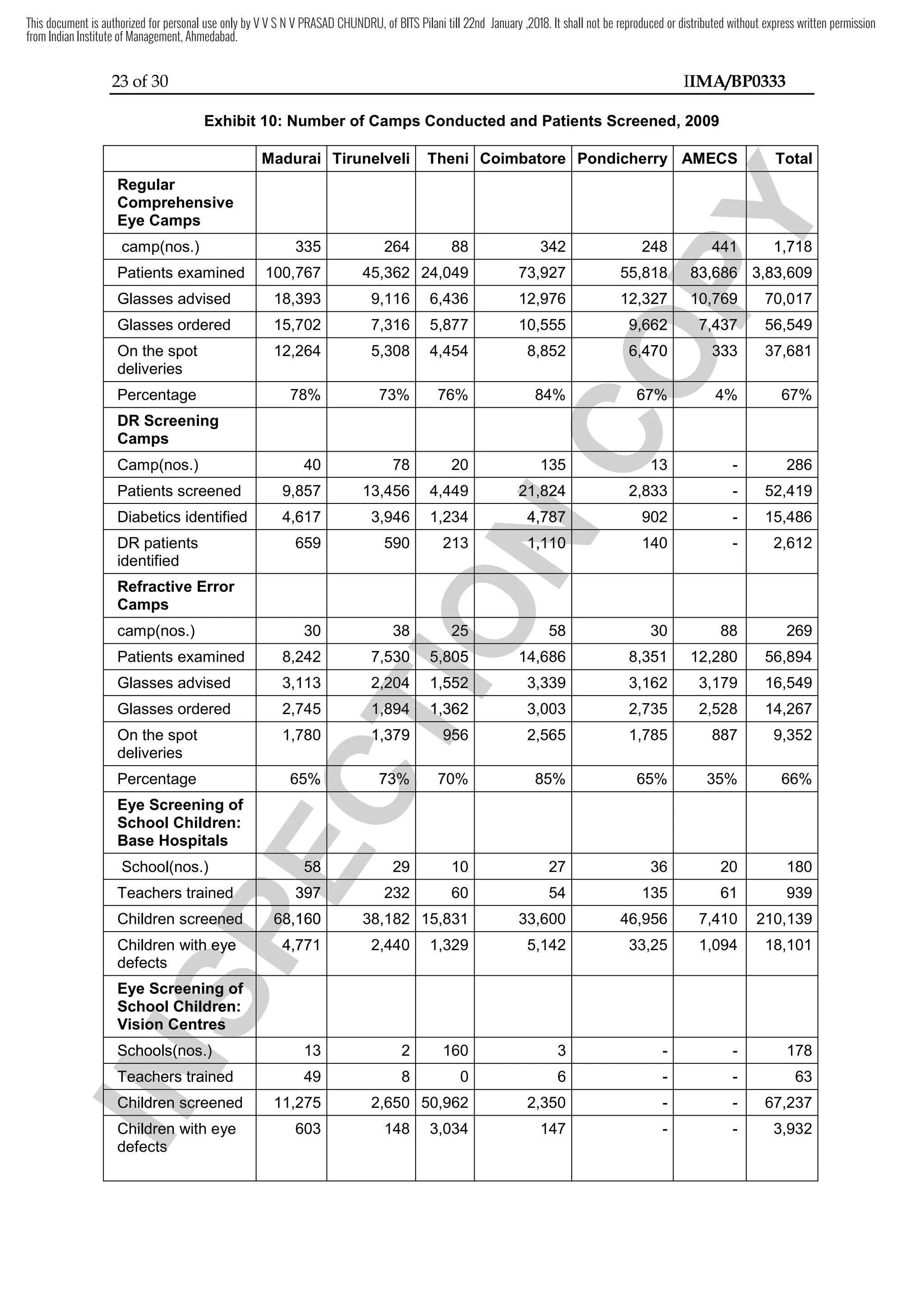
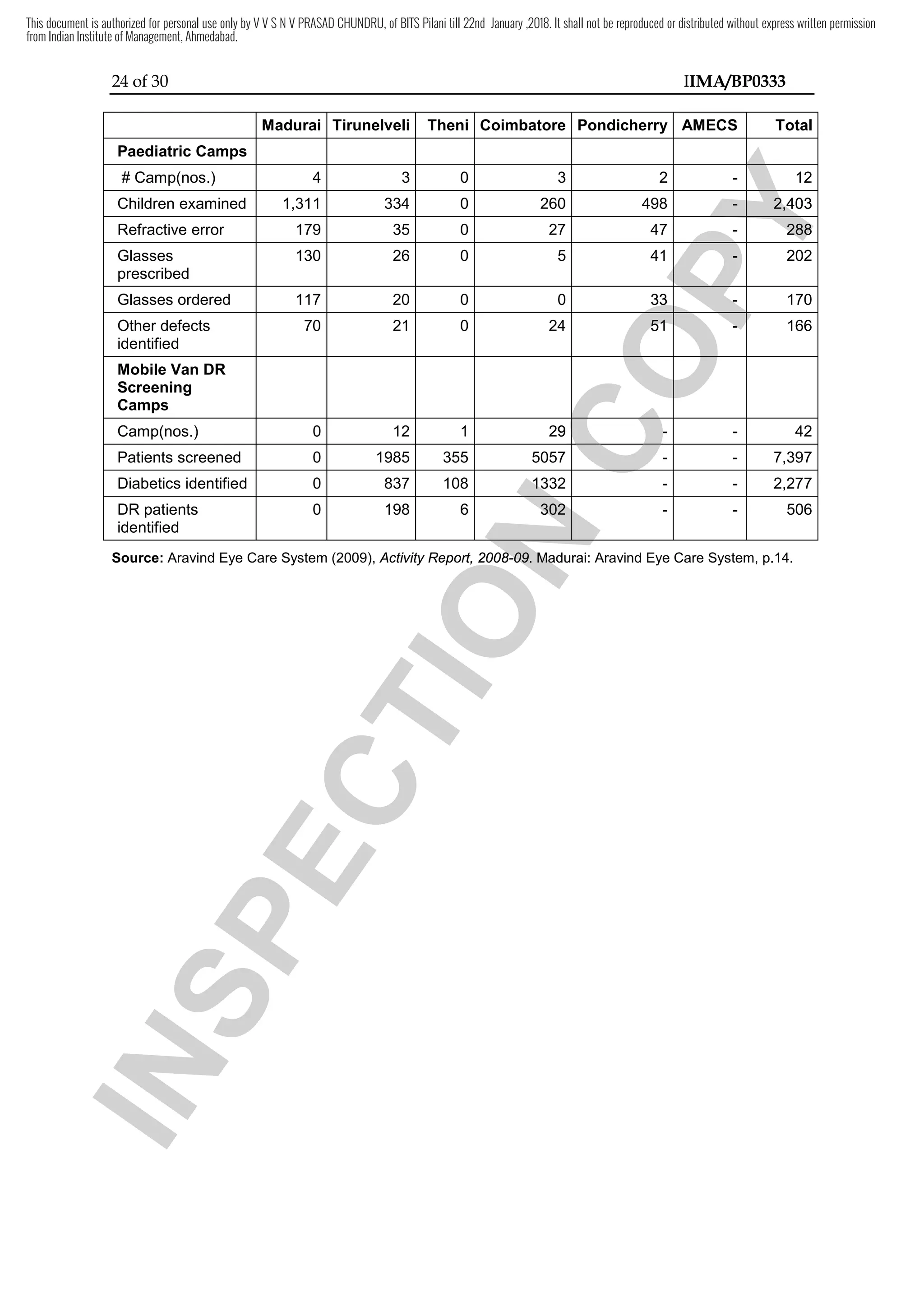
AECS also organized diabetic retinopathy (DR) camps refractive error camps, eye screening
camps for school children, paediatric camps, and mobile van DR screening camps.
Exhibit 3 gives the details of these camps conducted from 2003 to 2009.
In 1982 AECS had set up its own training institute, Aravind Post-Graduate Institute of
Ophthalmology (APGIM), which offered a Resident (Post Graduate) Programme, a
Fellowship Programmes for super specialization, and an Ophthalmic Assistants’ Training.
Its affiliation to different universities enabled it to give degree certificates in some of the
programmes.
Its manufacturing arm, Aurolab, produced IOLs and medical consumables for eye care, like
sutures and medications at low cost. Right from the beginning, these products were made
available to eye hospitals and ophthalmologists outside AECS. This enabled it to get the
needed economies of scale. It was also in consonance with its mission of elimination of
needless blindness. It enabled many hospitals, not only in India, but also in other developing
countries, to conduct surgeries at much lower cost. Aurolab’s products were exported to
many countries. Every year it also developed a number of pioneering products. In 2009, the
9 For details of how these eye camps were operated, see the case BP 0299, pp.10-12.
I
N
S
P
E
C
T
I
O
N
a number of outreach activities
I
N
S
P
E
C
T
I
O
N
a number of outreach activities
symbolized
I
N
S
P
E
C
T
I
O
N
symbolized the organization’s
I
N
S
P
E
C
T
I
O
N
the organization’s
eye camps
I
N
S
P
E
C
T
I
O
N
eye camps were of different types, but the most
I
N
S
P
E
C
T
I
O
N
were of different types, but the most
comprehensive eye camps, where complete examination of eyes was
I
N
S
P
E
C
T
I
O
N
comprehensive eye camps, where complete examination of eyes was
done, spectacles prescribed and delivered on the spot in about 70
I
N
S
P
E
C
T
I
O
N
done, spectacles prescribed and delivered on the spot in about 70
and giving nutrition advice
I
N
S
P
E
C
T
I
O
N
and giving nutrition advice. In 2009
I
N
S
P
E
C
T
I
O
N. In 2009
such camps,
I
N
S
P
E
C
T
I
O
N
such camps, and
I
N
S
P
E
C
T
I
O
N
and 314,780 patients
I
N
S
P
E
C
T
I
O
N
314,780 patients
. Those needing surgeries were brought to the main hospitals in buses
I
N
S
P
E
C
T
I
O
N
. Those needing surgeries were brought to the main hospitals in buses
camp site), and after the surgery and recuperatio
I
N
S
P
E
C
T
I
O
N
camp site), and after the surgery and recuperatio
in buses
I
N
S
P
E
C
T
I
O
N
in buses. T
I
N
S
P
E
C
T
I
O
N
. To enable
I
N
S
P
E
C
T
I
O
N
o enable
with commonly prescribed powers,
I
N
S
P
E
C
T
I
O
N
with commonly prescribed powers,
that could not be delivered on the spot, they were made in Madurai and sent to them by
I
N
S
P
E
C
T
I
O
N
that could not be delivered on the spot, they were made in Madurai and sent to them by
299,923
I
N
S
P
E
C
T
I
O
N
299,923 patients examined
I
N
S
P
E
C
T
I
O
N
patients examined
were ordered by the patients. Of these, 37,
I
N
S
P
E
C
T
I
O
N
were ordered by the patients. Of these, 37,
diabetic retinopathy
I
N
S
P
E
C
T
I
O
N
diabetic retinopathy
school children,
I
N
S
P
E
C
T
I
O
N
school children, paediatric
I
N
S
P
E
C
T
I
O
N
paediatric camps, and mobile van DR screening camps.
I
N
S
P
E
C
T
I
O
N
camps, and mobile van DR screening camps.
Exhibit 3 gives the details of these camps
I
N
S
P
E
C
T
I
O
N
Exhibit 3 gives the details of these camps
had
I
N
S
P
E
C
T
I
O
N
had set up
I
N
S
P
E
C
T
I
O
N
set up its own
I
N
S
P
E
C
T
I
O
N
its own
Ophthalmology
I
N
S
P
E
C
T
I
O
N
Ophthalmology (APGIM),
I
N
S
P
E
C
T
I
O
N
(APGIM), which offered
I
N
S
P
E
C
T
I
O
N
which offered
P
I
N
S
P
E
C
T
I
O
N
Programmes for super specialization, and
I
N
S
P
E
C
T
I
O
N
rogrammes for super specialization, and
Its affiliation to different universities enabled it to gi
I
N
S
P
E
C
T
I
O
N
Its affiliation to different universities enabled it to gi
programmes.
I
N
S
P
E
C
T
I
O
N
programmes.
I
N
S
P
E
C
T
I
O
N
Its manufacturing arm, Aurolab
I
N
S
P
E
C
T
I
O
N
Its manufacturing arm, Aurolab
sutures and medications
I
N
S
P
E
C
T
I
O
N
sutures and medications
available
I
N
S
P
E
C
T
I
O
N
available to eye hospitals a
I
N
S
P
E
C
T
I
O
N
to eye hospitals a
needed economies of scale
I
N
S
P
E
C
T
I
O
N
needed economies of scale
needless blindness
I
N
S
P
E
C
T
I
O
N
needless blindness
countries
I
N
S
P
E
C
T
I
O
N
countries, t
I
N
S
P
E
C
T
I
O
N
, t
many countries
I
N
S
P
E
C
T
I
O
N
many countries
C
O
P
Y
. I
C
O
P
Y
. In both
C
O
P
Y
n both
thus releasing
C
O
P
Y
thus releasing
d not changed
C
O
P
Y
d not changed
2009. It may be noted that AE
C
O
P
Y
2009. It may be noted that AEC
C
O
P
Y
CS
C
O
P
Y
S
, since most cataract
C
O
P
Y
, since most cataract
patients were now discharged the same day, and treated as out patients
C
O
P
Y
patients were now discharged the same day, and treated as out patients.
C
O
P
Y
. Over the years
C
O
P
Y
Over the years
(counted as beds earlier) in the free patients’ hospital had been converted to regular
C
O
P
Y
(counted as beds earlier) in the free patients’ hospital had been converted to regular
Many patients even opted for
C
O
P
Y
Many patients even opted for
the number of surgeries
C
O
P
Y
the number of surgeries done
C
O
P
Y
done was a more
C
O
P
Y
was a more
mere number of beds
C
O
P
Y
mere number of beds.
C
O
P
Y
.
and the number of paying and free outpatients
C
O
P
Y
and the number of paying and free outpatients
a number of outreach activities
C
O
P
Y
a number of outreach activities
the organization’s
C
O
P
Y
the organization’s
This document is authorized for personal use only by V V S N V PRASAD CHUNDRU, of BITS Pilani till 22nd January ,2018. It shall not be reproduced or distributed without express written permission
from Indian Institute of Management, Ahmedabad.
5 of 30 IIMA/BP0333
important new products were Auroflex – EV, negative aspheric IOLs that gave increased
contrast and better visibility in low light conditions, absorbable sutures and a green laser
photo coagulator, especially useful in coagulation of the tiny blood vessels of the retina.
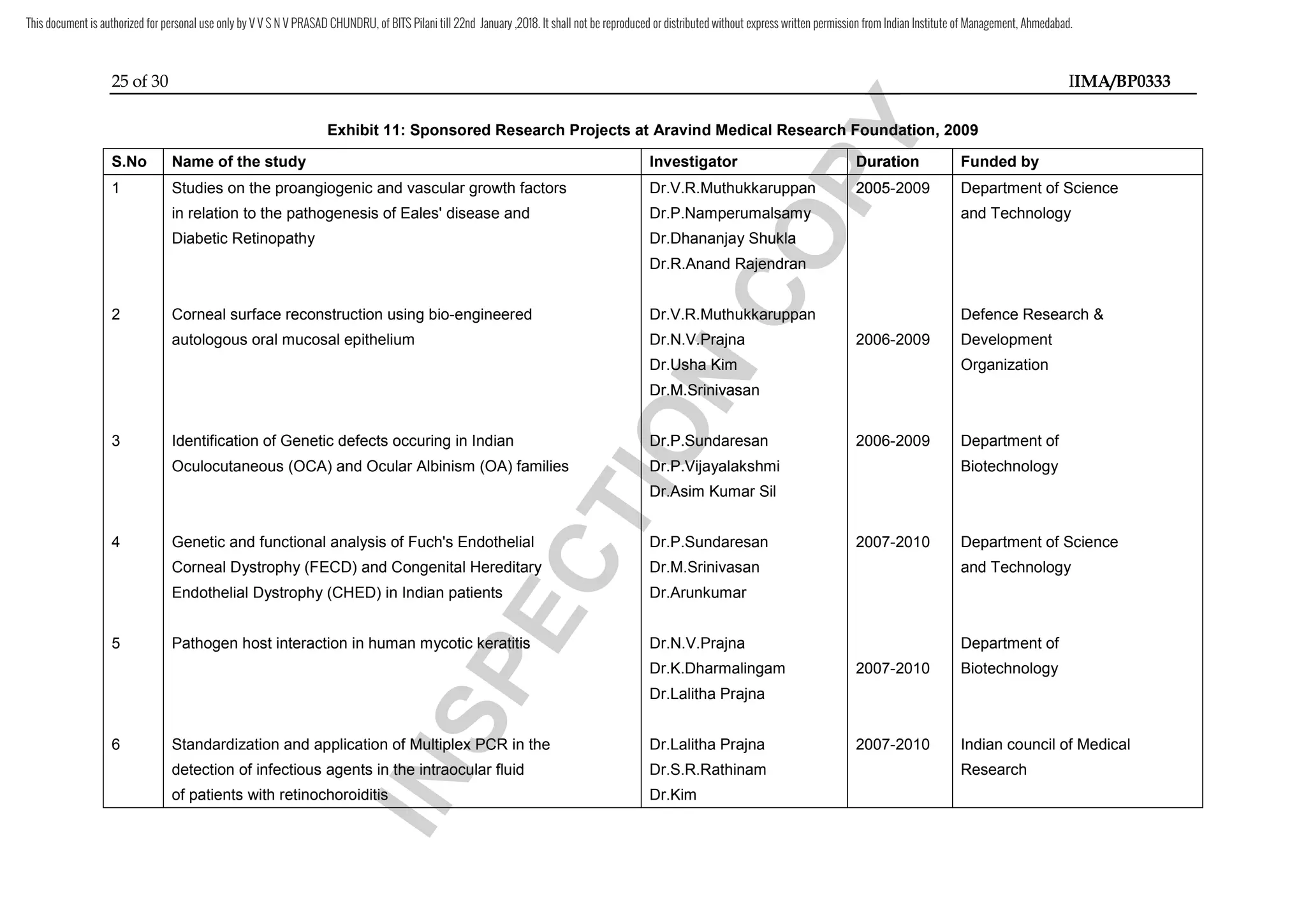
The Aravind Medical Research Foundation expanded its research activities dramatically,
especially with the commissioning of the Dr. G. Venkataswamy Research Institute on
October 1, 2008. It was engaged in cutting edge research in all the areas connected with eye
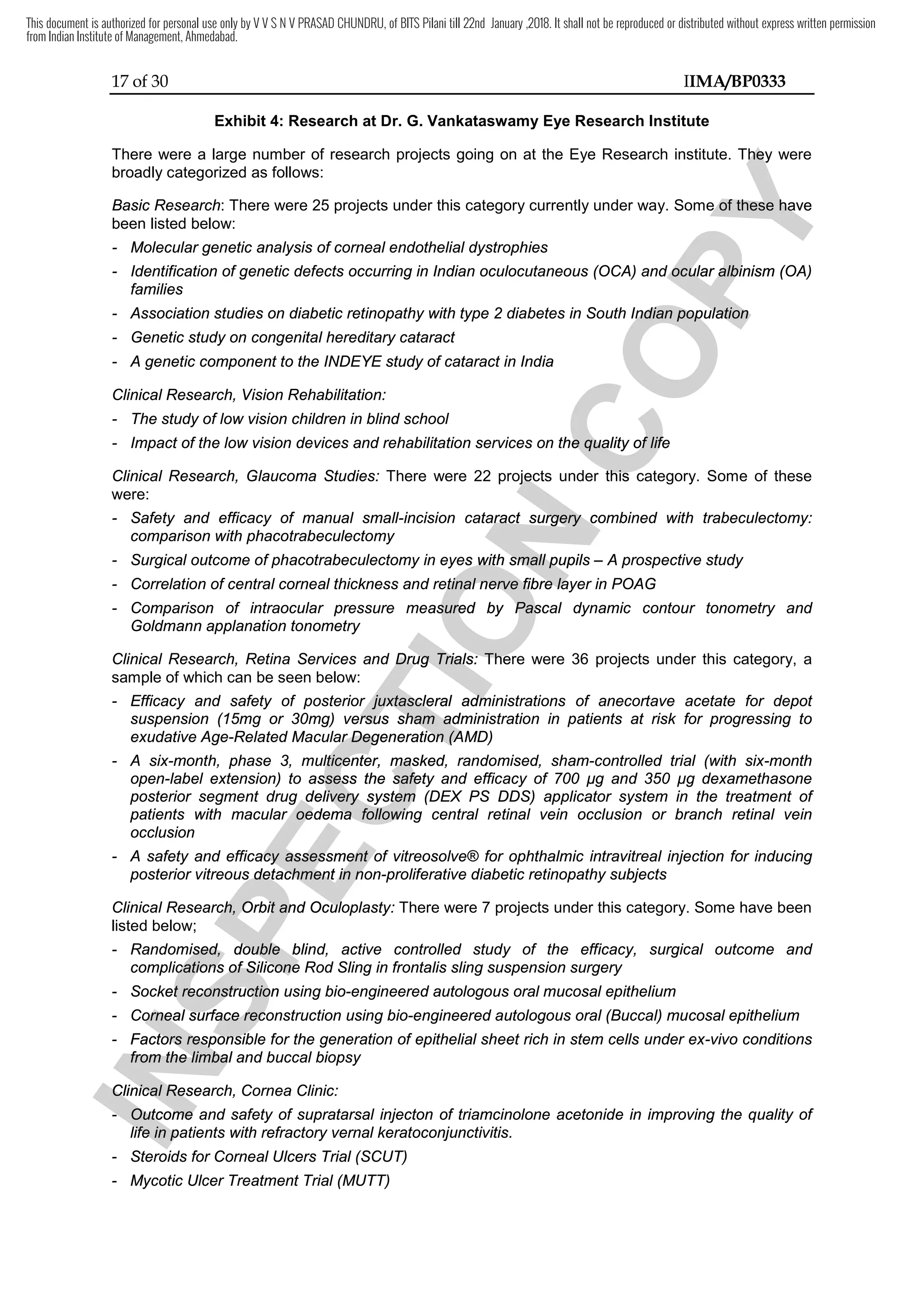
diseases. Some idea of the ongoing research at this institute can be obtained from Exhibit 4.
Many research scholars from other parts of India and abroad came to study here. During his
visit, the case writer met three scholars from different countries who had come to pursue
their research taking advantage of AECS’s facilities, research staff, and data.
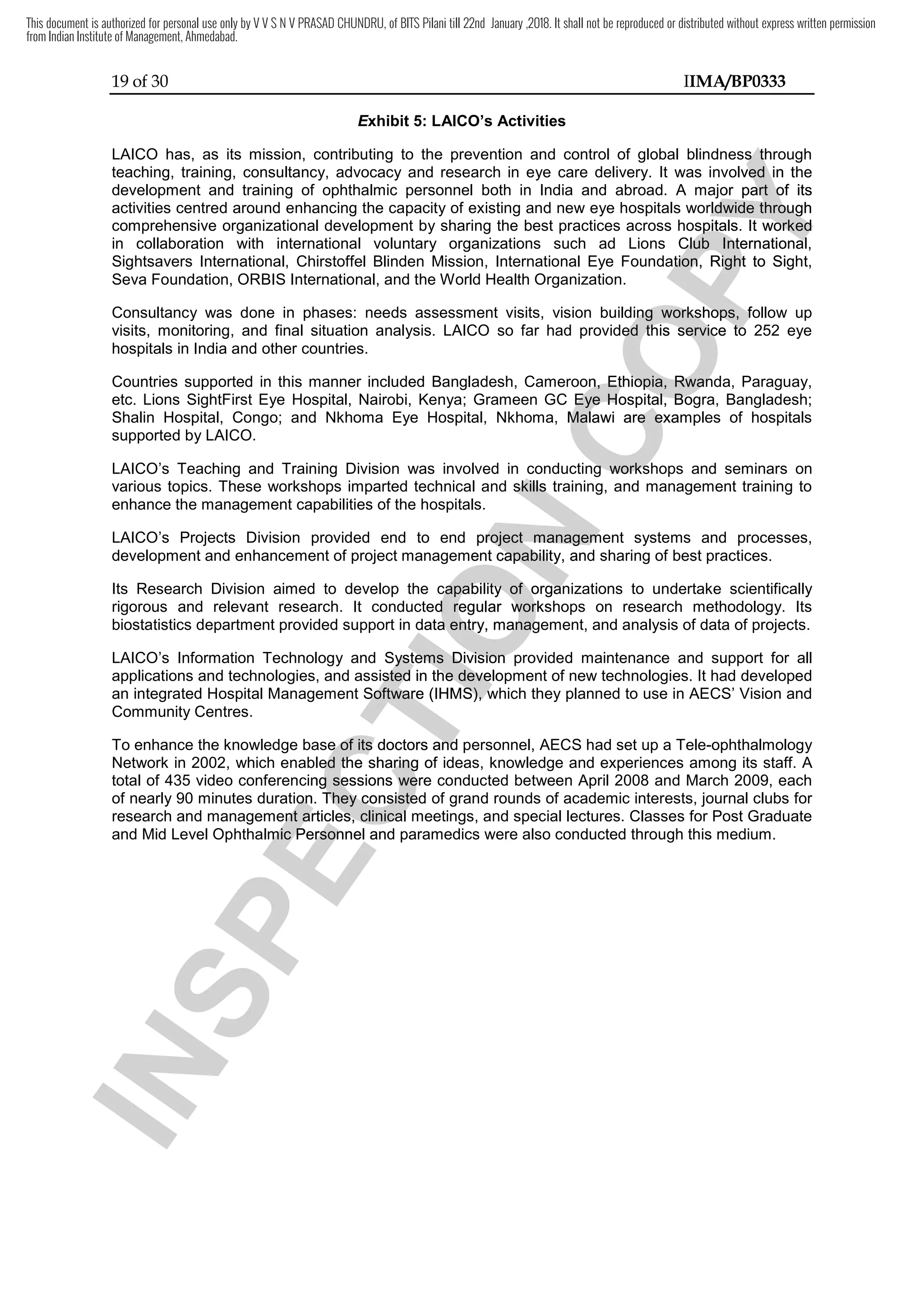
AECS’ training arm, the Lions Aravind Institute of Community Ophthalmology (LAICO),
offered training programmes to outside hospitals to improve their practices. LAICO offered
programmes both in techniques of surgery and in management to doctors, hospital
managers and paramedics. LAICO offered training programmes both at its facilities at
Madurai and at customers’ sites, and also in number of foreign countries. In all, as on 2009,
LAICO had provided its services to 252 eye hospitals in India and abroad. It also undertook
consultancy for improving the performance of hospitals, with need assessment, vision
building workshops, follow-up visits, and monitoring. LAICO worked in collaboration with
a number of voluntary organizations such as Lions Club, Sight Savers International, Seva
Foundation and World Health Organization. Exhibit 5 gives some idea of LAICO’s activities.
AECS also had an eye bank established with the support from the Rotary International. It
was set up in 1998 at Madurai, and by 2009, AECS succeeded in establishing collection
centres in its hospitals at Tirunelveli, Coimbatore and Pondicherry. A total of 3,626 eyes
were received in 2009, of which 1,070 were suitable for transplant, and these were all used.
Changes in the Environment
The environment had changed considerably since the last visit of the case writer in 2003. The
following paragraphs describe the key changes.
(i) Incidence of cataract as the major cause for blindness.
In 2003, cataract accounted for 62.6 per cent of blindness in India, full or partial10. Due to a
variety of reasons, notably the sharp increase in the number of cataract surgeries done as a
result of higher awareness, this percentage was believed to have come down11. The number
of cataract surgeries done per million population, the so called cataract surgery rate (CSR)
was about 9,000 in Tamil Nadu, compared to the average rate of India of about 5,000. In
states like Bihar, it was only 600, thus pointing to the magnitude of work that still had to be
done (In USA, the CSR was about 5000). Despite the strides made, there still continued a
considerable backlog of people needing cataract surgery. Though the incidence of cataract
cases would continue to rise with aging population, the increasing awareness was expected
to result in early surgeries, thus pushing up the demand for cataract surgeries. But even so,
the demand for cataract surgeries seemed to be reaching a plateau. This was because of the
progressively greater difficulty in accessing the people needing attention. A welcome
development was the increase in the percentage of IOL surgeries in India to about 98 per
cent in 2009 as compared to about 65 per cent in 2003.
10 Case BP0299, p.5.
11 Latest data not available.
I
N
S
P
E
C
T
I
O
N
LAICO had provided its services to 252 eye hospitals in India and abroad. It also undertook
I
N
S
P
E
C
T
I
O
N
LAICO had provided its services to 252 eye hospitals in India and abroad. It also undertook
consultancy for improving the performance of hospital
I
N
S
P
E
C
T
I
O
N
consultancy for improving the performance of hospitals
I
N
S
P
E
C
T
I
O
Ns, with need assessment, vision
I
N
S
P
E
C
T
I
O
N, with need assessment, vision
and monitoring. LAICO
I
N
S
P
E
C
T
I
O
N
and monitoring. LAICO worked in collaboration with
I
N
S
P
E
C
T
I
O
Nworked in collaboration with
such as Lions Club, Sight
I
N
S
P
E
C
T
I
O
N
such as Lions Club, Sight
. Exhibit 5 gives some idea of LAICO’s activities.
I
N
S
P
E
C
T
I
O
N
. Exhibit 5 gives some idea of LAICO’s activities.
with
I
N
S
P
E
C
T
I
O
N
with the
I
N
S
P
E
C
T
I
O
N
the support from
I
N
S
P
E
C
T
I
O
N
support from
by 2009,
I
N
S
P
E
C
T
I
O
N
by 2009, AECS
I
N
S
P
E
C
T
I
O
N
AECS succeeded in establishing
I
N
S
P
E
C
T
I
O
N
succeeded in establishing
Tirunelveli, Coimbatore and Pondicherry. A total of 3
I
N
S
P
E
C
T
I
O
N
Tirunelveli, Coimbatore and Pondicherry. A total of 3
were received in 2009, of which 1,070 were suitable for transplant, and these were all used.
I
N
S
P
E
C
T
I
O
N
were received in 2009, of which 1,070 were suitable for transplant, and these were all used.
The environment had changed considerably since the last visit
I
N
S
P
E
C
T
I
O
N
The environment had changed considerably since the last visit
following paragraphs describe the key changes.
I
N
S
P
E
C
T
I
O
N
following paragraphs describe the key changes.
Incidence of cataract as the major cause for blindness
I
N
S
P
E
C
T
I
O
N
Incidence of cataract as the major cause for blindness
In 2003, cataract accounted for 62.6 pe
I
N
S
P
E
C
T
I
O
N
In 2003, cataract accounted for 62.6 per
I
N
S
P
E
C
T
I
O
N
r cent of blindness
I
N
S
P
E
C
T
I
O
N
cent of blindness
variety of reasons, notably the
I
N
S
P
E
C
T
I
O
N
variety of reasons, notably the sharp increase in the
I
N
S
P
E
C
T
I
O
N
sharp increase in the
result of higher awareness, this percentage was believed to have
I
N
S
P
E
C
T
I
O
N
result of higher awareness, this percentage was believed to have
of cataract surgeries done per million population, the so called cataract surgery rate (CSR)
I
N
S
P
E
C
T
I
O
N
of cataract surgeries done per million population, the so called cataract surgery rate (CSR)
000 in Tamil Nadu,
I
N
S
P
E
C
T
I
O
N
000 in Tamil Nadu,
states like Bihar, it was only 600, thus pointing to the mag
I
N
S
P
E
C
T
I
O
N
states like Bihar, it was only 600, thus pointing to the mag
In USA, the CSR
I
N
S
P
E
C
T
I
O
N
In USA, the CSR wa
I
N
S
P
E
C
T
I
O
N
was about
I
N
S
P
E
C
T
I
O
N
s about
considerable
I
N
S
P
E
C
T
I
O
N
considerable backlog
I
N
S
P
E
C
T
I
O
N
backlog of
I
N
S
P
E
C
T
I
O
N
of people needing cataract surgery.
I
N
S
P
E
C
T
I
O
N
people needing cataract surgery.
cases would continue to rise with aging population, the increasing awareness was expected
I
N
S
P
E
C
T
I
O
N
cases would continue to rise with aging population, the increasing awareness was expected
to result in
I
N
S
P
E
C
T
I
O
N
to result in early
I
N
S
P
E
C
T
I
O
N
early surgeries, thus pushing up the demand for cataract surgeries. But even so,
I
N
S
P
E
C
T
I
O
N
surgeries, thus pushing up the demand for cataract surgeries. But even so,
the demand for cataract surgeries seemed to be reaching a plateau.
I
N
S
P
E
C
T
I
O
N
the demand for cataract surgeries seemed to be reaching a plateau.
progressively greater difficulty in accessing the peopl
I
N
S
P
E
C
T
I
O
N
progressively greater difficulty in accessing the peopl
development was the
I
N
S
P
E
C
T
I
O
N
development was the
I
N
S
P
E
C
T
I
O
N
cent in 2009 as compared to about 65
I
N
S
P
E
C
T
I
O
N
cent in 2009 as compared to about 65
I
N
S
P
E
C
T
I
O
N
C
O
P
Y
and a green laser
C
O
P
Y
and a green laser
retina.
C
O
P
Y
retina.
The Aravind Medical Research Foundation expanded its research activities d
C
O
P
Y
The Aravind Medical Research Foundation expanded its research activities dramatically,
C
O
P
Y
ramatically,
especially with the commissioning of the Dr. G. Venkataswamy Research Institute on
C
O
P
Y
especially with the commissioning of the Dr. G. Venkataswamy Research Institute on
connected with eye
C
O
P
Y
connected with eye
e obtained from Exhibit 4.
C
O
P
Y
e obtained from Exhibit 4.
India and abroad came to study
C
O
P
Y
India and abroad came to study here
C
O
P
Y
here.
C
O
P
Y
. During his
C
O
P
Y
During his
three scholars from different countries who had come to pursue
C
O
P
Y
three scholars from different countries who had come to pursue
, and data.
C
O
P
Y
, and data.
training arm, the Lions Aravind Institute of Community Op
C
O
P
Y
training arm, the Lions Aravind Institute of Community Oph
C
O
P
Y
hthalmology (LAICO),
C
O
P
Y
thalmology (LAICO),
their practices. LAICO offered
C
O
P
Y
their practices. LAICO offered
management to doctors, hospital
C
O
P
Y
management to doctors, hospital
programmes
C
O
P
Y
programmes both
C
O
P
Y
both at its facilities at
C
O
P
Y
at its facilities at
also in number of foreign countries.
C
O
P
Y
also in number of foreign countries.
LAICO had provided its services to 252 eye hospitals in India and abroad. It also undertook
C
O
P
Y
LAICO had provided its services to 252 eye hospitals in India and abroad. It also undertook
, with need assessment, vision
C
O
P
Y
, with need assessment, vision
This document is authorized for personal use only by V V S N V PRASAD CHUNDRU, of BITS Pilani till 22nd January ,2018. It shall not be reproduced or distributed without express written permission
from Indian Institute of Management, Ahmedabad.
6 of 30 IIMA/BP0333
As a result, though, in absolute numbers, AECS’s cataract surgeries were going up every
year, this number, as a percentage of the total surgeries done, was coming down. In 2008-09,
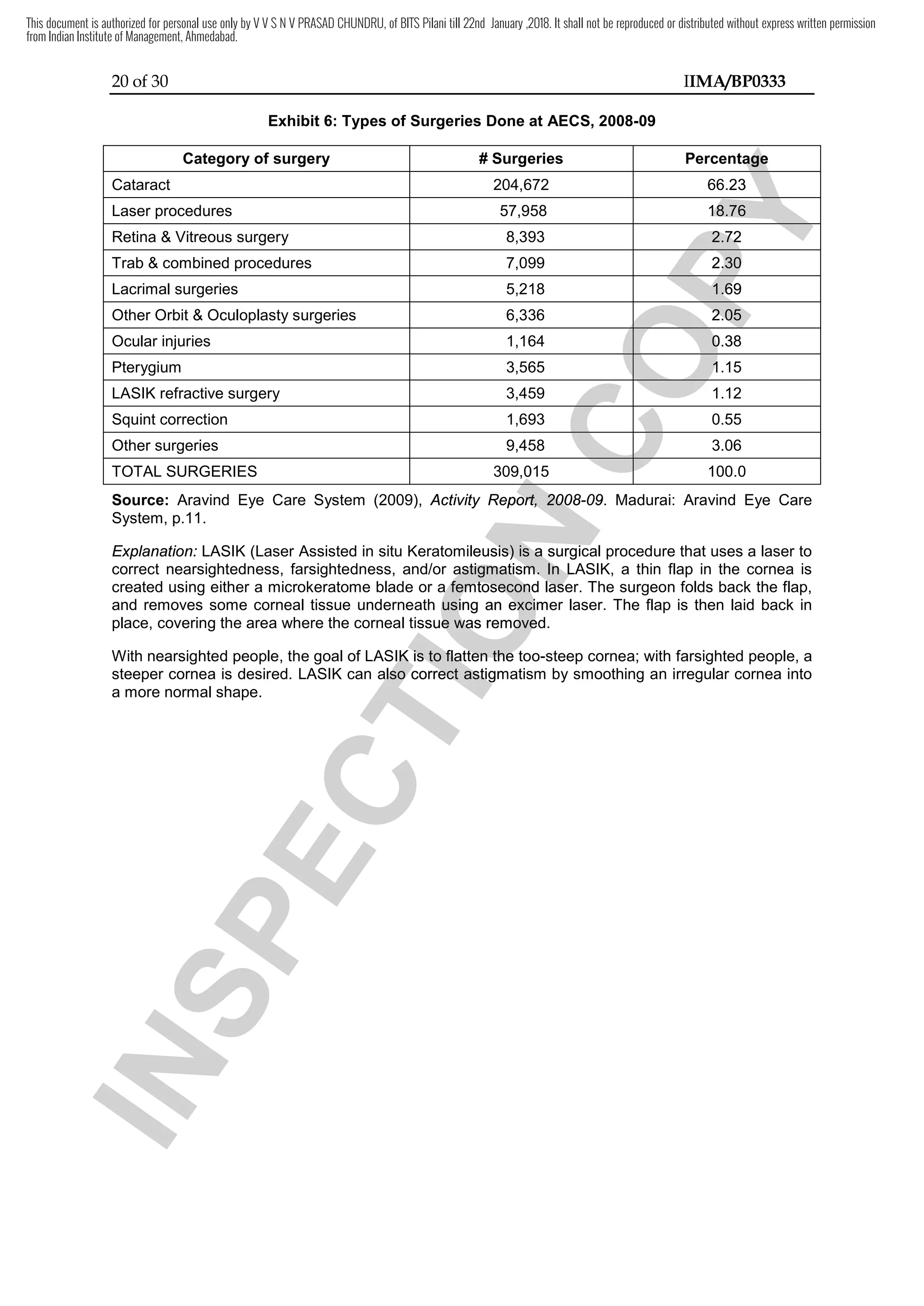
this percentage had come down to 66 per cent. Exhibit 6 provides the composition of
surgeries done at AECS in 2008-09. This had important implications for the organization,
since it had built a system with a high degree of operational efficiency based on the
relatively standardized procedure for cataract surgeries12. This standardization and the
resulting high productivity of its doctors had also kept the costs down, and in turn, enabled
AECS to provide free surgeries to as much as 60 per cent of its patients.
(ii) Reduced demand for free services.
There was a general improvement in the living conditions and so the percentage of people
who needed free medical service was coming down. On the other hand, the expectations of
patients were going up. This was reflected in the improvement in facilities provided by all
AEHs. For example, all AEHs now provided cots to its free patients (as compared to mats
earlier), resulting in the reduction in the number of patients who could be accommodated as
cots needed more floor space. Dr. Natchiar summarized these changes:
Now patient expectations have gone up. They do not want to stay long in hospitals. The
number of patients demanding private rooms has gone up, while the number of those willing
to share accommodation has come down.
There were also multiple insurance schemes, both private and state sponsored, that enabled
patients to cover their costs. AECS’s policy remained the same: to treat everyone who came
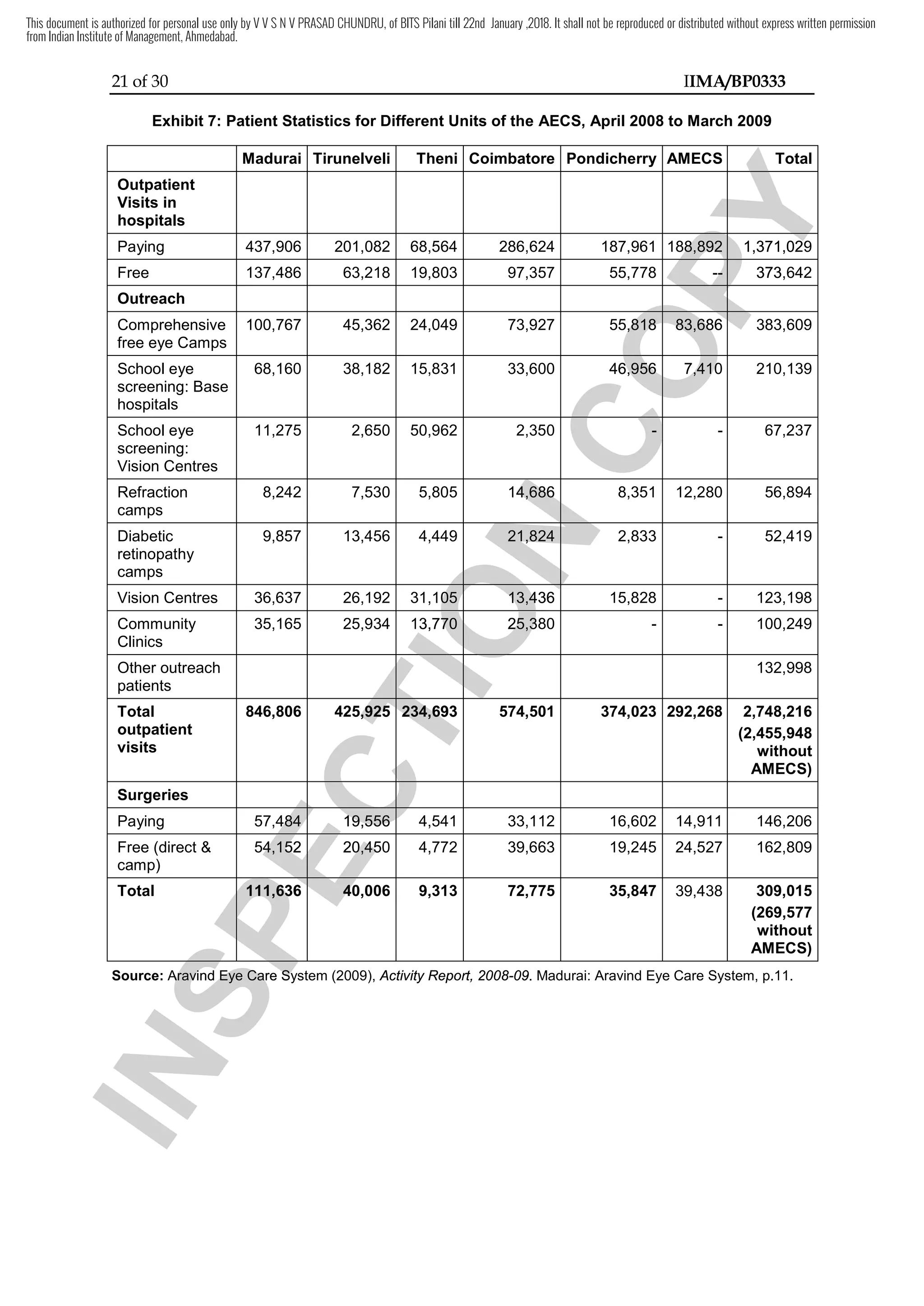
to the free patients’ unit free of cost. Details of patients treated under different categories can
be seen in Exhibit 7.
(iii) Changes in the demand and need for other areas of eye care.
Though there was a decline in the cataract surgery in AECS, other areas of eye care had
begun to emerge needing attention. Among these, the most important were diabetic
retinopathy (DR) that included control of diabetes, refraction correction, and prevention and
treatment of glaucoma. It was expected that soon many of the activities of AECS will get
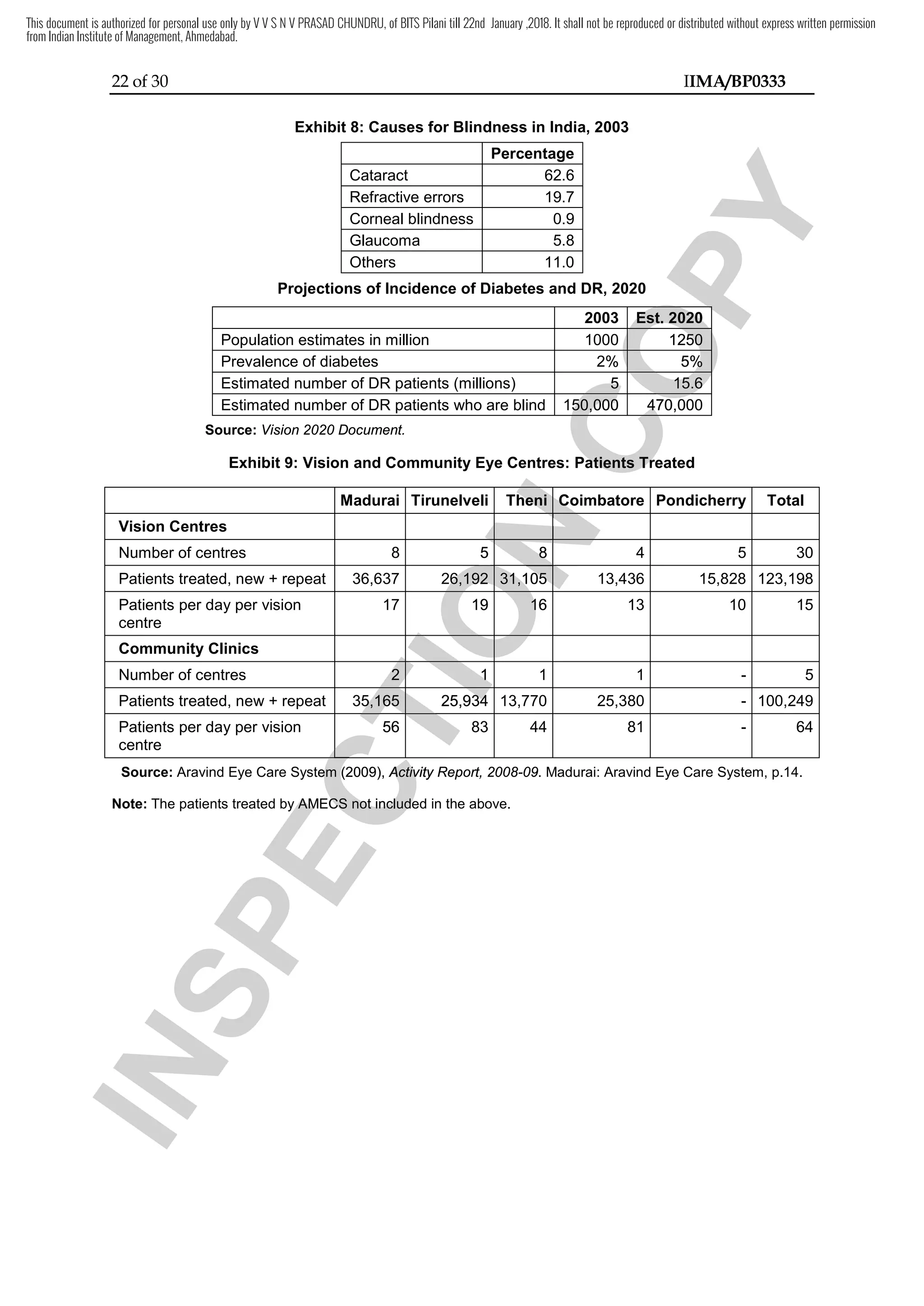
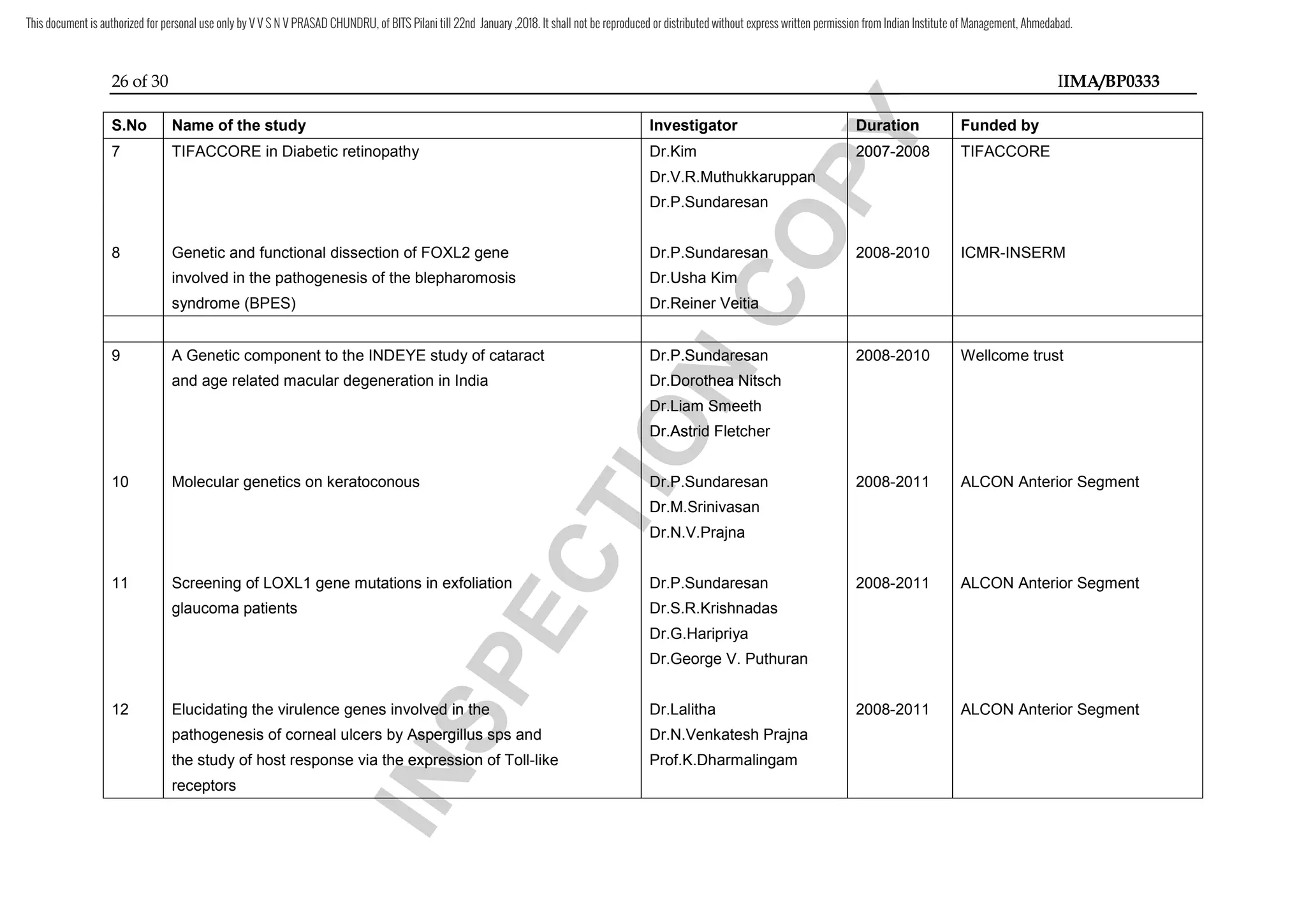
directed towards these areas (Exhibit 8).
Unlike cataract, diabetic retinopathy was preventable; however, if not treated in time, the
damages it caused to retina were usually irreversible. Hence the focus here had to be more
on prevention and early attention than cure, and the attention needed to be directed towards
education of population, effective screening for diabetes, and monitoring of the patients. It
was estimated that in 2003 about two per cent of India’s population (nearly 20 million) were
diabetic. Out of this number, about 5 million were DR patients and 1.5 million needed
treatment. Further, about 150,000 of these were blind. What was more disturbing was that
the trends were expected to worsen. According to the Vision 2020 document, the percentage
of the diabetics was expected to increase to 5 per cent by 2020, which would mean 62.5
million patients. It was estimated that of these, 15.6 million would have DR, and 4.7 million
would need treatment13. AECS felt that to treat diabetes and DR it would have to adopt a
highly non standard approach, with high uncertain outcomes.
12 For details, see case BP 0299, pp.8-9.
13 National Programme for Control of Blindness-India: Vision 2020 Plan of Action. (2003). New Delhi: Ophthalmology/
Blindness Control Section, Directorate General of Health Services, Ministry of Health and Family Welfare,
Government of India, p.1. This document is hereafter referred to as the Vision 2020 Document.
I
N
S
P
E
C
T
I
O
N
Now patient expectations have gone up. They do not want to stay long in hospitals. The
I
N
S
P
E
C
T
I
O
N
Now patient expectations have gone up. They do not want to stay long in hospitals. The
ng private rooms has gone up, while
I
N
S
P
E
C
T
I
O
N
ng private rooms has gone up, while
There were also multiple insurance schemes, both private and state sponsored, that enable
I
N
S
P
E
C
T
I
O
N
There were also multiple insurance schemes, both private and state sponsored, that enable
remained the same
I
N
S
P
E
C
T
I
O
N
remained the same
etails of patients treated under different categories
I
N
S
P
E
C
T
I
O
N
etails of patients treated under different categories
Changes in the demand and need for other areas of eye care
I
N
S
P
E
C
T
I
O
N
Changes in the demand and need for other areas of eye care
decline in the cat
I
N
S
P
E
C
T
I
O
N
decline in the cataract
I
N
S
P
E
C
T
I
O
N
aract surgery in AECS,
I
N
S
P
E
C
T
I
O
N
surgery in AECS,
attention.
I
N
S
P
E
C
T
I
O
N
attention. Among these, the most important were diabetic
I
N
S
P
E
C
T
I
O
N
Among these, the most important were diabetic
control of diabetes, refraction
I
N
S
P
E
C
T
I
O
N
control of diabetes, refraction
treatment of glaucoma. It was expected that soon
I
N
S
P
E
C
T
I
O
N
treatment of glaucoma. It was expected that soon
directed towards these areas (Exhibit 8
I
N
S
P
E
C
T
I
O
N
directed towards these areas (Exhibit 8).
I
N
S
P
E
C
T
I
O
N
).
I
N
S
P
E
C
T
I
O
N
iabetic retinopathy was
I
N
S
P
E
C
T
I
O
N
iabetic retinopathy was
to retina were usually irreversible.
I
N
S
P
E
C
T
I
O
N
to retina were usually irreversible.
and early attention
I
N
S
P
E
C
T
I
O
N
and early attention than cure, and
I
N
S
P
E
C
T
I
O
N
than cure, and
education of population, effective screening for diabetes
I
N
S
P
E
C
T
I
O
N
education of population, effective screening for diabetes
that
I
N
S
P
E
C
T
I
O
N
that in 2003
I
N
S
P
E
C
T
I
O
N
in 2003 about
I
N
S
P
E
C
T
I
O
N
about
Out of this number
I
N
S
P
E
C
T
I
O
N
Out of this number,
I
N
S
P
E
C
T
I
O
N
,
treatment. Further, about 150,000 of these were blind. What was more disturbing was
I
N
S
P
E
C
T
I
O
N
treatment. Further, about 150,000 of these were blind. What was more disturbing was
trends were expected to w
I
N
S
P
E
C
T
I
O
N
trends were expected to w
of the diabetics was expected to increase to 5 per
I
N
S
P
E
C
T
I
O
N
of the diabetics was expected to increase to 5 per
million patients. It was estimated that of these, 15.6 million would have DR, and 4.7 million
I
N
S
P
E
C
T
I
O
N
million patients. It was estimated that of these, 15.6 million would have DR, and 4.7 million
would need tre
I
N
S
P
E
C
T
I
O
N
would need tre
I
N
S
P
E
C
T
I
O
N
atment
I
N
S
P
E
C
T
I
O
N
atment
highly non standard approach, with high uncertain outcomes.
I
N
S
P
E
C
T
I
O
N
highly non standard approach, with high uncertain outcomes.
I
N
S
P
E
C
T
I
O
N
For details, see case BP 0299, pp.8
I
N
S
P
E
C
T
I
O
N
For details, see case BP 0299, pp.8
National Programme for Control of Blindness
I
N
S
P
E
C
T
I
O
N
National Programme for Control of Blindness
C
O
P
Y
was coming down. In 2008
C
O
P
Y
was coming down. In 2008
the composition of
C
O
P
Y
the composition of
he organization,
C
O
P
Y
he organization,
efficiency based on the
C
O
P
Y
efficiency based on the
standardization and the
C
O
P
Y
standardization and the
had also kept the costs down, and in turn, enabled
C
O
P
Y
had also kept the costs down, and in turn, enabled
the percentage of people
C
O
P
Y
the percentage of people
was coming down. On the other hand, the expectations of
C
O
P
Y
was coming down. On the other hand, the expectations of
going up. This was reflected in the improvement
C
O
P
Y
going up. This was reflected in the improvement in
C
O
P
Y
in facilities
C
O
P
Y
facilities provided
C
O
P
Y
provided
now provided cots to its free patients (as compared to mats
C
O
P
Y
now provided cots to its free patients (as compared to mats
the number of patients who could be
C
O
P
Y
the number of patients who could be accommodate
C
O
P
Y
accommodate
Dr. Natchiar summarized these changes:
C
O
P
Y
Dr. Natchiar summarized these changes:
Now patient expectations have gone up. They do not want to stay long in hospitals. The
C
O
P
Y
Now patient expectations have gone up. They do not want to stay long in hospitals. The
the number of
C
O
P
Y
the number of
This document is authorized for personal use only by V V S N V PRASAD CHUNDRU, of BITS Pilani till 22nd January ,2018. It shall not be reproduced or distributed without express written permission
from Indian Institute of Management, Ahmedabad.
7 of 30 IIMA/BP0333
Glaucoma if left untreated also led to blindness. About four per cent of India’s population
was estimated to have glaucoma14.
Refraction correction too had become an important area of concern. A survey conducted in
Delhi indicated that one per cent of children aged 5 to 15 years had VA of less than 6/18 in
the better eye15. In 2008-09, out of the patients examined in refractive error camps, 29 per
cent had to be prescribed glasses; in the screening camps organized for school children, the
figure was around 6-8 per cent; in paediatric camps, this was 1.1 per cent16. There was
increased demand for laser and LASIK surgeries for reducing or eliminating myopia, for DR,
Glaucoma and for treating conditions following cataract operations. In 2008-09, out of
309,015 surgeries conducted in all hospitals of AECS, 57,958 were laser procedures for other
than refractive errors, and 3,459 were LASIK procedures for refractive corrections (Exhibit
6). Thus about 20 per cent of all surgeries of AECS were laser/ LASIK surgeries. Said Dr.
Nam:
Earlier, we used to do about 1000 laser surgeries p.a. for diabetic retinopathy. Now we are
doing about 20,000 in Madurai alone, and about 55,000 in all our hospitals. Probably 100,000
surgeries will be needed in our hospitals. We have, in India, about 46 million diabetics, of
whom about 5 million or nearly 11 per cent will have DR. Of these, 30 per cent will also need
laser procedures. Thus laser surgeries are emerging as a very crucial area for us.
The challenge here is to bring down the cost of laser equipment from the present `2.5 million
to at least about `0.8 million. Aurolab is presently working on this.
At present, most of these surgeries are done by specialists. We need to train the
ophthalmologist in this procedure. The nature of these surgeries varies considerably from
case to case, with many categories of retinopathies. The surgeons need to get acquainted with
them.
(iv) Expectations from doctors and other staff
Doctors’ salaries were becoming highly competitive. But they were also looking for
opportunities to establish their own names among peers, and in particular, looking for
opportunities to do research, publish papers, to take part in conferences and network among
peers. It was thought that such activities would directly increase doctors’ competences, and
increase the visibility and awareness of the hospitals the doctors belonged to.
(v) Competition
Competition from other hospitals was increasing sharply. New hospitals were coming up,
and they generally looked better than at least the old buildings of AEH, Madurai. They
provided better room and food facilities as compared to AEHs, which were seen as
functional, no-frills chain of hospitals. These new hospitals enticed doctors with better pay.
One of the doctors the case writer interviewed remarked that many of the doctors in other
private chain of eye hospitals located in different cities of Tamil Nadu were ex-AECS
personnel17. Many of the corporate hospitals too had doctors who had been with AECS
earlier. In fact, AECS doctors were always in high demand due to their excellent training,
exposure to a wide variety of diseases and good work ethics. But none of the competing
14 Ibid. p.1.
15 Ibid., p.1.
16 Compiled from Aravind’s Activity Report, 2008-09, p.14.
17 Interview with Dr. Kim, Head, Retina-Vitreous Clinic.
I
N
S
P
E
C
T
I
O
N
. We have, in India, about 46 million diabetics, of
I
N
S
P
E
C
T
I
O
N
. We have, in India, about 46 million diabetics, of
cent will have DR. Of these, 30 per
I
N
S
P
E
C
T
I
O
N
cent will have DR. Of these, 30 per
laser procedures. Thus laser surgeries are emerging as a very crucial area for us.
I
N
S
P
E
C
T
I
O
N
laser procedures. Thus laser surgeries are emerging as a very crucial area for us.
The challenge here is to bring down the cost of laser equipment from the present
I
N
S
P
E
C
T
I
O
N
The challenge here is to bring down the cost of laser equipment from the present
presently
I
N
S
P
E
C
T
I
O
N
presently working on this
I
N
S
P
E
C
T
I
O
N
working on this
t present, most of these surgeries are done by specialists. We need to train
I
N
S
P
E
C
T
I
O
N
t present, most of these surgeries are done by specialists. We need to train
. The
I
N
S
P
E
C
T
I
O
N
. The nature of these surgeries
I
N
S
P
E
C
T
I
O
N
nature of these surgeries
case to case, with many categories of retinopathies. The
I
N
S
P
E
C
T
I
O
N
case to case, with many categories of retinopathies. The
Expectations from doctors and other staff
I
N
S
P
E
C
T
I
O
N
Expectations from doctors and other staff
Doctors’ salaries were becoming highly competitive. But they were also looking for
I
N
S
P
E
C
T
I
O
N
Doctors’ salaries were becoming highly competitive. But they were also looking for
opportunities to establish their own names among peers, and in particular, looking for
I
N
S
P
E
C
T
I
O
N
opportunities to establish their own names among peers, and in particular, looking for
opportunities to do research,
I
N
S
P
E
C
T
I
O
N
opportunities to do research, publish papers, to take part in
I
N
S
P
E
C
T
I
O
N
publish papers, to take part in
such activities would directly increase doctors’ competences, and
I
N
S
P
E
C
T
I
O
N
such activities would directly increase doctors’ competences, and
increase the visibility and awareness of the hospitals the doctors belonged to.
I
N
S
P
E
C
T
I
O
N
increase the visibility and awareness of the hospitals the doctors belonged to.
mpetition from other hospitals was increasing sharply.
I
N
S
P
E
C
T
I
O
N
mpetition from other hospitals was increasing sharply.
generally looked better than at least the old buildings of
I
N
S
P
E
C
T
I
O
N
generally looked better than at least the old buildings of
provided better room and food facilities as compared to
I
N
S
P
E
C
T
I
O
N
provided better room and food facilities as compared to
ctional, no
I
N
S
P
E
C
T
I
O
N
ctional, no-
I
N
S
P
E
C
T
I
O
N
-frills
I
N
S
P
E
C
T
I
O
N
frills chain of
I
N
S
P
E
C
T
I
O
N
chain of hospitals. These
I
N
S
P
E
C
T
I
O
N
hospitals. These
of the doctors the case writer interviewed remarked that
I
N
S
P
E
C
T
I
O
N
of the doctors the case writer interviewed remarked that
private chain of e
I
N
S
P
E
C
T
I
O
N
private chain of eye
I
N
S
P
E
C
T
I
O
N
ye hospitals
I
N
S
P
E
C
T
I
O
N
hospitals
personnel
I
N
S
P
E
C
T
I
O
N
personnel17
I
N
S
P
E
C
T
I
O
N
17.
I
N
S
P
E
C
T
I
O
N
. Many of the
I
N
S
P
E
C
T
I
O
N
Many of the
earlier.
I
N
S
P
E
C
T
I
O
N
earlier. In fact,
I
N
S
P
E
C
T
I
O
N
In fact, AECS
I
N
S
P
E
C
T
I
O
N
AECS
exposure to a
I
N
S
P
E
C
T
I
O
N
exposure to a wide
I
N
S
P
E
C
T
I
O
N
wide
I
N
S
P
E
C
T
I
O
N
14
I
N
S
P
E
C
T
I
O
N
14
I
N
S
P
E
C
T
I
O
N
Ibid.
I
N
S
P
E
C
T
I
O
N
Ibid. p.1.
I
N
S
P
E
C
T
I
O
N
p.1.
Ibid.,
I
N
S
P
E
C
T
I
O
N
Ibid., p.1.
I
N
S
P
E
C
T
I
O
N
p.1.
C
O
P
Y
concern. A survey conducted in
C
O
P
Y
concern. A survey conducted in
less than
C
O
P
Y
less than 6/18
C
O
P
Y
6/18 in
C
O
P
Y
in
09, out of the patients examined in refractive error camps, 29 per
C
O
P
Y
09, out of the patients examined in refractive error camps, 29 per
cent had to be prescribed glasses; in the screening camps organized for school children, the
C
O
P
Y
cent had to be prescribed glasses; in the screening camps organized for school children, the
cent; in paediatric camps, this was 1.1 per
C
O
P
Y
cent; in paediatric camps, this was 1.1 per cent
C
O
P
Y
cent16
C
O
P
Y
16.
C
O
P
Y
. There was
C
O
P
Y
There was
ucing or eliminating myopia, for DR,
C
O
P
Y
ucing or eliminating myopia, for DR,
Glaucoma and for treating conditions following cataract operations
C
O
P
Y
Glaucoma and for treating conditions following cataract operations. I
C
O
P
Y
. In 2008
C
O
P
Y
n 2008-09,
C
O
P
Y
-09,
were laser procedures
C
O
P
Y
were laser procedures for other
C
O
P
Y
for other
LASIK procedures for refractive corrections
C
O
P
Y
LASIK procedures for refractive corrections
cent of all surgeries of AECS were laser/ LASIK surgeries
C
O
P
Y
cent of all surgeries of AECS were laser/ LASIK surgeries
for diabetic retinopathy. Now we are
C
O
P
Y
for diabetic retinopathy. Now we are
and about 55,000 in all our hospitals. Probably 100,000
C
O
P
Y
and about 55,000 in all our hospitals. Probably 100,000
. We have, in India, about 46 million diabetics, of
C
O
P
Y
. We have, in India, about 46 million diabetics, of
cent will have DR. Of these, 30 per
C
O
P
Y
cent will have DR. Of these, 30 per
This document is authorized for personal use only by V V S N V PRASAD CHUNDRU, of BITS Pilani till 22nd January ,2018. It shall not be reproduced or distributed without express written permission
from Indian Institute of Management, Ahmedabad.
8 of 30 IIMA/BP0333
hospitals, according to this doctor, offered comparative scope for professional advancement,
as did AECS.18
(vi) Continued incidence of blindness in India
Of the total estimated 45 million blind persons (VA < 3/60 in the better eye) in the world, 7
million were in India19. There were 12 million bilaterally blind persons in India with VA less
than 6/60 in the better eye (the definition used in India).
There were about 11,000 eye surgeons in India, or about one surgeon for about 100,000
people. This ratio varied enormously between urban and rural areas: 1:20,000 as against
1:250,000. Even of these, about 50 per cent qualified eye surgeons were “non-operating”
surgeons, i.e., not doing any surgeries. The quality of the “operating” surgeons varied: many
could not perform IOL surgeries. This had an impact on the overall effectiveness of the anti-
cataract campaign: a study conducted in 1998 indicated that while nearly 40 per cent of
patients who had traditional surgery had poor visual outcome, less than 10 per cent
following IOL surgeries had a poor outcome. Hence there was an imperative need to train
more surgeons in IOL surgery. Paramedics were also in short supply, leading to a situation
where surgeons had to perform jobs like refraction testing and pre-operative care.
Vision 2020 envisaged an increase in CSR to 5,000 by 2010; 5,500 by 2015; and 6,000 by 2020,
and increase in the proportion of IOL surgery to 100 per cent by 2010. These indicated
further need to train eye surgeons in micro surgery, laser surgery, etc.
Paediatric blindness was also an area that had to be addressed. About 0.8 per 1000 children
were estimated to have serious vision problems in India, mostly due to posterior segment
problems, ocular trauma and refraction errors. These could be addressed by school eye
screening programmes, vitamin A supplementation and improved general nutrition.
The Government of India’s Vision 2020 document had outlined several areas of action in
prevention, treatment, better techniques, creation of HR and infrastructure, and financial
outlays needed. Mr. Thulasiraj was one of the members of the Working Group under the
National Programme for Control of Blindness.
Aravind Eye Care System’s Responses
AECS had responded to these challenges on a number of fronts:
(i) Reduced percentage of cataract surgeries and expansion into other areas.
Due to its emphasis on undertaking other surgeries besides cataract, the mix of AECS’s
surgeries had altered. Cataract surgeries had decreased in terms of percentage of all
surgeries (though in absolute terms they were still increasing). The laser and LASIK
surgeries had increased steeply and now constituted to around 20 per cent of AECS’s
surgeries. They were being performed even in smaller units such as Theni and Tirunelveli.
The laser surgery was also expected to gain further importance. The other areas gaining in
importance were Trab and combined procedures, retina and vitreous surgeries, lacrimal
surgeries, and other orbit and oculoplasty surgeries.
Mr. Thulasiraj, Head, LAICO told the case writer:
This shift is an outcome of a strategic decision to focus on sub speciality services as areas of
rapid growth while continuing to maintain the leadership in cataract services.
18 Interview with Dr. Kim.
19 Vision 2020 document, p.1.
I
N
S
P
E
C
T
I
O
N
refraction testing
I
N
S
P
E
C
T
I
O
N
refraction testing
000 by 2010
I
N
S
P
E
C
T
I
O
N
000 by 2010; 5,
I
N
S
P
E
C
T
I
O
N
; 5,500 by 2015
I
N
S
P
E
C
T
I
O
N500 by 2015
and increase in the proportion of IOL surgery to 100
I
N
S
P
E
C
T
I
O
N
and increase in the proportion of IOL surgery to 100 per
I
N
S
P
E
C
T
I
O
N
per cent
I
N
S
P
E
C
T
I
O
Ncent
train eye surgeons in micro surgery,
I
N
S
P
E
C
T
I
O
N
train eye surgeons in micro surgery, laser surgery
I
N
S
P
E
C
T
I
O
N
laser surgery
that had to be addressed
I
N
S
P
E
C
T
I
O
N
that had to be addressed
vision problems
I
N
S
P
E
C
T
I
O
N
vision problems
I
N
S
P
E
C
T
I
O
N
in India, mostly due to posterior segment
I
N
S
P
E
C
T
I
O
N
in India, mostly due to posterior segment
problems, ocular trauma and refraction errors. These c
I
N
S
P
E
C
T
I
O
N
problems, ocular trauma and refraction errors. These c
supplementation
I
N
S
P
E
C
T
I
O
N
supplementation and improved general nutrition.
I
N
S
P
E
C
T
I
O
N
and improved general nutrition.
’s Vision 2020 document
I
N
S
P
E
C
T
I
O
N
’s Vision 2020 document
prevention, treatment, better techniques, creation of
I
N
S
P
E
C
T
I
O
N
prevention, treatment, better techniques, creation of
outlays needed. Mr. Thulasiraj was one of the members of the Working Group under the
I
N
S
P
E
C
T
I
O
N
outlays needed. Mr. Thulasiraj was one of the members of the Working Group under the
National Programme for Control of Blindness.
I
N
S
P
E
C
T
I
O
N
National Programme for Control of Blindness.
Aravind Eye Care System’s Responses
I
N
S
P
E
C
T
I
O
N
Aravind Eye Care System’s Responses
to these challenges
I
N
S
P
E
C
T
I
O
N
to these challenges
Reduced percentage of cataract surgeries and expansion into other areas
I
N
S
P
E
C
T
I
O
N
Reduced percentage of cataract surgeries and expansion into other areas
its emphasis on
I
N
S
P
E
C
T
I
O
N
its emphasis on undertaking
I
N
S
P
E
C
T
I
O
N
undertaking
surgeries had altered. Cataract surgeries had decreased in terms of percentage of all
I
N
S
P
E
C
T
I
O
N
surgeries had altered. Cataract surgeries had decreased in terms of percentage of all
surgeries (though in absolute terms they
I
N
S
P
E
C
T
I
O
N
surgeries (though in absolute terms they
I
N
S
P
E
C
T
I
O
N
surgeries had increased steeply and now constituted
I
N
S
P
E
C
T
I
O
N
surgeries had increased steeply and now constituted
surgeries.
I
N
S
P
E
C
T
I
O
N
surgeries. They
I
N
S
P
E
C
T
I
O
N
They were
I
N
S
P
E
C
T
I
O
N
were being
I
N
S
P
E
C
T
I
O
N
being
The laser surgery was also
I
N
S
P
E
C
T
I
O
N
The laser surgery was also
importance were Trab and combined procedures, retina and vitreous surgeries, lacrimal
I
N
S
P
E
C
T
I
O
N
importance were Trab and combined procedures, retina and vitreous surgeries, lacrimal
surgeries
I
N
S
P
E
C
T
I
O
N
surgeries
I
N
S
P
E
C
T
I
O
N
,
I
N
S
P
E
C
T
I
O
N
, and other orbit and oculoplasty surgeries.
I
N
S
P
E
C
T
I
O
N
and other orbit and oculoplasty surgeries.
Mr. Thulasiraj, Head,
I
N
S
P
E
C
T
I
O
N
Mr. Thulasiraj, Head,
This shift is an outcome of a strategic decision to focus on sub speciality services as areas of
I
N
S
P
E
C
T
I
O
N
This shift is an outcome of a strategic decision to focus on sub speciality services as areas of
I
N
S
P
E
C
T
I
O
N
rapid growth while continuing to maintain the leadership in cataract services.
I
N
S
P
E
C
T
I
O
N
rapid growth while continuing to maintain the leadership in cataract services.
I
N
S
P
E
C
T
I
O
N
C
O
P
Y
better eye) in th
C
O
P
Y
better eye) in the world, 7
C
O
P
Y
e world, 7
. There were 12 million bilaterally blind persons in India with VA
C
O
P
Y
. There were 12 million bilaterally blind persons in India with VA less
C
O
P
Y
less
surgeon for about 100,000
C
O
P
Y
surgeon for about 100,000
This ratio varied enormously between urban and rural areas: 1:20,000 as against
C
O
P
Y
This ratio varied enormously between urban and rural areas: 1:20,000 as against
qualified eye surgeons were “non
C
O
P
Y
qualified eye surgeons were “non-
C
O
P
Y
-operating”
C
O
P
Y
operating”
the “operating” surgeons vari
C
O
P
Y
the “operating” surgeons vari
This had an impact on the overall effectiveness of the anti
C
O
P
Y
This had an impact on the overall effectiveness of the anti
that while
C
O
P
Y
that while nearly 40
C
O
P
Y
nearly 40
traditional surgery had poor visual outcome,
C
O
P
Y
traditional surgery had poor visual outcome, less
C
O
P
Y
less than 10
C
O
P
Y
than 10
Hence there was an imperative need to train
C
O
P
Y
Hence there was an imperative need to train
Paramedics were also in short supply, leading to a situation
C
O
P
Y
Paramedics were also in short supply, leading to a situation
and pre
C
O
P
Y
and pre-
C
O
P
Y
-operative care.
C
O
P
Y
operative care.
This document is authorized for personal use only by V V S N V PRASAD CHUNDRU, of BITS Pilani till 22nd January ,2018. It shall not be reproduced or distributed without express written permission
from Indian Institute of Management, Ahmedabad.
9 of 30 IIMA/BP0333
(ii) Reduction in eye camps
The number of eye camps conducted by AECS had levelled off and the number of patients
seen in these camps was coming down (Exhibit 3). The eye camps were now of four types:
the traditional comprehensive eye camps, diabetic retinopathy (DR) screening camps,
refraction camps, and school eye screening camps. There was also a new mobile van
screening camp, mainly for DR screening.
It was not clear that the need for eye camps by AECS was coming down. Eye camps did
provide a quick way to check a relatively large number of people and other hospitals and
private surgeons continued to organize eye camps. It was estimated that still only about
eight percent of those who needed screening were in fact getting themselves screened.
(iii) Establishment of a network of Vision Centres and Community Eye Clinics
AECS had also established Vision Centres (VC) and Community Eye Clinics (CEC) in rural
areas. VCs were small units staffed with an ophthalmic technician and had telemedicine
support from the base hospital. It also had an administrative support person. The doctor
was in the base hospital but was linked or “on duty” on video with the VC. He or she
offered consultation to patients via webcams and computer screens. If needed, the patient
would be advised to go to the hospital, with a briefing given by the VC.
Patients were charged `20 per consultation, and the charges were collected on the spot at
these centres. At the time of writing this case, there were 31 VCs. Each centre served a
population of about 50,000. They were all operating from rented buildings.
Dr. Nam told the case writer: “We plan to increase our Vision Centres to about 50. They
provide rural patients an easy access to our facility. ” In response to a question by the case
writer, he replied, “Only a few cannot afford even `20 that we charge as consultation fees.
We treat these patients free.” If a patient needing surgery was not able to afford the low
subsidized rates, he or she was given free surgery or admitted through an eye camp.
The CECs were larger than VCs, but smaller than the hospitals. Every day a doctor from the
nearest base hospital would visit the CEC. All CECs had an optician, a field organizer, an
optical shop person and a nurse. They did not have facilities for surgery but could diagnose
eye problems and diabetics, and prescribe and deliver spectacles.
There were five CECs; around 60 to 70 patients visited each centre every day and each CEC
served a population of about 300,000. The patients were charged `20 per consultation.
If a surgery was required, the patient would be sent to the respective main hospital. In 2008-
09, 100,249 patients had visited the CECs , and 123,198 the VCs. 20
AECS was planning to convert some of the CECs to small Surgical Centres (smaller than
AEH, Theni) where simple surgeries would be undertaken. The two CECs at Tuticorin and
Tirupur were being converted into Surgical Centres.
(iv) Other outreach activities
AECS had expanded the scope of its eye screening activities for school children, both in its
base hospitals and in VCs. It had screened 210,139 students in the base hospitals and 67,237
in the VCs.21 It held separate paediatric eye screening camps for children to identify vision
20 Aravind Eye Care System (2009), Activity Report 2008-09, p.11.
21 Ibid.
I
N
S
P
E
C
T
I
O
N
cams and computer screens
I
N
S
P
E
C
T
I
O
N
cams and computer screens
the hospital, with a briefing given by the
I
N
S
P
E
C
T
I
O
N
the hospital, with a briefing given by the
20 per consultation, and the cha
I
N
S
P
E
C
T
I
O
N
20 per consultation, and the char
I
N
S
P
E
C
T
I
O
N
rges were collected on the spot at
I
N
S
P
E
C
T
I
O
Nges were collected on the spot at
these centres. At the time of writing this case, there were 31
I
N
S
P
E
C
T
I
O
N
these centres. At the time of writing this case, there were 31
operating from rented buildings.
I
N
S
P
E
C
T
I
O
N
operating from rented buildings.
We plan to increase our Vision Centres to about
I
N
S
P
E
C
T
I
O
N
We plan to increase our Vision Centres to about
access to
I
N
S
P
E
C
T
I
O
N
access to our facility.
I
N
S
P
E
C
T
I
O
N
our facility. ” In response to a question by the case
I
N
S
P
E
C
T
I
O
N
” In response to a question by the case
“Only a few cannot afford even
I
N
S
P
E
C
T
I
O
N
“Only a few cannot afford even `
I
N
S
P
E
C
T
I
O
N
`20
I
N
S
P
E
C
T
I
O
N
20
a patient
I
N
S
P
E
C
T
I
O
N
a patient needing surgery
I
N
S
P
E
C
T
I
O
N
needing surgery
subsidized rates, he or she was given
I
N
S
P
E
C
T
I
O
N
subsidized rates, he or she was given free surgery or admitted through an eye camp.
I
N
S
P
E
C
T
I
O
N
free surgery or admitted through an eye camp.
VCs
I
N
S
P
E
C
T
I
O
N
VCs, but smaller than the hospitals
I
N
S
P
E
C
T
I
O
N
, but smaller than the hospitals
base hospital would visit
I
N
S
P
E
C
T
I
O
N
base hospital would visit the
I
N
S
P
E
C
T
I
O
N
the CEC
I
N
S
P
E
C
T
I
O
N
CEC.
I
N
S
P
E
C
T
I
O
N
. All CECs
I
N
S
P
E
C
T
I
O
N
All CECs
op person and a nurse. They did not have facilities for surgery but
I
N
S
P
E
C
T
I
O
N
op person and a nurse. They did not have facilities for surgery but
eye problems and diabetics, and prescribe
I
N
S
P
E
C
T
I
O
N
eye problems and diabetics, and prescribe
CEC
I
N
S
P
E
C
T
I
O
N
CECs;
I
N
S
P
E
C
T
I
O
N
s; around
I
N
S
P
E
C
T
I
O
N
around 60
I
N
S
P
E
C
T
I
O
N
60 to
I
N
S
P
E
C
T
I
O
N
to 70 patients visited each centre
I
N
S
P
E
C
T
I
O
N
70 patients visited each centre
served a population of about 300,000
I
N
S
P
E
C
T
I
O
N
served a population of about 300,000
If a surgery was required
I
N
S
P
E
C
T
I
O
N
If a surgery was required,
I
N
S
P
E
C
T
I
O
N
, the patient would be
I
N
S
P
E
C
T
I
O
N
the patient would be
patients
I
N
S
P
E
C
T
I
O
N
patients had
I
N
S
P
E
C
T
I
O
N
had visited
I
N
S
P
E
C
T
I
O
N
visited
AECS was planning
I
N
S
P
E
C
T
I
O
N
AECS was planning to convert
I
N
S
P
E
C
T
I
O
N
to convert
Theni
I
N
S
P
E
C
T
I
O
N
Theni)
I
N
S
P
E
C
T
I
O
N
) where simple surgeries would be undertaken
I
N
S
P
E
C
T
I
O
N
where simple surgeries would be undertaken
ur
I
N
S
P
E
C
T
I
O
N
ur we
I
N
S
P
E
C
T
I
O
N
were being converted into
I
N
S
P
E
C
T
I
O
N
re being converted into
(iv)
I
N
S
P
E
C
T
I
O
N
(iv) Other outreach activities
I
N
S
P
E
C
T
I
O
N
Other outreach activities
AECS
I
N
S
P
E
C
T
I
O
N
AECS had expanded the scope of its eye screening
I
N
S
P
E
C
T
I
O
N
had expanded the scope of its eye screening
base hospitals and
I
N
S
P
E
C
T
I
O
N
base hospitals and
in
I
N
S
P
E
C
T
I
O
N
in the
I
N
S
P
E
C
T
I
O
N
the VCs.
I
N
S
P
E
C
T
I
O
N
VCs.
I
N
S
P
E
C
T
I
O
N
21
I
N
S
P
E
C
T
I
O
N
21
I
N
S
P
E
C
T
I
O
N
C
O
P
Y
patients
C
O
P
Y
patients
. The eye camps were now of four types:
C
O
P
Y
. The eye camps were now of four types:
the traditional comprehensive eye camps, diabetic retinopathy (DR) screening camps,
C
O
P
Y
the traditional comprehensive eye camps, diabetic retinopathy (DR) screening camps,
. There was also a new mobile van
C
O
P
Y
. There was also a new mobile van
was coming down. Eye camps did
C
O
P
Y
was coming down. Eye camps did
provide a quick way to check a relatively large number of people and
C
O
P
Y
provide a quick way to check a relatively large number of people and other h
C
O
P
Y
other hospitals and
C
O
P
Y
ospitals and
. It was estimated that still only about
C
O
P
Y
. It was estimated that still only about
percent of those who needed screening were in fact getting themselves screened.
C
O
P
Y
percent of those who needed screening were in fact getting themselves screened.
Establishment of a network of Vision Centres and Community Eye Clini
C
O
P
Y
Establishment of a network of Vision Centres and Community Eye Clinics
C
O
P
Y
cs
and Community Eye
C
O
P
Y
and Community Eye Clinics
C
O
P
Y
Clinics (CEC)
C
O
P
Y
(CEC)
echnician
C
O
P
Y
echnician and
C
O
P
Y
and had
C
O
P
Y
had
an administrative support person.
C
O
P
Y
an administrative support person.
“on duty” on video with the
C
O
P
Y
“on duty” on video with the
cams and computer screens
C
O
P
Y
cams and computer screens.
C
O
P
Y
.
This document is authorized for personal use only by V V S N V PRASAD CHUNDRU, of BITS Pilani till 22nd January ,2018. It shall not be reproduced or distributed without express written permission
from Indian Institute of Management, Ahmedabad.
10 of 30 IIMA/BP0333
problems in infants and babies. It also conducted separate refraction camps and mobile-van
screening camps to expand its outreach (Exhibit 10).
(v) Aravind Managed Eye Care Services (AMECS)
Pursuing its mission of eradicating needless blindness, AECS had been engaged, through
LAICO, in training doctors in other hospitals to improve their efficiency (refer the earlier
case BP0299). This was, however, a limited activity. It was cautiously venturing into
managing other hospitals without owning them. AECS had entered into partnership with
some socially conscious organizations. At the time of writing this case, it was managing four
such hospitals: one at Amreli, Gujarat in collaboration with Sun Pharmaceuticals Group; one
at Kolkata in collaboration with MP Birla Group; and one each at Amethi and Lucknow, U.P.
in collaboration with Rajiv Gandhi Charitable Trust. The Amreli Unit was managed by the
AEH, Coimbatore; the rest were managed by AEH, Madurai.
In these hospitals, AECS had neither provided any facilities and nor had it made any
investments. It sent selected personnel from its respective units to supervise their activities.
These employees were from the area where the hospital was located. They were selected by
AECS and trained at respective AEH. These managed hospitals retained their own name
though they had indicators to show they were being managed by AECS. The top
management of AECS was very cautious with their brand equity and was not yet ready to
lend its brand to these units.
The experience with these AMECS so far had been mixed. AECS executives attributed the
difficulties to the cultural differences between Tamil Nadu and the northern states of the
country. Dr. Nam said:
Managing by remote control is always difficult. We still have our doubts regarding
transmission of our core values such as compassionate care.
Mr. Thulasiraj added:
Our operations model is heavily dependent on work culture and values. Our systems are
built on trust. If the work culture and values are not there this system will not work well.
Dr. Natchiar corroborated:
We shall select future AMECS more carefully. We also have an exit policy.
The agreement was usually for five years and it was understood that during this period
AECS would gradually reduce its staff at these hospitals. The agreement’s exit policy
allowed AECS to review the agreement periodically. Essentially this step was seen as a
means to expand quickly without too much upfront investment.
(vi) Upgrading of facilities
AECS had started upgrading its facilities. Dr. Natchiar told the case writer:
Patient expectations are going up. Patients do not want common rooms; there is a growing
demand for more and better private rooms.
Hence it constructed a whole new block at AEH, Madurai without significantly adding to
the overall number of beds. As already stated, the floor mats for free patients had been
replaced with cots. There were also improvements on the look and feel of the hospitals, and
the patient rooms.
I
N
S
P
E
C
T
I
O
N
These managed hospitals
I
N
S
P
E
C
T
I
O
N
These managed hospitals
show they were
I
N
S
P
E
C
T
I
O
N
show they were being
I
N
S
P
E
C
T
I
O
N
being managed by
I
N
S
P
E
C
T
I
O
Nmanaged by
their brand equity and w
I
N
S
P
E
C
T
I
O
N
their brand equity and w
The experience with these AMECS so far had been mixed.
I
N
S
P
E
C
T
I
O
N
The experience with these AMECS so far had been mixed. AECS
I
N
S
P
E
C
T
I
O
NAECS
difficulties to the cultural differences between Tamil Nadu and the
I
N
S
P
E
C
T
I
O
N
difficulties to the cultural differences between Tamil Nadu and the
Managing by remote control is always difficult. We still have our doubts regarding
I
N
S
P
E
C
T
I
O
N
Managing by remote control is always difficult. We still have our doubts regarding
transmission of our core values such as compassionate care.
I
N
S
P
E
C
T
I
O
N
transmission of our core values such as compassionate care.
I
N
S
P
E
C
T
I
O
N
Our operations model is heavily dependent on work cult
I
N
S
P
E
C
T
I
O
N
Our operations model is heavily dependent on work cult
built on trust. If the work culture and values are not there this system will not work well.
I
N
S
P
E
C
T
I
O
N
built on trust. If the work culture and values are not there this system will not work well.
corroborated
I
N
S
P
E
C
T
I
O
N
corroborated:
I
N
S
P
E
C
T
I
O
N
:
We shall select future AMECS more carefully. We
I
N
S
P
E
C
T
I
O
N
We shall select future AMECS more carefully. We
The agreement was
I
N
S
P
E
C
T
I
O
N
The agreement was usually
I
N
S
P
E
C
T
I
O
N
usually for
I
N
S
P
E
C
T
I
O
N
for five years and it was understood that during
I
N
S
P
E
C
T
I
O
N
five years and it was understood that during
AECS would gradually reduce its staff at these hospitals. The agreement’s
I
N
S
P
E
C
T
I
O
N
AECS would gradually reduce its staff at these hospitals. The agreement’s
allowed AECS to review
I
N
S
P
E
C
T
I
O
N
allowed AECS to review the agreement
I
N
S
P
E
C
T
I
O
N
the agreement
means to expand quickly w
I
N
S
P
E
C
T
I
O
N
means to expand quickly without too much upfront investment.
I
N
S
P
E
C
T
I
O
N
ithout too much upfront investment.
Upgrading of facilities
I
N
S
P
E
C
T
I
O
N
Upgrading of facilities
I
N
S
P
E
C
T
I
O
N
AECS
I
N
S
P
E
C
T
I
O
N
AECS
I
N
S
P
E
C
T
I
O
N
had started upgrading its facilities. Dr. Natchiar told the case writer:
I
N
S
P
E
C
T
I
O
N
had started upgrading its facilities. Dr. Natchiar told the case writer:
Patient expectations are going up
I
N
S
P
E
C
T
I
O
N
Patient expectations are going up
demand for more and better private rooms.
I
N
S
P
E
C
T
I
O
N
demand for more and better private rooms.
Hence
I
N
S
P
E
C
T
I
O
N
Hence it
I
N
S
P
E
C
T
I
O
N
it constructed a whole new block
I
N
S
P
E
C
T
I
O
N
constructed a whole new block
the overall number of beds
I
N
S
P
E
C
T
I
O
N
the overall number of beds
replaced
I
N
S
P
E
C
T
I
O
N
replaced with
I
N
S
P
E
C
T
I
O
N
with
the patient rooms.
I
N
S
P
E
C
T
I
O
N
the patient rooms.
C
O
P
Y
engaged, through
C
O
P
Y
engaged, through
refer
C
O
P
Y
refer the earlier
C
O
P
Y
the earlier
case BP0299). This was, however, a limited activity. It was cautiously ventur
C
O
P
Y
case BP0299). This was, however, a limited activity. It was cautiously venturing
C
O
P
Y
ing into
C
O
P
Y
into
managing other hospitals without owning them. AECS had entered into
C
O
P
Y
managing other hospitals without owning them. AECS had entered into partnership with
C
O
P
Y
partnership with
socially conscious organizations. At the time of writing this case, it was managing
C
O
P
Y
socially conscious organizations. At the time of writing this case, it was managing
n Pharmaceuticals Group
C
O
P
Y
n Pharmaceuticals Group
each at Amethi
C
O
P
Y
each at Amethi and
C
O
P
Y
and Lucknow
C
O
P
Y
Lucknow
The Amreli Unit was managed by the
C
O
P
Y
The Amreli Unit was managed by the
any facilities
C
O
P
Y
any facilities and
C
O
P
Y
and nor
C
O
P
Y
nor had
C
O
P
Y
had
sent selected personnel from its respective units to supervise their activities
C
O
P
Y
sent selected personnel from its respective units to supervise their activities
from the area where the hospital was located. They were
C
O
P
Y
from the area where the hospital was located. They were
These managed hospitals
C
O
P
Y
These managed hospitals retained their own
C
O
P
Y
retained their own
managed by
C
O
P
Y
managed by
This document is authorized for personal use only by V V S N V PRASAD CHUNDRU, of BITS Pilani till 22nd January ,2018. It shall not be reproduced or distributed without express written permission
from Indian Institute of Management, Ahmedabad.
11 of 30 IIMA/BP0333
However, AECS still wanted to be seen as a hospital affordable for all classes of patients, be
they poor or rich. Said Dr. Kim, Head, Retina-Vitreous Clinic:
We have an image of a common man’s hospital that caters to the poor sections of the society.
We want it to continue. We continue to ask for every new project, how does this project
benefit the patient? We always try to see it from the patients’ point of view and not just how it
benefits the institution. This is a strong underlying motivator.
He added:
We need to keep OP attractive. Ours is a surgery oriented organization. But we need to keep
charges affordable. Otherwise patients could get overawed.
AECS had always designed its services around patients. To further enhance its patient-
centred care, it was endeavouring to make the patient an active partner – one who would
understand his/ her condition better, adhere to the treatment decided upon, and also
motivate his community to access eye care. To do this, AECS’ Centre for Patient
Empowerment intended to improve eye care awareness in the community and also find
ways to enhance patient experience within the service delivery system.
(vii) Emphasis on research
Research had always been an important activity at AECS. It served to maintain a strong
knowledge base that translated into better and more efficient medical care. For example, a
number of research projects were connected with diabetes and its impact on blindness, and
these projects could lead to better ways to control DR. Research on transplantation of cells
had led to better means of tissue reconstruction, as for example, with corneal tissue. With
increased categories of surgeries and number of non cataract surgeries, this research was
expected to give AECS an edge over its competitors.
Research was also a means for giving opportunities to doctors for self development. The
doctors could take any one day per week off from their work for pursuit of research. This
gave doctors opportunity to attend international conferences and gain peer recognition. Dr.
Nam said: “This is also a retention strategy.” Research was also a source of funds: about `15
million was received as research grants during 2008-09. Exhibit 11 gives details of ongoing
sponsored research projects at Aravind Medical Research Foundation.
To pursue a comprehensive research programme on eye care, AECS had built a brand new
research facility, Dr. G. Venkataswamy Eye Research Institute, in the memory of its founder,
at a cost of `290 million. It was inaugurated on October 1, 2008 by Dr. A.P.J. Abdul Kalam,
the former President of India. It had immunology, molecular genetics, genetic susceptibility,
stem cell biology, proteomics, and translational research as thrust areas. It was recognized as
a centre of National Retinoblastoma Registry by the Indian Council of Medical Research and
a centre for Diabetic Retinopathy by TIFAC-CORE, Department of Science and Technology,
Government of India.
Its scholars and students attended and presented number of papers at international
conferences and published papers in peer reviewed journals (Exhibit 12 for details). They
also had to their credit a number of publications in journals (Exhibit 13 for details). As on
2009, it had 25 research scholars working on different projects under the guidance of AECS
doctors. Many research scholars from different countries regularly visited this institute to
enhance their understanding of certain types of eye diseases, especially in the tropical
conditions. They also used AECS’ formidable data bank developed from different projects.
I
N
S
P
E
C
T
I
O
N
ways to enhance patient experience within the service delivery system.
I
N
S
P
E
C
T
I
O
N
ways to enhance patient experience within the service delivery system.
Research had always been an important activity at
I
N
S
P
E
C
T
I
O
N
Research had always been an important activity at AECS
I
N
S
P
E
C
T
I
O
N
AECS. It served to maintain a strong
I
N
S
P
E
C
T
I
O
N. It served to maintain a strong
knowledge base that translated into better and more efficient medical care. For example, a
I
N
S
P
E
C
T
I
O
N
knowledge base that translated into better and more efficient medical care. For example, a
number of research projects were connected with diabetes and its impact on blindness, and
I
N
S
P
E
C
T
I
O
N
number of research projects were connected with diabetes and its impact on blindness, and
these projects could lead to better ways to co
I
N
S
P
E
C
T
I
O
N
these projects could lead to better ways to control DR
I
N
S
P
E
C
T
I
O
N
ntrol DR.
I
N
S
P
E
C
T
I
O
N
. Research on transplantation of cells
I
N
S
P
E
C
T
I
O
N
Research on transplantation of cells
had led to better means of tissue reconstruction
I
N
S
P
E
C
T
I
O
N
had led to better means of tissue reconstruction,
I
N
S
P
E
C
T
I
O
N
, as
I
N
S
P
E
C
T
I
O
N
as for example,
I
N
S
P
E
C
T
I
O
N
for example,
increased categories of surgeries and number of non cataract surgeries, this research was
I
N
S
P
E
C
T
I
O
N
increased categories of surgeries and number of non cataract surgeries, this research was
ge over its competitors.
I
N
S
P
E
C
T
I
O
N
ge over its competitors.
giving opportunities
I
N
S
P
E
C
T
I
O
N
giving opportunities
one day per week off from their work
I
N
S
P
E
C
T
I
O
N
one day per week off from their work
to attend international conferences and gain peer recognition. Dr.
I
N
S
P
E
C
T
I
O
N
to attend international conferences and gain peer recognition. Dr.
Nam said: “This is also a retention strategy.
I
N
S
P
E
C
T
I
O
N
Nam said: “This is also a retention strategy.”
I
N
S
P
E
C
T
I
O
N
”
million was received as research grants during 2008
I
N
S
P
E
C
T
I
O
N
million was received as research grants during 2008
sponsored research projects at Aravind Medical
I
N
S
P
E
C
T
I
O
N
sponsored research projects at Aravind Medical
a comprehensive
I
N
S
P
E
C
T
I
O
N
a comprehensive research programme
I
N
S
P
E
C
T
I
O
N
research programme
Dr. G. Venkataswamy Eye Research Institute
I
N
S
P
E
C
T
I
O
N
Dr. G. Venkataswamy Eye Research Institute
million
I
N
S
P
E
C
T
I
O
N
million. It was inaugu
I
N
S
P
E
C
T
I
O
N
. It was inaugu
former President of India
I
N
S
P
E
C
T
I
O
N
former President of India.
I
N
S
P
E
C
T
I
O
N
. It had immunology, molecular g
I
N
S
P
E
C
T
I
O
N
It had immunology, molecular g
ll biology, proteomi
I
N
S
P
E
C
T
I
O
N
ll biology, proteomics
I
N
S
P
E
C
T
I
O
N
cs
a centre of Na
I
N
S
P
E
C
T
I
O
N
a centre of National Retinoblastoma Registry by
I
N
S
P
E
C
T
I
O
N
tional Retinoblastoma Registry by
a centre for Diabetic Retinopathy by TIFAC
I
N
S
P
E
C
T
I
O
N
a centre for Diabetic Retinopathy by TIFAC
Government of India.
I
N
S
P
E
C
T
I
O
N
Government of India.
Its scholars and students attended and presented number of papers at in
I
N
S
P
E
C
T
I
O
N
Its scholars and students attended and presented number of papers at in
conferences
I
N
S
P
E
C
T
I
O
N
conferences and published papers in peer reviewed journals
I
N
S
P
E
C
T
I
O
N
and published papers in peer reviewed journals
also
I
N
S
P
E
C
T
I
O
N
also had
I
N
S
P
E
C
T
I
O
N
had to their credit
I
N
S
P
E
C
T
I
O
N
to their credit
2009, it had 25 research scholars working on different projects under the guidance of
I
N
S
P
E
C
T
I
O
N
2009, it had 25 research scholars working on different projects under the guidance of
doctors.
I
N
S
P
E
C
T
I
O
N
doctors. Many research
I
N
S
P
E
C
T
I
O
N
Many research
enhance
I
N
S
P
E
C
T
I
O
N
enhance their understanding of
I
N
S
P
E
C
T
I
O
N
their understanding of
conditions.
I
N
S
P
E
C
T
I
O
N
conditions.
C
O
P
Y
to the poor sections of the society
C
O
P
Y
to the poor sections of the society.
C
O
P
Y
.
We want it to continue. We continue to ask for every new project, how does this project
C
O
P
Y
We want it to continue. We continue to ask for every new project, how does this project
We always try to see it from the patients’ point of view and not just how it
C
O
P
Y
We always try to see it from the patients’ point of view and not just how it
is a surgery oriented organization. But we need to keep
C
O
P
Y
is a surgery oriented organization. But we need to keep
To fu
C
O
P
Y
To further
C
O
P
Y
rther enhance
C
O
P
Y
enhance
s endeavouring to make the patient an active partner
C
O
P
Y
s endeavouring to make the patient an active partner –
C
O
P
Y
– one who
C
O
P
Y
one who
adhere to the treatment decided upon, and also
C
O
P
Y
adhere to the treatment decided upon, and also
To do this
C
O
P
Y
To do this,
C
O
P
Y
, AE
C
O
P
Y
AECS’
C
O
P
Y
CS’ Centre for Patient
C
O
P
Y
Centre for Patient
to improve eye care awareness in the community and also
C
O
P
Y
to improve eye care awareness in the community and also
ways to enhance patient experience within the service delivery system.
C
O
P
Y
ways to enhance patient experience within the service delivery system.
This document is authorized for personal use only by V V S N V PRASAD CHUNDRU, of BITS Pilani till 22nd January ,2018. It shall not be reproduced or distributed without express written permission
from Indian Institute of Management, Ahmedabad.
12 of 30 IIMA/BP0333
During his visit, the case writer met three foreign scholars who were pursuing their research
there.
Issues in Future Directions
AECS had always produced a healthy financial surplus, and funds had never been a
problem. Exhibit 14 shows that AECS had produced a surplus continuously for the last ten
years (it produced surpluses even in the earlier years, see case BP0299). Exhibit 15 gives the
Income and Expenditure Statements of AECS for the year 2008-09. So, though finance was
not a serious issue, there were other issues which AECS needed to look into and determine
its future direction.
To get different perspectives on AECS’ future direction the case writer interviewed a
number of its key personnel. These views have been grouped by the case writer under some
broad categories and are presented below:
The Basic Vision for AECS
Though there was complete agreement on AECS’ basic mission of eradicating needless
blindness, there were differences on the where they should focus. Dr. Nam felt:
Our emphasis is to be at par with the best eye hospitals in the world without diluting our
vision… We see our activities in four broad areas: paediatric eye care, cataract, retinopathy,
glaucoma, and refraction.
Dr. S. Aravind, a senior doctor, who was also the administrator of the hospital, said:
We are looking at how our vision is to be attained… I sometimes wonder whether our
mindset has become incremental. Earlier we had a lot of constraints, and we learnt to work
within constraints. Now we have resources, and many options are available.
According to Dr. Kim:
We are a highly mission driven set of people. Resources are not the only consideration in
deciding the direction of growth.
Growth: Directions
There were a number of directions that AECS could take; the real problem was one of
prioritization.
Dr. Nam said:
Diabetes is a challenge. We have 46 million diabetics in India. To reach them, innovative
methods are needed; for example, greater use of paramedics in campaign against diabetes.
We need to create awareness among patients and even among doctors on this issue, because
blindness from diabetes is fully preventable, though diabetes itself is not. DR follow up
systems need to be initiated.
In another ten years, cataract prevention and taking care will become equal in importance.22
Glaucoma, macular degeneration with age, etc. will also become important. We need to move
in multiple directions.
We have set up the Vision Centres. We have 31 of them: we plan to go up to 50. We are also
developing Community Centres. Is this the way to go? This is an extremely decentralized
model. There are serious control issues.
22 Though at present cataract was not preventable, a lot of research was going on in this area and a breakthrough on
how to prevent cataract was highly likely.
I
N
S
P
E
C
T
I
O
N
there were differences on the where they should
I
N
S
P
E
C
T
I
O
N
there were differences on the where they should
at par with the best eye hospitals in the world without diluting
I
N
S
P
E
C
T
I
O
N
at par with the best eye hospitals in the world without diluting
vision… We see our activities in four broad areas:
I
N
S
P
E
C
T
I
O
N
vision… We see our activities in four broad areas: paediatric
I
N
S
P
E
C
T
I
O
N
paediatric eye care, cataract, retinopathy
I
N
S
P
E
C
T
I
O
N eye care, cataract, retinopathy
also the administrator of the hospital,
I
N
S
P
E
C
T
I
O
N
also the administrator of the hospital,
We are looking at how our vision is to be attained… I sometimes wonder whether our
I
N
S
P
E
C
T
I
O
N
We are looking at how our vision is to be attained… I sometimes wonder whether our
mindset has become incremental. Earlier we had a lot of constraints, and we learnt to work
I
N
S
P
E
C
T
I
O
N
mindset has become incremental. Earlier we had a lot of constraints, and we learnt to work
s. Now we have resources, and many options are available.
I
N
S
P
E
C
T
I
O
N
s. Now we have resources, and many options are available.
We are a highly mission driven set of people. Re
I
N
S
P
E
C
T
I
O
N
We are a highly mission driven set of people. Re
deciding the direction of growth.
I
N
S
P
E
C
T
I
O
N
deciding the direction of growth.
There were a number of directions
I
N
S
P
E
C
T
I
O
N
There were a number of directions that
I
N
S
P
E
C
T
I
O
N
that
Diabetes is a challenge. We have 46 million diabetics in India. To
I
N
S
P
E
C
T
I
O
N
Diabetes is a challenge. We have 46 million diabetics in India. To
methods are needed
I
N
S
P
E
C
T
I
O
N
methods are needed;
I
N
S
P
E
C
T
I
O
N
; for example, greater use of paramedics
I
N
S
P
E
C
T
I
O
N
for example, greater use of paramedics
We need to create awareness among patients and even
I
N
S
P
E
C
T
I
O
N
We need to create awareness among patients and even
I
N
S
P
E
C
T
I
O
N
lindness from diabetes is fully preventable, though diabetes itself is not. DR follow u
I
N
S
P
E
C
T
I
O
N
lindness from diabetes is fully preventable, though diabetes itself is not. DR follow u
systems need to be initiated.
I
N
S
P
E
C
T
I
O
N
systems need to be initiated.
In another ten years, cataract prevention a
I
N
S
P
E
C
T
I
O
N
In another ten years, cataract prevention a
Glaucoma, mac
I
N
S
P
E
C
T
I
O
N
Glaucoma, mac
in multiple directions.
I
N
S
P
E
C
T
I
O
N
in multiple directions.
We have set up
I
N
S
P
E
C
T
I
O
N
We have set up
de
I
N
S
P
E
C
T
I
O
N
developing
I
N
S
P
E
C
T
I
O
N
veloping
I
N
S
P
E
C
T
I
O
N
model. There are serious control issues.
I
N
S
P
E
C
T
I
O
N
model. There are serious control issues.
I
N
S
P
E
C
T
I
O
N
C
O
P
Y
had never been
C
O
P
Y
had never been a
C
O
P
Y
a
had produced a surplus continuously for the last ten
C
O
P
Y
had produced a surplus continuously for the last ten
). Exhibit 15 gives the
C
O
P
Y
). Exhibit 15 gives the
thou
C
O
P
Y
though finance was
C
O
P
Y
gh finance was
look into and
C
O
P
Y
look into and determine
C
O
P
Y
determine
future direction the case writer interviewed a
C
O
P
Y
future direction the case writer interviewed a
by the case writer
C
O
P
Y
by the case writer
basic mission of eradicating needless
C
O
P
Y
basic mission of eradicating needless
focus.
C
O
P
Y
focus. Dr. Nam
C
O
P
Y
Dr. Nam
This document is authorized for personal use only by V V S N V PRASAD CHUNDRU, of BITS Pilani till 22nd January ,2018. It shall not be reproduced or distributed without express written permission
from Indian Institute of Management, Ahmedabad.
13 of 30 IIMA/BP0333
Refraction is another major area. Laser surgeries are gaining ground fast. Probably 100,000
laser surgeries per year are needed. How do we tie this up with spread in education? We are
now training teachers to identify children who need eye testing and correction, and we have
devised a rough and ready system to identify defective vision.23 We have devised a half day
training module and we are training teachers. We are also involving voluntary organizations
in this exercise.
Mr. Thulasiraj said:
We have a tremendous opportunity in treatment of refractive errors. These services are characterized
by non availability especially in rural areas; they are concentrated in urban areas. We can set up a
network of Refraction Centres.
He also saw big opportunities in training:
We have tremendous opportunities in LAICO. We are now working with voluntary sector
and have done a lot of work. We are looking at working with private and government
doctors. We are into quite interesting activities. For example, we offer a range of IT products,
like online patient care management.
We shall have a Projects Division to manage research projects.
According to Dr. Aravind:
Resources are not a problem. The challenge today is our aspiration, not our resources. How
do you retain the same hunger and the same passion? Earlier, if we failed, the price was
small. Now the stakes are higher. There is a tendency to play safe.
Concurred Mr. Thulasiraj on some of the above points:
Resources are not a problem. Financially, all our hospitals are viable. We can bankroll new
hospitals every year. We can thus grow rapidly if we adopt a pure hospital growth format.
We have to address mindset issues. We are diffident about moving out of our comfort zone.
We have been essentially in Tamil Nadu and we have limited, very limited experience
outside Tamil Nadu. But we have before us national and global opportunities.
Geographic Expansion
There were different views on whether and how to grow beyond Tamil Nadu. Dr. Nam felt:
Expansion to other Indian states is an issue. Culture is an important issue for us. Culture in
North India is quite different. Managing by remote control is difficult. We want to protect our
own distinctive culture.
We still have our doubts on the feasibility of transmission of values like compassionate care.
So our involvement with AMECs is really an experiment. We think it will take enormous
efforts to expand these.
Concurred Dr. Kim:
Yes. We need to be very careful about the cultural aspect. Should we move into states like
Bihar?
Business models should not obscure our hospital’s growth model. These are different
definitions and paths to growth.
23 AECS had devised a “string and board” system by which a patient could sit at a fixed distance from a board with
letters of different size written on it.
I
N
S
P
E
C
T
I
O
N
rojects Division to manage research projects.
I
N
S
P
E
C
T
I
O
N
rojects Division to manage research projects.
Resources are not a problem. The challenge today is our aspiration, not our resources. How
I
N
S
P
E
C
T
I
O
N
Resources are not a problem. The challenge today is our aspiration, not our resources. How
same passion? Earlier, if we failed, the price was
I
N
S
P
E
C
T
I
O
N
same passion? Earlier, if we failed, the price was
es are higher. There is a tendency to play sa
I
N
S
P
E
C
T
I
O
N
es are higher. There is a tendency to play sa
on some of the above points:
I
N
S
P
E
C
T
I
O
N
on some of the above points:
Resources are not a problem. Financially, all our hospitals are viable. We can bankroll new
I
N
S
P
E
C
T
I
O
N
Resources are not a problem. Financially, all our hospitals are viable. We can bankroll new
hospitals every year. We can thus grow rapidly if we adopt a pure hospital growth format.
I
N
S
P
E
C
T
I
O
N
hospitals every year. We can thus grow rapidly if we adopt a pure hospital growth format.
ess mindset issues. We are
I
N
S
P
E
C
T
I
O
N
ess mindset issues. We are diffident about
I
N
S
P
E
C
T
I
O
N
diffident about
essentially in Tamil Nadu
I
N
S
P
E
C
T
I
O
N
essentially in Tamil Nadu and
I
N
S
P
E
C
T
I
O
N
and
But we
I
N
S
P
E
C
T
I
O
N
But we have
I
N
S
P
E
C
T
I
O
N
have before us
I
N
S
P
E
C
T
I
O
N
before us national and global opportunities.
I
N
S
P
E
C
T
I
O
N
national and global opportunities.
There were different view
I
N
S
P
E
C
T
I
O
N
There were different views
I
N
S
P
E
C
T
I
O
N
s on
I
N
S
P
E
C
T
I
O
N
on whether and how to
I
N
S
P
E
C
T
I
O
N
whether and how to
I
N
S
P
E
C
T
I
O
N
Expansion to other Indian states is an issue. Culture is an important issue for us. Culture in
I
N
S
P
E
C
T
I
O
N
Expansion to other Indian states is an issue. Culture is an important issue for us. Culture in
North India is quite different. Managing by remote control is difficult.
I
N
S
P
E
C
T
I
O
N
North India is quite different. Managing by remote control is difficult.
own distinctive culture.
I
N
S
P
E
C
T
I
O
N
own distinctive culture.
We still have our doubts on the feasibility of transmission of values like compassionate care.
I
N
S
P
E
C
T
I
O
N
We still have our doubts on the feasibility of transmission of values like compassionate care.
So our involvement with AMECs is really an experiment. We think it will take enormous
I
N
S
P
E
C
T
I
O
N
So our involvement with AMECs is really an experiment. We think it will take enormous
efforts to expand these.
I
N
S
P
E
C
T
I
O
N
efforts to expand these.
ncurred Dr. Kim:
I
N
S
P
E
C
T
I
O
N
ncurred Dr. Kim:
Yes. We need to be very careful about the
I
N
S
P
E
C
T
I
O
N
Yes. We need to be very careful about the
I
N
S
P
E
C
T
I
O
N
Bihar?
I
N
S
P
E
C
T
I
O
N
Bihar?
Business models should not obscure our hospital’s growth model. These are different
I
N
S
P
E
C
T
I
O
N
Business models should not obscure our hospital’s growth model. These are different
definitions and paths to growth.
I
N
S
P
E
C
T
I
O
N
definitions and paths to growth.
I
N
S
P
E
C
T
I
O
N
C
O
P
Y
are needed. How do we tie this up with spread in education? We are
C
O
P
Y
are needed. How do we tie this up with spread in education? We are
need eye testing and correction, and we have
C
O
P
Y
need eye testing and correction, and we have
have devised
C
O
P
Y
have devised a half day
C
O
P
Y
a half day
d we are training teachers. We are also involving voluntary organizations
C
O
P
Y
d we are training teachers. We are also involving voluntary organizations
services
C
O
P
Y
services are characterized
C
O
P
Y
are characterized
especially in rural areas; they are concentrated in urban areas
C
O
P
Y
especially in rural areas; they are concentrated in urban areas.
C
O
P
Y
. We can set up a
C
O
P
Y
We can set up a
We have tremendous opportunities in LAICO. We are now working with voluntary sector
C
O
P
Y
We have tremendous opportunities in LAICO. We are now working with voluntary sector
and have done a lot of work. We are looking at working with private and government
C
O
P
Y
and have done a lot of work. We are looking at working with private and government
or example, we offer a range of IT products,
C
O
P
Y
or example, we offer a range of IT products,
This document is authorized for personal use only by V V S N V PRASAD CHUNDRU, of BITS Pilani till 22nd January ,2018. It shall not be reproduced or distributed without express written permission
from Indian Institute of Management, Ahmedabad.
14 of 30 IIMA/BP0333
Mr. Thulasiraj added:
Our operational model itself is heavily dependent on our work culture and values. Our
systems have an underlying foundation of value systems. They are based on trust. If this
work culture and values are not there, this system will not work. So this could pose problems
for growth.
AECS executives saw opportunities to expand globally in certain activities. According to Dr.
Nam:
DR (Diabetes Retinopathy) can be studied adopting a global approach. We need more
research, and develop more knowledge. Hence our research centre has to become important.
Dr. Kim added:
We are moving more into research, especially in specialties. We have to give new services
that are currently not available but necessary for eye care to stay ahead of competition.
Mr. Thulasiraj said:
We have a global opportunity. There are 135 countries in the world with a population of less
than 20 million each. They cannot develop their own specialty competencies. We are, on the
other hand, developing more specialties. We can thus give our knowledge and offer our
services to many of these countries. We can even expand our manufacturing to make them
offshore. So many innovations are possible.
HR Issues
Another major challenge was developing a large cadre of competent doctors, nurses and
paramedics, especially because they also had to be imbibed with the right values. Dr. Nam
summarized these challenges:
Now many non cataract operations, as for example, the DR operations, are done by
specialists. We need to train more ophthalmologists in these surgical procedures.
Knowledge management is important. We are doing this through our Virtual Academy. We
have SAT connectivity with all hospitals, and we organize lectures every day and share our
experiences over the entire AECS system. But we should be able to talk to other
ophthalmologists also across the country.
Dr. Natchiar explained:
We concentrate on empowering people in existing facilities, and recruit new people in new
facilities. But our policy of sending core people from older units will continue.
Dr. Kim added:
We have developed a good training programme for our own staff. In fact our personnel are in
great demand and are well regarded. We do Mid Level Ophthalmic Personnel (MLOP)
training for other hospitals. This is becoming an important activity.
Dr. Aravind saw an issue in getting the next generation ready. He said:
The older generation is now in the sixties. And except for a few, the younger generation is in
the forties. There could be a situation when the younger generation would have to take over
responsibilities before they are fully ready.
Mr. Thulasiraj added:
LAICO is developing a cadre of managers for AECS. For example, those with Masters in
Hospital Management, we give one year training in our Fellow Programme in Management.
After one year, they are absorbed as managers.
I
N
S
P
E
C
T
I
O
N
their own specialty competencies. We are, on the
I
N
S
P
E
C
T
I
O
N
their own specialty competencies. We are, on the
. We can thus give our knowledge a
I
N
S
P
E
C
T
I
O
N
. We can thus give our knowledge a
of these countries. We can even expand our manufacturing to make them
I
N
S
P
E
C
T
I
O
N
of these countries. We can even expand our manufacturing to make them
eveloping a large cadre of competent doctors, nurses and
I
N
S
P
E
C
T
I
O
N
eveloping a large cadre of competent doctors, nurses and
also had
I
N
S
P
E
C
T
I
O
N
also had to be imbibed with the right values
I
N
S
P
E
C
T
I
O
N
to be imbibed with the right values
Now many non cataract operations, as for example, the DR operations
I
N
S
P
E
C
T
I
O
N
Now many non cataract operations, as for example, the DR operations
to train more ophthalmologists in these surgical pr
I
N
S
P
E
C
T
I
O
N
to train more ophthalmologists in these surgical pr
Knowledge management is important. We are doing this through our Virtual Academy. We
I
N
S
P
E
C
T
I
O
N
Knowledge management is important. We are doing this through our Virtual Academy. We
have SAT connectivity with all hospitals, and we organize lectures every day and share our
I
N
S
P
E
C
T
I
O
N
have SAT connectivity with all hospitals, and we organize lectures every day and share our
experiences over the entire
I
N
S
P
E
C
T
I
O
N
experiences over the entire AECS
I
N
S
P
E
C
T
I
O
N
AECS system. But we should be able to talk
I
N
S
P
E
C
T
I
O
N
system. But we should be able to talk
ophthalmologists also across the country.
I
N
S
P
E
C
T
I
O
N
ophthalmologists also across the country.
explained
I
N
S
P
E
C
T
I
O
N
explained:
I
N
S
P
E
C
T
I
O
N
:
We concentrate on empowering people in existing facilities, and recruit new people in new
I
N
S
P
E
C
T
I
O
N
We concentrate on empowering people in existing facilities, and recruit new people in new
facilities. But our policy of sending core people from older units will continue.
I
N
S
P
E
C
T
I
O
N
facilities. But our policy of sending core people from older units will continue.
added
I
N
S
P
E
C
T
I
O
N
added:
I
N
S
P
E
C
T
I
O
N
:
I
N
S
P
E
C
T
I
O
N
We have developed a good training programme for
I
N
S
P
E
C
T
I
O
N
We have developed a good training programme for
great demand and are well regarded. We do Mid
I
N
S
P
E
C
T
I
O
N
great demand and are well regarded. We do Mid
training for other hospitals. This is becoming an important activity.
I
N
S
P
E
C
T
I
O
N
training for other hospitals. This is becoming an important activity.
ravind saw an issue in
I
N
S
P
E
C
T
I
O
N
ravind saw an issue in
The older
I
N
S
P
E
C
T
I
O
N
The older generation
I
N
S
P
E
C
T
I
O
N
generation
the forties. There could be a situation when the young
I
N
S
P
E
C
T
I
O
N
the forties. There could be a situation when the young
re
I
N
S
P
E
C
T
I
O
N
responsibilities before they are fully ready.
I
N
S
P
E
C
T
I
O
N
sponsibilities before they are fully ready.
Mr.
I
N
S
P
E
C
T
I
O
N
Mr. Thulasiraj
I
N
S
P
E
C
T
I
O
N
Thulasiraj
LAICO is developing a cadre of managers for
I
N
S
P
E
C
T
I
O
N
LAICO is developing a cadre of managers for
Hospital Management, we give one year training in our Fellow Programme in Management.
I
N
S
P
E
C
T
I
O
N
Hospital Management, we give one year training in our Fellow Programme in Management.
C
O
P
Y
Our operational model itself is heavily dependent on our work culture and values. Our
C
O
P
Y
Our operational model itself is heavily dependent on our work culture and values. Our
systems have an underlying foundation of value systems. They are based on trust. If this
C
O
P
Y
systems have an underlying foundation of value systems. They are based on trust. If this
ose problems
C
O
P
Y
ose problems
. According to
C
O
P
Y
. According to Dr.
C
O
P
Y
Dr.
a global approach. We need more
C
O
P
Y
a global approach. We need more
has
C
O
P
Y
has to become important.
C
O
P
Y
to become important.
We are moving more into research, especially in specialties. We have to give new services
C
O
P
Y
We are moving more into research, especially in specialties. We have to give new services
to stay ahead of competition.
C
O
P
Y
to stay ahead of competition.
e have a global opportunity. There are 135 countries in the world with
C
O
P
Y
e have a global opportunity. There are 135 countries in the world with
their own specialty competencies. We are, on the
C
O
P
Y
their own specialty competencies. We are, on the
. We can thus give our knowledge a
C
O
P
Y
. We can thus give our knowledge a
This document is authorized for personal use only by V V S N V PRASAD CHUNDRU, of BITS Pilani till 22nd January ,2018. It shall not be reproduced or distributed without express written permission
from Indian Institute of Management, Ahmedabad.
15 of 30 IIMA/BP0333
The case writer found it remarkably interesting that with such a high degree of convergence
across its executives regarding its basic mission, there could still be such widely different
perspectives regarding how this should be achieved.
I
N
S
P
E
C
T
I
O
N
C
O
P
Y
be such widely different
C
O
P
Y
be such widely different
This document is authorized for personal use only by V V S N V PRASAD CHUNDRU, of BITS Pilani till 22nd January ,2018. It shall not be reproduced or distributed without express written permission
from Indian Institute of Management, Ahmedabad.
16 of 30 IIMA/BP0333
Exhibit 1: Aravind Eye Care System: Number of Beds in Different Hospitals, 2009
Unit Free / Subsidized beds Paying beds Total Operation Theatres/Tables
Madurai 900 325 1225 13/49
Tirunelveli 482 158 640 5/16
Theni 123 40 163 2/8
Coimbatore 580 176 756 11/20
Pondicherry 600 136 736 8/21
Total 2685 835 3500 39/114
Source: Data supplied by Aravind Eye Care System.
Exhibit 2: Number of Surgeries Undertaken and the Number of Outpatient Visits of Paying and
Free Patients, 2003-2009
Year Paying Free including Camp Total
OP visits Surgery OP visits Surgery OP visits Surgery
2003 758,991 78,487 688,584 123,579 1,447,575 202,066
2004 870,171 85,745 765,860 141,690 1,636,031 227,435
2005 928,785 93,134 793,113 154,101 1,721,898 247,235
Jan 2006 till March 2007 1,140,764 104,108 1,037,572 147,989 2,178,336 252,097
April 2007 to March 2008 1,101,154 114,464 1,073,614 148,202 2,174,768 262,666
April 2008 to March 2009 1,182,137 131,295 1,273,811 138,282 2,455,948 269,577
Source: Data supplied by Aravind Eye Care System.
Notes: 1. The above figures are for all AEHs.
2. The figures for surgery in April 2008 to March 2009 exclude laser procedures.
Exhibit 3: Eye Camps Conducted, 2003-2009
Year
(calendar years)
No. of Camps Organized Patients Seen Surgeries of “Camp” Patients
2003 1,158 388,594 81,357
2004 1,271 433,502 95,249
2005 1,335 437,224 98,326
2006 1,442 412,683 92,346
2007 1,448 377,377 87,667
2008 1,302 320,563 69,580
2009 1,319 314,780 71,869
Source: Data supplied by Aravind Eye Care System.
I
N
S
P
E
C
T
I
O
N
688,584
I
N
S
P
E
C
T
I
O
N
688,584
I
N
S
P
E
C
T
I
O
N
I
N
S
P
E
C
T
I
O
N
765,860
I
N
S
P
E
C
T
I
O
N
765,860 141,690
I
N
S
P
E
C
T
I
O
N141,690
I
N
S
P
E
C
T
I
O
N
I
N
S
P
E
C
T
I
O
N
I
N
S
P
E
C
T
I
O
N
I
N
S
P
E
C
T
I
O
N
793,113
I
N
S
P
E
C
T
I
O
N
793,113 154,101
I
N
S
P
E
C
T
I
O
N154,101
I
N
S
P
E
C
T
I
O
N
I
N
S
P
E
C
T
I
O
N
I
N
S
P
E
C
T
I
O
N
I
N
S
P
E
C
T
I
O
N
1,037,572
I
N
S
P
E
C
T
I
O
N
1,037,572 147,989
I
N
S
P
E
C
T
I
O
N147,989
I
N
S
P
E
C
T
I
O
N
I
N
S
P
E
C
T
I
O
N
I
N
S
P
E
C
T
I
O
N
I
N
S
P
E
C
T
I
O
N
I
N
S
P
E
C
T
I
O
N
114,464
I
N
S
P
E
C
T
I
O
N
114,464 1,073,614
I
N
S
P
E
C
T
I
O
N
1,073,614
I
N
S
P
E
C
T
I
O
N
I
N
S
P
E
C
T
I
O
N
I
N
S
P
E
C
T
I
O
N
I
N
S
P
E
C
T
I
O
N
I
N
S
P
E
C
T
I
O
N
I
N
S
P
E
C
T
I
O
N
I
N
S
P
E
C
T
I
O
N
131,295
I
N
S
P
E
C
T
I
O
N
131,295 1,273,811
I
N
S
P
E
C
T
I
O
N
1,273,811
I
N
S
P
E
C
T
I
O
N
I
N
S
P
E
C
T
I
O
N
I
N
S
P
E
C
T
I
O
N
I
N
S
P
E
C
T
I
O
N
I
N
S
P
E
C
T
I
O
N
I
N
S
P
E
C
T
I
O
N
I
N
S
P
E
C
T
I
O
N
y Aravind Eye Care System.
I
N
S
P
E
C
T
I
O
N
y Aravind Eye Care System.
AEHs.
I
N
S
P
E
C
T
I
O
N
AEHs.
. The figures for surgery in April 2008 to March 2009 exclude laser procedures.
I
N
S
P
E
C
T
I
O
N
. The figures for surgery in April 2008 to March 2009 exclude laser procedures.
Exhibit 3
I
N
S
P
E
C
T
I
O
N
Exhibit 3:
I
N
S
P
E
C
T
I
O
N
: Eye Camps Conducted, 2003
I
N
S
P
E
C
T
I
O
N
Eye Camps Conducted, 2003
No. of Camps Organized
I
N
S
P
E
C
T
I
O
N
No. of Camps Organized
I
N
S
P
E
C
T
I
O
N
1,158
I
N
S
P
E
C
T
I
O
N
1,158
I
N
S
P
E
C
T
I
O
N
1,271
I
N
S
P
E
C
T
I
O
N
1,271
I
N
S
P
E
C
T
I
O
N
I
N
S
P
E
C
T
I
O
N
1,335
I
N
S
P
E
C
T
I
O
N
1,335
I
N
S
P
E
C
T
I
O
N
I
N
S
P
E
C
T
I
O
N
I
N
S
P
E
C
T
I
O
N
I
N
S
P
E
C
T
I
O
N
I
N
S
P
E
C
T
I
O
N
I
N
S
P
E
C
T
I
O
N
I
N
S
P
E
C
T
I
O
N
I
N
S
P
E
C
T
I
O
N
2007
I
N
S
P
E
C
T
I
O
N
2007
I
N
S
P
E
C
T
I
O
N
I
N
S
P
E
C
T
I
O
N
I
N
S
P
E
C
T
I
O
N
I
N
S
P
E
C
T
I
O
N
2008
I
N
S
P
E
C
T
I
O
N
2008
I
N
S
P
E
C
T
I
O
N
I
N
S
P
E
C
T
I
O
N
I
N
S
P
E
C
T
I
O
N
I
N
S
P
E
C
T
I
O
N
2009
I
N
S
P
E
C
T
I
O
N
2009
I
N
S
P
E
C
T
I
O
N
I
N
S
P
E
C
T
I
O
N
I
N
S
P
E
C
T
I
O
N
I
N
S
P
E
C
T
I
O
N
I
N
S
P
E
C
T
I
O
N
I
N
S
P
E
C
T
I
O
N
I
N
S
P
E
C
T
I
O
N
Source
I
N
S
P
E
C
T
I
O
N
Source:
I
N
S
P
E
C
T
I
O
N
: Data supplied by Aravind Eye Care System
I
N
S
P
E
C
T
I
O
N
Data supplied by Aravind Eye Care System
C
O
P
Y
Operation Theatres/Tables
C
O
P
Y
Operation Theatres/Tables
C
O
P
Y
C
O
P
Y
C
O
P
Y
5/16
C
O
P
Y
5/16
C
O
P
Y
C
O
P
Y
C
O
P
Y
2/8
C
O
P
Y
2/8
C
O
P
Y
C
O
P
Y
C
O
P
Y
11/20
C
O
P
Y
11/20
C
O
P
Y
8/21
C
O
P
Y
8/21
C
O
P
Y
3
C
O
P
Y
39
C
O
P
Y
9/1
C
O
P
Y
/114
C
O
P
Y
14
C
O
P
Y
C
O
P
Y
Outpatient
C
O
P
Y
Outpatient V
C
O
P
Y
Visits of Paying and
C
O
P
Y
isits of Paying and
Free including Camp
C
O
P
Y
Free including Camp
C
O
P
Y
C
O
P
Y
C
O
P
Y
C
O
P
Y
Surgery
C
O
P
Y
Surgery
C
O
P
Y
C
O
P
Y
C
O
P
Y
C
O
P
Y
123,579
C
O
P
Y
123,579
C
O
P
Y
This document is authorized for personal use only by V V S N V PRASAD CHUNDRU, of BITS Pilani till 22nd January ,2018. It shall not be reproduced or distributed without express written permission
from Indian Institute of Management, Ahmedabad.
17 of 30 IIMA/BP0333
Exhibit 4: Research at Dr. G. Vankataswamy Eye Research Institute
There were a large number of research projects going on at the Eye Research institute. They were
broadly categorized as follows:
Basic Research: There were 25 projects under this category currently under way. Some of these have
been listed below:
- Molecular genetic analysis of corneal endothelial dystrophies
- Identification of genetic defects occurring in Indian oculocutaneous (OCA) and ocular albinism (OA)
families
- Association studies on diabetic retinopathy with type 2 diabetes in South Indian population
- Genetic study on congenital hereditary cataract
- A genetic component to the INDEYE study of cataract in India
Clinical Research, Vision Rehabilitation:
- The study of low vision children in blind school
- Impact of the low vision devices and rehabilitation services on the quality of life
Clinical Research, Glaucoma Studies: There were 22 projects under this category. Some of these
were:
- Safety and efficacy of manual small-incision cataract surgery combined with trabeculectomy:
comparison with phacotrabeculectomy
- Surgical outcome of phacotrabeculectomy in eyes with small pupils – A prospective study
- Correlation of central corneal thickness and retinal nerve fibre layer in POAG
- Comparison of intraocular pressure measured by Pascal dynamic contour tonometry and
Goldmann applanation tonometry
Clinical Research, Retina Services and Drug Trials: There were 36 projects under this category, a
sample of which can be seen below:
- Efficacy and safety of posterior juxtascleral administrations of anecortave acetate for depot
suspension (15mg or 30mg) versus sham administration in patients at risk for progressing to
exudative Age-Related Macular Degeneration (AMD)
- A six-month, phase 3, multicenter, masked, randomised, sham-controlled trial (with six-month
open-label extension) to assess the safety and efficacy of 700 µg and 350 µg dexamethasone
posterior segment drug delivery system (DEX PS DDS) applicator system in the treatment of
patients with macular oedema following central retinal vein occlusion or branch retinal vein
occlusion
- A safety and efficacy assessment of vitreosolve® for ophthalmic intravitreal injection for inducing
posterior vitreous detachment in non-proliferative diabetic retinopathy subjects
Clinical Research, Orbit and Oculoplasty: There were 7 projects under this category. Some have been
listed below;
- Randomised, double blind, active controlled study of the efficacy, surgical outcome and
complications of Silicone Rod Sling in frontalis sling suspension surgery
- Socket reconstruction using bio-engineered autologous oral mucosal epithelium
- Corneal surface reconstruction using bio-engineered autologous oral (Buccal) mucosal epithelium
- Factors responsible for the generation of epithelial sheet rich in stem cells under ex-vivo conditions
from the limbal and buccal biopsy
Clinical Research, Cornea Clinic:
- Outcome and safety of supratarsal injecton of triamcinolone acetonide in improving the quality of
life in patients with refractory vernal keratoconjunctivitis.
- Steroids for Corneal Ulcers Trial (SCUT)
- Mycotic Ulcer Treatment Trial (MUTT)
I
N
S
P
E
C
T
I
O
N
There were 22 projects under this category. Some of these
I
N
S
P
E
C
T
I
O
N
There were 22 projects under this category. Some of these
incision cataract surgery combined with trabeculectomy:
I
N
S
P
E
C
T
I
O
N
incision cataract surgery combined with trabeculectomy:
Surgical outcome of phacotrabeculectomy in eyes with small pupils
I
N
S
P
E
C
T
I
O
N
Surgical outcome of phacotrabeculectomy in eyes with small pupils
Correlation of central corneal thickness and retinal nerve fibre layer in POAG
I
N
S
P
E
C
T
I
O
N
Correlation of central corneal thickness and retinal nerve fibre layer in POAG
Comparison of intraocular pressure measured by Pascal dynamic contour tonometry and
I
N
S
P
E
C
T
I
O
N
Comparison of intraocular pressure measured by Pascal dynamic contour tonometry and
Clinical Research, Retina Services and Drug Trials
I
N
S
P
E
C
T
I
O
N
Clinical Research, Retina Services and Drug Trials:
I
N
S
P
E
C
T
I
O
N
: There were
I
N
S
P
E
C
T
I
O
N
There were
Efficacy and safety of posterior juxtascleral administrations of anecortave acetate for depot
I
N
S
P
E
C
T
I
O
N
Efficacy and safety of posterior juxtascleral administrations of anecortave acetate for depot
suspension (15mg or 30mg) versus sham administration in patients at risk for progressing to
I
N
S
P
E
C
T
I
O
N
suspension (15mg or 30mg) versus sham administration in patients at risk for progressing to
Related Macular Degeneration (AMD)
I
N
S
P
E
C
T
I
O
N
Related Macular Degeneration (AMD)
month, phase 3, multicenter, masked, randomised, sham
I
N
S
P
E
C
T
I
O
N
month, phase 3, multicenter, masked, randomised, sham
label extension) to assess the safety and efficacy of 700 µg and 350 µg dexamethasone
I
N
S
P
E
C
T
I
O
N
label extension) to assess the safety and efficacy of 700 µg and 350 µg dexamethasone
posterior segment drug delivery system (DEX PS DDS) applicator system in the treatment of
I
N
S
P
E
C
T
I
O
N
posterior segment drug delivery system (DEX PS DDS) applicator system in the treatment of
patients with macular
I
N
S
P
E
C
T
I
O
N
patients with macular o
I
N
S
P
E
C
T
I
O
N
oedema following central retinal vein occlusion or branch retinal vein
I
N
S
P
E
C
T
I
O
N
edema following central retinal vein occlusion or branch retinal vein
A safety and efficacy assessment of vitreosolve® for ophthalmic intravitreal injection for inducing
I
N
S
P
E
C
T
I
O
N
A safety and efficacy assessment of vitreosolve® for ophthalmic intravitreal injection for inducing
posterior vitreous detachment in non
I
N
S
P
E
C
T
I
O
N
posterior vitreous detachment in non
Clinical Research, Orbit and Oculoplasty
I
N
S
P
E
C
T
I
O
N
Clinical Research, Orbit and Oculoplasty
Randomised, double blind, active controlled study of the efficacy, surgical outcome and
I
N
S
P
E
C
T
I
O
N
Randomised, double blind, active controlled study of the efficacy, surgical outcome and
complications of Silicone Rod Sling in frontalis sling suspension surgery
I
N
S
P
E
C
T
I
O
N
complications of Silicone Rod Sling in frontalis sling suspension surgery
Socket reconstruction using bio
I
N
S
P
E
C
T
I
O
N
Socket reconstruction using bio
Corneal surface reconstruction using bio
I
N
S
P
E
C
T
I
O
N
Corneal surface reconstruction using bio
Factors responsible for the generation of epithelial sheet rich in stem cells under ex
I
N
S
P
E
C
T
I
O
N
Factors responsible for the generation of epithelial sheet rich in stem cells under ex
from the limbal and buccal biopsy
I
N
S
P
E
C
T
I
O
N
from the limbal and buccal biopsy
Clinical Research
I
N
S
P
E
C
T
I
O
N
Clinical Research
-
I
N
S
P
E
C
T
I
O
N
- Outcome and safety of supratarsal injecton of triamcinolone acetonide in improving the quality of
I
N
S
P
E
C
T
I
O
N
Outcome and safety of supratarsal injecton of triamcinolone acetonide in improving the quality of
I
N
S
P
E
C
T
I
O
N
life in patients with refractory vernal keratoconjunctivitis.
I
N
S
P
E
C
T
I
O
N
life in patients with refractory vernal keratoconjunctivitis.
C
O
P
Y
There were a large number of research projects going on at the Eye Research institute. They were
C
O
P
Y
There were a large number of research projects going on at the Eye Research institute. They were
: There were 25 projects under this category currently under way. Some of these have
C
O
P
Y
: There were 25 projects under this category currently under way. Some of these have
Identification of genetic defects occurring in Indian oculocutaneous (OCA) and ocular albinism (OA)
C
O
P
Y
Identification of genetic defects occurring in Indian oculocutaneous (OCA) and ocular albinism (OA)
Association studies on diabetic retinopathy with type 2 diabetes in South Indian population
C
O
P
Y
Association studies on diabetic retinopathy with type 2 diabetes in South Indian population
Impact of the low vision devices and rehabilitation services on the quality of life
C
O
P
Y
Impact of the low vision devices and rehabilitation services on the quality of life
There were 22 projects under this category. Some of these
C
O
P
Y
There were 22 projects under this category. Some of these
This document is authorized for personal use only by V V S N V PRASAD CHUNDRU, of BITS Pilani till 22nd January ,2018. It shall not be reproduced or distributed without express written permission
from Indian Institute of Management, Ahmedabad.
18 of 30 IIMA/BP0333
- Comparison of accuracy of IOL master and conventional A-scan biometry in IOL power calculation
in high myopes
Clinical Research, Cataract and IOL Services: There were 12 projects under this category, following
are some of the ongoing projects:
- Comparison of accuracy of IOL master and conventional A-scan in IOL power calculations
- Study of visual outcome and complications following posterior capsular rupture during IOL surgery
- Capsule wash for pediatric eyes
- Role of CTR on anterior capsular contraction in patients with retinitis pigmentosa
- Contralateral eye study to compare the incidence of PCO between square edge PMMA IOL and
round edge PMMA IOL and between square edge PMMA IOL and acrysof IOL
Clinical Research, Uvea Services. There were 3 projects under this category:
- Posurdex – intermediate and posterior uveitis study
- HLA-DR determination of Vogt-Koyanagi-Harada syndrome and sympathetic ophthalmia in South
Indian patients
- A double-masked, placebo-controlled, multicentric, parallel group, dose ranging study to assess the
efficacy and safety of LX211 as therapy in subjects with non-infectious intermediate, anterior and
intermediate, posterior or pan-uveitis
Clinical Research, Paediatric Ophthalmology Services: There were 7 projects under this category. To
name a few:
- How valid (sensitive and specific) is teacher’s screening for refractive errors as compared to that
done by trained refractionists?
- Clinical profile with ocular and oculocutaneous albinism at a tertiary care centre
Operations Research: The four projects under this category were:
- Investigating gender equity in the utilisation of cataract surgical services in Aravind Eye Hospital,
Madurai - SEVA Canada
- Uptake of spectacles for refractive errors across different delivery systems
- Assess the prevalence and socioeconomic burden of near visual impairment caused by
uncorrected presbyopia
- HR practices which influences employee satisfaction and patient satisfaction
Aurolab Clinical Trials:
- Posterior capsular opacification after implantation of square edge PMMA, round edge PMMA and
acrysof intraocular lenses: A prospective, randomised comparative trial
- Clinical evaluation of hydrophobic foldable IOLs
- Effect of square edge PMMA IOL in preventing lens epithelial cell migration in paediatric cataract
surgery: A randomised controlled trial
- Randomised controlled trial of Aurolase 532-I-1 with already available green laser (Iridex) in
proliferative diabetic retinopathy
- Clinical evaluation of aspheric intraocular lenses
Source: Dr. G. Venkataswamy Eye Research Foundation Annual Report, 2008-09. Madurai: Aravind Eye Care
System.
I
N
S
P
E
C
T
I
O
N
There were 7 projects under this category. To
I
N
S
P
E
C
T
I
O
N
There were 7 projects under this category. To
How valid (sensitive and specific) is teacher’s screening for refractive errors as compared to that
I
N
S
P
E
C
T
I
O
N
How valid (sensitive and specific) is teacher’s screening for refractive errors as compared to that
Clinical profile with ocular and oculocutaneous albinism at a tertiary care centre
I
N
S
P
E
C
T
I
O
N
Clinical profile with ocular and oculocutaneous albinism at a tertiary care centre
projects under this category
I
N
S
P
E
C
T
I
O
N
projects under this category were
I
N
S
P
E
C
T
I
O
N
were
Investigating gender equity in the utilisation of cataract surgical services in Aravind Eye Hospital,
I
N
S
P
E
C
T
I
O
N
Investigating gender equity in the utilisation of cataract surgical services in Aravind Eye Hospital,
Uptake of spectacles for refractive errors across different delivery systems
I
N
S
P
E
C
T
I
O
N
Uptake of spectacles for refractive errors across different delivery systems
Assess the prevalence and socioeconomic burden of near visual impairment caused by
I
N
S
P
E
C
T
I
O
N
Assess the prevalence and socioeconomic burden of near visual impairment caused by
HR practices which influences employee satisfaction and patient satisfaction
I
N
S
P
E
C
T
I
O
N
HR practices which influences employee satisfaction and patient satisfaction
Posterior capsular opacification after implantation of square edge PMMA, round edge PMMA
I
N
S
P
E
C
T
I
O
N
Posterior capsular opacification after implantation of square edge PMMA, round edge PMMA
acrysof intraocular lenses: A prospective, randomised comparative trial
I
N
S
P
E
C
T
I
O
N
acrysof intraocular lenses: A prospective, randomised comparative trial
Clinical evaluation of hydrophobic foldable IOLs
I
N
S
P
E
C
T
I
O
N
Clinical evaluation of hydrophobic foldable IOLs
Effect of square edge PMMA IOL in preventing lens epithelial cell migration in paediatric cataract
I
N
S
P
E
C
T
I
O
N
Effect of square edge PMMA IOL in preventing lens epithelial cell migration in paediatric cataract
surgery: A randomised controlled trial
I
N
S
P
E
C
T
I
O
N
surgery: A randomised controlled trial
Randomised controlled trial of Aurolase 532
I
N
S
P
E
C
T
I
O
N
Randomised controlled trial of Aurolase 532
proliferative diabetic retinopathy
I
N
S
P
E
C
T
I
O
N
proliferative diabetic retinopathy
Clinical evaluation of aspheric intraocular lenses
I
N
S
P
E
C
T
I
O
N
Clinical evaluation of aspheric intraocular lenses
Source:
I
N
S
P
E
C
T
I
O
N
Source: Dr. G. Venkataswamy Eye Research Foundation Annual
I
N
S
P
E
C
T
I
O
N
Dr. G. Venkataswamy Eye Research Foundation Annual
System.
I
N
S
P
E
C
T
I
O
N
System.
C
O
P
Y
There were 12 projects under this category,
C
O
P
Y
There were 12 projects under this category, following
C
O
P
Y
following
ulations
C
O
P
Y
ulations
Study of visual outcome and complications following posterior capsular rupture during IOL surgery
C
O
P
Y
Study of visual outcome and complications following posterior capsular rupture during IOL surgery
Role of CTR on anterior capsular contraction in patients with retinitis pigmentosa
C
O
P
Y
Role of CTR on anterior capsular contraction in patients with retinitis pigmentosa
Contralateral eye study to compare the incidence of PCO between square edge PMMA IOL and
C
O
P
Y
Contralateral eye study to compare the incidence of PCO between square edge PMMA IOL and
round edge PMMA IOL and between square edge PMMA IOL and acrysof IOL
C
O
P
Y
round edge PMMA IOL and between square edge PMMA IOL and acrysof IOL
There were 3 projects under this category:
C
O
P
Y
There were 3 projects under this category:
Harada syndrome and sympathetic ophthalmia in South
C
O
P
Y
Harada syndrome and sympathetic ophthalmia in South
controlled, multicentric, parallel group, dose ranging study to assess the
C
O
P
Y
controlled, multicentric, parallel group, dose ranging study to assess the
infectious intermediate, anterior and
C
O
P
Y
infectious intermediate, anterior and
This document is authorized for personal use only by V V S N V PRASAD CHUNDRU, of BITS Pilani till 22nd January ,2018. It shall not be reproduced or distributed without express written permission
from Indian Institute of Management, Ahmedabad.
19 of 30 IIMA/BP0333
Exhibit 5: LAICO’s Activities
LAICO has, as its mission, contributing to the prevention and control of global blindness through
teaching, training, consultancy, advocacy and research in eye care delivery. It was involved in the
development and training of ophthalmic personnel both in India and abroad. A major part of its
activities centred around enhancing the capacity of existing and new eye hospitals worldwide through
comprehensive organizational development by sharing the best practices across hospitals. It worked
in collaboration with international voluntary organizations such ad Lions Club International,
Sightsavers International, Chirstoffel Blinden Mission, International Eye Foundation, Right to Sight,
Seva Foundation, ORBIS International, and the World Health Organization.
Consultancy was done in phases: needs assessment visits, vision building workshops, follow up
visits, monitoring, and final situation analysis. LAICO so far had provided this service to 252 eye
hospitals in India and other countries.
Countries supported in this manner included Bangladesh, Cameroon, Ethiopia, Rwanda, Paraguay,
etc. Lions SightFirst Eye Hospital, Nairobi, Kenya; Grameen GC Eye Hospital, Bogra, Bangladesh;
Shalin Hospital, Congo; and Nkhoma Eye Hospital, Nkhoma, Malawi are examples of hospitals
supported by LAICO.
LAICO’s Teaching and Training Division was involved in conducting workshops and seminars on
various topics. These workshops imparted technical and skills training, and management training to
enhance the management capabilities of the hospitals.
LAICO’s Projects Division provided end to end project management systems and processes,
development and enhancement of project management capability, and sharing of best practices.
Its Research Division aimed to develop the capability of organizations to undertake scientifically
rigorous and relevant research. It conducted regular workshops on research methodology. Its
biostatistics department provided support in data entry, management, and analysis of data of projects.
LAICO’s Information Technology and Systems Division provided maintenance and support for all
applications and technologies, and assisted in the development of new technologies. It had developed
an integrated Hospital Management Software (IHMS), which they planned to use in AECS’ Vision and
Community Centres.
To enhance the knowledge base of its doctors and personnel, AECS had set up a Tele-ophthalmology
Network in 2002, which enabled the sharing of ideas, knowledge and experiences among its staff. A
total of 435 video conferencing sessions were conducted between April 2008 and March 2009, each
of nearly 90 minutes duration. They consisted of grand rounds of academic interests, journal clubs for
research and management articles, clinical meetings, and special lectures. Classes for Post Graduate
and Mid Level Ophthalmic Personnel and paramedics were also conducted through this medium.
I
N
S
P
E
C
T
I
O
N
conducting
I
N
S
P
E
C
T
I
O
N
conducting
technical and skills tr
I
N
S
P
E
C
T
I
O
N
technical and skills training
I
N
S
P
E
C
T
I
O
Naining
end to end project management systems and processes,
I
N
S
P
E
C
T
I
O
N
end to end project management systems and processes,
development and enhancement of project management capability
I
N
S
P
E
C
T
I
O
N
development and enhancement of project management capability,
I
N
S
P
E
C
T
I
O
N, and sharing of best practices.
I
N
S
P
E
C
T
I
O
Nand sharing of best practices.
to develop the capability of organizations to undertake scientifically
I
N
S
P
E
C
T
I
O
N
to develop the capability of organizations to undertake scientifically
ed
I
N
S
P
E
C
T
I
O
N
ed regular workshops on research methodology. It
I
N
S
P
E
C
T
I
O
N
regular workshops on research methodology. It
support in data
I
N
S
P
E
C
T
I
O
N
support in data entry, management
I
N
S
P
E
C
T
I
O
N
entry, management
Information Technology and Systems Division provide
I
N
S
P
E
C
T
I
O
N
Information Technology and Systems Division provide
applications and technologies, and assisted in the development of new technologies. It ha
I
N
S
P
E
C
T
I
O
N
applications and technologies, and assisted in the development of new technologies. It ha
I
N
S
P
E
C
T
I
O
N
an integrated Hospital Management Software (IHMS)
I
N
S
P
E
C
T
I
O
N
an integrated Hospital Management Software (IHMS), which they planned
I
N
S
P
E
C
T
I
O
N
, which they planned
To enhance the knowledge base of its doctors and personnel,
I
N
S
P
E
C
T
I
O
N
To enhance the knowledge base of its doctors and personnel,
enabled
I
N
S
P
E
C
T
I
O
N
enabled the sharing of ideas, knowledge and experiences among its staff. A
I
N
S
P
E
C
T
I
O
N
the sharing of ideas, knowledge and experiences among its staff. A
total of 435 video conferencing sessions were conducted between April 2008 and March 2009, each
I
N
S
P
E
C
T
I
O
N
total of 435 video conferencing sessions were conducted between April 2008 and March 2009, each
of nearly 90 minutes duration. They consisted of grand rounds of academic interests, journal clubs for
I
N
S
P
E
C
T
I
O
N
of nearly 90 minutes duration. They consisted of grand rounds of academic interests, journal clubs for
research and management articles, clinical meetings
I
N
S
P
E
C
T
I
O
N
research and management articles, clinical meetings
I
N
S
P
E
C
T
I
O
N
and Mid Level Ophthalmic Personnel and paramedics were also conducted through this medium.
I
N
S
P
E
C
T
I
O
N
and Mid Level Ophthalmic Personnel and paramedics were also conducted through this medium.
C
O
P
Y
LAICO has, as its mission, contributing to the prevention and control of global blindness through
C
O
P
Y
LAICO has, as its mission, contributing to the prevention and control of global blindness through
was involved in the
C
O
P
Y
was involved in the
A major part of its
C
O
P
Y
A major part of its
around enhancing the capacity of existing and new eye hospitals worldwide through
C
O
P
Y
around enhancing the capacity of existing and new eye hospitals worldwide through
best practices across hospitals. It work
C
O
P
Y
best practices across hospitals. It worked
C
O
P
Y
ed
in collaboration with international voluntary organizations such ad Lions Club International,
C
O
P
Y
in collaboration with international voluntary organizations such ad Lions Club International,
Sightsavers International, Chirstoffel Blinden Mission, International Eye Foundation, Right to Sig
C
O
P
Y
Sightsavers International, Chirstoffel Blinden Mission, International Eye Foundation, Right to Sig
done in phases: needs assessment visits, vision building workshops, follow up
C
O
P
Y
done in phases: needs assessment visits, vision building workshops, follow up
and final situation analysis. LAICO so far had provided this ser
C
O
P
Y
and final situation analysis. LAICO so far had provided this service to 252 eye
C
O
P
Y
vice to 252 eye
Countries supported in this manner included Bangladesh, Cameroon, Ethiopia, Rwanda, Paraguay
C
O
P
Y
Countries supported in this manner included Bangladesh, Cameroon, Ethiopia, Rwanda, Paraguay
Grameen GC Eye Hospital, Bogra, Bangladesh
C
O
P
Y
Grameen GC Eye Hospital, Bogra, Bangladesh
and Nkhoma Eye Hospital, Nkhoma, Malawi are examples of hospitals
C
O
P
Y
and Nkhoma Eye Hospital, Nkhoma, Malawi are examples of hospitals
conducting
C
O
P
Y
conducting workshops and seminars on
C
O
P
Y
workshops and seminars on
and management training to
C
O
P
Y
and management training to
This document is authorized for personal use only by V V S N V PRASAD CHUNDRU, of BITS Pilani till 22nd January ,2018. It shall not be reproduced or distributed without express written permission
from Indian Institute of Management, Ahmedabad.
20 of 30 IIMA/BP0333
Exhibit 6: Types of Surgeries Done at AECS, 2008-09
Category of surgery # Surgeries Percentage
Cataract 204,672 66.23
Laser procedures 57,958 18.76
Retina & Vitreous surgery 8,393 2.72
Trab & combined procedures 7,099 2.30
Lacrimal surgeries 5,218 1.69
Other Orbit & Oculoplasty surgeries 6,336 2.05
Ocular injuries 1,164 0.38
Pterygium 3,565 1.15
LASIK refractive surgery 3,459 1.12
Squint correction 1,693 0.55
Other surgeries 9,458 3.06
TOTAL SURGERIES 309,015 100.0
Source: Aravind Eye Care System (2009), Activity Report, 2008-09. Madurai: Aravind Eye Care
System, p.11.
Explanation: LASIK (Laser Assisted in situ Keratomileusis) is a surgical procedure that uses a laser to
correct nearsightedness, farsightedness, and/or astigmatism. In LASIK, a thin flap in the cornea is
created using either a microkeratome blade or a femtosecond laser. The surgeon folds back the flap,
and removes some corneal tissue underneath using an excimer laser. The flap is then laid back in
place, covering the area where the corneal tissue was removed.
With nearsighted people, the goal of LASIK is to flatten the too-steep cornea; with farsighted people, a
steeper cornea is desired. LASIK can also correct astigmatism by smoothing an irregular cornea into
a more normal shape.
I
N
S
P
E
C
T
I
O
N
309,015
I
N
S
P
E
C
T
I
O
N
309,015
I
N
S
P
E
C
T
I
O
N
I
N
S
P
E
C
T
I
O
N
Activity Report, 2008
I
N
S
P
E
C
T
I
O
N
Activity Report, 2008
LASIK (Laser Assisted in situ Keratomileusis) is a surgical procedure that uses a laser to
I
N
S
P
E
C
T
I
O
N
LASIK (Laser Assisted in situ Keratomileusis) is a surgical procedure that uses a laser to
correct nearsightedness, farsightedness, and/or astigmatism. In LASIK, a thin flap in the cornea is
I
N
S
P
E
C
T
I
O
N
correct nearsightedness, farsightedness, and/or astigmatism. In LASIK, a thin flap in the cornea is
created using either a microkeratome blade or a femtosecond laser. The surgeon folds back the flap,
I
N
S
P
E
C
T
I
O
N
created using either a microkeratome blade or a femtosecond laser. The surgeon folds back the flap,
removes some corneal tissue underneath using an
I
N
S
P
E
C
T
I
O
N
removes some corneal tissue underneath using an excimer laser
I
N
S
P
E
C
T
I
O
N
excimer laser
place, covering the area where the corneal tissue was removed.
I
N
S
P
E
C
T
I
O
N
place, covering the area where the corneal tissue was removed.
people, the goal of LASIK is to flatten the too
I
N
S
P
E
C
T
I
O
N
people, the goal of LASIK is to flatten the too
steeper cornea is desired. LASIK can also correct
I
N
S
P
E
C
T
I
O
N
steeper cornea is desired. LASIK can also correct astigmatism
I
N
S
P
E
C
T
I
O
N
astigmatism
C
O
P
Y
Percentage
C
O
P
Y
Percentage
C
O
P
Y
66.23
C
O
P
Y
66.23
C
O
P
Y
C
O
P
Y
18.76
C
O
P
Y
18.76
C
O
P
Y
C
O
P
Y
C
O
P
Y
2.72
C
O
P
Y
2.72
C
O
P
Y
2.30
C
O
P
Y
2.30
C
O
P
Y
1.69
C
O
P
Y
1.69
C
O
P
Y
2.05
C
O
P
Y
2.05
C
O
P
Y
C
O
P
Y
0.38
C
O
P
Y
0.38
C
O
P
Y
C
O
P
Y
C
O
P
Y
C
O
P
Y
1.15
C
O
P
Y
1.15
C
O
P
Y
C
O
P
Y
C
O
P
Y
C
O
P
Y
C
O
P
Y
C
O
P
Y
C
O
P
Y
C
O
P
Y
C
O
P
Y
C
O
P
Y
C
O
P
Y
C
O
P
Y
C
O
P
Y
C
O
P
Y
C
O
P
Y
C
O
P
Y
C
O
P
Y
C
O
P
Y
C
O
P
Y
C
O
P
Y
C
O
P
Y
C
O
P
Y
C
O
P
Y
C
O
P
Y
This document is authorized for personal use only by V V S N V PRASAD CHUNDRU, of BITS Pilani till 22nd January ,2018. It shall not be reproduced or distributed without express written permission
from Indian Institute of Management, Ahmedabad.
21 of 30 IIMA/BP0333
Exhibit 7: Patient Statistics for Different Units of the AECS, April 2008 to March 2009
Madurai Tirunelveli Theni Coimbatore Pondicherry AMECS Total
Outpatient
Visits in
hospitals
Paying 437,906 201,082 68,564 286,624 187,961 188,892 1,371,029
Free 137,486 63,218 19,803 97,357 55,778 -- 373,642
Outreach
Comprehensive
free eye Camps
100,767 45,362 24,049 73,927 55,818 83,686 383,609
School eye
screening: Base
hospitals
68,160 38,182 15,831 33,600 46,956 7,410 210,139
School eye
screening:
Vision Centres
11,275 2,650 50,962 2,350 - - 67,237
Refraction
camps
8,242 7,530 5,805 14,686 8,351 12,280 56,894
Diabetic
retinopathy
camps
9,857 13,456 4,449 21,824 2,833 - 52,419
Vision Centres 36,637 26,192 31,105 13,436 15,828 - 123,198
Community
Clinics
35,165 25,934 13,770 25,380 - - 100,249
Other outreach
patients
132,998
Total
outpatient
visits
846,806 425,925 234,693 574,501 374,023 292,268 2,748,216
(2,455,948
without
AMECS)
Surgeries
Paying 57,484 19,556 4,541 33,112 16,602 14,911 146,206
Free (direct &
camp)
54,152 20,450 4,772 39,663 19,245 24,527 162,809
Total 111,636 40,006 9,313 72,775 35,847 39,438 309,015
(269,577
without
AMECS)
Source: Aravind Eye Care System (2009), Activity Report, 2008-09. Madurai: Aravind Eye Care System, p.11.
I
N
S
P
E
C
T
I
O
N
14,686
I
N
S
P
E
C
T
I
O
N
14,686
I
N
S
P
E
C
T
I
O
N
I
N
S
P
E
C
T
I
O
N
21,824
I
N
S
P
E
C
T
I
O
N
21,824
I
N
S
P
E
C
T
I
O
N
I
N
S
P
E
C
T
I
O
N
I
N
S
P
E
C
T
I
O
N
I
N
S
P
E
C
T
I
O
N
I
N
S
P
E
C
T
I
O
N
31,105
I
N
S
P
E
C
T
I
O
N
31,105 13,436
I
N
S
P
E
C
T
I
O
N
13,436
I
N
S
P
E
C
T
I
O
N
I
N
S
P
E
C
T
I
O
N
I
N
S
P
E
C
T
I
O
N
I
N
S
P
E
C
T
I
O
N
I
N
S
P
E
C
T
I
O
N
I
N
S
P
E
C
T
I
O
N
I
N
S
P
E
C
T
I
O
N
I
N
S
P
E
C
T
I
O
N
13,770
I
N
S
P
E
C
T
I
O
N
13,770 25,380
I
N
S
P
E
C
T
I
O
N
25,380
I
N
S
P
E
C
T
I
O
N
I
N
S
P
E
C
T
I
O
N
I
N
S
P
E
C
T
I
O
N
I
N
S
P
E
C
T
I
O
N
I
N
S
P
E
C
T
I
O
N
I
N
S
P
E
C
T
I
O
N
I
N
S
P
E
C
T
I
O
N
I
N
S
P
E
C
T
I
O
N
I
N
S
P
E
C
T
I
O
N
425,925
I
N
S
P
E
C
T
I
O
N
425,925 234,693
I
N
S
P
E
C
T
I
O
N
234,693
I
N
S
P
E
C
T
I
O
N
I
N
S
P
E
C
T
I
O
N
I
N
S
P
E
C
T
I
O
N
I
N
S
P
E
C
T
I
O
N
I
N
S
P
E
C
T
I
O
N
I
N
S
P
E
C
T
I
O
N
I
N
S
P
E
C
T
I
O
N
I
N
S
P
E
C
T
I
O
N
I
N
S
P
E
C
T
I
O
N
I
N
S
P
E
C
T
I
O
N
I
N
S
P
E
C
T
I
O
N
I
N
S
P
E
C
T
I
O
N
57,484
I
N
S
P
E
C
T
I
O
N
57,484
I
N
S
P
E
C
T
I
O
N
19,556
I
N
S
P
E
C
T
I
O
N
19,556
I
N
S
P
E
C
T
I
O
N
I
N
S
P
E
C
T
I
O
N
I
N
S
P
E
C
T
I
O
N
I
N
S
P
E
C
T
I
O
N
I
N
S
P
E
C
T
I
O
N
I
N
S
P
E
C
T
I
O
N
I
N
S
P
E
C
T
I
O
N
54,152
I
N
S
P
E
C
T
I
O
N
54,152 20,450
I
N
S
P
E
C
T
I
O
N
20,450
I
N
S
P
E
C
T
I
O
N
I
N
S
P
E
C
T
I
O
N
I
N
S
P
E
C
T
I
O
N
I
N
S
P
E
C
T
I
O
N
111,636
I
N
S
P
E
C
T
I
O
N
111,636
I
N
S
P
E
C
T
I
O
N
40,006
I
N
S
P
E
C
T
I
O
N
40,006
I
N
S
P
E
C
T
I
O
N
I
N
S
P
E
C
T
I
O
N
I
N
S
P
E
C
T
I
O
N
I
N
S
P
E
C
T
I
O
N
I
N
S
P
E
C
T
I
O
N
I
N
S
P
E
C
T
I
O
N
I
N
S
P
E
C
T
I
O
N
I
N
S
P
E
C
T
I
O
N
Aravind Eye
I
N
S
P
E
C
T
I
O
N
Aravind Eye C
I
N
S
P
E
C
T
I
O
N
Care System (2009),
I
N
S
P
E
C
T
I
O
N
are System (2009),
C
O
P
Y
Total
C
O
P
Y
Total
C
O
P
Y
C
O
P
Y
C
O
P
Y
C
O
P
Y
188,892
C
O
P
Y
188,892 1,371,029
C
O
P
Y
1,371,029
C
O
P
Y
C
O
P
Y
C
O
P
Y
C
O
P
Y
--
C
O
P
Y
-- 373,642
C
O
P
Y
373,642
C
O
P
Y
C
O
P
Y
C
O
P
Y
C
O
P
Y
C
O
P
Y
C
O
P
Y
C
O
P
Y
C
O
P
Y
C
O
P
Y
C
O
P
Y
C
O
P
Y
C
O
P
Y
55,818
C
O
P
Y
55,818 83,686
C
O
P
Y
83,686
C
O
P
Y
C
O
P
Y
C
O
P
Y
C
O
P
Y
C
O
P
Y
C
O
P
Y
C
O
P
Y
46,956
C
O
P
Y
46,956 7,410
C
O
P
Y
7,410
C
O
P
Y
C
O
P
Y
C
O
P
Y
C
O
P
Y
-
C
O
P
Y
-
C
O
P
Y
C
O
P
Y
C
O
P
Y
C
O
P
Y
C
O
P
Y
8,351
C
O
P
Y
8,351
C
O
P
Y
This document is authorized for personal use only by V V S N V PRASAD CHUNDRU, of BITS Pilani till 22nd January ,2018. It shall not be reproduced or distributed without express written permission
from Indian Institute of Management, Ahmedabad.
22 of 30 IIMA/BP0333
Exhibit 8: Causes for Blindness in India, 2003
Percentage
Cataract 62.6
Refractive errors 19.7
Corneal blindness 0.9
Glaucoma 5.8
Others 11.0
Projections of Incidence of Diabetes and DR, 2020
2003 Est. 2020
Population estimates in million 1000 1250
Prevalence of diabetes 2% 5%
Estimated number of DR patients (millions) 5 15.6
Estimated number of DR patients who are blind 150,000 470,000
Source: Vision 2020 Document.
Exhibit 9: Vision and Community Eye Centres: Patients Treated
Madurai Tirunelveli Theni Coimbatore Pondicherry Total
Vision Centres
Number of centres 8 5 8 4 5 30
Patients treated, new + repeat 36,637 26,192 31,105 13,436 15,828 123,198
Patients per day per vision
centre
17 19 16 13 10 15
Community Clinics
Number of centres 2 1 1 1 - 5
Patients treated, new + repeat 35,165 25,934 13,770 25,380 - 100,249
Patients per day per vision
centre
56 83 44 81 - 64
Source: Aravind Eye Care System (2009), Activity Report, 2008-09. Madurai: Aravind Eye Care System, p.14.
Note: The patients treated by AMECS not included in the above.
I
N
S
P
E
C
T
I
O
N
Vision and Community Eye Centres: Pa
I
N
S
P
E
C
T
I
O
N
Vision and Community Eye Centres: Pa
Theni
I
N
S
P
E
C
T
I
O
N
Theni Coimbatore
I
N
S
P
E
C
T
I
O
NCoimbatore
I
N
S
P
E
C
T
I
O
N
I
N
S
P
E
C
T
I
O
N
I
N
S
P
E
C
T
I
O
N
I
N
S
P
E
C
T
I
O
N
I
N
S
P
E
C
T
I
O
N
I
N
S
P
E
C
T
I
O
N
I
N
S
P
E
C
T
I
O
N
I
N
S
P
E
C
T
I
O
N
I
N
S
P
E
C
T
I
O
N
5
I
N
S
P
E
C
T
I
O
N
5 8
I
N
S
P
E
C
T
I
O
N
8
I
N
S
P
E
C
T
I
O
N
I
N
S
P
E
C
T
I
O
N
I
N
S
P
E
C
T
I
O
N
I
N
S
P
E
C
T
I
O
N
I
N
S
P
E
C
T
I
O
N
I
N
S
P
E
C
T
I
O
N
I
N
S
P
E
C
T
I
O
N
I
N
S
P
E
C
T
I
O
N
26,192
I
N
S
P
E
C
T
I
O
N
26,192 31,105
I
N
S
P
E
C
T
I
O
N
31,105
I
N
S
P
E
C
T
I
O
N
I
N
S
P
E
C
T
I
O
N
I
N
S
P
E
C
T
I
O
N
I
N
S
P
E
C
T
I
O
N
I
N
S
P
E
C
T
I
O
N
I
N
S
P
E
C
T
I
O
N
I
N
S
P
E
C
T
I
O
N
19
I
N
S
P
E
C
T
I
O
N
19 16
I
N
S
P
E
C
T
I
O
N
16
I
N
S
P
E
C
T
I
O
N
I
N
S
P
E
C
T
I
O
N
I
N
S
P
E
C
T
I
O
N
I
N
S
P
E
C
T
I
O
N
I
N
S
P
E
C
T
I
O
N
I
N
S
P
E
C
T
I
O
N
I
N
S
P
E
C
T
I
O
N
I
N
S
P
E
C
T
I
O
N
I
N
S
P
E
C
T
I
O
N
I
N
S
P
E
C
T
I
O
N
I
N
S
P
E
C
T
I
O
N
I
N
S
P
E
C
T
I
O
N
2
I
N
S
P
E
C
T
I
O
N
2 1
I
N
S
P
E
C
T
I
O
N
1
I
N
S
P
E
C
T
I
O
N
I
N
S
P
E
C
T
I
O
N
I
N
S
P
E
C
T
I
O
N
I
N
S
P
E
C
T
I
O
N
I
N
S
P
E
C
T
I
O
N
I
N
S
P
E
C
T
I
O
N
I
N
S
P
E
C
T
I
O
N
I
N
S
P
E
C
T
I
O
N
35,165
I
N
S
P
E
C
T
I
O
N
35,165 25,934
I
N
S
P
E
C
T
I
O
N
25,934
I
N
S
P
E
C
T
I
O
N
I
N
S
P
E
C
T
I
O
N
I
N
S
P
E
C
T
I
O
N
I
N
S
P
E
C
T
I
O
N
56
I
N
S
P
E
C
T
I
O
N
56
I
N
S
P
E
C
T
I
O
N
I
N
S
P
E
C
T
I
O
N
I
N
S
P
E
C
T
I
O
N
I
N
S
P
E
C
T
I
O
N
I
N
S
P
E
C
T
I
O
N
I
N
S
P
E
C
T
I
O
N
I
N
S
P
E
C
T
I
O
N
I
N
S
P
E
C
T
I
O
N
I
N
S
P
E
C
T
I
O
N
I
N
S
P
E
C
T
I
O
N
I
N
S
P
E
C
T
I
O
N
are System (2009),
I
N
S
P
E
C
T
I
O
N
are System (2009), Activity Report, 2008
I
N
S
P
E
C
T
I
O
N
Activity Report, 2008
The patients treated by AMECS not included in the above.
I
N
S
P
E
C
T
I
O
N
The patients treated by AMECS not included in the above.
C
O
P
Y
Est.
C
O
P
Y
Est. 2020
C
O
P
Y
2020
C
O
P
Y
C
O
P
Y
C
O
P
Y
000
C
O
P
Y
000 1250
C
O
P
Y
1250
C
O
P
Y
C
O
P
Y
C
O
P
Y
C
O
P
Y
2
C
O
P
Y
2%
C
O
P
Y
% 5
C
O
P
Y
5%
C
O
P
Y
%
C
O
P
Y
C
O
P
Y
C
O
P
Y
C
O
P
Y
C
O
P
Y
C
O
P
Y
5
C
O
P
Y
5 15.6
C
O
P
Y
15.6
C
O
P
Y
C
O
P
Y
C
O
P
Y
C
O
P
Y
C
O
P
Y
C
O
P
Y
150,000
C
O
P
Y
150,000 470,000
C
O
P
Y
470,000
C
O
P
Y
C
O
P
Y
C
O
P
Y
C
O
P
Y
C
O
P
Y
C
O
P
Y
C
O
P
Y
Vision and Community Eye Centres: Pa
C
O
P
Y
Vision and Community Eye Centres: Patients Treated
C
O
P
Y
tients Treated
C
O
P
Y
This document is authorized for personal use only by V V S N V PRASAD CHUNDRU, of BITS Pilani till 22nd January ,2018. It shall not be reproduced or distributed without express written permission
from Indian Institute of Management, Ahmedabad.
23 of 30 IIMA/BP0333
Exhibit 10: Number of Camps Conducted and Patients Screened, 2009
Madurai Tirunelveli Theni Coimbatore Pondicherry AMECS Total
Regular
Comprehensive
Eye Camps
camp(nos.) 335 264 88 342 248 441 1,718
Patients examined 100,767 45,362 24,049 73,927 55,818 83,686 3,83,609
Glasses advised 18,393 9,116 6,436 12,976 12,327 10,769 70,017
Glasses ordered 15,702 7,316 5,877 10,555 9,662 7,437 56,549
On the spot
deliveries
12,264 5,308 4,454 8,852 6,470 333 37,681
Percentage 78% 73% 76% 84% 67% 4% 67%
DR Screening
Camps
Camp(nos.) 40 78 20 135 13 - 286
Patients screened 9,857 13,456 4,449 21,824 2,833 - 52,419
Diabetics identified 4,617 3,946 1,234 4,787 902 - 15,486
DR patients
identified
659 590 213 1,110 140 - 2,612
Refractive Error
Camps
camp(nos.) 30 38 25 58 30 88 269
Patients examined 8,242 7,530 5,805 14,686 8,351 12,280 56,894
Glasses advised 3,113 2,204 1,552 3,339 3,162 3,179 16,549
Glasses ordered 2,745 1,894 1,362 3,003 2,735 2,528 14,267
On the spot
deliveries
1,780 1,379 956 2,565 1,785 887 9,352
Percentage 65% 73% 70% 85% 65% 35% 66%
Eye Screening of
School Children:
Base Hospitals
School(nos.) 58 29 10 27 36 20 180
Teachers trained 397 232 60 54 135 61 939
Children screened 68,160 38,182 15,831 33,600 46,956 7,410 210,139
Children with eye
defects
4,771 2,440 1,329 5,142 33,25 1,094 18,101
Eye Screening of
School Children:
Vision Centres
Schools(nos.) 13 2 160 3 - - 178
Teachers trained 49 8 0 6 - - 63
Children screened 11,275 2,650 50,962 2,350 - - 67,237
Children with eye
defects
603 148 3,034 147 - - 3,932
I
N
S
P
E
C
T
I
O
N
21,824
I
N
S
P
E
C
T
I
O
N
21,824
I
N
S
P
E
C
T
I
O
N
I
N
S
P
E
C
T
I
O
N
4,787
I
N
S
P
E
C
T
I
O
N
4,787
I
N
S
P
E
C
T
I
O
N
I
N
S
P
E
C
T
I
O
N
I
N
S
P
E
C
T
I
O
N
I
N
S
P
E
C
T
I
O
N
1,1
I
N
S
P
E
C
T
I
O
N
1,110
I
N
S
P
E
C
T
I
O
N
10
I
N
S
P
E
C
T
I
O
N
I
N
S
P
E
C
T
I
O
N
I
N
S
P
E
C
T
I
O
N
I
N
S
P
E
C
T
I
O
N
I
N
S
P
E
C
T
I
O
N
I
N
S
P
E
C
T
I
O
N
I
N
S
P
E
C
T
I
O
N
I
N
S
P
E
C
T
I
O
N
I
N
S
P
E
C
T
I
O
N
I
N
S
P
E
C
T
I
O
N
I
N
S
P
E
C
T
I
O
N
I
N
S
P
E
C
T
I
O
N
25
I
N
S
P
E
C
T
I
O
N
25
I
N
S
P
E
C
T
I
O
N
I
N
S
P
E
C
T
I
O
N
I
N
S
P
E
C
T
I
O
N
I
N
S
P
E
C
T
I
O
N
I
N
S
P
E
C
T
I
O
N
7,530
I
N
S
P
E
C
T
I
O
N
7,530 5,805
I
N
S
P
E
C
T
I
O
N
5,805
I
N
S
P
E
C
T
I
O
N
I
N
S
P
E
C
T
I
O
N
I
N
S
P
E
C
T
I
O
N
I
N
S
P
E
C
T
I
O
N
I
N
S
P
E
C
T
I
O
N
I
N
S
P
E
C
T
I
O
N
I
N
S
P
E
C
T
I
O
N
2,204
I
N
S
P
E
C
T
I
O
N
2,204 1,552
I
N
S
P
E
C
T
I
O
N
1,552
I
N
S
P
E
C
T
I
O
N
I
N
S
P
E
C
T
I
O
N
I
N
S
P
E
C
T
I
O
N
I
N
S
P
E
C
T
I
O
N
I
N
S
P
E
C
T
I
O
N
I
N
S
P
E
C
T
I
O
N
I
N
S
P
E
C
T
I
O
N
1,894
I
N
S
P
E
C
T
I
O
N
1,894 1,362
I
N
S
P
E
C
T
I
O
N
1,362
I
N
S
P
E
C
T
I
O
N
I
N
S
P
E
C
T
I
O
N
I
N
S
P
E
C
T
I
O
N
I
N
S
P
E
C
T
I
O
N
I
N
S
P
E
C
T
I
O
N
I
N
S
P
E
C
T
I
O
N
I
N
S
P
E
C
T
I
O
N
1,379
I
N
S
P
E
C
T
I
O
N
1,379 956
I
N
S
P
E
C
T
I
O
N
956
I
N
S
P
E
C
T
I
O
N
I
N
S
P
E
C
T
I
O
N
I
N
S
P
E
C
T
I
O
N
I
N
S
P
E
C
T
I
O
N
I
N
S
P
E
C
T
I
O
N
65%
I
N
S
P
E
C
T
I
O
N
65%
I
N
S
P
E
C
T
I
O
N
73%
I
N
S
P
E
C
T
I
O
N
73%
I
N
S
P
E
C
T
I
O
N
I
N
S
P
E
C
T
I
O
N
I
N
S
P
E
C
T
I
O
N
I
N
S
P
E
C
T
I
O
N
I
N
S
P
E
C
T
I
O
N
I
N
S
P
E
C
T
I
O
N
I
N
S
P
E
C
T
I
O
N
I
N
S
P
E
C
T
I
O
N
I
N
S
P
E
C
T
I
O
N
I
N
S
P
E
C
T
I
O
N
I
N
S
P
E
C
T
I
O
N
I
N
S
P
E
C
T
I
O
N
I
N
S
P
E
C
T
I
O
N
I
N
S
P
E
C
T
I
O
N
58
I
N
S
P
E
C
T
I
O
N
58
I
N
S
P
E
C
T
I
O
N
I
N
S
P
E
C
T
I
O
N
I
N
S
P
E
C
T
I
O
N
I
N
S
P
E
C
T
I
O
N
I
N
S
P
E
C
T
I
O
N
Teachers trained
I
N
S
P
E
C
T
I
O
N
Teachers trained 397
I
N
S
P
E
C
T
I
O
N
397
I
N
S
P
E
C
T
I
O
N
I
N
S
P
E
C
T
I
O
N
I
N
S
P
E
C
T
I
O
N
I
N
S
P
E
C
T
I
O
N
I
N
S
P
E
C
T
I
O
N
I
N
S
P
E
C
T
I
O
N
I
N
S
P
E
C
T
I
O
N
Children screened
I
N
S
P
E
C
T
I
O
N
Children screened 68,160
I
N
S
P
E
C
T
I
O
N
68,160
I
N
S
P
E
C
T
I
O
N
I
N
S
P
E
C
T
I
O
N
I
N
S
P
E
C
T
I
O
N
I
N
S
P
E
C
T
I
O
N
I
N
S
P
E
C
T
I
O
N
I
N
S
P
E
C
T
I
O
N
I
N
S
P
E
C
T
I
O
N
Children with eye
I
N
S
P
E
C
T
I
O
N
Children with eye 4,771
I
N
S
P
E
C
T
I
O
N
4,771
I
N
S
P
E
C
T
I
O
N
I
N
S
P
E
C
T
I
O
N
I
N
S
P
E
C
T
I
O
N
I
N
S
P
E
C
T
I
O
N
Eye Screening of
I
N
S
P
E
C
T
I
O
N
Eye Screening of
School Children:
I
N
S
P
E
C
T
I
O
N
School Children:
Vision
I
N
S
P
E
C
T
I
O
N
Vision C
I
N
S
P
E
C
T
I
O
N
Centres
I
N
S
P
E
C
T
I
O
N
entres
I
N
S
P
E
C
T
I
O
N
I
N
S
P
E
C
T
I
O
N
I
N
S
P
E
C
T
I
O
N
I
N
S
P
E
C
T
I
O
N
Schools(nos.)
I
N
S
P
E
C
T
I
O
N
Schools(nos.)
I
N
S
P
E
C
T
I
O
N
Teachers trained
I
N
S
P
E
C
T
I
O
N
Teachers trained
I
N
S
P
E
C
T
I
O
N
I
N
S
P
E
C
T
I
O
N
Children screened
I
N
S
P
E
C
T
I
O
N
Children screened
I
N
S
P
E
C
T
I
O
N
I
N
S
P
E
C
T
I
O
N
I
N
S
P
E
C
T
I
O
N
I
N
S
P
E
C
T
I
O
N
Children with eye
I
N
S
P
E
C
T
I
O
N
Children with eye
defects
I
N
S
P
E
C
T
I
O
N
defects
I
N
S
P
E
C
T
I
O
N
C
O
P
Y
Total
C
O
P
Y
Total
C
O
P
Y
C
O
P
Y
C
O
P
Y
C
O
P
Y
C
O
P
Y
C
O
P
Y
C
O
P
Y
441
C
O
P
Y
441 1,718
C
O
P
Y
1,718
C
O
P
Y
C
O
P
Y
C
O
P
Y
C
O
P
Y
55,818
C
O
P
Y
55,818 83,686
C
O
P
Y
83,686 3,83,609
C
O
P
Y
3,83,609
C
O
P
Y
C
O
P
Y
C
O
P
Y
C
O
P
Y
C
O
P
Y
12,327
C
O
P
Y
12,327 10,769
C
O
P
Y
10,769 70,017
C
O
P
Y
70,017
C
O
P
Y
C
O
P
Y
C
O
P
Y
C
O
P
Y
C
O
P
Y
C
O
P
Y
C
O
P
Y
9,662
C
O
P
Y
9,662 7,437
C
O
P
Y
7,437
C
O
P
Y
C
O
P
Y
C
O
P
Y
C
O
P
Y
C
O
P
Y
C
O
P
Y
C
O
P
Y
6,470
C
O
P
Y
6,470 333
C
O
P
Y
333
C
O
P
Y
C
O
P
Y
C
O
P
Y
C
O
P
Y
67%
C
O
P
Y
67%
C
O
P
Y
C
O
P
Y
C
O
P
Y
C
O
P
Y
C
O
P
Y
C
O
P
Y
C
O
P
Y
C
O
P
Y
C
O
P
Y
13
C
O
P
Y
13
C
O
P
Y
2,833
C
O
P
Y
2,833
C
O
P
Y
This document is authorized for personal use only by V V S N V PRASAD CHUNDRU, of BITS Pilani till 22nd January ,2018. It shall not be reproduced or distributed without express written permission
from Indian Institute of Management, Ahmedabad.
24 of 30 IIMA/BP0333
Madurai Tirunelveli Theni Coimbatore Pondicherry AMECS Total
Paediatric Camps
# Camp(nos.) 4 3 0 3 2 - 12
Children examined 1,311 334 0 260 498 - 2,403
Refractive error 179 35 0 27 47 - 288
Glasses
prescribed
130 26 0 5 41 - 202
Glasses ordered 117 20 0 0 33 - 170
Other defects
identified
70 21 0 24 51 - 166
Mobile Van DR
Screening
Camps
Camp(nos.) 0 12 1 29 - - 42
Patients screened 0 1985 355 5057 - - 7,397
Diabetics identified 0 837 108 1332 - - 2,277
DR patients
identified
0 198 6 302 - - 506
Source: Aravind Eye Care System (2009), Activity Report, 2008-09. Madurai: Aravind Eye Care System, p.14.
I
N
S
P
E
C
T
I
O
N
1332
I
N
S
P
E
C
T
I
O
N
1332
I
N
S
P
E
C
T
I
O
N
302
I
N
S
P
E
C
T
I
O
N
302
I
N
S
P
E
C
T
I
O
N
I
N
S
P
E
C
T
I
O
N
I
N
S
P
E
C
T
I
O
N
I
N
S
P
E
C
T
I
O
N
I
N
S
P
E
C
T
I
O
N
Activity Report, 2008
I
N
S
P
E
C
T
I
O
N
Activity Report, 2008-
I
N
S
P
E
C
T
I
O
N
-09
I
N
S
P
E
C
T
I
O
N
09. Madurai: Aravind Eye Care System, p.14.
I
N
S
P
E
C
T
I
O
N
. Madurai: Aravind Eye Care System, p.14.
C
O
P
Y
C
O
P
Y
-
C
O
P
Y
- 12
C
O
P
Y
12
C
O
P
Y
C
O
P
Y
C
O
P
Y
C
O
P
Y
C
O
P
Y
-
C
O
P
Y
- 2,403
C
O
P
Y
2,403
C
O
P
Y
C
O
P
Y
C
O
P
Y
C
O
P
Y
C
O
P
Y
C
O
P
Y
-
C
O
P
Y
- 288
C
O
P
Y
288
C
O
P
Y
C
O
P
Y
C
O
P
Y
C
O
P
Y
C
O
P
Y
C
O
P
Y
-
C
O
P
Y
- 202
C
O
P
Y
202
C
O
P
Y
C
O
P
Y
C
O
P
Y
C
O
P
Y
C
O
P
Y
33
C
O
P
Y
33 -
C
O
P
Y
-
C
O
P
Y
C
O
P
Y
C
O
P
Y
C
O
P
Y
C
O
P
Y
C
O
P
Y
C
O
P
Y
51
C
O
P
Y
51 -
C
O
P
Y
-
C
O
P
Y
C
O
P
Y
C
O
P
Y
C
O
P
Y
C
O
P
Y
C
O
P
Y
C
O
P
Y
C
O
P
Y
C
O
P
Y
C
O
P
Y
C
O
P
Y
C
O
P
Y
29
C
O
P
Y
29 -
C
O
P
Y
-
C
O
P
Y
C
O
P
Y
C
O
P
Y
C
O
P
Y
C
O
P
Y
C
O
P
Y
C
O
P
Y
C
O
P
Y
C
O
P
Y
C
O
P
Y
C
O
P
Y
C
O
P
Y
C
O
P
Y
This document is authorized for personal use only by V V S N V PRASAD CHUNDRU, of BITS Pilani till 22nd January ,2018. It shall not be reproduced or distributed without express written permission
from Indian Institute of Management, Ahmedabad.
25 of 30 IIMA/BP0333
Exhibit 11: Sponsored Research Projects at Aravind Medical Research Foundation, 2009
S.No Name of the study Investigator Duration Funded by
1 Studies on the proangiogenic and vascular growth factors Dr.V.R.Muthukkaruppan 2005-2009 Department of Science
in relation to the pathogenesis of Eales' disease and Dr.P.Namperumalsamy and Technology
Diabetic Retinopathy Dr.Dhananjay Shukla
Dr.R.Anand Rajendran
2 Corneal surface reconstruction using bio-engineered Dr.V.R.Muthukkaruppan Defence Research &
autologous oral mucosal epithelium Dr.N.V.Prajna 2006-2009 Development
Dr.Usha Kim Organization
Dr.M.Srinivasan
3 Identification of Genetic defects occuring in Indian Dr.P.Sundaresan 2006-2009 Department of
Oculocutaneous (OCA) and Ocular Albinism (OA) families Dr.P.Vijayalakshmi Biotechnology
Dr.Asim Kumar Sil
4 Genetic and functional analysis of Fuch's Endothelial Dr.P.Sundaresan 2007-2010 Department of Science
Corneal Dystrophy (FECD) and Congenital Hereditary Dr.M.Srinivasan and Technology
Endothelial Dystrophy (CHED) in Indian patients Dr.Arunkumar
5 Pathogen host interaction in human mycotic keratitis Dr.N.V.Prajna Department of
Dr.K.Dharmalingam 2007-2010 Biotechnology
Dr.Lalitha Prajna
6 Standardization and application of Multiplex PCR in the Dr.Lalitha Prajna 2007-2010 Indian council of Medical
detection of infectious agents in the intraocular fluid Dr.S.R.Rathinam Research
of patients with retinochoroiditis Dr.Kim
I
N
S
P
E
C
T
I
O
N
Dr.N.V.Prajna
I
N
S
P
E
C
T
I
O
N
Dr.N.V.Prajna
Dr.Usha Kim
I
N
S
P
E
C
T
I
O
N
Dr.Usha Kim
Dr.M.Srinivasan
I
N
S
P
E
C
T
I
O
N
Dr.M.Srinivasan
I
N
S
P
E
C
T
I
O
N
I
N
S
P
E
C
T
I
O
N
Dr.P.Sundaresan
I
N
S
P
E
C
T
I
O
N
Dr.P.Sundaresan
I
N
S
P
E
C
T
I
O
N
Dr.P.Vijayalakshmi
I
N
S
P
E
C
T
I
O
N
Dr.P.Vijayalakshmi
I
N
S
P
E
C
T
I
O
N
Dr.Asim
I
N
S
P
E
C
T
I
O
N
Dr.Asim
I
N
S
P
E
C
T
I
O
N
I
N
S
P
E
C
T
I
O
N
I
N
S
P
E
C
T
I
O
N
I
N
S
P
E
C
T
I
O
N
I
N
S
P
E
C
T
I
O
N
Corneal Dystrophy (FECD) and Congenital Hereditary
I
N
S
P
E
C
T
I
O
N
Corneal Dystrophy (FECD) and Congenital Hereditary
Pathogen host interaction in human mycotic keratitis
I
N
S
P
E
C
T
I
O
N
Pathogen host interaction in human mycotic keratitis
Standardization and application of Multiplex PCR in the
I
N
S
P
E
C
T
I
O
N
Standardization and application of Multiplex PCR in the
detection of infectious agents in the intraocular fluid
I
N
S
P
E
C
T
I
O
N
detection of infectious agents in the intraocular fluid
I
N
S
P
E
C
T
I
O
N
of patients with retinochoroiditis
I
N
S
P
E
C
T
I
O
N
of patients with retinochoroiditis
I
N
S
P
E
C
T
I
O
N
C
O
P
Y
C
O
P
Y
Aravind Medical Research Foundation
C
O
P
Y
Aravind Medical Research Foundation
Duration
C
O
P
Y
Duration
C
O
P
Y
C
O
P
Y
C
O
P
Y
C
O
P
Y
R.Muthukkaruppan
C
O
P
Y
R.Muthukkaruppan 2005
C
O
P
Y
2005
C
O
P
Y
C
O
P
Y
C
O
P
Y
C
O
P
Y
Dr.P.Namperumalsamy
C
O
P
Y
Dr.P.Namperumalsamy
C
O
P
Y
C
O
P
Y
Dr.Dhananjay Shukla
C
O
P
Y
Dr.Dhananjay Shukla
C
O
P
Y
Dr.R.Anand Rajendran
C
O
P
Y
Dr.R.Anand Rajendran
R.Muthukkaruppan
C
O
P
Y
R.Muthukkaruppan
This document is authorized for personal use only by V V S N V PRASAD CHUNDRU, of BITS Pilani till 22nd January ,2018. It shall not be reproduced or distributed without express written permission from Indian Institute of Management, Ahmedabad.
26 of 30 IIMA/BP0333
S.No Name of the study Investigator Duration Funded by
7 TIFACCORE in Diabetic retinopathy Dr.Kim 2007-2008 TIFACCORE
Dr.V.R.Muthukkaruppan
Dr.P.Sundaresan
8 Genetic and functional dissection of FOXL2 gene Dr.P.Sundaresan 2008-2010 ICMR-INSERM
involved in the pathogenesis of the blepharomosis Dr.Usha Kim
syndrome (BPES) Dr.Reiner Veitia
9 A Genetic component to the INDEYE study of cataract Dr.P.Sundaresan 2008-2010 Wellcome trust
and age related macular degeneration in India Dr.Dorothea Nitsch
Dr.Liam Smeeth
Dr.Astrid Fletcher
10 Molecular genetics on keratoconous Dr.P.Sundaresan 2008-2011 ALCON Anterior Segment
Dr.M.Srinivasan
Dr.N.V.Prajna
11 Screening of LOXL1 gene mutations in exfoliation Dr.P.Sundaresan 2008-2011 ALCON Anterior Segment
glaucoma patients Dr.S.R.Krishnadas
Dr.G.Haripriya
Dr.George V. Puthuran
12 Elucidating the virulence genes involved in the Dr.Lalitha 2008-2011 ALCON Anterior Segment
pathogenesis of corneal ulcers by Aspergillus sps and Dr.N.Venkatesh Prajna
the study of host response via the expression of Toll-like Prof.K.Dharmalingam
receptors
I
N
S
P
E
C
T
I
O
N
Dr.P.Sundaresan
I
N
S
P
E
C
T
I
O
N
Dr.P.Sundaresan
I
N
S
P
E
C
T
I
O
N
Dr.Dorothea Nitsch
I
N
S
P
E
C
T
I
O
N
Dr.Dorothea Nitsch
Dr.Liam Smeeth
I
N
S
P
E
C
T
I
O
N
Dr.Liam Smeeth
I
N
S
P
E
C
T
I
O
N
Dr.Astrid Fletcher
I
N
S
P
E
C
T
I
O
N
Dr.Astrid Fletcher
I
N
S
P
E
C
T
I
O
N
I
N
S
P
E
C
T
I
O
N
I
N
S
P
E
C
T
I
O
N
I
N
S
P
E
C
T
I
O
N
Dr.P.Sundaresan
I
N
S
P
E
C
T
I
O
N
Dr.P.Sundaresan
I
N
S
P
E
C
T
I
O
N
Dr.M.Srinivasan
I
N
S
P
E
C
T
I
O
N
Dr.M.Srinivasan
I
N
S
P
E
C
T
I
O
N
I
N
S
P
E
C
T
I
O
N
Elucidating the virulence genes involved in the
I
N
S
P
E
C
T
I
O
N
Elucidating the virulence genes involved in the
pathogenesis of corneal ulcers by Aspergillus sps and
I
N
S
P
E
C
T
I
O
N
pathogenesis of corneal ulcers by Aspergillus sps and
the study of host response via the expression of Toll
I
N
S
P
E
C
T
I
O
N
the study of host response via the expression of Toll
I
N
S
P
E
C
T
I
O
N
I
N
S
P
E
C
T
I
O
N
C
O
P
Y
C
O
P
Y
Duration
C
O
P
Y
Duration
C
O
P
Y
C
O
P
Y
2007
C
O
P
Y
2007-
C
O
P
Y
-2008
C
O
P
Y
2008
C
O
P
Y
C
O
P
Y
C
O
P
Y
C
O
P
Y
R.Muthukkaruppan
C
O
P
Y
R.Muthukkaruppan
C
O
P
Y
C
O
P
Y
C
O
P
Y
C
O
P
Y
C
O
P
Y
Dr.P.Sundaresan
C
O
P
Y
Dr.P.Sundaresan
C
O
P
Y
Dr.Usha Kim
C
O
P
Y
Dr.Usha Kim
Dr.Reiner Veitia
C
O
P
Y
Dr.Reiner Veitia
C
O
P
Y
This document is authorized for personal use only by V V S N V PRASAD CHUNDRU, of BITS Pilani till 22nd January ,2018. It shall not be reproduced or distributed without express written permission from Indian Institute of Management, Ahmedabad.
27 of 30 IIMA/BP0333
S.No Name of the study Investigator Duration Funded by
13 Molecular insights into the etiology of infectious uveitis Dr.Lalitha Prajna 2008-2011 DBT
Dr.S.R.Rathinam
14 Antigenic Mimicry between Leptospiral and Human Dr.Gowri Priya 2008-2011 ALCON Anterior Segment
Lens proteins Dr.S.R.Rathinam
Dr.VR.Muthukkaruppan
15 Cytokine profile in Aqueous humor of Trematode-induced Dr.Gowri Priya 2008-2011 ALCON Anterior Segment
Granuloma Dr.S.R.Rathinam
Dr.V.R.Muthukkaruppan
16 Developing Xenobiotic - free culture conditions to Dr.Gowri Priya 2008-2011 ALCON Anterior Segment
generate stem cell rich epithelium for corneal surface Dr.V.R.Muthukkaruppan
reconstruction Dr.N.V.Prajna
17 Factors responsible for the generation of epithelial Dr.Gowri Priya 2008-2009 Champalimaud Grant
sheet rich in stem cells under exvivo conditions from Dr.N.V.Prajna
the limbal and buccal biopsy Dr.Usha Kim
18 Evaluation of a suitable invitro model for diabetic Dr.S.Senthilkumari 2008-2009 Champalimaud grant
retinopathy
19 Transcriptome and proteome analyses of ALR2 and its Dr.P.Sundaresan 2009-2012 Department of Biotechnology
involvement in the pathogenesis of diabetic retinopathy
I
N
S
P
E
C
T
I
O
N
Dr.Gowri Priya
I
N
S
P
E
C
T
I
O
N
Dr.Gowri Priya
Dr.S
I
N
S
P
E
C
T
I
O
N
Dr.S.
I
N
S
P
E
C
T
I
O
N
.R.Rathinam
I
N
S
P
E
C
T
I
O
N
R.Rathinam
Dr.V
I
N
S
P
E
C
T
I
O
N
Dr.V.
I
N
S
P
E
C
T
I
O
N
.R.Muthukkaruppan
I
N
S
P
E
C
T
I
O
N
R.Muthukkaruppan
I
N
S
P
E
C
T
I
O
N
I
N
S
P
E
C
T
I
O
N
Dr.Gowri Priya
I
N
S
P
E
C
T
I
O
N
Dr.Gowri Priya
I
N
S
P
E
C
T
I
O
N
Dr.V
I
N
S
P
E
C
T
I
O
N
Dr.V.
I
N
S
P
E
C
T
I
O
N
.R.Muthukkaruppan
I
N
S
P
E
C
T
I
O
N
R.Muthukkaruppan
I
N
S
P
E
C
T
I
O
N
Dr.N.V.Prajna
I
N
S
P
E
C
T
I
O
N
Dr.N.V.Prajna
I
N
S
P
E
C
T
I
O
N
I
N
S
P
E
C
T
I
O
N
I
N
S
P
E
C
T
I
O
N
I
N
S
P
E
C
T
I
O
N
I
N
S
P
E
C
T
I
O
N
iabetic
I
N
S
P
E
C
T
I
O
N
iabetic
Transcriptome and proteome analyses of ALR2 and its
I
N
S
P
E
C
T
I
O
N
Transcriptome and proteome analyses of ALR2 and its
d
I
N
S
P
E
C
T
I
O
N
d
I
N
S
P
E
C
T
I
O
N
iabetic
I
N
S
P
E
C
T
I
O
N
iabetic r
I
N
S
P
E
C
T
I
O
N
retinopathy
I
N
S
P
E
C
T
I
O
N
etinopathy
I
N
S
P
E
C
T
I
O
N
C
O
P
Y
C
O
P
Y
Duration
C
O
P
Y
Duration
C
O
P
Y
C
O
P
Y
2008
C
O
P
Y
2008-
C
O
P
Y
-2011
C
O
P
Y
2011
C
O
P
Y
C
O
P
Y
C
O
P
Y
C
O
P
Y
C
O
P
Y
C
O
P
Y
C
O
P
Y
C
O
P
Y
2008
C
O
P
Y
2008
C
O
P
Y
R.Rathinam
C
O
P
Y
R.Rathinam
C
O
P
Y
hukkaruppan
C
O
P
Y
hukkaruppan
This document is authorized for personal use only by V V S N V PRASAD CHUNDRU, of BITS Pilani till 22nd January ,2018. It shall not be reproduced or distributed without express written permission from Indian Institute of Management, Ahmedabad.
28 of 30 IIMA/BP0333
Exhibit 12: Articles Published by AECS’ staff in International and National Peer
Reviewed Journals, 2004-08
Aravind Eye Care System
Year No of Publications
2004 46
2005 49
2006 70
2007 65
2008 73
Total 303
Note: This includes the papers shown in Exhibit 13.
Breakup of the Above in Terms of Staff from Different Units of AECS
AEHs (5 hospitals) 238
LAICO 31
Dr. G.V.Eye Research Foundation (Research articles) 34
24
303
Source: Data supplied by AECS.
24 For the year-wise breakup of this figure, refer to Exhibit 13.
I
N
S
P
E
C
T
I
O
N
I
N
S
P
E
C
T
I
O
N
Dr. G.V.Eye Research Foundation (Research articles)
I
N
S
P
E
C
T
I
O
N
Dr. G.V.Eye Research Foundation (Research articles)
I
N
S
P
E
C
T
I
O
N
I
N
S
P
E
C
T
I
O
N
I
N
S
P
E
C
T
I
O
N
I
N
S
P
E
C
T
I
O
N
C
O
P
Y
Above in Terms of Staff from Different Units of AECS
C
O
P
Y
Above in Terms of Staff from Different Units of AECS
C
O
P
Y
C
O
P
Y
2
C
O
P
Y
238
C
O
P
Y
38
C
O
P
Y
C
O
P
Y
C
O
P
Y
C
O
P
Y
C
O
P
Y
C
O
P
Y
31
C
O
P
Y
31
C
O
P
Y
C
O
P
Y
C
O
P
Y
C
O
P
Y
C
O
P
Y
C
O
P
Y
C
O
P
Y
Dr. G.V.Eye Research Foundation (Research articles)
C
O
P
Y
Dr. G.V.Eye Research Foundation (Research articles)
C
O
P
Y
Dr. G.V.Eye Research Foundation (Research articles)
C
O
P
Y
C
O
P
Y
C
O
P
Y
C
O
P
Y
This document is authorized for personal use only by V V S N V PRASAD CHUNDRU, of BITS Pilani till 22nd January ,2018. It shall not be reproduced or distributed without express written permission
from Indian Institute of Management, Ahmedabad.
29 of 30 IIMA/BP0333
Exhibit 13: Number of Published Research Articles by Staff of Dr. G.V. Eye Research
Foundation, 2004-08
2004 : 4
2005 : 2
2006 : 8
2007 : 8
2008 : 12
Total : 34
Exhibit 14: Income & Expenditure, 1997-98 to 2008-09
(` million)
Year Income Expenditure Surplus
1997 - 98 180.30 81.70 98.60
1998 - 99 239.50 123.20 116.30
1999 - 2000 276.30 143.20 133.10
2000 - 2001 340.40 156.60 183.80
2001 - 2002 388.00 177.50 210.50
2002 - 2003 423.70 204.70 219.00
2003 - 2004 454.30 259.20 195.10
2004 - 2005 511.40 284.70 226.70
2005 - 2006 661.30 323.50 337.80
2006 - 2007 750.10 429.30 320.80
2007 - 2008 800.50 474.90 325.60
2008 - 2009 1,161.60 594.50 567.10
Source: Data provided by AECS.
I
N
S
P
E
C
T
I
O
N
143.20
I
N
S
P
E
C
T
I
O
N
143.20
156.60
I
N
S
P
E
C
T
I
O
N
156.60 183.80
I
N
S
P
E
C
T
I
O
N183.80
I
N
S
P
E
C
T
I
O
N
I
N
S
P
E
C
T
I
O
N
I
N
S
P
E
C
T
I
O
N
177.50
I
N
S
P
E
C
T
I
O
N
177.50 210.50
I
N
S
P
E
C
T
I
O
N210.50
I
N
S
P
E
C
T
I
O
N
I
N
S
P
E
C
T
I
O
N
I
N
S
P
E
C
T
I
O
N
I
N
S
P
E
C
T
I
O
N
204.70
I
N
S
P
E
C
T
I
O
N
204.70 219.00
I
N
S
P
E
C
T
I
O
N219.00
I
N
S
P
E
C
T
I
O
N
I
N
S
P
E
C
T
I
O
N
I
N
S
P
E
C
T
I
O
N
I
N
S
P
E
C
T
I
O
N
I
N
S
P
E
C
T
I
O
N
454.30
I
N
S
P
E
C
T
I
O
N
454.30 259.20
I
N
S
P
E
C
T
I
O
N
259.20
I
N
S
P
E
C
T
I
O
N
I
N
S
P
E
C
T
I
O
N
I
N
S
P
E
C
T
I
O
N
I
N
S
P
E
C
T
I
O
N
I
N
S
P
E
C
T
I
O
N
I
N
S
P
E
C
T
I
O
N
I
N
S
P
E
C
T
I
O
N
511.40
I
N
S
P
E
C
T
I
O
N
511.40 284.70
I
N
S
P
E
C
T
I
O
N
284.70
I
N
S
P
E
C
T
I
O
N
I
N
S
P
E
C
T
I
O
N
I
N
S
P
E
C
T
I
O
N
I
N
S
P
E
C
T
I
O
N
I
N
S
P
E
C
T
I
O
N
661.30
I
N
S
P
E
C
T
I
O
N
661.30 323.50
I
N
S
P
E
C
T
I
O
N
323.50
I
N
S
P
E
C
T
I
O
N
I
N
S
P
E
C
T
I
O
N
I
N
S
P
E
C
T
I
O
N
I
N
S
P
E
C
T
I
O
N
750.10
I
N
S
P
E
C
T
I
O
N
750.10 429.30
I
N
S
P
E
C
T
I
O
N
429.30
I
N
S
P
E
C
T
I
O
N
I
N
S
P
E
C
T
I
O
N
I
N
S
P
E
C
T
I
O
N
I
N
S
P
E
C
T
I
O
N
2008
I
N
S
P
E
C
T
I
O
N
2008 800.50
I
N
S
P
E
C
T
I
O
N
800.50
I
N
S
P
E
C
T
I
O
N
I
N
S
P
E
C
T
I
O
N
I
N
S
P
E
C
T
I
O
N
I
N
S
P
E
C
T
I
O
N
I
N
S
P
E
C
T
I
O
N
2009
I
N
S
P
E
C
T
I
O
N
2009 1,161.60
I
N
S
P
E
C
T
I
O
N
1,161.60
I
N
S
P
E
C
T
I
O
N
I
N
S
P
E
C
T
I
O
N
I
N
S
P
E
C
T
I
O
N
I
N
S
P
E
C
T
I
O
N
I
N
S
P
E
C
T
I
O
N
I
N
S
P
E
C
T
I
O
N
I
N
S
P
E
C
T
I
O
N
I
N
S
P
E
C
T
I
O
N
I
N
S
P
E
C
T
I
O
N
I
N
S
P
E
C
T
I
O
N
I
N
S
P
E
C
T
I
O
N
I
N
S
P
E
C
T
I
O
N
Source
I
N
S
P
E
C
T
I
O
N
Source:
I
N
S
P
E
C
T
I
O
N
: Data provided by AECS.
I
N
S
P
E
C
T
I
O
N
Data provided by AECS.
C
O
P
Y
98 to 2008
C
O
P
Y
98 to 2008-
C
O
P
Y
-09
C
O
P
Y
09
million)
C
O
P
Y
million)
Surplus
C
O
P
Y
Surplus
C
O
P
Y
C
O
P
Y
C
O
P
Y
81.70
C
O
P
Y
81.70 98.60
C
O
P
Y
98.60
C
O
P
Y
C
O
P
Y
C
O
P
Y
C
O
P
Y
116.30
C
O
P
Y
116.30
C
O
P
Y
C
O
P
Y
C
O
P
Y
C
O
P
Y
C
O
P
Y
C
O
P
Y
133.10
C
O
P
Y
133.10
C
O
P
Y
C
O
P
Y
C
O
P
Y
This document is authorized for personal use only by V V S N V PRASAD CHUNDRU, of BITS Pilani till 22nd January ,2018. It shall not be reproduced or distributed without express written permission
from Indian Institute of Management, Ahmedabad.
30 of 30 IIMA/BP0333
Exhibit 15: Income and Expenditure Statements, 2008-09
(` million)
Income Statement, 2008-2009 Expenditure Statement, 2008-2009
Particulars Amount Particulars Amount
Medical Service 63.50 Staff Salary 133.90
Operation Charges 605.30 IOL Cost 112.00
Treatment Charges 65.80 Medicines 95.80
Consulting Fees 48.30 Electricity 33.00
X Ray & Laboratory Charges 16.10 Hospital Linen 2.00
Tuition Fees and Course fees 21.80 Camp expenses 11.60
Grants in aid 75.50 Interest expenses 0.01
Donation 9.70 Library books 0.20
Interest received 179.80 Water Supply 3.10
Dividends received 0.50 Depreciation 55.60
Miscellaneous income 0.60 Miscellaneous Expenses 1.50
Vision Centre income 2.40 Drs. Consultancy Charges 48.20
Research Study and consultancy 15.50 Contribution to RAI Eye Hospital 1.50
Sale of Applications 0.40 Project Expenses 6.20
Sale of Ophthalmic books 1.30 Instrument equipment maintenance 20.60
Building Amenities 4.60 Building Repairs 11.50
Royalty 3.40 Electrical Item 11.60
Award 42.80 Vehicle Maintenance 2.90
Profit on Sale of assets 1.00 General Maintenance 0.90
Mess Revenue 3.30 Cleaning and Sanitation 7.00
Agriculture income 0.01 Printing and Stationary 7.00
Total 1,161.61 Postage and Telegram 4.50
Security Charges 2.70
Travel 6.20
X ray and Photography 0.40
Hospital Expenses 1.40
Building Rent 0.10
Subscription 0.80
Academic Expenses 0.40
Advertisement 0.30
Donation Paid 10.80
Tax and Legal fees 0.60
Audit fees 0.20
Total 594.51
Excess of income Over expenditure 567.10
Source: Data supplied by AECS.
I
N
S
P
E
C
T
I
O
N
Miscellaneous Expenses
I
N
S
P
E
C
T
I
O
N
Miscellaneous Expenses
Drs. Consultancy Charges
I
N
S
P
E
C
T
I
O
N
Drs. Consultancy Charges
I
N
S
P
E
C
T
I
O
N
Contribution to RAI Eye
I
N
S
P
E
C
T
I
O
N
Contribution to RAI Eye
I
N
S
P
E
C
T
I
O
N
Project Expenses
I
N
S
P
E
C
T
I
O
N
Project Expenses
I
N
S
P
E
C
T
I
O
N
Instrument equipment
I
N
S
P
E
C
T
I
O
N
Instrument equipment
I
N
S
P
E
C
T
I
O
N
I
N
S
P
E
C
T
I
O
N
Building Repairs
I
N
S
P
E
C
T
I
O
N
Building Repairs
I
N
S
P
E
C
T
I
O
N
I
N
S
P
E
C
T
I
O
N
I
N
S
P
E
C
T
I
O
N
I
N
S
P
E
C
T
I
O
N
Electri
I
N
S
P
E
C
T
I
O
N
Electrical Item
I
N
S
P
E
C
T
I
O
N
cal Item
I
N
S
P
E
C
T
I
O
N
I
N
S
P
E
C
T
I
O
N
I
N
S
P
E
C
T
I
O
N
I
N
S
P
E
C
T
I
O
N
I
N
S
P
E
C
T
I
O
N
I
N
S
P
E
C
T
I
O
N
42.80
I
N
S
P
E
C
T
I
O
N
42.80 Vehicle Maintenance
I
N
S
P
E
C
T
I
O
N
Vehicle Maintenance
I
N
S
P
E
C
T
I
O
N
I
N
S
P
E
C
T
I
O
N
I
N
S
P
E
C
T
I
O
N
I
N
S
P
E
C
T
I
O
N
I
N
S
P
E
C
T
I
O
N
I
N
S
P
E
C
T
I
O
N
1.00
I
N
S
P
E
C
T
I
O
N
1.00 General Maintenance
I
N
S
P
E
C
T
I
O
N
General Maintenance
I
N
S
P
E
C
T
I
O
N
I
N
S
P
E
C
T
I
O
N
I
N
S
P
E
C
T
I
O
N
I
N
S
P
E
C
T
I
O
N
I
N
S
P
E
C
T
I
O
N
I
N
S
P
E
C
T
I
O
N
3.30
I
N
S
P
E
C
T
I
O
N
3.30 Cleaning and Sanitation
I
N
S
P
E
C
T
I
O
N
Cleaning and Sanitation
I
N
S
P
E
C
T
I
O
N
I
N
S
P
E
C
T
I
O
N
I
N
S
P
E
C
T
I
O
N
I
N
S
P
E
C
T
I
O
N
I
N
S
P
E
C
T
I
O
N
I
N
S
P
E
C
T
I
O
N
0.01
I
N
S
P
E
C
T
I
O
N
0.01
I
N
S
P
E
C
T
I
O
N
I
N
S
P
E
C
T
I
O
N
I
N
S
P
E
C
T
I
O
N
I
N
S
P
E
C
T
I
O
N
I
N
S
P
E
C
T
I
O
N
I
N
S
P
E
C
T
I
O
N
I
N
S
P
E
C
T
I
O
N
Total
I
N
S
P
E
C
T
I
O
N
Total 1,161.61
I
N
S
P
E
C
T
I
O
N
1,161.61
I
N
S
P
E
C
T
I
O
N
I
N
S
P
E
C
T
I
O
N
I
N
S
P
E
C
T
I
O
N
I
N
S
P
E
C
T
I
O
N
I
N
S
P
E
C
T
I
O
N
I
N
S
P
E
C
T
I
O
N
I
N
S
P
E
C
T
I
O
N
I
N
S
P
E
C
T
I
O
N
I
N
S
P
E
C
T
I
O
N
I
N
S
P
E
C
T
I
O
N
Source:
I
N
S
P
E
C
T
I
O
N
Source: Data supplied by
I
N
S
P
E
C
T
I
O
N
Data supplied by
C
O
P
Y
million)
C
O
P
Y
million)
C
O
P
Y
Amount
C
O
P
Y
Amount
C
O
P
Y
C
O
P
Y
C
O
P
Y
C
O
P
Y
C
O
P
Y
133.90
C
O
P
Y
133.90
C
O
P
Y
C
O
P
Y
C
O
P
Y
C
O
P
Y
C
O
P
Y
C
O
P
Y
112.00
C
O
P
Y
112.00
C
O
P
Y
C
O
P
Y
C
O
P
Y
C
O
P
Y
95.80
C
O
P
Y
95.80
C
O
P
Y
C
O
P
Y
C
O
P
Y
C
O
P
Y
33.00
C
O
P
Y
33.00
C
O
P
Y
C
O
P
Y
C
O
P
Y
C
O
P
Y
C
O
P
Y
C
O
P
Y
C
O
P
Y
C
O
P
Y
C
O
P
Y
C
O
P
Y
C
O
P
Y
C
O
P
Y
C
O
P
Y
C
O
P
Y
Water Supply
C
O
P
Y
Water Supply
C
O
P
Y
C
O
P
Y
Miscellaneous Expenses
C
O
P
Y
Miscellaneous Expenses
C
O
P
Y
C
O
P
Y
This document is authorized for personal use only by V V S N V PRASAD CHUNDRU, of BITS Pilani till 22nd January ,2018. It shall not be reproduced or distributed without express written permission
from Indian Institute of Management, Ahmedabad.

Aravind eye cae system bo p strategies

  • 1.
    Indian Institute ofManagement Ahmedabad One Mission, Multiple Roads: Aravind Eye Care System in 2009 How do we grow keeping at par with the best eye hospitals in the world, yet keeping our mission? That is our challenge now. – Dr. P. Namperumalsamy The year 2008-2009 was one Aravind Eye Care System (AECS) could be proud of. AECS had received the prestigious Bill & Melinda Gates Award for Global Health; for the first time this award had been given to an organization not working in the realms of communicable diseases or population control. AECS had also been acknowledged by the Clinton Global Initiative in its Annual Meeting held in September 2008 when the former US President, Bill Clinton, personally introduced AECS’s work in the field of Diabetic Retinopathy (DR). Thought leaders like C.K. Prahalad had recognized its contribution in bringing out an innovative and influential model to deliver quality eye care to the bottom of the pyramid in his highly acclaimed book, The Fortune at the Bottom of the Pyramid1. The hospitals under the Aravind Eye Care System had done 309,015 surgeries in all in 2008-09, the highest number in its history. Of these, 162,809 were for free patients. When the case writer revisited AECS in 2009, nearly six years after writing the first case on it2, he found that much had happened besides sheer growth. Its legendary founder, Dr. G. Venkataswamy (Dr. V) was no more (he passed away on July 7, 2006). The Pondicherry hospital had become fully functional. A new research facility, Dr. G. Venkataswamy Eye Research Institute had been commissioned on October 1, 2008. A new facility was about to be finished in Madurai where the existing clinics, operating theatres and in-patient wards would be shifted; the old building would be for out patients and administrative services. Its manufacturing arm, Aurolab, had moved into a sparking new facility, in anticipation of future growth. AECS had set up 31 Vision Centres and five Community Eye Clinics in different parts of rural Tamil Nadu as a part of its outreach programme. It had also started an initiative, in a limited way, called Aravind Managed Eye Care Services (AMECS) to manage other hospitals without owning them. 1 Prahalad, C.K. (2004), The Fortune at the Bottom of the Pyramid: Eradicating Poverty through Profits. New Jersey: Wharton Publishing. 2 Manikutty, S. and Vohra, N. (2004), “Aravind Eye Care System: Giving the Most Precious Gift”. Case material, Indian Institute of Management, Ahmedabad, Case # BP0299. Prepared by Prof. S. Manikutty, Indian Institute of Management, Ahmedabad as a basis for class discussion. Cases are not designed to present illustrations of correct or incorrect handling of administrative problems. The case writer wishes to place on record his gratitude to Dr. Namperumalsamy, Dr. Natchiar, Mr. Thulasiraj, Dr. S. Aravind, Dr. Kim, Ms. Dhivya and Ms. Veni of the Aravind Eye Care System for their enthusiasm and cooperation that made this case possible. Cases of the Indian Institute of Management, Ahmedabad, are prepared as a basis for classroom discussion. They are not designed to present illustrations of either correct or incorrect handling of administrative problems. © 2010 by Indian Institute of Management, Ahmedabad. IIMA/BP0333 I N S P E C T I O N Initiative in its Annual Meeting held in September 2008 when I N S P E C T I O N Initiative in its Annual Meeting held in September 2008 when ’s work in the field of Diabetic Retinopathy I N S P E C T I O N ’s work in the field of Diabetic Retinopathy had recognized its contribution I N S P E C T I O N had recognized its contribution innovative and influential model to deliver quality eye care to the bottom of the pyramid I N S P E C T I O N innovative and influential model to deliver quality eye care to the bottom of the pyramid The Fortune at the Bottom of the Pyramid I N S P E C T I O N The Fortune at the Bottom of the Pyramid Care System had done 309,015 surgeries in all in 2008-09, the highest number in I N S P E C T I O N Care System had done 309,015 surgeries in all in 2008-09, the highest number in 162,809 were for free patients. I N S P E C T I O N 162,809 were for free patients. in 2009, nearly six years after writing the first case on I N S P E C T I O N in 2009, nearly six years after writing the first case on had happened besides I N S P E C T I O N had happened besides sheer I N S P E C T I O N sheer Venkataswamy (Dr. V) was no more (he passed away I N S P E C T I O N Venkataswamy (Dr. V) was no more (he passed away fully functional. A new research facility, Dr. G. Venkataswamy Eye I N S P E C T I O N fully functional. A new research facility, Dr. G. Venkataswamy Eye ad been commissioned on October I N S P E C T I O N ad been commissioned on October where I N S P E C T I O N where the I N S P E C T I O N the existing I N S P E C T I O N existing I N S P E C T I O N clinics, operating theatres and I N S P E C T I O N clinics, operating theatres and the old building would be for out patients and administrative services. Its I N S P E C T I O N the old building would be for out patients and administrative services. Its nufacturing arm, Aurolab I N S P E C T I O N nufacturing arm, Aurolab, I N S P E C T I O N , had moved into a sparking new facility, in anticipation of I N S P E C T I O N had moved into a sparking new facility, in anticipation of S had set up 31 Vision Centres and five Community Eye Clinics in I N S P E C T I O N S had set up 31 Vision Centres and five Community Eye Clinics in different parts of rural Tamil Nadu as a part of its outreach programme. It had also sta I N S P E C T I O N different parts of rural Tamil Nadu as a part of its outreach programme. It had also sta an initiative, in a limited way, called Aravind Managed Eye Care Services (AMECS) to I N S P E C T I O N an initiative, in a limited way, called Aravind Managed Eye Care Services (AMECS) to hospitals without owning them. I N S P E C T I O N hospitals without owning them. I N S P E C T I O N Prahalad, C.K. (2004), I N S P E C T I O N Prahalad, C.K. (2004), The Fortune at the Bottom of the Pyramid: Eradicating Poverty through Profits I N S P E C T I O N The Fortune at the Bottom of the Pyramid: Eradicating Poverty through Profits Wharton Publishing. I N S P E C T I O N Wharton Publishing. , S. and Vohra, N. (2004), “Aravind Eye I N S P E C T I O N , S. and Vohra, N. (2004), “Aravind Eye Indian Institute of Management, Ahmedabad, Case # BP0299. I N S P E C T I O N Indian Institute of Management, Ahmedabad, Case # BP0299. I N S P E C T I O N Prepared I N S P E C T I O N Prepared by Prof. S. Manikutty, Indian Institute of Management, Ahmedabad as a basis for class I N S P E C T I O N by Prof. S. Manikutty, Indian Institute of Management, Ahmedabad as a basis for class I N S P E C T I O N scussion. Cases are not designed to present illustrations of correct or incorrect handling of I N S P E C T I O N scussion. Cases are not designed to present illustrations of correct or incorrect handling of administrative problems. The case writer wishes to place on record his gratitude to Dr. I N S P E C T I O N administrative problems. The case writer wishes to place on record his gratitude to Dr. Namperumalsamy, Dr. Natchiar, Mr. Thulasiraj, Dr. S. Aravind, Dr. Kim, Ms. I N S P E C T I O N Namperumalsamy, Dr. Natchiar, Mr. Thulasiraj, Dr. S. Aravind, Dr. Kim, Ms. the Aravind Eye I N S P E C T I O N the Aravind Eye Cases of the Indian Institute of Management, Ahmedabad, are prepared as a basis for classroom I N S P E C T I O N Cases of the Indian Institute of Management, Ahmedabad, are prepared as a basis for classroom I N S P E C T I O N discussion. They are not designed to presen I N S P E C T I O N discussion. They are not designed to presen administrative problems. I N S P E C T I O N administrative problems. C O P Y C O P Y Aravind Eye Care System in 2009 C O P Y Aravind Eye Care System in 2009 How do we grow keeping at par with the best eye hospitals in the world, C O P Y How do we grow keeping at par with the best eye hospitals in the world, hat is our challenge now. C O P Y hat is our challenge now. – C O P Y – Dr. P. Namperumalsamy C O P Y Dr. P. Namperumalsamy ) could be proud of. C O P Y ) could be proud of. da Gates Award for Global Health C O P Y da Gates Award for Global Health; C O P Y ; for C O P Y for the first time this C O P Y the first time this given to an organization not working in the realms of communicable C O P Y given to an organization not working in the realms of communicable acknowledged by the Clinton Global C O P Y acknowledged by the Clinton Global the C O P Y the former US President, Bill C O P Y former US President, Bill C O P Y IIMA/BP033 C O P Y IIMA/BP033 This document is authorized for personal use only by V V S N V PRASAD CHUNDRU, of BITS Pilani till 22nd January ,2018. It shall not be reproduced or distributed without express written permission from Indian Institute of Management, Ahmedabad.
  • 2.
    2 of 30IIMA/BP0333 These actions and initiatives were in response to certain fundamental changes in the environment. Its mission, articulated by Dr. V. in the simple but powerful statement, “Elimination of needless blindness” continued to be the same, and all the key people at AECS were in agreement that this should continue. But, as seen from the quote at the beginning of this case, Dr. P. Namperumalsamy (Dr. Nam), who had succeeded Dr. V. as the Chief Executive, was faced with the challenge of choosing the path that would help them to move closer towards achieving this mission, ensure further growth and enable them to deliver high quality eye care. Aravind Eye Care System: Historical Perspective Aravind Eye Care System had its beginnings in 1976 when Dr. V. started a modest 11-bed hospital, named Aravind Eye Hospital at Madurai, the temple town in Tamil Nadu, India. Dr. V. was a remarkable person. He had joined the Army Medical Camps after securing a MBBS degree in 1944, but was discharged in 1948 due to arthritis. Rheumatoid arthritis had crippled his fingers completely. However, by sheer perseverance and will power, he not only started to write but also started wielding the surgeon’s scalpel again. He then joined the government service as an eye surgeon and rose to become the Head of the Department of Ophthalmology at the Government Medical College, Madurai. During his service, he pioneered state level programmes to address blindness through mobile eye camps. Despite his arthritic fingers, he trained himself to do microsurgery and in the technique of Intraocular Lens (IOL) insertion. After his superannuation (retirement) in 1976, he started a modest 11 bed hospital with his personal savings. From the beginning, a policy was put in place – there would be paying as well as free patients. Paying patients would be charged only moderately and not more than comparable hospitals in the city. Viability was ensured through close control of costs, high productivity of doctors and achieving high volumes. Dr. V. was profoundly influenced by Mahatma Gandhi and Sri Aurobindo Ghosh, the sage philosopher who founded the famous ashram in Pondicherry. A strong need to give to society was imbibed in Dr. V. The name “Aravind” in the Aravind Eye Hospital was chosen to honour Sri Aurobindo. Dr. V. wrote: Many people often ask me: What made me take up a task of such magnitude at the age of 58? I guess I drew my inspiration from the legacy of our great forefathers… Besides, there were inspirational leaders like Mahatma Gandhi and Sri Aurobindo whose philosophy and way of life influenced many. Naturally I felt impelled to give something back to this great land of ours.3 Values and a certain degree of spirituality were vital components of AECS. All doctors, nurses and staff were expected to show politeness to patients, visitors and whoever they interacted with, as also among themselves. No matter how poor a patient was, he/she had to be treated with respect. The pictures of Aurobindo and the Mother were ubiquitous, and the hospital also had a meditation room. Aurobindo’s teachings were continuously disseminated and reinforced, and as Mr. R.D. Thulasiraj, the Executive Director of Lions Aravind Institute of Community Ophthalmology (LAICO) and IT and Systems Director, Corporate Office, observed: Our operational model is heavily dependent on work culture and values. The systems are built on our basic values. 3 Aravind Eye Care System (2001). “Promises to Keep." Madurai: Aravind Eye Care System. I N S P E C T I O N government service as an eye surgeon and rose to become the Head of the Department of I N S P E C T I O N government service as an eye surgeon and rose to become the Head of the Department of thalmology at the Government Medical College, Madurai. During his service, he I N S P E C T I O N thalmology at the Government Medical College, Madurai. During his service, he state level programmes to address blindness through mobile eye camps. Despite I N S P E C T I O N state level programmes to address blindness through mobile eye camps. Despite his arthritic fingers, he trained himself to do microsurgery and in the technique of I N S P E C T I O N his arthritic fingers, he trained himself to do microsurgery and in the technique of After his superannuation (retirement) in 1976, he started I N S P E C T I O N After his superannuation (retirement) in 1976, he started a I N S P E C T I O N a modest I N S P E C T I O Nmodest personal savings. From the beginning, a policy was put in place I N S P E C T I O N personal savings. From the beginning, a policy was put in place well as free patients. Paying patients would be charged only moderately and not more than I N S P E C T I O N well as free patients. Paying patients would be charged only moderately and not more than comparable hospitals in the city. Viability was ensured through close control of costs, high I N S P E C T I O N comparable hospitals in the city. Viability was ensured through close control of costs, high productivity of doctors and achieving I N S P E C T I O N productivity of doctors and achieving high I N S P E C T I O N high volumes. I N S P E C T I O N volumes. Dr. V. was profoundly influenced by Mahatma Gandhi and Sri Aurobindo Ghosh, the sage I N S P E C T I O N Dr. V. was profoundly influenced by Mahatma Gandhi and Sri Aurobindo Ghosh, the sage philosopher who founded the famous ashram in Pondicherry. A strong need to give to I N S P E C T I O N philosopher who founded the famous ashram in Pondicherry. A strong need to give to I N S P E C T I O N society was imbibed in Dr. V I N S P E C T I O N society was imbibed in Dr. V. I N S P E C T I O N . The name I N S P E C T I O N The name “Aravind” I N S P E C T I O N “Aravind” Dr. V. wrote: I N S P E C T I O N Dr. V. wrote: Many people often ask me: What made me take up a task of such magnitude at the age of 58? I I N S P E C T I O N Many people often ask me: What made me take up a task of such magnitude at the age of 58? I guess I drew my inspir I N S P E C T I O N guess I drew my inspiration from the legacy of our great forefathers… Besides, there were I N S P E C T I O N ation from the legacy of our great forefathers… Besides, there were inspirational leaders like Mahatma Gandhi and Sri Aurobindo whose philosophy and way of I N S P E C T I O N inspirational leaders like Mahatma Gandhi and Sri Aurobindo whose philosophy and way of life influenced many. Naturally I felt impelled to give something back to this great land of I N S P E C T I O N life influenced many. Naturally I felt impelled to give something back to this great land of Values and a certain I N S P E C T I O N Values and a certain degree of I N S P E C T I O N degree of nurses and staff I N S P E C T I O N nurses and staff were expected to show politeness I N S P E C T I O N were expected to show politeness interacted with, as also among themselves. No matter how poor a patient was I N S P E C T I O N interacted with, as also among themselves. No matter how poor a patient was to be treated with respect. The pictures of Aurobindo and the Mother were ubiquitous, and I N S P E C T I O N to be treated with respect. The pictures of Aurobindo and the Mother were ubiquitous, and I N S P E C T I O N the hospital I N S P E C T I O N the hospital also I N S P E C T I O N also had I N S P E C T I O N had disseminated and reinforced, and as Mr. R.D. I N S P E C T I O N disseminated and reinforced, and as Mr. R.D. Aravind Institute of Community Op I N S P E C T I O N Aravind Institute of Community Op Corporate I N S P E C T I O N Corporate O I N S P E C T I O N Office, I N S P E C T I O N ffice, Our operational model is heavily dependent on work culture and values. The systems are I N S P E C T I O N Our operational model is heavily dependent on work culture and values. The systems are built on I N S P E C T I O N built on C O P Y by Dr. V. in the simple but powerful statement, C O P Y by Dr. V. in the simple but powerful statement, of needless blindness” continued to be the same, and all the key people at C O P Y of needless blindness” continued to be the same, and all the key people at were in agreement that this should continue. But, as seen from the quote at the C O P Y were in agreement that this should continue. But, as seen from the quote at the succeeded Dr. V. C O P Y succeeded Dr. V. as the C O P Y as the of choosing the path that would help them to C O P Y of choosing the path that would help them to and C O P Y and enable them to C O P Y enable them to . started a C O P Y . started a modest C O P Y modest hospital, named Aravind Eye Hospital at Madurai, the temple town in Tamil Nadu C O P Y hospital, named Aravind Eye Hospital at Madurai, the temple town in Tamil Nadu He had joined the Army Medical Camps after C O P Y He had joined the Army Medical Camps after in 1944, but was discharged in 1948 due to arthritis. Rheumatoid arthritis had C O P Y in 1944, but was discharged in 1948 due to arthritis. Rheumatoid arthritis had crippled his fingers completely. However, by sheer perseverance and will power, he not C O P Y crippled his fingers completely. However, by sheer perseverance and will power, he not the surgeon’s scalpel C O P Y the surgeon’s scalpel again C O P Y again. He then joined the C O P Y . He then joined the government service as an eye surgeon and rose to become the Head of the Department of C O P Y government service as an eye surgeon and rose to become the Head of the Department of thalmology at the Government Medical College, Madurai. During his service, he C O P Y thalmology at the Government Medical College, Madurai. During his service, he This document is authorized for personal use only by V V S N V PRASAD CHUNDRU, of BITS Pilani till 22nd January ,2018. It shall not be reproduced or distributed without express written permission from Indian Institute of Management, Ahmedabad.
  • 3.
    3 of 30IIMA/BP0333 AECS had developed a unique approach to meet its mission. Since the majority of incidence of blindness was due to cataract, it focused on cataract surgery. They found this procedure to be amenable to a high degree of standardization, and established a unique two-bed system of operation in which the surgeon moved between two beds (for details see the earlier case, “Aravind Eye Care System: Giving the Most Precious Gift”4) had been developed at AECS. By this system, AECS could achieve a consistent productivity rate of 25 surgeries/day/doctor5, when the general rate in other hospitals was just about 5-6. Though its patient rooms, doctors’ rooms, outpatient (OP) area, etc., were Spartan but functional, the medical and surgical equipment used at AECS were of the highest quality. Its success in bringing down the cost of surgeries was also due to its success in manufacturing IOLs in- house. The cost of imported lens was US $ 80 whereas the ones manufactured by Aurolab cost only $ 5. Due to its two-bed system of surgery and later low cost of IOL, AECS could conduct surgeries at a very competitive price, and do about 60 per cent of its surgeries free or almost free6. In 2003, the cost for a base level IOL cataract surgery was only `3,800 (or $ 80). Even with a phaco-emulsification procedure, and with foldable acrylic three piece IOL (these were optional), the cost was only `12,500 if the patient chose to stay in the general ward, and `14,900 if he/she chose an air conditioned room. Recent trends were for the patients to opt for surgery as outpatients. AECS gained a name quickly and grew fast. By 1997, it was performing 123,095 surgeries per year, and had 975,868 outpatient visits. By 2003, these figures were 202,066 and 1.45 million7, of which 123,579 in surgery and 688,584 outpatients (including camp outpatients) were treated free. Despite such a high percentage of free patients, AECS had been creating a sizeable surplus, the net surplus being about 50 per cent of the total income. For example, in 2002-03, it had a surplus of `219 million out of an income of `423.7 million. AECS’s growth was fully funded by the accumulated surplus; AECS never needed to go to banks for financing its expansion8 except in the initial years when personal properties were pledged to get a bank loan for building the first hospital. Its expansion was spectacular. In 1977, a 30 bed hospital was opened. In 1978, a 70 bed hospital exclusively meant for free patients was built. The hospital presently used for paying patients was built in 1981 with 250 beds (80,000 sq. ft. over five floors) and all the clinics were housed there. In 1984, a new 350 bed free patient hospital was built, and AEH, Madurai progressively expanded to house 1100 free beds and 415 paying beds by 2003. In 1985, a 100 bed hospital was built at Theni, Dr. Nam’s birth place; in 1988, a 400 bed hospital at Tirunelveli; in 1997, an 874 bed hospital at Coimbatore; and in 2004, a 750 bed hospital at Pondicherry. By 2003, AECS hospitals had a total of 3,649 beds between the five units (Madurai, Theni, Tirunelveli, Coimbatore, and Pondicherry), of which 2850 were for free and 799 were for paying patients. After the Pondicherry hospital, AECS did not build any 4 Op. Cit., Case BP0299. 5 Actually, per half day, from 7 AM to 1 PM. No operations were conducted in the afternoons. 6 For eye camp patients brought to the hospitals, the treatment was fully free, but the Government gave a certain grant (Rs.500 per patient in 2003; Rs.750 now), but in large number of cases the process and paperwork needed to avail this grant posed a major hurdle. For the walk-in free patients, there was a nominal charge of Rs.500 per patient in 2003 (now Rs.750). 7 All figures from data given by AECS. See also the earlier case on Aravind Eye Care System, BP0299, Exhibit 5. 8 AECS was wholly owned and operated by a non profit organization, Govel Trust. Hence the surplus could go only to fund AECS’s activities. I N S P E C T I O N if the patient chose to stay in the general ward, I N S P E C T I O N if the patient chose to stay in the general ward, Recent trends were for the patients to I N S P E C T I O N Recent trends were for the patients to By 1997, it was performing 123,095 surgeries I N S P E C T I O N By 1997, it was performing 123,095 surgeries visits. By 2003, these figures were 202,066 and 1.45 I N S P E C T I O N visits. By 2003, these figures were 202,066 and 1.45 in surgery and 688,584 outpatients I N S P E C T I O N in surgery and 688,584 outpatients Despite such a high percentage of free patients, I N S P E C T I O N Despite such a high percentage of free patients, AE I N S P E C T I O N AEC I N S P E C T I O N CS I N S P E C T I O N S cent of I N S P E C T I O N cent of the I N S P E C T I O N the total income. For example, in 2002 I N S P E C T I O N total income. For example, in 2002 ion out of an income of I N S P E C T I O N ion out of an income of ` I N S P E C T I O N `423.7 million. I N S P E C T I O N 423.7 million. surplus; AE I N S P E C T I O N surplus; AEC I N S P E C T I O N CS never needed to go to banks for financing its expansion I N S P E C T I O N S never needed to go to banks for financing its expansion years when personal properties were pledged to get a bank loan for I N S P E C T I O N years when personal properties were pledged to get a bank loan for Its expansion was spectacular. In 1977, a 30 bed hospital was opened. In 1978, a 70 bed I N S P E C T I O N Its expansion was spectacular. In 1977, a 30 bed hospital was opened. In 1978, a 70 bed hospital exclusively meant for free patients was built. The hospital I N S P E C T I O N hospital exclusively meant for free patients was built. The hospital was built in 1981 with 250 beds (80,000 sq. ft. over five floors) and all the clinics I N S P E C T I O N was built in 1981 with 250 beds (80,000 sq. ft. over five floors) and all the clinics were housed there I N S P E C T I O N were housed there. In 1984, a new 350 bed free patient hospital was built I N S P E C T I O N . In 1984, a new 350 bed free patient hospital was built Madurai progressively expanded to I N S P E C T I O N Madurai progressively expanded to 1985, a 100 bed hospital was built at Theni, Dr. Nam’s birth place; in 1988, a 400 bed hospital I N S P E C T I O N 1985, a 100 bed hospital was built at Theni, Dr. Nam’s birth place; in 1988, a 400 bed hospital at Tirunelveli; in 1997, a I N S P E C T I O N at Tirunelveli; in 1997, an I N S P E C T I O N n 874 bed hospital I N S P E C T I O N 874 bed hospital I N S P E C T I O N Pondicherry. By 2003, I N S P E C T I O N Pondicherry. By 2003, AE I N S P E C T I O N AE (Madurai, Theni, Tirunelveli, Coimbatore I N S P E C T I O N (Madurai, Theni, Tirunelveli, Coimbatore and 799 I N S P E C T I O N and 799 were I N S P E C T I O N were for paying patients. I N S P E C T I O N for paying patients. I N S P E C T I O N Op. Cit. I N S P E C T I O N Op. Cit., Case BP0299. I N S P E C T I O N , Case BP0299. Ac I N S P E C T I O N Actually, per half day, from 7 AM to 1 PM. No operations were conducted in the afternoons. I N S P E C T I O N tually, per half day, from 7 AM to 1 PM. No operations were conducted in the afternoons. 6 I N S P E C T I O N 6 For eye camp patients brought to the hospitals, the treatment was fully free, but the Government gave a certain I N S P E C T I O N For eye camp patients brought to the hospitals, the treatment was fully free, but the Government gave a certain grant (Rs.500 per patient in 2003; Rs.750 now), but i I N S P E C T I O N grant (Rs.500 per patient in 2003; Rs.750 now), but i avail this grant pose I N S P E C T I O N avail this grant pose in 2003 (now Rs.750). I N S P E C T I O N in 2003 (now Rs.750). All figures from data given by AECS. See also the earlier case on Aravind Eye Care System, BP0299, Exhibit 5. I N S P E C T I O N All figures from data given by AECS. See also the earlier case on Aravind Eye Care System, BP0299, Exhibit 5. C O P Y They found this procedure C O P Y They found this procedure a unique two C O P Y a unique two- C O P Y -bed C O P Y bed of operation in which the surgeon moved between two beds (for details see the C O P Y of operation in which the surgeon moved between two beds (for details see the earlier case, “Aravind Eye Care System: Giving the Most Precious Gift” C O P Y earlier case, “Aravind Eye Care System: Giving the Most Precious Gift”4 C O P Y 4) C O P Y ) had been C O P Y had been productivi C O P Y productivit C O P Y ty rate of C O P Y y rate of 25 C O P Y 25 rate in other hospitals was just about 5 C O P Y rate in other hospitals was just about 5-6. C O P Y -6. Though C O P Y Though partan but functional C O P Y partan but functional, C O P Y , were of the highest quality. Its success in C O P Y were of the highest quality. Its success in was also due to its success in manufactur C O P Y was also due to its success in manufacturing C O P Y ing IOLs in C O P Y IOLs in The cost of imported lens was US $ 80 whereas the ones manufactured by C O P Y The cost of imported lens was US $ 80 whereas the ones manufactured by A C O P Y A cost of IOL, C O P Y cost of IOL, AECS C O P Y AECS could conduct C O P Y could conduct cent of its surgeries free C O P Y cent of its surgeries free In 2003, the cost for a base level IOL cataract surgery was only C O P Y In 2003, the cost for a base level IOL cataract surgery was only ` C O P Y `3,800 (or $ 80). Even C O P Y 3,800 (or $ 80). Even crylic C O P Y crylic three C O P Y three piece IOL (these C O P Y piece IOL (these if the patient chose to stay in the general ward, C O P Y if the patient chose to stay in the general ward, This document is authorized for personal use only by V V S N V PRASAD CHUNDRU, of BITS Pilani till 22nd January ,2018. It shall not be reproduced or distributed without express written permission from Indian Institute of Management, Ahmedabad.
  • 4.
    4 of 30IIMA/BP0333 new hospitals or increase the bed capacity till 2009. Then it set up a new free patients’ unit in Tirunelveli and a new paying patients’ hospital was being built at Madurai. In both instances, the beds from the existing units were to be shifted to the new units thus releasing space to expand the outpatient services. Thus as on 2009, the bed capacity had not changed much from 2003. Exhibit 1 gives the number of beds in different units, as on 2009. It may be noted that AECS did not consider the number of beds to be an important parameter, since most cataract patients were now discharged the same day, and treated as out patients. Over the years, the mats (counted as beds earlier) in the free patients’ hospital had been converted to regular cots, and the average length of stay of a patient had reduced. Many patients even opted for surgeries as outpatients. Hence for AECS the number of surgeries done was a more meaningful indicator of its impact than the mere number of beds. Exhibit 2 gives the number of surgeries done and the number of paying and free outpatients from 1997-2009. In consonance with its mission, AECS conducted a number of outreach activities. Of these, eye camps were the most important for they symbolized the organization’s determination to reach out to the people in the villages. The eye camps were of different types, but the most important were the comprehensive eye camps, where complete examination of eyes was done, spectacles prescribed and delivered on the spot in about 70 per cent of the cases, in addition to checking for diabetes and giving nutrition advice. In 2009 (April 1, 2008 to March 31, 2009), AECS conducted 1,319 such camps, and 314,780 patients were examined in these camps. Those needing surgeries were brought to the main hospitals in buses (AECS did not conduct any surgeries at the camp site), and after the surgery and recuperation, the patients were dropped back in their villages in buses. To enable delivery of spectacles on the spot, a stock of spectacles with commonly prescribed powers, was taken to the camps. For glasses that could not be delivered on the spot, they were made in Madurai and sent to them by courier9. In 2008-09, out of 299,923 patients examined, glasses were advised to 59,248 persons, of whom 49,112 were ordered by the patients. Of these, 37,348 were delivered on the spot. AECS also organized diabetic retinopathy (DR) camps refractive error camps, eye screening camps for school children, paediatric camps, and mobile van DR screening camps. Exhibit 3 gives the details of these camps conducted from 2003 to 2009. In 1982 AECS had set up its own training institute, Aravind Post-Graduate Institute of Ophthalmology (APGIM), which offered a Resident (Post Graduate) Programme, a Fellowship Programmes for super specialization, and an Ophthalmic Assistants’ Training. Its affiliation to different universities enabled it to give degree certificates in some of the programmes. Its manufacturing arm, Aurolab, produced IOLs and medical consumables for eye care, like sutures and medications at low cost. Right from the beginning, these products were made available to eye hospitals and ophthalmologists outside AECS. This enabled it to get the needed economies of scale. It was also in consonance with its mission of elimination of needless blindness. It enabled many hospitals, not only in India, but also in other developing countries, to conduct surgeries at much lower cost. Aurolab’s products were exported to many countries. Every year it also developed a number of pioneering products. In 2009, the 9 For details of how these eye camps were operated, see the case BP 0299, pp.10-12. I N S P E C T I O N a number of outreach activities I N S P E C T I O N a number of outreach activities symbolized I N S P E C T I O N symbolized the organization’s I N S P E C T I O N the organization’s eye camps I N S P E C T I O N eye camps were of different types, but the most I N S P E C T I O N were of different types, but the most comprehensive eye camps, where complete examination of eyes was I N S P E C T I O N comprehensive eye camps, where complete examination of eyes was done, spectacles prescribed and delivered on the spot in about 70 I N S P E C T I O N done, spectacles prescribed and delivered on the spot in about 70 and giving nutrition advice I N S P E C T I O N and giving nutrition advice. In 2009 I N S P E C T I O N. In 2009 such camps, I N S P E C T I O N such camps, and I N S P E C T I O N and 314,780 patients I N S P E C T I O N 314,780 patients . Those needing surgeries were brought to the main hospitals in buses I N S P E C T I O N . Those needing surgeries were brought to the main hospitals in buses camp site), and after the surgery and recuperatio I N S P E C T I O N camp site), and after the surgery and recuperatio in buses I N S P E C T I O N in buses. T I N S P E C T I O N . To enable I N S P E C T I O N o enable with commonly prescribed powers, I N S P E C T I O N with commonly prescribed powers, that could not be delivered on the spot, they were made in Madurai and sent to them by I N S P E C T I O N that could not be delivered on the spot, they were made in Madurai and sent to them by 299,923 I N S P E C T I O N 299,923 patients examined I N S P E C T I O N patients examined were ordered by the patients. Of these, 37, I N S P E C T I O N were ordered by the patients. Of these, 37, diabetic retinopathy I N S P E C T I O N diabetic retinopathy school children, I N S P E C T I O N school children, paediatric I N S P E C T I O N paediatric camps, and mobile van DR screening camps. I N S P E C T I O N camps, and mobile van DR screening camps. Exhibit 3 gives the details of these camps I N S P E C T I O N Exhibit 3 gives the details of these camps had I N S P E C T I O N had set up I N S P E C T I O N set up its own I N S P E C T I O N its own Ophthalmology I N S P E C T I O N Ophthalmology (APGIM), I N S P E C T I O N (APGIM), which offered I N S P E C T I O N which offered P I N S P E C T I O N Programmes for super specialization, and I N S P E C T I O N rogrammes for super specialization, and Its affiliation to different universities enabled it to gi I N S P E C T I O N Its affiliation to different universities enabled it to gi programmes. I N S P E C T I O N programmes. I N S P E C T I O N Its manufacturing arm, Aurolab I N S P E C T I O N Its manufacturing arm, Aurolab sutures and medications I N S P E C T I O N sutures and medications available I N S P E C T I O N available to eye hospitals a I N S P E C T I O N to eye hospitals a needed economies of scale I N S P E C T I O N needed economies of scale needless blindness I N S P E C T I O N needless blindness countries I N S P E C T I O N countries, t I N S P E C T I O N , t many countries I N S P E C T I O N many countries C O P Y . I C O P Y . In both C O P Y n both thus releasing C O P Y thus releasing d not changed C O P Y d not changed 2009. It may be noted that AE C O P Y 2009. It may be noted that AEC C O P Y CS C O P Y S , since most cataract C O P Y , since most cataract patients were now discharged the same day, and treated as out patients C O P Y patients were now discharged the same day, and treated as out patients. C O P Y . Over the years C O P Y Over the years (counted as beds earlier) in the free patients’ hospital had been converted to regular C O P Y (counted as beds earlier) in the free patients’ hospital had been converted to regular Many patients even opted for C O P Y Many patients even opted for the number of surgeries C O P Y the number of surgeries done C O P Y done was a more C O P Y was a more mere number of beds C O P Y mere number of beds. C O P Y . and the number of paying and free outpatients C O P Y and the number of paying and free outpatients a number of outreach activities C O P Y a number of outreach activities the organization’s C O P Y the organization’s This document is authorized for personal use only by V V S N V PRASAD CHUNDRU, of BITS Pilani till 22nd January ,2018. It shall not be reproduced or distributed without express written permission from Indian Institute of Management, Ahmedabad.
  • 5.
    5 of 30IIMA/BP0333 important new products were Auroflex – EV, negative aspheric IOLs that gave increased contrast and better visibility in low light conditions, absorbable sutures and a green laser photo coagulator, especially useful in coagulation of the tiny blood vessels of the retina. The Aravind Medical Research Foundation expanded its research activities dramatically, especially with the commissioning of the Dr. G. Venkataswamy Research Institute on October 1, 2008. It was engaged in cutting edge research in all the areas connected with eye diseases. Some idea of the ongoing research at this institute can be obtained from Exhibit 4. Many research scholars from other parts of India and abroad came to study here. During his visit, the case writer met three scholars from different countries who had come to pursue their research taking advantage of AECS’s facilities, research staff, and data. AECS’ training arm, the Lions Aravind Institute of Community Ophthalmology (LAICO), offered training programmes to outside hospitals to improve their practices. LAICO offered programmes both in techniques of surgery and in management to doctors, hospital managers and paramedics. LAICO offered training programmes both at its facilities at Madurai and at customers’ sites, and also in number of foreign countries. In all, as on 2009, LAICO had provided its services to 252 eye hospitals in India and abroad. It also undertook consultancy for improving the performance of hospitals, with need assessment, vision building workshops, follow-up visits, and monitoring. LAICO worked in collaboration with a number of voluntary organizations such as Lions Club, Sight Savers International, Seva Foundation and World Health Organization. Exhibit 5 gives some idea of LAICO’s activities. AECS also had an eye bank established with the support from the Rotary International. It was set up in 1998 at Madurai, and by 2009, AECS succeeded in establishing collection centres in its hospitals at Tirunelveli, Coimbatore and Pondicherry. A total of 3,626 eyes were received in 2009, of which 1,070 were suitable for transplant, and these were all used. Changes in the Environment The environment had changed considerably since the last visit of the case writer in 2003. The following paragraphs describe the key changes. (i) Incidence of cataract as the major cause for blindness. In 2003, cataract accounted for 62.6 per cent of blindness in India, full or partial10. Due to a variety of reasons, notably the sharp increase in the number of cataract surgeries done as a result of higher awareness, this percentage was believed to have come down11. The number of cataract surgeries done per million population, the so called cataract surgery rate (CSR) was about 9,000 in Tamil Nadu, compared to the average rate of India of about 5,000. In states like Bihar, it was only 600, thus pointing to the magnitude of work that still had to be done (In USA, the CSR was about 5000). Despite the strides made, there still continued a considerable backlog of people needing cataract surgery. Though the incidence of cataract cases would continue to rise with aging population, the increasing awareness was expected to result in early surgeries, thus pushing up the demand for cataract surgeries. But even so, the demand for cataract surgeries seemed to be reaching a plateau. This was because of the progressively greater difficulty in accessing the people needing attention. A welcome development was the increase in the percentage of IOL surgeries in India to about 98 per cent in 2009 as compared to about 65 per cent in 2003. 10 Case BP0299, p.5. 11 Latest data not available. I N S P E C T I O N LAICO had provided its services to 252 eye hospitals in India and abroad. It also undertook I N S P E C T I O N LAICO had provided its services to 252 eye hospitals in India and abroad. It also undertook consultancy for improving the performance of hospital I N S P E C T I O N consultancy for improving the performance of hospitals I N S P E C T I O Ns, with need assessment, vision I N S P E C T I O N, with need assessment, vision and monitoring. LAICO I N S P E C T I O N and monitoring. LAICO worked in collaboration with I N S P E C T I O Nworked in collaboration with such as Lions Club, Sight I N S P E C T I O N such as Lions Club, Sight . Exhibit 5 gives some idea of LAICO’s activities. I N S P E C T I O N . Exhibit 5 gives some idea of LAICO’s activities. with I N S P E C T I O N with the I N S P E C T I O N the support from I N S P E C T I O N support from by 2009, I N S P E C T I O N by 2009, AECS I N S P E C T I O N AECS succeeded in establishing I N S P E C T I O N succeeded in establishing Tirunelveli, Coimbatore and Pondicherry. A total of 3 I N S P E C T I O N Tirunelveli, Coimbatore and Pondicherry. A total of 3 were received in 2009, of which 1,070 were suitable for transplant, and these were all used. I N S P E C T I O N were received in 2009, of which 1,070 were suitable for transplant, and these were all used. The environment had changed considerably since the last visit I N S P E C T I O N The environment had changed considerably since the last visit following paragraphs describe the key changes. I N S P E C T I O N following paragraphs describe the key changes. Incidence of cataract as the major cause for blindness I N S P E C T I O N Incidence of cataract as the major cause for blindness In 2003, cataract accounted for 62.6 pe I N S P E C T I O N In 2003, cataract accounted for 62.6 per I N S P E C T I O N r cent of blindness I N S P E C T I O N cent of blindness variety of reasons, notably the I N S P E C T I O N variety of reasons, notably the sharp increase in the I N S P E C T I O N sharp increase in the result of higher awareness, this percentage was believed to have I N S P E C T I O N result of higher awareness, this percentage was believed to have of cataract surgeries done per million population, the so called cataract surgery rate (CSR) I N S P E C T I O N of cataract surgeries done per million population, the so called cataract surgery rate (CSR) 000 in Tamil Nadu, I N S P E C T I O N 000 in Tamil Nadu, states like Bihar, it was only 600, thus pointing to the mag I N S P E C T I O N states like Bihar, it was only 600, thus pointing to the mag In USA, the CSR I N S P E C T I O N In USA, the CSR wa I N S P E C T I O N was about I N S P E C T I O N s about considerable I N S P E C T I O N considerable backlog I N S P E C T I O N backlog of I N S P E C T I O N of people needing cataract surgery. I N S P E C T I O N people needing cataract surgery. cases would continue to rise with aging population, the increasing awareness was expected I N S P E C T I O N cases would continue to rise with aging population, the increasing awareness was expected to result in I N S P E C T I O N to result in early I N S P E C T I O N early surgeries, thus pushing up the demand for cataract surgeries. But even so, I N S P E C T I O N surgeries, thus pushing up the demand for cataract surgeries. But even so, the demand for cataract surgeries seemed to be reaching a plateau. I N S P E C T I O N the demand for cataract surgeries seemed to be reaching a plateau. progressively greater difficulty in accessing the peopl I N S P E C T I O N progressively greater difficulty in accessing the peopl development was the I N S P E C T I O N development was the I N S P E C T I O N cent in 2009 as compared to about 65 I N S P E C T I O N cent in 2009 as compared to about 65 I N S P E C T I O N C O P Y and a green laser C O P Y and a green laser retina. C O P Y retina. The Aravind Medical Research Foundation expanded its research activities d C O P Y The Aravind Medical Research Foundation expanded its research activities dramatically, C O P Y ramatically, especially with the commissioning of the Dr. G. Venkataswamy Research Institute on C O P Y especially with the commissioning of the Dr. G. Venkataswamy Research Institute on connected with eye C O P Y connected with eye e obtained from Exhibit 4. C O P Y e obtained from Exhibit 4. India and abroad came to study C O P Y India and abroad came to study here C O P Y here. C O P Y . During his C O P Y During his three scholars from different countries who had come to pursue C O P Y three scholars from different countries who had come to pursue , and data. C O P Y , and data. training arm, the Lions Aravind Institute of Community Op C O P Y training arm, the Lions Aravind Institute of Community Oph C O P Y hthalmology (LAICO), C O P Y thalmology (LAICO), their practices. LAICO offered C O P Y their practices. LAICO offered management to doctors, hospital C O P Y management to doctors, hospital programmes C O P Y programmes both C O P Y both at its facilities at C O P Y at its facilities at also in number of foreign countries. C O P Y also in number of foreign countries. LAICO had provided its services to 252 eye hospitals in India and abroad. It also undertook C O P Y LAICO had provided its services to 252 eye hospitals in India and abroad. It also undertook , with need assessment, vision C O P Y , with need assessment, vision This document is authorized for personal use only by V V S N V PRASAD CHUNDRU, of BITS Pilani till 22nd January ,2018. It shall not be reproduced or distributed without express written permission from Indian Institute of Management, Ahmedabad.
  • 6.
    6 of 30IIMA/BP0333 As a result, though, in absolute numbers, AECS’s cataract surgeries were going up every year, this number, as a percentage of the total surgeries done, was coming down. In 2008-09, this percentage had come down to 66 per cent. Exhibit 6 provides the composition of surgeries done at AECS in 2008-09. This had important implications for the organization, since it had built a system with a high degree of operational efficiency based on the relatively standardized procedure for cataract surgeries12. This standardization and the resulting high productivity of its doctors had also kept the costs down, and in turn, enabled AECS to provide free surgeries to as much as 60 per cent of its patients. (ii) Reduced demand for free services. There was a general improvement in the living conditions and so the percentage of people who needed free medical service was coming down. On the other hand, the expectations of patients were going up. This was reflected in the improvement in facilities provided by all AEHs. For example, all AEHs now provided cots to its free patients (as compared to mats earlier), resulting in the reduction in the number of patients who could be accommodated as cots needed more floor space. Dr. Natchiar summarized these changes: Now patient expectations have gone up. They do not want to stay long in hospitals. The number of patients demanding private rooms has gone up, while the number of those willing to share accommodation has come down. There were also multiple insurance schemes, both private and state sponsored, that enabled patients to cover their costs. AECS’s policy remained the same: to treat everyone who came to the free patients’ unit free of cost. Details of patients treated under different categories can be seen in Exhibit 7. (iii) Changes in the demand and need for other areas of eye care. Though there was a decline in the cataract surgery in AECS, other areas of eye care had begun to emerge needing attention. Among these, the most important were diabetic retinopathy (DR) that included control of diabetes, refraction correction, and prevention and treatment of glaucoma. It was expected that soon many of the activities of AECS will get directed towards these areas (Exhibit 8). Unlike cataract, diabetic retinopathy was preventable; however, if not treated in time, the damages it caused to retina were usually irreversible. Hence the focus here had to be more on prevention and early attention than cure, and the attention needed to be directed towards education of population, effective screening for diabetes, and monitoring of the patients. It was estimated that in 2003 about two per cent of India’s population (nearly 20 million) were diabetic. Out of this number, about 5 million were DR patients and 1.5 million needed treatment. Further, about 150,000 of these were blind. What was more disturbing was that the trends were expected to worsen. According to the Vision 2020 document, the percentage of the diabetics was expected to increase to 5 per cent by 2020, which would mean 62.5 million patients. It was estimated that of these, 15.6 million would have DR, and 4.7 million would need treatment13. AECS felt that to treat diabetes and DR it would have to adopt a highly non standard approach, with high uncertain outcomes. 12 For details, see case BP 0299, pp.8-9. 13 National Programme for Control of Blindness-India: Vision 2020 Plan of Action. (2003). New Delhi: Ophthalmology/ Blindness Control Section, Directorate General of Health Services, Ministry of Health and Family Welfare, Government of India, p.1. This document is hereafter referred to as the Vision 2020 Document. I N S P E C T I O N Now patient expectations have gone up. They do not want to stay long in hospitals. The I N S P E C T I O N Now patient expectations have gone up. They do not want to stay long in hospitals. The ng private rooms has gone up, while I N S P E C T I O N ng private rooms has gone up, while There were also multiple insurance schemes, both private and state sponsored, that enable I N S P E C T I O N There were also multiple insurance schemes, both private and state sponsored, that enable remained the same I N S P E C T I O N remained the same etails of patients treated under different categories I N S P E C T I O N etails of patients treated under different categories Changes in the demand and need for other areas of eye care I N S P E C T I O N Changes in the demand and need for other areas of eye care decline in the cat I N S P E C T I O N decline in the cataract I N S P E C T I O N aract surgery in AECS, I N S P E C T I O N surgery in AECS, attention. I N S P E C T I O N attention. Among these, the most important were diabetic I N S P E C T I O N Among these, the most important were diabetic control of diabetes, refraction I N S P E C T I O N control of diabetes, refraction treatment of glaucoma. It was expected that soon I N S P E C T I O N treatment of glaucoma. It was expected that soon directed towards these areas (Exhibit 8 I N S P E C T I O N directed towards these areas (Exhibit 8). I N S P E C T I O N ). I N S P E C T I O N iabetic retinopathy was I N S P E C T I O N iabetic retinopathy was to retina were usually irreversible. I N S P E C T I O N to retina were usually irreversible. and early attention I N S P E C T I O N and early attention than cure, and I N S P E C T I O N than cure, and education of population, effective screening for diabetes I N S P E C T I O N education of population, effective screening for diabetes that I N S P E C T I O N that in 2003 I N S P E C T I O N in 2003 about I N S P E C T I O N about Out of this number I N S P E C T I O N Out of this number, I N S P E C T I O N , treatment. Further, about 150,000 of these were blind. What was more disturbing was I N S P E C T I O N treatment. Further, about 150,000 of these were blind. What was more disturbing was trends were expected to w I N S P E C T I O N trends were expected to w of the diabetics was expected to increase to 5 per I N S P E C T I O N of the diabetics was expected to increase to 5 per million patients. It was estimated that of these, 15.6 million would have DR, and 4.7 million I N S P E C T I O N million patients. It was estimated that of these, 15.6 million would have DR, and 4.7 million would need tre I N S P E C T I O N would need tre I N S P E C T I O N atment I N S P E C T I O N atment highly non standard approach, with high uncertain outcomes. I N S P E C T I O N highly non standard approach, with high uncertain outcomes. I N S P E C T I O N For details, see case BP 0299, pp.8 I N S P E C T I O N For details, see case BP 0299, pp.8 National Programme for Control of Blindness I N S P E C T I O N National Programme for Control of Blindness C O P Y was coming down. In 2008 C O P Y was coming down. In 2008 the composition of C O P Y the composition of he organization, C O P Y he organization, efficiency based on the C O P Y efficiency based on the standardization and the C O P Y standardization and the had also kept the costs down, and in turn, enabled C O P Y had also kept the costs down, and in turn, enabled the percentage of people C O P Y the percentage of people was coming down. On the other hand, the expectations of C O P Y was coming down. On the other hand, the expectations of going up. This was reflected in the improvement C O P Y going up. This was reflected in the improvement in C O P Y in facilities C O P Y facilities provided C O P Y provided now provided cots to its free patients (as compared to mats C O P Y now provided cots to its free patients (as compared to mats the number of patients who could be C O P Y the number of patients who could be accommodate C O P Y accommodate Dr. Natchiar summarized these changes: C O P Y Dr. Natchiar summarized these changes: Now patient expectations have gone up. They do not want to stay long in hospitals. The C O P Y Now patient expectations have gone up. They do not want to stay long in hospitals. The the number of C O P Y the number of This document is authorized for personal use only by V V S N V PRASAD CHUNDRU, of BITS Pilani till 22nd January ,2018. It shall not be reproduced or distributed without express written permission from Indian Institute of Management, Ahmedabad.
  • 7.
    7 of 30IIMA/BP0333 Glaucoma if left untreated also led to blindness. About four per cent of India’s population was estimated to have glaucoma14. Refraction correction too had become an important area of concern. A survey conducted in Delhi indicated that one per cent of children aged 5 to 15 years had VA of less than 6/18 in the better eye15. In 2008-09, out of the patients examined in refractive error camps, 29 per cent had to be prescribed glasses; in the screening camps organized for school children, the figure was around 6-8 per cent; in paediatric camps, this was 1.1 per cent16. There was increased demand for laser and LASIK surgeries for reducing or eliminating myopia, for DR, Glaucoma and for treating conditions following cataract operations. In 2008-09, out of 309,015 surgeries conducted in all hospitals of AECS, 57,958 were laser procedures for other than refractive errors, and 3,459 were LASIK procedures for refractive corrections (Exhibit 6). Thus about 20 per cent of all surgeries of AECS were laser/ LASIK surgeries. Said Dr. Nam: Earlier, we used to do about 1000 laser surgeries p.a. for diabetic retinopathy. Now we are doing about 20,000 in Madurai alone, and about 55,000 in all our hospitals. Probably 100,000 surgeries will be needed in our hospitals. We have, in India, about 46 million diabetics, of whom about 5 million or nearly 11 per cent will have DR. Of these, 30 per cent will also need laser procedures. Thus laser surgeries are emerging as a very crucial area for us. The challenge here is to bring down the cost of laser equipment from the present `2.5 million to at least about `0.8 million. Aurolab is presently working on this. At present, most of these surgeries are done by specialists. We need to train the ophthalmologist in this procedure. The nature of these surgeries varies considerably from case to case, with many categories of retinopathies. The surgeons need to get acquainted with them. (iv) Expectations from doctors and other staff Doctors’ salaries were becoming highly competitive. But they were also looking for opportunities to establish their own names among peers, and in particular, looking for opportunities to do research, publish papers, to take part in conferences and network among peers. It was thought that such activities would directly increase doctors’ competences, and increase the visibility and awareness of the hospitals the doctors belonged to. (v) Competition Competition from other hospitals was increasing sharply. New hospitals were coming up, and they generally looked better than at least the old buildings of AEH, Madurai. They provided better room and food facilities as compared to AEHs, which were seen as functional, no-frills chain of hospitals. These new hospitals enticed doctors with better pay. One of the doctors the case writer interviewed remarked that many of the doctors in other private chain of eye hospitals located in different cities of Tamil Nadu were ex-AECS personnel17. Many of the corporate hospitals too had doctors who had been with AECS earlier. In fact, AECS doctors were always in high demand due to their excellent training, exposure to a wide variety of diseases and good work ethics. But none of the competing 14 Ibid. p.1. 15 Ibid., p.1. 16 Compiled from Aravind’s Activity Report, 2008-09, p.14. 17 Interview with Dr. Kim, Head, Retina-Vitreous Clinic. I N S P E C T I O N . We have, in India, about 46 million diabetics, of I N S P E C T I O N . We have, in India, about 46 million diabetics, of cent will have DR. Of these, 30 per I N S P E C T I O N cent will have DR. Of these, 30 per laser procedures. Thus laser surgeries are emerging as a very crucial area for us. I N S P E C T I O N laser procedures. Thus laser surgeries are emerging as a very crucial area for us. The challenge here is to bring down the cost of laser equipment from the present I N S P E C T I O N The challenge here is to bring down the cost of laser equipment from the present presently I N S P E C T I O N presently working on this I N S P E C T I O N working on this t present, most of these surgeries are done by specialists. We need to train I N S P E C T I O N t present, most of these surgeries are done by specialists. We need to train . The I N S P E C T I O N . The nature of these surgeries I N S P E C T I O N nature of these surgeries case to case, with many categories of retinopathies. The I N S P E C T I O N case to case, with many categories of retinopathies. The Expectations from doctors and other staff I N S P E C T I O N Expectations from doctors and other staff Doctors’ salaries were becoming highly competitive. But they were also looking for I N S P E C T I O N Doctors’ salaries were becoming highly competitive. But they were also looking for opportunities to establish their own names among peers, and in particular, looking for I N S P E C T I O N opportunities to establish their own names among peers, and in particular, looking for opportunities to do research, I N S P E C T I O N opportunities to do research, publish papers, to take part in I N S P E C T I O N publish papers, to take part in such activities would directly increase doctors’ competences, and I N S P E C T I O N such activities would directly increase doctors’ competences, and increase the visibility and awareness of the hospitals the doctors belonged to. I N S P E C T I O N increase the visibility and awareness of the hospitals the doctors belonged to. mpetition from other hospitals was increasing sharply. I N S P E C T I O N mpetition from other hospitals was increasing sharply. generally looked better than at least the old buildings of I N S P E C T I O N generally looked better than at least the old buildings of provided better room and food facilities as compared to I N S P E C T I O N provided better room and food facilities as compared to ctional, no I N S P E C T I O N ctional, no- I N S P E C T I O N -frills I N S P E C T I O N frills chain of I N S P E C T I O N chain of hospitals. These I N S P E C T I O N hospitals. These of the doctors the case writer interviewed remarked that I N S P E C T I O N of the doctors the case writer interviewed remarked that private chain of e I N S P E C T I O N private chain of eye I N S P E C T I O N ye hospitals I N S P E C T I O N hospitals personnel I N S P E C T I O N personnel17 I N S P E C T I O N 17. I N S P E C T I O N . Many of the I N S P E C T I O N Many of the earlier. I N S P E C T I O N earlier. In fact, I N S P E C T I O N In fact, AECS I N S P E C T I O N AECS exposure to a I N S P E C T I O N exposure to a wide I N S P E C T I O N wide I N S P E C T I O N 14 I N S P E C T I O N 14 I N S P E C T I O N Ibid. I N S P E C T I O N Ibid. p.1. I N S P E C T I O N p.1. Ibid., I N S P E C T I O N Ibid., p.1. I N S P E C T I O N p.1. C O P Y concern. A survey conducted in C O P Y concern. A survey conducted in less than C O P Y less than 6/18 C O P Y 6/18 in C O P Y in 09, out of the patients examined in refractive error camps, 29 per C O P Y 09, out of the patients examined in refractive error camps, 29 per cent had to be prescribed glasses; in the screening camps organized for school children, the C O P Y cent had to be prescribed glasses; in the screening camps organized for school children, the cent; in paediatric camps, this was 1.1 per C O P Y cent; in paediatric camps, this was 1.1 per cent C O P Y cent16 C O P Y 16. C O P Y . There was C O P Y There was ucing or eliminating myopia, for DR, C O P Y ucing or eliminating myopia, for DR, Glaucoma and for treating conditions following cataract operations C O P Y Glaucoma and for treating conditions following cataract operations. I C O P Y . In 2008 C O P Y n 2008-09, C O P Y -09, were laser procedures C O P Y were laser procedures for other C O P Y for other LASIK procedures for refractive corrections C O P Y LASIK procedures for refractive corrections cent of all surgeries of AECS were laser/ LASIK surgeries C O P Y cent of all surgeries of AECS were laser/ LASIK surgeries for diabetic retinopathy. Now we are C O P Y for diabetic retinopathy. Now we are and about 55,000 in all our hospitals. Probably 100,000 C O P Y and about 55,000 in all our hospitals. Probably 100,000 . We have, in India, about 46 million diabetics, of C O P Y . We have, in India, about 46 million diabetics, of cent will have DR. Of these, 30 per C O P Y cent will have DR. Of these, 30 per This document is authorized for personal use only by V V S N V PRASAD CHUNDRU, of BITS Pilani till 22nd January ,2018. It shall not be reproduced or distributed without express written permission from Indian Institute of Management, Ahmedabad.
  • 8.
    8 of 30IIMA/BP0333 hospitals, according to this doctor, offered comparative scope for professional advancement, as did AECS.18 (vi) Continued incidence of blindness in India Of the total estimated 45 million blind persons (VA < 3/60 in the better eye) in the world, 7 million were in India19. There were 12 million bilaterally blind persons in India with VA less than 6/60 in the better eye (the definition used in India). There were about 11,000 eye surgeons in India, or about one surgeon for about 100,000 people. This ratio varied enormously between urban and rural areas: 1:20,000 as against 1:250,000. Even of these, about 50 per cent qualified eye surgeons were “non-operating” surgeons, i.e., not doing any surgeries. The quality of the “operating” surgeons varied: many could not perform IOL surgeries. This had an impact on the overall effectiveness of the anti- cataract campaign: a study conducted in 1998 indicated that while nearly 40 per cent of patients who had traditional surgery had poor visual outcome, less than 10 per cent following IOL surgeries had a poor outcome. Hence there was an imperative need to train more surgeons in IOL surgery. Paramedics were also in short supply, leading to a situation where surgeons had to perform jobs like refraction testing and pre-operative care. Vision 2020 envisaged an increase in CSR to 5,000 by 2010; 5,500 by 2015; and 6,000 by 2020, and increase in the proportion of IOL surgery to 100 per cent by 2010. These indicated further need to train eye surgeons in micro surgery, laser surgery, etc. Paediatric blindness was also an area that had to be addressed. About 0.8 per 1000 children were estimated to have serious vision problems in India, mostly due to posterior segment problems, ocular trauma and refraction errors. These could be addressed by school eye screening programmes, vitamin A supplementation and improved general nutrition. The Government of India’s Vision 2020 document had outlined several areas of action in prevention, treatment, better techniques, creation of HR and infrastructure, and financial outlays needed. Mr. Thulasiraj was one of the members of the Working Group under the National Programme for Control of Blindness. Aravind Eye Care System’s Responses AECS had responded to these challenges on a number of fronts: (i) Reduced percentage of cataract surgeries and expansion into other areas. Due to its emphasis on undertaking other surgeries besides cataract, the mix of AECS’s surgeries had altered. Cataract surgeries had decreased in terms of percentage of all surgeries (though in absolute terms they were still increasing). The laser and LASIK surgeries had increased steeply and now constituted to around 20 per cent of AECS’s surgeries. They were being performed even in smaller units such as Theni and Tirunelveli. The laser surgery was also expected to gain further importance. The other areas gaining in importance were Trab and combined procedures, retina and vitreous surgeries, lacrimal surgeries, and other orbit and oculoplasty surgeries. Mr. Thulasiraj, Head, LAICO told the case writer: This shift is an outcome of a strategic decision to focus on sub speciality services as areas of rapid growth while continuing to maintain the leadership in cataract services. 18 Interview with Dr. Kim. 19 Vision 2020 document, p.1. I N S P E C T I O N refraction testing I N S P E C T I O N refraction testing 000 by 2010 I N S P E C T I O N 000 by 2010; 5, I N S P E C T I O N ; 5,500 by 2015 I N S P E C T I O N500 by 2015 and increase in the proportion of IOL surgery to 100 I N S P E C T I O N and increase in the proportion of IOL surgery to 100 per I N S P E C T I O N per cent I N S P E C T I O Ncent train eye surgeons in micro surgery, I N S P E C T I O N train eye surgeons in micro surgery, laser surgery I N S P E C T I O N laser surgery that had to be addressed I N S P E C T I O N that had to be addressed vision problems I N S P E C T I O N vision problems I N S P E C T I O N in India, mostly due to posterior segment I N S P E C T I O N in India, mostly due to posterior segment problems, ocular trauma and refraction errors. These c I N S P E C T I O N problems, ocular trauma and refraction errors. These c supplementation I N S P E C T I O N supplementation and improved general nutrition. I N S P E C T I O N and improved general nutrition. ’s Vision 2020 document I N S P E C T I O N ’s Vision 2020 document prevention, treatment, better techniques, creation of I N S P E C T I O N prevention, treatment, better techniques, creation of outlays needed. Mr. Thulasiraj was one of the members of the Working Group under the I N S P E C T I O N outlays needed. Mr. Thulasiraj was one of the members of the Working Group under the National Programme for Control of Blindness. I N S P E C T I O N National Programme for Control of Blindness. Aravind Eye Care System’s Responses I N S P E C T I O N Aravind Eye Care System’s Responses to these challenges I N S P E C T I O N to these challenges Reduced percentage of cataract surgeries and expansion into other areas I N S P E C T I O N Reduced percentage of cataract surgeries and expansion into other areas its emphasis on I N S P E C T I O N its emphasis on undertaking I N S P E C T I O N undertaking surgeries had altered. Cataract surgeries had decreased in terms of percentage of all I N S P E C T I O N surgeries had altered. Cataract surgeries had decreased in terms of percentage of all surgeries (though in absolute terms they I N S P E C T I O N surgeries (though in absolute terms they I N S P E C T I O N surgeries had increased steeply and now constituted I N S P E C T I O N surgeries had increased steeply and now constituted surgeries. I N S P E C T I O N surgeries. They I N S P E C T I O N They were I N S P E C T I O N were being I N S P E C T I O N being The laser surgery was also I N S P E C T I O N The laser surgery was also importance were Trab and combined procedures, retina and vitreous surgeries, lacrimal I N S P E C T I O N importance were Trab and combined procedures, retina and vitreous surgeries, lacrimal surgeries I N S P E C T I O N surgeries I N S P E C T I O N , I N S P E C T I O N , and other orbit and oculoplasty surgeries. I N S P E C T I O N and other orbit and oculoplasty surgeries. Mr. Thulasiraj, Head, I N S P E C T I O N Mr. Thulasiraj, Head, This shift is an outcome of a strategic decision to focus on sub speciality services as areas of I N S P E C T I O N This shift is an outcome of a strategic decision to focus on sub speciality services as areas of I N S P E C T I O N rapid growth while continuing to maintain the leadership in cataract services. I N S P E C T I O N rapid growth while continuing to maintain the leadership in cataract services. I N S P E C T I O N C O P Y better eye) in th C O P Y better eye) in the world, 7 C O P Y e world, 7 . There were 12 million bilaterally blind persons in India with VA C O P Y . There were 12 million bilaterally blind persons in India with VA less C O P Y less surgeon for about 100,000 C O P Y surgeon for about 100,000 This ratio varied enormously between urban and rural areas: 1:20,000 as against C O P Y This ratio varied enormously between urban and rural areas: 1:20,000 as against qualified eye surgeons were “non C O P Y qualified eye surgeons were “non- C O P Y -operating” C O P Y operating” the “operating” surgeons vari C O P Y the “operating” surgeons vari This had an impact on the overall effectiveness of the anti C O P Y This had an impact on the overall effectiveness of the anti that while C O P Y that while nearly 40 C O P Y nearly 40 traditional surgery had poor visual outcome, C O P Y traditional surgery had poor visual outcome, less C O P Y less than 10 C O P Y than 10 Hence there was an imperative need to train C O P Y Hence there was an imperative need to train Paramedics were also in short supply, leading to a situation C O P Y Paramedics were also in short supply, leading to a situation and pre C O P Y and pre- C O P Y -operative care. C O P Y operative care. This document is authorized for personal use only by V V S N V PRASAD CHUNDRU, of BITS Pilani till 22nd January ,2018. It shall not be reproduced or distributed without express written permission from Indian Institute of Management, Ahmedabad.
  • 9.
    9 of 30IIMA/BP0333 (ii) Reduction in eye camps The number of eye camps conducted by AECS had levelled off and the number of patients seen in these camps was coming down (Exhibit 3). The eye camps were now of four types: the traditional comprehensive eye camps, diabetic retinopathy (DR) screening camps, refraction camps, and school eye screening camps. There was also a new mobile van screening camp, mainly for DR screening. It was not clear that the need for eye camps by AECS was coming down. Eye camps did provide a quick way to check a relatively large number of people and other hospitals and private surgeons continued to organize eye camps. It was estimated that still only about eight percent of those who needed screening were in fact getting themselves screened. (iii) Establishment of a network of Vision Centres and Community Eye Clinics AECS had also established Vision Centres (VC) and Community Eye Clinics (CEC) in rural areas. VCs were small units staffed with an ophthalmic technician and had telemedicine support from the base hospital. It also had an administrative support person. The doctor was in the base hospital but was linked or “on duty” on video with the VC. He or she offered consultation to patients via webcams and computer screens. If needed, the patient would be advised to go to the hospital, with a briefing given by the VC. Patients were charged `20 per consultation, and the charges were collected on the spot at these centres. At the time of writing this case, there were 31 VCs. Each centre served a population of about 50,000. They were all operating from rented buildings. Dr. Nam told the case writer: “We plan to increase our Vision Centres to about 50. They provide rural patients an easy access to our facility. ” In response to a question by the case writer, he replied, “Only a few cannot afford even `20 that we charge as consultation fees. We treat these patients free.” If a patient needing surgery was not able to afford the low subsidized rates, he or she was given free surgery or admitted through an eye camp. The CECs were larger than VCs, but smaller than the hospitals. Every day a doctor from the nearest base hospital would visit the CEC. All CECs had an optician, a field organizer, an optical shop person and a nurse. They did not have facilities for surgery but could diagnose eye problems and diabetics, and prescribe and deliver spectacles. There were five CECs; around 60 to 70 patients visited each centre every day and each CEC served a population of about 300,000. The patients were charged `20 per consultation. If a surgery was required, the patient would be sent to the respective main hospital. In 2008- 09, 100,249 patients had visited the CECs , and 123,198 the VCs. 20 AECS was planning to convert some of the CECs to small Surgical Centres (smaller than AEH, Theni) where simple surgeries would be undertaken. The two CECs at Tuticorin and Tirupur were being converted into Surgical Centres. (iv) Other outreach activities AECS had expanded the scope of its eye screening activities for school children, both in its base hospitals and in VCs. It had screened 210,139 students in the base hospitals and 67,237 in the VCs.21 It held separate paediatric eye screening camps for children to identify vision 20 Aravind Eye Care System (2009), Activity Report 2008-09, p.11. 21 Ibid. I N S P E C T I O N cams and computer screens I N S P E C T I O N cams and computer screens the hospital, with a briefing given by the I N S P E C T I O N the hospital, with a briefing given by the 20 per consultation, and the cha I N S P E C T I O N 20 per consultation, and the char I N S P E C T I O N rges were collected on the spot at I N S P E C T I O Nges were collected on the spot at these centres. At the time of writing this case, there were 31 I N S P E C T I O N these centres. At the time of writing this case, there were 31 operating from rented buildings. I N S P E C T I O N operating from rented buildings. We plan to increase our Vision Centres to about I N S P E C T I O N We plan to increase our Vision Centres to about access to I N S P E C T I O N access to our facility. I N S P E C T I O N our facility. ” In response to a question by the case I N S P E C T I O N ” In response to a question by the case “Only a few cannot afford even I N S P E C T I O N “Only a few cannot afford even ` I N S P E C T I O N `20 I N S P E C T I O N 20 a patient I N S P E C T I O N a patient needing surgery I N S P E C T I O N needing surgery subsidized rates, he or she was given I N S P E C T I O N subsidized rates, he or she was given free surgery or admitted through an eye camp. I N S P E C T I O N free surgery or admitted through an eye camp. VCs I N S P E C T I O N VCs, but smaller than the hospitals I N S P E C T I O N , but smaller than the hospitals base hospital would visit I N S P E C T I O N base hospital would visit the I N S P E C T I O N the CEC I N S P E C T I O N CEC. I N S P E C T I O N . All CECs I N S P E C T I O N All CECs op person and a nurse. They did not have facilities for surgery but I N S P E C T I O N op person and a nurse. They did not have facilities for surgery but eye problems and diabetics, and prescribe I N S P E C T I O N eye problems and diabetics, and prescribe CEC I N S P E C T I O N CECs; I N S P E C T I O N s; around I N S P E C T I O N around 60 I N S P E C T I O N 60 to I N S P E C T I O N to 70 patients visited each centre I N S P E C T I O N 70 patients visited each centre served a population of about 300,000 I N S P E C T I O N served a population of about 300,000 If a surgery was required I N S P E C T I O N If a surgery was required, I N S P E C T I O N , the patient would be I N S P E C T I O N the patient would be patients I N S P E C T I O N patients had I N S P E C T I O N had visited I N S P E C T I O N visited AECS was planning I N S P E C T I O N AECS was planning to convert I N S P E C T I O N to convert Theni I N S P E C T I O N Theni) I N S P E C T I O N ) where simple surgeries would be undertaken I N S P E C T I O N where simple surgeries would be undertaken ur I N S P E C T I O N ur we I N S P E C T I O N were being converted into I N S P E C T I O N re being converted into (iv) I N S P E C T I O N (iv) Other outreach activities I N S P E C T I O N Other outreach activities AECS I N S P E C T I O N AECS had expanded the scope of its eye screening I N S P E C T I O N had expanded the scope of its eye screening base hospitals and I N S P E C T I O N base hospitals and in I N S P E C T I O N in the I N S P E C T I O N the VCs. I N S P E C T I O N VCs. I N S P E C T I O N 21 I N S P E C T I O N 21 I N S P E C T I O N C O P Y patients C O P Y patients . The eye camps were now of four types: C O P Y . The eye camps were now of four types: the traditional comprehensive eye camps, diabetic retinopathy (DR) screening camps, C O P Y the traditional comprehensive eye camps, diabetic retinopathy (DR) screening camps, . There was also a new mobile van C O P Y . There was also a new mobile van was coming down. Eye camps did C O P Y was coming down. Eye camps did provide a quick way to check a relatively large number of people and C O P Y provide a quick way to check a relatively large number of people and other h C O P Y other hospitals and C O P Y ospitals and . It was estimated that still only about C O P Y . It was estimated that still only about percent of those who needed screening were in fact getting themselves screened. C O P Y percent of those who needed screening were in fact getting themselves screened. Establishment of a network of Vision Centres and Community Eye Clini C O P Y Establishment of a network of Vision Centres and Community Eye Clinics C O P Y cs and Community Eye C O P Y and Community Eye Clinics C O P Y Clinics (CEC) C O P Y (CEC) echnician C O P Y echnician and C O P Y and had C O P Y had an administrative support person. C O P Y an administrative support person. “on duty” on video with the C O P Y “on duty” on video with the cams and computer screens C O P Y cams and computer screens. C O P Y . This document is authorized for personal use only by V V S N V PRASAD CHUNDRU, of BITS Pilani till 22nd January ,2018. It shall not be reproduced or distributed without express written permission from Indian Institute of Management, Ahmedabad.
  • 10.
    10 of 30IIMA/BP0333 problems in infants and babies. It also conducted separate refraction camps and mobile-van screening camps to expand its outreach (Exhibit 10). (v) Aravind Managed Eye Care Services (AMECS) Pursuing its mission of eradicating needless blindness, AECS had been engaged, through LAICO, in training doctors in other hospitals to improve their efficiency (refer the earlier case BP0299). This was, however, a limited activity. It was cautiously venturing into managing other hospitals without owning them. AECS had entered into partnership with some socially conscious organizations. At the time of writing this case, it was managing four such hospitals: one at Amreli, Gujarat in collaboration with Sun Pharmaceuticals Group; one at Kolkata in collaboration with MP Birla Group; and one each at Amethi and Lucknow, U.P. in collaboration with Rajiv Gandhi Charitable Trust. The Amreli Unit was managed by the AEH, Coimbatore; the rest were managed by AEH, Madurai. In these hospitals, AECS had neither provided any facilities and nor had it made any investments. It sent selected personnel from its respective units to supervise their activities. These employees were from the area where the hospital was located. They were selected by AECS and trained at respective AEH. These managed hospitals retained their own name though they had indicators to show they were being managed by AECS. The top management of AECS was very cautious with their brand equity and was not yet ready to lend its brand to these units. The experience with these AMECS so far had been mixed. AECS executives attributed the difficulties to the cultural differences between Tamil Nadu and the northern states of the country. Dr. Nam said: Managing by remote control is always difficult. We still have our doubts regarding transmission of our core values such as compassionate care. Mr. Thulasiraj added: Our operations model is heavily dependent on work culture and values. Our systems are built on trust. If the work culture and values are not there this system will not work well. Dr. Natchiar corroborated: We shall select future AMECS more carefully. We also have an exit policy. The agreement was usually for five years and it was understood that during this period AECS would gradually reduce its staff at these hospitals. The agreement’s exit policy allowed AECS to review the agreement periodically. Essentially this step was seen as a means to expand quickly without too much upfront investment. (vi) Upgrading of facilities AECS had started upgrading its facilities. Dr. Natchiar told the case writer: Patient expectations are going up. Patients do not want common rooms; there is a growing demand for more and better private rooms. Hence it constructed a whole new block at AEH, Madurai without significantly adding to the overall number of beds. As already stated, the floor mats for free patients had been replaced with cots. There were also improvements on the look and feel of the hospitals, and the patient rooms. I N S P E C T I O N These managed hospitals I N S P E C T I O N These managed hospitals show they were I N S P E C T I O N show they were being I N S P E C T I O N being managed by I N S P E C T I O Nmanaged by their brand equity and w I N S P E C T I O N their brand equity and w The experience with these AMECS so far had been mixed. I N S P E C T I O N The experience with these AMECS so far had been mixed. AECS I N S P E C T I O NAECS difficulties to the cultural differences between Tamil Nadu and the I N S P E C T I O N difficulties to the cultural differences between Tamil Nadu and the Managing by remote control is always difficult. We still have our doubts regarding I N S P E C T I O N Managing by remote control is always difficult. We still have our doubts regarding transmission of our core values such as compassionate care. I N S P E C T I O N transmission of our core values such as compassionate care. I N S P E C T I O N Our operations model is heavily dependent on work cult I N S P E C T I O N Our operations model is heavily dependent on work cult built on trust. If the work culture and values are not there this system will not work well. I N S P E C T I O N built on trust. If the work culture and values are not there this system will not work well. corroborated I N S P E C T I O N corroborated: I N S P E C T I O N : We shall select future AMECS more carefully. We I N S P E C T I O N We shall select future AMECS more carefully. We The agreement was I N S P E C T I O N The agreement was usually I N S P E C T I O N usually for I N S P E C T I O N for five years and it was understood that during I N S P E C T I O N five years and it was understood that during AECS would gradually reduce its staff at these hospitals. The agreement’s I N S P E C T I O N AECS would gradually reduce its staff at these hospitals. The agreement’s allowed AECS to review I N S P E C T I O N allowed AECS to review the agreement I N S P E C T I O N the agreement means to expand quickly w I N S P E C T I O N means to expand quickly without too much upfront investment. I N S P E C T I O N ithout too much upfront investment. Upgrading of facilities I N S P E C T I O N Upgrading of facilities I N S P E C T I O N AECS I N S P E C T I O N AECS I N S P E C T I O N had started upgrading its facilities. Dr. Natchiar told the case writer: I N S P E C T I O N had started upgrading its facilities. Dr. Natchiar told the case writer: Patient expectations are going up I N S P E C T I O N Patient expectations are going up demand for more and better private rooms. I N S P E C T I O N demand for more and better private rooms. Hence I N S P E C T I O N Hence it I N S P E C T I O N it constructed a whole new block I N S P E C T I O N constructed a whole new block the overall number of beds I N S P E C T I O N the overall number of beds replaced I N S P E C T I O N replaced with I N S P E C T I O N with the patient rooms. I N S P E C T I O N the patient rooms. C O P Y engaged, through C O P Y engaged, through refer C O P Y refer the earlier C O P Y the earlier case BP0299). This was, however, a limited activity. It was cautiously ventur C O P Y case BP0299). This was, however, a limited activity. It was cautiously venturing C O P Y ing into C O P Y into managing other hospitals without owning them. AECS had entered into C O P Y managing other hospitals without owning them. AECS had entered into partnership with C O P Y partnership with socially conscious organizations. At the time of writing this case, it was managing C O P Y socially conscious organizations. At the time of writing this case, it was managing n Pharmaceuticals Group C O P Y n Pharmaceuticals Group each at Amethi C O P Y each at Amethi and C O P Y and Lucknow C O P Y Lucknow The Amreli Unit was managed by the C O P Y The Amreli Unit was managed by the any facilities C O P Y any facilities and C O P Y and nor C O P Y nor had C O P Y had sent selected personnel from its respective units to supervise their activities C O P Y sent selected personnel from its respective units to supervise their activities from the area where the hospital was located. They were C O P Y from the area where the hospital was located. They were These managed hospitals C O P Y These managed hospitals retained their own C O P Y retained their own managed by C O P Y managed by This document is authorized for personal use only by V V S N V PRASAD CHUNDRU, of BITS Pilani till 22nd January ,2018. It shall not be reproduced or distributed without express written permission from Indian Institute of Management, Ahmedabad.
  • 11.
    11 of 30IIMA/BP0333 However, AECS still wanted to be seen as a hospital affordable for all classes of patients, be they poor or rich. Said Dr. Kim, Head, Retina-Vitreous Clinic: We have an image of a common man’s hospital that caters to the poor sections of the society. We want it to continue. We continue to ask for every new project, how does this project benefit the patient? We always try to see it from the patients’ point of view and not just how it benefits the institution. This is a strong underlying motivator. He added: We need to keep OP attractive. Ours is a surgery oriented organization. But we need to keep charges affordable. Otherwise patients could get overawed. AECS had always designed its services around patients. To further enhance its patient- centred care, it was endeavouring to make the patient an active partner – one who would understand his/ her condition better, adhere to the treatment decided upon, and also motivate his community to access eye care. To do this, AECS’ Centre for Patient Empowerment intended to improve eye care awareness in the community and also find ways to enhance patient experience within the service delivery system. (vii) Emphasis on research Research had always been an important activity at AECS. It served to maintain a strong knowledge base that translated into better and more efficient medical care. For example, a number of research projects were connected with diabetes and its impact on blindness, and these projects could lead to better ways to control DR. Research on transplantation of cells had led to better means of tissue reconstruction, as for example, with corneal tissue. With increased categories of surgeries and number of non cataract surgeries, this research was expected to give AECS an edge over its competitors. Research was also a means for giving opportunities to doctors for self development. The doctors could take any one day per week off from their work for pursuit of research. This gave doctors opportunity to attend international conferences and gain peer recognition. Dr. Nam said: “This is also a retention strategy.” Research was also a source of funds: about `15 million was received as research grants during 2008-09. Exhibit 11 gives details of ongoing sponsored research projects at Aravind Medical Research Foundation. To pursue a comprehensive research programme on eye care, AECS had built a brand new research facility, Dr. G. Venkataswamy Eye Research Institute, in the memory of its founder, at a cost of `290 million. It was inaugurated on October 1, 2008 by Dr. A.P.J. Abdul Kalam, the former President of India. It had immunology, molecular genetics, genetic susceptibility, stem cell biology, proteomics, and translational research as thrust areas. It was recognized as a centre of National Retinoblastoma Registry by the Indian Council of Medical Research and a centre for Diabetic Retinopathy by TIFAC-CORE, Department of Science and Technology, Government of India. Its scholars and students attended and presented number of papers at international conferences and published papers in peer reviewed journals (Exhibit 12 for details). They also had to their credit a number of publications in journals (Exhibit 13 for details). As on 2009, it had 25 research scholars working on different projects under the guidance of AECS doctors. Many research scholars from different countries regularly visited this institute to enhance their understanding of certain types of eye diseases, especially in the tropical conditions. They also used AECS’ formidable data bank developed from different projects. I N S P E C T I O N ways to enhance patient experience within the service delivery system. I N S P E C T I O N ways to enhance patient experience within the service delivery system. Research had always been an important activity at I N S P E C T I O N Research had always been an important activity at AECS I N S P E C T I O N AECS. It served to maintain a strong I N S P E C T I O N. It served to maintain a strong knowledge base that translated into better and more efficient medical care. For example, a I N S P E C T I O N knowledge base that translated into better and more efficient medical care. For example, a number of research projects were connected with diabetes and its impact on blindness, and I N S P E C T I O N number of research projects were connected with diabetes and its impact on blindness, and these projects could lead to better ways to co I N S P E C T I O N these projects could lead to better ways to control DR I N S P E C T I O N ntrol DR. I N S P E C T I O N . Research on transplantation of cells I N S P E C T I O N Research on transplantation of cells had led to better means of tissue reconstruction I N S P E C T I O N had led to better means of tissue reconstruction, I N S P E C T I O N , as I N S P E C T I O N as for example, I N S P E C T I O N for example, increased categories of surgeries and number of non cataract surgeries, this research was I N S P E C T I O N increased categories of surgeries and number of non cataract surgeries, this research was ge over its competitors. I N S P E C T I O N ge over its competitors. giving opportunities I N S P E C T I O N giving opportunities one day per week off from their work I N S P E C T I O N one day per week off from their work to attend international conferences and gain peer recognition. Dr. I N S P E C T I O N to attend international conferences and gain peer recognition. Dr. Nam said: “This is also a retention strategy. I N S P E C T I O N Nam said: “This is also a retention strategy.” I N S P E C T I O N ” million was received as research grants during 2008 I N S P E C T I O N million was received as research grants during 2008 sponsored research projects at Aravind Medical I N S P E C T I O N sponsored research projects at Aravind Medical a comprehensive I N S P E C T I O N a comprehensive research programme I N S P E C T I O N research programme Dr. G. Venkataswamy Eye Research Institute I N S P E C T I O N Dr. G. Venkataswamy Eye Research Institute million I N S P E C T I O N million. It was inaugu I N S P E C T I O N . It was inaugu former President of India I N S P E C T I O N former President of India. I N S P E C T I O N . It had immunology, molecular g I N S P E C T I O N It had immunology, molecular g ll biology, proteomi I N S P E C T I O N ll biology, proteomics I N S P E C T I O N cs a centre of Na I N S P E C T I O N a centre of National Retinoblastoma Registry by I N S P E C T I O N tional Retinoblastoma Registry by a centre for Diabetic Retinopathy by TIFAC I N S P E C T I O N a centre for Diabetic Retinopathy by TIFAC Government of India. I N S P E C T I O N Government of India. Its scholars and students attended and presented number of papers at in I N S P E C T I O N Its scholars and students attended and presented number of papers at in conferences I N S P E C T I O N conferences and published papers in peer reviewed journals I N S P E C T I O N and published papers in peer reviewed journals also I N S P E C T I O N also had I N S P E C T I O N had to their credit I N S P E C T I O N to their credit 2009, it had 25 research scholars working on different projects under the guidance of I N S P E C T I O N 2009, it had 25 research scholars working on different projects under the guidance of doctors. I N S P E C T I O N doctors. Many research I N S P E C T I O N Many research enhance I N S P E C T I O N enhance their understanding of I N S P E C T I O N their understanding of conditions. I N S P E C T I O N conditions. C O P Y to the poor sections of the society C O P Y to the poor sections of the society. C O P Y . We want it to continue. We continue to ask for every new project, how does this project C O P Y We want it to continue. We continue to ask for every new project, how does this project We always try to see it from the patients’ point of view and not just how it C O P Y We always try to see it from the patients’ point of view and not just how it is a surgery oriented organization. But we need to keep C O P Y is a surgery oriented organization. But we need to keep To fu C O P Y To further C O P Y rther enhance C O P Y enhance s endeavouring to make the patient an active partner C O P Y s endeavouring to make the patient an active partner – C O P Y – one who C O P Y one who adhere to the treatment decided upon, and also C O P Y adhere to the treatment decided upon, and also To do this C O P Y To do this, C O P Y , AE C O P Y AECS’ C O P Y CS’ Centre for Patient C O P Y Centre for Patient to improve eye care awareness in the community and also C O P Y to improve eye care awareness in the community and also ways to enhance patient experience within the service delivery system. C O P Y ways to enhance patient experience within the service delivery system. This document is authorized for personal use only by V V S N V PRASAD CHUNDRU, of BITS Pilani till 22nd January ,2018. It shall not be reproduced or distributed without express written permission from Indian Institute of Management, Ahmedabad.
  • 12.
    12 of 30IIMA/BP0333 During his visit, the case writer met three foreign scholars who were pursuing their research there. Issues in Future Directions AECS had always produced a healthy financial surplus, and funds had never been a problem. Exhibit 14 shows that AECS had produced a surplus continuously for the last ten years (it produced surpluses even in the earlier years, see case BP0299). Exhibit 15 gives the Income and Expenditure Statements of AECS for the year 2008-09. So, though finance was not a serious issue, there were other issues which AECS needed to look into and determine its future direction. To get different perspectives on AECS’ future direction the case writer interviewed a number of its key personnel. These views have been grouped by the case writer under some broad categories and are presented below: The Basic Vision for AECS Though there was complete agreement on AECS’ basic mission of eradicating needless blindness, there were differences on the where they should focus. Dr. Nam felt: Our emphasis is to be at par with the best eye hospitals in the world without diluting our vision… We see our activities in four broad areas: paediatric eye care, cataract, retinopathy, glaucoma, and refraction. Dr. S. Aravind, a senior doctor, who was also the administrator of the hospital, said: We are looking at how our vision is to be attained… I sometimes wonder whether our mindset has become incremental. Earlier we had a lot of constraints, and we learnt to work within constraints. Now we have resources, and many options are available. According to Dr. Kim: We are a highly mission driven set of people. Resources are not the only consideration in deciding the direction of growth. Growth: Directions There were a number of directions that AECS could take; the real problem was one of prioritization. Dr. Nam said: Diabetes is a challenge. We have 46 million diabetics in India. To reach them, innovative methods are needed; for example, greater use of paramedics in campaign against diabetes. We need to create awareness among patients and even among doctors on this issue, because blindness from diabetes is fully preventable, though diabetes itself is not. DR follow up systems need to be initiated. In another ten years, cataract prevention and taking care will become equal in importance.22 Glaucoma, macular degeneration with age, etc. will also become important. We need to move in multiple directions. We have set up the Vision Centres. We have 31 of them: we plan to go up to 50. We are also developing Community Centres. Is this the way to go? This is an extremely decentralized model. There are serious control issues. 22 Though at present cataract was not preventable, a lot of research was going on in this area and a breakthrough on how to prevent cataract was highly likely. I N S P E C T I O N there were differences on the where they should I N S P E C T I O N there were differences on the where they should at par with the best eye hospitals in the world without diluting I N S P E C T I O N at par with the best eye hospitals in the world without diluting vision… We see our activities in four broad areas: I N S P E C T I O N vision… We see our activities in four broad areas: paediatric I N S P E C T I O N paediatric eye care, cataract, retinopathy I N S P E C T I O N eye care, cataract, retinopathy also the administrator of the hospital, I N S P E C T I O N also the administrator of the hospital, We are looking at how our vision is to be attained… I sometimes wonder whether our I N S P E C T I O N We are looking at how our vision is to be attained… I sometimes wonder whether our mindset has become incremental. Earlier we had a lot of constraints, and we learnt to work I N S P E C T I O N mindset has become incremental. Earlier we had a lot of constraints, and we learnt to work s. Now we have resources, and many options are available. I N S P E C T I O N s. Now we have resources, and many options are available. We are a highly mission driven set of people. Re I N S P E C T I O N We are a highly mission driven set of people. Re deciding the direction of growth. I N S P E C T I O N deciding the direction of growth. There were a number of directions I N S P E C T I O N There were a number of directions that I N S P E C T I O N that Diabetes is a challenge. We have 46 million diabetics in India. To I N S P E C T I O N Diabetes is a challenge. We have 46 million diabetics in India. To methods are needed I N S P E C T I O N methods are needed; I N S P E C T I O N ; for example, greater use of paramedics I N S P E C T I O N for example, greater use of paramedics We need to create awareness among patients and even I N S P E C T I O N We need to create awareness among patients and even I N S P E C T I O N lindness from diabetes is fully preventable, though diabetes itself is not. DR follow u I N S P E C T I O N lindness from diabetes is fully preventable, though diabetes itself is not. DR follow u systems need to be initiated. I N S P E C T I O N systems need to be initiated. In another ten years, cataract prevention a I N S P E C T I O N In another ten years, cataract prevention a Glaucoma, mac I N S P E C T I O N Glaucoma, mac in multiple directions. I N S P E C T I O N in multiple directions. We have set up I N S P E C T I O N We have set up de I N S P E C T I O N developing I N S P E C T I O N veloping I N S P E C T I O N model. There are serious control issues. I N S P E C T I O N model. There are serious control issues. I N S P E C T I O N C O P Y had never been C O P Y had never been a C O P Y a had produced a surplus continuously for the last ten C O P Y had produced a surplus continuously for the last ten ). Exhibit 15 gives the C O P Y ). Exhibit 15 gives the thou C O P Y though finance was C O P Y gh finance was look into and C O P Y look into and determine C O P Y determine future direction the case writer interviewed a C O P Y future direction the case writer interviewed a by the case writer C O P Y by the case writer basic mission of eradicating needless C O P Y basic mission of eradicating needless focus. C O P Y focus. Dr. Nam C O P Y Dr. Nam This document is authorized for personal use only by V V S N V PRASAD CHUNDRU, of BITS Pilani till 22nd January ,2018. It shall not be reproduced or distributed without express written permission from Indian Institute of Management, Ahmedabad.
  • 13.
    13 of 30IIMA/BP0333 Refraction is another major area. Laser surgeries are gaining ground fast. Probably 100,000 laser surgeries per year are needed. How do we tie this up with spread in education? We are now training teachers to identify children who need eye testing and correction, and we have devised a rough and ready system to identify defective vision.23 We have devised a half day training module and we are training teachers. We are also involving voluntary organizations in this exercise. Mr. Thulasiraj said: We have a tremendous opportunity in treatment of refractive errors. These services are characterized by non availability especially in rural areas; they are concentrated in urban areas. We can set up a network of Refraction Centres. He also saw big opportunities in training: We have tremendous opportunities in LAICO. We are now working with voluntary sector and have done a lot of work. We are looking at working with private and government doctors. We are into quite interesting activities. For example, we offer a range of IT products, like online patient care management. We shall have a Projects Division to manage research projects. According to Dr. Aravind: Resources are not a problem. The challenge today is our aspiration, not our resources. How do you retain the same hunger and the same passion? Earlier, if we failed, the price was small. Now the stakes are higher. There is a tendency to play safe. Concurred Mr. Thulasiraj on some of the above points: Resources are not a problem. Financially, all our hospitals are viable. We can bankroll new hospitals every year. We can thus grow rapidly if we adopt a pure hospital growth format. We have to address mindset issues. We are diffident about moving out of our comfort zone. We have been essentially in Tamil Nadu and we have limited, very limited experience outside Tamil Nadu. But we have before us national and global opportunities. Geographic Expansion There were different views on whether and how to grow beyond Tamil Nadu. Dr. Nam felt: Expansion to other Indian states is an issue. Culture is an important issue for us. Culture in North India is quite different. Managing by remote control is difficult. We want to protect our own distinctive culture. We still have our doubts on the feasibility of transmission of values like compassionate care. So our involvement with AMECs is really an experiment. We think it will take enormous efforts to expand these. Concurred Dr. Kim: Yes. We need to be very careful about the cultural aspect. Should we move into states like Bihar? Business models should not obscure our hospital’s growth model. These are different definitions and paths to growth. 23 AECS had devised a “string and board” system by which a patient could sit at a fixed distance from a board with letters of different size written on it. I N S P E C T I O N rojects Division to manage research projects. I N S P E C T I O N rojects Division to manage research projects. Resources are not a problem. The challenge today is our aspiration, not our resources. How I N S P E C T I O N Resources are not a problem. The challenge today is our aspiration, not our resources. How same passion? Earlier, if we failed, the price was I N S P E C T I O N same passion? Earlier, if we failed, the price was es are higher. There is a tendency to play sa I N S P E C T I O N es are higher. There is a tendency to play sa on some of the above points: I N S P E C T I O N on some of the above points: Resources are not a problem. Financially, all our hospitals are viable. We can bankroll new I N S P E C T I O N Resources are not a problem. Financially, all our hospitals are viable. We can bankroll new hospitals every year. We can thus grow rapidly if we adopt a pure hospital growth format. I N S P E C T I O N hospitals every year. We can thus grow rapidly if we adopt a pure hospital growth format. ess mindset issues. We are I N S P E C T I O N ess mindset issues. We are diffident about I N S P E C T I O N diffident about essentially in Tamil Nadu I N S P E C T I O N essentially in Tamil Nadu and I N S P E C T I O N and But we I N S P E C T I O N But we have I N S P E C T I O N have before us I N S P E C T I O N before us national and global opportunities. I N S P E C T I O N national and global opportunities. There were different view I N S P E C T I O N There were different views I N S P E C T I O N s on I N S P E C T I O N on whether and how to I N S P E C T I O N whether and how to I N S P E C T I O N Expansion to other Indian states is an issue. Culture is an important issue for us. Culture in I N S P E C T I O N Expansion to other Indian states is an issue. Culture is an important issue for us. Culture in North India is quite different. Managing by remote control is difficult. I N S P E C T I O N North India is quite different. Managing by remote control is difficult. own distinctive culture. I N S P E C T I O N own distinctive culture. We still have our doubts on the feasibility of transmission of values like compassionate care. I N S P E C T I O N We still have our doubts on the feasibility of transmission of values like compassionate care. So our involvement with AMECs is really an experiment. We think it will take enormous I N S P E C T I O N So our involvement with AMECs is really an experiment. We think it will take enormous efforts to expand these. I N S P E C T I O N efforts to expand these. ncurred Dr. Kim: I N S P E C T I O N ncurred Dr. Kim: Yes. We need to be very careful about the I N S P E C T I O N Yes. We need to be very careful about the I N S P E C T I O N Bihar? I N S P E C T I O N Bihar? Business models should not obscure our hospital’s growth model. These are different I N S P E C T I O N Business models should not obscure our hospital’s growth model. These are different definitions and paths to growth. I N S P E C T I O N definitions and paths to growth. I N S P E C T I O N C O P Y are needed. How do we tie this up with spread in education? We are C O P Y are needed. How do we tie this up with spread in education? We are need eye testing and correction, and we have C O P Y need eye testing and correction, and we have have devised C O P Y have devised a half day C O P Y a half day d we are training teachers. We are also involving voluntary organizations C O P Y d we are training teachers. We are also involving voluntary organizations services C O P Y services are characterized C O P Y are characterized especially in rural areas; they are concentrated in urban areas C O P Y especially in rural areas; they are concentrated in urban areas. C O P Y . We can set up a C O P Y We can set up a We have tremendous opportunities in LAICO. We are now working with voluntary sector C O P Y We have tremendous opportunities in LAICO. We are now working with voluntary sector and have done a lot of work. We are looking at working with private and government C O P Y and have done a lot of work. We are looking at working with private and government or example, we offer a range of IT products, C O P Y or example, we offer a range of IT products, This document is authorized for personal use only by V V S N V PRASAD CHUNDRU, of BITS Pilani till 22nd January ,2018. It shall not be reproduced or distributed without express written permission from Indian Institute of Management, Ahmedabad.
  • 14.
    14 of 30IIMA/BP0333 Mr. Thulasiraj added: Our operational model itself is heavily dependent on our work culture and values. Our systems have an underlying foundation of value systems. They are based on trust. If this work culture and values are not there, this system will not work. So this could pose problems for growth. AECS executives saw opportunities to expand globally in certain activities. According to Dr. Nam: DR (Diabetes Retinopathy) can be studied adopting a global approach. We need more research, and develop more knowledge. Hence our research centre has to become important. Dr. Kim added: We are moving more into research, especially in specialties. We have to give new services that are currently not available but necessary for eye care to stay ahead of competition. Mr. Thulasiraj said: We have a global opportunity. There are 135 countries in the world with a population of less than 20 million each. They cannot develop their own specialty competencies. We are, on the other hand, developing more specialties. We can thus give our knowledge and offer our services to many of these countries. We can even expand our manufacturing to make them offshore. So many innovations are possible. HR Issues Another major challenge was developing a large cadre of competent doctors, nurses and paramedics, especially because they also had to be imbibed with the right values. Dr. Nam summarized these challenges: Now many non cataract operations, as for example, the DR operations, are done by specialists. We need to train more ophthalmologists in these surgical procedures. Knowledge management is important. We are doing this through our Virtual Academy. We have SAT connectivity with all hospitals, and we organize lectures every day and share our experiences over the entire AECS system. But we should be able to talk to other ophthalmologists also across the country. Dr. Natchiar explained: We concentrate on empowering people in existing facilities, and recruit new people in new facilities. But our policy of sending core people from older units will continue. Dr. Kim added: We have developed a good training programme for our own staff. In fact our personnel are in great demand and are well regarded. We do Mid Level Ophthalmic Personnel (MLOP) training for other hospitals. This is becoming an important activity. Dr. Aravind saw an issue in getting the next generation ready. He said: The older generation is now in the sixties. And except for a few, the younger generation is in the forties. There could be a situation when the younger generation would have to take over responsibilities before they are fully ready. Mr. Thulasiraj added: LAICO is developing a cadre of managers for AECS. For example, those with Masters in Hospital Management, we give one year training in our Fellow Programme in Management. After one year, they are absorbed as managers. I N S P E C T I O N their own specialty competencies. We are, on the I N S P E C T I O N their own specialty competencies. We are, on the . We can thus give our knowledge a I N S P E C T I O N . We can thus give our knowledge a of these countries. We can even expand our manufacturing to make them I N S P E C T I O N of these countries. We can even expand our manufacturing to make them eveloping a large cadre of competent doctors, nurses and I N S P E C T I O N eveloping a large cadre of competent doctors, nurses and also had I N S P E C T I O N also had to be imbibed with the right values I N S P E C T I O N to be imbibed with the right values Now many non cataract operations, as for example, the DR operations I N S P E C T I O N Now many non cataract operations, as for example, the DR operations to train more ophthalmologists in these surgical pr I N S P E C T I O N to train more ophthalmologists in these surgical pr Knowledge management is important. We are doing this through our Virtual Academy. We I N S P E C T I O N Knowledge management is important. We are doing this through our Virtual Academy. We have SAT connectivity with all hospitals, and we organize lectures every day and share our I N S P E C T I O N have SAT connectivity with all hospitals, and we organize lectures every day and share our experiences over the entire I N S P E C T I O N experiences over the entire AECS I N S P E C T I O N AECS system. But we should be able to talk I N S P E C T I O N system. But we should be able to talk ophthalmologists also across the country. I N S P E C T I O N ophthalmologists also across the country. explained I N S P E C T I O N explained: I N S P E C T I O N : We concentrate on empowering people in existing facilities, and recruit new people in new I N S P E C T I O N We concentrate on empowering people in existing facilities, and recruit new people in new facilities. But our policy of sending core people from older units will continue. I N S P E C T I O N facilities. But our policy of sending core people from older units will continue. added I N S P E C T I O N added: I N S P E C T I O N : I N S P E C T I O N We have developed a good training programme for I N S P E C T I O N We have developed a good training programme for great demand and are well regarded. We do Mid I N S P E C T I O N great demand and are well regarded. We do Mid training for other hospitals. This is becoming an important activity. I N S P E C T I O N training for other hospitals. This is becoming an important activity. ravind saw an issue in I N S P E C T I O N ravind saw an issue in The older I N S P E C T I O N The older generation I N S P E C T I O N generation the forties. There could be a situation when the young I N S P E C T I O N the forties. There could be a situation when the young re I N S P E C T I O N responsibilities before they are fully ready. I N S P E C T I O N sponsibilities before they are fully ready. Mr. I N S P E C T I O N Mr. Thulasiraj I N S P E C T I O N Thulasiraj LAICO is developing a cadre of managers for I N S P E C T I O N LAICO is developing a cadre of managers for Hospital Management, we give one year training in our Fellow Programme in Management. I N S P E C T I O N Hospital Management, we give one year training in our Fellow Programme in Management. C O P Y Our operational model itself is heavily dependent on our work culture and values. Our C O P Y Our operational model itself is heavily dependent on our work culture and values. Our systems have an underlying foundation of value systems. They are based on trust. If this C O P Y systems have an underlying foundation of value systems. They are based on trust. If this ose problems C O P Y ose problems . According to C O P Y . According to Dr. C O P Y Dr. a global approach. We need more C O P Y a global approach. We need more has C O P Y has to become important. C O P Y to become important. We are moving more into research, especially in specialties. We have to give new services C O P Y We are moving more into research, especially in specialties. We have to give new services to stay ahead of competition. C O P Y to stay ahead of competition. e have a global opportunity. There are 135 countries in the world with C O P Y e have a global opportunity. There are 135 countries in the world with their own specialty competencies. We are, on the C O P Y their own specialty competencies. We are, on the . We can thus give our knowledge a C O P Y . We can thus give our knowledge a This document is authorized for personal use only by V V S N V PRASAD CHUNDRU, of BITS Pilani till 22nd January ,2018. It shall not be reproduced or distributed without express written permission from Indian Institute of Management, Ahmedabad.
  • 15.
    15 of 30IIMA/BP0333 The case writer found it remarkably interesting that with such a high degree of convergence across its executives regarding its basic mission, there could still be such widely different perspectives regarding how this should be achieved. I N S P E C T I O N C O P Y be such widely different C O P Y be such widely different This document is authorized for personal use only by V V S N V PRASAD CHUNDRU, of BITS Pilani till 22nd January ,2018. It shall not be reproduced or distributed without express written permission from Indian Institute of Management, Ahmedabad.
  • 16.
    16 of 30IIMA/BP0333 Exhibit 1: Aravind Eye Care System: Number of Beds in Different Hospitals, 2009 Unit Free / Subsidized beds Paying beds Total Operation Theatres/Tables Madurai 900 325 1225 13/49 Tirunelveli 482 158 640 5/16 Theni 123 40 163 2/8 Coimbatore 580 176 756 11/20 Pondicherry 600 136 736 8/21 Total 2685 835 3500 39/114 Source: Data supplied by Aravind Eye Care System. Exhibit 2: Number of Surgeries Undertaken and the Number of Outpatient Visits of Paying and Free Patients, 2003-2009 Year Paying Free including Camp Total OP visits Surgery OP visits Surgery OP visits Surgery 2003 758,991 78,487 688,584 123,579 1,447,575 202,066 2004 870,171 85,745 765,860 141,690 1,636,031 227,435 2005 928,785 93,134 793,113 154,101 1,721,898 247,235 Jan 2006 till March 2007 1,140,764 104,108 1,037,572 147,989 2,178,336 252,097 April 2007 to March 2008 1,101,154 114,464 1,073,614 148,202 2,174,768 262,666 April 2008 to March 2009 1,182,137 131,295 1,273,811 138,282 2,455,948 269,577 Source: Data supplied by Aravind Eye Care System. Notes: 1. The above figures are for all AEHs. 2. The figures for surgery in April 2008 to March 2009 exclude laser procedures. Exhibit 3: Eye Camps Conducted, 2003-2009 Year (calendar years) No. of Camps Organized Patients Seen Surgeries of “Camp” Patients 2003 1,158 388,594 81,357 2004 1,271 433,502 95,249 2005 1,335 437,224 98,326 2006 1,442 412,683 92,346 2007 1,448 377,377 87,667 2008 1,302 320,563 69,580 2009 1,319 314,780 71,869 Source: Data supplied by Aravind Eye Care System. I N S P E C T I O N 688,584 I N S P E C T I O N 688,584 I N S P E C T I O N I N S P E C T I O N 765,860 I N S P E C T I O N 765,860 141,690 I N S P E C T I O N141,690 I N S P E C T I O N I N S P E C T I O N I N S P E C T I O N I N S P E C T I O N 793,113 I N S P E C T I O N 793,113 154,101 I N S P E C T I O N154,101 I N S P E C T I O N I N S P E C T I O N I N S P E C T I O N I N S P E C T I O N 1,037,572 I N S P E C T I O N 1,037,572 147,989 I N S P E C T I O N147,989 I N S P E C T I O N I N S P E C T I O N I N S P E C T I O N I N S P E C T I O N I N S P E C T I O N 114,464 I N S P E C T I O N 114,464 1,073,614 I N S P E C T I O N 1,073,614 I N S P E C T I O N I N S P E C T I O N I N S P E C T I O N I N S P E C T I O N I N S P E C T I O N I N S P E C T I O N I N S P E C T I O N 131,295 I N S P E C T I O N 131,295 1,273,811 I N S P E C T I O N 1,273,811 I N S P E C T I O N I N S P E C T I O N I N S P E C T I O N I N S P E C T I O N I N S P E C T I O N I N S P E C T I O N I N S P E C T I O N y Aravind Eye Care System. I N S P E C T I O N y Aravind Eye Care System. AEHs. I N S P E C T I O N AEHs. . The figures for surgery in April 2008 to March 2009 exclude laser procedures. I N S P E C T I O N . The figures for surgery in April 2008 to March 2009 exclude laser procedures. Exhibit 3 I N S P E C T I O N Exhibit 3: I N S P E C T I O N : Eye Camps Conducted, 2003 I N S P E C T I O N Eye Camps Conducted, 2003 No. of Camps Organized I N S P E C T I O N No. of Camps Organized I N S P E C T I O N 1,158 I N S P E C T I O N 1,158 I N S P E C T I O N 1,271 I N S P E C T I O N 1,271 I N S P E C T I O N I N S P E C T I O N 1,335 I N S P E C T I O N 1,335 I N S P E C T I O N I N S P E C T I O N I N S P E C T I O N I N S P E C T I O N I N S P E C T I O N I N S P E C T I O N I N S P E C T I O N I N S P E C T I O N 2007 I N S P E C T I O N 2007 I N S P E C T I O N I N S P E C T I O N I N S P E C T I O N I N S P E C T I O N 2008 I N S P E C T I O N 2008 I N S P E C T I O N I N S P E C T I O N I N S P E C T I O N I N S P E C T I O N 2009 I N S P E C T I O N 2009 I N S P E C T I O N I N S P E C T I O N I N S P E C T I O N I N S P E C T I O N I N S P E C T I O N I N S P E C T I O N I N S P E C T I O N Source I N S P E C T I O N Source: I N S P E C T I O N : Data supplied by Aravind Eye Care System I N S P E C T I O N Data supplied by Aravind Eye Care System C O P Y Operation Theatres/Tables C O P Y Operation Theatres/Tables C O P Y C O P Y C O P Y 5/16 C O P Y 5/16 C O P Y C O P Y C O P Y 2/8 C O P Y 2/8 C O P Y C O P Y C O P Y 11/20 C O P Y 11/20 C O P Y 8/21 C O P Y 8/21 C O P Y 3 C O P Y 39 C O P Y 9/1 C O P Y /114 C O P Y 14 C O P Y C O P Y Outpatient C O P Y Outpatient V C O P Y Visits of Paying and C O P Y isits of Paying and Free including Camp C O P Y Free including Camp C O P Y C O P Y C O P Y C O P Y Surgery C O P Y Surgery C O P Y C O P Y C O P Y C O P Y 123,579 C O P Y 123,579 C O P Y This document is authorized for personal use only by V V S N V PRASAD CHUNDRU, of BITS Pilani till 22nd January ,2018. It shall not be reproduced or distributed without express written permission from Indian Institute of Management, Ahmedabad.
  • 17.
    17 of 30IIMA/BP0333 Exhibit 4: Research at Dr. G. Vankataswamy Eye Research Institute There were a large number of research projects going on at the Eye Research institute. They were broadly categorized as follows: Basic Research: There were 25 projects under this category currently under way. Some of these have been listed below: - Molecular genetic analysis of corneal endothelial dystrophies - Identification of genetic defects occurring in Indian oculocutaneous (OCA) and ocular albinism (OA) families - Association studies on diabetic retinopathy with type 2 diabetes in South Indian population - Genetic study on congenital hereditary cataract - A genetic component to the INDEYE study of cataract in India Clinical Research, Vision Rehabilitation: - The study of low vision children in blind school - Impact of the low vision devices and rehabilitation services on the quality of life Clinical Research, Glaucoma Studies: There were 22 projects under this category. Some of these were: - Safety and efficacy of manual small-incision cataract surgery combined with trabeculectomy: comparison with phacotrabeculectomy - Surgical outcome of phacotrabeculectomy in eyes with small pupils – A prospective study - Correlation of central corneal thickness and retinal nerve fibre layer in POAG - Comparison of intraocular pressure measured by Pascal dynamic contour tonometry and Goldmann applanation tonometry Clinical Research, Retina Services and Drug Trials: There were 36 projects under this category, a sample of which can be seen below: - Efficacy and safety of posterior juxtascleral administrations of anecortave acetate for depot suspension (15mg or 30mg) versus sham administration in patients at risk for progressing to exudative Age-Related Macular Degeneration (AMD) - A six-month, phase 3, multicenter, masked, randomised, sham-controlled trial (with six-month open-label extension) to assess the safety and efficacy of 700 µg and 350 µg dexamethasone posterior segment drug delivery system (DEX PS DDS) applicator system in the treatment of patients with macular oedema following central retinal vein occlusion or branch retinal vein occlusion - A safety and efficacy assessment of vitreosolve® for ophthalmic intravitreal injection for inducing posterior vitreous detachment in non-proliferative diabetic retinopathy subjects Clinical Research, Orbit and Oculoplasty: There were 7 projects under this category. Some have been listed below; - Randomised, double blind, active controlled study of the efficacy, surgical outcome and complications of Silicone Rod Sling in frontalis sling suspension surgery - Socket reconstruction using bio-engineered autologous oral mucosal epithelium - Corneal surface reconstruction using bio-engineered autologous oral (Buccal) mucosal epithelium - Factors responsible for the generation of epithelial sheet rich in stem cells under ex-vivo conditions from the limbal and buccal biopsy Clinical Research, Cornea Clinic: - Outcome and safety of supratarsal injecton of triamcinolone acetonide in improving the quality of life in patients with refractory vernal keratoconjunctivitis. - Steroids for Corneal Ulcers Trial (SCUT) - Mycotic Ulcer Treatment Trial (MUTT) I N S P E C T I O N There were 22 projects under this category. Some of these I N S P E C T I O N There were 22 projects under this category. Some of these incision cataract surgery combined with trabeculectomy: I N S P E C T I O N incision cataract surgery combined with trabeculectomy: Surgical outcome of phacotrabeculectomy in eyes with small pupils I N S P E C T I O N Surgical outcome of phacotrabeculectomy in eyes with small pupils Correlation of central corneal thickness and retinal nerve fibre layer in POAG I N S P E C T I O N Correlation of central corneal thickness and retinal nerve fibre layer in POAG Comparison of intraocular pressure measured by Pascal dynamic contour tonometry and I N S P E C T I O N Comparison of intraocular pressure measured by Pascal dynamic contour tonometry and Clinical Research, Retina Services and Drug Trials I N S P E C T I O N Clinical Research, Retina Services and Drug Trials: I N S P E C T I O N : There were I N S P E C T I O N There were Efficacy and safety of posterior juxtascleral administrations of anecortave acetate for depot I N S P E C T I O N Efficacy and safety of posterior juxtascleral administrations of anecortave acetate for depot suspension (15mg or 30mg) versus sham administration in patients at risk for progressing to I N S P E C T I O N suspension (15mg or 30mg) versus sham administration in patients at risk for progressing to Related Macular Degeneration (AMD) I N S P E C T I O N Related Macular Degeneration (AMD) month, phase 3, multicenter, masked, randomised, sham I N S P E C T I O N month, phase 3, multicenter, masked, randomised, sham label extension) to assess the safety and efficacy of 700 µg and 350 µg dexamethasone I N S P E C T I O N label extension) to assess the safety and efficacy of 700 µg and 350 µg dexamethasone posterior segment drug delivery system (DEX PS DDS) applicator system in the treatment of I N S P E C T I O N posterior segment drug delivery system (DEX PS DDS) applicator system in the treatment of patients with macular I N S P E C T I O N patients with macular o I N S P E C T I O N oedema following central retinal vein occlusion or branch retinal vein I N S P E C T I O N edema following central retinal vein occlusion or branch retinal vein A safety and efficacy assessment of vitreosolve® for ophthalmic intravitreal injection for inducing I N S P E C T I O N A safety and efficacy assessment of vitreosolve® for ophthalmic intravitreal injection for inducing posterior vitreous detachment in non I N S P E C T I O N posterior vitreous detachment in non Clinical Research, Orbit and Oculoplasty I N S P E C T I O N Clinical Research, Orbit and Oculoplasty Randomised, double blind, active controlled study of the efficacy, surgical outcome and I N S P E C T I O N Randomised, double blind, active controlled study of the efficacy, surgical outcome and complications of Silicone Rod Sling in frontalis sling suspension surgery I N S P E C T I O N complications of Silicone Rod Sling in frontalis sling suspension surgery Socket reconstruction using bio I N S P E C T I O N Socket reconstruction using bio Corneal surface reconstruction using bio I N S P E C T I O N Corneal surface reconstruction using bio Factors responsible for the generation of epithelial sheet rich in stem cells under ex I N S P E C T I O N Factors responsible for the generation of epithelial sheet rich in stem cells under ex from the limbal and buccal biopsy I N S P E C T I O N from the limbal and buccal biopsy Clinical Research I N S P E C T I O N Clinical Research - I N S P E C T I O N - Outcome and safety of supratarsal injecton of triamcinolone acetonide in improving the quality of I N S P E C T I O N Outcome and safety of supratarsal injecton of triamcinolone acetonide in improving the quality of I N S P E C T I O N life in patients with refractory vernal keratoconjunctivitis. I N S P E C T I O N life in patients with refractory vernal keratoconjunctivitis. C O P Y There were a large number of research projects going on at the Eye Research institute. They were C O P Y There were a large number of research projects going on at the Eye Research institute. They were : There were 25 projects under this category currently under way. Some of these have C O P Y : There were 25 projects under this category currently under way. Some of these have Identification of genetic defects occurring in Indian oculocutaneous (OCA) and ocular albinism (OA) C O P Y Identification of genetic defects occurring in Indian oculocutaneous (OCA) and ocular albinism (OA) Association studies on diabetic retinopathy with type 2 diabetes in South Indian population C O P Y Association studies on diabetic retinopathy with type 2 diabetes in South Indian population Impact of the low vision devices and rehabilitation services on the quality of life C O P Y Impact of the low vision devices and rehabilitation services on the quality of life There were 22 projects under this category. Some of these C O P Y There were 22 projects under this category. Some of these This document is authorized for personal use only by V V S N V PRASAD CHUNDRU, of BITS Pilani till 22nd January ,2018. It shall not be reproduced or distributed without express written permission from Indian Institute of Management, Ahmedabad.
  • 18.
    18 of 30IIMA/BP0333 - Comparison of accuracy of IOL master and conventional A-scan biometry in IOL power calculation in high myopes Clinical Research, Cataract and IOL Services: There were 12 projects under this category, following are some of the ongoing projects: - Comparison of accuracy of IOL master and conventional A-scan in IOL power calculations - Study of visual outcome and complications following posterior capsular rupture during IOL surgery - Capsule wash for pediatric eyes - Role of CTR on anterior capsular contraction in patients with retinitis pigmentosa - Contralateral eye study to compare the incidence of PCO between square edge PMMA IOL and round edge PMMA IOL and between square edge PMMA IOL and acrysof IOL Clinical Research, Uvea Services. There were 3 projects under this category: - Posurdex – intermediate and posterior uveitis study - HLA-DR determination of Vogt-Koyanagi-Harada syndrome and sympathetic ophthalmia in South Indian patients - A double-masked, placebo-controlled, multicentric, parallel group, dose ranging study to assess the efficacy and safety of LX211 as therapy in subjects with non-infectious intermediate, anterior and intermediate, posterior or pan-uveitis Clinical Research, Paediatric Ophthalmology Services: There were 7 projects under this category. To name a few: - How valid (sensitive and specific) is teacher’s screening for refractive errors as compared to that done by trained refractionists? - Clinical profile with ocular and oculocutaneous albinism at a tertiary care centre Operations Research: The four projects under this category were: - Investigating gender equity in the utilisation of cataract surgical services in Aravind Eye Hospital, Madurai - SEVA Canada - Uptake of spectacles for refractive errors across different delivery systems - Assess the prevalence and socioeconomic burden of near visual impairment caused by uncorrected presbyopia - HR practices which influences employee satisfaction and patient satisfaction Aurolab Clinical Trials: - Posterior capsular opacification after implantation of square edge PMMA, round edge PMMA and acrysof intraocular lenses: A prospective, randomised comparative trial - Clinical evaluation of hydrophobic foldable IOLs - Effect of square edge PMMA IOL in preventing lens epithelial cell migration in paediatric cataract surgery: A randomised controlled trial - Randomised controlled trial of Aurolase 532-I-1 with already available green laser (Iridex) in proliferative diabetic retinopathy - Clinical evaluation of aspheric intraocular lenses Source: Dr. G. Venkataswamy Eye Research Foundation Annual Report, 2008-09. Madurai: Aravind Eye Care System. I N S P E C T I O N There were 7 projects under this category. To I N S P E C T I O N There were 7 projects under this category. To How valid (sensitive and specific) is teacher’s screening for refractive errors as compared to that I N S P E C T I O N How valid (sensitive and specific) is teacher’s screening for refractive errors as compared to that Clinical profile with ocular and oculocutaneous albinism at a tertiary care centre I N S P E C T I O N Clinical profile with ocular and oculocutaneous albinism at a tertiary care centre projects under this category I N S P E C T I O N projects under this category were I N S P E C T I O N were Investigating gender equity in the utilisation of cataract surgical services in Aravind Eye Hospital, I N S P E C T I O N Investigating gender equity in the utilisation of cataract surgical services in Aravind Eye Hospital, Uptake of spectacles for refractive errors across different delivery systems I N S P E C T I O N Uptake of spectacles for refractive errors across different delivery systems Assess the prevalence and socioeconomic burden of near visual impairment caused by I N S P E C T I O N Assess the prevalence and socioeconomic burden of near visual impairment caused by HR practices which influences employee satisfaction and patient satisfaction I N S P E C T I O N HR practices which influences employee satisfaction and patient satisfaction Posterior capsular opacification after implantation of square edge PMMA, round edge PMMA I N S P E C T I O N Posterior capsular opacification after implantation of square edge PMMA, round edge PMMA acrysof intraocular lenses: A prospective, randomised comparative trial I N S P E C T I O N acrysof intraocular lenses: A prospective, randomised comparative trial Clinical evaluation of hydrophobic foldable IOLs I N S P E C T I O N Clinical evaluation of hydrophobic foldable IOLs Effect of square edge PMMA IOL in preventing lens epithelial cell migration in paediatric cataract I N S P E C T I O N Effect of square edge PMMA IOL in preventing lens epithelial cell migration in paediatric cataract surgery: A randomised controlled trial I N S P E C T I O N surgery: A randomised controlled trial Randomised controlled trial of Aurolase 532 I N S P E C T I O N Randomised controlled trial of Aurolase 532 proliferative diabetic retinopathy I N S P E C T I O N proliferative diabetic retinopathy Clinical evaluation of aspheric intraocular lenses I N S P E C T I O N Clinical evaluation of aspheric intraocular lenses Source: I N S P E C T I O N Source: Dr. G. Venkataswamy Eye Research Foundation Annual I N S P E C T I O N Dr. G. Venkataswamy Eye Research Foundation Annual System. I N S P E C T I O N System. C O P Y There were 12 projects under this category, C O P Y There were 12 projects under this category, following C O P Y following ulations C O P Y ulations Study of visual outcome and complications following posterior capsular rupture during IOL surgery C O P Y Study of visual outcome and complications following posterior capsular rupture during IOL surgery Role of CTR on anterior capsular contraction in patients with retinitis pigmentosa C O P Y Role of CTR on anterior capsular contraction in patients with retinitis pigmentosa Contralateral eye study to compare the incidence of PCO between square edge PMMA IOL and C O P Y Contralateral eye study to compare the incidence of PCO between square edge PMMA IOL and round edge PMMA IOL and between square edge PMMA IOL and acrysof IOL C O P Y round edge PMMA IOL and between square edge PMMA IOL and acrysof IOL There were 3 projects under this category: C O P Y There were 3 projects under this category: Harada syndrome and sympathetic ophthalmia in South C O P Y Harada syndrome and sympathetic ophthalmia in South controlled, multicentric, parallel group, dose ranging study to assess the C O P Y controlled, multicentric, parallel group, dose ranging study to assess the infectious intermediate, anterior and C O P Y infectious intermediate, anterior and This document is authorized for personal use only by V V S N V PRASAD CHUNDRU, of BITS Pilani till 22nd January ,2018. It shall not be reproduced or distributed without express written permission from Indian Institute of Management, Ahmedabad.
  • 19.
    19 of 30IIMA/BP0333 Exhibit 5: LAICO’s Activities LAICO has, as its mission, contributing to the prevention and control of global blindness through teaching, training, consultancy, advocacy and research in eye care delivery. It was involved in the development and training of ophthalmic personnel both in India and abroad. A major part of its activities centred around enhancing the capacity of existing and new eye hospitals worldwide through comprehensive organizational development by sharing the best practices across hospitals. It worked in collaboration with international voluntary organizations such ad Lions Club International, Sightsavers International, Chirstoffel Blinden Mission, International Eye Foundation, Right to Sight, Seva Foundation, ORBIS International, and the World Health Organization. Consultancy was done in phases: needs assessment visits, vision building workshops, follow up visits, monitoring, and final situation analysis. LAICO so far had provided this service to 252 eye hospitals in India and other countries. Countries supported in this manner included Bangladesh, Cameroon, Ethiopia, Rwanda, Paraguay, etc. Lions SightFirst Eye Hospital, Nairobi, Kenya; Grameen GC Eye Hospital, Bogra, Bangladesh; Shalin Hospital, Congo; and Nkhoma Eye Hospital, Nkhoma, Malawi are examples of hospitals supported by LAICO. LAICO’s Teaching and Training Division was involved in conducting workshops and seminars on various topics. These workshops imparted technical and skills training, and management training to enhance the management capabilities of the hospitals. LAICO’s Projects Division provided end to end project management systems and processes, development and enhancement of project management capability, and sharing of best practices. Its Research Division aimed to develop the capability of organizations to undertake scientifically rigorous and relevant research. It conducted regular workshops on research methodology. Its biostatistics department provided support in data entry, management, and analysis of data of projects. LAICO’s Information Technology and Systems Division provided maintenance and support for all applications and technologies, and assisted in the development of new technologies. It had developed an integrated Hospital Management Software (IHMS), which they planned to use in AECS’ Vision and Community Centres. To enhance the knowledge base of its doctors and personnel, AECS had set up a Tele-ophthalmology Network in 2002, which enabled the sharing of ideas, knowledge and experiences among its staff. A total of 435 video conferencing sessions were conducted between April 2008 and March 2009, each of nearly 90 minutes duration. They consisted of grand rounds of academic interests, journal clubs for research and management articles, clinical meetings, and special lectures. Classes for Post Graduate and Mid Level Ophthalmic Personnel and paramedics were also conducted through this medium. I N S P E C T I O N conducting I N S P E C T I O N conducting technical and skills tr I N S P E C T I O N technical and skills training I N S P E C T I O Naining end to end project management systems and processes, I N S P E C T I O N end to end project management systems and processes, development and enhancement of project management capability I N S P E C T I O N development and enhancement of project management capability, I N S P E C T I O N, and sharing of best practices. I N S P E C T I O Nand sharing of best practices. to develop the capability of organizations to undertake scientifically I N S P E C T I O N to develop the capability of organizations to undertake scientifically ed I N S P E C T I O N ed regular workshops on research methodology. It I N S P E C T I O N regular workshops on research methodology. It support in data I N S P E C T I O N support in data entry, management I N S P E C T I O N entry, management Information Technology and Systems Division provide I N S P E C T I O N Information Technology and Systems Division provide applications and technologies, and assisted in the development of new technologies. It ha I N S P E C T I O N applications and technologies, and assisted in the development of new technologies. It ha I N S P E C T I O N an integrated Hospital Management Software (IHMS) I N S P E C T I O N an integrated Hospital Management Software (IHMS), which they planned I N S P E C T I O N , which they planned To enhance the knowledge base of its doctors and personnel, I N S P E C T I O N To enhance the knowledge base of its doctors and personnel, enabled I N S P E C T I O N enabled the sharing of ideas, knowledge and experiences among its staff. A I N S P E C T I O N the sharing of ideas, knowledge and experiences among its staff. A total of 435 video conferencing sessions were conducted between April 2008 and March 2009, each I N S P E C T I O N total of 435 video conferencing sessions were conducted between April 2008 and March 2009, each of nearly 90 minutes duration. They consisted of grand rounds of academic interests, journal clubs for I N S P E C T I O N of nearly 90 minutes duration. They consisted of grand rounds of academic interests, journal clubs for research and management articles, clinical meetings I N S P E C T I O N research and management articles, clinical meetings I N S P E C T I O N and Mid Level Ophthalmic Personnel and paramedics were also conducted through this medium. I N S P E C T I O N and Mid Level Ophthalmic Personnel and paramedics were also conducted through this medium. C O P Y LAICO has, as its mission, contributing to the prevention and control of global blindness through C O P Y LAICO has, as its mission, contributing to the prevention and control of global blindness through was involved in the C O P Y was involved in the A major part of its C O P Y A major part of its around enhancing the capacity of existing and new eye hospitals worldwide through C O P Y around enhancing the capacity of existing and new eye hospitals worldwide through best practices across hospitals. It work C O P Y best practices across hospitals. It worked C O P Y ed in collaboration with international voluntary organizations such ad Lions Club International, C O P Y in collaboration with international voluntary organizations such ad Lions Club International, Sightsavers International, Chirstoffel Blinden Mission, International Eye Foundation, Right to Sig C O P Y Sightsavers International, Chirstoffel Blinden Mission, International Eye Foundation, Right to Sig done in phases: needs assessment visits, vision building workshops, follow up C O P Y done in phases: needs assessment visits, vision building workshops, follow up and final situation analysis. LAICO so far had provided this ser C O P Y and final situation analysis. LAICO so far had provided this service to 252 eye C O P Y vice to 252 eye Countries supported in this manner included Bangladesh, Cameroon, Ethiopia, Rwanda, Paraguay C O P Y Countries supported in this manner included Bangladesh, Cameroon, Ethiopia, Rwanda, Paraguay Grameen GC Eye Hospital, Bogra, Bangladesh C O P Y Grameen GC Eye Hospital, Bogra, Bangladesh and Nkhoma Eye Hospital, Nkhoma, Malawi are examples of hospitals C O P Y and Nkhoma Eye Hospital, Nkhoma, Malawi are examples of hospitals conducting C O P Y conducting workshops and seminars on C O P Y workshops and seminars on and management training to C O P Y and management training to This document is authorized for personal use only by V V S N V PRASAD CHUNDRU, of BITS Pilani till 22nd January ,2018. It shall not be reproduced or distributed without express written permission from Indian Institute of Management, Ahmedabad.
  • 20.
    20 of 30IIMA/BP0333 Exhibit 6: Types of Surgeries Done at AECS, 2008-09 Category of surgery # Surgeries Percentage Cataract 204,672 66.23 Laser procedures 57,958 18.76 Retina & Vitreous surgery 8,393 2.72 Trab & combined procedures 7,099 2.30 Lacrimal surgeries 5,218 1.69 Other Orbit & Oculoplasty surgeries 6,336 2.05 Ocular injuries 1,164 0.38 Pterygium 3,565 1.15 LASIK refractive surgery 3,459 1.12 Squint correction 1,693 0.55 Other surgeries 9,458 3.06 TOTAL SURGERIES 309,015 100.0 Source: Aravind Eye Care System (2009), Activity Report, 2008-09. Madurai: Aravind Eye Care System, p.11. Explanation: LASIK (Laser Assisted in situ Keratomileusis) is a surgical procedure that uses a laser to correct nearsightedness, farsightedness, and/or astigmatism. In LASIK, a thin flap in the cornea is created using either a microkeratome blade or a femtosecond laser. The surgeon folds back the flap, and removes some corneal tissue underneath using an excimer laser. The flap is then laid back in place, covering the area where the corneal tissue was removed. With nearsighted people, the goal of LASIK is to flatten the too-steep cornea; with farsighted people, a steeper cornea is desired. LASIK can also correct astigmatism by smoothing an irregular cornea into a more normal shape. I N S P E C T I O N 309,015 I N S P E C T I O N 309,015 I N S P E C T I O N I N S P E C T I O N Activity Report, 2008 I N S P E C T I O N Activity Report, 2008 LASIK (Laser Assisted in situ Keratomileusis) is a surgical procedure that uses a laser to I N S P E C T I O N LASIK (Laser Assisted in situ Keratomileusis) is a surgical procedure that uses a laser to correct nearsightedness, farsightedness, and/or astigmatism. In LASIK, a thin flap in the cornea is I N S P E C T I O N correct nearsightedness, farsightedness, and/or astigmatism. In LASIK, a thin flap in the cornea is created using either a microkeratome blade or a femtosecond laser. The surgeon folds back the flap, I N S P E C T I O N created using either a microkeratome blade or a femtosecond laser. The surgeon folds back the flap, removes some corneal tissue underneath using an I N S P E C T I O N removes some corneal tissue underneath using an excimer laser I N S P E C T I O N excimer laser place, covering the area where the corneal tissue was removed. I N S P E C T I O N place, covering the area where the corneal tissue was removed. people, the goal of LASIK is to flatten the too I N S P E C T I O N people, the goal of LASIK is to flatten the too steeper cornea is desired. LASIK can also correct I N S P E C T I O N steeper cornea is desired. LASIK can also correct astigmatism I N S P E C T I O N astigmatism C O P Y Percentage C O P Y Percentage C O P Y 66.23 C O P Y 66.23 C O P Y C O P Y 18.76 C O P Y 18.76 C O P Y C O P Y C O P Y 2.72 C O P Y 2.72 C O P Y 2.30 C O P Y 2.30 C O P Y 1.69 C O P Y 1.69 C O P Y 2.05 C O P Y 2.05 C O P Y C O P Y 0.38 C O P Y 0.38 C O P Y C O P Y C O P Y C O P Y 1.15 C O P Y 1.15 C O P Y C O P Y C O P Y C O P Y C O P Y C O P Y C O P Y C O P Y C O P Y C O P Y C O P Y C O P Y C O P Y C O P Y C O P Y C O P Y C O P Y C O P Y C O P Y C O P Y C O P Y C O P Y C O P Y C O P Y This document is authorized for personal use only by V V S N V PRASAD CHUNDRU, of BITS Pilani till 22nd January ,2018. It shall not be reproduced or distributed without express written permission from Indian Institute of Management, Ahmedabad.
  • 21.
    21 of 30IIMA/BP0333 Exhibit 7: Patient Statistics for Different Units of the AECS, April 2008 to March 2009 Madurai Tirunelveli Theni Coimbatore Pondicherry AMECS Total Outpatient Visits in hospitals Paying 437,906 201,082 68,564 286,624 187,961 188,892 1,371,029 Free 137,486 63,218 19,803 97,357 55,778 -- 373,642 Outreach Comprehensive free eye Camps 100,767 45,362 24,049 73,927 55,818 83,686 383,609 School eye screening: Base hospitals 68,160 38,182 15,831 33,600 46,956 7,410 210,139 School eye screening: Vision Centres 11,275 2,650 50,962 2,350 - - 67,237 Refraction camps 8,242 7,530 5,805 14,686 8,351 12,280 56,894 Diabetic retinopathy camps 9,857 13,456 4,449 21,824 2,833 - 52,419 Vision Centres 36,637 26,192 31,105 13,436 15,828 - 123,198 Community Clinics 35,165 25,934 13,770 25,380 - - 100,249 Other outreach patients 132,998 Total outpatient visits 846,806 425,925 234,693 574,501 374,023 292,268 2,748,216 (2,455,948 without AMECS) Surgeries Paying 57,484 19,556 4,541 33,112 16,602 14,911 146,206 Free (direct & camp) 54,152 20,450 4,772 39,663 19,245 24,527 162,809 Total 111,636 40,006 9,313 72,775 35,847 39,438 309,015 (269,577 without AMECS) Source: Aravind Eye Care System (2009), Activity Report, 2008-09. Madurai: Aravind Eye Care System, p.11. I N S P E C T I O N 14,686 I N S P E C T I O N 14,686 I N S P E C T I O N I N S P E C T I O N 21,824 I N S P E C T I O N 21,824 I N S P E C T I O N I N S P E C T I O N I N S P E C T I O N I N S P E C T I O N I N S P E C T I O N 31,105 I N S P E C T I O N 31,105 13,436 I N S P E C T I O N 13,436 I N S P E C T I O N I N S P E C T I O N I N S P E C T I O N I N S P E C T I O N I N S P E C T I O N I N S P E C T I O N I N S P E C T I O N I N S P E C T I O N 13,770 I N S P E C T I O N 13,770 25,380 I N S P E C T I O N 25,380 I N S P E C T I O N I N S P E C T I O N I N S P E C T I O N I N S P E C T I O N I N S P E C T I O N I N S P E C T I O N I N S P E C T I O N I N S P E C T I O N I N S P E C T I O N 425,925 I N S P E C T I O N 425,925 234,693 I N S P E C T I O N 234,693 I N S P E C T I O N I N S P E C T I O N I N S P E C T I O N I N S P E C T I O N I N S P E C T I O N I N S P E C T I O N I N S P E C T I O N I N S P E C T I O N I N S P E C T I O N I N S P E C T I O N I N S P E C T I O N I N S P E C T I O N 57,484 I N S P E C T I O N 57,484 I N S P E C T I O N 19,556 I N S P E C T I O N 19,556 I N S P E C T I O N I N S P E C T I O N I N S P E C T I O N I N S P E C T I O N I N S P E C T I O N I N S P E C T I O N I N S P E C T I O N 54,152 I N S P E C T I O N 54,152 20,450 I N S P E C T I O N 20,450 I N S P E C T I O N I N S P E C T I O N I N S P E C T I O N I N S P E C T I O N 111,636 I N S P E C T I O N 111,636 I N S P E C T I O N 40,006 I N S P E C T I O N 40,006 I N S P E C T I O N I N S P E C T I O N I N S P E C T I O N I N S P E C T I O N I N S P E C T I O N I N S P E C T I O N I N S P E C T I O N I N S P E C T I O N Aravind Eye I N S P E C T I O N Aravind Eye C I N S P E C T I O N Care System (2009), I N S P E C T I O N are System (2009), C O P Y Total C O P Y Total C O P Y C O P Y C O P Y C O P Y 188,892 C O P Y 188,892 1,371,029 C O P Y 1,371,029 C O P Y C O P Y C O P Y C O P Y -- C O P Y -- 373,642 C O P Y 373,642 C O P Y C O P Y C O P Y C O P Y C O P Y C O P Y C O P Y C O P Y C O P Y C O P Y C O P Y C O P Y 55,818 C O P Y 55,818 83,686 C O P Y 83,686 C O P Y C O P Y C O P Y C O P Y C O P Y C O P Y C O P Y 46,956 C O P Y 46,956 7,410 C O P Y 7,410 C O P Y C O P Y C O P Y C O P Y - C O P Y - C O P Y C O P Y C O P Y C O P Y C O P Y 8,351 C O P Y 8,351 C O P Y This document is authorized for personal use only by V V S N V PRASAD CHUNDRU, of BITS Pilani till 22nd January ,2018. It shall not be reproduced or distributed without express written permission from Indian Institute of Management, Ahmedabad.
  • 22.
    22 of 30IIMA/BP0333 Exhibit 8: Causes for Blindness in India, 2003 Percentage Cataract 62.6 Refractive errors 19.7 Corneal blindness 0.9 Glaucoma 5.8 Others 11.0 Projections of Incidence of Diabetes and DR, 2020 2003 Est. 2020 Population estimates in million 1000 1250 Prevalence of diabetes 2% 5% Estimated number of DR patients (millions) 5 15.6 Estimated number of DR patients who are blind 150,000 470,000 Source: Vision 2020 Document. Exhibit 9: Vision and Community Eye Centres: Patients Treated Madurai Tirunelveli Theni Coimbatore Pondicherry Total Vision Centres Number of centres 8 5 8 4 5 30 Patients treated, new + repeat 36,637 26,192 31,105 13,436 15,828 123,198 Patients per day per vision centre 17 19 16 13 10 15 Community Clinics Number of centres 2 1 1 1 - 5 Patients treated, new + repeat 35,165 25,934 13,770 25,380 - 100,249 Patients per day per vision centre 56 83 44 81 - 64 Source: Aravind Eye Care System (2009), Activity Report, 2008-09. Madurai: Aravind Eye Care System, p.14. Note: The patients treated by AMECS not included in the above. I N S P E C T I O N Vision and Community Eye Centres: Pa I N S P E C T I O N Vision and Community Eye Centres: Pa Theni I N S P E C T I O N Theni Coimbatore I N S P E C T I O NCoimbatore I N S P E C T I O N I N S P E C T I O N I N S P E C T I O N I N S P E C T I O N I N S P E C T I O N I N S P E C T I O N I N S P E C T I O N I N S P E C T I O N I N S P E C T I O N 5 I N S P E C T I O N 5 8 I N S P E C T I O N 8 I N S P E C T I O N I N S P E C T I O N I N S P E C T I O N I N S P E C T I O N I N S P E C T I O N I N S P E C T I O N I N S P E C T I O N I N S P E C T I O N 26,192 I N S P E C T I O N 26,192 31,105 I N S P E C T I O N 31,105 I N S P E C T I O N I N S P E C T I O N I N S P E C T I O N I N S P E C T I O N I N S P E C T I O N I N S P E C T I O N I N S P E C T I O N 19 I N S P E C T I O N 19 16 I N S P E C T I O N 16 I N S P E C T I O N I N S P E C T I O N I N S P E C T I O N I N S P E C T I O N I N S P E C T I O N I N S P E C T I O N I N S P E C T I O N I N S P E C T I O N I N S P E C T I O N I N S P E C T I O N I N S P E C T I O N I N S P E C T I O N 2 I N S P E C T I O N 2 1 I N S P E C T I O N 1 I N S P E C T I O N I N S P E C T I O N I N S P E C T I O N I N S P E C T I O N I N S P E C T I O N I N S P E C T I O N I N S P E C T I O N I N S P E C T I O N 35,165 I N S P E C T I O N 35,165 25,934 I N S P E C T I O N 25,934 I N S P E C T I O N I N S P E C T I O N I N S P E C T I O N I N S P E C T I O N 56 I N S P E C T I O N 56 I N S P E C T I O N I N S P E C T I O N I N S P E C T I O N I N S P E C T I O N I N S P E C T I O N I N S P E C T I O N I N S P E C T I O N I N S P E C T I O N I N S P E C T I O N I N S P E C T I O N I N S P E C T I O N are System (2009), I N S P E C T I O N are System (2009), Activity Report, 2008 I N S P E C T I O N Activity Report, 2008 The patients treated by AMECS not included in the above. I N S P E C T I O N The patients treated by AMECS not included in the above. C O P Y Est. C O P Y Est. 2020 C O P Y 2020 C O P Y C O P Y C O P Y 000 C O P Y 000 1250 C O P Y 1250 C O P Y C O P Y C O P Y C O P Y 2 C O P Y 2% C O P Y % 5 C O P Y 5% C O P Y % C O P Y C O P Y C O P Y C O P Y C O P Y C O P Y 5 C O P Y 5 15.6 C O P Y 15.6 C O P Y C O P Y C O P Y C O P Y C O P Y C O P Y 150,000 C O P Y 150,000 470,000 C O P Y 470,000 C O P Y C O P Y C O P Y C O P Y C O P Y C O P Y C O P Y Vision and Community Eye Centres: Pa C O P Y Vision and Community Eye Centres: Patients Treated C O P Y tients Treated C O P Y This document is authorized for personal use only by V V S N V PRASAD CHUNDRU, of BITS Pilani till 22nd January ,2018. It shall not be reproduced or distributed without express written permission from Indian Institute of Management, Ahmedabad.
  • 23.
    23 of 30IIMA/BP0333 Exhibit 10: Number of Camps Conducted and Patients Screened, 2009 Madurai Tirunelveli Theni Coimbatore Pondicherry AMECS Total Regular Comprehensive Eye Camps camp(nos.) 335 264 88 342 248 441 1,718 Patients examined 100,767 45,362 24,049 73,927 55,818 83,686 3,83,609 Glasses advised 18,393 9,116 6,436 12,976 12,327 10,769 70,017 Glasses ordered 15,702 7,316 5,877 10,555 9,662 7,437 56,549 On the spot deliveries 12,264 5,308 4,454 8,852 6,470 333 37,681 Percentage 78% 73% 76% 84% 67% 4% 67% DR Screening Camps Camp(nos.) 40 78 20 135 13 - 286 Patients screened 9,857 13,456 4,449 21,824 2,833 - 52,419 Diabetics identified 4,617 3,946 1,234 4,787 902 - 15,486 DR patients identified 659 590 213 1,110 140 - 2,612 Refractive Error Camps camp(nos.) 30 38 25 58 30 88 269 Patients examined 8,242 7,530 5,805 14,686 8,351 12,280 56,894 Glasses advised 3,113 2,204 1,552 3,339 3,162 3,179 16,549 Glasses ordered 2,745 1,894 1,362 3,003 2,735 2,528 14,267 On the spot deliveries 1,780 1,379 956 2,565 1,785 887 9,352 Percentage 65% 73% 70% 85% 65% 35% 66% Eye Screening of School Children: Base Hospitals School(nos.) 58 29 10 27 36 20 180 Teachers trained 397 232 60 54 135 61 939 Children screened 68,160 38,182 15,831 33,600 46,956 7,410 210,139 Children with eye defects 4,771 2,440 1,329 5,142 33,25 1,094 18,101 Eye Screening of School Children: Vision Centres Schools(nos.) 13 2 160 3 - - 178 Teachers trained 49 8 0 6 - - 63 Children screened 11,275 2,650 50,962 2,350 - - 67,237 Children with eye defects 603 148 3,034 147 - - 3,932 I N S P E C T I O N 21,824 I N S P E C T I O N 21,824 I N S P E C T I O N I N S P E C T I O N 4,787 I N S P E C T I O N 4,787 I N S P E C T I O N I N S P E C T I O N I N S P E C T I O N I N S P E C T I O N 1,1 I N S P E C T I O N 1,110 I N S P E C T I O N 10 I N S P E C T I O N I N S P E C T I O N I N S P E C T I O N I N S P E C T I O N I N S P E C T I O N I N S P E C T I O N I N S P E C T I O N I N S P E C T I O N I N S P E C T I O N I N S P E C T I O N I N S P E C T I O N I N S P E C T I O N 25 I N S P E C T I O N 25 I N S P E C T I O N I N S P E C T I O N I N S P E C T I O N I N S P E C T I O N I N S P E C T I O N 7,530 I N S P E C T I O N 7,530 5,805 I N S P E C T I O N 5,805 I N S P E C T I O N I N S P E C T I O N I N S P E C T I O N I N S P E C T I O N I N S P E C T I O N I N S P E C T I O N I N S P E C T I O N 2,204 I N S P E C T I O N 2,204 1,552 I N S P E C T I O N 1,552 I N S P E C T I O N I N S P E C T I O N I N S P E C T I O N I N S P E C T I O N I N S P E C T I O N I N S P E C T I O N I N S P E C T I O N 1,894 I N S P E C T I O N 1,894 1,362 I N S P E C T I O N 1,362 I N S P E C T I O N I N S P E C T I O N I N S P E C T I O N I N S P E C T I O N I N S P E C T I O N I N S P E C T I O N I N S P E C T I O N 1,379 I N S P E C T I O N 1,379 956 I N S P E C T I O N 956 I N S P E C T I O N I N S P E C T I O N I N S P E C T I O N I N S P E C T I O N I N S P E C T I O N 65% I N S P E C T I O N 65% I N S P E C T I O N 73% I N S P E C T I O N 73% I N S P E C T I O N I N S P E C T I O N I N S P E C T I O N I N S P E C T I O N I N S P E C T I O N I N S P E C T I O N I N S P E C T I O N I N S P E C T I O N I N S P E C T I O N I N S P E C T I O N I N S P E C T I O N I N S P E C T I O N I N S P E C T I O N I N S P E C T I O N 58 I N S P E C T I O N 58 I N S P E C T I O N I N S P E C T I O N I N S P E C T I O N I N S P E C T I O N I N S P E C T I O N Teachers trained I N S P E C T I O N Teachers trained 397 I N S P E C T I O N 397 I N S P E C T I O N I N S P E C T I O N I N S P E C T I O N I N S P E C T I O N I N S P E C T I O N I N S P E C T I O N I N S P E C T I O N Children screened I N S P E C T I O N Children screened 68,160 I N S P E C T I O N 68,160 I N S P E C T I O N I N S P E C T I O N I N S P E C T I O N I N S P E C T I O N I N S P E C T I O N I N S P E C T I O N I N S P E C T I O N Children with eye I N S P E C T I O N Children with eye 4,771 I N S P E C T I O N 4,771 I N S P E C T I O N I N S P E C T I O N I N S P E C T I O N I N S P E C T I O N Eye Screening of I N S P E C T I O N Eye Screening of School Children: I N S P E C T I O N School Children: Vision I N S P E C T I O N Vision C I N S P E C T I O N Centres I N S P E C T I O N entres I N S P E C T I O N I N S P E C T I O N I N S P E C T I O N I N S P E C T I O N Schools(nos.) I N S P E C T I O N Schools(nos.) I N S P E C T I O N Teachers trained I N S P E C T I O N Teachers trained I N S P E C T I O N I N S P E C T I O N Children screened I N S P E C T I O N Children screened I N S P E C T I O N I N S P E C T I O N I N S P E C T I O N I N S P E C T I O N Children with eye I N S P E C T I O N Children with eye defects I N S P E C T I O N defects I N S P E C T I O N C O P Y Total C O P Y Total C O P Y C O P Y C O P Y C O P Y C O P Y C O P Y C O P Y 441 C O P Y 441 1,718 C O P Y 1,718 C O P Y C O P Y C O P Y C O P Y 55,818 C O P Y 55,818 83,686 C O P Y 83,686 3,83,609 C O P Y 3,83,609 C O P Y C O P Y C O P Y C O P Y C O P Y 12,327 C O P Y 12,327 10,769 C O P Y 10,769 70,017 C O P Y 70,017 C O P Y C O P Y C O P Y C O P Y C O P Y C O P Y C O P Y 9,662 C O P Y 9,662 7,437 C O P Y 7,437 C O P Y C O P Y C O P Y C O P Y C O P Y C O P Y C O P Y 6,470 C O P Y 6,470 333 C O P Y 333 C O P Y C O P Y C O P Y C O P Y 67% C O P Y 67% C O P Y C O P Y C O P Y C O P Y C O P Y C O P Y C O P Y C O P Y C O P Y 13 C O P Y 13 C O P Y 2,833 C O P Y 2,833 C O P Y This document is authorized for personal use only by V V S N V PRASAD CHUNDRU, of BITS Pilani till 22nd January ,2018. It shall not be reproduced or distributed without express written permission from Indian Institute of Management, Ahmedabad.
  • 24.
    24 of 30IIMA/BP0333 Madurai Tirunelveli Theni Coimbatore Pondicherry AMECS Total Paediatric Camps # Camp(nos.) 4 3 0 3 2 - 12 Children examined 1,311 334 0 260 498 - 2,403 Refractive error 179 35 0 27 47 - 288 Glasses prescribed 130 26 0 5 41 - 202 Glasses ordered 117 20 0 0 33 - 170 Other defects identified 70 21 0 24 51 - 166 Mobile Van DR Screening Camps Camp(nos.) 0 12 1 29 - - 42 Patients screened 0 1985 355 5057 - - 7,397 Diabetics identified 0 837 108 1332 - - 2,277 DR patients identified 0 198 6 302 - - 506 Source: Aravind Eye Care System (2009), Activity Report, 2008-09. Madurai: Aravind Eye Care System, p.14. I N S P E C T I O N 1332 I N S P E C T I O N 1332 I N S P E C T I O N 302 I N S P E C T I O N 302 I N S P E C T I O N I N S P E C T I O N I N S P E C T I O N I N S P E C T I O N I N S P E C T I O N Activity Report, 2008 I N S P E C T I O N Activity Report, 2008- I N S P E C T I O N -09 I N S P E C T I O N 09. Madurai: Aravind Eye Care System, p.14. I N S P E C T I O N . Madurai: Aravind Eye Care System, p.14. C O P Y C O P Y - C O P Y - 12 C O P Y 12 C O P Y C O P Y C O P Y C O P Y C O P Y - C O P Y - 2,403 C O P Y 2,403 C O P Y C O P Y C O P Y C O P Y C O P Y C O P Y - C O P Y - 288 C O P Y 288 C O P Y C O P Y C O P Y C O P Y C O P Y C O P Y - C O P Y - 202 C O P Y 202 C O P Y C O P Y C O P Y C O P Y C O P Y 33 C O P Y 33 - C O P Y - C O P Y C O P Y C O P Y C O P Y C O P Y C O P Y C O P Y 51 C O P Y 51 - C O P Y - C O P Y C O P Y C O P Y C O P Y C O P Y C O P Y C O P Y C O P Y C O P Y C O P Y C O P Y C O P Y 29 C O P Y 29 - C O P Y - C O P Y C O P Y C O P Y C O P Y C O P Y C O P Y C O P Y C O P Y C O P Y C O P Y C O P Y C O P Y C O P Y This document is authorized for personal use only by V V S N V PRASAD CHUNDRU, of BITS Pilani till 22nd January ,2018. It shall not be reproduced or distributed without express written permission from Indian Institute of Management, Ahmedabad.
  • 25.
    25 of 30IIMA/BP0333 Exhibit 11: Sponsored Research Projects at Aravind Medical Research Foundation, 2009 S.No Name of the study Investigator Duration Funded by 1 Studies on the proangiogenic and vascular growth factors Dr.V.R.Muthukkaruppan 2005-2009 Department of Science in relation to the pathogenesis of Eales' disease and Dr.P.Namperumalsamy and Technology Diabetic Retinopathy Dr.Dhananjay Shukla Dr.R.Anand Rajendran 2 Corneal surface reconstruction using bio-engineered Dr.V.R.Muthukkaruppan Defence Research & autologous oral mucosal epithelium Dr.N.V.Prajna 2006-2009 Development Dr.Usha Kim Organization Dr.M.Srinivasan 3 Identification of Genetic defects occuring in Indian Dr.P.Sundaresan 2006-2009 Department of Oculocutaneous (OCA) and Ocular Albinism (OA) families Dr.P.Vijayalakshmi Biotechnology Dr.Asim Kumar Sil 4 Genetic and functional analysis of Fuch's Endothelial Dr.P.Sundaresan 2007-2010 Department of Science Corneal Dystrophy (FECD) and Congenital Hereditary Dr.M.Srinivasan and Technology Endothelial Dystrophy (CHED) in Indian patients Dr.Arunkumar 5 Pathogen host interaction in human mycotic keratitis Dr.N.V.Prajna Department of Dr.K.Dharmalingam 2007-2010 Biotechnology Dr.Lalitha Prajna 6 Standardization and application of Multiplex PCR in the Dr.Lalitha Prajna 2007-2010 Indian council of Medical detection of infectious agents in the intraocular fluid Dr.S.R.Rathinam Research of patients with retinochoroiditis Dr.Kim I N S P E C T I O N Dr.N.V.Prajna I N S P E C T I O N Dr.N.V.Prajna Dr.Usha Kim I N S P E C T I O N Dr.Usha Kim Dr.M.Srinivasan I N S P E C T I O N Dr.M.Srinivasan I N S P E C T I O N I N S P E C T I O N Dr.P.Sundaresan I N S P E C T I O N Dr.P.Sundaresan I N S P E C T I O N Dr.P.Vijayalakshmi I N S P E C T I O N Dr.P.Vijayalakshmi I N S P E C T I O N Dr.Asim I N S P E C T I O N Dr.Asim I N S P E C T I O N I N S P E C T I O N I N S P E C T I O N I N S P E C T I O N I N S P E C T I O N Corneal Dystrophy (FECD) and Congenital Hereditary I N S P E C T I O N Corneal Dystrophy (FECD) and Congenital Hereditary Pathogen host interaction in human mycotic keratitis I N S P E C T I O N Pathogen host interaction in human mycotic keratitis Standardization and application of Multiplex PCR in the I N S P E C T I O N Standardization and application of Multiplex PCR in the detection of infectious agents in the intraocular fluid I N S P E C T I O N detection of infectious agents in the intraocular fluid I N S P E C T I O N of patients with retinochoroiditis I N S P E C T I O N of patients with retinochoroiditis I N S P E C T I O N C O P Y C O P Y Aravind Medical Research Foundation C O P Y Aravind Medical Research Foundation Duration C O P Y Duration C O P Y C O P Y C O P Y C O P Y R.Muthukkaruppan C O P Y R.Muthukkaruppan 2005 C O P Y 2005 C O P Y C O P Y C O P Y C O P Y Dr.P.Namperumalsamy C O P Y Dr.P.Namperumalsamy C O P Y C O P Y Dr.Dhananjay Shukla C O P Y Dr.Dhananjay Shukla C O P Y Dr.R.Anand Rajendran C O P Y Dr.R.Anand Rajendran R.Muthukkaruppan C O P Y R.Muthukkaruppan This document is authorized for personal use only by V V S N V PRASAD CHUNDRU, of BITS Pilani till 22nd January ,2018. It shall not be reproduced or distributed without express written permission from Indian Institute of Management, Ahmedabad.
  • 26.
    26 of 30IIMA/BP0333 S.No Name of the study Investigator Duration Funded by 7 TIFACCORE in Diabetic retinopathy Dr.Kim 2007-2008 TIFACCORE Dr.V.R.Muthukkaruppan Dr.P.Sundaresan 8 Genetic and functional dissection of FOXL2 gene Dr.P.Sundaresan 2008-2010 ICMR-INSERM involved in the pathogenesis of the blepharomosis Dr.Usha Kim syndrome (BPES) Dr.Reiner Veitia 9 A Genetic component to the INDEYE study of cataract Dr.P.Sundaresan 2008-2010 Wellcome trust and age related macular degeneration in India Dr.Dorothea Nitsch Dr.Liam Smeeth Dr.Astrid Fletcher 10 Molecular genetics on keratoconous Dr.P.Sundaresan 2008-2011 ALCON Anterior Segment Dr.M.Srinivasan Dr.N.V.Prajna 11 Screening of LOXL1 gene mutations in exfoliation Dr.P.Sundaresan 2008-2011 ALCON Anterior Segment glaucoma patients Dr.S.R.Krishnadas Dr.G.Haripriya Dr.George V. Puthuran 12 Elucidating the virulence genes involved in the Dr.Lalitha 2008-2011 ALCON Anterior Segment pathogenesis of corneal ulcers by Aspergillus sps and Dr.N.Venkatesh Prajna the study of host response via the expression of Toll-like Prof.K.Dharmalingam receptors I N S P E C T I O N Dr.P.Sundaresan I N S P E C T I O N Dr.P.Sundaresan I N S P E C T I O N Dr.Dorothea Nitsch I N S P E C T I O N Dr.Dorothea Nitsch Dr.Liam Smeeth I N S P E C T I O N Dr.Liam Smeeth I N S P E C T I O N Dr.Astrid Fletcher I N S P E C T I O N Dr.Astrid Fletcher I N S P E C T I O N I N S P E C T I O N I N S P E C T I O N I N S P E C T I O N Dr.P.Sundaresan I N S P E C T I O N Dr.P.Sundaresan I N S P E C T I O N Dr.M.Srinivasan I N S P E C T I O N Dr.M.Srinivasan I N S P E C T I O N I N S P E C T I O N Elucidating the virulence genes involved in the I N S P E C T I O N Elucidating the virulence genes involved in the pathogenesis of corneal ulcers by Aspergillus sps and I N S P E C T I O N pathogenesis of corneal ulcers by Aspergillus sps and the study of host response via the expression of Toll I N S P E C T I O N the study of host response via the expression of Toll I N S P E C T I O N I N S P E C T I O N C O P Y C O P Y Duration C O P Y Duration C O P Y C O P Y 2007 C O P Y 2007- C O P Y -2008 C O P Y 2008 C O P Y C O P Y C O P Y C O P Y R.Muthukkaruppan C O P Y R.Muthukkaruppan C O P Y C O P Y C O P Y C O P Y C O P Y Dr.P.Sundaresan C O P Y Dr.P.Sundaresan C O P Y Dr.Usha Kim C O P Y Dr.Usha Kim Dr.Reiner Veitia C O P Y Dr.Reiner Veitia C O P Y This document is authorized for personal use only by V V S N V PRASAD CHUNDRU, of BITS Pilani till 22nd January ,2018. It shall not be reproduced or distributed without express written permission from Indian Institute of Management, Ahmedabad.
  • 27.
    27 of 30IIMA/BP0333 S.No Name of the study Investigator Duration Funded by 13 Molecular insights into the etiology of infectious uveitis Dr.Lalitha Prajna 2008-2011 DBT Dr.S.R.Rathinam 14 Antigenic Mimicry between Leptospiral and Human Dr.Gowri Priya 2008-2011 ALCON Anterior Segment Lens proteins Dr.S.R.Rathinam Dr.VR.Muthukkaruppan 15 Cytokine profile in Aqueous humor of Trematode-induced Dr.Gowri Priya 2008-2011 ALCON Anterior Segment Granuloma Dr.S.R.Rathinam Dr.V.R.Muthukkaruppan 16 Developing Xenobiotic - free culture conditions to Dr.Gowri Priya 2008-2011 ALCON Anterior Segment generate stem cell rich epithelium for corneal surface Dr.V.R.Muthukkaruppan reconstruction Dr.N.V.Prajna 17 Factors responsible for the generation of epithelial Dr.Gowri Priya 2008-2009 Champalimaud Grant sheet rich in stem cells under exvivo conditions from Dr.N.V.Prajna the limbal and buccal biopsy Dr.Usha Kim 18 Evaluation of a suitable invitro model for diabetic Dr.S.Senthilkumari 2008-2009 Champalimaud grant retinopathy 19 Transcriptome and proteome analyses of ALR2 and its Dr.P.Sundaresan 2009-2012 Department of Biotechnology involvement in the pathogenesis of diabetic retinopathy I N S P E C T I O N Dr.Gowri Priya I N S P E C T I O N Dr.Gowri Priya Dr.S I N S P E C T I O N Dr.S. I N S P E C T I O N .R.Rathinam I N S P E C T I O N R.Rathinam Dr.V I N S P E C T I O N Dr.V. I N S P E C T I O N .R.Muthukkaruppan I N S P E C T I O N R.Muthukkaruppan I N S P E C T I O N I N S P E C T I O N Dr.Gowri Priya I N S P E C T I O N Dr.Gowri Priya I N S P E C T I O N Dr.V I N S P E C T I O N Dr.V. I N S P E C T I O N .R.Muthukkaruppan I N S P E C T I O N R.Muthukkaruppan I N S P E C T I O N Dr.N.V.Prajna I N S P E C T I O N Dr.N.V.Prajna I N S P E C T I O N I N S P E C T I O N I N S P E C T I O N I N S P E C T I O N I N S P E C T I O N iabetic I N S P E C T I O N iabetic Transcriptome and proteome analyses of ALR2 and its I N S P E C T I O N Transcriptome and proteome analyses of ALR2 and its d I N S P E C T I O N d I N S P E C T I O N iabetic I N S P E C T I O N iabetic r I N S P E C T I O N retinopathy I N S P E C T I O N etinopathy I N S P E C T I O N C O P Y C O P Y Duration C O P Y Duration C O P Y C O P Y 2008 C O P Y 2008- C O P Y -2011 C O P Y 2011 C O P Y C O P Y C O P Y C O P Y C O P Y C O P Y C O P Y C O P Y 2008 C O P Y 2008 C O P Y R.Rathinam C O P Y R.Rathinam C O P Y hukkaruppan C O P Y hukkaruppan This document is authorized for personal use only by V V S N V PRASAD CHUNDRU, of BITS Pilani till 22nd January ,2018. It shall not be reproduced or distributed without express written permission from Indian Institute of Management, Ahmedabad.
  • 28.
    28 of 30IIMA/BP0333 Exhibit 12: Articles Published by AECS’ staff in International and National Peer Reviewed Journals, 2004-08 Aravind Eye Care System Year No of Publications 2004 46 2005 49 2006 70 2007 65 2008 73 Total 303 Note: This includes the papers shown in Exhibit 13. Breakup of the Above in Terms of Staff from Different Units of AECS AEHs (5 hospitals) 238 LAICO 31 Dr. G.V.Eye Research Foundation (Research articles) 34 24 303 Source: Data supplied by AECS. 24 For the year-wise breakup of this figure, refer to Exhibit 13. I N S P E C T I O N I N S P E C T I O N Dr. G.V.Eye Research Foundation (Research articles) I N S P E C T I O N Dr. G.V.Eye Research Foundation (Research articles) I N S P E C T I O N I N S P E C T I O N I N S P E C T I O N I N S P E C T I O N C O P Y Above in Terms of Staff from Different Units of AECS C O P Y Above in Terms of Staff from Different Units of AECS C O P Y C O P Y 2 C O P Y 238 C O P Y 38 C O P Y C O P Y C O P Y C O P Y C O P Y C O P Y 31 C O P Y 31 C O P Y C O P Y C O P Y C O P Y C O P Y C O P Y C O P Y Dr. G.V.Eye Research Foundation (Research articles) C O P Y Dr. G.V.Eye Research Foundation (Research articles) Dr. G.V.Eye Research Foundation (Research articles) C O P Y Dr. G.V.Eye Research Foundation (Research articles) C O P Y C O P Y C O P Y C O P Y This document is authorized for personal use only by V V S N V PRASAD CHUNDRU, of BITS Pilani till 22nd January ,2018. It shall not be reproduced or distributed without express written permission from Indian Institute of Management, Ahmedabad.
  • 29.
    29 of 30IIMA/BP0333 Exhibit 13: Number of Published Research Articles by Staff of Dr. G.V. Eye Research Foundation, 2004-08 2004 : 4 2005 : 2 2006 : 8 2007 : 8 2008 : 12 Total : 34 Exhibit 14: Income & Expenditure, 1997-98 to 2008-09 (` million) Year Income Expenditure Surplus 1997 - 98 180.30 81.70 98.60 1998 - 99 239.50 123.20 116.30 1999 - 2000 276.30 143.20 133.10 2000 - 2001 340.40 156.60 183.80 2001 - 2002 388.00 177.50 210.50 2002 - 2003 423.70 204.70 219.00 2003 - 2004 454.30 259.20 195.10 2004 - 2005 511.40 284.70 226.70 2005 - 2006 661.30 323.50 337.80 2006 - 2007 750.10 429.30 320.80 2007 - 2008 800.50 474.90 325.60 2008 - 2009 1,161.60 594.50 567.10 Source: Data provided by AECS. I N S P E C T I O N 143.20 I N S P E C T I O N 143.20 156.60 I N S P E C T I O N 156.60 183.80 I N S P E C T I O N183.80 I N S P E C T I O N I N S P E C T I O N I N S P E C T I O N 177.50 I N S P E C T I O N 177.50 210.50 I N S P E C T I O N210.50 I N S P E C T I O N I N S P E C T I O N I N S P E C T I O N I N S P E C T I O N 204.70 I N S P E C T I O N 204.70 219.00 I N S P E C T I O N219.00 I N S P E C T I O N I N S P E C T I O N I N S P E C T I O N I N S P E C T I O N I N S P E C T I O N 454.30 I N S P E C T I O N 454.30 259.20 I N S P E C T I O N 259.20 I N S P E C T I O N I N S P E C T I O N I N S P E C T I O N I N S P E C T I O N I N S P E C T I O N I N S P E C T I O N I N S P E C T I O N 511.40 I N S P E C T I O N 511.40 284.70 I N S P E C T I O N 284.70 I N S P E C T I O N I N S P E C T I O N I N S P E C T I O N I N S P E C T I O N I N S P E C T I O N 661.30 I N S P E C T I O N 661.30 323.50 I N S P E C T I O N 323.50 I N S P E C T I O N I N S P E C T I O N I N S P E C T I O N I N S P E C T I O N 750.10 I N S P E C T I O N 750.10 429.30 I N S P E C T I O N 429.30 I N S P E C T I O N I N S P E C T I O N I N S P E C T I O N I N S P E C T I O N 2008 I N S P E C T I O N 2008 800.50 I N S P E C T I O N 800.50 I N S P E C T I O N I N S P E C T I O N I N S P E C T I O N I N S P E C T I O N I N S P E C T I O N 2009 I N S P E C T I O N 2009 1,161.60 I N S P E C T I O N 1,161.60 I N S P E C T I O N I N S P E C T I O N I N S P E C T I O N I N S P E C T I O N I N S P E C T I O N I N S P E C T I O N I N S P E C T I O N I N S P E C T I O N I N S P E C T I O N I N S P E C T I O N I N S P E C T I O N I N S P E C T I O N Source I N S P E C T I O N Source: I N S P E C T I O N : Data provided by AECS. I N S P E C T I O N Data provided by AECS. C O P Y 98 to 2008 C O P Y 98 to 2008- C O P Y -09 C O P Y 09 million) C O P Y million) Surplus C O P Y Surplus C O P Y C O P Y C O P Y 81.70 C O P Y 81.70 98.60 C O P Y 98.60 C O P Y C O P Y C O P Y C O P Y 116.30 C O P Y 116.30 C O P Y C O P Y C O P Y C O P Y C O P Y C O P Y 133.10 C O P Y 133.10 C O P Y C O P Y C O P Y This document is authorized for personal use only by V V S N V PRASAD CHUNDRU, of BITS Pilani till 22nd January ,2018. It shall not be reproduced or distributed without express written permission from Indian Institute of Management, Ahmedabad.
  • 30.
    30 of 30IIMA/BP0333 Exhibit 15: Income and Expenditure Statements, 2008-09 (` million) Income Statement, 2008-2009 Expenditure Statement, 2008-2009 Particulars Amount Particulars Amount Medical Service 63.50 Staff Salary 133.90 Operation Charges 605.30 IOL Cost 112.00 Treatment Charges 65.80 Medicines 95.80 Consulting Fees 48.30 Electricity 33.00 X Ray & Laboratory Charges 16.10 Hospital Linen 2.00 Tuition Fees and Course fees 21.80 Camp expenses 11.60 Grants in aid 75.50 Interest expenses 0.01 Donation 9.70 Library books 0.20 Interest received 179.80 Water Supply 3.10 Dividends received 0.50 Depreciation 55.60 Miscellaneous income 0.60 Miscellaneous Expenses 1.50 Vision Centre income 2.40 Drs. Consultancy Charges 48.20 Research Study and consultancy 15.50 Contribution to RAI Eye Hospital 1.50 Sale of Applications 0.40 Project Expenses 6.20 Sale of Ophthalmic books 1.30 Instrument equipment maintenance 20.60 Building Amenities 4.60 Building Repairs 11.50 Royalty 3.40 Electrical Item 11.60 Award 42.80 Vehicle Maintenance 2.90 Profit on Sale of assets 1.00 General Maintenance 0.90 Mess Revenue 3.30 Cleaning and Sanitation 7.00 Agriculture income 0.01 Printing and Stationary 7.00 Total 1,161.61 Postage and Telegram 4.50 Security Charges 2.70 Travel 6.20 X ray and Photography 0.40 Hospital Expenses 1.40 Building Rent 0.10 Subscription 0.80 Academic Expenses 0.40 Advertisement 0.30 Donation Paid 10.80 Tax and Legal fees 0.60 Audit fees 0.20 Total 594.51 Excess of income Over expenditure 567.10 Source: Data supplied by AECS. I N S P E C T I O N Miscellaneous Expenses I N S P E C T I O N Miscellaneous Expenses Drs. Consultancy Charges I N S P E C T I O N Drs. Consultancy Charges I N S P E C T I O N Contribution to RAI Eye I N S P E C T I O N Contribution to RAI Eye I N S P E C T I O N Project Expenses I N S P E C T I O N Project Expenses I N S P E C T I O N Instrument equipment I N S P E C T I O N Instrument equipment I N S P E C T I O N I N S P E C T I O N Building Repairs I N S P E C T I O N Building Repairs I N S P E C T I O N I N S P E C T I O N I N S P E C T I O N I N S P E C T I O N Electri I N S P E C T I O N Electrical Item I N S P E C T I O N cal Item I N S P E C T I O N I N S P E C T I O N I N S P E C T I O N I N S P E C T I O N I N S P E C T I O N I N S P E C T I O N 42.80 I N S P E C T I O N 42.80 Vehicle Maintenance I N S P E C T I O N Vehicle Maintenance I N S P E C T I O N I N S P E C T I O N I N S P E C T I O N I N S P E C T I O N I N S P E C T I O N I N S P E C T I O N 1.00 I N S P E C T I O N 1.00 General Maintenance I N S P E C T I O N General Maintenance I N S P E C T I O N I N S P E C T I O N I N S P E C T I O N I N S P E C T I O N I N S P E C T I O N I N S P E C T I O N 3.30 I N S P E C T I O N 3.30 Cleaning and Sanitation I N S P E C T I O N Cleaning and Sanitation I N S P E C T I O N I N S P E C T I O N I N S P E C T I O N I N S P E C T I O N I N S P E C T I O N I N S P E C T I O N 0.01 I N S P E C T I O N 0.01 I N S P E C T I O N I N S P E C T I O N I N S P E C T I O N I N S P E C T I O N I N S P E C T I O N I N S P E C T I O N I N S P E C T I O N Total I N S P E C T I O N Total 1,161.61 I N S P E C T I O N 1,161.61 I N S P E C T I O N I N S P E C T I O N I N S P E C T I O N I N S P E C T I O N I N S P E C T I O N I N S P E C T I O N I N S P E C T I O N I N S P E C T I O N I N S P E C T I O N I N S P E C T I O N Source: I N S P E C T I O N Source: Data supplied by I N S P E C T I O N Data supplied by C O P Y million) C O P Y million) C O P Y Amount C O P Y Amount C O P Y C O P Y C O P Y C O P Y C O P Y 133.90 C O P Y 133.90 C O P Y C O P Y C O P Y C O P Y C O P Y C O P Y 112.00 C O P Y 112.00 C O P Y C O P Y C O P Y C O P Y 95.80 C O P Y 95.80 C O P Y C O P Y C O P Y C O P Y 33.00 C O P Y 33.00 C O P Y C O P Y C O P Y C O P Y C O P Y C O P Y C O P Y C O P Y C O P Y C O P Y C O P Y C O P Y C O P Y C O P Y Water Supply C O P Y Water Supply C O P Y C O P Y Miscellaneous Expenses C O P Y Miscellaneous Expenses C O P Y C O P Y This document is authorized for personal use only by V V S N V PRASAD CHUNDRU, of BITS Pilani till 22nd January ,2018. It shall not be reproduced or distributed without express written permission from Indian Institute of Management, Ahmedabad.