Arabish:Fad, Trend, or Language Shift?Salaam 3leykumAhlanwasahlan
Outline:Define our Terms
Background Information
What is it?
Why is it?
The Research
Methods
Data
Analysis
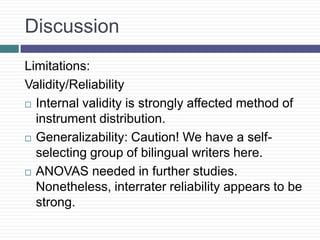
Discussion
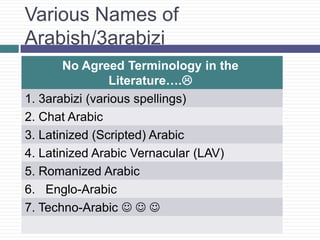
AcknowledgmentsVarious Names of Arabish/3arabizi
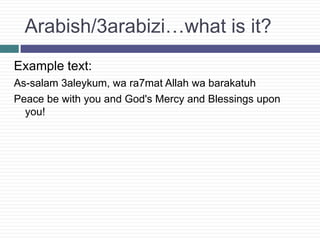
Arabish/3arabizi…what is it?Example text:As-salam 3aleykum, wa ra7matAllah wa barakatuhPeace be with you and God's Mercy and Blessings upon you!
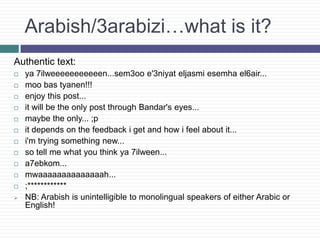
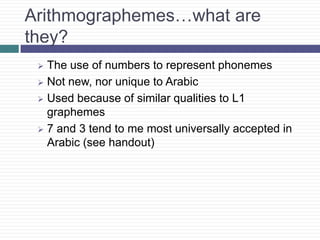
Arabish/3arabizi…what is it?Authentic text:ya 7ilweeeeeeeeeeen...sem3oo e'3niyat eljasmiesemha el6air...moo bas tyanen!!!enjoy this post...it will be the only post through Bandar's eyes...maybe the only... ;pit depends on the feedback i get and how i feel about it...i'm trying something new...so tell me what you think ya 7ilween...a7ebkom...mwaaaaaaaaaaaaaah...;************NB: Arabish is almost unintelligible to monolingual speakers of either Arabic or English!Arithmographemes…what are they? The use of numbers to represent phonemes
Not new, nor unique to Arabic
Used because of similar qualities to L1 graphemes
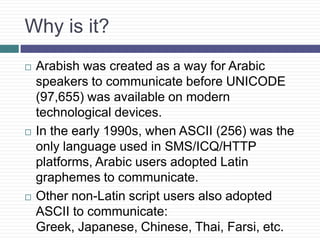
7 and 3 tend to me most universally accepted in Arabic (see handout)Why is it?Arabish was created as a way for Arabic speakers to communicate before UNICODE (97,655) was available on modern technological devices. In the early 1990s, when ASCII (256) was the only language used in SMS/ICQ/HTTP platforms, Arabic users adopted Latin graphemes to communicate. Other non-Latin script users also adopted ASCII to communicate: Greek, Japanese, Chinese, Thai, Farsi, etc.
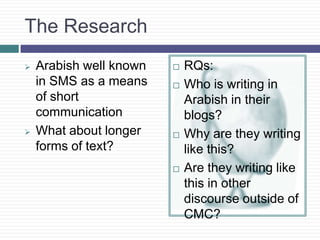
The ResearchArabish well known in SMS as a means of short communication
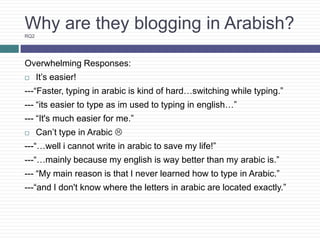
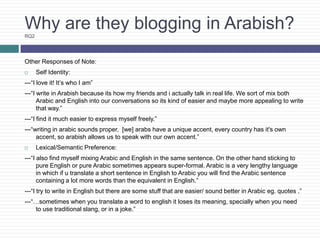
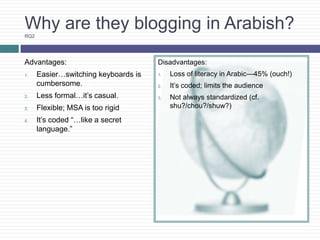
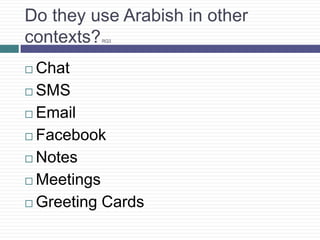
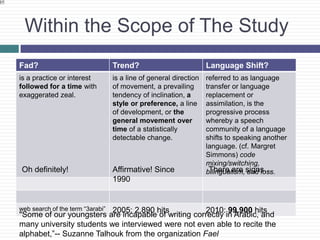
What about longer forms of text?RQs:Who is writing in Arabish in their blogs?Why are they writing like this?Are they writing like this in other discourse outside of CMC?
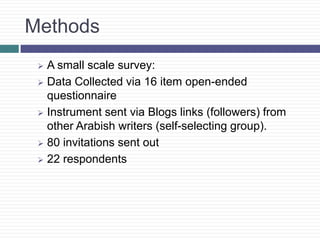
MethodsA small scale survey:
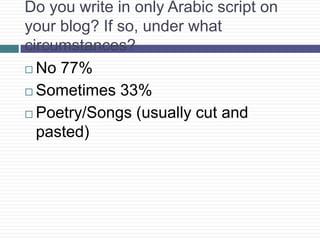
Data collected via 16 item open-ended questionnaire

Arabish

  • 1.
    Arabish:Fad, Trend, orLanguage Shift?Salaam 3leykumAhlanwasahlan
  • 2.
  • 3.
  • 4.
  • 5.
  • 6.
  • 7.
  • 8.
  • 9.
  • 10.
  • 11.
  • 12.
    Arabish/3arabizi…what is it?Exampletext:As-salam 3aleykum, wa ra7matAllah wa barakatuhPeace be with you and God's Mercy and Blessings upon you!
  • 13.
    Arabish/3arabizi…what is it?Authentictext:ya 7ilweeeeeeeeeeen...sem3oo e'3niyat eljasmiesemha el6air...moo bas tyanen!!!enjoy this post...it will be the only post through Bandar's eyes...maybe the only... ;pit depends on the feedback i get and how i feel about it...i'm trying something new...so tell me what you think ya 7ilween...a7ebkom...mwaaaaaaaaaaaaaah...;************NB: Arabish is almost unintelligible to monolingual speakers of either Arabic or English!Arithmographemes…what are they? The use of numbers to represent phonemes
  • 14.
    Not new, norunique to Arabic
  • 15.
    Used because ofsimilar qualities to L1 graphemes
  • 16.
    7 and 3tend to me most universally accepted in Arabic (see handout)Why is it?Arabish was created as a way for Arabic speakers to communicate before UNICODE (97,655) was available on modern technological devices. In the early 1990s, when ASCII (256) was the only language used in SMS/ICQ/HTTP platforms, Arabic users adopted Latin graphemes to communicate. Other non-Latin script users also adopted ASCII to communicate: Greek, Japanese, Chinese, Thai, Farsi, etc.
  • 17.
    The ResearchArabish wellknown in SMS as a means of short communication
  • 18.
    What about longerforms of text?RQs:Who is writing in Arabish in their blogs?Why are they writing like this?Are they writing like this in other discourse outside of CMC?
  • 19.
  • 20.
    Data collected via16 item open-ended questionnaire

Editor's Notes

  • #2 Presentation slide for courses, classes, lectures et al.
  • #3 Beginning course details and/or books/materials needed for a class/project.
  • #4 A schedule design for optional periods of time/objectives.
  • #5 Objectives for instruction and expected results and/or skills developed from learning.
  • #6 Objectives for instruction and expected results and/or skills developed from learning.
  • #7 Relative vocabulary list.
  • #9 A list of procedures and steps, or a lecture slide with media.
  • #10 Relative vocabulary list.
  • #12 A list of procedures and steps, or a lecture slide with media.
  • #15 A list of procedures and steps, or a lecture slide with media.
  • #18 Conclusion to course, lecture, et al.
  • #19 Introductory notes.