Aquaponics at Cambry
August 28th, 2013
Lives Changed… All Around
What is Aquaponics?
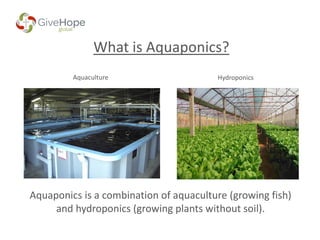
Aquaculture Hydroponics
Aquaponics is a combination of aquaculture (growing fish)
and hydroponics (growing plants without soil).
How the System Works
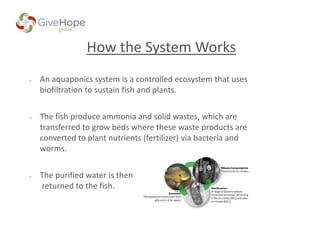
• An aquaponics system is a controlled ecosystem that uses
biofiltration to sustain fish and plants.
• The fish produce ammonia and solid wastes, which are
transferred to grow beds where these waste products are
converted to plant nutrients (fertilizer) via bacteria and
worms.
• The purified water is then
returned to the fish.
How the System Works
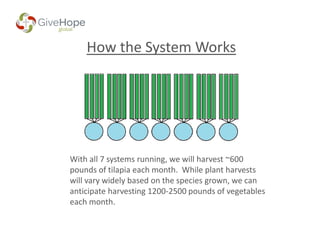
With all 7 systems running, we will harvest ~600
pounds of tilapia each month. While plant harvests
will vary widely based on the species grown, we can
anticipate harvesting 1200-2500 pounds of vegetables
each month.
Aquaponics vs Traditional Farming
Annual yield in
Aquaponics
Annual yield in
Field
Basil 1.55 lbs/ft2 0.48 lbs/ft2
Okra 0.83 lbs/ft2 0.0093lbs/ft2
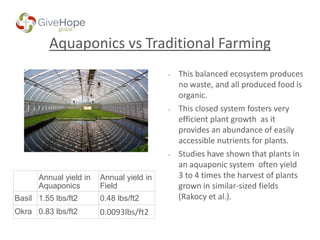
• This balanced ecosystem produces
no waste, and all produced food is
organic.
• This closed system fosters very
efficient plant growth as it
provides an abundance of easily
accessible nutrients for plants.
• Studies have shown that plants in
an aquaponic system often yield
3 to 4 times the harvest of plants
grown in similar-sized fields
(Rakocy et al.).
Cambry's Nutrional Needs
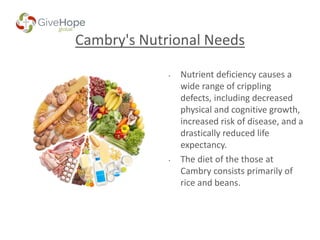
• Nutrient deficiency causes a
wide range of crippling
defects, including decreased
physical and cognitive growth,
increased risk of disease, and a
drastically reduced life
expectancy.
• The diet of the those at
Cambry consists primarily of
rice and beans.
How Cambry Benefits
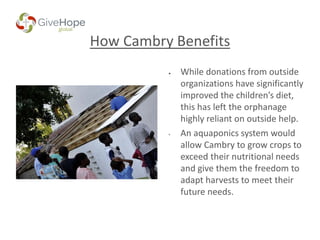
• While donations from outside
organizations have significantly
improved the children’s diet,
this has left the orphanage
highly reliant on outside help.
• An aquaponics system would
allow Cambry to grow crops to
exceed their nutritional needs
and give them the freedom to
adapt harvests to meet their
future needs.
How The Community Benefits
• Once completed, these
aquaponics systems will
bring an agricultural
industry that will, in addition
to feeding those at Cambry,
give them a product to take
to market.
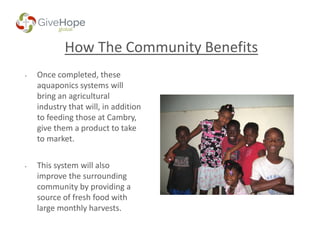
• This system will also
improve the surrounding
community by providing a
source of fresh food with
large monthly harvests.
Short Term Goals
• We plan to build the first
phase of this project starting
October 5th.
• The number of grow beds
supported by the fish is
dependent on the amount of
waste the fish produce.
• We expect to harvest the
first portion of our grow bed
by early December.
Expenses
 Grow Beds – 4 for $6,460 (2 for ~$3,230)
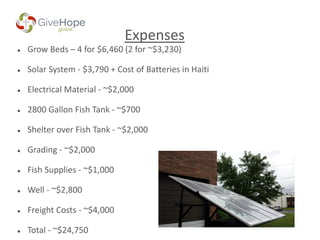
 Solar System - $3,790 + Cost of Batteries in Haiti
 Electrical Material - ~$2,000
 2800 Gallon Fish Tank - ~$700
 Shelter over Fish Tank - ~$2,000
 Grading - ~$2,000
 Fish Supplies - ~$1,000
 Well - ~$2,800
 Freight Costs - ~$4,000
 Total - ~$24,750

Aquaponics at Cambry - Haiti

  • 1.
    Aquaponics at Cambry August28th, 2013 Lives Changed… All Around
  • 2.
    What is Aquaponics? AquacultureHydroponics Aquaponics is a combination of aquaculture (growing fish) and hydroponics (growing plants without soil).
  • 3.
    How the SystemWorks • An aquaponics system is a controlled ecosystem that uses biofiltration to sustain fish and plants. • The fish produce ammonia and solid wastes, which are transferred to grow beds where these waste products are converted to plant nutrients (fertilizer) via bacteria and worms. • The purified water is then returned to the fish.
  • 4.
    How the SystemWorks With all 7 systems running, we will harvest ~600 pounds of tilapia each month. While plant harvests will vary widely based on the species grown, we can anticipate harvesting 1200-2500 pounds of vegetables each month.
  • 5.
    Aquaponics vs TraditionalFarming Annual yield in Aquaponics Annual yield in Field Basil 1.55 lbs/ft2 0.48 lbs/ft2 Okra 0.83 lbs/ft2 0.0093lbs/ft2 • This balanced ecosystem produces no waste, and all produced food is organic. • This closed system fosters very efficient plant growth as it provides an abundance of easily accessible nutrients for plants. • Studies have shown that plants in an aquaponic system often yield 3 to 4 times the harvest of plants grown in similar-sized fields (Rakocy et al.).
  • 6.
    Cambry's Nutrional Needs •Nutrient deficiency causes a wide range of crippling defects, including decreased physical and cognitive growth, increased risk of disease, and a drastically reduced life expectancy. • The diet of the those at Cambry consists primarily of rice and beans.
  • 7.
    How Cambry Benefits •While donations from outside organizations have significantly improved the children’s diet, this has left the orphanage highly reliant on outside help. • An aquaponics system would allow Cambry to grow crops to exceed their nutritional needs and give them the freedom to adapt harvests to meet their future needs.
  • 8.
    How The CommunityBenefits • Once completed, these aquaponics systems will bring an agricultural industry that will, in addition to feeding those at Cambry, give them a product to take to market. • This system will also improve the surrounding community by providing a source of fresh food with large monthly harvests.
  • 9.
    Short Term Goals •We plan to build the first phase of this project starting October 5th. • The number of grow beds supported by the fish is dependent on the amount of waste the fish produce. • We expect to harvest the first portion of our grow bed by early December.
  • 10.
    Expenses  Grow Beds– 4 for $6,460 (2 for ~$3,230)  Solar System - $3,790 + Cost of Batteries in Haiti  Electrical Material - ~$2,000  2800 Gallon Fish Tank - ~$700  Shelter over Fish Tank - ~$2,000  Grading - ~$2,000  Fish Supplies - ~$1,000  Well - ~$2,800  Freight Costs - ~$4,000  Total - ~$24,750