Approaches To Planning
With
Emphasis on Administrative planning
By Hassan Raza Shah
Topics
1. Planning in Public Sector
2. Approaches to Planning
Informal planning
Extended budgeting
Top-down planning
Strategic analysis
Bottom-up planning.
Behavioral approaches
The strategic review
3. The Planning Process
4. Administrative Planning
5. Administrative Planning Process
Planning in Public Sector
Planning is an attempt to manage the future: what
is to be accomplished and how.
A disciplined effort to produce fundamental
decisions shaping the nature and direction of
governmental activities within constitutional
bounds
The best fit between an organization and it’s
environment
Approaches to Planning
Informal planning
Extended budgeting
Top-down planning
Strategic analysis
Bottom-up planning.
Behavioral approaches
The strategic review
Informal Planning
Takes place in someone's mind, and the
decisions reached may not be written down
in any extensive form.
Extended Budgeting
Extended budgeting is rarely used as it is
only feasible if the environment is stable and
predictable. It is primarily financial planning
based on the extrapolation of past trends.
Top-down Planning
Top-down planning relates to decisions
taken at the top of the organization and
passed down to staff members for
implementation.
Strategic Analysis
Strategic Analysis uses planning techniques,
and involves the creation and analytical
evaluation of alternative options.
Bottom-Up Planning
Bottom-up planning involves managers
throughout the organization, and therefore
ensures that people who will be involved in
implementing plans are consulted.
Behavioral approaches
Behavioral approaches can take several
forms, but essentially the behavioral
approach requires that managers spend
time discussing the future opportunities and
threats and areas in which the organization
might develop.
The Strategic Review
The strategic review was developed to take
the best features of other six approaches
and blend them together into a systematic
and comprehensive planning system.
Steps in Strategic Planning
1. Initial agreement among internal and external stakeholders and
decision makers whose support is necessary for successful plan
formulation and implementation
2. Identification of the mandates, or "musts," confronting the
government corporation or agency.
3. Clarification of the organization's mission and values, or "wants."
4. Identification of opportunities and threats
5. Determining strengths and weaknesses
6. Identification of strategic issues (i.e., fundamental policy questions
affecting the organization’s mandates, mission, values, product or service
level and mix, clients or users, cost, financing, or management)
7. Strategy development (i.e., the identification of practical alternatives).
8. Describing the organization’s potential future is the eighth step.
Administrative Planning
Administrative planning is more
productively defined as a process than as
an administrative function, a process which
is intended to be used to help decide on
priorities or actions or on the allocation of
resources
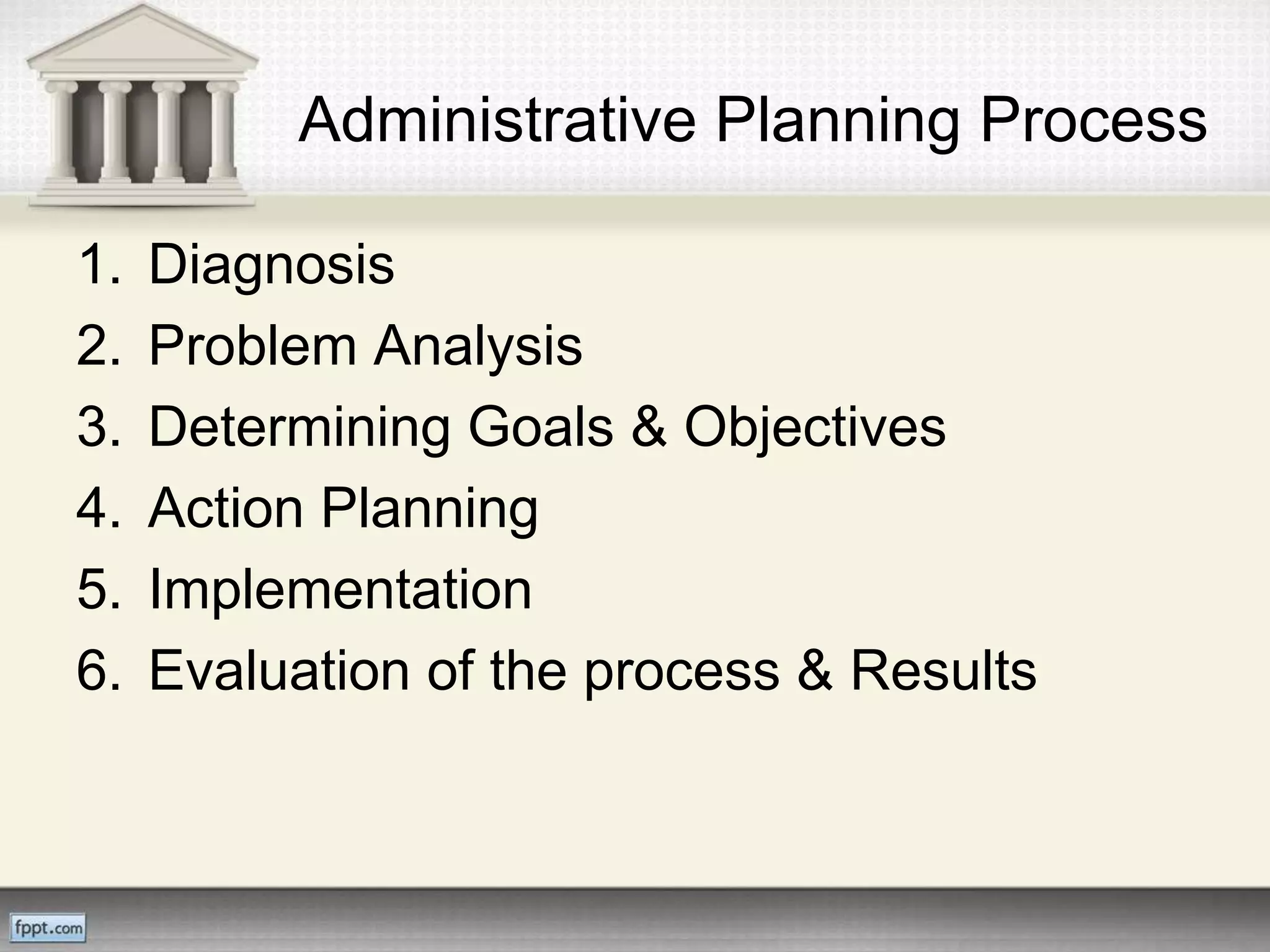
Administrative Planning Process
1. Diagnosis
2. Problem Analysis
3. Determining Goals & Objectives
4. Action Planning
5. Implementation
6. Evaluation of the process & Results

Approaches To Planning by Hassan Raza.ppt

  • 1.
    Approaches To Planning With Emphasison Administrative planning By Hassan Raza Shah
  • 2.
    Topics 1. Planning inPublic Sector 2. Approaches to Planning Informal planning Extended budgeting Top-down planning Strategic analysis Bottom-up planning. Behavioral approaches The strategic review 3. The Planning Process 4. Administrative Planning 5. Administrative Planning Process
  • 3.
    Planning in PublicSector Planning is an attempt to manage the future: what is to be accomplished and how. A disciplined effort to produce fundamental decisions shaping the nature and direction of governmental activities within constitutional bounds The best fit between an organization and it’s environment
  • 4.
    Approaches to Planning Informalplanning Extended budgeting Top-down planning Strategic analysis Bottom-up planning. Behavioral approaches The strategic review
  • 5.
    Informal Planning Takes placein someone's mind, and the decisions reached may not be written down in any extensive form.
  • 6.
    Extended Budgeting Extended budgetingis rarely used as it is only feasible if the environment is stable and predictable. It is primarily financial planning based on the extrapolation of past trends.
  • 7.
    Top-down Planning Top-down planningrelates to decisions taken at the top of the organization and passed down to staff members for implementation.
  • 8.
    Strategic Analysis Strategic Analysisuses planning techniques, and involves the creation and analytical evaluation of alternative options.
  • 9.
    Bottom-Up Planning Bottom-up planninginvolves managers throughout the organization, and therefore ensures that people who will be involved in implementing plans are consulted.
  • 10.
    Behavioral approaches Behavioral approachescan take several forms, but essentially the behavioral approach requires that managers spend time discussing the future opportunities and threats and areas in which the organization might develop.
  • 11.
    The Strategic Review Thestrategic review was developed to take the best features of other six approaches and blend them together into a systematic and comprehensive planning system.
  • 12.
    Steps in StrategicPlanning 1. Initial agreement among internal and external stakeholders and decision makers whose support is necessary for successful plan formulation and implementation 2. Identification of the mandates, or "musts," confronting the government corporation or agency. 3. Clarification of the organization's mission and values, or "wants." 4. Identification of opportunities and threats 5. Determining strengths and weaknesses 6. Identification of strategic issues (i.e., fundamental policy questions affecting the organization’s mandates, mission, values, product or service level and mix, clients or users, cost, financing, or management) 7. Strategy development (i.e., the identification of practical alternatives). 8. Describing the organization’s potential future is the eighth step.
  • 13.
    Administrative Planning Administrative planningis more productively defined as a process than as an administrative function, a process which is intended to be used to help decide on priorities or actions or on the allocation of resources
  • 14.
    Administrative Planning Process 1.Diagnosis 2. Problem Analysis 3. Determining Goals & Objectives 4. Action Planning 5. Implementation 6. Evaluation of the process & Results