By: Louie John A. Devera
Strategic Management
- refers to the goal of establishing a good fit between an organization and its
environment. Golensky and Hager (2020)
Strategic Planning
- is a disciplined effort to produce fundamental decisions and actions that shape the
organization’s future. It is defining the organization’s mission, vision, and values;
assessing its internal strengths and weaknesses; identifying its external
opportunities and threats; and developing strategies to achieve its goals. Bryson, J.M
(1988)
2
Other Views of Strategic Planning
- Is the beginning of the process that leads to the desired ends of strategic
management.
- “ fulfillment of the mission, meeting the mandates, continuous learning, and
sustained creation of public value”
3
Two Major impact of
usefulness of the Strategic
Planning Process
1. The care and deliberation during the preliminary conception process
2. The organization-wide commitment sustained throughout the planning process
The organization will determine the period of time for which strategic goals are set by
considering the:
a. An availability of resources
b. The volatility of the marketplace
4
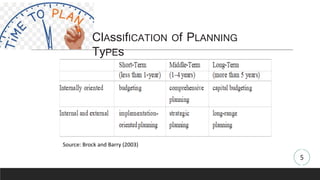
Source: Brock and Barry (2003)
ClAssIfICATION Of PLANNING
TyPEs
5
5
5
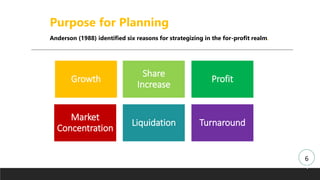
Anderson (1988) identified six reasons for strategizing in the for-profit realm.
Growth
Share
Increase
Profit
Market
Concentration
Liquidation Turnaround
Purpose for Planning
6
4
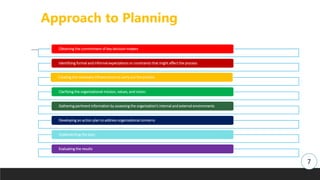
Approach to Planning
Obtaining the commitment of key decision-makers
Identifying formal and informal expectations or constraints that might affect the process
Creating the necessary infrastructure to carry out the process
Clarifying the organizational mission, values, and vision:
Gathering pertinent information by assessing the organization’s internal and external environments
Developing an action plan to address organizational concerns
Implementing the plan:
Evaluating the results
7
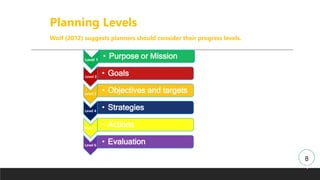
Wolf (2012) suggests planners should consider their progress levels.
Planning Levels
8
4
Level 1
• Purpose or Mission
Level 2
• Goals
Level 3
• Objectives and targets
Level 4
• Strategies
Level 5
• Actions
Level 6
• Evaluation
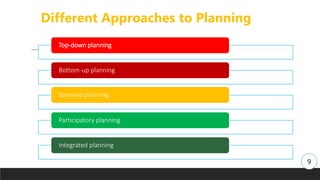
Different Approaches to Planning
Top-down planning
Bottom-up planning
Scenario planning
Participatory planning
Integrated planning
9
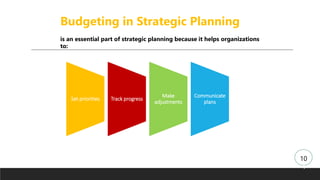
Budgeting in Strategic Planning
is an essential part of strategic planning because it helps organizations
to:
10
4
Set priorities Track progress
Make
adjustments
Communicate
plans
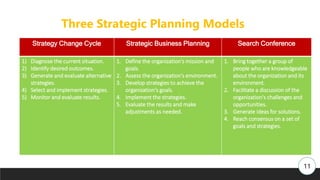
Three Strategic Planning Models
11
Strategy Change Cycle Strategic Business Planning Search Conference
1) Diagnose the current situation.
2) Identify desired outcomes.
3) Generate and evaluate alternative
strategies.
4) Select and implement strategies.
5) Monitor and evaluate results.
1. Define the organization's mission and
goals.
2. Assess the organization's environment.
3. Develop strategies to achieve the
organization's goals.
4. Implement the strategies.
5. Evaluate the results and make
adjustments as needed.
1. Bring together a group of
people who are knowledgeable
about the organization and its
environment.
2. Facilitate a discussion of the
organization's challenges and
opportunities.
3. Generate ideas for solutions.
4. Reach consensus on a set of
goals and strategies.

Strategic Planning.pptx

  • 1.
    By: Louie JohnA. Devera
  • 2.
    Strategic Management - refersto the goal of establishing a good fit between an organization and its environment. Golensky and Hager (2020) Strategic Planning - is a disciplined effort to produce fundamental decisions and actions that shape the organization’s future. It is defining the organization’s mission, vision, and values; assessing its internal strengths and weaknesses; identifying its external opportunities and threats; and developing strategies to achieve its goals. Bryson, J.M (1988) 2
  • 3.
    Other Views ofStrategic Planning - Is the beginning of the process that leads to the desired ends of strategic management. - “ fulfillment of the mission, meeting the mandates, continuous learning, and sustained creation of public value” 3
  • 4.
    Two Major impactof usefulness of the Strategic Planning Process 1. The care and deliberation during the preliminary conception process 2. The organization-wide commitment sustained throughout the planning process The organization will determine the period of time for which strategic goals are set by considering the: a. An availability of resources b. The volatility of the marketplace 4
  • 5.
    Source: Brock andBarry (2003) ClAssIfICATION Of PLANNING TyPEs 5 5 5
  • 6.
    Anderson (1988) identifiedsix reasons for strategizing in the for-profit realm. Growth Share Increase Profit Market Concentration Liquidation Turnaround Purpose for Planning 6 4
  • 7.
    Approach to Planning Obtainingthe commitment of key decision-makers Identifying formal and informal expectations or constraints that might affect the process Creating the necessary infrastructure to carry out the process Clarifying the organizational mission, values, and vision: Gathering pertinent information by assessing the organization’s internal and external environments Developing an action plan to address organizational concerns Implementing the plan: Evaluating the results 7
  • 8.
    Wolf (2012) suggestsplanners should consider their progress levels. Planning Levels 8 4 Level 1 • Purpose or Mission Level 2 • Goals Level 3 • Objectives and targets Level 4 • Strategies Level 5 • Actions Level 6 • Evaluation
  • 9.
    Different Approaches toPlanning Top-down planning Bottom-up planning Scenario planning Participatory planning Integrated planning 9
  • 10.
    Budgeting in StrategicPlanning is an essential part of strategic planning because it helps organizations to: 10 4 Set priorities Track progress Make adjustments Communicate plans
  • 11.
    Three Strategic PlanningModels 11 Strategy Change Cycle Strategic Business Planning Search Conference 1) Diagnose the current situation. 2) Identify desired outcomes. 3) Generate and evaluate alternative strategies. 4) Select and implement strategies. 5) Monitor and evaluate results. 1. Define the organization's mission and goals. 2. Assess the organization's environment. 3. Develop strategies to achieve the organization's goals. 4. Implement the strategies. 5. Evaluate the results and make adjustments as needed. 1. Bring together a group of people who are knowledgeable about the organization and its environment. 2. Facilitate a discussion of the organization's challenges and opportunities. 3. Generate ideas for solutions. 4. Reach consensus on a set of goals and strategies.