Approach to a Rheumatologic Patient:Approach to a Rheumatologic Patient:
History, Physical Examination andHistory, Physical Examination and
Laboratory StudiesLaboratory Studies
Tahir Khan, M.D., FACP, FACRTahir Khan, M.D., FACP, FACR
Consultant RheumatologistConsultant Rheumatologist
Mafraq HospitalMafraq Hospital
Common ComplaintsCommon Complaints
 PainPain
 StiffnessStiffness
 LockingLocking
 SwellingSwelling
 FatigueFatigue
 Cracking and clicking of jointsCracking and clicking of joints
HistoryHistory
 Acute or chronicAcute or chronic
 Migratory, additive, or intermittentMigratory, additive, or intermittent
 Is the process articular or non articularIs the process articular or non articular
 If articular, whether inflammatory or non-If articular, whether inflammatory or non-
inflammatory (jt. Swelling, stiffness, decreasedinflammatory (jt. Swelling, stiffness, decreased
ROM)ROM)
 Addition clues like age, joint distribution,Addition clues like age, joint distribution,
symmetry, extra-articular.symmetry, extra-articular.
 Other medical illnessesOther medical illnesses
 FHFH
Physical ExaminationPhysical Examination
QuestionQuestion
 74 year old male with history of NHL presents74 year old male with history of NHL presents
with pain and swelling of his hands for 3 weeks.with pain and swelling of his hands for 3 weeks.
He noticed swelling of her feet as well. He isHe noticed swelling of her feet as well. He is
unable to close his hands or make his fists and itunable to close his hands or make his fists and it
takes him 2-3 hours to feel slight better daily. Hetakes him 2-3 hours to feel slight better daily. He
denied any other symptoms. MSK exam revealdenied any other symptoms. MSK exam reveal
soft tissue swelling of her dorsum hands and feet.soft tissue swelling of her dorsum hands and feet.
He has synovitis of his 2-5 MCPs, PIPs with in hisHe has synovitis of his 2-5 MCPs, PIPs with in his
bilateral MCPs. Labs done by his PCP revealbilateral MCPs. Labs done by his PCP reveal
negative RF, CCP, What is the most likelynegative RF, CCP, What is the most likely
diagnosis.diagnosis.
Question (continued)Question (continued)
 What is the most likely diagnosis?What is the most likely diagnosis?
 A) Rheumatoid arthritisA) Rheumatoid arthritis
 B) Polymyalgia rheumaticaB) Polymyalgia rheumatica
 C) LofgrenC) Lofgren’s syndrome’s syndrome
 D) Remitting seronegativeD) Remitting seronegative
symmetrical synovitis with pittingsymmetrical synovitis with pitting
edema (RS3PE)edema (RS3PE)
 E) Recurrence of NHLE) Recurrence of NHL
Physical ExaminationPhysical Examination
 Vitals: Fever, tachycardia (pericarditis, anemia),Vitals: Fever, tachycardia (pericarditis, anemia),
tachypnea, hypertension (systemic process),tachypnea, hypertension (systemic process),
weight, height (loss of 2 cm = new vertebralweight, height (loss of 2 cm = new vertebral
fracture).fracture).
 Head and Neck: Alopecia, ocular inflammationHead and Neck: Alopecia, ocular inflammation
(think SpA), oral ulcers (painless with reactive(think SpA), oral ulcers (painless with reactive
arthritis, painful with enteropathic arthritis), nasalarthritis, painful with enteropathic arthritis), nasal
ulcerations, discharge or bleeding (vasculitis-ulcerations, discharge or bleeding (vasculitis-
GPA), malar rash, telangectasia,GPA), malar rash, telangectasia,
lymphadenopathy, parotid or salivary glandlymphadenopathy, parotid or salivary gland
enlargement, dry mouth, dental carries, thyroid,enlargement, dry mouth, dental carries, thyroid,
scalp tenderness.scalp tenderness.
Physical ExaminationPhysical Examination
 Head & Neck: Scalp tenderness, ear cartilage.Head & Neck: Scalp tenderness, ear cartilage.
 Chest: Tachypnea, crackles (ILD withChest: Tachypnea, crackles (ILD with
rheumatic diseases), wheezing, pleuralrheumatic diseases), wheezing, pleural
effusions (SLE or RA), chest expansion.effusions (SLE or RA), chest expansion.
 CVS: Murmurs (RF, endocarditis), rubsCVS: Murmurs (RF, endocarditis), rubs
(SLE,RA), loss of pulses, asymmetrical BP,(SLE,RA), loss of pulses, asymmetrical BP,
bruits (think large vessel vasculitis).bruits (think large vessel vasculitis).
 Skin and Nails: Psoriasis, rashes (think SLE),Skin and Nails: Psoriasis, rashes (think SLE),
periungual erythema (think CTD), livedoperiungual erythema (think CTD), livedo
reticularis (think SLE with APS, or vasculitis).reticularis (think SLE with APS, or vasculitis).
Physical ExaminationPhysical Examination
 Skin and Nails: Photosensitivity, ErythemaSkin and Nails: Photosensitivity, Erythema
nodosum (think enteropathic arthritis,nodosum (think enteropathic arthritis,
sarcoid), erythema migrans (lyme),sarcoid), erythema migrans (lyme),
telangiectasia (think CREST, scleroderma),telangiectasia (think CREST, scleroderma),
pustular skin lesions (think disseminatedpustular skin lesions (think disseminated
gonococcal infection), nodules (RA, tophi),gonococcal infection), nodules (RA, tophi),
subcutaneous calcifications, lesions on palmssubcutaneous calcifications, lesions on palms
and soles (pustular psoriasis orand soles (pustular psoriasis or
keratoderma=reactive), lesions on glanskeratoderma=reactive), lesions on glans
penis (think circinate balanitis=reactive),penis (think circinate balanitis=reactive),
gottrongottron’s plaques (DM dermatomyositis ),’s plaques (DM dermatomyositis ),
Heliotrope (DM), Shawl sign, Tethered skin,Heliotrope (DM), Shawl sign, Tethered skin,
Raynaud’s.Raynaud’s.
Physical ExaminationPhysical Examination
 Skin and Nails: DesquamationSkin and Nails: Desquamation
palms/strawberry tongue (Kawasakipalms/strawberry tongue (Kawasaki’s).’s).
 Abdomen: Tenderness (BehcetAbdomen: Tenderness (Behcet’s, HSP, SLE,’s, HSP, SLE,
PAN), Look for masses, organomegaly, bruits.PAN), Look for masses, organomegaly, bruits.
 Neurologic: Neuropathy (vasculitis), carpalNeurologic: Neuropathy (vasculitis), carpal
tunnel syndrome (RA, pregnancy,tunnel syndrome (RA, pregnancy,
hypothyroidism, amyloidosis), CNShypothyroidism, amyloidosis), CNS
abnormalities like encephahopathy (SLE).abnormalities like encephahopathy (SLE).
MSK ExaminationMSK Examination
 Goal: Whether joint is normal or abnormalGoal: Whether joint is normal or abnormal
 If abnormal, is it inflammatory orIf abnormal, is it inflammatory or
degenerative joint disease.degenerative joint disease.
 Joint swelling (fluid, hypertrophied synoviumJoint swelling (fluid, hypertrophied synovium
or from bony enlargement)or from bony enlargement)
 Examine all joints using the same approach:Examine all joints using the same approach:
InspectionInspection
PalpationPalpation
Range of motionRange of motion
Special testsSpecial tests
Wrist ExaminationWrist Examination
 Tinel sign: Tap over the median nerve lateral toTinel sign: Tap over the median nerve lateral to
Palmaris longus tendon whilst extending thePalmaris longus tendon whilst extending the
wrist.wrist.
 Phalens test: Flexion of the wrists producesPhalens test: Flexion of the wrists produces
aggravation of carpal tunnel symptoms.aggravation of carpal tunnel symptoms.
Shoulder ExaminationShoulder Examination
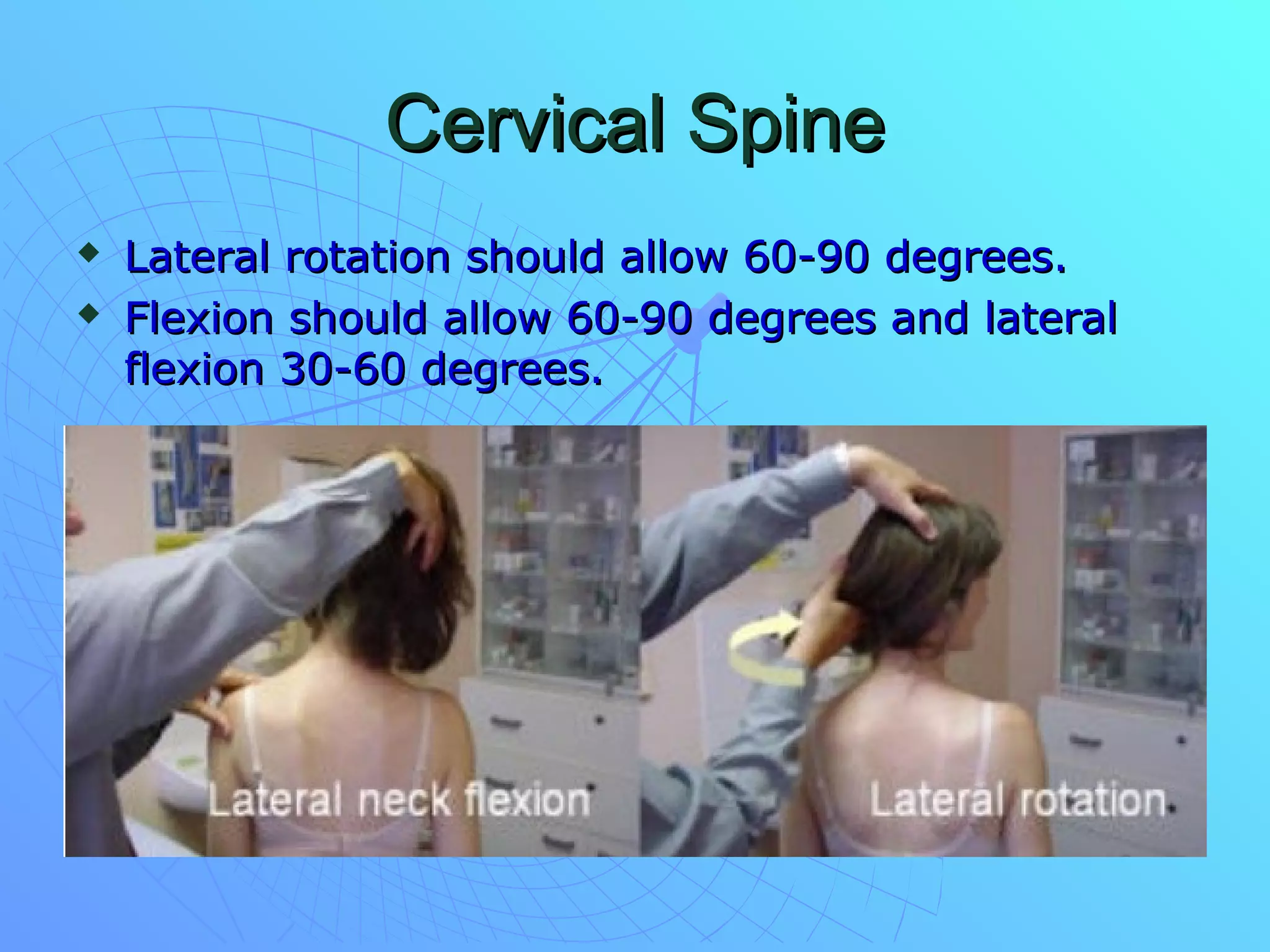
Cervical SpineCervical Spine
 Lateral rotation should allow 60-90 degrees.Lateral rotation should allow 60-90 degrees.
 Flexion should allow 60-90 degrees and lateralFlexion should allow 60-90 degrees and lateral
flexion 30-60 degrees.flexion 30-60 degrees.
Thoracic SpineThoracic Spine
 The thoracic spine allows 45 – 75 degrees ofThe thoracic spine allows 45 – 75 degrees of
rotation.rotation.

Chest expansion should be greater than 4 cmChest expansion should be greater than 4 cm..
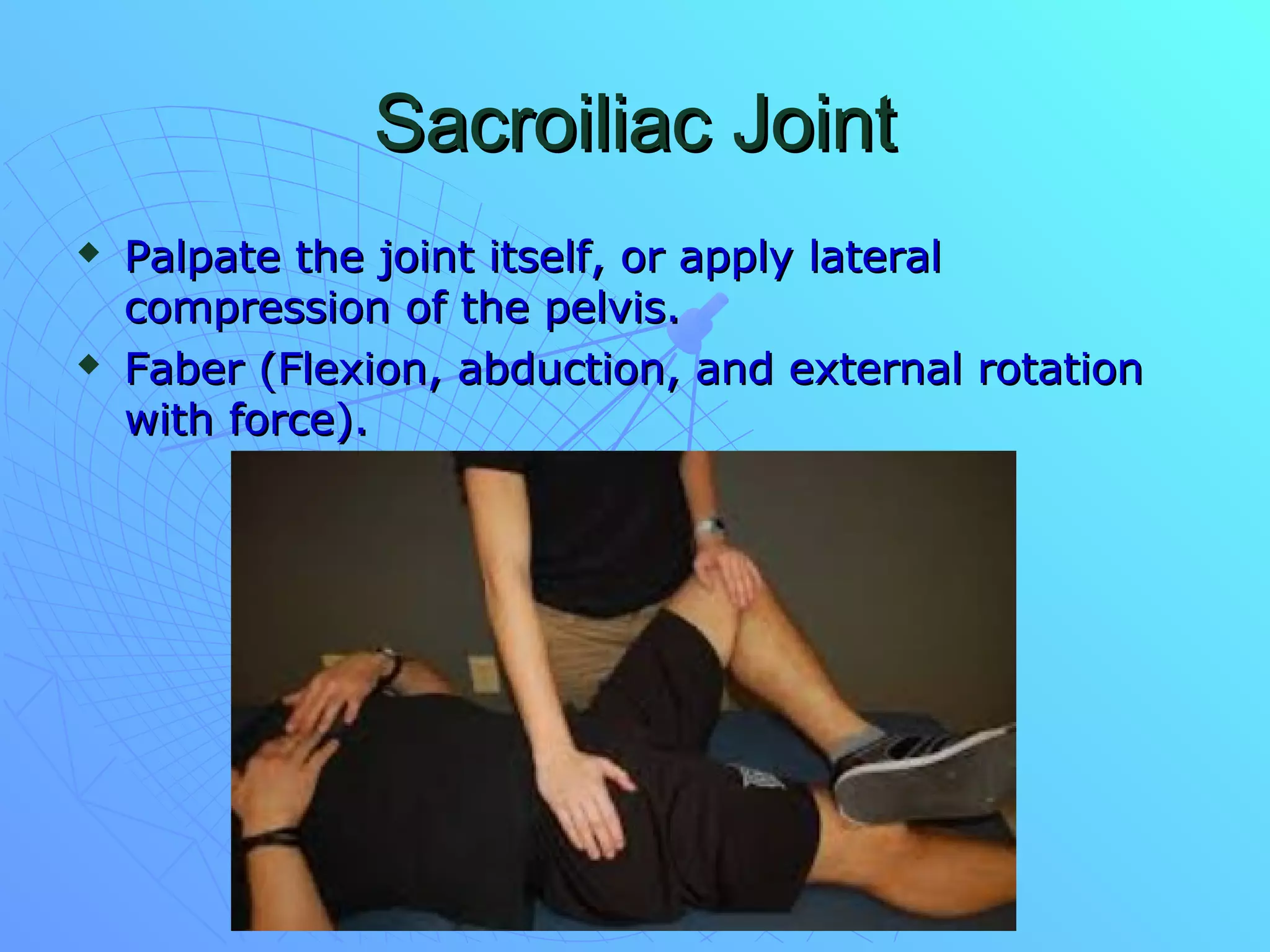
Sacroiliac JointSacroiliac Joint
 Palpate the joint itself, or apply lateralPalpate the joint itself, or apply lateral
compression of the pelvis.compression of the pelvis.
 Faber (Flexion, abduction, and external rotationFaber (Flexion, abduction, and external rotation
with force).with force).
Hip JointHip Joint
Knee JointKnee Joint
Trigger Point ExaminationTrigger Point Examination
Special TestsSpecial Tests
 GowerGower’s sign: Patient attempts to rise from a’s sign: Patient attempts to rise from a
chair by climbing up legs with his handschair by climbing up legs with his hands
 Use an ophthalmoscope or otoscope to seeUse an ophthalmoscope or otoscope to see
red dots or lines at periungual areas, look forred dots or lines at periungual areas, look for
superficial dilated capillaries, drop out ofsuperficial dilated capillaries, drop out of
capillaries with dilatation and hypertrophy ofcapillaries with dilatation and hypertrophy of
remaining vessels.remaining vessels.
Special TestsSpecial Tests
 Persons withPersons with
SjogrenSjogren’s moisten’s moisten
less than 5 mm inless than 5 mm in
5 minutes.5 minutes.
Laboratory Studies inLaboratory Studies in
Rheumatic DiseasesRheumatic Diseases
DO WE NEED LABS?DO WE NEED LABS?
 Most Rheumatic conditions areMost Rheumatic conditions are
diagnosed clinically.diagnosed clinically.
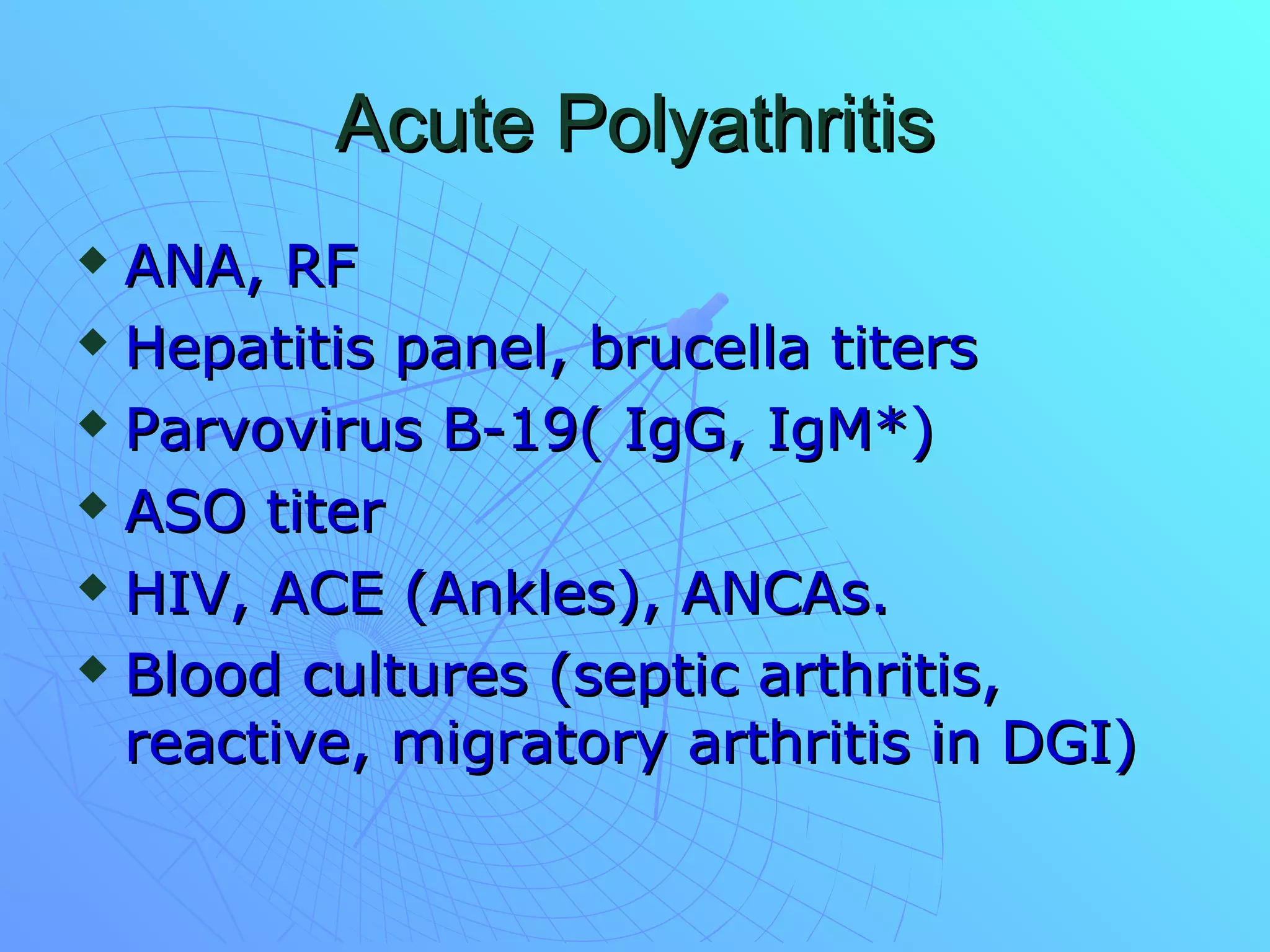
Acute PolyathritisAcute Polyathritis
 ANA, RFANA, RF
 Hepatitis panel, brucella titersHepatitis panel, brucella titers
 Parvovirus B-19( IgG, IgM*)Parvovirus B-19( IgG, IgM*)
 ASO titerASO titer
 HIV, ACE (Ankles), ANCAs.HIV, ACE (Ankles), ANCAs.
 Blood cultures (septic arthritis,Blood cultures (septic arthritis,
reactive, migratory arthritis in DGI)reactive, migratory arthritis in DGI)
Chronic PolyarthritisChronic Polyarthritis
 CBCCBC
 ESR, CRPESR, CRP
 ANAANA
 RF, Anti-CCP antibodyRF, Anti-CCP antibody
 CMPCMP
 S. uric acidS. uric acid
 ANCAANCA
 TSH, Ferritin, transferrinTSH, Ferritin, transferrin
 Urine analysisUrine analysis
Synovial Fluid AnalysisSynovial Fluid Analysis
 Most CTD have Class II inflammatory SF-Most CTD have Class II inflammatory SF-
yellow/ whiteyellow/ white
- transparent/ opaque- transparent/ opaque
- variable viscosity and mucin clot- variable viscosity and mucin clot
- WBC count 2000- 100,000- WBC count 2000- 100,000
- > 50% PMN- > 50% PMN’s’s
- Culture -ve- Culture -ve
- Indolent/ low virulent infections may- Indolent/ low virulent infections may
coexist.coexist.
- Cholesterol (chronic), steroid- Cholesterol (chronic), steroid
(injected) and other crystals.(injected) and other crystals.
ENAsENAs
 Antigens extracted from rabbit, calfAntigens extracted from rabbit, calf
thymus, or human spleen. Antibodiesthymus, or human spleen. Antibodies
react with nucleic acid bindingreact with nucleic acid binding
proteins.proteins.
 ENA- 4 : Anti-SSA & SSB- linkedENA- 4 : Anti-SSA & SSB- linked
Anti-Sm & RNP- linkedAnti-Sm & RNP- linked
 ENA- 6: Above + Anti-Scl70 & Jo-1ENA- 6: Above + Anti-Scl70 & Jo-1
Anti- cardiolipin AntibodiesAnti- cardiolipin Antibodies
 Check in lupus patient, if Hx of DVT, arterialCheck in lupus patient, if Hx of DVT, arterial
thrombosis, stroke, miscarriages.thrombosis, stroke, miscarriages.
 TESTS: ACLA *: IgG, IgM, IgA (moderate toTESTS: ACLA *: IgG, IgM, IgA (moderate to
high titers - ELISAhigh titers - ELISA
Lupus anticoagulant*- 20%- specific-Lupus anticoagulant*- 20%- specific-
functional assayfunctional assay
(prolonged PTT, RVVT, Kaolin clotting(prolonged PTT, RVVT, Kaolin clotting
time)time)
(B2GP2 or prothrombin)- not corrected(B2GP2 or prothrombin)- not corrected
in APLA syndrome by adding normal serum,in APLA syndrome by adding normal serum,
corrects in clotting factor deficiency.corrects in clotting factor deficiency.
(phospholipid addition corrects it)(phospholipid addition corrects it)
Anti- B2GP1 AB (co-factor) – moreAnti- B2GP1 AB (co-factor) – more
specific.specific.
Repeat in 8-10 weeks to confirmRepeat in 8-10 weeks to confirm
Monosodium urate crystalsMonosodium urate crystals
Crystal examinationCrystal examination
CPPDCPPD
Chondrocalcinosis orChondrocalcinosis or
PseudogoutPseudogout
 Weakly + birefringent rectangular crystalsWeakly + birefringent rectangular crystals
on polarized microscopy.on polarized microscopy.
 SF type II inflamm.SF type II inflamm.
 Remember list of disease associations:Remember list of disease associations:
Hyperparathyroidism, Hemochromatosis,Hyperparathyroidism, Hemochromatosis,
hypomagnesemia and phosphatasia,hypomagnesemia and phosphatasia,
ochronosis, Wilsonochronosis, Wilson’s, DM, OA, acromegaly’s, DM, OA, acromegaly
etc.)etc.)
CPPD crystalsCPPD crystals
Crystal examinationCrystal examinationCrystal examinationCrystal examinationCrystal examination
SLE Disease Monitoring LabsSLE Disease Monitoring Labs
 ??
QuestionsQuestions
THANK YOU!THANK YOU!

Approach to a rheumatologic patient

  • 1.
    Approach to aRheumatologic Patient:Approach to a Rheumatologic Patient: History, Physical Examination andHistory, Physical Examination and Laboratory StudiesLaboratory Studies Tahir Khan, M.D., FACP, FACRTahir Khan, M.D., FACP, FACR Consultant RheumatologistConsultant Rheumatologist Mafraq HospitalMafraq Hospital
  • 2.
    Common ComplaintsCommon Complaints PainPain  StiffnessStiffness  LockingLocking  SwellingSwelling  FatigueFatigue  Cracking and clicking of jointsCracking and clicking of joints
  • 4.
    HistoryHistory  Acute orchronicAcute or chronic  Migratory, additive, or intermittentMigratory, additive, or intermittent  Is the process articular or non articularIs the process articular or non articular  If articular, whether inflammatory or non-If articular, whether inflammatory or non- inflammatory (jt. Swelling, stiffness, decreasedinflammatory (jt. Swelling, stiffness, decreased ROM)ROM)  Addition clues like age, joint distribution,Addition clues like age, joint distribution, symmetry, extra-articular.symmetry, extra-articular.  Other medical illnessesOther medical illnesses  FHFH
  • 5.
  • 7.
    QuestionQuestion  74 yearold male with history of NHL presents74 year old male with history of NHL presents with pain and swelling of his hands for 3 weeks.with pain and swelling of his hands for 3 weeks. He noticed swelling of her feet as well. He isHe noticed swelling of her feet as well. He is unable to close his hands or make his fists and itunable to close his hands or make his fists and it takes him 2-3 hours to feel slight better daily. Hetakes him 2-3 hours to feel slight better daily. He denied any other symptoms. MSK exam revealdenied any other symptoms. MSK exam reveal soft tissue swelling of her dorsum hands and feet.soft tissue swelling of her dorsum hands and feet. He has synovitis of his 2-5 MCPs, PIPs with in hisHe has synovitis of his 2-5 MCPs, PIPs with in his bilateral MCPs. Labs done by his PCP revealbilateral MCPs. Labs done by his PCP reveal negative RF, CCP, What is the most likelynegative RF, CCP, What is the most likely diagnosis.diagnosis.
  • 9.
    Question (continued)Question (continued) What is the most likely diagnosis?What is the most likely diagnosis?  A) Rheumatoid arthritisA) Rheumatoid arthritis  B) Polymyalgia rheumaticaB) Polymyalgia rheumatica  C) LofgrenC) Lofgren’s syndrome’s syndrome  D) Remitting seronegativeD) Remitting seronegative symmetrical synovitis with pittingsymmetrical synovitis with pitting edema (RS3PE)edema (RS3PE)  E) Recurrence of NHLE) Recurrence of NHL
  • 13.
    Physical ExaminationPhysical Examination Vitals: Fever, tachycardia (pericarditis, anemia),Vitals: Fever, tachycardia (pericarditis, anemia), tachypnea, hypertension (systemic process),tachypnea, hypertension (systemic process), weight, height (loss of 2 cm = new vertebralweight, height (loss of 2 cm = new vertebral fracture).fracture).  Head and Neck: Alopecia, ocular inflammationHead and Neck: Alopecia, ocular inflammation (think SpA), oral ulcers (painless with reactive(think SpA), oral ulcers (painless with reactive arthritis, painful with enteropathic arthritis), nasalarthritis, painful with enteropathic arthritis), nasal ulcerations, discharge or bleeding (vasculitis-ulcerations, discharge or bleeding (vasculitis- GPA), malar rash, telangectasia,GPA), malar rash, telangectasia, lymphadenopathy, parotid or salivary glandlymphadenopathy, parotid or salivary gland enlargement, dry mouth, dental carries, thyroid,enlargement, dry mouth, dental carries, thyroid, scalp tenderness.scalp tenderness.
  • 14.
    Physical ExaminationPhysical Examination Head & Neck: Scalp tenderness, ear cartilage.Head & Neck: Scalp tenderness, ear cartilage.  Chest: Tachypnea, crackles (ILD withChest: Tachypnea, crackles (ILD with rheumatic diseases), wheezing, pleuralrheumatic diseases), wheezing, pleural effusions (SLE or RA), chest expansion.effusions (SLE or RA), chest expansion.  CVS: Murmurs (RF, endocarditis), rubsCVS: Murmurs (RF, endocarditis), rubs (SLE,RA), loss of pulses, asymmetrical BP,(SLE,RA), loss of pulses, asymmetrical BP, bruits (think large vessel vasculitis).bruits (think large vessel vasculitis).  Skin and Nails: Psoriasis, rashes (think SLE),Skin and Nails: Psoriasis, rashes (think SLE), periungual erythema (think CTD), livedoperiungual erythema (think CTD), livedo reticularis (think SLE with APS, or vasculitis).reticularis (think SLE with APS, or vasculitis).
  • 15.
    Physical ExaminationPhysical Examination Skin and Nails: Photosensitivity, ErythemaSkin and Nails: Photosensitivity, Erythema nodosum (think enteropathic arthritis,nodosum (think enteropathic arthritis, sarcoid), erythema migrans (lyme),sarcoid), erythema migrans (lyme), telangiectasia (think CREST, scleroderma),telangiectasia (think CREST, scleroderma), pustular skin lesions (think disseminatedpustular skin lesions (think disseminated gonococcal infection), nodules (RA, tophi),gonococcal infection), nodules (RA, tophi), subcutaneous calcifications, lesions on palmssubcutaneous calcifications, lesions on palms and soles (pustular psoriasis orand soles (pustular psoriasis or keratoderma=reactive), lesions on glanskeratoderma=reactive), lesions on glans penis (think circinate balanitis=reactive),penis (think circinate balanitis=reactive), gottrongottron’s plaques (DM dermatomyositis ),’s plaques (DM dermatomyositis ), Heliotrope (DM), Shawl sign, Tethered skin,Heliotrope (DM), Shawl sign, Tethered skin, Raynaud’s.Raynaud’s.
  • 18.
    Physical ExaminationPhysical Examination Skin and Nails: DesquamationSkin and Nails: Desquamation palms/strawberry tongue (Kawasakipalms/strawberry tongue (Kawasaki’s).’s).  Abdomen: Tenderness (BehcetAbdomen: Tenderness (Behcet’s, HSP, SLE,’s, HSP, SLE, PAN), Look for masses, organomegaly, bruits.PAN), Look for masses, organomegaly, bruits.  Neurologic: Neuropathy (vasculitis), carpalNeurologic: Neuropathy (vasculitis), carpal tunnel syndrome (RA, pregnancy,tunnel syndrome (RA, pregnancy, hypothyroidism, amyloidosis), CNShypothyroidism, amyloidosis), CNS abnormalities like encephahopathy (SLE).abnormalities like encephahopathy (SLE).
  • 19.
    MSK ExaminationMSK Examination Goal: Whether joint is normal or abnormalGoal: Whether joint is normal or abnormal  If abnormal, is it inflammatory orIf abnormal, is it inflammatory or degenerative joint disease.degenerative joint disease.  Joint swelling (fluid, hypertrophied synoviumJoint swelling (fluid, hypertrophied synovium or from bony enlargement)or from bony enlargement)  Examine all joints using the same approach:Examine all joints using the same approach: InspectionInspection PalpationPalpation Range of motionRange of motion Special testsSpecial tests
  • 24.
    Wrist ExaminationWrist Examination Tinel sign: Tap over the median nerve lateral toTinel sign: Tap over the median nerve lateral to Palmaris longus tendon whilst extending thePalmaris longus tendon whilst extending the wrist.wrist.  Phalens test: Flexion of the wrists producesPhalens test: Flexion of the wrists produces aggravation of carpal tunnel symptoms.aggravation of carpal tunnel symptoms.
  • 26.
  • 27.
    Cervical SpineCervical Spine Lateral rotation should allow 60-90 degrees.Lateral rotation should allow 60-90 degrees.  Flexion should allow 60-90 degrees and lateralFlexion should allow 60-90 degrees and lateral flexion 30-60 degrees.flexion 30-60 degrees.
  • 28.
    Thoracic SpineThoracic Spine The thoracic spine allows 45 – 75 degrees ofThe thoracic spine allows 45 – 75 degrees of rotation.rotation.  Chest expansion should be greater than 4 cmChest expansion should be greater than 4 cm..
  • 29.
    Sacroiliac JointSacroiliac Joint Palpate the joint itself, or apply lateralPalpate the joint itself, or apply lateral compression of the pelvis.compression of the pelvis.  Faber (Flexion, abduction, and external rotationFaber (Flexion, abduction, and external rotation with force).with force).
  • 32.
  • 33.
  • 36.
  • 37.
    Special TestsSpecial Tests GowerGower’s sign: Patient attempts to rise from a’s sign: Patient attempts to rise from a chair by climbing up legs with his handschair by climbing up legs with his hands  Use an ophthalmoscope or otoscope to seeUse an ophthalmoscope or otoscope to see red dots or lines at periungual areas, look forred dots or lines at periungual areas, look for superficial dilated capillaries, drop out ofsuperficial dilated capillaries, drop out of capillaries with dilatation and hypertrophy ofcapillaries with dilatation and hypertrophy of remaining vessels.remaining vessels.
  • 38.
    Special TestsSpecial Tests Persons withPersons with SjogrenSjogren’s moisten’s moisten less than 5 mm inless than 5 mm in 5 minutes.5 minutes.
  • 42.
    Laboratory Studies inLaboratoryStudies in Rheumatic DiseasesRheumatic Diseases
  • 43.
    DO WE NEEDLABS?DO WE NEED LABS?  Most Rheumatic conditions areMost Rheumatic conditions are diagnosed clinically.diagnosed clinically.
  • 44.
    Acute PolyathritisAcute Polyathritis ANA, RFANA, RF  Hepatitis panel, brucella titersHepatitis panel, brucella titers  Parvovirus B-19( IgG, IgM*)Parvovirus B-19( IgG, IgM*)  ASO titerASO titer  HIV, ACE (Ankles), ANCAs.HIV, ACE (Ankles), ANCAs.  Blood cultures (septic arthritis,Blood cultures (septic arthritis, reactive, migratory arthritis in DGI)reactive, migratory arthritis in DGI)
  • 45.
    Chronic PolyarthritisChronic Polyarthritis CBCCBC  ESR, CRPESR, CRP  ANAANA  RF, Anti-CCP antibodyRF, Anti-CCP antibody  CMPCMP  S. uric acidS. uric acid  ANCAANCA  TSH, Ferritin, transferrinTSH, Ferritin, transferrin  Urine analysisUrine analysis
  • 46.
    Synovial Fluid AnalysisSynovialFluid Analysis  Most CTD have Class II inflammatory SF-Most CTD have Class II inflammatory SF- yellow/ whiteyellow/ white - transparent/ opaque- transparent/ opaque - variable viscosity and mucin clot- variable viscosity and mucin clot - WBC count 2000- 100,000- WBC count 2000- 100,000 - > 50% PMN- > 50% PMN’s’s - Culture -ve- Culture -ve - Indolent/ low virulent infections may- Indolent/ low virulent infections may coexist.coexist. - Cholesterol (chronic), steroid- Cholesterol (chronic), steroid (injected) and other crystals.(injected) and other crystals.
  • 47.
    ENAsENAs  Antigens extractedfrom rabbit, calfAntigens extracted from rabbit, calf thymus, or human spleen. Antibodiesthymus, or human spleen. Antibodies react with nucleic acid bindingreact with nucleic acid binding proteins.proteins.  ENA- 4 : Anti-SSA & SSB- linkedENA- 4 : Anti-SSA & SSB- linked Anti-Sm & RNP- linkedAnti-Sm & RNP- linked  ENA- 6: Above + Anti-Scl70 & Jo-1ENA- 6: Above + Anti-Scl70 & Jo-1
  • 48.
    Anti- cardiolipin AntibodiesAnti-cardiolipin Antibodies  Check in lupus patient, if Hx of DVT, arterialCheck in lupus patient, if Hx of DVT, arterial thrombosis, stroke, miscarriages.thrombosis, stroke, miscarriages.  TESTS: ACLA *: IgG, IgM, IgA (moderate toTESTS: ACLA *: IgG, IgM, IgA (moderate to high titers - ELISAhigh titers - ELISA Lupus anticoagulant*- 20%- specific-Lupus anticoagulant*- 20%- specific- functional assayfunctional assay (prolonged PTT, RVVT, Kaolin clotting(prolonged PTT, RVVT, Kaolin clotting time)time) (B2GP2 or prothrombin)- not corrected(B2GP2 or prothrombin)- not corrected in APLA syndrome by adding normal serum,in APLA syndrome by adding normal serum, corrects in clotting factor deficiency.corrects in clotting factor deficiency. (phospholipid addition corrects it)(phospholipid addition corrects it) Anti- B2GP1 AB (co-factor) – moreAnti- B2GP1 AB (co-factor) – more specific.specific. Repeat in 8-10 weeks to confirmRepeat in 8-10 weeks to confirm
  • 49.
    Monosodium urate crystalsMonosodiumurate crystals Crystal examinationCrystal examination
  • 50.
    CPPDCPPD Chondrocalcinosis orChondrocalcinosis or PseudogoutPseudogout Weakly + birefringent rectangular crystalsWeakly + birefringent rectangular crystals on polarized microscopy.on polarized microscopy.  SF type II inflamm.SF type II inflamm.  Remember list of disease associations:Remember list of disease associations: Hyperparathyroidism, Hemochromatosis,Hyperparathyroidism, Hemochromatosis, hypomagnesemia and phosphatasia,hypomagnesemia and phosphatasia, ochronosis, Wilsonochronosis, Wilson’s, DM, OA, acromegaly’s, DM, OA, acromegaly etc.)etc.)
  • 51.
    CPPD crystalsCPPD crystals CrystalexaminationCrystal examinationCrystal examinationCrystal examinationCrystal examination
  • 52.
    SLE Disease MonitoringLabsSLE Disease Monitoring Labs  ??
  • 53.

Editor's Notes

  • #22 Swan neck
  • #23 A woman with long standing rheumatoid arthritis has soft tissue swelling and subluxation of the metacarpophalangeal joints. The right thumb shows hyperextension of the interphalangeal joint (a Z deformity). Both ring fingers have Boutonniere deformities with flexion of the proximal and hyperextension of the distal interphalangeal joints.