
KNOCK, KNOCK, KNOCK Are you ready?
TODAY’S PRESENTERS Joe Murray Pete Schoepflin
Joe Murray has served as the Director of Academic Advising and Retention Services at Miami University’s Hamilton Campus since 1992.  He earned both a Bachelor of Science in Engineering and a Master of Science in Human Resource Management degrees from Purdue University.  He has helped to develop and refine the Appreciative Advising Inventory and been part of a national taskforce aimed at advancing the concept of Appreciative Advising. It is an innovative six-phase advising philosophy focused on making the most of students’ strengths and partnering with students to develop a co-created plan to accomplish their goals and dreams.    Joe works tirelessly to help students that are traditionally underrepresented in higher education. He serves as the Co-Chair of the First-Generation College Student Interest Group for the National Academic Advising Association (NACADA ).  Peter R Schoepflin  parent, resource parent, trainer, advocate, OFFCMH chair  Married to my amazing wife Angela for 37 years.  Raising 9 children;  8 biological and 1 adopted.  Began in Foster Care  in 1977 working for a Foster Group Home for Juvenile youth. Worked part time for the county Juvenile Detention Center.  1980 We went through the licensing process to become foster parents. 1982 went to work at the county MRDD Adult Workshop and then moved to the Ohio State Institution for a short time. Over the years our fostering ranged from youth to infants and newborns; specializing in medically fragile and developmental disabilities. 1998 Our son Jordan (age 12) came into our lives as a new born and we adopted him 3 years later.  He is a special needs child, who has a MRDD diagnosis. Became a certified trainer in Ohio of the mandatory Pre-Service Curriculum  for families  considering fostering /adoption. Presently, Chairman of the Board of Directors for the Ohio Federation for Children’s Mental Health. (www.ohiofederation.org ). In 2009  my wife and I were honored to receive a congressional  “Angels in Adoption “ award from the CCAI  in Washington, DC. for our years of service working with  Foster, Adopt and Kinship families and children in Ohio. ABOUT US….
Four R’s of Student Resiliency  Role Response Referral Retention OVERVIEW
MY ROLE: ADVISING SYLLABUS
ADVISING SYLLABUS
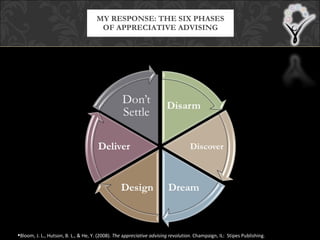
MY RESPONSE: THE SIX PHASES OF APPRECIATIVE ADVISING Bloom, J. L., Hutson, B. L., & He, Y. (2008).  The  a ppreciative advising revolution . Champaign, IL:  Stipes Publishing.
Disarm Recognizing the importance of first impressions, create a safe, welcoming environment for students. Discover   Utilize positive open-ended questions to draw out what they enjoy doing, their strengths, and their passions. Listen to each answer carefully before asking the next positive question.  APPRECIATIVE ADVISING PHASES Bloom, J. L., Hutson, B. L., & He, Y. (2008).  The  a ppreciative advising revolution . Champaign, IL:  Stipes Publishing.
Dream Help students formulate a vision of what they might become, and then assist them in developing their life and career goals. Design   Help students devise concrete, incremental, and achievable goals. APPRECIATIVE ADVISING PHASES Bloom, J. L., Hutson, B. L., & He, Y. (2008).  The  a ppreciative advising revolution . Champaign, IL:  Stipes Publishing.
Deliver   The students follow through on their plans. The advisor is  there for them when they stumble, believing in them every step of the way and helping them continue to update and refine their dreams as they go.  Don’t Settle  The advisor challenges the student to proactively raise the student’s internal bar of self- expectations APPRECIATIVE ADVISING PHASES Bloom, J. L., Hutson, B. L., & He, Y. (2008).  The  a ppreciative advising revolution . Champaign, IL:  Stipes Publishing.
“ Others believe there are many ways to succeed.  They believe it is not better to be Picasso than to be Rembrandt, to be Mozart rather than Beethoven….We each have something unique to offer. To develop it, to offer it clearly, fully, and powerfully—is to succeed.  Beethoven did not fail to become another Mozart; he succeeded at becoming Beethoven.  Seen this way, success comes from developing your uniqueness.  It is rare but not scarce. Every one, potentially, can succeed” (Lipman, 1994, p. 29-30). Lipman, D. (1995).  The storytelling coach: How to listen, praise and bring out people ’ s best . Little Rock, AR: August House, Inc. WHAT IS STUDENT SUCCESS?
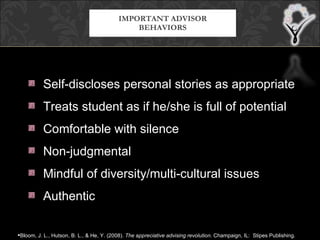
IMPORTANT ADVISOR BEHAVIORS Self-discloses personal stories as appropriate Treats student as if he/she is full of potential Comfortable with silence Non-judgmental Mindful of diversity/multi-cultural issues Authentic Bloom, J. L., Hutson, B. L., & He, Y. (2008).  The  a ppreciative advising revolution . Champaign, IL:  Stipes Publishing.
COMPREHENSIVE RETENTION FRAMEWORK Prevention Intervention Recovery Curricular Policies Programs
TAKE HOME PIECE
http://www.appreciativeadvising.net Join the Appreciative Advising group on Facebook Upcoming Webinar on Supporting Foster Youth-Aug 10,  1-2:30pm EST WANT TO LEARN MORE?
QUESTIONS

Appreciative Advising

  • 1.
    KNOCK, KNOCK, KNOCKAre you ready?
  • 2.
    TODAY’S PRESENTERS JoeMurray Pete Schoepflin
  • 3.
    Joe Murray hasserved as the Director of Academic Advising and Retention Services at Miami University’s Hamilton Campus since 1992. He earned both a Bachelor of Science in Engineering and a Master of Science in Human Resource Management degrees from Purdue University. He has helped to develop and refine the Appreciative Advising Inventory and been part of a national taskforce aimed at advancing the concept of Appreciative Advising. It is an innovative six-phase advising philosophy focused on making the most of students’ strengths and partnering with students to develop a co-created plan to accomplish their goals and dreams.   Joe works tirelessly to help students that are traditionally underrepresented in higher education. He serves as the Co-Chair of the First-Generation College Student Interest Group for the National Academic Advising Association (NACADA ). Peter R Schoepflin parent, resource parent, trainer, advocate, OFFCMH chair Married to my amazing wife Angela for 37 years. Raising 9 children; 8 biological and 1 adopted. Began in Foster Care in 1977 working for a Foster Group Home for Juvenile youth. Worked part time for the county Juvenile Detention Center. 1980 We went through the licensing process to become foster parents. 1982 went to work at the county MRDD Adult Workshop and then moved to the Ohio State Institution for a short time. Over the years our fostering ranged from youth to infants and newborns; specializing in medically fragile and developmental disabilities. 1998 Our son Jordan (age 12) came into our lives as a new born and we adopted him 3 years later. He is a special needs child, who has a MRDD diagnosis. Became a certified trainer in Ohio of the mandatory Pre-Service Curriculum for families considering fostering /adoption. Presently, Chairman of the Board of Directors for the Ohio Federation for Children’s Mental Health. (www.ohiofederation.org ). In 2009 my wife and I were honored to receive a congressional “Angels in Adoption “ award from the CCAI in Washington, DC. for our years of service working with Foster, Adopt and Kinship families and children in Ohio. ABOUT US….
  • 4.
    Four R’s ofStudent Resiliency Role Response Referral Retention OVERVIEW
  • 5.
  • 6.
  • 7.
    MY RESPONSE: THESIX PHASES OF APPRECIATIVE ADVISING Bloom, J. L., Hutson, B. L., & He, Y. (2008). The a ppreciative advising revolution . Champaign, IL: Stipes Publishing.
  • 8.
    Disarm Recognizing theimportance of first impressions, create a safe, welcoming environment for students. Discover Utilize positive open-ended questions to draw out what they enjoy doing, their strengths, and their passions. Listen to each answer carefully before asking the next positive question. APPRECIATIVE ADVISING PHASES Bloom, J. L., Hutson, B. L., & He, Y. (2008). The a ppreciative advising revolution . Champaign, IL: Stipes Publishing.
  • 9.
    Dream Help studentsformulate a vision of what they might become, and then assist them in developing their life and career goals. Design Help students devise concrete, incremental, and achievable goals. APPRECIATIVE ADVISING PHASES Bloom, J. L., Hutson, B. L., & He, Y. (2008). The a ppreciative advising revolution . Champaign, IL: Stipes Publishing.
  • 10.
    Deliver The students follow through on their plans. The advisor is there for them when they stumble, believing in them every step of the way and helping them continue to update and refine their dreams as they go. Don’t Settle The advisor challenges the student to proactively raise the student’s internal bar of self- expectations APPRECIATIVE ADVISING PHASES Bloom, J. L., Hutson, B. L., & He, Y. (2008). The a ppreciative advising revolution . Champaign, IL: Stipes Publishing.
  • 11.
    “ Others believethere are many ways to succeed. They believe it is not better to be Picasso than to be Rembrandt, to be Mozart rather than Beethoven….We each have something unique to offer. To develop it, to offer it clearly, fully, and powerfully—is to succeed. Beethoven did not fail to become another Mozart; he succeeded at becoming Beethoven. Seen this way, success comes from developing your uniqueness. It is rare but not scarce. Every one, potentially, can succeed” (Lipman, 1994, p. 29-30). Lipman, D. (1995). The storytelling coach: How to listen, praise and bring out people ’ s best . Little Rock, AR: August House, Inc. WHAT IS STUDENT SUCCESS?
  • 12.
    IMPORTANT ADVISOR BEHAVIORSSelf-discloses personal stories as appropriate Treats student as if he/she is full of potential Comfortable with silence Non-judgmental Mindful of diversity/multi-cultural issues Authentic Bloom, J. L., Hutson, B. L., & He, Y. (2008). The a ppreciative advising revolution . Champaign, IL: Stipes Publishing.
  • 13.
    COMPREHENSIVE RETENTION FRAMEWORKPrevention Intervention Recovery Curricular Policies Programs
  • 14.
  • 15.
    http://www.appreciativeadvising.net Join theAppreciative Advising group on Facebook Upcoming Webinar on Supporting Foster Youth-Aug 10, 1-2:30pm EST WANT TO LEARN MORE?
  • 16.