Worldwide  ERC ® Relocation Appraising Alvin “Chip” Wagner III,  SCRP, SRA, IFA (630) 416-6556  --  [email_address] Presented to the Appraisal Foundation in 2007 at their 20 th  Anniversary
About Worldwide ERC ® Founded in 1964,  Worldwide ERC ®  (Employee Relocation Council) was formed to help our members overcome the challenges of  workforce mobility .  Members come from many professions –  human resources; recruiting; government; military; real estate; financial services; moving; counseling; consulting ; and more! Worldwide ERC ®  provides information on current issues, trends, and best practices for the  movement of employees  within the United States as well as globally.
The Relocation Industry and Relocation Appraising 1985 First standardized relocation appraisal Revisions made as necessary to comply with USPAP and the evolution of the industry. Revisions in: 1989 1991 1994 2001 2003
The Relocation Industry and Relocation Appraising 2000’s and beyond… Relocation is now a $30 Billion industry Appraisers are a very small part of the process Average costs to transfer America’s employee $65,000+/- for home-owning current employees $55,000+/- for home-owning new hires
The Relocation Industry and Relocation Appraising 2000’s and beyond… Changes in Corporate America affecting industry Downsizing Reorganization Mergers and acquisitions Outsourcing
The Relocation Industry and Relocation Appraising 2000’s and beyond… Result in relocation industry 60% corporations now offered home purchase (down from 80% last decade) Strong economy and real estate markets reduced need for appraisals Fewer relocation appraisal specialists
Relocation Appraising Purpose To assist the corporation in determining the home purchase offer it will make to an employee.
Relocation Appraising Basic Process Two appraisals and a BMA ordered BMA obtained for the purpose of marketing the property as seen through the real estate agent’s eyes If two appraisals within 5%, an offer made to employee, usually based on an average of those two appraisals If appraisals not within 5%, additional appraisals may be ordered Multiple appraisals and BMA’s serve as check and balance
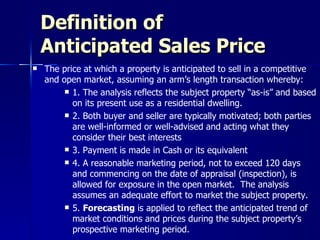
Definition of  Anticipated Sales Price The price at which a property is anticipated to sell in a competitive and open market, assuming an arm’s length transaction whereby: 1. The analysis reflects the subject property “as-is” and based on its present use as a residential dwelling. 2. Both buyer and seller are typically motivated; both parties are well-informed or well-advised and acting what they consider their best interests 3. Payment is made in Cash or its equivalent 4. A reasonable marketing period, not to exceed 120 days and commencing on the date of appraisal (inspection), is allowed for exposure in the open market.  The analysis assumes an adequate effort to market the subject property. 5.  Forecasting  is applied to reflect the anticipated trend of market conditions and prices during the subject property’s prospective marketing period.
Definition of Forecasting Forecasting is the process of analyzing historical trends and current factors as a basis for anticipating market trends.  A forecasting adjustment is then applied to reflect any impact these trends will have on the subject property’s market time and sales price
Several types of residential property appraisals Differences can center around such things as: Intended Use Purpose Definition of Value The following specifically examines relocation and mortgage appraisals side by side, highlighting some of the primary differences between the two… Difference between a Relocation Appraisal and Other Appraisals
Intended Use/User Mortgage Used by lenders to facilitate lending decisions Relocation Used by employers and relocation management companies to facilitate corporate relocation
Purpose Mortgage Conducted to develop an opinion of  Market Value Seeks to answer the question:  “What is the property  worth ?” Relocation Conducted to develop an opinion of  Anticipated Sales Price Seeks to answer the question:  “What will the property  sell for ?”
Marketing Time Mortgage Appraisal Because it develops an opinion of  Market Value , it assumes the property’s exposure to the market  precedes  the date of appraisal, analyzing historical market data Relocation Appraisal Because it develops an opinion of  Anticipated Sales Price , the marketing time occurs  after  the date of appraisal, and consideration is given to what trends will occur during the prospective marketing period
Decision Period Mortgage Appraisal As mortgage terms can last up to 30 years, it is a long-term decision making tool Relocation Appraisal Based on a short-term decision, typically up to 120 days, implying a greater level of risk and need for higher degree of accuracy
Both reports follow the Uniform Standards of Professional Appraisal Practice (USPAP), but relocation appraisals typically include an expanded analysis of market trends Reporting Format Mortgage Appraisal Provides data in the Uniform Residential Appraisal Report (URAR) Relocation Appraisal Reports data in the Worldwide ERC ®  Summary Appraisal Report
Property Condition/Appeal Mortgage Appraisal Property’s condition will likely be reflected in the purchaser’s offering price Relocation Appraisal Greater emphasis is placed on items such as appeal and décor, as the appraiser is attempting to reflect how a potential buyer will react to the property’s appearance While both types take into account a property’s condition…
Financing Considerations Mortgage Appraisal No adjustments made for costs paid by the seller if they are typical for that market Relocation Appraisal Adjustments made for all seller paid sales or financing concessions While both types value the property on a cash equivalency basis…
Comparable Properties/Forecasting Mortgage Appraisal Considers historical market data No forecasting Relocation Appraisal Considers historical sales, as well as  analyzing pending sales and competing properties Forecasting  is applied to reflect the anticipated trend of market conditions and prices during the subject property’s prospective marketing period
Reasonable Market Time Mortgage Appraisal Based on what is normal in market, without limit Relocation Appraisal Develops an opinion of anticipated sales price during a reasonable marketing period, not to exceed 120 days, and commencing on date of appraisal
Differences can perhaps best be remembered by the two separate questions each type of appraisal seeks to answer… Mortgage Appraisal What is the property worth? Relocation Appraisal What will the property most likely sell for? Difference between a Relocation Appraisal and Other Appraisals
Appraisal Challenges First extended “down” residential real estate market in over 25 years Understanding how to read Market Change Understanding how to Forecast Understanding impact of Décor/Appeal and condition in a soft market Oversupplied inventory, new construction and effect of substitution on marketplace Foreclosures Concessions Extended Days on Market Lack of “good” comps, homes just aren’t selling
Appraisal   Trends Appraisers Leaving the Profession Fewer experienced appraisers Less Relocation Work Less Educational Opportunities Less Specialization
Worldwide  ERC ® Relocation Appraising Alvin “Chip” Wagner III,  SCRP, SRA, IFA (630) 416-6556  --  [email_address]

Appraisal Foundation Presentation 2007

  • 1.
    Worldwide ERC® Relocation Appraising Alvin “Chip” Wagner III, SCRP, SRA, IFA (630) 416-6556 -- [email_address] Presented to the Appraisal Foundation in 2007 at their 20 th Anniversary
  • 2.
    About Worldwide ERC® Founded in 1964, Worldwide ERC ® (Employee Relocation Council) was formed to help our members overcome the challenges of workforce mobility . Members come from many professions – human resources; recruiting; government; military; real estate; financial services; moving; counseling; consulting ; and more! Worldwide ERC ® provides information on current issues, trends, and best practices for the movement of employees within the United States as well as globally.
  • 3.
    The Relocation Industryand Relocation Appraising 1985 First standardized relocation appraisal Revisions made as necessary to comply with USPAP and the evolution of the industry. Revisions in: 1989 1991 1994 2001 2003
  • 4.
    The Relocation Industryand Relocation Appraising 2000’s and beyond… Relocation is now a $30 Billion industry Appraisers are a very small part of the process Average costs to transfer America’s employee $65,000+/- for home-owning current employees $55,000+/- for home-owning new hires
  • 5.
    The Relocation Industryand Relocation Appraising 2000’s and beyond… Changes in Corporate America affecting industry Downsizing Reorganization Mergers and acquisitions Outsourcing
  • 6.
    The Relocation Industryand Relocation Appraising 2000’s and beyond… Result in relocation industry 60% corporations now offered home purchase (down from 80% last decade) Strong economy and real estate markets reduced need for appraisals Fewer relocation appraisal specialists
  • 7.
    Relocation Appraising PurposeTo assist the corporation in determining the home purchase offer it will make to an employee.
  • 8.
    Relocation Appraising BasicProcess Two appraisals and a BMA ordered BMA obtained for the purpose of marketing the property as seen through the real estate agent’s eyes If two appraisals within 5%, an offer made to employee, usually based on an average of those two appraisals If appraisals not within 5%, additional appraisals may be ordered Multiple appraisals and BMA’s serve as check and balance
  • 9.
    Definition of Anticipated Sales Price The price at which a property is anticipated to sell in a competitive and open market, assuming an arm’s length transaction whereby: 1. The analysis reflects the subject property “as-is” and based on its present use as a residential dwelling. 2. Both buyer and seller are typically motivated; both parties are well-informed or well-advised and acting what they consider their best interests 3. Payment is made in Cash or its equivalent 4. A reasonable marketing period, not to exceed 120 days and commencing on the date of appraisal (inspection), is allowed for exposure in the open market. The analysis assumes an adequate effort to market the subject property. 5. Forecasting is applied to reflect the anticipated trend of market conditions and prices during the subject property’s prospective marketing period.
  • 10.
    Definition of ForecastingForecasting is the process of analyzing historical trends and current factors as a basis for anticipating market trends. A forecasting adjustment is then applied to reflect any impact these trends will have on the subject property’s market time and sales price
  • 11.
    Several types ofresidential property appraisals Differences can center around such things as: Intended Use Purpose Definition of Value The following specifically examines relocation and mortgage appraisals side by side, highlighting some of the primary differences between the two… Difference between a Relocation Appraisal and Other Appraisals
  • 12.
    Intended Use/User MortgageUsed by lenders to facilitate lending decisions Relocation Used by employers and relocation management companies to facilitate corporate relocation
  • 13.
    Purpose Mortgage Conductedto develop an opinion of Market Value Seeks to answer the question: “What is the property worth ?” Relocation Conducted to develop an opinion of Anticipated Sales Price Seeks to answer the question: “What will the property sell for ?”
  • 14.
    Marketing Time MortgageAppraisal Because it develops an opinion of Market Value , it assumes the property’s exposure to the market precedes the date of appraisal, analyzing historical market data Relocation Appraisal Because it develops an opinion of Anticipated Sales Price , the marketing time occurs after the date of appraisal, and consideration is given to what trends will occur during the prospective marketing period
  • 15.
    Decision Period MortgageAppraisal As mortgage terms can last up to 30 years, it is a long-term decision making tool Relocation Appraisal Based on a short-term decision, typically up to 120 days, implying a greater level of risk and need for higher degree of accuracy
  • 16.
    Both reports followthe Uniform Standards of Professional Appraisal Practice (USPAP), but relocation appraisals typically include an expanded analysis of market trends Reporting Format Mortgage Appraisal Provides data in the Uniform Residential Appraisal Report (URAR) Relocation Appraisal Reports data in the Worldwide ERC ® Summary Appraisal Report
  • 17.
    Property Condition/Appeal MortgageAppraisal Property’s condition will likely be reflected in the purchaser’s offering price Relocation Appraisal Greater emphasis is placed on items such as appeal and décor, as the appraiser is attempting to reflect how a potential buyer will react to the property’s appearance While both types take into account a property’s condition…
  • 18.
    Financing Considerations MortgageAppraisal No adjustments made for costs paid by the seller if they are typical for that market Relocation Appraisal Adjustments made for all seller paid sales or financing concessions While both types value the property on a cash equivalency basis…
  • 19.
    Comparable Properties/Forecasting MortgageAppraisal Considers historical market data No forecasting Relocation Appraisal Considers historical sales, as well as analyzing pending sales and competing properties Forecasting is applied to reflect the anticipated trend of market conditions and prices during the subject property’s prospective marketing period
  • 20.
    Reasonable Market TimeMortgage Appraisal Based on what is normal in market, without limit Relocation Appraisal Develops an opinion of anticipated sales price during a reasonable marketing period, not to exceed 120 days, and commencing on date of appraisal
  • 21.
    Differences can perhapsbest be remembered by the two separate questions each type of appraisal seeks to answer… Mortgage Appraisal What is the property worth? Relocation Appraisal What will the property most likely sell for? Difference between a Relocation Appraisal and Other Appraisals
  • 22.
    Appraisal Challenges Firstextended “down” residential real estate market in over 25 years Understanding how to read Market Change Understanding how to Forecast Understanding impact of Décor/Appeal and condition in a soft market Oversupplied inventory, new construction and effect of substitution on marketplace Foreclosures Concessions Extended Days on Market Lack of “good” comps, homes just aren’t selling
  • 23.
    Appraisal Trends Appraisers Leaving the Profession Fewer experienced appraisers Less Relocation Work Less Educational Opportunities Less Specialization
  • 24.
    Worldwide ERC® Relocation Appraising Alvin “Chip” Wagner III, SCRP, SRA, IFA (630) 416-6556 -- [email_address]