HSA 171
CAR
1436/4/14
 Health Services Administration (Management).
 Management Definitions.
 Management Functions.
 Manager.
 Types of Managers.
 Management skills.
 Levels of Management.
 Health Services Administration (Healthcare).
 Healthcare Definition.
 Characteristics of HC.
 Challenges.
3
 Management
 Health Services (Healthcare)
4
No single definition of management has been universally
accepted. Some popular definitions are:
• Management is the art of getting things done through people.
• Management is getting the right things done at the right
time.
• Management is the process that involves the guidance or
direction of a group of people toward organizational goals or
objectives.
5
• Management is a process through which objectives of an
organization are accomplished by utilizing human and
physical resources and technology.
• Management means the effective use of resources to
accomplish the goals of the organization.
• Management is a systematic process with judgment, to
achieve objectives.
• Management is a creative problem solving.
6
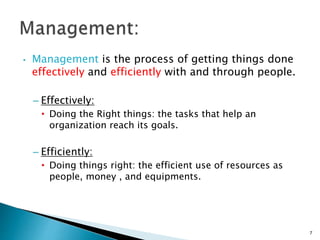
• Management is the process of getting things done
effectively and efficiently with and through people.
– Effectively:
• Doing the Right things: the tasks that help an
organization reach its goals.
– Efficiently:
• Doing things right: the efficient use of resources as
people, money , and equipments.
7
 Management in business and organizations is the function
that coordinates the efforts of people to accomplish goals
and objectives using available resources efficiently and
effectively.
 Management comprises planning, organizing, staffing,
leading or directing, and controlling an organization to
accomplish the goal. Resourcing encompasses the
deployment and manipulation of human resources, financial
resources, technological resources, and natural resources.
Management is also an academic discipline, a social science
whose objective is to study social organization.
8
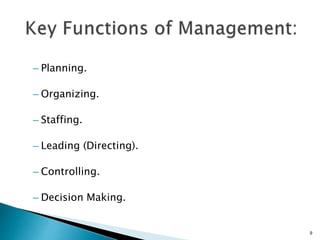
– Planning.
– Organizing.
– Staffing.
– Leading (Directing).
– Controlling.
– Decision Making.
9
Planning:
Defining the organizational purpose and ways to achieve it.
Organizing:
Arranging and structuring work to accomplish organizational
goals.
Leading (Directing):
Directing the work activities of others.
Controlling:
Monitoring, comparing, and correcting work performance.
10
 Are the people responsible for supervising/managing the
organization’s resources to meet it’s goals.
◦ Human Resources: People
◦ Financial Resources: Money , Investments.
◦ Technological Resources: systems, Information , Time.
◦ Natural Resources: buildings, equipments, machines
 Individuals in organizations who direct the activities of
others.
11
 General Managers:
focuses on the entire business as a whole (a top-down organizational
view).
A general manager is responsible for all areas and oversees all of the
firm's functions and day-to-day business operations. The general
manager has to communicate with all departments to make sure
the organization performs well.
 Functional Managers:
Is a person who has management authority over an organizational
unit—such as a department—within a business, company, or other
organization.
12
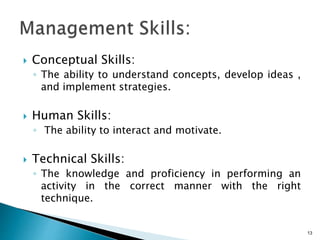
 Conceptual Skills:
◦ The ability to understand concepts, develop ideas ,
and implement strategies.
 Human Skills:
◦ The ability to interact and motivate.
 Technical Skills:
◦ The knowledge and proficiency in performing an
activity in the correct manner with the right
technique.
13
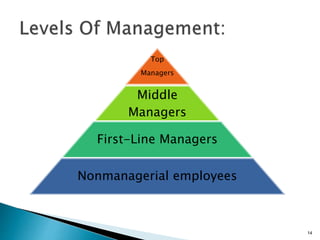
Top
Managers
Middle
Managers
First-Line Managers
Nonmanagerial employees
14
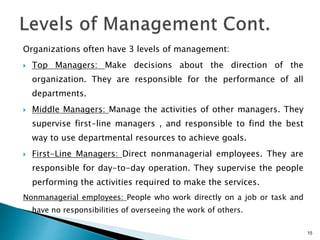
Organizations often have 3 levels of management:
 Top Managers: Make decisions about the direction of the
organization. They are responsible for the performance of all
departments.
 Middle Managers: Manage the activities of other managers. They
supervise first-line managers , and responsible to find the best
way to use departmental resources to achieve goals.
 First-Line Managers: Direct nonmanagerial employees. They are
responsible for day-to-day operation. They supervise the people
performing the activities required to make the services.
Nonmanagerial employees: People who work directly on a job or task and
have no responsibilities of overseeing the work of others.
15
Healthcare
16
• Is the field relating to leadership, management, and
administration of hospital, hospital networks and health care
system.
17
• Is known by many names, including:
– Health Management
– Healthcare Management
– Health Systems Management
– Health Care Systems Management
– Medical and Health Services Management
18
 The American society of hospitals:
◦ Health management is the planning, organizing, directing
and controlling and coordinating the resources and
procedures and methods by which is to meet the needs and
the demand for health and medical care services and to
provide a healthy environment through the provision of
health care services to consumers as individuals, groups
and society as a whole. "
19
Health care organizations have Special Features that
differentiate them from business organizations and factories.
What are Some of the Features?
20
 Health care organizations deals with vital issues of
life, illness and death, which cause anxiety, tension
and deep emotion.
 The work requires various individual skills and
forms of care. It is essentially a human service.
21
 Health care organizations have to change frequently in
response to new patterns of illness, modified
equipment and techniques, rising public expectations,
i.e. change is part of their organizational culture.
 Complexity, having different departments and
professions, makes it not easy to supervise and control.
 Relatively expensive, so come under pressure to be
managed as economically as possible.
22
 The individual nature of health services, each health service has to
be adapted , planned, delivered according to the need of each
individual (Patient).
 The Personal and individual nature of health services, make the daily
work at the institution different and complex ,therefore, it’s not
subject only to a few of profiling and measurement.
 The high degree of apprenticeship and specialization in the health
sector, considering that most doctors working in occupational health
institutions-(professors)- specialized elements, giving them great
influence and power to make the other elements (pharmacists and
nurses) officials in front of them.
23
 The demand for health services and the need for them
increases with the development of civilization of a society.
 Health Service are not subject to the law of supply and
demand, the demand for health service always remains more
than supply. Demand for health service is often an emergency
and urgent and can not be postponed.
24
 To be planner, coordinator.
 To be a leader and motivator .
 To be an observer of the work and activities.
 Be an ideal model for all employees.
 To be a good decision maker.
 To use resources efficiently and effectively in
health organizations .
25
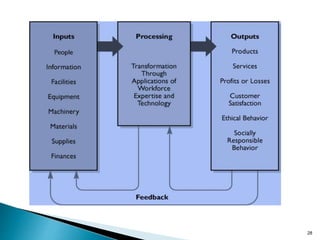
Input
Activities
Output
Feedback
26
 Input:
 Need for HS , resources (…) , cultural variables, values, rules and
regulations .
 Activities:
◦ Administrative process and technology.
 Output:
◦ services, research, training, rates of new cases of recovery or non-
healing problems (social, psychological) and the impression or
reputation of health organizations.
 Feedback:
◦ Information on compliance or differences between the standards
and outputs .
27
28
• The Total Environment Forces (public and external):
– legal (laws and regulations)
– political (political system)
– cultural (attitude),
– economic (finance and resources)
– social (population ).
• The health environment forces (private and internal):
– public health and the level of health research, education
and technology
29
 Environmental Changes .
 limited resources available to high cost in contrast to the
huge demand for these resources.
 Health director is always required to offers a lot of services
using little available resources.
 High expectations of consumers of health services - in
general, dissatisfaction with the quality of services and the
cost of these services.
 The continuous rise of the cost of service along with the
dissatisfaction in relation to funding health services, whether
governmental or private institutions or insurance.
30
 grumbling and dissatisfaction from providers of health services,
particularly doctors and nurses there is dissatisfaction because of
work pressure and increased demand for the service and also
dissatisfaction about working conditions and low wages.
 Ethical ,social, and professional considerations ,which places
restrictions and impediments to either focus on economic efficiency
considerations of health services.
31

Applying Administration's Concepts and Theories 1.ppt

  • 1.
  • 2.
  • 3.
     Health ServicesAdministration (Management).  Management Definitions.  Management Functions.  Manager.  Types of Managers.  Management skills.  Levels of Management.  Health Services Administration (Healthcare).  Healthcare Definition.  Characteristics of HC.  Challenges. 3
  • 4.
     Management  HealthServices (Healthcare) 4
  • 5.
    No single definitionof management has been universally accepted. Some popular definitions are: • Management is the art of getting things done through people. • Management is getting the right things done at the right time. • Management is the process that involves the guidance or direction of a group of people toward organizational goals or objectives. 5
  • 6.
    • Management isa process through which objectives of an organization are accomplished by utilizing human and physical resources and technology. • Management means the effective use of resources to accomplish the goals of the organization. • Management is a systematic process with judgment, to achieve objectives. • Management is a creative problem solving. 6
  • 7.
    • Management isthe process of getting things done effectively and efficiently with and through people. – Effectively: • Doing the Right things: the tasks that help an organization reach its goals. – Efficiently: • Doing things right: the efficient use of resources as people, money , and equipments. 7
  • 8.
     Management inbusiness and organizations is the function that coordinates the efforts of people to accomplish goals and objectives using available resources efficiently and effectively.  Management comprises planning, organizing, staffing, leading or directing, and controlling an organization to accomplish the goal. Resourcing encompasses the deployment and manipulation of human resources, financial resources, technological resources, and natural resources. Management is also an academic discipline, a social science whose objective is to study social organization. 8
  • 9.
    – Planning. – Organizing. –Staffing. – Leading (Directing). – Controlling. – Decision Making. 9
  • 10.
    Planning: Defining the organizationalpurpose and ways to achieve it. Organizing: Arranging and structuring work to accomplish organizational goals. Leading (Directing): Directing the work activities of others. Controlling: Monitoring, comparing, and correcting work performance. 10
  • 11.
     Are thepeople responsible for supervising/managing the organization’s resources to meet it’s goals. ◦ Human Resources: People ◦ Financial Resources: Money , Investments. ◦ Technological Resources: systems, Information , Time. ◦ Natural Resources: buildings, equipments, machines  Individuals in organizations who direct the activities of others. 11
  • 12.
     General Managers: focuseson the entire business as a whole (a top-down organizational view). A general manager is responsible for all areas and oversees all of the firm's functions and day-to-day business operations. The general manager has to communicate with all departments to make sure the organization performs well.  Functional Managers: Is a person who has management authority over an organizational unit—such as a department—within a business, company, or other organization. 12
  • 13.
     Conceptual Skills: ◦The ability to understand concepts, develop ideas , and implement strategies.  Human Skills: ◦ The ability to interact and motivate.  Technical Skills: ◦ The knowledge and proficiency in performing an activity in the correct manner with the right technique. 13
  • 14.
  • 15.
    Organizations often have3 levels of management:  Top Managers: Make decisions about the direction of the organization. They are responsible for the performance of all departments.  Middle Managers: Manage the activities of other managers. They supervise first-line managers , and responsible to find the best way to use departmental resources to achieve goals.  First-Line Managers: Direct nonmanagerial employees. They are responsible for day-to-day operation. They supervise the people performing the activities required to make the services. Nonmanagerial employees: People who work directly on a job or task and have no responsibilities of overseeing the work of others. 15
  • 16.
  • 17.
    • Is thefield relating to leadership, management, and administration of hospital, hospital networks and health care system. 17
  • 18.
    • Is knownby many names, including: – Health Management – Healthcare Management – Health Systems Management – Health Care Systems Management – Medical and Health Services Management 18
  • 19.
     The Americansociety of hospitals: ◦ Health management is the planning, organizing, directing and controlling and coordinating the resources and procedures and methods by which is to meet the needs and the demand for health and medical care services and to provide a healthy environment through the provision of health care services to consumers as individuals, groups and society as a whole. " 19
  • 20.
    Health care organizationshave Special Features that differentiate them from business organizations and factories. What are Some of the Features? 20
  • 21.
     Health careorganizations deals with vital issues of life, illness and death, which cause anxiety, tension and deep emotion.  The work requires various individual skills and forms of care. It is essentially a human service. 21
  • 22.
     Health careorganizations have to change frequently in response to new patterns of illness, modified equipment and techniques, rising public expectations, i.e. change is part of their organizational culture.  Complexity, having different departments and professions, makes it not easy to supervise and control.  Relatively expensive, so come under pressure to be managed as economically as possible. 22
  • 23.
     The individualnature of health services, each health service has to be adapted , planned, delivered according to the need of each individual (Patient).  The Personal and individual nature of health services, make the daily work at the institution different and complex ,therefore, it’s not subject only to a few of profiling and measurement.  The high degree of apprenticeship and specialization in the health sector, considering that most doctors working in occupational health institutions-(professors)- specialized elements, giving them great influence and power to make the other elements (pharmacists and nurses) officials in front of them. 23
  • 24.
     The demandfor health services and the need for them increases with the development of civilization of a society.  Health Service are not subject to the law of supply and demand, the demand for health service always remains more than supply. Demand for health service is often an emergency and urgent and can not be postponed. 24
  • 25.
     To beplanner, coordinator.  To be a leader and motivator .  To be an observer of the work and activities.  Be an ideal model for all employees.  To be a good decision maker.  To use resources efficiently and effectively in health organizations . 25
  • 26.
  • 27.
     Input:  Needfor HS , resources (…) , cultural variables, values, rules and regulations .  Activities: ◦ Administrative process and technology.  Output: ◦ services, research, training, rates of new cases of recovery or non- healing problems (social, psychological) and the impression or reputation of health organizations.  Feedback: ◦ Information on compliance or differences between the standards and outputs . 27
  • 28.
  • 29.
    • The TotalEnvironment Forces (public and external): – legal (laws and regulations) – political (political system) – cultural (attitude), – economic (finance and resources) – social (population ). • The health environment forces (private and internal): – public health and the level of health research, education and technology 29
  • 30.
     Environmental Changes.  limited resources available to high cost in contrast to the huge demand for these resources.  Health director is always required to offers a lot of services using little available resources.  High expectations of consumers of health services - in general, dissatisfaction with the quality of services and the cost of these services.  The continuous rise of the cost of service along with the dissatisfaction in relation to funding health services, whether governmental or private institutions or insurance. 30
  • 31.
     grumbling anddissatisfaction from providers of health services, particularly doctors and nurses there is dissatisfaction because of work pressure and increased demand for the service and also dissatisfaction about working conditions and low wages.  Ethical ,social, and professional considerations ,which places restrictions and impediments to either focus on economic efficiency considerations of health services. 31

Editor's Notes

  • #11 Planning Planning involves deciding where to take a company and selecting steps to get there. It first requires managers to be aware of challenges facing their businesses, and it then it requires managers to forecast future business and economic conditions. They then formulate objectives to reach by certain deadlines and decide on steps to reach them. They re-evaluate their plans as conditions change and make adjustments as necessary. Planning helps allocate resources and reduce waste as well. Organizing Managers organize by bringing together physical, human and financial resources to achieve objectives. They identify activities to be accomplished, classify activities, assign activities to groups or individuals, create responsibility and delegate authority. They then coordinate the relationships of responsibility and authority. Related Reading: The Basic Steps in the Management Planning Process Leading Leading requires managers to motivate employees to achieve business objectives and goals. It requires the use of authority to achieve those ends as well as the ability to communicate effectively. Effective leaders are students of human personalities, motivation and communication. They can influence their personnel to view situations from their perspectives. Leading also involves supervision of employees and their work. Controlling Controlling is a function of management that involves measuring achievement against established objectives and goals. It also requires managers to be able to identify sources of deviation from successful accomplishment and to provide a corrective course of action. Managers first establish objectives and goals, then measure achievement of them, identify anything that is keeping the company from achieving them, and provide means of correction if necessary. Controlling does not necessarily involve achieving only monetary goals and objectives. It can also relate to nontangible goals and objectives like meeting a production quota or reducing customer complaints by a certain amount.