SHARAD INSTITUTE OF TECHNOLOGY,
COLLEGE OF ENGINEERING,
YADRAV- ICHALKARANJI (Kolhapur)
An ‘A’ Grade Institute Accredited by NAAC
NBA Accredited Programmes
Prepared by
Mr. Ashish A. Desai
Assistant Professor
Mechanical Department
Fluid Mechanics
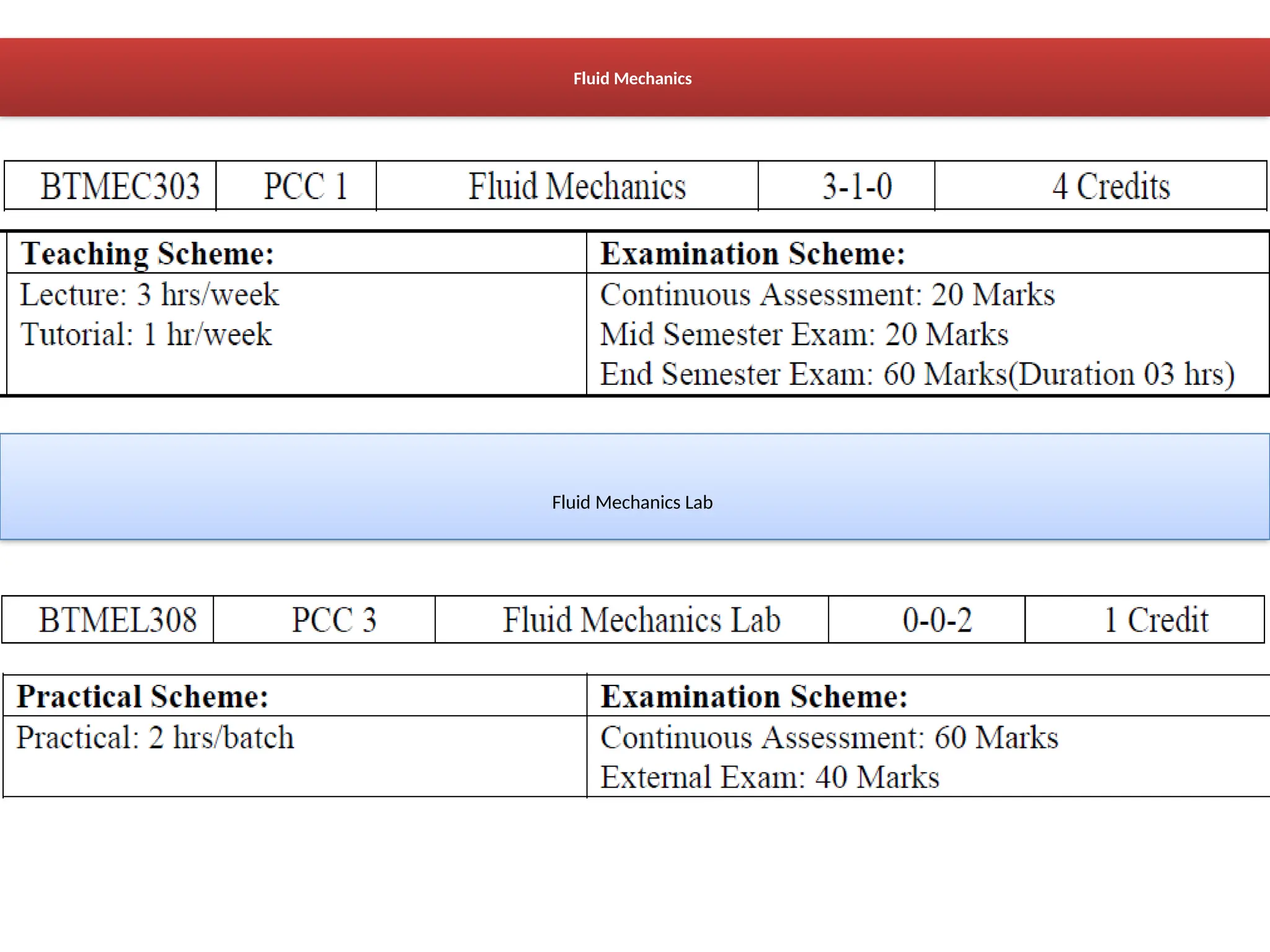
Fluid Mechanics
Fluid Mechanics Lab
1.Course Plan
Point to be discussed ……
3.Pre-requisite
2.Unit of Measurement
1.Course Plan
 Course objective
 Course outcome
 Course content
 Text/Reference books
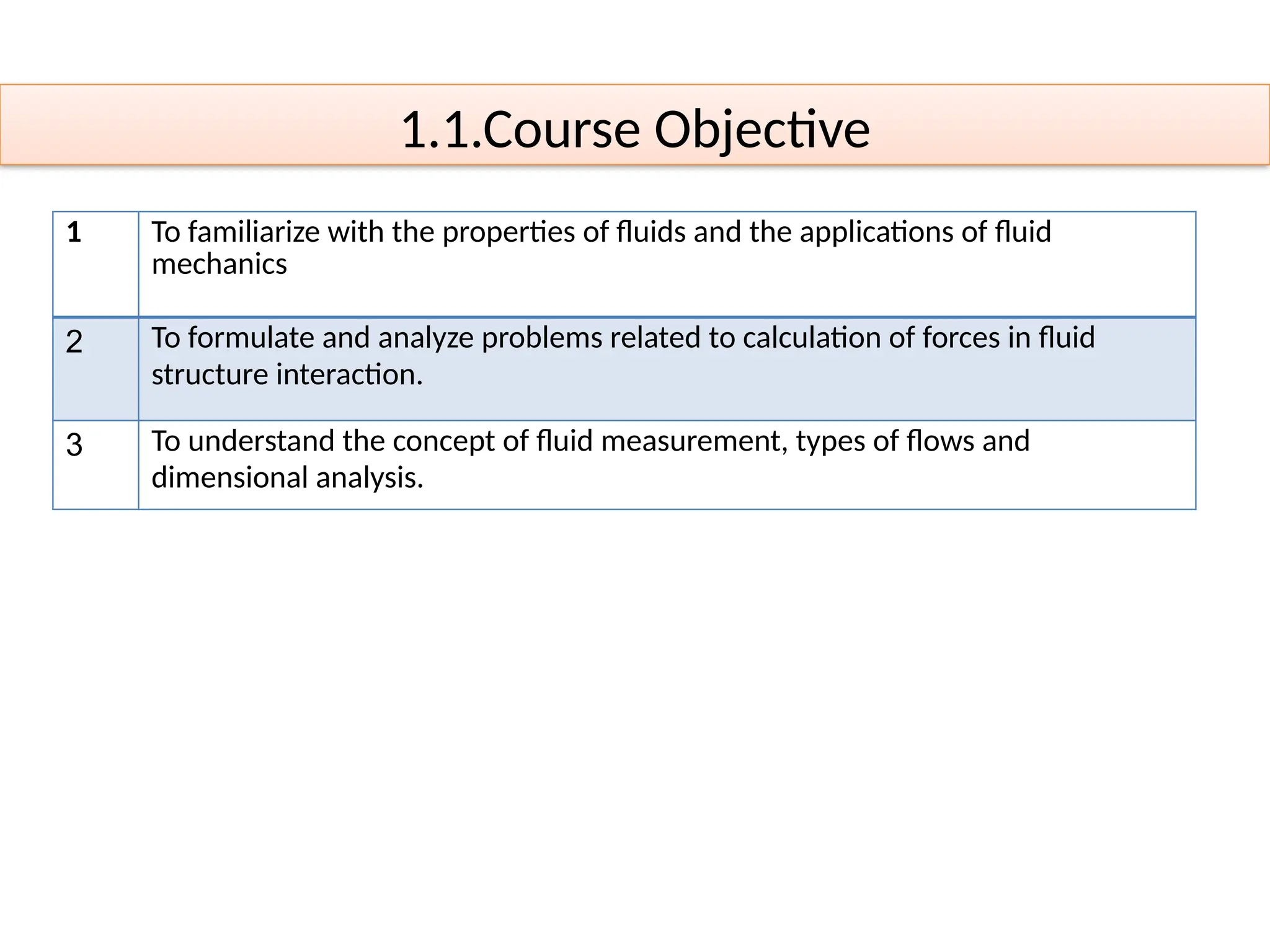
1.1.Course Objective
1 To familiarize with the properties of fluids and the applications of fluid
mechanics
2 To formulate and analyze problems related to calculation of forces in fluid
structure interaction.
3 To understand the concept of fluid measurement, types of flows and
dimensional analysis.
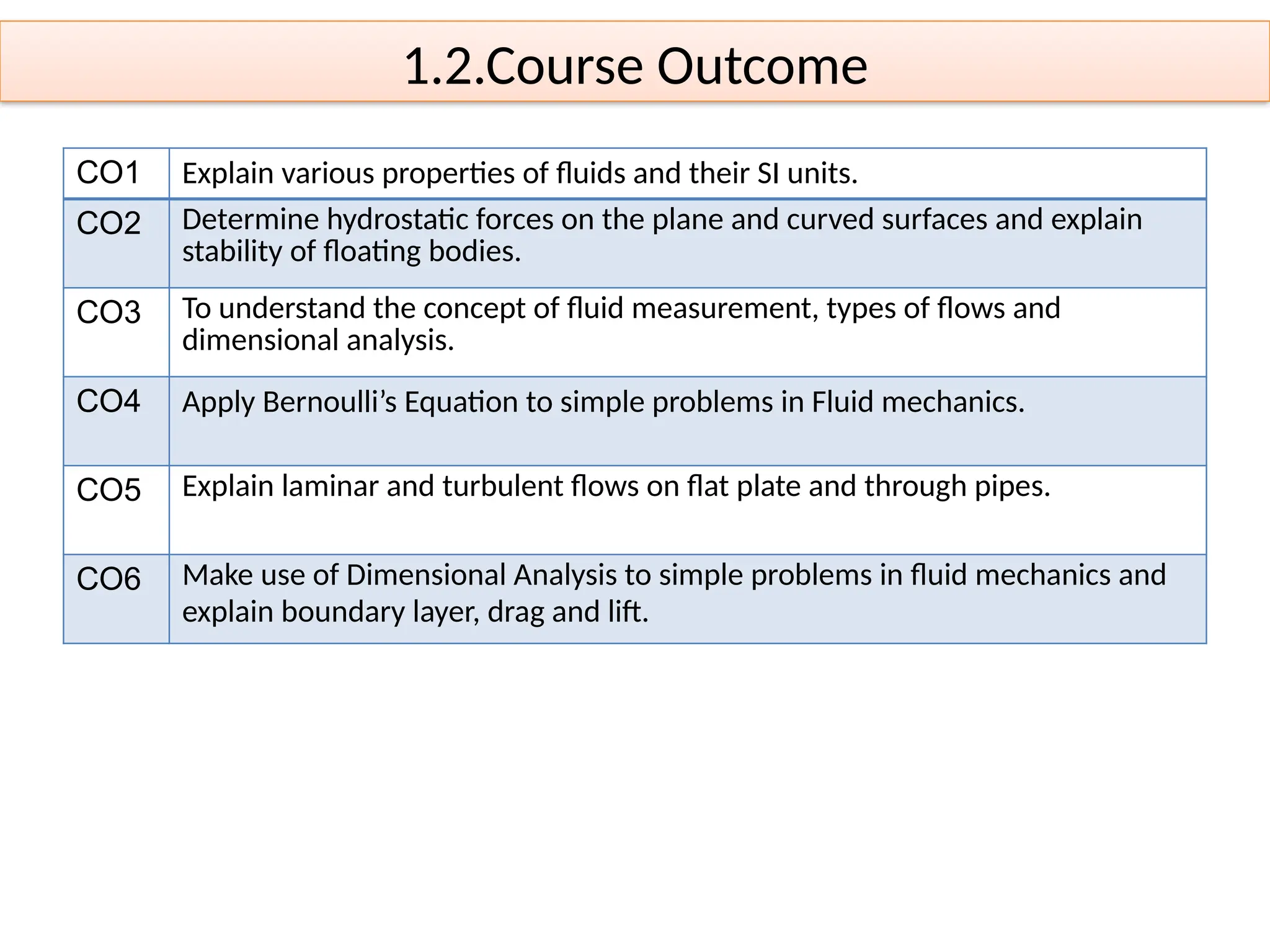
1.2.Course Outcome
CO1 Explain various properties of fluids and their SI units.
CO2 Determine hydrostatic forces on the plane and curved surfaces and explain
stability of floating bodies.
CO3 To understand the concept of fluid measurement, types of flows and
dimensional analysis.
CO4 Apply Bernoulli’s Equation to simple problems in Fluid mechanics.
CO5 Explain laminar and turbulent flows on flat plate and through pipes.
CO6 Make use of Dimensional Analysis to simple problems in fluid mechanics and
explain boundary layer, drag and lift.
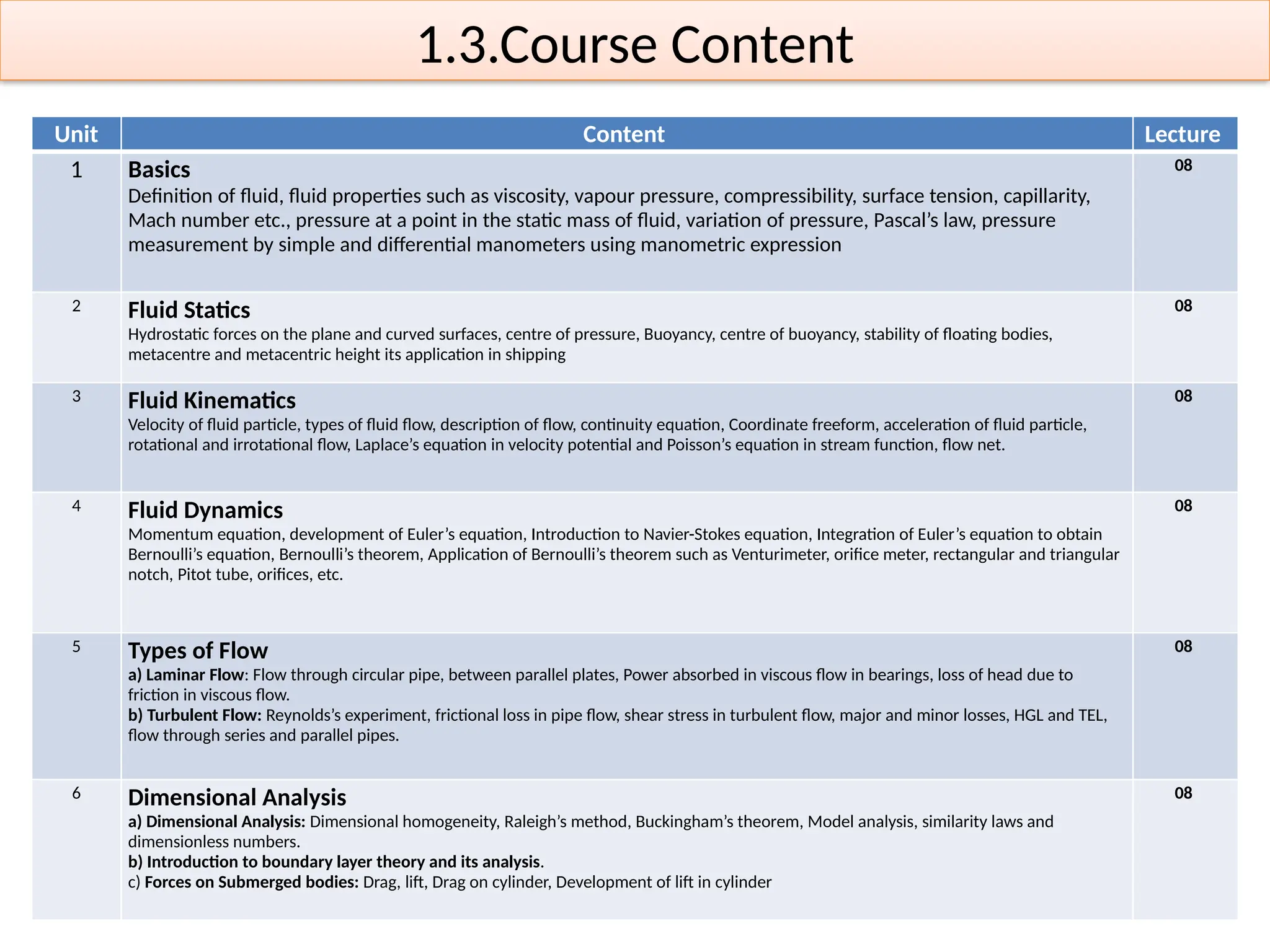
Unit Content Lecture
1 Basics
Definition of fluid, fluid properties such as viscosity, vapour pressure, compressibility, surface tension, capillarity,
Mach number etc., pressure at a point in the static mass of fluid, variation of pressure, Pascal’s law, pressure
measurement by simple and differential manometers using manometric expression
08
2 Fluid Statics
Hydrostatic forces on the plane and curved surfaces, centre of pressure, Buoyancy, centre of buoyancy, stability of floating bodies,
metacentre and metacentric height its application in shipping
08
3 Fluid Kinematics
Velocity of fluid particle, types of fluid flow, description of flow, continuity equation, Coordinate freeform, acceleration of fluid particle,
rotational and irrotational flow, Laplace’s equation in velocity potential and Poisson’s equation in stream function, flow net.
08
4 Fluid Dynamics
Momentum equation, development of Euler’s equation, Introduction to Navier-Stokes equation, Integration of Euler’s equation to obtain
Bernoulli’s equation, Bernoulli’s theorem, Application of Bernoulli’s theorem such as Venturimeter, orifice meter, rectangular and triangular
notch, Pitot tube, orifices, etc.
08
5 Types of Flow
a) Laminar Flow: Flow through circular pipe, between parallel plates, Power absorbed in viscous flow in bearings, loss of head due to
friction in viscous flow.
b) Turbulent Flow: Reynolds’s experiment, frictional loss in pipe flow, shear stress in turbulent flow, major and minor losses, HGL and TEL,
flow through series and parallel pipes.
08
6 Dimensional Analysis
a) Dimensional Analysis: Dimensional homogeneity, Raleigh’s method, Buckingham’s theorem, Model analysis, similarity laws and
dimensionless numbers.
b) Introduction to boundary layer theory and its analysis.
c) Forces on Submerged bodies: Drag, lift, Drag on cylinder, Development of lift in cylinder
08
1.3.Course Content
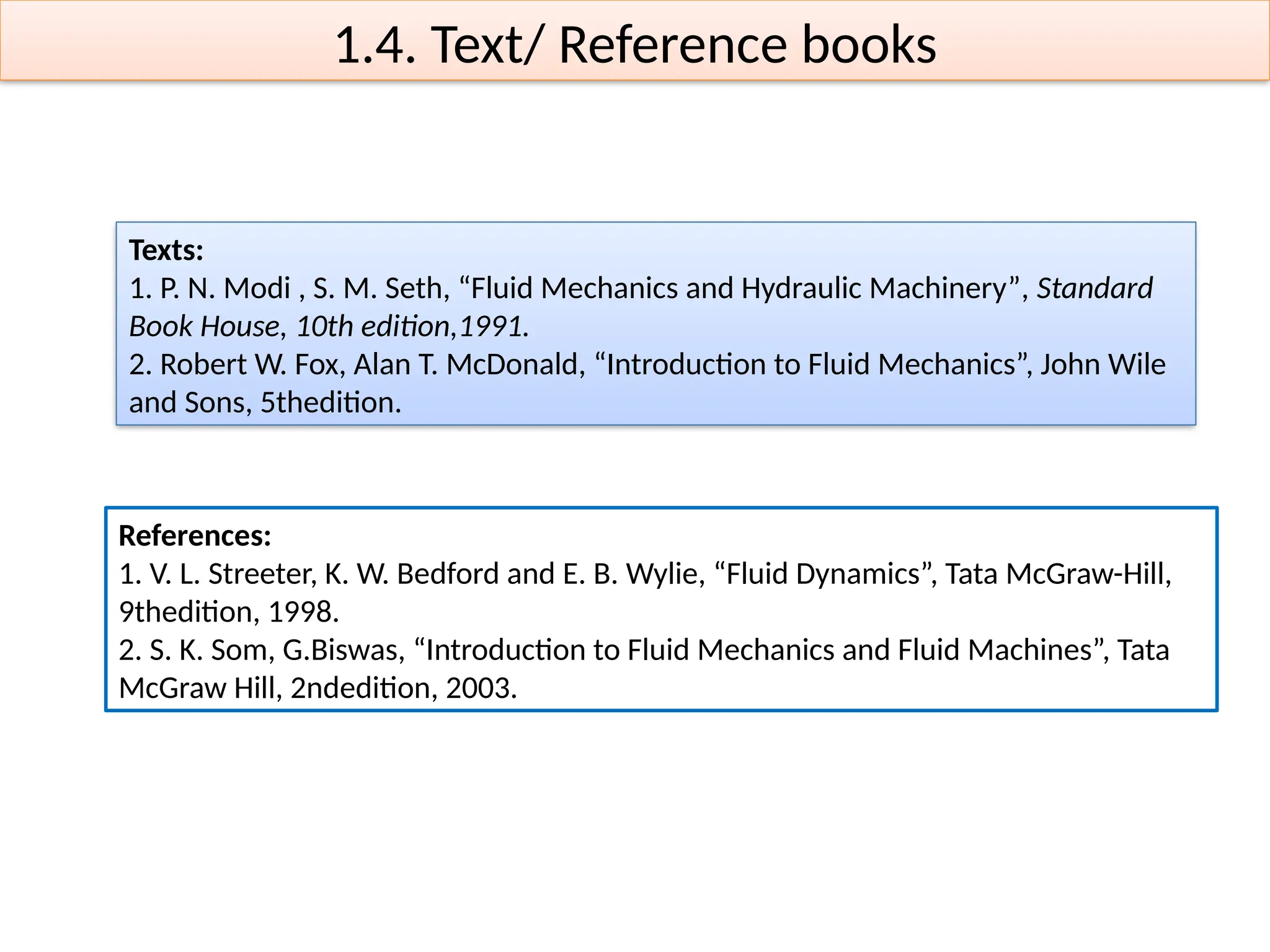
1.4. Text/ Reference books
References:
1. V. L. Streeter, K. W. Bedford and E. B. Wylie, “Fluid Dynamics”, Tata McGraw-Hill,
9thedition, 1998.
2. S. K. Som, G.Biswas, “Introduction to Fluid Mechanics and Fluid Machines”, Tata
McGraw Hill, 2ndedition, 2003.
Texts:
1. P. N. Modi , S. M. Seth, “Fluid Mechanics and Hydraulic Machinery”, Standard
Book House, 10th edition,1991.
2. Robert W. Fox, Alan T. McDonald, “Introduction to Fluid Mechanics”, John Wile
and Sons, 5thedition.
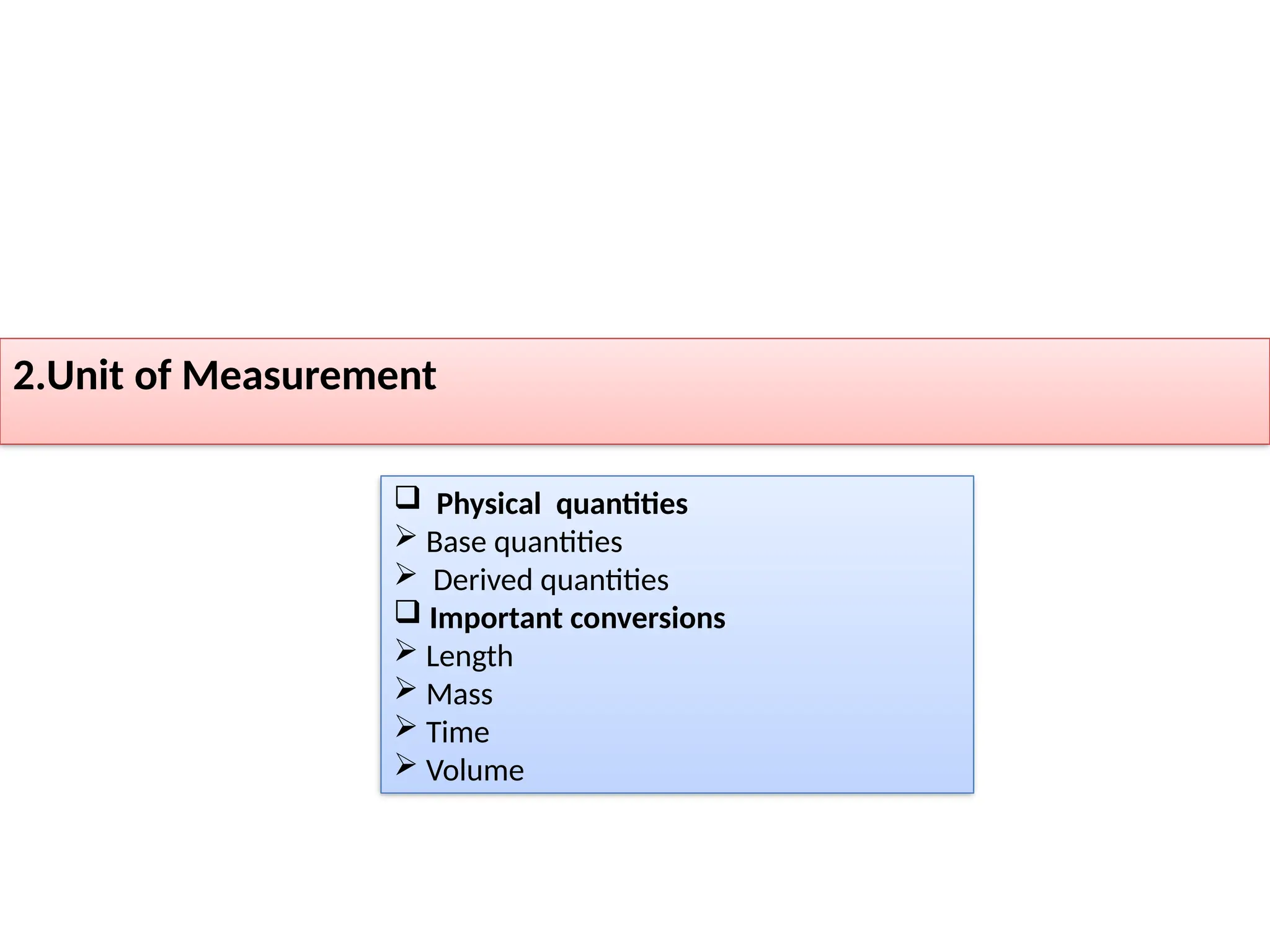
2.Unit of Measurement
 Physical quantities
 Base quantities
 Derived quantities
 Important conversions
 Length
 Mass
 Time
 Volume
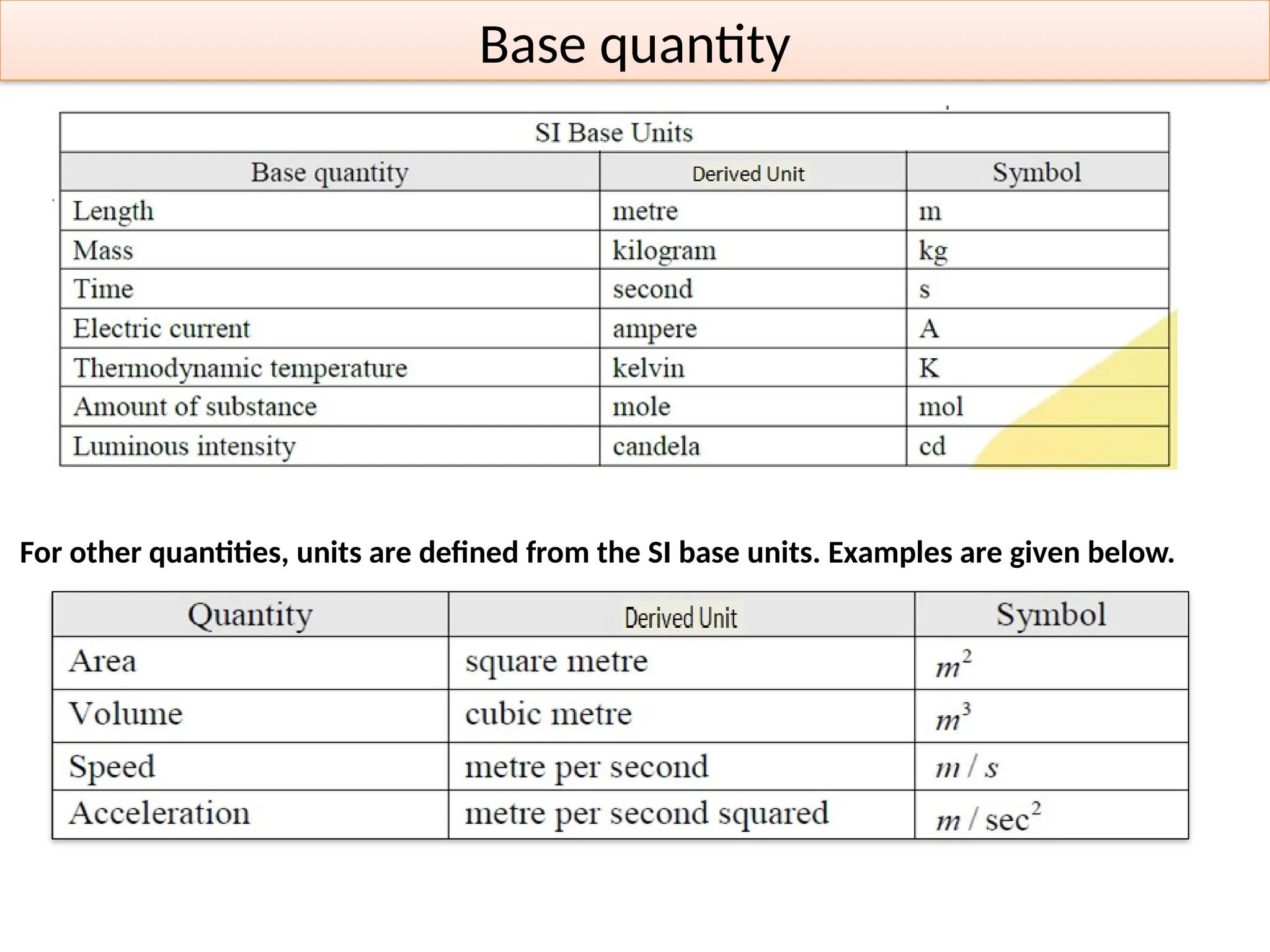
For other quantities, units are defined from the SI base units. Examples are given below.
Base quantity
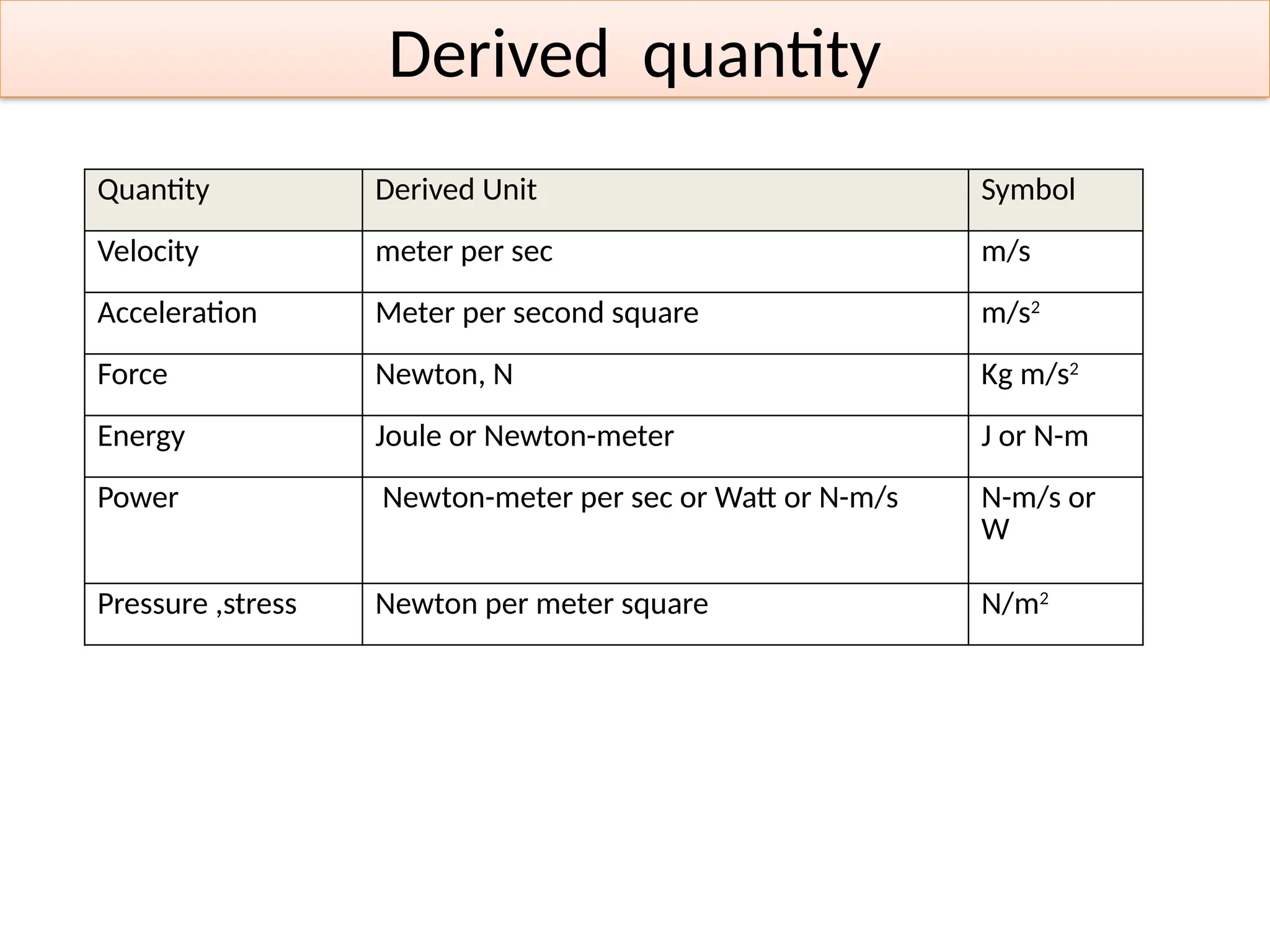
Quantity Derived Unit Symbol
Velocity meter per sec m/s
Acceleration Meter per second square m/s2
Force Newton, N Kg m/s2
Energy Joule or Newton-meter J or N-m
Power Newton-meter per sec or Watt or N-m/s N-m/s or
W
Pressure ,stress Newton per meter square N/m2
Derived quantity
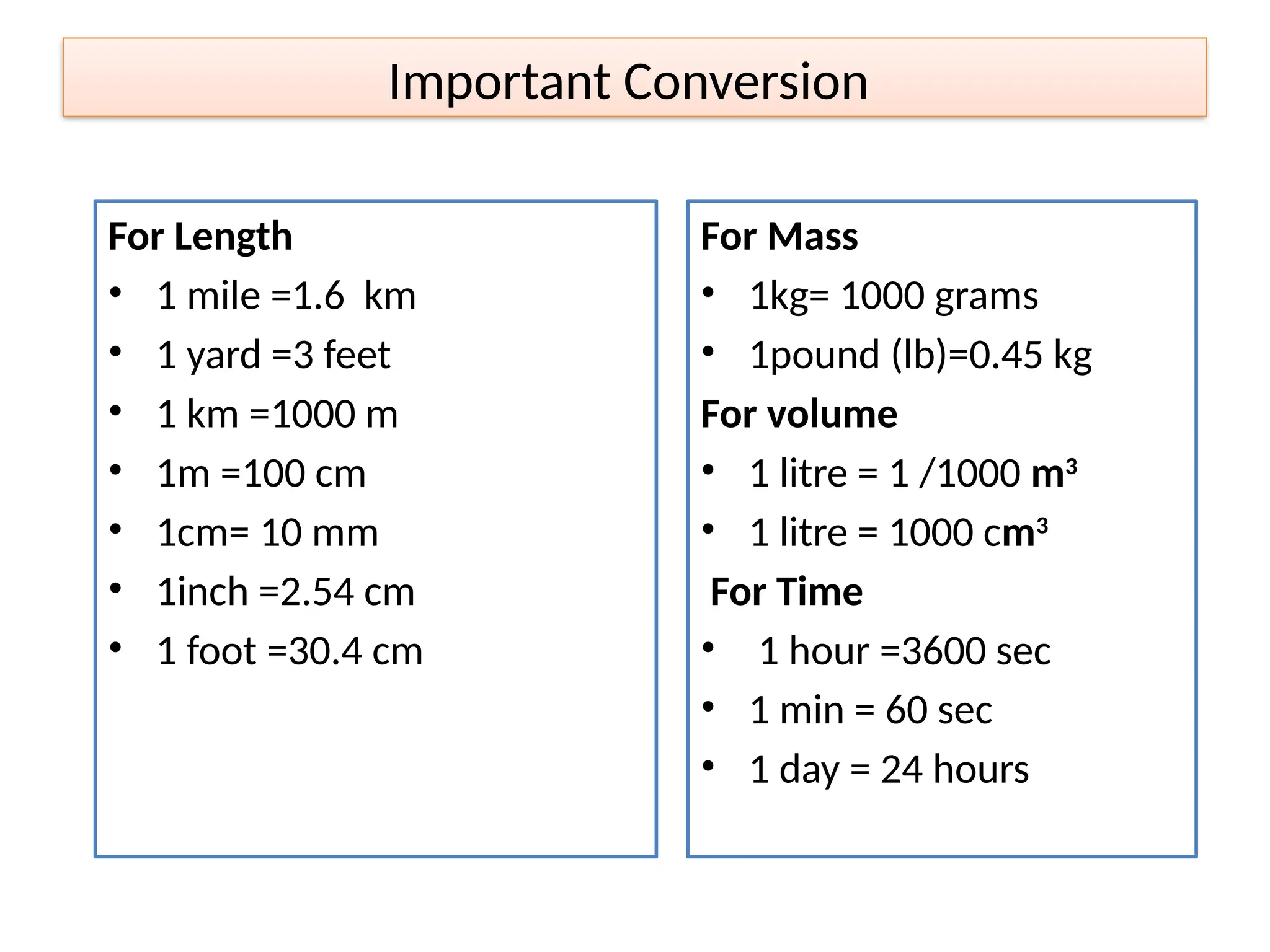
Important Conversion
For Length
• 1 mile =1.6 km
• 1 yard =3 feet
• 1 km =1000 m
• 1m =100 cm
• 1cm= 10 mm
• 1inch =2.54 cm
• 1 foot =30.4 cm
For Mass
• 1kg= 1000 grams
• 1pound (lb)=0.45 kg
For volume
• 1 litre = 1 /1000 m3
• 1 litre = 1000 cm3
For Time
• 1 hour =3600 sec
• 1 min = 60 sec
• 1 day = 24 hours
3.Pre-requisite
Review of basics Contents
 What is fluid and solid ?
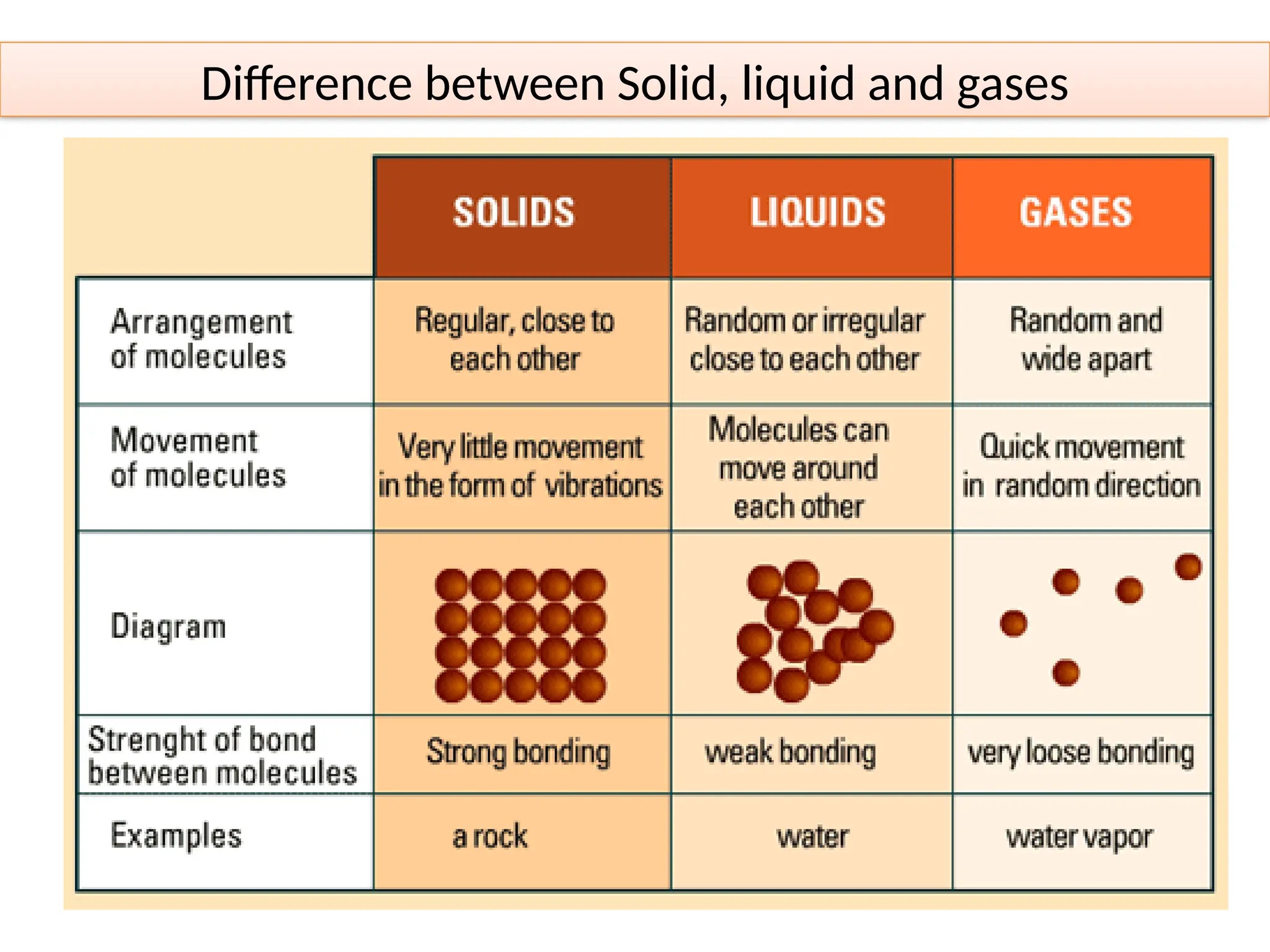
 Difference between soild,liquid and gas
 What is Fluid Mechanics ?
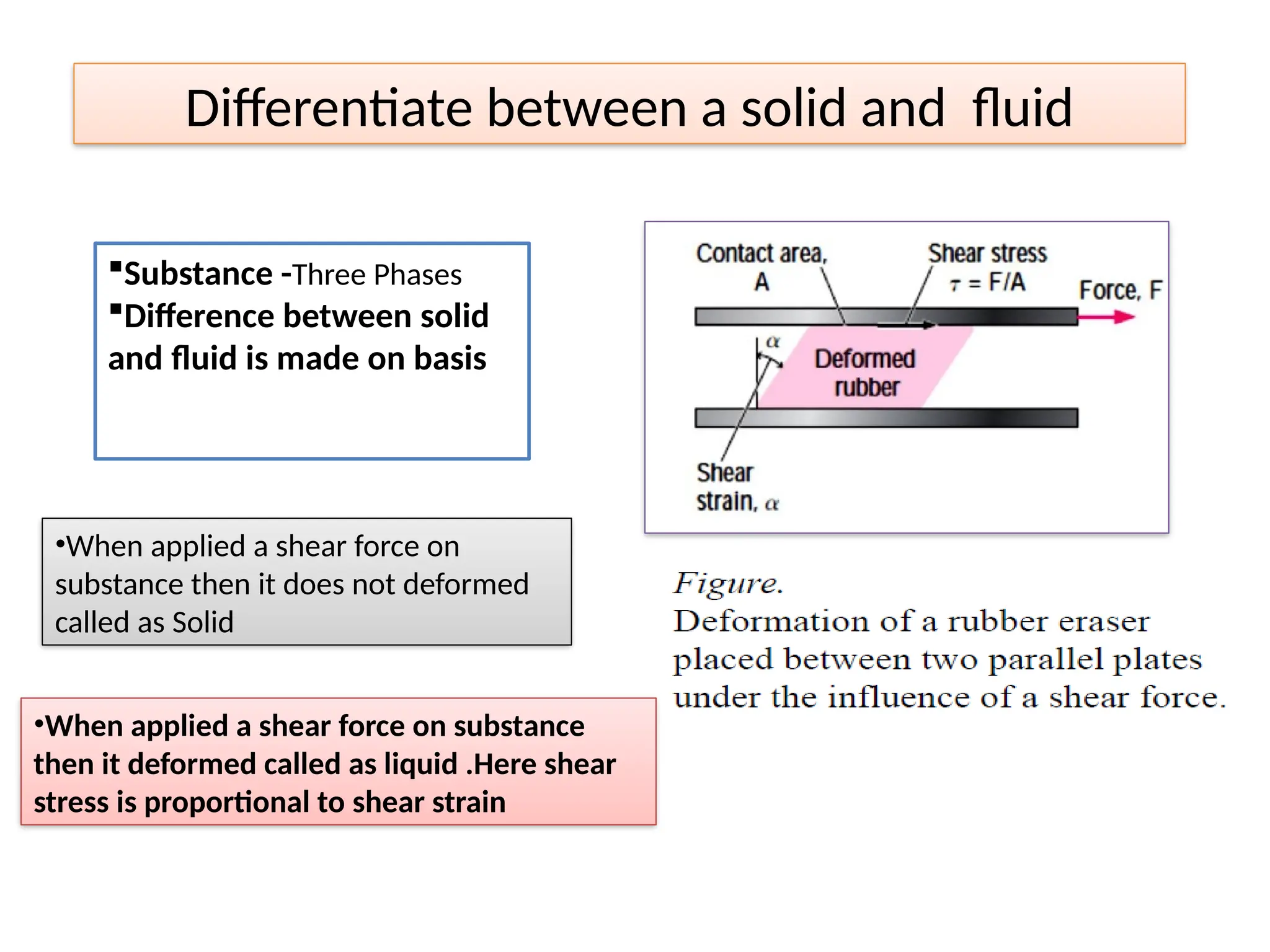
Differentiate between a solid and fluid
Substance -Three Phases
Difference between solid
and fluid is made on basis
•When applied a shear force on
substance then it does not deformed
called as Solid
•When applied a shear force on substance
then it deformed called as liquid .Here shear
stress is proportional to shear strain
Difference between Solid, liquid and gases
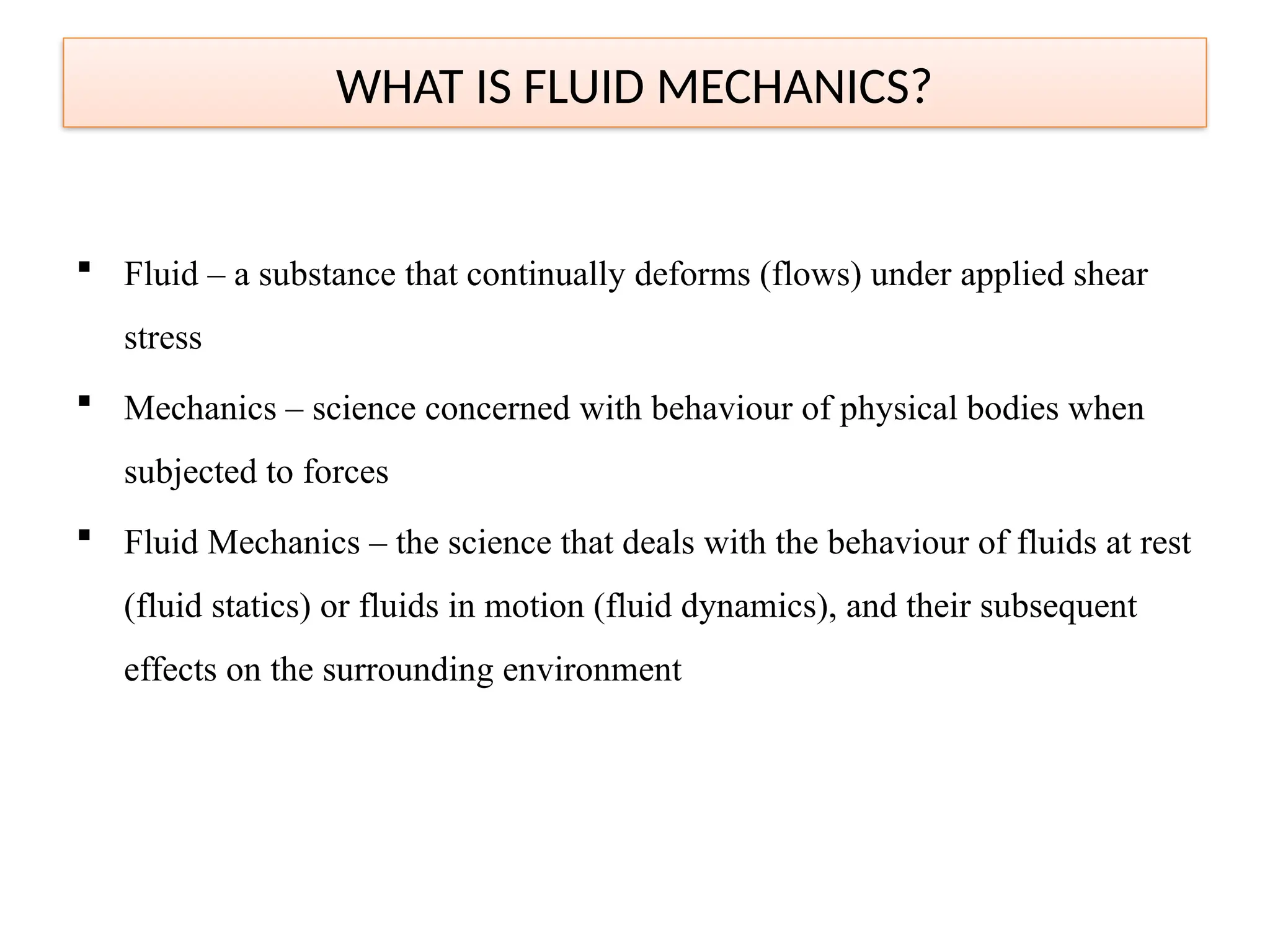
 Fluid – a substance that continually deforms (flows) under applied shear
stress
 Mechanics – science concerned with behaviour of physical bodies when
subjected to forces
 Fluid Mechanics – the science that deals with the behaviour of fluids at rest
(fluid statics) or fluids in motion (fluid dynamics), and their subsequent
effects on the surrounding environment
WHAT IS FLUID MECHANICS?
Thank You

Introduction to FM and Units Measurement .pptx

  • 1.
    SHARAD INSTITUTE OFTECHNOLOGY, COLLEGE OF ENGINEERING, YADRAV- ICHALKARANJI (Kolhapur) An ‘A’ Grade Institute Accredited by NAAC NBA Accredited Programmes Prepared by Mr. Ashish A. Desai Assistant Professor Mechanical Department Fluid Mechanics
  • 2.
  • 3.
    1.Course Plan Point tobe discussed …… 3.Pre-requisite 2.Unit of Measurement
  • 4.
    1.Course Plan  Courseobjective  Course outcome  Course content  Text/Reference books
  • 5.
    1.1.Course Objective 1 Tofamiliarize with the properties of fluids and the applications of fluid mechanics 2 To formulate and analyze problems related to calculation of forces in fluid structure interaction. 3 To understand the concept of fluid measurement, types of flows and dimensional analysis.
  • 6.
    1.2.Course Outcome CO1 Explainvarious properties of fluids and their SI units. CO2 Determine hydrostatic forces on the plane and curved surfaces and explain stability of floating bodies. CO3 To understand the concept of fluid measurement, types of flows and dimensional analysis. CO4 Apply Bernoulli’s Equation to simple problems in Fluid mechanics. CO5 Explain laminar and turbulent flows on flat plate and through pipes. CO6 Make use of Dimensional Analysis to simple problems in fluid mechanics and explain boundary layer, drag and lift.
  • 7.
    Unit Content Lecture 1Basics Definition of fluid, fluid properties such as viscosity, vapour pressure, compressibility, surface tension, capillarity, Mach number etc., pressure at a point in the static mass of fluid, variation of pressure, Pascal’s law, pressure measurement by simple and differential manometers using manometric expression 08 2 Fluid Statics Hydrostatic forces on the plane and curved surfaces, centre of pressure, Buoyancy, centre of buoyancy, stability of floating bodies, metacentre and metacentric height its application in shipping 08 3 Fluid Kinematics Velocity of fluid particle, types of fluid flow, description of flow, continuity equation, Coordinate freeform, acceleration of fluid particle, rotational and irrotational flow, Laplace’s equation in velocity potential and Poisson’s equation in stream function, flow net. 08 4 Fluid Dynamics Momentum equation, development of Euler’s equation, Introduction to Navier-Stokes equation, Integration of Euler’s equation to obtain Bernoulli’s equation, Bernoulli’s theorem, Application of Bernoulli’s theorem such as Venturimeter, orifice meter, rectangular and triangular notch, Pitot tube, orifices, etc. 08 5 Types of Flow a) Laminar Flow: Flow through circular pipe, between parallel plates, Power absorbed in viscous flow in bearings, loss of head due to friction in viscous flow. b) Turbulent Flow: Reynolds’s experiment, frictional loss in pipe flow, shear stress in turbulent flow, major and minor losses, HGL and TEL, flow through series and parallel pipes. 08 6 Dimensional Analysis a) Dimensional Analysis: Dimensional homogeneity, Raleigh’s method, Buckingham’s theorem, Model analysis, similarity laws and dimensionless numbers. b) Introduction to boundary layer theory and its analysis. c) Forces on Submerged bodies: Drag, lift, Drag on cylinder, Development of lift in cylinder 08 1.3.Course Content
  • 8.
    1.4. Text/ Referencebooks References: 1. V. L. Streeter, K. W. Bedford and E. B. Wylie, “Fluid Dynamics”, Tata McGraw-Hill, 9thedition, 1998. 2. S. K. Som, G.Biswas, “Introduction to Fluid Mechanics and Fluid Machines”, Tata McGraw Hill, 2ndedition, 2003. Texts: 1. P. N. Modi , S. M. Seth, “Fluid Mechanics and Hydraulic Machinery”, Standard Book House, 10th edition,1991. 2. Robert W. Fox, Alan T. McDonald, “Introduction to Fluid Mechanics”, John Wile and Sons, 5thedition.
  • 9.
    2.Unit of Measurement Physical quantities  Base quantities  Derived quantities  Important conversions  Length  Mass  Time  Volume
  • 10.
    For other quantities,units are defined from the SI base units. Examples are given below. Base quantity
  • 11.
    Quantity Derived UnitSymbol Velocity meter per sec m/s Acceleration Meter per second square m/s2 Force Newton, N Kg m/s2 Energy Joule or Newton-meter J or N-m Power Newton-meter per sec or Watt or N-m/s N-m/s or W Pressure ,stress Newton per meter square N/m2 Derived quantity
  • 12.
    Important Conversion For Length •1 mile =1.6 km • 1 yard =3 feet • 1 km =1000 m • 1m =100 cm • 1cm= 10 mm • 1inch =2.54 cm • 1 foot =30.4 cm For Mass • 1kg= 1000 grams • 1pound (lb)=0.45 kg For volume • 1 litre = 1 /1000 m3 • 1 litre = 1000 cm3 For Time • 1 hour =3600 sec • 1 min = 60 sec • 1 day = 24 hours
  • 13.
    3.Pre-requisite Review of basicsContents  What is fluid and solid ?  Difference between soild,liquid and gas  What is Fluid Mechanics ?
  • 14.
    Differentiate between asolid and fluid Substance -Three Phases Difference between solid and fluid is made on basis •When applied a shear force on substance then it does not deformed called as Solid •When applied a shear force on substance then it deformed called as liquid .Here shear stress is proportional to shear strain
  • 15.
    Difference between Solid,liquid and gases
  • 16.
     Fluid –a substance that continually deforms (flows) under applied shear stress  Mechanics – science concerned with behaviour of physical bodies when subjected to forces  Fluid Mechanics – the science that deals with the behaviour of fluids at rest (fluid statics) or fluids in motion (fluid dynamics), and their subsequent effects on the surrounding environment WHAT IS FLUID MECHANICS?
  • 17.

Editor's Notes