Prepared By
A.Prasad roshan
prasadroshan1982@gmail.com
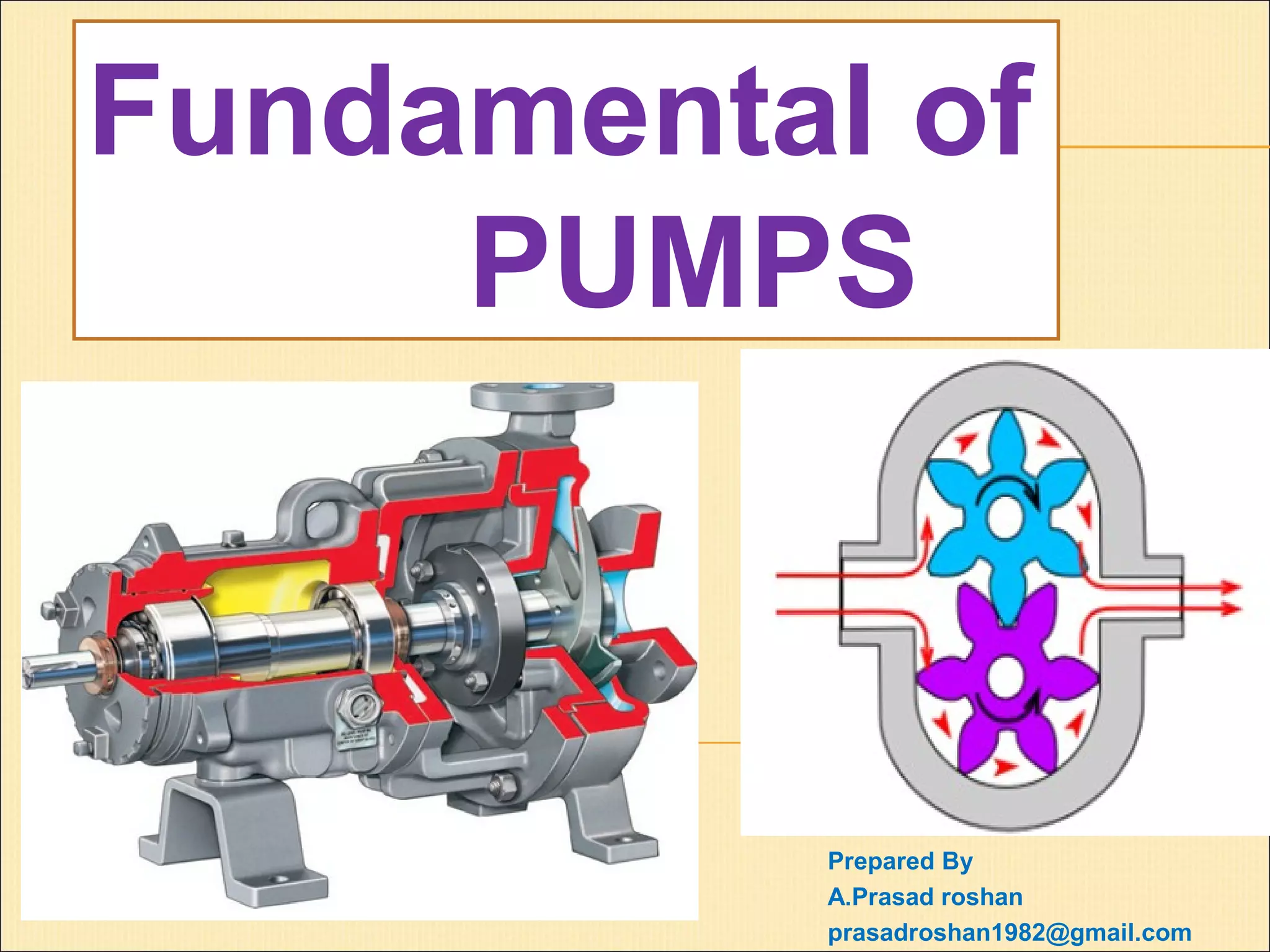
Fundamental of
PUMPS
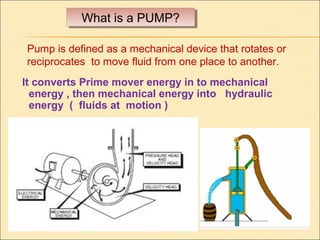
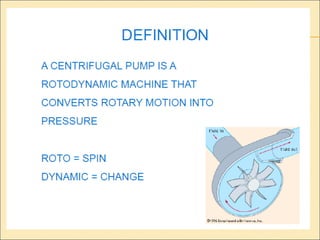
Pump is defined as a mechanical device that rotates or
reciprocates to move fluid from one place to another.
It converts Prime mover energy in to mechanical
energy , then mechanical energy into hydraulic
energy ( fluids at motion )
What is a PUMP?What is a PUMP?
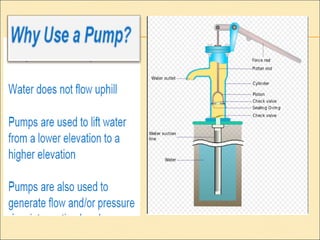
What is the purpose of a pump?
1) pump is designed to transfer fluid from
one point to another.
2)Pumps transfer fluid from
low pressure areas to higher pressure areas,
3)low elevations to higher elevations, and
4)from local locations to distant locations.
What is the purpose of a pump?
1) pump is designed to transfer fluid from
one point to another.
2)Pumps transfer fluid from
low pressure areas to higher pressure areas,
3)low elevations to higher elevations, and
4)from local locations to distant locations.
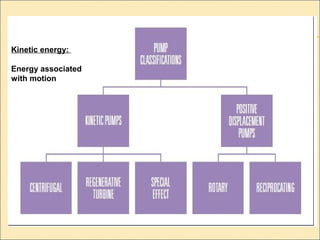
Kinetic energy:
Energy associated
with motion
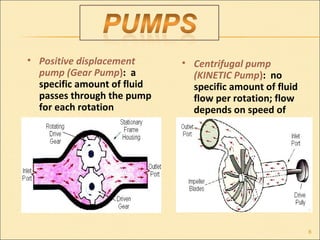
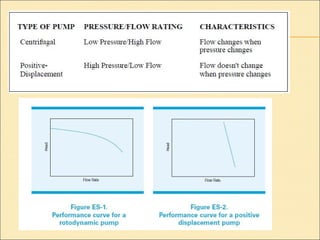
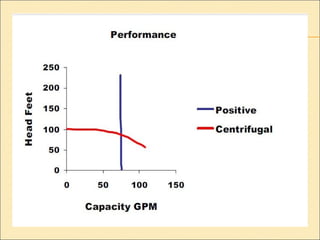
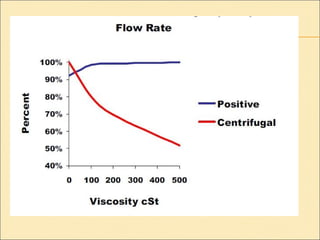
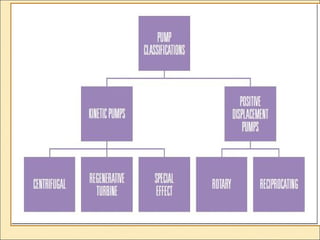
• Positive displacement
pump (Gear Pump): a
specific amount of fluid
passes through the pump
for each rotation
• Centrifugal pump
(KINETIC Pump): no
specific amount of fluid
flow per rotation; flow
depends on speed of
blades
6
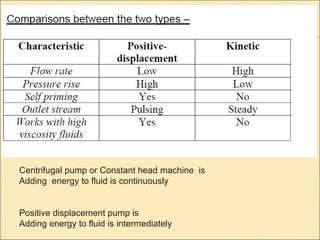
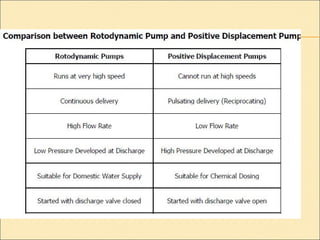
Centrifugal pump or Constant head machine is
Adding energy to fluid is continuously
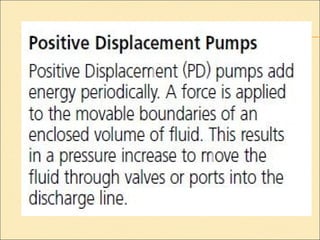
Positive displacement pump is
Adding energy to fluid is intermediately
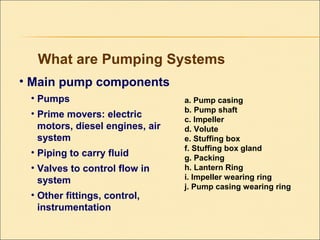
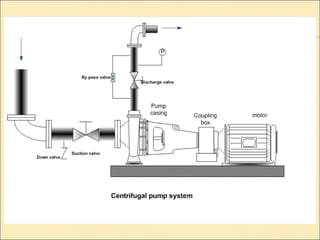
• Main pump components
• Pumps
• Prime movers: electric
motors, diesel engines, air
system
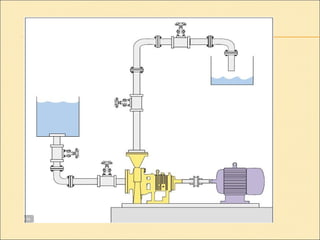
• Piping to carry fluid
• Valves to control flow in
system
• Other fittings, control,
instrumentation
What are Pumping Systems
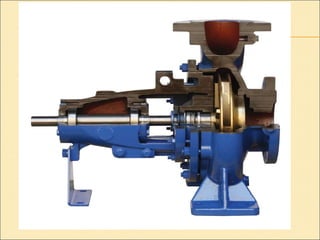
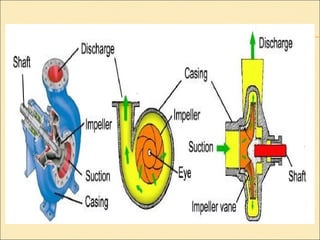
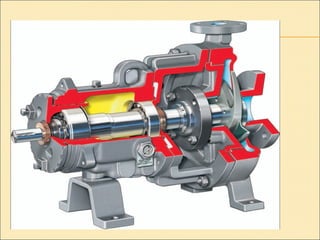
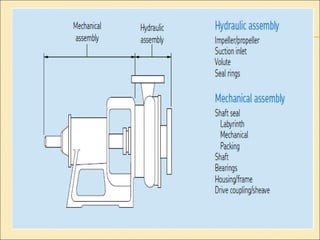
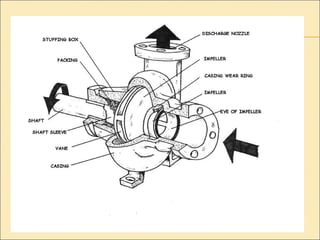
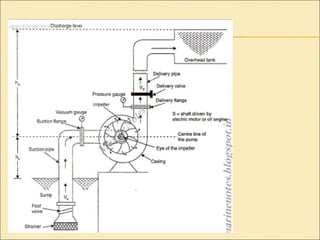
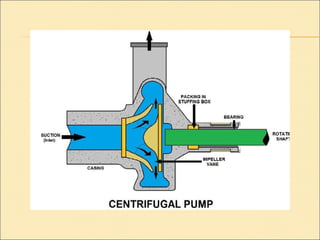
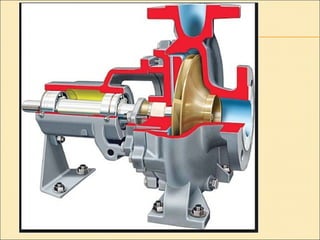
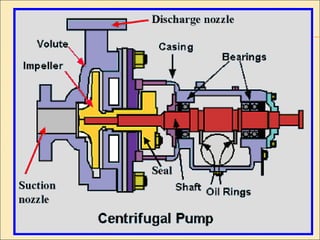
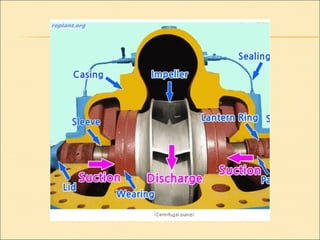
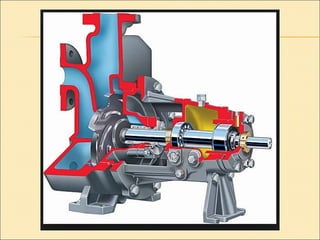
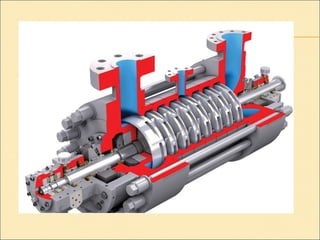
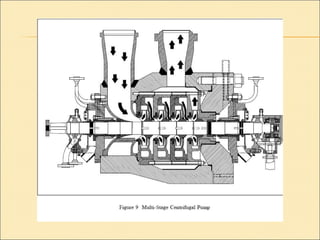
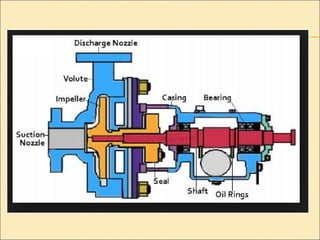
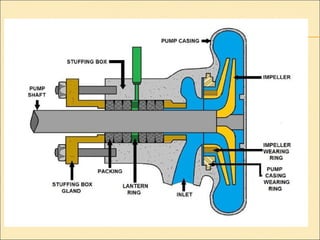
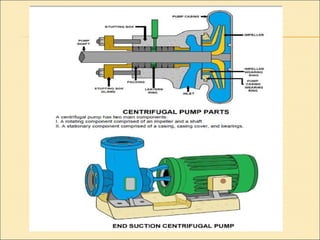
a. Pump casing
b. Pump shaft
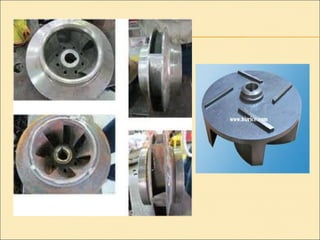
c. Impeller
d. Volute
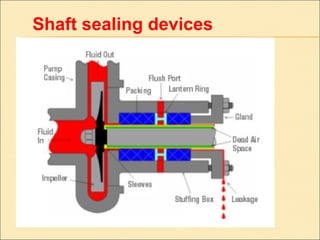
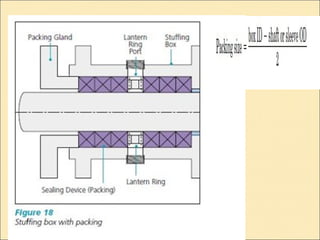
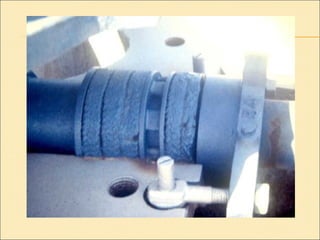
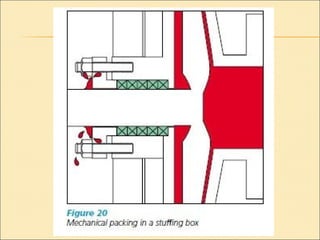
e. Stuffing box
f. Stuffing box gland
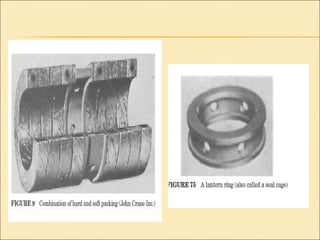
g. Packing
h. Lantern Ring
i. Impeller wearing ring
j. Pump casing wearing ring
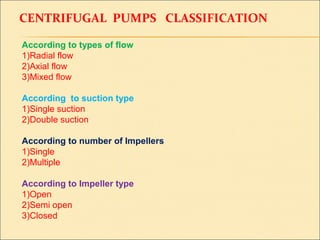
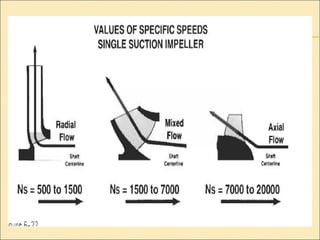
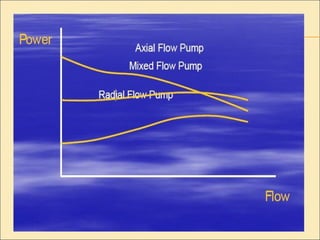
CENTRIFUGAL PUMPS CLASSIFICATION
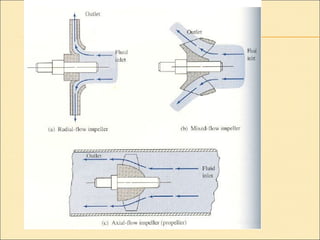
According to types of flow
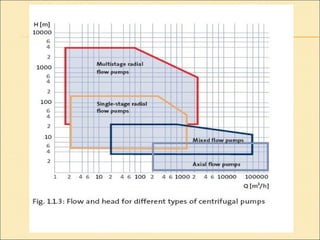
1)Radial flow
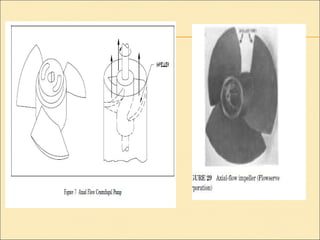
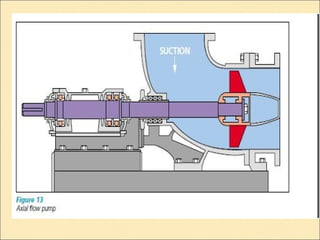
2)Axial flow
3)Mixed flow
According to suction type
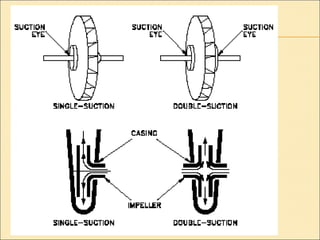
1)Single suction
2)Double suction
According to number of Impellers
1)Single
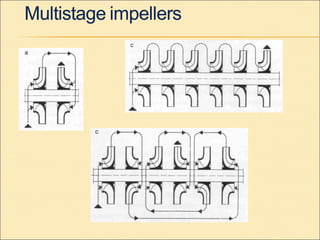
2)Multiple
According to Impeller type
1)Open
2)Semi open
3)Closed
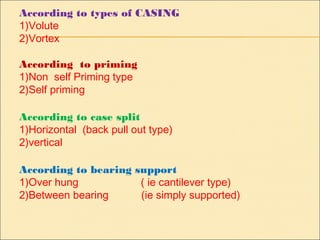
According to types of CASING
1)Volute
2)Vortex
According to priming
1)Non self Priming type
2)Self priming
According to case split
1)Horizontal (back pull out type)
2)vertical
According to bearing support
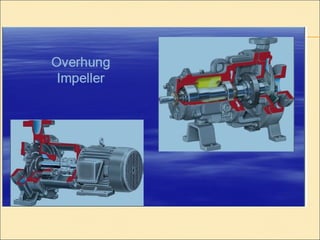
1)Over hung ( ie cantilever type)
2)Between bearing (ie simply supported)
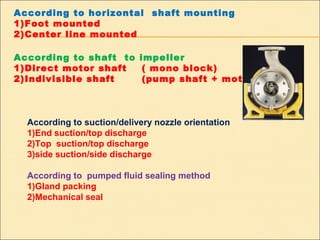
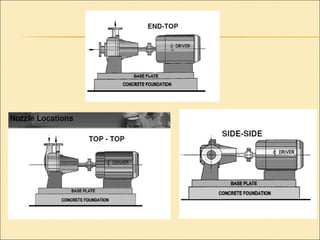
According to suction/delivery nozzle orientation
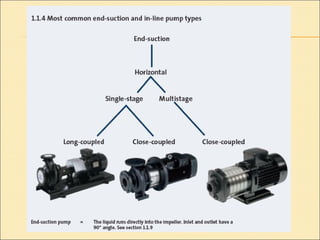
1)End suction/top discharge
2)Top suction/top discharge
3)side suction/side discharge
According to pumped fluid sealing method
1)Gland packing
2)Mechanical seal
According to horizontal shaft mounting
1)Foot mounted
2)Center line mounted
According to shaft to impeller
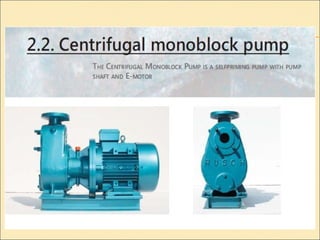
1)Direct motor shaft ( mono block)
2)Indivisible shaft (pump shaft + motor shaft)
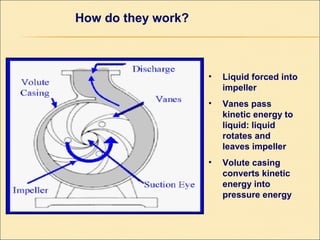
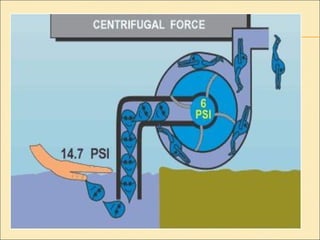
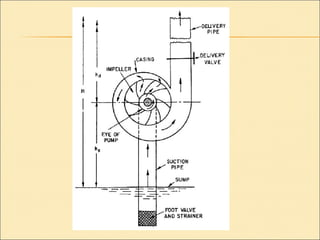
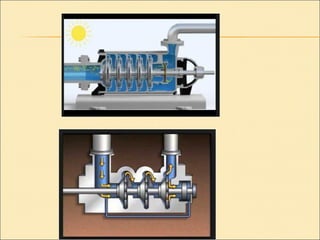
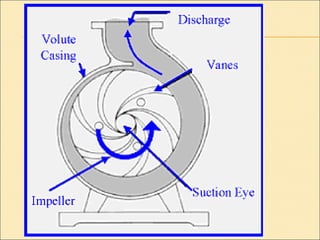
How do they work?
• Liquid forced into
impeller
• Vanes pass
kinetic energy to
liquid: liquid
rotates and
leaves impeller
• Volute casing
converts kinetic
energy into
pressure energy
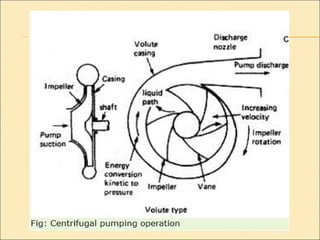
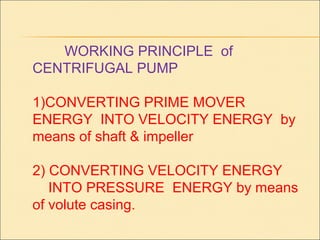
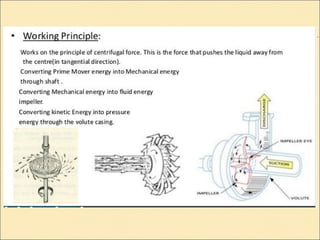
WORKING PRINCIPLE of
CENTRIFUGAL PUMP
1)CONVERTING PRIME MOVER
ENERGY INTO VELOCITY ENERGY by
means of shaft & impeller
2) CONVERTING VELOCITY ENERGY
INTO PRESSURE ENERGY by means
of volute casing.
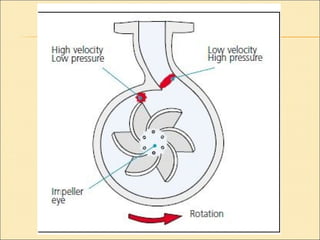
Velocity and pressure changes
within a centrifugal pump.
velocity
pressure
Suction
hose
impeller
volute
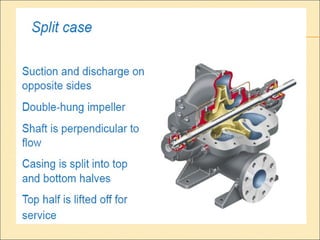
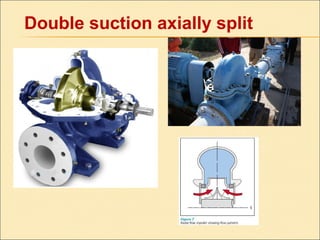
Double suction axially split
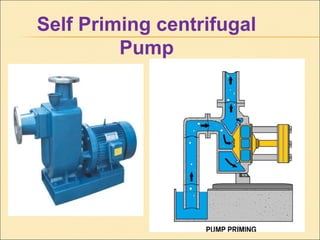
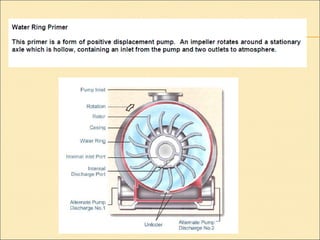
Self Priming centrifugal
Pump
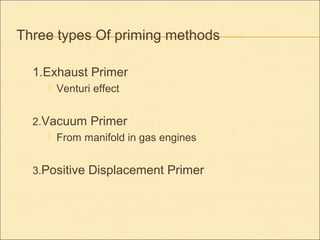
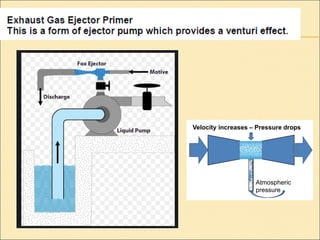
Three types Of priming methods
1.Exhaust Primer
 Venturi effect
2.Vacuum Primer
 From manifold in gas engines
3.Positive Displacement Primer
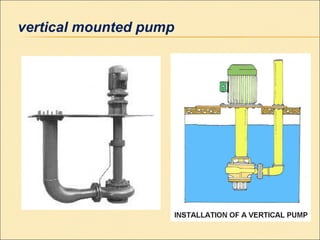
vertical mounted pump
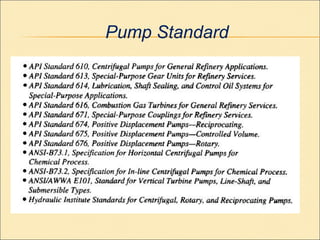
Pump Standard
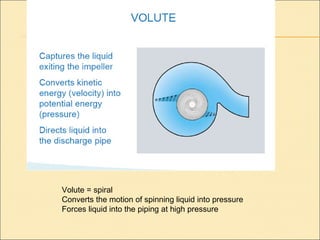
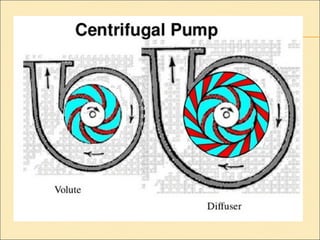
Volute = spiral
Converts the motion of spinning liquid into pressure
Forces liquid into the piping at high pressure
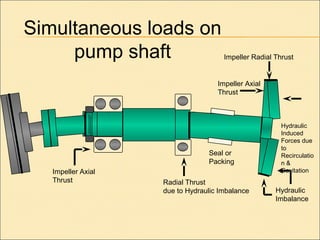
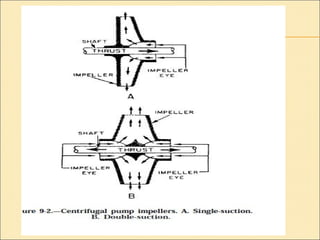
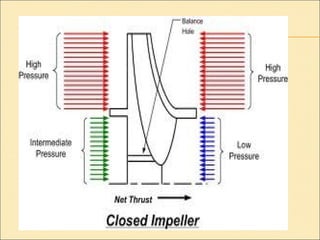
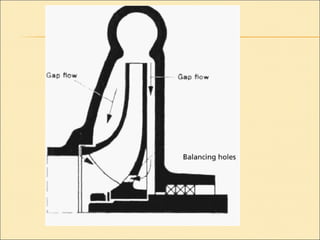
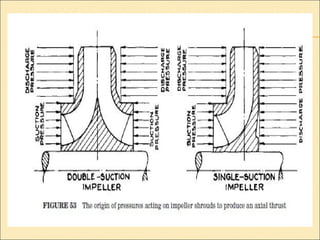
Impeller Axial
Thrust
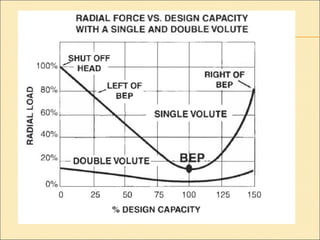
Impeller Radial Thrust
Hydraulic
Imbalance
Seal or
Packing
Radial Thrust
due to Hydraulic Imbalance
Impeller Axial
Thrust
Hydraulic
Induced
Forces due
to
Recirculatio
n &
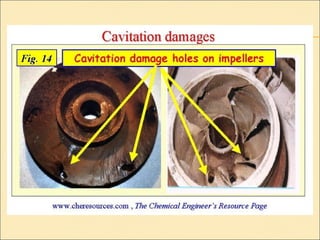
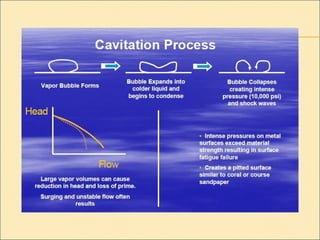
Cavitation
Simultaneous loads on
pump shaft
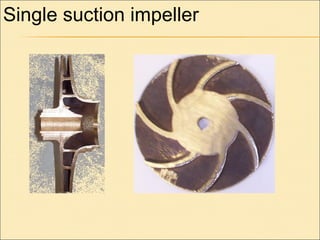
Single suction impeller
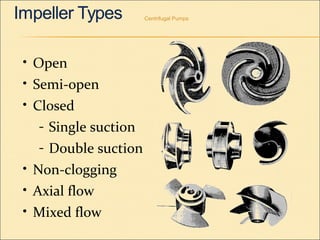
Centrifugal Pumps
• Open
• Semi-open
• Closed
- Single suction
- Double suction
• Non-clogging
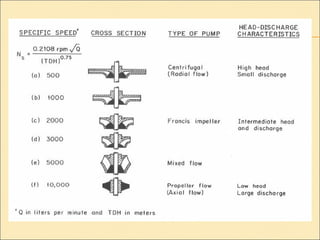
• Axial flow
• Mixed flow
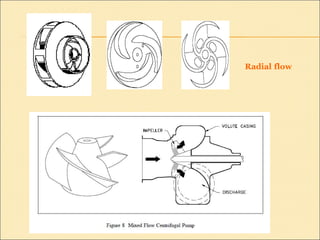
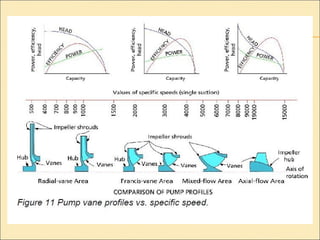
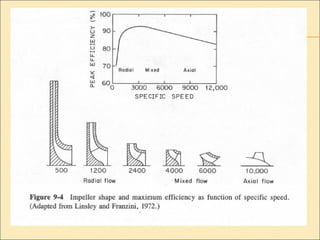
Radial flow
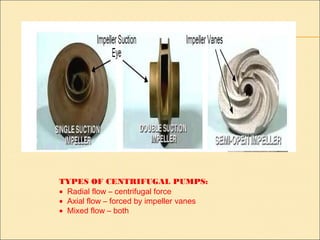
TYPES OF CENTRIFUGAL PUMPS:
• Radial flow – centrifugal force
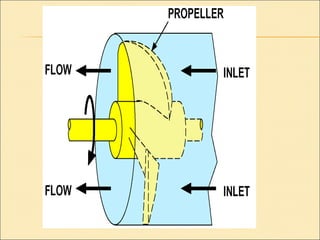
• Axial flow – forced by impeller vanes
• Mixed flow – both
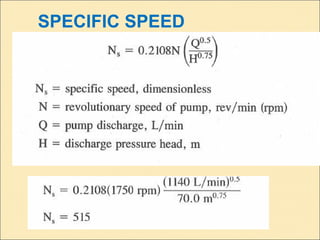
SPECIFIC SPEED
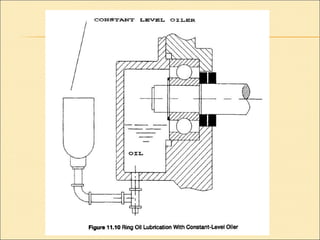
Shaft sealing devices
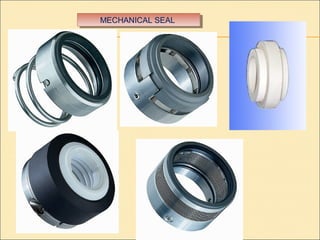
MECHANICAL SEALMECHANICAL SEAL
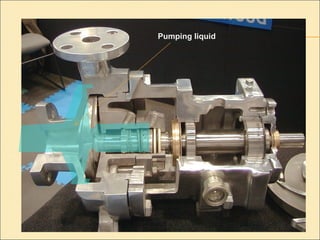
Pumping liquid
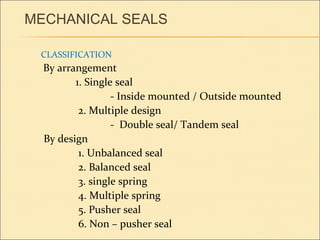
MECHANICAL SEALS
CLASSIFICATION
By arrangement
1. Single seal
- Inside mounted / Outside mounted
2. Multiple design
- Double seal/ Tandem seal
By design
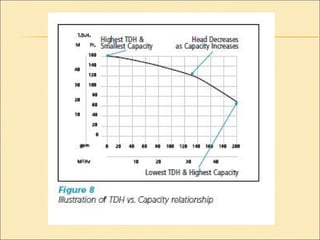
1. Unbalanced seal
2. Balanced seal
3. single spring
4. Multiple spring
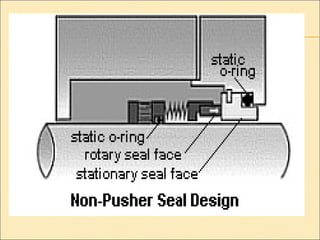
5. Pusher seal
6. Non – pusher seal
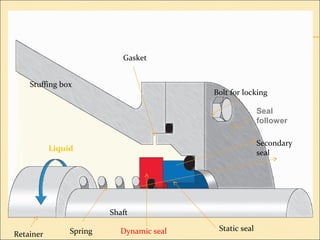
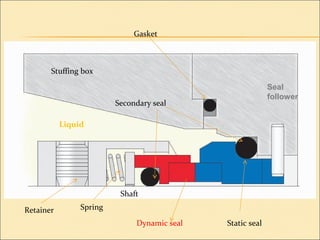
Shaft
Seal
follower
Stuffing box
Retainer Spring Static sealDynamic seal
Liquid
Bolt for locking
Gasket
Secondary
seal
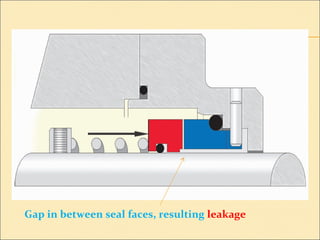
Gap in between seal faces, resulting leakage
Shaft
Seal
follower
Stuffing box
Retainer Spring
Static sealDynamic seal
Liquid
Gasket
Secondary seal
Shaft
Seal
follower
Stuffing box
Retainer
Spring
Static seal
Dynamic seal
Liquid
Gasket
Secondary
seal
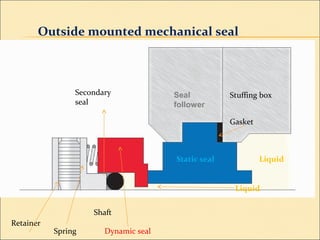
Outside mounted mechanical seal
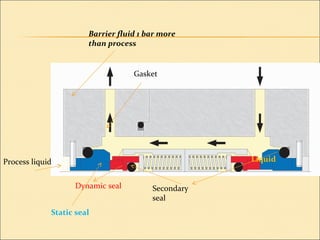
Liquid
Static seal
Dynamic seal
Liquid
Gasket
Secondary
seal
Barrier fluid 1 bar more
than process
Process liquid
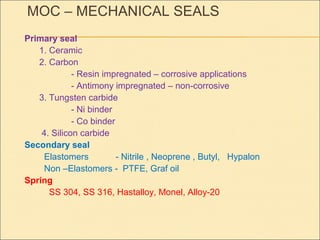
MOC – MECHANICAL SEALS
Primary seal
1. Ceramic
2. Carbon
- Resin impregnated – corrosive applications
- Antimony impregnated – non-corrosive
3. Tungsten carbide
- Ni binder
- Co binder
4. Silicon carbide
Secondary seal
Elastomers - Nitrile , Neoprene , Butyl, Hypalon
Non –Elastomers - PTFE, Graf oil
Spring
SS 304, SS 316, Hastalloy, Monel, Alloy-20
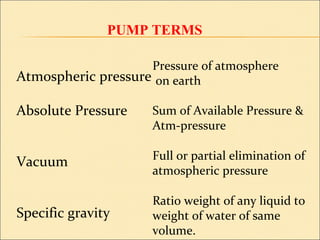
PUMP TERMS
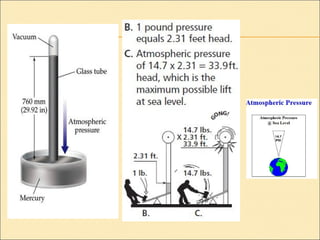
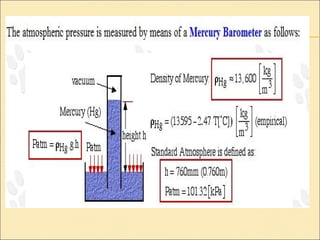
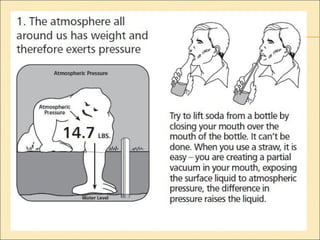
Atmospheric pressure
Absolute Pressure
Vacuum
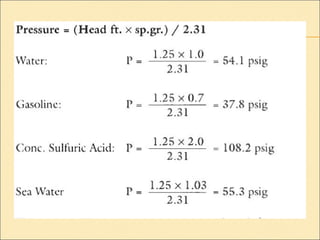
Specific gravity
Pressure of atmosphere
on earth
Sum of Available Pressure &
Atm-pressure
Full or partial elimination of
atmospheric pressure
Ratio weight of any liquid to
weight of water of same
volume.
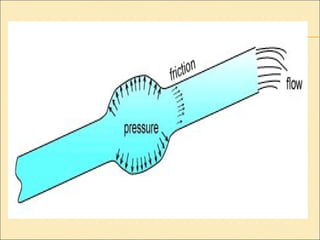
Three important characteristics of pump systems.
1)Pressure is the driving force responsible for the
movement of the fluid.
2)Friction is the force that slows down fluid
particles.
3) Flow rate is the amount of volume that is
displaced per unit time.
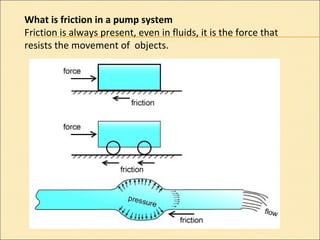
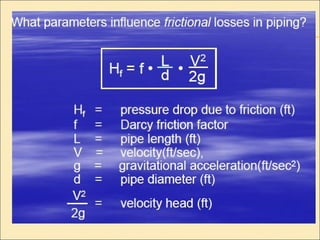
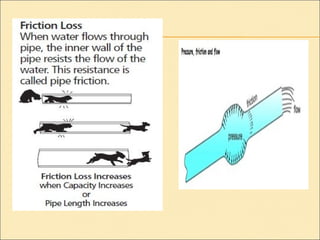
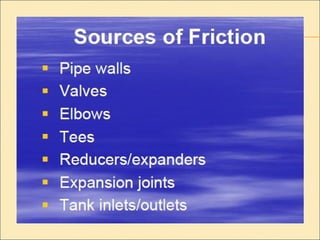
What is friction in a pump system
Friction is always present, even in fluids, it is the force that
resists the movement of objects.
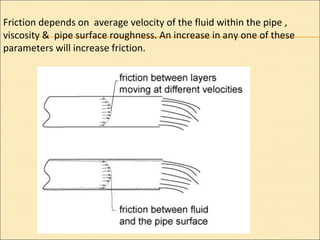
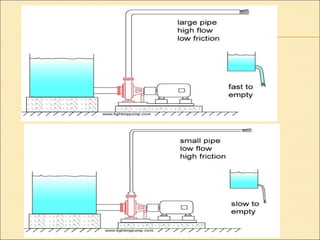
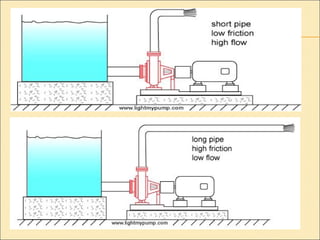
Friction depends on average velocity of the fluid within the pipe ,
viscosity & pipe surface roughness. An increase in any one of these
parameters will increase friction.
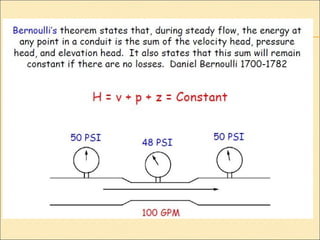
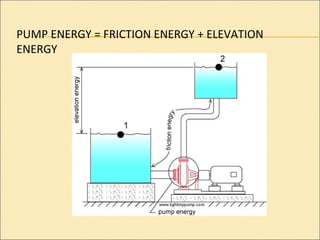
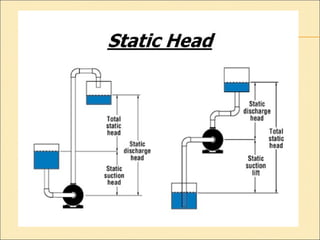
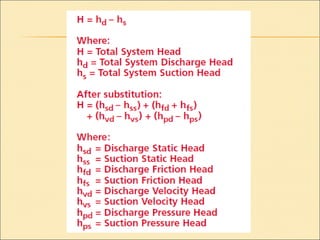
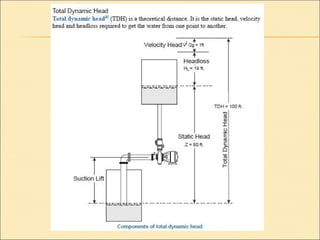
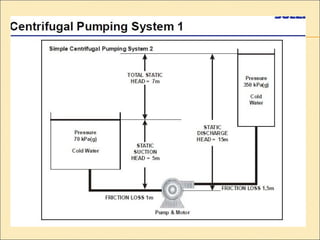
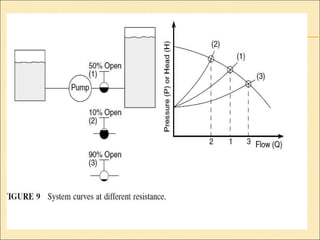
PUMP ENERGY = FRICTION ENERGY + ELEVATION
ENERGY
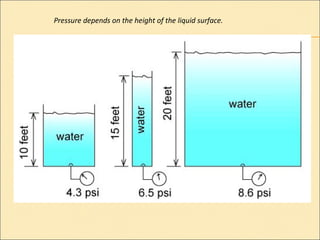
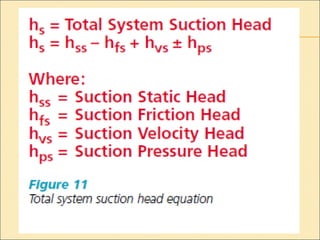
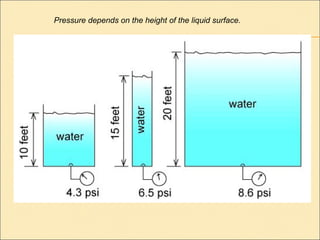
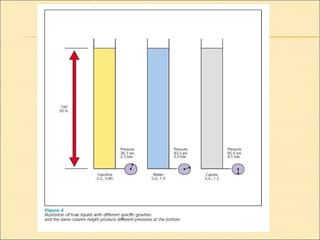
Pressure depends on the height of the liquid surface.
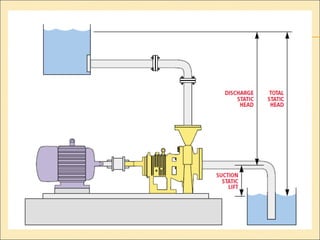
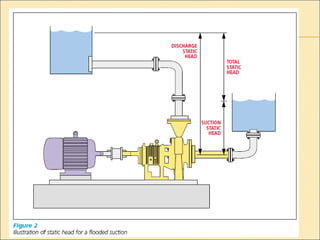
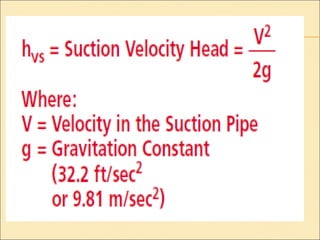
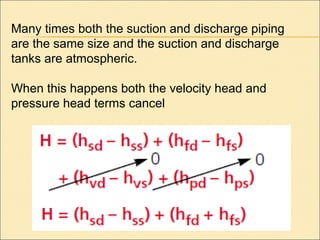
Many times both the suction and discharge piping
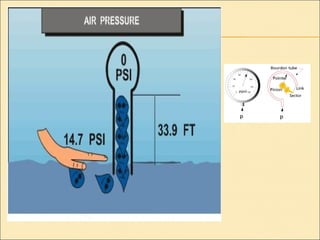
are the same size and the suction and discharge
tanks are atmospheric.
When this happens both the velocity head and
pressure head terms cancel
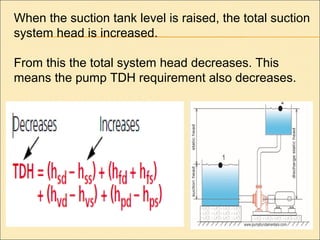
When the suction tank level is raised, the total suction
system head is increased.
From this the total system head decreases. This
means the pump TDH requirement also decreases.
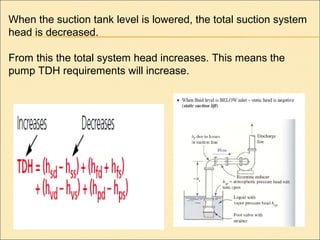
When the suction tank level is lowered, the total suction system
head is decreased.
From this the total system head increases. This means the
pump TDH requirements will increase.
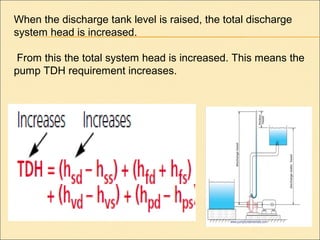
When the discharge tank level is raised, the total discharge
system head is increased.
From this the total system head is increased. This means the
pump TDH requirement increases.
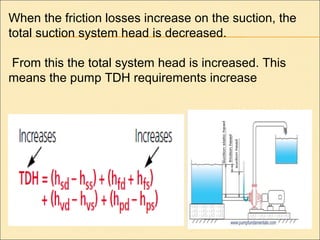
When the friction losses increase on the suction, the
total suction system head is decreased.
From this the total system head is increased. This
means the pump TDH requirements increase
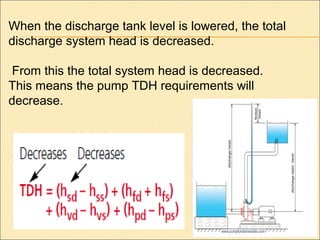
When the discharge tank level is lowered, the total
discharge system head is decreased.
From this the total system head is decreased.
This means the pump TDH requirements will
decrease.
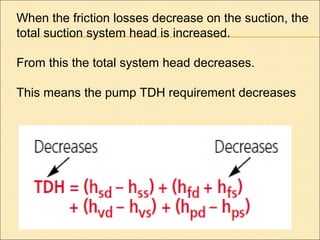
When the friction losses decrease on the suction, the
total suction system head is increased.
From this the total system head decreases.
This means the pump TDH requirement decreases
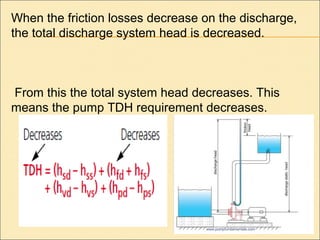
When the friction losses decrease on the discharge,
the total discharge system head is decreased.
From this the total system head decreases. This
means the pump TDH requirement decreases.
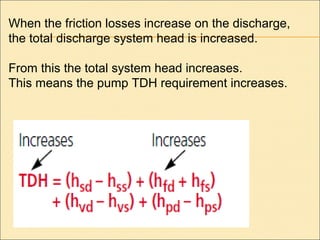
When the friction losses increase on the discharge,
the total discharge system head is increased.
From this the total system head increases.
This means the pump TDH requirement increases.
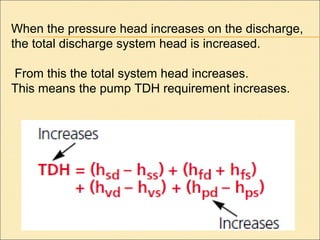
When the pressure head increases on the discharge,
the total discharge system head is increased.
From this the total system head increases.
This means the pump TDH requirement increases.
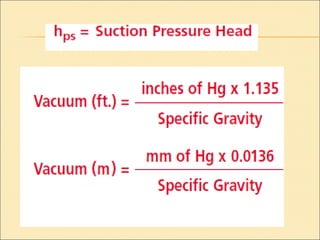
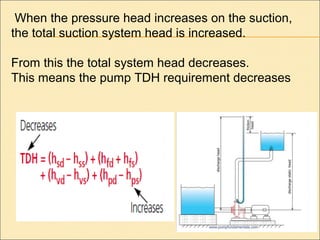
When the pressure head increases on the suction,
the total suction system head is increased.
From this the total system head decreases.
This means the pump TDH requirement decreases
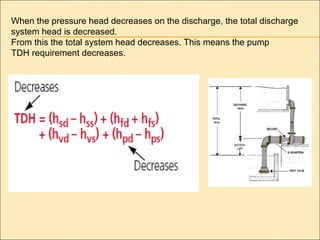
When the pressure head decreases on the discharge, the total discharge
system head is decreased.
From this the total system head decreases. This means the pump
TDH requirement decreases.
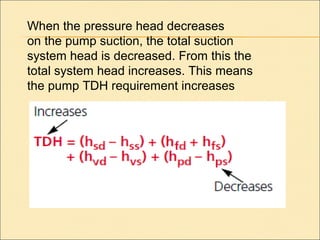
When the pressure head decreases
on the pump suction, the total suction
system head is decreased. From this the
total system head increases. This means
the pump TDH requirement increases
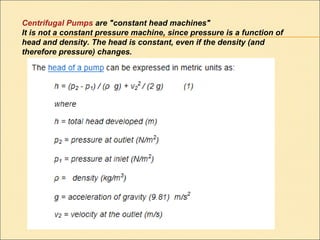
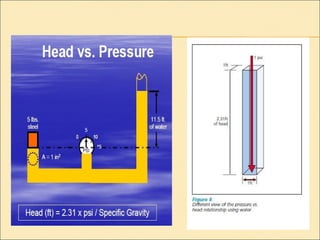
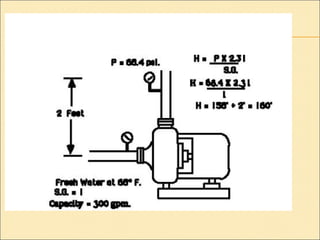
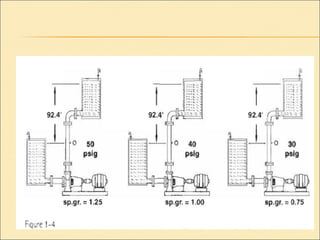
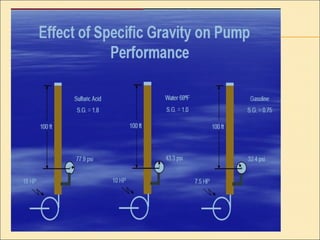
Centrifugal Pumps are "constant head machines"
It is not a constant pressure machine, since pressure is a function of
head and density. The head is constant, even if the density (and
therefore pressure) changes.
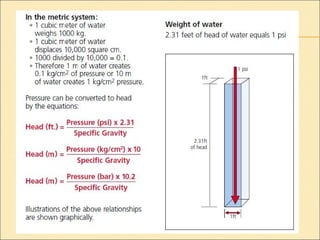
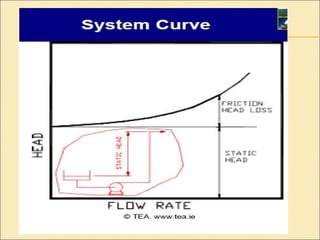
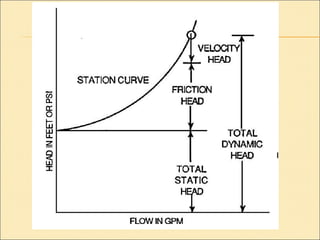
Pressure depends on the height of the liquid surface.
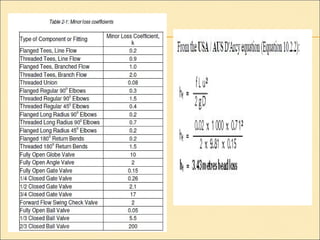
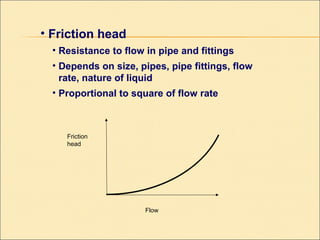
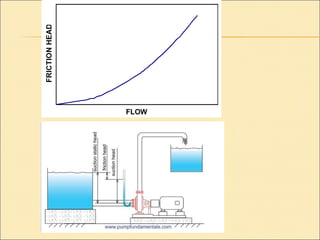
• Friction head
• Resistance to flow in pipe and fittings
• Depends on size, pipes, pipe fittings, flow
rate, nature of liquid
• Proportional to square of flow rate
Friction
head
Flow
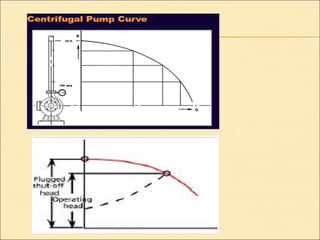
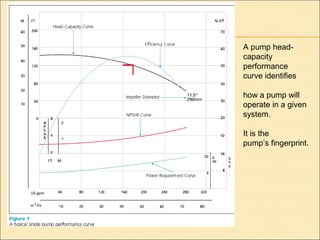
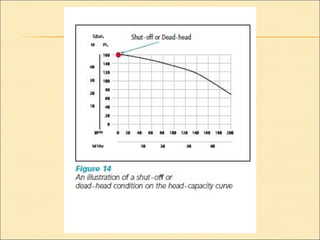
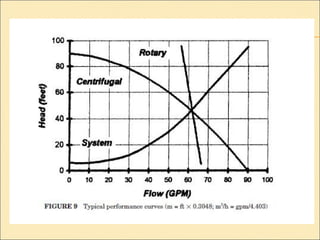
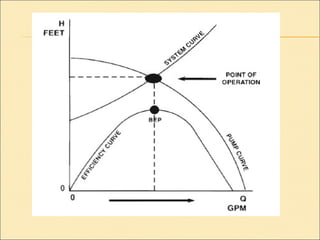
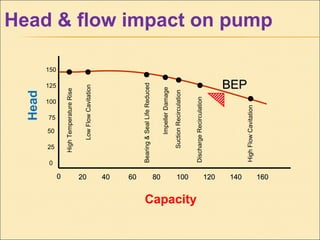
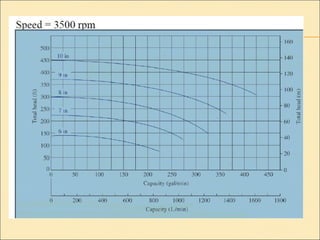
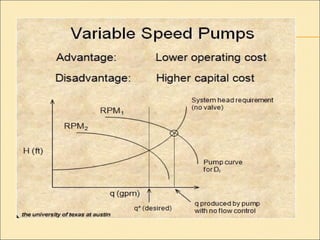
A pump head-
capacity
performance
curve identifies
how a pump will
operate in a given
system.
It is the
pump’s fingerprint.
Head & flow impact on pump
00 2020 4040 6060 8080 100100 120120 140140 160160
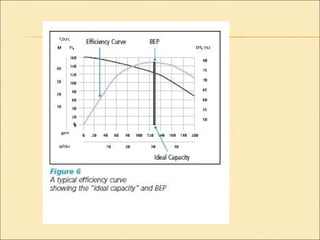
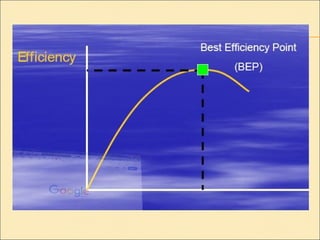
BEPBEP
HighFlowCavitation
DischargeRecirculation
SuctionRecirculation
ImpellerDamage
Bearing&SealLifeReduced
LowFlowCavitation
HighTemperatureRise
Capacity
Head
150
125
100
75
50
25
0
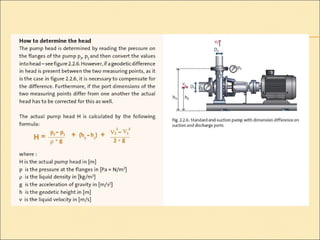
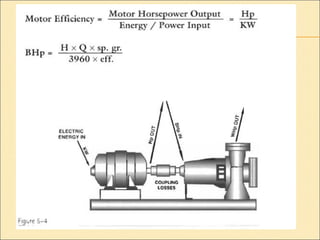
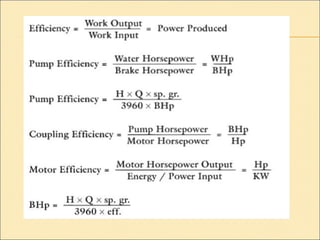
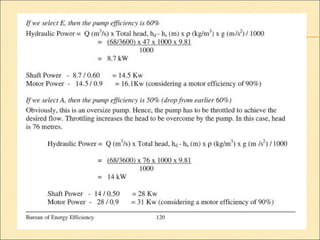
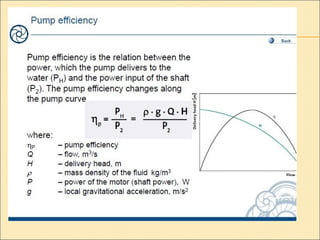
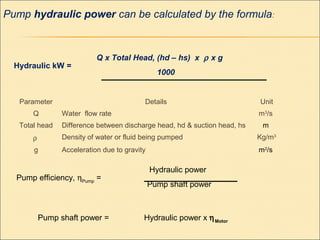
Pump hydraulic power can be calculated by the formula:
Hydraulic kW =
Q x Total Head, (hd – hs) x ρ x g
1000
Parameter Details Unit
Q Water flow rate m3
/s
Total head Difference between discharge head, hd & suction head, hs m
ρ Density of water or fluid being pumped Kg/m3
g Acceleration due to gravity m2
/s
Pump efficiency, ηPump
=
Hydraulic power
Pump shaft power
Pump shaft power = Hydraulic power x ηMotor
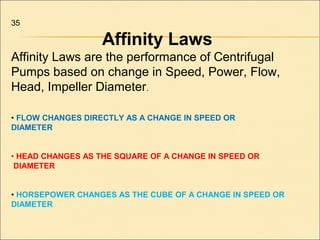
35
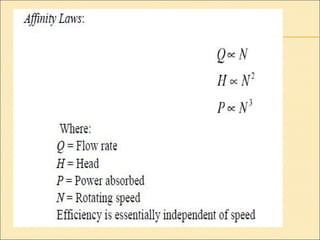
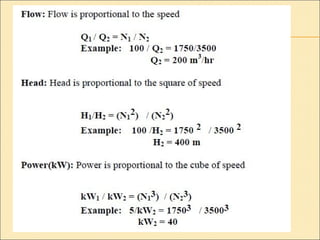
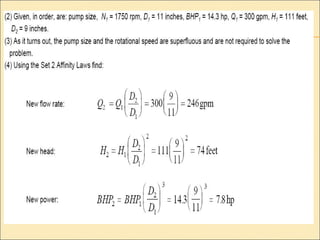
Affinity Laws
Affinity Laws are the performance of Centrifugal
Pumps based on change in Speed, Power, Flow,
Head, Impeller Diameter.
• FLOW CHANGES DIRECTLY AS A CHANGE IN SPEED OR
DIAMETER
• HEAD CHANGES AS THE SQUARE OF A CHANGE IN SPEED OR
DIAMETER
• HORSEPOWER CHANGES AS THE CUBE OF A CHANGE IN SPEED OR
DIAMETER
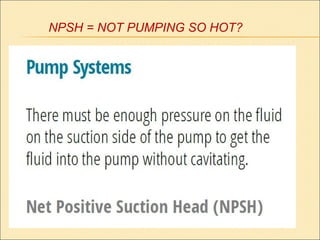
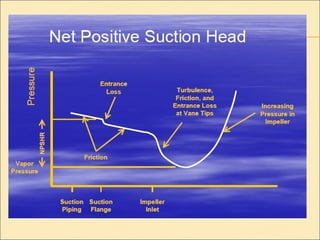
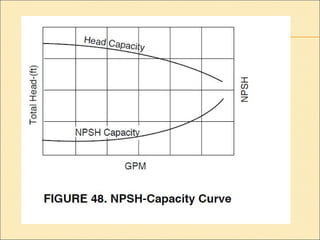
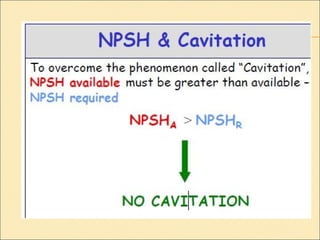
NPSH = NOT PUMPING SO HOT?
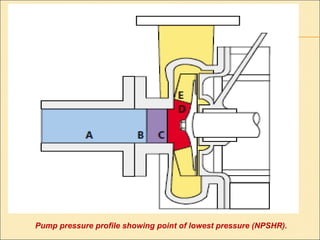
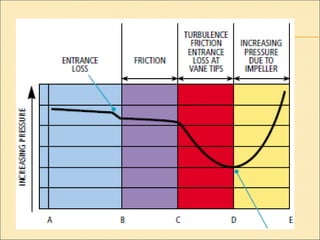
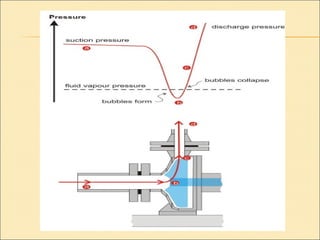
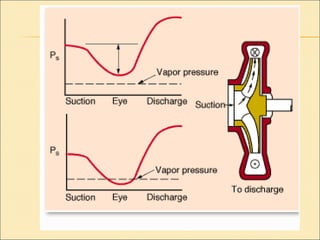
Pump pressure profile showing point of lowest pressure (NPSHR).
Multiple-Pump Operation
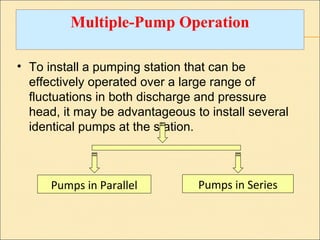
• To install a pumping station that can be
effectively operated over a large range of
fluctuations in both discharge and pressure
head, it may be advantageous to install several
identical pumps at the station.
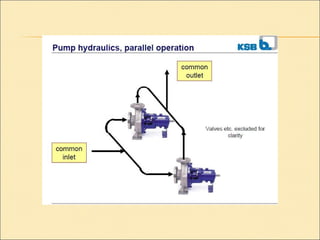
Pumps in Parallel Pumps in Series
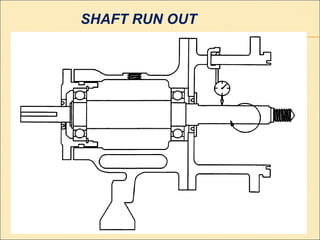
SHAFT RUN OUT
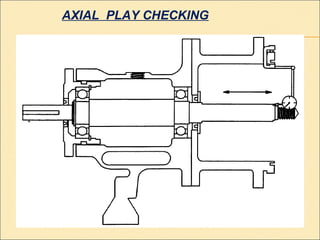
AXIAL PLAY CHECKING
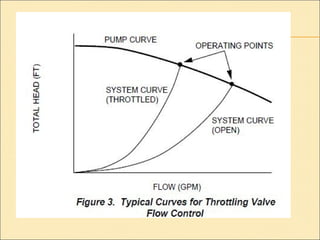
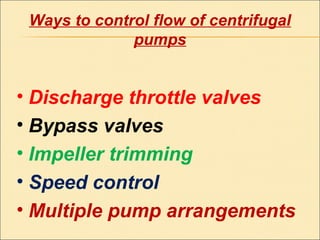
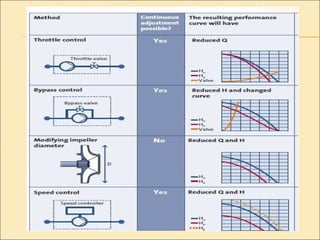
Ways to control flow of centrifugal
pumps
• Discharge throttle valves
• Bypass valves
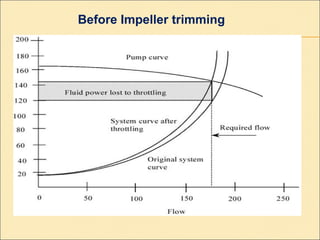
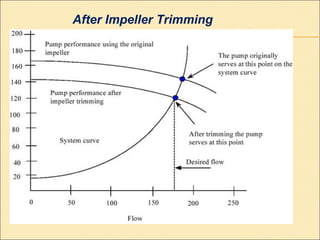
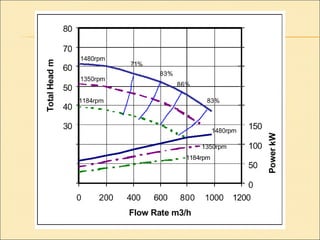
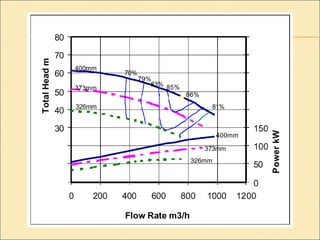
• Impeller trimming
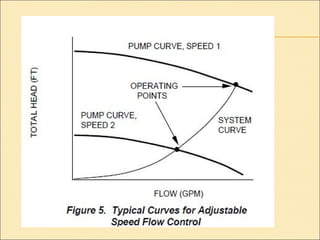
• Speed control
• Multiple pump arrangements
Before Impeller trimming
After Impeller Trimming
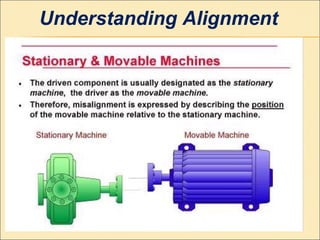
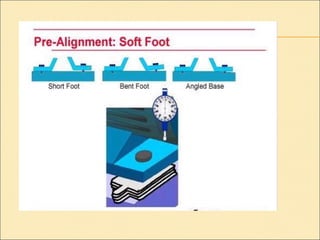
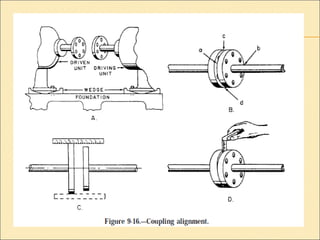
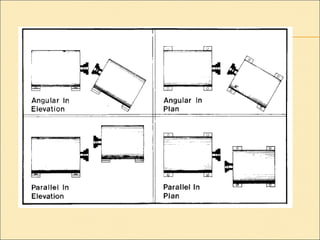
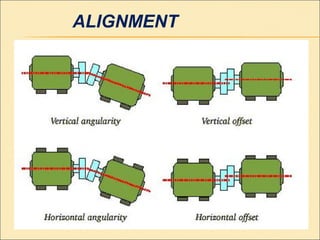
Understanding Alignment
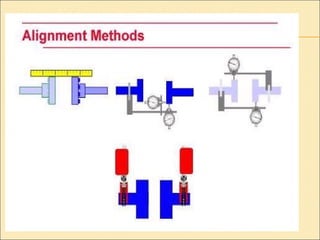
Method of alignment
a)Feeler gauge
b)Straight edge method
c)Rim & face method
d)Reverse indicator method
e)Laser method
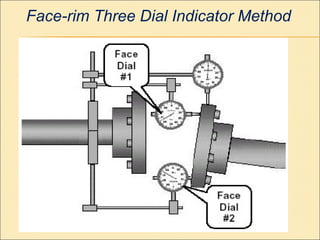
Face-rim Three Dial Indicator Method
ALIGNMENT
Centrifugal Pumps
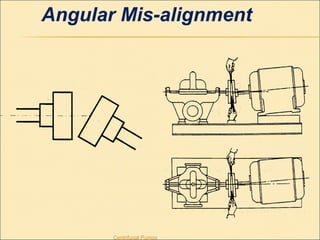
Angular Mis-alignment
Centrifugal Pumps
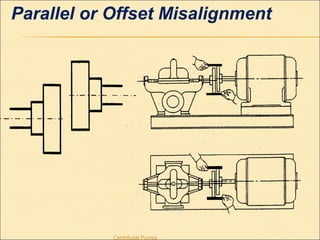
Parallel or Offset Misalignment
Positive displacement
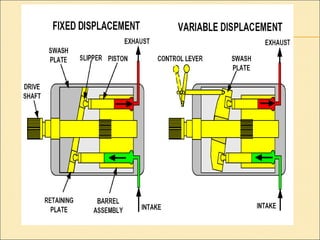
Fixed displacement, fluid is
captured in cavities within
the pump and mechanical
energy moves it from the
inlet to discharge
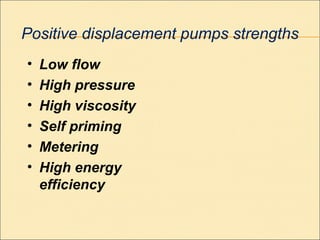
• Low flow
• High pressure
• High viscosity
• Self priming
• Metering
• High energy
efficiency
Positive displacement pumps strengths
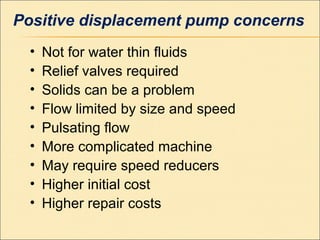
Positive displacement pump concerns
• Not for water thin fluids
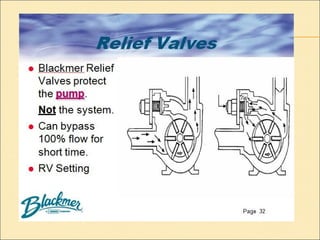
• Relief valves required
• Solids can be a problem
• Flow limited by size and speed
• Pulsating flow
• More complicated machine
• May require speed reducers
• Higher initial cost
• Higher repair costs
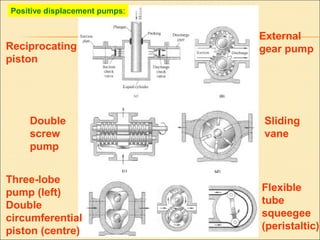
Reciprocating
piston
External
gear pump
Double
screw
pump
Sliding
vane
Three-lobe
pump (left)
Double
circumferential
piston (centre)
Flexible
tube
squeegee
(peristaltic)
Positive displacement pumps:
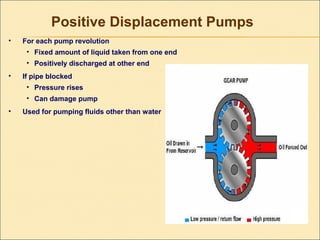
• For each pump revolution
• Fixed amount of liquid taken from one end
• Positively discharged at other end
• If pipe blocked
• Pressure rises
• Can damage pump
• Used for pumping fluids other than water
Positive Displacement Pumps
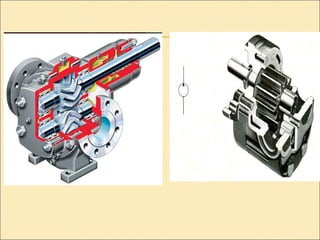
G E A R P U M P S
L O B E P U M P S
S C R E W P U M P S
C A M P U M P S
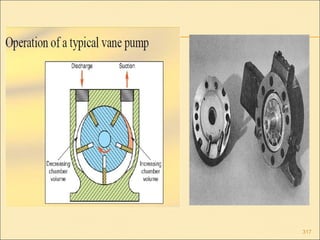
V A N E P U M P S
R O T A R Y P U M P S
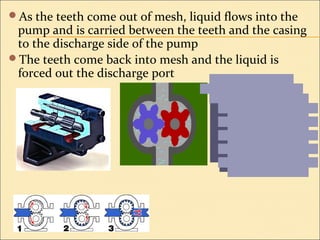
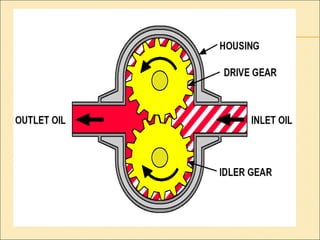
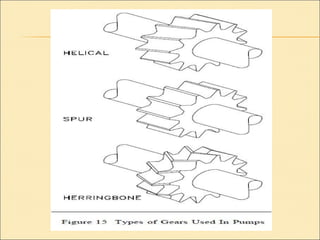
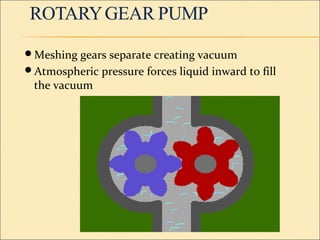
As the teeth come out of mesh, liquid flows into the
pump and is carried between the teeth and the casing
to the discharge side of the pump
The teeth come back into mesh and the liquid is
forced out the discharge port
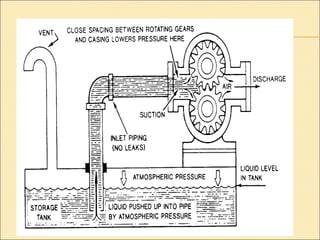
Meshing gears separate creating vacuum
Atmospheric pressure forces liquid inward to fill
the vacuum
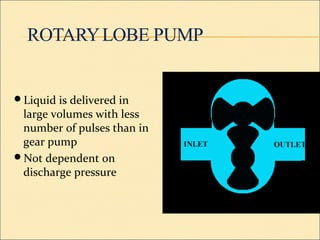
Liquid is delivered in
large volumes with less
number of pulses than in
gear pump
Not dependent on
discharge pressure
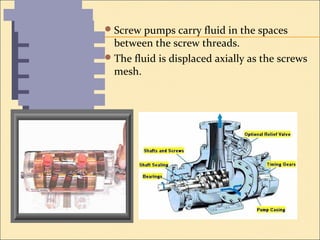
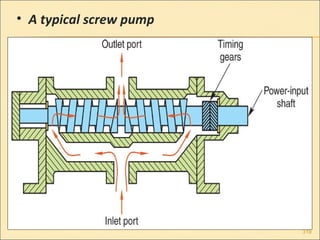
Screw pumps carry fluid in the spaces
between the screw threads.
The fluid is displaced axially as the screws
mesh.
G E A R P U M P S
L O B E P U M P S
S C R E W P U M P S
C A M P U M P S
V A N E P U M P S
R O T A R Y P U M P S
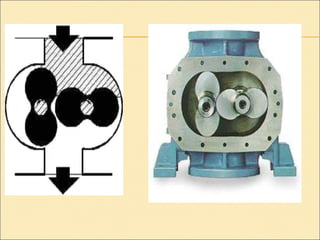
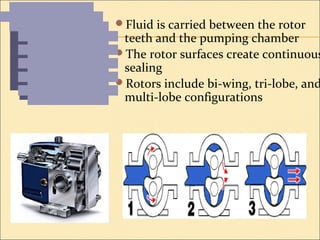
Fluid is carried between the rotor
teeth and the pumping chamber
The rotor surfaces create continuous
sealing
Rotors include bi-wing, tri-lobe, and
multi-lobe configurations
G E A R P U M P S
L O B E P U M P S
S C R E W P U M P S
C A M P U M P S
V A N E P U M P S
R O T A R Y P U M P S
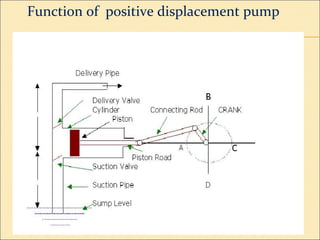
Function of positive displacement pump
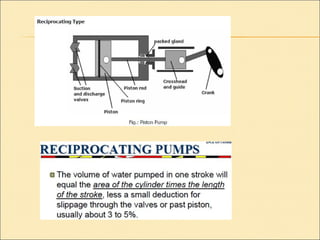
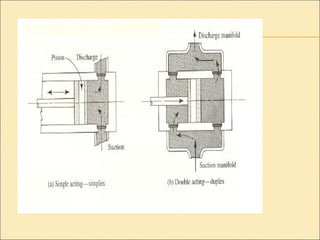
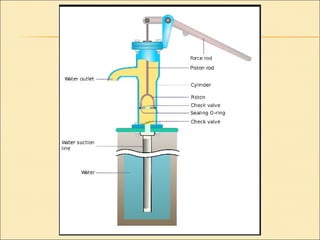
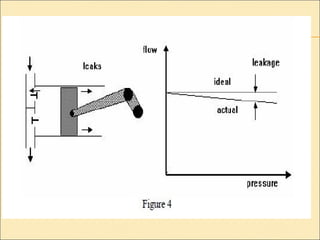
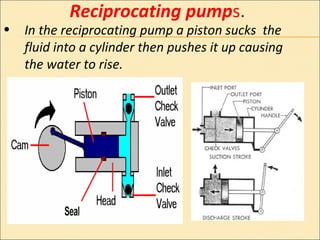
Reciprocating pumps.
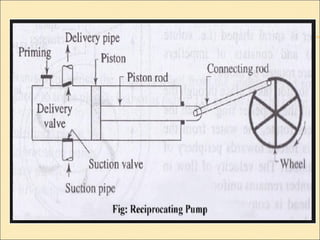
• In the reciprocating pump a piston sucks the
fluid into a cylinder then pushes it up causing
the water to rise.
P IS T O N P U M P S
P L U N G E R P U M P S
D IA P H R A G M P U M P S
R E C IP R O C A T IN G P U M P S
P O S IT IV E D IS P L A C E M E N T P U M P S
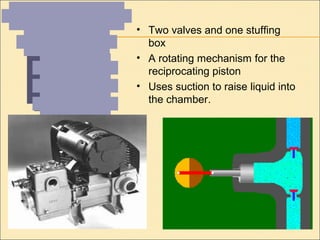
• Two valves and one stuffing
box
• A rotating mechanism for the
reciprocating piston
• Uses suction to raise liquid into
the chamber.
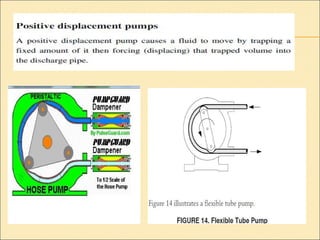
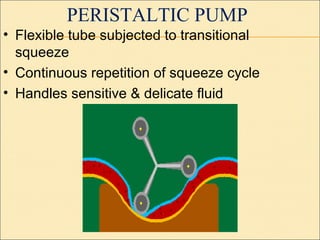
PERISTALTIC PUMP
• Flexible tube subjected to transitional
squeeze
• Continuous repetition of squeeze cycle
• Handles sensitive & delicate fluid
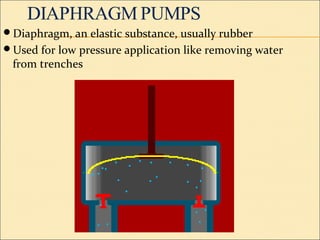
Diaphragm, an elastic substance, usually rubber
Used for low pressure application like removing water
from trenches
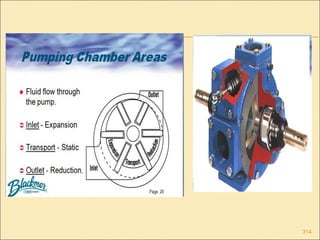
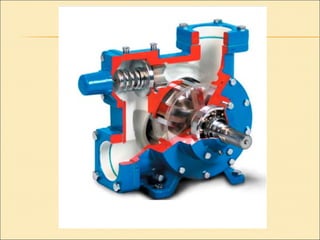
314
317
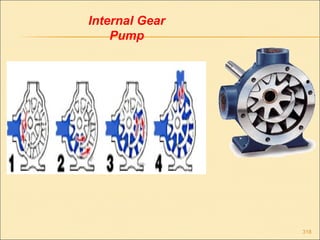
Internal Gear
Pump
318
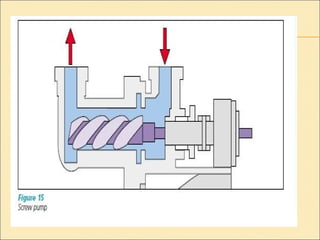
• A typical screw pump
319
Thanks

Pump

  • 1.
  • 2.
    Pump is definedas a mechanical device that rotates or reciprocates to move fluid from one place to another. It converts Prime mover energy in to mechanical energy , then mechanical energy into hydraulic energy ( fluids at motion ) What is a PUMP?What is a PUMP?
  • 4.
    What is thepurpose of a pump? 1) pump is designed to transfer fluid from one point to another. 2)Pumps transfer fluid from low pressure areas to higher pressure areas, 3)low elevations to higher elevations, and 4)from local locations to distant locations. What is the purpose of a pump? 1) pump is designed to transfer fluid from one point to another. 2)Pumps transfer fluid from low pressure areas to higher pressure areas, 3)low elevations to higher elevations, and 4)from local locations to distant locations.
  • 5.
  • 6.
    • Positive displacement pump(Gear Pump): a specific amount of fluid passes through the pump for each rotation • Centrifugal pump (KINETIC Pump): no specific amount of fluid flow per rotation; flow depends on speed of blades 6
  • 8.
    Centrifugal pump orConstant head machine is Adding energy to fluid is continuously Positive displacement pump is Adding energy to fluid is intermediately
  • 15.
    • Main pumpcomponents • Pumps • Prime movers: electric motors, diesel engines, air system • Piping to carry fluid • Valves to control flow in system • Other fittings, control, instrumentation What are Pumping Systems a. Pump casing b. Pump shaft c. Impeller d. Volute e. Stuffing box f. Stuffing box gland g. Packing h. Lantern Ring i. Impeller wearing ring j. Pump casing wearing ring
  • 18.
    CENTRIFUGAL PUMPS CLASSIFICATION Accordingto types of flow 1)Radial flow 2)Axial flow 3)Mixed flow According to suction type 1)Single suction 2)Double suction According to number of Impellers 1)Single 2)Multiple According to Impeller type 1)Open 2)Semi open 3)Closed
  • 19.
    According to typesof CASING 1)Volute 2)Vortex According to priming 1)Non self Priming type 2)Self priming According to case split 1)Horizontal (back pull out type) 2)vertical According to bearing support 1)Over hung ( ie cantilever type) 2)Between bearing (ie simply supported)
  • 20.
    According to suction/deliverynozzle orientation 1)End suction/top discharge 2)Top suction/top discharge 3)side suction/side discharge According to pumped fluid sealing method 1)Gland packing 2)Mechanical seal According to horizontal shaft mounting 1)Foot mounted 2)Center line mounted According to shaft to impeller 1)Direct motor shaft ( mono block) 2)Indivisible shaft (pump shaft + motor shaft)
  • 28.
    How do theywork? • Liquid forced into impeller • Vanes pass kinetic energy to liquid: liquid rotates and leaves impeller • Volute casing converts kinetic energy into pressure energy
  • 35.
    WORKING PRINCIPLE of CENTRIFUGALPUMP 1)CONVERTING PRIME MOVER ENERGY INTO VELOCITY ENERGY by means of shaft & impeller 2) CONVERTING VELOCITY ENERGY INTO PRESSURE ENERGY by means of volute casing.
  • 36.
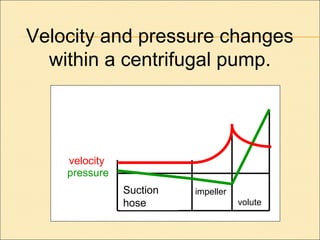
    Velocity and pressurechanges within a centrifugal pump. velocity pressure Suction hose impeller volute
  • 54.
  • 58.
  • 62.
    Three types Ofpriming methods 1.Exhaust Primer  Venturi effect 2.Vacuum Primer  From manifold in gas engines 3.Positive Displacement Primer
  • 65.
  • 66.
  • 73.
    Volute = spiral Convertsthe motion of spinning liquid into pressure Forces liquid into the piping at high pressure
  • 75.
    Impeller Axial Thrust Impeller RadialThrust Hydraulic Imbalance Seal or Packing Radial Thrust due to Hydraulic Imbalance Impeller Axial Thrust Hydraulic Induced Forces due to Recirculatio n & Cavitation Simultaneous loads on pump shaft
  • 84.
  • 86.
    Centrifugal Pumps • Open •Semi-open • Closed - Single suction - Double suction • Non-clogging • Axial flow • Mixed flow
  • 87.
  • 89.
    TYPES OF CENTRIFUGALPUMPS: • Radial flow – centrifugal force • Axial flow – forced by impeller vanes • Mixed flow – both
  • 98.
  • 109.
  • 116.
  • 117.
  • 118.
    MECHANICAL SEALS CLASSIFICATION By arrangement 1.Single seal - Inside mounted / Outside mounted 2. Multiple design - Double seal/ Tandem seal By design 1. Unbalanced seal 2. Balanced seal 3. single spring 4. Multiple spring 5. Pusher seal 6. Non – pusher seal
  • 119.
    Shaft Seal follower Stuffing box Retainer SpringStatic sealDynamic seal Liquid Bolt for locking Gasket Secondary seal
  • 120.
    Gap in betweenseal faces, resulting leakage
  • 122.
    Shaft Seal follower Stuffing box Retainer Spring StaticsealDynamic seal Liquid Gasket Secondary seal
  • 123.
    Shaft Seal follower Stuffing box Retainer Spring Static seal Dynamicseal Liquid Gasket Secondary seal Outside mounted mechanical seal Liquid
  • 124.
    Static seal Dynamic seal Liquid Gasket Secondary seal Barrierfluid 1 bar more than process Process liquid
  • 125.
    MOC – MECHANICALSEALS Primary seal 1. Ceramic 2. Carbon - Resin impregnated – corrosive applications - Antimony impregnated – non-corrosive 3. Tungsten carbide - Ni binder - Co binder 4. Silicon carbide Secondary seal Elastomers - Nitrile , Neoprene , Butyl, Hypalon Non –Elastomers - PTFE, Graf oil Spring SS 304, SS 316, Hastalloy, Monel, Alloy-20
  • 128.
    PUMP TERMS Atmospheric pressure AbsolutePressure Vacuum Specific gravity Pressure of atmosphere on earth Sum of Available Pressure & Atm-pressure Full or partial elimination of atmospheric pressure Ratio weight of any liquid to weight of water of same volume.
  • 129.
    Three important characteristicsof pump systems. 1)Pressure is the driving force responsible for the movement of the fluid. 2)Friction is the force that slows down fluid particles. 3) Flow rate is the amount of volume that is displaced per unit time.
  • 131.
    What is frictionin a pump system Friction is always present, even in fluids, it is the force that resists the movement of objects.
  • 132.
    Friction depends onaverage velocity of the fluid within the pipe , viscosity & pipe surface roughness. An increase in any one of these parameters will increase friction.
  • 133.
    PUMP ENERGY =FRICTION ENERGY + ELEVATION ENERGY
  • 136.
    Pressure depends onthe height of the liquid surface.
  • 154.
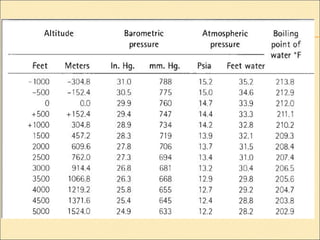
    Many times boththe suction and discharge piping are the same size and the suction and discharge tanks are atmospheric. When this happens both the velocity head and pressure head terms cancel
  • 155.
    When the suctiontank level is raised, the total suction system head is increased. From this the total system head decreases. This means the pump TDH requirement also decreases.
  • 156.
    When the suctiontank level is lowered, the total suction system head is decreased. From this the total system head increases. This means the pump TDH requirements will increase.
  • 157.
    When the dischargetank level is raised, the total discharge system head is increased. From this the total system head is increased. This means the pump TDH requirement increases.
  • 158.
    When the frictionlosses increase on the suction, the total suction system head is decreased. From this the total system head is increased. This means the pump TDH requirements increase
  • 160.
    When the dischargetank level is lowered, the total discharge system head is decreased. From this the total system head is decreased. This means the pump TDH requirements will decrease.
  • 161.
    When the frictionlosses decrease on the suction, the total suction system head is increased. From this the total system head decreases. This means the pump TDH requirement decreases
  • 162.
    When the frictionlosses decrease on the discharge, the total discharge system head is decreased. From this the total system head decreases. This means the pump TDH requirement decreases.
  • 163.
    When the frictionlosses increase on the discharge, the total discharge system head is increased. From this the total system head increases. This means the pump TDH requirement increases.
  • 164.
    When the pressurehead increases on the discharge, the total discharge system head is increased. From this the total system head increases. This means the pump TDH requirement increases.
  • 165.
    When the pressurehead increases on the suction, the total suction system head is increased. From this the total system head decreases. This means the pump TDH requirement decreases
  • 166.
    When the pressurehead decreases on the discharge, the total discharge system head is decreased. From this the total system head decreases. This means the pump TDH requirement decreases.
  • 167.
    When the pressurehead decreases on the pump suction, the total suction system head is decreased. From this the total system head increases. This means the pump TDH requirement increases
  • 178.
    Centrifugal Pumps are"constant head machines" It is not a constant pressure machine, since pressure is a function of head and density. The head is constant, even if the density (and therefore pressure) changes.
  • 180.
    Pressure depends onthe height of the liquid surface.
  • 187.
    • Friction head •Resistance to flow in pipe and fittings • Depends on size, pipes, pipe fittings, flow rate, nature of liquid • Proportional to square of flow rate Friction head Flow
  • 194.
    A pump head- capacity performance curveidentifies how a pump will operate in a given system. It is the pump’s fingerprint.
  • 208.
    Head & flowimpact on pump 00 2020 4040 6060 8080 100100 120120 140140 160160 BEPBEP HighFlowCavitation DischargeRecirculation SuctionRecirculation ImpellerDamage Bearing&SealLifeReduced LowFlowCavitation HighTemperatureRise Capacity Head 150 125 100 75 50 25 0
  • 216.
    Pump hydraulic powercan be calculated by the formula: Hydraulic kW = Q x Total Head, (hd – hs) x ρ x g 1000 Parameter Details Unit Q Water flow rate m3 /s Total head Difference between discharge head, hd & suction head, hs m ρ Density of water or fluid being pumped Kg/m3 g Acceleration due to gravity m2 /s Pump efficiency, ηPump = Hydraulic power Pump shaft power Pump shaft power = Hydraulic power x ηMotor
  • 219.
    35 Affinity Laws Affinity Lawsare the performance of Centrifugal Pumps based on change in Speed, Power, Flow, Head, Impeller Diameter. • FLOW CHANGES DIRECTLY AS A CHANGE IN SPEED OR DIAMETER • HEAD CHANGES AS THE SQUARE OF A CHANGE IN SPEED OR DIAMETER • HORSEPOWER CHANGES AS THE CUBE OF A CHANGE IN SPEED OR DIAMETER
  • 225.
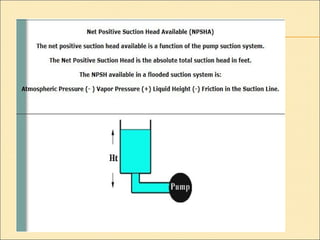
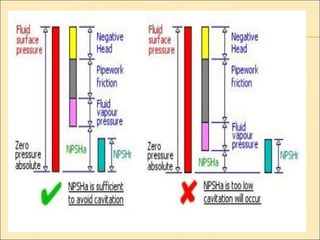
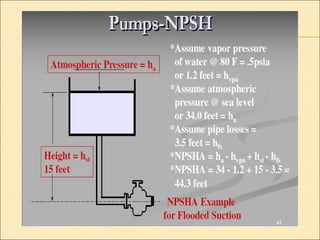
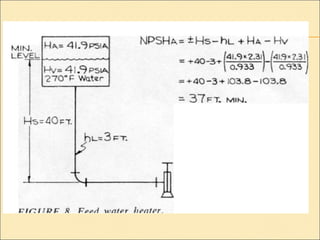
    NPSH = NOTPUMPING SO HOT?
  • 227.
    Pump pressure profileshowing point of lowest pressure (NPSHR).
  • 250.
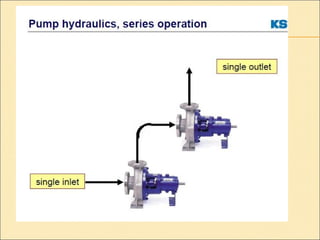
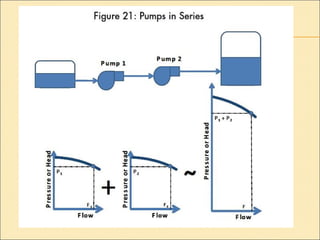
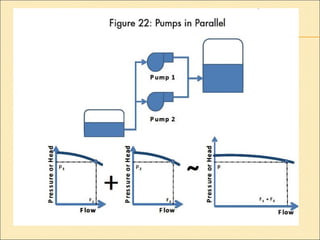
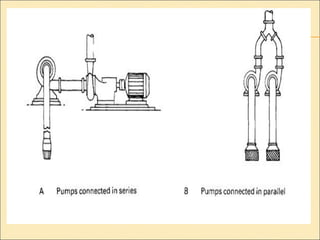
    Multiple-Pump Operation • Toinstall a pumping station that can be effectively operated over a large range of fluctuations in both discharge and pressure head, it may be advantageous to install several identical pumps at the station. Pumps in Parallel Pumps in Series
  • 259.
  • 260.
  • 262.
    Ways to controlflow of centrifugal pumps • Discharge throttle valves • Bypass valves • Impeller trimming • Speed control • Multiple pump arrangements
  • 264.
  • 265.
  • 270.
  • 272.
    Method of alignment a)Feelergauge b)Straight edge method c)Rim & face method d)Reverse indicator method e)Laser method
  • 275.
    Face-rim Three DialIndicator Method
  • 277.
  • 278.
  • 279.
    Centrifugal Pumps Parallel orOffset Misalignment
  • 283.
    Positive displacement Fixed displacement,fluid is captured in cavities within the pump and mechanical energy moves it from the inlet to discharge
  • 288.
    • Low flow •High pressure • High viscosity • Self priming • Metering • High energy efficiency Positive displacement pumps strengths
  • 289.
    Positive displacement pumpconcerns • Not for water thin fluids • Relief valves required • Solids can be a problem • Flow limited by size and speed • Pulsating flow • More complicated machine • May require speed reducers • Higher initial cost • Higher repair costs
  • 290.
  • 291.
    • For eachpump revolution • Fixed amount of liquid taken from one end • Positively discharged at other end • If pipe blocked • Pressure rises • Can damage pump • Used for pumping fluids other than water Positive Displacement Pumps
  • 292.
    G E AR P U M P S L O B E P U M P S S C R E W P U M P S C A M P U M P S V A N E P U M P S R O T A R Y P U M P S As the teeth come out of mesh, liquid flows into the pump and is carried between the teeth and the casing to the discharge side of the pump The teeth come back into mesh and the liquid is forced out the discharge port
  • 300.
    Meshing gears separatecreating vacuum Atmospheric pressure forces liquid inward to fill the vacuum
  • 302.
    Liquid is deliveredin large volumes with less number of pulses than in gear pump Not dependent on discharge pressure
  • 305.
    Screw pumps carryfluid in the spaces between the screw threads. The fluid is displaced axially as the screws mesh. G E A R P U M P S L O B E P U M P S S C R E W P U M P S C A M P U M P S V A N E P U M P S R O T A R Y P U M P S
  • 306.
    Fluid is carriedbetween the rotor teeth and the pumping chamber The rotor surfaces create continuous sealing Rotors include bi-wing, tri-lobe, and multi-lobe configurations G E A R P U M P S L O B E P U M P S S C R E W P U M P S C A M P U M P S V A N E P U M P S R O T A R Y P U M P S
  • 307.
    Function of positivedisplacement pump
  • 310.
    Reciprocating pumps. • Inthe reciprocating pump a piston sucks the fluid into a cylinder then pushes it up causing the water to rise.
  • 311.
    P IS TO N P U M P S P L U N G E R P U M P S D IA P H R A G M P U M P S R E C IP R O C A T IN G P U M P S P O S IT IV E D IS P L A C E M E N T P U M P S • Two valves and one stuffing box • A rotating mechanism for the reciprocating piston • Uses suction to raise liquid into the chamber.
  • 312.
    PERISTALTIC PUMP • Flexibletube subjected to transitional squeeze • Continuous repetition of squeeze cycle • Handles sensitive & delicate fluid
  • 313.
    Diaphragm, an elasticsubstance, usually rubber Used for low pressure application like removing water from trenches
  • 314.
  • 317.
  • 318.
  • 319.
    • A typicalscrew pump 319
  • 325.