Learning Competency
Cite examplesof practical applications of the different
regions of EM waves, such as the use of radio waves
in telecommunications (S10FE-IIc-d-48).
At the end of this lesson, the given DepEd learning
competency should be met by the students.
3.
Learning Objectives
At theend of this lesson, the learner should be able to
do the following:
● Enumerate the different uses of certain parts of the
electromagnetic spectrum.
● Differentiate long distance and short distance
utilization of electromagnetic waves.
4.
Learning Objectives
At theend of this lesson, the learner should be able to
do the following:
● Discuss how lasers are produced.
● Discuss some X-ray and UV ray techniques.
5.
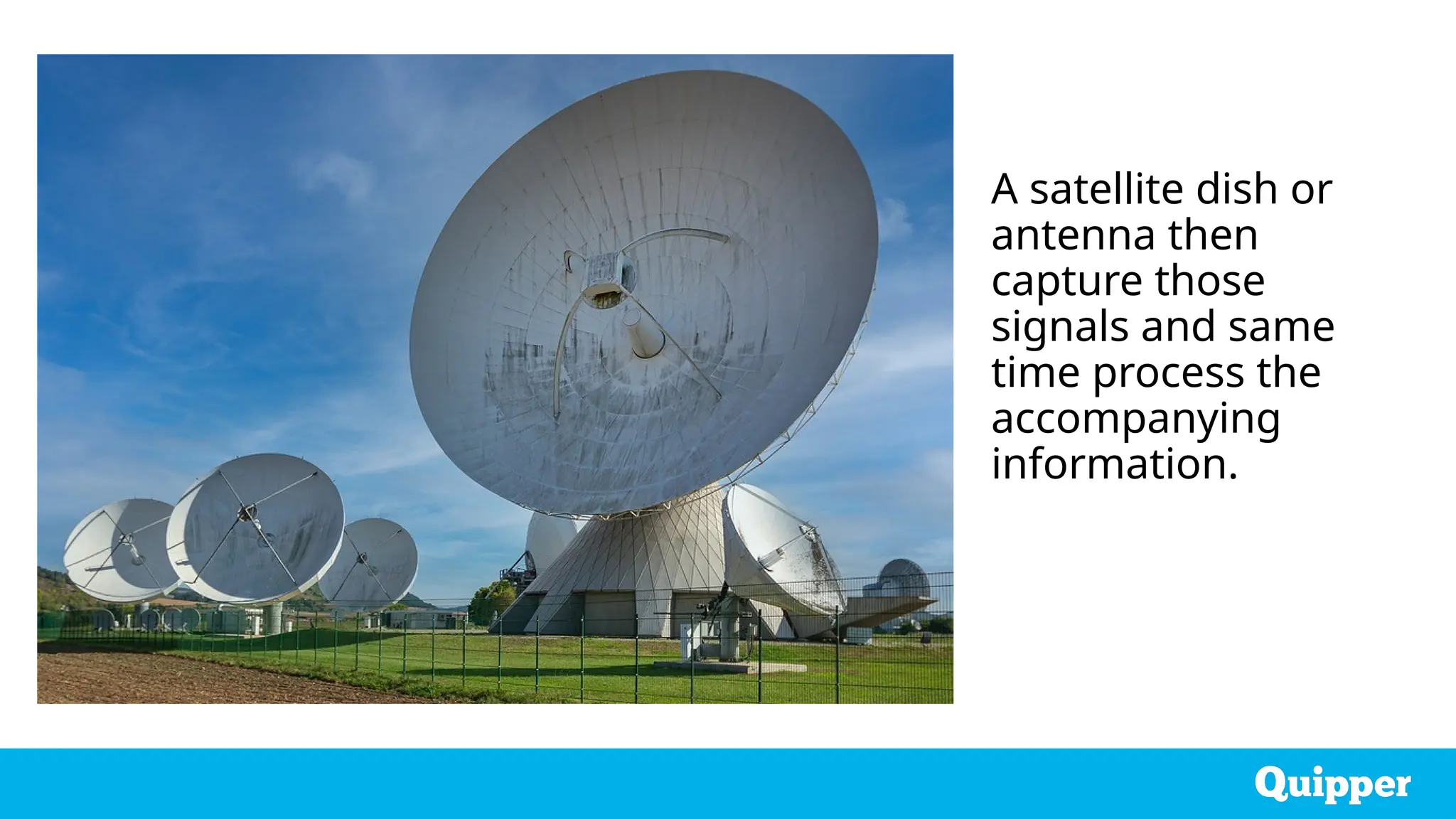
The use of
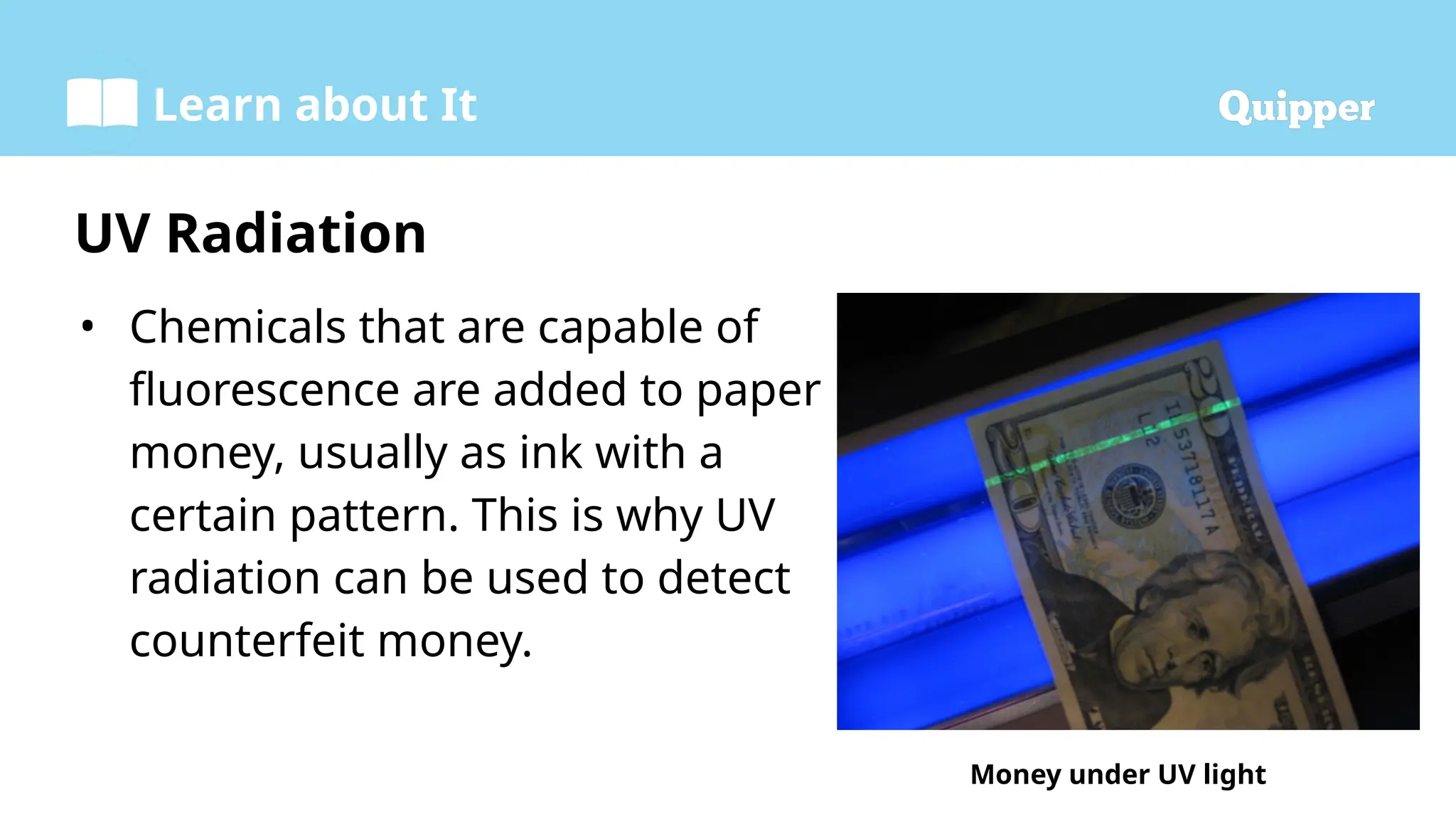
television,radio,
and internet is
made possible by
communication
satellites. These
satellites use radio
waves to send
signals to the
antennas located on
Earth.
6.
A satellite dishor
antenna then
capture those
signals and same
time process the
accompanying
information.
7.
Radio wave isonly one of the seven regions of the
electromagnetic spectrum.
In this lesson, you will learn more about the various
technological applications of EM waves.
8.
Try it!
Warm-Up
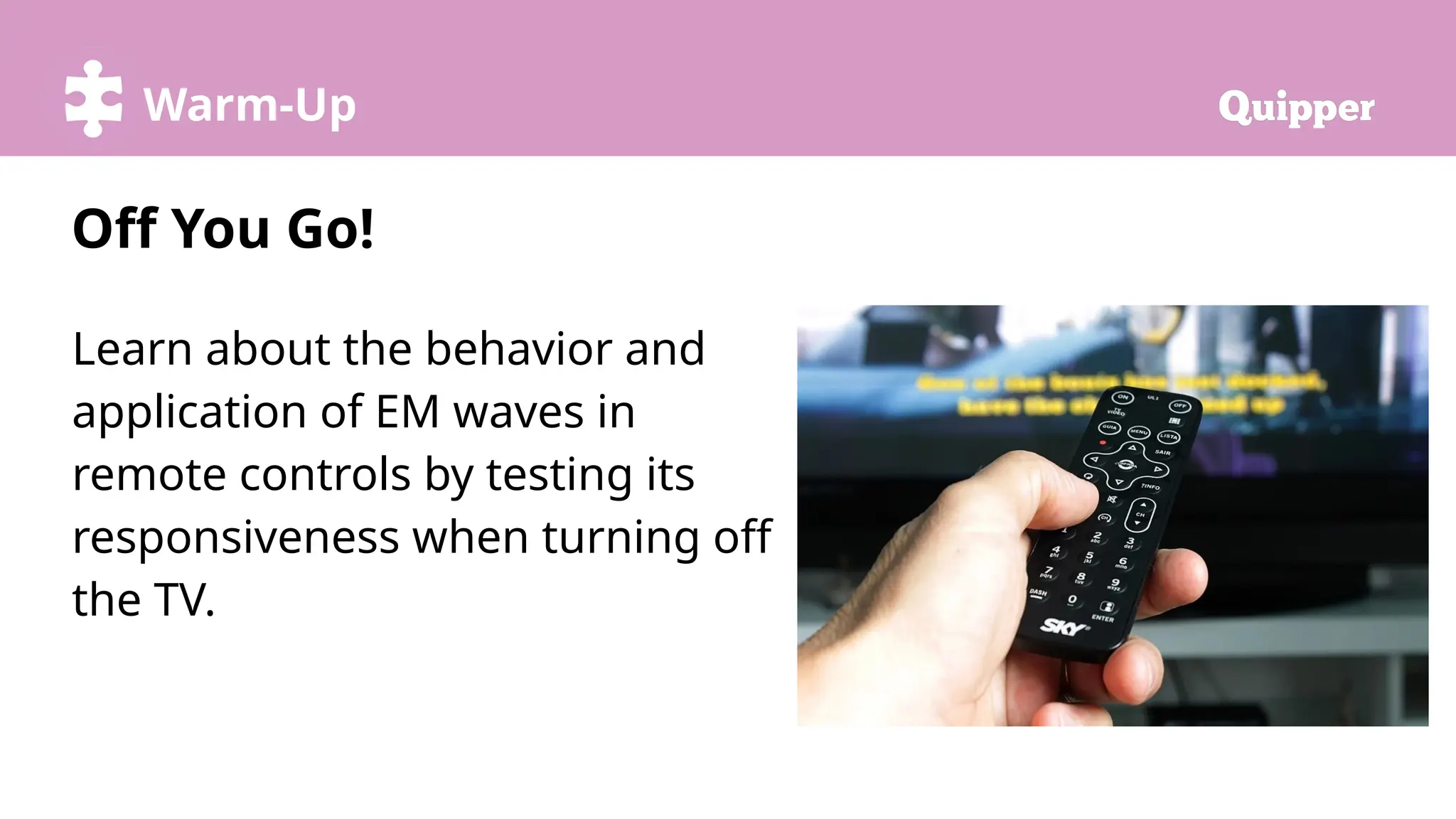
Learn aboutthe behavior and
application of EM waves in
remote controls by testing its
responsiveness when turning off
the TV.
Off You Go!
9.
Learn about It
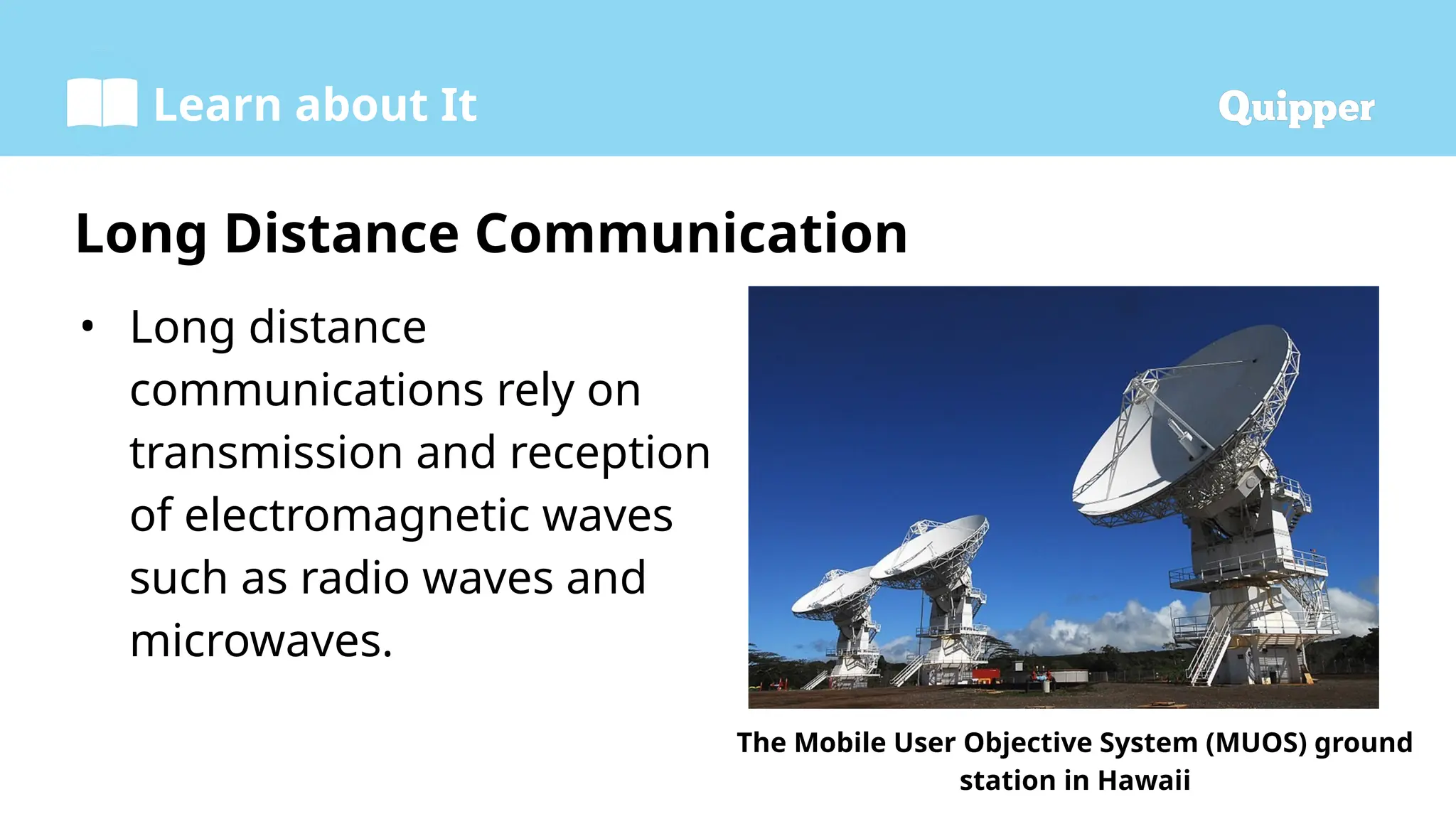
•Long distance
communications rely on
transmission and reception
of electromagnetic waves
such as radio waves and
microwaves.
Long Distance Communication
The Mobile User Objective System (MUOS) ground
station in Hawaii
10.
Learn about It
•An antenna converts electrical signals into radio signals
and vice versa.
• Television and radio stations have very large antennae
that transmit radio waves over a large area.
• These waves are picked up by antennae of television and
radio units at homes and offices.
Long Distance Communication
11.
Learn about It
•Transmission is the process in which an antenna
converts electric current to radio waves.
• Reception is the process in which an antenna converts
received radio wave signals to electric current.
Long Distance Communication
12.
Learn about It
•Radio communications work by systematically adjusting
the amplitude or frequency.
• In amplitude modulation (AM), the difference in the amplitudes
(i.e. signal strength) of the waves is modulated.
• In frequency modulation (FM), the difference in frequency (and
consequently wavelength) is varied instead of the amplitude.
Long Distance Communication
13.
Learn about It
•Music is normally transmitted using FM. AM is used for
voice communications and broadcasts.
• Microwaves are also used in long distance
communication for systems such as the Global
Positioning System (GPS) for navigation and mapping.
Long-Distance Communication
14.
Learn about It
•Wireless communications over short distances also
require higher-energy electromagnetic wave such as
microwave and infrared rays.
Short-Distance Communication
15.
Learn about It
•Wireless Local Area Network (WLAN) uses microwaves
to enable communications between the Wireless Access
Point or WAP (the device that serves as the hub or center
of LAN), and the terminals (computers, laptops, mobile
devices connected to LAN).
Short-Distance Communication
16.
Learn about It
•Remote controls, such as those used in operating
televisions, air conditioners, and other appliances, use
infrared signals to operate.
Short-Distance Communication
17.
Learn about It
•Night vision systems work by using
infrared radiation as an additional
input to visible light in producing
images.
Visible Light and Night Vision
A tactical air controller in night
vision on a simulated target using
lasers.
18.
Learn about It
•Infrared emissions are associated
with surfaces with a higher relative
temperature compared with the
environment.
• CCTV cameras can be equipped
with night vision apparatus.
Visible Light and Night Vision
A CCTV camera
19.
Learn about It
•X-ray scanners in ports and
airports are used to detect
what is inside luggage and
boxes that enter these
establishments.
X-ray Techniques
A baggage screening X-ray display
20.
Learn about It
•Laser stands for Light
Amplification by Stimulated
Emission Radiation.
• A laser device is made of a tube
with mirrors on both ends and
a material that can be
stimulated to produce light.
Laser
A laser cutting machine which forms
and cuts metals.
21.
Learn about It
•Laser cutting technology are used to cut metals and
woods. It works by heating a thin region across a material
allowing it to either burn or melt.
• Laser is also commonly used in reading contents of an
optical disk.
Laser
22.
Learn about It
•UV radiation can make some difficult-to-see substances
more visible through fluorescence.
• Fluorescence is a phenomenon where substances
absorb UV radiation and emit visible light.
UV Radiation
23.
Learn about It
•Chemicals that are capable of
fluorescence are added to paper
money, usually as ink with a
certain pattern. This is why UV
radiation can be used to detect
counterfeit money.
UV Radiation
Money under UV light
24.
Learn about It
•Ultraviolet waves contribute to the production of free
radicals that can also damage DNA. Thus, UV radiation is
used to purify the air by destroying the DNA of airborne
microorganisms.
• A reaction with an inert catalyst can also make UV
radiation useful in dealing with pollutants.
UV Radiation
25.
Key Points
● EMwaves have several applications in technology which includes the
following:
○ Radio waves and microwaves are used in long distance
communications such as that in AM and FM radio communications.
○ Microwaves are used in short distance applications such as in WLAN
and those in remote controls of appliances.
○ Infrared are used in night vision systems of CCTV cameras.
26.
Key Points
● EMwaves have several applications in technology which includes the
following:
○ Lasers use amplified light waves for detecting barcodes in groceries
and reading disk drives.
○ UV rays make some difficult-to-see substances more visible through
fluorescence. These waves are also used in detecting counterfeit
money and air purification.
○ X-rays are utilized in scanners of airports and establishments.
27.
Check Your Understanding
Enumerateother uses or applications for the
following EM waves. You may also cite certain
(electronic) devices which utilize the EM wave.
1. visible light
2. infrared
3. microwave
28.
Photo Credit
Slide 19:Xray-verkehrshaus by IDuke is licensed under CC BY 2.5 via Wikimedia Commons.
29.
Bibliography
BBC. Uses ofElectromagnetic Radiation. Accessed on 20 April 2017.
https://www.bbc.co.uk/bitesize/guides/z66g87h/revision/3.
National Aeronautics and Space Administration. Anatomy of an Electromagnetic Wave. Accessed on 20
April 2017. https://science.nasa.gov/ems.
Serway, Raymond A. and John W. Jewett. Physics for Scientist and Engineers 9th Edition. USA: Cengage
Learning. 2013.
Walker, James S. Physics 5th Edition. California: Pearson. 2016.













![QUARTER 2 MODULE 1 LESSON [Autosaved].pptx](https://cdn.slidesharecdn.com/ss_thumbnails/quarter2module1lessonautosaved-250617110230-9b4f88eb-thumbnail.jpg?width=640&height=640&fit=bounds)


