Application of Calculus in
Heat Transfer
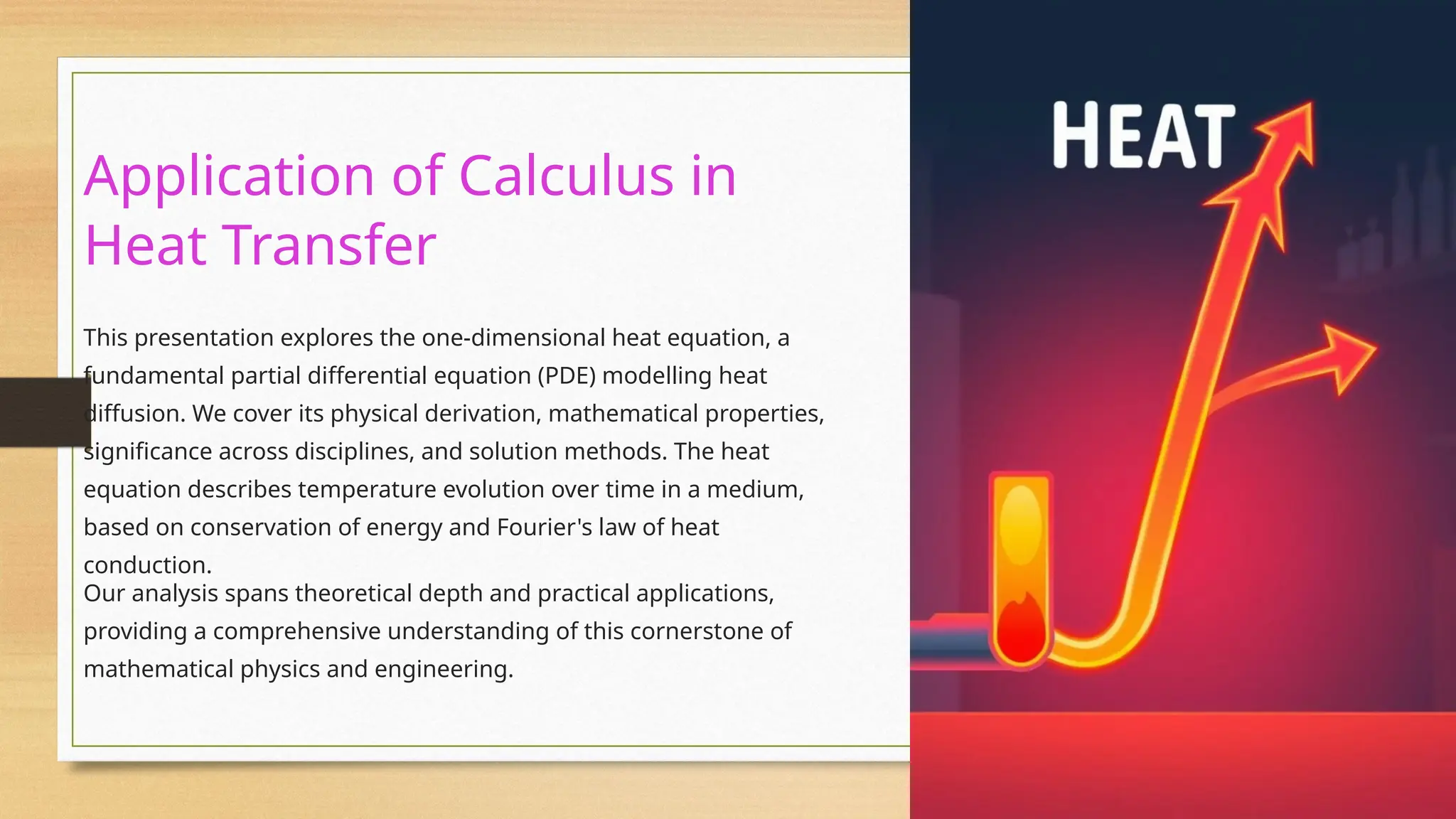
This presentation explores the one-dimensional heat equation, a
fundamental partial differential equation (PDE) modelling heat
diffusion. We cover its physical derivation, mathematical properties,
significance across disciplines, and solution methods. The heat
equation describes temperature evolution over time in a medium,
based on conservation of energy and Fourier's law of heat
conduction.
Our analysis spans theoretical depth and practical applications,
providing a comprehensive understanding of this cornerstone of
mathematical physics and engineering.
The heat equation, a second-order partial differential equation (PDE), is a cornerstone of mathematical
physics, modeling the diffusion of heat and other quantities in various media. This report offers a detailed
theoretical exploration of the one-dimensional heat equation, including its physical derivation,
mathematical properties, significance across disciplines, and a solution approach using separation of
variables. A simple proof verifies the solution for a specific case, emphasizing the PDE’s structure.
Spanning theoretical depth and practical implications, this analysis covers all aspects of the heat equation
The heat equation is a parabolic partial differential equation that describes the evolution of temperature or
analogous quantities in a medium over time. It is a second-order PDE in space and first-order in time,
making it a fundamental model for diffusion processes. Arising from physical principles such as
conservation of energy and Fourier’s law of heat conduction, the heat equation finds applications in
physics, engineering, biology, and finance. This report provides a rigorous, theoretical analysis of the one-
dimensional heat equation, emphasizing its derivation, mathematical structure, physical and theoretical
significance, and solution techniques using direct PDE methods. We avoid Fourier series to focus on the
intrinsic properties of the PDE and provide a simple, verifiable solution.
Introduction
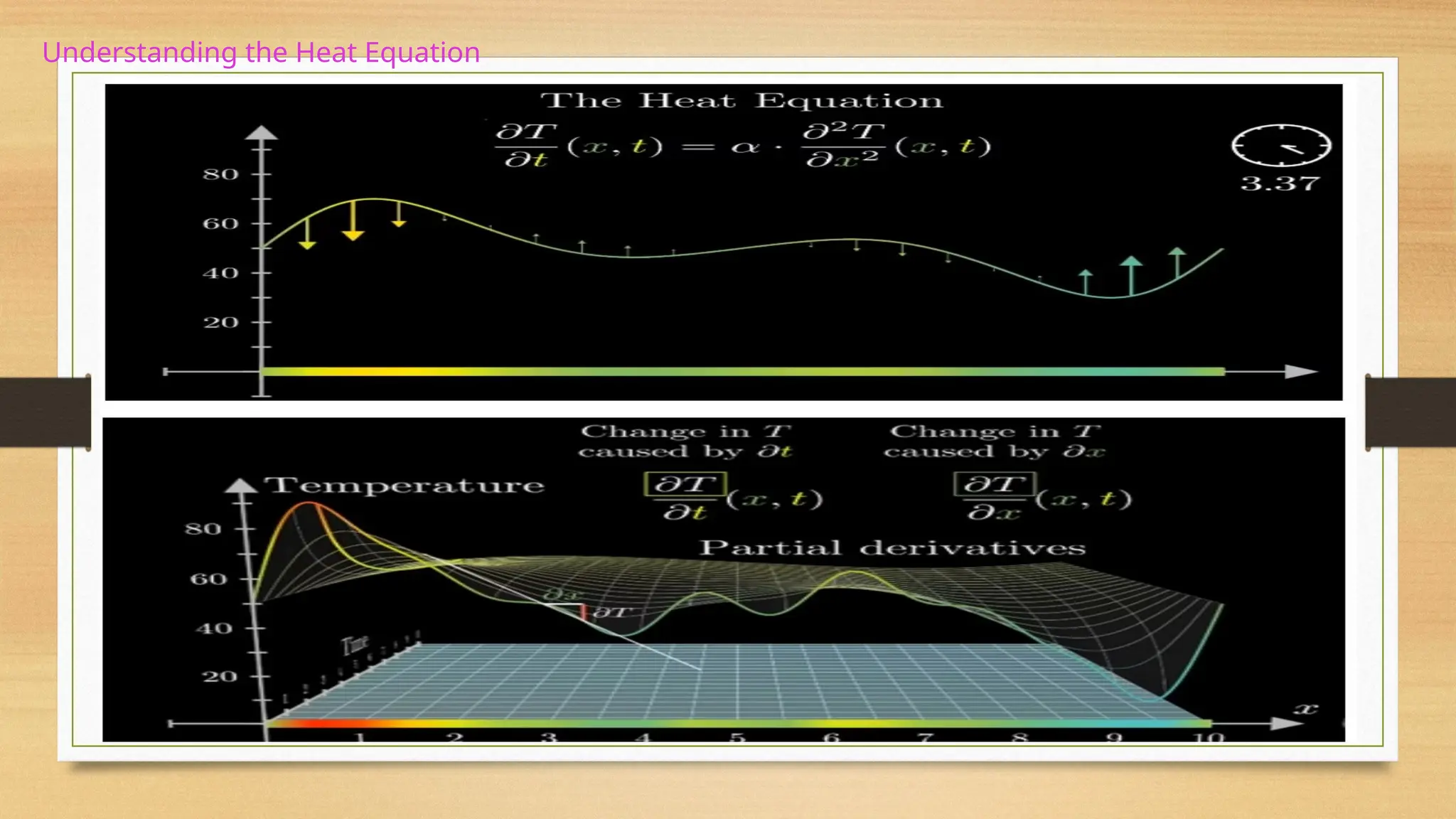
Understanding the Heat Equation
Derivation of the Heat Equation
Assumptions
Homogeneous rod
with constant density,
specific heat, and
thermal conductivity;
heat flow is one-
dimensional; no
internal heat sources;
lateral insulation.
Fourier's Law
Heat flux is proportional to
the negative temperature
gradient, ensuring heat
flows from hot to cold
regions.
Energy Conservation
The rate of thermal energy change equals the net heat flow into a segment, leading to the PDE formulation.
Mathematical Properties of
the Heat Equation
Linearity
The equation is linear,
allowing solutions to be
superposed to form complex
temperature profiles.
Order and Diffusion
Second-order in space
smooths temperature
gradients; first-order in time
ensures forward evolution
consistent with physical
irreversibility.
Smoothing Effect
Solutions become infinitely differentiable for positive time, even
from discontinuous initial conditions, reflecting diffusion's
dissipative nature.
Significance of the Heat Equation
Theoretical Importance
• Prototype for parabolic PDEs with existence and
uniqueness theorems
• Links to probability theory via Gaussian solutions
and Brownian motion
• Extends to higher dimensions with Laplacian operator
Physical Relevance
• Models heat diffusion driven by molecular collisions
• Encapsulates material properties through thermal
diffusivity
• Balances energy conservation and models transient
and steady states
Real-Life Applications of the Heat
Equation
Aerospace &
Automotive
Heat shields for re-
entry vehicles and
engine cooling
systems to prevent
overheating.
Environmental
Science
Models heat
diffusion in soils,
oceans, and
atmosphere for
climate and
pollution studies.
Medical
Treatments
Guides
hyperthermia
therapy by
controlling tissue
heating to target
cancer cells safely.
Geophysics
Models geothermal
heat flow aiding
energy exploration
and volcanic activity
understanding.
Example Solution and
Verification
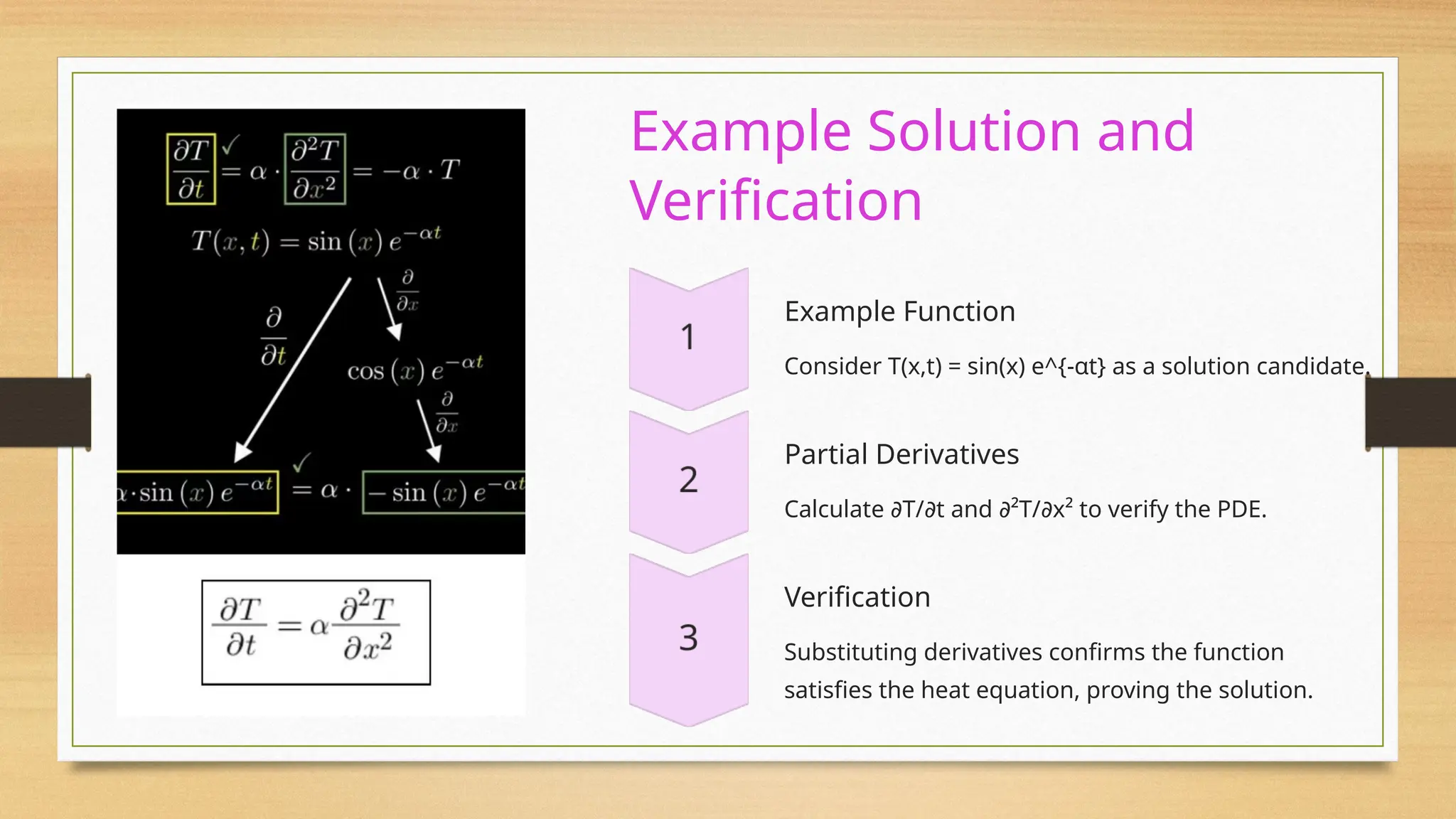
Example Function
Consider T(x,t) = sin(x) e^{-αt} as a solution candidate.
Partial Derivatives
Calculate T/ t and ²T/ x² to verify the PDE.
∂ ∂ ∂ ∂
Verification
Substituting derivatives confirms the function
satisfies the heat equation, proving the solution.
Conclusion and References
Summary
The heat equation is a fundamental PDE modelling heat diffusion,
derived from physical laws and exhibiting key mathematical
properties like linearity and smoothing.
Applications
Its significance spans physics, engineering, biology, and finance,
with practical uses in thermal engineering, environmental science,
and medicine.
References
• Evans, L. C. (2010). Partial Differential Equations.
• Cannon, J. R. (1984). The One-Dimensional Heat Equation.
• Farlow, S. J. (1993). Partial Differential Equations for
Scientists and Engineers.
• 3Blue1Brown YouTube Video on Partial Differential Heat Equation.
Application-of-Calculus-in-Heat-Transfer (1).pptx

  • 1.
    Application of Calculusin Heat Transfer This presentation explores the one-dimensional heat equation, a fundamental partial differential equation (PDE) modelling heat diffusion. We cover its physical derivation, mathematical properties, significance across disciplines, and solution methods. The heat equation describes temperature evolution over time in a medium, based on conservation of energy and Fourier's law of heat conduction. Our analysis spans theoretical depth and practical applications, providing a comprehensive understanding of this cornerstone of mathematical physics and engineering.
  • 2.
    The heat equation,a second-order partial differential equation (PDE), is a cornerstone of mathematical physics, modeling the diffusion of heat and other quantities in various media. This report offers a detailed theoretical exploration of the one-dimensional heat equation, including its physical derivation, mathematical properties, significance across disciplines, and a solution approach using separation of variables. A simple proof verifies the solution for a specific case, emphasizing the PDE’s structure. Spanning theoretical depth and practical implications, this analysis covers all aspects of the heat equation The heat equation is a parabolic partial differential equation that describes the evolution of temperature or analogous quantities in a medium over time. It is a second-order PDE in space and first-order in time, making it a fundamental model for diffusion processes. Arising from physical principles such as conservation of energy and Fourier’s law of heat conduction, the heat equation finds applications in physics, engineering, biology, and finance. This report provides a rigorous, theoretical analysis of the one- dimensional heat equation, emphasizing its derivation, mathematical structure, physical and theoretical significance, and solution techniques using direct PDE methods. We avoid Fourier series to focus on the intrinsic properties of the PDE and provide a simple, verifiable solution. Introduction
  • 3.
  • 4.
    Derivation of theHeat Equation Assumptions Homogeneous rod with constant density, specific heat, and thermal conductivity; heat flow is one- dimensional; no internal heat sources; lateral insulation. Fourier's Law Heat flux is proportional to the negative temperature gradient, ensuring heat flows from hot to cold regions. Energy Conservation The rate of thermal energy change equals the net heat flow into a segment, leading to the PDE formulation.
  • 5.
    Mathematical Properties of theHeat Equation Linearity The equation is linear, allowing solutions to be superposed to form complex temperature profiles. Order and Diffusion Second-order in space smooths temperature gradients; first-order in time ensures forward evolution consistent with physical irreversibility. Smoothing Effect Solutions become infinitely differentiable for positive time, even from discontinuous initial conditions, reflecting diffusion's dissipative nature.
  • 6.
    Significance of theHeat Equation Theoretical Importance • Prototype for parabolic PDEs with existence and uniqueness theorems • Links to probability theory via Gaussian solutions and Brownian motion • Extends to higher dimensions with Laplacian operator Physical Relevance • Models heat diffusion driven by molecular collisions • Encapsulates material properties through thermal diffusivity • Balances energy conservation and models transient and steady states
  • 7.
    Real-Life Applications ofthe Heat Equation Aerospace & Automotive Heat shields for re- entry vehicles and engine cooling systems to prevent overheating. Environmental Science Models heat diffusion in soils, oceans, and atmosphere for climate and pollution studies. Medical Treatments Guides hyperthermia therapy by controlling tissue heating to target cancer cells safely. Geophysics Models geothermal heat flow aiding energy exploration and volcanic activity understanding.
  • 8.
    Example Solution and Verification ExampleFunction Consider T(x,t) = sin(x) e^{-αt} as a solution candidate. Partial Derivatives Calculate T/ t and ²T/ x² to verify the PDE. ∂ ∂ ∂ ∂ Verification Substituting derivatives confirms the function satisfies the heat equation, proving the solution.
  • 9.
    Conclusion and References Summary Theheat equation is a fundamental PDE modelling heat diffusion, derived from physical laws and exhibiting key mathematical properties like linearity and smoothing. Applications Its significance spans physics, engineering, biology, and finance, with practical uses in thermal engineering, environmental science, and medicine. References • Evans, L. C. (2010). Partial Differential Equations. • Cannon, J. R. (1984). The One-Dimensional Heat Equation. • Farlow, S. J. (1993). Partial Differential Equations for Scientists and Engineers. • 3Blue1Brown YouTube Video on Partial Differential Heat Equation.