presented
by
Yogesh Sharma
Description
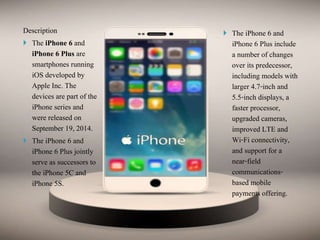
 The iPhone 6 and
iPhone 6 Plus are
smartphones running
iOS developed by
Apple Inc. The
devices are part of the
iPhone series and
were released on
September 19, 2014.
 The iPhone 6 and
iPhone 6 Plus jointly
serve as successors to
the iPhone 5C and
iPhone 5S.
 The iPhone 6 and
iPhone 6 Plus include
a number of changes
over its predecessor,
including models with
larger 4.7-inch and
5.5-inch displays, a
faster processor,
upgraded cameras,
improved LTE and
Wi-Fi connectivity,
and support for a
near-field
communications-
based mobile
payments offering.
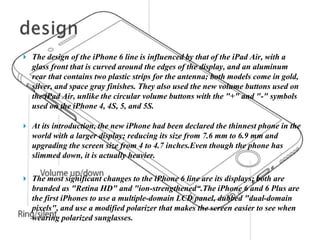
 The design of the iPhone 6 line is influenced by that of the iPad Air, with a
glass front that is curved around the edges of the display, and an aluminum
rear that contains two plastic strips for the antenna; both models come in gold,
silver, and space gray finishes. They also used the new volume buttons used on
the iPad Air, unlike the circular volume buttons with the "+" and "-" symbols
used on the iPhone 4, 4S, 5, and 5S.
 At its introduction, the new iPhone had been declared the thinnest phone in the
world with a larger display; reducing its size from 7.6 mm to 6.9 mm and
upgrading the screen size from 4 to 4.7 inches.Even though the phone has
slimmed down, it is actually heavier.
 The most significant changes to the iPhone 6 line are its displays; both are
branded as "Retina HD" and "ion-strengthened“.The iPhone 6 and 6 Plus are
the first iPhones to use a multiple-domain LCD panel, dubbed "dual-domain
pixels", and use a modified polarizer that makes the screen easier to see when
wearing polarized sunglasses.
 OS:- iOS 8, upgradable to iOS 8.1.3
 Chipset:- Apple A8
 CPU:- Dual-core 1.4 GHz Cyclone (ARM v8-
based)
 GPU:- PowerVR GX6450 (quad-core graphics)
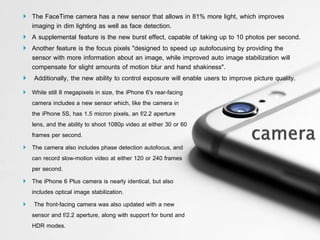
 The FaceTime camera has a new sensor that allows in 81% more light, which improves
imaging in dim lighting as well as face detection.
 A supplemental feature is the new burst effect, capable of taking up to 10 photos per second.
 Another feature is the focus pixels "designed to speed up autofocusing by providing the
sensor with more information about an image, while improved auto image stabilization will
compensate for slight amounts of motion blur and hand shakiness".
 Additionally, the new ability to control exposure will enable users to improve picture quality.
 While still 8 megapixels in size, the iPhone 6's rear-facing
camera includes a new sensor which, like the camera in
the iPhone 5S, has 1.5 micron pixels, an f/2.2 aperture
lens, and the ability to shoot 1080p video at either 30 or 60
frames per second.
 The camera also includes phase detection autofocus, and
can record slow-motion video at either 120 or 240 frames
per second.
 The iPhone 6 Plus camera is nearly identical, but also
includes optical image stabilization.
 The front-facing camera was also updated with a new
sensor and f/2.2 aperture, along with support for burst and
HDR modes.
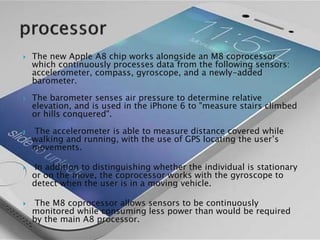
 The new Apple A8 chip works alongside an M8 coprocessor
which continuously processes data from the following sensors:
accelerometer, compass, gyroscope, and a newly-added
barometer.
 The barometer senses air pressure to determine relative
elevation, and is used in the iPhone 6 to "measure stairs climbed
or hills conquered".
 The accelerometer is able to measure distance covered while
walking and running, with the use of GPS locating the user’s
movements.
 In addition to distinguishing whether the individual is stationary
or on the move, the coprocessor works with the gyroscope to
detect when the user is in a moving vehicle.
 The M8 coprocessor allows sensors to be continuously
monitored while consuming less power than would be required
by the main A8 processor.
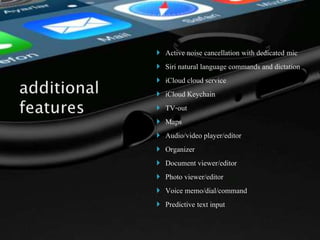
 Active noise cancellation with dedicated mic
 Siri natural language commands and dictation
 iCloud cloud service
 iCloud Keychain
 TV-out
 Maps
 Audio/video player/editor
 Organizer
 Document viewer/editor
 Photo viewer/editor
 Voice memo/dial/command
 Predictive text input
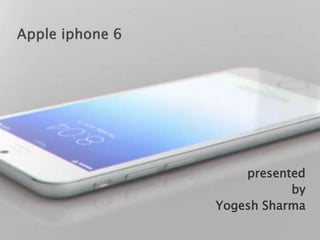
Apple iphone 6
Apple iphone 6

Apple iphone 6

  • 1.
  • 2.
    Description  The iPhone6 and iPhone 6 Plus are smartphones running iOS developed by Apple Inc. The devices are part of the iPhone series and were released on September 19, 2014.  The iPhone 6 and iPhone 6 Plus jointly serve as successors to the iPhone 5C and iPhone 5S.  The iPhone 6 and iPhone 6 Plus include a number of changes over its predecessor, including models with larger 4.7-inch and 5.5-inch displays, a faster processor, upgraded cameras, improved LTE and Wi-Fi connectivity, and support for a near-field communications- based mobile payments offering.
  • 3.
     The designof the iPhone 6 line is influenced by that of the iPad Air, with a glass front that is curved around the edges of the display, and an aluminum rear that contains two plastic strips for the antenna; both models come in gold, silver, and space gray finishes. They also used the new volume buttons used on the iPad Air, unlike the circular volume buttons with the "+" and "-" symbols used on the iPhone 4, 4S, 5, and 5S.  At its introduction, the new iPhone had been declared the thinnest phone in the world with a larger display; reducing its size from 7.6 mm to 6.9 mm and upgrading the screen size from 4 to 4.7 inches.Even though the phone has slimmed down, it is actually heavier.  The most significant changes to the iPhone 6 line are its displays; both are branded as "Retina HD" and "ion-strengthened“.The iPhone 6 and 6 Plus are the first iPhones to use a multiple-domain LCD panel, dubbed "dual-domain pixels", and use a modified polarizer that makes the screen easier to see when wearing polarized sunglasses.
  • 4.
     OS:- iOS8, upgradable to iOS 8.1.3  Chipset:- Apple A8  CPU:- Dual-core 1.4 GHz Cyclone (ARM v8- based)  GPU:- PowerVR GX6450 (quad-core graphics)
  • 5.
     The FaceTimecamera has a new sensor that allows in 81% more light, which improves imaging in dim lighting as well as face detection.  A supplemental feature is the new burst effect, capable of taking up to 10 photos per second.  Another feature is the focus pixels "designed to speed up autofocusing by providing the sensor with more information about an image, while improved auto image stabilization will compensate for slight amounts of motion blur and hand shakiness".  Additionally, the new ability to control exposure will enable users to improve picture quality.  While still 8 megapixels in size, the iPhone 6's rear-facing camera includes a new sensor which, like the camera in the iPhone 5S, has 1.5 micron pixels, an f/2.2 aperture lens, and the ability to shoot 1080p video at either 30 or 60 frames per second.  The camera also includes phase detection autofocus, and can record slow-motion video at either 120 or 240 frames per second.  The iPhone 6 Plus camera is nearly identical, but also includes optical image stabilization.  The front-facing camera was also updated with a new sensor and f/2.2 aperture, along with support for burst and HDR modes.
  • 6.
     The newApple A8 chip works alongside an M8 coprocessor which continuously processes data from the following sensors: accelerometer, compass, gyroscope, and a newly-added barometer.  The barometer senses air pressure to determine relative elevation, and is used in the iPhone 6 to "measure stairs climbed or hills conquered".  The accelerometer is able to measure distance covered while walking and running, with the use of GPS locating the user’s movements.  In addition to distinguishing whether the individual is stationary or on the move, the coprocessor works with the gyroscope to detect when the user is in a moving vehicle.  The M8 coprocessor allows sensors to be continuously monitored while consuming less power than would be required by the main A8 processor.
  • 7.
     Active noisecancellation with dedicated mic  Siri natural language commands and dictation  iCloud cloud service  iCloud Keychain  TV-out  Maps  Audio/video player/editor  Organizer  Document viewer/editor  Photo viewer/editor  Voice memo/dial/command  Predictive text input