How Does Mutual Fund Reputation Affect Subsequent
Fund Flows?
Apoorva Javadekar
Boston University
February8, 2016
Apoorva Javadekar (Boston University) Reputation and Fund Flows February 8, 2016 1 / 34
Introduction
Motivation I:Why Study Mutual Funds?
1 Mutual Funds: Important Vehicle of Investment
Manage 15Tr $
Mutual funds owns30% USequities Vs20%direct holdings
46% of US householdown mutual funds
2 Understand BehavioralPatterns:
Investors learn about managerial ability through returns
⇒ fund flows shedlight on learning, information processingcapacities
etc.
3 Fund Flows AffectManagerial RiskTaking
90% funds managers paid as a % of assets
⇒ flow patterns can affect risk taking
⇒ impacts on asset prices
Apoorva Javadekar (Boston University) Reputation and Fund Flows February 8, 2016 2 / 34
Introduction
Motivation II:The Paper
1 Existing Literature:
Studies link between fund performanceand fund flows (flow-schedule)
Finds andrationalizes evidenceof return chasing andconvexity in fund
flows
But not muchis known about the importance of performancehistory
(reputation)
2 This Paper:
Explore the role of reputation for fund flows
How history up to t − 1 affect link between time t performanceand
time t + 1flows
Can we explain the evidence?
Apoorva Javadekar (Boston University) Reputation and Fund Flows February 8, 2016 3 / 34
Introduction
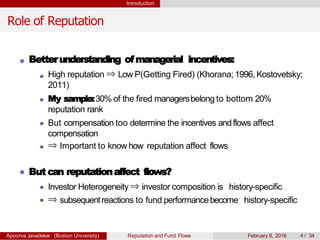
Role of Reputation
Betterunderstanding ofmanagerial incentives:
High reputation ⇒ Low P(Getting Fired) (Khorana; 1996, Kostovetsky;
2011)
My sample:30% of the fired managersbelong to bottom 20%
reputation rank
But compensation too determine the incentives andflows affect
compensation
⇒ Important to know how reputation affect flows
But can reputationaffect flows?
Investor Heterogeneity ⇒ investor composition is history-specific
⇒ subsequentreactions to fund performancebecome history-specific
Apoorva Javadekar (Boston University) Reputation and Fund Flows February 8, 2016 4 / 34
Introduction
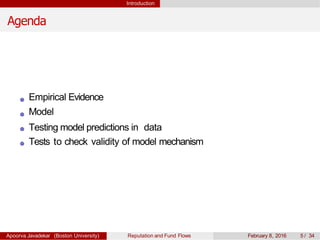
Agenda
Empirical Evidence
Model
Testing model predictions in data
Tests to check validity of model mechanism
Apoorva Javadekar (Boston University) Reputation and Fund Flows February 8, 2016 5 / 34
Introduction
Literature Review
Return Chasing and flowconvexity:
Ippolito (1992), Sirri & Tuffano (1998), Chevallier & Ellison (1997)
Lack Performance Persistence:
Carhart (1997), Bollen & Busse(2004) test short andmedium term
persistence
Risk shifting due to convexflows:
Brown, Harlow, Starks (1996), Basak (2012)
Theoretical Models:
Berk & Green (2004): rationalizes lack of persistence andreturn chasing
simultaneously using decreasingreturns and competitive capital supply
Lynch & Musto (2003): explains convexity using manager replacement
Berk& Tonks(2007): repeat losershaveinsensitive flows to the
left of flow-schedule
Apoorva Javadekar (Boston University) Reputation and Fund Flows February 8, 2016 6 / 34
Empirical Evidence
Variables
Fund Flows:
FLOWit =
qit − [qit−1 × (1 + rit )]
it−1 × itq (1 + r )
where rit denotes net of expense fund returns during time t and qit
denotes fund assets at the end of time t.
Fund Performance:
Rankswithin same’investmentobjective’ basedon raw net returns
(Sirri & Tuffano; 1998)
Ranks based upon ’CAPM-Alpha’ (Berk & Binsbergen; 2014)
Ranks are normalized to lie between [0, 1]interval.
Current Performance (Perfit ): Based upon current year t
Reputation(reputeit): Basedupon 5yearwindow ending with
current yeart.
Apoorva Javadekar (Boston University) Reputation and Fund Flows February 8, 2016 7 / 34
Empirical Evidence
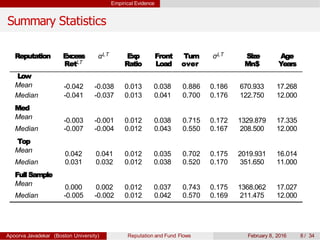
Summary Statistics
Reputation Excess αLT Exp Front Turn σLT Size Age
RetLT Ratio Load over Mn$ Years
Low
Mean -0.042 -0.038 0.013 0.038 0.886 0.186 670.933 17.268
Median -0.041 -0.037 0.013 0.041 0.700 0.176 122.750 12.000
Med
Mean
-0.003 -0.001 0.012 0.038 0.715 0.172 1329.879 17.335
Median -0.007 -0.004 0.012 0.043 0.550 0.167 208.500 12.000
Top
Mean
0.042 0.041 0.012 0.035 0.702 0.175 2019.931 16.014
Median 0.031 0.032 0.012 0.038 0.520 0.170 351.650 11.000
FullSample
Mean
0.000 0.002 0.012 0.037 0.743 0.175 1368.062 17.027
Median -0.005 -0.002 0.012 0.042 0.570 0.169 211.475 12.000
Apoorva Javadekar (Boston University) Reputation and Fund Flows February 8, 2016 8 / 34
Empirical Evidence
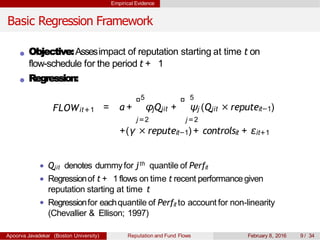
Basic Regression Framework
FLOWit+1
Objective:Assesimpact of reputation starting at time t on
flow-schedule for the period t + 1
Regression:
5 5
j=2 j=2
= a + φjQjit + ψj (Qjit × reputeit−1)
+(γ × reputeit−1) + controlsit + εit+1
Qjit denotes dummyfor jth quantile of Perfit
Regressionof t + 1flows on time t recent performancegiven
reputation starting at time t
Regressionfor eachquantile of Perfit to account for non-linearity
(Chevallier & Ellison; 1997)
Apoorva Javadekar (Boston University) Reputation and Fund Flows February 8, 2016 9 / 34
Empirical Evidence
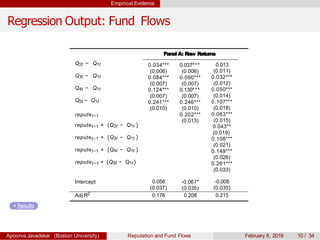
Regression Output: Fund Flows
PanelA: Raw Returns
0.034***
(0.006)
0.084***
(0.007)
0.124***
(0.007)
0.241***
(0.010)
0.037***
(0.006)
0.090***
(0.007)
0.130***
(0.007)
0.246***
(0.010)
0.202***
(0.013)
Q2t − Q1t
Q3t − Q1t
Q4t − Q1t
Q5t − Q1t
reputet−1
reputet−1 × (Q2t − Q1t )
reputet−1 × (Q3t − Q1t )
reputet−1 × (Q4t − Q1t )
reputet−1 × (Q5t − Q1t)
0.013
(0.011)
0.032***
(0.012)
0.050***
(0.014)
0.107***
(0.018)
0.083***
(0.015)
0.043**
(0.019)
0.108***
(0.021)
0.149***
(0.026)
0.261***
(0.033)
Intercept 0.056
(0.037)
-0.067*
(0.035)
-0.008
(0.035)
Adj R2 0.176 0.208 0.215
Results
Apoorva Javadekar (Boston University) Reputation and Fund Flows February 8, 2016 10 / 34
Empirical Evidence
Main Results Regression Table
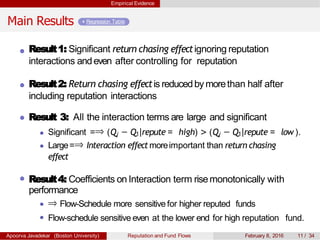
Result1: Significant return chasing effectignoring reputation
interactions andeven after controlling for reputation
Result2: Return chasing effectis reducedby morethan half after
including reputation interactions
Result 3: All the interaction terms are large and significant
Significant =⇒ (Qj − Q1|repute = high) > (Qj − Q1|repute = low ).
Large=⇒ Interaction effectmoreimportant than return chasing
effect
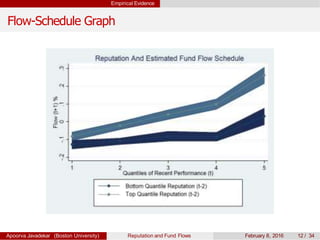
Result4: Coefficients on Interaction term risemonotonically with
performance
⇒ Flow-Schedule more sensitive for higher reputed funds
Flow-schedule sensitive even at the lower end for high reputation fund.
Apoorva Javadekar (Boston University) Reputation and Fund Flows February 8, 2016 11 / 34
Empirical Evidence
Flow-Schedule Graph
Apoorva Javadekar (Boston University) Reputation and Fund Flows February 8, 2016 12 / 34
Empirical Evidence
Example
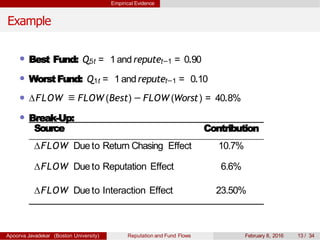
Best Fund: Q5t = 1and reputet−1 = 0.90
WorstFund: Q1t = 1andreputet−1 = 0.10
∆FLOW ≡ FLOW (Best) − FLOW (Worst) = 40.8%
Break-Up:
Source Contribution
∆FLOW Due to Return Chasing Effect 10.7%
∆FLOW Dueto Reputation Effect 6.6%
∆FLOW Due to Interaction Effect 23.50%
Apoorva Javadekar (Boston University) Reputation and Fund Flows February 8, 2016 13 / 34
Empirical Evidence
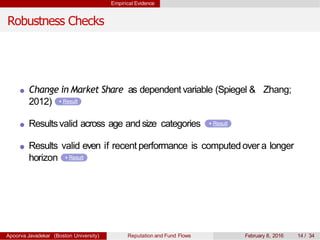
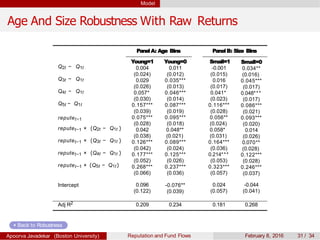
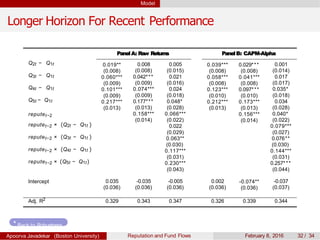
Robustness Checks
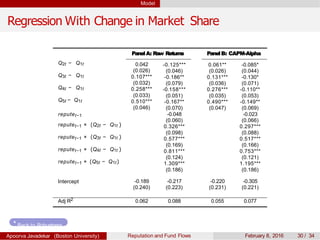
Change in Market Share as dependent variable (Spiegel & Zhang;
2012) Result
Resultsvalid across age andsize categories Result
Results valid even if recent performance is computed over a longer
horizon Result
Apoorva Javadekar (Boston University) Reputation and Fund Flows February 8, 2016 14 / 34
Empirical Evidence
Model
Apoorva Javadekar (Boston University) Reputation and Fund Flows February 8, 2016 15 / 34
Model
Set-Up
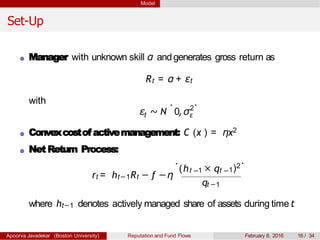
Manager with unknown skill α andgenerates gross return as
Rt = α + εt
with
tε ∼ N 0,σ2
ε
. .
Convexcostofactivemanagement: C (x ) = ηx2
Net Return Process:
rt = ht−1Rt − f −η
.
(ht 1 × qt− −
qt −1
1)2
.
where ht−1 denotes actively managed share of assets during time t
Apoorva Javadekar (Boston University) Reputation and Fund Flows February 8, 2016 16 / 34
Model
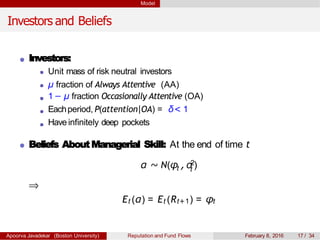
Investors and Beliefs
Investors:
Unit mass of risk neutral investors
µ fraction of Always Attentive (AA)
1 − µ fraction Occasionally Attentive (OA)
Eachperiod, P(attention|OA) = δ< 1
Haveinfinitely deep pockets
Beliefs AboutManagerial Skill: At the end of time t
t
2
tα ∼ N(φ , σ)
⇒
Et (α) = Et (Rt+1) = φt
Apoorva Javadekar (Boston University) Reputation and Fund Flows February 8, 2016 17 / 34
Model
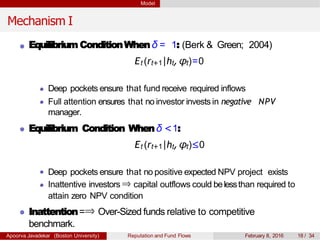
Mechanism I
Equilibrium ConditionWhenδ = 1: (Berk & Green; 2004)
Et (rt+1|ht, φt)=0
Deep pockets ensure that fund receive required inflows
Full attention ensures that no investor invests in negative NPV
manager.
Equilibrium Condition Whenδ <1:
Et (rt+1|ht, φt)≤0
Deep pockets ensure that no positive expected NPV project exists
Inattentive investors ⇒ capital outflows could belessthan required to
attain zero NPV condition
Inattention=⇒ Over-Sized funds relative to competitive
benchmark.
Apoorva Javadekar (Boston University) Reputation and Fund Flows February 8, 2016 18 / 34
Model
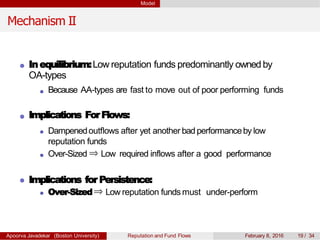
Mechanism II
Inequilibrium:Low reputation funds predominantly owned by
OA-types
Because AA-types are fast to move out of poor performing funds
Implications ForFlows:
Dampenedoutflows after yet another bad performanceby low
reputation funds
Over-Sized ⇒ Low required inflows after a good performance
Implications for Persistence:
Over-Sized⇒ Low reputation funds must under-perform
Apoorva Javadekar (Boston University) Reputation and Fund Flows February 8, 2016 19 / 34
Model
Solution With δ < 1
Initial Investor Composition: A investor’s ownership at t = 0 is
λ0 =
µ
µ + (1 − µ)δ
s
F
¸¸
EcAttentive raction In
x
onomy
Competitive Size and Flows: qt
∗satisfy
tEt [rt+1|ht,q∗] = 0
andrequired flows
e∗ ∗
t = qt − qt−1(1 + rt )
Attentive Capital:
zt = λt −1 t−1+ (1 − λ )δ
A
s
ttentive Fraction
¸¸
Within
x
Fund
t −1 tq (1 + r )
Apoorva Javadekar (Boston University) Reputation and Fund Flows February 8, 2016 20 / 34
Model
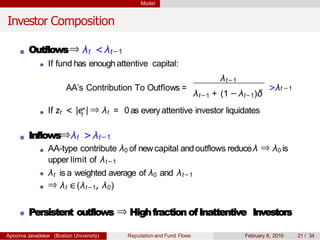
Investor Composition
Outflows⇒ λt <λt−1
If fund has enoughattentive capital:
λt−1
AA’s Contribution To Outflows = >λ
λt−1 + (1 − λt−1)δ
t −1
tIf zt < |e∗|⇒ λt = 0 as everyattentive investor liquidates
Inflows⇒λt >λt−1
AA-type contribute λ0 of newcapital andoutflows reduceλ ⇒ λ0 is
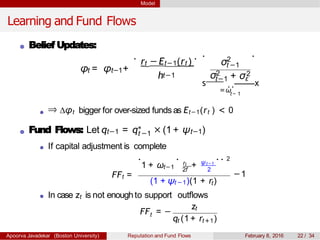
upper limit of λt−1
λt is a weighted average of λ0 and λt−1
⇒ λt ∈(λt−1, λ0)
Persistent outflows ⇒ Highfraction ofInattentive Investors
Apoorva Javadekar (Boston University) Reputation and Fund Flows February 8, 2016 21 / 34
Model
Learning and Fund Flows
Belief Updates:
φt = φt−1+
h
.
2σt −1
σ2 2
t−1 + σε
..
rt − Et−1(rt )
.
t−1
s
=ω
¸¸ x
t − 1
⇒ ∆φt bigger for over-sized funds as Et−1(rt ) < 0
t −1Fund Flows: Let qt−1 = q∗ × (1 + ψt−1)
If capital adjustment is complete
FFt =
− 2f 2
.
1 + ωt 1
.
rt + ψt − 1
. . 2
(1 + ψt −1 t)(1 + r)
−1
In case zt is not enoughto support outflows
tFF = −
zt
t t +1q (1 + r )
Apoorva Javadekar (Boston University) Reputation and Fund Flows February 8, 2016 22 / 34
Model
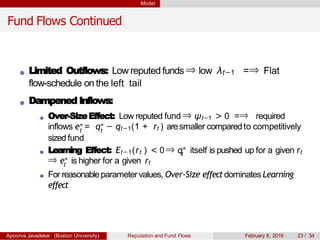
Fund Flows Continued
=⇒ FlatLimited Outflows: Low reputed funds ⇒ low λt−1
flow-schedule on the left tail
Dampened Inflows:
Over-SizeEffect: Low reputed fund ⇒ ψt−1 > 0 =⇒ required
t t
inflows e∗ = q∗ − qt−1(1 + rt ) aresmaller comparedto competitively
sized fund
tLearning Effect: Et−1(rt ) < 0 ⇒ q∗ itself is pushed up for a given rt
t
⇒ e∗ is higher for a given rt
For reasonableparametervalues, Over-Size effectdominatesLearning
effect
Apoorva Javadekar (Boston University) Reputation and Fund Flows February 8, 2016 23 / 34
Model
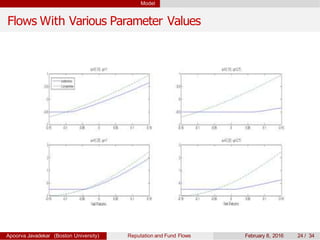
Flows With Various Parameter Values
Apoorva Javadekar (Boston University) Reputation and Fund Flows February 8, 2016 24 / 34
Model
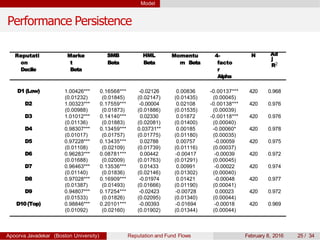
Performance Persistence
Reputati
on
Decile
Marke
t
Beta
SMB
Beta
HML
Beta
Momentu
m Beta
4-
facto
r
Alpha
N Ad
j
R2
D1 (Low) 1.00426*** 0.16568*** -0.02126 0.00836 -0.00137*** 420 0.968
(0.01232) (0.01845) (0.02147) (0.01435) (0.00045)
D2 1.00323*** 0.17559*** -0.00004 0.02108 -0.00138*** 420 0.976
(0.00988) (0.01873) (0.01886) (0.01535) (0.00039)
D3 1.01012*** 0.14140*** 0.02330 0.01872 -0.00118*** 420 0.976
(0.01136) (0.01883) (0.02081) (0.01400) (0.00040)
D4 0.98307*** 0.13459*** 0.03731** 0.00185 -0.00060* 420 0.978
(0.01017) (0.01757) (0.01775) (0.01180) (0.00035)
D5 0.97228*** 0.13435*** 0.02788 0.00757 -0.00059 420 0.975
(0.01108) (0.02109) (0.01739) (0.01116) (0.00037)
D6 0.96283*** 0.08781*** 0.00442 -0.00417 -0.00039 420 0.972
(0.01688) (0.02009) (0.01763) (0.01291) (0.00045)
D7 0.96463*** 0.13536*** 0.01433 0.00991 -0.00022 420 0.974
(0.01140) (0.01836) (0.02146) (0.01302) (0.00040)
D8 0.97028*** 0.16909*** -0.01974 0.01421 -0.00048 420 0.977
(0.01387) (0.01493) (0.01666) (0.01190) (0.00041)
D9 0.94807*** 0.17254*** -0.02423 -0.00728 0.00023 420 0.972
(0.01533) (0.01826) (0.02095) (0.01340) (0.00044)
D10(Top) 0.98846*** 0.20101*** -0.00393 -0.01694 -0.00018 420 0.969
(0.01092) (0.02160) (0.01902) (0.01344) (0.00044)
Apoorva Javadekar (Boston University) Reputation and Fund Flows February 8, 2016 25 / 34
Model
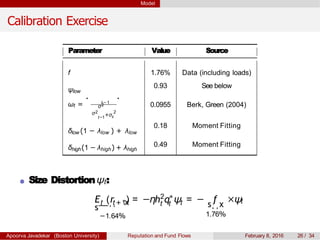
Calibration Exercise
Parameter Value Source
f
ψlow
ωt =
.
t − 1
.
σ2
σ2 2
t−1
+σε
δlow (1 − λlow ) + λlow
δhigh(1 − λhigh) + λhigh
1.76% Data (including loads)
0.93 See below
0.0955 Berk, Green (2004)
0.18 Moment Fitting
0.49 Moment Fitting
Size Distortionψt:
t t +1¸¸ x
s
−1.64%
2 ∗
t t tE (r ) = −ηh q ψ = − fs¸¸x
1.76%
×ψt
Apoorva Javadekar (Boston University) Reputation and Fund Flows February 8, 2016 26 / 34
Model
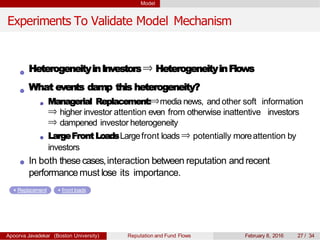
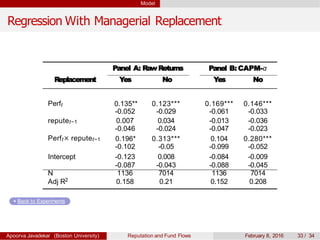
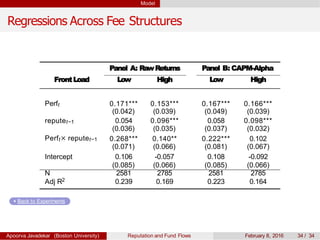
Experiments To Validate Model Mechanism
HeterogeneityinInvestors⇒ HeterogeneityinFlows
What events damp this heterogeneity?
Managerial Replacement:⇒media news, and other soft information
⇒ higher investor attention even from otherwise inattentive investors
⇒ dampened investor heterogeneity
LargeFront LoadsLargefront loads ⇒ potentially moreattention by
investors
In both thesecases,interaction between reputation and recent
performancemust lose its importance.
Replacement front loads
Apoorva Javadekar (Boston University) Reputation and Fund Flows February 8, 2016 27 / 34
Model
Concluding Remarks
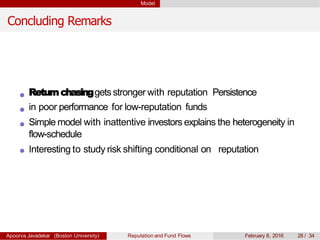
Returnchasinggetsstronger with reputation Persistence
in poor performance for low-reputation funds
Simple model with inattentive investors explains the heterogeneity in
flow-schedule
Interesting to study risk shifting conditional on reputation
Apoorva Javadekar (Boston University) Reputation and Fund Flows February 8, 2016 28 / 34
Model
Thank You !
Apoorva Javadekar (Boston University) Reputation and Fund Flows February 8, 2016 29 / 34
Model
Regression With Change in Market Share
PanelA: Raw Returns PanelB: CAPM-Alpha
0.042
(0.026)
0.107***
(0.032)
0.258***
(0.033)
0.510***
(0.046)
0.061**
(0.026)
0.131***
(0.036)
0.276***
(0.035)
0.490***
(0.047)
Q2t − Q1t
Q3t − Q1t
Q4t − Q1t
Q5t − Q1t
reputet−1
reputet−1 × (Q2t − Q1t )
reputet−1 × (Q3t − Q1t )
reputet−1 × (Q4t − Q1t )
reputet−1 × (Q5t − Q1t)
-0.125***
(0.046)
-0.186**
(0.079)
-0.158***
(0.051)
-0.167**
(0.070)
-0.048
(0.060)
0.326***
(0.098)
0.577***
(0.169)
0.811***
(0.124)
1.309***
(0.186)
-0.085*
(0.044)
-0.130*
(0.071)
-0.110**
(0.053)
-0.149**
(0.069)
-0.023
(0.066)
0.297***
(0.088)
0.517***
(0.166)
0.753***
(0.121)
1.195***
(0.186)
Intercept -0.189
(0.240)
-0.217
(0.223)
-0.220
(0.231)
-0.305
(0.221)
Adj R2 0.062 0.088 0.055 0.077
Back to Robustness
Apoorva Javadekar (Boston University) Reputation and Fund Flows February 8, 2016 30 / 34
Model
Age And Size Robustness With Raw Returns
PanelA: Age Bins PanelB: Size Bins
Q2t − Q1t
Q3t − Q1t
Q4t − Q1t
Q5t − Q1t
reputet−1
reputet−1 × (Q2t − Q1t )
reputet−1 × (Q3t − Q1t )
reputet−1 × (Q4t − Q1t )
reputet−1 × (Q5t − Q1t)
Young=1
0.004
(0.024)
0.029
(0.026)
0.057*
(0.030)
0.157***
(0.039)
0.075***
(0.028)
0.042
(0.038)
0.126***
(0.042)
0.177***
(0.052)
0.268***
(0.066)
Young=0
0.011
(0.012)
0.035***
(0.013)
0.046***
(0.014)
0.087***
(0.019)
0.095***
(0.018)
0.048**
(0.021)
0.089***
(0.024)
0.125***
(0.026)
0.237***
(0.036)
Small=1
-0.001
(0.015)
0.016
(0.017)
0.041*
(0.023)
0.116***
(0.028)
0.056**
(0.024)
0.058*
(0.031)
0.164***
(0.036)
0.214***
(0.053)
0.323***
(0.057)
Small=0
0.034**
(0.016)
0.045***
(0.017)
0.048***
(0.017)
0.086***
(0.021)
0.093***
(0.020)
0.014
(0.026)
0.070**
(0.028)
0.122***
(0.028)
0.246***
(0.037)
Intercept 0.096
(0.122)
-0.076**
(0.039)
0.024
(0.057)
-0.044
(0.041)
Adj R2 0.209 0.234 0.181 0.268
Back to Robustness
Apoorva Javadekar (Boston University) Reputation and Fund Flows February 8, 2016 31 / 34
Model
Longer Horizon For Recent Performance
Panel A: Raw Returns PanelB: CAPM-Alpha
0.019**
(0.008)
0.060***
(0.009)
0.101***
(0.009)
0.217***
(0.013)
0.039***
(0.008)
0.058***
(0.008)
0.123***
(0.010)
0.212***
(0.013)
0.008
(0.008)
0.042***
(0.009)
0.074***
(0.009)
0.177***
(0.013)
0.158***
(0.014)
0.029***
(0.008)
0.041***
(0.008)
0.097***
(0.010)
0.173***
(0.013)
0.156***
(0.014)
Q2t − Q1t
Q3t − Q1t
Q4t − Q1t
Q5t − Q1t
reputet−2
reputet−2 × (Q2t − Q1t )
reputet−2 × (Q3t − Q1t )
reputet−2 × (Q4t − Q1t )
reputet−2 × (Q5t − Q1t)
0.005
(0.015)
0.021
(0.016)
0.024
(0.018)
0.048*
(0.028)
0.066***
(0.022)
0.022
(0.029)
0.063**
(0.030)
0.117***
(0.031)
0.230***
(0.043)
0.001
(0.014)
0.017
(0.017)
0.035*
(0.018)
0.034
(0.028)
0.040*
(0.022)
0.079***
(0.027)
0.076**
(0.030)
0.144***
(0.031)
0.257***
(0.044)
Intercept 0.035
(0.036)
-0.035
(0.036)
-0.005
(0.036)
0.002
(0.036)
-0.074**
(0.036)
-0.037
(0.037)
Adj. R2 0.329 0.343 0.347 0.326 0.339 0.344
Back to Robustness
Apoorva Javadekar (Boston University) Reputation and Fund Flows February 8, 2016 32 / 34
Model
Regression With Managerial Replacement
Panel A: RawReturns Panel B: CAPM-α
Replacement Yes No Yes No
Perft 0.135** 0.123*** 0.169*** 0.146***
-0.052 -0.029 -0.061 -0.033
reputet−1 0.007 0.034 -0.013 -0.036
-0.046 -0.024 -0.047 -0.023
Perft× reputet−1 0.196* 0.313*** 0.104 0.280***
-0.102 -0.05 -0.099 -0.052
Intercept -0.123 0.008 -0.084 -0.009
-0.087 -0.043 -0.088 -0.045
N 1136 7014 1136 7014
Adj R2 0.158 0.21 0.152 0.208
Back to Experiments
Apoorva Javadekar (Boston University) Reputation and Fund Flows February 8, 2016 33 / 34
Model
Regressions Across Fee Structures
Panel A: RawReturns Panel B: CAPM-Alpha
FrontLoad Low High Low High
Perft 0.171*** 0.153*** 0.167*** 0.166***
(0.042) (0.039) (0.049) (0.039)
reputet−1 0.054 0.096*** 0.058 0.098***
(0.036) (0.035) (0.037) (0.032)
Perft× reputet−1 0.268*** 0.140** 0.222*** 0.102
(0.071) (0.066) (0.081) (0.067)
Intercept 0.106 -0.057 0.108 -0.092
(0.085) (0.066) (0.085) (0.066)
N 2581 2785 2581 2785
Adj R2 0.239 0.169 0.223 0.164
Back to Experiments
Apoorva Javadekar (Boston University) Reputation and Fund Flows February 8, 2016 34 / 34

Apoorva JavdekarHow Does Mutual Fund Reputation Affect Subsequent Fund Flows?

  • 1.
    How Does MutualFund Reputation Affect Subsequent Fund Flows? Apoorva Javadekar Boston University February8, 2016 Apoorva Javadekar (Boston University) Reputation and Fund Flows February 8, 2016 1 / 34
  • 2.
    Introduction Motivation I:Why StudyMutual Funds? 1 Mutual Funds: Important Vehicle of Investment Manage 15Tr $ Mutual funds owns30% USequities Vs20%direct holdings 46% of US householdown mutual funds 2 Understand BehavioralPatterns: Investors learn about managerial ability through returns ⇒ fund flows shedlight on learning, information processingcapacities etc. 3 Fund Flows AffectManagerial RiskTaking 90% funds managers paid as a % of assets ⇒ flow patterns can affect risk taking ⇒ impacts on asset prices Apoorva Javadekar (Boston University) Reputation and Fund Flows February 8, 2016 2 / 34
  • 3.
    Introduction Motivation II:The Paper 1Existing Literature: Studies link between fund performanceand fund flows (flow-schedule) Finds andrationalizes evidenceof return chasing andconvexity in fund flows But not muchis known about the importance of performancehistory (reputation) 2 This Paper: Explore the role of reputation for fund flows How history up to t − 1 affect link between time t performanceand time t + 1flows Can we explain the evidence? Apoorva Javadekar (Boston University) Reputation and Fund Flows February 8, 2016 3 / 34
  • 4.
    Introduction Role of Reputation Betterunderstandingofmanagerial incentives: High reputation ⇒ Low P(Getting Fired) (Khorana; 1996, Kostovetsky; 2011) My sample:30% of the fired managersbelong to bottom 20% reputation rank But compensation too determine the incentives andflows affect compensation ⇒ Important to know how reputation affect flows But can reputationaffect flows? Investor Heterogeneity ⇒ investor composition is history-specific ⇒ subsequentreactions to fund performancebecome history-specific Apoorva Javadekar (Boston University) Reputation and Fund Flows February 8, 2016 4 / 34
  • 5.
    Introduction Agenda Empirical Evidence Model Testing modelpredictions in data Tests to check validity of model mechanism Apoorva Javadekar (Boston University) Reputation and Fund Flows February 8, 2016 5 / 34
  • 6.
    Introduction Literature Review Return Chasingand flowconvexity: Ippolito (1992), Sirri & Tuffano (1998), Chevallier & Ellison (1997) Lack Performance Persistence: Carhart (1997), Bollen & Busse(2004) test short andmedium term persistence Risk shifting due to convexflows: Brown, Harlow, Starks (1996), Basak (2012) Theoretical Models: Berk & Green (2004): rationalizes lack of persistence andreturn chasing simultaneously using decreasingreturns and competitive capital supply Lynch & Musto (2003): explains convexity using manager replacement Berk& Tonks(2007): repeat losershaveinsensitive flows to the left of flow-schedule Apoorva Javadekar (Boston University) Reputation and Fund Flows February 8, 2016 6 / 34
  • 7.
    Empirical Evidence Variables Fund Flows: FLOWit= qit − [qit−1 × (1 + rit )] it−1 × itq (1 + r ) where rit denotes net of expense fund returns during time t and qit denotes fund assets at the end of time t. Fund Performance: Rankswithin same’investmentobjective’ basedon raw net returns (Sirri & Tuffano; 1998) Ranks based upon ’CAPM-Alpha’ (Berk & Binsbergen; 2014) Ranks are normalized to lie between [0, 1]interval. Current Performance (Perfit ): Based upon current year t Reputation(reputeit): Basedupon 5yearwindow ending with current yeart. Apoorva Javadekar (Boston University) Reputation and Fund Flows February 8, 2016 7 / 34
  • 8.
    Empirical Evidence Summary Statistics ReputationExcess αLT Exp Front Turn σLT Size Age RetLT Ratio Load over Mn$ Years Low Mean -0.042 -0.038 0.013 0.038 0.886 0.186 670.933 17.268 Median -0.041 -0.037 0.013 0.041 0.700 0.176 122.750 12.000 Med Mean -0.003 -0.001 0.012 0.038 0.715 0.172 1329.879 17.335 Median -0.007 -0.004 0.012 0.043 0.550 0.167 208.500 12.000 Top Mean 0.042 0.041 0.012 0.035 0.702 0.175 2019.931 16.014 Median 0.031 0.032 0.012 0.038 0.520 0.170 351.650 11.000 FullSample Mean 0.000 0.002 0.012 0.037 0.743 0.175 1368.062 17.027 Median -0.005 -0.002 0.012 0.042 0.570 0.169 211.475 12.000 Apoorva Javadekar (Boston University) Reputation and Fund Flows February 8, 2016 8 / 34
  • 9.
    Empirical Evidence Basic RegressionFramework FLOWit+1 Objective:Assesimpact of reputation starting at time t on flow-schedule for the period t + 1 Regression: 5 5 j=2 j=2 = a + φjQjit + ψj (Qjit × reputeit−1) +(γ × reputeit−1) + controlsit + εit+1 Qjit denotes dummyfor jth quantile of Perfit Regressionof t + 1flows on time t recent performancegiven reputation starting at time t Regressionfor eachquantile of Perfit to account for non-linearity (Chevallier & Ellison; 1997) Apoorva Javadekar (Boston University) Reputation and Fund Flows February 8, 2016 9 / 34
  • 10.
    Empirical Evidence Regression Output:Fund Flows PanelA: Raw Returns 0.034*** (0.006) 0.084*** (0.007) 0.124*** (0.007) 0.241*** (0.010) 0.037*** (0.006) 0.090*** (0.007) 0.130*** (0.007) 0.246*** (0.010) 0.202*** (0.013) Q2t − Q1t Q3t − Q1t Q4t − Q1t Q5t − Q1t reputet−1 reputet−1 × (Q2t − Q1t ) reputet−1 × (Q3t − Q1t ) reputet−1 × (Q4t − Q1t ) reputet−1 × (Q5t − Q1t) 0.013 (0.011) 0.032*** (0.012) 0.050*** (0.014) 0.107*** (0.018) 0.083*** (0.015) 0.043** (0.019) 0.108*** (0.021) 0.149*** (0.026) 0.261*** (0.033) Intercept 0.056 (0.037) -0.067* (0.035) -0.008 (0.035) Adj R2 0.176 0.208 0.215 Results Apoorva Javadekar (Boston University) Reputation and Fund Flows February 8, 2016 10 / 34
  • 11.
    Empirical Evidence Main ResultsRegression Table Result1: Significant return chasing effectignoring reputation interactions andeven after controlling for reputation Result2: Return chasing effectis reducedby morethan half after including reputation interactions Result 3: All the interaction terms are large and significant Significant =⇒ (Qj − Q1|repute = high) > (Qj − Q1|repute = low ). Large=⇒ Interaction effectmoreimportant than return chasing effect Result4: Coefficients on Interaction term risemonotonically with performance ⇒ Flow-Schedule more sensitive for higher reputed funds Flow-schedule sensitive even at the lower end for high reputation fund. Apoorva Javadekar (Boston University) Reputation and Fund Flows February 8, 2016 11 / 34
  • 12.
    Empirical Evidence Flow-Schedule Graph ApoorvaJavadekar (Boston University) Reputation and Fund Flows February 8, 2016 12 / 34
  • 13.
    Empirical Evidence Example Best Fund:Q5t = 1and reputet−1 = 0.90 WorstFund: Q1t = 1andreputet−1 = 0.10 ∆FLOW ≡ FLOW (Best) − FLOW (Worst) = 40.8% Break-Up: Source Contribution ∆FLOW Due to Return Chasing Effect 10.7% ∆FLOW Dueto Reputation Effect 6.6% ∆FLOW Due to Interaction Effect 23.50% Apoorva Javadekar (Boston University) Reputation and Fund Flows February 8, 2016 13 / 34
  • 14.
    Empirical Evidence Robustness Checks Changein Market Share as dependent variable (Spiegel & Zhang; 2012) Result Resultsvalid across age andsize categories Result Results valid even if recent performance is computed over a longer horizon Result Apoorva Javadekar (Boston University) Reputation and Fund Flows February 8, 2016 14 / 34
  • 15.
    Empirical Evidence Model Apoorva Javadekar(Boston University) Reputation and Fund Flows February 8, 2016 15 / 34
  • 16.
    Model Set-Up Manager with unknownskill α andgenerates gross return as Rt = α + εt with tε ∼ N 0,σ2 ε . . Convexcostofactivemanagement: C (x ) = ηx2 Net Return Process: rt = ht−1Rt − f −η . (ht 1 × qt− − qt −1 1)2 . where ht−1 denotes actively managed share of assets during time t Apoorva Javadekar (Boston University) Reputation and Fund Flows February 8, 2016 16 / 34
  • 17.
    Model Investors and Beliefs Investors: Unitmass of risk neutral investors µ fraction of Always Attentive (AA) 1 − µ fraction Occasionally Attentive (OA) Eachperiod, P(attention|OA) = δ< 1 Haveinfinitely deep pockets Beliefs AboutManagerial Skill: At the end of time t t 2 tα ∼ N(φ , σ) ⇒ Et (α) = Et (Rt+1) = φt Apoorva Javadekar (Boston University) Reputation and Fund Flows February 8, 2016 17 / 34
  • 18.
    Model Mechanism I Equilibrium ConditionWhenδ= 1: (Berk & Green; 2004) Et (rt+1|ht, φt)=0 Deep pockets ensure that fund receive required inflows Full attention ensures that no investor invests in negative NPV manager. Equilibrium Condition Whenδ <1: Et (rt+1|ht, φt)≤0 Deep pockets ensure that no positive expected NPV project exists Inattentive investors ⇒ capital outflows could belessthan required to attain zero NPV condition Inattention=⇒ Over-Sized funds relative to competitive benchmark. Apoorva Javadekar (Boston University) Reputation and Fund Flows February 8, 2016 18 / 34
  • 19.
    Model Mechanism II Inequilibrium:Low reputationfunds predominantly owned by OA-types Because AA-types are fast to move out of poor performing funds Implications ForFlows: Dampenedoutflows after yet another bad performanceby low reputation funds Over-Sized ⇒ Low required inflows after a good performance Implications for Persistence: Over-Sized⇒ Low reputation funds must under-perform Apoorva Javadekar (Boston University) Reputation and Fund Flows February 8, 2016 19 / 34
  • 20.
    Model Solution With δ< 1 Initial Investor Composition: A investor’s ownership at t = 0 is λ0 = µ µ + (1 − µ)δ s F ¸¸ EcAttentive raction In x onomy Competitive Size and Flows: qt ∗satisfy tEt [rt+1|ht,q∗] = 0 andrequired flows e∗ ∗ t = qt − qt−1(1 + rt ) Attentive Capital: zt = λt −1 t−1+ (1 − λ )δ A s ttentive Fraction ¸¸ Within x Fund t −1 tq (1 + r ) Apoorva Javadekar (Boston University) Reputation and Fund Flows February 8, 2016 20 / 34
  • 21.
    Model Investor Composition Outflows⇒ λt<λt−1 If fund has enoughattentive capital: λt−1 AA’s Contribution To Outflows = >λ λt−1 + (1 − λt−1)δ t −1 tIf zt < |e∗|⇒ λt = 0 as everyattentive investor liquidates Inflows⇒λt >λt−1 AA-type contribute λ0 of newcapital andoutflows reduceλ ⇒ λ0 is upper limit of λt−1 λt is a weighted average of λ0 and λt−1 ⇒ λt ∈(λt−1, λ0) Persistent outflows ⇒ Highfraction ofInattentive Investors Apoorva Javadekar (Boston University) Reputation and Fund Flows February 8, 2016 21 / 34
  • 22.
    Model Learning and FundFlows Belief Updates: φt = φt−1+ h . 2σt −1 σ2 2 t−1 + σε .. rt − Et−1(rt ) . t−1 s =ω ¸¸ x t − 1 ⇒ ∆φt bigger for over-sized funds as Et−1(rt ) < 0 t −1Fund Flows: Let qt−1 = q∗ × (1 + ψt−1) If capital adjustment is complete FFt = − 2f 2 . 1 + ωt 1 . rt + ψt − 1 . . 2 (1 + ψt −1 t)(1 + r) −1 In case zt is not enoughto support outflows tFF = − zt t t +1q (1 + r ) Apoorva Javadekar (Boston University) Reputation and Fund Flows February 8, 2016 22 / 34
  • 23.
    Model Fund Flows Continued =⇒FlatLimited Outflows: Low reputed funds ⇒ low λt−1 flow-schedule on the left tail Dampened Inflows: Over-SizeEffect: Low reputed fund ⇒ ψt−1 > 0 =⇒ required t t inflows e∗ = q∗ − qt−1(1 + rt ) aresmaller comparedto competitively sized fund tLearning Effect: Et−1(rt ) < 0 ⇒ q∗ itself is pushed up for a given rt t ⇒ e∗ is higher for a given rt For reasonableparametervalues, Over-Size effectdominatesLearning effect Apoorva Javadekar (Boston University) Reputation and Fund Flows February 8, 2016 23 / 34
  • 24.
    Model Flows With VariousParameter Values Apoorva Javadekar (Boston University) Reputation and Fund Flows February 8, 2016 24 / 34
  • 25.
    Model Performance Persistence Reputati on Decile Marke t Beta SMB Beta HML Beta Momentu m Beta 4- facto r Alpha NAd j R2 D1 (Low) 1.00426*** 0.16568*** -0.02126 0.00836 -0.00137*** 420 0.968 (0.01232) (0.01845) (0.02147) (0.01435) (0.00045) D2 1.00323*** 0.17559*** -0.00004 0.02108 -0.00138*** 420 0.976 (0.00988) (0.01873) (0.01886) (0.01535) (0.00039) D3 1.01012*** 0.14140*** 0.02330 0.01872 -0.00118*** 420 0.976 (0.01136) (0.01883) (0.02081) (0.01400) (0.00040) D4 0.98307*** 0.13459*** 0.03731** 0.00185 -0.00060* 420 0.978 (0.01017) (0.01757) (0.01775) (0.01180) (0.00035) D5 0.97228*** 0.13435*** 0.02788 0.00757 -0.00059 420 0.975 (0.01108) (0.02109) (0.01739) (0.01116) (0.00037) D6 0.96283*** 0.08781*** 0.00442 -0.00417 -0.00039 420 0.972 (0.01688) (0.02009) (0.01763) (0.01291) (0.00045) D7 0.96463*** 0.13536*** 0.01433 0.00991 -0.00022 420 0.974 (0.01140) (0.01836) (0.02146) (0.01302) (0.00040) D8 0.97028*** 0.16909*** -0.01974 0.01421 -0.00048 420 0.977 (0.01387) (0.01493) (0.01666) (0.01190) (0.00041) D9 0.94807*** 0.17254*** -0.02423 -0.00728 0.00023 420 0.972 (0.01533) (0.01826) (0.02095) (0.01340) (0.00044) D10(Top) 0.98846*** 0.20101*** -0.00393 -0.01694 -0.00018 420 0.969 (0.01092) (0.02160) (0.01902) (0.01344) (0.00044) Apoorva Javadekar (Boston University) Reputation and Fund Flows February 8, 2016 25 / 34
  • 26.
    Model Calibration Exercise Parameter ValueSource f ψlow ωt = . t − 1 . σ2 σ2 2 t−1 +σε δlow (1 − λlow ) + λlow δhigh(1 − λhigh) + λhigh 1.76% Data (including loads) 0.93 See below 0.0955 Berk, Green (2004) 0.18 Moment Fitting 0.49 Moment Fitting Size Distortionψt: t t +1¸¸ x s −1.64% 2 ∗ t t tE (r ) = −ηh q ψ = − fs¸¸x 1.76% ×ψt Apoorva Javadekar (Boston University) Reputation and Fund Flows February 8, 2016 26 / 34
  • 27.
    Model Experiments To ValidateModel Mechanism HeterogeneityinInvestors⇒ HeterogeneityinFlows What events damp this heterogeneity? Managerial Replacement:⇒media news, and other soft information ⇒ higher investor attention even from otherwise inattentive investors ⇒ dampened investor heterogeneity LargeFront LoadsLargefront loads ⇒ potentially moreattention by investors In both thesecases,interaction between reputation and recent performancemust lose its importance. Replacement front loads Apoorva Javadekar (Boston University) Reputation and Fund Flows February 8, 2016 27 / 34
  • 28.
    Model Concluding Remarks Returnchasinggetsstronger withreputation Persistence in poor performance for low-reputation funds Simple model with inattentive investors explains the heterogeneity in flow-schedule Interesting to study risk shifting conditional on reputation Apoorva Javadekar (Boston University) Reputation and Fund Flows February 8, 2016 28 / 34
  • 29.
    Model Thank You ! ApoorvaJavadekar (Boston University) Reputation and Fund Flows February 8, 2016 29 / 34
  • 30.
    Model Regression With Changein Market Share PanelA: Raw Returns PanelB: CAPM-Alpha 0.042 (0.026) 0.107*** (0.032) 0.258*** (0.033) 0.510*** (0.046) 0.061** (0.026) 0.131*** (0.036) 0.276*** (0.035) 0.490*** (0.047) Q2t − Q1t Q3t − Q1t Q4t − Q1t Q5t − Q1t reputet−1 reputet−1 × (Q2t − Q1t ) reputet−1 × (Q3t − Q1t ) reputet−1 × (Q4t − Q1t ) reputet−1 × (Q5t − Q1t) -0.125*** (0.046) -0.186** (0.079) -0.158*** (0.051) -0.167** (0.070) -0.048 (0.060) 0.326*** (0.098) 0.577*** (0.169) 0.811*** (0.124) 1.309*** (0.186) -0.085* (0.044) -0.130* (0.071) -0.110** (0.053) -0.149** (0.069) -0.023 (0.066) 0.297*** (0.088) 0.517*** (0.166) 0.753*** (0.121) 1.195*** (0.186) Intercept -0.189 (0.240) -0.217 (0.223) -0.220 (0.231) -0.305 (0.221) Adj R2 0.062 0.088 0.055 0.077 Back to Robustness Apoorva Javadekar (Boston University) Reputation and Fund Flows February 8, 2016 30 / 34
  • 31.
    Model Age And SizeRobustness With Raw Returns PanelA: Age Bins PanelB: Size Bins Q2t − Q1t Q3t − Q1t Q4t − Q1t Q5t − Q1t reputet−1 reputet−1 × (Q2t − Q1t ) reputet−1 × (Q3t − Q1t ) reputet−1 × (Q4t − Q1t ) reputet−1 × (Q5t − Q1t) Young=1 0.004 (0.024) 0.029 (0.026) 0.057* (0.030) 0.157*** (0.039) 0.075*** (0.028) 0.042 (0.038) 0.126*** (0.042) 0.177*** (0.052) 0.268*** (0.066) Young=0 0.011 (0.012) 0.035*** (0.013) 0.046*** (0.014) 0.087*** (0.019) 0.095*** (0.018) 0.048** (0.021) 0.089*** (0.024) 0.125*** (0.026) 0.237*** (0.036) Small=1 -0.001 (0.015) 0.016 (0.017) 0.041* (0.023) 0.116*** (0.028) 0.056** (0.024) 0.058* (0.031) 0.164*** (0.036) 0.214*** (0.053) 0.323*** (0.057) Small=0 0.034** (0.016) 0.045*** (0.017) 0.048*** (0.017) 0.086*** (0.021) 0.093*** (0.020) 0.014 (0.026) 0.070** (0.028) 0.122*** (0.028) 0.246*** (0.037) Intercept 0.096 (0.122) -0.076** (0.039) 0.024 (0.057) -0.044 (0.041) Adj R2 0.209 0.234 0.181 0.268 Back to Robustness Apoorva Javadekar (Boston University) Reputation and Fund Flows February 8, 2016 31 / 34
  • 32.
    Model Longer Horizon ForRecent Performance Panel A: Raw Returns PanelB: CAPM-Alpha 0.019** (0.008) 0.060*** (0.009) 0.101*** (0.009) 0.217*** (0.013) 0.039*** (0.008) 0.058*** (0.008) 0.123*** (0.010) 0.212*** (0.013) 0.008 (0.008) 0.042*** (0.009) 0.074*** (0.009) 0.177*** (0.013) 0.158*** (0.014) 0.029*** (0.008) 0.041*** (0.008) 0.097*** (0.010) 0.173*** (0.013) 0.156*** (0.014) Q2t − Q1t Q3t − Q1t Q4t − Q1t Q5t − Q1t reputet−2 reputet−2 × (Q2t − Q1t ) reputet−2 × (Q3t − Q1t ) reputet−2 × (Q4t − Q1t ) reputet−2 × (Q5t − Q1t) 0.005 (0.015) 0.021 (0.016) 0.024 (0.018) 0.048* (0.028) 0.066*** (0.022) 0.022 (0.029) 0.063** (0.030) 0.117*** (0.031) 0.230*** (0.043) 0.001 (0.014) 0.017 (0.017) 0.035* (0.018) 0.034 (0.028) 0.040* (0.022) 0.079*** (0.027) 0.076** (0.030) 0.144*** (0.031) 0.257*** (0.044) Intercept 0.035 (0.036) -0.035 (0.036) -0.005 (0.036) 0.002 (0.036) -0.074** (0.036) -0.037 (0.037) Adj. R2 0.329 0.343 0.347 0.326 0.339 0.344 Back to Robustness Apoorva Javadekar (Boston University) Reputation and Fund Flows February 8, 2016 32 / 34
  • 33.
    Model Regression With ManagerialReplacement Panel A: RawReturns Panel B: CAPM-α Replacement Yes No Yes No Perft 0.135** 0.123*** 0.169*** 0.146*** -0.052 -0.029 -0.061 -0.033 reputet−1 0.007 0.034 -0.013 -0.036 -0.046 -0.024 -0.047 -0.023 Perft× reputet−1 0.196* 0.313*** 0.104 0.280*** -0.102 -0.05 -0.099 -0.052 Intercept -0.123 0.008 -0.084 -0.009 -0.087 -0.043 -0.088 -0.045 N 1136 7014 1136 7014 Adj R2 0.158 0.21 0.152 0.208 Back to Experiments Apoorva Javadekar (Boston University) Reputation and Fund Flows February 8, 2016 33 / 34
  • 34.
    Model Regressions Across FeeStructures Panel A: RawReturns Panel B: CAPM-Alpha FrontLoad Low High Low High Perft 0.171*** 0.153*** 0.167*** 0.166*** (0.042) (0.039) (0.049) (0.039) reputet−1 0.054 0.096*** 0.058 0.098*** (0.036) (0.035) (0.037) (0.032) Perft× reputet−1 0.268*** 0.140** 0.222*** 0.102 (0.071) (0.066) (0.081) (0.067) Intercept 0.106 -0.057 0.108 -0.092 (0.085) (0.066) (0.085) (0.066) N 2581 2785 2581 2785 Adj R2 0.239 0.169 0.223 0.164 Back to Experiments Apoorva Javadekar (Boston University) Reputation and Fund Flows February 8, 2016 34 / 34