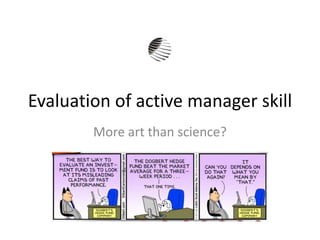
Evaluation of active manager skill
More art than science?
KEY POINTS TO INVESTIGATE
1. How do you determine luck vs. skill?
2. Do big or small managers have a market advantage?
3. The science of due diligence
 Want to keep it simple since in simplicity lies some modicum of truth. Einstein and
Occam’s razor principle: “Everything should be made as simple as possible, but not
simpler.” Just like in stock selection, the more assumptions the decision maker has
to make the more unlikely the explanation of return vs. risk source
 Just a reminder: all value is created in future so subjective issues are essential in
making suitable manager decision. No amount of numbers can give full picture
 Hard not to get into philosophy, human nature, and organization psychology in
order to optimally answer above issues
 Isn’t it time to go beyond sharpe ratio (and it’s many corollaries)?
INHERENT FLAWS IN EVALUATION PROCESS THAT MUST BE MITIGATED
 Any time period chosen is ultimately arbitrary if goal is to invest in fund for
decades. 2008 drawdown affect: Legg Mason Opportunity Fund I annualized 36%
in five-years to Feb 28, 2014. If take the 6-year return to Feb 28, 2014 then 6%
annualized (lower than S&P 500). Star and renowned from 1991-2005; shunned
post 2008
 The problem is that skill and luck are not independently observable (Prof
Bradford Cornell of California Institute of Technology)
 Allocator must have thought through inherent incentive flaw (especially if she is a
fiduciary, her goal is (or at least should be!) to maximize long-term (5+ years
minimum) return while keeping drawdowns lower than market/other funds in
category and ideally yearly outperformance. Basically, better, consistent returns
than market, without hassles
 On other hand, the fund manager is highly incentivized to reach his performance
targets yearly to “crystallize” the incentive fee. Many times, as we have read
about and seen countless time, the short-term outperformance is not able to
sustain and even if the allocator stays with a manager over several business cycles
he doesn’t do as well as he could just by buying index ETF
Buffet (again!) but why not try to follow the student who is at/near top of his class?
 Is it fair that Buffett perennially bashes active managers (average plumber adds
more value than average fund manager?!)?
 Actually its just his way of going to next logical step of Charles Ellis….more than 40
years ago. Charles Ellis, the US investment consultant, called active management
the "loser's game”.
 Basic point was that he likened endeavor to a long (very long!) game of tennis- the
basic point is that to succeed over time you need to make as few unforced errors as
possible
 Sounds obvious but are most allocators in position to evolve their business
model/teams to logical conclusion? Exclusivity principle: people with money to
invest can’t fathom/accept that in most cases the return they get with active
managers will be less than market
 Check out Buffett’s national coin flipping thought experiment if you haven’t read
it….in my view, has presented quite damning “proof” for vast majority of active
managers- regardless of their size, they are basically lucky/packaging beta
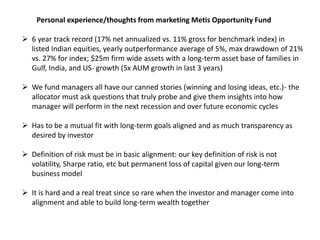
Personal experience/thoughts from marketing Metis Opportunity Fund
 6 year track record (17% net annualized vs. 11% gross for benchmark index) in
listed Indian equities, yearly outperformance average of 5%, max drawdown of 21%
vs. 27% for index; $25m firm wide assets with a long-term asset base of families in
Gulf, India, and US- growth (5x AUM growth in last 3 years)
 We fund managers all have our canned stories (winning and losing ideas, etc.)- the
allocator must ask questions that truly probe and give them insights into how
manager will perform in the next recession and over future economic cycles
 Has to be a mutual fit with long-term goals aligned and as much transparency as
desired by investor
 Definition of risk must be in basic alignment: our key definition of risk is not
volatility, Sharpe ratio, etc but permanent loss of capital given our long-term
business model
 It is hard and a real treat since so rare when the investor and manager come into
alignment and able to build long-term wealth together
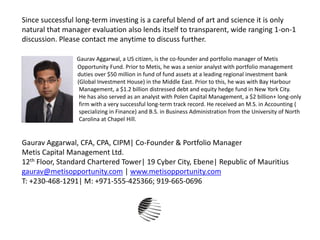
Since successful long-term investing is a careful blend of art and science it is only
natural that manager evaluation also lends itself to transparent, wide ranging 1-on-1
discussion. Please contact me anytime to discuss further.
Gaurav Aggarwal, a US citizen, is the co-founder and portfolio manager of Metis
Opportunity Fund. Prior to Metis, he was a senior analyst with portfolio management
duties over $50 million in fund of fund assets at a leading regional investment bank
(Global Investment House) in the Middle East. Prior to this, he was with Bay Harbour
Management, a $1.2 billion distressed debt and equity hedge fund in New York City.
He has also served as an analyst with Polen Capital Management, a $2 billion+ long-only
firm with a very successful long-term track record. He received an M.S. in Accounting (
specializing in Finance) and B.S. in Business Administration from the University of North
Carolina at Chapel Hill.
Gaurav Aggarwal, CFA, CPA, CIPM| Co-Founder & Portfolio Manager
Metis Capital Management Ltd.
12th Floor, Standard Chartered Tower| 19 Cyber City, Ebene| Republic of Mauritius
gaurav@metisopportunity.com | www.metisopportunity.com
T: +230-468-1291| M: +971-555-425366; 919-665-0696
REFERENCES
Dilbert cartoon (www2.fiu.edu/~dupoyetb/Portfolio_Mgt/lectures/ch19.ppt)
https://www.nytimes.com/2014/03/08/your-money/mutual-funds-and-etfs/as-you-
evaluate-a-fund-manager-look-beyond-results.html?mcubz=1&_r=0

Evaluation active manager skill meis may 2017

  • 1.
    Evaluation of activemanager skill More art than science?
  • 2.
    KEY POINTS TOINVESTIGATE 1. How do you determine luck vs. skill? 2. Do big or small managers have a market advantage? 3. The science of due diligence  Want to keep it simple since in simplicity lies some modicum of truth. Einstein and Occam’s razor principle: “Everything should be made as simple as possible, but not simpler.” Just like in stock selection, the more assumptions the decision maker has to make the more unlikely the explanation of return vs. risk source  Just a reminder: all value is created in future so subjective issues are essential in making suitable manager decision. No amount of numbers can give full picture  Hard not to get into philosophy, human nature, and organization psychology in order to optimally answer above issues  Isn’t it time to go beyond sharpe ratio (and it’s many corollaries)?
  • 3.
    INHERENT FLAWS INEVALUATION PROCESS THAT MUST BE MITIGATED  Any time period chosen is ultimately arbitrary if goal is to invest in fund for decades. 2008 drawdown affect: Legg Mason Opportunity Fund I annualized 36% in five-years to Feb 28, 2014. If take the 6-year return to Feb 28, 2014 then 6% annualized (lower than S&P 500). Star and renowned from 1991-2005; shunned post 2008  The problem is that skill and luck are not independently observable (Prof Bradford Cornell of California Institute of Technology)  Allocator must have thought through inherent incentive flaw (especially if she is a fiduciary, her goal is (or at least should be!) to maximize long-term (5+ years minimum) return while keeping drawdowns lower than market/other funds in category and ideally yearly outperformance. Basically, better, consistent returns than market, without hassles  On other hand, the fund manager is highly incentivized to reach his performance targets yearly to “crystallize” the incentive fee. Many times, as we have read about and seen countless time, the short-term outperformance is not able to sustain and even if the allocator stays with a manager over several business cycles he doesn’t do as well as he could just by buying index ETF
  • 4.
    Buffet (again!) butwhy not try to follow the student who is at/near top of his class?  Is it fair that Buffett perennially bashes active managers (average plumber adds more value than average fund manager?!)?  Actually its just his way of going to next logical step of Charles Ellis….more than 40 years ago. Charles Ellis, the US investment consultant, called active management the "loser's game”.  Basic point was that he likened endeavor to a long (very long!) game of tennis- the basic point is that to succeed over time you need to make as few unforced errors as possible  Sounds obvious but are most allocators in position to evolve their business model/teams to logical conclusion? Exclusivity principle: people with money to invest can’t fathom/accept that in most cases the return they get with active managers will be less than market  Check out Buffett’s national coin flipping thought experiment if you haven’t read it….in my view, has presented quite damning “proof” for vast majority of active managers- regardless of their size, they are basically lucky/packaging beta
  • 5.
    Personal experience/thoughts frommarketing Metis Opportunity Fund  6 year track record (17% net annualized vs. 11% gross for benchmark index) in listed Indian equities, yearly outperformance average of 5%, max drawdown of 21% vs. 27% for index; $25m firm wide assets with a long-term asset base of families in Gulf, India, and US- growth (5x AUM growth in last 3 years)  We fund managers all have our canned stories (winning and losing ideas, etc.)- the allocator must ask questions that truly probe and give them insights into how manager will perform in the next recession and over future economic cycles  Has to be a mutual fit with long-term goals aligned and as much transparency as desired by investor  Definition of risk must be in basic alignment: our key definition of risk is not volatility, Sharpe ratio, etc but permanent loss of capital given our long-term business model  It is hard and a real treat since so rare when the investor and manager come into alignment and able to build long-term wealth together
  • 6.
    Since successful long-terminvesting is a careful blend of art and science it is only natural that manager evaluation also lends itself to transparent, wide ranging 1-on-1 discussion. Please contact me anytime to discuss further. Gaurav Aggarwal, a US citizen, is the co-founder and portfolio manager of Metis Opportunity Fund. Prior to Metis, he was a senior analyst with portfolio management duties over $50 million in fund of fund assets at a leading regional investment bank (Global Investment House) in the Middle East. Prior to this, he was with Bay Harbour Management, a $1.2 billion distressed debt and equity hedge fund in New York City. He has also served as an analyst with Polen Capital Management, a $2 billion+ long-only firm with a very successful long-term track record. He received an M.S. in Accounting ( specializing in Finance) and B.S. in Business Administration from the University of North Carolina at Chapel Hill. Gaurav Aggarwal, CFA, CPA, CIPM| Co-Founder & Portfolio Manager Metis Capital Management Ltd. 12th Floor, Standard Chartered Tower| 19 Cyber City, Ebene| Republic of Mauritius gaurav@metisopportunity.com | www.metisopportunity.com T: +230-468-1291| M: +971-555-425366; 919-665-0696
  • 7.