The 1970s: Rock Music, Disco,
and the Popular Mainstream
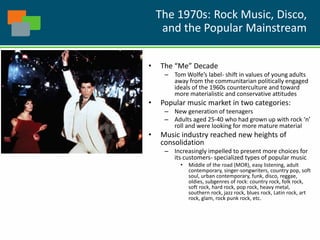
• The “Me” Decade
– Tom Wolfe’s label- shift in values of young adults
away from the communitarian politically engaged
ideals of the 1960s counterculture and toward
more materialistic and conservative attitudes
• Popular music market in two categories:
– New generation of teenagers
– Adults aged 25-40 who had grown up with rock ‘n’
roll and were looking for more mature material
• Music industry reached new heights of
consolidation
– Increasingly impelled to present more choices for
its customers- specialized types of popular music
• Middle of the road (MOR), easy listening, adult
contemporary, singer-songwriters, country pop, soft
soul, urban contemporary, funk, disco, reggae,
oldies, subgenres of rock: country rock, folk rock,
soft rock, hard rock, pop rock, heavy metal,
southern rock, jazz rock, blues rock, Latin rock, art
rock, glam, rock punk rock, etc.
Top 40 Format
• Top 40 playlist format- dominated AM radio airwaves
• Primary medium for hard rock or progressive rock bands- FM format
– Free-form FM programming- restricted to community or college-based stations
– AOR (album-oriented rock)- aimed at young white males aged 13-25
• Survey of Billboard charts of the 1970s- reveals a complex picture
– Traditions continued to intermingle with one another
• Commercial mainstream:
– Pop rock
– Adult contemporary
– Singer-songwriters
– Soft soul
– Country pop
– Bubblegum
– Disco
– “oldies” radio- hits of the 1950s and early 1960s
Singer-songwriters
– Carole King (b. 1942)- career illustrates the central
prominence of singer-songwriters in this period
• Tapestry (1971)- album whose success made King a major
recording star
– Joni Mitchell (b. 1943)- began career as songwriter,
started recording on her own in 1968
• Blue (1971)- best-known album; cycle of songs about
complexity of love
– James Taylor (b. 1948)- perhaps the most successful
long-running career of the ‘70s era singer-songwriters.
• Sweet Baby James (1970)- hugely successful album with
many hit singles, including number 3 hit “Fire and Rain.”
Listening Guide: A 1970s Jukebox
• “It’s Too Late,” written by Carole King and Toni Sterne, performed by
Carole King (released 1971)
– Carole King (b. 1942)- her career illustrates the central prominence of singer-
songwriters in this period
– Tapestry (1971)
• Superstition,” written and performed by Stevie Wonder (released 1972)
– Stevie Wonder (b. 1950)- successful singer and songwriter during his teenage
years with Motown in the 1960s, established a new benchmark of
achievement for a pop music figure in 1971 when he negotiated a new
contract giving him full artistic control over all aspects of his music
– Overdubbing- Wonder plays most of the instruments, synchronizing the
performance by overdubbing several tracks on the recording tape
– Blends elements borrowed from different aspects of African American musical
traditions
– Synthesizers- Wonder was a pioneer in the use of new electronic instruments
Listening Guide: A 1970s Jukebox
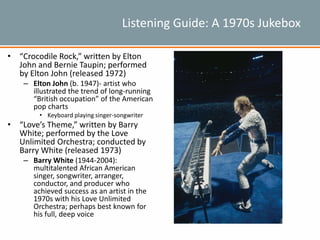
• “Crocodile Rock,” written by Elton
John and Bernie Taupin; performed
by Elton John (released 1972)
– Elton John (b. 1947)- artist who
illustrated the trend of long-running
“British occupation” of the American
pop charts
• Keyboard playing singer-songwriter
• “Love’s Theme,” written by Barry
White; performed by the Love
Unlimited Orchestra; conducted by
Barry White (released 1973)
– Barry White (1944-2004):
multitalented African American
singer, songwriter, arranger,
conductor, and producer who
achieved success as an artist in the
1970s with his Love Unlimited
Orchestra; perhaps best known for
his full, deep voice
Listening Guide: A 1970s Jukebox
• “Thank God I’m a Country Boy,” written by John Martin
Sommers; performed by John Denver (released 1975)
– John Denver (1943-1997)- style more urban folk with some pop
elements, though by the time he recorded “Thank God I’m a
Country Boy” he portrayed himself as a country artist musically
and thematically
– Song is a cut taken from live album An Evening with John Denver
• “Hotel California,” written by Don Felder, Don Henley, and
Glenn Frey (all members of the Eagles); performed by the
Eagles (released 1976)
– The Eagles- influential band who epitomized the culture of
southern California
Country Music and the Pop Mainstream
• Country-pop crossover accomplished by a new generation of musicians
– Glen Campbell (b. 1936)- worked in western swing bands in the Southwest as a
teenager, moved to LA in 1958, where he developed a career as a studio session
guitarist and vocalist; had a series of crossover hits on the country and pop charts
– Charlie Rich (b. 1932)- called “Silver Fox,” a talented jazz and blues pianist whose
career started in rockabilly; by the 1960s switched to pop-oriented countrypolitan
style who had a series of number one crossover hits in the mid-1970s
– John Denver (1943-1997)- Third #1 hit, “Thank God I’m a Country Boy,” was turning
point from pop/country/folk blend to “pure” country
• Dichotomy between pop performers who capitalized on the popularity of
country music and established country musicians who moved toward the pop
mainstream
– Olivia Newton-John (b. 1948)- English-born singer who grew up in Australia who
scored a series of Top 10 country pop crossover hits and in 1974 won the Country
Music Association’s award for Female Singer of the Year
– Dolly Parton (b. 1946)- established country star who built her career through
regular appearances on country music radio and television programs, including the
Grand Ole Opry; flexible soprano voice, songwriting ability, and carefully crafted
image as a cheerful sex symbol gained her a loyal following among country fans
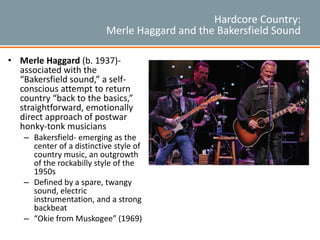
Hardcore Country:
Merle Haggard and the Bakersfield Sound
• Merle Haggard (b. 1937)-
associated with the
“Bakersfield sound,” a self-
conscious attempt to return
country “back to the basics,”
straightforward, emotionally
direct approach of postwar
honky-tonk musicians
– Bakersfield- emerging as the
center of a distinctive style of
country music, an outgrowth
of the rockabilly style of the
1950s
– Defined by a spare, twangy
sound, electric
instrumentation, and a strong
backbeat
– “Okie from Muskogee” (1969)
Country Rock
• Importance of albums over singles
• The Eagles- influential band who epitomized
the culture of Southern California
– Started with laid-back, country-inspired tunes like
“Take it Easy”
– “Hotel California” (released 1976)- more complex,
hard-hitting; influenced by late 1960s poetic
ballads
Rock Comes of Age
• Rock- diffused into every corner of the music industry
– Pop rock and soft rock- designed to appeal to the widest
possible demographic and were promoted on Top 40 radio
and television
• Diverse musicians promoted by record companies under the
general heading of rock music
• African Americans and Rock Music
• Generally low interest in black communities; no clear successor to
Hendrix
• Stevie Wonder (b. 1950)- Singer, songwriter, multi-instrumentalist,
arranger, and producer
– “Superstition”- demonstrates overdubbing
Rock Comes of Age
• Early rock festivals- crowning moment of 1960s
counterculture
– 1970s- mutated into highly profitable mass-audience
concerts held in civic centers and sports arenas across
the country
• 1973- Led Zeppelin broke the world record for live concert
attendance set by the Beatles
• Rock album
– Capacity- could accommodate more than forty
minutes of music
Rock Comes of Age
• Development of studio technology:
– High-fidelity stereo sound- allowed sound sources to be “moved
around”
– 16-, 24-, 32-track recording consoles and electronic sound
devices allowed musicians, record producers, and studio
engineers to create complex aural textures and to construct a
given track over a period of time
– Melotron- could imitate the sound of a string orchestra both in
the studio and at live performances
– Musical response to technological changes:
• Rock bands began to spend many months and lots of money in the
studio to create a single rock “masterpiece”
• Talented musicians took advantage of multitracking to play all the
instruments on a given track
• Technology could be used to create the impression that it was not
being used
Rock Comes of Age
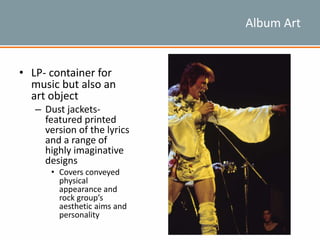
• The Rise and Fall of Ziggy Stardust and the Spiders from Mars (1972)
– David Bowie (1947-2016)- “glam rock” pioneer
• Rock albums centered on a fictitious character whose identity is analogous to that of one
or musicians in the band
• Coherence of the album derives more from the imaginative and magnetic persona of the
singer and his character than from the music itself
• Concert tour was a theatrical tour de force, with special lighting effects and spectacular
costumes that set the standard for later rock acts
• Other rock albums held together by an emotional, philosophical, or political
theme
– Joni Mitchell (b. 1943)- Canadian singer-songwriter whose album Blue (1971)
consists of a cycle of songs about the complexities of love
– Dark Side of the Moon (1973)- album by the British rock band Pink Floyd, based
on the theme of madness and the things that drive us to it
– Marvin Gaye (1939-1984)- theme album What’s Going On (1971) fused soul
music and gospel influence with the political impetus of progressive rock
– Pictures at an Exhibition (1971)- live album recorded by the art rock band
Emerson, Lake, and Palmer
Album Art
• LP- container for
music but also an
art object
– Dust jackets-
featured printed
version of the lyrics
and a range of
highly imaginative
designs
• Covers conveyed
physical
appearance and
rock group’s
aesthetic aims and
personality
Listening Guide:
“Stairway to Heaven” and “Oye Como Va”
• “Stairway to Heaven,” music and lyrics by Jimmy Page and Robert Plant; performed
by Led Zeppelin (recorded 1971)
– Led Zeppelin- formed in 1968, made up of guitarist Jimmy Page, drummer John Bonham,
electric bassist and organist John Paul Jones, tenor Robert Plant
– Led Zeppelin’s most famous recording
– Song never released as a single- had to be purchased with the album
– Song juxtaposes two dimensions of Led Zeppelin’s persona: bone-crushing rock band, known
for inspiring riots and dismantling hotel rooms, and the folk music aficionados steeped in a
reverence for ancient English and Celtic mythology
• “Oye Como Va,” music and lyrics Tito Puente; performed by Santana (recorded
1971)
– Carlos Santana (b. 1947)- Mexican born guitarist whose rock music shows multicultural
engagement
• Influenced by the music of Mexican Americans such as Ritchie Valens; jazz, including experimental
music of John Coltrane and Miles Davis; salsa, a New York-based style of Latin dance music strongly
rooted in Afro-Cuban traditions; San Francisco rock, including artists such as Janis Joplin, Jimi Hendrix,
and Sly and the Family Stone
– Abraxas (1970)- album that established the band and a strong Latin American substream within
rock music
– Instrumentation- guitar, bass, keyboard, drums, rock band plus Latin percussion, Hammond B-3
organ (one of the most characteristic sounds of 1970s rocks)
– “mix”- tonal quality, balancing, and positioning of sounds
– Rhythmic complexity- electrified version of Afro-Cuban dance rhythm
Southern Rock and Jazz Rock
• Allman Brothers Band- group that helped to reconnect the generative power of the
blues to both the mainstream rock music and the open-ended instrumental
improvisations of modern jazz and San Francisco “jam bands” such as the Grateful
Dead
– Florida-born brothers Duane and Gregg Allman joined with guitarist Dickey Betts, bassist Berry
Oakley, ad drummers Butch Trucks and Jai Johnny (Jaimoe) Johanson
– Style: rooted in southern folk music, including songs, rhythms, and textures derived from
African American tradition; the use of harmonica; playing techniques like “bottleneck guitar”
– Blues were central to sound and sensibility
– Incorporation of elements of blues, rhythm & blues, and jazz; powerful, extended live “jams”
helped alter the norms of concert performance
• Southern rock- established the genre, paving the way for other bands such as the
Marshall Tucker Band, Lynyrd Skynyrd, and the Charlie Daniels Band
– Political implications- many southern rock bands, whether intentionally or unintentionally,
presented a view of the South that was, at best, insensitive to African American history, and at
worst, racist
– Use of Confederate iconography in album packaging and stage sets; general conflation of the
idea of the rock rebel with that of the southern rebel; song lyrics
– Neil Young’s song “Southern Man” vs. Lynyrd Skynyrd’s “Sweet Home Alabama”
– Association of southern rock with whiteness and conservative social values
Southern Rock and Jazz Rock
• Jazz rock- more loosely defined category that included commercially
successful collaborations between jazz and rock musicians and a variety of
hybrid styles that melded rock aesthetics and instrumentation with the
harmonic and rhythmic complexity and improvisational virtuosity of
contemporary jazz
– Miles Davis (1926-1991)- began his career in the late 1940s playing trumpet
with modern jazz pioneers such as Charlie Parker and for much of the 1950s
and 1960s played a critical role in the evolution of jazz; in 1970 released an
album that was a fusion between jazz and rock, Bitches Brew
• Jazz aficionados were confounded and alienated by the album that combined the
exploratory spirit of avant-garde jazz with sonic textures and grooves inspired by the
music of Jimi Hendrix and Sly Stone
• Recording didn’t fit either the jazz or rock paradigms of the time
• Chicago- radio-friendly jazz rock band in the early 1970s that achieved the
greatest long-term popularity and commercial success
– Second only to the Beach Boys as the most successful American rock band of
all time
– “25 or 6 to 4” (1970)- highest charting track from their second album Chicago
II- good example of their earlier, more rock-oriented approach
“Night Fever”: The Rise of Disco
• Disco era- 1975-1980- rise of a massively popular alternative to rock music,
centrally focused on social dancing, including couple-based dances like the hustle
and choreographed line dances
– De-emphasized importance of the band
– Attention focused on producers who oversaw the making of recordings, DJs who played them
in nightclubs, and handful of glamorous stars who sang with backing of anonymous studio
musicians
– Rejected the idea of the rock album as an architecturally designed collection of individual
pieces
– DJs- expanded single, and developed techniques for blending one record into the next without
interruption
• Term derived from “discotheque”- used in Europe in the 1960s to refer to
nightclubs devoted to playing recorded music for dancing
– Mid-1970s- clubs featuring an uninterrupted stream of dance music increasingly common in
the United States, especially in urban black and Latino communities, and in the increasingly
visible gay communities in New York and San Francisco
– Late 1970s- disco had taken over the mainstream
– Saturday Night Fever (1977)
“Night Fever”: The Rise of Disco
• How disco entered
popular musical taste
– Novelty records in disco
style
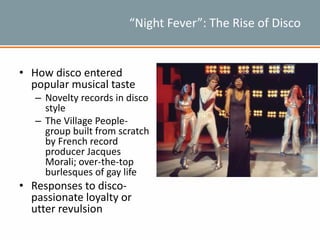
– The Village People-
group built from scratch
by French record
producer Jacques
Morali; over-the-top
burlesques of gay life
• Responses to disco-
passionate loyalty or
utter revulsion
Listening Guide: Disco
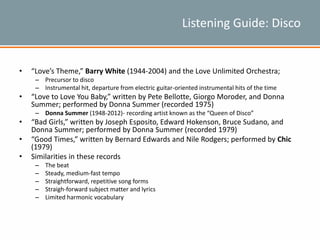
• “Love’s Theme,” Barry White (1944-2004) and the Love Unlimited Orchestra;
– Precursor to disco
– Instrumental hit, departure from electric guitar-oriented instrumental hits of the time
• “Love to Love You Baby,” written by Pete Bellotte, Giorgo Moroder, and Donna
Summer; performed by Donna Summer (recorded 1975)
– Donna Summer (1948-2012)- recording artist known as the “Queen of Disco”
• “Bad Girls,” written by Joseph Esposito, Edward Hokenson, Bruce Sudano, and
Donna Summer; performed by Donna Summer (recorded 1979)
• “Good Times,” written by Bernard Edwards and Nile Rodgers; performed by Chic
(1979)
• Similarities in these records
– The beat
– Steady, medium-fast tempo
– Straightforward, repetitive song forms
– Straigh-forward subject matter and lyrics
– Limited harmonic vocabulary
Key Terms
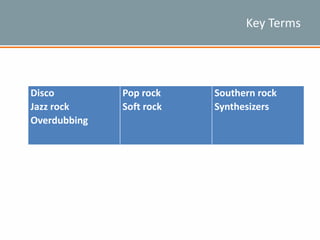
Disco
Jazz rock
Overdubbing
Pop rock
Soft rock
Southern rock
Synthesizers
Key People
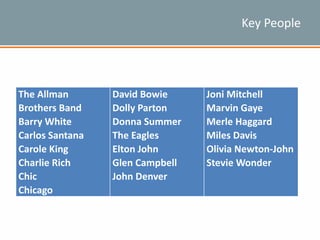
The Allman
Brothers Band
Barry White
Carlos Santana
Carole King
Charlie Rich
Chic
Chicago
David Bowie
Dolly Parton
Donna Summer
The Eagles
Elton John
Glen Campbell
John Denver
Joni Mitchell
Marvin Gaye
Merle Haggard
Miles Davis
Olivia Newton-John
Stevie Wonder

APM Chapter 11

  • 2.
    The 1970s: RockMusic, Disco, and the Popular Mainstream • The “Me” Decade – Tom Wolfe’s label- shift in values of young adults away from the communitarian politically engaged ideals of the 1960s counterculture and toward more materialistic and conservative attitudes • Popular music market in two categories: – New generation of teenagers – Adults aged 25-40 who had grown up with rock ‘n’ roll and were looking for more mature material • Music industry reached new heights of consolidation – Increasingly impelled to present more choices for its customers- specialized types of popular music • Middle of the road (MOR), easy listening, adult contemporary, singer-songwriters, country pop, soft soul, urban contemporary, funk, disco, reggae, oldies, subgenres of rock: country rock, folk rock, soft rock, hard rock, pop rock, heavy metal, southern rock, jazz rock, blues rock, Latin rock, art rock, glam, rock punk rock, etc.
  • 3.
    Top 40 Format •Top 40 playlist format- dominated AM radio airwaves • Primary medium for hard rock or progressive rock bands- FM format – Free-form FM programming- restricted to community or college-based stations – AOR (album-oriented rock)- aimed at young white males aged 13-25 • Survey of Billboard charts of the 1970s- reveals a complex picture – Traditions continued to intermingle with one another • Commercial mainstream: – Pop rock – Adult contemporary – Singer-songwriters – Soft soul – Country pop – Bubblegum – Disco – “oldies” radio- hits of the 1950s and early 1960s
  • 4.
    Singer-songwriters – Carole King(b. 1942)- career illustrates the central prominence of singer-songwriters in this period • Tapestry (1971)- album whose success made King a major recording star – Joni Mitchell (b. 1943)- began career as songwriter, started recording on her own in 1968 • Blue (1971)- best-known album; cycle of songs about complexity of love – James Taylor (b. 1948)- perhaps the most successful long-running career of the ‘70s era singer-songwriters. • Sweet Baby James (1970)- hugely successful album with many hit singles, including number 3 hit “Fire and Rain.”
  • 5.
    Listening Guide: A1970s Jukebox • “It’s Too Late,” written by Carole King and Toni Sterne, performed by Carole King (released 1971) – Carole King (b. 1942)- her career illustrates the central prominence of singer- songwriters in this period – Tapestry (1971) • Superstition,” written and performed by Stevie Wonder (released 1972) – Stevie Wonder (b. 1950)- successful singer and songwriter during his teenage years with Motown in the 1960s, established a new benchmark of achievement for a pop music figure in 1971 when he negotiated a new contract giving him full artistic control over all aspects of his music – Overdubbing- Wonder plays most of the instruments, synchronizing the performance by overdubbing several tracks on the recording tape – Blends elements borrowed from different aspects of African American musical traditions – Synthesizers- Wonder was a pioneer in the use of new electronic instruments
  • 6.
    Listening Guide: A1970s Jukebox • “Crocodile Rock,” written by Elton John and Bernie Taupin; performed by Elton John (released 1972) – Elton John (b. 1947)- artist who illustrated the trend of long-running “British occupation” of the American pop charts • Keyboard playing singer-songwriter • “Love’s Theme,” written by Barry White; performed by the Love Unlimited Orchestra; conducted by Barry White (released 1973) – Barry White (1944-2004): multitalented African American singer, songwriter, arranger, conductor, and producer who achieved success as an artist in the 1970s with his Love Unlimited Orchestra; perhaps best known for his full, deep voice
  • 7.
    Listening Guide: A1970s Jukebox • “Thank God I’m a Country Boy,” written by John Martin Sommers; performed by John Denver (released 1975) – John Denver (1943-1997)- style more urban folk with some pop elements, though by the time he recorded “Thank God I’m a Country Boy” he portrayed himself as a country artist musically and thematically – Song is a cut taken from live album An Evening with John Denver • “Hotel California,” written by Don Felder, Don Henley, and Glenn Frey (all members of the Eagles); performed by the Eagles (released 1976) – The Eagles- influential band who epitomized the culture of southern California
  • 8.
    Country Music andthe Pop Mainstream • Country-pop crossover accomplished by a new generation of musicians – Glen Campbell (b. 1936)- worked in western swing bands in the Southwest as a teenager, moved to LA in 1958, where he developed a career as a studio session guitarist and vocalist; had a series of crossover hits on the country and pop charts – Charlie Rich (b. 1932)- called “Silver Fox,” a talented jazz and blues pianist whose career started in rockabilly; by the 1960s switched to pop-oriented countrypolitan style who had a series of number one crossover hits in the mid-1970s – John Denver (1943-1997)- Third #1 hit, “Thank God I’m a Country Boy,” was turning point from pop/country/folk blend to “pure” country • Dichotomy between pop performers who capitalized on the popularity of country music and established country musicians who moved toward the pop mainstream – Olivia Newton-John (b. 1948)- English-born singer who grew up in Australia who scored a series of Top 10 country pop crossover hits and in 1974 won the Country Music Association’s award for Female Singer of the Year – Dolly Parton (b. 1946)- established country star who built her career through regular appearances on country music radio and television programs, including the Grand Ole Opry; flexible soprano voice, songwriting ability, and carefully crafted image as a cheerful sex symbol gained her a loyal following among country fans
  • 9.
    Hardcore Country: Merle Haggardand the Bakersfield Sound • Merle Haggard (b. 1937)- associated with the “Bakersfield sound,” a self- conscious attempt to return country “back to the basics,” straightforward, emotionally direct approach of postwar honky-tonk musicians – Bakersfield- emerging as the center of a distinctive style of country music, an outgrowth of the rockabilly style of the 1950s – Defined by a spare, twangy sound, electric instrumentation, and a strong backbeat – “Okie from Muskogee” (1969)
  • 10.
    Country Rock • Importanceof albums over singles • The Eagles- influential band who epitomized the culture of Southern California – Started with laid-back, country-inspired tunes like “Take it Easy” – “Hotel California” (released 1976)- more complex, hard-hitting; influenced by late 1960s poetic ballads
  • 11.
    Rock Comes ofAge • Rock- diffused into every corner of the music industry – Pop rock and soft rock- designed to appeal to the widest possible demographic and were promoted on Top 40 radio and television • Diverse musicians promoted by record companies under the general heading of rock music • African Americans and Rock Music • Generally low interest in black communities; no clear successor to Hendrix • Stevie Wonder (b. 1950)- Singer, songwriter, multi-instrumentalist, arranger, and producer – “Superstition”- demonstrates overdubbing
  • 12.
    Rock Comes ofAge • Early rock festivals- crowning moment of 1960s counterculture – 1970s- mutated into highly profitable mass-audience concerts held in civic centers and sports arenas across the country • 1973- Led Zeppelin broke the world record for live concert attendance set by the Beatles • Rock album – Capacity- could accommodate more than forty minutes of music
  • 13.
    Rock Comes ofAge • Development of studio technology: – High-fidelity stereo sound- allowed sound sources to be “moved around” – 16-, 24-, 32-track recording consoles and electronic sound devices allowed musicians, record producers, and studio engineers to create complex aural textures and to construct a given track over a period of time – Melotron- could imitate the sound of a string orchestra both in the studio and at live performances – Musical response to technological changes: • Rock bands began to spend many months and lots of money in the studio to create a single rock “masterpiece” • Talented musicians took advantage of multitracking to play all the instruments on a given track • Technology could be used to create the impression that it was not being used
  • 14.
    Rock Comes ofAge • The Rise and Fall of Ziggy Stardust and the Spiders from Mars (1972) – David Bowie (1947-2016)- “glam rock” pioneer • Rock albums centered on a fictitious character whose identity is analogous to that of one or musicians in the band • Coherence of the album derives more from the imaginative and magnetic persona of the singer and his character than from the music itself • Concert tour was a theatrical tour de force, with special lighting effects and spectacular costumes that set the standard for later rock acts • Other rock albums held together by an emotional, philosophical, or political theme – Joni Mitchell (b. 1943)- Canadian singer-songwriter whose album Blue (1971) consists of a cycle of songs about the complexities of love – Dark Side of the Moon (1973)- album by the British rock band Pink Floyd, based on the theme of madness and the things that drive us to it – Marvin Gaye (1939-1984)- theme album What’s Going On (1971) fused soul music and gospel influence with the political impetus of progressive rock – Pictures at an Exhibition (1971)- live album recorded by the art rock band Emerson, Lake, and Palmer
  • 15.
    Album Art • LP-container for music but also an art object – Dust jackets- featured printed version of the lyrics and a range of highly imaginative designs • Covers conveyed physical appearance and rock group’s aesthetic aims and personality
  • 16.
    Listening Guide: “Stairway toHeaven” and “Oye Como Va” • “Stairway to Heaven,” music and lyrics by Jimmy Page and Robert Plant; performed by Led Zeppelin (recorded 1971) – Led Zeppelin- formed in 1968, made up of guitarist Jimmy Page, drummer John Bonham, electric bassist and organist John Paul Jones, tenor Robert Plant – Led Zeppelin’s most famous recording – Song never released as a single- had to be purchased with the album – Song juxtaposes two dimensions of Led Zeppelin’s persona: bone-crushing rock band, known for inspiring riots and dismantling hotel rooms, and the folk music aficionados steeped in a reverence for ancient English and Celtic mythology • “Oye Como Va,” music and lyrics Tito Puente; performed by Santana (recorded 1971) – Carlos Santana (b. 1947)- Mexican born guitarist whose rock music shows multicultural engagement • Influenced by the music of Mexican Americans such as Ritchie Valens; jazz, including experimental music of John Coltrane and Miles Davis; salsa, a New York-based style of Latin dance music strongly rooted in Afro-Cuban traditions; San Francisco rock, including artists such as Janis Joplin, Jimi Hendrix, and Sly and the Family Stone – Abraxas (1970)- album that established the band and a strong Latin American substream within rock music – Instrumentation- guitar, bass, keyboard, drums, rock band plus Latin percussion, Hammond B-3 organ (one of the most characteristic sounds of 1970s rocks) – “mix”- tonal quality, balancing, and positioning of sounds – Rhythmic complexity- electrified version of Afro-Cuban dance rhythm
  • 17.
    Southern Rock andJazz Rock • Allman Brothers Band- group that helped to reconnect the generative power of the blues to both the mainstream rock music and the open-ended instrumental improvisations of modern jazz and San Francisco “jam bands” such as the Grateful Dead – Florida-born brothers Duane and Gregg Allman joined with guitarist Dickey Betts, bassist Berry Oakley, ad drummers Butch Trucks and Jai Johnny (Jaimoe) Johanson – Style: rooted in southern folk music, including songs, rhythms, and textures derived from African American tradition; the use of harmonica; playing techniques like “bottleneck guitar” – Blues were central to sound and sensibility – Incorporation of elements of blues, rhythm & blues, and jazz; powerful, extended live “jams” helped alter the norms of concert performance • Southern rock- established the genre, paving the way for other bands such as the Marshall Tucker Band, Lynyrd Skynyrd, and the Charlie Daniels Band – Political implications- many southern rock bands, whether intentionally or unintentionally, presented a view of the South that was, at best, insensitive to African American history, and at worst, racist – Use of Confederate iconography in album packaging and stage sets; general conflation of the idea of the rock rebel with that of the southern rebel; song lyrics – Neil Young’s song “Southern Man” vs. Lynyrd Skynyrd’s “Sweet Home Alabama” – Association of southern rock with whiteness and conservative social values
  • 18.
    Southern Rock andJazz Rock • Jazz rock- more loosely defined category that included commercially successful collaborations between jazz and rock musicians and a variety of hybrid styles that melded rock aesthetics and instrumentation with the harmonic and rhythmic complexity and improvisational virtuosity of contemporary jazz – Miles Davis (1926-1991)- began his career in the late 1940s playing trumpet with modern jazz pioneers such as Charlie Parker and for much of the 1950s and 1960s played a critical role in the evolution of jazz; in 1970 released an album that was a fusion between jazz and rock, Bitches Brew • Jazz aficionados were confounded and alienated by the album that combined the exploratory spirit of avant-garde jazz with sonic textures and grooves inspired by the music of Jimi Hendrix and Sly Stone • Recording didn’t fit either the jazz or rock paradigms of the time • Chicago- radio-friendly jazz rock band in the early 1970s that achieved the greatest long-term popularity and commercial success – Second only to the Beach Boys as the most successful American rock band of all time – “25 or 6 to 4” (1970)- highest charting track from their second album Chicago II- good example of their earlier, more rock-oriented approach
  • 19.
    “Night Fever”: TheRise of Disco • Disco era- 1975-1980- rise of a massively popular alternative to rock music, centrally focused on social dancing, including couple-based dances like the hustle and choreographed line dances – De-emphasized importance of the band – Attention focused on producers who oversaw the making of recordings, DJs who played them in nightclubs, and handful of glamorous stars who sang with backing of anonymous studio musicians – Rejected the idea of the rock album as an architecturally designed collection of individual pieces – DJs- expanded single, and developed techniques for blending one record into the next without interruption • Term derived from “discotheque”- used in Europe in the 1960s to refer to nightclubs devoted to playing recorded music for dancing – Mid-1970s- clubs featuring an uninterrupted stream of dance music increasingly common in the United States, especially in urban black and Latino communities, and in the increasingly visible gay communities in New York and San Francisco – Late 1970s- disco had taken over the mainstream – Saturday Night Fever (1977)
  • 20.
    “Night Fever”: TheRise of Disco • How disco entered popular musical taste – Novelty records in disco style – The Village People- group built from scratch by French record producer Jacques Morali; over-the-top burlesques of gay life • Responses to disco- passionate loyalty or utter revulsion
  • 21.
    Listening Guide: Disco •“Love’s Theme,” Barry White (1944-2004) and the Love Unlimited Orchestra; – Precursor to disco – Instrumental hit, departure from electric guitar-oriented instrumental hits of the time • “Love to Love You Baby,” written by Pete Bellotte, Giorgo Moroder, and Donna Summer; performed by Donna Summer (recorded 1975) – Donna Summer (1948-2012)- recording artist known as the “Queen of Disco” • “Bad Girls,” written by Joseph Esposito, Edward Hokenson, Bruce Sudano, and Donna Summer; performed by Donna Summer (recorded 1979) • “Good Times,” written by Bernard Edwards and Nile Rodgers; performed by Chic (1979) • Similarities in these records – The beat – Steady, medium-fast tempo – Straightforward, repetitive song forms – Straigh-forward subject matter and lyrics – Limited harmonic vocabulary
  • 22.
    Key Terms Disco Jazz rock Overdubbing Poprock Soft rock Southern rock Synthesizers
  • 23.
    Key People The Allman BrothersBand Barry White Carlos Santana Carole King Charlie Rich Chic Chicago David Bowie Dolly Parton Donna Summer The Eagles Elton John Glen Campbell John Denver Joni Mitchell Marvin Gaye Merle Haggard Miles Davis Olivia Newton-John Stevie Wonder

Editor's Notes

  • #7 Elton John does his thing in a sequined baseball uniform at Dodger Stadium, Los Angeles, c. 1975. Terry O’Neill/Hulton Archive/Getty Images.
  • #10 “Hardcore country” singer Merle Haggard (left) and Kris Kristofferson on stage together in 2011. © Minneapolis Star Tribune/ZUMAPRESS.COM/Alamy
  • #16 David Bowie performing as Ziggy Stardust, 1973. © Pictorial Press Ltd./Alamy.
  • #21 Donna Summer on stage, ca. mid-1970s. © Pictorial Press Ltd./Alamy