QUICK SURVEY
Questions
• Rate the following statements on a
Likert scale
(1) strongly disagree
(2) disagree
(3) neither agree or disagree
(4) agree
(5) strongly agree
1. World hunger is a serious
problem that needs attention.
2. Our country needs to
address the growing number
of homeless.
3. Sleep, exercise and a
healthy diet is key for one’s
well-being.
4. Green bags at grocery
stores will help the
environment in the long run
5. Our government should
spend more money on more
buses and routes in Canberra
6. The public needs better
understanding of mental
health issues in order to
reduce stigma
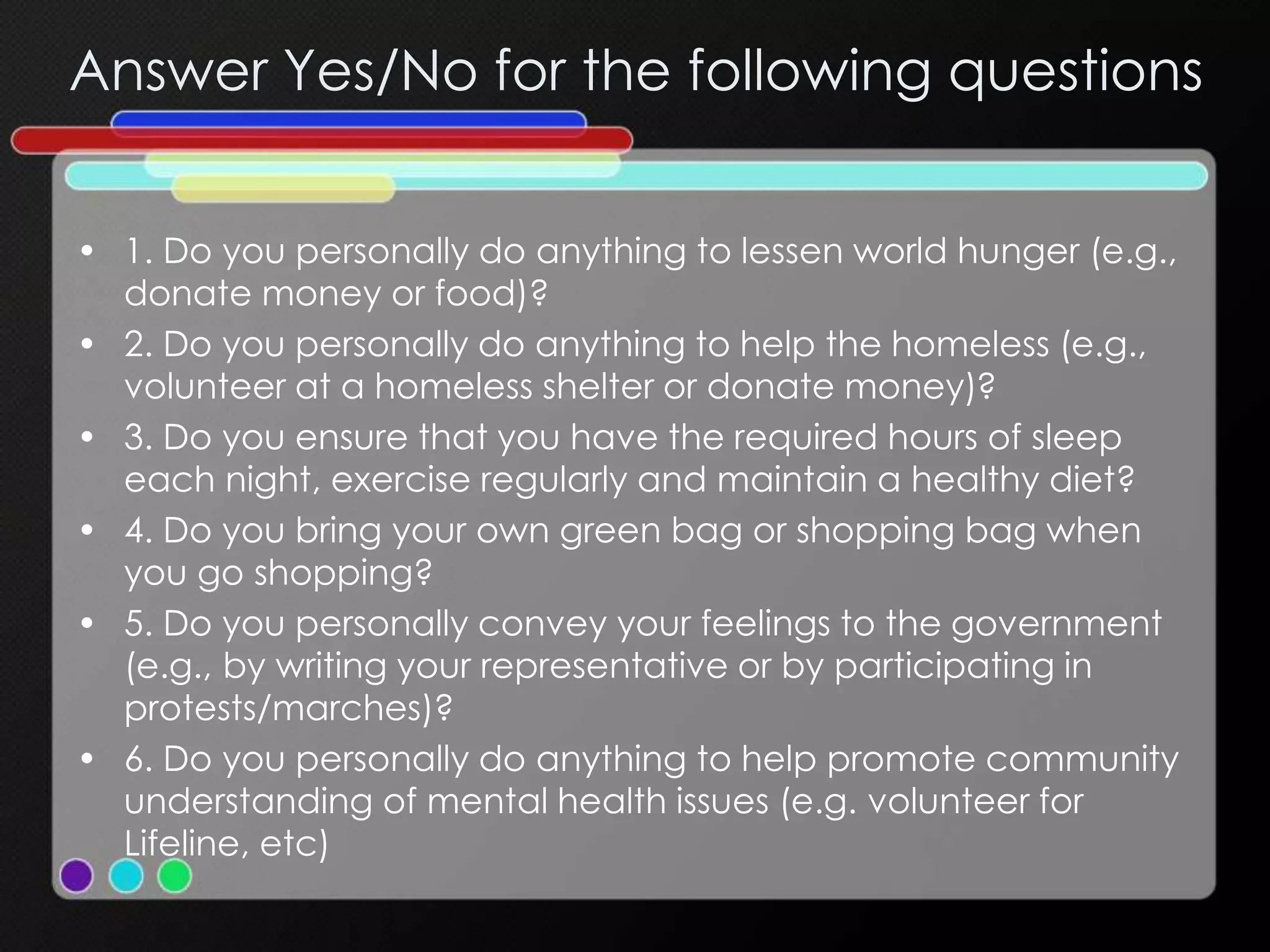
Answer Yes/No for the following questions
• 1. Do you personally do anything to lessen world hunger (e.g.,
donate money or food)?
• 2. Do you personally do anything to help the homeless (e.g.,
volunteer at a homeless shelter or donate money)?
• 3. Do you ensure that you have the required hours of sleep
each night, exercise regularly and maintain a healthy diet?
• 4. Do you bring your own green bag or shopping bag when
you go shopping?
• 5. Do you personally convey your feelings to the government
(e.g., by writing your representative or by participating in
protests/marches)?
• 6. Do you personally do anything to help promote community
understanding of mental health issues (e.g. volunteer for
Lifeline, etc)
How did these inconsistencies
make you feel??
CHANGING ATTITUDES:
COGNITIVE DISSONANCE
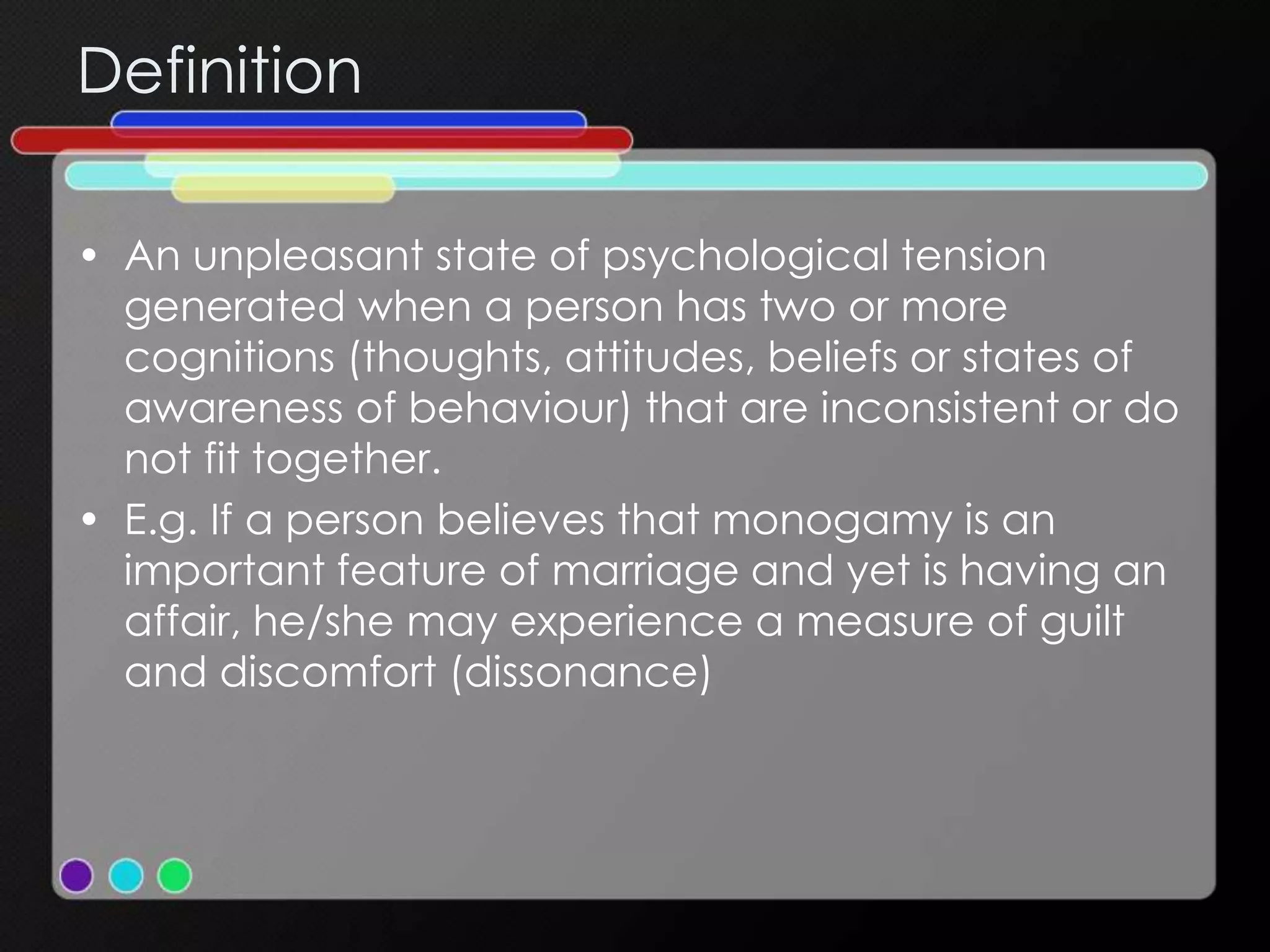
Definition
• An unpleasant state of psychological tension
generated when a person has two or more
cognitions (thoughts, attitudes, beliefs or states of
awareness of behaviour) that are inconsistent or do
not fit together.
• E.g. If a person believes that monogamy is an
important feature of marriage and yet is having an
affair, he/she may experience a measure of guilt
and discomfort (dissonance)
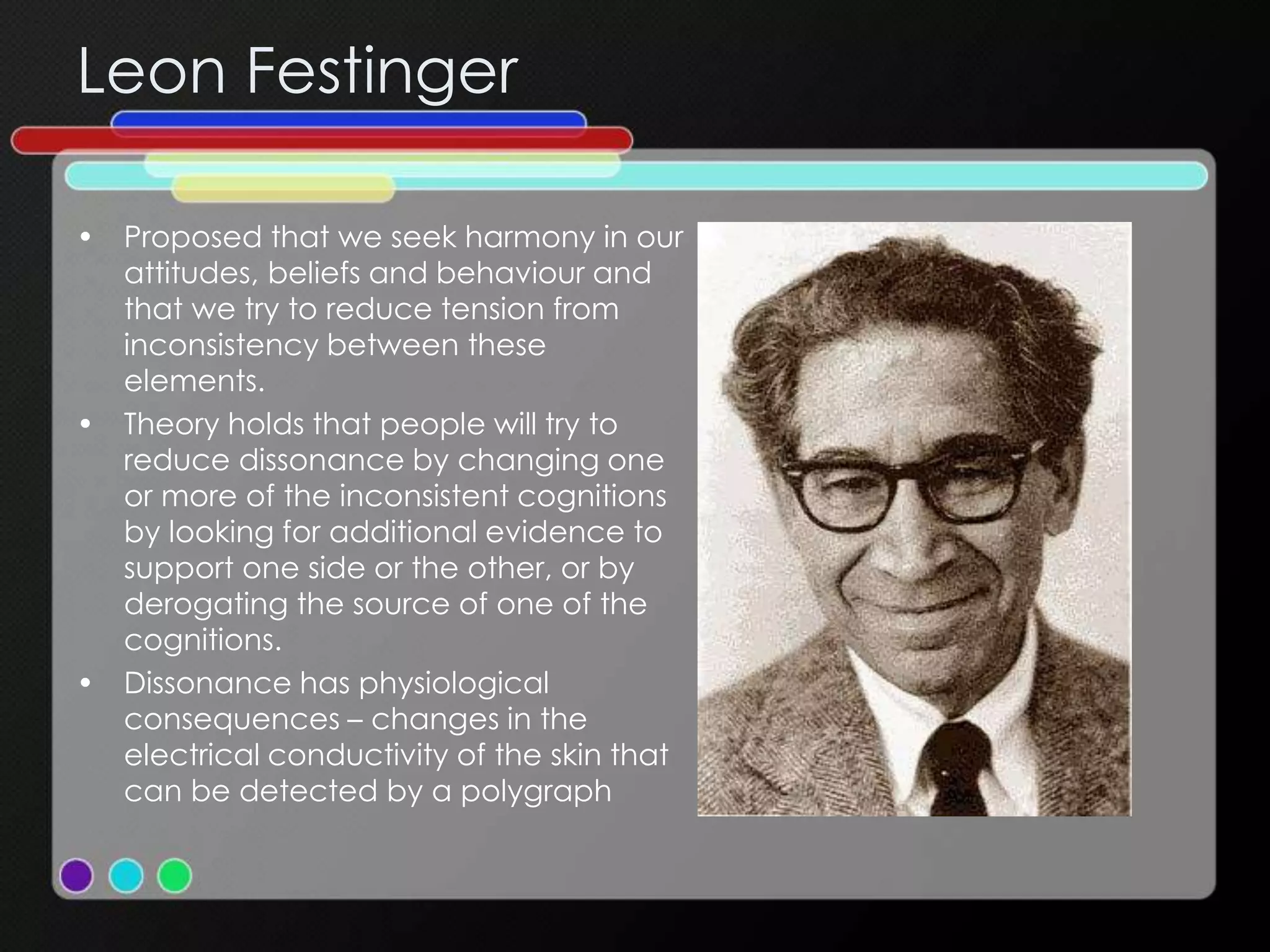
Leon Festinger
• Proposed that we seek harmony in our
attitudes, beliefs and behaviour and
that we try to reduce tension from
inconsistency between these
elements.
• Theory holds that people will try to
reduce dissonance by changing one
or more of the inconsistent cognitions
by looking for additional evidence to
support one side or the other, or by
derogating the source of one of the
cognitions.
• Dissonance has physiological
consequences – changes in the
electrical conductivity of the skin that
can be detected by a polygraph
The greater the dissonance,
the stronger the attempts to
reduce it
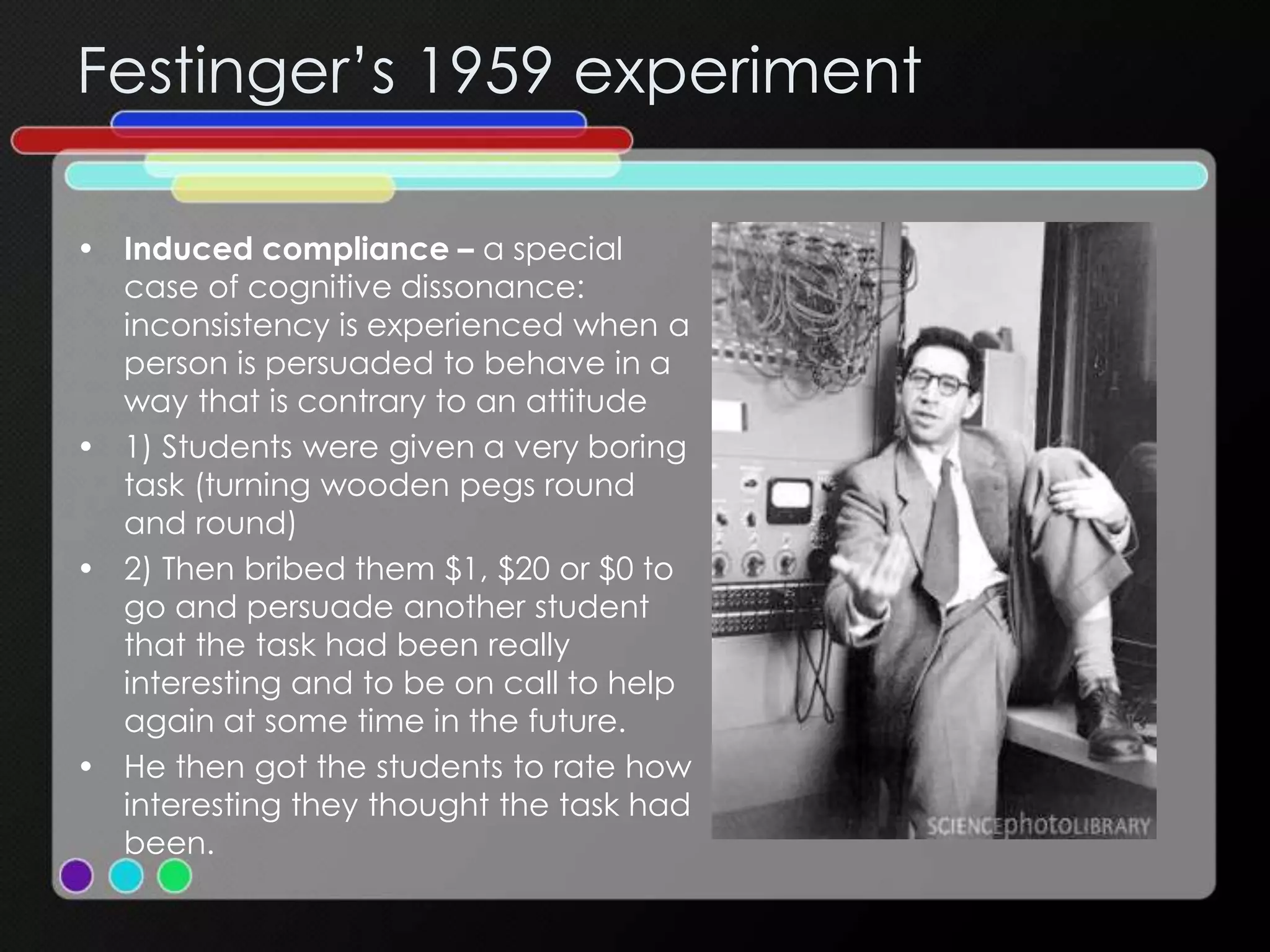
Festinger’s 1959 experiment
• Induced compliance – a special
case of cognitive dissonance:
inconsistency is experienced when a
person is persuaded to behave in a
way that is contrary to an attitude
• 1) Students were given a very boring
task (turning wooden pegs round
and round)
• 2) Then bribed them $1, $20 or $0 to
go and persuade another student
that the task had been really
interesting and to be on call to help
again at some time in the future.
• He then got the students to rate how
interesting they thought the task had
been.
Results
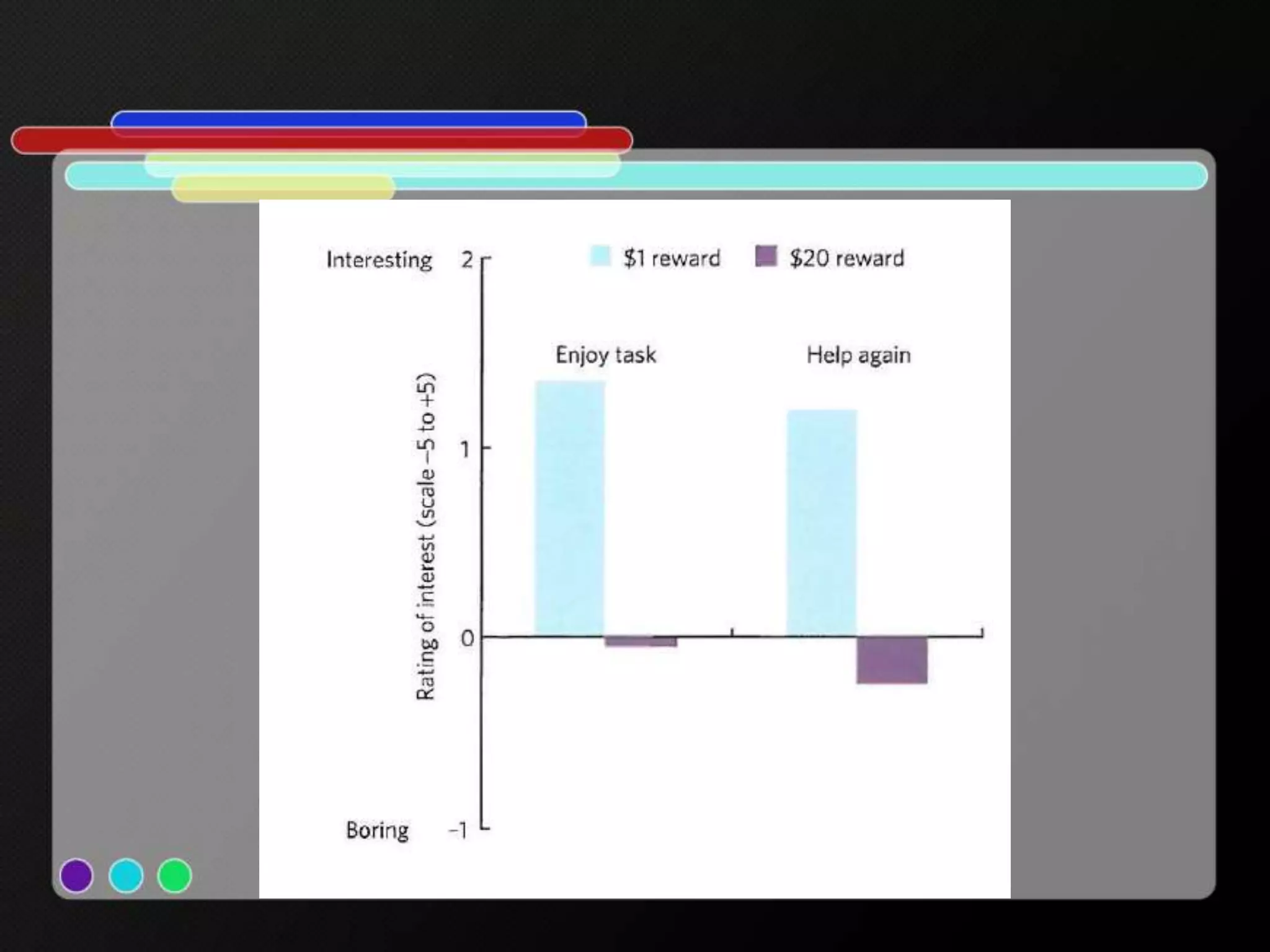
• Those in the $1 group rated the
task as interesting, but those in
the $20 group reported it as
boring ($0 group even more
so).
• This can be explained by
cognitive dissonance because
lying to the other student
created dissonance ("I am
truthful" vs "I just told a lie")
• The $1 students managed to
persuade themselves that they
hadn't lied and the task had
been interesting, just to get rid
of the dissonance.
• i.e. $20 person could explain
their lie with the thought ‘I
did it for the $20’. It must
have been a lousy task
indeed.’ = no dissonance
• $1 person had the dilemma:
‘I’ve done a really boring
task, then told someone else
that it is interesting, and
even agreed to come back
and do it again for a measly
$1???
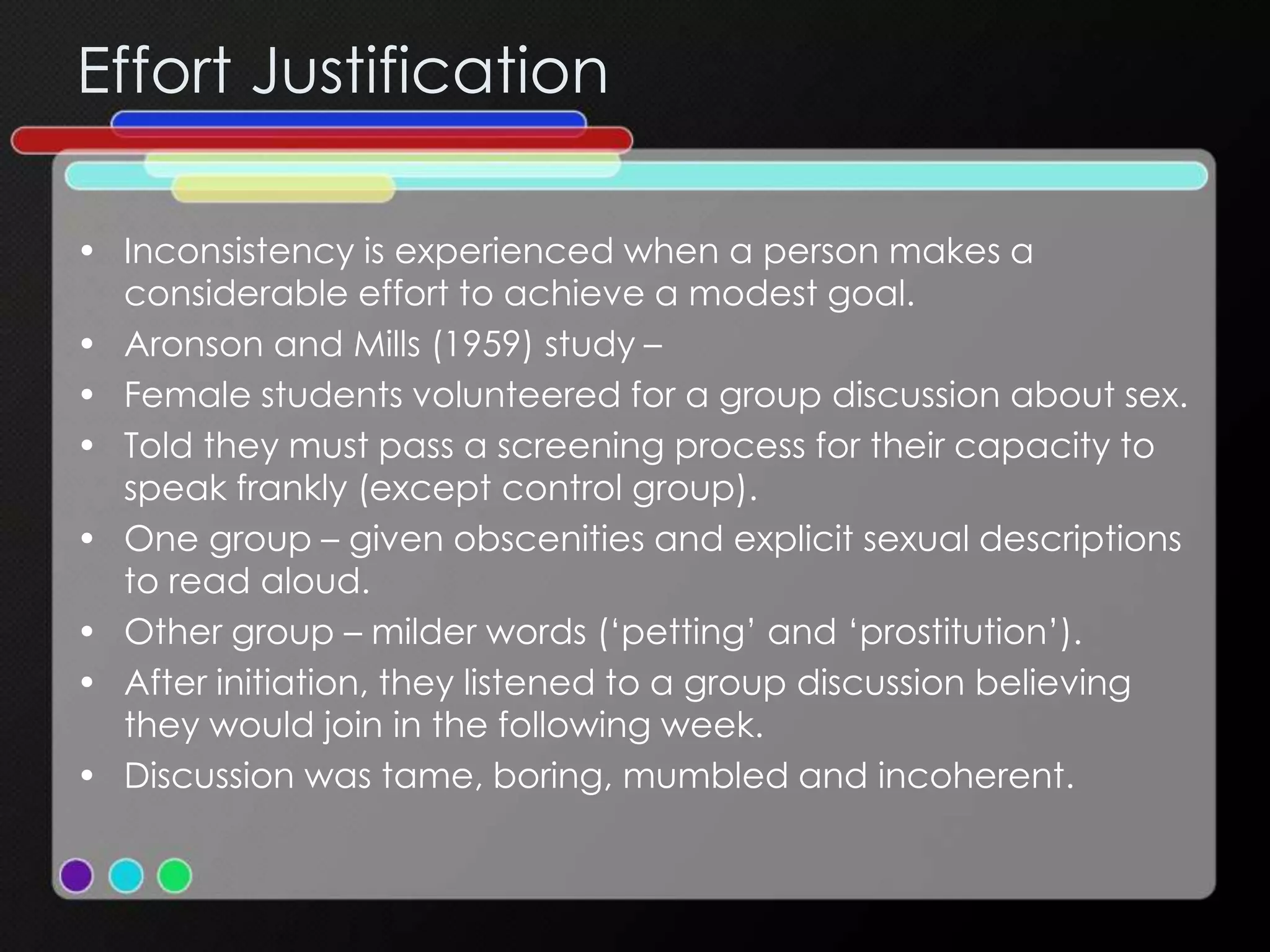
Effort Justification
• Inconsistency is experienced when a person makes a
considerable effort to achieve a modest goal.
• Aronson and Mills (1959) study –
• Female students volunteered for a group discussion about sex.
• Told they must pass a screening process for their capacity to
speak frankly (except control group).
• One group – given obscenities and explicit sexual descriptions
to read aloud.
• Other group – milder words (‘petting’ and ‘prostitution’).
• After initiation, they listened to a group discussion believing
they would join in the following week.
• Discussion was tame, boring, mumbled and incoherent.
Results
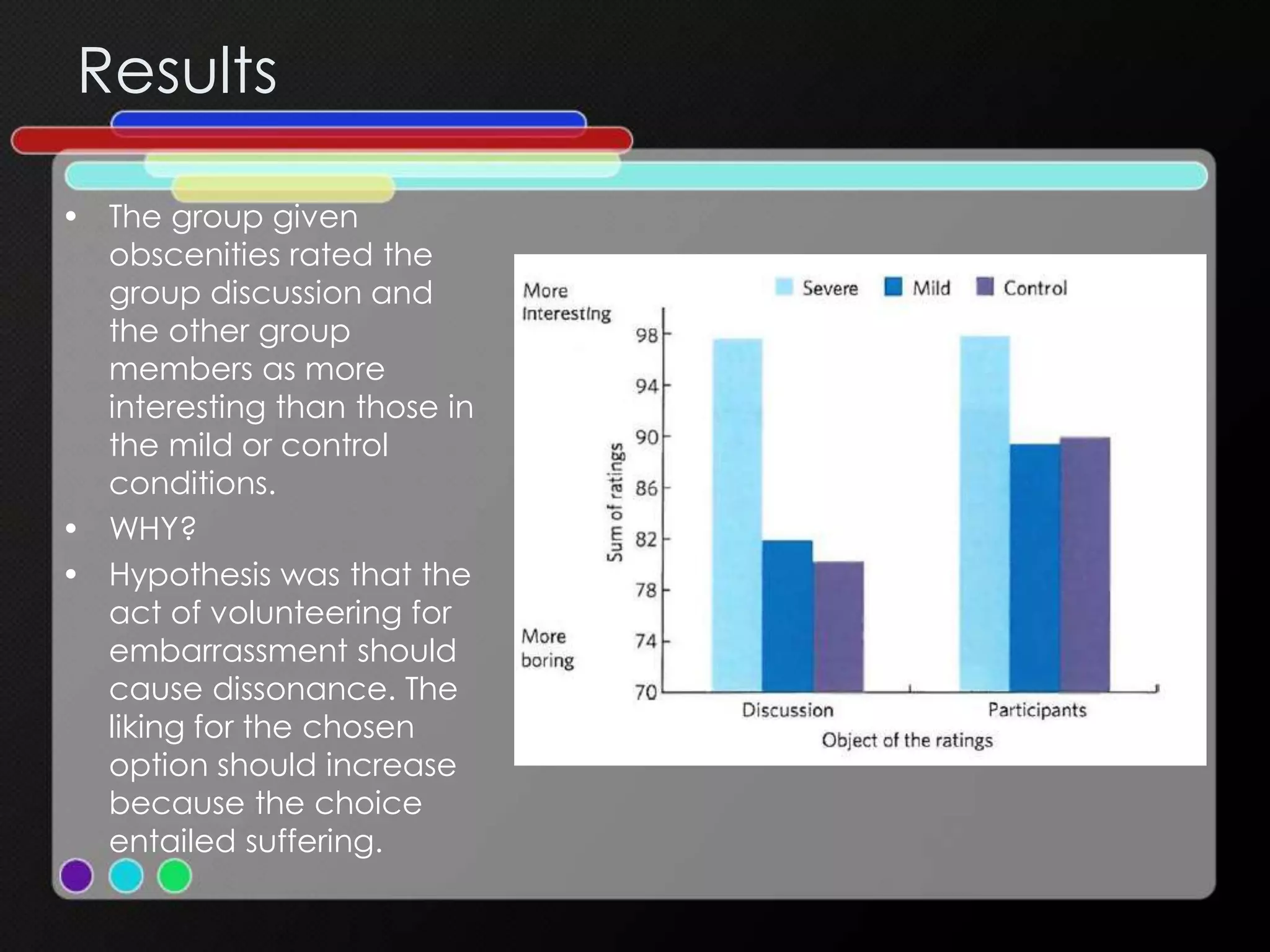
• The group given
obscenities rated the
group discussion and
the other group
members as more
interesting than those in
the mild or control
conditions.
• WHY?
• Hypothesis was that the
act of volunteering for
embarrassment should
cause dissonance. The
liking for the chosen
option should increase
because the choice
entailed suffering.
In Sum
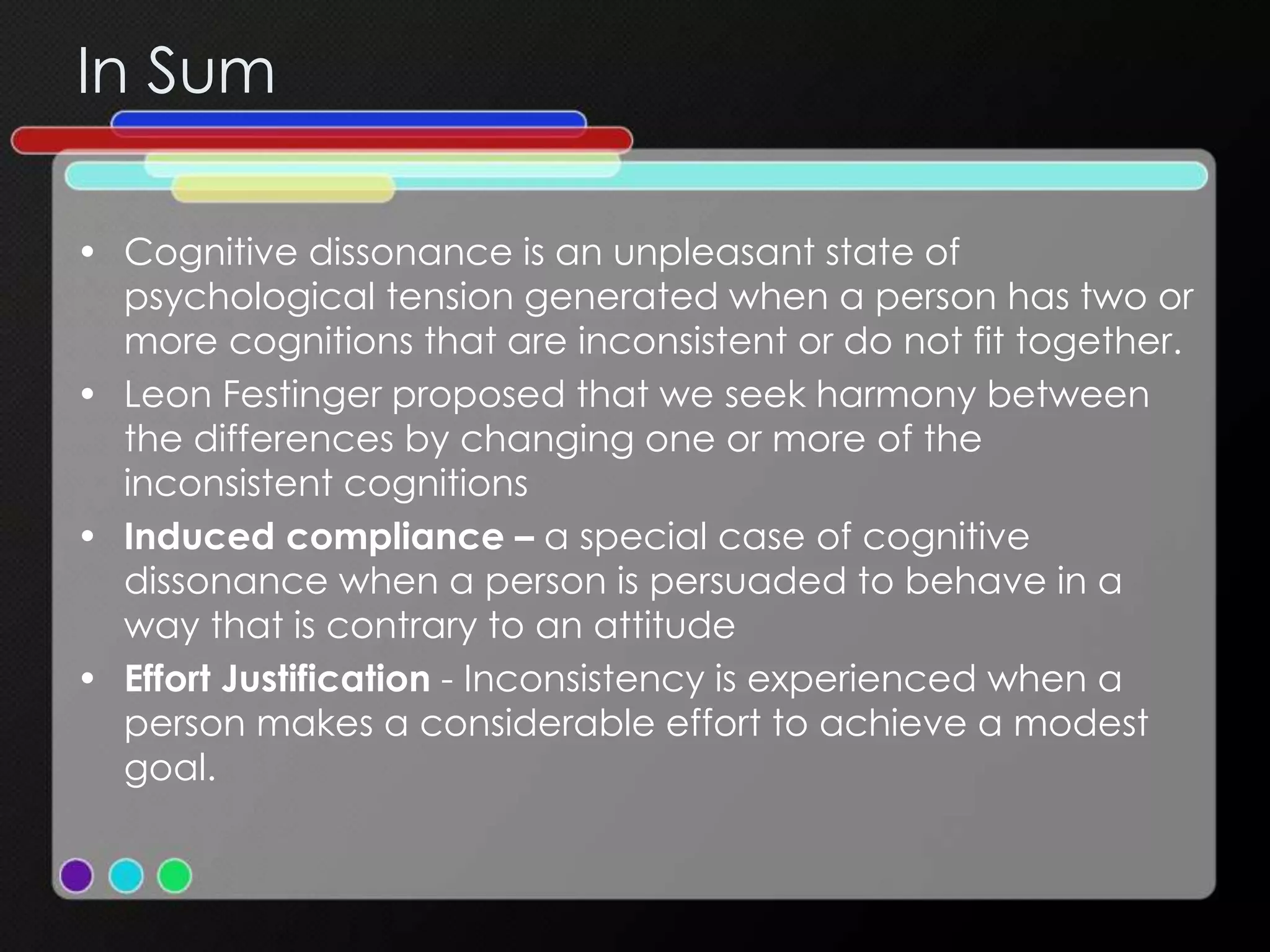
• Cognitive dissonance is an unpleasant state of
psychological tension generated when a person has two or
more cognitions that are inconsistent or do not fit together.
• Leon Festinger proposed that we seek harmony between
the differences by changing one or more of the
inconsistent cognitions
• Induced compliance – a special case of cognitive
dissonance when a person is persuaded to behave in a
way that is contrary to an attitude
• Effort Justification - Inconsistency is experienced when a
person makes a considerable effort to achieve a modest
goal.

Apl05 cognitive dissonance

  • 1.
  • 2.
    Questions • Rate thefollowing statements on a Likert scale (1) strongly disagree (2) disagree (3) neither agree or disagree (4) agree (5) strongly agree
  • 3.
    1. World hungeris a serious problem that needs attention.
  • 4.
    2. Our countryneeds to address the growing number of homeless.
  • 5.
    3. Sleep, exerciseand a healthy diet is key for one’s well-being.
  • 6.
    4. Green bagsat grocery stores will help the environment in the long run
  • 7.
    5. Our governmentshould spend more money on more buses and routes in Canberra
  • 8.
    6. The publicneeds better understanding of mental health issues in order to reduce stigma
  • 9.
    Answer Yes/No forthe following questions • 1. Do you personally do anything to lessen world hunger (e.g., donate money or food)? • 2. Do you personally do anything to help the homeless (e.g., volunteer at a homeless shelter or donate money)? • 3. Do you ensure that you have the required hours of sleep each night, exercise regularly and maintain a healthy diet? • 4. Do you bring your own green bag or shopping bag when you go shopping? • 5. Do you personally convey your feelings to the government (e.g., by writing your representative or by participating in protests/marches)? • 6. Do you personally do anything to help promote community understanding of mental health issues (e.g. volunteer for Lifeline, etc)
  • 10.
    How did theseinconsistencies make you feel??
  • 11.
  • 12.
    Definition • An unpleasantstate of psychological tension generated when a person has two or more cognitions (thoughts, attitudes, beliefs or states of awareness of behaviour) that are inconsistent or do not fit together. • E.g. If a person believes that monogamy is an important feature of marriage and yet is having an affair, he/she may experience a measure of guilt and discomfort (dissonance)
  • 13.
    Leon Festinger • Proposedthat we seek harmony in our attitudes, beliefs and behaviour and that we try to reduce tension from inconsistency between these elements. • Theory holds that people will try to reduce dissonance by changing one or more of the inconsistent cognitions by looking for additional evidence to support one side or the other, or by derogating the source of one of the cognitions. • Dissonance has physiological consequences – changes in the electrical conductivity of the skin that can be detected by a polygraph
  • 14.
    The greater thedissonance, the stronger the attempts to reduce it
  • 15.
    Festinger’s 1959 experiment •Induced compliance – a special case of cognitive dissonance: inconsistency is experienced when a person is persuaded to behave in a way that is contrary to an attitude • 1) Students were given a very boring task (turning wooden pegs round and round) • 2) Then bribed them $1, $20 or $0 to go and persuade another student that the task had been really interesting and to be on call to help again at some time in the future. • He then got the students to rate how interesting they thought the task had been.
  • 16.
    Results • Those inthe $1 group rated the task as interesting, but those in the $20 group reported it as boring ($0 group even more so). • This can be explained by cognitive dissonance because lying to the other student created dissonance ("I am truthful" vs "I just told a lie") • The $1 students managed to persuade themselves that they hadn't lied and the task had been interesting, just to get rid of the dissonance. • i.e. $20 person could explain their lie with the thought ‘I did it for the $20’. It must have been a lousy task indeed.’ = no dissonance • $1 person had the dilemma: ‘I’ve done a really boring task, then told someone else that it is interesting, and even agreed to come back and do it again for a measly $1???
  • 18.
    Effort Justification • Inconsistencyis experienced when a person makes a considerable effort to achieve a modest goal. • Aronson and Mills (1959) study – • Female students volunteered for a group discussion about sex. • Told they must pass a screening process for their capacity to speak frankly (except control group). • One group – given obscenities and explicit sexual descriptions to read aloud. • Other group – milder words (‘petting’ and ‘prostitution’). • After initiation, they listened to a group discussion believing they would join in the following week. • Discussion was tame, boring, mumbled and incoherent.
  • 19.
    Results • The groupgiven obscenities rated the group discussion and the other group members as more interesting than those in the mild or control conditions. • WHY? • Hypothesis was that the act of volunteering for embarrassment should cause dissonance. The liking for the chosen option should increase because the choice entailed suffering.
  • 20.
    In Sum • Cognitivedissonance is an unpleasant state of psychological tension generated when a person has two or more cognitions that are inconsistent or do not fit together. • Leon Festinger proposed that we seek harmony between the differences by changing one or more of the inconsistent cognitions • Induced compliance – a special case of cognitive dissonance when a person is persuaded to behave in a way that is contrary to an attitude • Effort Justification - Inconsistency is experienced when a person makes a considerable effort to achieve a modest goal.