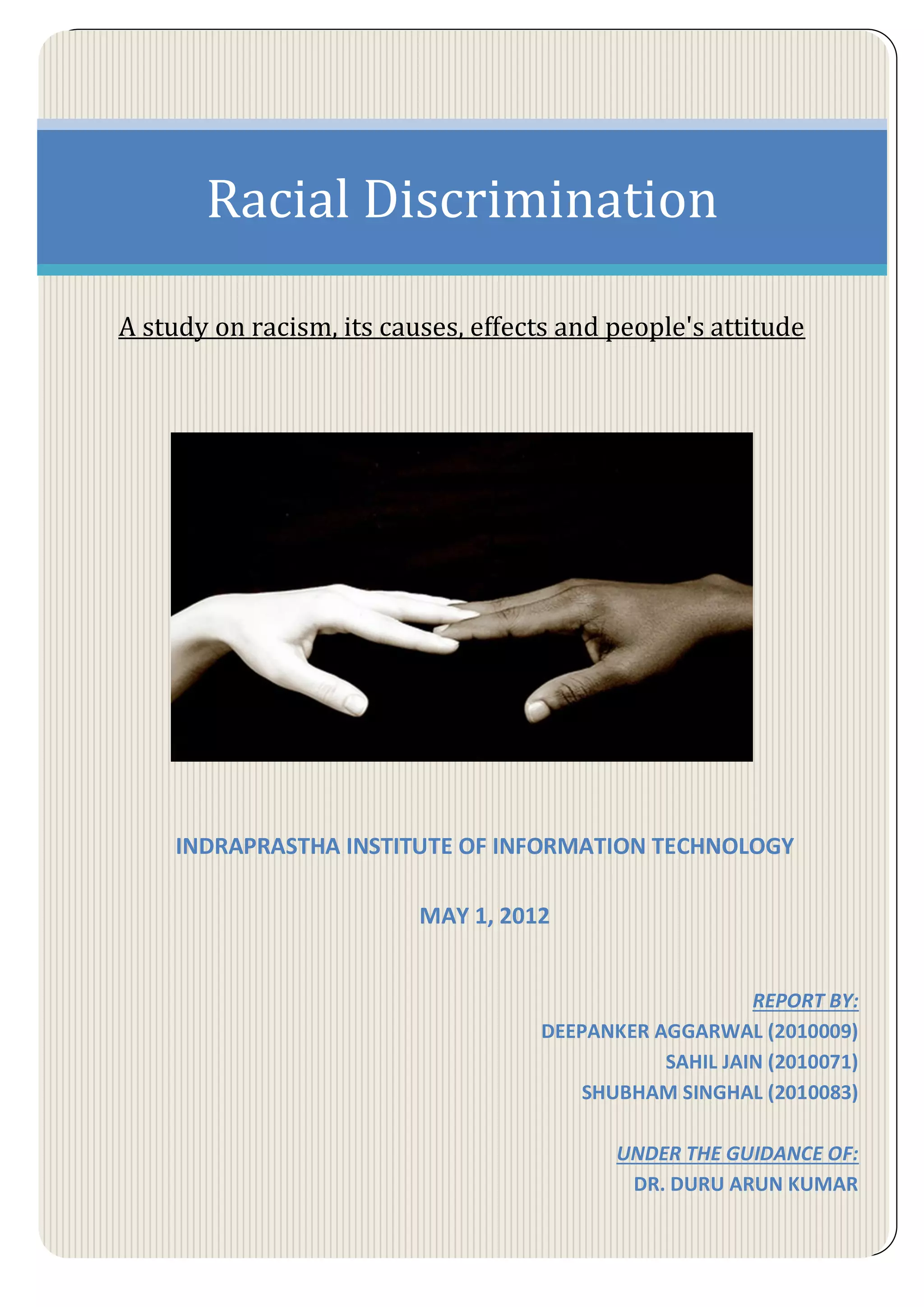
Racial Discrimination
A study on racism, its causes, effects and people's attitude
INDRAPRASTHA INSTITUTE OF INFORMATION TECHNOLOGY
MAY 1, 2012
REPORT BY:
DEEPANKER AGGARWAL (2010009)
SAHIL JAIN (2010071)
SHUBHAM SINGHAL (2010083)
UNDER THE GUIDANCE OF:
DR. DURU ARUN KUMAR
Introduction
We always feel that a society based on the values of freedom and equality will
not be deeply affected by racial conflict, but let us analyse the following
situations:
 When Hurricane Katrina struck New Orleans and the Gulf Coast in 2006,
hundreds lost their lives, thousands of people were displaced, and billions
of dollars property was destroyed. Although the hurricane affected the
lives (and death) of many, African Americans- many of them poor- were
disproportionately left homeless and killed. Millions of Americans were
shocked by the images in the media of poor people desperate to survive but
left without help for a long time. Since Katrina, many have asked if one
reason the government was so ineffective in its response was because so
many of the victims of the storm were Black.
 Eight days after the horrific, catastrophic September 11, 2011 terrorist
attacks on New York City’s now destroyed World Trade Centre and the
Pentagon, a white man killed a gas station owner because he wore a turban.
The man was a Sikh and had no known connection with the terrorists, but
he had dark skin and wore a turban.
These ugly incidents have one thing in common- race. Along with gender and class,
race has is an integral part of social institutions. In everyday interaction, race
still matter and matters a lot.
Different people define race differently, so different people define racism
differently. First of all, let us define the term ‘race’- a large group of people
distinguished from others on the basis of a common heritage or on the basis of
common physical characteristics, such as skin colour or hair type.
Race and Racism
(How we define these terms?)
A race is a socially constructed category of people who share biologically
transmitted traits that members of a society consider important. Although we
think of race in terms of biological elements, race is a socially constructed
concept. It is true that human beings differ in any number of ways involving
physical traits, but a “race” comes into being only when the members of a society
decide that some physical trait (such as skin colour or eye shape)
actually matters .
Racism is a powerful and harmful form of prejudice, racism is the belief
that one racial category is innately superior or inferior to another. Racism has
existed throughout world history. Despite their many achievements, the ancient
Greeks, the peoples of India, and the Chinese all regarded people unlike
themselves as inferior.
History: Caste and Race in India
Various sources confirm that Caste discrimination is a product of ancient India.
Cambridge Encyclopaedia Vol.13 defines Caste in India as a “theoretical construct
of the Brahmin scholars to describe and categorise (Varna) the complex social
arrangement of which they were themselves a part.”
Varna was the theoretical construct of Brahmin, the masters of Indian racism.
True there were Brahmin scholars in the traditional India, but they were not
racists. However some ‘Brahmins’ who created ‘varna’ can best be described are
colonial settlers who migrated to India during the post- Indus period. Brahmins
considered themselves as the purest form of human and treated others as lower
class.
Several Brahminical texts are available indicating long history of caste system in
India. Manu, the spokesperson for the racist varnas, did not leave anything for
imagination when he defined Jathi. According to him Jathi is varna or race. In
his book ‘Manu Samhitha’ he classified Indians mainly into five Jathis; Brahmin,
kshathriya, vaisya, Shudra and the fifth ‘samkara’ or mixed Jathi that came out
of the inter-jathi relations. When the fifth jathi got further mixed among them
or with the pure jathis it resulted in the more proliferation of the jathis.
Colonial Britain came to an India devastated under Brahmin racism and a bout of
tyrannical Muslim invasion. Instead, it joined rank with the oppressors to full fill
its own colonial ambitions through forging a mutually beneficial socio-racist-
political order which further discriminated them. Applications of Britain’s racial
’science’ on India was more crucial than anybody would think, for its ultimate
purpose was to define India and its ancient civilization in terms of its own
national, religious and economic interest by making India dispossessed of its
history, ethnicity and tradition. In the 1901 Census, the people were asked to
slot themselves, or were slotted by enumerators, as members of the specific
castes of Brahmin, Khsthriya, Vaishya ,Shudra etc .”
That was Britain’s biggest contribution to the racism of India. Hence, as some
sociologists believe, the caste system present in India, mixed with the newly born
racial discrimination, was brought by the British during 18th century.
Causes of Racism
We are not sure of the exact cause of racism. There are many reasons. Social
scientists speculate about the causes. A few things that may contribute to
racism and racially motivated violence appear below:
 Xenophobia, the fear of people who are different. An element of
xenophobia is present in racism. There are many people who still look down
upon the Black and fear them.
 A need to feel OK, to feel worthwhile. This can result in people wanting to
feel superior to others. This was one of the main reasons of Apartheid.
 Social and political domination of one group over the other.
 Racism is used by governments to excuse systemic and systematic
oppression and human rights abuses.
 Promotion of the idea that attempts to end discrimination and inequality
are reverse discrimination and reverse racism. The same has happened in
India in the case of reservation of jobs and admission to institutions for
the Schedule Caste and the Schedule Tribe.
 Ignorance of other cultures, religions, and values.
 Fear of sharing power with other groups of people.
 Laws and government policies aimed at preventing immigration of people of
different cultures and religions. The name Khan is always hated at airports
in the Europe and America.
There is no escaping Racism in India
(A case study of some incidents)
India is always a mystery, a country which is so huge that practices from Kashmir
to Kanyakumari. Each state is like a different country with diverse languages,
cuisines, clothes, customs, climate. Punjabis are closer in terms of their food and
language to Pakistanis than to Tamils. All these differences made people fairly
suspicious of those who were not like them. And ‘people like us’ closed ranks and
bonded. These closed communities are naturally full of prejudices towards the
other, the outsider. Every state considers itself superior. We stereotype each
other mercilessly and there are jokes galore about food, clothes and accents
(how residents of each state speak English, actually!).
 There’s a huge North-South divide too. There’s another side to us though.
As migration takes place, across state borders within India, a kind of
xenophobia begins. In Mumbai in the 1960s, Maharashtrians drove out
south Indians, Madrasis, they called them, with a claim that they were
stealing their jobs.
 Recently, the same paranoid party called for North Indians to be thrown
out. Many poor, migrant Biharis were beaten up, attacked and threatened
as they went about their daily grind, often working for a pittance.
 In Bangalore there are rumblings of resentment over north Indian techies
who have flooded the city with their loud, noisy, in-your-face manners.
South Indians are relatively quiet, stand in queues and can’t understand the
chaos of a northern railway station.
 In Bangalore a bunch of Nigerians were picked up for drug peddling. The
hostility is because of this perhaps. But there’s no getting away from
Indian racism.
 Students from North East India are mostly dubbed ‘chinky’. People ask
them if they are Japanese, Chinese or Korean. There is total ignorance in
most parts of India about the culture, indeed about anything North
Eastern.
 Men all over India drool over porn at their home computers and in internet
cafes around the country. So it could be dangerous for a white, blonde
woman to walk alone at night, too many men have been fantasizing about
her. They stereotype white women as easy.
 Indians rarely perceive beauty in black or far-eastern women. In fact, most
Indians look for pale-skinned brides for their sons. Bridal ads ask for ‘fair
skinned’ girls. So skin colour is important and you can’t be beautiful if you
are not fair.
Effects of Racial Discrimination
 Racism, in most cases, results in the hatred of each individual of the
subjected race, which could lead to discrimination and hate crimes.
 Racism, in its most frequently used term, is created when people dislike a
certain characteristic attributed to a significant amount of individuals of a
certain race, yet, would dislike the *race* itself and not just the individuals
possessing subjected characteristic. Thus, when the characteristics are
used to define each individuals of that race, *racial stereotyping* is born.
 As a result, people would avoid individuals of that race in attempt to avoid
the stereotypes, which leads to discrimination.
 Also, hate is a negative emotion that generates anger. Anger leads to
violence, and violence is a crime. Thus, when people commit crimes against
someone of the subjected race because they attempt to 'combat' the
stereotypes they dislike, chances are, they'd get charged for a hate crime.
 For example, if I stereotyped race A as thieves, and I killed someone of
race A because I hated *them,* (note how I, by using the word 'them,'
considered the group and not the individual,) for stealing, even if the
individual I killed didn't steal, I'd get charged with a hate crime because
my case was motivated by race.
 Racism also results in segregation. Fear of certain racial stereotypes also
forces some people to isolate from another group. Isolation can also lead to
discrimination.
 Discrimination could deny people of certain groups opportunities based on
race and racial stereotypes alone. Those are the effects of racism.
Survey Analysis
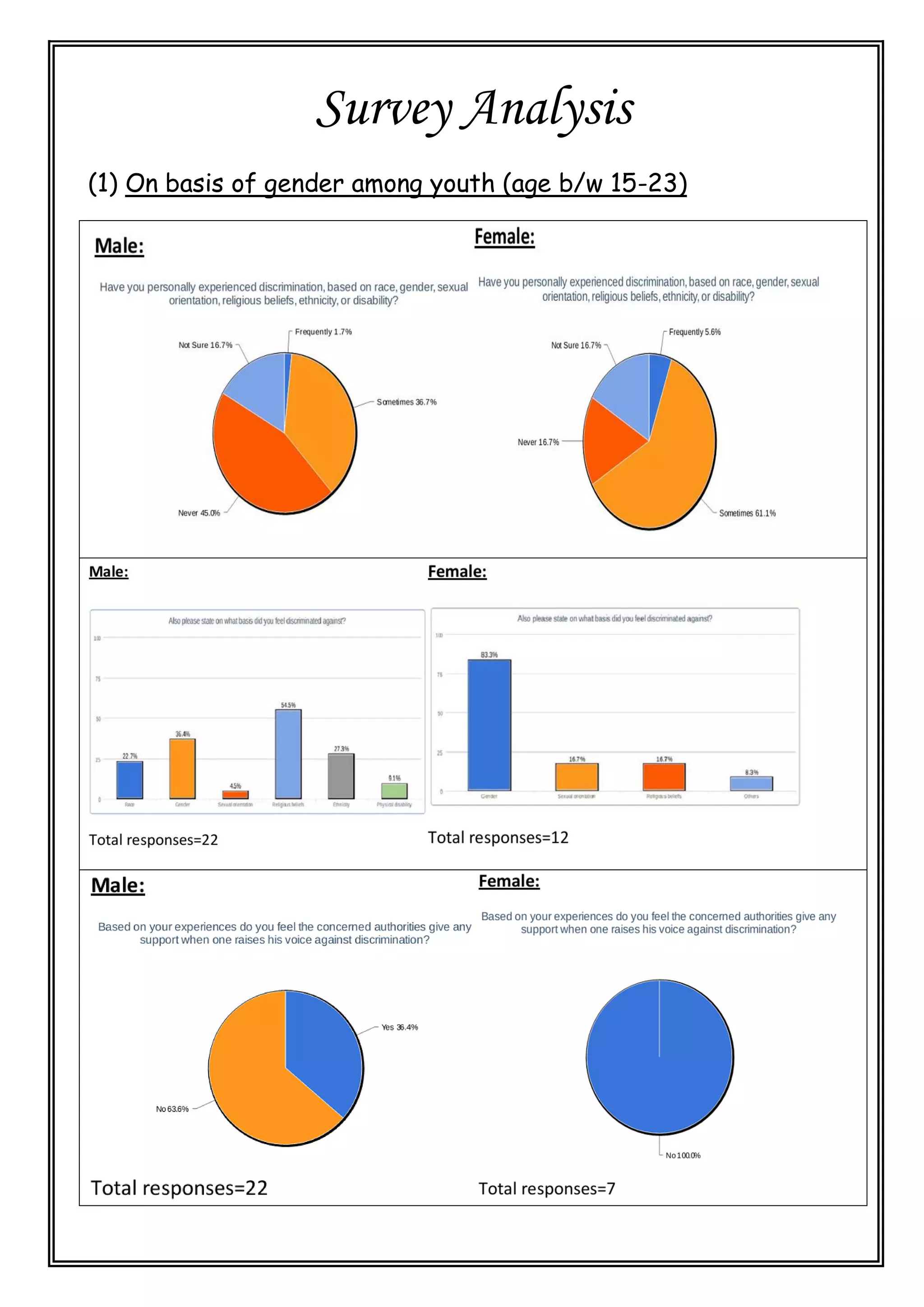
(1) On basis of gender among youth (age b/w 15-23)
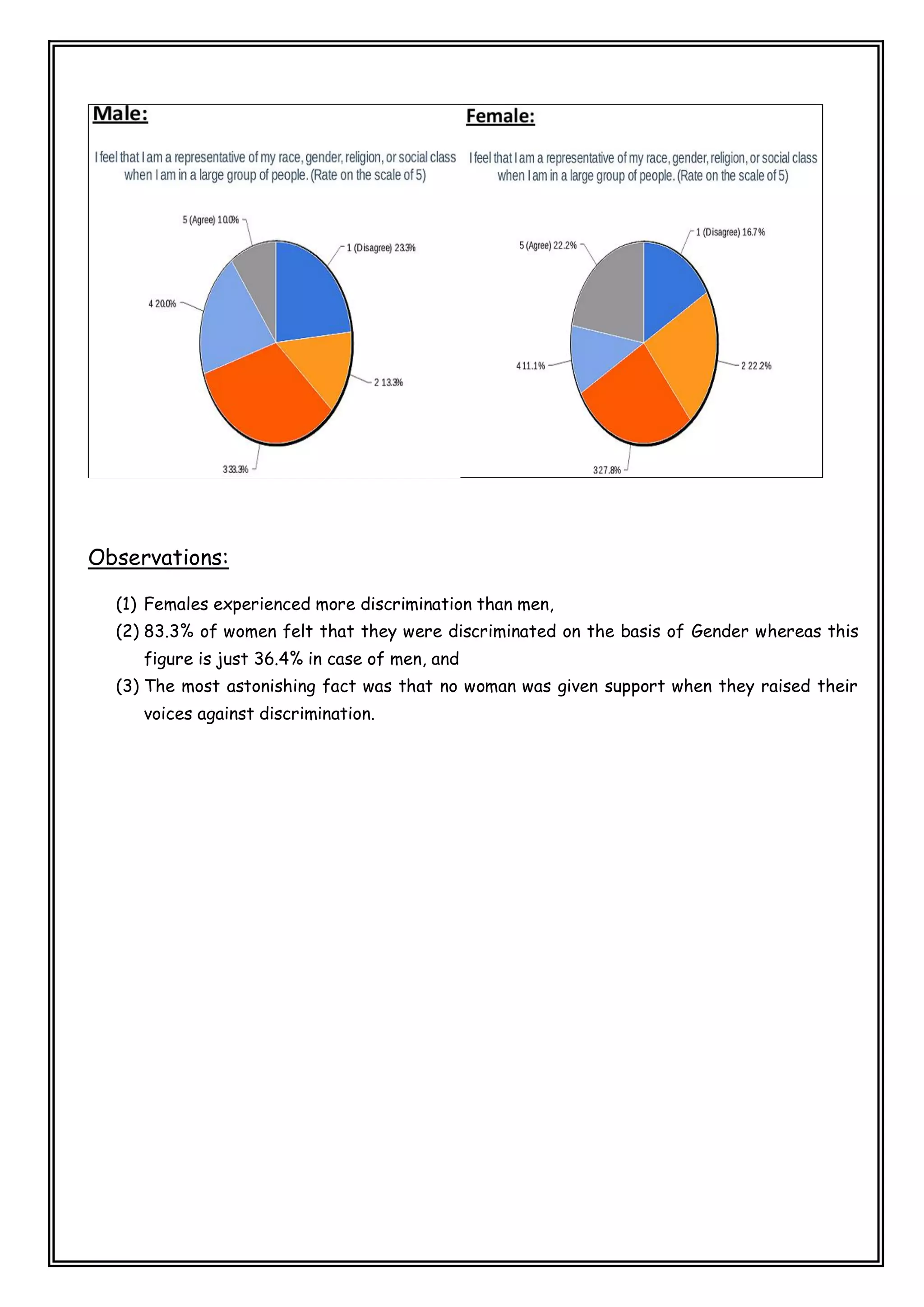
Observations:
(1) Females experienced more discrimination than men,
(2) 83.3% of women felt that they were discriminated on the basis of Gender whereas this
figure is just 36.4% in case of men, and
(3) The most astonishing fact was that no woman was given support when they raised their
voices against discrimination.
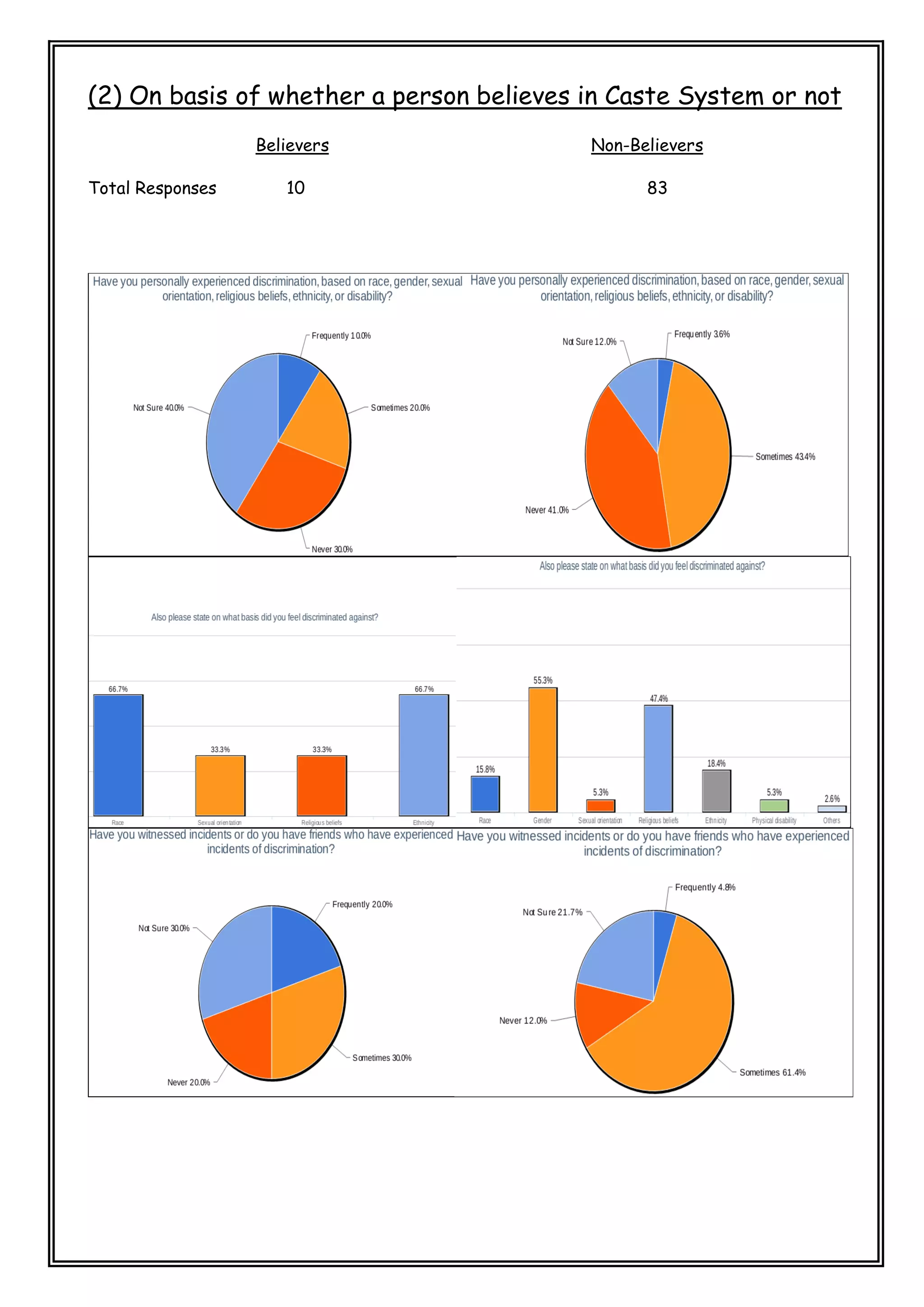
(2) On basis of whether a person believes in Caste System or not
Believers Non-Believers
Total Responses 10 83
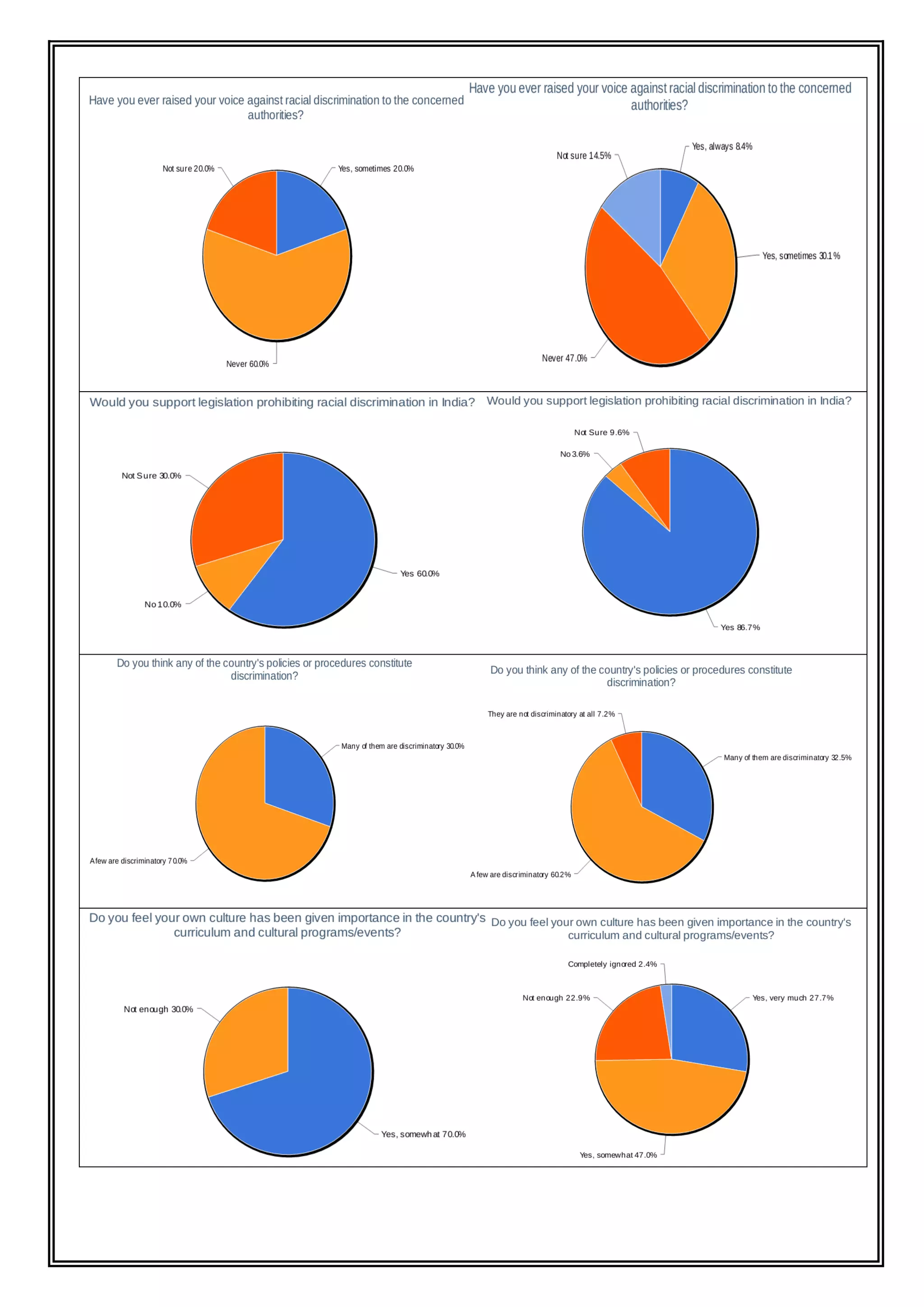
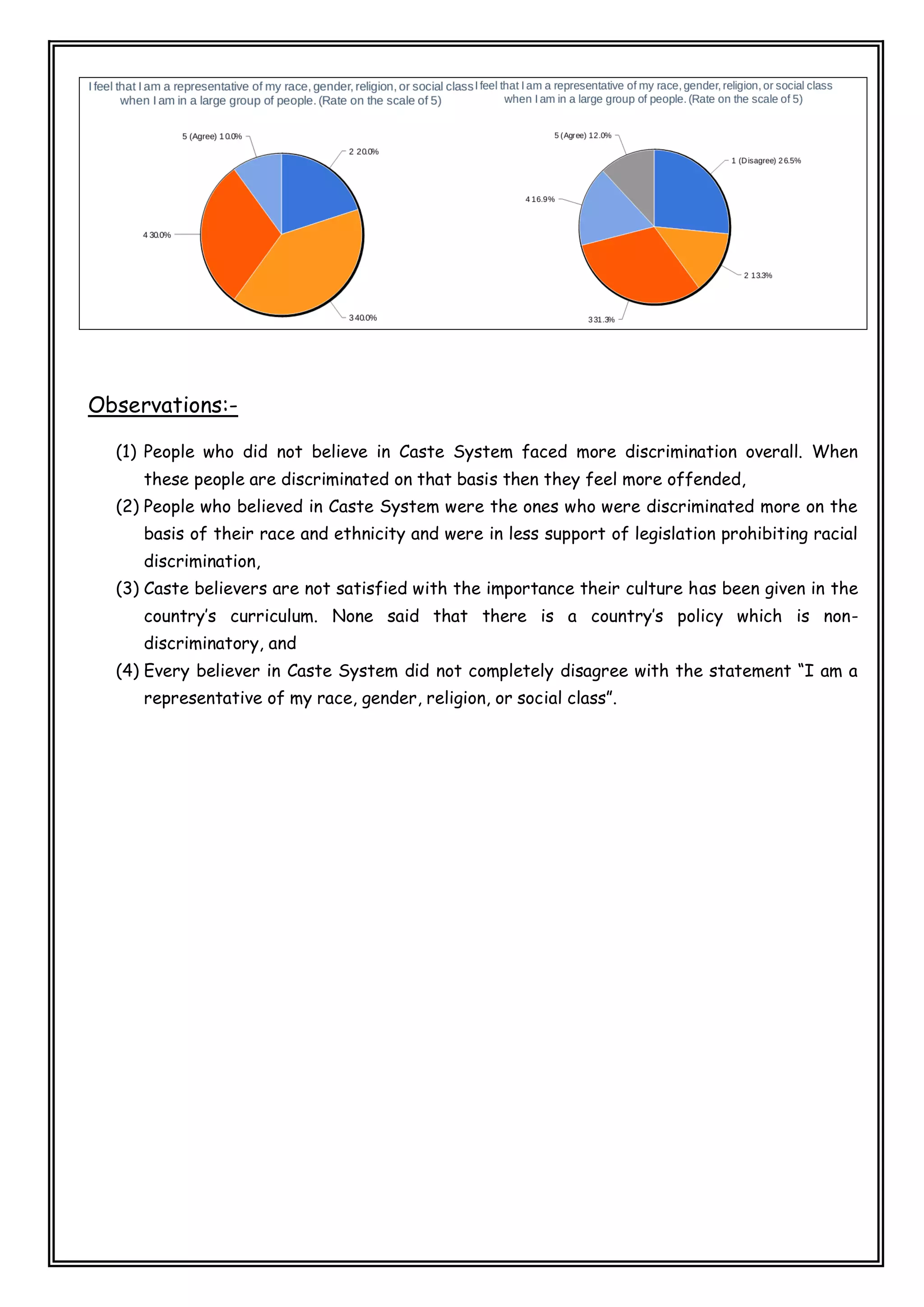
Observations:-
(1) People who did not believe in Caste System faced more discrimination overall. When
these people are discriminated on that basis then they feel more offended,
(2) People who believed in Caste System were the ones who were discriminated more on the
basis of their race and ethnicity and were in less support of legislation prohibiting racial
discrimination,
(3) Caste believers are not satisfied with the importance their culture has been given in the
country’s curriculum. None said that there is a country’s policy which is non-
discriminatory, and
(4) Every believer in Caste System did not completely disagree with the statement “I am a
representative of my race, gender, religion, or social class”.
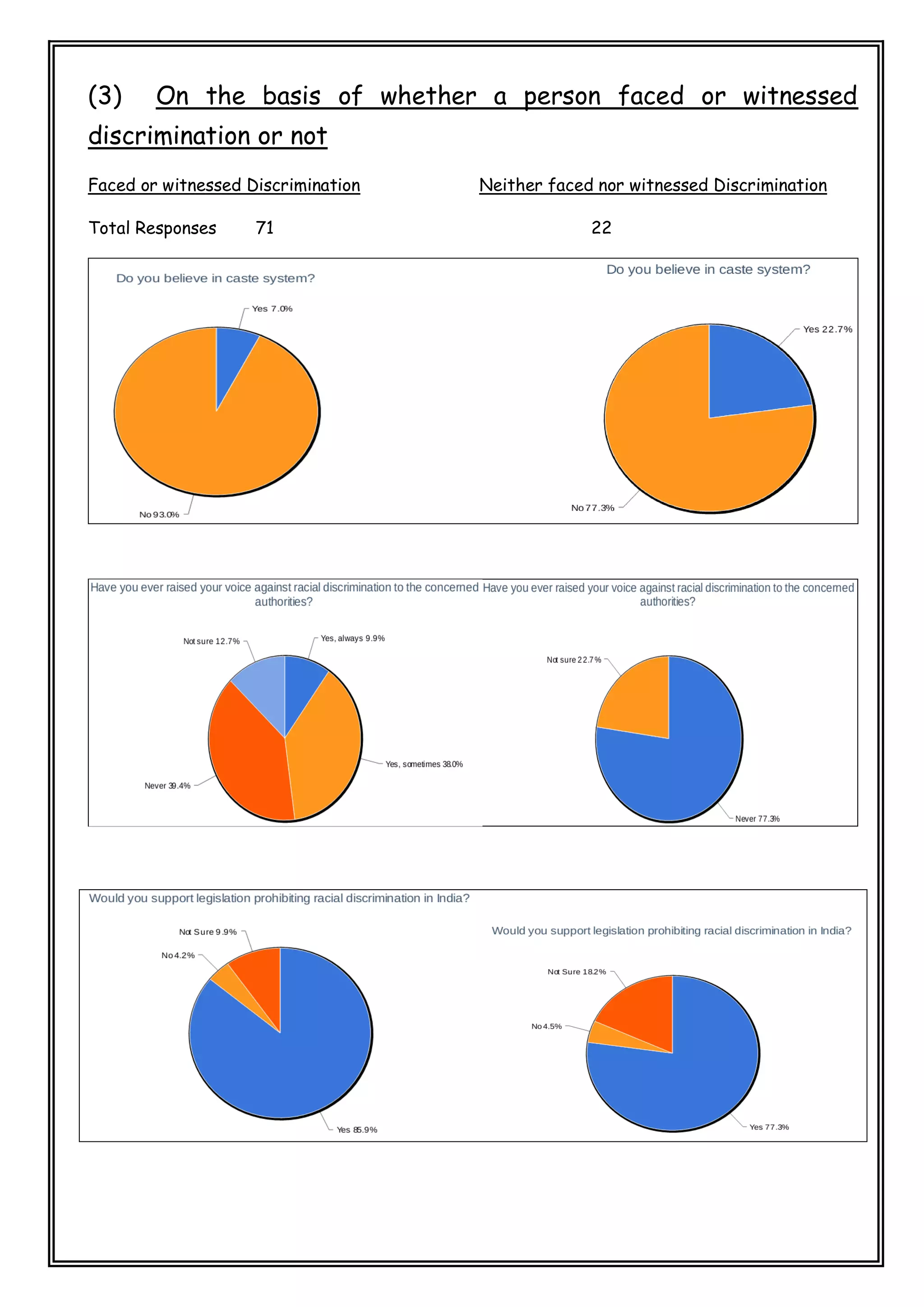
(3) On the basis of whether a person faced or witnessed
discrimination or not
Faced or witnessed Discrimination Neither faced nor witnessed Discrimination
Total Responses 71 22
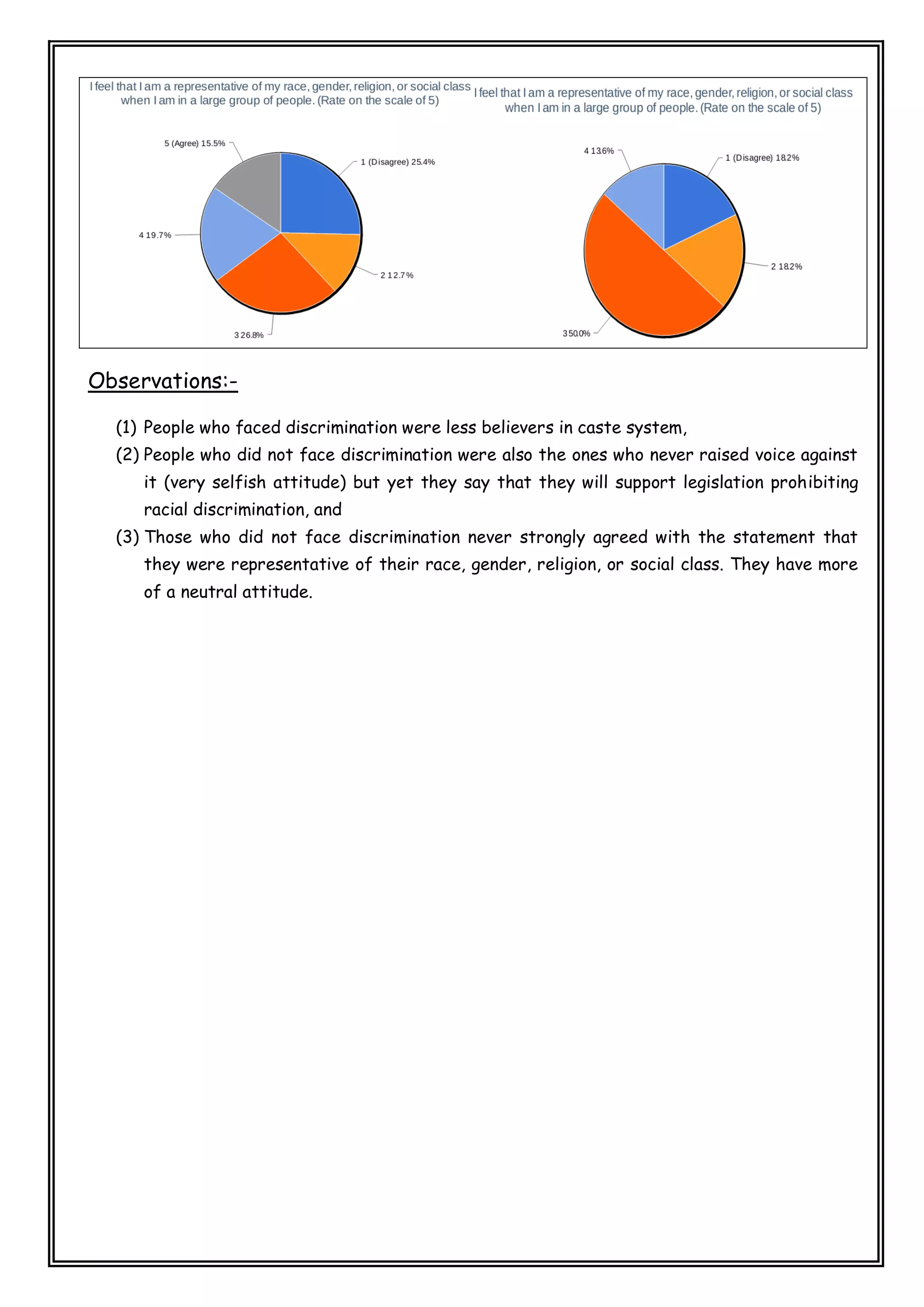
Observations:-
(1) People who faced discrimination were less believers in caste system,
(2) People who did not face discrimination were also the ones who never raised voice against
it (very selfish attitude) but yet they say that they will support legislation prohibiting
racial discrimination, and
(3) Those who did not face discrimination never strongly agreed with the statement that
they were representative of their race, gender, religion, or social class. They have more
of a neutral attitude.
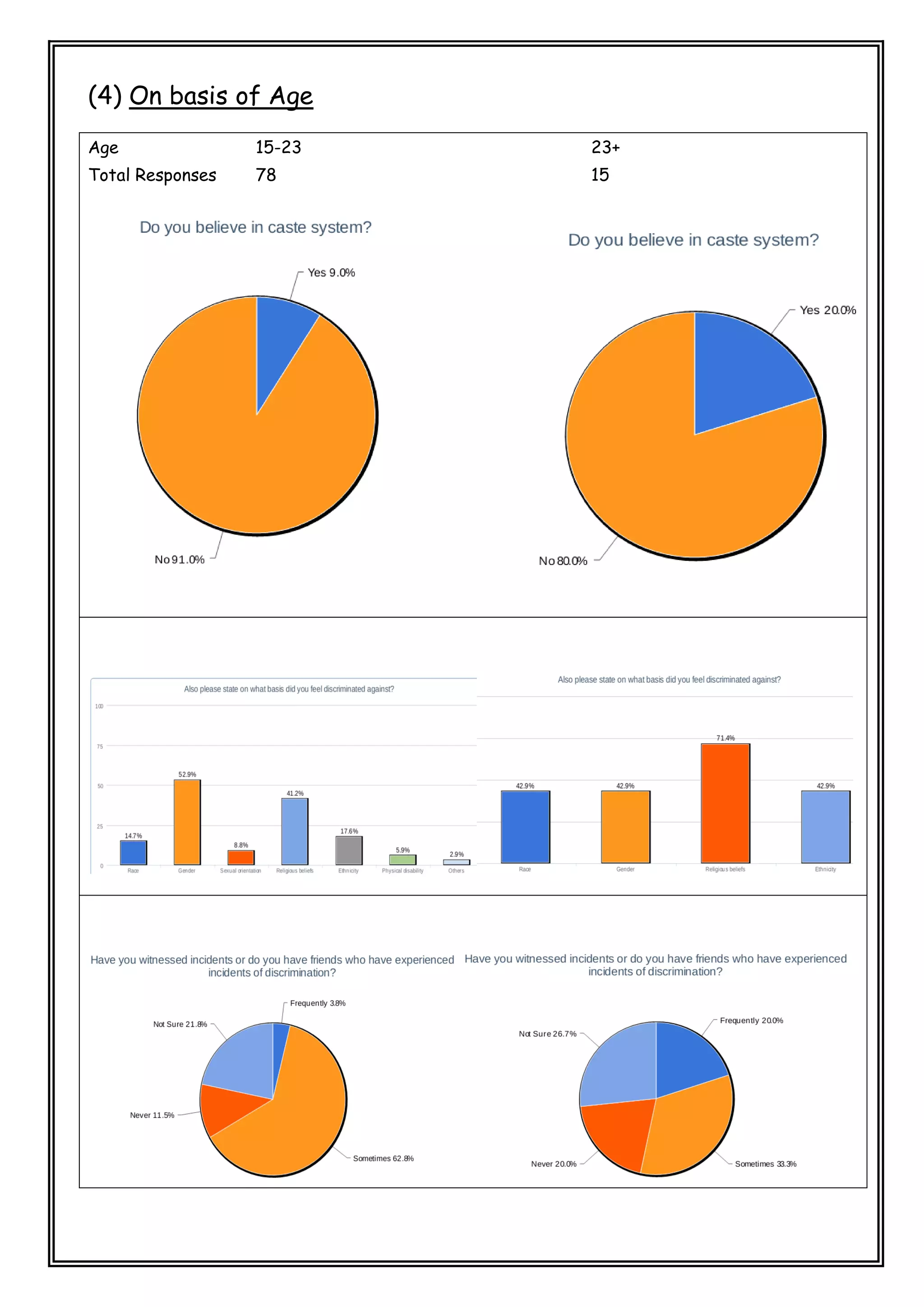
(4) On basis of Age
Age 15-23 23+
Total Responses 78 15
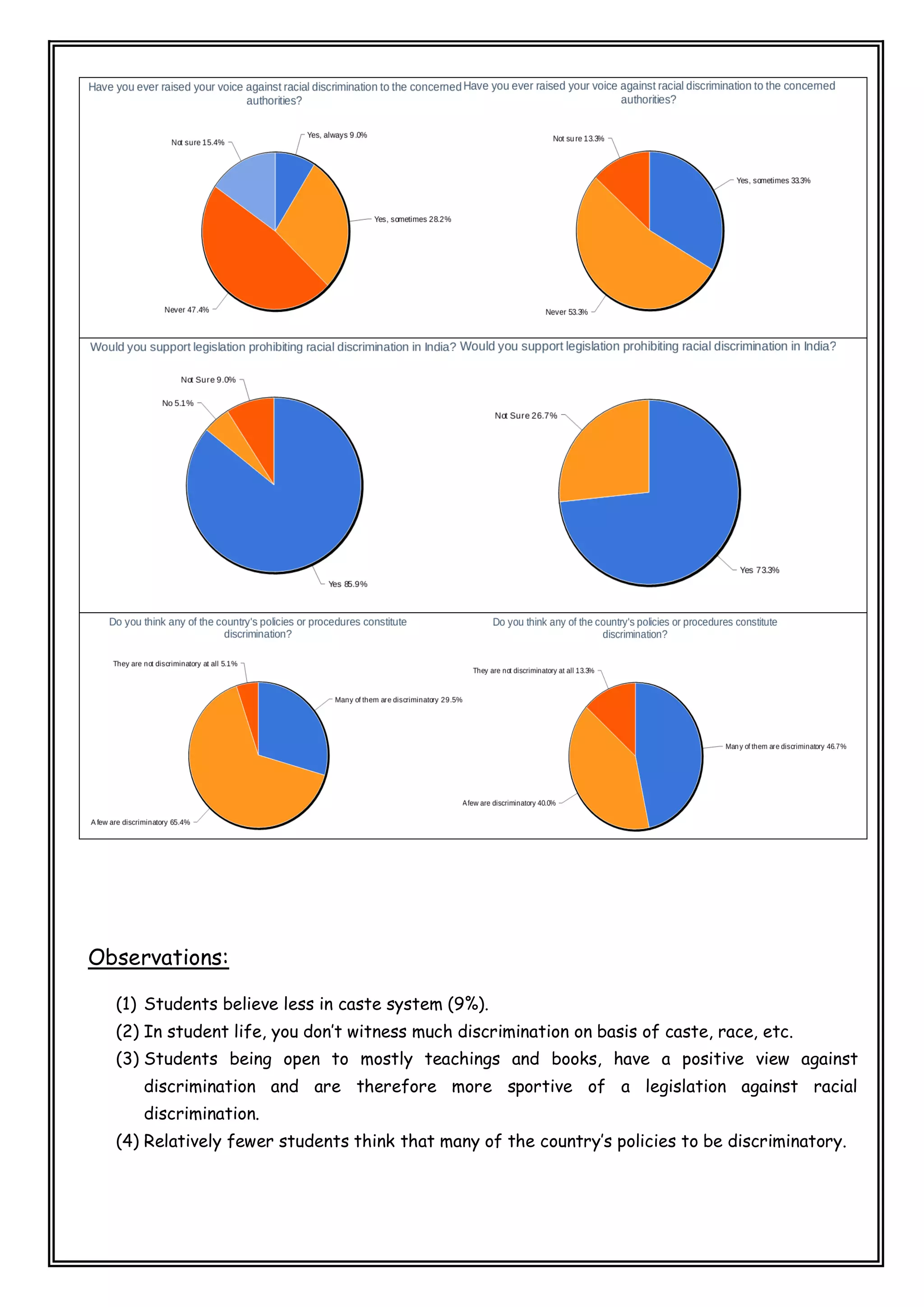
Observations:
(1) Students believe less in caste system (9%).
(2) In student life, you don’t witness much discrimination on basis of caste, race, etc.
(3) Students being open to mostly teachings and books, have a positive view against
discrimination and are therefore more sportive of a legislation against racial
discrimination.
(4) Relatively fewer students think that many of the country’s policies to be discriminatory.

Racial Discrimination

  • 1.
    Racial Discrimination A studyon racism, its causes, effects and people's attitude INDRAPRASTHA INSTITUTE OF INFORMATION TECHNOLOGY MAY 1, 2012 REPORT BY: DEEPANKER AGGARWAL (2010009) SAHIL JAIN (2010071) SHUBHAM SINGHAL (2010083) UNDER THE GUIDANCE OF: DR. DURU ARUN KUMAR
  • 2.
    Introduction We always feelthat a society based on the values of freedom and equality will not be deeply affected by racial conflict, but let us analyse the following situations:  When Hurricane Katrina struck New Orleans and the Gulf Coast in 2006, hundreds lost their lives, thousands of people were displaced, and billions of dollars property was destroyed. Although the hurricane affected the lives (and death) of many, African Americans- many of them poor- were disproportionately left homeless and killed. Millions of Americans were shocked by the images in the media of poor people desperate to survive but left without help for a long time. Since Katrina, many have asked if one reason the government was so ineffective in its response was because so many of the victims of the storm were Black.  Eight days after the horrific, catastrophic September 11, 2011 terrorist attacks on New York City’s now destroyed World Trade Centre and the Pentagon, a white man killed a gas station owner because he wore a turban. The man was a Sikh and had no known connection with the terrorists, but he had dark skin and wore a turban. These ugly incidents have one thing in common- race. Along with gender and class, race has is an integral part of social institutions. In everyday interaction, race still matter and matters a lot. Different people define race differently, so different people define racism differently. First of all, let us define the term ‘race’- a large group of people distinguished from others on the basis of a common heritage or on the basis of common physical characteristics, such as skin colour or hair type.
  • 3.
    Race and Racism (Howwe define these terms?) A race is a socially constructed category of people who share biologically transmitted traits that members of a society consider important. Although we think of race in terms of biological elements, race is a socially constructed concept. It is true that human beings differ in any number of ways involving physical traits, but a “race” comes into being only when the members of a society decide that some physical trait (such as skin colour or eye shape) actually matters . Racism is a powerful and harmful form of prejudice, racism is the belief that one racial category is innately superior or inferior to another. Racism has existed throughout world history. Despite their many achievements, the ancient Greeks, the peoples of India, and the Chinese all regarded people unlike themselves as inferior.
  • 4.
    History: Caste andRace in India Various sources confirm that Caste discrimination is a product of ancient India. Cambridge Encyclopaedia Vol.13 defines Caste in India as a “theoretical construct of the Brahmin scholars to describe and categorise (Varna) the complex social arrangement of which they were themselves a part.” Varna was the theoretical construct of Brahmin, the masters of Indian racism. True there were Brahmin scholars in the traditional India, but they were not racists. However some ‘Brahmins’ who created ‘varna’ can best be described are colonial settlers who migrated to India during the post- Indus period. Brahmins considered themselves as the purest form of human and treated others as lower class. Several Brahminical texts are available indicating long history of caste system in India. Manu, the spokesperson for the racist varnas, did not leave anything for imagination when he defined Jathi. According to him Jathi is varna or race. In his book ‘Manu Samhitha’ he classified Indians mainly into five Jathis; Brahmin, kshathriya, vaisya, Shudra and the fifth ‘samkara’ or mixed Jathi that came out of the inter-jathi relations. When the fifth jathi got further mixed among them or with the pure jathis it resulted in the more proliferation of the jathis. Colonial Britain came to an India devastated under Brahmin racism and a bout of tyrannical Muslim invasion. Instead, it joined rank with the oppressors to full fill its own colonial ambitions through forging a mutually beneficial socio-racist- political order which further discriminated them. Applications of Britain’s racial ’science’ on India was more crucial than anybody would think, for its ultimate purpose was to define India and its ancient civilization in terms of its own national, religious and economic interest by making India dispossessed of its history, ethnicity and tradition. In the 1901 Census, the people were asked to slot themselves, or were slotted by enumerators, as members of the specific castes of Brahmin, Khsthriya, Vaishya ,Shudra etc .” That was Britain’s biggest contribution to the racism of India. Hence, as some sociologists believe, the caste system present in India, mixed with the newly born racial discrimination, was brought by the British during 18th century.
  • 5.
    Causes of Racism Weare not sure of the exact cause of racism. There are many reasons. Social scientists speculate about the causes. A few things that may contribute to racism and racially motivated violence appear below:  Xenophobia, the fear of people who are different. An element of xenophobia is present in racism. There are many people who still look down upon the Black and fear them.  A need to feel OK, to feel worthwhile. This can result in people wanting to feel superior to others. This was one of the main reasons of Apartheid.  Social and political domination of one group over the other.  Racism is used by governments to excuse systemic and systematic oppression and human rights abuses.  Promotion of the idea that attempts to end discrimination and inequality are reverse discrimination and reverse racism. The same has happened in India in the case of reservation of jobs and admission to institutions for the Schedule Caste and the Schedule Tribe.  Ignorance of other cultures, religions, and values.  Fear of sharing power with other groups of people.  Laws and government policies aimed at preventing immigration of people of different cultures and religions. The name Khan is always hated at airports in the Europe and America.
  • 6.
    There is noescaping Racism in India (A case study of some incidents) India is always a mystery, a country which is so huge that practices from Kashmir to Kanyakumari. Each state is like a different country with diverse languages, cuisines, clothes, customs, climate. Punjabis are closer in terms of their food and language to Pakistanis than to Tamils. All these differences made people fairly suspicious of those who were not like them. And ‘people like us’ closed ranks and bonded. These closed communities are naturally full of prejudices towards the other, the outsider. Every state considers itself superior. We stereotype each other mercilessly and there are jokes galore about food, clothes and accents (how residents of each state speak English, actually!).  There’s a huge North-South divide too. There’s another side to us though. As migration takes place, across state borders within India, a kind of xenophobia begins. In Mumbai in the 1960s, Maharashtrians drove out south Indians, Madrasis, they called them, with a claim that they were stealing their jobs.  Recently, the same paranoid party called for North Indians to be thrown out. Many poor, migrant Biharis were beaten up, attacked and threatened as they went about their daily grind, often working for a pittance.  In Bangalore there are rumblings of resentment over north Indian techies who have flooded the city with their loud, noisy, in-your-face manners. South Indians are relatively quiet, stand in queues and can’t understand the chaos of a northern railway station.  In Bangalore a bunch of Nigerians were picked up for drug peddling. The hostility is because of this perhaps. But there’s no getting away from Indian racism.
  • 7.
     Students fromNorth East India are mostly dubbed ‘chinky’. People ask them if they are Japanese, Chinese or Korean. There is total ignorance in most parts of India about the culture, indeed about anything North Eastern.  Men all over India drool over porn at their home computers and in internet cafes around the country. So it could be dangerous for a white, blonde woman to walk alone at night, too many men have been fantasizing about her. They stereotype white women as easy.  Indians rarely perceive beauty in black or far-eastern women. In fact, most Indians look for pale-skinned brides for their sons. Bridal ads ask for ‘fair skinned’ girls. So skin colour is important and you can’t be beautiful if you are not fair.
  • 8.
    Effects of RacialDiscrimination  Racism, in most cases, results in the hatred of each individual of the subjected race, which could lead to discrimination and hate crimes.  Racism, in its most frequently used term, is created when people dislike a certain characteristic attributed to a significant amount of individuals of a certain race, yet, would dislike the *race* itself and not just the individuals possessing subjected characteristic. Thus, when the characteristics are used to define each individuals of that race, *racial stereotyping* is born.  As a result, people would avoid individuals of that race in attempt to avoid the stereotypes, which leads to discrimination.  Also, hate is a negative emotion that generates anger. Anger leads to violence, and violence is a crime. Thus, when people commit crimes against someone of the subjected race because they attempt to 'combat' the stereotypes they dislike, chances are, they'd get charged for a hate crime.  For example, if I stereotyped race A as thieves, and I killed someone of race A because I hated *them,* (note how I, by using the word 'them,' considered the group and not the individual,) for stealing, even if the individual I killed didn't steal, I'd get charged with a hate crime because my case was motivated by race.  Racism also results in segregation. Fear of certain racial stereotypes also forces some people to isolate from another group. Isolation can also lead to discrimination.  Discrimination could deny people of certain groups opportunities based on race and racial stereotypes alone. Those are the effects of racism.
  • 9.
    Survey Analysis (1) Onbasis of gender among youth (age b/w 15-23)
  • 10.
    Observations: (1) Females experiencedmore discrimination than men, (2) 83.3% of women felt that they were discriminated on the basis of Gender whereas this figure is just 36.4% in case of men, and (3) The most astonishing fact was that no woman was given support when they raised their voices against discrimination.
  • 11.
    (2) On basisof whether a person believes in Caste System or not Believers Non-Believers Total Responses 10 83
  • 13.
    Observations:- (1) People whodid not believe in Caste System faced more discrimination overall. When these people are discriminated on that basis then they feel more offended, (2) People who believed in Caste System were the ones who were discriminated more on the basis of their race and ethnicity and were in less support of legislation prohibiting racial discrimination, (3) Caste believers are not satisfied with the importance their culture has been given in the country’s curriculum. None said that there is a country’s policy which is non- discriminatory, and (4) Every believer in Caste System did not completely disagree with the statement “I am a representative of my race, gender, religion, or social class”.
  • 14.
    (3) On thebasis of whether a person faced or witnessed discrimination or not Faced or witnessed Discrimination Neither faced nor witnessed Discrimination Total Responses 71 22
  • 15.
    Observations:- (1) People whofaced discrimination were less believers in caste system, (2) People who did not face discrimination were also the ones who never raised voice against it (very selfish attitude) but yet they say that they will support legislation prohibiting racial discrimination, and (3) Those who did not face discrimination never strongly agreed with the statement that they were representative of their race, gender, religion, or social class. They have more of a neutral attitude.
  • 16.
    (4) On basisof Age Age 15-23 23+ Total Responses 78 15
  • 17.
    Observations: (1) Students believeless in caste system (9%). (2) In student life, you don’t witness much discrimination on basis of caste, race, etc. (3) Students being open to mostly teachings and books, have a positive view against discrimination and are therefore more sportive of a legislation against racial discrimination. (4) Relatively fewer students think that many of the country’s policies to be discriminatory.