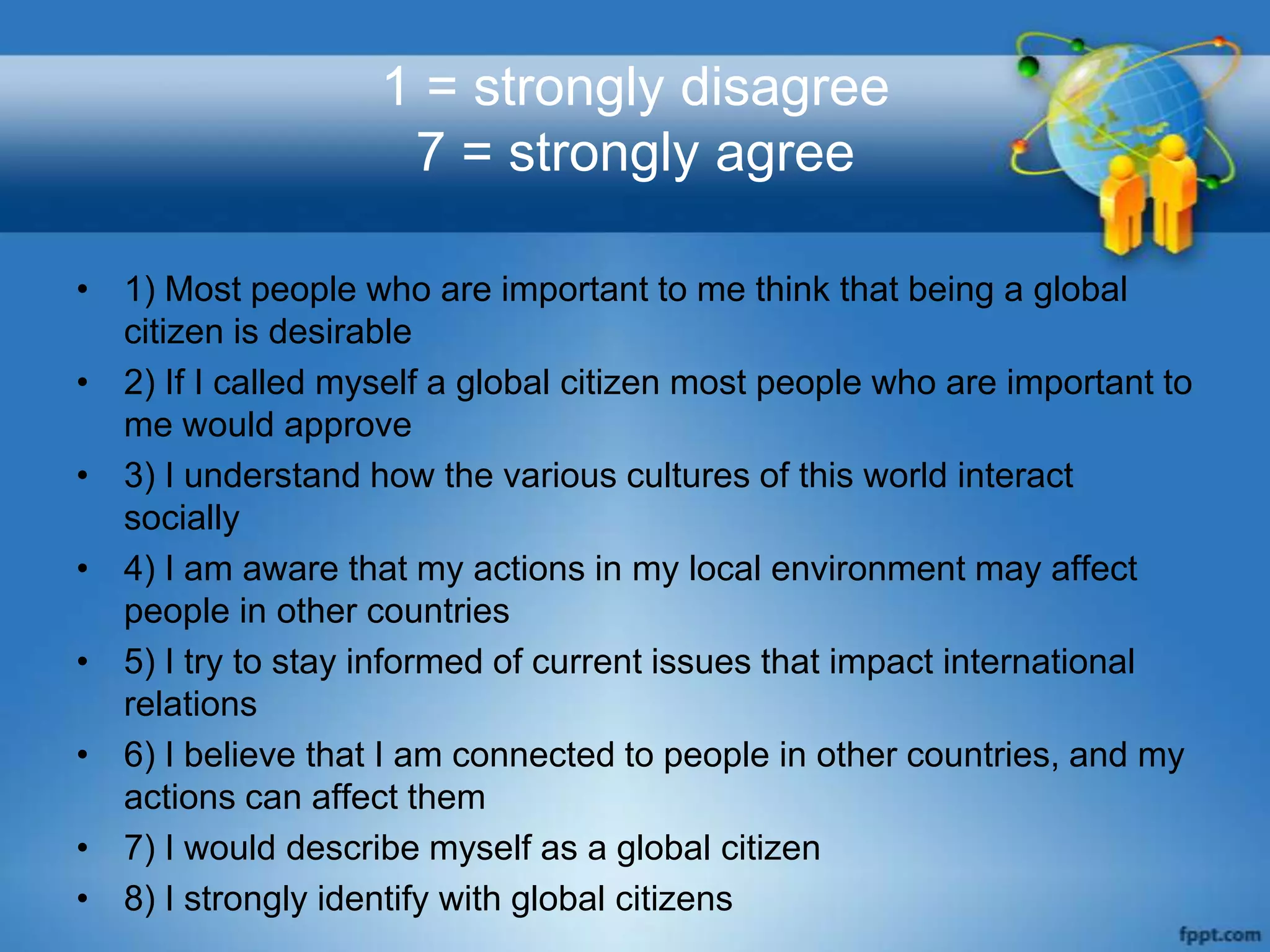
1 = strongly disagree
                    7 = strongly agree

• 1) Most people who are important to me think that being a global
  citizen is desirable
• 2) If I called myself a global citizen most people who are important to
  me would approve
• 3) I understand how the various cultures of this world interact
  socially
• 4) I am aware that my actions in my local environment may affect
  people in other countries
• 5) I try to stay informed of current issues that impact international
  relations
• 6) I believe that I am connected to people in other countries, and my
  actions can affect them
• 7) I would describe myself as a global citizen
• 8) I strongly identify with global citizens
1 = strongly disagree
                   7 = strongly agree

• 9) I am able to empathize with people from other countries
• 10) It is easy for me to put myself in someone else’s shoes
  regardless of what country they are from
• 11) I would like to join groups that emphasize getting to
  know people from different countries
• 12) I am interested in learning about the many cultures that
  have existed in this world
• 13) Those countries that are well off should help people in
  countries who are less fortunate
• 14) Basic services such as health care, clean water, food,
  and legal assistance should be available to everyone,
  regardless of what country they live in
1 = strongly disagree
                 7 = strongly agree
• 15) People have a responsibility to conserve natural
  resources to foster a sustainable environment
• 16) Natural resources should be used primarily to provide
  for basic needs rather than material wealth
• 17) If I had the opportunity, I would help others who are in
  need regardless of their nationality
• 18) If I could, I would dedicate my life to helping others no
  matter what country they are from
• 19) Being actively involved in global issues is my
  responsibility
• 20) It is my responsibility to understand and respect cultural
  differences across the globe to the best of my abilities
Global Citizenship
Definition

• awareness, caring, and embracing cultural
  diversity while promoting social justice and
  sustainability, coupled with a sense of
  responsibility to act.
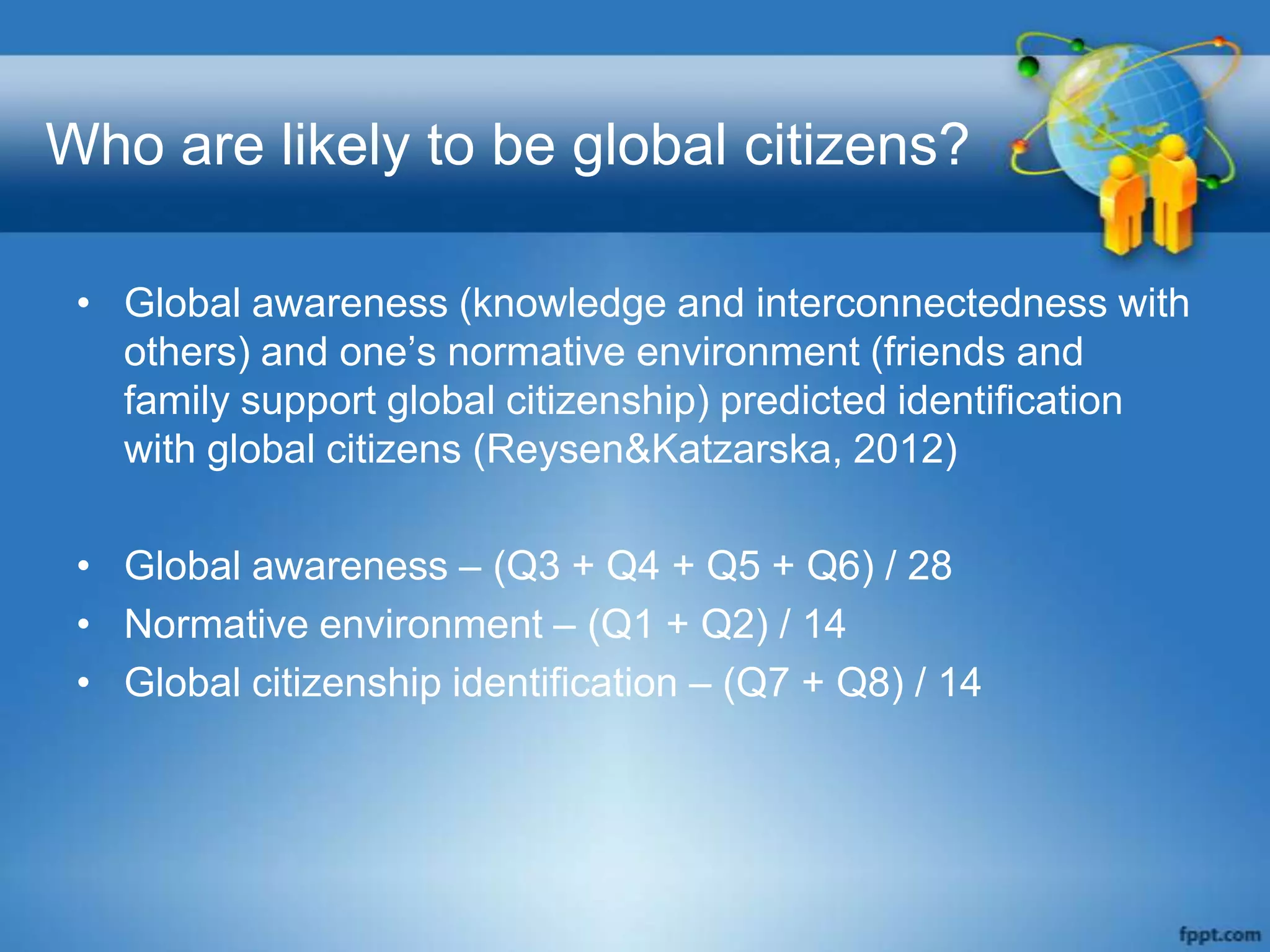
Who are likely to be global citizens?

 • Global awareness (knowledge and interconnectedness with
   others) and one’s normative environment (friends and
   family support global citizenship) predicted identification
   with global citizens (Reysen&Katzarska, 2012)

 • Global awareness – (Q3 + Q4 + Q5 + Q6) / 28
 • Normative environment – (Q1 + Q2) / 14
 • Global citizenship identification – (Q7 + Q8) / 14
In turn..

• global citizenship predicted prosocial values of intergroup
  empathy, valuing diversity, social justice, environmental
  sustainability, intergroup helping, and a felt responsibility to act
  for the betterment of the world
•   Intergroup empathy - a felt connection and concern for people outside one’s
    ingroup (Golmohamad, 2008; Oxfam, 1997). (Q9 + Q10) / 14
•   Valuing diversity - an interest in and appreciation for the diverse cultures of
    the world (Dower 2002b; Golmohamad, 2008). (Q11 + Q12) / 14
•   Social justice - attitudes concerning human rights and equitable and fair
    treatment of all humans (Dower, 2002a, 2002b; Heater, 2000). (Q13 + Q14)
    / 14
•   Environmental sustainability - the belief that humans and nature are
    connected, combined with a felt obligation to protect the natural
    environment (Heater, 2000) (Q15 + Q16) / 14
•   Intergroup helping - aid to others outside one’s group, and is enacted
    through behaviors such as donating to charity, volunteering locally, and
    working with transnational organizations to help others globally (Dower,
    2002a) (Q17 + Q18) / 14
•   Responsibility to act - an acceptance of a moral duty or obligation to act for
    the betterment of the world (Dower, 2002a, 2002b). (Q19 + Q20) / 14
Research

• When global citizen identity is salient
  (important), greater identification is related
  to adherence (support) to the group’s
  content (i.e., prosocial values and
  behaviours).
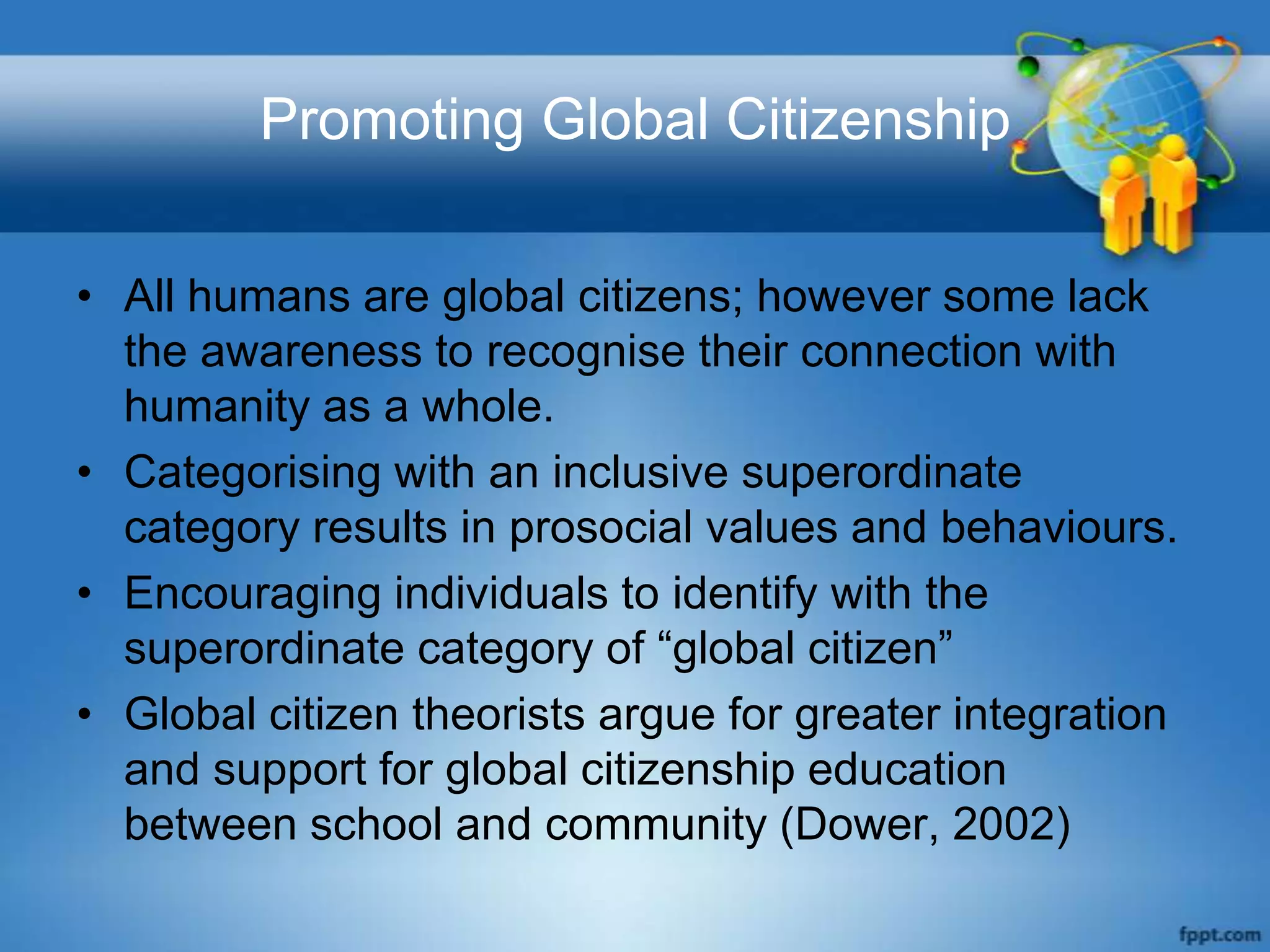
Promoting Global Citizenship

• All humans are global citizens; however some lack
  the awareness to recognise their connection with
  humanity as a whole.
• Categorising with an inclusive superordinate
  category results in prosocial values and behaviours.
• Encouraging individuals to identify with the
  superordinate category of “global citizen”
• Global citizen theorists argue for greater integration
  and support for global citizenship education
  between school and community (Dower, 2002)

12 global citizenship

  • 1.
    1 = stronglydisagree 7 = strongly agree • 1) Most people who are important to me think that being a global citizen is desirable • 2) If I called myself a global citizen most people who are important to me would approve • 3) I understand how the various cultures of this world interact socially • 4) I am aware that my actions in my local environment may affect people in other countries • 5) I try to stay informed of current issues that impact international relations • 6) I believe that I am connected to people in other countries, and my actions can affect them • 7) I would describe myself as a global citizen • 8) I strongly identify with global citizens
  • 2.
    1 = stronglydisagree 7 = strongly agree • 9) I am able to empathize with people from other countries • 10) It is easy for me to put myself in someone else’s shoes regardless of what country they are from • 11) I would like to join groups that emphasize getting to know people from different countries • 12) I am interested in learning about the many cultures that have existed in this world • 13) Those countries that are well off should help people in countries who are less fortunate • 14) Basic services such as health care, clean water, food, and legal assistance should be available to everyone, regardless of what country they live in
  • 3.
    1 = stronglydisagree 7 = strongly agree • 15) People have a responsibility to conserve natural resources to foster a sustainable environment • 16) Natural resources should be used primarily to provide for basic needs rather than material wealth • 17) If I had the opportunity, I would help others who are in need regardless of their nationality • 18) If I could, I would dedicate my life to helping others no matter what country they are from • 19) Being actively involved in global issues is my responsibility • 20) It is my responsibility to understand and respect cultural differences across the globe to the best of my abilities
  • 4.
  • 5.
    Definition • awareness, caring,and embracing cultural diversity while promoting social justice and sustainability, coupled with a sense of responsibility to act.
  • 6.
    Who are likelyto be global citizens? • Global awareness (knowledge and interconnectedness with others) and one’s normative environment (friends and family support global citizenship) predicted identification with global citizens (Reysen&Katzarska, 2012) • Global awareness – (Q3 + Q4 + Q5 + Q6) / 28 • Normative environment – (Q1 + Q2) / 14 • Global citizenship identification – (Q7 + Q8) / 14
  • 7.
    In turn.. • globalcitizenship predicted prosocial values of intergroup empathy, valuing diversity, social justice, environmental sustainability, intergroup helping, and a felt responsibility to act for the betterment of the world
  • 8.
    Intergroup empathy - a felt connection and concern for people outside one’s ingroup (Golmohamad, 2008; Oxfam, 1997). (Q9 + Q10) / 14 • Valuing diversity - an interest in and appreciation for the diverse cultures of the world (Dower 2002b; Golmohamad, 2008). (Q11 + Q12) / 14 • Social justice - attitudes concerning human rights and equitable and fair treatment of all humans (Dower, 2002a, 2002b; Heater, 2000). (Q13 + Q14) / 14 • Environmental sustainability - the belief that humans and nature are connected, combined with a felt obligation to protect the natural environment (Heater, 2000) (Q15 + Q16) / 14 • Intergroup helping - aid to others outside one’s group, and is enacted through behaviors such as donating to charity, volunteering locally, and working with transnational organizations to help others globally (Dower, 2002a) (Q17 + Q18) / 14 • Responsibility to act - an acceptance of a moral duty or obligation to act for the betterment of the world (Dower, 2002a, 2002b). (Q19 + Q20) / 14
  • 9.
    Research • When globalcitizen identity is salient (important), greater identification is related to adherence (support) to the group’s content (i.e., prosocial values and behaviours).
  • 10.
    Promoting Global Citizenship •All humans are global citizens; however some lack the awareness to recognise their connection with humanity as a whole. • Categorising with an inclusive superordinate category results in prosocial values and behaviours. • Encouraging individuals to identify with the superordinate category of “global citizen” • Global citizen theorists argue for greater integration and support for global citizenship education between school and community (Dower, 2002)