



Web APIs and Enterprise: On Agility,
                          Community and Governance.
 10.20.2005
Layer 7 Webinar April 19th 2012
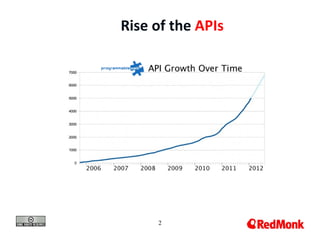
Rise of the APIs


     2
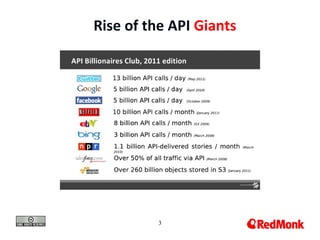
Rise of the API Giants


         3
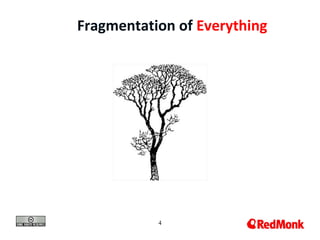
Fragmentation of Everything


           4
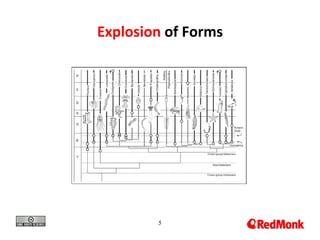
Explosion of Forms


        5
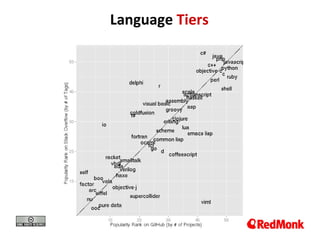
Language Tiers


      6
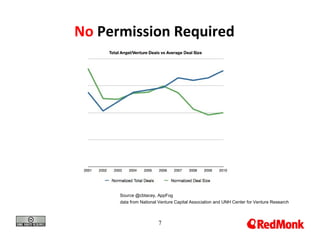
No Permission Required


      Source @cbtacey, AppFog
      data from National Venture Capital Association and UNH Center for Venture Research


                        7
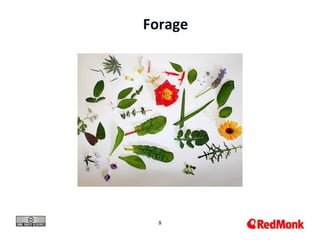
Forage


  8
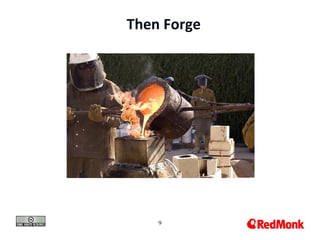
Then Forge


    9
On Quality


    10
On Engagement

• The API Economy is a social phenomenon
• Community management is not optional – invest in people
• Your people may already be good at this
• Hiring gets easier
• Web APIs set the bar for consumability
• APIs can’t build communities


                             11
On Design


• Good APIs generate great PR - early adopters as evangelists
• Bad APIs generate a ton of calls to your support organisation
• REST not SOAP (and definitely not WS-*)
• JSON not XML
• API first design encourages service modularity, enabling reuse
• Easy to Learn, Easy to Use, Easy to Extend
• Minimum Progress to Declare Victory. Avoid “Requirement Creep”


                              12
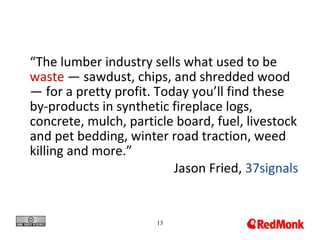
“The lumber industry sells what used to be
waste — sawdust, chips, and shredded wood
— for a pretty profit. Today you’ll find these
by-products in synthetic fireplace logs,
concrete, mulch, particle board, fuel, livestock
and pet bedding, winter road traction, weed
killing and more.”
                          Jason Fried, 37signals


                      13
Engagement with customers,
   partners, employees,
  and other stakeholders
      generates data


            14
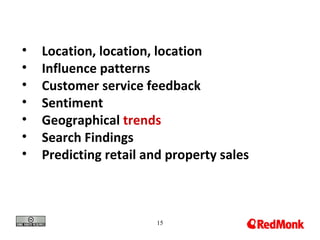
•   Location, location, location
•   Influence patterns
•   Customer service feedback
•   Sentiment
•   Geographical trends
•   Search Findings
•   Predicting retail and property sales


                        15
Right now, if you think of the data at all,
 you probably consider it a by-product


                    16
Why not turn it into API?


            17
QUESTIONS

    18
Photo credits
Breadcrumb – diongillard on Flickr
Pathway by ^riza^ on Flickr
SF in Cloud – SF Chronicle


                               19
20

API Management webinar with Redmonk and layer 7

  • 1.
    Web APIs andEnterprise: On Agility, Community and Governance. 10.20.2005 Layer 7 Webinar April 19th 2012
  • 2.
  • 3.
    Rise of theAPI Giants 3
  • 4.
  • 5.
  • 6.
  • 7.
    No Permission Required Source @cbtacey, AppFog data from National Venture Capital Association and UNH Center for Venture Research 7
  • 8.
  • 9.
  • 10.
  • 11.
    On Engagement • TheAPI Economy is a social phenomenon • Community management is not optional – invest in people • Your people may already be good at this • Hiring gets easier • Web APIs set the bar for consumability • APIs can’t build communities 11
  • 12.
    On Design • GoodAPIs generate great PR - early adopters as evangelists • Bad APIs generate a ton of calls to your support organisation • REST not SOAP (and definitely not WS-*) • JSON not XML • API first design encourages service modularity, enabling reuse • Easy to Learn, Easy to Use, Easy to Extend • Minimum Progress to Declare Victory. Avoid “Requirement Creep” 12
  • 13.
    “The lumber industrysells what used to be waste — sawdust, chips, and shredded wood — for a pretty profit. Today you’ll find these by-products in synthetic fireplace logs, concrete, mulch, particle board, fuel, livestock and pet bedding, winter road traction, weed killing and more.” Jason Fried, 37signals 13
  • 14.
    Engagement with customers, partners, employees, and other stakeholders generates data 14
  • 15.
    Location, location, location • Influence patterns • Customer service feedback • Sentiment • Geographical trends • Search Findings • Predicting retail and property sales 15
  • 16.
    Right now, ifyou think of the data at all, you probably consider it a by-product 16
  • 17.
    Why not turnit into API? 17
  • 18.
  • 19.
    Photo credits Breadcrumb –diongillard on Flickr Pathway by ^riza^ on Flickr SF in Cloud – SF Chronicle 19
  • 20.