NAAQS (National Ambient Air Quality Standards) 
OVERVIEW 
The Environmental Protection Agency (EPA) is considering new regulations that would cause serious damage to the energy industry and our economy. By imposing stricter National Ambient Air Quality Standards (NAAQS), the EPA will cause much of our nation to be out of compliance with these new ozone standards. That means significant potential regulatory costs and new restrictions on energy companies, other businesses, and individuals. 
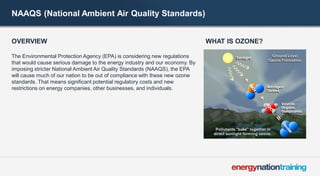
WHAT IS OZONE?
NAAQS (National Ambient Air Quality Standards) 
ECONOMIC IMPACT 
If the EPA lowers the current ozone standards from the 75 parts per billion (ppb) to 60 parts per billion (ppb), it could: 
• 
Mean 97% of the people who live in the United States would live in areas that would not be in compliance. 
• 
Give the EPA authority to regulate any activities that emit ozone, which would be a significant blow to the oil and gas industry and its employees. 
• 
Cost over $1 billion every year to comply. 
• 
Reduce the U.S. Gross Domestic Product by $676 billion in 2020. 
• 
Destroy 7.3 million jobs by 2020. 
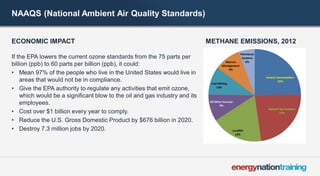
METHANE EMISSIONS, 2012
NAAQS (National Ambient Air Quality Standards) 
IMPRACTICAL EXPECTATIONS 
At a level of 60 ppb, this regulatory standard would be below peak background levels in many places, including some wilderness areas. If the EPA were to impose this stricter standard, it would be unachievable in many areas. The energy industry and many other businesses could spend billions to comply with regulations that will be impossible to meet.
NAAQS (National Ambient Air Quality Standards) 
NEXT STEPS ON NAAQS 
Urge the EPA not to impose unrealistic ozone standards, as they would be disastrous for our economy, job creation, and international competitiveness.

NAAQS

  • 1.
    NAAQS (National AmbientAir Quality Standards) OVERVIEW The Environmental Protection Agency (EPA) is considering new regulations that would cause serious damage to the energy industry and our economy. By imposing stricter National Ambient Air Quality Standards (NAAQS), the EPA will cause much of our nation to be out of compliance with these new ozone standards. That means significant potential regulatory costs and new restrictions on energy companies, other businesses, and individuals. WHAT IS OZONE?
  • 2.
    NAAQS (National AmbientAir Quality Standards) ECONOMIC IMPACT If the EPA lowers the current ozone standards from the 75 parts per billion (ppb) to 60 parts per billion (ppb), it could: • Mean 97% of the people who live in the United States would live in areas that would not be in compliance. • Give the EPA authority to regulate any activities that emit ozone, which would be a significant blow to the oil and gas industry and its employees. • Cost over $1 billion every year to comply. • Reduce the U.S. Gross Domestic Product by $676 billion in 2020. • Destroy 7.3 million jobs by 2020. METHANE EMISSIONS, 2012
  • 3.
    NAAQS (National AmbientAir Quality Standards) IMPRACTICAL EXPECTATIONS At a level of 60 ppb, this regulatory standard would be below peak background levels in many places, including some wilderness areas. If the EPA were to impose this stricter standard, it would be unachievable in many areas. The energy industry and many other businesses could spend billions to comply with regulations that will be impossible to meet.
  • 4.
    NAAQS (National AmbientAir Quality Standards) NEXT STEPS ON NAAQS Urge the EPA not to impose unrealistic ozone standards, as they would be disastrous for our economy, job creation, and international competitiveness.