Making API Docs Work 
API Usability and getting people to contribute to open source @CFPB
How this project came about. 
T&I wanted to use the release of HMDA data as an opportunity 
to engage the developer community. Understanding that HMDA 
data could get complicated, Clinton Dreisbach wrote 
documentation for the API. Desiree Garcia and Mehgan Iulo 
were asked to make it look presentable.
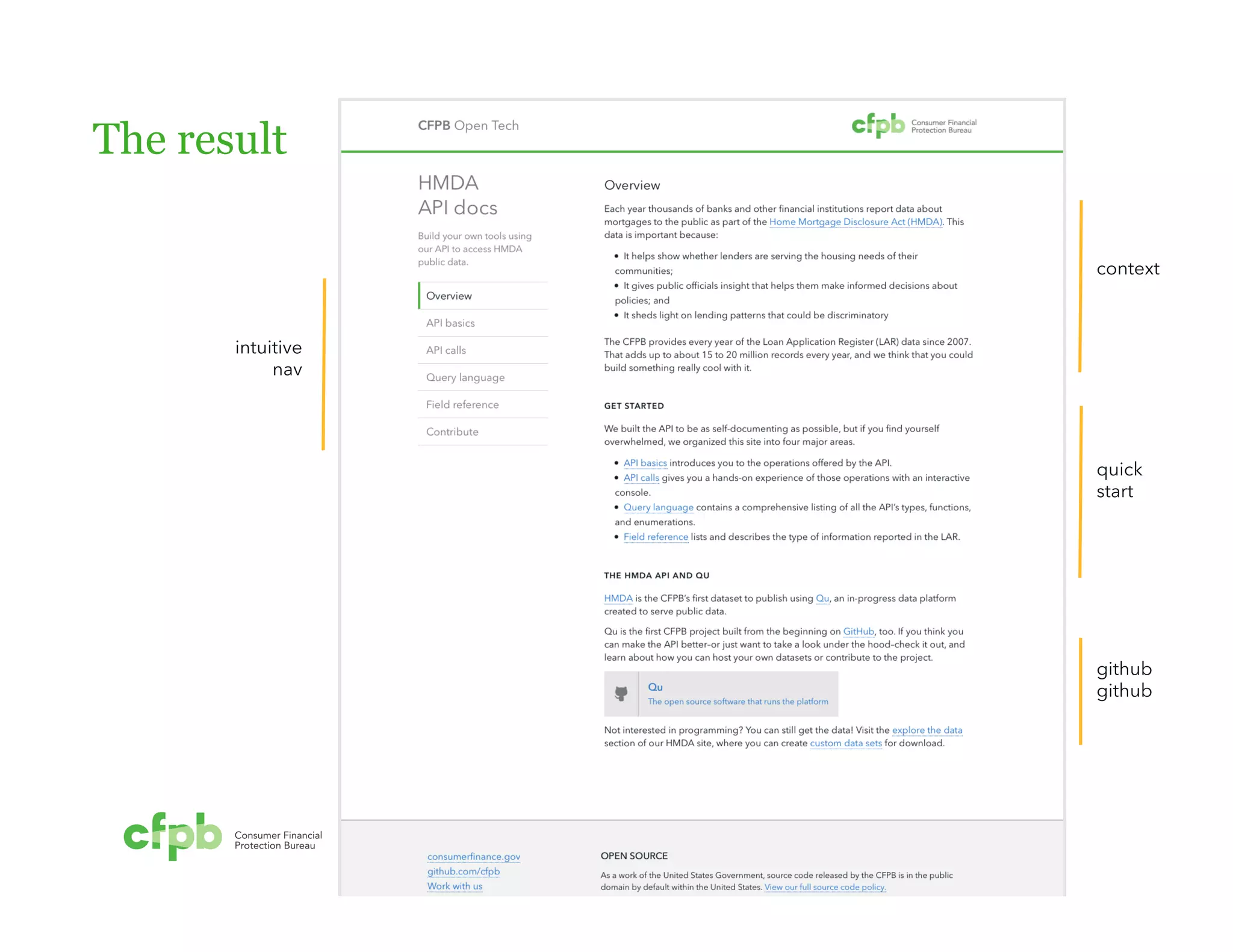
The result 
intuitive 
nav 
context 
quick 
start 
github 
github
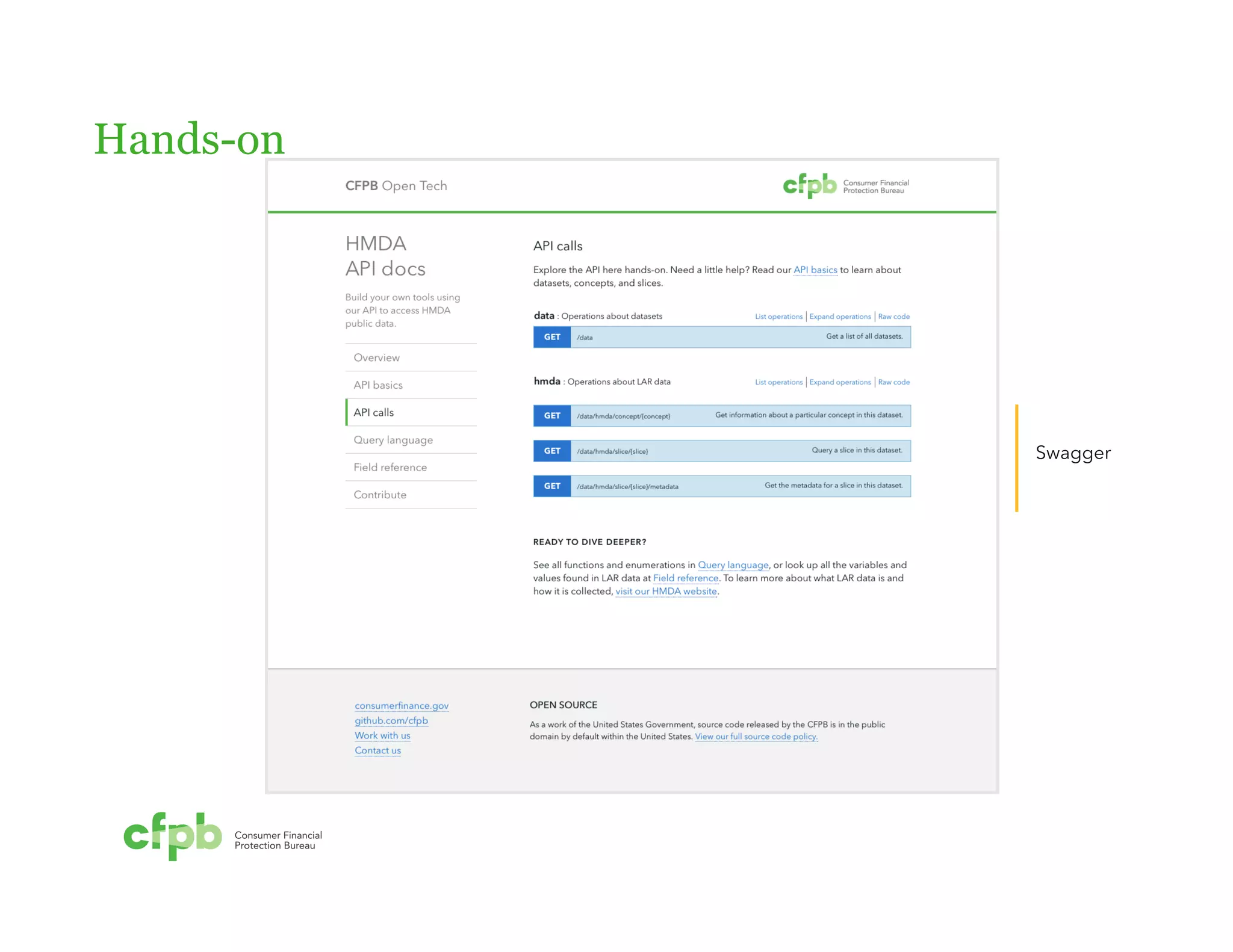
Hands-on 
Swagger
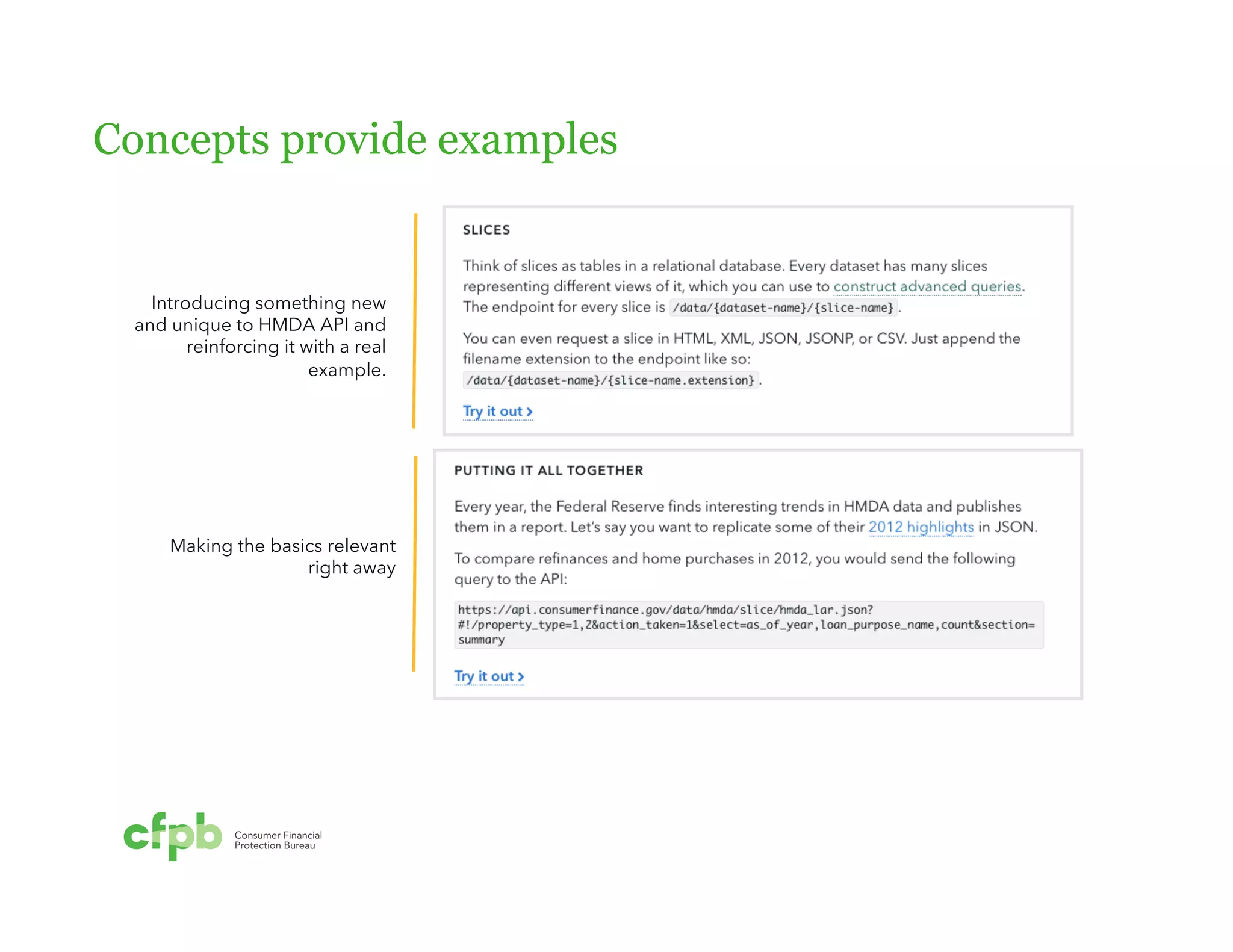
Concepts provide examples 
Introducing something new 
and unique to HMDA API and 
reinforcing it with a real 
example. 
Making the basics relevant 
right away
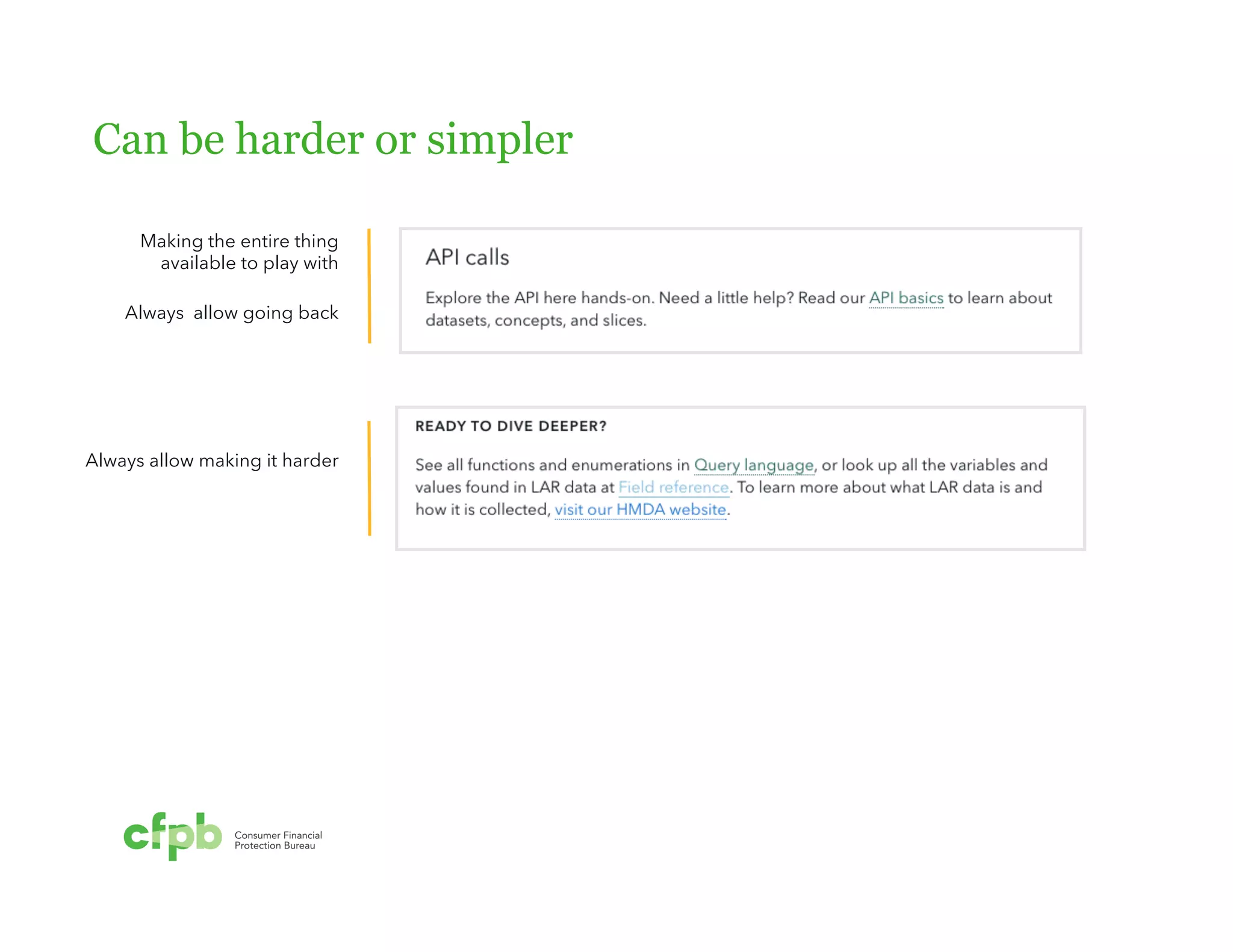
Can be harder or simpler 
Making the entire thing 
available to play with 
Always allow going back 
Always allow making it harder
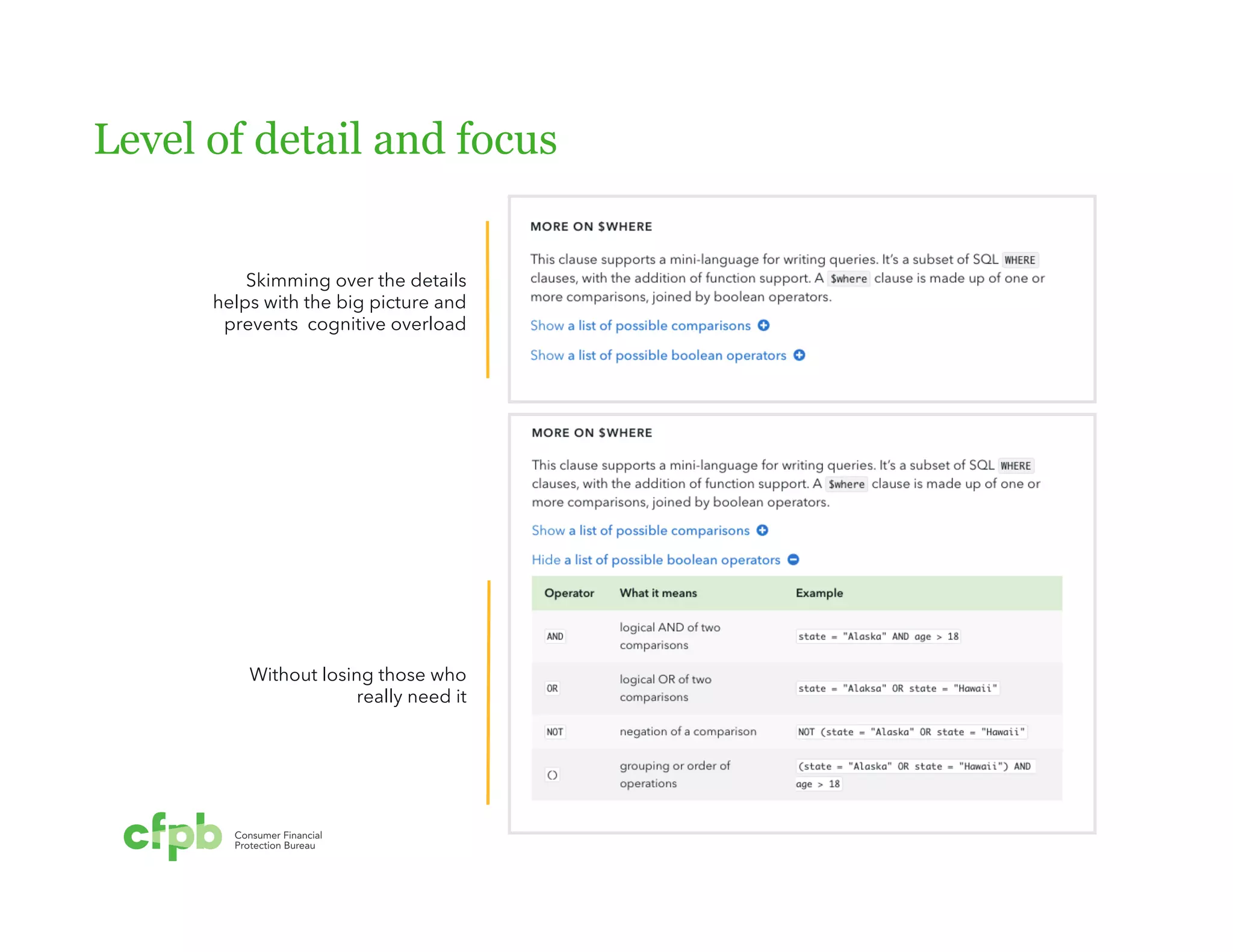
Level of detail and focus 
Skimming over the details 
helps with the big picture and 
prevents cognitive overload 
Without losing those who 
really need it
2 
Win! 
So we forget about it!
2 
18f 
API usability
3 
It sounded so much cooler than it was 
▪ 6 people from private industry invited to do a usability study on 3 
government API documentation sites 
▪ Companies: 
▪ GovTribe 
▪ API Academy 
▪ iStrategyLabs 
▪ Sites: HMDA Docs was one of them, SAM API, USAjobs 
▪ Note that SAM API kinda took our work and changed the colors on them 
▪ Study was a think aloud free-association thing for 5 minutes plus ?s 
▪ CFPB docs were perceived as an ideal
5 
▪ “It’s so easy to use” 
▪ “wonderfully laid out and 
organized” 
▪ “lots of just in time moments” 
▪ “great to see embedded calls” 
▪ “[that HMDA site uses the 
API] that’s awesome” 
The bad 
▪ “It looks like a show-off science 
project” 
▪ “sounds like terms and 
conditions” 
▪ “can’t find any definitions” 
▪ “congress stuff” 
▪ business plans, stagnant 
Overall Findings 
The good 
Cool but I would’t use it.
3 
Following up with a thank you note 
Committed in front of the industry visitors that we would make changes 
to improve their experience. 
1. Fixing what was freezing 
2. Adding more examples ( 
3. Trimming the fat on gov-speak (approachable) 
The highest hope being that they would check back and contribute this 
time. 
The worst case being that we would do nothing and they’d lose trust; 
another instance of “more talking no doing”
Why usability and user experience is an afterthought 
3 
My take: 
▪ The dev community represents the ultimate power user. 
▪ Usability is perceived as a non-issue because we know all the 
workarounds 
▪ There might even be some triumph to figuring out something that is 
disorganized, tricky, and unintuitive. 
This isn’t the real problem.
2 
The problem is not one of ability and skill. 
It’s one of motivation.
3 
Open source success and motivation 
▪ People have a perception of what government-produced software is 
like, it’s not attractive, and it puts us at a disadvantage. 
▪ If we invite the dev community to contribute, we have to work extra 
hard 
▪ We have to pitch it in such a way that gives the promise of, “this will 
be different” 
▪ But it can’t stop there–once they arrive at our documentation or other 
content, it needs to continue being different 
▪ This was the strategy for the first version of the docs. It made them 
successful but also posed the biggest challenge:
2 
Responding to usability 
findings using Github
3 
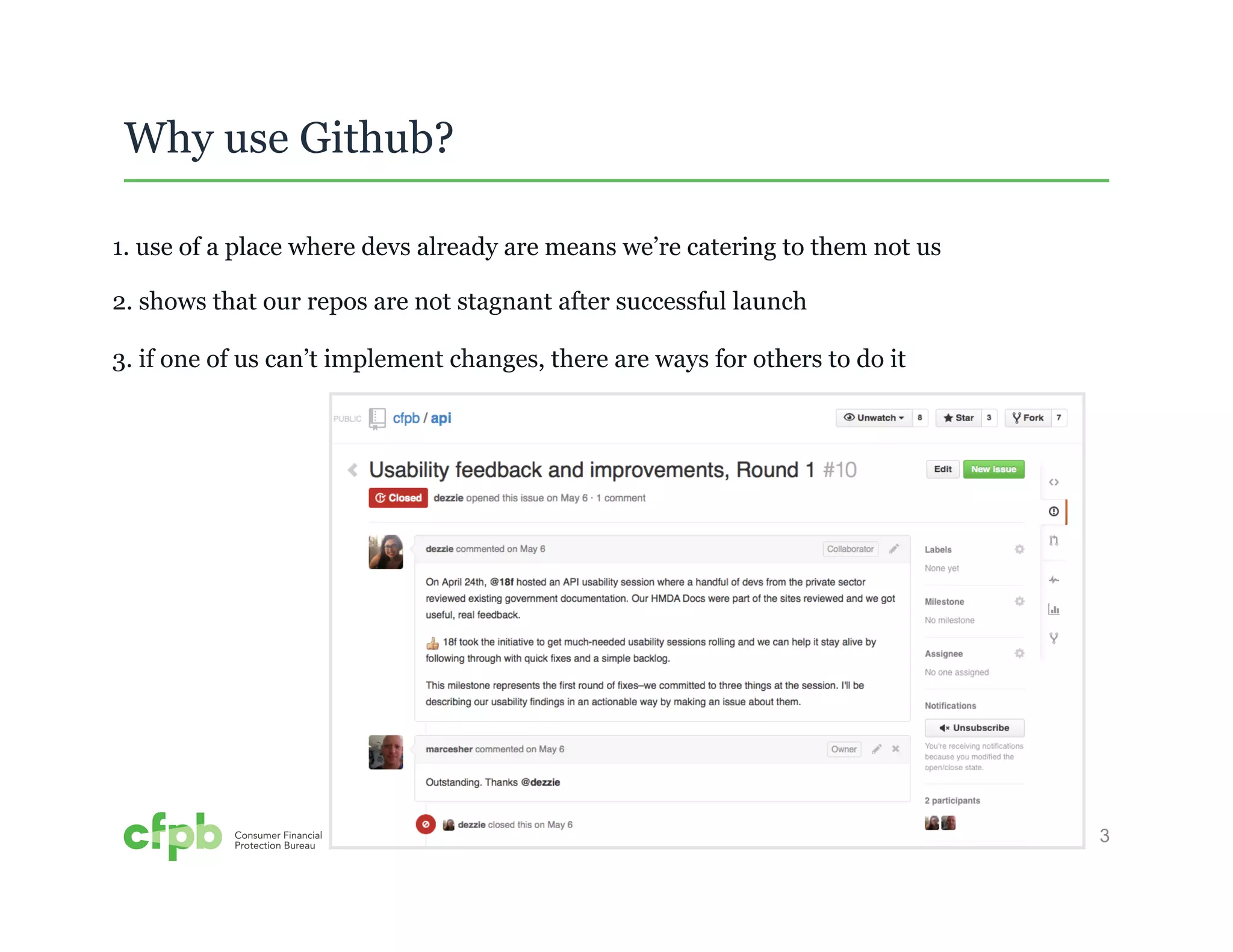
Why use Github? 
1. use of a place where devs already are means we’re catering to them not us 
2. shows that our repos are not stagnant after successful launch 
3. if one of us can’t implement changes, there are ways for others to do it
3 
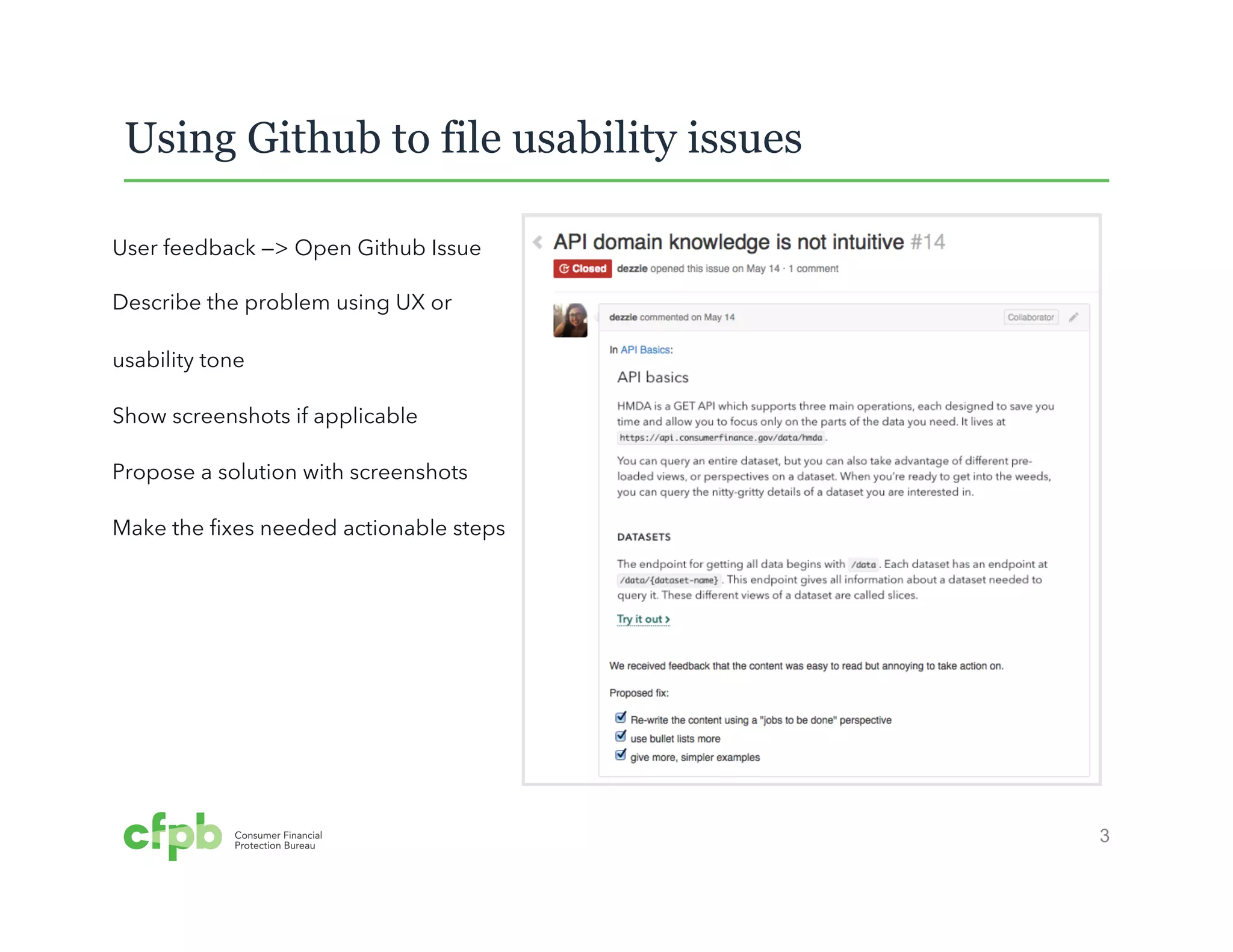
Using Github to file usability issues 
User feedback —> Open Github Issue 
Describe the problem using UX or 
usability tone 
Show screenshots if applicable 
Propose a solution with screenshots 
Make the fixes needed actionable steps
2 
Easy stuff
3 
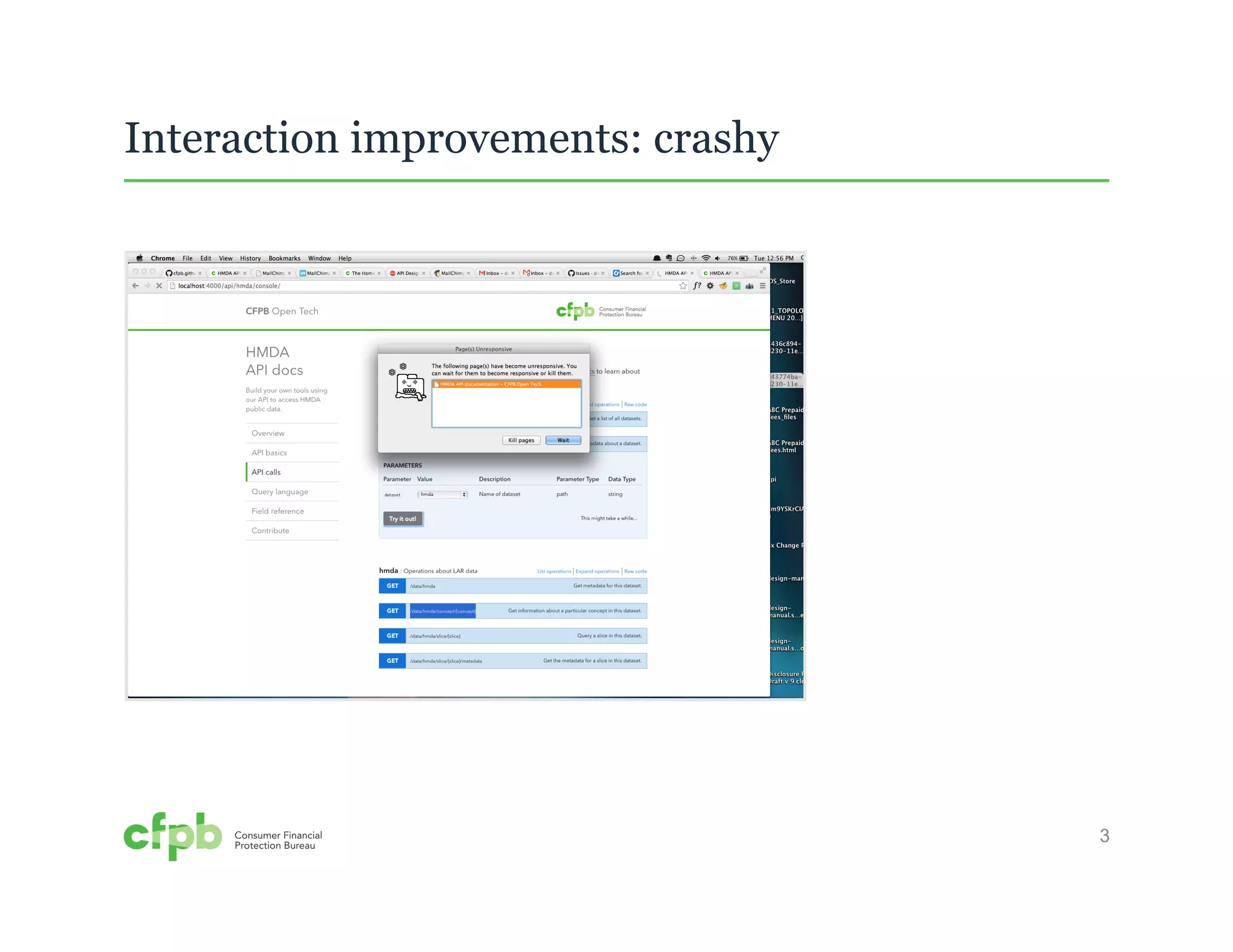
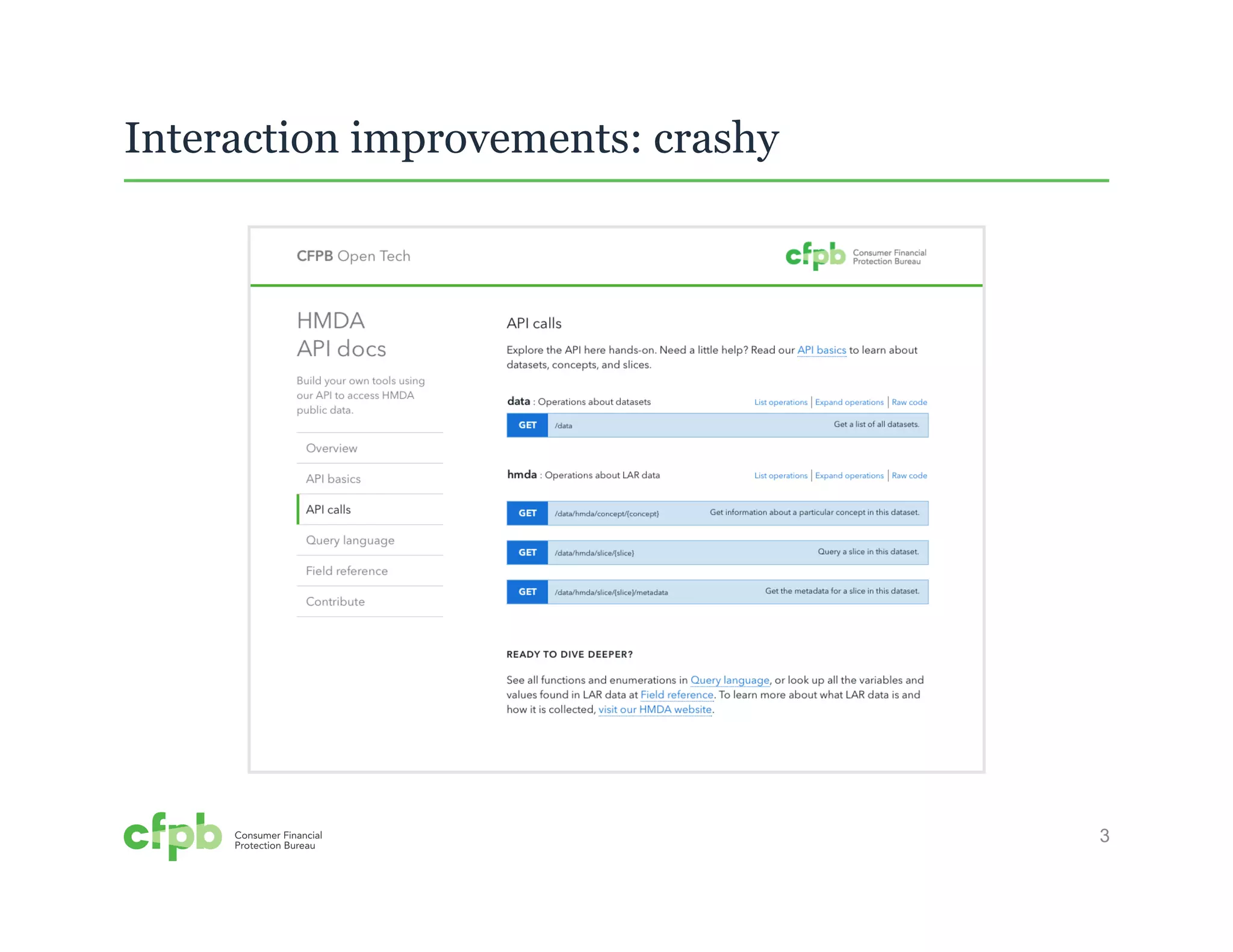
Interaction improvements: crashy
3 
Interaction improvements: crashy
3 
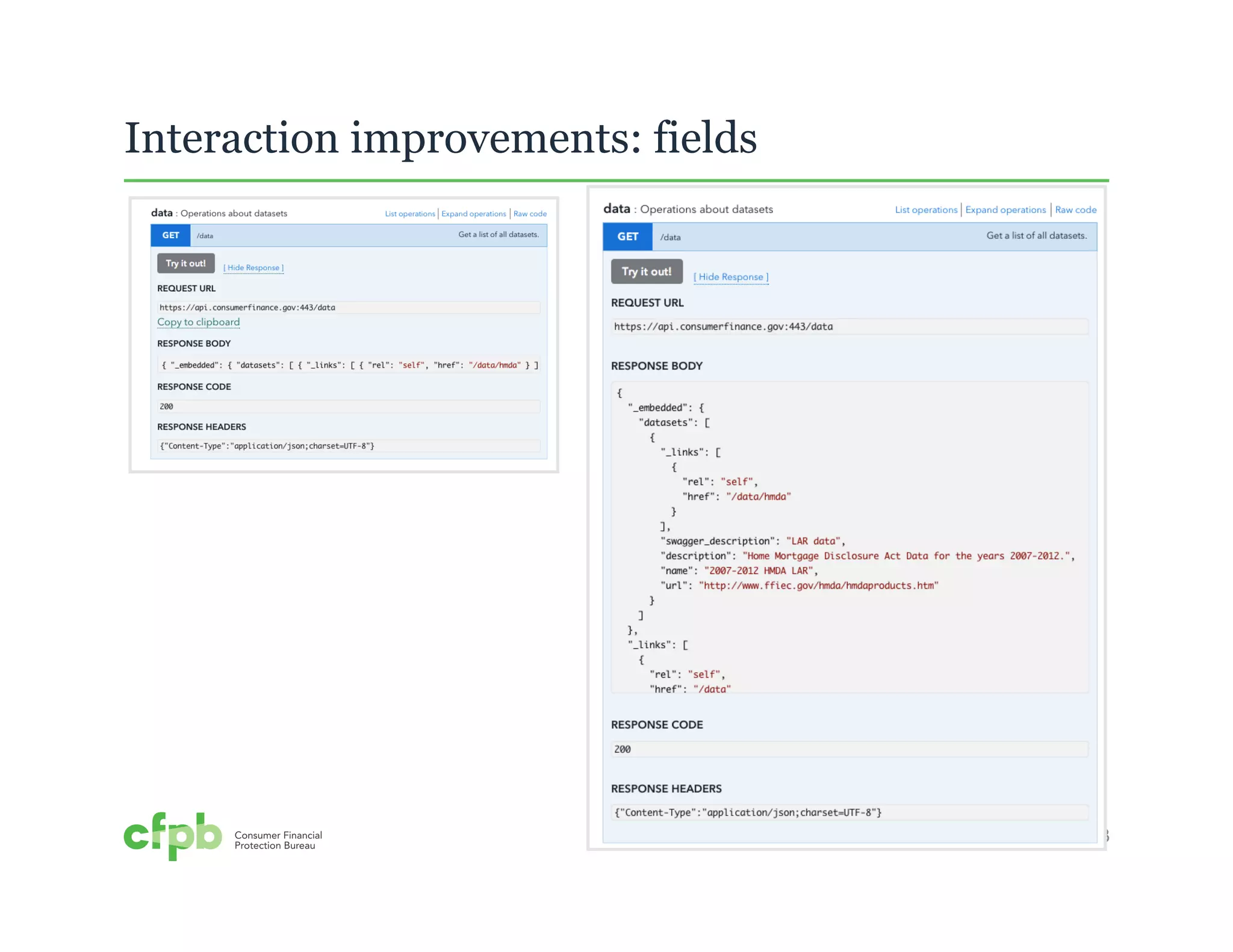
Interaction improvements: fields
3 
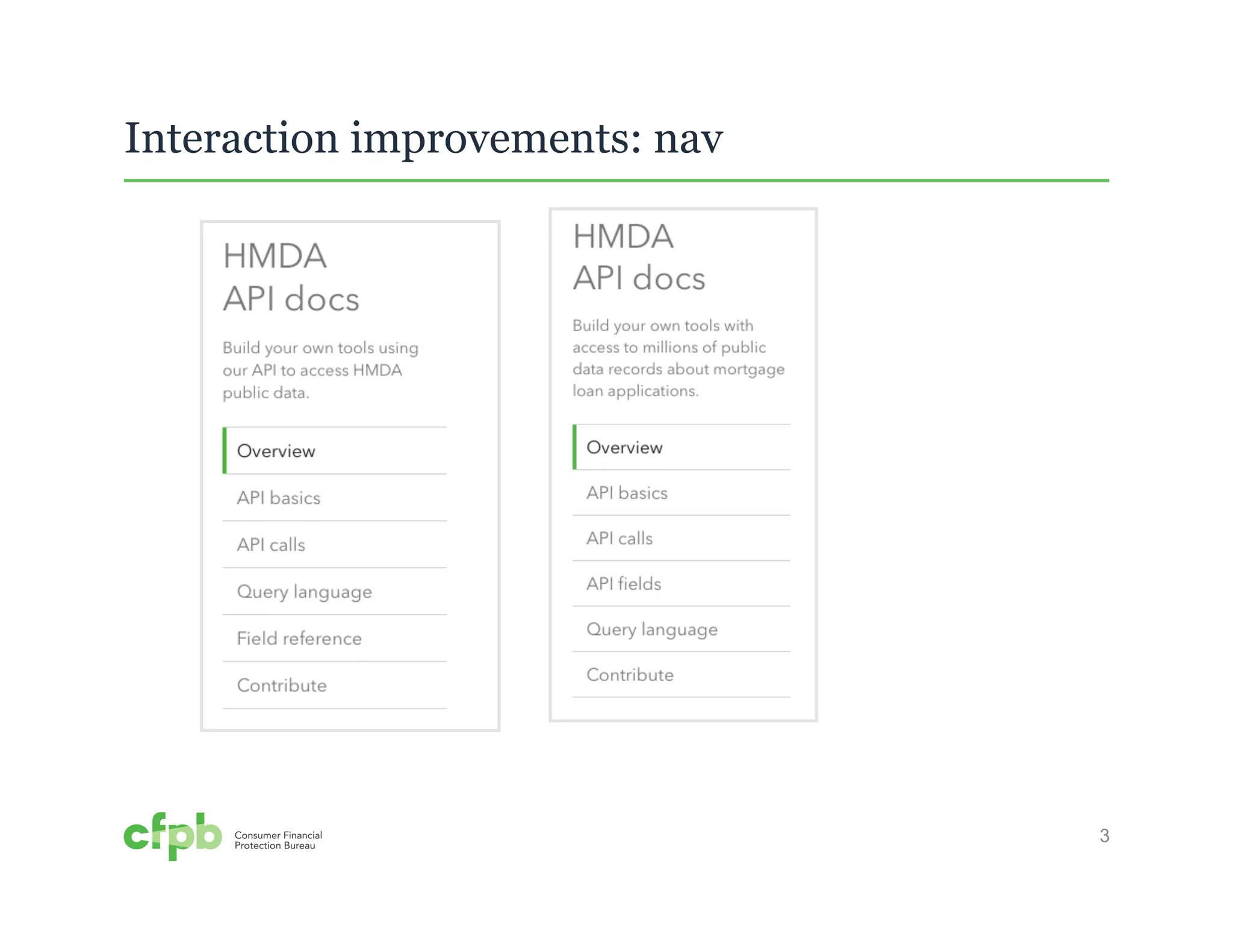
Interaction improvements: nav
2 
Trickier stuff
3 
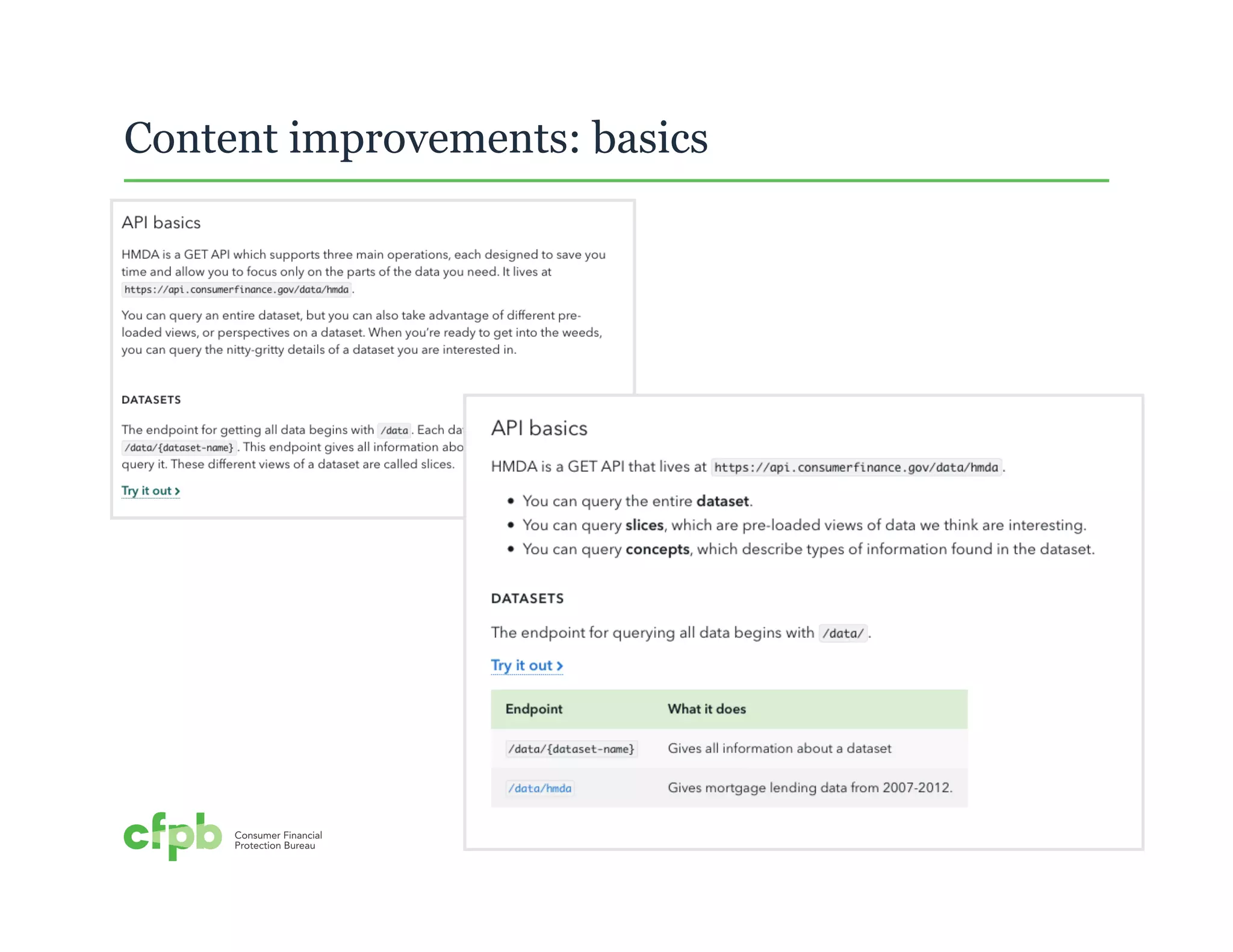
Content improvements: basics
3 
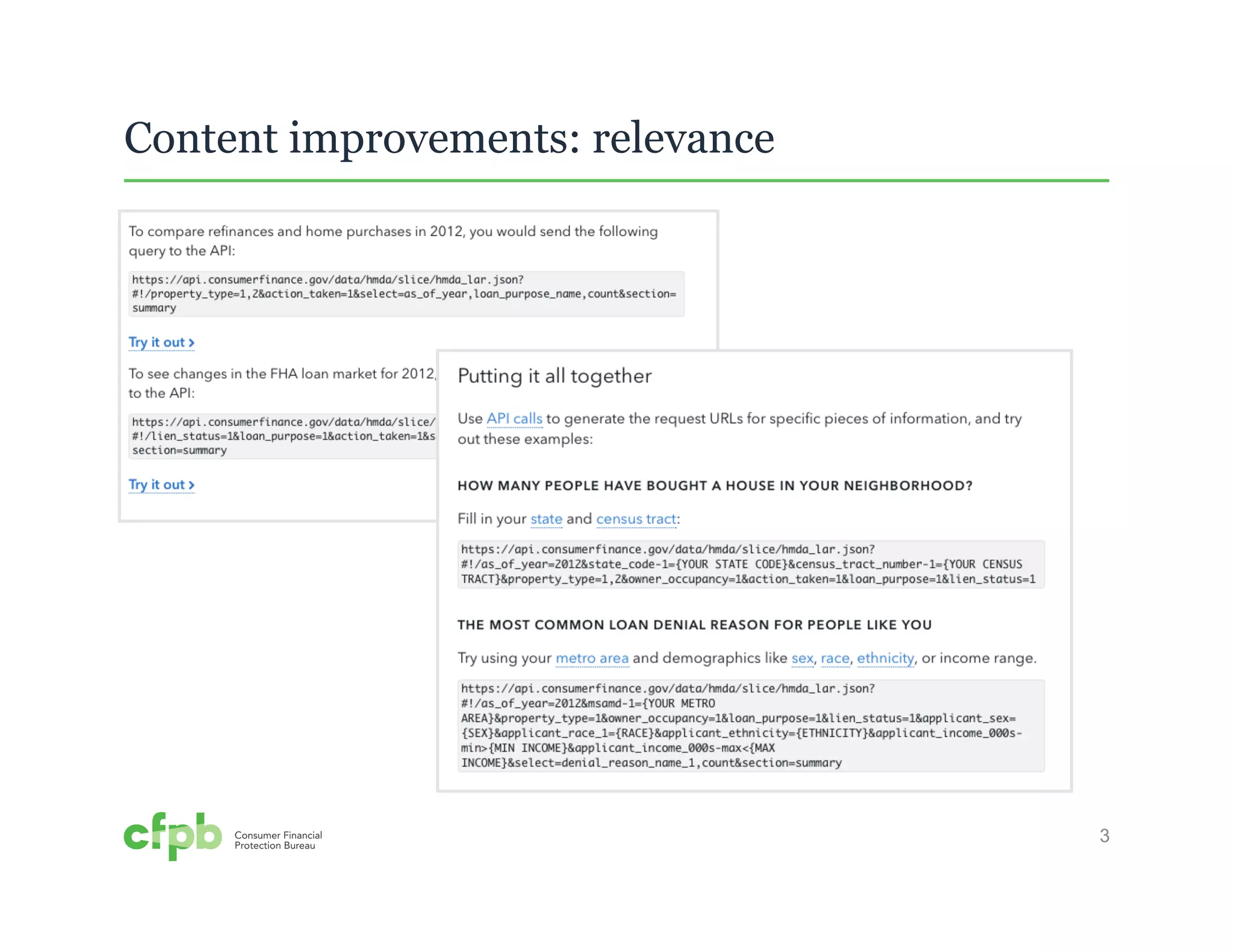
Content improvements: relevance
3 
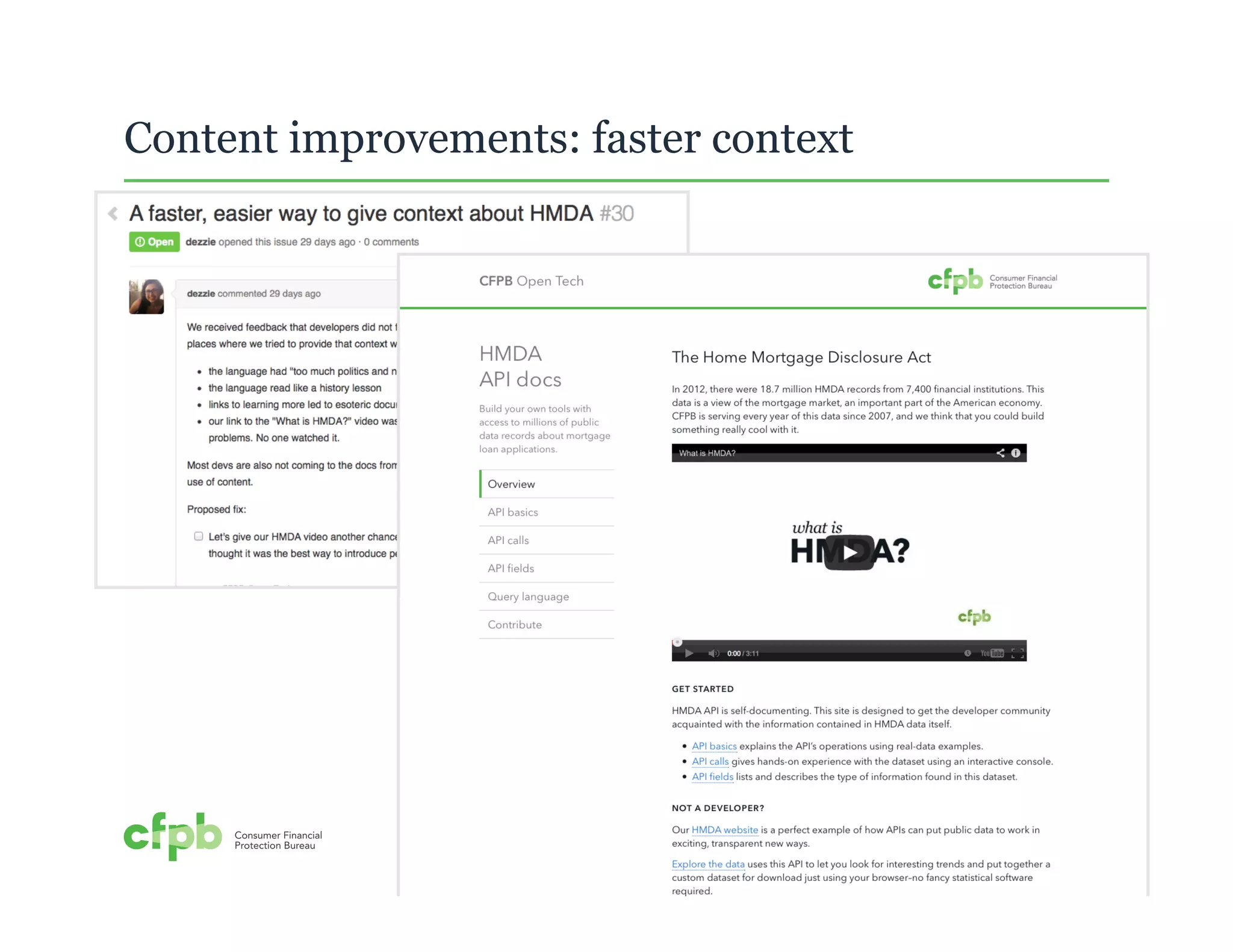
Content improvements: faster context
2 
The hard stuff
3 
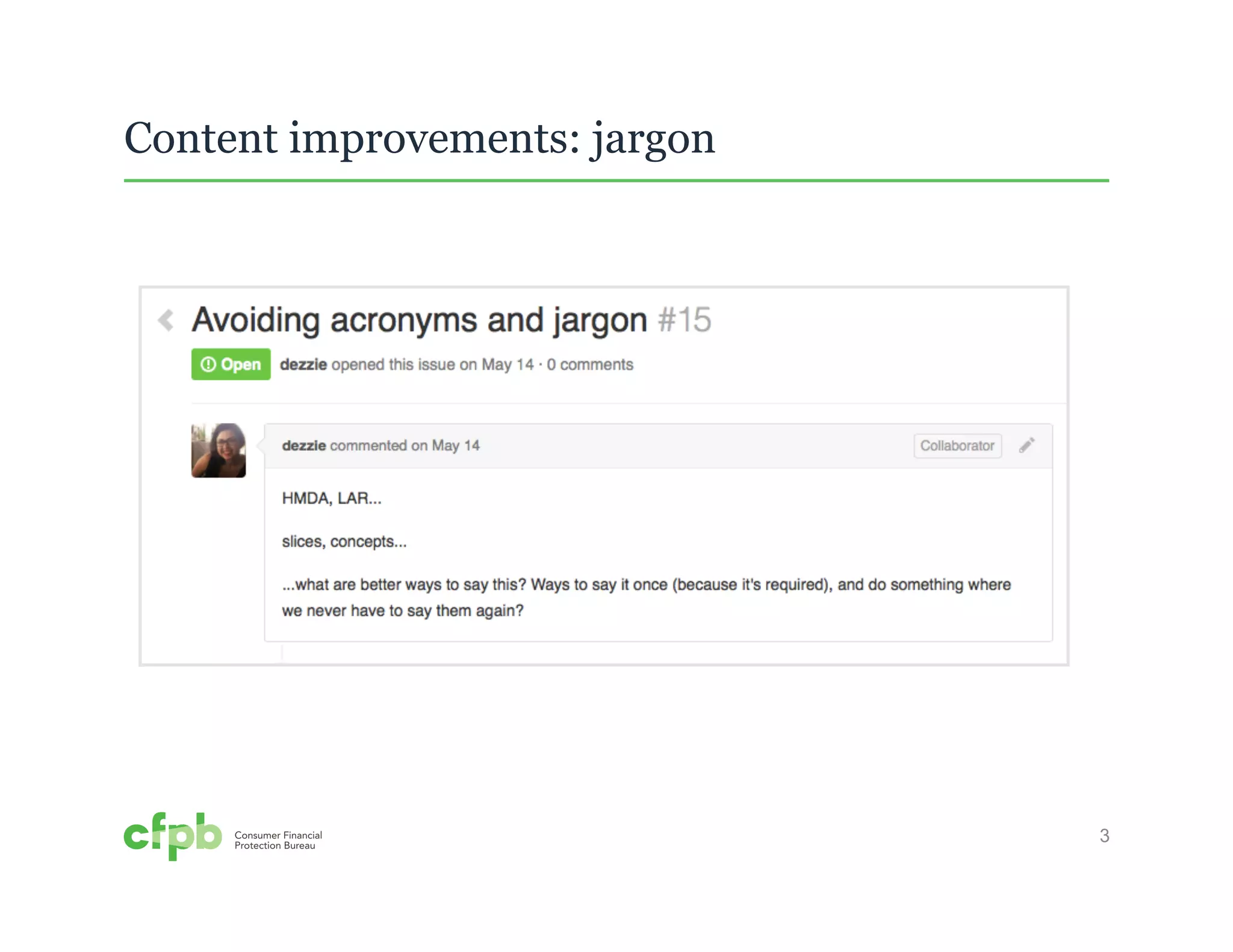
Content improvements: jargon
“How do I know this stuff will be there in 5 years?” 
The deal breaker for those who want to create serious work–the 
unknown cannot be accounted for in a business plan. Less 
talking and more doing–no activity on a project after launch is 
seen as abandoned. 
How do we communicate our change process outside the 
Bureau?
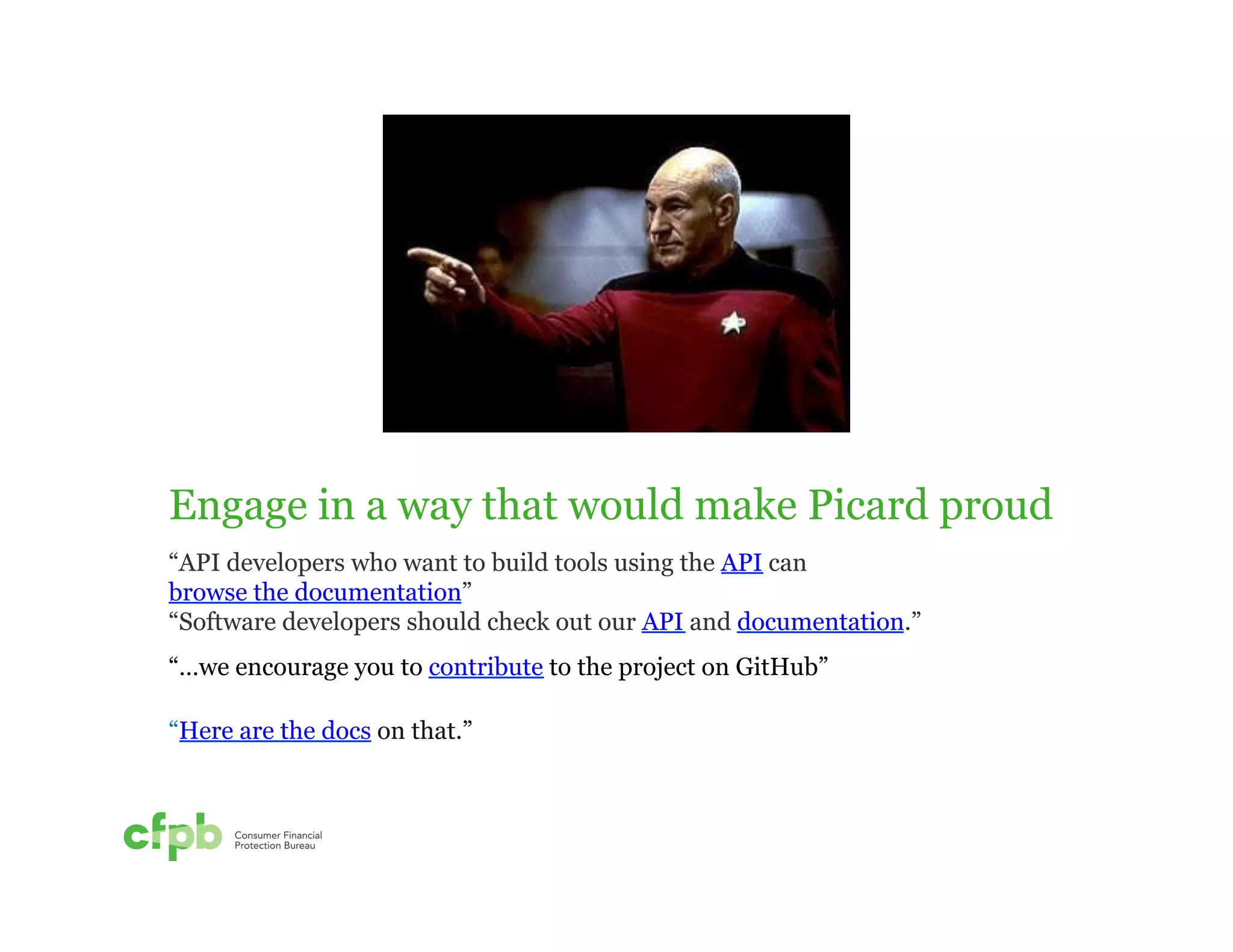
Engage in a way that would make Picard proud 
“API developers who want to build tools using the API can 
browse the documentation” 
“Software developers should check out our API and documentation.” 
“…we encourage you to contribute to the project on GitHub” 
“Here are the docs on that.”
2 
Lessons learned
Devs are users too. 
Not speaking to developers in the user research portion of the 
HMDA project is a homemade example of assuming that we know 
our user. API Documentation, likewise, is not for expert HMDA 
users.
Mortgage data is boring. 
This is like promoting a MOOC on Latin grammar.
I ate my own dog food. 
In order to empathize with developers, I had to see if I could learn and 
do using my own documentation.

Making API documentation work

  • 1.
    Making API DocsWork API Usability and getting people to contribute to open source @CFPB
  • 2.
    How this projectcame about. T&I wanted to use the release of HMDA data as an opportunity to engage the developer community. Understanding that HMDA data could get complicated, Clinton Dreisbach wrote documentation for the API. Desiree Garcia and Mehgan Iulo were asked to make it look presentable.
  • 3.
    The result intuitive nav context quick start github github
  • 4.
  • 5.
    Concepts provide examples Introducing something new and unique to HMDA API and reinforcing it with a real example. Making the basics relevant right away
  • 6.
    Can be harderor simpler Making the entire thing available to play with Always allow going back Always allow making it harder
  • 7.
    Level of detailand focus Skimming over the details helps with the big picture and prevents cognitive overload Without losing those who really need it
  • 8.
    2 Win! Sowe forget about it!
  • 9.
    2 18f APIusability
  • 10.
    3 It soundedso much cooler than it was ▪ 6 people from private industry invited to do a usability study on 3 government API documentation sites ▪ Companies: ▪ GovTribe ▪ API Academy ▪ iStrategyLabs ▪ Sites: HMDA Docs was one of them, SAM API, USAjobs ▪ Note that SAM API kinda took our work and changed the colors on them ▪ Study was a think aloud free-association thing for 5 minutes plus ?s ▪ CFPB docs were perceived as an ideal
  • 11.
    5 ▪ “It’sso easy to use” ▪ “wonderfully laid out and organized” ▪ “lots of just in time moments” ▪ “great to see embedded calls” ▪ “[that HMDA site uses the API] that’s awesome” The bad ▪ “It looks like a show-off science project” ▪ “sounds like terms and conditions” ▪ “can’t find any definitions” ▪ “congress stuff” ▪ business plans, stagnant Overall Findings The good Cool but I would’t use it.
  • 12.
    3 Following upwith a thank you note Committed in front of the industry visitors that we would make changes to improve their experience. 1. Fixing what was freezing 2. Adding more examples ( 3. Trimming the fat on gov-speak (approachable) The highest hope being that they would check back and contribute this time. The worst case being that we would do nothing and they’d lose trust; another instance of “more talking no doing”
  • 13.
    Why usability anduser experience is an afterthought 3 My take: ▪ The dev community represents the ultimate power user. ▪ Usability is perceived as a non-issue because we know all the workarounds ▪ There might even be some triumph to figuring out something that is disorganized, tricky, and unintuitive. This isn’t the real problem.
  • 14.
    2 The problemis not one of ability and skill. It’s one of motivation.
  • 15.
    3 Open sourcesuccess and motivation ▪ People have a perception of what government-produced software is like, it’s not attractive, and it puts us at a disadvantage. ▪ If we invite the dev community to contribute, we have to work extra hard ▪ We have to pitch it in such a way that gives the promise of, “this will be different” ▪ But it can’t stop there–once they arrive at our documentation or other content, it needs to continue being different ▪ This was the strategy for the first version of the docs. It made them successful but also posed the biggest challenge:
  • 16.
    2 Responding tousability findings using Github
  • 17.
    3 Why useGithub? 1. use of a place where devs already are means we’re catering to them not us 2. shows that our repos are not stagnant after successful launch 3. if one of us can’t implement changes, there are ways for others to do it
  • 18.
    3 Using Githubto file usability issues User feedback —> Open Github Issue Describe the problem using UX or usability tone Show screenshots if applicable Propose a solution with screenshots Make the fixes needed actionable steps
  • 19.
  • 20.
  • 21.
  • 22.
  • 23.
  • 24.
  • 25.
  • 26.
  • 27.
  • 28.
  • 29.
  • 30.
    “How do Iknow this stuff will be there in 5 years?” The deal breaker for those who want to create serious work–the unknown cannot be accounted for in a business plan. Less talking and more doing–no activity on a project after launch is seen as abandoned. How do we communicate our change process outside the Bureau?
  • 31.
    Engage in away that would make Picard proud “API developers who want to build tools using the API can browse the documentation” “Software developers should check out our API and documentation.” “…we encourage you to contribute to the project on GitHub” “Here are the docs on that.”
  • 32.
  • 33.
    Devs are userstoo. Not speaking to developers in the user research portion of the HMDA project is a homemade example of assuming that we know our user. API Documentation, likewise, is not for expert HMDA users.
  • 34.
    Mortgage data isboring. This is like promoting a MOOC on Latin grammar.
  • 35.
    I ate myown dog food. In order to empathize with developers, I had to see if I could learn and do using my own documentation.