APACHE WICKET 
Apache Wicket 
10 years and beyond 
Martijn Dashorst 
topicus onderwijs 
@dashorst
a brief history 
of Wicket 
the current state 
of Wicket 
the future 
of Wicket
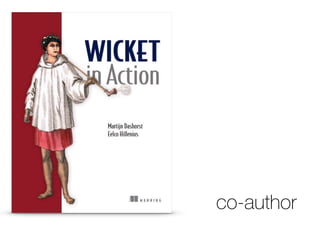
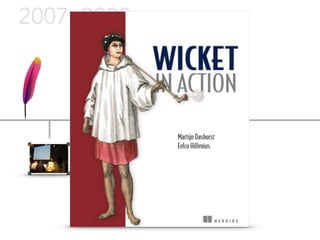
co-author
10 year contributor to Wicket
started in 2004 at topicus 
without any knowledge of web programming
before Wicket 
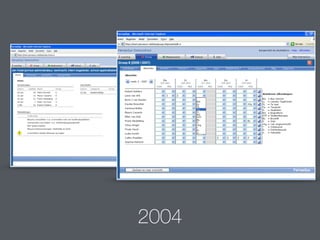
at topicus
2004
using maverick velocity 
hibernate jasperreports
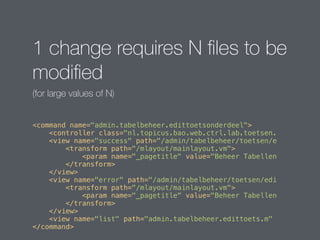
lots of XML configuration
1 change requires N files to be 
modified 
(for large values of N) 
<command name="admin.tabelbeheer.edittoetsonderdeel"> 
<controller class="nl.topicus.bao.web.ctrl.lab.toetsen. 
<view name="success" path="/admin/tabelbeheer/toetsen/e 
<transform path="/mlayout/mainlayout.vm"> 
<param name="_pagetitle" value="Beheer Tabellen 
</transform> 
</view> 
<view name="error" path="/admin/tabelbeheer/toetsen/edi 
<transform path="/mlayout/mainlayout.vm"> 
<param name="_pagetitle" value="Beheer Tabellen 
</transform> 
</view> 
<view name="list" path="admin.tabelbeheer.edittoets.m" 
</command>
high learning curve
no back button support 
no multi-tab support
HTTP Session dumping 
ground
little to no reuse 
</tr> 
#if($model.bean.absentieRegels.empty) 
<tr> 
<td colspan="19" class="border-r">#formname('groep.absent' 
</tr> 
#else 
#set($columnIndexes=[1,2,3,4,5,6,7,8,9,10]) 
#foreach($row in $model.bean.absentieRegels) 
<tr> 
<td class="columnvalue">$arrayTool.elementAt($row, 0)</td 
#foreach($index in $columnIndexes) 
#set($melding=$arrayTool.elementAt($row, $index))
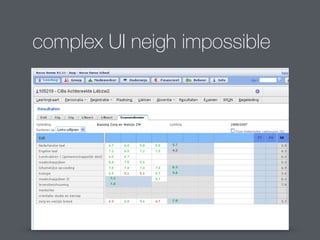
complex UI neigh impossible
a framework that makes 
reuse possible, minimises 
configuration, server side 
state management easy 
and is as type safe as 
possible
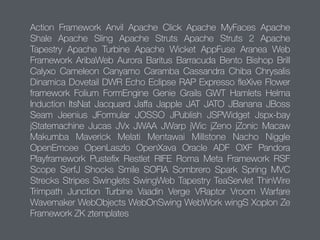
Action Framework Anvil Apache Click Apache MyFaces Apache 
Shale Apache Sling Apache Struts Apache Struts 2 Apache 
Tapestry Apache Turbine Apache Wicket AppFuse Aranea Web 
Framework AribaWeb Aurora Baritus Barracuda Bento Bishop Brill 
Calyxo Cameleon Canyamo Caramba Cassandra Chiba Chrysalis 
Dinamica Dovetail DWR Echo Eclipse RAP Expresso fleXive Flower 
framework Folium FormEngine Genie Grails GWT Hamlets Helma 
Induction ItsNat Jacquard Jaffa Japple JAT JATO JBanana JBoss 
Seam Jeenius JFormular JOSSO JPublish JSPWidget Jspx-bay 
jStatemachine Jucas JVx JWAA JWarp jWic jZeno jZonic Macaw 
Makumba Maverick Melati Mentawai Millstone Nacho Niggle 
OpenEmcee OpenLaszlo OpenXava Oracle ADF OXF Pandora 
Playframework Pustefix Restlet RIFE Roma Meta Framework RSF 
Scope SerfJ Shocks Smile SOFIA Sombrero Spark Spring MVC 
Strecks Stripes Swinglets SwingWeb Tapestry TeaServlet ThinWire 
Trimpath Junction Turbine Vaadin Verge VRaptor Vroom Warfare 
Wavemaker WebObjects WebOnSwing WebWork wingS Xoplon Ze 
Framework ZK ztemplates
120+ java web frameworks
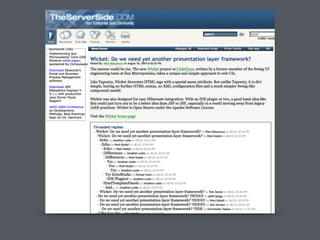
18 August 2004
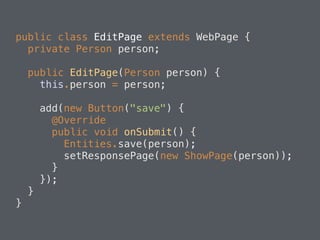
public class EditPage extends WebPage { 
private Person person; 
public EditPage(Person person) { 
this.person = person; 
add(new Button("save") { 
@Override 
public void onSubmit() { 
Entities.save(person); 
setResponsePage(new ShowPage(person)); 
} 
}); 
} 
}
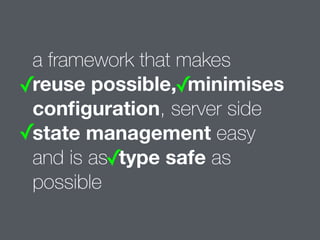
a framework that makes 
reuse possible, minimises 
configuration, server side 
state management easy 
and is as type safe as 
possible 
✓ ✓ 
✓ 
✓
Action Framework Anvil Apache Click Apache MyFaces Apache 
Shale Apache Sling Apache Struts Apache Struts 2 Apache 
Tapestry Apache Turbine Apache Wicket AppFuse Aranea Web 
Framework AribaWeb Aurora Baritus Barracuda Bento Bishop Brill 
Calyxo Cameleon Canyamo Caramba Cassandra Chiba Chrysalis 
Dinamica Dovetail DWR Echo Eclipse RAP Expresso fleXive Flower 
framework Folium FormEngine Genie Grails GWT Hamlets Helma 
Induction ItsNat Jacquard Jaffa Japple JAT JATO JBanana JBoss 
Seam Jeenius JFormular JOSSO JPublish JSPWidget Jspx-bay 
jStatemachine Jucas JVx JWAA JWarp jWic jZeno jZonic Macaw 
Makumba Maverick Melati Mentawai Millstone Nacho Niggle 
OpenEmcee OpenLaszlo OpenXava Oracle ADF OXF Pandora 
Playframework Pustefix Restlet RIFE Roma Meta Framework RSF 
Scope SerfJ Shocks Smile SOFIA Sombrero Spark Spring MVC 
Strecks Stripes Swinglets SwingWeb Tapestry TeaServlet ThinWire 
Trimpath Junction Turbine Vaadin Verge VRaptor Vroom Warfare 
Wavemaker WebObjects WebOnSwing WebWork wingS Xoplon Ze 
Framework ZK ztemplates
Action Framework Anvil Apache Click Apache MyFaces Apache 
Shale Apache Sling Apache Struts Apache Struts 2 Apache 
Tapestry Apache Turbine Apache Wicket AppFuse Aranea Web 
Framework AribaWeb Aurora Baritus Barracuda Bento Bishop Brill 
Calyxo Cameleon Canyamo Caramba Cassandra Chiba Chrysalis 
Dinamica Dovetail DWR Echo Eclipse RAP Expresso fleXive Flower 
framework Folium FormEngine Genie Grails GWT Hamlets Helma 
Induction ItsNat Jacquard Jaffa Japple JAT JATO JBanana JBoss 
Seam Jeenius JFormular JOSSO JPublish JSPWidget Jspx-bay 
jStatemachine Jucas JVx JWAA JWarp jWic jZeno jZonic Macaw 
Makumba Maverick Melati Mentawai Millstone Nacho Niggle 
OpenEmcee OpenLaszlo OpenXava Oracle ADF OXF Pandora 
Playframework Pustefix Restlet RIFE Roma Meta Framework RSF 
Scope SerfJ Shocks Smile SOFIA Sombrero Spark Spring MVC 
Strecks Stripes Swinglets SwingWeb Tapestry TeaServlet ThinWire 
Trimpath Junction Turbine Vaadin Verge VRaptor Vroom Warfare 
Wavemaker WebObjects WebOnSwing WebWork wingS Xoplon Ze 
Framework ZK ztemplates
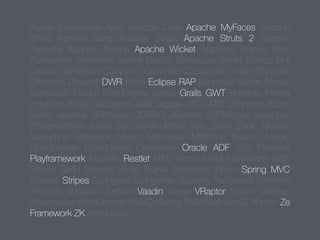
15 java web frameworks alive 
i.e. made any release in the last year
including Wicket!
What is Wicket? 
Apache Wicket 
From Wikipedia, the free encyclopedia 
Apache Wicket, commonly referred to as 
Wicket, is a lightweight component-based web 
application framework for the Java programming 
language conceptually similar to JavaServer 
Faces and Tapestry. It was originally written by 
Jonathan Locke in April 2004. Version 1.0 was 
released in June 2005. It graduated into an 
Apache top-level project in June 2007.[2]
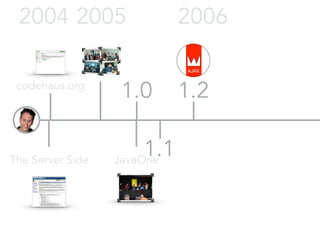
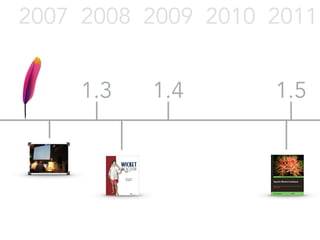
A brief history of Wicket
2004
2004 
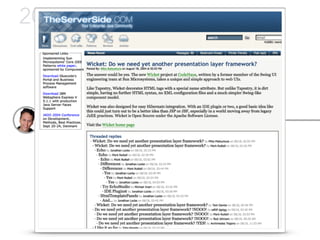
The Server Side
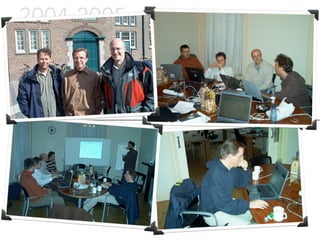
2004 2005 
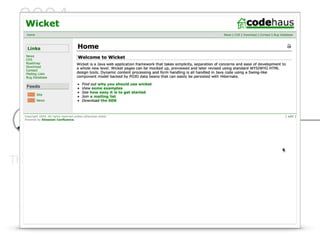
codehaus.org 
The Server Side
2004 2005 
codehaus.org 
The Server Side
2004 
codehaus.org 
1.0 
1.1 
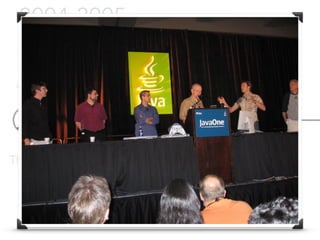
The Server Side JavaOne 
2006 
1.2 
2005 
AJAX
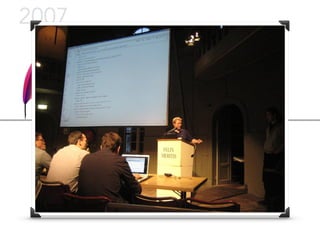
2007
2007 
2008 
1.3
2007 
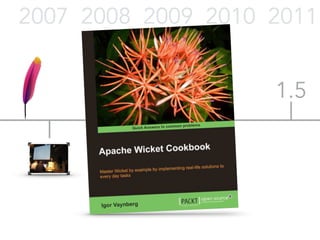
2008 2009 
1.3 
1.4 
2010 2011 
1.5
2007 
2008 2009 
1.3 
1.4 
2010 2011 
1.5
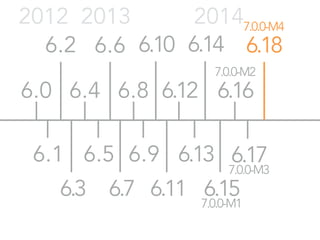
2012 
6.0 
2013 2014 
6.10 
6.14 
6.12 
6.2 
6.4 
6.6 
6.8 
6.1 6.5 6.9 
6.13 
6.11 
7.0.0-M4 
6.18 
7.0.0-M2 
6.16 
6.15 
7.0.0-M1 
6.3 6.7 
6.17 
7.0.0-M3
That's 
of Apache Wicket! 10 years
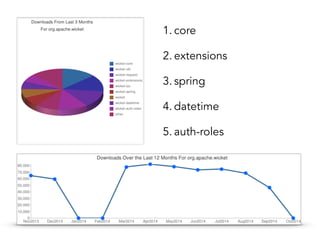
The state of Wicket
1. core 
2. extensions 
3. spring 
4. datetime 
5. auth-roles
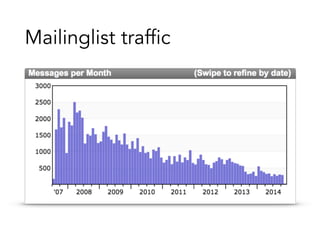
Mailinglist traffic
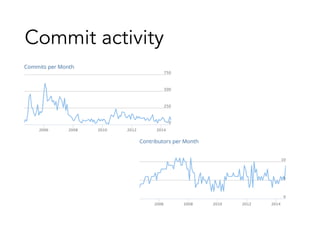
Commit activity
User Manual 
195 
25 Wicket Internals 
25.1 Page storing 
During request handling, Wicket manages page instances through interface 
org.apache.wicket.request.handler.IPageProvider. This interface creates a new page instance or 
loads a previously serialized page instance if we provide the corrisponding page id. IPageProvider delegates 
page creation and retrieval to interface org.apache.wicket.request.mapper.IPageSource. When page 
class is provided IPageSource delegates page creation to interface org.apache.wicket.IPageFactory, 
while when page id is provided it uses interface org.apache.wicket.page.IPageManager to load the 
previously serialized page. 
The following workflow diagram summarizes the mechanism seen so far: 
IPageManager 
org.apache.wicket.page.IPageManager's task is to manage which pages have been used in a request 
and store their last state in the backing stores, namely IPageStore. The default implementation 
org.apache.wicket.page.PageStoreManager collects all stateful pages which have been used in the 
request cycle (more than one page can be used in a single request if for example setResponsePage() or 
RestartResponseException is used). At the end of the request all collected page instances are being stored 
in the first level cache - http session. They are stored in http session attribute named 
"wicket:persistentPageManagerData-APPLICATION_NAME" and passed to the underlying IPageStore 
. When the next http request comes IPageProvider will ask for page with specific id and PageStoreManager 
will look first in the http session and if no match is found then it will delegate to the IPageStore. At the end of the 
second request the http session based cache is being overwritten completely with the newly used page 
instances. 
To setup another IPageManager implementat ion use 
org.apache.wicket.Application.setPageManagerProvider(IPageManagerProvider). The 
custom IPageManager implementation may or may not use IPageStore/IDataStore. 
IPageStore 
org.apache.wicket.pageStore.IPageStore's role is to mediate the storing and loading of pages done by 
the under lying IDataStore. The defaul t implementat ion 
org.apache.wicket.pageStore.DefaultPageStore pre-processes the pages before passing them to 
As you can see above, the Exception gets raised during the initialization of the WicketTester instance even 
before the actual test method gets executed. Even though we have applied rather cool and simple annotation 
based test configuration already described and passed in perfectly well prepared ApplicationContext instance to 
the WicketTester instance in the constructor, somewhere down the rabbit hole someone complained that no 
WebApplicationContext instance could have been found which seems to be required in order to initialize the 
WicketTester properly. 
The problem that we run against here is due to the fact that SpringComponentInjector during its own initialization 
is trying to get hold of an according Spring's ApplicationContext instance that would normally be there in a 
runtime environment but does not find any since we are running in a test environment currently. 
SpringComponentInjector delegates to Spring's own WebApplicationContextUtils class to retrieve the instance of 
ApplicationContext out of the ServletContext which is perfectly fine for a runtime environment but is unfortunately 
failing in a test environment: 
183 
public static WebApplicationContext getRequiredWebApplicationContext(ServletContext sc) 
throws IllegalStateException { 
WebApplicationContext wac = getWebApplicationContext(sc); 
if (wac == null) { 
throw new IllegalStateException("No WebApplicationContext found: no 
ContextLoaderListener registered?"); 
} 
return wac; 
} 
If you still remember we defined a ContextLoaderListener in our web.xml file as part of the configuration of our 
runtime environment that makes sure an according WebApplicationContext instance gets initialized and 
registered against the ServletContext properly. Luckily, this problem can easily be solved if we slightly change 
the way we initialize SpringComponentInjector in our main MyWebApplication class. Apart from the constructor 
that we have used so far, there is another constructor in the SpringComponentInjector class that expects the 
caller to provide it with an according ApplicationContext instance rather than trying to resolve one on its own: 
public SpringComponentInjector(WebApplication webapp, ApplicationContext ctx, 
boolean wrapInProxies) 
{ 
if (webapp == null) 
{ 
throw new IllegalArgumentException("Argument [[webapp]] cannot be null"); 
} 
if (ctx == null) 
{ 
throw new IllegalArgumentException("Argument [[ctx]] cannot be null"); 
} 
// store context in application's metadata … 
webapp.setMetaData(CONTEXT_KEY, new ApplicationContextHolder(ctx)); 
// … and create and register the annotation aware injector 
InjectorHolder.setInjector(new AnnotSpringInjector(new ContextLocator(),
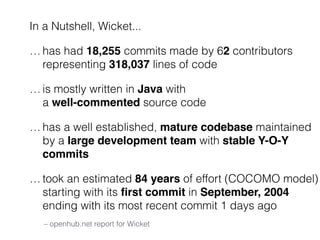
In a Nutshell, Wicket... 
…has had 18,255 commits made by 62 contributors 
representing 318,037 lines of code 
…is mostly written in Java with 
a well-commented source code 
…has a well established, mature codebase maintained 
by a large development team with stable Y-O-Y 
commits 
…took an estimated 84 years of effort (COCOMO model) 
starting with its first commit in September, 2004 
ending with its most recent commit 1 days ago 
– openhub.net report for Wicket
The future of Wicket
Wicket 1.4 
security releases only
Wicket 1.5 
security releases only
Wicket 6
java 6
semantic 
versioning
semi-monthly releases 
mainly bug fixes 
some new minor features
Wicket 7
Java 7
Servlet 3
Minor API breaks
Component queuing
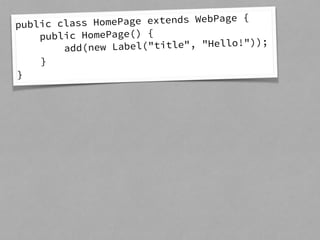
public class HomePage extends WebPage { 
public HomePage() { 
add(new Label("title", "Hello!")); 
} 
}
public class HomePage extends WebPage { 
public HomePage() { 
add(new Label("title", "Hello!")); 
} 
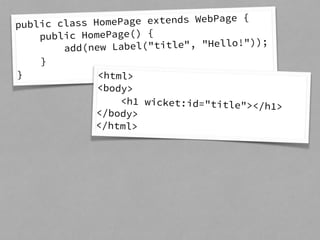
} <html> 
<body> 
<h1 wicket:id="title"></h1> 
</body> 
</html>
public class HomePage extends WebPage { 
public HomePage() { 
add(new Label("title", "Hello!")); 
} 
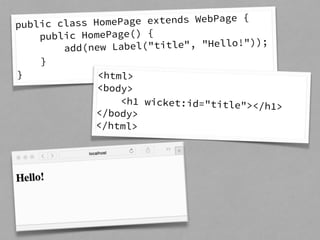
} <html> 
<body> 
<h1 wicket:id="title"></h1> 
</body> 
</html>
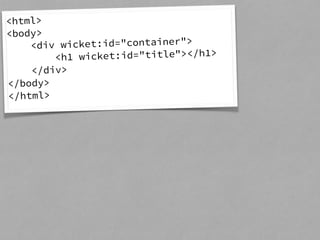
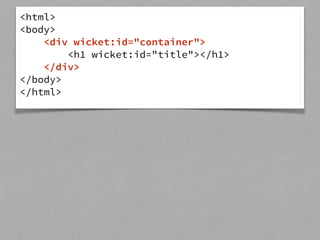
Add a <div> around content...
<html> 
<body> 
<div wicket:id="container"> 
<h1 wicket:id="title"></h1> 
</div> 
</body> 
</html>
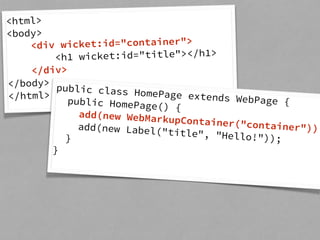
<html> 
<body> 
<div wicket:id="container"> 
<h1 wicket:id="title"></h1> 
</div> 
</body> 
</html> public class HomePage extends WebPage { 
public HomePage() { 
add(new WebMarkupContainer("container")); 
add(new Label("title", "Hello!")); 
} 
}
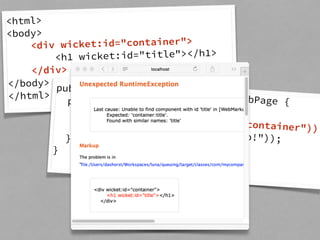
<html> 
<body> 
<div wicket:id="container"> 
<h1 wicket:id="title"></h1> 
</div> 
</body> 
</html> public class HomePage extends WebPage { 
public HomePage() { 
add(new WebMarkupContainer("container")); 
add(new Label("title", "Hello!")); 
} 
}
in Wicket 
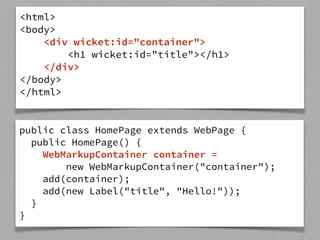
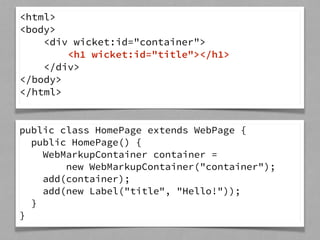
code always follows markup
<html> 
<body> 
<div wicket:id="container"> 
<h1 wicket:id="title"></h1> 
</div> 
</body> 
</html>
<html> 
<body> 
<div wicket:id="container"> 
<h1 wicket:id="title"></h1> 
</div> 
</body> 
</html> 
public class HomePage extends WebPage { 
public HomePage() { 
WebMarkupContainer container = 
new WebMarkupContainer("container"); 
add(container); 
add(new Label("title", "Hello!")); 
} 
}
<html> 
<body> 
<div wicket:id="container"> 
<h1 wicket:id="title"></h1> 
</div> 
</body> 
</html> 
public class HomePage extends WebPage { 
public HomePage() { 
WebMarkupContainer container = 
new WebMarkupContainer("container"); 
add(container); 
add(new Label("title", "Hello!")); 
} 
}
<html> 
<body> 
<div wicket:id="container"> 
<h1 wicket:id="title"></h1> 
</div> 
</body> 
</html> 
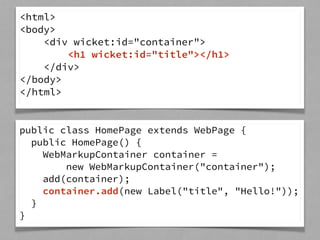
public class HomePage extends WebPage { 
public HomePage() { 
WebMarkupContainer container = 
new WebMarkupContainer("container"); 
add(container); 
container.add(new Label("title", "Hello!")); 
} 
}
in Wicket 
or does it? 
code always follows markup
Enter Component Queuing 
(coming to you in wicket 7)
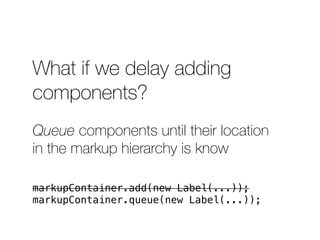
What if we delay adding 
components? 
Queue components until their location 
in the markup hierarchy is know 
markupContainer.add(new Label(...)); 
markupContainer.queue(new Label(...));
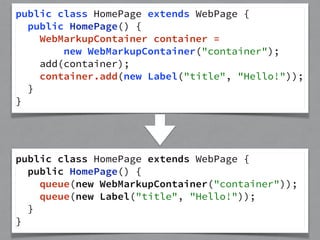
public class HomePage extends WebPage { 
public HomePage() { 
WebMarkupContainer container = 
new WebMarkupContainer("container"); 
add(container); 
container.add(new Label("title", "Hello!")); 
} 
} 
public class HomePage extends WebPage { 
public HomePage() { 
queue(new WebMarkupContainer("container")); 
queue(new Label("title", "Hello!")); 
} 
}
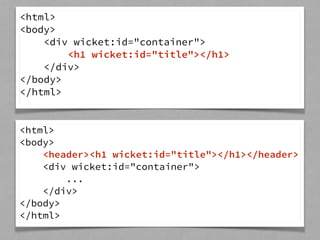
<html> 
<body> 
<div wicket:id="container"> 
<html> 
<body> 
<header><h1 wicket:id="title"></h1></header> 
<div wicket:id="container"> 
... 
</div> 
</body> 
</html> 
<h1 wicket:id="title"></h1> 
</div> 
</body> 
</html>
Limitations of 
Component Queuing
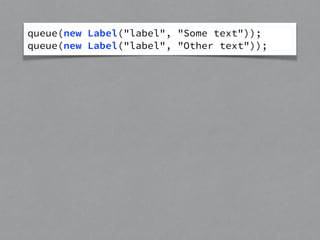
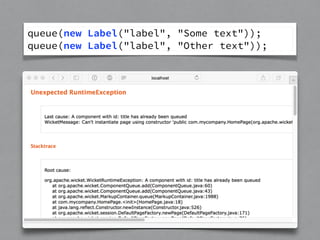
queue(new Label("label", "Some text")); 
queue(new Label("label", "Other text"));
queue(new Label("label", "Some text")); 
queue(new Label("label", "Other text"));
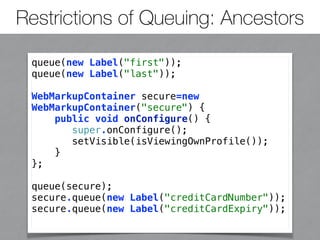
Restrictions of Queuing: Ancestors 
queue(new Label("first")); 
queue(new Label("last")); 
WebMarkupContainer secure=new 
WebMarkupContainer("secure") { 
public void onConfigure() { 
super.onConfigure(); 
setVisible(isViewingOwnProfile()); 
} 
}; 
queue(secure); 
secure.queue(new Label("creditCardNumber")); 
secure.queue(new Label("creditCardExpiry"));
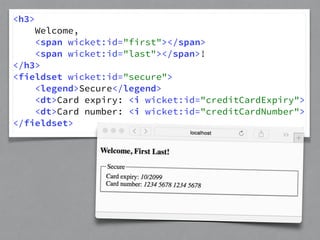
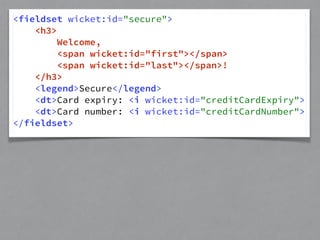
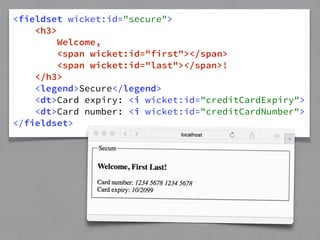
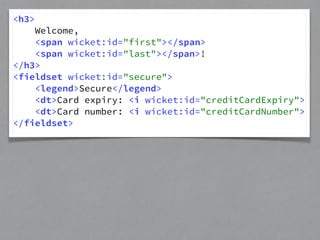
<h3> 
Welcome, 
<span wicket:id="first"></span> 
<span wicket:id="last"></span>! 
</h3> 
<fieldset wicket:id="secure"> 
<legend>Secure</legend> 
<dt>Card expiry: <i wicket:id="creditCardExpiry"> 
<dt>Card number: <i wicket:id="creditCardNumber"> 
</fieldset>
<h3> 
Welcome, 
<span wicket:id="first"></span> 
<span wicket:id="last"></span>! 
</h3> 
<fieldset wicket:id="secure"> 
<legend>Secure</legend> 
<dt>Card expiry: <i wicket:id="creditCardExpiry"> 
<dt>Card number: <i wicket:id="creditCardNumber"> 
</fieldset>
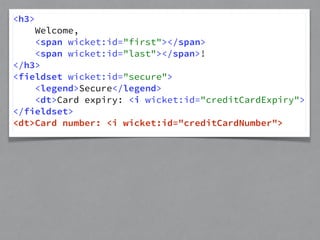
<h3> 
Welcome, 
<span wicket:id="first"></span> 
<span wicket:id="last"></span>! 
</h3> 
<fieldset wicket:id="secure"> 
<legend>Secure</legend> 
<dt>Card expiry: <i wicket:id="creditCardExpiry"> 
</fieldset> 
<dt>Card number: <i wicket:id="creditCardNumber">
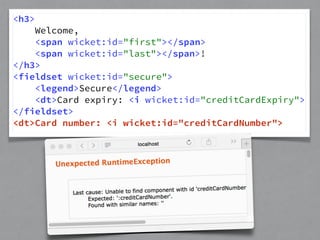
<h3> 
Welcome, 
<span wicket:id="first"></span> 
<span wicket:id="last"></span>! 
</h3> 
<fieldset wicket:id="secure"> 
<legend>Secure</legend> 
<dt>Card expiry: <i wicket:id="creditCardExpiry"> 
</fieldset> 
<dt>Card number: <i wicket:id="creditCardNumber">
<fieldset wicket:id="secure"> 
<h3> 
Welcome, 
<span wicket:id="first"></span> 
<span wicket:id="last"></span>! 
</h3> 
<legend>Secure</legend> 
<dt>Card expiry: <i wicket:id="creditCardExpiry"> 
<dt>Card number: <i wicket:id="creditCardNumber"> 
</fieldset>
<fieldset wicket:id="secure"> 
<h3> 
Welcome, 
<span wicket:id="first"></span> 
<span wicket:id="last"></span>! 
</h3> 
<legend>Secure</legend> 
<dt>Card expiry: <i wicket:id="creditCardExpiry"> 
<dt>Card number: <i wicket:id="creditCardNumber"> 
</fieldset>
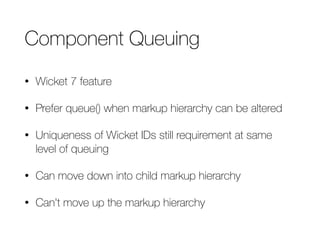
Component Queuing 
• Wicket 7 feature 
• Prefer queue() when markup hierarchy can be altered 
• Uniqueness of Wicket IDs still requirement at same 
level of queuing 
• Can move down into child markup hierarchy 
• Can't move up the markup hierarchy
Wicket 8
Java 8
PROJECT LAMBDA 
“functional” programming in 
Java
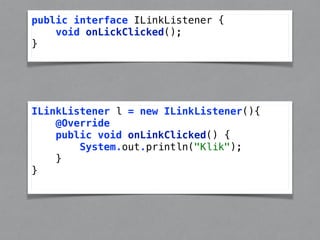
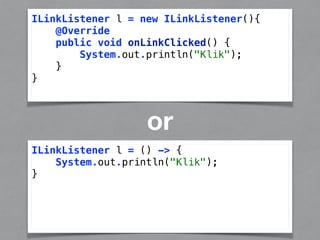
public interface ILinkListener { 
void onLickClicked(); 
} 
ILinkListener l = new ILinkListener(){ 
@Override 
public void onLinkClicked() { 
System.out.println("Klik"); 
} 
}
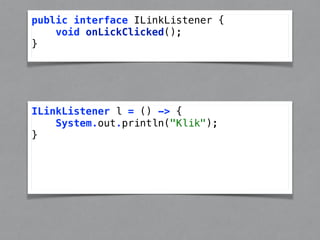
public interface ILinkListener { 
void onLickClicked(); 
} 
ILinkListener l = () -> { 
System.out.println("Klik"); 
}
ILinkListener l = new ILinkListener(){ 
ILinkListener l = () -> { 
System.out.println("Klik"); 
} 
@Override 
public void onLinkClicked() { 
System.out.println("Klik"); 
} 
} 
or
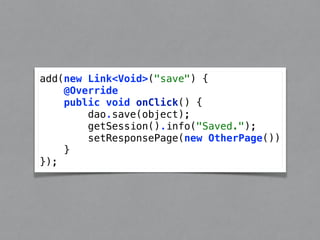
add(new Link<Void>("save") { 
@Override 
public void onClick() { 
dao.save(object); 
getSession().info("Saved."); 
setResponsePage(new OtherPage()) 
} 
});
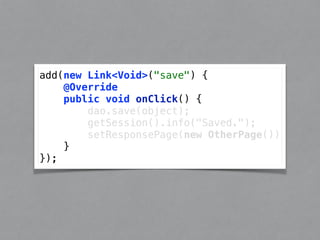
add(new Link<Void>("save") { 
@Override 
public void onClick() { 
dao.save(object); 
getSession().info("Saved."); 
setResponsePage(new OtherPage()) 
} 
});
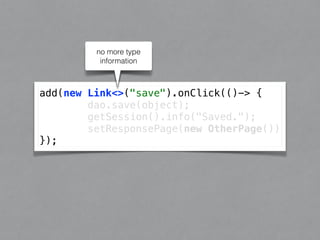
add(new Link<>("save").onClick(()-> { 
dao.save(object); 
getSession().info("Saved."); 
setResponsePage(new OtherPage()) 
}); 
no more type 
information
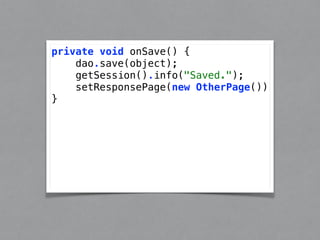
private void onSave() { 
dao.save(object); 
getSession().info("Saved."); 
setResponsePage(new OtherPage()) 
}
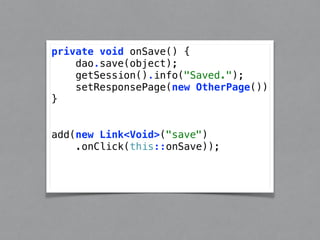
private void onSave() { 
dao.save(object); 
getSession().info("Saved."); 
setResponsePage(new OtherPage()) 
} 
add(new Link<Void>("save") 
.onClick(this::onSave));
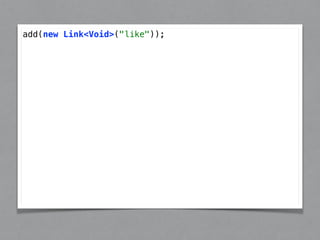
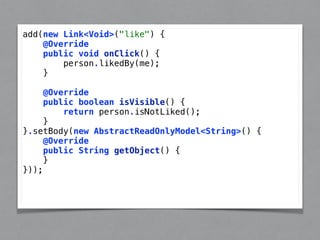
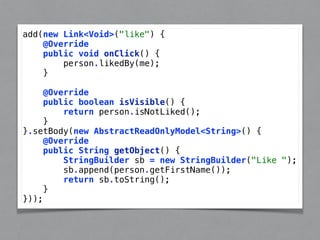
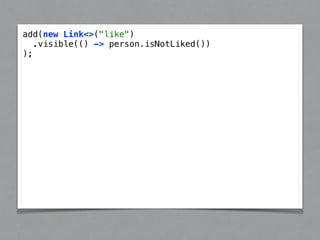
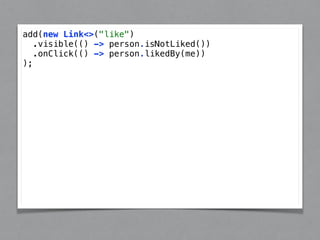
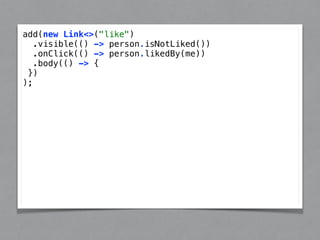
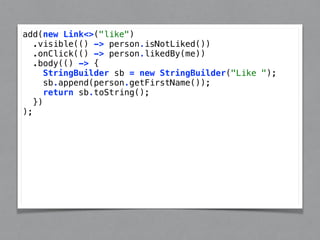
A link with onclick, visibility and 
body
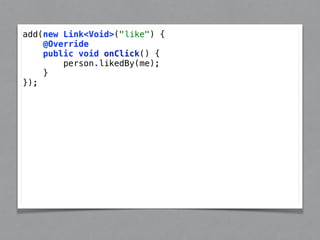
add(new Link<Void>("like"));
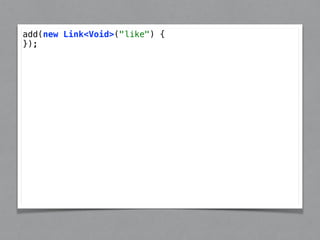
add(new Link<Void>("like") { 
});
add(new Link<Void>("like") { 
@Override 
public void onClick() { 
person.likedBy(me); 
} 
});
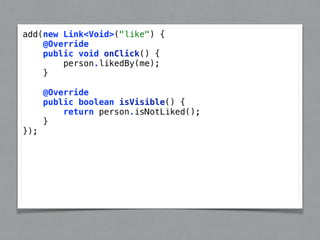
add(new Link<Void>("like") { 
@Override 
public void onClick() { 
person.likedBy(me); 
} 
@Override 
public boolean isVisible() { 
return person.isNotLiked(); 
} 
});
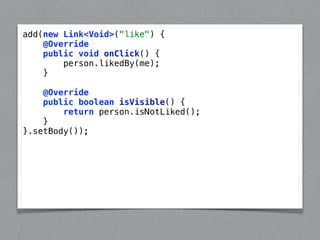
add(new Link<Void>("like") { 
@Override 
public void onClick() { 
person.likedBy(me); 
} 
@Override 
public boolean isVisible() { 
return person.isNotLiked(); 
} 
}.setBody());
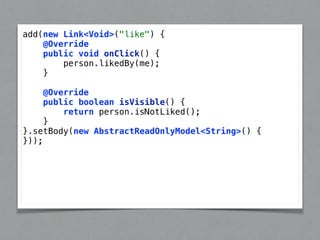
add(new Link<Void>("like") { 
@Override 
public void onClick() { 
person.likedBy(me); 
} 
@Override 
public boolean isVisible() { 
return person.isNotLiked(); 
} 
}.setBody(new AbstractReadOnlyModel<String>() { 
}));
add(new Link<Void>("like") { 
@Override 
public void onClick() { 
person.likedBy(me); 
} 
@Override 
public boolean isVisible() { 
return person.isNotLiked(); 
} 
}.setBody(new AbstractReadOnlyModel<String>() { 
@Override 
public String getObject() { 
} 
}));
add(new Link<Void>("like") { 
@Override 
public void onClick() { 
person.likedBy(me); 
} 
@Override 
public boolean isVisible() { 
return person.isNotLiked(); 
} 
}.setBody(new AbstractReadOnlyModel<String>() { 
@Override 
public String getObject() { 
StringBuilder sb = new StringBuilder("Like "); 
sb.append(person.getFirstName()); 
return sb.toString(); 
} 
}));
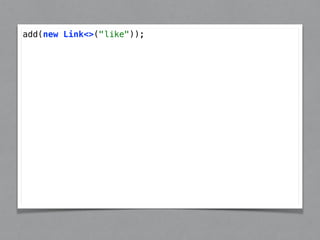
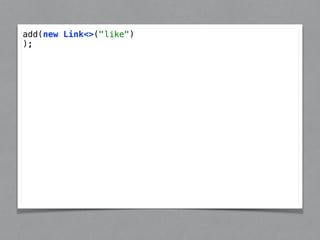
A link with onclick, visibility and 
body
add(new Link<>("like"));
add(new Link<>("like") 
);
add(new Link<>("like") 
.visible(() -> person.isNotLiked()) 
);
add(new Link<>("like") 
.visible(() -> person.isNotLiked()) 
.onClick(() -> person.likedBy(me)) 
);
add(new Link<>("like") 
.visible(() -> person.isNotLiked()) 
.onClick(() -> person.likedBy(me)) 
.body(() -> { 
}) 
);
add(new Link<>("like") 
.visible(() -> person.isNotLiked()) 
.onClick(() -> person.likedBy(me)) 
.body(() -> { 
StringBuilder sb = new StringBuilder("Like "); 
sb.append(person.getFirstName()); 
return sb.toString(); 
}) 
);
add(new Link<>("like") 
.visible(() -> person.isNotLiked()) 
.onClick(() -> person.likedBy(me)) 
.body(() -> { 
StringBuilder sb = new StringBuilder("Like "); 
sb.append(person.getFirstName()); 
return sb.toString(); 
}) 
); 
add(new Link<Void>("like") { 
@Override 
public void onClick() { 
person.likedBy(me); 
} 
@Override 
public boolean isVisible() { 
return person.isNotLiked(); 
} 
}.setBody(new AbstractReadOnlyModel<String>() { 
@Override 
public String getObject() { 
StringBuilder sb = new StringBuilder("Like "); 
sb.append(person.getFirstName()); 
return sb.toString(); 
} 
})); 
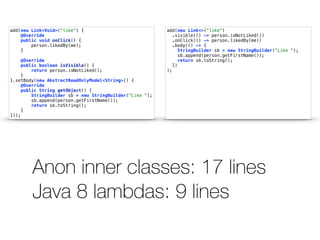
Anon inner classes: 17 lines 
Java 8 lambdas: 9 lines
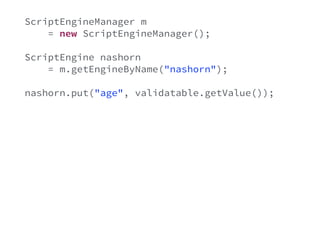
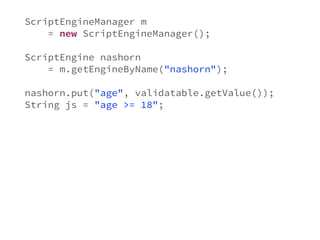
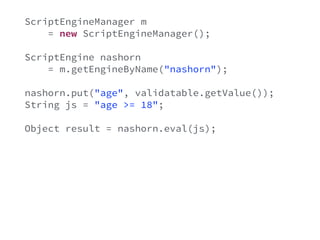
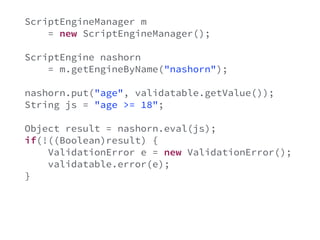
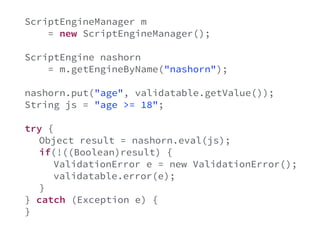
nashorn
JavaScript validation
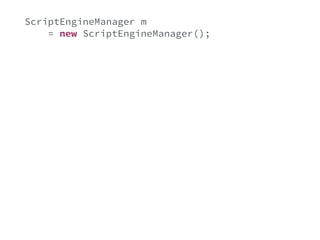
ScriptEngineManager m 
= new ScriptEngineManager(); 
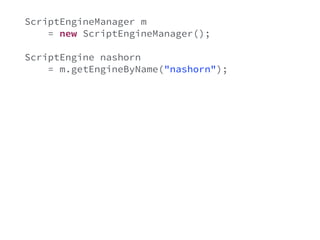
ScriptEngine nashorn 
= m.getEngineByName("nashorn"); 
nashorn.put("age", validatable.getValue()); 
String js = "age >= 18"; 
try { 
Object result = nashorn.eval(js); 
if(!((Boolean)result) { 
ValidationError e = new ValidationError(); 
validatable.error(e); 
} 
} catch(Exception e) { 
}
ScriptEngineManager m 
= new ScriptEngineManager(); 
ScriptEngine nashorn 
= m.getEngineByName("nashorn"); 
nashorn.put("age", validatable.getValue()); 
String js = "age >= 18"; 
try { 
Object result = nashorn.eval(js); 
if(!((Boolean)result) { 
ValidationError e = new ValidationError(); 
validatable.error(e); 
} 
} catch(Exception e) { 
}
ScriptEngineManager m 
= new ScriptEngineManager(); 
ScriptEngine nashorn 
= m.getEngineByName("nashorn"); 
nashorn.put("age", validatable.getValue()); 
String js = "age >= 18"; 
try { 
Object result = nashorn.eval(js); 
if(!((Boolean)result) { 
ValidationError e = new ValidationError(); 
validatable.error(e); 
} 
} catch(Exception e) { 
}
ScriptEngineManager m 
= new ScriptEngineManager(); 
ScriptEngine nashorn 
= m.getEngineByName("nashorn"); 
nashorn.put("age", validatable.getValue()); 
String js = "age >= 18"; 
try { 
Object result = nashorn.eval(js); 
if(!((Boolean)result) { 
ValidationError e = new ValidationError(); 
validatable.error(e); 
} 
} catch(Exception e) { 
}
ScriptEngineManager m 
= new ScriptEngineManager(); 
ScriptEngine nashorn 
= m.getEngineByName("nashorn"); 
nashorn.put("age", validatable.getValue()); 
String js = "age >= 18"; 
Object result = nashorn.eval(js); 
try { 
if(!((Boolean)result) { 
ValidationError e = new ValidationError(); 
validatable.error(e); 
} 
} catch(Exception e) { 
}
ScriptEngineManager m 
= new ScriptEngineManager(); 
ScriptEngine nashorn 
= m.getEngineByName("nashorn"); 
nashorn.put("age", validatable.getValue()); 
String js = "age >= 18"; 
Object result = nashorn.eval(js); 
if(!((Boolean)result) { 
ValidationError e = new ValidationError(); 
validatable.error(e); 
} 
try { 
} catch(Exception e) { 
}
ScriptEngineManager m 
= new ScriptEngineManager(); 
ScriptEngine nashorn 
= m.getEngineByName("nashorn"); 
nashorn.put("age", validatable.getValue()); 
String js = "age >= 18"; 
try { 
Object result = nashorn.eval(js); 
if(!((Boolean)result) { 
ValidationError e = new ValidationError(); 
validatable.error(e); 
} 
} catch (Exception e) { 
}
java.time
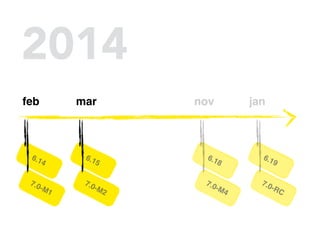
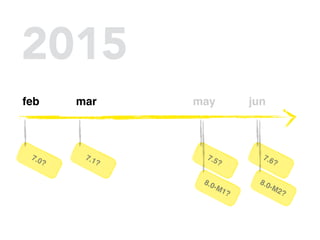
Roadmap
Monthly releases
feb mar nov 
6.14 
6.15 
7.0-M1 
7.0-M2 
6.18 
7.0-M4 
2014 
jan 
6.19 
7.0-RC
feb mar may 
7.0? 
7.1? 
7.5? 
8.0-M1? 
2015 
jun 
7.6? 
8.0-M2?
Is there a future for 
server-side frameworks?
“We continue to see teams run into trouble using 
JSF -- JavaServer Faces -- and are recommending 
you avoid this technology.” 
–ThoughtWorks Technology Radar January 2014
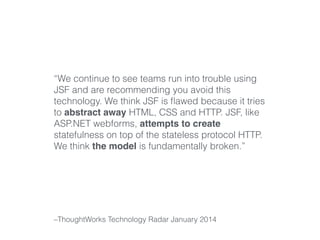
“We continue to see teams run into trouble using 
JSF -- JavaServer Faces -- and are recommending 
you avoid this technology. Teams seem to choose 
JSF because it is a J2EE standard without really 
evaluating whether the programming model suits 
them. We think JSF is flawed because it tries to 
abstract away HTML, CSS and HTTP, exactly the 
reverse of what modern web frameworks do. JSF, 
like ASP.NET webforms, attempts to create 
statefulness on top of the stateless protocol HTTP 
and ends up causing a whole host of problems 
involving shared server-side state. We are aware 
of the improvements in JSF 2.0, but think the 
model is fundamentally broken. We recommend 
teams use simple frameworks and embrace and 
understand web technologies including HTTP, 
HTML and CSS.” 
–ThoughtWorks Technology Radar January 2014
“We continue to see teams run into trouble using 
JSF and are recommending you avoid this 
technology. We think JSF is flawed because it tries 
to abstract away HTML, CSS and HTTP. JSF, like 
ASP.NET webforms, attempts to create 
statefulness on top of the stateless protocol HTTP. 
We think the model is fundamentally broken.” 
–ThoughtWorks Technology Radar January 2014
“We continue to see teams run into trouble using 
JSF and are recommending you avoid this 
technology. We think JSF is flawed because it tries 
to abstract away HTML, CSS and HTTP. JSF, like 
ASP.NET webforms, attempts to create 
statefulness on top of the stateless protocol HTTP. 
We think the model is fundamentally broken.” 
–ThoughtWorks Technology Radar January 2014
“We recommend teams use simple 
frameworks and embrace and 
understand web technologies 
including HTTP, HTML and CSS.”
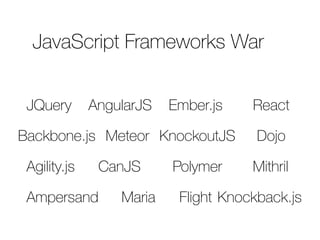
JavaScript Frameworks War 
JQuery AngularJS Ember.js React 
Backbone.js Meteor KnockoutJS Dojo 
Agility.js CanJS Polymer Mithril 
Ampersand Maria Flight Knockback.js
What is the Future for web 
development?
What is the Future for web 
development? 
Web Components
What is the Future for web 
development? 
Web Components 
AngularJS Polymer 
(2.0)
What is the Future of Wicket?
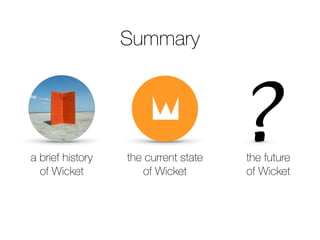
a brief history 
of Wicket 
the current state 
of Wicket 
the future 
of Wicket 
Summary
Thank you!
Questions?
contact 
@dashorst 
topicus stand

Apache Wicket: 10 jaar en verder - Martijn Dashorst

  • 1.
    APACHE WICKET ApacheWicket 10 years and beyond Martijn Dashorst topicus onderwijs @dashorst
  • 2.
    a brief history of Wicket the current state of Wicket the future of Wicket
  • 4.
  • 5.
  • 6.
    started in 2004at topicus without any knowledge of web programming
  • 7.
  • 8.
  • 9.
    using maverick velocity hibernate jasperreports
  • 10.
    lots of XMLconfiguration
  • 11.
    1 change requiresN files to be modified (for large values of N) <command name="admin.tabelbeheer.edittoetsonderdeel"> <controller class="nl.topicus.bao.web.ctrl.lab.toetsen. <view name="success" path="/admin/tabelbeheer/toetsen/e <transform path="/mlayout/mainlayout.vm"> <param name="_pagetitle" value="Beheer Tabellen </transform> </view> <view name="error" path="/admin/tabelbeheer/toetsen/edi <transform path="/mlayout/mainlayout.vm"> <param name="_pagetitle" value="Beheer Tabellen </transform> </view> <view name="list" path="admin.tabelbeheer.edittoets.m" </command>
  • 12.
  • 13.
    no back buttonsupport no multi-tab support
  • 14.
  • 15.
    little to noreuse </tr> #if($model.bean.absentieRegels.empty) <tr> <td colspan="19" class="border-r">#formname('groep.absent' </tr> #else #set($columnIndexes=[1,2,3,4,5,6,7,8,9,10]) #foreach($row in $model.bean.absentieRegels) <tr> <td class="columnvalue">$arrayTool.elementAt($row, 0)</td #foreach($index in $columnIndexes) #set($melding=$arrayTool.elementAt($row, $index))
  • 16.
    complex UI neighimpossible
  • 17.
    a framework thatmakes reuse possible, minimises configuration, server side state management easy and is as type safe as possible
  • 18.
    Action Framework AnvilApache Click Apache MyFaces Apache Shale Apache Sling Apache Struts Apache Struts 2 Apache Tapestry Apache Turbine Apache Wicket AppFuse Aranea Web Framework AribaWeb Aurora Baritus Barracuda Bento Bishop Brill Calyxo Cameleon Canyamo Caramba Cassandra Chiba Chrysalis Dinamica Dovetail DWR Echo Eclipse RAP Expresso fleXive Flower framework Folium FormEngine Genie Grails GWT Hamlets Helma Induction ItsNat Jacquard Jaffa Japple JAT JATO JBanana JBoss Seam Jeenius JFormular JOSSO JPublish JSPWidget Jspx-bay jStatemachine Jucas JVx JWAA JWarp jWic jZeno jZonic Macaw Makumba Maverick Melati Mentawai Millstone Nacho Niggle OpenEmcee OpenLaszlo OpenXava Oracle ADF OXF Pandora Playframework Pustefix Restlet RIFE Roma Meta Framework RSF Scope SerfJ Shocks Smile SOFIA Sombrero Spark Spring MVC Strecks Stripes Swinglets SwingWeb Tapestry TeaServlet ThinWire Trimpath Junction Turbine Vaadin Verge VRaptor Vroom Warfare Wavemaker WebObjects WebOnSwing WebWork wingS Xoplon Ze Framework ZK ztemplates
  • 19.
    120+ java webframeworks
  • 20.
  • 21.
    public class EditPageextends WebPage { private Person person; public EditPage(Person person) { this.person = person; add(new Button("save") { @Override public void onSubmit() { Entities.save(person); setResponsePage(new ShowPage(person)); } }); } }
  • 22.
    a framework thatmakes reuse possible, minimises configuration, server side state management easy and is as type safe as possible ✓ ✓ ✓ ✓
  • 23.
    Action Framework AnvilApache Click Apache MyFaces Apache Shale Apache Sling Apache Struts Apache Struts 2 Apache Tapestry Apache Turbine Apache Wicket AppFuse Aranea Web Framework AribaWeb Aurora Baritus Barracuda Bento Bishop Brill Calyxo Cameleon Canyamo Caramba Cassandra Chiba Chrysalis Dinamica Dovetail DWR Echo Eclipse RAP Expresso fleXive Flower framework Folium FormEngine Genie Grails GWT Hamlets Helma Induction ItsNat Jacquard Jaffa Japple JAT JATO JBanana JBoss Seam Jeenius JFormular JOSSO JPublish JSPWidget Jspx-bay jStatemachine Jucas JVx JWAA JWarp jWic jZeno jZonic Macaw Makumba Maverick Melati Mentawai Millstone Nacho Niggle OpenEmcee OpenLaszlo OpenXava Oracle ADF OXF Pandora Playframework Pustefix Restlet RIFE Roma Meta Framework RSF Scope SerfJ Shocks Smile SOFIA Sombrero Spark Spring MVC Strecks Stripes Swinglets SwingWeb Tapestry TeaServlet ThinWire Trimpath Junction Turbine Vaadin Verge VRaptor Vroom Warfare Wavemaker WebObjects WebOnSwing WebWork wingS Xoplon Ze Framework ZK ztemplates
  • 24.
    Action Framework AnvilApache Click Apache MyFaces Apache Shale Apache Sling Apache Struts Apache Struts 2 Apache Tapestry Apache Turbine Apache Wicket AppFuse Aranea Web Framework AribaWeb Aurora Baritus Barracuda Bento Bishop Brill Calyxo Cameleon Canyamo Caramba Cassandra Chiba Chrysalis Dinamica Dovetail DWR Echo Eclipse RAP Expresso fleXive Flower framework Folium FormEngine Genie Grails GWT Hamlets Helma Induction ItsNat Jacquard Jaffa Japple JAT JATO JBanana JBoss Seam Jeenius JFormular JOSSO JPublish JSPWidget Jspx-bay jStatemachine Jucas JVx JWAA JWarp jWic jZeno jZonic Macaw Makumba Maverick Melati Mentawai Millstone Nacho Niggle OpenEmcee OpenLaszlo OpenXava Oracle ADF OXF Pandora Playframework Pustefix Restlet RIFE Roma Meta Framework RSF Scope SerfJ Shocks Smile SOFIA Sombrero Spark Spring MVC Strecks Stripes Swinglets SwingWeb Tapestry TeaServlet ThinWire Trimpath Junction Turbine Vaadin Verge VRaptor Vroom Warfare Wavemaker WebObjects WebOnSwing WebWork wingS Xoplon Ze Framework ZK ztemplates
  • 25.
    15 java webframeworks alive i.e. made any release in the last year
  • 26.
  • 27.
    What is Wicket? Apache Wicket From Wikipedia, the free encyclopedia Apache Wicket, commonly referred to as Wicket, is a lightweight component-based web application framework for the Java programming language conceptually similar to JavaServer Faces and Tapestry. It was originally written by Jonathan Locke in April 2004. Version 1.0 was released in June 2005. It graduated into an Apache top-level project in June 2007.[2]
  • 28.
    A brief historyof Wicket
  • 29.
  • 30.
  • 31.
    2004 2005 codehaus.org The Server Side
  • 32.
    2004 2005 codehaus.org The Server Side
  • 33.
    2004 codehaus.org 1.0 1.1 The Server Side JavaOne 2006 1.2 2005 AJAX
  • 34.
  • 35.
  • 36.
    2007 2008 2009 1.3 1.4 2010 2011 1.5
  • 37.
    2007 2008 2009 1.3 1.4 2010 2011 1.5
  • 38.
    2012 6.0 20132014 6.10 6.14 6.12 6.2 6.4 6.6 6.8 6.1 6.5 6.9 6.13 6.11 7.0.0-M4 6.18 7.0.0-M2 6.16 6.15 7.0.0-M1 6.3 6.7 6.17 7.0.0-M3
  • 39.
    That's of ApacheWicket! 10 years
  • 40.
  • 41.
    1. core 2.extensions 3. spring 4. datetime 5. auth-roles
  • 42.
  • 43.
  • 44.
    User Manual 195 25 Wicket Internals 25.1 Page storing During request handling, Wicket manages page instances through interface org.apache.wicket.request.handler.IPageProvider. This interface creates a new page instance or loads a previously serialized page instance if we provide the corrisponding page id. IPageProvider delegates page creation and retrieval to interface org.apache.wicket.request.mapper.IPageSource. When page class is provided IPageSource delegates page creation to interface org.apache.wicket.IPageFactory, while when page id is provided it uses interface org.apache.wicket.page.IPageManager to load the previously serialized page. The following workflow diagram summarizes the mechanism seen so far: IPageManager org.apache.wicket.page.IPageManager's task is to manage which pages have been used in a request and store their last state in the backing stores, namely IPageStore. The default implementation org.apache.wicket.page.PageStoreManager collects all stateful pages which have been used in the request cycle (more than one page can be used in a single request if for example setResponsePage() or RestartResponseException is used). At the end of the request all collected page instances are being stored in the first level cache - http session. They are stored in http session attribute named "wicket:persistentPageManagerData-APPLICATION_NAME" and passed to the underlying IPageStore . When the next http request comes IPageProvider will ask for page with specific id and PageStoreManager will look first in the http session and if no match is found then it will delegate to the IPageStore. At the end of the second request the http session based cache is being overwritten completely with the newly used page instances. To setup another IPageManager implementat ion use org.apache.wicket.Application.setPageManagerProvider(IPageManagerProvider). The custom IPageManager implementation may or may not use IPageStore/IDataStore. IPageStore org.apache.wicket.pageStore.IPageStore's role is to mediate the storing and loading of pages done by the under lying IDataStore. The defaul t implementat ion org.apache.wicket.pageStore.DefaultPageStore pre-processes the pages before passing them to As you can see above, the Exception gets raised during the initialization of the WicketTester instance even before the actual test method gets executed. Even though we have applied rather cool and simple annotation based test configuration already described and passed in perfectly well prepared ApplicationContext instance to the WicketTester instance in the constructor, somewhere down the rabbit hole someone complained that no WebApplicationContext instance could have been found which seems to be required in order to initialize the WicketTester properly. The problem that we run against here is due to the fact that SpringComponentInjector during its own initialization is trying to get hold of an according Spring's ApplicationContext instance that would normally be there in a runtime environment but does not find any since we are running in a test environment currently. SpringComponentInjector delegates to Spring's own WebApplicationContextUtils class to retrieve the instance of ApplicationContext out of the ServletContext which is perfectly fine for a runtime environment but is unfortunately failing in a test environment: 183 public static WebApplicationContext getRequiredWebApplicationContext(ServletContext sc) throws IllegalStateException { WebApplicationContext wac = getWebApplicationContext(sc); if (wac == null) { throw new IllegalStateException("No WebApplicationContext found: no ContextLoaderListener registered?"); } return wac; } If you still remember we defined a ContextLoaderListener in our web.xml file as part of the configuration of our runtime environment that makes sure an according WebApplicationContext instance gets initialized and registered against the ServletContext properly. Luckily, this problem can easily be solved if we slightly change the way we initialize SpringComponentInjector in our main MyWebApplication class. Apart from the constructor that we have used so far, there is another constructor in the SpringComponentInjector class that expects the caller to provide it with an according ApplicationContext instance rather than trying to resolve one on its own: public SpringComponentInjector(WebApplication webapp, ApplicationContext ctx, boolean wrapInProxies) { if (webapp == null) { throw new IllegalArgumentException("Argument [[webapp]] cannot be null"); } if (ctx == null) { throw new IllegalArgumentException("Argument [[ctx]] cannot be null"); } // store context in application's metadata … webapp.setMetaData(CONTEXT_KEY, new ApplicationContextHolder(ctx)); // … and create and register the annotation aware injector InjectorHolder.setInjector(new AnnotSpringInjector(new ContextLocator(),
  • 45.
    In a Nutshell,Wicket... …has had 18,255 commits made by 62 contributors representing 318,037 lines of code …is mostly written in Java with a well-commented source code …has a well established, mature codebase maintained by a large development team with stable Y-O-Y commits …took an estimated 84 years of effort (COCOMO model) starting with its first commit in September, 2004 ending with its most recent commit 1 days ago – openhub.net report for Wicket
  • 50.
  • 51.
    Wicket 1.4 securityreleases only
  • 52.
    Wicket 1.5 securityreleases only
  • 53.
  • 54.
  • 55.
  • 56.
    semi-monthly releases mainlybug fixes some new minor features
  • 57.
  • 58.
  • 59.
  • 60.
  • 61.
  • 62.
    public class HomePageextends WebPage { public HomePage() { add(new Label("title", "Hello!")); } }
  • 63.
    public class HomePageextends WebPage { public HomePage() { add(new Label("title", "Hello!")); } } <html> <body> <h1 wicket:id="title"></h1> </body> </html>
  • 64.
    public class HomePageextends WebPage { public HomePage() { add(new Label("title", "Hello!")); } } <html> <body> <h1 wicket:id="title"></h1> </body> </html>
  • 65.
    Add a <div>around content...
  • 66.
    <html> <body> <divwicket:id="container"> <h1 wicket:id="title"></h1> </div> </body> </html>
  • 67.
    <html> <body> <divwicket:id="container"> <h1 wicket:id="title"></h1> </div> </body> </html> public class HomePage extends WebPage { public HomePage() { add(new WebMarkupContainer("container")); add(new Label("title", "Hello!")); } }
  • 68.
    <html> <body> <divwicket:id="container"> <h1 wicket:id="title"></h1> </div> </body> </html> public class HomePage extends WebPage { public HomePage() { add(new WebMarkupContainer("container")); add(new Label("title", "Hello!")); } }
  • 69.
    in Wicket codealways follows markup
  • 70.
    <html> <body> <divwicket:id="container"> <h1 wicket:id="title"></h1> </div> </body> </html>
  • 71.
    <html> <body> <divwicket:id="container"> <h1 wicket:id="title"></h1> </div> </body> </html> public class HomePage extends WebPage { public HomePage() { WebMarkupContainer container = new WebMarkupContainer("container"); add(container); add(new Label("title", "Hello!")); } }
  • 72.
    <html> <body> <divwicket:id="container"> <h1 wicket:id="title"></h1> </div> </body> </html> public class HomePage extends WebPage { public HomePage() { WebMarkupContainer container = new WebMarkupContainer("container"); add(container); add(new Label("title", "Hello!")); } }
  • 73.
    <html> <body> <divwicket:id="container"> <h1 wicket:id="title"></h1> </div> </body> </html> public class HomePage extends WebPage { public HomePage() { WebMarkupContainer container = new WebMarkupContainer("container"); add(container); container.add(new Label("title", "Hello!")); } }
  • 74.
    in Wicket ordoes it? code always follows markup
  • 75.
    Enter Component Queuing (coming to you in wicket 7)
  • 76.
    What if wedelay adding components? Queue components until their location in the markup hierarchy is know markupContainer.add(new Label(...)); markupContainer.queue(new Label(...));
  • 77.
    public class HomePageextends WebPage { public HomePage() { WebMarkupContainer container = new WebMarkupContainer("container"); add(container); container.add(new Label("title", "Hello!")); } } public class HomePage extends WebPage { public HomePage() { queue(new WebMarkupContainer("container")); queue(new Label("title", "Hello!")); } }
  • 78.
    <html> <body> <divwicket:id="container"> <html> <body> <header><h1 wicket:id="title"></h1></header> <div wicket:id="container"> ... </div> </body> </html> <h1 wicket:id="title"></h1> </div> </body> </html>
  • 79.
  • 80.
    queue(new Label("label", "Sometext")); queue(new Label("label", "Other text"));
  • 81.
    queue(new Label("label", "Sometext")); queue(new Label("label", "Other text"));
  • 82.
    Restrictions of Queuing:Ancestors queue(new Label("first")); queue(new Label("last")); WebMarkupContainer secure=new WebMarkupContainer("secure") { public void onConfigure() { super.onConfigure(); setVisible(isViewingOwnProfile()); } }; queue(secure); secure.queue(new Label("creditCardNumber")); secure.queue(new Label("creditCardExpiry"));
  • 83.
    <h3> Welcome, <spanwicket:id="first"></span> <span wicket:id="last"></span>! </h3> <fieldset wicket:id="secure"> <legend>Secure</legend> <dt>Card expiry: <i wicket:id="creditCardExpiry"> <dt>Card number: <i wicket:id="creditCardNumber"> </fieldset>
  • 84.
    <h3> Welcome, <spanwicket:id="first"></span> <span wicket:id="last"></span>! </h3> <fieldset wicket:id="secure"> <legend>Secure</legend> <dt>Card expiry: <i wicket:id="creditCardExpiry"> <dt>Card number: <i wicket:id="creditCardNumber"> </fieldset>
  • 85.
    <h3> Welcome, <spanwicket:id="first"></span> <span wicket:id="last"></span>! </h3> <fieldset wicket:id="secure"> <legend>Secure</legend> <dt>Card expiry: <i wicket:id="creditCardExpiry"> </fieldset> <dt>Card number: <i wicket:id="creditCardNumber">
  • 86.
    <h3> Welcome, <spanwicket:id="first"></span> <span wicket:id="last"></span>! </h3> <fieldset wicket:id="secure"> <legend>Secure</legend> <dt>Card expiry: <i wicket:id="creditCardExpiry"> </fieldset> <dt>Card number: <i wicket:id="creditCardNumber">
  • 87.
    <fieldset wicket:id="secure"> <h3> Welcome, <span wicket:id="first"></span> <span wicket:id="last"></span>! </h3> <legend>Secure</legend> <dt>Card expiry: <i wicket:id="creditCardExpiry"> <dt>Card number: <i wicket:id="creditCardNumber"> </fieldset>
  • 88.
    <fieldset wicket:id="secure"> <h3> Welcome, <span wicket:id="first"></span> <span wicket:id="last"></span>! </h3> <legend>Secure</legend> <dt>Card expiry: <i wicket:id="creditCardExpiry"> <dt>Card number: <i wicket:id="creditCardNumber"> </fieldset>
  • 89.
    Component Queuing •Wicket 7 feature • Prefer queue() when markup hierarchy can be altered • Uniqueness of Wicket IDs still requirement at same level of queuing • Can move down into child markup hierarchy • Can't move up the markup hierarchy
  • 90.
  • 91.
  • 92.
  • 93.
    public interface ILinkListener{ void onLickClicked(); } ILinkListener l = new ILinkListener(){ @Override public void onLinkClicked() { System.out.println("Klik"); } }
  • 94.
    public interface ILinkListener{ void onLickClicked(); } ILinkListener l = () -> { System.out.println("Klik"); }
  • 95.
    ILinkListener l =new ILinkListener(){ ILinkListener l = () -> { System.out.println("Klik"); } @Override public void onLinkClicked() { System.out.println("Klik"); } } or
  • 96.
    add(new Link<Void>("save") { @Override public void onClick() { dao.save(object); getSession().info("Saved."); setResponsePage(new OtherPage()) } });
  • 97.
    add(new Link<Void>("save") { @Override public void onClick() { dao.save(object); getSession().info("Saved."); setResponsePage(new OtherPage()) } });
  • 98.
    add(new Link<>("save").onClick(()-> { dao.save(object); getSession().info("Saved."); setResponsePage(new OtherPage()) }); no more type information
  • 99.
    private void onSave(){ dao.save(object); getSession().info("Saved."); setResponsePage(new OtherPage()) }
  • 100.
    private void onSave(){ dao.save(object); getSession().info("Saved."); setResponsePage(new OtherPage()) } add(new Link<Void>("save") .onClick(this::onSave));
  • 101.
    A link withonclick, visibility and body
  • 102.
  • 103.
  • 104.
    add(new Link<Void>("like") { @Override public void onClick() { person.likedBy(me); } });
  • 105.
    add(new Link<Void>("like") { @Override public void onClick() { person.likedBy(me); } @Override public boolean isVisible() { return person.isNotLiked(); } });
  • 106.
    add(new Link<Void>("like") { @Override public void onClick() { person.likedBy(me); } @Override public boolean isVisible() { return person.isNotLiked(); } }.setBody());
  • 107.
    add(new Link<Void>("like") { @Override public void onClick() { person.likedBy(me); } @Override public boolean isVisible() { return person.isNotLiked(); } }.setBody(new AbstractReadOnlyModel<String>() { }));
  • 108.
    add(new Link<Void>("like") { @Override public void onClick() { person.likedBy(me); } @Override public boolean isVisible() { return person.isNotLiked(); } }.setBody(new AbstractReadOnlyModel<String>() { @Override public String getObject() { } }));
  • 109.
    add(new Link<Void>("like") { @Override public void onClick() { person.likedBy(me); } @Override public boolean isVisible() { return person.isNotLiked(); } }.setBody(new AbstractReadOnlyModel<String>() { @Override public String getObject() { StringBuilder sb = new StringBuilder("Like "); sb.append(person.getFirstName()); return sb.toString(); } }));
  • 110.
    A link withonclick, visibility and body
  • 111.
  • 112.
  • 113.
    add(new Link<>("like") .visible(()-> person.isNotLiked()) );
  • 114.
    add(new Link<>("like") .visible(()-> person.isNotLiked()) .onClick(() -> person.likedBy(me)) );
  • 115.
    add(new Link<>("like") .visible(()-> person.isNotLiked()) .onClick(() -> person.likedBy(me)) .body(() -> { }) );
  • 116.
    add(new Link<>("like") .visible(()-> person.isNotLiked()) .onClick(() -> person.likedBy(me)) .body(() -> { StringBuilder sb = new StringBuilder("Like "); sb.append(person.getFirstName()); return sb.toString(); }) );
  • 117.
    add(new Link<>("like") .visible(()-> person.isNotLiked()) .onClick(() -> person.likedBy(me)) .body(() -> { StringBuilder sb = new StringBuilder("Like "); sb.append(person.getFirstName()); return sb.toString(); }) ); add(new Link<Void>("like") { @Override public void onClick() { person.likedBy(me); } @Override public boolean isVisible() { return person.isNotLiked(); } }.setBody(new AbstractReadOnlyModel<String>() { @Override public String getObject() { StringBuilder sb = new StringBuilder("Like "); sb.append(person.getFirstName()); return sb.toString(); } })); Anon inner classes: 17 lines Java 8 lambdas: 9 lines
  • 118.
  • 119.
  • 120.
    ScriptEngineManager m =new ScriptEngineManager(); ScriptEngine nashorn = m.getEngineByName("nashorn"); nashorn.put("age", validatable.getValue()); String js = "age >= 18"; try { Object result = nashorn.eval(js); if(!((Boolean)result) { ValidationError e = new ValidationError(); validatable.error(e); } } catch(Exception e) { }
  • 121.
    ScriptEngineManager m =new ScriptEngineManager(); ScriptEngine nashorn = m.getEngineByName("nashorn"); nashorn.put("age", validatable.getValue()); String js = "age >= 18"; try { Object result = nashorn.eval(js); if(!((Boolean)result) { ValidationError e = new ValidationError(); validatable.error(e); } } catch(Exception e) { }
  • 122.
    ScriptEngineManager m =new ScriptEngineManager(); ScriptEngine nashorn = m.getEngineByName("nashorn"); nashorn.put("age", validatable.getValue()); String js = "age >= 18"; try { Object result = nashorn.eval(js); if(!((Boolean)result) { ValidationError e = new ValidationError(); validatable.error(e); } } catch(Exception e) { }
  • 123.
    ScriptEngineManager m =new ScriptEngineManager(); ScriptEngine nashorn = m.getEngineByName("nashorn"); nashorn.put("age", validatable.getValue()); String js = "age >= 18"; try { Object result = nashorn.eval(js); if(!((Boolean)result) { ValidationError e = new ValidationError(); validatable.error(e); } } catch(Exception e) { }
  • 124.
    ScriptEngineManager m =new ScriptEngineManager(); ScriptEngine nashorn = m.getEngineByName("nashorn"); nashorn.put("age", validatable.getValue()); String js = "age >= 18"; Object result = nashorn.eval(js); try { if(!((Boolean)result) { ValidationError e = new ValidationError(); validatable.error(e); } } catch(Exception e) { }
  • 125.
    ScriptEngineManager m =new ScriptEngineManager(); ScriptEngine nashorn = m.getEngineByName("nashorn"); nashorn.put("age", validatable.getValue()); String js = "age >= 18"; Object result = nashorn.eval(js); if(!((Boolean)result) { ValidationError e = new ValidationError(); validatable.error(e); } try { } catch(Exception e) { }
  • 126.
    ScriptEngineManager m =new ScriptEngineManager(); ScriptEngine nashorn = m.getEngineByName("nashorn"); nashorn.put("age", validatable.getValue()); String js = "age >= 18"; try { Object result = nashorn.eval(js); if(!((Boolean)result) { ValidationError e = new ValidationError(); validatable.error(e); } } catch (Exception e) { }
  • 127.
  • 128.
  • 129.
  • 130.
    feb mar nov 6.14 6.15 7.0-M1 7.0-M2 6.18 7.0-M4 2014 jan 6.19 7.0-RC
  • 131.
    feb mar may 7.0? 7.1? 7.5? 8.0-M1? 2015 jun 7.6? 8.0-M2?
  • 132.
    Is there afuture for server-side frameworks?
  • 134.
    “We continue tosee teams run into trouble using JSF -- JavaServer Faces -- and are recommending you avoid this technology.” –ThoughtWorks Technology Radar January 2014
  • 135.
    “We continue tosee teams run into trouble using JSF -- JavaServer Faces -- and are recommending you avoid this technology. Teams seem to choose JSF because it is a J2EE standard without really evaluating whether the programming model suits them. We think JSF is flawed because it tries to abstract away HTML, CSS and HTTP, exactly the reverse of what modern web frameworks do. JSF, like ASP.NET webforms, attempts to create statefulness on top of the stateless protocol HTTP and ends up causing a whole host of problems involving shared server-side state. We are aware of the improvements in JSF 2.0, but think the model is fundamentally broken. We recommend teams use simple frameworks and embrace and understand web technologies including HTTP, HTML and CSS.” –ThoughtWorks Technology Radar January 2014
  • 136.
    “We continue tosee teams run into trouble using JSF and are recommending you avoid this technology. We think JSF is flawed because it tries to abstract away HTML, CSS and HTTP. JSF, like ASP.NET webforms, attempts to create statefulness on top of the stateless protocol HTTP. We think the model is fundamentally broken.” –ThoughtWorks Technology Radar January 2014
  • 137.
    “We continue tosee teams run into trouble using JSF and are recommending you avoid this technology. We think JSF is flawed because it tries to abstract away HTML, CSS and HTTP. JSF, like ASP.NET webforms, attempts to create statefulness on top of the stateless protocol HTTP. We think the model is fundamentally broken.” –ThoughtWorks Technology Radar January 2014
  • 138.
    “We recommend teamsuse simple frameworks and embrace and understand web technologies including HTTP, HTML and CSS.”
  • 139.
    JavaScript Frameworks War JQuery AngularJS Ember.js React Backbone.js Meteor KnockoutJS Dojo Agility.js CanJS Polymer Mithril Ampersand Maria Flight Knockback.js
  • 140.
    What is theFuture for web development?
  • 141.
    What is theFuture for web development? Web Components
  • 142.
    What is theFuture for web development? Web Components AngularJS Polymer (2.0)
  • 143.
    What is theFuture of Wicket?
  • 144.
    a brief history of Wicket the current state of Wicket the future of Wicket Summary
  • 145.
  • 146.
  • 147.