APA Style

   Italics
 Brackets
Parenthesis
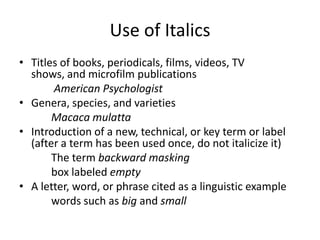
Use of Italics
• Titles of books, periodicals, films, videos, TV
  shows, and microfilm publications
       American Psychologist
• Genera, species, and varieties
       Macaca mulatta
• Introduction of a new, technical, or key term or label
  (after a term has been used once, do not italicize it)
       The term backward masking
       box labeled empty
• A letter, word, or phrase cited as a linguistic example
       words such as big and small
Use of Italics (continued)
• Words that could be misread
      the small group
      [meaning a designation, not group size]
• Letters used as statistical symbols or algebraic variables
      a/b = c/d
• Some test scores and scales
      MMPI scales: Hs, Pd
• Periodical volume numbers in reference lists
      American Psychologist, 26, 46 – 67
• Anchors of a scale
      health ratings ranged from 1 (poor) to 5 (excellent)
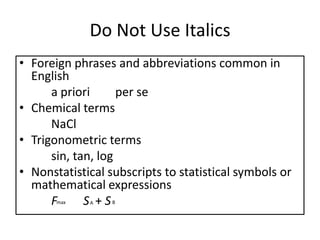
Do Not Use Italics
• Foreign phrases and abbreviations common in
  English
      a priori      per se
• Chemical terms
      NaCl
• Trigonometric terms
      sin, tan, log
• Nonstatistical subscripts to statistical symbols or
  mathematical expressions
      Fmax   S +S
             A    B
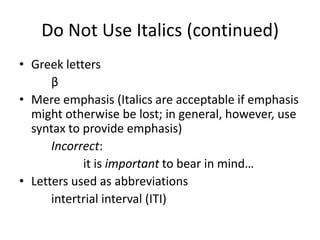
Do Not Use Italics (continued)
• Greek letters
      β
• Mere emphasis (Italics are acceptable if emphasis
  might otherwise be lost; in general, however, use
  syntax to provide emphasis)
      Incorrect:
            it is important to bear in mind…
• Letters used as abbreviations
      intertrial interval (ITI)
Use Brackets
• To enclose the values that are limits of a
  confidence interval
      95% Cls [-7.2, 4.3], [9.2, 12.4],
      and [-1.2, -0.5]
• To enclose material inserted in a quotation by
  some person other than the original writer
      “when *his own and others’+ behaviors
      were studied”
Use Brackets (continued)
• To enclose parenthetical material that is already
  within parentheses
      (The results for the control group [n = 8] are
      also presented in Figure 2.)
   Exception 1: Do not use brackets if the material can be
    set of easily with commas.
             (as lmai, 1990, later concluded)
   Exception 2: In mathematical material, the placement
    of brackets and parentheses is reversed; that
    is, patentheses appear within brackets.
Do Not User Brackets
• To set off statistics that already include
  parentheses
      Correct:
        was statistically significant, F(I, 32) = 4.37, p = 0.45
     Incorrect:
        was statistically significant (F[I, 32] = 4.37, p = 0.45)
Use Parentheses
• To set off structurally independent elements
       The patterns were statistically significant
       (see Figure 5).
• To set of reference citations in text
       Dumas and Dore (1991) reported
• To introduce an abbreviation
       effect on the galvanic skin response (GSR)
• To set off letters that identify items in a series within a
  sentence of paragraph
       The subject areas included (a) synonyms associated
       with cultural interactions, (b) descriptors for ethnic
       group membership, and © psychological symptoms.
Use Parentheses (continued)
• To group mathematical expressions
      (k – 1)/(g – 2)
• To enclose the citation or page number of a direct
  quotation
      The author stated, “The effect disappeared
      within minutes” (Lopez, 1993, p.311)
• To enclose numbers that identify displayed
  formulas and equations
      a = b + c (1)
Use Parentheses (continued)
• To enclose statistical values
      was statistically significant (p = .031)
• To enclose degrees of freedom
      F(2, 116) = 3.71
Do Not User Parentheses
• To enclose material within other parentheses
      (the Beck Depression Inventory [BDI])
      [Use brackets to avoid nested parentheses.]
• Back to back
      Correct:
            (e.g. defensive pessimism; Norem &
            Cantor, 1986)
      Incorrect:
            (e.g. defensive pessimism) (Norem &
            Cantor, 1986)

Apa style

  • 1.
    APA Style Italics Brackets Parenthesis
  • 2.
    Use of Italics •Titles of books, periodicals, films, videos, TV shows, and microfilm publications American Psychologist • Genera, species, and varieties Macaca mulatta • Introduction of a new, technical, or key term or label (after a term has been used once, do not italicize it) The term backward masking box labeled empty • A letter, word, or phrase cited as a linguistic example words such as big and small
  • 3.
    Use of Italics(continued) • Words that could be misread the small group [meaning a designation, not group size] • Letters used as statistical symbols or algebraic variables a/b = c/d • Some test scores and scales MMPI scales: Hs, Pd • Periodical volume numbers in reference lists American Psychologist, 26, 46 – 67 • Anchors of a scale health ratings ranged from 1 (poor) to 5 (excellent)
  • 4.
    Do Not UseItalics • Foreign phrases and abbreviations common in English a priori per se • Chemical terms NaCl • Trigonometric terms sin, tan, log • Nonstatistical subscripts to statistical symbols or mathematical expressions Fmax S +S A B
  • 5.
    Do Not UseItalics (continued) • Greek letters β • Mere emphasis (Italics are acceptable if emphasis might otherwise be lost; in general, however, use syntax to provide emphasis) Incorrect: it is important to bear in mind… • Letters used as abbreviations intertrial interval (ITI)
  • 6.
    Use Brackets • Toenclose the values that are limits of a confidence interval 95% Cls [-7.2, 4.3], [9.2, 12.4], and [-1.2, -0.5] • To enclose material inserted in a quotation by some person other than the original writer “when *his own and others’+ behaviors were studied”
  • 7.
    Use Brackets (continued) •To enclose parenthetical material that is already within parentheses (The results for the control group [n = 8] are also presented in Figure 2.) Exception 1: Do not use brackets if the material can be set of easily with commas. (as lmai, 1990, later concluded) Exception 2: In mathematical material, the placement of brackets and parentheses is reversed; that is, patentheses appear within brackets.
  • 8.
    Do Not UserBrackets • To set off statistics that already include parentheses Correct: was statistically significant, F(I, 32) = 4.37, p = 0.45 Incorrect: was statistically significant (F[I, 32] = 4.37, p = 0.45)
  • 9.
    Use Parentheses • Toset off structurally independent elements The patterns were statistically significant (see Figure 5). • To set of reference citations in text Dumas and Dore (1991) reported • To introduce an abbreviation effect on the galvanic skin response (GSR) • To set off letters that identify items in a series within a sentence of paragraph The subject areas included (a) synonyms associated with cultural interactions, (b) descriptors for ethnic group membership, and © psychological symptoms.
  • 10.
    Use Parentheses (continued) •To group mathematical expressions (k – 1)/(g – 2) • To enclose the citation or page number of a direct quotation The author stated, “The effect disappeared within minutes” (Lopez, 1993, p.311) • To enclose numbers that identify displayed formulas and equations a = b + c (1)
  • 11.
    Use Parentheses (continued) •To enclose statistical values was statistically significant (p = .031) • To enclose degrees of freedom F(2, 116) = 3.71
  • 12.
    Do Not UserParentheses • To enclose material within other parentheses (the Beck Depression Inventory [BDI]) [Use brackets to avoid nested parentheses.] • Back to back Correct: (e.g. defensive pessimism; Norem & Cantor, 1986) Incorrect: (e.g. defensive pessimism) (Norem & Cantor, 1986)