APA Referencing
Group Members
•Muhammad Usama Ijaz 15-EE-203
•Muhammad Usman Tariq 16-EE-134
•Haseeb Tahir 16-EE-010
Outline
1. Quotations from online resources that do not provide page
numbers.
2. The reference list.
3. Rules for reference list.
4. Rules for Books.
Quotations From Online Resources That
Do Not Provide Page Numbers
 When using direct quotes from online material provide the
author, year and page number within brackets ( ). If the page
number is not known, use a paragraph number.
 If the paragraph number could confuse the reader, consider
including a section heading e.g. discussion section.
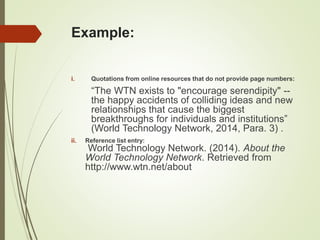
Example:
i. Quotations from online resources that do not provide page numbers:
“The WTN exists to "encourage serendipity" --
the happy accidents of colliding ideas and new
relationships that cause the biggest
breakthroughs for individuals and institutions”
(World Technology Network, 2014, Para. 3) .
ii. Reference list entry:
World Technology Network. (2014). About the
World Technology Network. Retrieved from
http://www.wtn.net/about
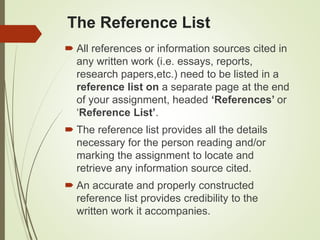
The Reference List
 All references or information sources cited in
any written work (i.e. essays, reports,
research papers,etc.) need to be listed in a
reference list on a separate page at the end
of your assignment, headed ‘References’ or
‘Reference List’.
 The reference list provides all the details
necessary for the person reading and/or
marking the assignment to locate and
retrieve any information source cited.
 An accurate and properly constructed
reference list provides credibility to the
written work it accompanies.
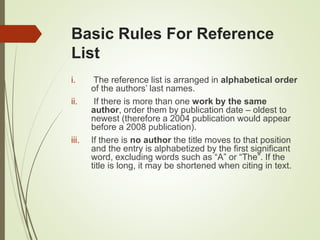
Basic Rules For Reference
List
i. The reference list is arranged in alphabetical order
of the authors’ last names.
ii. If there is more than one work by the same
author, order them by publication date – oldest to
newest (therefore a 2004 publication would appear
before a 2008 publication).
iii. If there is no author the title moves to that position
and the entry is alphabetized by the first significant
word, excluding words such as “A” or “The”. If the
title is long, it may be shortened when citing in text.
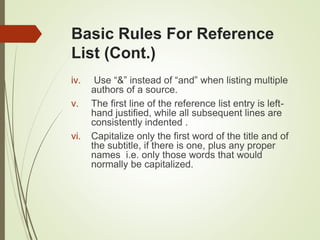
Basic Rules For Reference
List (Cont.)
iv. Use “&” instead of “and” when listing multiple
authors of a source.
v. The first line of the reference list entry is left-
hand justified, while all subsequent lines are
consistently indented .
vi. Capitalize only the first word of the title and of
the subtitle, if there is one, plus any proper
names i.e. only those words that would
normally be capitalized.
Basic Rules For Reference
List (Cont.)
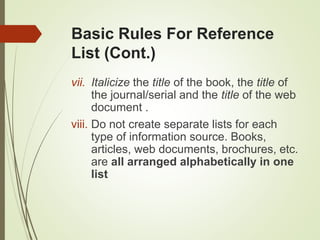
vii. Italicize the title of the book, the title of
the journal/serial and the title of the web
document .
viii. Do not create separate lists for each
type of information source. Books,
articles, web documents, brochures, etc.
are all arranged alphabetically in one
list
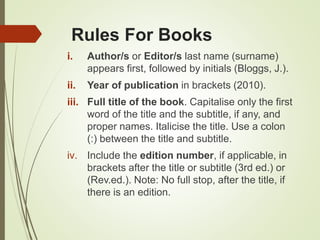
Rules For Books
i. Author/s or Editor/s last name (surname)
appears first, followed by initials (Bloggs, J.).
ii. Year of publication in brackets (2010).
iii. Full title of the book. Capitalise only the first
word of the title and the subtitle, if any, and
proper names. Italicise the title. Use a colon
(:) between the title and subtitle.
iv. Include the edition number, if applicable, in
brackets after the title or subtitle (3rd ed.) or
(Rev.ed.). Note: No full stop, after the title, if
there is an edition.
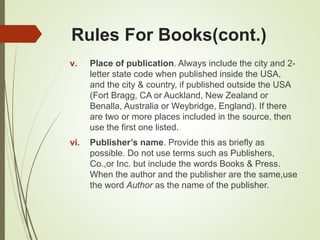
Rules For Books(cont.)
v. Place of publication. Always include the city and 2-
letter state code when published inside the USA,
and the city & country, if published outside the USA
(Fort Bragg, CA or Auckland, New Zealand or
Benalla, Australia or Weybridge, England). If there
are two or more places included in the source, then
use the first one listed.
vi. Publisher’s name. Provide this as briefly as
possible. Do not use terms such as Publishers,
Co.,or Inc. but include the words Books & Press.
When the author and the publisher are the same,use
the word Author as the name of the publisher.
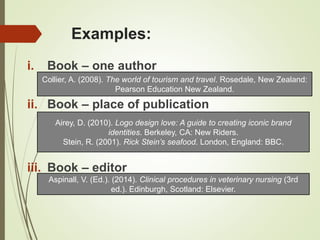
Examples:
i. Book – one author
ii. Book – place of publication
iii. Book – editor
Collier, A. (2008). The world of tourism and travel. Rosedale, New Zealand:
Pearson Education New Zealand.
Airey, D. (2010). Logo design love: A guide to creating iconic brand
identities. Berkeley, CA: New Riders.
Stein, R. (2001). Rick Stein’s seafood. London, England: BBC.
Aspinall, V. (Ed.). (2014). Clinical procedures in veterinary nursing (3rd
ed.). Edinburgh, Scotland: Elsevier.

APA referencing

  • 2.
  • 3.
    Group Members •Muhammad UsamaIjaz 15-EE-203 •Muhammad Usman Tariq 16-EE-134 •Haseeb Tahir 16-EE-010
  • 4.
    Outline 1. Quotations fromonline resources that do not provide page numbers. 2. The reference list. 3. Rules for reference list. 4. Rules for Books.
  • 5.
    Quotations From OnlineResources That Do Not Provide Page Numbers  When using direct quotes from online material provide the author, year and page number within brackets ( ). If the page number is not known, use a paragraph number.  If the paragraph number could confuse the reader, consider including a section heading e.g. discussion section.
  • 6.
    Example: i. Quotations fromonline resources that do not provide page numbers: “The WTN exists to "encourage serendipity" -- the happy accidents of colliding ideas and new relationships that cause the biggest breakthroughs for individuals and institutions” (World Technology Network, 2014, Para. 3) . ii. Reference list entry: World Technology Network. (2014). About the World Technology Network. Retrieved from http://www.wtn.net/about
  • 7.
    The Reference List All references or information sources cited in any written work (i.e. essays, reports, research papers,etc.) need to be listed in a reference list on a separate page at the end of your assignment, headed ‘References’ or ‘Reference List’.  The reference list provides all the details necessary for the person reading and/or marking the assignment to locate and retrieve any information source cited.  An accurate and properly constructed reference list provides credibility to the written work it accompanies.
  • 8.
    Basic Rules ForReference List i. The reference list is arranged in alphabetical order of the authors’ last names. ii. If there is more than one work by the same author, order them by publication date – oldest to newest (therefore a 2004 publication would appear before a 2008 publication). iii. If there is no author the title moves to that position and the entry is alphabetized by the first significant word, excluding words such as “A” or “The”. If the title is long, it may be shortened when citing in text.
  • 9.
    Basic Rules ForReference List (Cont.) iv. Use “&” instead of “and” when listing multiple authors of a source. v. The first line of the reference list entry is left- hand justified, while all subsequent lines are consistently indented . vi. Capitalize only the first word of the title and of the subtitle, if there is one, plus any proper names i.e. only those words that would normally be capitalized.
  • 10.
    Basic Rules ForReference List (Cont.) vii. Italicize the title of the book, the title of the journal/serial and the title of the web document . viii. Do not create separate lists for each type of information source. Books, articles, web documents, brochures, etc. are all arranged alphabetically in one list
  • 11.
    Rules For Books i.Author/s or Editor/s last name (surname) appears first, followed by initials (Bloggs, J.). ii. Year of publication in brackets (2010). iii. Full title of the book. Capitalise only the first word of the title and the subtitle, if any, and proper names. Italicise the title. Use a colon (:) between the title and subtitle. iv. Include the edition number, if applicable, in brackets after the title or subtitle (3rd ed.) or (Rev.ed.). Note: No full stop, after the title, if there is an edition.
  • 12.
    Rules For Books(cont.) v.Place of publication. Always include the city and 2- letter state code when published inside the USA, and the city & country, if published outside the USA (Fort Bragg, CA or Auckland, New Zealand or Benalla, Australia or Weybridge, England). If there are two or more places included in the source, then use the first one listed. vi. Publisher’s name. Provide this as briefly as possible. Do not use terms such as Publishers, Co.,or Inc. but include the words Books & Press. When the author and the publisher are the same,use the word Author as the name of the publisher.
  • 13.
    Examples: i. Book –one author ii. Book – place of publication iii. Book – editor Collier, A. (2008). The world of tourism and travel. Rosedale, New Zealand: Pearson Education New Zealand. Airey, D. (2010). Logo design love: A guide to creating iconic brand identities. Berkeley, CA: New Riders. Stein, R. (2001). Rick Stein’s seafood. London, England: BBC. Aspinall, V. (Ed.). (2014). Clinical procedures in veterinary nursing (3rd ed.). Edinburgh, Scotland: Elsevier.