APA MANUAL
6TH EDITION
PRESENTED BY - TAMANNA GUPTA
CHAPTER-1
Writing for the Behavioral and Social Sciences
This chapter discuss several considerations that authors
should weigh before writing for publication
CONTENT
1. Types of research articles
 Empirical studies
 Literature reviews
 Theoretical articles
 Methodological articles
 Case studies
 Other types of articles
2. Ethical and legal standard of publication
3. Ensuring the accuracy of scientific knowledge
 Ethical reporting of research results
 Data retention and sharing
 Duplication and piecemeal publication of data
 Plagiarism and self- plagiarism
4. Protecting the rights and welfare of research
participants
 Rights and confidentiality of research participants
 Conflict of interests
5. Protecting intellectual property rights
 Publication credit
 Reviewers
 Author’s copy rights on an unpublished
manuscript
 Planning for ethical compliance
1. TYPES OF ARTICLES
 Empirical studies
 Literature reviews
 Theoretical articles
 Methodological articles
 Case studies
 Other types of articles
EMPIRICAL STUDIES
Empirical studies are report original
research. These includes secondary
analysis that test hypothesis by
presenting novel analysis of data
not considered are addressed in
previous reports.
LITERATURE REVIEWS
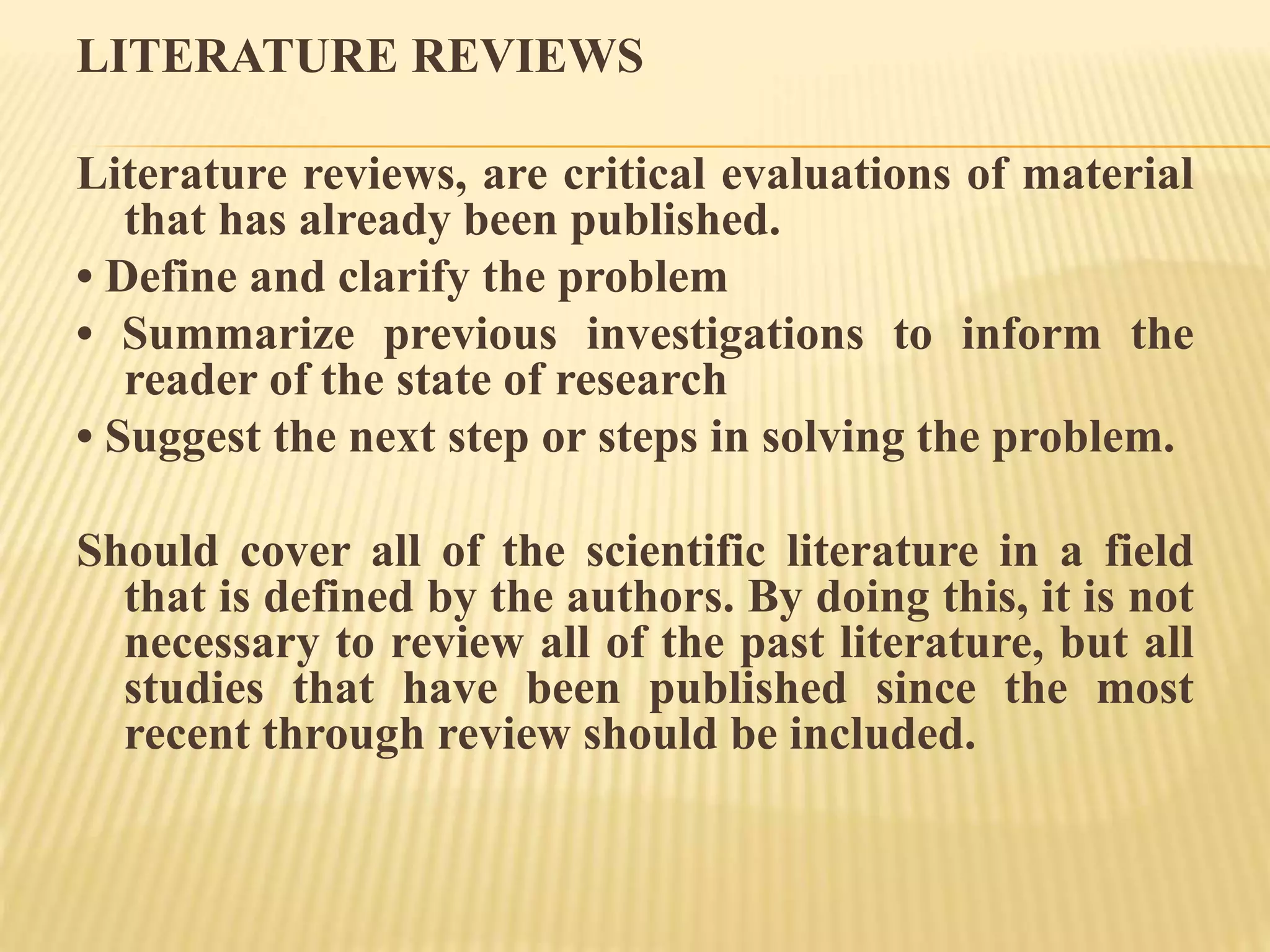
Literature reviews, are critical evaluations of material
that has already been published.
• Define and clarify the problem
• Summarize previous investigations to inform the
reader of the state of research
• Suggest the next step or steps in solving the problem.
Should cover all of the scientific literature in a field
that is defined by the authors. By doing this, it is not
necessary to review all of the past literature, but all
studies that have been published since the most
recent through review should be included.
THEORETICALARTICLES
 Present empirical information only when it
advances a theoretical issue.
 Trace the development of theory to expand or
present a new theory or analyze existing theory
 Pointing out flaws or demonstrating the advantage
of one theory over another.
 In this type of article, authors customarily
examine a theory's internal consistency and
external validity.
METHODOLOGICALARTICLES
 Present new methodological approaches,
modifications of existing .
 Provide sufficient detail for researchers to
assess the applicability of the methodology
to their research problem.
 The article allows the reader to compare
the proposed methods with those in current
use and to implement the proposed methods
CASE STUDIES
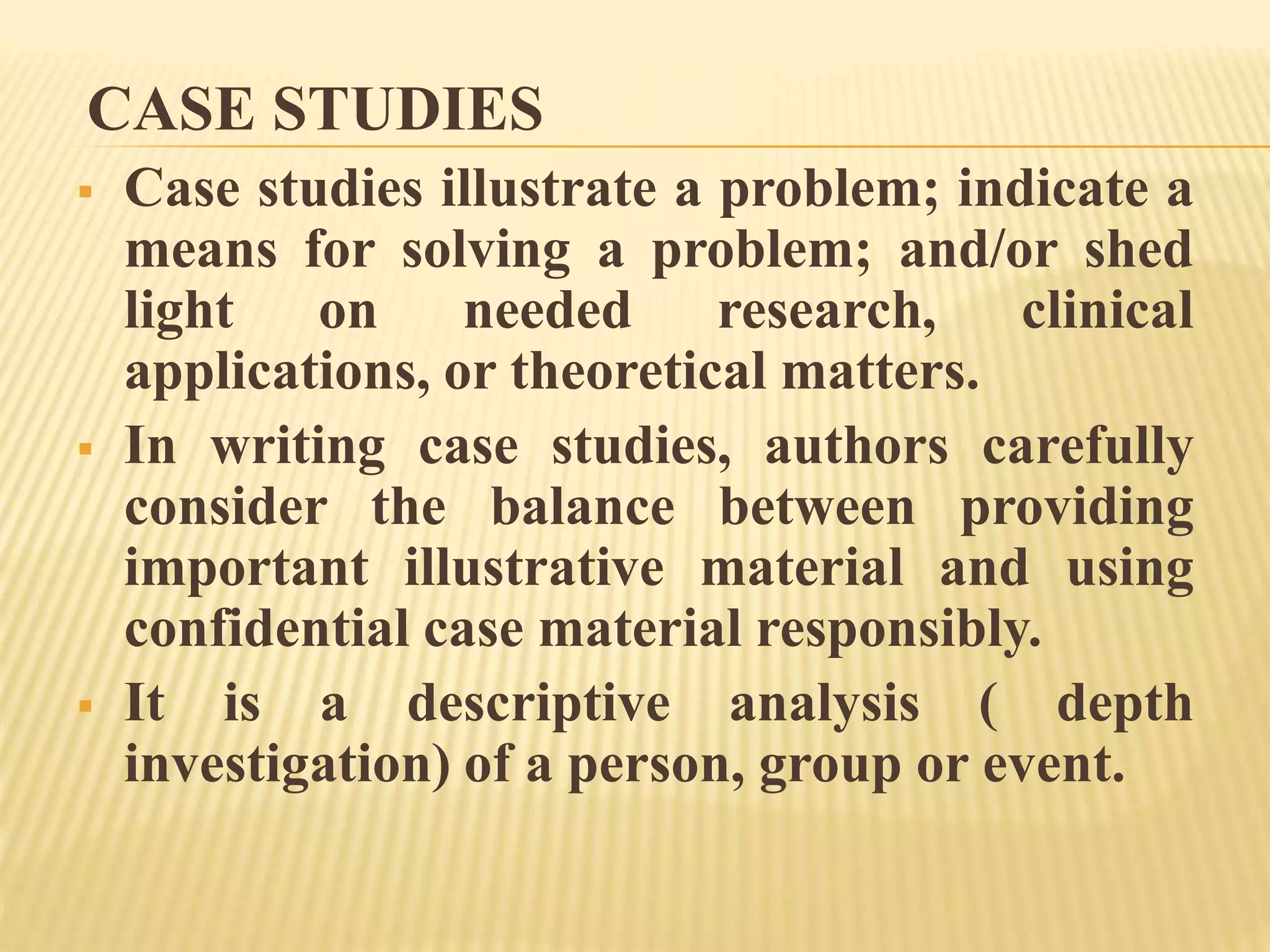
 Case studies illustrate a problem; indicate a
means for solving a problem; and/or shed
light on needed research, clinical
applications, or theoretical matters.
 In writing case studies, authors carefully
consider the balance between providing
important illustrative material and using
confidential case material responsibly.
 It is a descriptive analysis ( depth
investigation) of a person, group or event.
Other Types of Articles
 Less frequently published types of articles
include brief reports, comments and replies
on previously published articles, book
reviews, letters to the editor, and
monographs. Consult with the editor of the
journal to which you are considering
submitting the manuscript for specific
information regarding these kinds of
articles.
2. ETHICALAND LEGAL STANDARDS IN PUBLISHING
Much of the Publication Manual addresses
scientific writing style. Style involves no
inherent right or wrong. It is merely a
conventional way of presenting information
that is designed to ease communication.
• To ensure the accuracy of scientific
knowledge
• To protect the rights and welfare of research
participants
• To protect intellectual property rights.
3. ENSURING THE ACCURACY OF SCIENTIFIC KNOWLEDGE
 Ethical reporting of research results
 Data retention and sharing
 Duplication and piecemeal publication of
data
 Plagiarism and self- plagiarism
Ethical reporting of research results
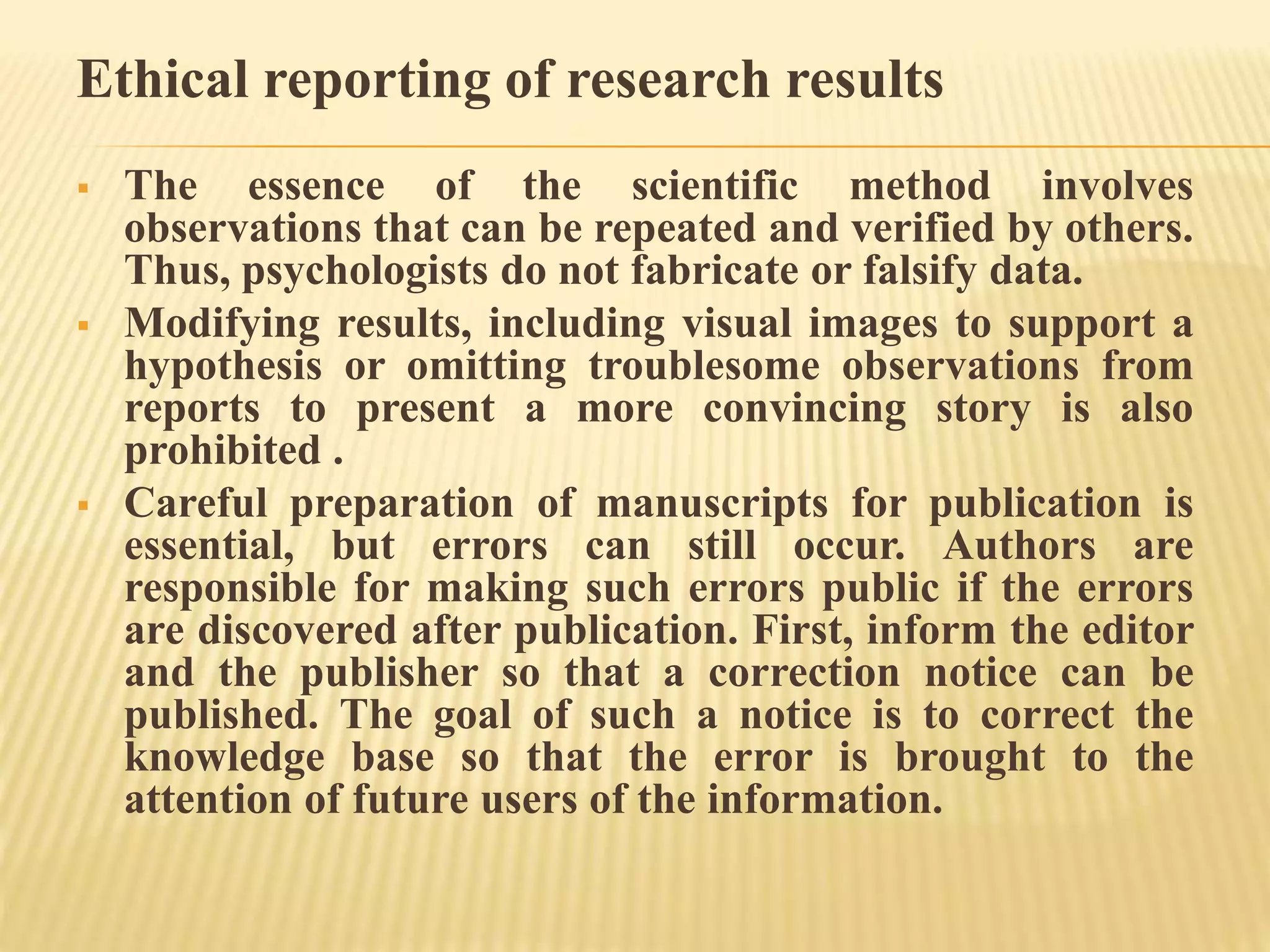
 The essence of the scientific method involves
observations that can be repeated and verified by others.
Thus, psychologists do not fabricate or falsify data.
 Modifying results, including visual images to support a
hypothesis or omitting troublesome observations from
reports to present a more convincing story is also
prohibited .
 Careful preparation of manuscripts for publication is
essential, but errors can still occur. Authors are
responsible for making such errors public if the errors
are discovered after publication. First, inform the editor
and the publisher so that a correction notice can be
published. The goal of such a notice is to correct the
knowledge base so that the error is brought to the
attention of future users of the information.
Data Retention and Sharing
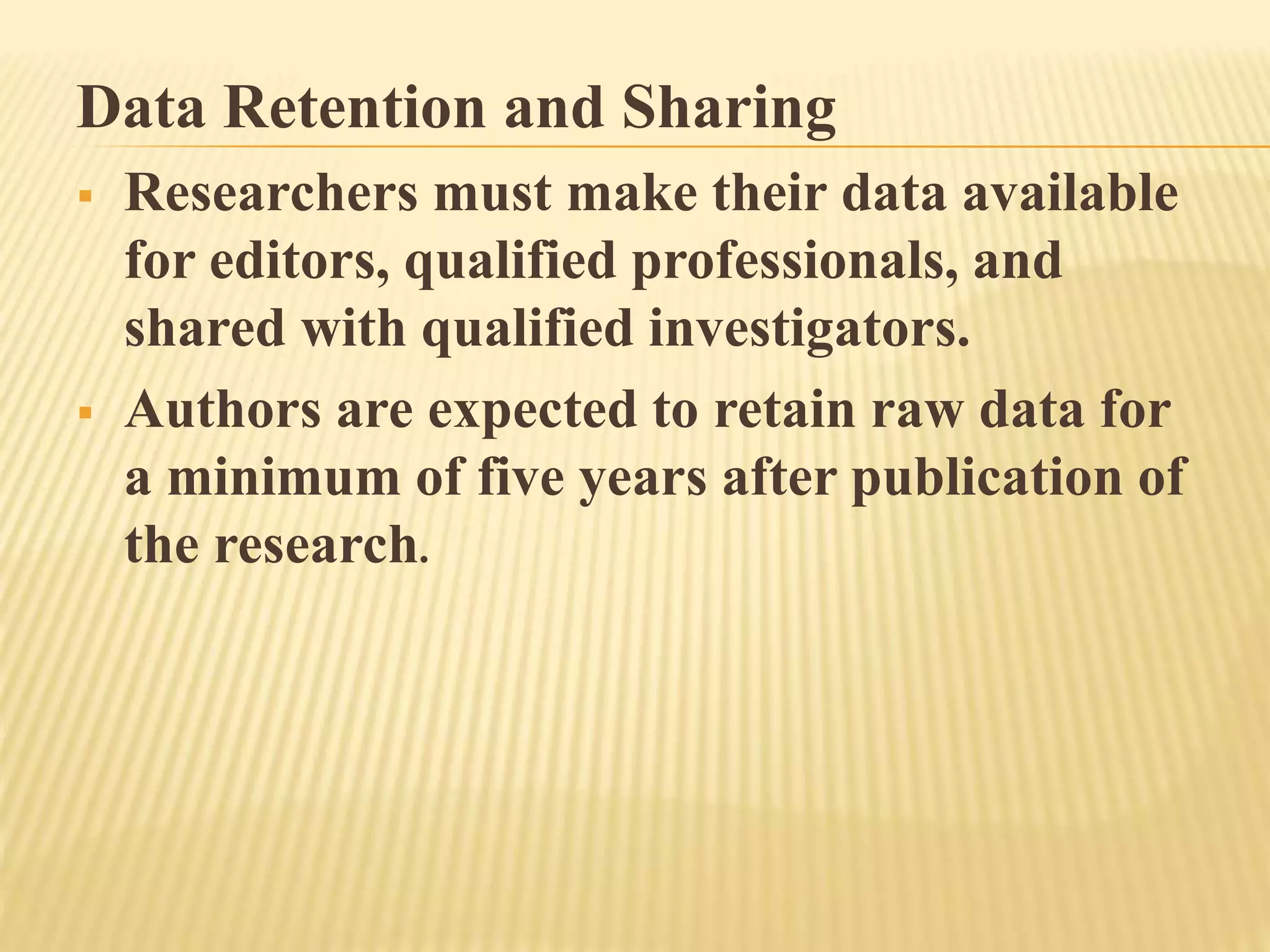
 Researchers must make their data available
for editors, qualified professionals, and
shared with qualified investigators.
 Authors are expected to retain raw data for
a minimum of five years after publication of
the research.
Duplicate and Piecemeal Publication of Data
 Duplicate publication is the publication of the same data
or ideas in two separate sources. Duplicate publication can
also lead to copyright violations; authors cannot assign the
copyright for the same material to more than one
publisher. If necessary, than acknowledging and citing
previous work.
 Piecemeal publication is the unnecessary splitting of the
findings from one research effort into multiple articles.
Data that can be meaningfully combined within a single
publication should be presented together to enhance
effective communication. Piecemeal, or fragmented,
publication of research findings can be misleading if
multiple reports appear to represent independent instances
of data collection or analyses
Plagiarism and Self-Plagiarism
 Plagiarism - Researchers do not claim the words and
ideas of another as their own; they give credit where
credit is due.
 Self – plagiarism - Just as researchers do not present
the work of others as their own (plagiarism), they do
not present their own previously published work .
When the duplicated words are limited in scope, this
approach is permissible. When duplication of one's
own words is more extensive, citation of the duplicated
words should be the norm. The author's own words
that are cited should be located in a single paragraph
or a few paragraphs, with a citation at the end of each.
4. Protecting the Rights and Welfare of Research Participants
 Rights and confidentiality of research
participants
 Conflict of interests
Rights and confidentiality of research participants
When researchers use case studies to describe
their research, they are prohibited from
disclosing "confidential, personally
identifiable information concerning their
patients, individual or organizational clients,
students, research participants, or other
recipients of their services"
Conflict of Interest
An interest is significant will depend on
individual circumstances. In general, the
safest and most open course of action is to
disclose in an author note activities and
relationships that if known to others might
be viewed as a conflict of interest, even if
you do not believe that any conflict or bias
exists.
5. Protecting Intellectual Property Rights
 Publication credit
 Reviewers
 Author’s copy rights on an unpublished
manuscript
 Planning for ethical compliance
PUBLICATION CREDIT
 Authorship is reserved for persons who
make a substantial contribution to and who
accept responsibility for a published work.
 The general rule is that the name of the
principal contributor should appear first,
with subsequent names in order of
decreasing contribution, but this convention
can vary from field to field.
REVIEWERS
During the review process, the manuscript is a
confidential. If reviewers for APA journals wish to
consult with a colleague about some aspect of the
manuscript, the reviewer must request permission
from the editor prior to approaching the colleague.
Publishers have different policies on this, and
reviewers should consult with the editor about this
matter. In addition, editors and reviewers may not
use the material from an unpublished manuscript
to advance their own or others' work without the
author's consent.
Author's Copyright on an Unpublished Manuscript
Authors are protected by federal statute
against unauthorized use of their
unpublished manuscripts. The notice need
not appear on unpublished works;
nonetheless, it is recommended that a
copyright notice be included on all works,
whether published or not. Registration of
copyright provides a public record and is
usually a prerequisite for any legal action.
PLANNING FOR ETHICAL
COMPLIANCE
Authors submitting a manuscript to an
APA journal are required to submit a
form stating their compliance with
ethical standards for publication as
well as a form disclosing any conflicts
of interest once a manuscript is
accepted.
CONCLUSION
Because of the importance of ethical issues that
affect the conduct of scientific inquiry, have
placed ethics discussions in this opening
chapter and have significantly expanded
coverage of several topics. New guidance is
included on determining authorship and terms
of collaboration, duplicate publication,
plagiarism and self-plagiarism, disguising of
participants, validity of instrumentation, and
making data available to others for
verification.
THANK YOU

APA manual PPT Chapter - 1

  • 1.
  • 2.
    CHAPTER-1 Writing for theBehavioral and Social Sciences This chapter discuss several considerations that authors should weigh before writing for publication
  • 3.
    CONTENT 1. Types ofresearch articles  Empirical studies  Literature reviews  Theoretical articles  Methodological articles  Case studies  Other types of articles 2. Ethical and legal standard of publication 3. Ensuring the accuracy of scientific knowledge  Ethical reporting of research results
  • 4.
     Data retentionand sharing  Duplication and piecemeal publication of data  Plagiarism and self- plagiarism 4. Protecting the rights and welfare of research participants  Rights and confidentiality of research participants  Conflict of interests 5. Protecting intellectual property rights  Publication credit  Reviewers  Author’s copy rights on an unpublished manuscript  Planning for ethical compliance
  • 5.
    1. TYPES OFARTICLES  Empirical studies  Literature reviews  Theoretical articles  Methodological articles  Case studies  Other types of articles
  • 6.
    EMPIRICAL STUDIES Empirical studiesare report original research. These includes secondary analysis that test hypothesis by presenting novel analysis of data not considered are addressed in previous reports.
  • 7.
    LITERATURE REVIEWS Literature reviews,are critical evaluations of material that has already been published. • Define and clarify the problem • Summarize previous investigations to inform the reader of the state of research • Suggest the next step or steps in solving the problem. Should cover all of the scientific literature in a field that is defined by the authors. By doing this, it is not necessary to review all of the past literature, but all studies that have been published since the most recent through review should be included.
  • 8.
    THEORETICALARTICLES  Present empiricalinformation only when it advances a theoretical issue.  Trace the development of theory to expand or present a new theory or analyze existing theory  Pointing out flaws or demonstrating the advantage of one theory over another.  In this type of article, authors customarily examine a theory's internal consistency and external validity.
  • 9.
    METHODOLOGICALARTICLES  Present newmethodological approaches, modifications of existing .  Provide sufficient detail for researchers to assess the applicability of the methodology to their research problem.  The article allows the reader to compare the proposed methods with those in current use and to implement the proposed methods
  • 10.
    CASE STUDIES  Casestudies illustrate a problem; indicate a means for solving a problem; and/or shed light on needed research, clinical applications, or theoretical matters.  In writing case studies, authors carefully consider the balance between providing important illustrative material and using confidential case material responsibly.  It is a descriptive analysis ( depth investigation) of a person, group or event.
  • 11.
    Other Types ofArticles  Less frequently published types of articles include brief reports, comments and replies on previously published articles, book reviews, letters to the editor, and monographs. Consult with the editor of the journal to which you are considering submitting the manuscript for specific information regarding these kinds of articles.
  • 12.
    2. ETHICALAND LEGALSTANDARDS IN PUBLISHING Much of the Publication Manual addresses scientific writing style. Style involves no inherent right or wrong. It is merely a conventional way of presenting information that is designed to ease communication. • To ensure the accuracy of scientific knowledge • To protect the rights and welfare of research participants • To protect intellectual property rights.
  • 13.
    3. ENSURING THEACCURACY OF SCIENTIFIC KNOWLEDGE  Ethical reporting of research results  Data retention and sharing  Duplication and piecemeal publication of data  Plagiarism and self- plagiarism
  • 14.
    Ethical reporting ofresearch results  The essence of the scientific method involves observations that can be repeated and verified by others. Thus, psychologists do not fabricate or falsify data.  Modifying results, including visual images to support a hypothesis or omitting troublesome observations from reports to present a more convincing story is also prohibited .  Careful preparation of manuscripts for publication is essential, but errors can still occur. Authors are responsible for making such errors public if the errors are discovered after publication. First, inform the editor and the publisher so that a correction notice can be published. The goal of such a notice is to correct the knowledge base so that the error is brought to the attention of future users of the information.
  • 15.
    Data Retention andSharing  Researchers must make their data available for editors, qualified professionals, and shared with qualified investigators.  Authors are expected to retain raw data for a minimum of five years after publication of the research.
  • 16.
    Duplicate and PiecemealPublication of Data  Duplicate publication is the publication of the same data or ideas in two separate sources. Duplicate publication can also lead to copyright violations; authors cannot assign the copyright for the same material to more than one publisher. If necessary, than acknowledging and citing previous work.  Piecemeal publication is the unnecessary splitting of the findings from one research effort into multiple articles. Data that can be meaningfully combined within a single publication should be presented together to enhance effective communication. Piecemeal, or fragmented, publication of research findings can be misleading if multiple reports appear to represent independent instances of data collection or analyses
  • 17.
    Plagiarism and Self-Plagiarism Plagiarism - Researchers do not claim the words and ideas of another as their own; they give credit where credit is due.  Self – plagiarism - Just as researchers do not present the work of others as their own (plagiarism), they do not present their own previously published work . When the duplicated words are limited in scope, this approach is permissible. When duplication of one's own words is more extensive, citation of the duplicated words should be the norm. The author's own words that are cited should be located in a single paragraph or a few paragraphs, with a citation at the end of each.
  • 18.
    4. Protecting theRights and Welfare of Research Participants  Rights and confidentiality of research participants  Conflict of interests
  • 19.
    Rights and confidentialityof research participants When researchers use case studies to describe their research, they are prohibited from disclosing "confidential, personally identifiable information concerning their patients, individual or organizational clients, students, research participants, or other recipients of their services"
  • 20.
    Conflict of Interest Aninterest is significant will depend on individual circumstances. In general, the safest and most open course of action is to disclose in an author note activities and relationships that if known to others might be viewed as a conflict of interest, even if you do not believe that any conflict or bias exists.
  • 21.
    5. Protecting IntellectualProperty Rights  Publication credit  Reviewers  Author’s copy rights on an unpublished manuscript  Planning for ethical compliance
  • 22.
    PUBLICATION CREDIT  Authorshipis reserved for persons who make a substantial contribution to and who accept responsibility for a published work.  The general rule is that the name of the principal contributor should appear first, with subsequent names in order of decreasing contribution, but this convention can vary from field to field.
  • 23.
    REVIEWERS During the reviewprocess, the manuscript is a confidential. If reviewers for APA journals wish to consult with a colleague about some aspect of the manuscript, the reviewer must request permission from the editor prior to approaching the colleague. Publishers have different policies on this, and reviewers should consult with the editor about this matter. In addition, editors and reviewers may not use the material from an unpublished manuscript to advance their own or others' work without the author's consent.
  • 24.
    Author's Copyright onan Unpublished Manuscript Authors are protected by federal statute against unauthorized use of their unpublished manuscripts. The notice need not appear on unpublished works; nonetheless, it is recommended that a copyright notice be included on all works, whether published or not. Registration of copyright provides a public record and is usually a prerequisite for any legal action.
  • 25.
    PLANNING FOR ETHICAL COMPLIANCE Authorssubmitting a manuscript to an APA journal are required to submit a form stating their compliance with ethical standards for publication as well as a form disclosing any conflicts of interest once a manuscript is accepted.
  • 26.
    CONCLUSION Because of theimportance of ethical issues that affect the conduct of scientific inquiry, have placed ethics discussions in this opening chapter and have significantly expanded coverage of several topics. New guidance is included on determining authorship and terms of collaboration, duplicate publication, plagiarism and self-plagiarism, disguising of participants, validity of instrumentation, and making data available to others for verification.
  • 27.