P R E S E N T E D B Y : - TAM AN N A G U P TA
APA MANUAL
6th EDITION
CHAPTER-8
THE PUBLICATION PROCESS
This chapter provide an overview of the journal
publishing process. We emphasize the author's
responsibilities in manuscript preparation and at each
subsequent stage of publication.
CONTENT
1. EDITORIAL PROCESS
 Peer Review
 Manuscript Acceptance or Rejection
2. AUTHOR RESPONSIBILITIES
 Preparing the Manuscript for Submission
 Complying With Ethical, Legal, and Policy Requirements
 Publisher Policy Requirements
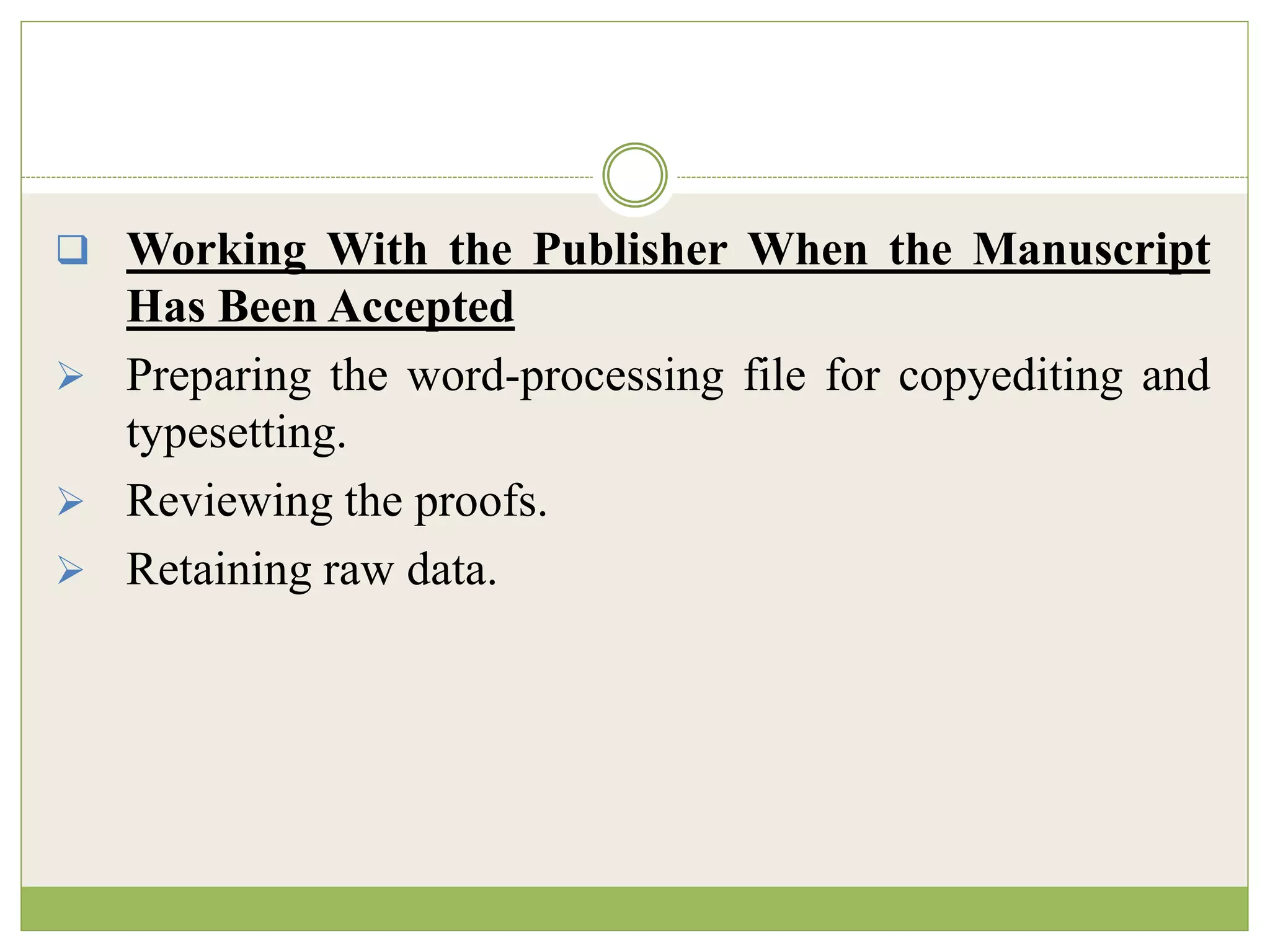
 Working With the Publisher When the Manuscript Has Been
Accepted
 Checklist for Manuscript Submission
EDITORIAL PROCESS
 Peer Review
To ensure the quality of each contribution-that the work is original,
valid, and significant-scholars in the subspecialties of a field
carefully review submitted manuscripts. By submitting a
manuscript to a peer-reviewed journal, an author implicitly
consents to the circulation and discussion of the manuscript.
During the review process, the manuscript is considered a
confidential and privileged document, but publishers differ, so
check the journal's instructions to authors.
 Reviewers: Reviewers provide scholarly input into the editorial
decision, but the decision is the action editor's alone to make.
 Masked review.
 Timing of peer review: Approximate 3 months.
 Manuscript Acceptance or Rejection
Editors may generally choose one of three actions:
1. Acceptance : Once a manuscript is accepted, it enters
into the production phase of publication.
2. Rejection : A manuscript that has been rejected by a
journal may not be revised and resubmitted to that
same journal.
3. Rejection with invitation to revise and resubmit. This
category applies to a range of manuscripts that are
judged to have a high potential for eventual publication
in the journal but that are not yet ready for final
acceptance
AUTHOR RESPONSIBILITIES
 PREPARING THE MANUSCRIPT FOR SUBMISSION
 Quality of presentation: A well-prepared manuscript encourages
editors and reviewers to view your work as professional. In
contrast, mechanical flaws sometimes lead reviewers to
misinterpret content.
 Format :
Typeface : The preferred typeface for APA publications is Times New
Roman, with 12-point font size.
Line spacing : Double-space between all text lines of the manuscript.
Margins : Leave uniform margins of at least 1 in. (2.54 cm) at the top,
bottom, left, and right of every page.
Paragraphs and indentation: Indent the first line of every paragraph
and the first line of every footnote.
 Order of manuscript pages : Arrange the pages of the manuscript as
follows:
Title page : The title page includes five elements: title, running
head, author byline, institutional affiliation, and
author note. Identify the title page with the page number 1.
Abstract : start on separate page, numbered page 2)
Text : start on a separate page, numbered page 3)
References : start on a separate page)
Tables : start each on a separate page)
Figures : start each on a separate page; include caption on
page with figure
Appendices : start each on a separate page
 Page numbers and manuscript page headers.
 Spelling check
 Cover letter :
When submitting a manuscript for consideration, enclose a letter that includes the
following elements:
• Specific details about the manuscript (title, length, number of tables and figures)
• A request for masked review, if that is an option for the journal and you choose to
use it
• Recommendations for potential reviewers or reviewers to avoid (optional)
• Information about any previous presentation of the data (e.g., at a scientific meeting)
information about the existence of any closely related manuscripts that have been
submitted for simultaneous consideration to the same or to another journal;
• Notice of any interests or activities that might be seen as influencing the research
(e.g., financial interests in a test Or procedure, funding by pharmaceutical
companies for drug research);
• Verification that the treatment of subjects (human or animal) was in accordance with
established ethical standards; and
• A copy of the permission granted to reproduce or adapt any copyrighted material
from another source or a notice that permissions are pending. (The publisher will
need copies of all granted permissions on receipt of your accepted manuscript.)
 Complying With Ethical, Legal, and Policy
Requirements
 Ethical conduct of research and conflicts of interest : When
you submit your manuscript, you may be asked to verify that
you have complied with ethical standards in the conduct of
your research.
 Permission to reprint or adapt the work of others.
 Publisher Policy Requirements
 Transfer of copyright :
When a manuscript is accepted for publication, the journal
editor sends to the author a legal form regarding
copyright and authorship. By transferring copyright,
authors permit publishers to
(a) more widely distribute the work,
(b) control reuse by others, and
(c) handle the paperwork involved in copyright registration
and administration.
 Working With the Publisher When the Manuscript
Has Been Accepted
 Preparing the word-processing file for copyediting and
typesetting.
 Reviewing the proofs.
 Retaining raw data.
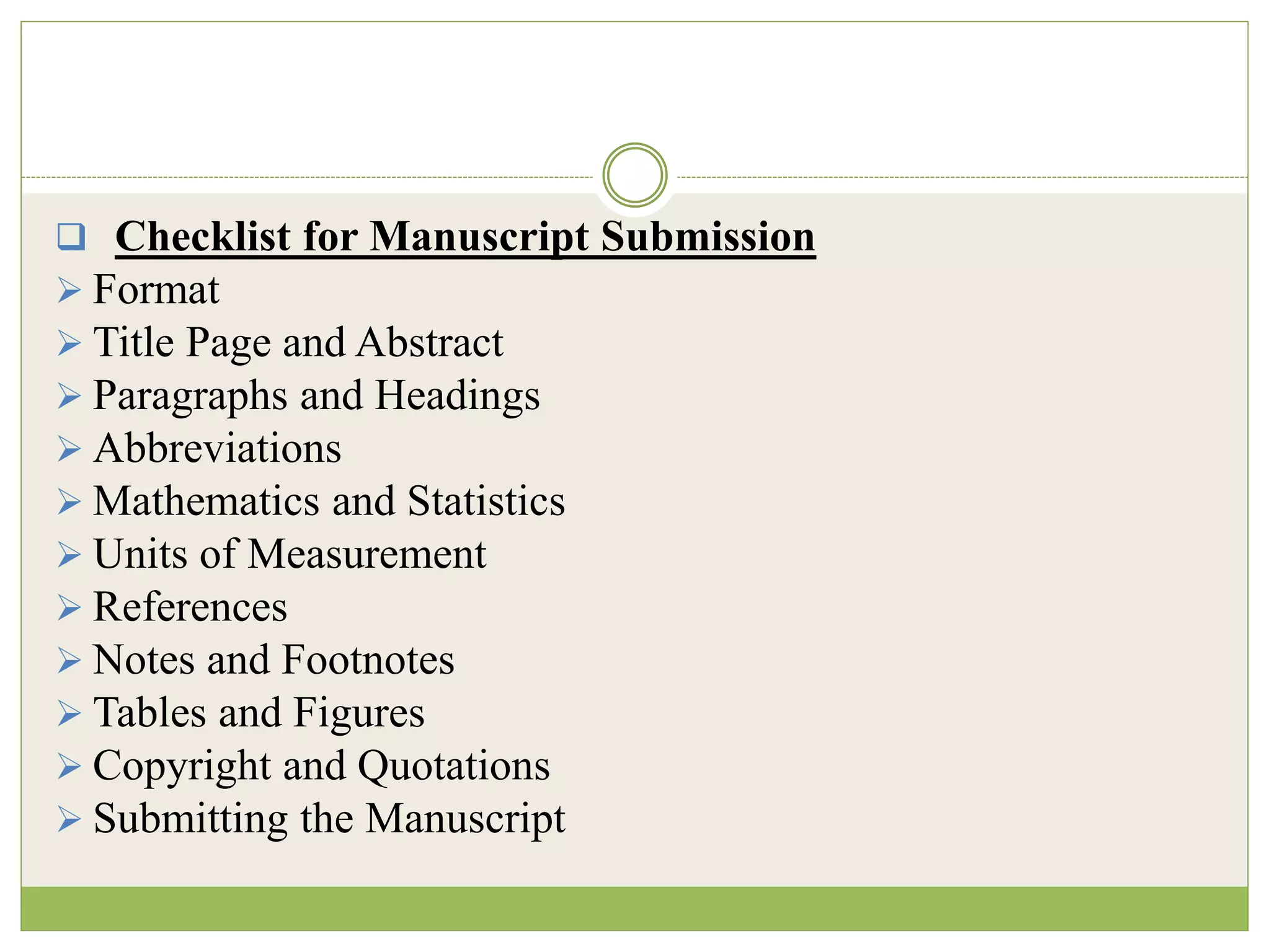
 Checklist for Manuscript Submission
 Format
 Title Page and Abstract
 Paragraphs and Headings
 Abbreviations
 Mathematics and Statistics
 Units of Measurement
 References
 Notes and Footnotes
 Tables and Figures
 Copyright and Quotations
 Submitting the Manuscript
CONCLUSION
Chapter 8 has been revised to focus more on the publication
process and less on specific APA policies and procedures. It
includes an expanded discussion of the function and process of
peer review; a discussion of ethical, legal, and policy
requirements in publication; and guidelines on working with
the publisher while the article is in press.
In this chapter, we describe the peer review process, focusing
first on how editors evaluate manuscripts. Next, we
delineate the author's responsibilities in four areas:
(a) preparing the manuscript for submission,
(b) attending to administrative and ethical responsibilities,
(c) complying with publisher policy requirements, and
(d) working with the publisher during the production process.
THANK YOU

APA Manual Chapter 8

  • 1.
    P R ES E N T E D B Y : - TAM AN N A G U P TA APA MANUAL 6th EDITION
  • 2.
    CHAPTER-8 THE PUBLICATION PROCESS Thischapter provide an overview of the journal publishing process. We emphasize the author's responsibilities in manuscript preparation and at each subsequent stage of publication.
  • 3.
    CONTENT 1. EDITORIAL PROCESS Peer Review  Manuscript Acceptance or Rejection 2. AUTHOR RESPONSIBILITIES  Preparing the Manuscript for Submission  Complying With Ethical, Legal, and Policy Requirements  Publisher Policy Requirements  Working With the Publisher When the Manuscript Has Been Accepted  Checklist for Manuscript Submission
  • 4.
    EDITORIAL PROCESS  PeerReview To ensure the quality of each contribution-that the work is original, valid, and significant-scholars in the subspecialties of a field carefully review submitted manuscripts. By submitting a manuscript to a peer-reviewed journal, an author implicitly consents to the circulation and discussion of the manuscript. During the review process, the manuscript is considered a confidential and privileged document, but publishers differ, so check the journal's instructions to authors.  Reviewers: Reviewers provide scholarly input into the editorial decision, but the decision is the action editor's alone to make.  Masked review.  Timing of peer review: Approximate 3 months.
  • 5.
     Manuscript Acceptanceor Rejection Editors may generally choose one of three actions: 1. Acceptance : Once a manuscript is accepted, it enters into the production phase of publication. 2. Rejection : A manuscript that has been rejected by a journal may not be revised and resubmitted to that same journal. 3. Rejection with invitation to revise and resubmit. This category applies to a range of manuscripts that are judged to have a high potential for eventual publication in the journal but that are not yet ready for final acceptance
  • 6.
    AUTHOR RESPONSIBILITIES  PREPARINGTHE MANUSCRIPT FOR SUBMISSION  Quality of presentation: A well-prepared manuscript encourages editors and reviewers to view your work as professional. In contrast, mechanical flaws sometimes lead reviewers to misinterpret content.  Format : Typeface : The preferred typeface for APA publications is Times New Roman, with 12-point font size. Line spacing : Double-space between all text lines of the manuscript. Margins : Leave uniform margins of at least 1 in. (2.54 cm) at the top, bottom, left, and right of every page. Paragraphs and indentation: Indent the first line of every paragraph and the first line of every footnote.
  • 7.
     Order ofmanuscript pages : Arrange the pages of the manuscript as follows: Title page : The title page includes five elements: title, running head, author byline, institutional affiliation, and author note. Identify the title page with the page number 1. Abstract : start on separate page, numbered page 2) Text : start on a separate page, numbered page 3) References : start on a separate page) Tables : start each on a separate page) Figures : start each on a separate page; include caption on page with figure Appendices : start each on a separate page  Page numbers and manuscript page headers.  Spelling check
  • 8.
     Cover letter: When submitting a manuscript for consideration, enclose a letter that includes the following elements: • Specific details about the manuscript (title, length, number of tables and figures) • A request for masked review, if that is an option for the journal and you choose to use it • Recommendations for potential reviewers or reviewers to avoid (optional) • Information about any previous presentation of the data (e.g., at a scientific meeting) information about the existence of any closely related manuscripts that have been submitted for simultaneous consideration to the same or to another journal; • Notice of any interests or activities that might be seen as influencing the research (e.g., financial interests in a test Or procedure, funding by pharmaceutical companies for drug research); • Verification that the treatment of subjects (human or animal) was in accordance with established ethical standards; and • A copy of the permission granted to reproduce or adapt any copyrighted material from another source or a notice that permissions are pending. (The publisher will need copies of all granted permissions on receipt of your accepted manuscript.)
  • 9.
     Complying WithEthical, Legal, and Policy Requirements  Ethical conduct of research and conflicts of interest : When you submit your manuscript, you may be asked to verify that you have complied with ethical standards in the conduct of your research.  Permission to reprint or adapt the work of others.
  • 10.
     Publisher PolicyRequirements  Transfer of copyright : When a manuscript is accepted for publication, the journal editor sends to the author a legal form regarding copyright and authorship. By transferring copyright, authors permit publishers to (a) more widely distribute the work, (b) control reuse by others, and (c) handle the paperwork involved in copyright registration and administration.
  • 11.
     Working Withthe Publisher When the Manuscript Has Been Accepted  Preparing the word-processing file for copyediting and typesetting.  Reviewing the proofs.  Retaining raw data.
  • 12.
     Checklist forManuscript Submission  Format  Title Page and Abstract  Paragraphs and Headings  Abbreviations  Mathematics and Statistics  Units of Measurement  References  Notes and Footnotes  Tables and Figures  Copyright and Quotations  Submitting the Manuscript
  • 13.
    CONCLUSION Chapter 8 hasbeen revised to focus more on the publication process and less on specific APA policies and procedures. It includes an expanded discussion of the function and process of peer review; a discussion of ethical, legal, and policy requirements in publication; and guidelines on working with the publisher while the article is in press. In this chapter, we describe the peer review process, focusing first on how editors evaluate manuscripts. Next, we delineate the author's responsibilities in four areas: (a) preparing the manuscript for submission, (b) attending to administrative and ethical responsibilities, (c) complying with publisher policy requirements, and (d) working with the publisher during the production process.
  • 14.