WRITING CLEARLY AND CONCISELY
This chapter provides some general principles of
expository writing and suggests ways to improve
writing style.
1. ORGANIZATION
 Length
 Organizing a Manuscript With Headings
 Levels of Heading
 Striation
2. WRITING STYLE
 Continuity in Presentation of Ideas
 Smoothness of Expression
 Tone
 Economy of Expression
 Precision and Clarity
 Linguistic Devices
 Strategies to Improve Writing Style
3. REDUCING BIAS IN LANGUAGE
4. GENERAL GUIDELINES FOR REDUCING
BIAS
 Guideline 1: Describe at the Appropriate Level of Specificity
 Guideline 2: Be Sensitive to Labels
 Guideline 3: Acknowledge Participation
5. REDUCING BIAS BY TOPIC
 Gender
 Sexual Orientation
 Racial and Ethnic Identity
 Disabilities
 Age
 Historical and Interpretive Inaccuracies
6. GRAMMAR AND USAGE
 Verbs
 Agreement of Subject and Verb
 Pronouns
 Misplaced and Dangling Modifiers and Use of Adverbs
 Relative Pronouns and Subordinate Conjunctions
 Parallel Construction
Before beginning to write, consider the best length
and structure for the findings you wish to share.
Ordering your thoughts logically, both at the
paragraph and at the sentence levels, will
strengthen the impact of your writing.
The optimal length of a manuscript is the number of pages
needed to effectively communicate the primary ideas of the
study, review, or theoretical analysis. As a rule "less is more."
If a paper is too long :-
 shorten it by stating points clearly and directly,
 confining the discussion to the specific problem under
investigation,
 deleting or combining data displays,
 eliminating repetition across sections
 writing in the active voice.
 At times, a paper may need to be divided into two or more
papers, each with a more specific focus.
 Journals differ in average length of articles published
 In scientific writing, sound organizational
structure is the key to clear, precise, and logical
communication.
 Concise headings help the reader anticipate key
points and track the development of your
argument.
 Levels of heading establish the hierarchy of
sections via format or appearance. All topics of
equal importance have the same level of heading
throughout a manuscript.
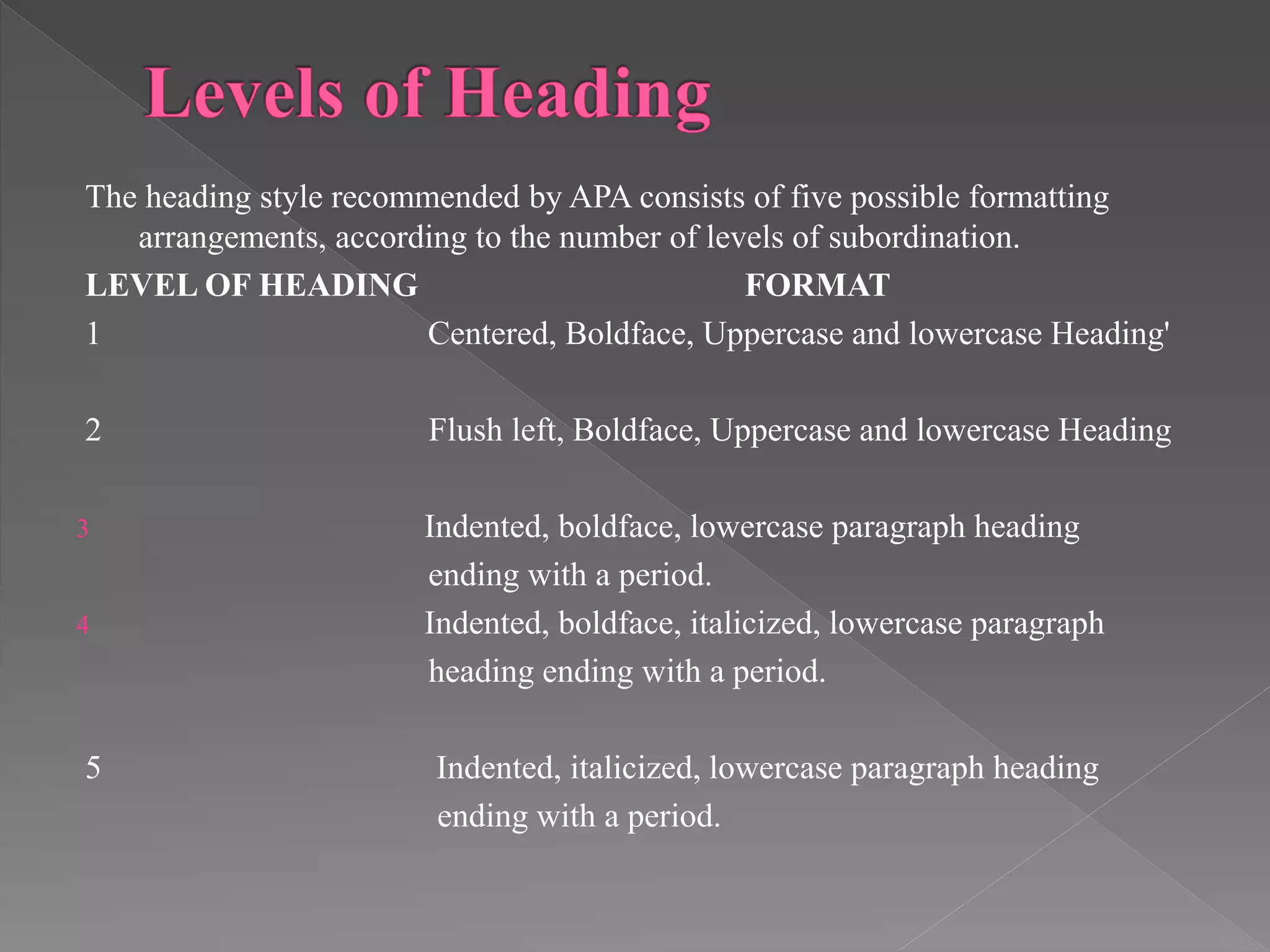
The heading style recommended by APA consists of five possible formatting
arrangements, according to the number of levels of subordination.
LEVEL OF HEADING FORMAT
1 Centered, Boldface, Uppercase and lowercase Heading'
2 Flush left, Boldface, Uppercase and lowercase Heading
3 Indented, boldface, lowercase paragraph heading
ending with a period.
4 Indented, boldface, italicized, lowercase paragraph
heading ending with a period.
5 Indented, italicized, lowercase paragraph heading
ending with a period.
Striation helps the reader understand the
organization of key points within sections,
paragraphs, and sentences.
 Within a paragraph or sentence, identify elements
in a series by lowercase letters in parentheses.
 Within a sentence, use commas to separate three
or more elements that do not have internal
commas.
 Use semicolons to separate three or more
elements that have internal commas.
The prime objective of scientific reporting is clear
communication. Establishing a tone that conveys the
essential points of the study in an interesting manner
will engage readers and communicate your ideas
more effectively.
 Continuity in presentation of ideas.
 Smoothness of expression.
 Tone
 Economy of Expression
 Precision and Clarity
 Linguistic Devices
 Strategies to Improve Writing Style
Readers will better understand the ideas continuity
in words, concepts, and thematic development
from the opening statement to the conclusion.
 Scientific prose
 Creative writing
 Clear and logical communication
 Avoid suddenly shifting the topic, tense, or
person
One effective way to achieve the right tone is to
imagine a specific reader you are intending to
reach and to write in a way that will educate and
persuade that individual.
 Say only what needs to be said
 The number of printed pages a journal can
publish is limited, and editors therefore often
request that authors shorten submitted papers.
You can tighten long papers by eliminating
redundancy, wordiness, jargon, evasiveness, over
use of the passive voice, circumlocution, and
clumsy prose.
 Word choice - Make certain that every word
means exactly what you intend it to mean.
 Colloquial expressions - Avoid colloquial
expressions which diffuse meaning.
 Jargon - it is the continuous use of a technical
vocabulary, even in places where that vocabulary
is not relevant.
 Devices that attract attention to words, sounds, or other
embellishments instead of to ideas are inappropriate in scientific
writing.
 Avoid heavy alliteration, rhyming, poetic expressions, and
clichés.
 Use metaphors sparingly; although they can help simplify
complicated Ideas, metaphors can be distracting.
 Avoid mixed metaphors and words with surplus or unintended
meaning which may distract if not actually mislead the reader.
 Use figurative expressions with restraint and colorful
expressions with care; these expressions can sound strained or
forced.
Three approaches to achieving professional and
effective communication are
(a) Writing from an outline
(b) Putting aside the first draft, then rereading it
later
(c) Asking a colleague to review and critique the
draft for you
 Scientific writing must be free of irrelevant
evaluation of the group or groups.
 Unbiased language - If writing reflects
respect for participants and readers and
write with appropriate specificity and
precision, than writing will be contributing to
the goal of accurate, unbiased
communication.
 Guideline 1: Describe at the Appropriate Level of
Specificity
Choose words that are accurate, clear, and free from
bias. The appropriate degree of specificity depends
on the research question and the present state of
knowledge in the field of study. Part of writing
without bias is recognizing that differences should be
mentioned only when relevant. Marital status, sexual
orientation, racial and ethnic identity, or the fact that
a person has a disability should not be mentioned
gratuitously.
 Guideline 2: Be Sensitive to Labels
Avoid labeling people when possible. A common
occurrence in scientific writing is that participants. In
a study tend to lose their individuality; they are
broadly categorized as objects.
 Guideline 3: Acknowledge Participation
Write about the people in your study in a way that
acknowledges their participation but is also
consistent with the traditions of the field in which
you are working.
 Gender : Avoid ambiguity in gender role by choosing
nouns, pronouns, and adjectives that specifically describe
your participants.
 Disabilities: Avoid language that objectifies a person by
her or his condition. Use people-first language to describe
groups of people with disabilities.
 Age : Age should be reported as part of the description of
participants in the Method section. Be specific in providing
age ranges; avoid open-ended definitions such as "under 18
years" or "over 65 years."
 Historical and Interpretive Inaccuracies: to avoid
historical and interpretive inaccuracies.
Incorrect grammar and careless construction of
sentences distract the reader, introduce ambiguity,
and generally obstruct communication.
 Verbs : Use the active rather than the passive voice,
and select tense or mood carefully.
 Agreement of Subject and Verb: A verb must agree
in number (i.e., singular or plural) with its subject.
 Misplaced and Dangling Modifiers and Use of
Adverbs: An adjective or an adverb, whether a
single word or a phrase, must clearly refer to the
word it modifies.
 Relative Pronouns and Subordinate
Conjunctions: Relative pronouns (who, whom, that,
which) and subordinate conjunctions (e.g., since,
while, although) introduce an element that is
subordinate to the main clause of the sentence and
reflect the relationship of the subordinate element to
the main clause. Therefore, select these pronouns and
conjunctions with care; interchanging them may
reduce the precision of your meaning.
 Parallel Construction: To enhance the reader's
understanding, present parallel ideas in parallel or
coordinate form.
In this chapter, we offer two areas with significantly changed
content. First, we have simplified APA heading style. Second,
we have updated guidelines for reducing bias in language to
reflect current practices and preferences. A new section on
presenting historical language that is inappropriate by present
standards has been added, and examples of good and bad
language choices have been expanded and moved to the web,
where they are more accessible to all and can be easily
updated.
THANK YOU

APA manual PPT CHAPTER- 3

  • 2.
    WRITING CLEARLY ANDCONCISELY This chapter provides some general principles of expository writing and suggests ways to improve writing style.
  • 3.
    1. ORGANIZATION  Length Organizing a Manuscript With Headings  Levels of Heading  Striation 2. WRITING STYLE  Continuity in Presentation of Ideas  Smoothness of Expression  Tone  Economy of Expression  Precision and Clarity  Linguistic Devices  Strategies to Improve Writing Style 3. REDUCING BIAS IN LANGUAGE
  • 4.
    4. GENERAL GUIDELINESFOR REDUCING BIAS  Guideline 1: Describe at the Appropriate Level of Specificity  Guideline 2: Be Sensitive to Labels  Guideline 3: Acknowledge Participation 5. REDUCING BIAS BY TOPIC  Gender  Sexual Orientation  Racial and Ethnic Identity  Disabilities  Age  Historical and Interpretive Inaccuracies 6. GRAMMAR AND USAGE  Verbs  Agreement of Subject and Verb  Pronouns  Misplaced and Dangling Modifiers and Use of Adverbs  Relative Pronouns and Subordinate Conjunctions  Parallel Construction
  • 5.
    Before beginning towrite, consider the best length and structure for the findings you wish to share. Ordering your thoughts logically, both at the paragraph and at the sentence levels, will strengthen the impact of your writing.
  • 6.
    The optimal lengthof a manuscript is the number of pages needed to effectively communicate the primary ideas of the study, review, or theoretical analysis. As a rule "less is more." If a paper is too long :-  shorten it by stating points clearly and directly,  confining the discussion to the specific problem under investigation,  deleting or combining data displays,  eliminating repetition across sections  writing in the active voice.  At times, a paper may need to be divided into two or more papers, each with a more specific focus.  Journals differ in average length of articles published
  • 7.
     In scientificwriting, sound organizational structure is the key to clear, precise, and logical communication.  Concise headings help the reader anticipate key points and track the development of your argument.  Levels of heading establish the hierarchy of sections via format or appearance. All topics of equal importance have the same level of heading throughout a manuscript.
  • 8.
    The heading stylerecommended by APA consists of five possible formatting arrangements, according to the number of levels of subordination. LEVEL OF HEADING FORMAT 1 Centered, Boldface, Uppercase and lowercase Heading' 2 Flush left, Boldface, Uppercase and lowercase Heading 3 Indented, boldface, lowercase paragraph heading ending with a period. 4 Indented, boldface, italicized, lowercase paragraph heading ending with a period. 5 Indented, italicized, lowercase paragraph heading ending with a period.
  • 9.
    Striation helps thereader understand the organization of key points within sections, paragraphs, and sentences.  Within a paragraph or sentence, identify elements in a series by lowercase letters in parentheses.  Within a sentence, use commas to separate three or more elements that do not have internal commas.  Use semicolons to separate three or more elements that have internal commas.
  • 10.
    The prime objectiveof scientific reporting is clear communication. Establishing a tone that conveys the essential points of the study in an interesting manner will engage readers and communicate your ideas more effectively.  Continuity in presentation of ideas.  Smoothness of expression.  Tone  Economy of Expression  Precision and Clarity  Linguistic Devices  Strategies to Improve Writing Style
  • 11.
    Readers will betterunderstand the ideas continuity in words, concepts, and thematic development from the opening statement to the conclusion.
  • 12.
     Scientific prose Creative writing  Clear and logical communication  Avoid suddenly shifting the topic, tense, or person
  • 13.
    One effective wayto achieve the right tone is to imagine a specific reader you are intending to reach and to write in a way that will educate and persuade that individual.
  • 14.
     Say onlywhat needs to be said  The number of printed pages a journal can publish is limited, and editors therefore often request that authors shorten submitted papers. You can tighten long papers by eliminating redundancy, wordiness, jargon, evasiveness, over use of the passive voice, circumlocution, and clumsy prose.
  • 15.
     Word choice- Make certain that every word means exactly what you intend it to mean.  Colloquial expressions - Avoid colloquial expressions which diffuse meaning.  Jargon - it is the continuous use of a technical vocabulary, even in places where that vocabulary is not relevant.
  • 16.
     Devices thatattract attention to words, sounds, or other embellishments instead of to ideas are inappropriate in scientific writing.  Avoid heavy alliteration, rhyming, poetic expressions, and clichés.  Use metaphors sparingly; although they can help simplify complicated Ideas, metaphors can be distracting.  Avoid mixed metaphors and words with surplus or unintended meaning which may distract if not actually mislead the reader.  Use figurative expressions with restraint and colorful expressions with care; these expressions can sound strained or forced.
  • 17.
    Three approaches toachieving professional and effective communication are (a) Writing from an outline (b) Putting aside the first draft, then rereading it later (c) Asking a colleague to review and critique the draft for you
  • 18.
     Scientific writingmust be free of irrelevant evaluation of the group or groups.  Unbiased language - If writing reflects respect for participants and readers and write with appropriate specificity and precision, than writing will be contributing to the goal of accurate, unbiased communication.
  • 19.
     Guideline 1:Describe at the Appropriate Level of Specificity Choose words that are accurate, clear, and free from bias. The appropriate degree of specificity depends on the research question and the present state of knowledge in the field of study. Part of writing without bias is recognizing that differences should be mentioned only when relevant. Marital status, sexual orientation, racial and ethnic identity, or the fact that a person has a disability should not be mentioned gratuitously.
  • 20.
     Guideline 2:Be Sensitive to Labels Avoid labeling people when possible. A common occurrence in scientific writing is that participants. In a study tend to lose their individuality; they are broadly categorized as objects.  Guideline 3: Acknowledge Participation Write about the people in your study in a way that acknowledges their participation but is also consistent with the traditions of the field in which you are working.
  • 21.
     Gender :Avoid ambiguity in gender role by choosing nouns, pronouns, and adjectives that specifically describe your participants.  Disabilities: Avoid language that objectifies a person by her or his condition. Use people-first language to describe groups of people with disabilities.  Age : Age should be reported as part of the description of participants in the Method section. Be specific in providing age ranges; avoid open-ended definitions such as "under 18 years" or "over 65 years."  Historical and Interpretive Inaccuracies: to avoid historical and interpretive inaccuracies.
  • 22.
    Incorrect grammar andcareless construction of sentences distract the reader, introduce ambiguity, and generally obstruct communication.  Verbs : Use the active rather than the passive voice, and select tense or mood carefully.  Agreement of Subject and Verb: A verb must agree in number (i.e., singular or plural) with its subject.  Misplaced and Dangling Modifiers and Use of Adverbs: An adjective or an adverb, whether a single word or a phrase, must clearly refer to the word it modifies.
  • 23.
     Relative Pronounsand Subordinate Conjunctions: Relative pronouns (who, whom, that, which) and subordinate conjunctions (e.g., since, while, although) introduce an element that is subordinate to the main clause of the sentence and reflect the relationship of the subordinate element to the main clause. Therefore, select these pronouns and conjunctions with care; interchanging them may reduce the precision of your meaning.  Parallel Construction: To enhance the reader's understanding, present parallel ideas in parallel or coordinate form.
  • 24.
    In this chapter,we offer two areas with significantly changed content. First, we have simplified APA heading style. Second, we have updated guidelines for reducing bias in language to reflect current practices and preferences. A new section on presenting historical language that is inappropriate by present standards has been added, and examples of good and bad language choices have been expanded and moved to the web, where they are more accessible to all and can be easily updated.
  • 25.