


Though the formatting for tables and
figures has not dramatically changed from
the sixth edition, a few relevant changes are
as follows:
 Tables and figures are now formatted in
parallel in other words, they use consistent
rules for titles, notes, and numbering.
 Tables and figures may now be presented
either in the text of the document or after
the reference list on separate pages.
 PURPOSE:
The purpose of tables and
figures in documents is to
enhance your readers'
understanding of the information
in the document; usually, large
amounts of information can be
communicated more efficiently in
tables or figures.
1. Necessity
Visual material such as tables and figures
can be used quickly and efficiently to
present a large amount of information to an
audience, but visuals must be used to assist
communication, not to use up space, or
disguise marginally significant results behind
a screen of complicated statistics.
2. Relation of Tables or Figures and Text
Because tables and figures supplement
the text, refer in the text to all tables and
figures used and explain what the reader
should look for when using the table or
figure.
3. Documentation
If you are using figures, tables and/or
data from other sources, be sure to gather
all the information you will need to properly
document your sources.
4. Integrity and Independence
Each table and figure must
be intelligible without
reference to the text, so be
sure to include an explanation
of every abbreviation (except
the standard statistical symbols
and abbreviations).
5. Organization, Consistency, and Coherence
Number all tables sequentially as you
refer to them in the text (Table 1, Table 2,
etc.), likewise for figures (Figure 1, Figure 2,
etc.). Abbreviations, terminology, and
probability level values must be consistent
across tables and figures in the same article.
 Data in a table that would require only two
or fewer columns and rows should be
presented in the text. More complex data is
better presented in tabular format. In order
for quantitative data to be presented clearly
and efficiently, it must be arranged logically.
 NUMBERS
Number all tables with Arabic numerals
sequentially. Do not use suffix letters (e.g. Table
3a, 3b, 3c); instead, combine the related tables.
 TITLES
Like the title of the paper itself, each table
must have a clear and concise title. Titles should
be written in italicized title case below the table
number, with a blank line between the number
and the title. When appropriate, you may use
the title to explain an abbreviation
parenthetically.
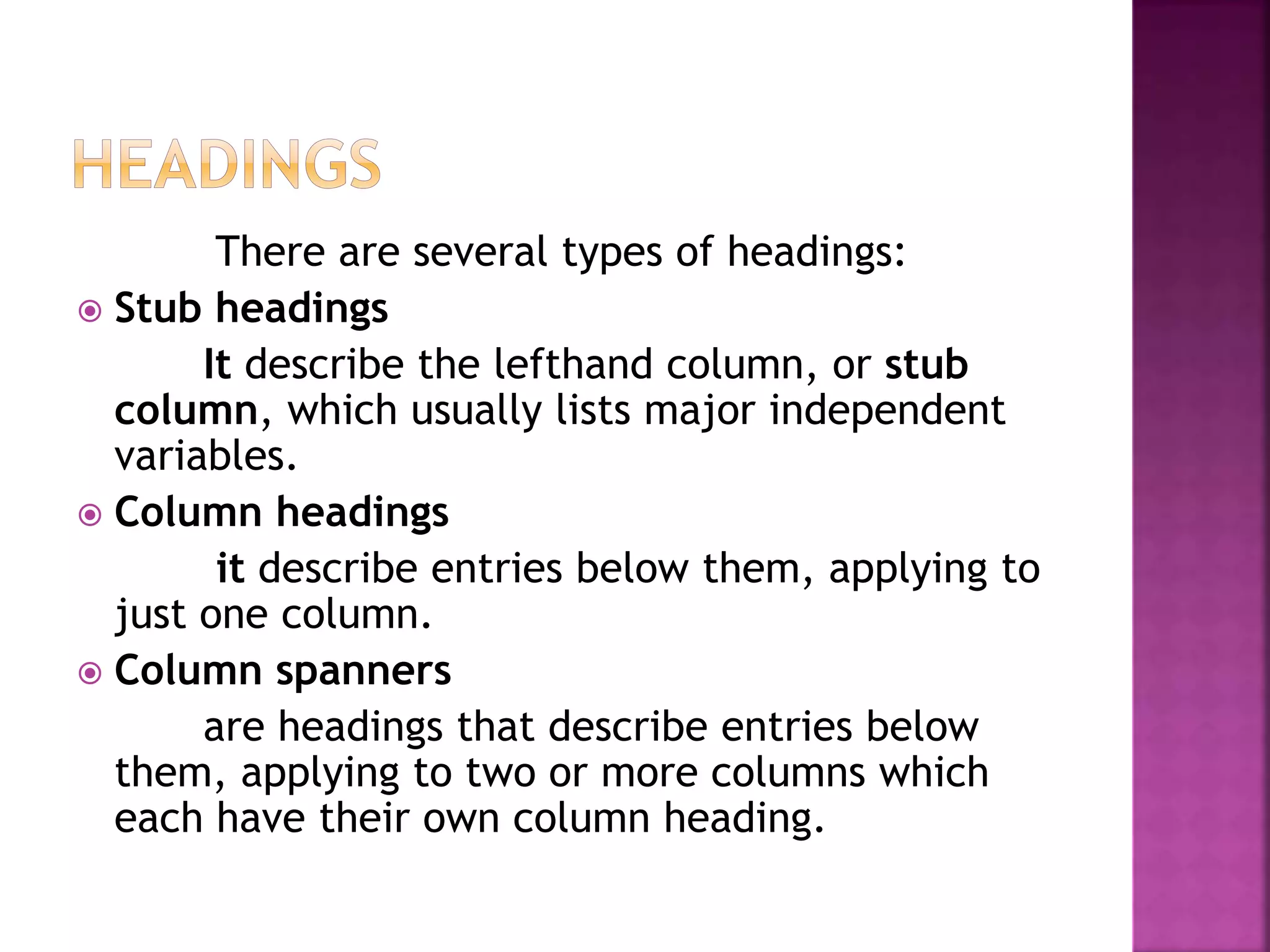
There are several types of headings:
 Stub headings
It describe the lefthand column, or stub
column, which usually lists major independent
variables.
 Column headings
it describe entries below them, applying to
just one column.
 Column spanners
are headings that describe entries below
them, applying to two or more columns which
each have their own column heading.
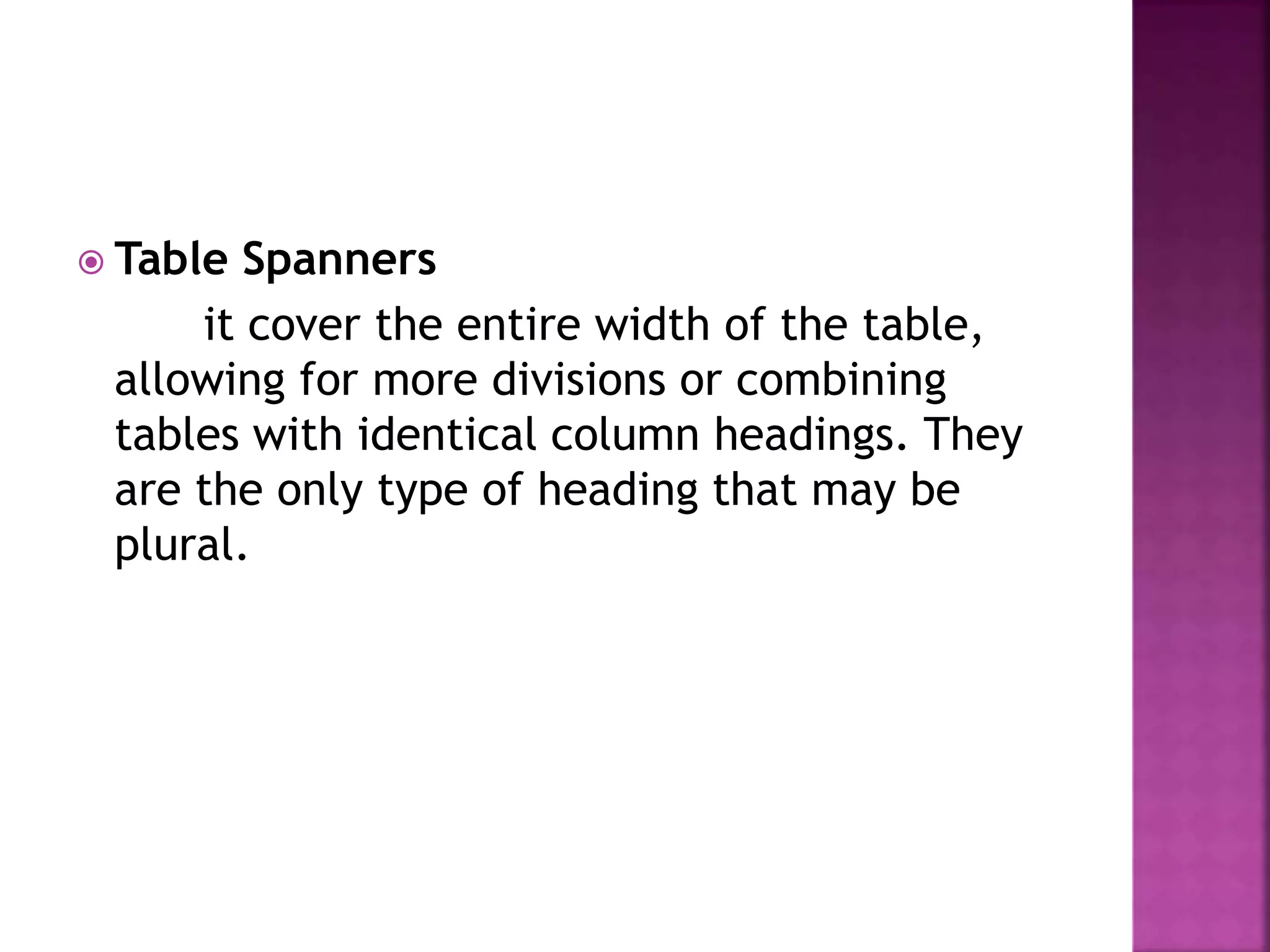
 Table Spanners
it cover the entire width of the table,
allowing for more divisions or combining
tables with identical column headings. They
are the only type of heading that may be
plural.
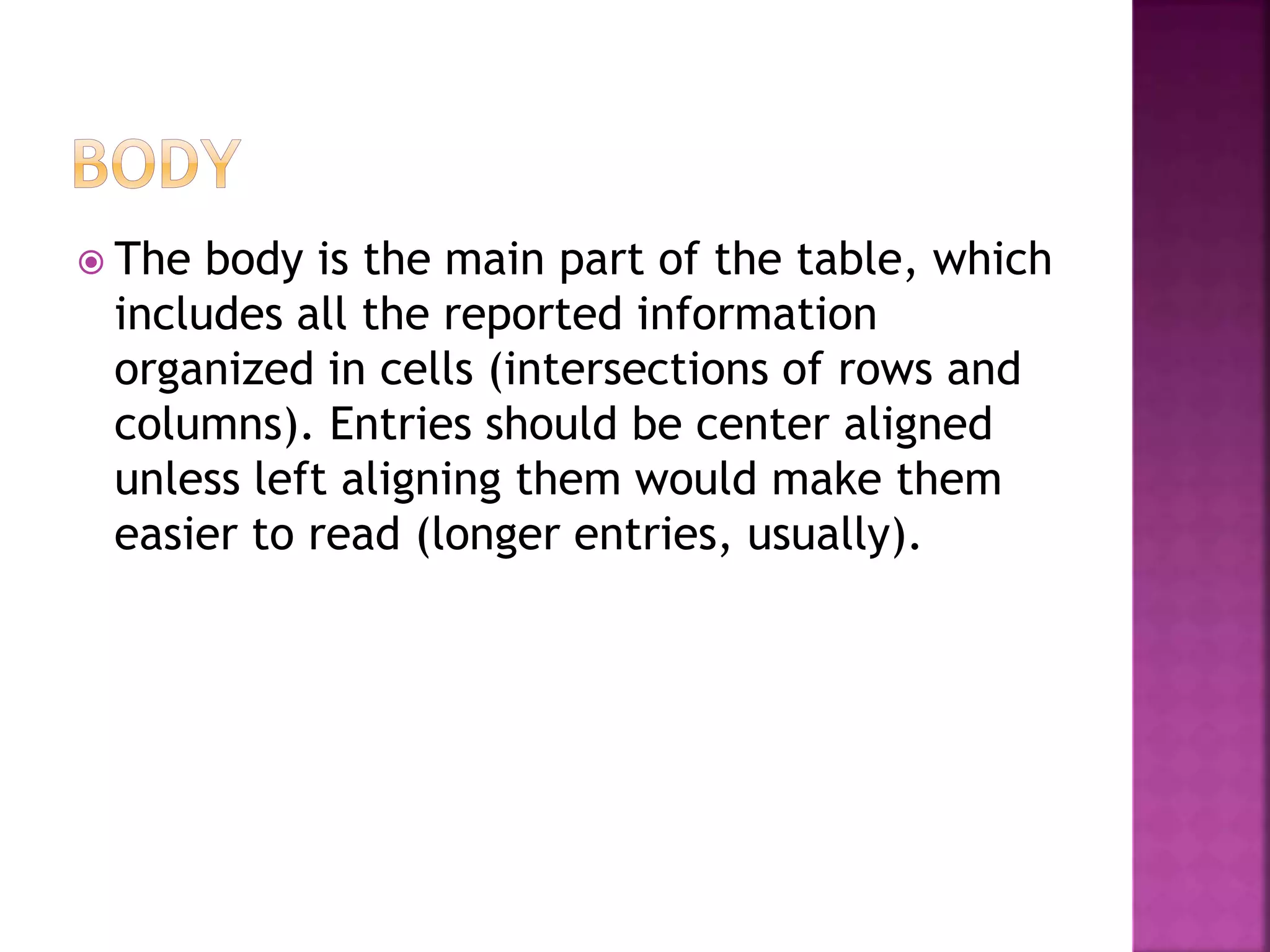
 The body is the main part of the table, which
includes all the reported information
organized in cells (intersections of rows and
columns). Entries should be center aligned
unless left aligning them would make them
easier to read (longer entries, usually).
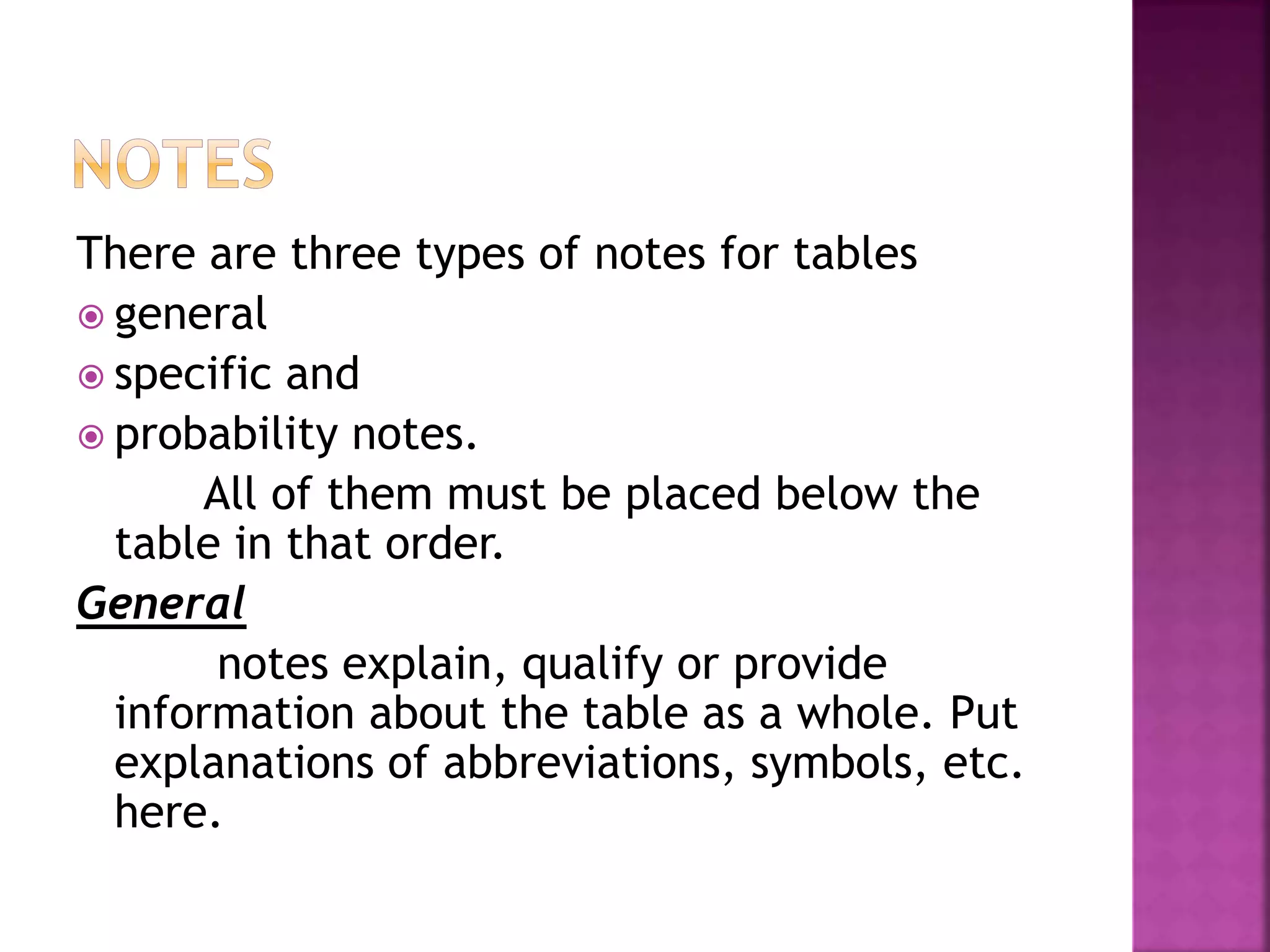
There are three types of notes for tables
 general
 specific and
 probability notes.
All of them must be placed below the
table in that order.
General
notes explain, qualify or provide
information about the table as a whole. Put
explanations of abbreviations, symbols, etc.
here.
 Specific
notes explain, qualify or provide
information about a particular column, row,
or individual entry. To indicate specific
notes, use superscript lowercase letters
(e.g. a, b, c), and order the superscripts from
left to right, top to bottom. Each table’s first
footnote must be the superscript a.
 Probability
notes provide the reader with the results
of the tests for statistical significance.
 Do not use vertical borders, and do not use
borders around each cell. Spacing and strict
alignment is typically enough to clarify
relationships between elements.
 Tables from Other Sources
If using tables from an external source,
copy the structure of the original exactly,
and cite the source in accordance with APA
style
 Is the table necessary?
 Are all comparable tables presented
consistently?
 Are all tables numbered with Arabic numerals
in the order they are mentioned in the text?
Is the table number bold and left-aligned?
 Does every column have a column heading?
Are column headings centered?
 Are the notes organized according to the
convention of general, specific, probability?
 Are table borders correctly used (top and
bottom of table, beneath column headings,
above table spanners)?
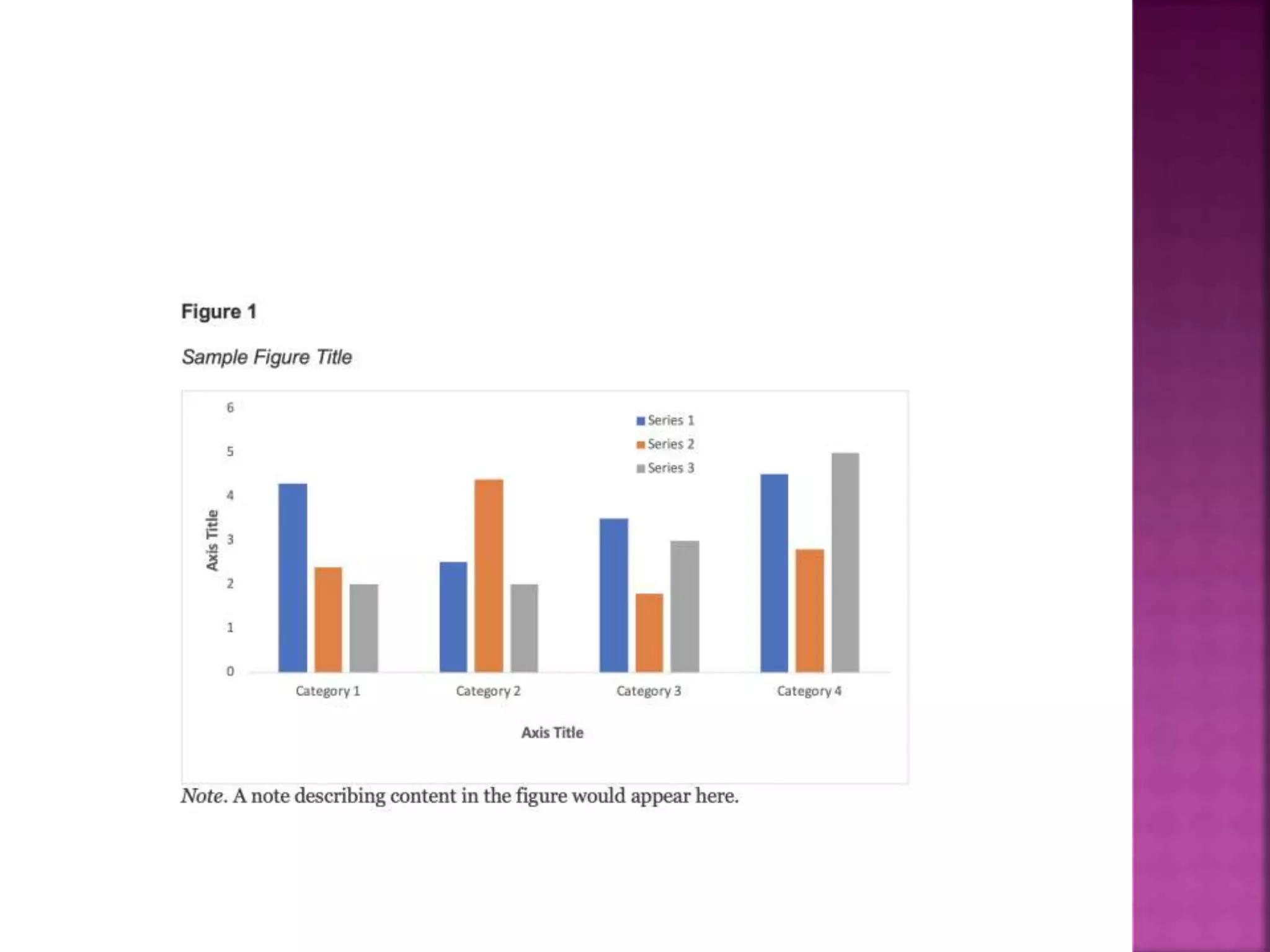
Just like tables, figures should
supplement the text and should be both
understandable on their own and referenced
fully in the text.
Preparing Figures:
In preparing figures, communication and
readability must be the ultimate criteria.
Avoid the temptation to use the special
effects available in most advanced software
packages.
 Design properly done is inconspicuous,
almost invisible, because it supports
communication. Design improperly, or
amateurishly, done draws the reader’s
attention from the data, and makes him or
her question the author’s credibility.
 NUMBERS
All figures that are part of the main text
require a number using Arabic numerals
(Figure 1, Figure 2, etc.). Numbers are
assigned based on the order in which figures
appear in the text and are bolded and left
aligned.
 TITLE
Under the number, write the title of the
figure in italicized title case.
 IMAGE
The image should be legible in both size
and resolution; fonts should be sans serif,
consistently sized, and between 8-14 pt.
Shading and color should be limited for
clarity; use patterns along with color and
check contrast between colors with free
online checkers to ensure all users (people
with color vision deficiencies or readers
printing in grayscale, for instance) can access
the content.
 LEGENDS
Legends, or keys, explain symbols,
styles, patterns, shading, or colors in the
image. Words in the legend should be in title
case; legends should go within or underneath
the image rather than to the side.
 NOTES
Notes clarify the content of the figure;
like tables, notes can be general, specific, or
probability.
 Is the figure necessary?
 Is the figure simple, clean, and free of
extraneous detail?
 Is the figure title descriptive of the content
of the figure? Is it written in italic title case
and left aligned?
 Are all elements of the figure clearly
labeled?
 Are all figures mentioned in the text?
Changes and updates to in-text citation
procedure in the seventh edition include the
following:
 Regardless of the medium of the source, all
sources with three authors or more are now
attributed using the name of the first author
followed by “et al.”
 The only exception to this occurs when doing so
would create ambiguity (e.g., if two papers have
first-listed authors with the same name). In
these cases, list as many names as needed to
differentiate the papers, followed by “et al.”
 Example:
Rida nawaz , Tallat , Sadia , Usman , and
Ayesha (2019) and Rida nawaz , Tallat , Misbah ,
Uzma , and Hassan (2019) can be cited as (Rida
nawaz, Tallat , Sadia , et al., 2019) and (Rida
nawaz, Tallat , Misbah, et al., 2019),
respectively.
Oral traditions and traditional
knowledge of indigenous people are
now treated as a distinct source
category.
If the information has been
recorded (e.g., as an audio file or
an interview transcript), follow the
ordinary directions for citing the
appropriate form of media.
 If the information was not recorded, but was
gleaned from a personal interaction, use a
modified form of the personal
communication citation.
 In both cases, capitalize not only the name
of indigenous groups and nations (e.g., Crow,
Seminole, Narragansett), but also most terms
derived from indigenous culture (e.g., Oral
Tradition, Elder, Traditional Knowledge,
Vision Quest).
Finally, work closely with
indigenous keepers of
traditional knowledge to
ensure that the knowledge is
reproduced only with the
permission of relevant
indigenous stakeholders.
 New guidelines describe how to present
quotations from research participants.
Quotations from research participants should
be formatted like normal quotations (e.g., if
they are longer than 40 words, use a block
quotation). However, you do not need to
provide an in-text citation or a reference list
entry. Instead, simply indicate that the quote
is from a research participant in the text.
If attributing the quote to
a pseudonym, enclose the
name in quotation marks
the first time you use it.
After the first time, do not
use quotation marks.
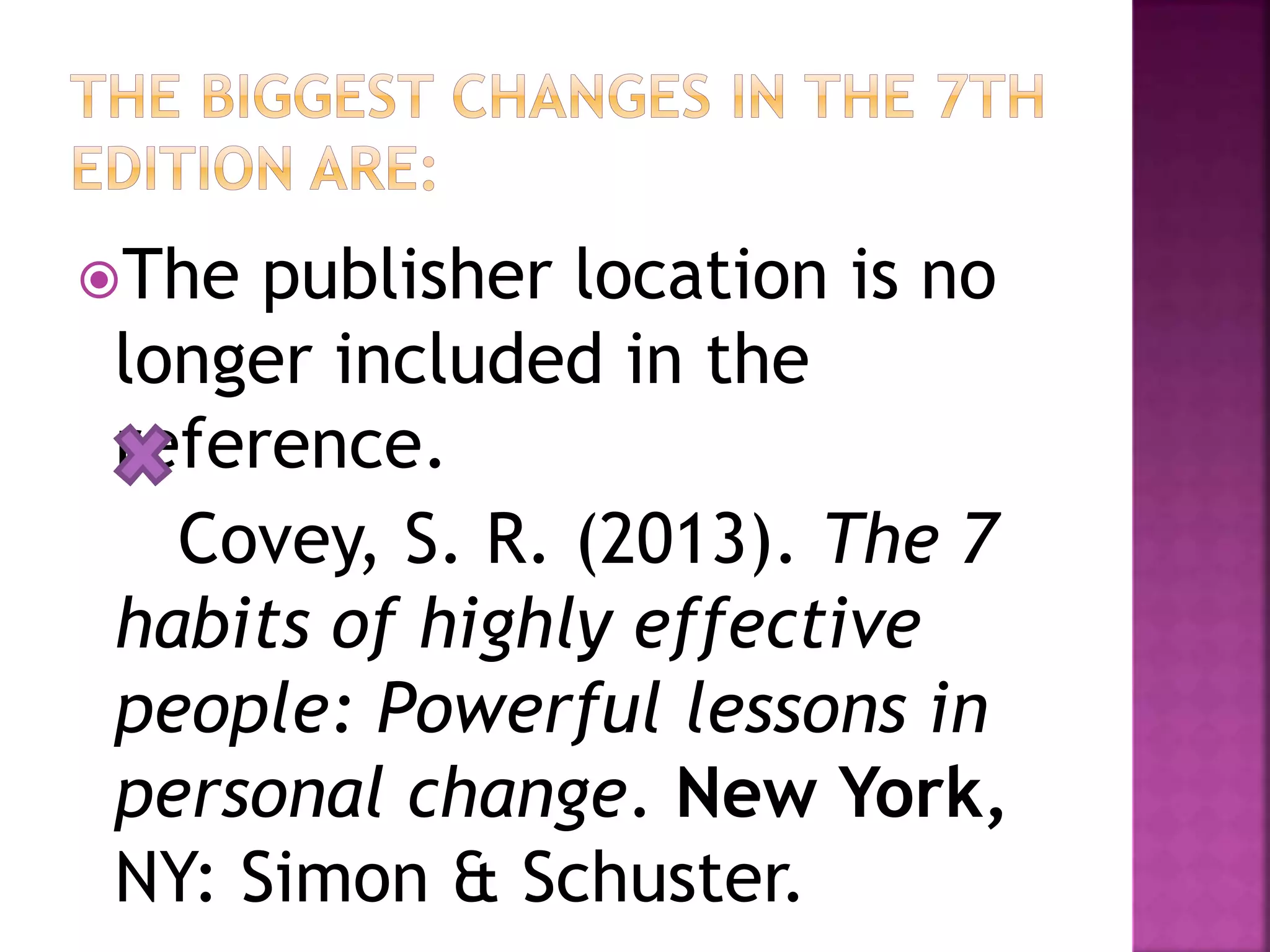
The publisher location is no
longer included in the
reference.
Covey, S. R. (2013). The 7
habits of highly effective
people: Powerful lessons in
personal change. New York,
NY: Simon & Schuster.
 The in-text citation for works with three or
more authors is now shortened right from the
first citation. You only include the first
author’s name and “et al.”
(Taylor, Kotler, Johnson, & Parker, 2018)
(Taylor et al., 2018)
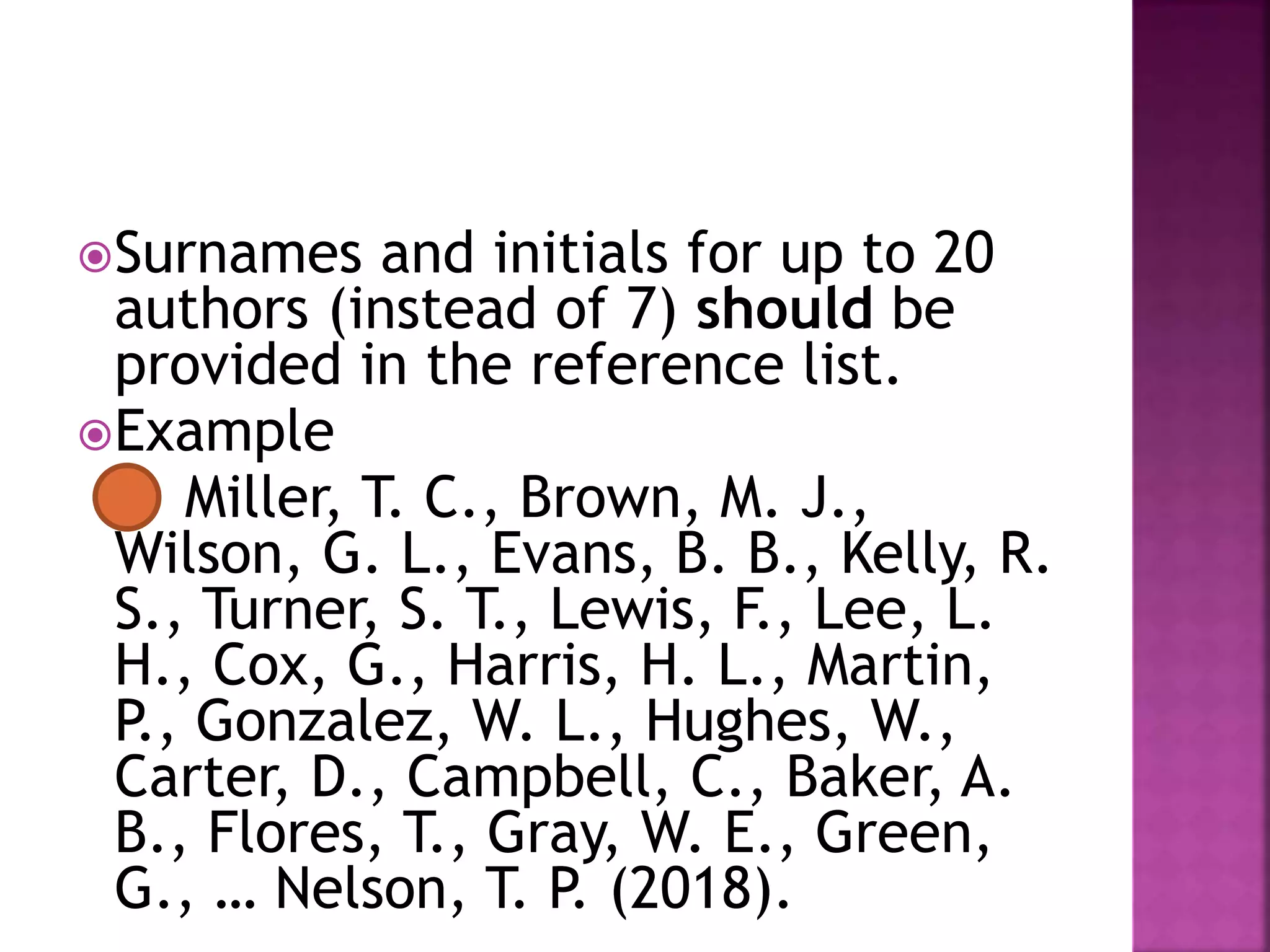
Surnames and initials for up to 20
authors (instead of 7) should be
provided in the reference list.
Example
Miller, T. C., Brown, M. J.,
Wilson, G. L., Evans, B. B., Kelly, R.
S., Turner, S. T., Lewis, F., Lee, L.
H., Cox, G., Harris, H. L., Martin,
P., Gonzalez, W. L., Hughes, W.,
Carter, D., Campbell, C., Baker, A.
B., Flores, T., Gray, W. E., Green,
G., … Nelson, T. P. (2018).
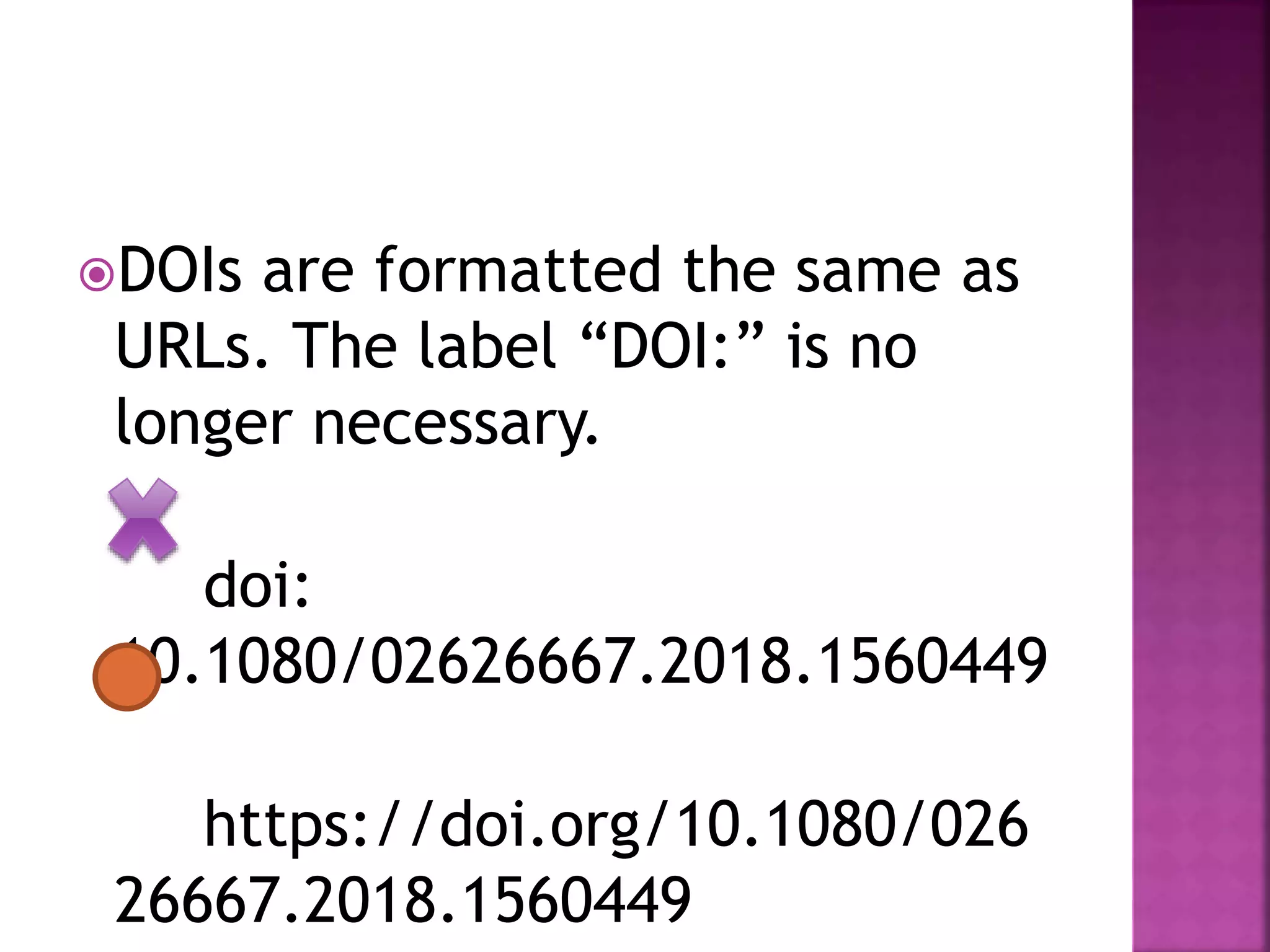
DOIs are formatted the same as
URLs. The label “DOI:” is no
longer necessary.
doi:
10.1080/02626667.2018.1560449
https://doi.org/10.1080/026
26667.2018.1560449
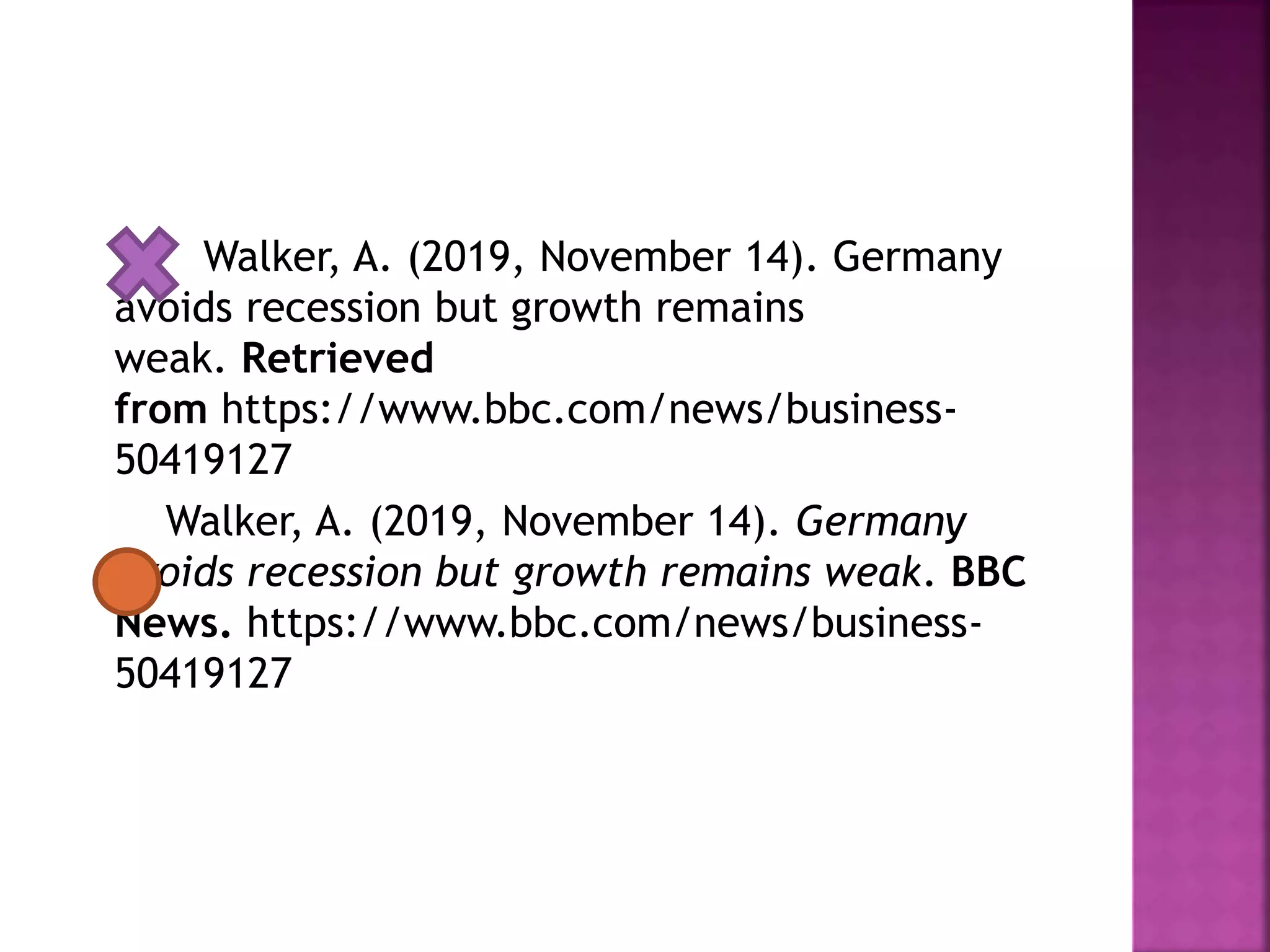
URLs are no longer preceded by
“Retrieved from,” unless a
retrieval date is needed. The
website name is included (unless
it’s the same as the author), and
web page titles are italicized.
Walker, A. (2019, November 14). Germany
avoids recession but growth remains
weak. Retrieved
from https://www.bbc.com/news/business-
50419127
Walker, A. (2019, November 14). Germany
avoids recession but growth remains weak. BBC
News. https://www.bbc.com/news/business-
50419127
For ebooks, the format, platform,
or device (e.g. Kindle) is no longer
included in the reference, and the
publisher is included.
Clear guidelines are provided for
including contributors other than
authors and editors. For example,
when citing a podcast episode, the
host of the episode should be
included; for a TV series episode,
the writer and director of that
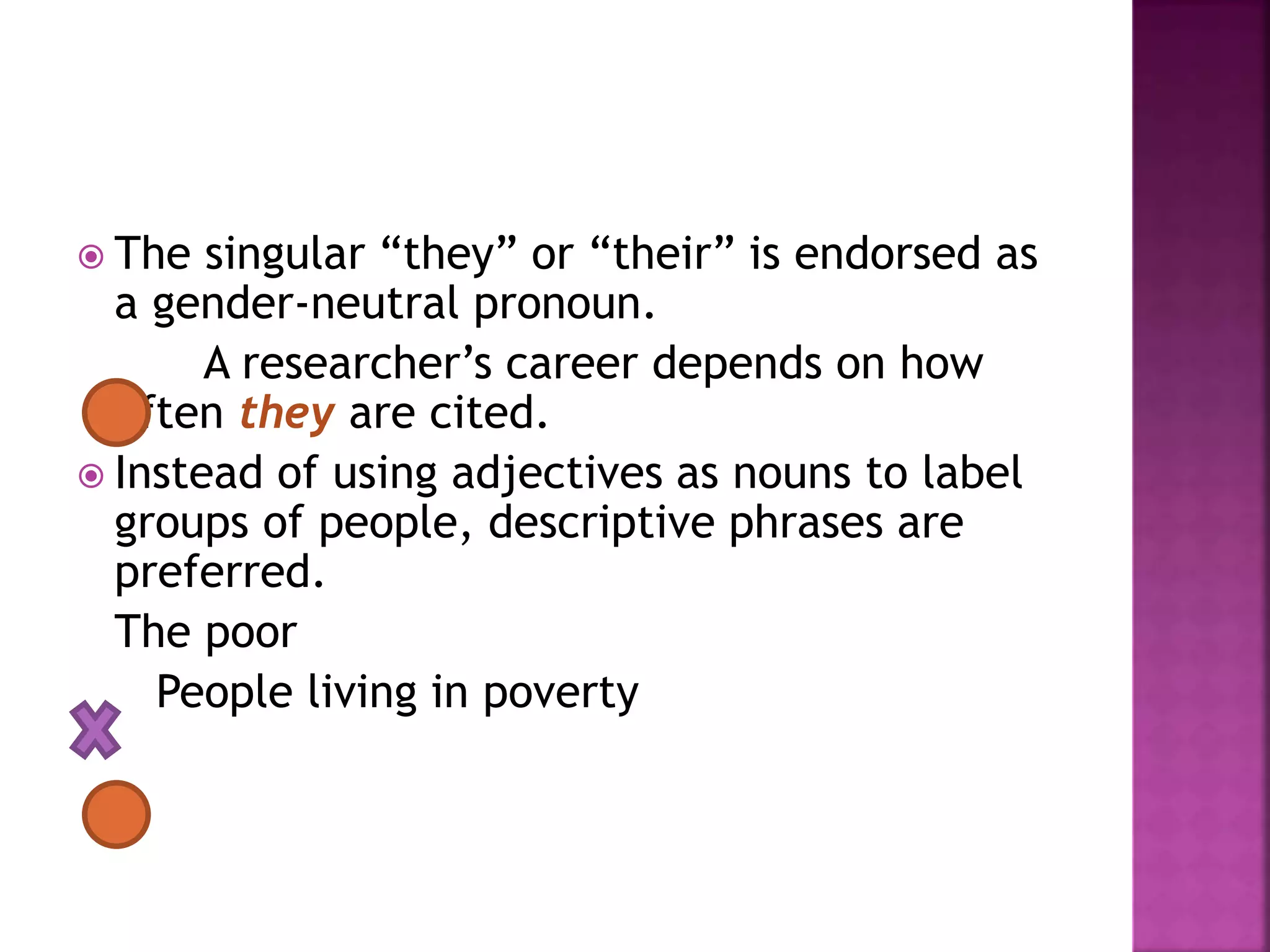
 The singular “they” or “their” is endorsed as
a gender-neutral pronoun.
A researcher’s career depends on how
often they are cited.
 Instead of using adjectives as nouns to label
groups of people, descriptive phrases are
preferred.
The poor
People living in poverty
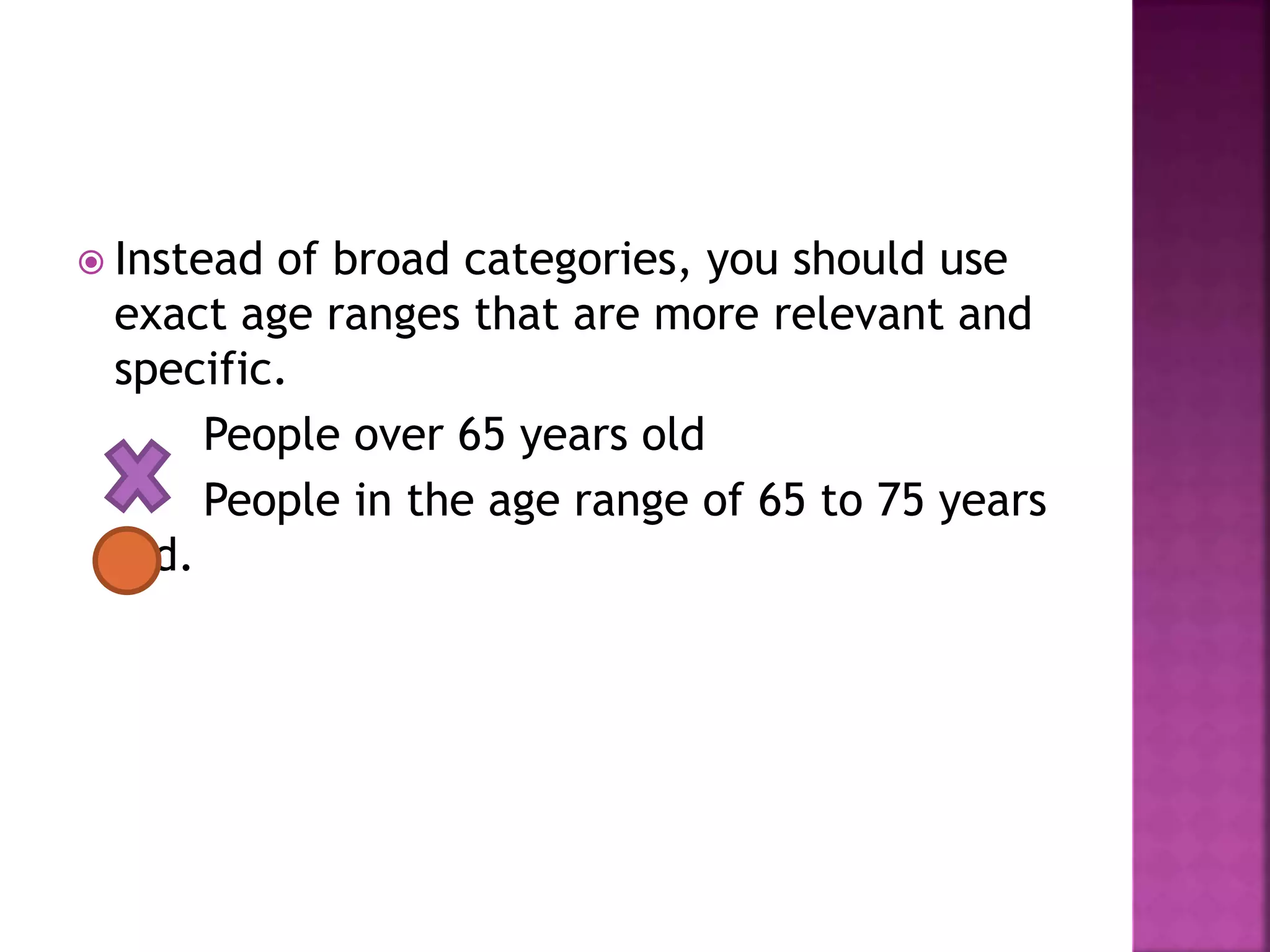
 Instead of broad categories, you should use
exact age ranges that are more relevant and
specific.
People over 65 years old
People in the age range of 65 to 75 years
old.
 Use only one space after a period at the end
of a sentence.
 Use double quotation marks instead of italics
to refer to linguistic examples

APA 7th EDITION chapter 7 and 8

  • 2.
    Though the formattingfor tables and figures has not dramatically changed from the sixth edition, a few relevant changes are as follows:  Tables and figures are now formatted in parallel in other words, they use consistent rules for titles, notes, and numbering.  Tables and figures may now be presented either in the text of the document or after the reference list on separate pages.
  • 3.
     PURPOSE: The purposeof tables and figures in documents is to enhance your readers' understanding of the information in the document; usually, large amounts of information can be communicated more efficiently in tables or figures.
  • 4.
    1. Necessity Visual materialsuch as tables and figures can be used quickly and efficiently to present a large amount of information to an audience, but visuals must be used to assist communication, not to use up space, or disguise marginally significant results behind a screen of complicated statistics.
  • 5.
    2. Relation ofTables or Figures and Text Because tables and figures supplement the text, refer in the text to all tables and figures used and explain what the reader should look for when using the table or figure. 3. Documentation If you are using figures, tables and/or data from other sources, be sure to gather all the information you will need to properly document your sources.
  • 6.
    4. Integrity andIndependence Each table and figure must be intelligible without reference to the text, so be sure to include an explanation of every abbreviation (except the standard statistical symbols and abbreviations).
  • 7.
    5. Organization, Consistency,and Coherence Number all tables sequentially as you refer to them in the text (Table 1, Table 2, etc.), likewise for figures (Figure 1, Figure 2, etc.). Abbreviations, terminology, and probability level values must be consistent across tables and figures in the same article.
  • 8.
     Data ina table that would require only two or fewer columns and rows should be presented in the text. More complex data is better presented in tabular format. In order for quantitative data to be presented clearly and efficiently, it must be arranged logically.
  • 9.
     NUMBERS Number alltables with Arabic numerals sequentially. Do not use suffix letters (e.g. Table 3a, 3b, 3c); instead, combine the related tables.  TITLES Like the title of the paper itself, each table must have a clear and concise title. Titles should be written in italicized title case below the table number, with a blank line between the number and the title. When appropriate, you may use the title to explain an abbreviation parenthetically.
  • 10.
    There are severaltypes of headings:  Stub headings It describe the lefthand column, or stub column, which usually lists major independent variables.  Column headings it describe entries below them, applying to just one column.  Column spanners are headings that describe entries below them, applying to two or more columns which each have their own column heading.
  • 11.
     Table Spanners itcover the entire width of the table, allowing for more divisions or combining tables with identical column headings. They are the only type of heading that may be plural.
  • 12.
     The bodyis the main part of the table, which includes all the reported information organized in cells (intersections of rows and columns). Entries should be center aligned unless left aligning them would make them easier to read (longer entries, usually).
  • 13.
    There are threetypes of notes for tables  general  specific and  probability notes. All of them must be placed below the table in that order. General notes explain, qualify or provide information about the table as a whole. Put explanations of abbreviations, symbols, etc. here.
  • 14.
     Specific notes explain,qualify or provide information about a particular column, row, or individual entry. To indicate specific notes, use superscript lowercase letters (e.g. a, b, c), and order the superscripts from left to right, top to bottom. Each table’s first footnote must be the superscript a.  Probability notes provide the reader with the results of the tests for statistical significance.
  • 15.
     Do notuse vertical borders, and do not use borders around each cell. Spacing and strict alignment is typically enough to clarify relationships between elements.  Tables from Other Sources If using tables from an external source, copy the structure of the original exactly, and cite the source in accordance with APA style
  • 16.
     Is thetable necessary?  Are all comparable tables presented consistently?  Are all tables numbered with Arabic numerals in the order they are mentioned in the text? Is the table number bold and left-aligned?  Does every column have a column heading? Are column headings centered?
  • 17.
     Are thenotes organized according to the convention of general, specific, probability?  Are table borders correctly used (top and bottom of table, beneath column headings, above table spanners)?
  • 18.
    Just like tables,figures should supplement the text and should be both understandable on their own and referenced fully in the text. Preparing Figures: In preparing figures, communication and readability must be the ultimate criteria. Avoid the temptation to use the special effects available in most advanced software packages.
  • 19.
     Design properlydone is inconspicuous, almost invisible, because it supports communication. Design improperly, or amateurishly, done draws the reader’s attention from the data, and makes him or her question the author’s credibility.
  • 20.
     NUMBERS All figuresthat are part of the main text require a number using Arabic numerals (Figure 1, Figure 2, etc.). Numbers are assigned based on the order in which figures appear in the text and are bolded and left aligned.  TITLE Under the number, write the title of the figure in italicized title case.
  • 21.
     IMAGE The imageshould be legible in both size and resolution; fonts should be sans serif, consistently sized, and between 8-14 pt. Shading and color should be limited for clarity; use patterns along with color and check contrast between colors with free online checkers to ensure all users (people with color vision deficiencies or readers printing in grayscale, for instance) can access the content.
  • 22.
     LEGENDS Legends, orkeys, explain symbols, styles, patterns, shading, or colors in the image. Words in the legend should be in title case; legends should go within or underneath the image rather than to the side.  NOTES Notes clarify the content of the figure; like tables, notes can be general, specific, or probability.
  • 24.
     Is thefigure necessary?  Is the figure simple, clean, and free of extraneous detail?  Is the figure title descriptive of the content of the figure? Is it written in italic title case and left aligned?  Are all elements of the figure clearly labeled?  Are all figures mentioned in the text?
  • 25.
    Changes and updatesto in-text citation procedure in the seventh edition include the following:  Regardless of the medium of the source, all sources with three authors or more are now attributed using the name of the first author followed by “et al.”
  • 26.
     The onlyexception to this occurs when doing so would create ambiguity (e.g., if two papers have first-listed authors with the same name). In these cases, list as many names as needed to differentiate the papers, followed by “et al.”  Example: Rida nawaz , Tallat , Sadia , Usman , and Ayesha (2019) and Rida nawaz , Tallat , Misbah , Uzma , and Hassan (2019) can be cited as (Rida nawaz, Tallat , Sadia , et al., 2019) and (Rida nawaz, Tallat , Misbah, et al., 2019), respectively.
  • 27.
    Oral traditions andtraditional knowledge of indigenous people are now treated as a distinct source category. If the information has been recorded (e.g., as an audio file or an interview transcript), follow the ordinary directions for citing the appropriate form of media.
  • 28.
     If theinformation was not recorded, but was gleaned from a personal interaction, use a modified form of the personal communication citation.  In both cases, capitalize not only the name of indigenous groups and nations (e.g., Crow, Seminole, Narragansett), but also most terms derived from indigenous culture (e.g., Oral Tradition, Elder, Traditional Knowledge, Vision Quest).
  • 29.
    Finally, work closelywith indigenous keepers of traditional knowledge to ensure that the knowledge is reproduced only with the permission of relevant indigenous stakeholders.
  • 30.
     New guidelinesdescribe how to present quotations from research participants. Quotations from research participants should be formatted like normal quotations (e.g., if they are longer than 40 words, use a block quotation). However, you do not need to provide an in-text citation or a reference list entry. Instead, simply indicate that the quote is from a research participant in the text.
  • 31.
    If attributing thequote to a pseudonym, enclose the name in quotation marks the first time you use it. After the first time, do not use quotation marks.
  • 32.
    The publisher locationis no longer included in the reference. Covey, S. R. (2013). The 7 habits of highly effective people: Powerful lessons in personal change. New York, NY: Simon & Schuster.
  • 33.
     The in-textcitation for works with three or more authors is now shortened right from the first citation. You only include the first author’s name and “et al.” (Taylor, Kotler, Johnson, & Parker, 2018) (Taylor et al., 2018)
  • 34.
    Surnames and initialsfor up to 20 authors (instead of 7) should be provided in the reference list. Example Miller, T. C., Brown, M. J., Wilson, G. L., Evans, B. B., Kelly, R. S., Turner, S. T., Lewis, F., Lee, L. H., Cox, G., Harris, H. L., Martin, P., Gonzalez, W. L., Hughes, W., Carter, D., Campbell, C., Baker, A. B., Flores, T., Gray, W. E., Green, G., … Nelson, T. P. (2018).
  • 35.
    DOIs are formattedthe same as URLs. The label “DOI:” is no longer necessary. doi: 10.1080/02626667.2018.1560449 https://doi.org/10.1080/026 26667.2018.1560449
  • 36.
    URLs are nolonger preceded by “Retrieved from,” unless a retrieval date is needed. The website name is included (unless it’s the same as the author), and web page titles are italicized.
  • 37.
    Walker, A. (2019,November 14). Germany avoids recession but growth remains weak. Retrieved from https://www.bbc.com/news/business- 50419127 Walker, A. (2019, November 14). Germany avoids recession but growth remains weak. BBC News. https://www.bbc.com/news/business- 50419127
  • 38.
    For ebooks, theformat, platform, or device (e.g. Kindle) is no longer included in the reference, and the publisher is included. Clear guidelines are provided for including contributors other than authors and editors. For example, when citing a podcast episode, the host of the episode should be included; for a TV series episode, the writer and director of that
  • 39.
     The singular“they” or “their” is endorsed as a gender-neutral pronoun. A researcher’s career depends on how often they are cited.  Instead of using adjectives as nouns to label groups of people, descriptive phrases are preferred. The poor People living in poverty
  • 40.
     Instead ofbroad categories, you should use exact age ranges that are more relevant and specific. People over 65 years old People in the age range of 65 to 75 years old.
  • 41.
     Use onlyone space after a period at the end of a sentence.  Use double quotation marks instead of italics to refer to linguistic examples