PRESENTED BY : - TAMANNA GUPTA
1. PUNCTUATION
 Spacing After Punctuation Marks
 Period
 Comma
 Semicolon
 Colon
 Dash
 Quotation Marks
 Double or Single Quotation Marks
 Parentheses
 Brackets
 Slash
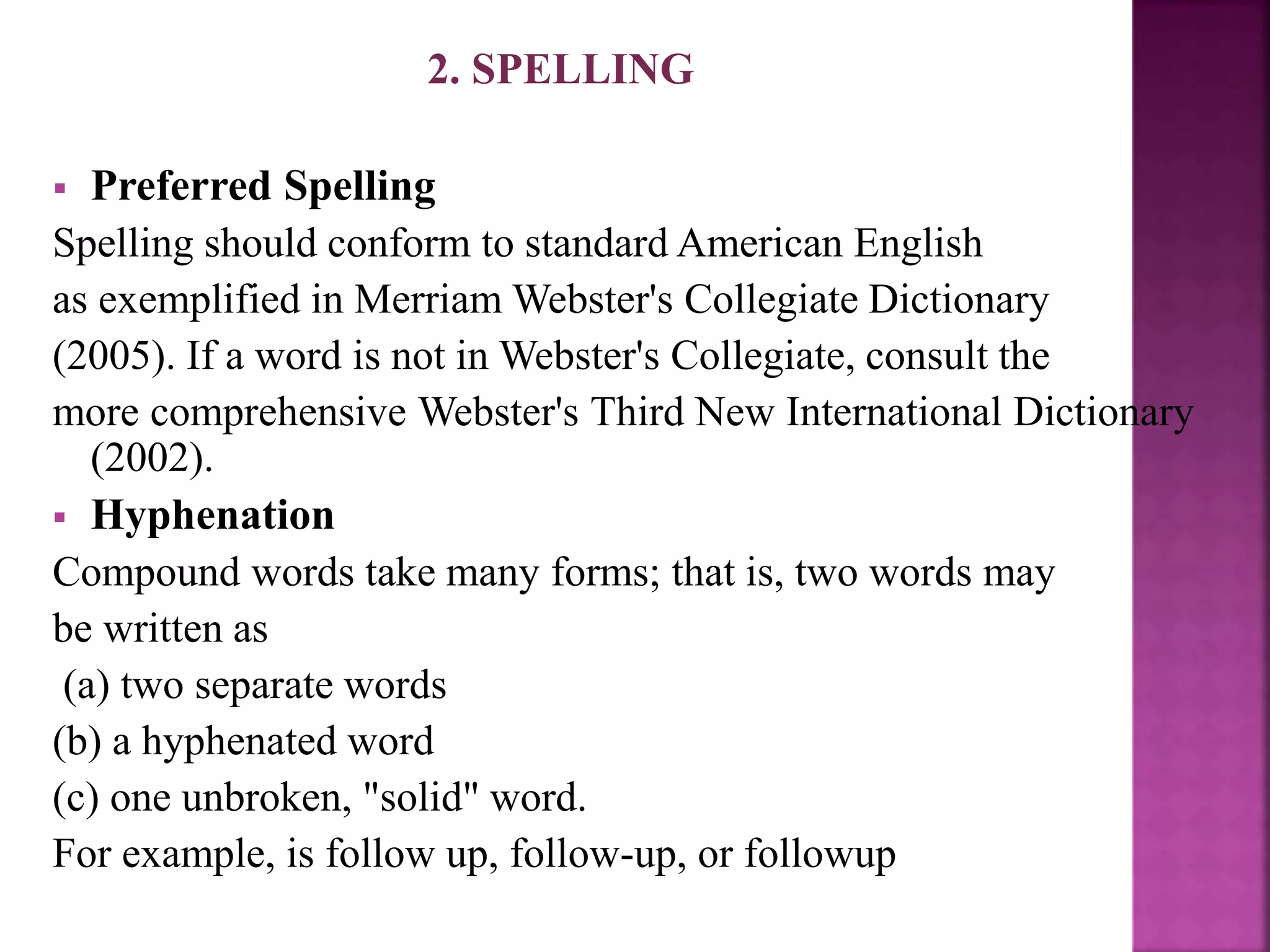
2. SPELLING
 Preferred Spelling
Spelling should conform to standard American English
as exemplified in Merriam Webster's Collegiate Dictionary
(2005). If a word is not in Webster's Collegiate, consult the
more comprehensive Webster's Third New International Dictionary
(2002).
 Hyphenation
Compound words take many forms; that is, two words may
be written as
(a) two separate words
(b) a hyphenated word
(c) one unbroken, "solid" word.
For example, is follow up, follow-up, or followup
3. CAPITALIZATION
 Words Beginning a Sentence
 Major Words in Titles and Headings
 Proper Nouns and Trade Names
 Nouns Followed by Numerals or Letters
 Titles of Tests
 Names of Conditions or Groups in an Experiment
 Names of Factors, Variables, and Effects
4. ITALICS
 Use of Italics
5. ABBREVIATIONS
 Use of Abbreviations
 Explanation of Abbreviations
 Abbreviations Accepted as Words
 Abbreviations Used Often in APA Journals
 Latin Abbreviations
 Scientific Abbreviations
 Other Abbreviations
 Plurals of Abbreviations
 Abbreviations Beginning a Sentence
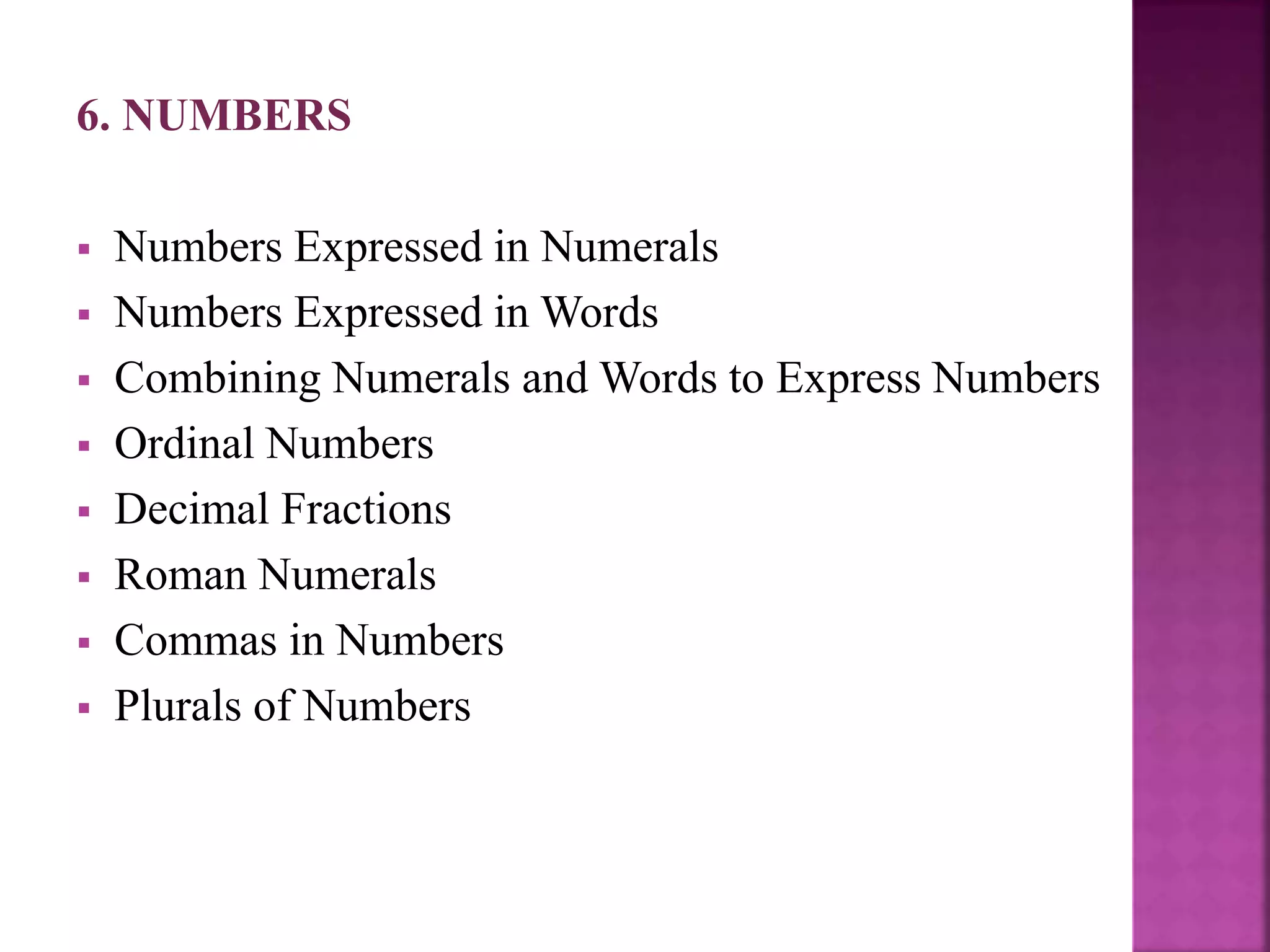
6. NUMBERS
 Numbers Expressed in Numerals
 Numbers Expressed in Words
 Combining Numerals and Words to Express Numbers
 Ordinal Numbers
 Decimal Fractions
 Roman Numerals
 Commas in Numbers
 Plurals of Numbers
7. METRICATION
 Policy on Metrication
 Style for Metric Units
8. STATISTICALAND MATHEMATICAL COPY
 Selecting Effective Presentation
 References for Statistics
 Formulas
 Statistics in Text
 Statistical Symbols
 Spacing, Alignment, and Punctuation
9. EQUATIONS
 Equations in Text
 Displayed Equations
 Preparing Statistical and Mathematical Copy
Chapter 4 includes guidelines for
reporting inferential statistics and a
significantly revised table of statistical
abbreviations. A new discussion of using
supplemental files containing lengthy
data sets and other media is also
included.
THANK YOU

Apa manual chapter 4

  • 1.
    PRESENTED BY :- TAMANNA GUPTA
  • 3.
    1. PUNCTUATION  SpacingAfter Punctuation Marks  Period  Comma  Semicolon  Colon  Dash  Quotation Marks  Double or Single Quotation Marks  Parentheses  Brackets  Slash
  • 4.
    2. SPELLING  PreferredSpelling Spelling should conform to standard American English as exemplified in Merriam Webster's Collegiate Dictionary (2005). If a word is not in Webster's Collegiate, consult the more comprehensive Webster's Third New International Dictionary (2002).  Hyphenation Compound words take many forms; that is, two words may be written as (a) two separate words (b) a hyphenated word (c) one unbroken, "solid" word. For example, is follow up, follow-up, or followup
  • 5.
    3. CAPITALIZATION  WordsBeginning a Sentence  Major Words in Titles and Headings  Proper Nouns and Trade Names  Nouns Followed by Numerals or Letters  Titles of Tests  Names of Conditions or Groups in an Experiment  Names of Factors, Variables, and Effects
  • 6.
  • 7.
    5. ABBREVIATIONS  Useof Abbreviations  Explanation of Abbreviations  Abbreviations Accepted as Words  Abbreviations Used Often in APA Journals  Latin Abbreviations  Scientific Abbreviations  Other Abbreviations  Plurals of Abbreviations  Abbreviations Beginning a Sentence
  • 8.
    6. NUMBERS  NumbersExpressed in Numerals  Numbers Expressed in Words  Combining Numerals and Words to Express Numbers  Ordinal Numbers  Decimal Fractions  Roman Numerals  Commas in Numbers  Plurals of Numbers
  • 9.
    7. METRICATION  Policyon Metrication  Style for Metric Units
  • 10.
    8. STATISTICALAND MATHEMATICALCOPY  Selecting Effective Presentation  References for Statistics  Formulas  Statistics in Text  Statistical Symbols  Spacing, Alignment, and Punctuation
  • 11.
    9. EQUATIONS  Equationsin Text  Displayed Equations  Preparing Statistical and Mathematical Copy
  • 12.
    Chapter 4 includesguidelines for reporting inferential statistics and a significantly revised table of statistical abbreviations. A new discussion of using supplemental files containing lengthy data sets and other media is also included.
  • 13.