August 2001
PLC Module 2-1
Programmable Logic Controller
Industrial Automation Research Group
Laboratorium Instrumentasi dan Kontrol
Departemen Teknik Fisika
Institut Teknologi Bandung
Desember 2003
August 2001
PLC Module 2-2
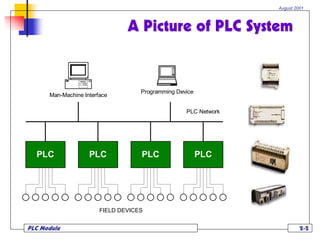
A Picture of PLC System
Man-Machine Interface
Programming Device
PLC PLC PLC PLC
PLC Network
FIELD DEVICES
August 2001
PLC Module 2-3
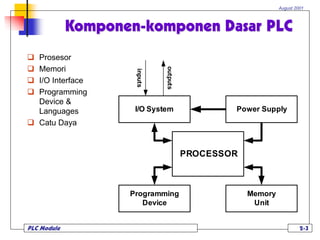
Komponen-komponen Dasar PLC
 Prosesor
 Memori
 I/O Interface
 Programming
Device &
Languages
 Catu Daya
PROCESSOR
I/O System Power Supply
Programming
Device
Memory
Unit
inputs
outputs
August 2001
PLC Module 2-4
Bagaimana PLC Bekerja ?
 Examine the status of inputs and outputs
 Controls some process or machine through outputs
using some control logic
 This control logic is executed periodically by the
processor in a predetermined sequential order
 User can change the control logic using a
programming language and it is stored in the
program memory
August 2001
PLC Module 2-5
Processor & Memory
 80386/80486 microprocessor
based
 Random Access Memory (RAM)
 Electrically Erasable Programmer
Read Only Memory (EEPROM)
CPU Data
Memory
Program
Memory
System
Clock
I/O
Port
input bus
address bus
output
bus
Instruction cycle :
Fetch the next instruction from
program memory
Place it in the instruction
register in the CPU
Increment the program counter
by one
Execute the instruction
August 2001
PLC Module 2-6
Input/Output Systems
 Discrete Inputs/Outputs
 Analog Inputs/Outputs
 Special Purpose Modules
 Intelligent Modules
 Communication Modules
August 2001
PLC Module 2-7
Discrete Signal Types
 Selector switches
 Temperature switches
 Flow switches
 Level switches
 Valve position switches
 Starter auxiliary contacts
 Pushbuttons
 Motor starter contacts
 Limit switches
 Pressure switches
 Hand switches
 Proximity switches
 Relay contacts
 Photoelectric sensors
 Annunciators
 Alarm lights
 Electric control relays
 Electric fans
 Indicating lights
 Electric valves
 Alarm horns
 Selenoid valves
 Motor starters
 Heater starters
August 2001
PLC Module 2-8
Discrete Input Modules
 AC and DC Discrete Input Module
• Electrical isolation between the field device (power) and the
controller (logic)
• Common return line connection
• ACI-XX where XX is voltage (120 and 220 VAC)
• DCI-XX where XX is voltage (12, 24, and 48 VDC)
 TTL
• TTL-compatible devices (solid-state controller and sensing
instruments)
• external +5 V dc power supply
 Isolated Input Module
• Separated return lines
• IACI-XX or IDCI-XX
August 2001
PLC Module 2-9
Discrete Output Module
 AC Output Module
• AC loads (using Triac/SCR
as switch)
• RC snubber protection
• Peak voltage limiter (metal
oxyde varistor - MOV)
• Fuse protection
• External switching voltage
 DC Output Module
• DC loads (using power
transistors)
• Fuse protection
 TTL Output Module
• TTL-compatible output
devices (seven segment
LED, IC, and +5 Vdc logic-
based devices)
• External +5 Vdc power
supply
 Isolated AC Output Module
 Dry Contact
• Normally open (NO)
• Normally closed (NC)
August 2001
PLC Module 2-10
Analog Devices
 Flow transmitters
 Pressure transmitters
 Temperature transmitters
 Analytical transmitters
 Position transmitters
 Potentiometers
 Level transmitters
 Speed instruments
 Electric motor drives
 Analog meters
 Chart data recorders
 Process controllers
 Current-to-pneumatic
transducers
 Electrical-operated valve
 Variable speed drives
August 2001
PLC Module 2-11
Analog Input Module
Very high input
impedance to
prevent signal
loading Filtering and
isolation circuits
Single-ended
Differential
Current (0-20 mA)
Voltage (1-5 V)
August 2001
PLC Module 2-12
Analog Output Module
Isolation between the output circuit
and the logic circuit is provided
through optical couplers
Receive data from the CPU which is
translated into a proportional
voltage/current to control an analog
field device
August 2001
PLC Module 2-13
Special Purpose Modules
 Binary Coded Decimal (BCD) Modules
• Provide parallel communication between the processor and
input/output devices
 Encoder/Counter Input Module
• Used for operations that require direct high speed encoder
input into a counter
 Pulse Counter Input Module
• Used to interface with field instruments that generate pulse
such as positive displacement (PD) flowmeters and turbine
type flowmeters
August 2001
PLC Module 2-14
Intelligent Module
 Can perform complete processing functions,
independent of the CPU and the control program
scan
 Thermocouple Input Module
• Designed to accept inputs directly from a thermocouple
• Provides cold junction compensation
 Motor Control Module
• Generates a pulse train that is compatible with stepping
motor translators that represent distance, speed, and
direction commands
 Control Loop Module (PID module)
• Used in continuous closed-loop where the proportional-
integral-derivative (PID) control algorithm is required
August 2001
PLC Module 2-15
Communication Module
 ASCII
• Used to send and receive
alphanumeric data between
peripheral equipment and the
controller
 Universal Remote I/O Link
• Allows I/O subsystems to be
remotely located from the
processor (1000 ft to several
miles)
 Serial Communications Module
• Used to communicate between
the programmable controller
and an intelligent instrument
with a serial output
• RS-232C, RS-422, or RS-485
communication link
 PCMCIA Interface Card
• Allows communications
between PLC or data highway
and notebook PC
 Ethernet
• Designed to allow a number of
PLC and other computer-based
devices to communicate over a
high speed plant local area
network
 Fiber Optic Converter
• Transform electrical signals and
transmit these signals through
fiber optic cables
August 2001
PLC Module 2-16
Memory Sizing
 The amount of memory required depends on :
• control program complexity
• the number of I/O points
 Precise (almost impossible) method to determine
memory size :
• Write out the control program
• Count the number of instructions used
• Multiply this count by the number of words used per
instructions (obtained from PLC programming manual)
• Add the amounts of memor used by executive programs and
the processor overhead
 Practical method :
• Total memory = 10 x [the number of I/O points]
August 2001
PLC Module 2-17
I/O and Memory Sizing Example
 I/O Points
• Remote Area 1 : I/O = 70 + 35 + 6 = 111
• Remote Area 2 : I/O = 95 + 50 + 10 = 155
• Main Process Area : I/O = 300 + 156 + 32
+ 5 = 493
• Total I/O points = 759
• Spare points = 10% x 759 = 76
 PLC size = Medium-
sized (1024 I/O points max.)
 Memory size =
10 x 759 = 7590 or 8K
August 2001
PLC Module 2-18
Hot Standby System
Architecture
August 2001
PLC Module 2-19
Typical Configuration of
PC/PLC
August 2001
PLC Module 2-20
Dual Link Configuration
August 2001
PLC Module 2-21
Peripheral Requirements
 Peripheral = other equipment in the PLC system that is not
directly connected to field I/O devices
• Compact portable programming device from PLC manufacturer
• Portable PC with PLC software
• Magnetic tape storage unit to store control program
• PROM Programmer
• Process I/O simulators
• Communications modules
 Depends on plant network design
 Extra modules is required for integration within different brands
• Operator interfaces
 hard-wired local and main control panels
 GUI software runs on a personal computer
 Intelligent peripheral devices such as touch screen
 Industrial PC with function keys and GUI software
August 2001
PLC Module 2-22
Example of I/O Wiring Diagrams
 Field wiring is normally indicated by a dashed line
 PLC output adresses are given on the left-hand side
 TB = Terminal Box
 JB = Junction Box
August 2001
PLC Module 2-23
Relay Circuit Diagram
August 2001
PLC Module 2-24
PLC Contact and its Logic
August 2001
PLC Module 2-25
Combination of Logic and
Contact Symbol
August 2001
PLC Module 2-26
I/O Address Assignment for
Real Input/Output
August 2001
PLC Module 2-27
I/O Address Assignment for
internal outputs
August 2001
PLC Module 2-28
I/O Connection
August 2001
PLC Module 2-29
Relay Circuit
August 2001
PLC Module 2-30
Identification of Real I/O
August 2001
PLC Module 2-31
I/O Address Assignment
August 2001
PLC Module 2-32
Internal Output Assignment
August 2001
PLC Module 2-33
Input/Output Connection
August 2001
PLC Module 2-34
Register Assignment Table
August 2001
PLC Module 2-35
Hardwired Components
August 2001
PLC Module 2-36
PLC Components
August 2001
PLC Module 2-37
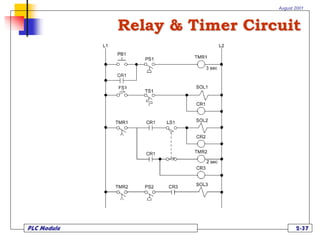
Relay & Timer Circuit
August 2001
PLC Module 2-38
I/O Address Assignment
August 2001
PLC Module 2-39
Internal Output and Register
Assignment
August 2001
PLC Module 2-40
PLC Implementation
August 2001
PLC Module 2-41
Motor Start/Stop Circuit
August 2001
PLC Module 2-42
Real I/O to PLC
August 2001
PLC Module 2-43
I/O Address Assignment
August 2001
PLC Module 2-44
PLC Implementation

apa itu plc dan program dari plc (Program logic controller)

  • 1.
    August 2001 PLC Module2-1 Programmable Logic Controller Industrial Automation Research Group Laboratorium Instrumentasi dan Kontrol Departemen Teknik Fisika Institut Teknologi Bandung Desember 2003
  • 2.
    August 2001 PLC Module2-2 A Picture of PLC System Man-Machine Interface Programming Device PLC PLC PLC PLC PLC Network FIELD DEVICES
  • 3.
    August 2001 PLC Module2-3 Komponen-komponen Dasar PLC  Prosesor  Memori  I/O Interface  Programming Device & Languages  Catu Daya PROCESSOR I/O System Power Supply Programming Device Memory Unit inputs outputs
  • 4.
    August 2001 PLC Module2-4 Bagaimana PLC Bekerja ?  Examine the status of inputs and outputs  Controls some process or machine through outputs using some control logic  This control logic is executed periodically by the processor in a predetermined sequential order  User can change the control logic using a programming language and it is stored in the program memory
  • 5.
    August 2001 PLC Module2-5 Processor & Memory  80386/80486 microprocessor based  Random Access Memory (RAM)  Electrically Erasable Programmer Read Only Memory (EEPROM) CPU Data Memory Program Memory System Clock I/O Port input bus address bus output bus Instruction cycle : Fetch the next instruction from program memory Place it in the instruction register in the CPU Increment the program counter by one Execute the instruction
  • 6.
    August 2001 PLC Module2-6 Input/Output Systems  Discrete Inputs/Outputs  Analog Inputs/Outputs  Special Purpose Modules  Intelligent Modules  Communication Modules
  • 7.
    August 2001 PLC Module2-7 Discrete Signal Types  Selector switches  Temperature switches  Flow switches  Level switches  Valve position switches  Starter auxiliary contacts  Pushbuttons  Motor starter contacts  Limit switches  Pressure switches  Hand switches  Proximity switches  Relay contacts  Photoelectric sensors  Annunciators  Alarm lights  Electric control relays  Electric fans  Indicating lights  Electric valves  Alarm horns  Selenoid valves  Motor starters  Heater starters
  • 8.
    August 2001 PLC Module2-8 Discrete Input Modules  AC and DC Discrete Input Module • Electrical isolation between the field device (power) and the controller (logic) • Common return line connection • ACI-XX where XX is voltage (120 and 220 VAC) • DCI-XX where XX is voltage (12, 24, and 48 VDC)  TTL • TTL-compatible devices (solid-state controller and sensing instruments) • external +5 V dc power supply  Isolated Input Module • Separated return lines • IACI-XX or IDCI-XX
  • 9.
    August 2001 PLC Module2-9 Discrete Output Module  AC Output Module • AC loads (using Triac/SCR as switch) • RC snubber protection • Peak voltage limiter (metal oxyde varistor - MOV) • Fuse protection • External switching voltage  DC Output Module • DC loads (using power transistors) • Fuse protection  TTL Output Module • TTL-compatible output devices (seven segment LED, IC, and +5 Vdc logic- based devices) • External +5 Vdc power supply  Isolated AC Output Module  Dry Contact • Normally open (NO) • Normally closed (NC)
  • 10.
    August 2001 PLC Module2-10 Analog Devices  Flow transmitters  Pressure transmitters  Temperature transmitters  Analytical transmitters  Position transmitters  Potentiometers  Level transmitters  Speed instruments  Electric motor drives  Analog meters  Chart data recorders  Process controllers  Current-to-pneumatic transducers  Electrical-operated valve  Variable speed drives
  • 11.
    August 2001 PLC Module2-11 Analog Input Module Very high input impedance to prevent signal loading Filtering and isolation circuits Single-ended Differential Current (0-20 mA) Voltage (1-5 V)
  • 12.
    August 2001 PLC Module2-12 Analog Output Module Isolation between the output circuit and the logic circuit is provided through optical couplers Receive data from the CPU which is translated into a proportional voltage/current to control an analog field device
  • 13.
    August 2001 PLC Module2-13 Special Purpose Modules  Binary Coded Decimal (BCD) Modules • Provide parallel communication between the processor and input/output devices  Encoder/Counter Input Module • Used for operations that require direct high speed encoder input into a counter  Pulse Counter Input Module • Used to interface with field instruments that generate pulse such as positive displacement (PD) flowmeters and turbine type flowmeters
  • 14.
    August 2001 PLC Module2-14 Intelligent Module  Can perform complete processing functions, independent of the CPU and the control program scan  Thermocouple Input Module • Designed to accept inputs directly from a thermocouple • Provides cold junction compensation  Motor Control Module • Generates a pulse train that is compatible with stepping motor translators that represent distance, speed, and direction commands  Control Loop Module (PID module) • Used in continuous closed-loop where the proportional- integral-derivative (PID) control algorithm is required
  • 15.
    August 2001 PLC Module2-15 Communication Module  ASCII • Used to send and receive alphanumeric data between peripheral equipment and the controller  Universal Remote I/O Link • Allows I/O subsystems to be remotely located from the processor (1000 ft to several miles)  Serial Communications Module • Used to communicate between the programmable controller and an intelligent instrument with a serial output • RS-232C, RS-422, or RS-485 communication link  PCMCIA Interface Card • Allows communications between PLC or data highway and notebook PC  Ethernet • Designed to allow a number of PLC and other computer-based devices to communicate over a high speed plant local area network  Fiber Optic Converter • Transform electrical signals and transmit these signals through fiber optic cables
  • 16.
    August 2001 PLC Module2-16 Memory Sizing  The amount of memory required depends on : • control program complexity • the number of I/O points  Precise (almost impossible) method to determine memory size : • Write out the control program • Count the number of instructions used • Multiply this count by the number of words used per instructions (obtained from PLC programming manual) • Add the amounts of memor used by executive programs and the processor overhead  Practical method : • Total memory = 10 x [the number of I/O points]
  • 17.
    August 2001 PLC Module2-17 I/O and Memory Sizing Example  I/O Points • Remote Area 1 : I/O = 70 + 35 + 6 = 111 • Remote Area 2 : I/O = 95 + 50 + 10 = 155 • Main Process Area : I/O = 300 + 156 + 32 + 5 = 493 • Total I/O points = 759 • Spare points = 10% x 759 = 76  PLC size = Medium- sized (1024 I/O points max.)  Memory size = 10 x 759 = 7590 or 8K
  • 18.
    August 2001 PLC Module2-18 Hot Standby System Architecture
  • 19.
    August 2001 PLC Module2-19 Typical Configuration of PC/PLC
  • 20.
    August 2001 PLC Module2-20 Dual Link Configuration
  • 21.
    August 2001 PLC Module2-21 Peripheral Requirements  Peripheral = other equipment in the PLC system that is not directly connected to field I/O devices • Compact portable programming device from PLC manufacturer • Portable PC with PLC software • Magnetic tape storage unit to store control program • PROM Programmer • Process I/O simulators • Communications modules  Depends on plant network design  Extra modules is required for integration within different brands • Operator interfaces  hard-wired local and main control panels  GUI software runs on a personal computer  Intelligent peripheral devices such as touch screen  Industrial PC with function keys and GUI software
  • 22.
    August 2001 PLC Module2-22 Example of I/O Wiring Diagrams  Field wiring is normally indicated by a dashed line  PLC output adresses are given on the left-hand side  TB = Terminal Box  JB = Junction Box
  • 23.
    August 2001 PLC Module2-23 Relay Circuit Diagram
  • 24.
    August 2001 PLC Module2-24 PLC Contact and its Logic
  • 25.
    August 2001 PLC Module2-25 Combination of Logic and Contact Symbol
  • 26.
    August 2001 PLC Module2-26 I/O Address Assignment for Real Input/Output
  • 27.
    August 2001 PLC Module2-27 I/O Address Assignment for internal outputs
  • 28.
    August 2001 PLC Module2-28 I/O Connection
  • 29.
    August 2001 PLC Module2-29 Relay Circuit
  • 30.
    August 2001 PLC Module2-30 Identification of Real I/O
  • 31.
    August 2001 PLC Module2-31 I/O Address Assignment
  • 32.
    August 2001 PLC Module2-32 Internal Output Assignment
  • 33.
    August 2001 PLC Module2-33 Input/Output Connection
  • 34.
    August 2001 PLC Module2-34 Register Assignment Table
  • 35.
    August 2001 PLC Module2-35 Hardwired Components
  • 36.
    August 2001 PLC Module2-36 PLC Components
  • 37.
    August 2001 PLC Module2-37 Relay & Timer Circuit
  • 38.
    August 2001 PLC Module2-38 I/O Address Assignment
  • 39.
    August 2001 PLC Module2-39 Internal Output and Register Assignment
  • 40.
    August 2001 PLC Module2-40 PLC Implementation
  • 41.
    August 2001 PLC Module2-41 Motor Start/Stop Circuit
  • 42.
    August 2001 PLC Module2-42 Real I/O to PLC
  • 43.
    August 2001 PLC Module2-43 I/O Address Assignment
  • 44.
    August 2001 PLC Module2-44 PLC Implementation