+
Chapter 1: Exploring Data
Section 1.1
Displaying Distributions with Graphs
The Practice of Statistics, 3rd edition - For AP*
STARNES, YATES, MOORE
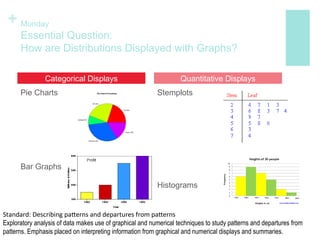
+ Monday
Essential Question:
How are Distributions Displayed with Graphs?
Categorical Displays
Pie Charts
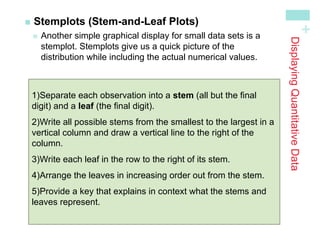
Bar Graphs
Quantitative Displays
Stemplots
Histograms
Standard: Describing patterns and departures from patterns
Exploratory analysis of data makes use of graphical and numerical techniques to study patterns and departures from
patterns. Emphasis placed on interpreting information from graphical and numerical displays and summaries.
+Quantitative Variables
Quantitative variables have numerical values that measure some characteristic of each individual. Arithmetic computation makes sense (averages, etc) Distributions list the values and the number of times a variable takes on that value.
Displays best used are –
 Dot plots
 Stem plots
 Histograms
 Relative Cumulative Frequency Charts (ogive)
 Time Plots (Trends and seasonal Variation)
 Box plots (1.2)
 Relative Frequency Charts (Ch. 4)
+
1)Draw a horizontal axis (a number line) and label it with the
variable name.
2)Scale the axis from the minimum to the maximum value.
3)Mark a dot above the location on the horizontal axis
corresponding to each data value.
Displaying
Quantitative
Data

Dotplots
One of the simplest graphs to construct and interpret is a
dotplot. Each data value is shown as a dot above its
location on a number line.
How to Make a Dotplot
Number of Goals Scored Per Game by the 2004 US Women’s Soccer Team
3 0 2 7 8 2 4 3 5 1 1 4 5 3 1 1 3
3 3 2 1 2 2 2 4 3 5 6 1 5 5 1 1 5
+
Examining the Distribution of a Quantitative Variable

The purpose of a graph is to help us understand the data.
After you make a graph, always ask, “What do I see?”
In any graph, look for the overall pattern and for striking
departures from that pattern.
Describe the overall pattern of a distribution by its:
•Shape
•Center
•Spread
Note individual values that fall outside the overall pattern.
These departures are called outliers and/or gaps.
How to Examine the Distribution of a Quantitative Variable
Displaying
Quantitative
Data
Don’t forget your
SOCS!
+ Shape 6
 Concentrate on main features.
Major peaks, outliers (not just the smallest and
largest observations), rough symmetry or clear
skewness.
 Types of Shapes:
Symmetric
Skewed
right
Skewed
left
+
Displaying
Quantitative
Data

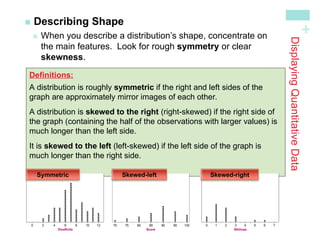
Describing Shape
When you describe a distribution’s shape, concentrate on
the main features. Look for rough symmetry or clear
skewness.
Definitions:
A distribution is roughly symmetric if the right and left sides of the
graph are approximately mirror images of each other.
A distribution is skewed to the right (right-skewed) if the right side of
the graph (containing the half of the observations with larger values) is
much longer than the left side.
It is skewed to the left (left-skewed) if the left side of the graph is
much longer than the right side.
DiceRolls
0 2 4 6 8 10 12
Score
70 75 80 85 90 95 100
Siblings
0 1 2 3 4 5 6 7
Symmetric Skewed-left Skewed-right
+

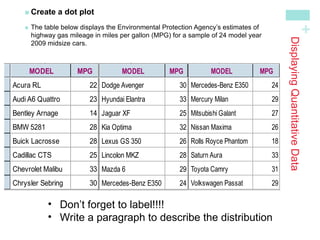
Create a dot plot
The table below displays the Environmental Protection Agency’s estimates of
highway gas mileage in miles per gallon (MPG) for a sample of 24 model year
2009 midsize cars.
Displaying
Quantitative
Data
• Don’t forget to label!!!!
• Write a paragraph to describe the distribution
9 Fuel Economy Guide
MODEL MPG
1
2
3
4
5
6
7
8
9
Acura RL 22
Audi A6 Quattro 23
Bentley Arnage 14
BMW 5281 28
Buick Lacrosse 28
Cadillac CTS 25
Chevrolet Malibu 33
Chrysler Sebring 30
Dodge Avenger 30
2009 Fuel Economy Guide
MODEL MPG <new>
9
10
11
12
13
14
15
16
17
Dodge Avenger 30
Hyundai Elantra 33
Jaguar XF 25
Kia Optima 32
Lexus GS 350 26
Lincolon MKZ 28
Mazda 6 29
Mercedes-Benz E350 24
Mercury Milan 29
2009 Fuel Economy Guide
MODEL MPG <new>
16
17
18
19
20
21
22
23
24
Mercedes-Benz E350 24
Mercury Milan 29
Mitsubishi Galant 27
Nissan Maxima 26
Rolls Royce Phantom 18
Saturn Aura 33
Toyota Camry 31
Volkswagen Passat 29
Volvo S80 25
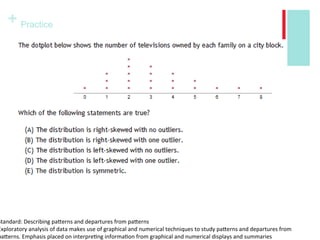
+ Practice
Warm Up:
Standard: Describing patterns and departures from patterns
Exploratory analysis of data makes use of graphical and numerical techniques to study patterns and departures from
patterns. Emphasis placed on interpreting information from graphical and numerical displays and summaries
+
Displaying
Quantitative
Data

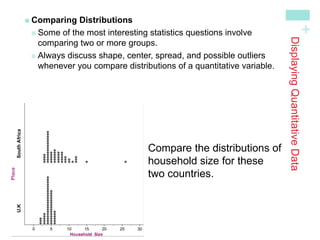
Comparing Distributions
Some of the most interesting statistics questions involve
comparing two or more groups.

Always discuss shape, center, spread, and possible outliers
whenever you compare distributions of a quantitative variable.
Household_Size
0 5 10 15 20 25 30
Compare the distributions of
household size for these
two countries.
Place
U.K
South
Africa
+
1)Separate each observation into a stem (all but the final
digit) and a leaf (the final digit).
2)Write all possible stems from the smallest to the largest in a
vertical column and draw a vertical line to the right of the
column.
3)Write each leaf in the row to the right of its stem.
4)Arrange the leaves in increasing order out from the stem.
5)Provide a key that explains in context what the stems and
leaves represent.
Displaying
Quantitative
Data

Stemplots (Stem-and-Leaf Plots)
Another simple graphical display for small data sets is a
stemplot. Stemplots give us a quick picture of the
distribution while including the actual numerical values.
+
Displaying
Quantitative
Data

Stemplots (Stem-and-Leaf Plots)
These data represent the responses of 20 female AP
Statistics students to the question, “How many pairs of
shoes do you have?” Construct a stemplot.
50 26 26 31 57 19 24 22 23 38
13 50 13 34 23 30 49 13 15 51
Stem
s
1
2
3
4
5
Add leaves
1 93335
2
664233
3 1840
4 9
5 0701 Order leaves
1 33359
2
233466
3 0148
4 9
5 0017 Add a key
Key: 4|9
represents a
female
student who
reported
having 49
pairs of
shoes.
+
Displaying
Quantitative
Data

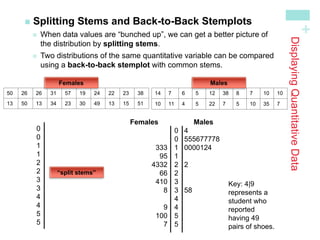
Splitting Stems and Back-to-Back Stemplots
 When data values are “bunched up”, we can get a better picture of
the distribution by splitting stems.

Two distributions of the same quantitative variable can be compared
using a back-to-back stemplot with common stems.
50 26 26 31 57 19 24 22 23 38
13 50 13 34 23 30 49 13 15 51
0
0
1
1
2
2
3
3
4
4
5
5
Key: 4|9
represents a
student who
reported
having 49
pairs of shoes.
Females
14 7 6 5 12 38 8 7 10 10
10 11 4 5 22 7 5 10 35 7
Males
0 4
0 555677778
1 0000124
1
2 2
2
3
3 58
4
4
5
5
Females
333
95
4332
66
410
8
9
100
7
Males
“split stems”
+
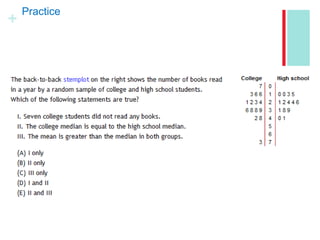
Practice
+
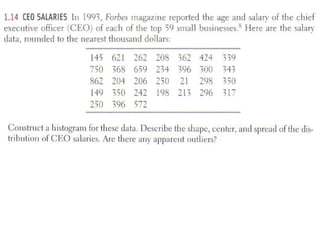
1)Divide the range of data into classes of equal width.
(Usually we divide this difference by 7)
1)Find the count (frequency) or percent (relative frequency) of
individuals in each class.
2)Label and scale your axes and draw the histogram. The
height of the bar equals its frequency. Adjacent bars should
touch, unless a class contains no individuals.
Displaying
Quantitative
Data

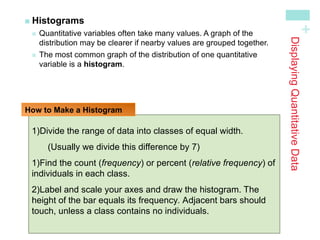
Histograms
 Quantitative variables often take many values. A graph of the
distribution may be clearer if nearby values are grouped together.

The most common graph of the distribution of one quantitative
variable is a histogram.
How to Make a Histogram
+
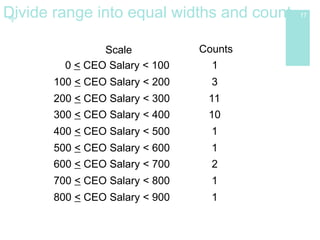
Divide range into equal widths and count 17
0 < CEO Salary < 100
100 < CEO Salary < 200
200 < CEO Salary < 300
300 < CEO Salary < 400
400 < CEO Salary < 500
500 < CEO Salary < 600
600 < CEO Salary < 700
700 < CEO Salary < 800
800 < CEO Salary < 900
Scale
1
3
11
10
1
1
2
1
1
Counts
+
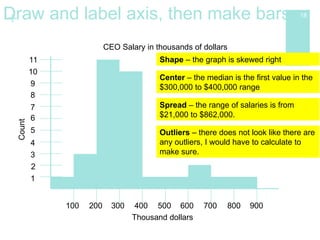
Draw and label axis, then make bars 18
CEO Salary in thousands of dollars
100 200 300 400 500 600 700 800 900
Thousand dollars
1
2
3
4
5
6
7
8
9
10
11 Shape – the graph is skewed right
Center – the median is the first value in the
$300,000 to $400,000 range
Spread – the range of salaries is from
$21,000 to $862,000.
Outliers – there does not look like there are
any outliers, I would have to calculate to
make sure.
+

Making a Histogram

On a separate sheet of paper, go to pg. 57 and complete p.
1.11 by hand.
Displaying
Quantitative
Data
+

Making a Histogram

On your graphing calculator, turn to page 59 and following the
directions
Displaying
Quantitative
Data
+
Center
Unusual
Features
Spread
Shape
To describe a distribution:
LET’S CUSS!
+
1)Don’t confuse histograms and bar graphs.
2)Don’t use counts (in a frequency table) or percents (in a
relative frequency table) as data.
3)Use percents instead of counts on the vertical axis when
comparing distributions with different numbers of
observations.
4)Just because a graph looks nice, it’s not necessarily a
meaningful display of data.
Displaying
Quantitative
Data

Using Histograms Wisely
Here are several cautions based on common mistakes
students make when using histograms.
Cautions
+
In this section, we learned that…
 You can use a dotplot, stemplot, or histogram to show the distribution
of a quantitative variable.
 When examining any graph, look for an overall pattern and for notable
departures from that pattern. Describe the shape, center, spread, and
any outliers. Don’t forget your SOCS!
 Some distributions have simple shapes, such as symmetric or skewed.
The number of modes (major peaks) is another aspect of overall shape.
 When comparing distributions, be sure to discuss shape, center, spread,
and possible outliers.
 Histograms are for quantitative data, bar graphs are for categorical data.
Use relative frequency histograms when comparing data sets of different
sizes.
Summary
Displaying Quantitative Data with Graphs

AP Stat Lesson 11 - Describing Data - dot plots, stem plots, histograms2.ppt

  • 1.
    + Chapter 1: ExploringData Section 1.1 Displaying Distributions with Graphs The Practice of Statistics, 3rd edition - For AP* STARNES, YATES, MOORE
  • 2.
    + Monday Essential Question: Howare Distributions Displayed with Graphs? Categorical Displays Pie Charts Bar Graphs Quantitative Displays Stemplots Histograms Standard: Describing patterns and departures from patterns Exploratory analysis of data makes use of graphical and numerical techniques to study patterns and departures from patterns. Emphasis placed on interpreting information from graphical and numerical displays and summaries.
  • 3.
    +Quantitative Variables Quantitative variableshave numerical values that measure some characteristic of each individual. Arithmetic computation makes sense (averages, etc) Distributions list the values and the number of times a variable takes on that value. Displays best used are –  Dot plots  Stem plots  Histograms  Relative Cumulative Frequency Charts (ogive)  Time Plots (Trends and seasonal Variation)  Box plots (1.2)  Relative Frequency Charts (Ch. 4)
  • 4.
    + 1)Draw a horizontalaxis (a number line) and label it with the variable name. 2)Scale the axis from the minimum to the maximum value. 3)Mark a dot above the location on the horizontal axis corresponding to each data value. Displaying Quantitative Data  Dotplots One of the simplest graphs to construct and interpret is a dotplot. Each data value is shown as a dot above its location on a number line. How to Make a Dotplot Number of Goals Scored Per Game by the 2004 US Women’s Soccer Team 3 0 2 7 8 2 4 3 5 1 1 4 5 3 1 1 3 3 3 2 1 2 2 2 4 3 5 6 1 5 5 1 1 5
  • 5.
    + Examining the Distributionof a Quantitative Variable  The purpose of a graph is to help us understand the data. After you make a graph, always ask, “What do I see?” In any graph, look for the overall pattern and for striking departures from that pattern. Describe the overall pattern of a distribution by its: •Shape •Center •Spread Note individual values that fall outside the overall pattern. These departures are called outliers and/or gaps. How to Examine the Distribution of a Quantitative Variable Displaying Quantitative Data Don’t forget your SOCS!
  • 6.
    + Shape 6 Concentrate on main features. Major peaks, outliers (not just the smallest and largest observations), rough symmetry or clear skewness.  Types of Shapes: Symmetric Skewed right Skewed left
  • 7.
    + Displaying Quantitative Data  Describing Shape When youdescribe a distribution’s shape, concentrate on the main features. Look for rough symmetry or clear skewness. Definitions: A distribution is roughly symmetric if the right and left sides of the graph are approximately mirror images of each other. A distribution is skewed to the right (right-skewed) if the right side of the graph (containing the half of the observations with larger values) is much longer than the left side. It is skewed to the left (left-skewed) if the left side of the graph is much longer than the right side. DiceRolls 0 2 4 6 8 10 12 Score 70 75 80 85 90 95 100 Siblings 0 1 2 3 4 5 6 7 Symmetric Skewed-left Skewed-right
  • 8.
    +  Create a dotplot The table below displays the Environmental Protection Agency’s estimates of highway gas mileage in miles per gallon (MPG) for a sample of 24 model year 2009 midsize cars. Displaying Quantitative Data • Don’t forget to label!!!! • Write a paragraph to describe the distribution 9 Fuel Economy Guide MODEL MPG 1 2 3 4 5 6 7 8 9 Acura RL 22 Audi A6 Quattro 23 Bentley Arnage 14 BMW 5281 28 Buick Lacrosse 28 Cadillac CTS 25 Chevrolet Malibu 33 Chrysler Sebring 30 Dodge Avenger 30 2009 Fuel Economy Guide MODEL MPG <new> 9 10 11 12 13 14 15 16 17 Dodge Avenger 30 Hyundai Elantra 33 Jaguar XF 25 Kia Optima 32 Lexus GS 350 26 Lincolon MKZ 28 Mazda 6 29 Mercedes-Benz E350 24 Mercury Milan 29 2009 Fuel Economy Guide MODEL MPG <new> 16 17 18 19 20 21 22 23 24 Mercedes-Benz E350 24 Mercury Milan 29 Mitsubishi Galant 27 Nissan Maxima 26 Rolls Royce Phantom 18 Saturn Aura 33 Toyota Camry 31 Volkswagen Passat 29 Volvo S80 25
  • 9.
    + Practice Warm Up: Standard:Describing patterns and departures from patterns Exploratory analysis of data makes use of graphical and numerical techniques to study patterns and departures from patterns. Emphasis placed on interpreting information from graphical and numerical displays and summaries
  • 10.
    + Displaying Quantitative Data  Comparing Distributions Some ofthe most interesting statistics questions involve comparing two or more groups.  Always discuss shape, center, spread, and possible outliers whenever you compare distributions of a quantitative variable. Household_Size 0 5 10 15 20 25 30 Compare the distributions of household size for these two countries. Place U.K South Africa
  • 11.
    + 1)Separate each observationinto a stem (all but the final digit) and a leaf (the final digit). 2)Write all possible stems from the smallest to the largest in a vertical column and draw a vertical line to the right of the column. 3)Write each leaf in the row to the right of its stem. 4)Arrange the leaves in increasing order out from the stem. 5)Provide a key that explains in context what the stems and leaves represent. Displaying Quantitative Data  Stemplots (Stem-and-Leaf Plots) Another simple graphical display for small data sets is a stemplot. Stemplots give us a quick picture of the distribution while including the actual numerical values.
  • 12.
    + Displaying Quantitative Data  Stemplots (Stem-and-Leaf Plots) Thesedata represent the responses of 20 female AP Statistics students to the question, “How many pairs of shoes do you have?” Construct a stemplot. 50 26 26 31 57 19 24 22 23 38 13 50 13 34 23 30 49 13 15 51 Stem s 1 2 3 4 5 Add leaves 1 93335 2 664233 3 1840 4 9 5 0701 Order leaves 1 33359 2 233466 3 0148 4 9 5 0017 Add a key Key: 4|9 represents a female student who reported having 49 pairs of shoes.
  • 13.
    + Displaying Quantitative Data  Splitting Stems andBack-to-Back Stemplots  When data values are “bunched up”, we can get a better picture of the distribution by splitting stems.  Two distributions of the same quantitative variable can be compared using a back-to-back stemplot with common stems. 50 26 26 31 57 19 24 22 23 38 13 50 13 34 23 30 49 13 15 51 0 0 1 1 2 2 3 3 4 4 5 5 Key: 4|9 represents a student who reported having 49 pairs of shoes. Females 14 7 6 5 12 38 8 7 10 10 10 11 4 5 22 7 5 10 35 7 Males 0 4 0 555677778 1 0000124 1 2 2 2 3 3 58 4 4 5 5 Females 333 95 4332 66 410 8 9 100 7 Males “split stems”
  • 14.
  • 15.
    + 1)Divide the rangeof data into classes of equal width. (Usually we divide this difference by 7) 1)Find the count (frequency) or percent (relative frequency) of individuals in each class. 2)Label and scale your axes and draw the histogram. The height of the bar equals its frequency. Adjacent bars should touch, unless a class contains no individuals. Displaying Quantitative Data  Histograms  Quantitative variables often take many values. A graph of the distribution may be clearer if nearby values are grouped together.  The most common graph of the distribution of one quantitative variable is a histogram. How to Make a Histogram
  • 17.
    + Divide range intoequal widths and count 17 0 < CEO Salary < 100 100 < CEO Salary < 200 200 < CEO Salary < 300 300 < CEO Salary < 400 400 < CEO Salary < 500 500 < CEO Salary < 600 600 < CEO Salary < 700 700 < CEO Salary < 800 800 < CEO Salary < 900 Scale 1 3 11 10 1 1 2 1 1 Counts
  • 18.
    + Draw and labelaxis, then make bars 18 CEO Salary in thousands of dollars 100 200 300 400 500 600 700 800 900 Thousand dollars 1 2 3 4 5 6 7 8 9 10 11 Shape – the graph is skewed right Center – the median is the first value in the $300,000 to $400,000 range Spread – the range of salaries is from $21,000 to $862,000. Outliers – there does not look like there are any outliers, I would have to calculate to make sure.
  • 19.
    +  Making a Histogram  Ona separate sheet of paper, go to pg. 57 and complete p. 1.11 by hand. Displaying Quantitative Data
  • 20.
    +  Making a Histogram  Onyour graphing calculator, turn to page 59 and following the directions Displaying Quantitative Data
  • 21.
  • 22.
    + 1)Don’t confuse histogramsand bar graphs. 2)Don’t use counts (in a frequency table) or percents (in a relative frequency table) as data. 3)Use percents instead of counts on the vertical axis when comparing distributions with different numbers of observations. 4)Just because a graph looks nice, it’s not necessarily a meaningful display of data. Displaying Quantitative Data  Using Histograms Wisely Here are several cautions based on common mistakes students make when using histograms. Cautions
  • 23.
    + In this section,we learned that…  You can use a dotplot, stemplot, or histogram to show the distribution of a quantitative variable.  When examining any graph, look for an overall pattern and for notable departures from that pattern. Describe the shape, center, spread, and any outliers. Don’t forget your SOCS!  Some distributions have simple shapes, such as symmetric or skewed. The number of modes (major peaks) is another aspect of overall shape.  When comparing distributions, be sure to discuss shape, center, spread, and possible outliers.  Histograms are for quantitative data, bar graphs are for categorical data. Use relative frequency histograms when comparing data sets of different sizes. Summary Displaying Quantitative Data with Graphs

Editor's Notes

  • #14 Answer: E
  • #21 Thanks to Texas A&M University at College Station, TX for giving me a wonderful opportunity to advance my teaching of Statistics. A special thanks to Dr. Jim Matis and Dr. Julie H. Carroll for their inspiration and dedication to improving the field of teaching statistics at the undergraduate level. Ask students why would they want to learn statistics. Besides the requirement for graduation…ask them if they ever read the sports summary statistics after games, watch the analysts predict stock market movements, watched the weather news forecast tomorrow’s climatic changes,…ALL of which involves statistics. Have they ever participated in a survey or experiment? I.E. phone surveys, internet surveys, medical experiments So what is Statistics? See if any volunteers will attempt to answer.