Advocates for Ohio’s Future Political and Field CallFeaturing:Gayle Channing Tenenbaum, co-Chair of Advocates for Ohio’s Future, Senior Policy Associate for Voices for Ohio’s Children, and Director of Policy and Govt Affairs at PCSAOLarkeRecchie, Executive Director of the Ohio Association of Area Agencies on Aging (o4a)Cathy Levine, Executive Director of Universal Health Care Action Network of Ohio and Co-Chair of Ohio Consumers for Health CoverageNora Nees, Director of Child and Senior Nutrition of the Ohio Association of Second Harvest Foodbanks (OASHF)
HB 153 (State Budget, FY 2012-2013)Cathy LevineCo-Chair of Ohio Consumers for Health Coverage (OCHC), Executive Director of Universal Health Care Action Network of Ohio (UHCAN-OH)
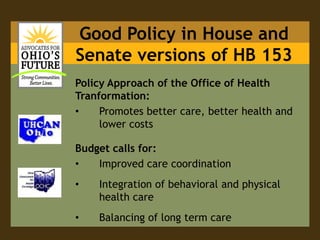
Good Policy in House and Senate versions of HB 153Policy Approach of the Office of Health Tranformation: Promotes better care, better health and lower costsBudget calls for:Improved care coordination
Integration of behavioral and physical health care
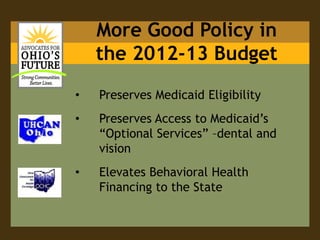
Balancing of long term careMore Good Policy in the 2012-13 BudgetPreserves Medicaid Eligibility
Preserves Access to Medicaid’s “Optional Services” –dental and vision
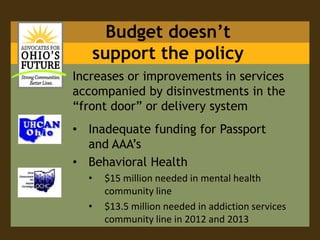
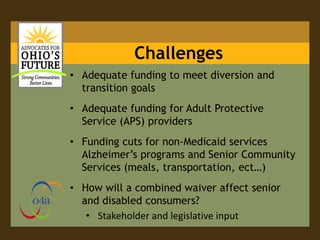
Elevates Behavioral Health Financing to the State Budget doesn’t support the policyIncreases or improvements in services accompanied by disinvestments in the “front door” or delivery systemInadequate funding for Passport and AAA’s
Behavioral Health
$15 million needed in mental health community line
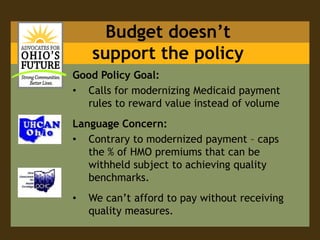
$13.5 million needed in addiction services community line in 2012 and 2013 Budget doesn’t support the policyGood Policy Goal: Calls for modernizing Medicaid payment rules to reward value instead of volumeLanguage Concern:Contrary to modernized payment – caps the % of HMO premiums that can be withheld subject to achieving quality benchmarks.
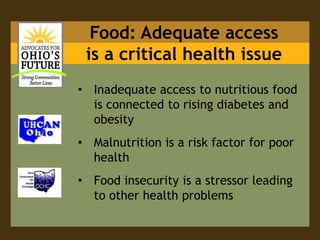
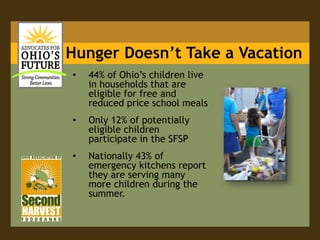
We can’t afford to pay without receiving quality measures. Food: Adequate access is a critical health issueInadequate access to nutritious food is connected to rising diabetes and obesity
Malnutrition is a risk factor for poor health
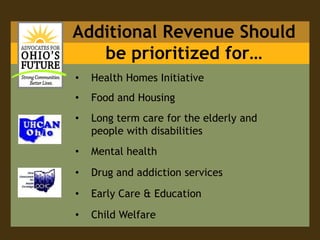
Food insecurity is a stressor leading to other health problemsAdditional Revenue Should be prioritized for…Health Homes Initiative
Food and Housing
Long term care for the elderly and people with disabilities
Mental health
Drug and addiction services
Early Care & Education
Child WelfareHB 153 (State Budget, FY 2012-2013)Gayle Channing TenenbaumCo-Chair of Advocates for Ohio’s Future, Senior Policy Associate for Voices for Ohio’s Children, and Director of Policy and Govt Affairs at PCSAO
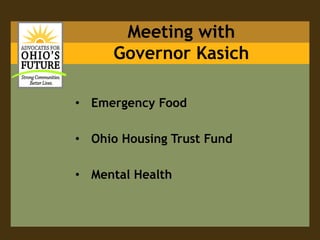
Meeting withGovernor KasichEmergency Food
Ohio Housing Trust Fund
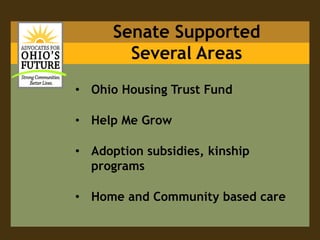
Mental HealthSenate Supported Several AreasOhio Housing Trust Fund
Help Me Grow
Adoption subsidies, kinship programs
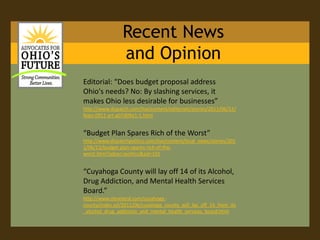
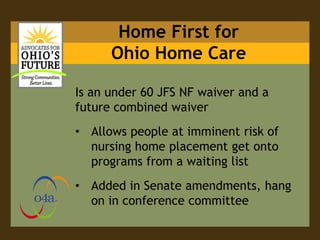
Home and Community based careRecent News and OpinionEditorial: “Does budget proposal address Ohio's needs? No: By slashing services, it makes Ohio less desirable for businesses”http://www.dispatch.com/live/content/editorials/stories/2011/06/12/fejes-0911-art-g07d09o1-1.html“Budget Plan Spares Rich of the Worst”http://www.dispatchpolitics.com/live/content/local_news/stories/2011/06/13/budget-plan-spares-rich-of-the-worst.html?adsec=politics&sid=101“Cuyahoga County will lay off 14 of its Alcohol, Drug Addiction, and Mental Health Services Board.”http://www.cleveland.com/cuyahoga-county/index.ssf/2011/06/cuyahoga_county_will_lay_off_14_from_its_alcohol_drug_addiction_and_mental_health_services_board.html
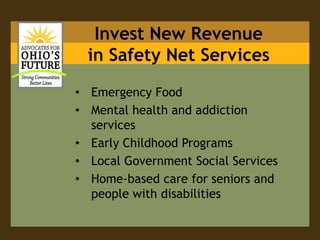
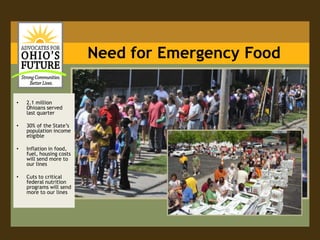
Invest New Revenue in Safety Net ServicesEmergency Food
Mental health and addiction services
Early Childhood Programs

AOF Webinar 6-14-11

  • 1.
    Advocates for Ohio’sFuture Political and Field CallFeaturing:Gayle Channing Tenenbaum, co-Chair of Advocates for Ohio’s Future, Senior Policy Associate for Voices for Ohio’s Children, and Director of Policy and Govt Affairs at PCSAOLarkeRecchie, Executive Director of the Ohio Association of Area Agencies on Aging (o4a)Cathy Levine, Executive Director of Universal Health Care Action Network of Ohio and Co-Chair of Ohio Consumers for Health CoverageNora Nees, Director of Child and Senior Nutrition of the Ohio Association of Second Harvest Foodbanks (OASHF)
  • 2.
    HB 153 (StateBudget, FY 2012-2013)Cathy LevineCo-Chair of Ohio Consumers for Health Coverage (OCHC), Executive Director of Universal Health Care Action Network of Ohio (UHCAN-OH)
  • 3.
    Good Policy inHouse and Senate versions of HB 153Policy Approach of the Office of Health Tranformation: Promotes better care, better health and lower costsBudget calls for:Improved care coordination
  • 4.
    Integration of behavioraland physical health care
  • 5.
    Balancing of longterm careMore Good Policy in the 2012-13 BudgetPreserves Medicaid Eligibility
  • 6.
    Preserves Access toMedicaid’s “Optional Services” –dental and vision
  • 7.
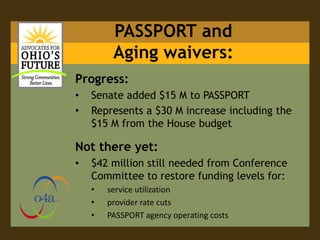
    Elevates Behavioral HealthFinancing to the State Budget doesn’t support the policyIncreases or improvements in services accompanied by disinvestments in the “front door” or delivery systemInadequate funding for Passport and AAA’s
  • 8.
  • 9.
    $15 million neededin mental health community line
  • 10.
    $13.5 million neededin addiction services community line in 2012 and 2013 Budget doesn’t support the policyGood Policy Goal: Calls for modernizing Medicaid payment rules to reward value instead of volumeLanguage Concern:Contrary to modernized payment – caps the % of HMO premiums that can be withheld subject to achieving quality benchmarks.
  • 11.
    We can’t affordto pay without receiving quality measures. Food: Adequate access is a critical health issueInadequate access to nutritious food is connected to rising diabetes and obesity
  • 12.
    Malnutrition is arisk factor for poor health
  • 13.
    Food insecurity isa stressor leading to other health problemsAdditional Revenue Should be prioritized for…Health Homes Initiative
  • 14.
  • 15.
    Long term carefor the elderly and people with disabilities
  • 16.
  • 17.
  • 18.
    Early Care &Education
  • 19.
    Child WelfareHB 153(State Budget, FY 2012-2013)Gayle Channing TenenbaumCo-Chair of Advocates for Ohio’s Future, Senior Policy Associate for Voices for Ohio’s Children, and Director of Policy and Govt Affairs at PCSAO
  • 20.
  • 21.
  • 22.
    Mental HealthSenate SupportedSeveral AreasOhio Housing Trust Fund
  • 23.
  • 24.
  • 25.
    Home and Communitybased careRecent News and OpinionEditorial: “Does budget proposal address Ohio's needs? No: By slashing services, it makes Ohio less desirable for businesses”http://www.dispatch.com/live/content/editorials/stories/2011/06/12/fejes-0911-art-g07d09o1-1.html“Budget Plan Spares Rich of the Worst”http://www.dispatchpolitics.com/live/content/local_news/stories/2011/06/13/budget-plan-spares-rich-of-the-worst.html?adsec=politics&sid=101“Cuyahoga County will lay off 14 of its Alcohol, Drug Addiction, and Mental Health Services Board.”http://www.cleveland.com/cuyahoga-county/index.ssf/2011/06/cuyahoga_county_will_lay_off_14_from_its_alcohol_drug_addiction_and_mental_health_services_board.html
  • 26.
    Invest New Revenuein Safety Net ServicesEmergency Food
  • 27.
    Mental health andaddiction services
  • 28.

Editor's Notes

  • #2 Need Groundwork picture!!
  • #4 Medicaid: Long-term reforms will improve health care outcomes and lower costs Without significant reform, growth in the state’s Medicaid program would overwhelm spending in all other state programs.  The Governor’s Office of Health Transformation moves Ohio’s Medicaid program in the right direction through a number of strategies to reduce system costs and improve health outcomes by modernizing the health care payment system, integrating behavioral and physical health care and reducing other fragmentation in the system, and improving the coordination of care. These strategies will better position the state to take advantage of many of the improvements available through federal health care reform.  The proposed changes will particularly help Ohioans with chronic conditions and children with disabilities who will benefit from coordinated care and integrated hospital, physician, and supportive services.  We also commend Governor Kasich for: Preserving Medicaid Eligibility –Ohio’s eligibility limits are already lower than many other states. Reductions to eligibility would have harmed vulnerable populations including more than 1.2 million of Ohio’s 2.9 million children who rely on the Medicaid program for their health care coverage.  Preserving Access to Medicaid’s “Optional Services” –Optional services, which include vision, dental, prescription drugs, hospice care, and community mental health services among other things, provide cost-effective care and enable people to avoid care in more expensive settings.  Elevating Behavioral Health Financing to the State –The decentralization of funding and lack of state investment has brought Ohio’s community behavioral health system to the brink of failure and collapse. In addition, disconnected systems have created perverse incentives to shift patients to more expensive and, often, inappropriate settings. Relieving counties of this responsibility will enable the state to create consistent and comprehensive policies to ensure better care for Medicaid-eligible individuals with behavioral health disorders. Rebalancing Long-Term Care— Ohio’s long-term care system relies too heavily on nursing home placements, which are more expensive than home- or community-based care. The governor’s budget establishes a goal of reducing the nursing home population to 50 percent of the state’s long-term care system.  Reforming the payment system for Large Providers –Since the Medicaid program was delinked from cash assistance in 1996, it has evolved from being a welfare program to a major player in the health care market. As such, its focus has had to shift to ensuring value for spending. Hospitals and nursing homes represent significant areas of Medicaid spending. The governor’s budget modifies Ohio’s out-of-date hospital payment system and moves nursing homes to a price-based reimbursement system that focuses more on quality.
  • #5 Preserving Investments Made in Early Care and Education – Helping children enter school ready to learn is critical to their long-term success. The budget preserves funding in the Department of Education for Early Childhood Education (formerly public preschool) for 5,700 children. The budget maintains some funding for Ohio’s Step Up to Quality program that works to improve the quality of Ohio’s early care and education programs. Funding for the Help Me Grow program was reduced by $3 million each year. We applaud the administration for continuing work begun in the Strickland administration to refinance this program through Medicaid. Refinancing portions of this program will mitigate General Revenue Fund (GRF) reductions.  The Governor’s focus on prenatal care is a common-sense method of promoting healthier children and mothers, and it saves money in the system. Lowering the number of low-birth-weight babies – whose care costs six times more than that of healthy babies – will have positive effects down the line, reducing the need for early intervention, special education in school, and more.  Preservation of the Ohio Housing Trust Fund, TANF Cash Assistance, and emergency food assistance represents more good news in the budget. DYSBoth the RECLAIM program and Youth Services Subsidy line items are funded at FY 2011 levels in both years of the bienniumContinuation of funding for Juvenile Justice Behavioral Health ProgramsOne more Juvenile Detention Center closed
  • #8 Preserving Investments Made in Early Care and Education – Helping children enter school ready to learn is critical to their long-term success. The budget preserves funding in the Department of Education for Early Childhood Education (formerly public preschool) for 5,700 children. The budget maintains some funding for Ohio’s Step Up to Quality program that works to improve the quality of Ohio’s early care and education programs. Funding for the Help Me Grow program was reduced by $3 million each year. We applaud the administration for continuing work begun in the Strickland administration to refinance this program through Medicaid. Refinancing portions of this program will mitigate General Revenue Fund (GRF) reductions.  The Governor’s focus on prenatal care is a common-sense method of promoting healthier children and mothers, and it saves money in the system. Lowering the number of low-birth-weight babies – whose care costs six times more than that of healthy babies – will have positive effects down the line, reducing the need for early intervention, special education in school, and more.  Preservation of the Ohio Housing Trust Fund, TANF Cash Assistance, and emergency food assistance represents more good news in the budget. DYSBoth the RECLAIM program and Youth Services Subsidy line items are funded at FY 2011 levels in both years of the bienniumContinuation of funding for Juvenile Justice Behavioral Health ProgramsOne more Juvenile Detention Center closed