BY,
ANU ELIZABETH GEORGE
MACFAST COLLEGE
THIRUVALLA
KERALA
EMAIL: anu8468@gmail.com
BRAND POSITIONING STRATEGY
BRAND POSITIONING STRATEGY IS ABOUT FINDING A
RIGHT PLACE FOR A BRAND IN MARKET PLACE AS WELL
CONSUMER MIND
A CONSUMER SHOULD EASILY IDENTIFY THAT FOR A
GIVEN NEED OR WANT THIS IS THE BRAND..
VICKS VAPORUB
•The Vaporub segment in the market is strategically
dominated by Vicks Vaporub
in India.
• A brand of Proctor & Gamble (P&G), Vicks Vaporub
covers almost the
entire market segment in the case of branded
competitors.
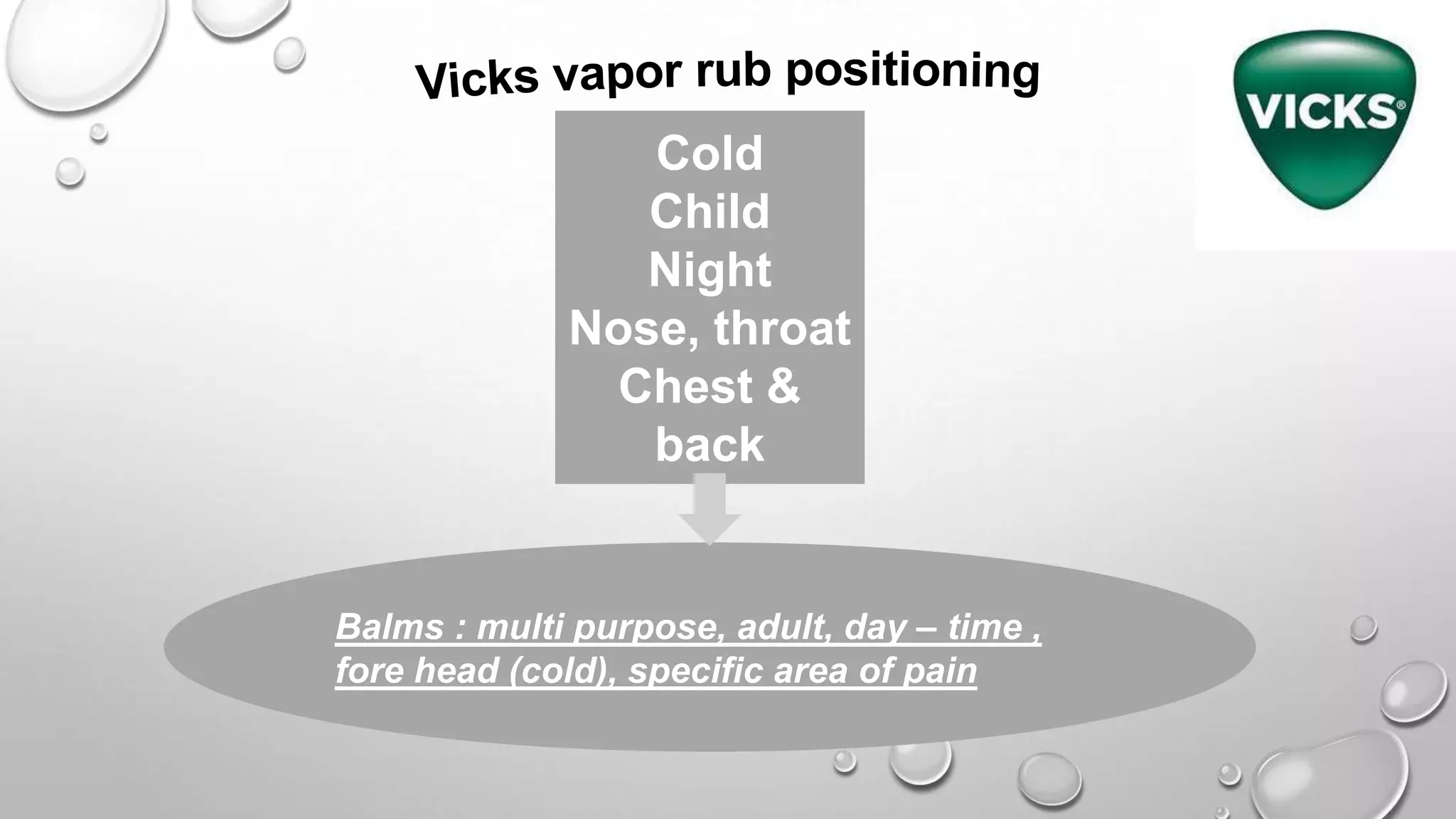
Cold
Child
Night
Nose, throat
Chest &
back
Balms : multi purpose, adult, day – time ,
fore head (cold), specific area of pain
.1996:
Surf excel was launched in 1996 offering µcomplete cleaning
and care¶ .
This was communicated through the campaign µ
Jaisabhidaagho,
Surf Excel hai Na¶.
This typ eof positioning is based on the concept of
Functional positioning (solve problem).
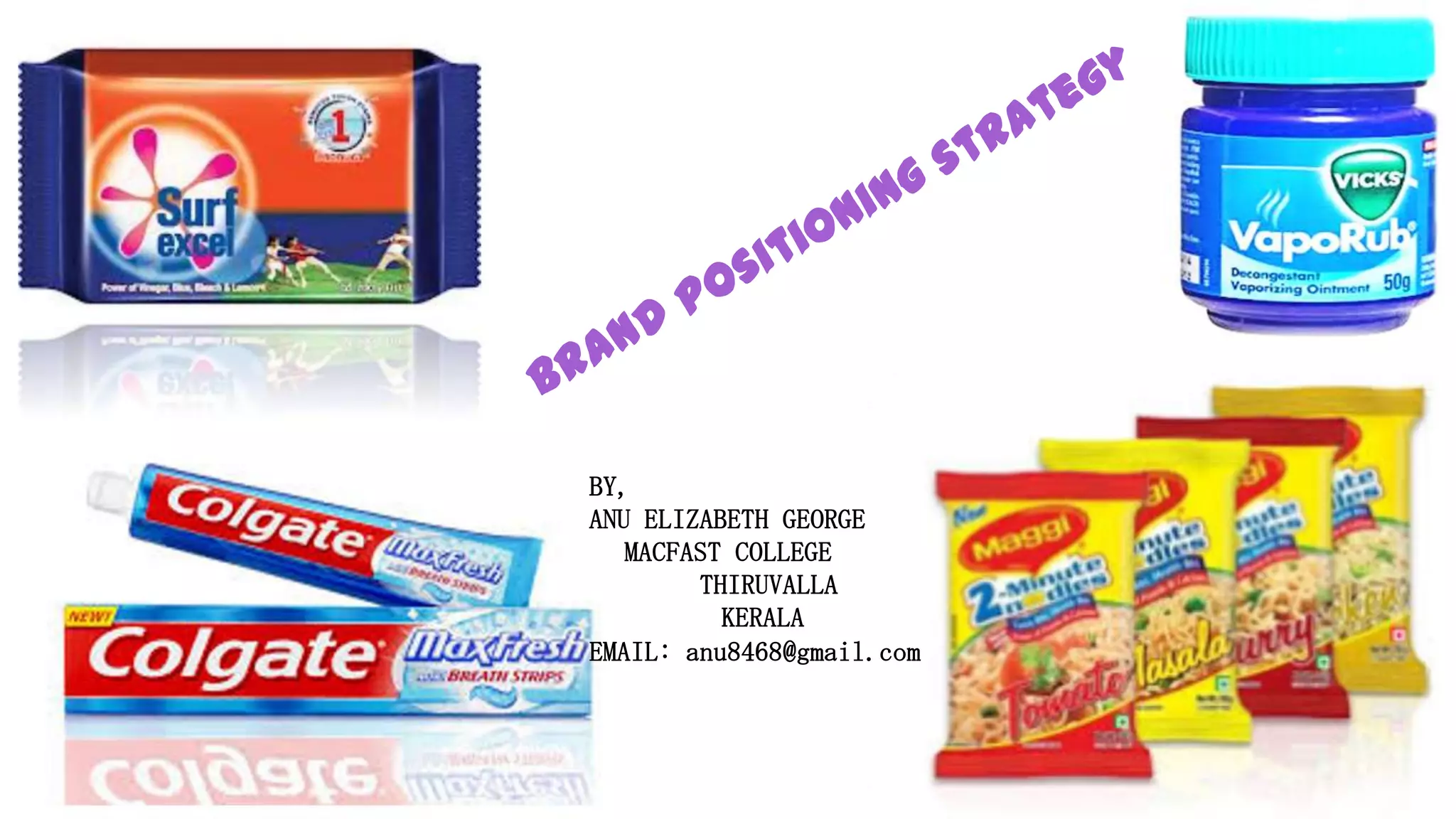
SURF EXCEL
•Surf Excel, launched in 1954, is one of the oldest detergent powders
in India and Pakistan.
• Initially, the brand was positioned on the clean proposition of “washes
whitest”.
•However, with the emergence of numerous local detergent
manufacturers and the entry of other global brands, Surf Excel
underwent various changes in its Brand Communication
2003:
In 2003 Surf excel was positioned to address a key concern of
the country:
shortage of water.
The brand was tied up with eminent
celebrity Shabana Azmi to propagate the concept of saving
two buckets of water along with getting stain free cleaning.
This campaigning was based on the combination of two
positioning concepts, namely ,symbolic positioning (social
meaningfulness) and functional positioning (Provide benefits
to customers)
2005:
In 2005 surf excel came up with the concept of vice is nice by using the
tagline µAgardaaglagnese kuchachahotahaito daagache hain¶.
• To hold their market share surf excel adopt this philosophy to propagate the concept that if
a child learns something and gets stained in the process then those stains are good. To
make µDirt is good
• a meaningful campaign stains are linked with learning of values.
• This type of positioning is based on the concept of Experiential positioning
(provide cognitive stimulation).
MAGGIE NOODLES
• Maggi‟, the very popular brand in Indian packaged food market, was
introduced in India in the year of 1982.
• This brand was introduced in India by Nestlé India Ltd.
• The dominance of Nestlé India Ltd (NIL) in instant noodles market is
still unquestionable.
• It has been able to beat competition from the likes of ITC (Sun feast
Yippee), and GlaxoSmithKline‟s (GSK) Horlicks Foodles.
• First-mover advantage in the instant noodles segment helped Maggi
to retain their market leadership over the years
.
MAGGI: BRAND POSITIONING FROM 1982
THROUGH 2000S
At the time, when Maggi made their entry in Indian
mark, Indian customers were much conservative in
their food habits, preferring homemade traditional
food, rather than canned or packed food.
• At the initial stage, they targeted Indian women on the perception
that
they can be easily attracted since maggi is easy to cook.
But all such efforts did not really work in the expected fashion.
• To find out the exact problem, NIL conducted a market research
and
found that children are the largest consumers of the product.
So, NIL positioned Maggi noodles as a „convenience
product‟ for mothers and as a „fun‟ product for children by
wearing the tagline of „Fast to Cook Good to Eat‟ (in 1980s).
Advertising taglines like „‟Mummy, bhookh lagi hai‟, „Bas 2-Minute,‟ and „Fast
to Cook Good to Eat’ (in 1990s) easily positioned Maggi in the minds of target
consumers.
Along with aggressive advertising, NIL had adopted other measures like
distributing free samples, giving gifts for empty packages, etc for increased
product promotion.
In 1988, Maggi launched its first extension product „Maggi instant soup‟,
which soon acquired a prominent position in the packaged soup market in
India
Maggi: Brand Positioning from 2000 till 2012
• From the year 2000 onwards NIL came up with a new marketing strategy
that focused on the development of health and wellness products.
• They shaped their marketing strategy after considering the changing
lifestyles and eating habits of Indian consumers.
As an outcome of this, Vegetable Atta Noodles entered Maggi family in 2005.
• At this time they promoted their products with the with the tagline
“Taste bhi, Health bhi”.
• By 2010, Maggi faced severe competition due to new entrants like ITC
(Sunfeast Yippee), GlaxoSmithKline’s (GSK) Horlicks Foodles, Hindustan
Unilever’s (HUL) Knorr Soupy noodles, and Big Bazaar’s Tasty Treat.
In 1806, William Colgate introduced starch, soap and candle factory on Dutch Street
in New York City under the name of "William Colgate & Company".
In 1857, William Colgate died and the company was reorganized as "Colgate &
Company" under the management of Samuel Colgate, his son.
In 1873, the firm introduced its first toothpaste, an aromatic toothpaste sold in jars.
COLGATE
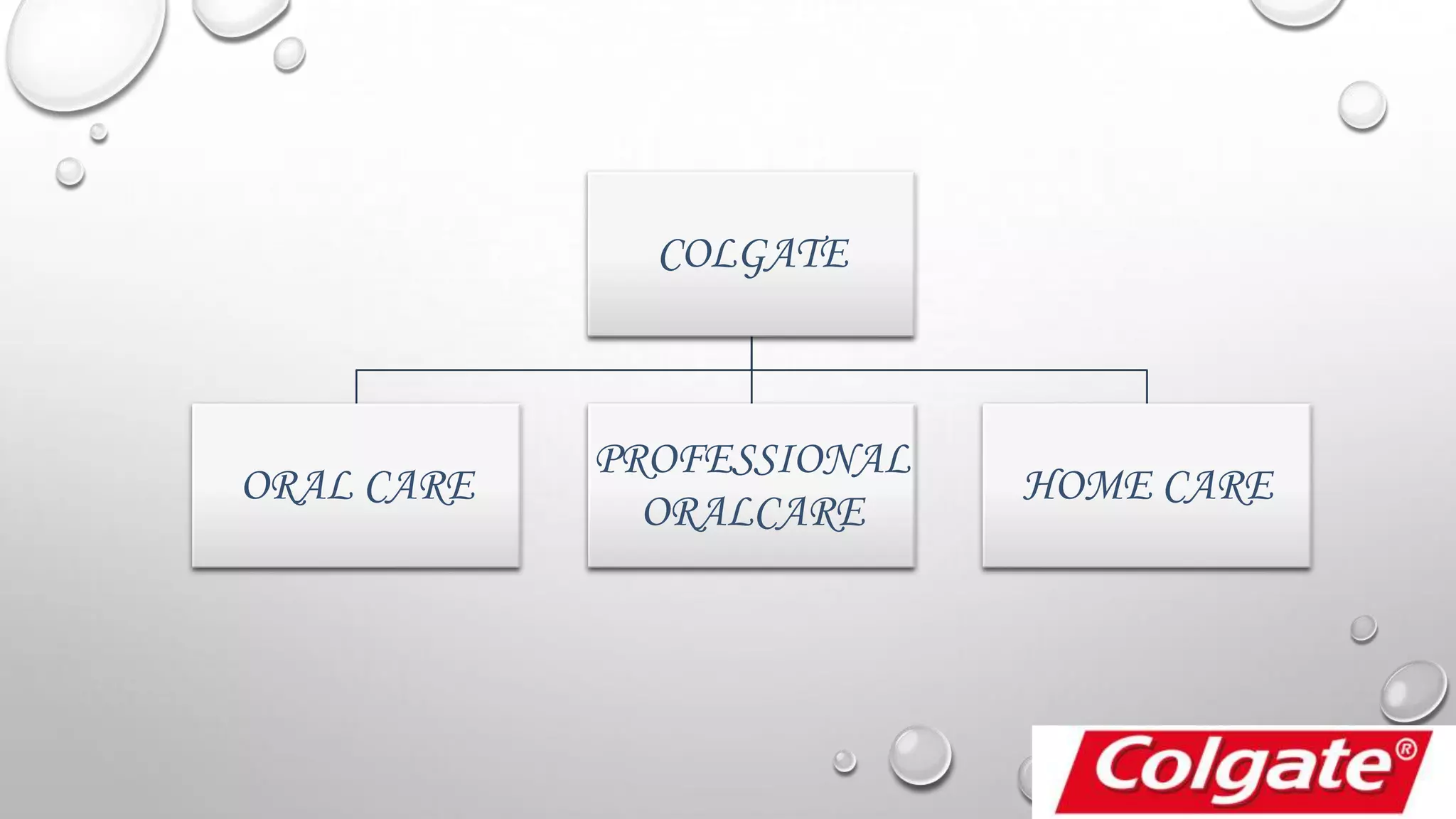
COLGATE
ORAL CARE
PROFESSIONAL
ORALCARE
HOME CARE
Colgate Branding positioning Strategy
Colgate has developed a powerful Branding Strategy which has significantly helped the Brand in acquiring
substantial amount of share in the oral care market of India. In order to strengthen its' Brand Identity, Colgate is
still restructuring its Branding Strategy.
Colgate Branding Strategy was strong enough to position the company as a major brand in the oral care market
of India. The Brand Colgate emerged as a market leader as it bagged considerable amount of market share in all
the segments of oral care market like toothpaste segment, tooth powder segment and toothbrush segment.
Colgate has succeeded in establishing its Brand Image and gaining substantial
market share in spite of facing tough competition from the brands like Hindusthan
Liver, Babool and Anchor. Still the Brand Colgate is continuously updating and
improving its' branding strategy in order to strengthen its' Brand Name and Brand
Identity
• They try to position some innovative toothpaste with a brand name other than Colgate
but under the umbrella of Colgate Palmolive.
• Focusing toward rural rich and consuming class by endorsing the development of
„Colgate Ayurvedic Toothpowder„.
• They would come up sachets of these tooth powder and position toward rural
population who buy in smaller lots
• For Urban population, they would come up with the products suiting to young
generation.
• For Urban rich and consuming class, they would come up with the products on the
basis of functional benefits
They positioning Colgate dental white crème and toothpowder towards rural rich
segment.
For rural consuming class they endorsing Cibaca toothpaste.

Anu (1)

  • 1.
    BY, ANU ELIZABETH GEORGE MACFASTCOLLEGE THIRUVALLA KERALA EMAIL: anu8468@gmail.com
  • 2.
    BRAND POSITIONING STRATEGY BRANDPOSITIONING STRATEGY IS ABOUT FINDING A RIGHT PLACE FOR A BRAND IN MARKET PLACE AS WELL CONSUMER MIND A CONSUMER SHOULD EASILY IDENTIFY THAT FOR A GIVEN NEED OR WANT THIS IS THE BRAND..
  • 4.
    VICKS VAPORUB •The Vaporubsegment in the market is strategically dominated by Vicks Vaporub in India. • A brand of Proctor & Gamble (P&G), Vicks Vaporub covers almost the entire market segment in the case of branded competitors.
  • 5.
    Cold Child Night Nose, throat Chest & back Balms: multi purpose, adult, day – time , fore head (cold), specific area of pain
  • 7.
    .1996: Surf excel waslaunched in 1996 offering µcomplete cleaning and care¶ . This was communicated through the campaign µ Jaisabhidaagho, Surf Excel hai Na¶. This typ eof positioning is based on the concept of Functional positioning (solve problem).
  • 8.
    SURF EXCEL •Surf Excel,launched in 1954, is one of the oldest detergent powders in India and Pakistan. • Initially, the brand was positioned on the clean proposition of “washes whitest”. •However, with the emergence of numerous local detergent manufacturers and the entry of other global brands, Surf Excel underwent various changes in its Brand Communication
  • 9.
    2003: In 2003 Surfexcel was positioned to address a key concern of the country: shortage of water. The brand was tied up with eminent celebrity Shabana Azmi to propagate the concept of saving two buckets of water along with getting stain free cleaning. This campaigning was based on the combination of two positioning concepts, namely ,symbolic positioning (social meaningfulness) and functional positioning (Provide benefits to customers)
  • 10.
    2005: In 2005 surfexcel came up with the concept of vice is nice by using the tagline µAgardaaglagnese kuchachahotahaito daagache hain¶. • To hold their market share surf excel adopt this philosophy to propagate the concept that if a child learns something and gets stained in the process then those stains are good. To make µDirt is good¶ • a meaningful campaign stains are linked with learning of values. • This type of positioning is based on the concept of Experiential positioning (provide cognitive stimulation).
  • 11.
    MAGGIE NOODLES • Maggi‟,the very popular brand in Indian packaged food market, was introduced in India in the year of 1982. • This brand was introduced in India by Nestlé India Ltd. • The dominance of Nestlé India Ltd (NIL) in instant noodles market is still unquestionable. • It has been able to beat competition from the likes of ITC (Sun feast Yippee), and GlaxoSmithKline‟s (GSK) Horlicks Foodles. • First-mover advantage in the instant noodles segment helped Maggi to retain their market leadership over the years .
  • 12.
    MAGGI: BRAND POSITIONINGFROM 1982 THROUGH 2000S At the time, when Maggi made their entry in Indian mark, Indian customers were much conservative in their food habits, preferring homemade traditional food, rather than canned or packed food.
  • 13.
    • At theinitial stage, they targeted Indian women on the perception that they can be easily attracted since maggi is easy to cook. But all such efforts did not really work in the expected fashion. • To find out the exact problem, NIL conducted a market research and found that children are the largest consumers of the product. So, NIL positioned Maggi noodles as a „convenience product‟ for mothers and as a „fun‟ product for children by wearing the tagline of „Fast to Cook Good to Eat‟ (in 1980s).
  • 14.
    Advertising taglines like„‟Mummy, bhookh lagi hai‟, „Bas 2-Minute,‟ and „Fast to Cook Good to Eat’ (in 1990s) easily positioned Maggi in the minds of target consumers. Along with aggressive advertising, NIL had adopted other measures like distributing free samples, giving gifts for empty packages, etc for increased product promotion. In 1988, Maggi launched its first extension product „Maggi instant soup‟, which soon acquired a prominent position in the packaged soup market in India
  • 15.
    Maggi: Brand Positioningfrom 2000 till 2012 • From the year 2000 onwards NIL came up with a new marketing strategy that focused on the development of health and wellness products. • They shaped their marketing strategy after considering the changing lifestyles and eating habits of Indian consumers. As an outcome of this, Vegetable Atta Noodles entered Maggi family in 2005. • At this time they promoted their products with the with the tagline “Taste bhi, Health bhi”. • By 2010, Maggi faced severe competition due to new entrants like ITC (Sunfeast Yippee), GlaxoSmithKline’s (GSK) Horlicks Foodles, Hindustan Unilever’s (HUL) Knorr Soupy noodles, and Big Bazaar’s Tasty Treat.
  • 16.
    In 1806, WilliamColgate introduced starch, soap and candle factory on Dutch Street in New York City under the name of "William Colgate & Company". In 1857, William Colgate died and the company was reorganized as "Colgate & Company" under the management of Samuel Colgate, his son. In 1873, the firm introduced its first toothpaste, an aromatic toothpaste sold in jars. COLGATE
  • 17.
  • 18.
    Colgate Branding positioningStrategy Colgate has developed a powerful Branding Strategy which has significantly helped the Brand in acquiring substantial amount of share in the oral care market of India. In order to strengthen its' Brand Identity, Colgate is still restructuring its Branding Strategy. Colgate Branding Strategy was strong enough to position the company as a major brand in the oral care market of India. The Brand Colgate emerged as a market leader as it bagged considerable amount of market share in all the segments of oral care market like toothpaste segment, tooth powder segment and toothbrush segment. Colgate has succeeded in establishing its Brand Image and gaining substantial market share in spite of facing tough competition from the brands like Hindusthan Liver, Babool and Anchor. Still the Brand Colgate is continuously updating and improving its' branding strategy in order to strengthen its' Brand Name and Brand Identity
  • 19.
    • They tryto position some innovative toothpaste with a brand name other than Colgate but under the umbrella of Colgate Palmolive. • Focusing toward rural rich and consuming class by endorsing the development of „Colgate Ayurvedic Toothpowder„. • They would come up sachets of these tooth powder and position toward rural population who buy in smaller lots • For Urban population, they would come up with the products suiting to young generation. • For Urban rich and consuming class, they would come up with the products on the basis of functional benefits
  • 20.
    They positioning Colgatedental white crème and toothpowder towards rural rich segment. For rural consuming class they endorsing Cibaca toothpaste.