Antonio
Gramsci
W
h
o
i
s
G
r
a
m
sci?
The Italian Marxist Antonio Gramsci (1891-
1037) played a key role in the transition
from economic determinism to more
modern Marxian positions.
Gramsci’s political and social writings
occur in two periods, pre-prison (1910–
1926) and prison (1929–35). His pre-prison
writings tend to be politically specific,
while his prison writings tend to be more
historical and theoretical.
Social Revolutions
Although Gramsci recognized the importance of structural factors,
especially the economy, he did not believe that these structural
factors led the masses to revolt.
The masses needed to develop a revolutionary ideology, but they
could not do that on their own.
Gramsci operated with a rather elitist conception - in which ideas
were generated by intellectuals and then extended to the masses
and put into practice by them.
The masses could not generate such ideas, and they could
experience them, once in existence, only on faith.
Elites  Collectivism
Hegemony
a b Coercion
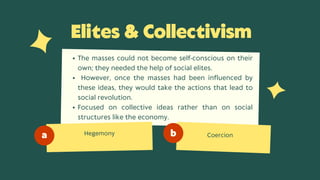
The masses could not become self-conscious on their
own; they needed the help of social elites.
However, once the masses had been influenced by
these ideas, they would take the actions that lead to
social revolution.
Focused on collective ideas rather than on social
structures like the economy.
HEGEMONY
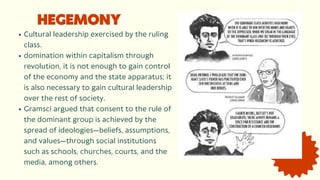
Cultural leadership exercised by the ruling
class.
domination within capitalism through
revolution, it is not enough to gain control
of the economy and the state apparatus; it
is also necessary to gain cultural leadership
over the rest of society.
Gramsci argued that consent to the rule of
the dominant group is achieved by the
spread of ideologies—beliefs, assumptions,
and values—through social institutions
such as schools, churches, courts, and the
media, among others.
Socially powerful people
use cultural influence to
let less powerful class to
adapt in a certain social
structure and culture to
achieve the powerful
people's best interest.
The Prison
Notebooks
The old world is dying,
and the new world
struggles to be born;
now is the time of
monsters
Tomorrow...
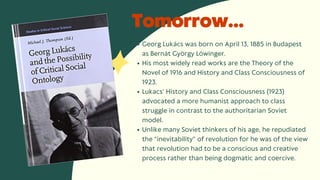
Georg Lukács was born on April 13, 1885 in Budapest
as Bernát György Löwinger.
His most widely read works are the Theory of the
Novel of 1916 and History and Class Consciousness of
1923.
Lukacs’ History and Class Consciousness (1923)
advocated a more humanist approach to class
struggle in contrast to the authoritarian Soviet
model.
Unlike many Soviet thinkers of his age, he repudiated
the “inevitability” of revolution for he was of the view
that revolution had to be a conscious and creative
process rather than being dogmatic and coercive.

Antonio Gramsci PPT.pdf

  • 1.
  • 2.
    W h o i s G r a m sci? The Italian MarxistAntonio Gramsci (1891- 1037) played a key role in the transition from economic determinism to more modern Marxian positions. Gramsci’s political and social writings occur in two periods, pre-prison (1910– 1926) and prison (1929–35). His pre-prison writings tend to be politically specific, while his prison writings tend to be more historical and theoretical.
  • 3.
    Social Revolutions Although Gramscirecognized the importance of structural factors, especially the economy, he did not believe that these structural factors led the masses to revolt. The masses needed to develop a revolutionary ideology, but they could not do that on their own. Gramsci operated with a rather elitist conception - in which ideas were generated by intellectuals and then extended to the masses and put into practice by them. The masses could not generate such ideas, and they could experience them, once in existence, only on faith.
  • 4.
    Elites Collectivism Hegemony ab Coercion The masses could not become self-conscious on their own; they needed the help of social elites. However, once the masses had been influenced by these ideas, they would take the actions that lead to social revolution. Focused on collective ideas rather than on social structures like the economy.
  • 5.
    HEGEMONY Cultural leadership exercisedby the ruling class. domination within capitalism through revolution, it is not enough to gain control of the economy and the state apparatus; it is also necessary to gain cultural leadership over the rest of society. Gramsci argued that consent to the rule of the dominant group is achieved by the spread of ideologies—beliefs, assumptions, and values—through social institutions such as schools, churches, courts, and the media, among others.
  • 6.
    Socially powerful people usecultural influence to let less powerful class to adapt in a certain social structure and culture to achieve the powerful people's best interest. The Prison Notebooks The old world is dying, and the new world struggles to be born; now is the time of monsters
  • 7.
    Tomorrow... Georg Lukács wasborn on April 13, 1885 in Budapest as Bernát György Löwinger. His most widely read works are the Theory of the Novel of 1916 and History and Class Consciousness of 1923. Lukacs’ History and Class Consciousness (1923) advocated a more humanist approach to class struggle in contrast to the authoritarian Soviet model. Unlike many Soviet thinkers of his age, he repudiated the “inevitability” of revolution for he was of the view that revolution had to be a conscious and creative process rather than being dogmatic and coercive.