Download to read offline
![1
RAVE: Replicated AntiVirus Engine
Carlos Silva1
Paulo Sousa2
Paulo Veríssimo2
1
Portugal Telecom
2
LaSIGE, Faculty of Sciences, University of Lisbon
c.miguel.silva@telecom.pt, {pjsousa,pjv}@di.fc.ul.pt
Abstract—Antivirus is a fundamental presence in every com-
puter infrastructure nowadays. The exponential growth of In-
ternet usage with increasing higher bandwidth led to situations
where virus (as well as worms and other type of malicious
content) had constant outbreaks with impressive amounts of
infected computers across the entire world. Email has been
the preferred choice for several of these malicious content
outbreaks. This paper describes the design, implementation, and
evaluation of RAVE, a Replicated AntiVirus Engine for email
infrastructures. Based on fault/intrusion tolerance concepts, this
system allows to increase the detection capability of anti-malware
solutions for email infrastructures by having different engines
working in parallel, allowing at the same time arbitrary faults
in a predefined number of replicas.
Index Terms—fault-tolerance, security, antivirus, email, repli-
cation, arbitrary faults.
I. INTRODUCTION
ANTIVIRUS is a fundamental presence in every computer
infrastructure nowadays. Ever since people started to
share files and using network services, viruses, worms and
other malicious contents have become a growing presence
in computers. The exponential growth of Internet usage with
increasing higher bandwidth led to situations where virus (as
well as worms and other type of malicious content) had con-
stant outbreaks with impressive amounts of infected computers
across the entire world. Email has been the preferred choice
for several of these malicious content outbreaks, with various
reported situations. To address the new threats, new security
solutions were developed under the “umbrella” of antimalware
products, with several detection engines to identify different
types of threats, i.e., virus, worms, trojans, spam, phishing,
spyware, adware. Moreover, the growing complexity of these
products led to an increase in the number of vulnerabilities
that can be later explored.
This paper describes the design, implementation, and eval-
uation of RAVE, a Replicated AntiVirus Engine for email
infrastructures. Based on fault/intrusion tolerance concepts,
this system allows to increase the detection capability of
anti-malware (e.g., virus, spam, spyware, phishing, adware)
solutions for email infrastructures by having different engines
working in parallel, allowing arbitrary faults in a predefined
number of replicas. By having a system with several replicas,
each running a different antivirus engine (and, if possible, a
different operating system), we obtain a system that offers
a very high detection efficiency with virtually no downtime
(even during antivirus’ updates) while allowing the arbitrary
failure of a predefined number of replicas, even if these failures
are provoked by a malicious intruder that explores an existing
vulnerability.
II. RELATED WORK
A. Antivirus Diversity
Antivirus solutions are normally diverse between each other,
i.e., they do not detect the same thing at the same time [1]. This
happens due to a series of different reasons. The first and most
obvious results from the fact that they are developed by dif-
ferent vendors with different software engineers and security
experts. The second major reason refers to software updates,
which are done at different times, with different capabilities.
The third reason is due to the solution configuration, as one
solution can have a more restrict and tight configuration while
other can be more “loose” (i.e., default security policies are
different amongst available solutions). Gashi et al. [1] reveal
another reason: the regression in the detection capability of
the engines. In certain cases, malware detected at a particular
version of the engine is no longer identified by newer versions
of the same engine, i.e., it is removed from the malware list
of that particular engine. This difference can have several
reasons but one can speculate that it is either resultant from
bad software programming or bad security analysis of the
suspicious content. Gashi et al. present also several important
conclusions, with two of them having a special relevance to
this work. The first is that using more than one antivirus
engine, results in an improved detection ratio of malicious
software. The other is that from a list of 32 different antivirus
solutions, one can combine any two of them and achieve a
very high detection ratio. Moreover, 18% of the combinations
result in an immaculate detection capability, i.e., every single
malware from the tested dataset was effectively detected by
one of the two antivirus used. The above conclusions are very
important to the work presented in this paper, as it is one of
our objectives to present a security solution that can deliver
very high rates of detection for malware.
In the solution presented by [2] there are important findings
that confirm the need to a different approach concerning
antivirus solutions. The first important finding is the fact
that the increased complexity of antivirus solutions has been
originating a growth in the number of vulnerabilities and
is leading to the appearance of malware that exploits these
vulnerabilities to infect systems, i.e., bypassing the detection
solution by exploiting its own weaknesses. Another important
finding confirms the Gashi et al. study [1] discussed above.
By applying N-Version programming to malware detection](https://image.slidesharecdn.com/antivirusengine-171210182949/85/Antivirus-engine-1-320.jpg)
![1
RAVE: Replicated AntiVirus Engine
Carlos Silva1
Paulo Sousa2
Paulo Veríssimo2
1
Portugal Telecom
2
LaSIGE, Faculty of Sciences, University of Lisbon
c.miguel.silva@telecom.pt, {pjsousa,pjv}@di.fc.ul.pt
Abstract—Antivirus is a fundamental presence in every com-
puter infrastructure nowadays. The exponential growth of In-
ternet usage with increasing higher bandwidth led to situations
where virus (as well as worms and other type of malicious
content) had constant outbreaks with impressive amounts of
infected computers across the entire world. Email has been
the preferred choice for several of these malicious content
outbreaks. This paper describes the design, implementation, and
evaluation of RAVE, a Replicated AntiVirus Engine for email
infrastructures. Based on fault/intrusion tolerance concepts, this
system allows to increase the detection capability of anti-malware
solutions for email infrastructures by having different engines
working in parallel, allowing at the same time arbitrary faults
in a predefined number of replicas.
Index Terms—fault-tolerance, security, antivirus, email, repli-
cation, arbitrary faults.
I. INTRODUCTION
ANTIVIRUS is a fundamental presence in every computer
infrastructure nowadays. Ever since people started to
share files and using network services, viruses, worms and
other malicious contents have become a growing presence
in computers. The exponential growth of Internet usage with
increasing higher bandwidth led to situations where virus (as
well as worms and other type of malicious content) had con-
stant outbreaks with impressive amounts of infected computers
across the entire world. Email has been the preferred choice
for several of these malicious content outbreaks, with various
reported situations. To address the new threats, new security
solutions were developed under the “umbrella” of antimalware
products, with several detection engines to identify different
types of threats, i.e., virus, worms, trojans, spam, phishing,
spyware, adware. Moreover, the growing complexity of these
products led to an increase in the number of vulnerabilities
that can be later explored.
This paper describes the design, implementation, and eval-
uation of RAVE, a Replicated AntiVirus Engine for email
infrastructures. Based on fault/intrusion tolerance concepts,
this system allows to increase the detection capability of
anti-malware (e.g., virus, spam, spyware, phishing, adware)
solutions for email infrastructures by having different engines
working in parallel, allowing arbitrary faults in a predefined
number of replicas. By having a system with several replicas,
each running a different antivirus engine (and, if possible, a
different operating system), we obtain a system that offers
a very high detection efficiency with virtually no downtime
(even during antivirus’ updates) while allowing the arbitrary
failure of a predefined number of replicas, even if these failures
are provoked by a malicious intruder that explores an existing
vulnerability.
II. RELATED WORK
A. Antivirus Diversity
Antivirus solutions are normally diverse between each other,
i.e., they do not detect the same thing at the same time [1]. This
happens due to a series of different reasons. The first and most
obvious results from the fact that they are developed by dif-
ferent vendors with different software engineers and security
experts. The second major reason refers to software updates,
which are done at different times, with different capabilities.
The third reason is due to the solution configuration, as one
solution can have a more restrict and tight configuration while
other can be more “loose” (i.e., default security policies are
different amongst available solutions). Gashi et al. [1] reveal
another reason: the regression in the detection capability of
the engines. In certain cases, malware detected at a particular
version of the engine is no longer identified by newer versions
of the same engine, i.e., it is removed from the malware list
of that particular engine. This difference can have several
reasons but one can speculate that it is either resultant from
bad software programming or bad security analysis of the
suspicious content. Gashi et al. present also several important
conclusions, with two of them having a special relevance to
this work. The first is that using more than one antivirus
engine, results in an improved detection ratio of malicious
software. The other is that from a list of 32 different antivirus
solutions, one can combine any two of them and achieve a
very high detection ratio. Moreover, 18% of the combinations
result in an immaculate detection capability, i.e., every single
malware from the tested dataset was effectively detected by
one of the two antivirus used. The above conclusions are very
important to the work presented in this paper, as it is one of
our objectives to present a security solution that can deliver
very high rates of detection for malware.
In the solution presented by [2] there are important findings
that confirm the need to a different approach concerning
antivirus solutions. The first important finding is the fact
that the increased complexity of antivirus solutions has been
originating a growth in the number of vulnerabilities and
is leading to the appearance of malware that exploits these
vulnerabilities to infect systems, i.e., bypassing the detection
solution by exploiting its own weaknesses. Another important
finding confirms the Gashi et al. study [1] discussed above.
By applying N-Version programming to malware detection](https://image.slidesharecdn.com/antivirusengine-171210182949/75/Antivirus-engine-1-2048.jpg)
![2
systems, multiple and heterogeneous antivirus solutions result
in an improved capability in the detection of malware.
B. Existing Antivirus Solutions
Antivirus (or anti-malware) solutions continue to be very
important security solutions [3]. TrendMicro [4] solutions are
a perfect example of the most common deployment schemes
for anti-malware in an organization, i.e., it allows to install and
configure a set of different engines that will serve different
purposes to control and prevent the existence of malware
inside the local networks of the organization.
A survey of solutions (specially coming from academic
research or some few open source communities) is presented
in a recent paper [2]. This work proposes the CloudAV
solution, where several different antivirus engines are used
in parallel as a network service, improving the detection
ratio of the overall solution. This service is presented as a
centralized infrastructure to which each host connects to using
a multiplatform host agent specially developed to be used in
the service. This host agent sends to the network service the
suspicious file it needs to check and only after the response
from the service will allow or deny access to that file. For the
authors, the host agent is not intended to replace host antivirus
agents, but instead to work as a complement.
Although this solution has several antivirus running in
parallel, there was no intention in creating a fault tolerant
system, but instead to just improve the detection capability
of the system. That is why there is no clear statement about
which algorithm they used to choose the “best” decision, i.e.,
if there was some kind of a voting phase or how the aggregator
machine is picked up amongst all the others in order to execute
its task. Other important design feature that is not considered is
the apparently single point of failure due to a single aggregator
machine that can be vulnerable to attacks, and how attacks
can be detected not only in the aggregator but also in other
machines that are running the different antivirus solutions.
C. Hybrid Systems
Classical synchrony models in distributed systems and ap-
plications are divided amongst synchronous and asynchronous,
i.e., whether or not they have time constraints. Hybrid systems
appear as a way of dealing with both “worlds” described,
allowing a systems architect to increase the reliability of a
system. Hybrid systems can be instantiated in several ways
[5]. One typical instantiation consists in having a part of the
system as an asynchronous sub-system (usually called the
payload), which is vulnerable to attacks and executes without
any timing assumptions. The other sub-system (usually called
the wormhole) only fails by crash and has time bounds, i.e.,
operates under the synchronous model. In the past there were
several proposals of different hybrid systems, from which
we mention only three: TTCB [6], CIS [7] and the Delta-4
architecture [8], [9].
Although being an hybrid system, RAVE has a different
approach than the referred hybrid systems:
TTCB: Comparing the TTCB approach with the RAVE
system we encounter some major differences. TTCB (Trusted
Time Computing Base) is not a system, it is a distributed
wormhole that provides a series of services: timely timing
failure detection, trusted block agreement, trusted random
numbers, etc. Differently from the RAVE wormhole, with the
TTCB we cannot develop a series of functions and procedures
for the TTCB to execute, as it has only a set of minimal
functions that it can execute.
CIS: The CIS (CRUTIAL Information Switch) is a kind
of distributed firewall that offers a rich access control model
and intrusion tolerance capabilities. The CIS operates in a
different way than RAVE. It only uses its wormhole to vote the
messages that need to be analyzed and the forwarding of the
message is done by the payload. RAVE also performs a voting
scheme but the wormhole part is responsible for sending the
result to the protected infrastructure.
Delta-4: It was one of the first (if not the first) to present the
hybrid system concept, with a network interface card (called
NAC, Network Attachment Controller) acting as a wormhole
for the system which was the computer where this card was
sitting on. These cards were connected to the LAN and were
fail-silent, i.e., crash-only model. However, and in an opposite
direction of the RAVE system, Delta-4 hybrid system does not
have its wormholes communicating through a control channel,
but instead directly connected to the (payload) LAN. While in
the case of RAVE the focus is deploying a replicated antivirus
solution as an hybrid system, the focus for Delta-4 is using
a special crafted NAC in order to employ an architecture that
allows for an host to be attacked, behave in a Byzantine way,
but with the wormhole (i.e., the NAC) stopping the LAN to
be flooded by packets from uncontrolled hosts.
III. ARCHITECTURE
A. RAVE System Model
The RAVE system has n replicas, each running a different
antivirus. The replicated system is deployed in an internal
Local Area Network (LAN) between the Internet and the
email infrastructure (i.e., email server or a cluster of email
servers), receiving email messages from the Internet that are
destined for mailboxes in the domain(s) served by the Email
Infrastructure. Replicas are hybrid systems with two parts [5]:
payload and wormhole.
a) Payload: It is an asynchronous subsystem composed
of n ≥ 2f + k + 1 replicas in which at the most f can
be subjected to arbitrary failures in a given period of time
while k can be in recovery as well. Between two consecutive
recoveries (concept explained below) if a replica does not fail
it is said to be correct, otherwise it is said to be faulty. We
assume that replicas’ faults are independent, i.e., the failure
of one replica is totally independent of another replica failure
at the same given time. This assumption is substantiated in
practice by using different operating systems and antivirus
engines in order to maximize design diversity. Configuration
diversity techniques can also be used to substantiate this
assumption [10].
b) Wormhole: It is a synchronous subsystem in which
at most only f local wormholes can fail by crash. There is
one local wormhole per payload replica and we assume that](https://image.slidesharecdn.com/antivirusengine-171210182949/85/Antivirus-engine-2-320.jpg)
![3
whenever a local wormhole crashes so does the payload of that
replica. The control channel that connects the local wormholes
is isolated from other networks, being secure and synchronous.
c) Recovery: RAVE implements two recovery methods:
proactive and reactive [11], [12]. Proactive recovery allows
the rejuvenation of a system replica, in a periodic manner,
with a “fresh” image of both the operating system and appli-
cation (in the case of RAVE, the application is an antivirus
engine). With this we can avoid that an attacker can corrupt
sufficient replicas to take control on the decisions of the
replicated system. The purpose is to boot up a replica with
a different operating system and application than it previously
had, removing the attacker advantage of knowing which was
the system that previously was running. Reactive recovery
is executed by implementing detection mechanisms that can
identify compromised replicas and in this way recover them.
B. RAVE Description
Figure 1 presents the architecture of our solution integrated
in a global email infrastructure of an ISP or enterprise. The
RAVE system sits in between the Internet and the Email
Infrastructure, inside the organization Internal Local Area
Network (e.g., a DMZ or another less protected internal area).
This system has a set of replicas each divided in two parts:
payload and wormhole. The payload part is where the antivirus
engine is running on top of an operating system and it is
the insecure portion of the system. The wormhole is assumed
to be secure and receives the application (i.e, the payload)
decisions and forwards them to the email infrastructure. In
this system the payload parts of each replica are interconnected
(including the Internet gateway) by an insecure network which
is exposed to WAN communications. Concerning the replica’s
wormholes, they are connected to the email infrastructure
through a trusted LAN. This infrastructure (i.e., the servers) is
also trusted and intrusion free, as well are the workstations that
are used to administer the infrastructure. The RAVE system
has another component which is the Images Repository that
contains the operating system and application images that run
on the payload at a given time. This repository is used by
the wormhole subsystem in order to recover a compromised
replica or reinstall a replica based on the proactive/reactive
recovery process.
Internet
Unsafe Safe
Payload Wormhole
C E G
1 3 5 7
A
Operating Systems
Antivirus Applications
Images Repository
R.A.V.E. - Replicated
Antivirus Engine
InternalLocalAreaNetworks
Email
Infrastructure
Perimeter
Gateway
B 2
D 4
F 6
H 8
Payload
Payload
Payload
Wormhole
Wormhole
Wormhole
Figure 1. RAVE Architecture.
The perimeter gateway 1 replicates each received email
towards all the replicas inside the RAVE system in which
different antivirus engines are installed and running in distinct
operating systems. Each replica is a hybrid system holding a
payload and a wormhole. The payload is where the antivirus
engine is running and it is the “entry point” for each email
message, therefore it is where messages are inspected for
malware. The result of the analysis is then delivered to the
local wormhole through a well-defined and secure interface.
The local wormholes execute a voting scheme and deliver to
the email infrastructure (e.g., email servers) the final output
of the RAVE system. The algorithms of both the payload and
wormhole are explained in [13]
The payload is the part of the system where the email
analysis is performed in order to detect malicious contents, i.e.,
malware. Ideally each replica’s payload should have a different
operating system and a different antivirus engine at any given
time. Looking at Figure 1 we can see that each payload has a
different operating system and antivirus engine, represented
by a different black letter and a different white number,
respectively. Each engine will execute the detection algorithm
and return a result (accordingly to a previous configured
policy) which will be received by the RAVE payload algorithm
and sent to the wormhole through a set of primitives that use
a secure and well-defined interface between the two parts.
The result, a hash of the result, and the original email are
sent to the wormhole. Each engine may behave differently in
the case of detection of a virus, or other malware. Some will
send an error message back to the originator of the email,
others will only remove the threat and send the rest of the
email to the internal infrastructure with a small reference to
the malicious content found and removed, and some others
will just discard the message. Although all these possibilities
are true we can configure the antivirus in order to insert some
more information that will allow us to normalize the output
and send it to the wormhole. This normalization is executed
because there is the need to convert the result to a format that
is understandable by the wormhole. The algorithm behinds this
normalization looks at the result of the detection and assign a
1 or a 0, whether a virus was or not discovered.
The wormhole has three major functions in this system:
one is to receive data from the payload and vote, another is
the monitoring of the payload activity and the last one is to
execute recoveries based on the detection of problems in the
payload (reactive recovery) or based on a recovery schedule
(proactive recovery). The wormhole waits for the invocation
of one of the primitives available for the payload in order to
initialize the procedure to execute a voting scheme. After the
voting is concluded, the result is sent by the master wormhole
to the Email Infrastructure. The role of master can be defined
simply by looking at the wormhole ID and choosing the lowest
one (each wormhole has a predefined ID and knows the IDs
of all other wormholes). If this wormhole/replica crashes then
the wormhole with the following lowest ID will take the place
as master (crashes are detected using a perfect failure detector
[14]), and so on and so forth. Monitoring the payload activity
is important in the detection of faults (benign or malicious).
Identification of successive wrong answers (when compared](https://image.slidesharecdn.com/antivirusengine-171210182949/85/Antivirus-engine-3-320.jpg)
![5
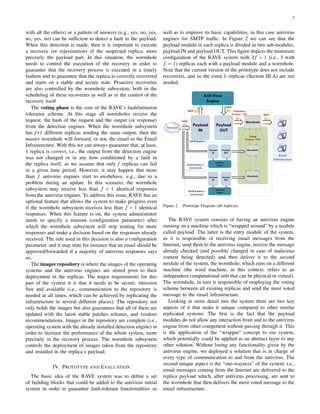
The two above described aspects are important regarding
security as they stop the vast majority of attacks that usually
affects this type of systems, especially the ones that are
targeted at the antivirus engine and at the communication
processes. The objective of the payload is not to stop the at-
tacks themselves, but instead to be a front-end to these attacks,
which will not be able to reach the antivirus engine. Clearly the
payload IN may crash facing several of these attacks (namely
denial of service attacks) but that will prevent the antivirus to
crash also, allowing it to continue its processing jobs if any are
still in its mailqueue. After the antivirus mailqueue becomes
empty the replica will appear to be crashed to its wormhole
as it stops sending data to the latter. This situation triggers a
reactive recovery.
”One-wayness” of the communication is a dramatic im-
provement in the security of the whole system, because it
simplifies the monitoring and the communication interfaces
between modules, especially between payload and wormhole.
As seen, the payload is vulnerable to attacks coming from the
Internet, while wormholes have an immensely less probability
of being intruded compared with the payload. Having a well
defined communication interface between these two modules
is a first good measure to bound the capability of the possible
attackers, although still representing a possible entry point
for an attacker to explore. This is why is so important to
have the above characteristic, with only one type of message
being exchanged from payload to wormhole, using a very
specific TCP port and well defined data types. There is no
communication from the wormhole to the payload, giving no
feedback to attackers in case of malicious attempts.
The prototype was deployed in the LaSIGE/FCUL virtual
servers farm and is composed of 3 physical machines all
running Xen virtualization software [15]. On each there is
a wormhole running Fedora Core 6 executing in Xen dom0
while the payload (also running Fedora Core 6) is executing
in a domU guest virtual machine. Because we were using
Xen virtualization software there were not a great variety of
Operating Systems that we could use, or better, we could
use only several different Linux distributions. We used three
different antivirus solutions, two are comercial aplications
(Trendmicro and Kaspersky) and one is an open source tool
(ClamAV).
The configuration that uses the solution from Trendmicro
(Interscan Messaging Security Suite - IMSS) [16], running
on top of Linux needed an external application as MTA as
it does not have integrated in the solution the capability to
receive email messages from the Internet and then send them
to the email infrastructure. Figure 3 shows the configuration
implemented where the MTA used was the Sendmail program,
with two instances of sendmail with the corresponding differ-
ent configuration files.
The Kaspersky solution (Kaspersky Mail Gateway) [17]was
installed from a trial license with a 50 mailbox limitation.
Figure 4 shows the message flow inside Kaspersky’s Mail
Gateway. It is a very simple architecture with a single file
to configure it, although there are a long series of sections
that can be use to tweak the configuration, redefine filtering
policies as well as group policies. Its configuration possibil-
sendmail
sendmail.cf
sendmail.mc
sendmail
sendmail.cf.
delivery
sendmail.mc
TrendMicro AV
Engine - IMSS
Upstream MTA
Sendmail IN
Downstream MTA
Sendmail OUT
Scanner Filter IMSS
Admin DB
Central
Controller
Port:
20025
Port:
10025
Port:
10026
Legend:
Main
processes
Configuration
files
Figure 3. Configuration with Trendmicro using Sendmail.
ities are very similar to the ones that we encounter in the
sendmail.cf configuration file, although this latter is far more
complicated and, perhaps, complete.
receiver sender
Scanning
Module
Antivirus
Module
inbound
working queue
outbound
working queue
Figure 4. Configuration with Kaspersky.
The configuration using ClamAV solution [18] is depicted
in Figure 5 where we can see the four basic processes of this
implementation as well as the message flow inside the solution
with the sendmail acting as the entry and exit point for each
message that needs to be analyzed. It shows the complexity
of a system like this which comprises several configuration
files for the processes to be up and running. A key feature is
the use of Unix sockets (instead of using TCP connections)
that allow the communication between the sendmail and the
clamav-milter (acronym for mail filter), and from this to clamd
that effectively is running.
clamav-
milter
sendmail clamd
sendmail.cf
sendmail.mc
clamav-
milter.conf
clamd.conf
/var/lib/
clamav/*.cvd
freshclam
freshclam.
conf
/var/run/clamav-
milter.socket
/var/run/
clamd.socket
Legend:
Main
processes
Communication
sockets
Configuration
files
Virus
(malware)
databases
Initial
Request by
Payload IN
Sendmail sends email to
mail filter for analysis
ClamAV Mail Filter sends
email to Scanning Engine
Email analyzed and actions
taken (security policy)
Maill Filter sends analyzed
email to Sendmail
Figure 5. Configuration with ClamAV tightly integrated with Sendmail.
As previously mentioned the prototype was built using 3 dif-
ferent configurations based on 3 different antivirus solutions,
which are all extremely different from each other in terms of
configurations and default policies. In fact this was a major
challenge while building the prototype. Several tests were](https://image.slidesharecdn.com/antivirusengine-171210182949/85/Antivirus-engine-5-320.jpg)
![6
executed against the system, in order to evaluate it in different
scenarios (only one configuration running, all configurations
at the same time and in stress conditions) with and without
the voting phase. One of the most important conclusions that
we gather from the tests was that RAVE components do not
introduce significant latency to the antivirus solutions that are
running inside each replica. More precisely, we concluded
that the latency imposed by the message scanning and policy
checking made by the antivirus engine is responsible for the
“lion’s share” of the overall latency of the system. Another
important conclusion revelead from our evaluation is the fact
that when all the engines are working properly then the system
presents a better result (in terms of detection efficiency) than
any individual engine. This is known because the evaluation
was using a set of known emails, with known malware files
which were not all known by every engine used. However
RAVE was able to detect them all, improving the detection as
expected. As well, some of the tests made include a faulty
engine which didn’t present its result in a timely manner
which changed the final result as there is timer to wait for
the payload. When that timer expires, and as long as we have
a f +1 results from the payloads then a decision will be made.
For the purpose of this work a default policy was used with
no fine tunning for this specific issue as it was not the main
objective of the whole evaluation. An extensive and detailed
information about the test sets and the results of the evaluation
to the system can be found at [13].
V. CONCLUSIONS AND FUTURE WORK
A. Conclusions
It is our opinion that RAVE represents a significative break-
through for anti-malware solutions. Due to the fact that it uses
different antivirus running in parallel and implements a voting
phase in order to choose the best and more accurate output
concerning the received email (detection capability is clearly
improved), it is a system that presents a stronger capability
in handling several type of errors like the ones originated by
the malfunction of a single antivirus. Also the fact that it can
continue to work even under antivirus updates represents an
important feature regarding the availability of the system as a
whole.
With the development of RAVE we confirmed that fault-
tolerant applications can be the next step for several solutions
that exist on the market nowadays. It is our belief that
development of systems like RAVE can create the necessary
momentum for the effective deployment of fault-tolerant so-
lutions in the security solutions arena, without major develop-
ment costs. This evolutionary path will create the necessary
conditions for the whole security paradigm to change from
redundant solutions in which the customers need to believe
that the solution they are about to purchase is the best fit for
their needs, to solutions based on several different services,
executing independently and agreeing collectively, enforcing
security, accuracy and availability .
B. Future Work
Future work will include the study of other solutions like
anti-spam solutions (most of them already present in the
antivirus used in RAVE), URL and content filtering, access
control and authorization devices. Regarding security solutions
there are some that are used to detect bad behaviors or
to allow/deny the access to some resource. If systems or
applications are willing to wait for decisions during a certain
period of time (i.e., without any strong and tight requirement
regarding time bounds) in order to execute their actions, then
it is our opinion that these systems are amongst the best
candidates for a fault tolerant system similar to RAVE, in order
to achieve better detection ratios and/or less false positives. A
web proxy, for instance, can be a good candidate for a RAVE
system if it implements some security policies that define
which users can or not access what and when. Having a fault-
tolerant web proxy, like in RAVE, would increase availability
and security as the result of having more than one machine
running the protocol and deciding which user can access to
which content and at what time.
REFERENCES
[1] I. Gashi, V. Stankovic, C. Leita, and O. Thonnard, “An experimental
study of diversity with off-the-shelf antivirus engines,” IEEE Interna-
tional Symposium on Network Computing and Applications, pp. 4–11,
2009.
[2] J. Oberheide, E. Cooke, and F. Jahanian, “Cloudav: N-version antivirus
in the network cloud,” Proceedings of the 17th USENIX Security
Symposium, 2008.
[3] R. Richardson, “CSI computer crime and security survey,” Computer
Security Institute, 2008.
[4] TrendMicro http://www.trendmicro.com, 1988.
[5] P. Verissimo, “Travelling through wormholes: a new look at distributed
system models.,” SIGACT News, vol. 37, pp. 66–81, 2006.
[6] M. Correia, L. C. Lung, N. F. Neves, and P. Veríssimo, “Efficient
byzantine-resilient reliable multicast on a hybrid failure model,” Oct.
2002.
[7] A. Bessani, P. Sousa, M. Correia, N. F. Neves, and P. Verissimo, “The
CRUTIAL way of critical infrastructure protection,” IEEE Security &
Privacy, vol. 6, pp. 44–51, Nov-Dec 2008.
[8] D. Powell, D. Seaton, G.Bonn, P. Verissimo, and F.Waeselynck, “The
delta-4 approach to dependability in open distributed computing sys-
tems,” 18th IEEE International Symposium on Fault-Tolerant Computing
(FTCS), pp. 246–251, June 1988.
[9] D. Powell, “Distributed fault tolerance: Lessons from delta-4,” IEEE
Micro, vol. 14, no. 1, pp. 36–47, 1994.
[10] A. Bessani, A. Daidone, I. Gashi, R. Obelheiro, P. Sousa, and
V. Stankovic, “Enhancing fault / intrusion tolerance through design and
configuration diversity,” Proceedings of the 3rd Workshop on Recent
Advances on Intrusion-Tolerant Systems (WRAITS 2009), 2009.
[11] P. Sousa, A. N. Bessani, M. Correia, N. F. Neves, and P. Verissimo,
“Highly available intrusion-tolerant services with proactive-reactive re-
covery,” IEEE Transactions on Parallel and Distributed Systems, vol. 21,
no. 4, pp. 452–465, 2010.
[12] M. Castro and B. Liskov, “Practical byzantine fault tolerance and
proactive recovery,” ACM Transactions on Computer Systems (TOCS),
vol. 20, pp. 398–461, Nov 2002.
[13] C. Silva, “Rave: Replicated antivirus engine,” Master’s thesis, Carnegie
Mellon University and Faculty of Sciences from University of Lisbon,
2009.
[14] T. D. Chandra and S. Toueg, “Unreliable failure detectors for reliable
distributed systems,” Journal of the ACM, vol. 43:2, pp. 225–267, 1996.
[15] P. Barham, B. Dragovic, K. Fraser, S. Hand, T. Harris, A. Ho, R. Neuge-
bauery, I. Pratt, and A. Warfield, “Xen and the art of virtualization,”
2003.
[16] Trendmicro, “Interscan message security suite,”
http://emea.trendmicro.com/emea/products/enterprise/interscan-
messaging-security-suite/index.html, 2000.
[17] Kaspersky, “Kaspersky mail gateway,”
http://www.kaspersky.com/mailgateway, 2006.
[18] ClamAV, “Clamav antivirus toolkit,” http://www.clamav.net/, 1999.](https://image.slidesharecdn.com/antivirusengine-171210182949/85/Antivirus-engine-6-320.jpg)

1. The document describes RAVE, a Replicated AntiVirus Engine system for email infrastructures that uses fault tolerance concepts. It runs multiple antivirus engines in parallel to improve detection capabilities. 2. By having several replicas running different antivirus engines (and operating systems), the system offers very high detection efficiency with no downtime during updates and can tolerate arbitrary failures of a predefined number of replicas. 3. The system aims to address issues with existing antivirus solutions like increased complexity leading to more vulnerabilities, and improve over solutions running multiple engines by providing fault tolerance against failures or attacks.


