Begun and held in Metro Manila, on Monday, the nineteenth day of
February, two thousand seven.
[ REPUBLIC ACTNO. 9372 I
AN ACT TO SECURE THE STATE AND PROTECT OUR
PEOPLE FROM TERRORISM
Be it enacted by the Senate and House of Representatives of
the Philippines in Congress assembled:
SECTION1. Short Etle. - This Act shall henceforth be
known as the “Human Security Act of 2007.”
SEC.2. Declaration of Policy. - It is declared a policy
of the State to protect life, liberty, and property from acts of
terrorism, to condemn terrorism as inimical and dangerous to
the national security of the country and to the welfare of the
people, and to make terrorism a crime against the Filipino
people, against humanity, and against the law of nations.
2
In the implementation of the policy stated above, the
State shall uphold the basic rights and fundamental liberties
of-the people as enshrined in the Constitution. ,
The State recognizes that the fight against terrorism
requires a comprehensive approach, comprising political,
economic, diplomatic, military, and legal means duly taking
into account the root causes of terrorism without
acknowledging these as justifications for terrorist andlor
criminal activities. Such measures shall include conflict
management and post-conflict peace-building, addressing the
roots of conflict by building state capacity and promoting
equitable economic development.
Nothing in this Act shall be interpreted as a curtailment,
restriction or diminution of constitutionally recognized powers
of the executive branch of the government. It is to be
understood, however, that the exercise of the constitutionally
recognized powers of the executive department of the
government shall not prejudice respect for human rights which
shall be absolute and protected at all times.
SEC. 3. Terrorjjsm. - Any person who commits an act
punishable under any of the following provisions of the Revised
Penal Code:
a. Article 122 (Piracy in General and Mutiny in the
Article 134 (Rebellion or Insurrection);
Article 134-a (Coup d'Etat), including acts committed
High Seas or in the Philippine Waters):
b.
c.
by private persons;
d. Article 248 (Murder);
e. Article 267 (Kidnapping and Serious Illegal
Detention);
f. Article 324 (Crimes Involving Destruction),
or under
3
PresidentialDecreeNo. 1613(TheLaw onilrson);
Repubfic Act No. 6969 (Toxic Substances and
(1)
(2)
. .
Hazardous and Nuclear Waste ControlAct of 1990);
(3) Republic Act No. 5207, (Atomic Energy
Regulatory and LiabilityAct of 1968);
(4)
(5)
Republic Act No. 6235 (Anti-HijackingLaw);
Presidential Decree No. 532 (Anti-Piracy and
Anti-HighwayRobbery Law of 1974);and,
(6) Presidential Decree No. 1866, as amended
(Decree Codifying the Laws on Illegal and Unlawful
Possession, Manufacture, Dealing in, Acquisition or
Disposition of Firearms, Ammunitions or Explosives)
thereby sowing and creating a condition of widespread and
extraordinary fear and panic among the populace, in order to
coerce the government to give in to a n unlawful demand shall
be guilty of the crime of terrorism and shall suffer the penalty
offorty (40)years ofimprisonment,withoutthe benefit ofparole
as provided for under Act No. 4103, otherwise known as the
Indeterminate Sentence Law, as amended.
SEC. 4. Conspiracy to Commit Terrorism. ~ Persons who
conspire to commit the crime of terrorism shall suffer the
penalty of forty (40) years of imprisonment.
There is conspiracy when two or more persons come to
an agreement concerning the commission of the crime of
terrorism as defined in Section 3 hereof and decide to commit
the same.
SEC. 5. Accomplice. - Any person who, not being a
principal under Article 17 of the Revised Penal Code or a
conspirator as defined in Section 4 hereof, cooperates in the
execution of either the crime of terrorism or conspiracy to
commit terrorism by previous or simultaneous acts shall suffer
the penalty of from seventeen (17) years, four months one day
to twenty (20) years of imprisonment.
4
SEC. 6. Accessory. - Any person who, having knowledge
of the commission of the crime of terrorism or conspiracy to
commit terrorism, and without having participated therein,
either as principal or accomplice under Articles 17 and 18 of
the Revised Penal Code, takes part subsequent to its
commission in any of the following manner: (a) by profiting
himself or assisting the offender to profit by the effects of the
crime: (b) by concealing or destroying the body of the crime,
or the effects, or instruments thereof, in order to prevent its
discovery; (c) by harboring, concealing, or assisting in the
escape of the principal or conspirator of the crime, shall suffer
the penalty of ten (10) years and one day to twelve (12) years
of imprisonment.
Notwithstanding the above paragraph, the penalties
prescribed for accessories shall not be imposed upon those who
are such with respect to their spouses, ascendants, descendants,
legitimate, natural, and adopted brothers and sisters, or
relatives by affinity within the same degrees, with the single
exception of accessories falling within the provisions of
subparagraph (a).
SEC. 7. Surveillance of Suspects and Interception and
Recording of"Coinmzmications.- The provisions of Republic
Act No. 4200 (Anti-Wire Tapping Law) to the contrary
notwithstanding, a police or law enforcement official and the
members of his team may, upon a written order of the Court
of Appeals, listen to, intercept and record, with the use of any
mode, form, kind or type of electronic or other surveillance
equipment or intercepting and tracking devices, or with the
use of any other suitable ways and meam for that purpose,
any communication, message, conversation, discussion, or
spoken or written words between members of a judicially
declared and outlawed terrorist organization, association, or
group of persons or of any person charged with or suspected
of the crime of terrorism or conspiracy to commit terrorism.
Provided, That surveillance, interception and recording
of communications between lawyers and clients, doctors and
patients, journalists and their sources and confidential business
correspondence shall not be authorized.
5
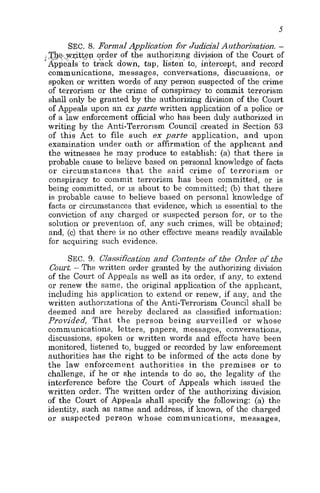
SEC. 8. Formal Application for Judicial Authorization. -
I,,, ,The,.y,ritt.ep.;,,~.~~ .order of the authorizlng division of the Court of
Appeals'to track down, tap, listen' to, intercept, and record
communications, messages, conversations, discussions, or
spoken or written words of any person suspected of the crime
of terrorism or the crime of conspiracy to commit terrorism
shall only be granted by the authorizing division of the Court
of Appeals upon an ex parte written application of a police or
of a law enforcement official who has been duly authorized in
writing by the Anti-Terrorism Council created in Section 53
of this Act to file such ex parte application, and upon
examination under oath or affirmation of the applicant and
the witnesses he may produce to establish: (a) that there is
probable cause to believe based on personal knowledge of facts
or circumstances that the said crime of terrorism or
conspiracy to commit terrorism has been committed, or is
being committed, or is about to be committed; (b) that there
is probable cause to believe based on personal knowledge of
facts or circumstances that evidence, which is essential to the
conviction of any charged or suspected person for, or to the
solution or prevention of, any such crimes, will be obtained;
and, (e) that there is no other effective means readily available
for acquiring such evidence.
SEC. 9. Classification and Contents of the Order of the
Court.- The written order granted by the authorizing division
of the Court of Appeals as well as its order, if any, to extend
or renew the same, the original application of the applicant,
including his applica.tion to extend or renew, if any, and the
written authorizations of the Anti-Terrorism Council shall be
deemed and are hereby declared as classified information:
Provided, That the person being surveilled or whose
communications, letters, papers, messages, conversations,
discussions, spoken or written words and effects have been
monitored, listened to, bugged or recorded by law enforcement
authorities has the right to be informed of the acts done by
the law enforcement authorities in the premises or to
challenge, if he or she intends to do so, the legality of the
interference before the Court of Appeals which issued the
written order. The written order of the authorizing division
of the Court of Appeals shall specify the following: (a) the
identity, such as name and address, if known, of the charged
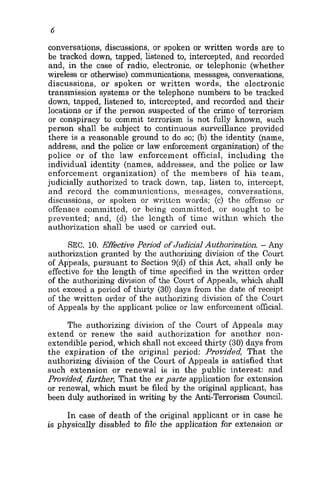
or suspected person whose communications, messages,
6
conversations, discussions, or spoken or written words are to
be tracked down, tapped, listened to, intercepted, and recorded
and, in the caee of radio, electronic, or telephonic (whether
wireless or otherwise) communications, messages, conversations,
discussions, or spoken or written words, the electronic
transmission systems or the telephone numbers to be tracked
down, tapped, listened to, intercepted, and recorded and their
locations or if the person suspected of the crime of terrorism
or conspiracy to commit terrorism is not fully known, such
person shall be subject to continuous surveillance provided
there is a reasonable ground to do so; 0.)the identity (name,
address, and the police or law enforcement organization) of the
police or of the law enforcement official, including the
individual identity (names, addresses, and the police or law
enforcement organization) of the members of his team,
judicially authorized to track down, tap, listen to, intercept,
and record the communications, messages, conversations,
discussions, 01’ spoken or written words; (c) the offense or
offenses committed, or being committed, or sought to be
prevented; and, (d) the length of time within which the
authorization shall be used or carried out.
SEC. 10. Effective Period ofJudicial Authoriza~oii.- Any
authorization granted by the authorizing division of the Court
of Appeals, pursuant to Section 9(d) of this Act, shall only be
effective for the length of time specified in the written order
of the authorizing division of the Court of Appeals, which shall
not exceed a period of thirty (30) days from the date of receipt
of the written order of the authorizing division of the Court
of Appeals by the applicant police or law enforcement official.
The authorizing division of the Court of Appeals may
extend or renew the said authorization for another non-
extendible period, which shall not exceed thirty (30) days from
the expiration of the original period: Provided, That the
authorizing division of the Court of Appeals is satisfied that
such extension or renewal is in the public interest: and
Provided, further, That the ex parte application for extension
or renewal, which must be filed by the original applicant, has
been duly authorized in writing by the Anti-Terrorism Council.
In case of death of the original applicant or in case he
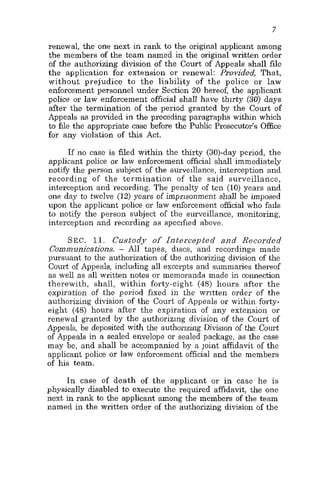
is physically disabled to file the application for extension or
7
renewal, the one next in rank to the original applicant among
the members of the team named in the original written order
of the authorizing division of the Court of Appeals shall file
the application for extension or renewal: Provided, That,
without prejudice to the liability of the police or law
enforcement personnel under Section 20 hereof, the applicant
police or law enforcement official shall have thirty (30) days
after the termination of the period granted by the Court of
Appeals as provided in the preceding paragraphs within which
to file the appropriate case before the Public Prosecutor’s Office
for any violation of this Act.
If no case is filed within the thirty (30)-day period, the
applicant police or law enforcement official shall immediately
notify the person subject of the surveillance, interception and
recording of the termination of the said surveillance,
interception and recording. The penalty of ten (10) years and
one day to twelve (12) years of imprisonment shall be imposed
upon the applicant police or law enforcement official who falls
to notify the person subject of the surveillance, monitoring,
interception and recording as specified above.
SEC. 11. Custody of Intercepted a n d Recorded
Communications. - All tapes, discs, and recordings made
pursuant to the authorization of the authorizing division of the
Court of Appeals, including all excerpts and summaries thereof
as well as all written notes or memoranda made in connection
therewith, shall, within forty-eight (48) hours after the
expiration of the period fixed in the written order of the
authorizing division of the Court of Appeals or within forty-
eight (48) hours after the expiration of any extension or
renewal granted by the authorizing division of the Court of
Appeals, be deposited with the authoiizing Division of the Court
of Appeals in a sealed envelope or sealed package, as the case
may be, and shall be accompanied by a joint affidavit of the
applicant police or law enforcement official and the members
of his team.
In case of death of the applicant or in case he is
physically disabled to execute the required affidavit, the one
next in rank to the applicant among the members of the team
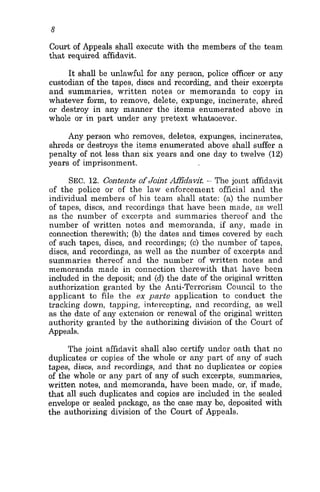
named in the written order of the authorizing division of the
8
Court of Appeals shall execute with the members of the team
that required affidavit.
It shall he unlawful for any person, police officer or any
custodian of the tapes, discs and recording, and their excerpts
and summaries, written notes or memoranda to copy in
whatever form, to remove, delete, expunge, incinerate, shred
or destroy in any manner the items enumerated above in
whole or in part under any pretext whatsoever.
Any person who removes, deletes, expunges, incinerates,
shreds or destroys the items enumerated above shall suffer a
penalty of not less than six years and one day to twelve (12)
years of imprisonment.
SIX. 12. Contents o f h i n t Mfidavit,- The joint affidavit
of the police or of the law enforcement official and the
individual members of his team shall state: (a) the number
of tapes, discs, and recordings that have been made, as well
as the number of excerpts and summaries thereof and the
number of written notes and memoranda, if any, made in
connection therewith; (b) the dates and times covered by each
of such tapes, discs, and recordings; (c) the number of tapes,
discs, and recordings, as well as the nuinber of excerpts and
summaries thereof and the number of written notes and
memoranda made in connection therewith that have been
included in the deposit; and (d) the date of the original written
authorization granted by the Anti-Terrorism Council to the
applicant to file the ex parte application to conduct the
tracking down, tapping, intercepting, and recording, as well
as the date of any extension or renewal of the original written
authority granted by the authorizing division of the Court of
Appeals.
The joint affidavit shall also certify under oath that no
duplicates or copies of the whole or any part of any of such
tapes, discs, and recordings, and that no duplicates or copies
of the whole or any part of any of such excerpts, summaries,
written notes, and memoranda, have been made, or, if made,
that all such duplicates and copies are included in the sealed
envelope or sealed package, as the case may be, deposited with
the authorizing division of the Court of Appeals.
I t shall be unlawful for any person, police or law
: enforcement,official to.omit or exclude from the joint affidavit
any item or portion thereof mentioned in this Section.
Any person, police or law enforcement officer who violates
any of the acts proscribed in the preceding paragraph shall
suffer the penalty of not less than ten (10) years and one day
to twelve (12) years of imprisonment.
SEC. 13. Disposition of Deposited Materials. - The sealed
envelope or sealed package and the contents thereof, which are
deposited with the authonzing division of the Court of Appeals,
shall be deemed and are hereby declared classified information,
and the sealed envelope or sealed package shall not be opened
and its contents (including the tapes, discs, and recordings and
all the excerpts and summaries thereof and the notes and
memoranda .made in connection therewith) shall not be
divulged, revealed, read, replayed, or used as evidence unless
authorized by written order of the authorizing division of the
Court of Appeals, which written order shall be granted only
upon a written application of the Department of Justice filed
before the authorizing division of the Court of Appeals and only
upon a showing that the Department of Justice has been duly
authorized in writing by the Anti-Terrorism Council to file the
application with proper written notice the person whose
conversation, communication, message discussion or spoken or
written words have been the subject of surveillance,
monitoring, recording and interception to open, reveal, divulge,
and use the contelits of the sealed envelope or sealed pacJrage
as evidence.
Any person, law enforcement official or judicial authority
who violates his duty to notify in writing the persons subject
of the surveillance as defined above shall suffer the penalty
of six years and one day to eight years of imprisonment.
SEC. 14. Application to Open Deposited Sealed Envelope
or Sealed Package. - The written application with notice to
the party concerned to open the deposited sealed envelope or
sealed package shall clearly state the purpose or reason: (a)
for opening the sealed envelope or sealed package; (b) for
revealing or disclosing its classified contents; (e) for replaying,
divulging, and or reading any of the listened to, intercepted,
10
and recorded communications, messages, conversations,
discussions, or spoken or written words (including any of the
excerpts and summaries thereof and any of the notes or
memoranda made in connection therewith); and, (d) for using
any of said listened to, intercepted, and recorded
communications, messages, conversations, discussions, or
spoken or written words (including any of the excerpts and
summaries thereof and any of the notes or memoranda made
in connection therewith) as evidence.
Any person, law enforcement official or judicial authority
who violates his duty to notify as defined above shall suffer
the penalty of six years and one day to eight years of
imprisonment.
SEC. 15. Evidentiary Value of Deposited Materials. - Any
listened to, intercepted, and recorded communications,
messages, conversations, discussions, or spoken or written
words, or any part or parts thereof, or any information or fact
contained therein, including their existence, content, substance,
purport, effect, or meaning, which have been secured in
violation of the pertinent provisions of this Act, shall absolutely
not be admissible and usable as evidence against anybody in
any judicial, quasi-judicial, legislative, or administrative
investigation, inquiry, proceeding, or hearing.
SEC. 16. Penalty for Unarrthorized or Malicious
Interceptions and/or Recoidings. - Any police or law
enforcement personnel who, not being authorized to do so by
the authorizing division of the Court of Appeals, tracks down,
taps, listens to, intercepts, and records in whatever manner
or form any communication, message, conversation, discussion,
or spoken or written word of a person charged with or
suspected of the crime of terrorism or the crime of conspiracy
to commit terrorism shall be guilty of an offense and shall
suffer the penalty of ten (10) years and one day to twelve (12)
years of imprisonment.
In addition to the liability attaching to the offender for
the commission of any other offense, the penalty of ten (10)
years and one day to twelve (12) years of imprisonment and
the accessory penalty of perpetual absolute disqualification from
public office shall be imposed upon any police or law
I I
enforcement personnel who maliciously obtained an authority
from the,Court of Appeals to track down, tap, listen to,
intercept, and record in whatever iiianner or.form any
communication, message, conversation, discussion, or spoken
or written words of a person charged with or suspected of the
crime of terrorism or conspiracy to commit terronsm: Provided,
That notwithstanding Section 13 of this Act, the party
aggrieved by such authorization shall be allowed access to the
sealed envelope or sealed package and the contents thereof as
evidence for the prosecution of any police or law enforcement
personnel who maliciously procured said authorization.
SEC. 17. Proscription of Terrorist Organizations,
Associatioo, or Group of Persons. - Any organization,
association, or group of persons organized for the purpose of
engaging in terrorism, or which, although not organized for
that purpose, actually uses the acts to terrorize mentioned in
this Act or to sow and create a condition of widespread and
extraordinary fear and panic among the populace in order to
coerce the government to give in to an unlawful demand shall,
upon application of the Department of Justice before a
competent Regional Trial Court, with due notice and
opportunity to be heard given to the organization, association,
or group of persons concerned, be declared as a terrorist and
outlawed organization, association, or group of persons by the
said Regional Trial Court.
SEC. 18. Period of Detention Without Judicial Warrant
of Arest. ~ The provisions of Article 125 of the Revised Penal
Code to the contrary notwithstanding, any police or law
enforcement personnel, who, having been duly authorized in
writing by the Anti-Terrorism Council has taken custody of
a person charged with or suspected of the crime of terrorism
or the crime of conspiracy tc commit terrorism shall, without
incurring any criminal liability for delay in the delivery of
detained persons to the proper judicial authorities, deliver said
charged or suspected person to the proper judicial authority
within a period of three days counted from the moment the
said charged or suspected person has been apprehended or
arrested, detained, and taken into custody by the said police,
or law enforcement personnel: Provided, That the arrest of
those suspected of the crime of terrorism or conspiracy to
commit terrorism must result from the surveillance under
12
Section 7 and examination of bank deposits under Section 27
of this Act.
The police or law enforcement personnel concerned shall,
before detaining the person suspected of the crime of terrorism,
present him or her before any judge at the latter’s residence
or office nearest the place where the arrest took place at any
time of the day or night. It shall be the duty of the judge,
among other things, to ascertain the identity of the police or
law enforcement personnel and the person or persons they have
arrested and presented before him or her, to inquire of them
the reasons why they have arrested the person and determine
by questioning and personal observation whether or not the
suspect has been subjected to any physical, moral or
psychological torture by whom and why. The judge shall then
submit a written report of what he/she had observed when
the subject was brought before him to the proper court that
has jurisdiction over the case of the person thus arrested. The
judge shall forthwith subinit hislher report within three
calendar days froin the time the suspect was brought to his/
her residence or office.
Immediately after taking custody of a person charged
with or suspected of the crime of terrorism or conspiracy to
ominit terrorism, the police or law enforcement personnel
shall notify in writing the judge of the court nearest the place
of apprehension or arrest: Provided That where the arrest is
made during Saturdays, Sundays, holidays or after office hours,
the written notice shall be seived at the residence of the judge
nearest the place where the accused was arrested.
The penalty of ten (10) years and one day to twelve (12)
years of imprisonment shall be imposed upon the police or law
enforcement personnel who fails to not& any judge as provided
in the preceding paragraph.
SEC. 19. Period ofDetention in f i e Event ofan Actual
or Imminent Terrorist Attack. - In the event of an actual or
imminent terrorist attack, suspects may not be detained for
more than three days without the written approval of a
municipal, city, provincial or regional official of a Human
Rights Commission or judge of the municipal, regional trial
court, the Sandiganbayan or a justice of the Court of Appeals
13
nearest the place of the arrest. If the arrest is made during
Saturdays, Sundays, holidays or after office hours, the
arresting police or Iaw enforcement personnel shall bring the
person thus arrested to the residence of any of the officials
mentioned above that is nearest the place where the accused
was arrested. The approval in writing of any of the said
officials shall be secured by the police or law enforcement
personnel concerned within five days after the date of the
detention of the persons concerned: Provided, however, That
within three days after the detention the suspects, whose
connection with the terror attack or threat is not established,
shall be released immediately.
SEC. 20. Penalty for Failure to Deliver Suspect to the
Proper Judicial Authority within Three Days. - The penalty
of ten (10) years and one day to twelve (12) years of
imprisonment shall be imposed upon any police or law
enforcement personnel who has apprehended or arrested,
detained and taken custody of a person charged with or
suspected of the crime of terrorism or conspiracy to commit
terrorism and fails to dehver such charged or suspected person
to the proper judicial authority within the period of three
days.
SEC. 21. Rights of a Person under Custodial Detention.
- The moment a person charged with or suspected of the
crime of terrorism or the crime of conspiracy to commit
terrorism is apprehended or arrested and detained, he shall
forthwith be informed, by the arresting police or law
enforcement officers or by the police or law enforcement officers
to whose custody the person concerned is brought, of his or
her right: (a) to be i~nformedof the nature and cause of his
arrest, t o remain silent and to have competent and
independent counsel preferably of his choice. If the person
cannot afford the services of counsel of his or her choice, the
police or law enforcement officers concerned shall immediately
contact the free legal assistance unit of the Integrated Bar of
the Philippines (IBP) or the Public Attorney's Office (PAO).
It shall be the duty of the free legal assistance unit of the
IBP or the PAO' th~uscontacted to immediately visit the
person(s) detained and provide him or her with legal
assistance. These rights cannot be waived except in writing
and in the presence of the counsel of choice; (b) informed of
14
the cause or causes of his detention in the presence of his
legal counsel; (e) allowed to communicate freely with his legal
counsel and to confer with them a t any time without
restriction; (d) allowed to communicate freely and privately
without restrictions with the members of his family or with
his nearest relatives and to be visited by them; and, (e) allowed
freely to avail of the service of a physician or physicians of
choice.
SEC. 22. Penalty for WoIation of the Rights of a
Detainee. - Any police or law enforcement personnel, or any
personnel of the police or other law enforcement custodial unit
that violates any of the aforesaid rights of a person charged
with or suspected of the crime of terrorism or the crime of
conspiracy to commit terrorism shall be guilty of an offense
and shall suffer the penalty of ten (10) years and one day to
twelve (12) years of imprisonment.
Unless the police or law enforcement personnel who
violated the rights of a detainee or detainees as stated above
is duly identified, the same penalty shall be imposed on the
police officer or head or leader of the law enforcement unit
having custody of the detainee at the time the violation was
done.
SEC.23. Requisenient for an OfficiaI Custodial Logbook
and it5 Contents. - The police or other law enforcement
custodial unit in whose care and control the person charged
with or suspected of the crime of terrorism or the crime of
conspiracy to commit terrorism has been placed under
custodial arrest and detention shall keep a securely and orderly
maintained official logbook, which is hereby declared as a
public document and opened to and made available for the
inspection and scrutiny of the lawyer or lawyers of the person
under custody 01 any member of his or her family or relative
by consanguinity or affinity within the fourth civil degree or
his or her physician at any time of the day or night without
any form of restriction. The logboolr shall contain a clear and
concise record of (a) the name, description, and address of the
detained person; (b) the date and exact time of his initial
admission for custodial arrest and detention; (e) the name and
address of the physician or physicians who examined him
physically and medically; (d) the state of his health and
1s
physical condition at the time of his initial admission for
-custodial detention; (e) the date and time.of each removal of
the detained person from his cell for interrogation or for any
purpose; (f) the date and time of his return to his cell; (g)
the name and address of the physician or physicians who
physically and medically examined him after each inteirogation;
(h) a summary of the physical and medical findings on the
detained person after each of such interrogation; (i) the names
and addresses of his family members and nearest relatives,
if any and if available; (i)the names and addresses of persons
who visit the detained person; (k) the date and time of each
of such visits; (1) the date and time of each request of the
detained person to communicate and confer with his legal
counsel or counsels: (m) the date and time of each visit, and
date and time of each departure of his legal counsel or
counsels; and, (n) all other important events bearing on and
all relevant details regarding the treatment of the detained
person while under custodial arrest and detention.
The said police or law enforcement custodial unit shall
upon demand of the aforementioned lawyer or lawyers or
members of the family or relatives within the fourth civil
degree of consanguinity or affinity of the person under custody
or his or her physician issue a certified true copy of the entiies
of the logboolr relative to the concerned detained person without
delay or restriction or requiring any fees whatsoever including
documentary stamp tax, notarial fees, and the like. This
certified true copy may be attested by the person who has
custody of the logbook or who allowed the party concerned to
scrutinize it at the time the demand for the certified true copy
is made.
The police or other law enforcement custodial unit who
fails to comply with the preceding paragraph to keep an official
logbook shall suffer the penalty of ten (10) years and one day
to twelve (12) years of imprisonment.
SEC. 24. No Torture or Coercion in Investigation and
Interrogation. - No threat, intimidation, or coercion, and no
act which will inflict any form of physical pain or torment,
or mental, moral, or psychological pressure, on the detained
person, which shall vitiate his free-will, shall be employed in
his investigation and interrogation for the crime of terrorism
16
or the crime of conspiracy to commit terrorism; otherwise, the
evidence obtained from said detained person resulting from
such threat, intimidation, or coercion, or from such inflicted
physical pain or torment, or mental, moral, or psychological
pressure, shall be, in its entirety, absolutely not admissible
and usable as evidence in any judicial, quasi-judicial,
legislative, or administrative investigation, inquiry, proceeding,
or hearing.
SEC. 25. Penalty hr Threat, Intimidation, Coercion, or
Tostuse in the Investigation and Zntesrogation of a Detained
Person. - Any person or persons who use threat, intimidation,
or coercion, or who inflict physical pain or torment, or mental,
moral, or psychological pressure, which shall vitiate the free-
will of a charged or suspected person under investigation and
interrogation for the crime of terrorism or the crime of
conspiracy to commit terrorism shall be guilty of an offense
and shall suffer the penalty of lwelve (12) years arid one day
to twenty (20) years of imprisonment.
When death or serious permanent disability of said
detained person occurs as a consequence of the use of such
threat, intimidation, or coercion, or as a consequence of the
infliction on him of such physical pain or torment, or as a
consequence of the infliction on him of such mental, moral,
or psychological pressure, the penalty shall be twelve (12) years
and one day to twenty (20) years of imprisonment.
SEC. 26. R.s&ictionon navel - In cases where evidence
of guilt is not strong, and the person charged with the crime
of terrorism or conspiracy to commit terrorism is entitled to
bail and is granted the same, the court, upon application by
the prosecutor, shall limit the right of travel of the accused
to within the municipality or city where he resides or where
the case is pending, in the interest of national security and
public safety, consistent with Article 111, Section 6 of the
Constitution. Travel outside of said municipality or city,
without the authorization of the court, shall be deemed a
violation of the terms and conditions of his bail, which shall
then be forfeited as provided under the Rules of Court.
He/she may also be placed under house arrest by order
of the court at his or her usual place of residence.
17
,While .under house. arrest, he or she may not use
telephones; cellphones,e-mails, computers, the internet or other
means of communications with people outside the residenm
until otherwise ordered by the court.
The restrictions abovementioned shall be terminated upon
the acquittal of the accused or of the dismissal of the case
filed against him or earlier upon the discretion of the court
on motion of the prosecutor or of the accused.
SEC. 21. Judicial Authorization Required to Examine
Bank Deposits, Accounts, and Records. - The provisions of
Republic Act No. 1405 as amended, to the contrary
notwithstanding, the justices of the Court of Appeals designated
as a special court to handle anti-terrorism cases after satisfying
themselves of the existence of probable cause in a hearing
called for that purpose that: (1) a person charged with or
suspected of the crime of terrorism or conspiracy to commit
terrorism, (2) of a judicially declared and outlawed terrorist
organization, association, or group of persons; and (3) of a
member of such judicially declared and outlawed organization,
association, or group of persons, may authorize in writing any
police or law enforcement officer and the members of hislher
team duly authorized in writing by the anti-terrorism council
to: (a) examine, or cause the examination of, the deposits,
placements, trust accounts, assets and records in a bank or
financial institution; and (b) gather or cause the gathering of
any relevant information about such deposits, placements, trust
accounts, assets, and records from a bank or financial
institution. The bank or financial institution concerned shall
not refuse to allow such examination or to provide the deslred
information, when so ordered by and served with the written
order of the Court of Appeals.
SEC. 28. Application to Examine Bank Deposits,
Accounts, and Records. - The written order of the Court of
Appeals authorizing the examination of bank deposits,
placements, trust accounts, assets, and records: (1)of a person
charged with or suspected of the crime of terrorism or
conspiracy to commit terrorism; (2) of any judicially declared
and outlawed terrorist organization, association, or group of
persons, or (3) of any member of such organization, association,
18
or group of persons in a bank or financial institution, and the
gathering of any relevant information about the same from
said bank or financial institution, shall only be granted by
the authorizing division of the Court of Appeals upon an ex
parte application to that effect of a police or of a law
enforcement official who has been duly authorized in writing
to file such exparte application by the Anti-Terrorism Council
created in Section 53 of this Act to file such ex parte
application, and upon examination under oath or affirmation
of the applicant and the witnesses he may produce to establish
the facts that will justify the need and urgency of examining
and freezing the bank deposits, placements, trust accounts,
assets, and records: (1)of the person charged with or suspected
of the crime of terrorism or conspiracy to commit terrorism;
(2) of a judicially declared and outlawed terrorist organization,
association or group of persons; or (3) of any member of such
organization, association, or group of persons.
SEC. 29. Classification and Contents of the Court Order
Authorizing the Examination of Bank Deposits, Accounb, and
Records. - The written order granted by the authorizing
division of the Court of Appeals as well as its order, if any,
to extend or renew the same, the original ex parte application
of the applicant, including his ex-parte application to extend
or renew, if any, and the written authorizations of the Anti-
Terrorism Council, shall be deemed and are hereby declared
as classified information: Provided, That the person whose
bank deposits, placements, trnst accounts, assets, and records
have been examined, frozen, sequestered and seized by law
enforcement authorities has the right to be informed of the
acts done by the law enforcement authorities in the premises
or to challenge, if he or she intends to do so, the legality of
the interference. The written order of the authorizing division
of the Court of Appeals designated to handle cases involving
terrorism shall specify: (a) the identity of the said: (1)person
charged with or suspected of the crime of terrorism or
conspiracy to commit terrorism; (2) judicially declared and
outlawed terrorist organization, association, or group of persons;
and (3) member of such judicially declared and outlawed
organization, association, or group of persons, as the case may
be, whose deposits, placements, trust accounts, assets, and
records are to be examined or the information to be gathered;
(b) the identity of the bank or financial institution where such
19
deposits, placements, trust accounts, assets, and records are
held and maintained; (c) the identity of the persons who will
conduct the said examination and the gathering of the desired
information; and, (d) the length of time the authorization shall
be carried out.
SEC. 30. Effective Period of Court Authorization to
Examine and Obtain Infomation on Bank Deposits, Accounts,
and Records. - The authorization issued or granted by the
authorizing division of the Court of Appeals to examine or
cause the examination of and to freeze bank deposits,
placements, trust accounts, assets, and records, or to gather
information about the same, shall be effective for the length
of time specified in the written order of the authorizing
division of the Court of Appeals, which shall not exceed a period
of thirty (30) days from the date of receipt of the written order
of the authorizing division of the Court of Appeals by the
applicant police or law enforcement official.
The authorizing division of the Court of Appeals may
extend or i'enew the said authorization for another period,
which shall not exceed thirty (30) days renewable to another
thirty (30) days from the expiration of the original period:
Provided, That the authorizing division of the Court of Appeals
is satisfied that such extension or renewal is in the public
interest: and, Provided, further, That the application for
extension or renewal, which must be filed by the original
applicant, has been duly authorized in writing by the Anti-
Terrorisin Council.
In case of death of the original applicant or in case he
is physically disabled to file the application for extension or
renewal, the one next in rank to the original applicant among
the members of the team named in the original written order
of the authorizing division of the Court of Appeals shall file
the application for extension or renewal: Provided, That,
without prejudice to the liability of the police or law
enforcement personnel under Section 19 hereof, the applicant
police or law enforcement official shall have thirty (30) days
after the termination of the period granted by the Court of
Appeals as provided in the preceding paragraphs within which
to file the appropriate case before the Public Prosecutor's Office
for any violation of this Act.
20
If no case is filed within the thirty (30)-day period, the
applicant police or law enforcement official shall immediately
notify in writing the person subject of the bank examination
and freezing of bank deposits, placements, trust accounts,
assets and records. The penalty of ten (10) years and one day
to twelve (12) years of imprisonment shall be imposed upon
the applicant police or law enforcement official who fails to
notify in writing the person subject of the bank examination
and freezing of bank deposits, placements, trust accounts,
assets and records.
Any person, law enforcement official or judicial authority
who violates his duty to notify in writing as defined above
shall suffer the penalty of six years and one day to eight
years of imprisonment.
SEC. 31. Custody ofBank Data and Information Obtained
afier Examination of Deposits, Placements, Trust Accounts,
Assets and Records. - All information, data, excerpts,
summaries, notes, memoranda, working sheets, reports, and
other documents obtained from the examination of the bank
deposits, placements, trust accounts, assets and records of: (1)
a person charged with or suspected of the crime of terrorism
or the crime of conspiracy to commit terrorism; (2) a judicially
declared and outlawed terrorist organization, association, or
group of persons; or (3) a member of any such organization,
association, or group of persons shall, within forty-eight (48)
hours after the expiration of the period fixed in the written
order of the authorizing division of the Court of Appeals or
within forty-eight (48) hours after the expiration of the
extension or renewal granted by the authorizing division of the
Court of Appeals, be deposited with the authorizing division
of the Court of Appeals in a sealed envelope or sealed package,
as the case may be, and shall be accompanied by a joint
affidavit of the applicant police or law enforcement official and
the persons who actually conducted the examination of said
bank deposits, placements, trust accounts, assets and records.
SEC. 32. Contents of Joint Affidavit. - The joint affidavit
shall state: (a) the identifying marks, numbers, or symbols of
the deposits, placements, trust accounts, assets, and records
examined; (b)the identity and address of the bank or financial
institution where such deposits, placements, trust accounts,
assets, and records are held and maintained; (e) the number
of bank deposits, placements, trust accounts, assets, and
records discovered, examined, and frozen; (d) the outstanding
balances of each of such deposits, placements, trust accounts,
assets; (e) all information, data, excerpts, summaries, notes,
memoranda, working sheets, reports, documents, records
examined and placed in the sealed envelope or sealed package
deposited with the authorizing division of the Court of Appeals:
(0 the date of the original written authorization granted by
the Anti-Terrorism Council to the applicant to file the exparte
application to conduct the examination of the said bank
deposits, placements, trust accounts, assets and records, as
well as the date of any extension or renewal of the original
written authorization granted by the authorizing division of
the Court of Appeals; and (g) that the items enumerated were
all that were found in the bank or financial institution
examined at the time of the completion of the examination.
The joint affidavit shall also certify under oath that no
duplicates or copies of the information, data, excerpts,
summaries, notes, memoranda, working sheets, reports, and
documents acquired from the examination of the bank deposits,
placements, trust accounts, assets and records have been
made, or, if made, that all such duplicates and copies are
placed in the sealed envelope or sealed package deposited with
the authorizing division of the Court of Appeals.
It shall be'unlawful for any person, police officer or
custodian of the bank data and information obtained after
examination of deposits, placements, trust accounts, assets and
records to copy, to remove, delete, expunge, incinerate, shred
or destroy in any manner the items enumerated above in
whole or in part under any pretext whatsoever.
Any person who copies, removes, deletes, expunges,
incinerates, shreds or destroys the items enumerated above
shall suffer a penalty of not less than six years and one day
to twelve (12) years of imprisonment.
SEC. 33. Disposition of Bank Materials. - The sealed
envelope or sealed package and the contents thereof, which are
deposited with the authorizing division of the Court of Appeals,
shall be deemed and are hereby declared classified information,
22
and the sealed envelope or sealed package shall not be opened
and its contents shall not he divulged, revealed, read, or used
as evidence unless authorized in a written order of the
authorizing division of the Court of Appeals, which written
order shall be granted only upon a written application of the
Department of Justice filed before the authorizing division of
the Court of Appeals and only upon a showing that the
Department of Justice has been duly authorized in writing by
the Anti-Terrorism Council to file the application, with notice
in writing to the party concerned not later than three days
before the scheduled opening, to open, reveal, divulge, and use
the contents of the sealed envelope or sealed package as
evidence.
Any person, law enforcement official or judicial authority
who violates his duty to notify in writing as defined above
shall suffer the penalty of six years and one day to eight
years of imprisonment.
SEC.34. Application to Open Deposited Bank Materials.
- The written application, with notice in writing to the party
concerned not later than three days of the scheduled opening,
to open the sealed envelope or sealed package shall clearly
state the purpose and reason: (a) for opening the sealed
envelope or sealed package; (b) for reveahng and disclosing its
classified contents; and, (c) for using the classified information,
data, excerpts, summaries, notes, memoranda, working sheets,
reports, and documents as evidence. '
SEC.35. Evidentiary Value of Deposited Bank Materials.
- Any information, data, excerpts, summaries, notes,
memoranda, work sheets, reports, or documents acquired from
the examination of the bank deposits, placements, trust
accounts, assets and records of (1) a person charged or
suspected of the crime of terrorism or the crime of conspiracy
to commit terrorism; (2) a judicially declared and outlawed
terrorist organization, association, or group of persons; or (3)
a member of such organization, association, or group of
persons, which have been secured in violation of the provisions
of this Act, shall absolutely not be admissible and usable as
evidence against anybody in any judicial, quasi-judicial,
legislative, or administrative investigation, inquiry, proceeding,
or hearing.
23
SEC. 36. Penalty for Unauthorized or Malicious
Examination of a Bank or a Financial Institution. - Any
person, police or law enforcement personnel who examines the
deposits, placements, trust accounts, assets, or records in a
bank or financial institution of (1) a person charged with or
suspected of the crime of terrorism or the crime of conspiracy
to commit terrorism; (2) a judicially declared and outlawed
terrorist organization, association, or group of persons; or (3)
a member of such organization, association, or group of
persons, without being authorized to do so by the Court of
Appeals, shall be guilty of an offense and shall suffer the
penalty of ten (10) years and one day to twelve (12) years of
imprisonment.
In addition to the liability attaching to the offender for
the commission of any other offense, the penalty of ten (10)
years and one day to twelve (12) years of imprisonment shall
be imposed upon any police or law enforcement personnel, who
maliciously obtained an authority from the Court of Appeals
to examine the deposits, placements, trust accounts, assets,
or records in a bank or financial institution of: (1) a person
charged with or suspected of the crime of terrorism or
conspiracy to commit terrorism; (2) a judicially declared and
outlawed terrorist organization, association, or soup of persons;
or (3) a member of such organization, association, or group
of persons: Provided, That notwithstanding Section 33 of this
Act, the party aggrieved by such authorization shall upon
motion duly filed be allowed access to the sealed envelope or
sealed package and the contents thereof as evidence for the
prosecution of any police or law enforcement personnel who
maliciously procured said authorization.
SEC. 37. Penalty of Bank Officials and Employees Defiing
a Court Authorization. - An employee, official, OP a member
of the board of directors of a bank or financial institution, who
refuses to allow the examination of the deposits, placements,
trust accounts, assets, and records of (1) a person charged
with or suspected of the crime of terrorism or the crime of
conspiracy to commit terrorism; (2) a judicially declared and
outlawed terrorist organization, associahon, or group of persons;
or (3) a member of such judicially declared and outlawed
organization, association, or group of persons in said bank or
24
financial institution, when duly served with the written order
of the authorizing division of the Court of Appeals, shall be
guilty'of an offense and shall suffer the penalty of ten (10)
years and one day to twelve (12) years of imprisonment.
SEC. 38. Penalty for False or Untruthful Statement or
Misrepsesentahii of Material Fact in Joint Hfidavits. - Ally
false or untruthful statement or misrepresentation of material
fact in the joint affidavits required respectively in Section 12
and Section 32 of this Act shall constitute a criminal offense
and the affiants shall suffer individually the penalty of ten
(10) years and one day to twelve (12) years of imprisonment.
SEC. 39. Seizuse and Sepestration. - The deposits and
their outstanding balances, placements, trust accounts, assets,
and records in any bank or financial institution, moneys,
businesses, transportation and communication equipment,
supplies and other implements, and property of whatever kind
and nature belonging: (1)to any person suspected of or charged
before a competent Regional Trial Court for the criine of
terrorism or the crime of conspiracy to commit terrorism; (2)
to a judicially declared and outlawed organization, association,
or group of persons; or (3) to a member of such organization,
association, or group of persons shall be seized, sequestered,
and frozen in order to prevent their use, transfer, or
conveyance for purposes that are iniinical to the safety and
security of the people or injurious to the interest of the State.
The accused or a person suspected of may withdraw such
sums as may be reasonably needed by the monthly needs of
his family including the services of his or her counsel and
his or her family's medical needs upon approval of the court.
He or she may also use any of his property that is under
seizure 01' sequestration or frozen because of hisher indictment
as a terrorist upon permission of the court for any legitimate
reason.
Any person who unjustifiably refuses to follow the order
of the proper division of the Court of Appeals to allow the
person accused of the crime of terrorism or of the crime of
conspiracy to commit terrorism to withdraw such sums from
sequestered or frozen deposits, placements, trust accounts,
assets and records as may be necessary for the regular
25
sustenance of hisker family or to use any of hisker property
that has been seized, sequestered or frozen for legitimate
purposes while,hisher case is pending shall suffer the penalty
of ten (10) years and one day to twelve (12) years of
imprisonment.
SEC. 40. Nature of Seized, Sequestered and Frozen Bank
Deposits, Placements, Trust Accounts, Assets and Records. -
The seized, sequestered and frozen bank deposits, placements,
trust accounts, assets and records belonging to a person
suspected of or charged with the crime of terrorism or
conspiracy to commit terrorism shall be deemed as property
held in trust by the bank or financial institution for such
person and the government during the pendency of the
investigation of the person suspected of or during the pendency
of the trial of the person charged with any of the said crimes,
as the case may be and their use or disposition while the case
is pending shall be subject to the approval of the court before
which the case or cases are pending.
SEC.41. Disposition of the Seized, Sequestered and Frozen
Bank Deposits, Placements, Trust Accounts, Assets and
Record. - If the person suspected of or charged with the crime
of terrorism or conspiracy to commit terrorism is found, after
his investigation, to be innocent by the investigating body, or
is acquitted, after his arraignment or his case is dismissed
before his arraignment by a competent court, the seizure,
sequestration and freezing of his bank deposits, placements,
trust accounts, assets and records shall forthwith be deemed
lifted by the investigating body or by the competent court, as
the case may be, and his bank deposits, placements, trust
accounts, assets and records shall be deemed released from
such seizure, sequestration and freezing, and shall be restored
to him without any delay by the bank or financial institution
concerned without any further action on his part. The filing
of any appeal on motion for reconsideration shall not state the
release of said funds from seizure, sequestration and freezing.
If the person charged with the crime of terrorism or
conspiracy to commit terrorism is convicted by a finaljudgment
of a competent trial court, his seized, sequestered and frozen
bank deposits, placements, trust accounts, assets and records
shall be automatically forfeited in favor of the government.
26
Upon his or her acquittal or the dismissal of the charges
against him or her, the amount of Five hundred thousand
pesos (P500,OOO.OO) a day for the period in which his properties,
assets or funds were seized shallbe paid to him on the concept
of liquidated damages. The amount shall be taken from the
appropriations of the police or law enforcement agency that
caused the filing of the enumerated charges against himher.
SEC. 42. Penalty for Unjustified Refusal to Restore or
Delay in Restoring Seized Sequestered and Frozen Bank
Deposits, Placements, Trust Accounts, Assets and Records. -
Any person who unjustifiably refuses to restore or delays the
restoration of seized, sequestered and frozen bank deposits,
placements, trust accounts, assets and records of a person
suspected of or charged with the crime of terrorism or
conspiracy to commit terrorism after such suspected person
has been found innocent by the investigating body or after the
case against such charged person has been dismissed or after
he is acquitted by a competent court shall suffer the penalty
of ten (10) years and one day to twelve (12) years of
imprisonment.
SEC. 43. Penalty for the Loss, Misuse, Diversion or
Dissipation of Seized Sequestered and Frozen Bank Deposits,
Placements, Trust Accounts, Assets and Records. - Any
person who is responsible for the loss, misuse, diversion, or
dissipation of the whole or any part of the seized, sequestered
and frozen bank deposits, placements, trust accounts, assets
and records of a person suspected of or charged with the crime
of terrorism or conspiracy to commit terrorism shall suffer the
penalty of ten (10) years and one day to twelve (12) years of
imprisonment.
SEC. 44. Infidelity in the Custody of Detained Persons.
- Any public officer who has direct custody of a detained
person under the provisions of this Act and who by his
deliberate act, misconduct, or inexcusable negligence causes or
allows the escape of such detained person shall be guilty of
an offense and shall suffer the penalty oE (a) twelve (12) years
and one day to twenty (20) years of imprisonment, if the
detained person has already been convicted and sentenced in
a final judgment of a competent court; and (b) six years and
one day to twelve (12) years of imprisonment, if the detained
27
person has not been convicted and sentenced in a final
jud'gment .of a competent court.
SEC. 45. Immunity and Protection of Government
htnesses. - The provisions of Republic Act No. 6981 (Witness
Protection, Security and Benefits Act) to the contrary
notwithstanding, the immunity of government witnesses
testifying under this Act shall be governed by Sections 17 and
18 of Rule 119 of the Rules of Court: Provided howeveq That
said witnesses shall be entitled to benefits granted tc witnesses
under said Republic Act No. 6981.
SEC. 46. Penalty for Unauthorized Revelation of
Classified Materjals. - The penalty of ten (10) years and one
day to twelve (12) years of imprisonment shall be imposed upon
any person, police or law enforcement agent, judicial officer
or civil servant who, not being authorized by the Court of
Appeals tu do so, reveals in any manner or form any classified
information under this Act.
SEC. 47. Penalty for Furnishing False Evidence, Forged
Document, or Spurious Evidence. - The penalty of twelve (12)
years and one day to twenty (20) years of imprisonment shall
be imposed upon any person who knowingly furnishes false
testimony, forged document or spurious evidence in any
investigation 01 hearing under this Act.
SEC. 48. Continuous E a l . - In cases of terrorism or
conspiracy to commit terrorism, the judge shall set the case
for continuous trial on a daily basis from Monday to Friday
or other short-term trial calendar so as to ensure speedy trial.
SEC. 49. Prosecution Under This Act Shall be a Bar to
Another Prosecution under the Revised Penal Code or any
Special Penal Laws. - When a person has been prosecuted
under a provision of this Act, upon a valid complaint or
information or other formal charge sufficient in form and
substance to sustain a conviction and after the accused had
pleaded to the charge, the acquittal of the accused or the
dismissal of the case shall be a bar to another prosecution
for any offense or felony which is necessarily included in the
offense charged under this Act.
28
SEC. 50. Damages for Unproven Charge of Terrori6m. -
Upon acquittal, any person who is accused of terrorism shall
be entitled to the payment of damages in the amount of Five
hundred thousand pesos (P500,OOO.OO)for every day that he
or she has been detained or deprived of liberty or arrested
without a warrant as a result of such an accusation. The
amount of damages shall be automatically charged against the
appropriations of the police agency or the Anti-Terrorism
Council that brought or sanctioned the filing of the charges
against the accused. It shall also be released within fifteen
(15) days from the date of the acquittal of the accused. The
award of damages mentioned above shall be without prejudice
to the right of the acquitted accused to file criminal or
administrative charges against those responsible for charging
him with the case of terrorism.
Any officer, employee, personnel, or person who delays the
release or refuses to release the amounts awarded to the
individual acquitted of the crime of terrorism as directed in
the paragraph immediately preceding shall suffer the penalty
of six months of imprisonment.
If the deductions are less than the amounts due to the
detained persons, the amount needed to complete the
compensation shall be taken from the current appropriations
for intelligence, emergency, social or other funds of the Office
of the President.
In the event that the amount cannot be covered by the
current budget of the police 01’ law enforcement agency
concerned, the amount shall be automatically included in the
appropriations of the said agency for the coming year.
SEC. 51. Dirty to Record and Report the Name and
Address of the Infirmant. - The police or law enforcement
officers to whom the name of a suspect in the crime of
terrorism was first revealed shall record the real name and
the specific address of the informant.
The police or law enforcement officials concerned shall
report the informant’s name and address to their superior
officer who shall transmit the information to the Congressional
Oversight Committee or to the proper court within five days
29
after the suspect was placed under arrest or his properties
,,,weresequestered, seized or frozen.
The name and address of the informant shall be
considered coddential and shall not be unnecessarily revealed
until after the proceedings against the suspect shall have been
terminated.
SEC. 52. Applicability of the Revised Penal Code. - The
provisions of Book I of the Revised Penal Code shall be
applicable to this Act.
SEC. 53. Anti-TenorisIn CounciI. - An Anti-Terrorism
Council, hereinafter referred to, for brevity, as the “Council,”
is hereby created. The members of the Council are: (1) the
Executive Secretary, who shall be its Chairperson; (2) the
Secretary of Justice, who shall be its Vice Chairperson; and
(3) the Secretary of Foreign Affairs; (4) the Secretary of
National Defense; (5) the Secretary of the Interior and Local
Government; (6) the Secretary of Finance; and (7) the Nahonal
Security Advisor, as its other members.
The Council shall implement this Act and assume the
responsibility for the proper and effective implementation of the
anti-terrorism policy of the country. The Council shall keep
records of its proceedings and decisions. All records of the
Council shall be subject to such security classifications as the
Council may, in its judgment and discretion, decide to adopt
to safeguard the safety of the people, the security of the
Republic, and the welfare of the nation.
The National Intelligence Coordinating Agency shall be
the Secretariat of the Council. The Council shall define the
powers, duties, and functions of the National Intelligence
Coordinating Agency as Secretariat of the Council. The
National Bureau of Investigation, the Bureau of Immigration,
the Office of Civil Defense, the Intelligence Service of the
Armed Forces of the Philippines, the Anti-Money Laundering
Council, the Philippine Center on Transnational Crime, and
the Philippine National Police intelligence and investigative
elements shall serve as support agencies for the Council.
The Council shall formulate and adopt comprehensive,
adequate, effment, and effective anti-terrorism plans, programs,
30
and counter-measures to suppress and eradicate terrorism in
the country and to protect the people from acts of terrorism.
Nothing herein shall be interpreted to empower the Anti-
Terrorism Council to exercise any judicial or quasi-judicia1
power or authority.
SEC. 54. Functions of the CouncjJ. - In pursuit of its
mandate in the previous Section, the Council shall have the
following functions with due regard for the rights of the people
as mandated by the Constitution and pertinent laws:
1. Formulate and adopt plans, programs and counter-
measures against terrorists and acts of terrorism in the
country;
2. Coordinate all national efforts to suppress and
eradicate acts of terrorism in the country and mobilize the
entire nation against terrorism proscribed in this Act;
3. Direct the speedy investigation and prosecution of all
persons accused or detained for the crime of terrorism or
conspiracy to commit terrorism and other offense&punishable
under this Act, and monitor the progress of their cases;
4. Establish and maintain comprehensive data-base
information systems on terrorism, terrorist activities, and
counter-terrorism operations;
5. Freeze the funds property, bank deposits, placements,
trust accounts, assets and records belonging to a person
suspected of or charged with the crime of terrorism or
conspiracy to commit terrorism, pursuant to Republic Act No.
9160, otherwise known as the Anti-Money Laundering Act of
2001, as amended;
6. Grant monetary rewards and other incentives to
informers who give vital information leading to the
apprehension, arrest, detention, prosecution, and conviction of
person or persons who are liable for the crime of terrorism
or conspiracy to commit terrorism;
31
Establish and maintain coordination with and the
cooperation and assistance of other nations in the struggle
against international terrorism; and
7.
8. Request the Supreme Court to designate specific
divisions of the Court of Appeals and Regional Trial Courts
in Manila, Cebu City and Cagayan de Oro City, as the case
may be, to handle all cases involving the crime of terrorism
or conspiracy to commit terrorism and all matters incident
to said crimes. The Secretary of Justice shall assign a team
of prosecutors from: (a) Luzon to handle terrorism cases filed
in the Regional Trial Court in Manila; (b) from the Visayas
to handle cases filed in Cebu City; and (c) from Mindanao to
handle cases filed in Cagayan de Oro City.
SEC. 55. Role of the Commission on Human Rights. -
The Commission on Human Rights shall give the highest
priolity to the investigation and prosecution of violations of civil
and political rights of persons in relation to the implementation
of this Act; and for this purpose, the Commission shall have
the concurrent jurisdiction to prosecute publlc officials, law
enforcers, and other persons who may have violated the civil
and political ri~ghtsof persons suspected of, accused of, or
detained for the crime of terrorism or conspiracy to commit
terrorism.
SEC. 56. Creation of a Grievance Committee. - There
is hereby created a Grievance Committee composed of the
Ombudsman, as chair, and the Solicitor General, and a n
undersecretary from the Department of Justice (DOJ), as
members, to receive and evaluate complaints against the
actuations of the police and law enforcement officials in the
implementation of this Act. The Committee shall hold office
in Manila.
The Committee shall have three subcommittees that will
be respectively headed by the Deputy Ombudsmen in Luzon,
the Visayas and Mindanao. The subcommittees shall
respectively hold office at the Offices of Deputy Ombudsmen.
Three Assistant Solicitors Gcneral designated by the Solicitor
General, and the regional prosecutors of the DOJ assigned to
the regions where the Deputy Ombudsmen hold office shall
be members thereof. The three subcommittaes shall assist the
32
Grievance Committee in receiving, investigating and evaluating
complainte against the police and other law enforcement officers
in the implementation of this Act. If the evidence warrants
it, they may file the appropriate cases against the erring police
and law enforcement officers. Unless seasonably disowned or
denounced by the complainants, decisions or judgments in the
said cases shall preclude the filing of other cases based on the
same cause or causes of action as those that were filed with
the Grievance Committee or its branches.
SEC. 57. Ban on Extraordinary Rendition. .No person
suspected or convicted of the crime of terrorism shall be
subjected to extraordinary rendition to any country unless his
or her testimony is needed for terrorist related police
investigations or judicial trials in the said country and unless
his or her human rights, including the right against torture,
and right to counsel, are officially assured by the requesting
country and transmitted accordingly and approved by the
Department of Justice.
SEC. 58. Extra-Territorial Application of this Act. -
Subject to the provision of an existing treaty of which the
Philippines is a signatory and to any contrary provision of any
law of preferential application, the provisions of this Act shall
apply: (1) to individual persons who commit any of the crimes
defined and punished in this Act within the terrestrial domain,
interior waters, maritime zone, and airspace of the Philippines:
(2) to individual persons who, although physically outside the
territorial limits of the Philippines, commit, conspire or plot
to commit any of the crimes defined and punished in this Act
inside the territorial limits of the Philippines; (3) to individual
persons who, although physically outside the territorial limits
of the Philippines, commit any of the said crimes on board
Philippine ship or Philippine airship; (4) to individual persons
who commit any of said crimes within any embassy, consulate,
or diplomatic premiscs belonging to or occupied by the
Philippine government in an official capacity; (5) to individual
persons who, although physically outside the territorial limits
of the Philippines, commit said crimes against Philippine
citizens or persons of Philippine descent, where their citizenship
or ethnicity was a factor in the commission of the crime; and
(6) to individual persons who, although physically outside the
33
territorial limits of the Philippines, commit said crimes directly
against the Philippine government.
SEC. 59. Joint Oversight Committee. - There is hereby
created a Joint Oversight Committee to oversee the
implementation of this Act.
The Oversight Committee shall be composed of five
members each from the Senate and the House in addition to
the Chairs of the Committees of Public Order of both Houses
who shall also Chair the Oversight Committee in the order
specified herein. The membership of the Committee for every
House shall at least have two opposition or minority members.
The Joint Oversight Committee shall have its own independent
counsel.
The Chair of the Committee shall rotate every six
months with the Senate chairing it for the first six months
and the House for the next six months. In every case, the
ranking opposition or minority member of the Committee shall
be the Vice Chair.
Upon the expiration of one year after this Act is approved
by the President, the Committee shall review the Act
particularly the provisions that authorize the surveillance of
suspects of or persons charged with the crime of terrorism.
To that end, the Committee shall summon the police and law
enforcement officers and the members of the Anti-Terrorism
Council and require them to answer questions from the
members of Congress and to submit a written report of the
acts they have done in the implementation of the law
including the manner in which the persons suspected of or
charged with the crime of terrorism have been dealt with in
their custody and from the date when the movements of the
latter were subjected to surveillance and his or her
correspondences, messages, conversations and the like were
listened to or subjected to monitoring, recording and tapping.
Without prejudice to its submitting other reports, the
Committee shall render a semi-annual report to both Houses
of Congress. The report may include where necessary a
recommendation to reassess the effects of globalization on
terrorist activities on the people, provide a sunset clause to
34
or amend any portion of the Act or to repeal the Act in its
entirety.
The courts dealing with anti-terrorism cases shall submit
to Congress and the President a report every six months of
the status of anti-terrorism cases that have been filed with
them starting from the date this Act is implemented.
SEC. 60. Separabdity Clause. - If for any reason any part
or provision of this Act is declared unconstitutional or invalid,
the other parts or provisions hereof which are not affected
thereby shall remain and continue to be in full force and
effect.
SEC. 61. Repealilig Clause. - AU laws, decrees, executive
orders, rules or regulations or parts thereof, inconsistent with
the provisions of this Act are hereby repealed, amended, or
modified accordingly.
SEC. 62. Special Effectivity Clause. - After the bill shall
have been signed into law by the President, the Act shall be
published in three newspapers of national circulation; three
newspapers of local circulation, one each in Ilocos Norte,
Baguio City and Pampanga; three newspapers of local
circulation, one each in Cebu, Iloilo and Tacloban; and three
newspapers of local circulation, one each in Cagayan de Oro,
Davao and General Santos City.
The title of the Act and its provisions defining the acts
of terrorism that are punished shall be aired everyday at
primetime for seven days, morning, noon and night over three
national television and radio networks; three radio and
television networks, one each in Cebu, Tacloban and Iloilo; and
in five radio and television networks, one each in Lanao del
Sur, Cagayan de Oro, Davao City, Cotabato City and
Zamboanga City. The publication in the newspapers of local
circulation and the announcements over local radio and
television networks shall be done in the dominant language
of the community.
35
After the publication required above shall have been done,
the Act shall take effect two months after the elections are
held in May 2007.
Thereafter, the provisions of this Act shall be
automatically suspended one month before and two months
after the holding of any election.
n
ThisActwhich isa consolidationof Senate BillNo. 2137 and
House Bill No. 4839 was finally passed by the Senateand
the House of Representatives on February 8, 2007 and
February 19,2007,respectively.
or.NAZARENO
Secretary of the Senate
GLo+i#tGqmoYoP esident of the Phi ippines

Anti-terrorism law

  • 1.
    Begun and heldin Metro Manila, on Monday, the nineteenth day of February, two thousand seven. [ REPUBLIC ACTNO. 9372 I AN ACT TO SECURE THE STATE AND PROTECT OUR PEOPLE FROM TERRORISM Be it enacted by the Senate and House of Representatives of the Philippines in Congress assembled: SECTION1. Short Etle. - This Act shall henceforth be known as the “Human Security Act of 2007.” SEC.2. Declaration of Policy. - It is declared a policy of the State to protect life, liberty, and property from acts of terrorism, to condemn terrorism as inimical and dangerous to the national security of the country and to the welfare of the people, and to make terrorism a crime against the Filipino people, against humanity, and against the law of nations.
  • 2.
    2 In the implementationof the policy stated above, the State shall uphold the basic rights and fundamental liberties of-the people as enshrined in the Constitution. , The State recognizes that the fight against terrorism requires a comprehensive approach, comprising political, economic, diplomatic, military, and legal means duly taking into account the root causes of terrorism without acknowledging these as justifications for terrorist andlor criminal activities. Such measures shall include conflict management and post-conflict peace-building, addressing the roots of conflict by building state capacity and promoting equitable economic development. Nothing in this Act shall be interpreted as a curtailment, restriction or diminution of constitutionally recognized powers of the executive branch of the government. It is to be understood, however, that the exercise of the constitutionally recognized powers of the executive department of the government shall not prejudice respect for human rights which shall be absolute and protected at all times. SEC. 3. Terrorjjsm. - Any person who commits an act punishable under any of the following provisions of the Revised Penal Code: a. Article 122 (Piracy in General and Mutiny in the Article 134 (Rebellion or Insurrection); Article 134-a (Coup d'Etat), including acts committed High Seas or in the Philippine Waters): b. c. by private persons; d. Article 248 (Murder); e. Article 267 (Kidnapping and Serious Illegal Detention); f. Article 324 (Crimes Involving Destruction), or under
  • 3.
    3 PresidentialDecreeNo. 1613(TheLaw onilrson); RepubficAct No. 6969 (Toxic Substances and (1) (2) . . Hazardous and Nuclear Waste ControlAct of 1990); (3) Republic Act No. 5207, (Atomic Energy Regulatory and LiabilityAct of 1968); (4) (5) Republic Act No. 6235 (Anti-HijackingLaw); Presidential Decree No. 532 (Anti-Piracy and Anti-HighwayRobbery Law of 1974);and, (6) Presidential Decree No. 1866, as amended (Decree Codifying the Laws on Illegal and Unlawful Possession, Manufacture, Dealing in, Acquisition or Disposition of Firearms, Ammunitions or Explosives) thereby sowing and creating a condition of widespread and extraordinary fear and panic among the populace, in order to coerce the government to give in to a n unlawful demand shall be guilty of the crime of terrorism and shall suffer the penalty offorty (40)years ofimprisonment,withoutthe benefit ofparole as provided for under Act No. 4103, otherwise known as the Indeterminate Sentence Law, as amended. SEC. 4. Conspiracy to Commit Terrorism. ~ Persons who conspire to commit the crime of terrorism shall suffer the penalty of forty (40) years of imprisonment. There is conspiracy when two or more persons come to an agreement concerning the commission of the crime of terrorism as defined in Section 3 hereof and decide to commit the same. SEC. 5. Accomplice. - Any person who, not being a principal under Article 17 of the Revised Penal Code or a conspirator as defined in Section 4 hereof, cooperates in the execution of either the crime of terrorism or conspiracy to commit terrorism by previous or simultaneous acts shall suffer the penalty of from seventeen (17) years, four months one day to twenty (20) years of imprisonment.
  • 4.
    4 SEC. 6. Accessory.- Any person who, having knowledge of the commission of the crime of terrorism or conspiracy to commit terrorism, and without having participated therein, either as principal or accomplice under Articles 17 and 18 of the Revised Penal Code, takes part subsequent to its commission in any of the following manner: (a) by profiting himself or assisting the offender to profit by the effects of the crime: (b) by concealing or destroying the body of the crime, or the effects, or instruments thereof, in order to prevent its discovery; (c) by harboring, concealing, or assisting in the escape of the principal or conspirator of the crime, shall suffer the penalty of ten (10) years and one day to twelve (12) years of imprisonment. Notwithstanding the above paragraph, the penalties prescribed for accessories shall not be imposed upon those who are such with respect to their spouses, ascendants, descendants, legitimate, natural, and adopted brothers and sisters, or relatives by affinity within the same degrees, with the single exception of accessories falling within the provisions of subparagraph (a). SEC. 7. Surveillance of Suspects and Interception and Recording of"Coinmzmications.- The provisions of Republic Act No. 4200 (Anti-Wire Tapping Law) to the contrary notwithstanding, a police or law enforcement official and the members of his team may, upon a written order of the Court of Appeals, listen to, intercept and record, with the use of any mode, form, kind or type of electronic or other surveillance equipment or intercepting and tracking devices, or with the use of any other suitable ways and meam for that purpose, any communication, message, conversation, discussion, or spoken or written words between members of a judicially declared and outlawed terrorist organization, association, or group of persons or of any person charged with or suspected of the crime of terrorism or conspiracy to commit terrorism. Provided, That surveillance, interception and recording of communications between lawyers and clients, doctors and patients, journalists and their sources and confidential business correspondence shall not be authorized.
  • 5.
    5 SEC. 8. FormalApplication for Judicial Authorization. - I,,, ,The,.y,ritt.ep.;,,~.~~ .order of the authorizlng division of the Court of Appeals'to track down, tap, listen' to, intercept, and record communications, messages, conversations, discussions, or spoken or written words of any person suspected of the crime of terrorism or the crime of conspiracy to commit terrorism shall only be granted by the authorizing division of the Court of Appeals upon an ex parte written application of a police or of a law enforcement official who has been duly authorized in writing by the Anti-Terrorism Council created in Section 53 of this Act to file such ex parte application, and upon examination under oath or affirmation of the applicant and the witnesses he may produce to establish: (a) that there is probable cause to believe based on personal knowledge of facts or circumstances that the said crime of terrorism or conspiracy to commit terrorism has been committed, or is being committed, or is about to be committed; (b) that there is probable cause to believe based on personal knowledge of facts or circumstances that evidence, which is essential to the conviction of any charged or suspected person for, or to the solution or prevention of, any such crimes, will be obtained; and, (e) that there is no other effective means readily available for acquiring such evidence. SEC. 9. Classification and Contents of the Order of the Court.- The written order granted by the authorizing division of the Court of Appeals as well as its order, if any, to extend or renew the same, the original application of the applicant, including his applica.tion to extend or renew, if any, and the written authorizations of the Anti-Terrorism Council shall be deemed and are hereby declared as classified information: Provided, That the person being surveilled or whose communications, letters, papers, messages, conversations, discussions, spoken or written words and effects have been monitored, listened to, bugged or recorded by law enforcement authorities has the right to be informed of the acts done by the law enforcement authorities in the premises or to challenge, if he or she intends to do so, the legality of the interference before the Court of Appeals which issued the written order. The written order of the authorizing division of the Court of Appeals shall specify the following: (a) the identity, such as name and address, if known, of the charged or suspected person whose communications, messages,
  • 6.
    6 conversations, discussions, orspoken or written words are to be tracked down, tapped, listened to, intercepted, and recorded and, in the caee of radio, electronic, or telephonic (whether wireless or otherwise) communications, messages, conversations, discussions, or spoken or written words, the electronic transmission systems or the telephone numbers to be tracked down, tapped, listened to, intercepted, and recorded and their locations or if the person suspected of the crime of terrorism or conspiracy to commit terrorism is not fully known, such person shall be subject to continuous surveillance provided there is a reasonable ground to do so; 0.)the identity (name, address, and the police or law enforcement organization) of the police or of the law enforcement official, including the individual identity (names, addresses, and the police or law enforcement organization) of the members of his team, judicially authorized to track down, tap, listen to, intercept, and record the communications, messages, conversations, discussions, 01’ spoken or written words; (c) the offense or offenses committed, or being committed, or sought to be prevented; and, (d) the length of time within which the authorization shall be used or carried out. SEC. 10. Effective Period ofJudicial Authoriza~oii.- Any authorization granted by the authorizing division of the Court of Appeals, pursuant to Section 9(d) of this Act, shall only be effective for the length of time specified in the written order of the authorizing division of the Court of Appeals, which shall not exceed a period of thirty (30) days from the date of receipt of the written order of the authorizing division of the Court of Appeals by the applicant police or law enforcement official. The authorizing division of the Court of Appeals may extend or renew the said authorization for another non- extendible period, which shall not exceed thirty (30) days from the expiration of the original period: Provided, That the authorizing division of the Court of Appeals is satisfied that such extension or renewal is in the public interest: and Provided, further, That the ex parte application for extension or renewal, which must be filed by the original applicant, has been duly authorized in writing by the Anti-Terrorism Council. In case of death of the original applicant or in case he is physically disabled to file the application for extension or
  • 7.
    7 renewal, the onenext in rank to the original applicant among the members of the team named in the original written order of the authorizing division of the Court of Appeals shall file the application for extension or renewal: Provided, That, without prejudice to the liability of the police or law enforcement personnel under Section 20 hereof, the applicant police or law enforcement official shall have thirty (30) days after the termination of the period granted by the Court of Appeals as provided in the preceding paragraphs within which to file the appropriate case before the Public Prosecutor’s Office for any violation of this Act. If no case is filed within the thirty (30)-day period, the applicant police or law enforcement official shall immediately notify the person subject of the surveillance, interception and recording of the termination of the said surveillance, interception and recording. The penalty of ten (10) years and one day to twelve (12) years of imprisonment shall be imposed upon the applicant police or law enforcement official who falls to notify the person subject of the surveillance, monitoring, interception and recording as specified above. SEC. 11. Custody of Intercepted a n d Recorded Communications. - All tapes, discs, and recordings made pursuant to the authorization of the authorizing division of the Court of Appeals, including all excerpts and summaries thereof as well as all written notes or memoranda made in connection therewith, shall, within forty-eight (48) hours after the expiration of the period fixed in the written order of the authorizing division of the Court of Appeals or within forty- eight (48) hours after the expiration of any extension or renewal granted by the authorizing division of the Court of Appeals, be deposited with the authoiizing Division of the Court of Appeals in a sealed envelope or sealed package, as the case may be, and shall be accompanied by a joint affidavit of the applicant police or law enforcement official and the members of his team. In case of death of the applicant or in case he is physically disabled to execute the required affidavit, the one next in rank to the applicant among the members of the team named in the written order of the authorizing division of the
  • 8.
    8 Court of Appealsshall execute with the members of the team that required affidavit. It shall he unlawful for any person, police officer or any custodian of the tapes, discs and recording, and their excerpts and summaries, written notes or memoranda to copy in whatever form, to remove, delete, expunge, incinerate, shred or destroy in any manner the items enumerated above in whole or in part under any pretext whatsoever. Any person who removes, deletes, expunges, incinerates, shreds or destroys the items enumerated above shall suffer a penalty of not less than six years and one day to twelve (12) years of imprisonment. SIX. 12. Contents o f h i n t Mfidavit,- The joint affidavit of the police or of the law enforcement official and the individual members of his team shall state: (a) the number of tapes, discs, and recordings that have been made, as well as the number of excerpts and summaries thereof and the number of written notes and memoranda, if any, made in connection therewith; (b) the dates and times covered by each of such tapes, discs, and recordings; (c) the number of tapes, discs, and recordings, as well as the nuinber of excerpts and summaries thereof and the number of written notes and memoranda made in connection therewith that have been included in the deposit; and (d) the date of the original written authorization granted by the Anti-Terrorism Council to the applicant to file the ex parte application to conduct the tracking down, tapping, intercepting, and recording, as well as the date of any extension or renewal of the original written authority granted by the authorizing division of the Court of Appeals. The joint affidavit shall also certify under oath that no duplicates or copies of the whole or any part of any of such tapes, discs, and recordings, and that no duplicates or copies of the whole or any part of any of such excerpts, summaries, written notes, and memoranda, have been made, or, if made, that all such duplicates and copies are included in the sealed envelope or sealed package, as the case may be, deposited with the authorizing division of the Court of Appeals.
  • 9.
    I t shallbe unlawful for any person, police or law : enforcement,official to.omit or exclude from the joint affidavit any item or portion thereof mentioned in this Section. Any person, police or law enforcement officer who violates any of the acts proscribed in the preceding paragraph shall suffer the penalty of not less than ten (10) years and one day to twelve (12) years of imprisonment. SEC. 13. Disposition of Deposited Materials. - The sealed envelope or sealed package and the contents thereof, which are deposited with the authonzing division of the Court of Appeals, shall be deemed and are hereby declared classified information, and the sealed envelope or sealed package shall not be opened and its contents (including the tapes, discs, and recordings and all the excerpts and summaries thereof and the notes and memoranda .made in connection therewith) shall not be divulged, revealed, read, replayed, or used as evidence unless authorized by written order of the authorizing division of the Court of Appeals, which written order shall be granted only upon a written application of the Department of Justice filed before the authorizing division of the Court of Appeals and only upon a showing that the Department of Justice has been duly authorized in writing by the Anti-Terrorism Council to file the application with proper written notice the person whose conversation, communication, message discussion or spoken or written words have been the subject of surveillance, monitoring, recording and interception to open, reveal, divulge, and use the contelits of the sealed envelope or sealed pacJrage as evidence. Any person, law enforcement official or judicial authority who violates his duty to notify in writing the persons subject of the surveillance as defined above shall suffer the penalty of six years and one day to eight years of imprisonment. SEC. 14. Application to Open Deposited Sealed Envelope or Sealed Package. - The written application with notice to the party concerned to open the deposited sealed envelope or sealed package shall clearly state the purpose or reason: (a) for opening the sealed envelope or sealed package; (b) for revealing or disclosing its classified contents; (e) for replaying, divulging, and or reading any of the listened to, intercepted,
  • 10.
    10 and recorded communications,messages, conversations, discussions, or spoken or written words (including any of the excerpts and summaries thereof and any of the notes or memoranda made in connection therewith); and, (d) for using any of said listened to, intercepted, and recorded communications, messages, conversations, discussions, or spoken or written words (including any of the excerpts and summaries thereof and any of the notes or memoranda made in connection therewith) as evidence. Any person, law enforcement official or judicial authority who violates his duty to notify as defined above shall suffer the penalty of six years and one day to eight years of imprisonment. SEC. 15. Evidentiary Value of Deposited Materials. - Any listened to, intercepted, and recorded communications, messages, conversations, discussions, or spoken or written words, or any part or parts thereof, or any information or fact contained therein, including their existence, content, substance, purport, effect, or meaning, which have been secured in violation of the pertinent provisions of this Act, shall absolutely not be admissible and usable as evidence against anybody in any judicial, quasi-judicial, legislative, or administrative investigation, inquiry, proceeding, or hearing. SEC. 16. Penalty for Unarrthorized or Malicious Interceptions and/or Recoidings. - Any police or law enforcement personnel who, not being authorized to do so by the authorizing division of the Court of Appeals, tracks down, taps, listens to, intercepts, and records in whatever manner or form any communication, message, conversation, discussion, or spoken or written word of a person charged with or suspected of the crime of terrorism or the crime of conspiracy to commit terrorism shall be guilty of an offense and shall suffer the penalty of ten (10) years and one day to twelve (12) years of imprisonment. In addition to the liability attaching to the offender for the commission of any other offense, the penalty of ten (10) years and one day to twelve (12) years of imprisonment and the accessory penalty of perpetual absolute disqualification from public office shall be imposed upon any police or law
  • 11.
    I I enforcement personnelwho maliciously obtained an authority from the,Court of Appeals to track down, tap, listen to, intercept, and record in whatever iiianner or.form any communication, message, conversation, discussion, or spoken or written words of a person charged with or suspected of the crime of terrorism or conspiracy to commit terronsm: Provided, That notwithstanding Section 13 of this Act, the party aggrieved by such authorization shall be allowed access to the sealed envelope or sealed package and the contents thereof as evidence for the prosecution of any police or law enforcement personnel who maliciously procured said authorization. SEC. 17. Proscription of Terrorist Organizations, Associatioo, or Group of Persons. - Any organization, association, or group of persons organized for the purpose of engaging in terrorism, or which, although not organized for that purpose, actually uses the acts to terrorize mentioned in this Act or to sow and create a condition of widespread and extraordinary fear and panic among the populace in order to coerce the government to give in to an unlawful demand shall, upon application of the Department of Justice before a competent Regional Trial Court, with due notice and opportunity to be heard given to the organization, association, or group of persons concerned, be declared as a terrorist and outlawed organization, association, or group of persons by the said Regional Trial Court. SEC. 18. Period of Detention Without Judicial Warrant of Arest. ~ The provisions of Article 125 of the Revised Penal Code to the contrary notwithstanding, any police or law enforcement personnel, who, having been duly authorized in writing by the Anti-Terrorism Council has taken custody of a person charged with or suspected of the crime of terrorism or the crime of conspiracy tc commit terrorism shall, without incurring any criminal liability for delay in the delivery of detained persons to the proper judicial authorities, deliver said charged or suspected person to the proper judicial authority within a period of three days counted from the moment the said charged or suspected person has been apprehended or arrested, detained, and taken into custody by the said police, or law enforcement personnel: Provided, That the arrest of those suspected of the crime of terrorism or conspiracy to commit terrorism must result from the surveillance under
  • 12.
    12 Section 7 andexamination of bank deposits under Section 27 of this Act. The police or law enforcement personnel concerned shall, before detaining the person suspected of the crime of terrorism, present him or her before any judge at the latter’s residence or office nearest the place where the arrest took place at any time of the day or night. It shall be the duty of the judge, among other things, to ascertain the identity of the police or law enforcement personnel and the person or persons they have arrested and presented before him or her, to inquire of them the reasons why they have arrested the person and determine by questioning and personal observation whether or not the suspect has been subjected to any physical, moral or psychological torture by whom and why. The judge shall then submit a written report of what he/she had observed when the subject was brought before him to the proper court that has jurisdiction over the case of the person thus arrested. The judge shall forthwith subinit hislher report within three calendar days froin the time the suspect was brought to his/ her residence or office. Immediately after taking custody of a person charged with or suspected of the crime of terrorism or conspiracy to ominit terrorism, the police or law enforcement personnel shall notify in writing the judge of the court nearest the place of apprehension or arrest: Provided That where the arrest is made during Saturdays, Sundays, holidays or after office hours, the written notice shall be seived at the residence of the judge nearest the place where the accused was arrested. The penalty of ten (10) years and one day to twelve (12) years of imprisonment shall be imposed upon the police or law enforcement personnel who fails to not& any judge as provided in the preceding paragraph. SEC. 19. Period ofDetention in f i e Event ofan Actual or Imminent Terrorist Attack. - In the event of an actual or imminent terrorist attack, suspects may not be detained for more than three days without the written approval of a municipal, city, provincial or regional official of a Human Rights Commission or judge of the municipal, regional trial court, the Sandiganbayan or a justice of the Court of Appeals
  • 13.
    13 nearest the placeof the arrest. If the arrest is made during Saturdays, Sundays, holidays or after office hours, the arresting police or Iaw enforcement personnel shall bring the person thus arrested to the residence of any of the officials mentioned above that is nearest the place where the accused was arrested. The approval in writing of any of the said officials shall be secured by the police or law enforcement personnel concerned within five days after the date of the detention of the persons concerned: Provided, however, That within three days after the detention the suspects, whose connection with the terror attack or threat is not established, shall be released immediately. SEC. 20. Penalty for Failure to Deliver Suspect to the Proper Judicial Authority within Three Days. - The penalty of ten (10) years and one day to twelve (12) years of imprisonment shall be imposed upon any police or law enforcement personnel who has apprehended or arrested, detained and taken custody of a person charged with or suspected of the crime of terrorism or conspiracy to commit terrorism and fails to dehver such charged or suspected person to the proper judicial authority within the period of three days. SEC. 21. Rights of a Person under Custodial Detention. - The moment a person charged with or suspected of the crime of terrorism or the crime of conspiracy to commit terrorism is apprehended or arrested and detained, he shall forthwith be informed, by the arresting police or law enforcement officers or by the police or law enforcement officers to whose custody the person concerned is brought, of his or her right: (a) to be i~nformedof the nature and cause of his arrest, t o remain silent and to have competent and independent counsel preferably of his choice. If the person cannot afford the services of counsel of his or her choice, the police or law enforcement officers concerned shall immediately contact the free legal assistance unit of the Integrated Bar of the Philippines (IBP) or the Public Attorney's Office (PAO). It shall be the duty of the free legal assistance unit of the IBP or the PAO' th~uscontacted to immediately visit the person(s) detained and provide him or her with legal assistance. These rights cannot be waived except in writing and in the presence of the counsel of choice; (b) informed of
  • 14.
    14 the cause orcauses of his detention in the presence of his legal counsel; (e) allowed to communicate freely with his legal counsel and to confer with them a t any time without restriction; (d) allowed to communicate freely and privately without restrictions with the members of his family or with his nearest relatives and to be visited by them; and, (e) allowed freely to avail of the service of a physician or physicians of choice. SEC. 22. Penalty for WoIation of the Rights of a Detainee. - Any police or law enforcement personnel, or any personnel of the police or other law enforcement custodial unit that violates any of the aforesaid rights of a person charged with or suspected of the crime of terrorism or the crime of conspiracy to commit terrorism shall be guilty of an offense and shall suffer the penalty of ten (10) years and one day to twelve (12) years of imprisonment. Unless the police or law enforcement personnel who violated the rights of a detainee or detainees as stated above is duly identified, the same penalty shall be imposed on the police officer or head or leader of the law enforcement unit having custody of the detainee at the time the violation was done. SEC.23. Requisenient for an OfficiaI Custodial Logbook and it5 Contents. - The police or other law enforcement custodial unit in whose care and control the person charged with or suspected of the crime of terrorism or the crime of conspiracy to commit terrorism has been placed under custodial arrest and detention shall keep a securely and orderly maintained official logbook, which is hereby declared as a public document and opened to and made available for the inspection and scrutiny of the lawyer or lawyers of the person under custody 01 any member of his or her family or relative by consanguinity or affinity within the fourth civil degree or his or her physician at any time of the day or night without any form of restriction. The logboolr shall contain a clear and concise record of (a) the name, description, and address of the detained person; (b) the date and exact time of his initial admission for custodial arrest and detention; (e) the name and address of the physician or physicians who examined him physically and medically; (d) the state of his health and
  • 15.
    1s physical condition atthe time of his initial admission for -custodial detention; (e) the date and time.of each removal of the detained person from his cell for interrogation or for any purpose; (f) the date and time of his return to his cell; (g) the name and address of the physician or physicians who physically and medically examined him after each inteirogation; (h) a summary of the physical and medical findings on the detained person after each of such interrogation; (i) the names and addresses of his family members and nearest relatives, if any and if available; (i)the names and addresses of persons who visit the detained person; (k) the date and time of each of such visits; (1) the date and time of each request of the detained person to communicate and confer with his legal counsel or counsels: (m) the date and time of each visit, and date and time of each departure of his legal counsel or counsels; and, (n) all other important events bearing on and all relevant details regarding the treatment of the detained person while under custodial arrest and detention. The said police or law enforcement custodial unit shall upon demand of the aforementioned lawyer or lawyers or members of the family or relatives within the fourth civil degree of consanguinity or affinity of the person under custody or his or her physician issue a certified true copy of the entiies of the logboolr relative to the concerned detained person without delay or restriction or requiring any fees whatsoever including documentary stamp tax, notarial fees, and the like. This certified true copy may be attested by the person who has custody of the logbook or who allowed the party concerned to scrutinize it at the time the demand for the certified true copy is made. The police or other law enforcement custodial unit who fails to comply with the preceding paragraph to keep an official logbook shall suffer the penalty of ten (10) years and one day to twelve (12) years of imprisonment. SEC. 24. No Torture or Coercion in Investigation and Interrogation. - No threat, intimidation, or coercion, and no act which will inflict any form of physical pain or torment, or mental, moral, or psychological pressure, on the detained person, which shall vitiate his free-will, shall be employed in his investigation and interrogation for the crime of terrorism
  • 16.
    16 or the crimeof conspiracy to commit terrorism; otherwise, the evidence obtained from said detained person resulting from such threat, intimidation, or coercion, or from such inflicted physical pain or torment, or mental, moral, or psychological pressure, shall be, in its entirety, absolutely not admissible and usable as evidence in any judicial, quasi-judicial, legislative, or administrative investigation, inquiry, proceeding, or hearing. SEC. 25. Penalty hr Threat, Intimidation, Coercion, or Tostuse in the Investigation and Zntesrogation of a Detained Person. - Any person or persons who use threat, intimidation, or coercion, or who inflict physical pain or torment, or mental, moral, or psychological pressure, which shall vitiate the free- will of a charged or suspected person under investigation and interrogation for the crime of terrorism or the crime of conspiracy to commit terrorism shall be guilty of an offense and shall suffer the penalty of lwelve (12) years arid one day to twenty (20) years of imprisonment. When death or serious permanent disability of said detained person occurs as a consequence of the use of such threat, intimidation, or coercion, or as a consequence of the infliction on him of such physical pain or torment, or as a consequence of the infliction on him of such mental, moral, or psychological pressure, the penalty shall be twelve (12) years and one day to twenty (20) years of imprisonment. SEC. 26. R.s&ictionon navel - In cases where evidence of guilt is not strong, and the person charged with the crime of terrorism or conspiracy to commit terrorism is entitled to bail and is granted the same, the court, upon application by the prosecutor, shall limit the right of travel of the accused to within the municipality or city where he resides or where the case is pending, in the interest of national security and public safety, consistent with Article 111, Section 6 of the Constitution. Travel outside of said municipality or city, without the authorization of the court, shall be deemed a violation of the terms and conditions of his bail, which shall then be forfeited as provided under the Rules of Court. He/she may also be placed under house arrest by order of the court at his or her usual place of residence.
  • 17.
    17 ,While .under house.arrest, he or she may not use telephones; cellphones,e-mails, computers, the internet or other means of communications with people outside the residenm until otherwise ordered by the court. The restrictions abovementioned shall be terminated upon the acquittal of the accused or of the dismissal of the case filed against him or earlier upon the discretion of the court on motion of the prosecutor or of the accused. SEC. 21. Judicial Authorization Required to Examine Bank Deposits, Accounts, and Records. - The provisions of Republic Act No. 1405 as amended, to the contrary notwithstanding, the justices of the Court of Appeals designated as a special court to handle anti-terrorism cases after satisfying themselves of the existence of probable cause in a hearing called for that purpose that: (1) a person charged with or suspected of the crime of terrorism or conspiracy to commit terrorism, (2) of a judicially declared and outlawed terrorist organization, association, or group of persons; and (3) of a member of such judicially declared and outlawed organization, association, or group of persons, may authorize in writing any police or law enforcement officer and the members of hislher team duly authorized in writing by the anti-terrorism council to: (a) examine, or cause the examination of, the deposits, placements, trust accounts, assets and records in a bank or financial institution; and (b) gather or cause the gathering of any relevant information about such deposits, placements, trust accounts, assets, and records from a bank or financial institution. The bank or financial institution concerned shall not refuse to allow such examination or to provide the deslred information, when so ordered by and served with the written order of the Court of Appeals. SEC. 28. Application to Examine Bank Deposits, Accounts, and Records. - The written order of the Court of Appeals authorizing the examination of bank deposits, placements, trust accounts, assets, and records: (1)of a person charged with or suspected of the crime of terrorism or conspiracy to commit terrorism; (2) of any judicially declared and outlawed terrorist organization, association, or group of persons, or (3) of any member of such organization, association,
  • 18.
    18 or group ofpersons in a bank or financial institution, and the gathering of any relevant information about the same from said bank or financial institution, shall only be granted by the authorizing division of the Court of Appeals upon an ex parte application to that effect of a police or of a law enforcement official who has been duly authorized in writing to file such exparte application by the Anti-Terrorism Council created in Section 53 of this Act to file such ex parte application, and upon examination under oath or affirmation of the applicant and the witnesses he may produce to establish the facts that will justify the need and urgency of examining and freezing the bank deposits, placements, trust accounts, assets, and records: (1)of the person charged with or suspected of the crime of terrorism or conspiracy to commit terrorism; (2) of a judicially declared and outlawed terrorist organization, association or group of persons; or (3) of any member of such organization, association, or group of persons. SEC. 29. Classification and Contents of the Court Order Authorizing the Examination of Bank Deposits, Accounb, and Records. - The written order granted by the authorizing division of the Court of Appeals as well as its order, if any, to extend or renew the same, the original ex parte application of the applicant, including his ex-parte application to extend or renew, if any, and the written authorizations of the Anti- Terrorism Council, shall be deemed and are hereby declared as classified information: Provided, That the person whose bank deposits, placements, trnst accounts, assets, and records have been examined, frozen, sequestered and seized by law enforcement authorities has the right to be informed of the acts done by the law enforcement authorities in the premises or to challenge, if he or she intends to do so, the legality of the interference. The written order of the authorizing division of the Court of Appeals designated to handle cases involving terrorism shall specify: (a) the identity of the said: (1)person charged with or suspected of the crime of terrorism or conspiracy to commit terrorism; (2) judicially declared and outlawed terrorist organization, association, or group of persons; and (3) member of such judicially declared and outlawed organization, association, or group of persons, as the case may be, whose deposits, placements, trust accounts, assets, and records are to be examined or the information to be gathered; (b) the identity of the bank or financial institution where such
  • 19.
    19 deposits, placements, trustaccounts, assets, and records are held and maintained; (c) the identity of the persons who will conduct the said examination and the gathering of the desired information; and, (d) the length of time the authorization shall be carried out. SEC. 30. Effective Period of Court Authorization to Examine and Obtain Infomation on Bank Deposits, Accounts, and Records. - The authorization issued or granted by the authorizing division of the Court of Appeals to examine or cause the examination of and to freeze bank deposits, placements, trust accounts, assets, and records, or to gather information about the same, shall be effective for the length of time specified in the written order of the authorizing division of the Court of Appeals, which shall not exceed a period of thirty (30) days from the date of receipt of the written order of the authorizing division of the Court of Appeals by the applicant police or law enforcement official. The authorizing division of the Court of Appeals may extend or i'enew the said authorization for another period, which shall not exceed thirty (30) days renewable to another thirty (30) days from the expiration of the original period: Provided, That the authorizing division of the Court of Appeals is satisfied that such extension or renewal is in the public interest: and, Provided, further, That the application for extension or renewal, which must be filed by the original applicant, has been duly authorized in writing by the Anti- Terrorisin Council. In case of death of the original applicant or in case he is physically disabled to file the application for extension or renewal, the one next in rank to the original applicant among the members of the team named in the original written order of the authorizing division of the Court of Appeals shall file the application for extension or renewal: Provided, That, without prejudice to the liability of the police or law enforcement personnel under Section 19 hereof, the applicant police or law enforcement official shall have thirty (30) days after the termination of the period granted by the Court of Appeals as provided in the preceding paragraphs within which to file the appropriate case before the Public Prosecutor's Office for any violation of this Act.
  • 20.
    20 If no caseis filed within the thirty (30)-day period, the applicant police or law enforcement official shall immediately notify in writing the person subject of the bank examination and freezing of bank deposits, placements, trust accounts, assets and records. The penalty of ten (10) years and one day to twelve (12) years of imprisonment shall be imposed upon the applicant police or law enforcement official who fails to notify in writing the person subject of the bank examination and freezing of bank deposits, placements, trust accounts, assets and records. Any person, law enforcement official or judicial authority who violates his duty to notify in writing as defined above shall suffer the penalty of six years and one day to eight years of imprisonment. SEC. 31. Custody ofBank Data and Information Obtained afier Examination of Deposits, Placements, Trust Accounts, Assets and Records. - All information, data, excerpts, summaries, notes, memoranda, working sheets, reports, and other documents obtained from the examination of the bank deposits, placements, trust accounts, assets and records of: (1) a person charged with or suspected of the crime of terrorism or the crime of conspiracy to commit terrorism; (2) a judicially declared and outlawed terrorist organization, association, or group of persons; or (3) a member of any such organization, association, or group of persons shall, within forty-eight (48) hours after the expiration of the period fixed in the written order of the authorizing division of the Court of Appeals or within forty-eight (48) hours after the expiration of the extension or renewal granted by the authorizing division of the Court of Appeals, be deposited with the authorizing division of the Court of Appeals in a sealed envelope or sealed package, as the case may be, and shall be accompanied by a joint affidavit of the applicant police or law enforcement official and the persons who actually conducted the examination of said bank deposits, placements, trust accounts, assets and records. SEC. 32. Contents of Joint Affidavit. - The joint affidavit shall state: (a) the identifying marks, numbers, or symbols of the deposits, placements, trust accounts, assets, and records examined; (b)the identity and address of the bank or financial institution where such deposits, placements, trust accounts,
  • 21.
    assets, and recordsare held and maintained; (e) the number of bank deposits, placements, trust accounts, assets, and records discovered, examined, and frozen; (d) the outstanding balances of each of such deposits, placements, trust accounts, assets; (e) all information, data, excerpts, summaries, notes, memoranda, working sheets, reports, documents, records examined and placed in the sealed envelope or sealed package deposited with the authorizing division of the Court of Appeals: (0 the date of the original written authorization granted by the Anti-Terrorism Council to the applicant to file the exparte application to conduct the examination of the said bank deposits, placements, trust accounts, assets and records, as well as the date of any extension or renewal of the original written authorization granted by the authorizing division of the Court of Appeals; and (g) that the items enumerated were all that were found in the bank or financial institution examined at the time of the completion of the examination. The joint affidavit shall also certify under oath that no duplicates or copies of the information, data, excerpts, summaries, notes, memoranda, working sheets, reports, and documents acquired from the examination of the bank deposits, placements, trust accounts, assets and records have been made, or, if made, that all such duplicates and copies are placed in the sealed envelope or sealed package deposited with the authorizing division of the Court of Appeals. It shall be'unlawful for any person, police officer or custodian of the bank data and information obtained after examination of deposits, placements, trust accounts, assets and records to copy, to remove, delete, expunge, incinerate, shred or destroy in any manner the items enumerated above in whole or in part under any pretext whatsoever. Any person who copies, removes, deletes, expunges, incinerates, shreds or destroys the items enumerated above shall suffer a penalty of not less than six years and one day to twelve (12) years of imprisonment. SEC. 33. Disposition of Bank Materials. - The sealed envelope or sealed package and the contents thereof, which are deposited with the authorizing division of the Court of Appeals, shall be deemed and are hereby declared classified information,
  • 22.
    22 and the sealedenvelope or sealed package shall not be opened and its contents shall not he divulged, revealed, read, or used as evidence unless authorized in a written order of the authorizing division of the Court of Appeals, which written order shall be granted only upon a written application of the Department of Justice filed before the authorizing division of the Court of Appeals and only upon a showing that the Department of Justice has been duly authorized in writing by the Anti-Terrorism Council to file the application, with notice in writing to the party concerned not later than three days before the scheduled opening, to open, reveal, divulge, and use the contents of the sealed envelope or sealed package as evidence. Any person, law enforcement official or judicial authority who violates his duty to notify in writing as defined above shall suffer the penalty of six years and one day to eight years of imprisonment. SEC.34. Application to Open Deposited Bank Materials. - The written application, with notice in writing to the party concerned not later than three days of the scheduled opening, to open the sealed envelope or sealed package shall clearly state the purpose and reason: (a) for opening the sealed envelope or sealed package; (b) for reveahng and disclosing its classified contents; and, (c) for using the classified information, data, excerpts, summaries, notes, memoranda, working sheets, reports, and documents as evidence. ' SEC.35. Evidentiary Value of Deposited Bank Materials. - Any information, data, excerpts, summaries, notes, memoranda, work sheets, reports, or documents acquired from the examination of the bank deposits, placements, trust accounts, assets and records of (1) a person charged or suspected of the crime of terrorism or the crime of conspiracy to commit terrorism; (2) a judicially declared and outlawed terrorist organization, association, or group of persons; or (3) a member of such organization, association, or group of persons, which have been secured in violation of the provisions of this Act, shall absolutely not be admissible and usable as evidence against anybody in any judicial, quasi-judicial, legislative, or administrative investigation, inquiry, proceeding, or hearing.
  • 23.
    23 SEC. 36. Penaltyfor Unauthorized or Malicious Examination of a Bank or a Financial Institution. - Any person, police or law enforcement personnel who examines the deposits, placements, trust accounts, assets, or records in a bank or financial institution of (1) a person charged with or suspected of the crime of terrorism or the crime of conspiracy to commit terrorism; (2) a judicially declared and outlawed terrorist organization, association, or group of persons; or (3) a member of such organization, association, or group of persons, without being authorized to do so by the Court of Appeals, shall be guilty of an offense and shall suffer the penalty of ten (10) years and one day to twelve (12) years of imprisonment. In addition to the liability attaching to the offender for the commission of any other offense, the penalty of ten (10) years and one day to twelve (12) years of imprisonment shall be imposed upon any police or law enforcement personnel, who maliciously obtained an authority from the Court of Appeals to examine the deposits, placements, trust accounts, assets, or records in a bank or financial institution of: (1) a person charged with or suspected of the crime of terrorism or conspiracy to commit terrorism; (2) a judicially declared and outlawed terrorist organization, association, or soup of persons; or (3) a member of such organization, association, or group of persons: Provided, That notwithstanding Section 33 of this Act, the party aggrieved by such authorization shall upon motion duly filed be allowed access to the sealed envelope or sealed package and the contents thereof as evidence for the prosecution of any police or law enforcement personnel who maliciously procured said authorization. SEC. 37. Penalty of Bank Officials and Employees Defiing a Court Authorization. - An employee, official, OP a member of the board of directors of a bank or financial institution, who refuses to allow the examination of the deposits, placements, trust accounts, assets, and records of (1) a person charged with or suspected of the crime of terrorism or the crime of conspiracy to commit terrorism; (2) a judicially declared and outlawed terrorist organization, associahon, or group of persons; or (3) a member of such judicially declared and outlawed organization, association, or group of persons in said bank or
  • 24.
    24 financial institution, whenduly served with the written order of the authorizing division of the Court of Appeals, shall be guilty'of an offense and shall suffer the penalty of ten (10) years and one day to twelve (12) years of imprisonment. SEC. 38. Penalty for False or Untruthful Statement or Misrepsesentahii of Material Fact in Joint Hfidavits. - Ally false or untruthful statement or misrepresentation of material fact in the joint affidavits required respectively in Section 12 and Section 32 of this Act shall constitute a criminal offense and the affiants shall suffer individually the penalty of ten (10) years and one day to twelve (12) years of imprisonment. SEC. 39. Seizuse and Sepestration. - The deposits and their outstanding balances, placements, trust accounts, assets, and records in any bank or financial institution, moneys, businesses, transportation and communication equipment, supplies and other implements, and property of whatever kind and nature belonging: (1)to any person suspected of or charged before a competent Regional Trial Court for the criine of terrorism or the crime of conspiracy to commit terrorism; (2) to a judicially declared and outlawed organization, association, or group of persons; or (3) to a member of such organization, association, or group of persons shall be seized, sequestered, and frozen in order to prevent their use, transfer, or conveyance for purposes that are iniinical to the safety and security of the people or injurious to the interest of the State. The accused or a person suspected of may withdraw such sums as may be reasonably needed by the monthly needs of his family including the services of his or her counsel and his or her family's medical needs upon approval of the court. He or she may also use any of his property that is under seizure 01' sequestration or frozen because of hisher indictment as a terrorist upon permission of the court for any legitimate reason. Any person who unjustifiably refuses to follow the order of the proper division of the Court of Appeals to allow the person accused of the crime of terrorism or of the crime of conspiracy to commit terrorism to withdraw such sums from sequestered or frozen deposits, placements, trust accounts, assets and records as may be necessary for the regular
  • 25.
    25 sustenance of hiskerfamily or to use any of hisker property that has been seized, sequestered or frozen for legitimate purposes while,hisher case is pending shall suffer the penalty of ten (10) years and one day to twelve (12) years of imprisonment. SEC. 40. Nature of Seized, Sequestered and Frozen Bank Deposits, Placements, Trust Accounts, Assets and Records. - The seized, sequestered and frozen bank deposits, placements, trust accounts, assets and records belonging to a person suspected of or charged with the crime of terrorism or conspiracy to commit terrorism shall be deemed as property held in trust by the bank or financial institution for such person and the government during the pendency of the investigation of the person suspected of or during the pendency of the trial of the person charged with any of the said crimes, as the case may be and their use or disposition while the case is pending shall be subject to the approval of the court before which the case or cases are pending. SEC.41. Disposition of the Seized, Sequestered and Frozen Bank Deposits, Placements, Trust Accounts, Assets and Record. - If the person suspected of or charged with the crime of terrorism or conspiracy to commit terrorism is found, after his investigation, to be innocent by the investigating body, or is acquitted, after his arraignment or his case is dismissed before his arraignment by a competent court, the seizure, sequestration and freezing of his bank deposits, placements, trust accounts, assets and records shall forthwith be deemed lifted by the investigating body or by the competent court, as the case may be, and his bank deposits, placements, trust accounts, assets and records shall be deemed released from such seizure, sequestration and freezing, and shall be restored to him without any delay by the bank or financial institution concerned without any further action on his part. The filing of any appeal on motion for reconsideration shall not state the release of said funds from seizure, sequestration and freezing. If the person charged with the crime of terrorism or conspiracy to commit terrorism is convicted by a finaljudgment of a competent trial court, his seized, sequestered and frozen bank deposits, placements, trust accounts, assets and records shall be automatically forfeited in favor of the government.
  • 26.
    26 Upon his orher acquittal or the dismissal of the charges against him or her, the amount of Five hundred thousand pesos (P500,OOO.OO) a day for the period in which his properties, assets or funds were seized shallbe paid to him on the concept of liquidated damages. The amount shall be taken from the appropriations of the police or law enforcement agency that caused the filing of the enumerated charges against himher. SEC. 42. Penalty for Unjustified Refusal to Restore or Delay in Restoring Seized Sequestered and Frozen Bank Deposits, Placements, Trust Accounts, Assets and Records. - Any person who unjustifiably refuses to restore or delays the restoration of seized, sequestered and frozen bank deposits, placements, trust accounts, assets and records of a person suspected of or charged with the crime of terrorism or conspiracy to commit terrorism after such suspected person has been found innocent by the investigating body or after the case against such charged person has been dismissed or after he is acquitted by a competent court shall suffer the penalty of ten (10) years and one day to twelve (12) years of imprisonment. SEC. 43. Penalty for the Loss, Misuse, Diversion or Dissipation of Seized Sequestered and Frozen Bank Deposits, Placements, Trust Accounts, Assets and Records. - Any person who is responsible for the loss, misuse, diversion, or dissipation of the whole or any part of the seized, sequestered and frozen bank deposits, placements, trust accounts, assets and records of a person suspected of or charged with the crime of terrorism or conspiracy to commit terrorism shall suffer the penalty of ten (10) years and one day to twelve (12) years of imprisonment. SEC. 44. Infidelity in the Custody of Detained Persons. - Any public officer who has direct custody of a detained person under the provisions of this Act and who by his deliberate act, misconduct, or inexcusable negligence causes or allows the escape of such detained person shall be guilty of an offense and shall suffer the penalty oE (a) twelve (12) years and one day to twenty (20) years of imprisonment, if the detained person has already been convicted and sentenced in a final judgment of a competent court; and (b) six years and one day to twelve (12) years of imprisonment, if the detained
  • 27.
    27 person has notbeen convicted and sentenced in a final jud'gment .of a competent court. SEC. 45. Immunity and Protection of Government htnesses. - The provisions of Republic Act No. 6981 (Witness Protection, Security and Benefits Act) to the contrary notwithstanding, the immunity of government witnesses testifying under this Act shall be governed by Sections 17 and 18 of Rule 119 of the Rules of Court: Provided howeveq That said witnesses shall be entitled to benefits granted tc witnesses under said Republic Act No. 6981. SEC. 46. Penalty for Unauthorized Revelation of Classified Materjals. - The penalty of ten (10) years and one day to twelve (12) years of imprisonment shall be imposed upon any person, police or law enforcement agent, judicial officer or civil servant who, not being authorized by the Court of Appeals tu do so, reveals in any manner or form any classified information under this Act. SEC. 47. Penalty for Furnishing False Evidence, Forged Document, or Spurious Evidence. - The penalty of twelve (12) years and one day to twenty (20) years of imprisonment shall be imposed upon any person who knowingly furnishes false testimony, forged document or spurious evidence in any investigation 01 hearing under this Act. SEC. 48. Continuous E a l . - In cases of terrorism or conspiracy to commit terrorism, the judge shall set the case for continuous trial on a daily basis from Monday to Friday or other short-term trial calendar so as to ensure speedy trial. SEC. 49. Prosecution Under This Act Shall be a Bar to Another Prosecution under the Revised Penal Code or any Special Penal Laws. - When a person has been prosecuted under a provision of this Act, upon a valid complaint or information or other formal charge sufficient in form and substance to sustain a conviction and after the accused had pleaded to the charge, the acquittal of the accused or the dismissal of the case shall be a bar to another prosecution for any offense or felony which is necessarily included in the offense charged under this Act.
  • 28.
    28 SEC. 50. Damagesfor Unproven Charge of Terrori6m. - Upon acquittal, any person who is accused of terrorism shall be entitled to the payment of damages in the amount of Five hundred thousand pesos (P500,OOO.OO)for every day that he or she has been detained or deprived of liberty or arrested without a warrant as a result of such an accusation. The amount of damages shall be automatically charged against the appropriations of the police agency or the Anti-Terrorism Council that brought or sanctioned the filing of the charges against the accused. It shall also be released within fifteen (15) days from the date of the acquittal of the accused. The award of damages mentioned above shall be without prejudice to the right of the acquitted accused to file criminal or administrative charges against those responsible for charging him with the case of terrorism. Any officer, employee, personnel, or person who delays the release or refuses to release the amounts awarded to the individual acquitted of the crime of terrorism as directed in the paragraph immediately preceding shall suffer the penalty of six months of imprisonment. If the deductions are less than the amounts due to the detained persons, the amount needed to complete the compensation shall be taken from the current appropriations for intelligence, emergency, social or other funds of the Office of the President. In the event that the amount cannot be covered by the current budget of the police 01’ law enforcement agency concerned, the amount shall be automatically included in the appropriations of the said agency for the coming year. SEC. 51. Dirty to Record and Report the Name and Address of the Infirmant. - The police or law enforcement officers to whom the name of a suspect in the crime of terrorism was first revealed shall record the real name and the specific address of the informant. The police or law enforcement officials concerned shall report the informant’s name and address to their superior officer who shall transmit the information to the Congressional Oversight Committee or to the proper court within five days
  • 29.
    29 after the suspectwas placed under arrest or his properties ,,,weresequestered, seized or frozen. The name and address of the informant shall be considered coddential and shall not be unnecessarily revealed until after the proceedings against the suspect shall have been terminated. SEC. 52. Applicability of the Revised Penal Code. - The provisions of Book I of the Revised Penal Code shall be applicable to this Act. SEC. 53. Anti-TenorisIn CounciI. - An Anti-Terrorism Council, hereinafter referred to, for brevity, as the “Council,” is hereby created. The members of the Council are: (1) the Executive Secretary, who shall be its Chairperson; (2) the Secretary of Justice, who shall be its Vice Chairperson; and (3) the Secretary of Foreign Affairs; (4) the Secretary of National Defense; (5) the Secretary of the Interior and Local Government; (6) the Secretary of Finance; and (7) the Nahonal Security Advisor, as its other members. The Council shall implement this Act and assume the responsibility for the proper and effective implementation of the anti-terrorism policy of the country. The Council shall keep records of its proceedings and decisions. All records of the Council shall be subject to such security classifications as the Council may, in its judgment and discretion, decide to adopt to safeguard the safety of the people, the security of the Republic, and the welfare of the nation. The National Intelligence Coordinating Agency shall be the Secretariat of the Council. The Council shall define the powers, duties, and functions of the National Intelligence Coordinating Agency as Secretariat of the Council. The National Bureau of Investigation, the Bureau of Immigration, the Office of Civil Defense, the Intelligence Service of the Armed Forces of the Philippines, the Anti-Money Laundering Council, the Philippine Center on Transnational Crime, and the Philippine National Police intelligence and investigative elements shall serve as support agencies for the Council. The Council shall formulate and adopt comprehensive, adequate, effment, and effective anti-terrorism plans, programs,
  • 30.
    30 and counter-measures tosuppress and eradicate terrorism in the country and to protect the people from acts of terrorism. Nothing herein shall be interpreted to empower the Anti- Terrorism Council to exercise any judicial or quasi-judicia1 power or authority. SEC. 54. Functions of the CouncjJ. - In pursuit of its mandate in the previous Section, the Council shall have the following functions with due regard for the rights of the people as mandated by the Constitution and pertinent laws: 1. Formulate and adopt plans, programs and counter- measures against terrorists and acts of terrorism in the country; 2. Coordinate all national efforts to suppress and eradicate acts of terrorism in the country and mobilize the entire nation against terrorism proscribed in this Act; 3. Direct the speedy investigation and prosecution of all persons accused or detained for the crime of terrorism or conspiracy to commit terrorism and other offense&punishable under this Act, and monitor the progress of their cases; 4. Establish and maintain comprehensive data-base information systems on terrorism, terrorist activities, and counter-terrorism operations; 5. Freeze the funds property, bank deposits, placements, trust accounts, assets and records belonging to a person suspected of or charged with the crime of terrorism or conspiracy to commit terrorism, pursuant to Republic Act No. 9160, otherwise known as the Anti-Money Laundering Act of 2001, as amended; 6. Grant monetary rewards and other incentives to informers who give vital information leading to the apprehension, arrest, detention, prosecution, and conviction of person or persons who are liable for the crime of terrorism or conspiracy to commit terrorism;
  • 31.
    31 Establish and maintaincoordination with and the cooperation and assistance of other nations in the struggle against international terrorism; and 7. 8. Request the Supreme Court to designate specific divisions of the Court of Appeals and Regional Trial Courts in Manila, Cebu City and Cagayan de Oro City, as the case may be, to handle all cases involving the crime of terrorism or conspiracy to commit terrorism and all matters incident to said crimes. The Secretary of Justice shall assign a team of prosecutors from: (a) Luzon to handle terrorism cases filed in the Regional Trial Court in Manila; (b) from the Visayas to handle cases filed in Cebu City; and (c) from Mindanao to handle cases filed in Cagayan de Oro City. SEC. 55. Role of the Commission on Human Rights. - The Commission on Human Rights shall give the highest priolity to the investigation and prosecution of violations of civil and political rights of persons in relation to the implementation of this Act; and for this purpose, the Commission shall have the concurrent jurisdiction to prosecute publlc officials, law enforcers, and other persons who may have violated the civil and political ri~ghtsof persons suspected of, accused of, or detained for the crime of terrorism or conspiracy to commit terrorism. SEC. 56. Creation of a Grievance Committee. - There is hereby created a Grievance Committee composed of the Ombudsman, as chair, and the Solicitor General, and a n undersecretary from the Department of Justice (DOJ), as members, to receive and evaluate complaints against the actuations of the police and law enforcement officials in the implementation of this Act. The Committee shall hold office in Manila. The Committee shall have three subcommittees that will be respectively headed by the Deputy Ombudsmen in Luzon, the Visayas and Mindanao. The subcommittees shall respectively hold office at the Offices of Deputy Ombudsmen. Three Assistant Solicitors Gcneral designated by the Solicitor General, and the regional prosecutors of the DOJ assigned to the regions where the Deputy Ombudsmen hold office shall be members thereof. The three subcommittaes shall assist the
  • 32.
    32 Grievance Committee inreceiving, investigating and evaluating complainte against the police and other law enforcement officers in the implementation of this Act. If the evidence warrants it, they may file the appropriate cases against the erring police and law enforcement officers. Unless seasonably disowned or denounced by the complainants, decisions or judgments in the said cases shall preclude the filing of other cases based on the same cause or causes of action as those that were filed with the Grievance Committee or its branches. SEC. 57. Ban on Extraordinary Rendition. .No person suspected or convicted of the crime of terrorism shall be subjected to extraordinary rendition to any country unless his or her testimony is needed for terrorist related police investigations or judicial trials in the said country and unless his or her human rights, including the right against torture, and right to counsel, are officially assured by the requesting country and transmitted accordingly and approved by the Department of Justice. SEC. 58. Extra-Territorial Application of this Act. - Subject to the provision of an existing treaty of which the Philippines is a signatory and to any contrary provision of any law of preferential application, the provisions of this Act shall apply: (1) to individual persons who commit any of the crimes defined and punished in this Act within the terrestrial domain, interior waters, maritime zone, and airspace of the Philippines: (2) to individual persons who, although physically outside the territorial limits of the Philippines, commit, conspire or plot to commit any of the crimes defined and punished in this Act inside the territorial limits of the Philippines; (3) to individual persons who, although physically outside the territorial limits of the Philippines, commit any of the said crimes on board Philippine ship or Philippine airship; (4) to individual persons who commit any of said crimes within any embassy, consulate, or diplomatic premiscs belonging to or occupied by the Philippine government in an official capacity; (5) to individual persons who, although physically outside the territorial limits of the Philippines, commit said crimes against Philippine citizens or persons of Philippine descent, where their citizenship or ethnicity was a factor in the commission of the crime; and (6) to individual persons who, although physically outside the
  • 33.
    33 territorial limits ofthe Philippines, commit said crimes directly against the Philippine government. SEC. 59. Joint Oversight Committee. - There is hereby created a Joint Oversight Committee to oversee the implementation of this Act. The Oversight Committee shall be composed of five members each from the Senate and the House in addition to the Chairs of the Committees of Public Order of both Houses who shall also Chair the Oversight Committee in the order specified herein. The membership of the Committee for every House shall at least have two opposition or minority members. The Joint Oversight Committee shall have its own independent counsel. The Chair of the Committee shall rotate every six months with the Senate chairing it for the first six months and the House for the next six months. In every case, the ranking opposition or minority member of the Committee shall be the Vice Chair. Upon the expiration of one year after this Act is approved by the President, the Committee shall review the Act particularly the provisions that authorize the surveillance of suspects of or persons charged with the crime of terrorism. To that end, the Committee shall summon the police and law enforcement officers and the members of the Anti-Terrorism Council and require them to answer questions from the members of Congress and to submit a written report of the acts they have done in the implementation of the law including the manner in which the persons suspected of or charged with the crime of terrorism have been dealt with in their custody and from the date when the movements of the latter were subjected to surveillance and his or her correspondences, messages, conversations and the like were listened to or subjected to monitoring, recording and tapping. Without prejudice to its submitting other reports, the Committee shall render a semi-annual report to both Houses of Congress. The report may include where necessary a recommendation to reassess the effects of globalization on terrorist activities on the people, provide a sunset clause to
  • 34.
    34 or amend anyportion of the Act or to repeal the Act in its entirety. The courts dealing with anti-terrorism cases shall submit to Congress and the President a report every six months of the status of anti-terrorism cases that have been filed with them starting from the date this Act is implemented. SEC. 60. Separabdity Clause. - If for any reason any part or provision of this Act is declared unconstitutional or invalid, the other parts or provisions hereof which are not affected thereby shall remain and continue to be in full force and effect. SEC. 61. Repealilig Clause. - AU laws, decrees, executive orders, rules or regulations or parts thereof, inconsistent with the provisions of this Act are hereby repealed, amended, or modified accordingly. SEC. 62. Special Effectivity Clause. - After the bill shall have been signed into law by the President, the Act shall be published in three newspapers of national circulation; three newspapers of local circulation, one each in Ilocos Norte, Baguio City and Pampanga; three newspapers of local circulation, one each in Cebu, Iloilo and Tacloban; and three newspapers of local circulation, one each in Cagayan de Oro, Davao and General Santos City. The title of the Act and its provisions defining the acts of terrorism that are punished shall be aired everyday at primetime for seven days, morning, noon and night over three national television and radio networks; three radio and television networks, one each in Cebu, Tacloban and Iloilo; and in five radio and television networks, one each in Lanao del Sur, Cagayan de Oro, Davao City, Cotabato City and Zamboanga City. The publication in the newspapers of local circulation and the announcements over local radio and television networks shall be done in the dominant language of the community.
  • 35.
    35 After the publicationrequired above shall have been done, the Act shall take effect two months after the elections are held in May 2007. Thereafter, the provisions of this Act shall be automatically suspended one month before and two months after the holding of any election. n ThisActwhich isa consolidationof Senate BillNo. 2137 and House Bill No. 4839 was finally passed by the Senateand the House of Representatives on February 8, 2007 and February 19,2007,respectively. or.NAZARENO Secretary of the Senate GLo+i#tGqmoYoP esident of the Phi ippines