
Introduction
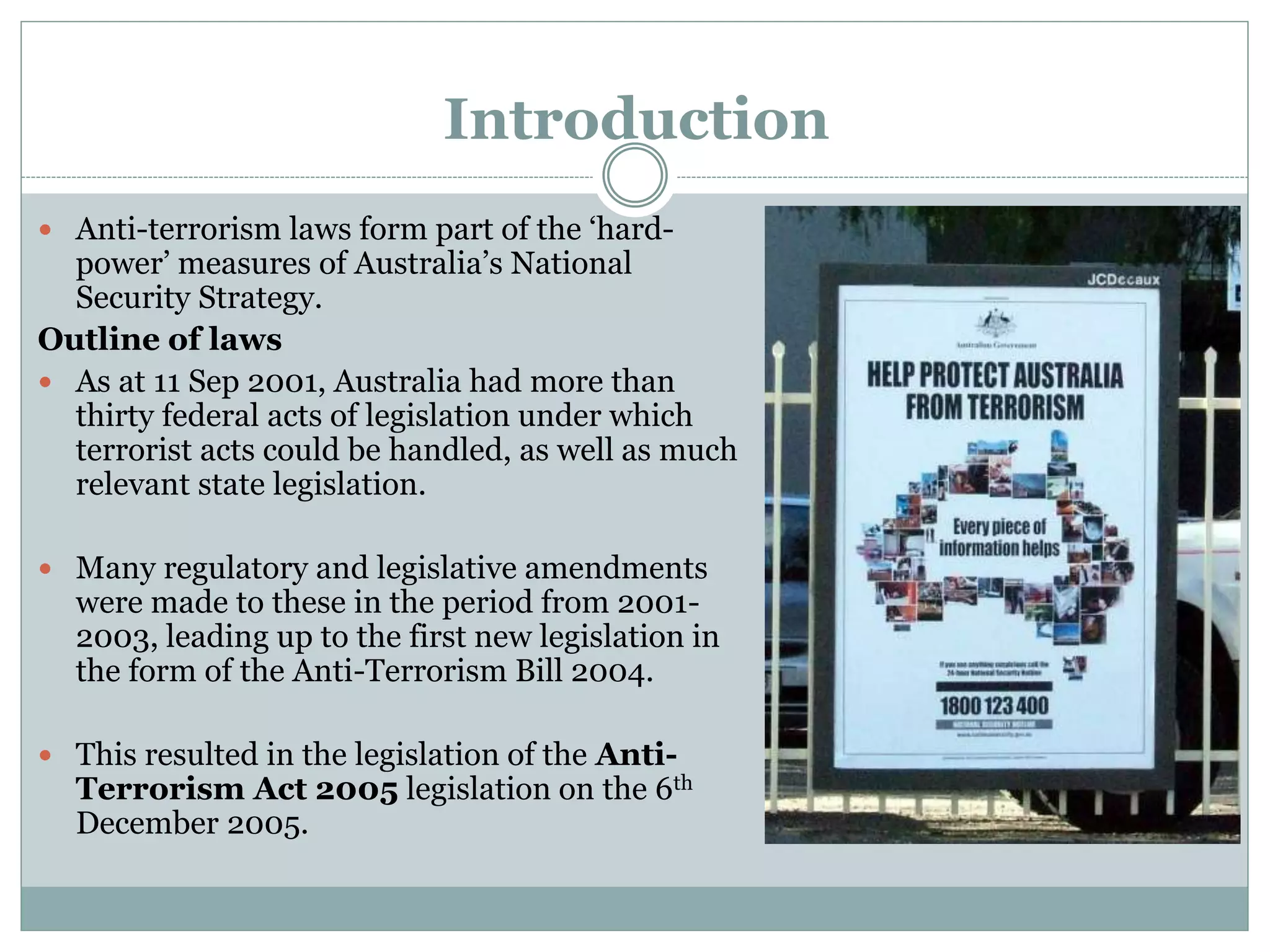
 Anti-terrorism laws form part of the ‘hard-
power’ measures of Australia’s National
Security Strategy.
Outline of laws
 As at 11 Sep 2001, Australia had more than
thirty federal acts of legislation under which
terrorist acts could be handled, as well as much
relevant state legislation.
 Many regulatory and legislative amendments
were made to these in the period from 2001-
2003, leading up to the first new legislation in
the form of the Anti-Terrorism Bill 2004.
 This resulted in the legislation of the Anti-
Terrorism Act 2005 legislation on the 6th
December 2005.
Creation of the Act
1. Anti-
Terrorism
Bill, 2004
3. Anti-
Terrorism bill
(No 3), 2004
2. Anti-
Terrorism bill
(No 2), 2004
•Why was it created?
•Who prepared the legislation?
•The Attorney-General, Phillip
Ruddock, described it as "a bill to
strengthen Australia's counter-
terrorism laws in a number of
respects – a task made more urgent
following the recent tragic terrorist
bombings in Spain."
•He said that Australia's counter-
terrorism laws "require review and,
where necessary, updating if we are
to have a legal framework capable of
safeguarding all Australians from the
scourge of terrorism."
4. Anti-
Terrorism Act
2005
Changes to the Act
 Potential for preventative detention
(ASIO)
 Control orders
 Significant restrictions on the right of any
citizen to express certain opinions:
 It becomes a crime, punishable by life
imprisonment, to recklessly provide funds
to a potential terrorist:
 Police can request information from any
source about any named person
 A legislative provision for 'hoax offences'
will create a more serious charge for people
who cause chaos for the public and
emergency services by dreaming up
devastating terrorist-inspired hoaxes.
Impacts
 The AFP can detain individuals
suspected of terrorism, without
criminal activities or evidence, for up to
14 days.
 The AFP and ASIO can order for the
surrender of passports of normal
citizens.
 Any decision made by the Attorney-
General on security grounds is exempt
from judicial review.
 Police can ask the court to place
restrictions on anyone who “poses a
terrorist risk”.
 Random raids and searches on Muslim
charities.
Impacts (Page 2)
 Police can stop, question and search anyone in the
street they suspect will commit a terrorist offence.
 Police have “emergency powers” to enter and search
a premise suspected of holding material related to
terrorism without a warrant.
 Certain “extreme” beliefs and speeches can be
charged as criminal, without any criteria for what
counts as “extreme”.
Case Study: Mohamed Haneef
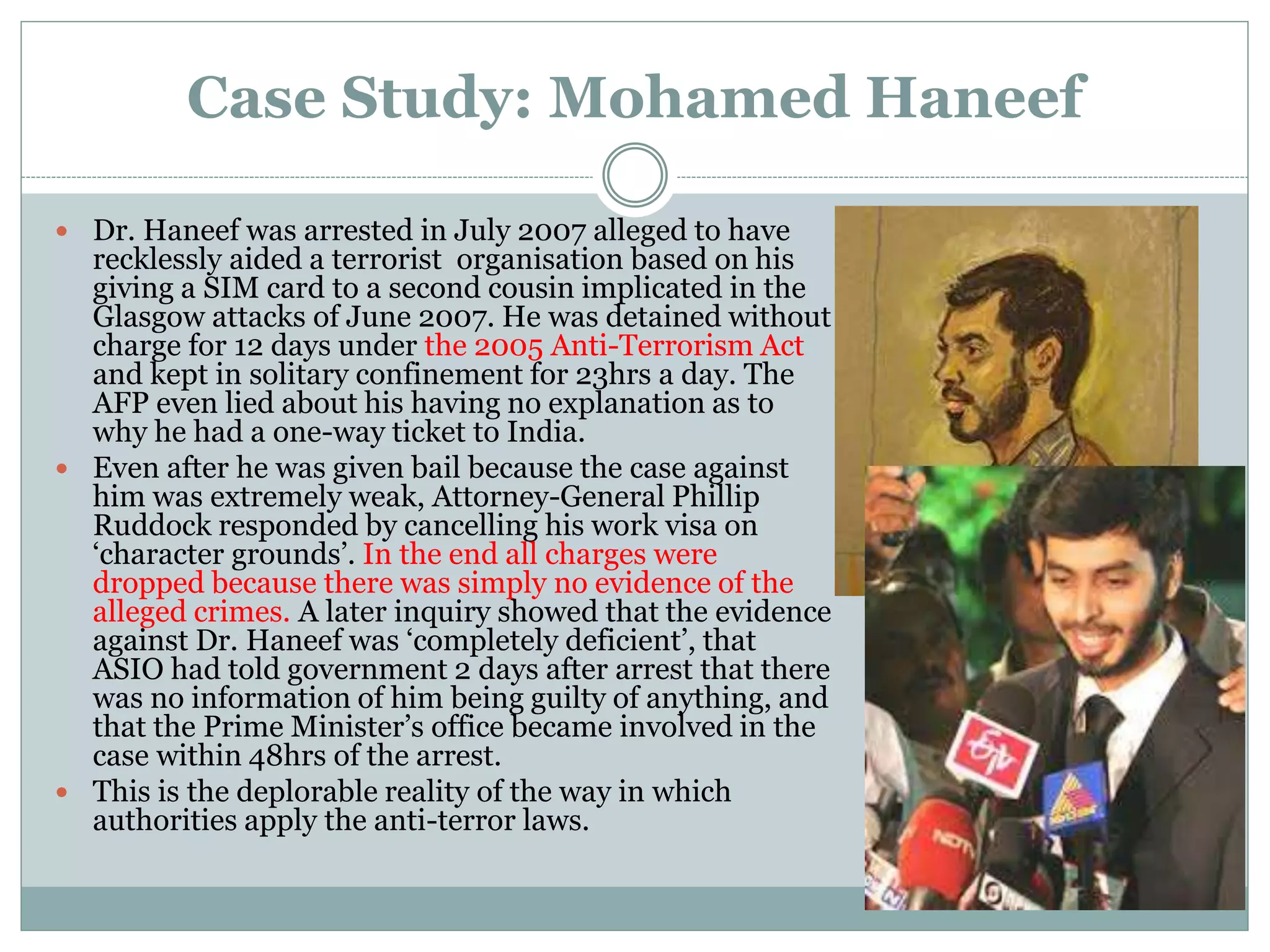
 Dr. Haneef was arrested in July 2007 alleged to have
recklessly aided a terrorist organisation based on his
giving a SIM card to a second cousin implicated in the
Glasgow attacks of June 2007. He was detained without
charge for 12 days under the 2005 Anti-Terrorism Act
and kept in solitary confinement for 23hrs a day. The
AFP even lied about his having no explanation as to
why he had a one-way ticket to India.
 Even after he was given bail because the case against
him was extremely weak, Attorney-General Phillip
Ruddock responded by cancelling his work visa on
‘character grounds’. In the end all charges were
dropped because there was simply no evidence of the
alleged crimes. A later inquiry showed that the evidence
against Dr. Haneef was ‘completely deficient’, that
ASIO had told government 2 days after arrest that there
was no information of him being guilty of anything, and
that the Prime Minister’s office became involved in the
case within 48hrs of the arrest.
 This is the deplorable reality of the way in which
authorities apply the anti-terror laws.
Personal Opinion: Saeed Baig
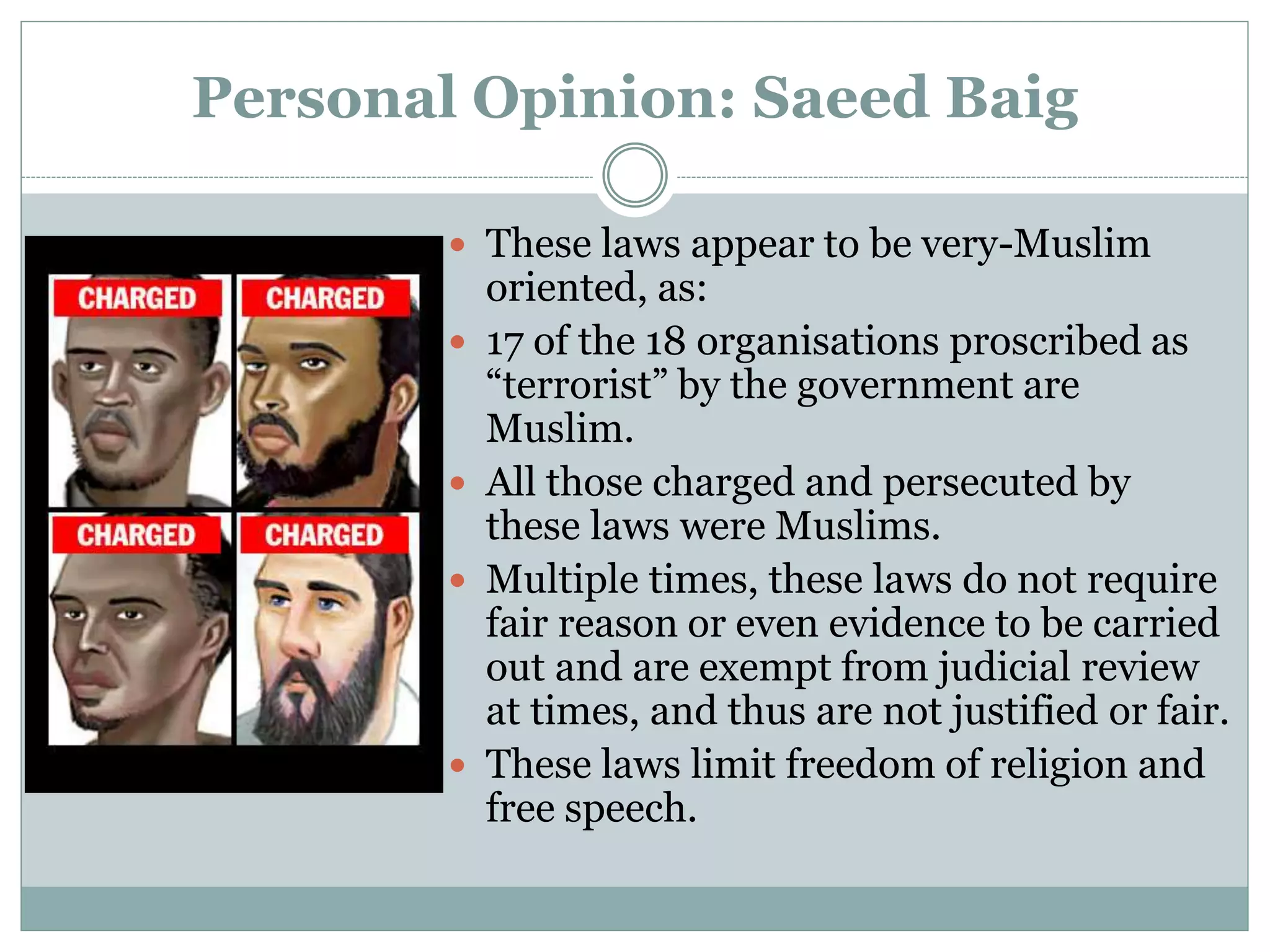
 These laws appear to be very-Muslim
oriented, as:
 17 of the 18 organisations proscribed as
“terrorist” by the government are
Muslim.
 All those charged and persecuted by
these laws were Muslims.
 Multiple times, these laws do not require
fair reason or even evidence to be carried
out and are exempt from judicial review
at times, and thus are not justified or fair.
 These laws limit freedom of religion and
free speech.
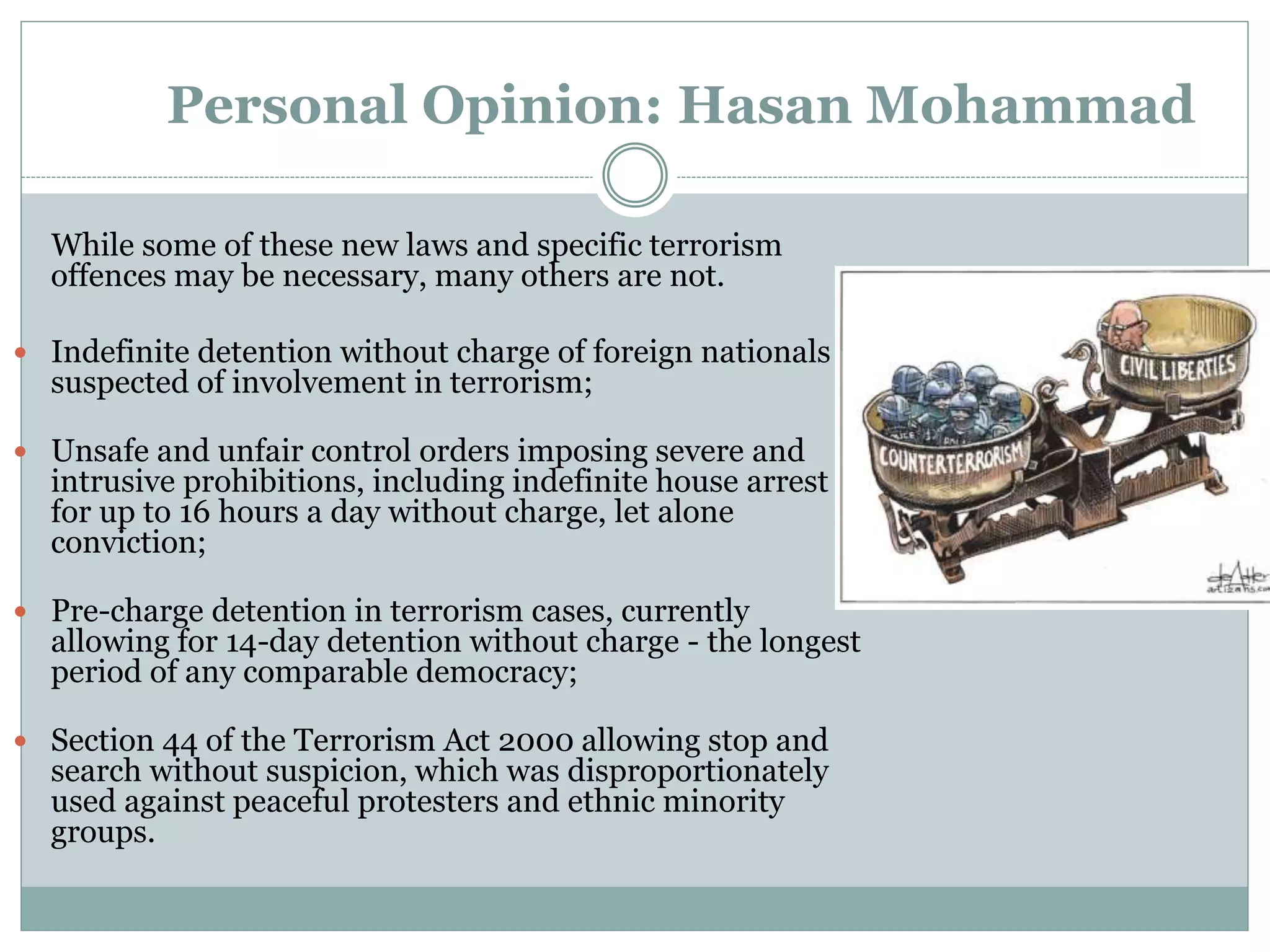
Personal Opinion: Hasan Mohammad
While some of these new laws and specific terrorism
offences may be necessary, many others are not.
 Indefinite detention without charge of foreign nationals if
suspected of involvement in terrorism;
 Unsafe and unfair control orders imposing severe and
intrusive prohibitions, including indefinite house arrest
for up to 16 hours a day without charge, let alone
conviction;
 Pre-charge detention in terrorism cases, currently
allowing for 14-day detention without charge - the longest
period of any comparable democracy;
 Section 44 of the Terrorism Act 2000 allowing stop and
search without suspicion, which was disproportionately
used against peaceful protesters and ethnic minority
groups.
Video Re-enactment

Anti-Terrorism Laws in Australia

  • 2.
    Introduction  Anti-terrorism lawsform part of the ‘hard- power’ measures of Australia’s National Security Strategy. Outline of laws  As at 11 Sep 2001, Australia had more than thirty federal acts of legislation under which terrorist acts could be handled, as well as much relevant state legislation.  Many regulatory and legislative amendments were made to these in the period from 2001- 2003, leading up to the first new legislation in the form of the Anti-Terrorism Bill 2004.  This resulted in the legislation of the Anti- Terrorism Act 2005 legislation on the 6th December 2005.
  • 3.
    Creation of theAct 1. Anti- Terrorism Bill, 2004 3. Anti- Terrorism bill (No 3), 2004 2. Anti- Terrorism bill (No 2), 2004 •Why was it created? •Who prepared the legislation? •The Attorney-General, Phillip Ruddock, described it as "a bill to strengthen Australia's counter- terrorism laws in a number of respects – a task made more urgent following the recent tragic terrorist bombings in Spain." •He said that Australia's counter- terrorism laws "require review and, where necessary, updating if we are to have a legal framework capable of safeguarding all Australians from the scourge of terrorism." 4. Anti- Terrorism Act 2005
  • 4.
    Changes to theAct  Potential for preventative detention (ASIO)  Control orders  Significant restrictions on the right of any citizen to express certain opinions:  It becomes a crime, punishable by life imprisonment, to recklessly provide funds to a potential terrorist:  Police can request information from any source about any named person  A legislative provision for 'hoax offences' will create a more serious charge for people who cause chaos for the public and emergency services by dreaming up devastating terrorist-inspired hoaxes.
  • 5.
    Impacts  The AFPcan detain individuals suspected of terrorism, without criminal activities or evidence, for up to 14 days.  The AFP and ASIO can order for the surrender of passports of normal citizens.  Any decision made by the Attorney- General on security grounds is exempt from judicial review.  Police can ask the court to place restrictions on anyone who “poses a terrorist risk”.  Random raids and searches on Muslim charities.
  • 6.
    Impacts (Page 2) Police can stop, question and search anyone in the street they suspect will commit a terrorist offence.  Police have “emergency powers” to enter and search a premise suspected of holding material related to terrorism without a warrant.  Certain “extreme” beliefs and speeches can be charged as criminal, without any criteria for what counts as “extreme”.
  • 7.
    Case Study: MohamedHaneef  Dr. Haneef was arrested in July 2007 alleged to have recklessly aided a terrorist organisation based on his giving a SIM card to a second cousin implicated in the Glasgow attacks of June 2007. He was detained without charge for 12 days under the 2005 Anti-Terrorism Act and kept in solitary confinement for 23hrs a day. The AFP even lied about his having no explanation as to why he had a one-way ticket to India.  Even after he was given bail because the case against him was extremely weak, Attorney-General Phillip Ruddock responded by cancelling his work visa on ‘character grounds’. In the end all charges were dropped because there was simply no evidence of the alleged crimes. A later inquiry showed that the evidence against Dr. Haneef was ‘completely deficient’, that ASIO had told government 2 days after arrest that there was no information of him being guilty of anything, and that the Prime Minister’s office became involved in the case within 48hrs of the arrest.  This is the deplorable reality of the way in which authorities apply the anti-terror laws.
  • 8.
    Personal Opinion: SaeedBaig  These laws appear to be very-Muslim oriented, as:  17 of the 18 organisations proscribed as “terrorist” by the government are Muslim.  All those charged and persecuted by these laws were Muslims.  Multiple times, these laws do not require fair reason or even evidence to be carried out and are exempt from judicial review at times, and thus are not justified or fair.  These laws limit freedom of religion and free speech.
  • 9.
    Personal Opinion: HasanMohammad While some of these new laws and specific terrorism offences may be necessary, many others are not.  Indefinite detention without charge of foreign nationals if suspected of involvement in terrorism;  Unsafe and unfair control orders imposing severe and intrusive prohibitions, including indefinite house arrest for up to 16 hours a day without charge, let alone conviction;  Pre-charge detention in terrorism cases, currently allowing for 14-day detention without charge - the longest period of any comparable democracy;  Section 44 of the Terrorism Act 2000 allowing stop and search without suspicion, which was disproportionately used against peaceful protesters and ethnic minority groups.
  • 10.