ANTENNAAND WAVE
PROPAGATION
Feed Methods for Parabolic
Reflectors
 The feed systems for parabolic reflector antennas or
dish antennas are of great importance.
 The parabolic reflector antenna feed element has a
major impact on the performance and therefore
correctly designing it means that the optimum
performance can be obtained from the overall
antenna system.
 The actual antenna element within the overall
parabolic reflector antenna, i.e. the device that
interfaces the transmission line or waveguide
containing the radiofrequency energy to free space, is
the feed element for the parabolic reflector antenna.
 The reflector surface itself is entirely passive.
Parabolic reflector feed length
 While there are many different types of
parabolic reflector antenna feed systems,
one key element of many of them is the feed
point and hence the focal length of the
reflector.
 The parabolic reflector focal point is the
point where all reflected waves will be
concentrated.The focal length f (distance of
focal point from the centre of the reflector)
is calculated with the following equation:
Parabolic reflector feed types
 There are several different types of
parabolic reflector feed systems that can
be used. Each has its own characteristics
that can be matched to the requirements
of the application.
 Focal feed - often also known as axial or
front feed system
 Cassegrain feed system
 Gregorian feed system
 Off Axis or offset feed
Focal feed system
 The parabolic reflector or dish antenna consists of a
radiating element which may be a simple dipole or a
waveguide horn antenna.
 This is placed at the focal point of the parabolic reflecting
surface.The energy from the radiating element is arranged so
that it illuminates the reflecting surface.
 Once the energy is reflected it leaves the antenna system in a
narrow beam.As a result considerable levels of gain can be
achieved.
 Achieving this is not always easy because it is dependent
upon the radiator that is used.
 For lower frequencies a dipole element is often employed
whereas at higher frequencies a circular waveguide may be
used. In fact the circular waveguide provides one of the
optimum sources of illumination.
Cassegrain feed system
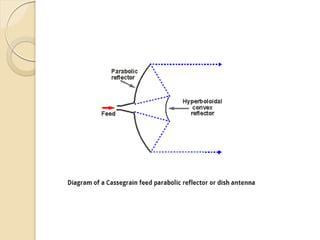
 The Cassegrain feed system, although
requiring a second reflecting surface has the
advantage that the overall length of the dish
antenna between the two reflectors is
shorter than the length between the
radiating element and the parabolic reflector.
 This is because there is a reflection in the
focusing of the signal which shortens the
physical length.
 This can be an advantage in some systems.
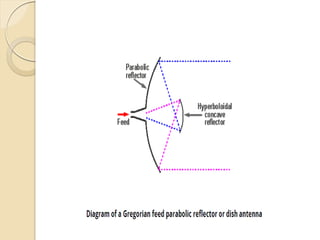
Gregorian parabolic reflector feed
 The Gregorian parabolic reflector feed
technique is very similar to the
Cassegrain design.
 The major difference is that except that
the secondary reflector is concave or
more correctly ellipsoidal in shape.
 Typical aperture efficiency levels of over
70% can be achieved because the system
is able to provide a better illumination of
all of the reflector surface
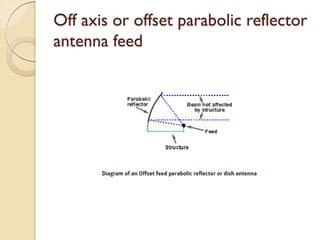
Off axis or offset parabolic reflector
antenna feed

antenna and wave propagation lecture notes

  • 1.
  • 2.
    Feed Methods forParabolic Reflectors  The feed systems for parabolic reflector antennas or dish antennas are of great importance.  The parabolic reflector antenna feed element has a major impact on the performance and therefore correctly designing it means that the optimum performance can be obtained from the overall antenna system.  The actual antenna element within the overall parabolic reflector antenna, i.e. the device that interfaces the transmission line or waveguide containing the radiofrequency energy to free space, is the feed element for the parabolic reflector antenna.  The reflector surface itself is entirely passive.
  • 3.
    Parabolic reflector feedlength  While there are many different types of parabolic reflector antenna feed systems, one key element of many of them is the feed point and hence the focal length of the reflector.  The parabolic reflector focal point is the point where all reflected waves will be concentrated.The focal length f (distance of focal point from the centre of the reflector) is calculated with the following equation:
  • 4.
    Parabolic reflector feedtypes  There are several different types of parabolic reflector feed systems that can be used. Each has its own characteristics that can be matched to the requirements of the application.  Focal feed - often also known as axial or front feed system  Cassegrain feed system  Gregorian feed system  Off Axis or offset feed
  • 5.
    Focal feed system The parabolic reflector or dish antenna consists of a radiating element which may be a simple dipole or a waveguide horn antenna.  This is placed at the focal point of the parabolic reflecting surface.The energy from the radiating element is arranged so that it illuminates the reflecting surface.  Once the energy is reflected it leaves the antenna system in a narrow beam.As a result considerable levels of gain can be achieved.  Achieving this is not always easy because it is dependent upon the radiator that is used.  For lower frequencies a dipole element is often employed whereas at higher frequencies a circular waveguide may be used. In fact the circular waveguide provides one of the optimum sources of illumination.
  • 7.
    Cassegrain feed system The Cassegrain feed system, although requiring a second reflecting surface has the advantage that the overall length of the dish antenna between the two reflectors is shorter than the length between the radiating element and the parabolic reflector.  This is because there is a reflection in the focusing of the signal which shortens the physical length.  This can be an advantage in some systems.
  • 9.
    Gregorian parabolic reflectorfeed  The Gregorian parabolic reflector feed technique is very similar to the Cassegrain design.  The major difference is that except that the secondary reflector is concave or more correctly ellipsoidal in shape.  Typical aperture efficiency levels of over 70% can be achieved because the system is able to provide a better illumination of all of the reflector surface
  • 11.
    Off axis oroffset parabolic reflector antenna feed