AIT | Annual Report 2009
Cover photo:
Ekkapong Cheevitsopon
Grand Prize Winner, 50th Anniversary Photo Competition
AIT leadership	 2
AIT Board of Trustees 	 2
Senior management	 3
Chairman’s Message	 4
President’s Message	 5
AIT Overview	 6
INSTITUTIONAL HIGHLIGHTS	 8
awards and recognition 	 24
AT a glance
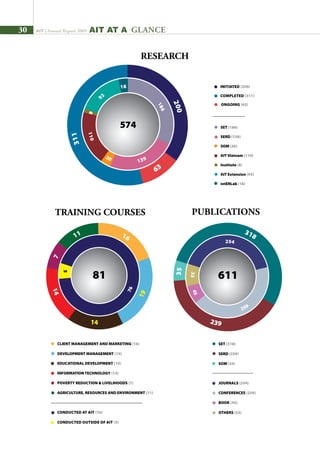
RESEARCH, TRAINING COURSES, PUBLICATIONS	 30
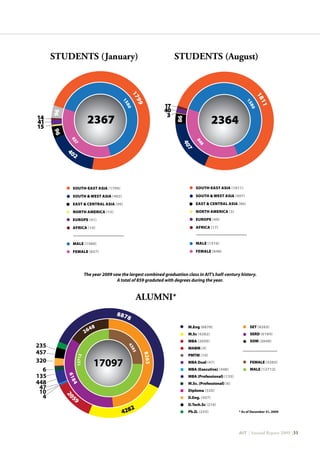
STUDENTS, ALUMNI	 31
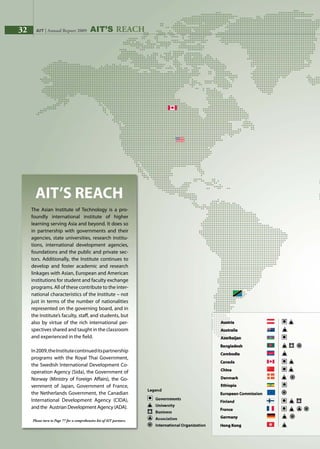
AIT’s REACH	 32
STRATEGY 2013	 38
Key Achievements IN 2009	 40
ACADEMICS	 42
RESEARCH	 56
EXTENSION, OUTREACH and centers	 62
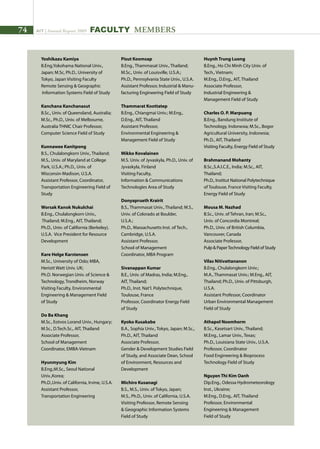
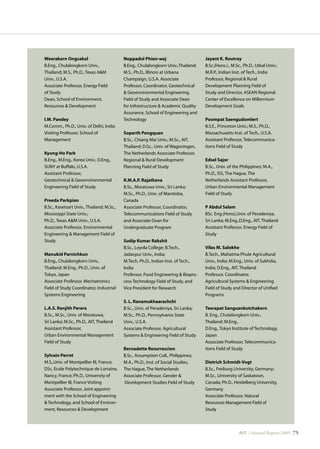
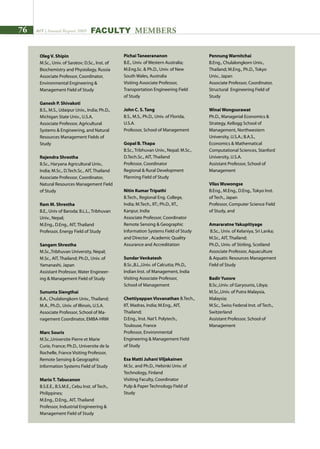
faculty members	 72
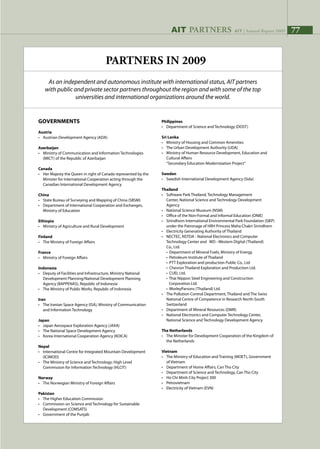
PARTNERS	 77
financial statementS and	 82
auditor’s report
CONTENTS
This report was printed on wood-free paper and used soy ink without any special techniques to ensure that this publication is recyclable.
Copyright © 2009 Asian Institute of Technology. All rights reserved.
www.ait.asia
Editorial team:
Shawn Kelly
Dr. Pritam Krishna Shreshta
Bajinder Pal Singh
Kim Escobin
Research and Design team:
Chittrawinee Wichianson
Bernardo Gadlan
Natnipha Vimuktanon
Apichart Ngarmniyom
This report was compiled and produced by the Media and Communications Unit (MCU),
External Relations and Communications Office (ERCO), with the involvement of all employees.
AIT wishes to thank the many people who rendered assistance in preparing this report.
Primary Photo Credits:
Paitoon Tinnapong
Ekkapong Cheevitsopon
AIT Student Union
AIT | Annual Report 2009 AIT LEADERSHIP
H.E. Mr. Gildas Le Lidec
Ambassador of France to Thailand
H.E. Mr. Lennart Linnér
Ambassador of Sweden to Thailand
H.E. Mr. David Lipman
Ambassador-Head of Delegation, European Commission
to Thailand
H.E. Ms. Sirpa Mäenpää
Ambassador of Finland to Thailand
H.E. Mr. Sohail Mahmood
Ambassador of Pakistan to Thailand
H.E. Mr. Nguyen Duy Hung
Ambassador of Vietnam to Thailand
Professor Dr. Surapon Nitikraipot
Rector, Thammasat University
H.E. Mr. Ouan Phommachack
Ambassador of Lao People’s Democratic Republic to Thai-
land
Dr. Chitriya Pinthong
Deputy Permanent Secretary,
Ministry of Foreign Affairs
H.E. Ms. Vijaya Latha Reddy
Ambassador of India to Thailand
H.E. Mr. Antonio Rodriguez
Ambassador of the Republic of the Philippines to Thailand
Mr. Deepak Seth
Chairman, House of Pearl Fashion Ltd., India
H.E. Mr. Naveen Prakash Jung Shah
Ambassador of Nepal to Thailand
H.E. Mr. Tjaco Theo van den Hout
Ambassador of the Netherlands to Thailand
Khunying Jada Wattanasiritham
Director and Executive Director,
The Siam Commercial Bank Public Co.,Ltd.
Dr. Sumate Yamnoon
Secretary-General, Commission on Higher Education,
Ministry of Education, Thailand
Professor Yongyuth Yuthavong
Former Minister of Science and Technology,
Thailand and Senior Researcher, National Center for
GeneticEngineering and Biotechnology, National Science
and Technology Development Agency (NSTDA)
Professor Said Irandoust
AIT President
Mr. Chaovalit Ekabut
President, AIT Alumni Association
CHAIRMAN EMERITUS
H.E. Dr. Thanat Khoman
Former Deputy Prime Minister of Thailand and Former
Minister of Foreign Affairs
CHAIRMAN
H.E. Dr. Tej Bunnag
Former Minister of Foreign Affairs, Thailand and
Assistant Secretary General for Administration
The Thai Red Cross Society
VICE CHAIRPERSONS
H.E. Mrs. Merete Fjeld Brattested
Ambassador of Norway to Thailand
Professor Shinichiro Ohgaki
Professor Emeritus, University of Tokyo,
President, National Institute for Environmental Studies
(NIES), Japan
Mr. Jean-Pierre Verbiest
Country Director, Thailand Resident Mission,
Asian Development Bank
BOARD MEMBERS
H.E. Mrs. You Ay
Ambassador of Cambodia to Thailand
Mr. Liu Baoli
Deputy Director-General,
Department of International Cooperation and Exchanges,
Ministry of Education, China
H.E. Mr. Chung Hae-moon
Ambassador of the Republic of Korea to Thailand
H.E. Professor J.B. Disanayaka
Ambassador of Sri Lanka to Thailand
Professor Hubert Gijzen
Director of UNESCO in Jarkata
H.E. Mr. Mohammad Hatta
Ambassador of Indonesia to Thailand
Dr. Noeleen Heyzer
Under-Secretary-General of the United Nations and Ex-
ecutive Secretary of Economic and Social Commission for
Asia and the Pacific (ESCAP), Thailand
Dr. Tongchat Hongladaromp
Chairman of the University Council,
King Mongkut’s University of Technology, Thonburi
H.E. Mr. Mustafa Kamal
Ambassador of the People’s Republic of Bangladesh to
Thailand
H.E. Mr. Kyoji Komachi
Ambassador of Japan to Thailand
As of December, 2009
AIT BOARD OF TRUSTEES
AIT | Annual Report 2009 | 
Senior Management 2009
PRESIDENT
•	 Professor Said Irandoust
VICE PRESIDENTS
•	 Professor Peter F. Haddawy, Academic Affairs
•	 Professor Sudip K. Rakshit, Research
•	 Professor Vilas Wuwongse, External Relations (until 30 June 2009)
•	 Dr. Khin Ni Ni Thein, Development and Resources
	 (until 30 June 2009)
•	 Professor Worsak Kanok-Nukulchai, Resource Development 	 	
	 (from 1 July 2009)
DEANS
•	 Professor Worsak Kanok-Nukulchai, School of Engineering and 	
	 Technology (until 31 August 2009)
•	 Professor Sivanappan Kumar, School of Environment, Resources 	
	 and Development (until 31 August 2009)
•	 Dr. Barbara Igel, School of Management
•	 Dr. Nitin V. Afzulpurkar, School of Engineering and Technology 	
	 (from 1 September 2009)
•	 Dr. Weerakorn Ongsakul, School of Environment, Resources and 	
	 Development (from 1 September 2009)
DIRECTORS
•	 Dr. Amrit Bart, AIT Vietnam
•	 Dr. Sugimin Pranoto, AIT Indonesia
•	 Dr. Jonathan L. Shaw, AIT Extension
•	 Professor Kanchana Kanchanasut, Internet Education and Research 	
	 Laboratory (intERLab)
•	 Professor Jayant K Routray, ASEAN Regional Center of Excellence on	
	 Millennium Development Goals at AIT
•	 Professor Vilas M. Salokhe, Unified Programs at AIT
•	 Dr. Nitin V. Afzulpurkar, Undergraduate Programs at AIT
	 (until 31 August 2009)
•	 Professor Ajit P. Annachhatre, AIT-United Nations Office at AIT
•	 Dr. Nitin Kumar Tripathi, Academic Quality Assurance and 	
	 Accreditation at AIT
•	 Dr. Mark Neal, Co-Director for Professional Programs at AIT
	 (until 30 June 2009)
•	 Mr. Nicholas Innes-Taylor, Co-Director for Professional Programs at 	
	 AIT
•	 Professor Richard J. Welford, Co-Director for Professional Programs 	
	 at AIT (from 1 August 2009)
•	 Dr. Evangelos Angelos Afendras, Center for Learning Innovation  	
	 Quality (from August 2009)
•	 Mr. Borje Wallberg, Yunus Center at AIT (from 6 November 2009)
AIT | Annual Report 2009
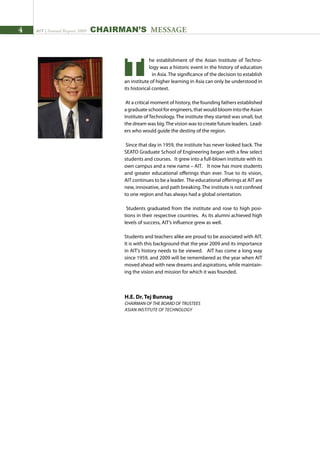
H.E. Dr. Tej Bunnag
CHAIRMAN OF THE BOARD OF TRUSTEES
Asian Institute of Technology
CHAIRMAN’S MESSAGE
	 he establishment of the Asian Institute of Techno-
	 logy was a historic event in the history of education
 in Asia. The significance of the decision to establish
an institute of higher learning in Asia can only be understood in
its historical context.
At a critical moment of history, the founding fathers established
a graduate school for engineers, that would bloom into the Asian
Institute of Technology. The institute they started was small, but
the dream was big.The vision was to create future leaders. Lead-
ers who would guide the destiny of the region.
Since that day in 1959, the institute has never looked back. The
SEATO Graduate School of Engineering began with a few select
students and courses. It grew into a full-blown institute with its
own campus and a new name – AIT. It now has more students
and greater educational offerings than ever. True to its vision,
AIT continues to be a leader. The educational offerings at AIT are
new, innovative, and path breaking.The institute is not confined
to one region and has always had a global orientation.
Students graduated from the institute and rose to high posi-
tions in their respective countries. As its alumni achieved high
levels of success, AIT’s influence grew as well.
Students and teachers alike are proud to be associated with AIT.
It is with this background that the year 2009 and its importance
in AIT’s history needs to be viewed. AIT has come a long way
since 1959, and 2009 will be remembered as the year when AIT
moved ahead with new dreams and aspirations, while maintain-
ing the vision and mission for which it was founded.
T
AIT | Annual Report 2009 | 
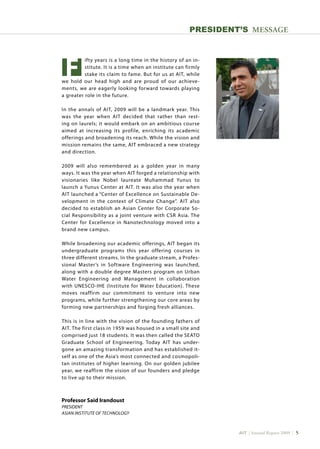
Professor Said Irandoust
PRESIDENT
Asian Institute of Technology
PRESIDENT’s MESSAGE
		ifty years is a long time in the history of an in-
		stitute. It is a time when an institute can firmly
		stake its claim to fame. But for us at AIT, while
we hold our head high and are proud of our achieve-
ments, we are eagerly looking forward towards playing
a greater role in the future.
In the annals of AIT, 2009 will be a landmark year. This
was the year when AIT decided that rather than rest-
ing on laurels; it would embark on an ambitious course
aimed at increasing its profile, enriching its academic
offerings and broadening its reach. While the vision and
mission remains the same, AIT embraced a new strategy
and direction.
2009 will also remembered as a golden year in many
ways. It was the year when AIT forged a relationship with
visionaries like Nobel laureate Muhammad Yunus to
launch a Yunus Center at AIT. It was also the year when
AIT launched a “Center of Excellence on Sustainable De-
velopment in the context of Climate Change”. AIT also
decided to establish an Asian Center for Corporate So-
cial Responsibility as a joint venture with CSR Asia. The
Center for Excellence in Nanotechnology moved into a
brand new campus.
While broadening our academic offerings, AIT began its
undergraduate programs this year offering courses in
three different streams. In the graduate stream, a Profes-
sional Master’s in Software Engineering was launched,
along with a double degree Masters program on Urban
Water Engineering and Management in collaboration
with UNESCO-IHE (Institute for Water Education). These
moves reaffirm our commitment to venture into new
programs, while further strengthening our core areas by
forming new partnerships and forging fresh alliances.
This is in line with the vision of the founding fathers of
AIT. The first class in 1959 was housed in a small site and
comprised just 18 students. It was then called the SEATO
Graduate School of Engineering. Today AIT has under-
gone an amazing transformation and has established it-
self as one of the Asia’s most connected and cosmopoli-
tan institutes of higher learning. On our golden jubilee
year, we reaffirm the vision of our founders and pledge
to live up to their mission.
F
AIT | Annual Report 2009
institutional Highlights
PAGE 8-23
Since its inception in 1959,
AIT has grown into a leading in-
ternational institution of higher
learning in Asia. AIT’s mission
is to develop highly qualified
professionals and researchers
who will play a leading role in
the sustainable development
of the region and its integration
into the global economy.
AIT offers Undergraduate, Master’s
and Doctoral Degree Programs,
apart from conducting training
programs.
Awards and Recognition
PAGE 24-29
AIT OVERVIEW
AIT is made up of the School of Engineering and Technology (SET),
the School of Environment, Resources and Development (SERD)
and the School of Management (SOM). AIT Extension offers non-
degree continuing education courses to practicing professionals.
AIT O
AIT | Annual Report 2009 | 
OVERVIEW
AIT is home to 130 faculty members and nearly 2,500 full-time
students, from over 40 countries, mostly from Asia. It has over
17,500 alumni living and working in 85 countries worldwide. A
substantial portion of AIT’s alumni serve in the region and hold
positions of influence in industry, governments, international
organizations and universities. In an era of strong internation-
alization of higher education, AIT positions itself in academic
and research exchanges and collaborations, between Asia and
other continents.
AIT | Annual Report 2009
JANUARY
With the help of a star-studded
field of inaugural round golfers,
the Asian Institute of Technol-
ogy (AIT) inaugurated its newly
refurbished nine-hole public
golf course. H.E. Dr. Tej Bunnag,
Chairman of the Asian Institute
ofTechnology Board ofTrustees,
and Assistant Secretary General
for Administration, Thai Red
Cross Society, and former Min-
ister of Foreign Affairs, Thailand,
and Mr. Preecha Boodsri, Gover-
nor of Pathum Thani province,
co-presided over the official AIT
Golf Club Opening Ceremony.
The 125-rai course was recently
redevelopedbyInnotechSports
Management of the Innotech
Group of Companies.
AIT Golf Club opens Pakistan’s Balochistan
University of Engineer-
ing  Technology inks
MoU
AIT signed a Memorandum
of Understanding (MoU) with
Balochistan University of Engi-
neering  Technology (BUETK),
which is located in Khuzdar in
Pakistan. AIT will provide higher
education and research oppor-
tunities for faculty members of
BUETK.
The three-year agreement
was signed by Brig. Mukhtar
Ahmad (Retd.), Vice Chancel-
lor of BUETK, and AIT President
Said Irandoust. The tie-up cov-
ers graduate studies, short-
term training, and research
programs. Based on the agree-
ment, selected faculty mem-
bers nominated by BUETK will
pursue master’s and / or doc-
toral studies at AIT.
Partnership for broad
cooperation with uni-
versity of Transport and
Communications (UTC),
Vietnam
AIT entered a Memorandum of
Understanding(MoU)withViet-
nam’s University of Transport
and Communications (UTC)
to enable a broad range of co-
operation in educational, re-
search and outreach programs.
The five-year agreement was
signed by Associate Prof. Tran
Dac Su, Rector, UTC, and Prof.
Said Irandoust, President of AIT.
A key component of the MoU
was joint implementation of
academic programs for both
undergraduate and graduate
levels.
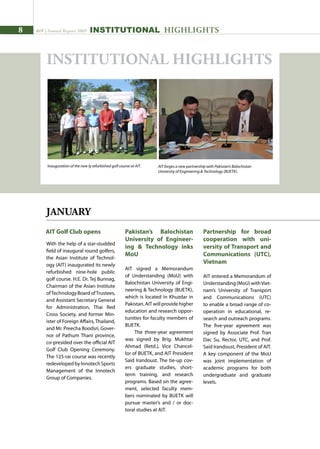
AIT forges a new partnership with Pakistan’s Balochistan
University of Engineering  Technology (BUETK).
INSTITUTIONAL HIGHLIGHTS
Inauguration of the new ly refurbished golf course at AIT.
INSTITUTIONAL HIGHLIGHTS
AIT | Annual Report 2009 | 
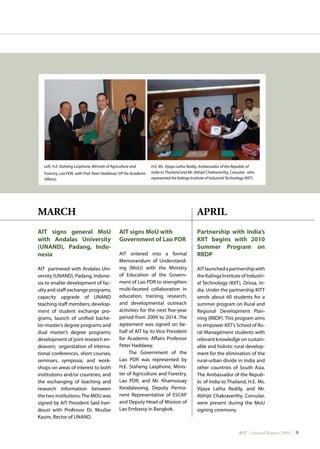
Left, H.E. Staheng Lasphone, Minister of Agriculture and
Forestry, Lao PDR, with Prof. Peter Haddawy (VP for Academic
Affairs).
MARCH
AIT signs general MoU
with Andalas University
(UNAND), Padang, Indo-
nesia
AIT partnered with Andalas Uni-
versity (UNAND), Padang, Indone-
sia to enable development of fac-
ulty and staff exchange programs;
capacity upgrade of UNAND
teaching staff members; develop-
ment of student exchange pro-
grams, launch of unified bache-
lor-master’s degree programs and
dual master’s degree programs;
development of joint research en-
deavors; organization of interna-
tional conferences, short courses,
seminars, symposia, and work-
shops on areas of interest to both
institutions and/or countries; and
the exchanging of teaching and
research information between
the two institutions.The MOU was
signed by AIT President Said Iran-
doust with Professor Dr. Musliar
Kasim, Rector of UNAND.
AIT signs MoU with
Government of Lao PDR
AIT entered into a formal
Memorandum of Understand-
ing (MoU) with the Ministry
of Education of the Govern-
ment of Lao PDR to strengthen
multi-faceted collaboration in
education, training, research,
and developmental outreach
activities for the next five-year
period from 2009 to 2014. The
agreement was signed on be-
half of AIT by its Vice President
for Academic Affairs Professor
Peter Haddawy.
The Government of the
Lao PDR was represented by
H.E. Staheng Lasphone, Minis-
ter of Agriculture and Forestry,
Lao PDR, and Mr. Khamsouay
Keodalavong, Deputy Perma-
nent Representative of ESCAP
and Deputy Head of Mission of
Lao Embassy in Bangkok.
APRIL
Partnership with India’s
KIIT begins with 2010
Summer Program on
RRDP
AITlaunchedapartnershipwith
the Kalinga Institute of Industri-
al Technology (KIIT), Orissa, In-
dia. Under the partnership KITT
sends about 60 students for a
summer program on Rural and
Regional Development Plan-
ning (RRDP). This program aims
to empower KIIT’s School of Ru-
ral Management students with
relevant knowledge on sustain-
able and holistic rural develop-
ment for the elimination of the
rural-urban divide in India and
other countries of South Asia.
The Ambassador of the Repub-
lic of India to Thailand, H.E. Ms.
Vijaya Latha Reddy, and Mr.
Abhijit Chakraverthy, Consular,
were present during the MoU
signing ceremony.
H.E. Ms. Vijaya Latha Reddy, Ambassador of the Republic of
India to Thailand and Mr. Abhijit Chakraverthy, Consular, who
represented the Kalinga Institute of Industrial Technology (KIIT).
10 AIT | Annual Report 2009
APRIL
GlobalHort begins
partnership
AIT signed a Memorandum of
Understanding (MoU) and a
Memorandum of Agreement
(MoA) with Global Horticul-
ture Initiative (GlobalHort).
GlobalHort specializes in ca-
pacity building to support
rural environments, especially
high value vegetable produc-
tion and income generation.
The MOU was signed by Dr.
Norman Looney, Chairman of
the Board of Directors, Glob-
alHort and AIT President Prof.
Said Irandoust. GlobalHort
also seconded one of its scien-
tists, Dr. Po-Yung Lai, to AIT for
a one-year period.
New home for AIT Vietnam
in Hanoi
AIT Center in Vietnam (AITCV) relo-
cated to a new home in the heart
ofVietnam’s capital by officially un-
veiling its new AIT-Vietnam center
building located on the campus
of the University of Transport and
Communications (UTC).
Thespecialinaugurationevent
at UTC was graced by Professor
Nguyen Thien Nhan, Deputy Prime
Minister and Minister of Education
and Training, Vietnam; H.E. Dr. Tej
Bunnag, former Minister of Foreign
Affairs of the Kingdom of Thailand
and Chairman of the AIT Board of
Trustees; AIT President Prof. Said
Irandoust; Dr. Amrit Bart, Direc-
tor of AIT Vietnam (AITVN); repre-
sentatives from the University of
Transportation and Communica-
tion and Vietnam National Univer-
sity; AIT partners in Vietnam, and
more than ten ambassadors based
in Vietnam.
JUNE
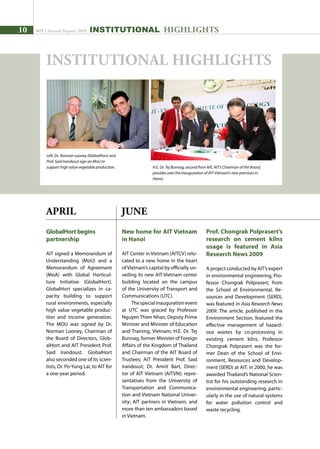
Left, Dr. Norman Looney (GlobalHort) and
Prof. Said Irandoust sign an MoU to
support high value vegetable production. H.E. Dr. Tej Bunnag, second from left, AIT’s Chairman of the Board,
presides over the inauguration of AIT-Vietnam’s new premises in
Hanoi.
INSTITUTIONAL HIGHLIGHTS
Prof. Chongrak Polprasert’s
research on cement kilns
usage is featured in Asia
Research News 2009
A project conducted by AIT’s expert
in environmental engineering, Pro-
fessor Chongrak Polprasert, from
the School of Environmental, Re-
sources and Development (SERD),
was featured in Asia Research News
2009. The article, published in the
Environment Section, featured the
effective management of hazard-
ous wastes by co-processing in
existing cement kilns. Professor
Chongrak Polprasert was the for-
mer Dean of the School of Envi-
ronment, Resources and Develop-
ment (SERD) at AIT. In 2000, he was
awarded Thailand’s National Scien-
tist for his outstanding research in
environmental engineering, partic-
ularly in the use of natural systems
for water pollution control and
waste recycling.
INSTITUTIONAL HIGHLIGHTS
AIT | Annual Report 2009 |11
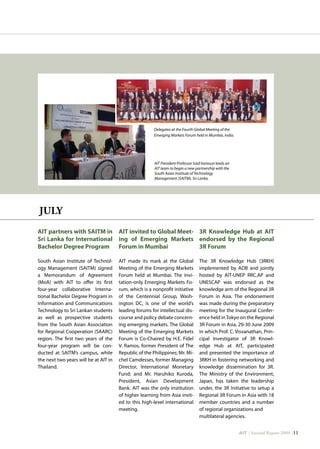
Delegates at the Fourth Global Meeting of the
Emerging Markets Forum held in Mumbai, India.
AIT President Professor Said Iranoust leads an
AIT team to begin a new partnership with the
South Asian Institute of Technology
Management (SAITM), Sri Lanka.
JULY
AIT partners with SAITM in
Sri Lanka for International
Bachelor Degree Program
South Asian Institute of Technol-
ogy Management (SAITM) signed
a Memorandum of Agreement
(MoA) with AIT to offer its first
four-year collaborative Interna-
tional Bachelor Degree Program in
Information and Communications
Technology to Sri Lankan students
as well as prospective students
from the South Asian Association
for Regional Cooperation (SAARC)
region. The first two years of the
four-year program will be con-
ducted at SAITM’s campus, while
the next two years will be at AIT in
Thailand.
AIT invited to Global Meet-
ing of Emerging Markets
Forum in Mumbai
AIT made its mark at the Global
Meeting of the Emerging Markets
Forum held at Mumbai. The invi-
tation-only Emerging Markets Fo-
rum, which is a nonprofit initiative
of the Centennial Group, Wash-
ington DC, is one of the world’s
leading forums for intellectual dis-
course and policy debate concern-
ing emerging markets. The Global
Meeting of the Emerging Markets
Forum is Co-Chaired by H.E. Fidel
V. Ramos, former President of The
Republic of the Philippines; Mr. Mi-
chel Camdesses, former Managing
Director, International Monetary
Fund; and Mr. Haruhiko Kuroda,
President, Asian Development
Bank. AIT was the only institution
of higher learning from Asia invit-
ed to this high-level international
meeting.
3R Knowledge Hub at AIT
endorsed by the Regional
3R Forum
The 3R Knowledge Hub (3RKH)
implemented by ADB and jointly
hosted by AIT-UNEP RRC.AP and
UNESCAP was endorsed as the
knowledge arm of the Regional 3R
Forum in Asia. The endorsement
was made during the preparatory
meeting for the Inaugural Confer-
ence held inTokyo on the Regional
3R Forum in Asia, 29-30 June 2009
in which Prof. C. Visvanathan, Prin-
cipal Investigator of 3R Knowl-
edge Hub at AIT, participated
and presented the importance of
3RKH in fostering networking and
knowledge dissemination for 3R.
The Ministry of the Environment,
Japan, has taken the leadership
under, the 3R Initiative to setup a
Regional 3R Forum in Asia with 18
member countries and a number
of regional organizations and
multilateral agencies.
12 AIT | Annual Report 2009
JULY
AIT signs MoU with
Government of Sri Lanka
on Housing Technology
AIT and the Government of Sri
Lanka signed an MoU for ex-
change of cost-effective and
environmentally friendly tech-
nology for constructing houses.
This MoU was signed by the AIT
President Said Irandoust and Mr.
S.M.A.L. Gunathilaka, Secretary,
Ministry of Housing and Common
Amenities, during a visit of an AIT
delegation to Sri Lanka. The MoU
was signed in the presence of
the Hon. Minister of Housing and
Common Amenities, Mr. Gitan-
jana Gunawardena. AIT’s Habitat
Centre and the Centre under the
Housing Ministry intends to joint-
ly submit bids for the rebuilding
of communities, housing, schools
and health centers.
Partnership with Ministry
of Education, Sri Lanka
AIT signed a MoU with the Minis-
try of Education, Sri Lanka, for the
implementation of a series of Pro-
fessional Development and Em-
powerment Programs (“PDEP”)
for Ministry officials. The courses,
funded by the Secondary Educa-
tion Modernization Program II
(SEMP II), address the needs of
school supervisors to be trained
in the facilitation of key process-
es, including School-Based As-
sessment (SBA), School Planning
Leadership and School Improve-
ment (PSI), Modern Teaching
Learning Methodologies, Teach-
ing Learning Resources.
AUGUST
Thailand’sfirstProfession-
al Master’s in Software En-
gineering launched
AIT and Thailand’s National Sci-
ence and Technology Develop-
ment Agency (NSTDA) signed
a Memorandum of Agreement
(MoA) to offer a Professional
Master’s in Software Engineer-
ing (PMSE), the first of its kind in
Thailand and one of the first in
the world. The MoA was signed
by Prof. Dr. Chananat Thebtara-
nonth, Vice President and Direc-
tor of Technology Management
Center (TMC), National Science
and Technology Development
Agency (NSTDA), and Prof. Dr.
Worsak Kanok-Nukulchai, AIT
Vice President for Resources De-
velopment.
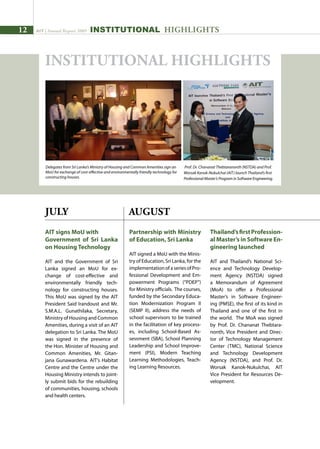
Prof. Dr. Chananat Thebtaranonth (NSTDA) and Prof.
Worsak Kanok-Nukulchai (AIT) launch Thailand’s first
Professional Master’s Program in Software Engineering.
INSTITUTIONAL HIGHLIGHTS
Delegates from Sri Lanka’s Ministry of Housing and Common Amenities sign an
MoU for exchange of cost-effective and environmentally friendly technology for
constructing houses.
INSTITUTIONAL HIGHLIGHTS
AIT | Annual Report 2009 |13
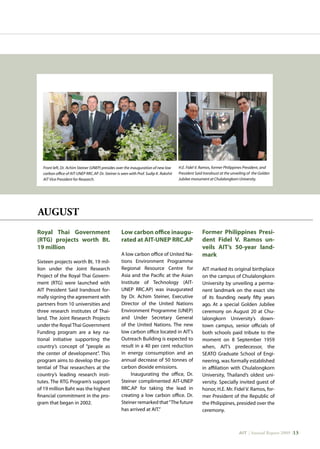
Front left, Dr. Achim Steiner (UNEP) presides over the inauguration of new low
carbon office of AIT-UNEP RRC.AP. Dr. Steiner is seen with Prof. Sudip K. Rakshit
AIT Vice President for Research.
H.E. Fidel V. Ramos, former Philippines President, and
President Said Irandoust at the unveiling of the Golden
Jubilee monument at Chulalongkorn University.
Royal Thai Government
(RTG) projects worth Bt.
19 million
Sixteen projects worth Bt. 19 mil-
lion under the Joint Research
Project of the Royal Thai Govern-
ment (RTG) were launched with
AIT President Said Irandoust for-
mally signing the agreement with
partners from 10 universities and
three research institutes of Thai-
land. The Joint Research Projects
under the Royal Thai Government
Funding program are a key na-
tional initiative supporting the
country’s concept of “people as
the center of development”. This
program aims to develop the po-
tential of Thai researchers at the
country’s leading research insti-
tutes. The RTG Program’s support
of 19 million Baht was the highest
financial commitment in the pro-
gram that began in 2002.
Low carbon office inaugu-
rated at AIT-UNEP RRC.AP
A low carbon office of United Na-
tions Environment Programme
Regional Resource Centre for
Asia and the Pacific at the Asian
Institute of Technology (AIT-
UNEP RRC.AP) was inaugurated
by Dr. Achim Steiner, Executive
Director of the United Nations
Environment Programme (UNEP)
and Under Secretary General
of the United Nations. The new
low carbon office located in AIT’s
Outreach Building is expected to
result in a 40 per cent reduction
in energy consumption and an
annual decrease of 50 tonnes of
carbon dioxide emissions.
Inaugurating the office, Dr.
Steiner complimented AIT-UNEP
RRC.AP for taking the lead in
creating a low carbon office. Dr.
Steiner remarked that“The future
has arrived at AIT.”
Former Philippines Presi-
dent Fidel V. Ramos un-
veils AIT’s 50-year land-
mark
AIT marked its original birthplace
on the campus of Chulalongkorn
University by unveiling a perma-
nent landmark on the exact site
of its founding nearly fifty years
ago. At a special Golden Jubilee
ceremony on August 20 at Chu-
lalongkorn University’s down-
town campus, senior officials of
both schools paid tribute to the
moment on 8 September 1959
when, AIT’s predecessor, the
SEATO Graduate School of Engi-
neering, was formally established
in affiliation with Chulalongkorn
University, Thailand’s oldest uni-
versity. Specially invited guest of
honor, H.E. Mr. Fidel V. Ramos, for-
mer President of the Republic of
the Philippines, presided over the
ceremony.
AUGUST
14 AIT | Annual Report 2009
Erasmus Mundus
Program kicks
off at AIT
The prestigious Erasmus Mundus
Program kicked off at AIT with
applications being invited from
interested students. A total of 48
students and staff from Thailand
and Indonesia were to be granted
Erasmus Mundus scholarships.
The scholarship covers the return
ticket from the home institution
to the host institution, insurance
during stay at the host institu-
tion, tuition, living expenses and
housing. AIT is the only institute
in Thailand which is a part of the
11-member consortium for the
Erasmus Mundus (EM) EuroAsia
Programme.
CanalAVIST streams cli-
mate change conference
to Vietnam and France
CanalAVIST streamed the Inter-
national Conference on Sustain-
able Development in the Con-
text of Climate Change (SDCC),
held from 24-25 September at
the Asian Institute of Technology
(Thailand), to audiences at AIT
Vietnam (AITVN), Hanoi, and to
Polytech Nice, in France.
UNESCAP Executive Secre-
tary, Dr. Noeleen Heyzer, inaugu-
rated the conference which gath-
ered partners and stakeholders
to discuss emerging and urgent
issues and plan joint research
efforts. The UN Under-Secretary
General expressed her delight at
havingparticipantsfromVietnam
attend virtually, making full use
of information technology while
limiting the carbon footprint by
removing the need for travel.
SEPTEMBER
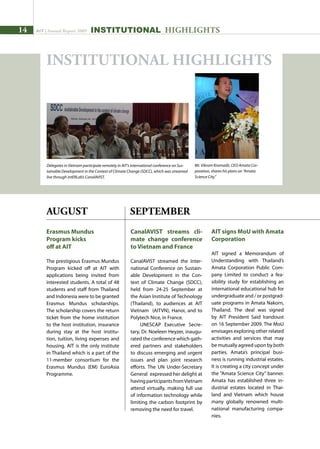
AIT signs MoU with Amata
Corporation
AIT signed a Memorandum of
Understanding with Thailand’s
Amata Corporation Public Com-
pany Limited to conduct a fea-
sibility study for establishing an
international educational hub for
undergraduate and / or postgrad-
uate programs in Amata Nakorn,
Thailand. The deal was signed
by AIT President Said Irandoust
on 16 September 2009. The MoU
envisages exploring other related
activities and services that may
be mutually agreed upon by both
parties. Amata’s principal busi-
ness is running industrial estates.
It is creating a city concept under
the “Amata Science City” banner.
Amata has established three in-
dustrial estates located in Thai-
land and Vietnam which house
many globally renowned multi-
national manufacturing compa-
nies.
Mr. Vikrom Kromadit, CEO Amata Cor-
poration, shares his plans on “Amata
Science City.”
INSTITUTIONAL HIGHLIGHTS
AUGUST
Delegates in Vietnam participate remotely in AIT’s international conference on Sus-
tainable Development in the Context of Climate Change (SDCC), which was streamed
live through intERLab’s CanalAVIST.
INSTITUTIONAL HIGHLIGHTS
AIT | Annual Report 2009 |15
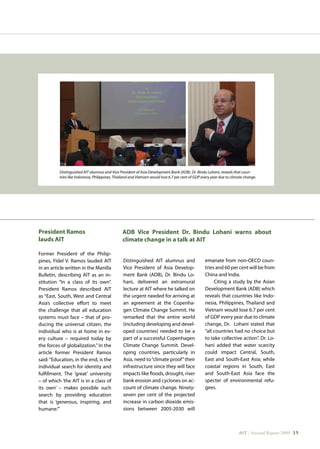
Distinguished AIT alumnus and Vice President of Asia Development Bank (ADB), Dr. Bindu Lohani, reveals that coun-
tries like Indonesia, Philippines, Thailand and Vietnam would lose 6.7 per cent of GDP every year due to climate change.
President Ramos
lauds AIT
Former President of the Philip-
pines, Fidel V. Ramos lauded AIT
in an article written in the Manilla
Bulletin, describing AIT as an in-
stitution “In a class of its own”.
President Ramos described AIT
as “East, South, West and Central
Asia’s collective effort to meet
the challenge that all education
systems must face – that of pro-
ducing the universal citizen, the
individual who is at home in ev-
ery culture – required today by
the forces of globalization.” In the
article former President Ramos
said:“Education, in the end, is the
individual search for identity and
fulfillment. The ‘great’ university
– of which ‘the AIT is in a class of
its own’ – makes possible such
search by providing education
that is ‘generous, inspiring, and
humane.’”
Distinguished AIT alumnus and
Vice President of Asia Develop-
ment Bank (ADB), Dr. Bindu Lo-
hani, delivered an extramural
lecture at AIT where he talked on
the urgent needed for arriving at
an agreement at the Copenha-
gen Climate Change Summit. He
remarked that the entire world
(including developing and devel-
oped countries) needed to be a
part of a successful Copenhagen
Climate Change Summit. Devel-
oping countries, particularly in
Asia, need to“climate proof”their
infrastructure since they will face
impacts like floods, drought, river
bank erosion and cyclones on ac-
count of climate change. Ninety-
seven per cent of the projected
increase in carbon dioxide emis-
sions between 2005-2030 will
emanate from non-OECD coun-
tries and 60 per cent will be from
China and India.
Citing a study by the Asian
Development Bank (ADB) which
reveals that countries like Indo-
nesia, Philippines, Thailand and
Vietnam would lose 6.7 per cent
of GDP every year due to climate
change, Dr. Lohani stated that
“all countries had no choice but
to take collective action”. Dr. Lo-
hani added that water scarcity
could impact Central, South,
East and South-East Asia; while
coastal regions in South, East
and South-East Asia face the
specter of environmental refu-
gees.
ADB Vice President Dr. Bindu Lohani warns about
climate change in a talk at AIT
16 AIT | Annual Report 2009
Thai-ASEANNewsfeatures
AIT Centre of Excellence
on SDCC
Thai-ASEAN News (TAN) Network,
featured the launch of the Cen-
tre of Excellence on Sustainable
Development in the Context of
Climate Change (SDCC) and AIT’s
International Conference on Cli-
mate Change.
The report emphasized how
AIT’s new research focus could
play a role in tackling climate
change issues and poverty across
the Asia-Pacific region.
Inaninterview,UN/ESCAPEx-
ecutive Secretary and UN Under-
Secretary General, Dr. Noeleen
Heyzer, stressed the importance
of focusing on the development
of technologies for energy ef-
ficiency, sustainable agriculture,
water management and food se-
curity.
AITfeaturesonUNEPwebsite
AIT is one of the institutes which was
featuredprominentlyonthewebsite
of the United Nations Environment
Programme (UNEP). This followed
the move by AIT in 2009 to join the
UN Climate Neutral Network.
AIT was featured in the section
on“Associations and Organizations”
which have joined the Climate Neu-
tral Network. AIT is among those“in-
stitutions which is adopting climate
neutral principles in their activities,
such as procurement and travel, as
well as promoting climate neutrality
to their members and /or partners”,
the website says. While featuring
AIT, the UNEP website refered to the
AIT Golden Jubilee and stated, “AIT
remains a vital hub for international,
trans-boundary education and re-
search with 1000 graduates annual-
ly, a network of 16,000 alumni from
about 80 countries and territories.”
Nobel Laureate
has AIT connection
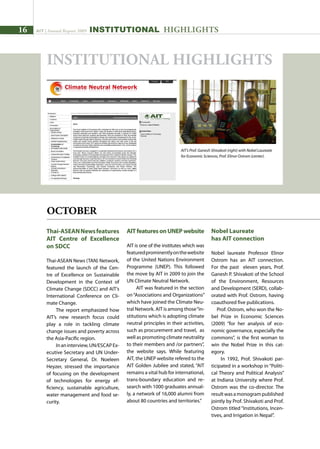
Nobel laureate Professor Elinor
Ostrom has an AIT connection.
For the past eleven years, Prof.
Ganesh P. Shivakoti of the School
of the Environment, Resources
and Development (SERD), collab-
orated with Prof. Ostrom, having
coauthored five publications.
Prof. Ostrom, who won the No-
bel Prize in Economic Sciences
(2009) “for her analysis of eco-
nomic governance, especially the
commons”, is the first woman to
win the Nobel Prize in this cat-
egory.
In 1992, Prof. Shivakoti par-
ticipated in a workshop in “Politi-
cal Theory and Political Analysis”
at Indiana University where Prof.
Ostrom was the co-director. The
resultwasamonogrampublished
jointly by Prof. Shivakoti and Prof.
Ostrom titled “Institutions, Incen-
tives, and Irrigation in Nepal”.
AIT’s Prof. Ganesh Shivakoti (right) with Nobel Laureate
for Economic Sciences, Prof. Elinor Ostrom (center).
INSTITUTIONAL HIGHLIGHTS
OCTOBER
INSTITUTIONAL HIGHLIGHTS
AIT | Annual Report 2009 |17
HRH Princess Maha Chakri Sirindhorn
honors AIT
On behalf of AIT, President Said Irandoust was
honored by Her Royal Highness Princess Maha
Chakri Sirindhorn at the research exhibition
organized by the Chulachomklao Royal Military
Academy (CRMA). At an elaborate ceremony, HRH
Princess Sirindhorn bestowed a token of appre-
ciation to the Asian Institute of Technology for its
contribution to the annual event. The exhibition
was organized on 25-26 November 2009 at the
CRMA campus where President Irandoust wel-
comed HRH Princess Sirindhorn to an AIT booth
and briefed her about the research conducted at
the Institute.
The exhibition displayed research activities
undertaken by CRMA students and faculty. A to-
tal of eight displays were installed by AIT at the
exhibition.The displays included field sensor net-
work applications, real-time image acquisition
from the Annapuruna Range in the Himalayas for
aircraft operation, and from an unmanned aerial
vehicle (UAV) platform for quick response to di-
sasters, a project by Dr. Kiyoshi Honda, Associate
Professor, School of Engineering and Technology
(SET).
Eight students from AIT were awarded scholarships
by H.E. Mr. Kyoji Komachi, Ambassador of Japan to
Thailand. The ambassador visited AIT and congratu-
lated each of the students for their success in win-
ning the scholarship.
“I congratulate you all for successfully earning
this scholarship and hope that you will contribute
towards the national development of your respec-
tive home countries,”the ambassador said.
Japan has assisted AIT for the past four decades
by granting scholarships, sending seconded faculty
as well as contributing towards its endowment fund.
Ambassador Komachi said that the Government of
Japan would continue to support AIT and help in
the transfer of technology in the region.
Professor Worsak Kanok-Nukulchai, Vice Presi-
dent for Resource Development, thanked the
Government of Japan for its support to AIT. He
recalled the continuous association the Institute has
enjoyed with Japan, and emphasized that AIT has
emerged much stronger courtesy of the unstinted
support of Japan and its people.
Eight AIT students receive
Japanese scholarships
NOVEMBER
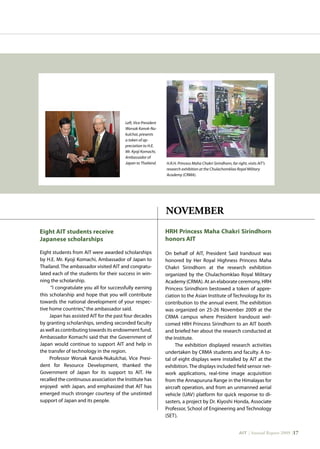
Left, Vice President
Worsak Kanok-Nu-
kulchai, presents
a token of ap-
preciation to H.E.
Mr. Kyoji Komachi,
Ambassador of
Japan to Thailand. H.R.H. Princess Maha Chakri Sirindhorn, far right, visits AIT’s
research exhibition at the Chulachomklao Royal Military
Academy (CRMA).
18 AIT | Annual Report 2009
Open Presentation
Competition for Students
“Creativity is a hugely important
factor contributing to one’s suc-
cess, and is often fostered outside
of classrooms at events like this
one,” AIT President Said Irandoust
remarked to a large crowd gath-
ered at the AIT auditorium where
academic teams faced-off in a test
of wits and the art of public speak-
ing, persuasion and presentation.
Theinaugural OpenPresenta-
tion Competition for students was
spearheaded by the Office of the
President. Special guest judge Dr.
Branford Johnson, Editor, Educa-
tion Section, Bangkok Post news-
paper, brought an expert jour-
nalistic perspective to the event,
and offered numerous tips and
recommendations for improving
students’presentation skills.
Three AIT students from
France volunteer for post-
disaster reflief work
Three French students from the
Asian Institute of Technology (AIT)
returned after serving for almost
a month as a part of the Telecoms
Sans Frontières (TSF) team which
assisted in post-disaster relief mea-
sures in the Philippines and Samoa
islands. The three, Frédéric Leduc,
Albane Coeurquetin and Fanny
Gaborit are Master’s students at
AIT.
The three, along with regional
ICT coordinator Sebastien Sivadier
and Oisin Walton, TSF delegate for
Asia and the Pacific, narrated their
experience from the disaster zone.
“We are happy that half of the
TSF team in the Philippines and Sa-
moa was comprised of volunteers
and members of the AIT communi-
ty, and we are looking forward to-
wards extending this partnership,”
Oisin remarked.
INSTITUTIONAL HIGHLIGHTS
DECEMBER
INSTITUTIONAL HIGHLIGHTS
Nanotechnology ripe for
growth, academics tell AIT/
Nanotecinternationalsym-
posium
From the development of new
cosmetics and computers to the
introduction of science fiction-like
cancer therapies, nanotechnology
stands poised to revolutionize the
way people work and live, scien-
tists told an international sympo-
sium hosted by the Asian Institute
ofTechnology in December that at-
tracted experts from 11 countries.
“The prosperity of nations will de-
pend on how well they commer-
cialize nanotechnology,” Prof. Ga-
bor L. Hornyak, a visiting American
professor at the Asian Institute of
Technology’s Center of Excellence
in Nanotechnology, told fellow
scientists attending the confer-
ence organized by AIT/CoEN and
Nanotec titled “Nanomaterials for
Energy, Health and Environment.”
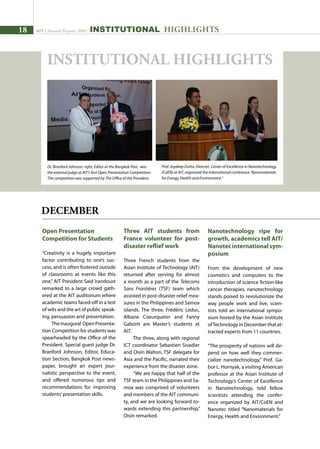
Prof. Joydeep Dutta, Director, Center of Excellence in Nanotechnology
(CoEN) at AIT, organized the international conference Nanomaterials
for Energy, Health and Environment.“
Dr. Branford Johnson, right, Editor at the Bangkok Post, was
the external judge at AIT’s first Open Presentation Competition.
The competition was supported by The Office of the President.
AIT | Annual Report 2009 |19
International Conference
on Sustainability Science
An International Conference on
Sustainability Science in Asia was
organized at AIT in 2009. Prof.
Akima Sumi, Executive Director
of Transdisciplinary Initiative for
Global Sustainability, urged both
developed and developing coun-
tries should work hand-in-hand
to enhance sustainable practices.
He stressed for greater interaction
between academia and society
and stated that the first step is to
establish “a concrete idea of sus-
tainable development”. Prof. Wor-
sak Kanok-Nukulchai, Vice Presi-
dent for Resource Development,
AIT, stated that during the last few
decades, Asia has witnessed rapid
urbanization and industrialization
which has in turn led to increased
demands on infrastructure. “Un-
fortunately these demands are not
based on sustainability,” Prof. Wor-
sak remarked.
iNexus Robot Competition at
AIT crowns Thailand’s auto-
nomousmachinechampion
Over two-hundred students rep-
resenting 22 tertiary institutions
from across Thailand competed
at the first “iNexus Thailand Robot
Competition”organized at AIT.
The would-be engineers and
computer scientists were chal-
lenged to build two autonomous
machines which cooperate and
collaborate in an intelligent way
to transport blocks placed ran-
domly on a flat grid to required
locations. At stake was the title of
Thai champion and cash prizes to-
taling 200,000 Baht.
The top three teams earned
free travel and accommodation to
compete at the “World Challenge”
competition at the Indian Institute
of Technology (IIT) Mumbai, India,
in January 2010.
AIT organizes Bio-Innova-
tions Asia Awards 2009
Seven international research pro-
posals won grants at the Bio-In-
novations Asia Awards 2009 cer-
emony held in Bangkok, Thailand
on 8 December 2009. The research
competition titled “Enabling Bio-
Innovation for Poverty Allevia-
tion in Asia” was organized by the
Asian Institute of Technology
(AIT), with financial support from
the Canada’s International Devel-
opment Research Centre (IDRC).
Each award-winner was entitled
to a funding grant of up to (CAN)
$18,000 to pursue their research
focused on Asia.
This year, a total of 108 re-
search entries pertaining to 15
countries were submitted from
across the Asian region. The win-
ners included international re-
searchers from the United States,
United Kingdom, China, Philip-
pines, Thailand and Nepal.
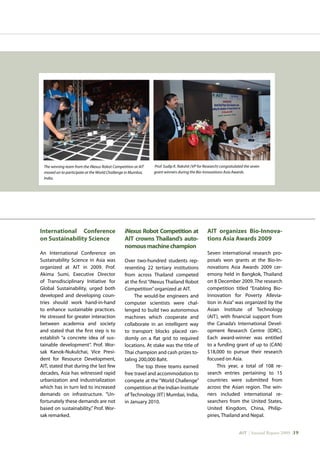
The winning team from the iNexus Robot Competition at AIT
moved on to participate at the World Challenge in Mumbai,
India.
Prof. Sudip K. Rakshit (VP for Research) congratulated the seven
grant winners during the Bio-Innovations Asia Awards.
20 AIT | Annual Report 2009 INSTITUTIONAL HIGHLIGHTS20 AIT | Annual Report 2009
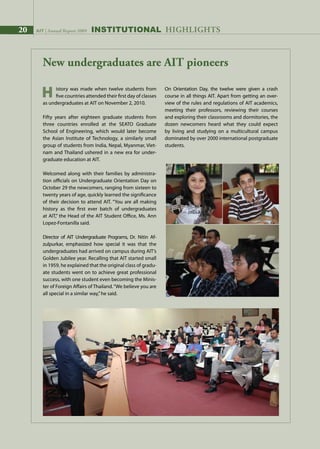
H		istory was made when twelve students from
		five countries attended their first day of classes
as undergraduates at AIT on November 2, 2010.
Fifty years after eighteen graduate students from
three countries enrolled at the SEATO Graduate
School of Engineering, which would later become
the Asian Institute of Technology, a similarly small
group of students from India, Nepal, Myanmar, Viet-
nam and Thailand ushered in a new era for under-
graduate education at AIT.
Welcomed along with their families by administra-
tion officials on Undergraduate Orientation Day on
October 29 the newcomers, ranging from sixteen to
twenty years of age, quickly learned the significance
of their decision to attend AIT. “You are all making
history as the first ever batch of undergraduates
at AIT,” the Head of the AIT Student Office, Ms. Ann
Lopez-Fontanilla said.
Director of AIT Undergraduate Programs, Dr. Nitin Af-
zulpurkar, emphasized how special it was that the
undergraduates had arrived on campus during AIT’s
Golden Jubilee year. Recalling that AIT started small
in 1959, he explained that the original class of gradu-
ate students went on to achieve great professional
success, with one student even becoming the Minis-
ter of Foreign Affairs of Thailand.“We believe you are
all special in a similar way,”he said.
On Orientation Day, the twelve were given a crash
course in all things AIT. Apart from getting an over-
view of the rules and regulations of AIT academics,
meeting their professors, reviewing their courses
and exploring their classrooms and dormitories, the
dozen newcomers heard what they could expect
by living and studying on a multicultural campus
dominated by over 2000 international postgraduate
students.
New undergraduates are AIT pioneers
AIT | Annual Report 2009 |21
		IT launched the Center of Excellence on
		Sustainable Development in the Context
of Climate Change (SDCC) on September 24,
2009. Dr. Noeleen Heyzer, Executive Secretary,
United Nations Economic and Social Com-
mission for Asia and the Pacific (UN/ESCAP),
said the UN body looked forward to working
in partnership with AIT to tackle poverty and
climate change in Asia.
The new Center was announced at an
international conference held at the Asian
Institute of Technology in Pathumthani from
24-25 September 2009. The conference was
inaugurated by Dr. Heyzer, who also signed a
memorandum of understanding (MOU) with
Prof. Said Irandoust, President, Asian Institute
of Technology for a partnership between the
UN/Economic and Social Commission for Asia
and the Pacific (ESCAP) and AIT.
Delivering a keynote speech at the confer-
ence, the UN Under-Secretary-General spoke
of the critical need to push forward toward a
low carbon, green society, and
stressed the urgency of final-
izing a global climate change
deal at the UN Framework Con-
vention on Climate Change
(UNFCCC) in Copenhagen, in
December this year.
Outlining the many threats
to human security in the Asia-
Pacific region, Dr. Heyzer said
most countries in the region
face two critical challenges:
poverty and climate change.
She called for a new global
paradigm that must include
increased balance, inclusiveness, and sustain-
ability.“AIT’s new research focus can play a role
in achieving this vision in Asia, and the new
center is one of the building blocks for con-
structing this future,”Dr. Heyzer said.
United Nations Development Programme
(UNEP), Executive Director-General, Dr. Achim
Steiner, echoed Dr. Heyzer in his videotape ad-
dress to the conference. “The United Nations
AITlaunchesCenterofExcellenceonSustainable
Development in the Context of Climate Change
Environment Programme shares the objectives of the AIT
Center of Excellence on Sustainable Development in the
Context of Climate Change and we hope to be able to
contribute and build on the long tradition that we have
developed in working together in partnership with AIT,”
the UN Under-Secretary-General said.
The conference gathered together a large number of
international scholars and stakeholders to discuss emerg-
ing, urgent issues and to plan joint research efforts. The
launching ceremony was also attended by other distin-
guished guest speakers, namely H.E. Mr. Lennart Linner,
Ambassador of the Kingdom of Sweden to Thailand; Mr.
Yann Pradeau, Charge d’Affaires a.i. of France to Thailand;
and Mr. Cholathorn Dumrongsak, Director, Total Quality
Production Center, Siam Cement Group (SCG).
AIT President Prof. Said Irandoust said, “If Asia,
which is home to 60% of the world’s population, is to have
a prosperous future, it must be built upon sustainable and
sound green principles.” According to Prof. Sudip K. Rak-
shit, VP for Research, AIT focuses on learning and research
strategies that will drive poverty reduction, reduce risk
and resource consumption, and create opportunities for
green jobs creation by
building sustainable
livelihoods in Asia.
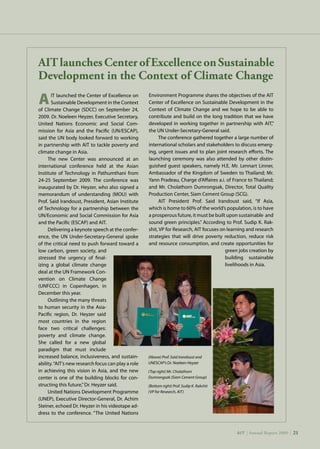
(Above) Prof. Said Irandoust and
UNESCAP’s Dr. Noeleen Heyzer
(Top right) Mr. Cholathorn
Dumrongsak (Siam Cement Group)
(Bottom right) Prof. Sudip K. Rakshit
(VP for Research, AIT)
AIT | Annual Report 2009 | 21
A
22 AIT | Annual Report 2009
School of Management celebrates 20th Anniversary,
IEMBA Vietnam marks 10th Anniversary
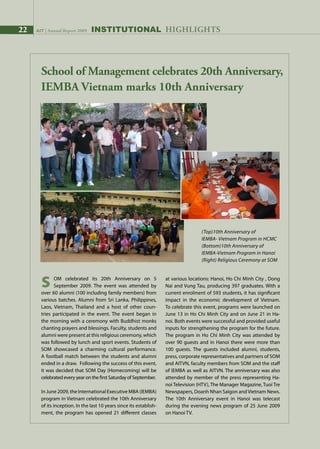
(Top)10th Anniversary of
IEMBA- Vietnam Program in HCMC
(Bottom)10th Anniversary of
IEMBA-Vietnam Program in Hanoi
(Right) Religious Ceremony at SOM
INSTITUTIONAL HIGHLIGHTS22 AIT | Annual Report 2009
S	 OM celebrated its 20th Anniversary on 5
	 September 2009. The event was attended by
over 60 alumni (100 including family members) from
various batches. Alumni from Sri Lanka, Philippines,
Laos, Vietnam, Thailand and a host of other coun-
tries participated in the event. The event began in
the morning with a ceremony with Buddhist monks
chanting prayers and blessings. Faculty, students and
alumni were present at this religious ceremony, which
was followed by lunch and sport events. Students of
SOM showcased a charming cultural performance.
A football match between the students and alumni
ended in a draw. Following the success of this event,
it was decided that SOM Day (Homecoming) will be
celebrated every year on the first Saturday of September.
In June 2009, the International Executive MBA (IEMBA)
program in Vietnam celebrated the 10th Anniversary
of its inception. In the last 10 years since its establish-
ment, the program has opened 21 different classes
at various locations: Hanoi, Ho Chi Minh City , Dong
Nai and Vung Tau, producing 397 graduates. With a
current enrolment of 593 students, it has significant
impact in the economic development of Vietnam.
To celebrate this event, programs were launched on
June 13 in Ho Chi Minh City and on June 21 in Ha-
noi. Both events were successful and provided useful
inputs for strengthening the program for the future.
The program in Ho Chi Minh City was attended by
over 90 guests and in Hanoi there were more than
100 guests. The guests included alumni, students,
press, corporate representatives and partners of SOM
and AITVN, faculty members from SOM and the staff
of IEMBA as well as AITVN. The anniversary was also
attended by member of the press representing Ha-
noi Television (HTV), The Manager Magazine, Tuoi Tre
Newspapers, Doanh Nhan Saigon and Vietnam News.
The 10th Anniversary event in Hanoi was telecast
during the evening news program of 25 June 2009
on Hanoi TV.
AIT | Annual Report 2009 |23
AIT Alumnus wins Ramon
Magsaysay Award of 2009
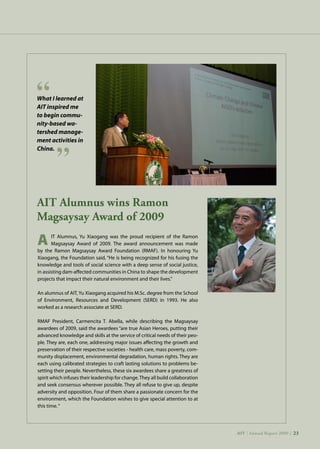
	 IT Alumnus, Yu Xiaogang was the proud recipient of the Ramon
	 Magsaysay Award of 2009. The award announcement was made
by the Ramon Magsaysay Award Foundation (RMAF). In honouring Yu
Xiaogang, the Foundation said, “He is being recognized for his fusing the
knowledge and tools of social science with a deep sense of social justice,
in assisting dam-affected communities in China to shape the development
projects that impact their natural environment and their lives.”
An alumnus of AIT, Yu Xiaogang acquired his M.Sc. degree from the School
of Environment, Resources and Development (SERD) in 1993. He also
worked as a research associate at SERD.
RMAF President, Carmencita T. Abella, while describing the Magsaysay
awardees of 2009, said the awardees “are true Asian Heroes, putting their
advanced knowledge and skills at the service of critical needs of their peo-
ple. They are, each one, addressing major issues affecting the growth and
preservation of their respective societies - health care, mass poverty, com-
munity displacement, environmental degradation, human rights. They are
each using calibrated strategies to craft lasting solutions to problems be-
setting their people. Nevertheless, these six awardees share a greatness of
spirit which infuses their leadership for change.They all build collaboration
and seek consensus wherever possible. They all refuse to give up, despite
adversity and opposition. Four of them share a passionate concern for the
environment, which the Foundation wishes to give special attention to at
this time.“
What I learned at
AIT inspired me
to begin commu-
nity-based wa-
tershed manage-
ment activities in
China.
A
AIT | Annual Report 2009 | 23
24 AIT | Annual Report 2009
January
AIT researchers win Bt. 150,000 grant from Japan’s MSIWF to study speed management
for road safety
A five-member team of AIT researchers was awarded a research grant of Bt. 150,000 from
Japan’s Mitsui Sumitomo Insurance Welfare Foundation (MSIWF) for its project “Evaluation of
Drivers’ Attitudes on Speed Management Strategies”. Led by Asst. Prof. Kunnawee Kanitpong,
field coordinator of Transportation Engineering at the School of Engineering and Technology
(SET), the team was honored on January 14 at a ceremony that marked the foundation’s entry
into Thailand as part of its search for ground-breaking research. The research aims to gain more
insight into public acceptability of speed management schemes in the context of Thailand and
to develop an understanding of the factors that influence drivers’ attitudes. AIT’s winning re-
search team was featured in the Thai newspaper The Nation, on 19 January 2009.
SERD’s Prof. C. Visvanathan joins editorial board of international environmental science
journal
SERD’s Prof. C. Visvanathan was chosen to be part of the editorial board of“Reviews in Environ-
mental Science and Bio Technology”, published by Springer Netherlands. Prof. C. Visvanathan
received his doctorate degree in 1988 in Chemical/Environmental Engineering from the Insti-
tute de Genie Chimique, Institut National Polytechnique Toulouse, France, under the Govern-
ment of France’s Ministry of External Affairs Scholarship. His career in AIT as an educator and
researcher spans two decades.
AIT alumnus appointed member of Nepal’s National Planning Commission (NPC)
Dr. Laxmi Prasad Devkota, M.Eng. Water Resources Engineering (1992), was selected to become
part of Nepal’s National Planning Commission. Dr. Devkota completed his doctor of engineer-
ing in hydrology from Nagoya University, Nagoya, Japan, in 1996. He is presently a member
and former Executive Director of the National Development Research Institute (NDRI), which
is a non-profit, non-governmental organization established in Nepal which aims to contribute
to society with high quality research and professional expertise on various issues. NPC serves
as the advisory body for formulating development plans and policies of the country under the
directives of the National Development Council (NDC). It explores and allocates resources for
economic development and works as a central agency for monitoring and evaluation of devel-
opment plans, policies and programs.
SET’s Associate Dean, Dr. Nitin Afzulpurkar’s journal paper among the top 25 most down-
loaded articles in Science Direct, Sensors and Actuators Journal for four consecutive
quarters in 2008 and 2009
The paper discusses the development of MEMS-based micropumps and their applications
in drug delivery and other biomedical applications such as micrototal analysis systems (μTAS)
or lab-on-a-chip and point of care testing systems (POCT). The focus of the review is to pre-
sent key features of micropumps such as actuation methods, working principles, construction,
fabrication methods, performance parameters and their medical applications. A book written
by Dr. Nitin and colleague Dr. Asim Nisar was also published by Stanford Publishing, Singapore,
in June 2009.
awards and recognition24 AIT | Annual Report 2009
AIT | Annual Report 2009 |25
Professor Phan Minh Dung (CSIM) is the sole representative from Southeast and South
Asia on the editorial board of the Artificial Intelligence Journal (AIJ)
AIJ is considered among the most prestigious journals in the field of Artificial Intelligence,
particularly in the field of Computer Science and Information Technology. Prof. Dung received
both his master’s and doctoral degree in Computer Science from Dresden University of Tech-
nology, Germany. He is a faculty member with the Computer Science and Information Manage-
ment field of study, SET.
March
Energy team commended
Professor Ram M. Shrestha (Energy) and AIT alumnus Dr. Govinda R. Timilsina were commend-
ed for their work on examining potential Demand-Side Management (DSM) programs in terms
of their impacts to the overall economy in Thailand. The study found that the economy-wide
impacts of the DSM program (Eg., economic welfare, GDP, international trade) depend on three
key factors: the project economics of the DSM option or the ratio of unit cost of electricity savings
to price of electricity (CPR); the implementation strategy of the DSM option; and scale or size of
the DSM option. The paper entitled “A general equilibrium analysis of potential demand-side
management programs in the household sector in Thailand”was also published in the Interna-
tional Journal of Energy Sector Management.
SET’s Dr. Nitin Kumar Tripathi is guest editor of international journal’s special issue on
Natural Disaster Management
Dr. Nitin Kumar Tripathi was invited to be the guest editor of the International Journal of
Remote Sensing’s special issue on Natural Disaster Management. The issue was published
by Taylor and Francis, United Kingdom. Dr. Tripathi is currently an associate professor for the
Remote Sensing and GIS field of study, SET. Dr. Tripathi received his masters and doctoral de-
gree from the Indian Institute of Technology (IIT), Kanpur, India.
Dean of the School of Management (SOM) interviewed by“Thansettakij”
On 12 March 2009, Dr. Barbara Igel, Dean of the School of Management, discussed corporate
social responsibility (CSR) and its implication on AIT’s activities and initiatives with theThai-lan-
guage magazine“Thansettakij”.
Dr. Roland appointed President of International Arbitration Tribunal Seating
Dr. Roland Amoussou-Guenou, AIT Lecturer and Project Manager of the AIT-Africa Initiative,
was appointed as President of an International Arbitration Tribunal seating in Bangkok.
26 AIT | Annual Report 200926 AIT | Annual Report 2009
May
AIT alumnus named Institute of Industrial Engineers (IIE) Fellow
AIT alumnus Professor R. Logen Logendran, MEng, Industrial Engineering and Management 1980,
is currently a Professor at Oregon State University. Professor Logendran was honored at the IIE
Annual Conference and Expo 31 May 2009 in Miami, USA.
TelecommunicationsTeam wins Best Paper Award
Co-authors, Dr. Poompat Saengudomlert, and AIT alumnus Mr. Sucha Supittayapornpong, shared
the Best Paper Award at the Sixth International Conference on Electrical Engineering/Electron-
ics, Computer, Telecommunications, and Information Technology (ECTI-CON 2009) in Pattaya,
Thailand, on 8 May 2009. The paper extends an existing static framework for joint flow control,
routing and medium access control (MAC) in random access multi-hop wireless networks in to a
dynamic framework where link capacities vary over time. Dr. Saengudomlert, assistant professor
of Telecommunications, received his bachelor’s degree from Princeton University and his master’s
and doctorate at the Massachusetts Institute of Technology (MIT) in Electrical Engineering and
Computer Science. Mr. Supittayapornpong, who graduated from AIT in 2008 with a master’s in
Telecommunications ’08, is currently a research associate at AIT.
Vice President for Research joins editorial board of Asian Biotechnology and Development
Review
Professor Sudip K. Rakshit, Vice President for Research, was invited to join the Editorial Board of
the “Asian Biotechnology and Development Review”. The journal is published by a think tank
called the Research and Information Service (RIS) for Developing Countries. It serves as a forum
for debate and reflection by eminent experts and disseminates information on substantive issues
such as the developmental potential of biotechnological issues for developing issues, the role of
south-south co-operation, and other implications of biotechnology for developing countries. The
publication was supported by the Department of Biotechnology, Government of India, and the
United Nations UNESCO, Paris.
Environmental Engineering and Management (EEM) alumna publishes book on the devel-
opment of clean mechanisms for solid waste management
German publishing house VDM Verlag requested Ms. Indra Gurung (M.Eng Environmental Engi-
neering and Management, 2007) for the rights to publish her master’s dissertation on the top-
ic “Application of Clean Development Mechanism for Solid Waste Management in Developing
Countries: A Case Study for Bangkok Thailand” in the form of a printed book. Her advisor was
Professor Chongrak Polprasert.
Center of Excellence in Nanotechnology (CoEN) Director elevated to Senior Member of the
Institute of Electrical and Electronics Engineers, Inc (IEEE)
AIT faculty member and SET Associate Dean, Professor Joydeep Dutta was appointed as a Senior
Member of the Institute of Electrical and Electronics Engineers, Inc (IEEE). IEEE’s Senior Member
status is the highest professional grade of the institute. Only 12% of its 382,000 members have
achieved this grade.
SET Team receives Best Paper Award at 2nd International Data Storage Technology
Conference (DST-CON 2009)
Dr. Nitin Afzulpurkar, Associate Dean SET, and his team including Sujin Wanchat (AIT Mechatron-
ics Master’s student) and two engineers from Magnecomp Precision Technology received the
Best Paper Award for their work on the “Influence of Cutting Parameters to Surface Roughness
awards and recognition
AIT | Annual Report 2009 |27
for Q-Switched Nd:YAG Laser”.The research was carried out between AIT and Magnecomp Preci-
sion Technology, a multinational company from the USA with its main base in Thailand and was
funded by HDDI project grant. The Best Paper Award was presented at the 2nd International
Data Storage Technology Conference (DST-CON2009) which was held in Bangkok from 13-15
May 2009. DST-CON 2009 Conference is a forum for academic and industry to present their re-
cent research works and exchange ideas in the area of Hard Disk Drive (HDD) or Data Storage
Technology (DST).
New AIT grad’s study on Hanoi motorcycle emissions takes best student paper award, USA
bound
Newly graduated (May 2009) Miss MaiThiThuy Phuong co-authored a paper with Dr. NguyenThi
Kim Oanh of the School of Environment, Resources and Development (SERD) which received the
winning student paper award of the West Coast Section of the Air Pollution Control Association
in Hanoi, Vietnam. Her paper titled“Emission Inventory for Motorcycles”also earned her a cash
award of US$ 1,500 and an invitation to present the paper at the 2009 Annual Conference and
Exhibition of the Air and Waste Management Association (AWMA), which took place in Detroit,
United States, June 16-19, 2009. The study has produced for the first time a detailed database
on the use of motorcycles and emissions for the city. Emission factors and emission inventory
are important to design appropriate vehicular emissions control strategies in Vietnam. The data
produced can also be used to analyze potential impacts of various management strategies on
air quality in the city.
July
SERD graduate among seven granted bio-innovation joint award by AIT and IDRC
A PhD graduate from AIT was among the winners of an Asia-wide research grants competi-
tion organized by the Asian Institute of Technology and sponsored by Canada’s International
Development Research Centre (IDRC). A total of 94 entries from 14 countries across the Asian
Region were received. Seven proposals were awarded grants. Each winner was presented with
CAN $18,000 (Bt. 541,000) to undertake the proposed research. Dr. Juthathip Chalermphol, who
earned her doctorate from AIT’s School of Environment, Resources and Development in May
2009, was one of the winners. Her study explored the gender roles of men and women in rural
areas of Thailand and to see how the imbalances women face in the field of agriculture might
change through the introduction of innovative technologies.
AIT’s impact is strong in SCG: Thailand’s Most Admired Company
The Siam Cement Group (SCG) remained the number one admired company in Thailand,
despite the economic downturn, a key survey said in 2009. According to the Asian Wall Street
Journal survey“Asia’s 200 Most Admired Countries,”the 96-year-old industrial firm’s performance
was impressive despite having to defer new regional projects. The SCG Paper president, Mr.
Chovalit Ekabut credits his AIT education to his contributions to the success of the firm. Many
AIT graduates work in SCG in all business units and at various levels. Two out of the five core
business units of SCG are headed by AIT alumni, one of whom is Chaovalit Ekabut, president of
SCG Paper.
Prof. Visvanathan on AIT’s instrumental role in membrane technology in Asia
As a guest panelist on the Pakistani TV show “Guest in Town”, AIT’s Professor Visvanathan
explained AIT’s instrumental role in promoting membrane technology as a bioreactor for the
past 25 years, focusing on applications to water and municipal waste water.
28 AIT | Annual Report 200928 AIT | Annual Report 2009
August
AIT report highlighted by Yale Center for the Study of Globalization
A report by the Asian Institute of Technology (AIT) and the United Nations Environment Program
(UNEP) on the Mekong river dams in China was highlighted by the Yale Center for the Study on
Globalization. The report “Freshwater under threat – South East Asia” is a joint publication of the
United Nations Environment Programme (UNEP) and the Asian Institute of Technology (AIT). The
study states that countries in South-East Asia should act now to secure the region’s abundant wa-
ter supplies into the future. Authored by AIT’s Dr. Mukand S. Babel of the School of Engineering
(SET) and Shahriar M. Wahid, Senior Research Engineering of AIT, the report states that though the
Mekong River Basin (MRB) is now characterized by either water shortages or open conflicts, and
it warrants attention due to potential threats that might arise from development pressures and
transboundary issues.
AIT Teams emerge champions in Thailand Intelligent Vehicle Challenge 2009
A driverless car invented by Asian Institute of Technology (AIT) students won the Thailand
Intelligent Vehicle Challenge for 2009.
AIT’s intelligent vehicle team named Kuen-Chai won all the races. Kuen-Chai received Baht 300,000
cashprizeandthechampionshiptrophy.Kuen-Chai’smembersincludedMetheeSrisupundit(M.Eng
Mechatronics), Nassaree Benalie (M.Eng Mechatronics), and Somphong Thanok (D.Eng
Mechatronics).TheteamwassupervisedbySchoolofEngineeringandTechnologyfacultymembers
Dr. Manukid Parnichkun and Dr. Matthew Dailey. The car used was a 2.0 Litre Mitsubishi Galant and
was equipped with AIT made Adaptive Cruise Control System. Various sensors including GPS, elec-
tronic compass and Laser Scanner were equipped in the car. The high-level system communicates
through the serial port to other microcontrollers to drive motors which control steering angle and
speed according to high-level system command. AIT’s other intelligent vehicle team, Pak-Shee,
received the excellent creativity award with Baht 50,000 cash prize. The team was comprised of Su-
radech Duongpummet (M.Eng Mechatronics), Wongsakorn Pornnutvuttikul (M.Eng Mechatronics),
Alisa Kunapinun (M.Eng Mechatronics). The team was also supervised by Dr. Manukid Parnichkun
and Dr. Matthew Dailey and assisted by Mr. Somphop Limsoonthrakul (RA Mechatronics).
September
AIT Alumnus Dr. Dinesh Raj Shiwakoti honored in Vietnam
Senior consulting engineer and AIT alumnus (1994), Dr. Dinesh Raj Shiwakoti, was granted a pres-
tigious merit award by the authorities in Ho Chi Minh City, Vietnam. Dr. Shiwakoti was honored in
reorganization of his excellent achievements in works contributing to the completion of Stage 1
construction of the Saigon East-West Highway Construction Project. The award was presented to
him during a special ceremony on 11 September 2009. Dr. Shiwakoti completed his Master’s degree
in Geotechnical and Transportation Engineering from AIT. He earned his doctorate from Yokohama
National University, and completed his post-doctorate research studies from the Port and Harbour
Research Institute in Japan.
awards and recognition
AIT | Annual Report 2009 |29
October
AIT features in USDA’s Agriculture Research Service
Research work by Prof. Vilas M. Salokhe of the School of Environment, Resources and Development
(SERD) at the Asian Institute of Technology (AIT) was featured by the Agriculture Research Service
(ARS) of the United States Department of Agriculture (USDA). An article written by Ann Perry titled
“Computer Modeling Can Contribute to Thai Soybean Production” stated that ARS scientists along
with their partners at AIT have been able to “pinpoint the best agronomic practices for maximizing
soybean production in Thailand”. The article said ARS scientists were testing the soybean model GLY-
CIM to improve its performance under a range of conditions around the world. GLYCIM was designed
to simulate the growth of any soybean cultivar on any soil at any location and for any time of the year.
ARS research leader Vangimalla Reddy and soil scientist Dennis Timlin at the ARS Crops Systems and
Global Change Laboratory in Beltsville, Md., partnered with scientists S. B. Lokhande and V.M. Salokhe,
who work at the Asian Institute of Technology, to see how well GLYCIM estimated soybean yield po-
tential in Thailand.
November
AIT student earns UNDP fellowship
Ms. Nisha Onta, a Ph.D. student of the Asian Institute of Technology was awarded the UNDP 2009
Asia Pacific Human Development Academic Fellowship. The UNDP Human Development Academic
Fellowship for Asia Pacific carries an award of US$ 10,000. The objective of the Academic Fellowship is
to encourage young PhD students from the Asia-Pacific region to analyze critical development issues
from a human development perspective, contributing to development theory, applications and poli-
cies. Fellows are expected to push the frontiers of research on human development while analyzing,
through the human development lens, issues related to human development. Nisha Onta is pursuing
her Ph.D. in Gender and Development Studies under the supervision of Dr. Bernadette P. Resurreccion,
Associate Professor at AIT. Her Ph.D title is “Gendered Pathways to Climate Change Adaptation: The
Case of Jumla, the Mid-Western Hills of Nepal.”She is currently a NORAD fellowship awardee at AIT.
December
Rockefeller Foundation identifies AIT as Center of Excellence
Asian Institute of Technology (AIT) was included as a Center of Excellence in an independent report
prepared by the Rockefeller Foundation. Titled “Research Centres of Excellence in Asia: A Quantita-
tive Review for the Rockefeller Foundation,” the report was prepared with inputs about AIT provided
by the Vice President for Research, Prof. Sudip K Rakshit. According to Mr. Ashvin Dayal, Managing
Director (Asia), Rockefeller Foundation, the Asia office is investing significantly in two major initiatives
- building climate resilience cities and transforming health systems. As the Rockefeller Foundation
aligns its work to new global initiatives, they would like to ensure that their efforts will also build and
strengthen the development of centers of Excellence for research in Asia.
AIT project secures grant from Global Horticulture Initiative
An AIT project on fruit flies in South and Southeast Asian countries secured a grant from the Global
Horticulture Initiative/ICDF, Taiwan. Titled “Area-Wide Integrated Pest Management of Fruit Flies in
South and Southeast Asian Countries (with special emphasis on Mekong Countries)”, the project was
submitted by the Agriculture Systems and Engineering (ASE) Field of Study, School of Environment,
Resources and Development (SERD).
30 AIT | Annual Report 2009
PUBLICATIONSTRAINING COURSES
RESEARCH
AIT at a GLANCE
Ongoing (63)
Completed (311)
SET (186)
SERD (139)
SOM (20)
AIT Vietnam (110)
Institute (8)
AIT Extension (93)
intERLab (18)
CLIENT MANAGEMENT AND MARKETING (16)
DEVELOPMENT MANAGEMENT (19)
EDUCATIONAL DEVELOPMENT (14)
INFORMATION TECHNOLOGY (14)
POVERTY REDUCTION  LIVELIHOODS (7)
AGRICULTURE, RESOURCES AND ENVIRONMENT (11)
Conducted at AIT (76)
Conducted outside of AIT (5)
SET (318)
SERD (239)
SOM (35)
JOURNALS (254)
CONFERENCES (259)
BOOK (45)
OTHERS (53)
611
initiated (200)
AIT | Annual Report 2009 |31
STUDENTS (January) STUDENTS (August)
South-east Asia (1799)
South  West Asia (402)
East  Central Asia (96)
North America (15)
europe (41)
africa (14)
MALE (1580)
FEMALE (837)
South-east Asia (1811)
South  West Asia (407)
East  Central Asia (86)
North America (3)
europe (40)
africa (17)
MALE (1516)
FEMALE (848)
ALUMNI*
SET (8265)
SERD (6184)
SOM (2648)
FEMALE (4385)
MALE (12712)
M.Eng (8878)
M.Sc (4282)
MBA (2059)
MABM (4)
PMTM (10)
MBA Dual (47)
MBA (Executive) (448)
MBA (Professional) (135)
M.Sc. (Professional) (6)
Diploma (320)
D.Eng. (457)
D.Tech.Sc (216)
Ph.D. (235)
The year 2009 saw the largest combined graduation class in AIT’s half-century history.
A total of 859 graduted with degrees during the year.
* As of December 31, 2009
32 AIT | Annual Report 2009 AIT’s REACH
The Asian Institute of Technology is a pro-
foundly international institute of higher
learning serving Asia and beyond. It does so
in partnership with governments and their
agencies, state universities, research institu-
tions, international development agencies,
foundations and the public and private sec-
tors. Additionally, the Institute continues to
develop and foster academic and research
linkages with Asian, European and American
institutions for student and faculty exchange
programs. All of these contribute to the inter-
national characteristics of the Institute – not
just in terms of the number of nationalities
represented on the governing board, and in
the Institute’s faculty, staff, and students, but
also by virtue of the rich international per-
spectives shared and taught in the classroom
and experienced in the field.
In2009,theInstitutecontinueditspartnership
programs with the Royal Thai Government,
the Swedish International Development Co-
operation Agency (Sida), the Government of
Norway (Ministry of Foreign Affairs), the Go-
vernment of Japan, Government of France,
the Netherlands Government, the Canadian
International Development Agency (CIDA),
and the Austrian Development Agency (ADA).
Please turn to Page 77 for a comprehensive list of AIT partners.
32 AIT | Annual Report 2009
AIT | Annual Report 2009 |33
An overview of AIT’s
Engagements during the year
34 AIT | Annual Report 2009 AIT’s REACH
These governments and government
agencies partnered with AIT in furthering
their development agenda in the region
through human resource development
programs at the higher education level as
well as at the continuing education level,
and through development and research
projects.
One of the major regional projects AIT is
involved in is the Swedish International
Development Cooperation Agency (Sida)
supported“Wetland Alliance Program”, the
aim of which is to build local capacity for
sustainable wetlands management in the
Mekong region. The regional partners of
the program are AIT, Coastal Resources In-
stitute (CORIN) of Prince of Songkhla Uni-
versity, World Fish, and World Wide Fund for Nature
(WWF). Another major regional project AIT is leading
is the Canadian International Development Agency
(CIDA) supported “Southeast Asia Urban Environmen-
talManagementApplications(SEA-UEMA)Project”that
aims to contribute to the improvement of Urban envi-
ronmental conditions in South-East Asia (7 Canadian
ODA eligible countries). The SEA-UEMA Project works
with local governments, national government agen-
cies, community based organizations, local/regional/
international research institutions and academic insti-
tutions in furthering its aim. The above two projects
exemplify the Institute’s expanded network of part-
ners, it being the link between the North and South (or
between the West and the East, in literal terms), and
its contribution to sustainable development at the re-
gional level. There are numerous other projects at AIT
working in the same line.
The year 2009 saw continued partnership between the
institute and the governments in the region, notable
examples included India, Pakistan, Vietnam, Indone-
sia, Nepal and Afghanistan. The government of India
continued to support AIT by sending seconded faculty
members to teach and provide research supervision to
students, and also by providing a local currency fund
for India-related research. The government of Paki-
stan provided scholarship support through its Higher
Education Commission to aspiring Pakistani students
to pursue their postgraduate education (Master’s and
Master’s leading to Doctoral studies) at AIT. It also pro-
vided funds to support Pakistani students for their re-
search travel back to Pakistan. The government of Viet-
nam also provided scholarship support to its nationals
for their studies at AIT-Vietnam as well as at AIT’s main
campus in Thailand. The government of Indonesia pro-
vided support for the operations of the AIT Center in
Bandung by seconding the staff at the center and also
providing scholarship support to Indonesians to study
on a dual degree program between AIT and an Indone-
sian university. The Nepalese government provided a
local currency fund to support research of importance
to Nepal, plus, at the end of the year, provided major
financial support through the AIT alumni in Nepal for
the organization of an international conference on
“Knowledge Management for Sustainable Develop-
ment” jointly organized by AITAA Nepal and AIT. AIT
also partnered with the government of Afghanistan in
capacity building of Balkh University, Faculty of Engi-
neering. The Institute also partnered with many other
Asian governments in serving their needs related to
short-term professional training, and post-graduate
education. Additionally, AIT also partnered with the
government of Ethiopia in Africa, whereby the latter
are sending Ethiopian nationals for post-graduation
education at AIT.
The Joint Japan World Bank Graduate Scholarship Pro-
gram (JJ/WBGSP), the ADB-Japan Scholarship Program,
the International Fellowship Program of the Ford Foun-
dation, The Bridge Fund, and the ASEAN Foundation
International AIT
AIT | Annual Report 2009 |35
continued to provide scholarships to Asian nationals
for their postgraduate studies at AIT.While the German
Academic Exchange (DAAD) program provided scho-
larships to Cambodia, Laos, Myanmar and Vietnam
(CLMV) countries, the KAAD also provided few partial
scholarships.The Chinese government is alsoproviding
some scholarships for Chinese nationals to pursue their
doctoral studies at AIT. These are in addition to the
scholarships being provided by Sida, Norway, Japan,
the Netherlands and the Austrian Development Agency
(ADA).
On the private sector and industry front, AIT contin-
ued professional as well as regular study programs and
other research collaborative programs, such as the
ones with Western Digital, Siam Cement Group, Elec-
tricityVietnam, EVN-Telecom, Nippon Koei Co. Ltd., and
Advance Agro Public Company Limited amongst many
others. The Institute also carried out partnerships with
the private sector - Innotech Sports Management of
the Innotech Group of Companies of Thailand to run
the AIT Golf Club professionally) and the French mul-
tinational company Sodexo for campus infrastructure
facilities management and maintenance – on a prof-
it sharing basis. A new MoU signed in 2009 with the
Amata Group of Companies (a firm which contributes
significantly to Thailand’s GDP), was noteworthy in
terms of the possible involvement of the private sector
in higher education. AIT also signed some agreements
for conducting joint academic programs and research
with private acade-mic institutions, for example, in Ne-
pal and Sri Lanka. The establishment of the CSR Asia
Center at AIT was also expected to increase AIT joint
activities with the private sector and industry.
TheASEANRegionalCenterofExcellenceonMDGs(AR-
CMDG) established at AIT in 2008 got due recognition
from the ASEAN countries when the 14th ASEAN Sum-
mit Joint Declaration on the Attainment of the Millen-
nium Development Goals in ASEAN countries included
sharing information, experiences and best practices in
the attainment of the MDGs among ASEAN Member
States through the relevant ASEAN bodies as well as
through the “ASEAN Regional Centre of Excellence on
MDGs” set up in the Asian Institute of Technology and
other regional institutions. AIT continued to engage
with the ASEAN Secretariat in the latter’s activities,
such as environment-related activities – education and
research. AIT continued its activities under the Greater
Mekong Sub-region Academic and Research Network
(GMSARN), which comprises of 11 academic institu-
tions from 6 Mekong countries. The Japan Aerospace
Exploration Agency (JAXA), which is providing faculty
secondment at AIT, recognizes the contribution of the
Institute in planning, implementing and conducting
Advance Land Observing Satellite (ALOS) initiatives,
which have implications across the region. The“Yunus
Center at AIT”, named after the Nobel Peace Laureate
Prof. Muhammad Yunus, was launched in 2009 with
the objective to contribute to poverty alleviation by
enabling rural people across Asia to handle and be
in control of improving their own livelihoods, with an
initial focus on agriculture and food security issues. The
activities of the recently established centers – “CSR
Asia Center at AIT” and the “Center of Excellence for
Sustainable Development in the context of Climate
Change (SDCC)” also would have implications across
Asia and beyond.
In 2009, the Institute carried on with its wide network
of partner institutions – in Asia and beyond – in work-
ing towards the common goal of contributing towards
sustainable development through poverty alleviation,
environmental protection and conservation, disaster
mitigation and management, infrastructure develop-
ment, and economic development. Some of the part-
ner institutions of AIT (including those with whom AIT
has student exchange and/or dual degree programs –
are: University of Balochistan (UOB), Pakistan; Baloch-
istan University of Engineering  Technology – Khuz-
dar (BUETK); UNU-IAS, Japan; Chubu University, Japan;
University of Tokyo, Japan; Tohoku University, Japan;
Ochanumizu University, Japan; Thammasat University,
Thailand;Vishwakarma School of International Studies
(VSIS), Pune, India; National Taiwan University; Yuan
ARCMDG established at AIT in
2008 got due recognition from
the ASEAN countries when the
14th ASEAN Summit Joint Decla-
ration on the Attainment of the
Millennium Development Goals
included sharing infrormation,
experiences and best practices
in the attainment of the MDGs
... as well as through the ‘ASEAN
Regional Centre of Excellence on
MDGs’
36 AIT | Annual Report 2009
Ze University, Taiwan; Andalas University, Indonesia;
University of Gaza-Madah, Indonesia; University of Bo-
ras, Sweden; International University of Vietnam; South
Asia Institute of Techology and Management (SAITM),
Sri Lanka; Asian Univesity, Thailand; NSTDA, Thailand;
Chulabhorn Research Institute and Mahidol University,
Thailand; Yunan University, China; Pokhara Univeristy,
Nepal; Kathmandu University, Nepal; ITC, International
Institute for Geo-information Science and Earth Ob-
servation – the Netherlands; University of Nice, France;
CIRAD, France (providing faculty secondment); AIT-
NCCR North-South Cooperation, Switzerland: AIT and
UNESCO International Research and Training Centre
for Rural Education (INRULED), China; State Bureau
of Surveying and Mapping (SBSM), China; European
Union; UN organizations such as UNEP, UNESCO, UN-
ESCAP, and APCTT.
As has been the case every year,
2009 also saw an exchange of
visits between AIT and its exist-
ing and prospective partners.
This year, however, saw more
visits in relation to promoting
the new AIT Charter by the AIT
Board Chair and the AIT Presi-
dent to various European coun-
tries and some Asian countries.
The President and Vice Presi-
dents also traveled abroad to
attend and participate in a se-
ries of 50th Anniversary press
conferences held in 7 countries
(including Ethiopia and Kazakh-
stan), in addition to attending
the 50th Anniversary events
in the home country Thailand.
Senior administrators, faculty members and staff also
traveledtovariouscountriesinrelationtocollaborative
academic and research activities and to attend confer-
ences. The Institute also received VIP visitors from vari-
ous partners, some of whom were: Mr. Achim Steiner,
UNEP Executive Director and UN Under Secretary
General; H.E. Professor Tissa Witharana, Minister of Sci-
ence and Technology, Sri Lanka; H.E. Mr. Gitanjana Gu-
nawardena, Minister of Housing and Common Ameni-
ties, Sri Lanka; H.E. Mr. Bohara, Minister of Forestry and
Soil Conservation, Nepal; Dr. Bindu Lohani, ADB Vice
President (Finance and Administration); Mr. Jeremy Bird,
CEO of the Mekong River Commission Secretariat; Mr.
Douglas Becker, Chairman and CEO of Laureate Educa-
tion Inc.; Mr. Durga P. Paudyal, Director-General for the
Center on Integrated Rural Development for Asia and
the Pacific (CIRDAP); Dr. Norman Looney, Chairman of
the Board of Directors of Global Horticulture Initiative;
Ms. Krista Slade, Executive Director, Asia-Pacific, CASE
(Council of Advancement and Support of Education);
Dr. Wai-Hong Loke, Regional Director CABI Southeast
and East Asia; Ms. Monica Garry, Executive Director,
The Bridge Fund; Dr. Mary S. Zurbuchen, Director for
Asia/Russia Programs, IFP, New York; Dr. Lourdes G.
Salvador, Executive Director, Asian Scholarship Foun-
dation; Prof. Yoshifumi Yasuoka, Executive Director
of the National Institute for Environmental Studies
(NIES), Japan; Prof. Dr. Muhammad Masoom Yasinzai,
Vice Chancellor of University of Balochistan, Pakistan.
Delegations came and/or went from/to the following
countries – Uzbekistan, Cambodia, China, Myanmar,
Bangladesh, Belgium, Sri Lanka, Philippines, India, Ne-
pal, Ethiopia, Kazakhstan, Indonesia, Vietnam, Japan,
Thailand, Oman, UAE, Pakistan, Timor Leste, Ethiopia,
Afghanistan, South Korea, North Korea, Taiwan, Spain,
Sweden, Norway, Maldives, Azerbaijan, Iran, Mongolia,
USA, Switzerland, Singapore and Malaysia.
In 2009, AIT organized, hosted, and/or participated in
various international conferences / seminars / meet-
ings. Some of them are named here: International Con-
ference entitled “An International Perspective on Envi-
ronmental and Water Resources” in partnership with
the American Society of Civil Engineers (ASCE), and the
Environmental and Water Resources Institute (EWRI),
January 5-7; 4th International Conference on Innova-
AIT’s REACH
AIT | Annual Report 2009 |37
tions in Food Processing Technology and Engineering
(ICFPTE’08), January 19-20; 2nd International Confer-
ence on Geoinformation Technology for Disaster Man-
agement and Rehabilitation, January 30-31; 6th ICT-
Asia Regional Seminar, February 11-12; Board Meeting
of the Conference of Non-Governmental Organizations
in Consultative Relationship with the United Nations
(CONGO) February 23- 25; The 2008 IEEE International
ConferenceonRoboticsandBiomimetics(ROBIO2008),
February23;EU-SoutheastAsiaExpertmeetingonFood
Quality, Safety  Traceability, February 24-27, in part-
nership with CIRAD, a French agricultural research cen-
tre working for international development; AIT-Tohoku
University Seminar-cum-Consultation Workshop on In-
frastructure Development and Environment, March 16;
Regional Workshop on “Capacity Building for Gender,
Poverty and Mobility Analysis of Road Transportation
Development in GMS Region”, April 1; GIS for Disaster
Risk Management (An Introductory Course), May 11,
in partnership with the Asian Disaster Preparedness
Center (ADPC) and ITC Netherlands; participation in
the 11th Convention of Nepal Engineers Association,
May 13-15; ProSPER.Net-Scopus Symposium, June 2-5
(ProSPER.Net is a consortium of eighteen of the lead-
ing universities in Asia-Pacific dedicated to furthering
the integration of sustainability into postgraduate ed-
ucation and research.); World Environment Day 2009,
AIT-UNEP Celebrations, June 5, with the theme ‘Your
Planet Needs You - UNite to Combat Climate Change’;
participation in the 6th ASEAN Leadership Forum, June
19; participation in the 2009 Global Meeting of the
Emerging Markets Forum, Mumbai, India, June 23 – 25;
participation in UN-ECOSOC (UN Economic and Social
Council) Meeting, Geneva, July 6-9; Erasmus Mundus
EuroAsia Mobility Project Steering Committee Meet-
ing at AIT, August 10-11; Workshop on “Energy Secu-
rity and Climate Change”, sponsored by the Norwegian
Ministry of Foreign Affairs, August 11; participation in
the “International Conference on Branding in Higher
Education: Practices and Lessons Learned from Global
Perspective”, August 10-12, organized by the Ministry
of Education and Training-Vietnam (MOET), SEAMEO
RETRAC  Nha Trang University (NTU); participation in
the Symposium and Expert Meeting on the project en-
titled “Leadership for Environment and Development:
Participatory Curriculum Development Network be-
tween the NGO and University”, at Chubu University,
Japan, September 17-18; International Conference on
“Sustainable Development in the context of Climate
Change”, September 24-25; International Conference
on Sustainability Science – Asia (ICSS-Asia), November
23-24; International Symposium on Aquaculture and
Fisheries Education (ISAFE), November 27-30; Europe-
an Science Cooperation Conference in Myanmar, De-
cember 4-5; International Conference on Knowledge
Management for Sustainable Development (KMSD),
Kathmandu, Nepal, December 10-12, in partnership
with AITAA Nepal, an AIT 50th anniversary event. In a
number of the above conferences / workshops / meet-
ings, the AIT President was invited to give a talk/key-
note speech.
38 AIT | Annual Report 2009 strategy 2013
Four Strategic Themes
Building on the Asian InstituteTechnology’s
core values, its capabilities in innovative
teaching and learning, research and out-
reach, and a thorough analysis of emerging
trends in the external environment for high-
er learning, the Institute developed a five-
year strategic framework for 2009 to 2013.
AIT Strategy 2013 is comprised of Four Strategic Themes.
1. Internationality as a Regional Network Institute
There are no foreign students, faculty, staff or alumni at AIT. AIT does not consider them to be foreign, since the
Institute embraces all nationalities and cultures, making every individual feel equally at home. The Institute’s
multicultural student body, faculty, staff, alumni and governing board continue to be AIT’s core strength.
As the region’s premier network institute, AIT contributes to this work by enhancing opportunities for local
development partners to scale-up their knowledge, to analyze needs and to set priorities that bring educational
and developmental stakeholders into regional and global agendas.
AIT | Annual Report 2009 |39
2. Excellence and Relevance in Education, Research and Outreach
Excellence in teaching and learning will continue to be the foundation of the Institute. AIT has
an opportunity to better integrate into its curricula the experiences and results of its research,
development and outreach initiatives. This cross-fertilization will be a source of program quality
development and renewal.
3. Positioning and Branding
The Asian Institute ofTechnology creates knowledge and develops human capital for sustainable
economic growth and development across Asia. Complementing the academic offerings and
research and outreach activities of national institutions located around Asia is integral to AIT’s
mission. This role becomes more pronounced as the pace of technological change accelerates,
placing a premium on knowledge and its local application within the context of national devel-
opment strategies. AIT will develop its capability as a regional knowledge hub of innovation for
sustainable development.
4. Development and Resources Management
Major challenges lie ahead for AIT in ensuring its long-term financial stability. Development agen-
cies are increasingly looking to Asian governments to drive regional and national development
agendas. Donors contribute to the national development strategies formulated by developing
countries by agreeing to co-finance components of these strategies.This trend is also reflected in
changes in the donors and funding partners of AIT over the years. This has led to the emergence
of several Asian countries as strong contributors to AIT.
Based on the Strategy document, and the
strategic themes it highlights, the institute
seeks to implement thorough action plans
which will be developed collaboratively by
relevant AIT units. These will include precise
targets and performance indicators against
which progress will be measured. Resources
needed for implementation of the outlined
goals will be drawn internally. Additionally
needed resources will be raised through part-
nerships with various stakeholders.
40 AIT | Annual Report 2009 Key AchievementS in 2009
		obel Laureate Muhammad Yunus and the Asian Institute of
		Technology (AIT) formally launched the Yunus Center at AIT,
the first of its kind outside of Bangladesh for the 2006 Nobel Peace
Prize winner. The formal charter was signed on 19 August 2009 by
Prof. Muhammad Yunus, Chairman, Yunus Centre, Dhaka and Prof.
Said Irandoust, President of AIT.
Speaking after the signing ceremony, Prof. Muhammad Yunus
remarked that this would be a landmark development in South-East
Asia. The Yunus Center at AIT will contribute to poverty alleviation
N
Yunus Center
at AIT launched
40 AIT | Annual Report 2009
AIT | Annual Report 2009 |41
Academics
Research
Extension, Outreach
and Centers
PAGE 42
PAGE 56
PAGE 62
2009 saw the launch of undergraduate programs
at AIT.
A total of 574 research projects were initiated in
2009. Faculty and staff members completed 611
publications.
AIT Extension hosted 81 specialized training
and capacity building programs. AIT Vietnam
enlarged AIT Vietnam’s network, while AIT Center
in Indonesia was renamed AIT Indonesia.
by enabling rural people to handle and be in
control of improving their own livelihoods
through their own farming and agriculture-
related business.
“All activities at the Center shall follow
the objective of poverty reduction and sus-
tainability with an initial focus on agricul-
ture and food security issues, encompassing
a variety of disciplines and facilitating inter-
disciplinaryworkinsuchareasasproduction
of food, food processing, logistics, economic
factors of consumption choices in the soci-
ety, the use of food for energy as well as nu-
tritional value of food, land ownership, soil
quality, water use, subsidies, credit, market
stability, market speculation, wholesale and
retail distribution systems and insurance,”
Prof Yunus said.
AIT President Prof. Said Irandoust re-
marked that it is very appropriate that AIT is
the venue of the Yunus Center since AIT was
recently endorsed by the United Nations
Secretary General, Ban Ki-Moon as the site
of the official ASEAN Center of Excellence
on Millennium Development Goals (MDGs).
“AIT’s mission is to assist the region towards
sustainable development, and its teaching,
learning and research are constantly geared
towards this goal,”the AIT President said.
42 AIT | Annual Report 200942 ACADEMICS
ACADEMICS
	 he Asian Institute of Technology has two very important strengths − technical
	 expertise and internationality. AIT’s faculty members are well-established
international experts in their respective fields. They have taught and graduated over
17,500 master’s and doctoral students since 1959. They have published widely in
international journals, and have served as consultants in numerous national and interna-
tional development projects. After five decades of AIT’s existence, a tremendous reser-
voir of knowledge has been created.
T
AIT | Annual Report 2009 |43
Academic Developments
Quality Assurance
“Research Evaluation and SupportWorkshop”: AWorkshop
on “Research Evaluation and Support” was conducted by
AIT from 9-10 April 2009 at the AIT Conference Center. The
purpose of the workshop was to spread awareness regard-
ing various techniques to evaluate the research perfor-
mance of individual researchers, fields of study, thematic
research groups and also to benchmark against peers in
the region. Key external invited speakers were Dr. Vud-
hipong Techadamrongsin, Deputy Director, The Thailand
Research Fund, Prof. Narongrit Sombatsompop, Head of
Polymer Processing and Flow (P-PROF) Group, Head of
Thai-Journal Citation Index (TCI) Centre, King Mongkut’s
University of Technology Thonburi (KMUTT), along with
colleagues from AIT, namely Professor Peter Haddawy,Vice
President for Academic Affairs, Professor Sudip K. Rakshit,
Vice President for Research and Dr. Nitin K. Tripathi, Direc-
tor, Academic Quality Assurance.
A team of experts from Elsevier, Singapore conducted the
hands-on session on the second day. The total number
of registered participants was 79, which included partici-
pants from NSTDA; Thammasat University; King Mongkut
University of Technology, Thonburi; Academy of Science,
Malaysia; all the AIT School Deans; AIT Vice President for
External Relations, faculty, staff and senior students.
Research Quality Evaluation
Workshop on Research Quality
Assessment
A workshop with the help of Vice President for Academic
Affairs and the Elsevier Scopus group was conducted by
the Director-AQAA (Academic Quality and Assurance and
Accreditation) for the AIT faculty/ senior staff members. It
was marked by presentations by peers and later hands on
exercises on how to evaluate the research quality/quantity
of faculty members using the Scopus database.The factors
to evaluate were number of papers published, H-Index
and total citations.
One of the most important aspects of the workshop from
the standpoint of strategy was the research benchmarking
of AIT. This was done on the basis of publication and citation
numbers, market share, and numbers per faculty member.
2009 Average
SET			 17.48
SERD			 15.28
SOM			 36.33
Average	 	 23.03
Institute-wide Faculty Headcount 2009
Student-to-Faculty Ratio 2009
2009 Average
Long-term Faculty
• Direct Hire		 87
• Seconded		 17
Short-term Faculty
•Visiting Faculty		 3.5
• Adjunct Factulty		 14.75
Grand Total		 122.25
Student Enrolment
In comparison to August 2008 the Institute
saw a 21% decrease in applications, from 2,028
in August 2008 to 1,594 in August 2009. This
negative trend was observed in all schools with
the School of Environment, Resources and Devel-
opment (SERD) experiencing the largest drop of
33%. The decrease in applications was reflected
in a corresponding decrease in offers. Institute-
wide offers were reduced by 9% when compar-
ing 2008 and 2009 statistics, from 1,442 in August
2008 to 1,311 in August 2009.
The final enrolment numbers showed an overall
decrease of 12%, from 648 in August 2008 to 571
in August 2009.
CACULATION BASIS OF FACULTY HEADCOUNT
Full Time	 = 1 headcount
Seconded	 = 1 headcount
Visiting Faculty	 = 0.50 headcount
Adjunct Faculty	 = 0.25 headcount
44 AIT | Annual Report 2009
The analyses showed the following:
•	 AIT faculty members are highly productive.
	 In most areas publications and citations per
	 faculty member are very high and much
	 higher than for Thai universities.
•	 Because of AIT’s small size, the research
	 market share is generally small, even in
	 Thailand.
•	 AIT has lost market share in Thailand in
	 recent years due to growth in research at
	 Thai universities.
•	 Strength in niche areas of Environment and
	 Energy gives AIT presence in Thailand, but
	 regional presence is still limited.
•	 AIT’s strongest research area is Sustainable
	 Development: AIT dominates Thailand in
	 publications and is second only to Mahidol
	 in citations.
•	 Nine of the top ten researchers in Sustainable
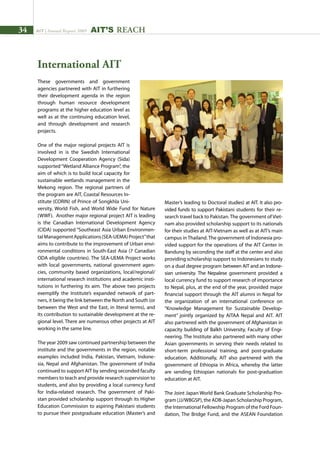
	 Development in Thailand are at AIT.
•	 AIT is very competitive regionally, with a
	 sustained lead over IIT-Kanpur, USM, and
	 Tokyo Tech in publications and citations.
Research Benchmarking Exercise
All the faculty members were requested to inform
the peer departments / institutions with which
their field of study can be compared. A consultative
meeting was held with all three schools at the level
of School deans, the Dean Faculty Meeting (SERD)
and with Coordinators. This was the first time that
this exercise was completed and was treated as a
learning process and an instrument to find areas to
be improved. Keeping this in mind, a comprehensive
research evaluation was conducted for each and ev-
ery faculty of all three Schools.
Academic Program Review (APR)
This was a comprehensive review of each academic
program, involving preparation of a self-study docu-
ment and visits by external reviewers. It is consid-
ered an essential process in preparation for formal
accreditation. This process started in July 2009 and
began with consultations with the Vice President
for Academic Affairs, deans, faculty meetings, Dean
(SET)-coordinator meeting and suggestions from
colleagues. A face-to-face meeting was called for all
Coordinators and Deans to meet the President, Vice
President for Academic Affairs and Director-AQAA to
explain the need of APR.
The existing template to prepare the Self Study
Document was refined and circulated to all field of
study (FoS) / program coordinators to complete. This
process will be carried out for the selected group of
FoS to be advised by the School Deans. Once the self
study document is ready then External Evaluators
were to be selected by the Vice President for Aca-
demic Affairs in consultation with the Deans to visit
AIT and conduct the final round of APR based on the
self-study document and direct visit to field of stud-
ies/ programs, laboratory and class observations.
Peer Teaching Review
A system of Peer Teaching Review was introduced
and made compulsory for evaluating any case of
promotion. Director AQAA met the Deans of School
of Management (SOM), School of Environment and
Resources Development (SERD) and School of Engi-
neering Technology (SET) to determine the progress
on implementation and to see what support might
be needed. SOM and SERD conducted the evalua-
tion of teaching quality as per AIT’s Policies  Proce-
dures (PP), whenever an application of promotion
was received. Although there were applications for
promotion in SET, peer teaching was yet to be imple-
mented. The newly appointed Dean of SET indicated
that peer reviews in SET would take place as soon as
possible.
Center for Learning Innovation and
Quality (CLIQ)
AIT’s Center for Learning Innovation and Quality
(CLIQ) began operation on June 10 with the intro-
duction of new Director, Dr. Evangelos Afendras.
The center’s mission is to serve AIT by supporting
continuous quality improvement and innovation of
pedagogy, curriculum development, academic qual-
ity assurance processes, particularly related to qual-
ity of teaching and formulation of guidelines for aca-
demic quality of professional programs. In addition,
the center provides these services and disseminates
best and innovative practices to universities in the
region.
ACADEMICS
AIT | Annual Report 2009 |45
CLIQ began its operation by conducting a fact-
gathering and exploration mission on material and
human infrastructure. During the initial period the
Center established a base of information in order to
assess the state of learning/teaching at AIT. Imple-
mentation of the processes identified in the CLIQ
proposal came from a better understanding of the
situation, as faculty perceptions became
crucial to undertaking the management
of teaching practice, where necessary.
This data gathering was pursued through
strategies involving numerous face-to-
face discussions with colleagues and
students, involvement with Professional
Programs both in planning, such as sur-
veying international practice in Recogni-
tion of Prior Learning (RPL) and visits to
relevant international agencies for the
development of insightsandthetestingof
materials for AIT.
CLIQ proposals included Introducing a
“Professional Communication” course
for our students; developing a follow-up
tracer study of Alumni involved in the
private sector; offering a menu of train-
ing courses and consulting services to
Alumni on entrepreneurship, profession-
al communication skills and other sup-
port for starting or further development
of their businesses; undertaking a fundamental re-
view with Language Centre staff and other stake-
holders of the range of issues from placement and
graduation language exams to the bridging courses,
and the possibility of introducing Content Based In-
struction in some optimal form; developing blended
learning approaches, particularly for the MBA and
Professional Programs; discussing the role of the
Medium of Instruction (National languages), ad-
dressing the necessity of offering some instruction
in some programs in languages other than English,
and designing such components. The loss of large
numbers of potential registrants - such as the re-
duction of market share for our courses in Vietnam
owing to linguistically more flexible programs - was
well documented.
The Language Center
The Language Center supports the mission of the
Institute through the AIT Bridging Program − an
intensive English language and academic prepara-
tion program for entering students from a variety
of educational backgrounds. In addition, the Center
supports all AIT students by offering writing clinics,
workshops, on-line and live writing courses as well as
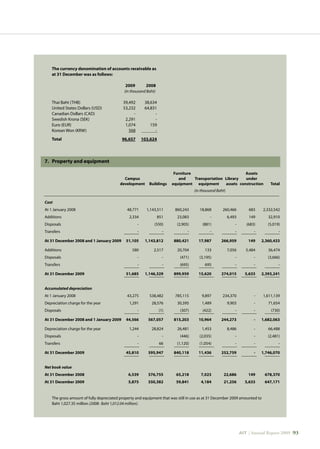
French, Thai and Chinese language courses.
Career Center
The AIT Career Center was established in November
2006 to assist students in making informed decisions
by providing the resources, programs and counsel-
ing that will lead them to different career options,
internships opportunities, part-time jobs, exchange
programs or ideas about options for further educa-
tion. Its services revolve around (1) Career Counsel-
ing and Placement Assistance; (2) Student Assistant-
ship / Internship Guidance; and (3) Further Studies
and Exchange Program Counseling.
In 2009, the Career Center carried out several career
talks and workshops. A total of 12 organizations/
universities, including representatives from Mead
Johnson, Standard Chartered Bank, Mekong River
Commission Secretariat, Institute for International
Education, Tokyo Institute of Technology and Poly-
tech-Nice, visited AIT to deliver career/scholarship/
46 AIT | Annual Report 2009
educationalopportunitytalks.AstheInternshipDesk
was recently launched in November 2009, the Career
Center team also visited companies in Bangkok to
give presentations. Two trips to the National Science
Museum for students and visits to other universities
in Bangkok for Job Fair observation and company
networking were organized. Twenty-five students
were sent for internships, summer and exchange
programs to Korea, Taiwan and Japan, respectively.
The year’s biggest event was the bi-annual Career
Fair organized on 26-27 March and 13 November
2009, which attracted 53 companies with 300 vacant
positions, 700 applicants and 70 job offers. Forty
students also visited the Career Center office for CV
counseling and mock interviews.
Admissions, Financial Aid and Registry
The information analysis and visualization capabil-
ity of the Admissions Information System, which
provides analyses of trends in applications over time
(broken down by country and field of study) contin-
ued to be developed during the year. This capability
enables schools to analyze and target their respons-
es to fluctuations in applications and student enrol-
ment. Financial aid, in the form of AIT partner schol-
arships and AIT fellowships, was offered to deserving
and highly qualified candidates. Improvements in
forecasting student enrolment and revenue from tu-
ition fees modules continue to be developed in the
Student Information and ERP Systems.
Key Initiatives
Yunus Center at AIT
2006 Nobel Laureate Professor Muhammad Yunus
came to Bangkok to launch the center on 19 August
2009. The launch enjoyed extremely heavy media
coverage, appearing in over 100 newspapers and
television stations world-wide. Coverage was partic-
ularly good in the United States. Media coverage in-
cluded New York Times, Forbes, CNBC, and Channel
News Asia. Several articles also appeared in Bangkok
Post, The Nation, and the Thai language press. On
behalf of the Yunus Center at AIT, Vice President for
Academic Affairs (VPAA) met with several heads of
private businesses such as the chief executive offi-
cers (CEO) of Betagro, Michelin Siam, HSBC Thailand,
and Ocean Insurance, who contacted AIT to find out
how to get involved and support the center.
VPAA also briefed the Thai Senate Subcommittee
on Banking and Finance on the mission and scope
of the Center, on the Grameen model of microcredit,
and on support that the Yunus Center could provide
to the government of Thailand, particularly through
our linkage to Grameen Trust. A discussion with the
Assistant Governor of the Bank of Thailand was ar-
ranged by HSBC.
Mr. Borje Wallberg functioned as Interim Director
of the Center in 2009. The Center hired one staff
member and was supported by two volunteer in-
terns from Sweden. A web page was designed. The
Center continued to work with a number of CEOs
on issues in Social Business, Microfinance, and Pov-
erty Alleviation. In particular, the CEO of Betagro ex-
pressed strong interest in partnering with the Center
to establish a social business and made a trip to Laos
to observe the AIT-led PRAM program. The Center is
planning a CEO roundtable on Social Business and a
symposium on Microfinance.
Poverty Reduction and Agricultural
Management (PRAM)
A SERD Task Force chaired by Prof. Jayant K. Routray
was formed to look at the curriculum, quality
assurance issues, guidelines and cost of the PRAM.
Some key achievements included a joint task force
with the Laos Ministry of Agriculture and Forestry
(MAF) to develop an overall strategic plan for hu-
man resources development within the Ministry of
Agriculture and Forestry. This was an important op-
portunity for AIT to be more strategic about its ef-
forts in developing educational programs for Laos
as well as securing funding to support both existing
graduate programs as well as new programs for pro-
fessional education.The first meeting of the AIT-MAF
Task Force was held on 8 December 2009. The main
purpose of this meeting was to clearly define the re-
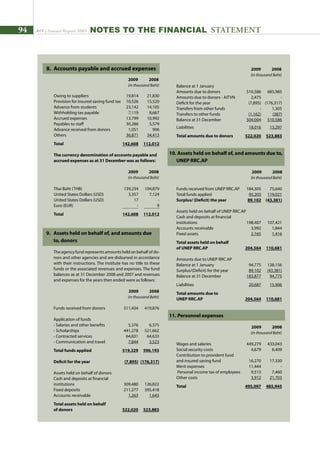
sponsibilities of the Task Force and develop a prac-
tical plan for shared action. Specific initiatives dis-
cussed included the Professional Bachelor’s Degree
in Poverty Reduction and Agriculture Management
(PRAM), professional master’s programs in develop-
ACADEMICS
AIT | Annual Report 2009 |47
ment, a special track to support students from more
rural areas to enter the master’s programs, refresher
training courses for senior ministry officials, and
capacity building of the National University of Laos’
faculty in the area of professional program design
and delivery. The Ministry expected great potential
to develop PRAM into a regional model for poverty
reduction and has offered to help with such a region-
al initiative.
Cambodia’s Fisheries Administration (under the Min-
istry of Agriculture, Forestry and Fisheries - MAFF),
was also keen to the possibility of professional edu-
cation programs for poverty reduction. Representa-
tives of MAFF briefed senior members of the AIT ad-
ministration on some options towards developing a
professional bachelor’s degree program in PRAM.
PRAM also moved forward in the Philippines. A
roundtable discussion with senior representatives
from the Commission on Higher Education (CHED),
Department of Agriculture (DA), Department of Sci-
ence and Technology (DOST), Department of Envi-
ronment and Natural Resources (DENR), the Philip-
pine National Academy of Science and Technology
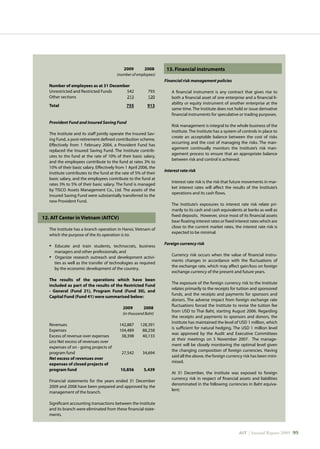
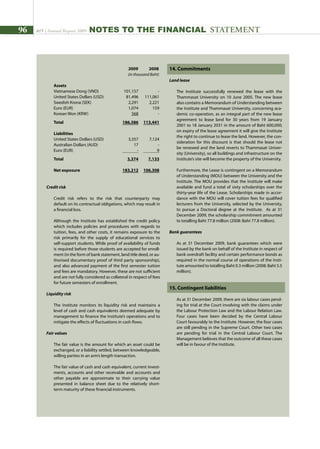
(NAST), some universities, NGOs and the business
sector was held in March to discuss the PRAM edu-
cation program and explain AIT’s approach towards
engagement in poverty reduction programs.
With the assistance of AIT, the Chancellors of the
Univesity of the Philippines Diliman (UPD) and the
University of the Philippines Open University (UPOU)
decided to go ahead with development of a bache-
lor’s program in Bioresources Management and Pro-
ductivity Systems. They have secured initial funding
from UNESCO. The Australian Research Institute in
Education for Sustainability (ARIES) was similarly in-
terested in partnering with PRAM.
ProSPER.Net-Scopus Symposium on
Sustainable Development:
Emerging Issues and New Leaders
2-5 June 2009
In 2009, AIT was host to a string of important ProS-
PER.Net events focusing on the theme of sustain-
able development. The event in June was the larg-
est ProSPER.Net gathering since the consortium’s
inception one year ago. ProSPER.Net is a consortium
of eighteen of the leading universities in Asia-Pacific
dedicated to furthering the integration of sustain-
ability into postgraduate education and research.
The events began with the ProSPER.Net Board meet-
ing on June 2, chaired by AIT’s Vice President for
Academic Affairs. The meeting was opened with re-
From classroom
to the field:
A PRAM
participant
(right) puts
theories to
practice by
sharing his new
found knowl-
edge on goat
raising with a
local farmer.
48 AIT | Annual Report 2009
marks by Prof. Govind Parayil, Vice Rector and Direc-
tor of UNU-IAS and by Mr. Daisuke Ari of the Ministry
of Environment of Japan. Despite the continuing fi-
nancial crisis, the Ministry has been able to increase
the ProSPER.Net budget for next year, indicating the
initial success of the project. Mr. Nick Innes-Taylor
presented the concept of AIT’s developing profes-
sional undergraduate program in Poverty Reduc-
tion and Agriculture Management. The General As-
sembly meeting was held the next day where it was
agreed to create a new project within ProSPER.Net
concerned with the role of higher education in pov-
erty reduction. The project will initially focus on the
PRAM and the related program (Bioresources Man-
agement and Productivity Systems) that is being
launched by the University of the Philippines in col-
laboration with AIT. Gaja Mada University and ARIES
will also partner in this project.
AIT hosted a symposium on “Sustainable Develop-
ment: Emerging Issues and New Leaders”in conjunc-
tion with the first annual ProSPER.Net-Scopus Young
Scientist Award in Sustainable Development. Distin-
guished expert panelists decided on winners from
finalists coming from throughout the Asia-Pacific
region.
The workshop also marked the inaugural or launch
of the ProSPER.Net-Scopus Award in Sustainable
Development. The award is designed to recognize
young scientists in the Asia-Pacific region who have
made outstanding contributions to sustainable de-
velopment in the areas of Business, Engineering 
Technology, and Agriculture  Natural Resources.
Over one hundred applications were received from
seventeen countries. Nine distinguished expert pan-
elists (three in each area) selected fifteen finalists
from among the applicants. As the final step in the
judging, the finalists came to campus and presented
their work to the panelists in an open symposium
format. The award winners were:
Business	
Winner: Dr. Kee-hung Lai, Hong Kong Polytechnic
University.
First Runner-up: Dr. Ming Yu Cheng, Multimedia
University, Malaysia.
Agriculture and Natural Resources
Winner: Dr. Ian Charles Anderson, University of
Western Sydney.
First Runner-up: Dr. Chi-Fai Chau, National Chung
Hsing University.
Engineering and Technology
Winner: Dr. Jiangyong Hu, National University of
Singapore.
First Runner-up: Dr. Nam-Trung NGUYEN, Nanyang
Technological University.
Dr. Parag Ratnakar Gogate, Institute of Chemical
Technology, Mumbai, India.
The week culminated with the ProSPER.Net Sym-
posium on Sustainability in Business Education on
June 4-5. The symposium was organized as part
of AIT’s project on integrating Sustainable Devel-
opment into Business School Curricula, lead by Dr.
Mark Neal of the School of Management. The sym-
posium included keynote talks by Prof. Kate Kearins
of Auckland University, Prof. Craig Deegan of RMIT
and Prof. Richard Welford of Hong Kong University
and CSR Asia. Project members Shinshu University,
Universiti Sains Malaysia, Yonsei University, and AIT
presented reports on project activities. The sympo-
sium also included presentations of about fifteen
papers. Addressing issues of sustainability in busi-
ness education and research is still very much at its
infancy in most of Asia-Pacific. The event confirmed
that AIT is very much at the cutting edge in leading
this project.
ACADEMICS
From left: Dr. Ian Charles Anderson (University of Western Sydney),
winner of the award for Agriculture and Natural Resources with Prof.
Peter Haddawy.
AIT | Annual Report 2009 |49
The School of Engineering and Techno-
logy (SET) at AIT develops innovative lead-
ers for a technologically driven future. SET
encourages critical thinking and learning
that transcends disciplines, and emphasiz-
es entrepreneurial approaches to applied
research that exudes the highest quality.
Students at SET are natural problem solv-
ers who want to contribute to Asia and the
world by engineering green, sustainable
solutions through the advance of science
and technology. The School values solid
understanding of the fundamentals in
many fields of study to meet today’s global
challenges for a better tomorrow.
In 2009 SET had a primary aim of being
able sustain growth in students, faculty
and other resources. Through a consoli-
dated effort the School made its targets
in enrollment, financial performance and
research collaborations.
SET initiated a new field of study in Nano-
technology, and new professional degree
program in the fields of Geothechnical
Engineering and Management (GEM),
Geosystem Exploration and Petroleum
GeoEngineering (GEPG) and Software
Engineering (SoE), as well as an under-
graduate degree programs in ICT, Mecha-
tronics and Electronics that will offer an
International Bachelor of Engineering Degree at its home
campus inThailand, and at AIT partner institutions inViet-
nam, Myanmar, and Sri Lanka. SET also initiated a total of
65 research projects this year.
Academic Highlights
AIT Nanotechnology Partnership in India: Under AIT’s
partnership agreement with VSIS, two-stage masters pro-
grams have already been launched in Energy Technology
and Mechatronics and a third one in Nanotechnology was
launched from July 2009. News on AIT’s partnership with
the Vishwakarma School of International Studies (VSIS),
Pune, India, was featured in the Indian Express newspa-
per.
Signing of MoU and MoA with VSIS, India: On January
School of Engineering and Technology
AIT President Professor Said Irandoust signs partnership agreements with
the Vishwakarma School of International Studies (VSIS), Pune, India for a
unified bachelor’s-master’s program and a two-stage master’s program in
Nanotechnology.
50 AIT | Annual Report 2009
26,AITsignedaMemorandumofUnderstanding (MoU)
and a Memorandum of Agreement (MoA) with Vish-
wakarma School of International Studies (VSIS), Pune,
India, for a unified bachelor’s-master’s program and a
two-stage master’s program in Nanotechnology.
MoU Signing with Universiti Putra Malaysia
(UPM): On Friday, 30 January, a delegation from the
Universiti Putra Malaysia (UPM) led by Professor Da-
tuk Dr. Nik Mustapha R. Abdullah, Vice Chancellor of
UPM signed an MoU for academic exchange and re-
search activities. This partnership was brought to AIT
through the coordination and connection of Dr. Nitin
Kumar Tripathi, faculty in the Remote Sensing and
GIS field of study.
Thailand’s first Professional Master’s in Software
Engineering (PMSE):
AIT and the National Science and Technology Devel-
opment Agency (NSTDA), Thailand, signed a Memo-
randum of Agreement (MoA) to offer the PMSE, the
first of its kind in Thailand and one of the first in the
world. The concept is one of a tripartite partnership
between an institute of higher learning (AIT), govern-
ment (Thailand Science Park, NSTDA) and industry
(the International Association of Software Architec-
ture-IASA Thailand Group) which will help Thailand
to provide innovative products and solutions in this
important field.
MoU with University of Nice, France: On Octo-
ber 28, AIT signed an MoU with the University of
Nice-Sophia Antipolis. The MoU was expected to
open the door to cooperation at both academic and
scientific levels.
Launching of Undergraduate Program at AIT:
Twelve students from five countries attended their
first day of classes as AIT undergraduates on 2
November 2009. Nine intend to major in ICT, two
will focus on Mechatron-
ics and one student will major
in Electronics. By their third year, the
Pathumthani campus based students will be
joined by AIT undergraduates currently studying
through partnerships in Sri Lanka and Vietnam.
At the School of Environment, Resources and De-
velopment (SERD), students are challenged to find
solutions for some of the great challenges facing the
planet. Faculty, researchers and students investigate
issues of global concern such as food, water and
energy. The School emphasizes an interdisciplinary
approach to teaching and applied research that in-
tegrates new knowledge in technology and social
science into its academic programs, training and
outreach activities.
This year, SERD initiated new research initiatives and
international academic programs which included
partnerships with several universities in the region.
Key academic developments were the new dual de-
gree master’s programs in Agricultural Systems (AS)
and Agribusiness Management (ABM) with the Uni-
versity of Jember (UNEJ), and in Energy and Environ-
ment (EE) in collaboration with Universitas Sriwijaya
(UNSRI, Indonesia).
Specialists from the Environmental Engineering and
Management (EEM) and Water Engineering Manage-
ment (WEM) fields of study initiated a partnership
with UNESCO-IHE to conduct a dual degree program
in Water Education. In its initial semester, four stu-
School of Environment, Resources and
Development
ACADEMICS
AIT | Annual Report 2009 |51
dents were accepted into this highly selective program through
AIT. A Professional Master’s Degree in EEM for Vietnam will be
launched in January 2010, pending confirmation of support from
Asian Disaster Reduction Center (ADRC).
Promotionalactivitieswere
also a priority for the School
this year, beginning with the
creation of a standardized web-
site and promotional materials.
Trips to target countries such as Viet-
nam and Indonesia were taken during
the course of year, reaping severalpromis-
ing partnerships with state universities.
In 2009 the School of Environment, Re-
sources and Development (SERD)
launched two new interdisciplinary
programs, namely the program on
Greater Mekong Sub-Region Development
Studies, and the two-stage dual degree Master’s
program in Energy and Environment with UNSRI,
Indonesia.
Key Results
A total of 664 students were enrolled
in the January and August 2009 se-
mesters, and 231 SERD students grad-
uated in May and December 2009. A
totalof43sponsoredresearchprojects
valued at more than Baht 68 million
were initiated. Moreover, 95 research
publications were produced during
the year. Finally, cost control measures
contributed to the School generating
a surplus of Baht 24.6 million.
Energy and
Sustainability
In 2009 the Thai Ministry of Energy
granted 10 Ph.D. His Majesty the King
Scholarships from the Energy Conser-
vation Promotion Fund to the Energy
Field of Study in the amount of Baht
12.5 million Baht for the period Octo-
ber 2009 to September 2013. These
scholarships will be available from
January 2010 onwards.
52 AIT | Annual Report 2009
School of Management
The School of Management (SOM) is one of the
Asian region’s leaders in management education
and research. SOM provides exceptional individuals
with a supportive environment in which they can
develop their skills and aptitudes, helping them to
reach their professional goals and to serve the in-
terests of countries in the Asia-Pacific region. The
School’s core strength lies in tailoring entrepreneur-
ship and leadership education to match local needs,
and in expanding Asian entrepreneurship concepts
to other regions.
The academic programs of the School are highly re-
garded, winning awards for their internationality and
ranking highly in the region.The School has continu-
ously diversified to match the needs of the market.
Besides its academic MBA and PhD programs, the
School also runs highly successful Executive MBA
(EMBA), and Doctor of Business Administration (DBA)
and Professional Masters Programs. The School is
dedicated to producing managers who can drive
their organizations to prosperity and profitability
without compromising ethics and social responsibility.
In 2009, the School was comprised of 11 full-time
faculty members and 29 adjunct faculty members
from 14 countries. With an increasing diversity in its
student and faculty bodies, the School of Manage-
ment has been able to recruit students from regions
that have not been traditionally represented, such as
South Africa. During the year SOM welcomed 27 ex-
change students from Asian and European partners
in France, Spain, Germany, Switzerland, Republic of
Korea, Denmark, India, Pakistan and Lithuania. Nine-
ty-two students were enrolled in SOM’s professional
Doctor of Business Administration (DBA) which is
conducted in centers in five countries: namely Viet-
nam, Sri Lanka, India, Taiwan and Thailand.
This year, SOM finalized an agreement with the As-
ton Business School in Birmingham, U.K. to carry out
collaborative research projects and faculty exchang-
es. A cooperative agreement with the University of
Applied Sciences HTW Chur in Switzerland, covering
fluid exchanges of faculty, staff and students, was
also confirmed in March 2009.
SOM continued to build and strengthen its linkages
with the professions by developing strategic partner-
ships with both public and private sectors through its
executive development and research projects. SOM
faculty members were also involved in the manage-
ment of the High-tech Business Incubation Program
in collaboration with Thailand’s National Electron-
ics and Computer Technology Center and Thailand
Science Park.
ACADEMICS
AIT | Annual Report 2009 |53
ProSPER.Net
In March 2009, the School of Management began
hosting ProSPER.Net’s Secretariat for research pro-
grams on integrating sustainability in management
education. SOM has been extensively involved in re-
search and activities of ProSPER.Net, and was expect-
ed to receive a grant in 2001 for developing social
and business case studies. This Secretariat is also in-
volved in integrating courses for the UN Global Com-
pact Forum and reports for publication on the status
of integrating sustainability into business education
curricula in the Asia-Pacific region.
Research Themes
The School of Management’s thematic research areas
reflect the growing importance in the business envi-
ronment of Social and Environmentally Responsive
Management, Good Governance, Innovation and
Entrepreneurship, Managing Global Supply Chains,
Corporate Social Responsibility and Sustainable
Business Models. SOM continues to contribute to de-
velopment of management knowledge through its
high quality research and publications.
54 AIT | Annual Report 2009
Civil  Infrastructure Engineering Group
	 •	 Construction, Engineering  Infrastructure
		 Management
	 •	 Geotechnical  Geoenvironmental Engineering
	 •	 Structural Engineering
	 •	 Transportation Engineering
	 •	 Water Engineering  Management
Industrial Systems Engineering Group
	 •	 Industrial  Manufacturing Engineering
	 •	 Mechatronics
	 •	 Microelectronics
	 •	 Nanotechnology
	 •	 Full-time MBA Program with specializations
in Finance, Human Resources Management,
Marketing, Technology Management, Entrepre-
neurship, Strategy, Public Management, Interna-
tional Management
	 •	 Executive MBA Program
	 •	 EMBA in Bangkok, EMBA - Human Resources
		 Management (EMBA-HRM), International EMBA
in Vietnam (iEMBA Vietnam)
	 •	 Dual Degree Arrangements:
		 Two degrees - AIT’s MBA degree and a special-
ized degree from one of Europe’s premier busi-
ness schools
ACADEMIC PROGRAMS
ACADEMICS
	 •	 Agricultural Systems  Engineering
	 •	 Aquaculture  Aquatic Resources Management
	 •	 Energy
	 •	 Environmental Engineering  Management
	 •	 Food Engineering  Bioprocess Technology
	 •	 Gender  Development Studies
	 •	 Natural Resources Management
	 •	 Pulp  Paper Technology
	 •	 Regional  Rural Development Planning
	 •	 Urban Environmental Management
Information  Communications Group
	 •	 Computer Science
	 •	 Information Management
	 •	 Remote Sensing  Geographic Information
Systems
	 •	 Telecommunications
Interdisciplinary Programs
	 •	 Offshore Technology  Management
	 •	 Information  Communications Technologies
	 •	 Disaster Preparedness, Mitigation  Management
	 •	 Geosystem Exploration  Petroleum Geoengi-
neering
	 •	 Gender, Transportation and Development
School of Engineering and Technology
School of Environment, Resources and Development
Interdisciplinary Programs
	 •	 Agri-Business Management
	 •	 Disaster Preparedness, Mitigation 
Management
	 •	 Energy and Environment
	 •	 Energy Business Management
	 •	 Greater Mekong Sub-region
		 Development Studies
School of Management
	 •	 Exchange Program Arrangements with partner
		 institutions in Asia or Europe
	 •	 Doctor of Philosophy (PhD) Program
	 •	 Doctor of Business Administration (DBA) Program
in AIT Thailand, Sri Lanka, Vietnam, Taiwan, and
India
	 •	 Professional Master’s Program in Technology
Management (PMTM)
AIT | Annual Report 2009 |55
56 AIT | Annual Report 2009
As a leading network institution of higher learn-
ing in the region, the Asian Institute of Technology
(AIT) has long been at the forefront of initiating new
ventures and innovative research. Research at AIT is
premised on the application of highly complex fields
of technological inquiry towards achieving sustain-
able development solutions for the region. AIT aims
to be a major center for knowledge, development,
research and development activity and is creating
specific niche areas for itself.
A total of 574 research activities were underway in
2009. More than half of these projects were planned
for multi-year implementation. Collectively, 611 pub-
lications were completed by faculty and staff mem-
bers. Two hundred and fifty-four were contributions
to peer-reviewed journals and 45 were chapters to
books.
After considerable deliberation, in 2009 a Center
of Excellence in “Sustainable Development in the
Context of Climate Change” was launched at AIT.
The six themes under its research umbrella are
Vulnerability and Risk Reduction, Adaptation and
Livelihood Strategies, Urban and Rural Sustainabil-
ity, Water and Food Security, Energy Security and
Low Carbon Society, Cleaner Production and Waste
Refining. The launch of the Center facilitated work
to identify societies that are vulnerable and where
adaptation and mitigation options are urgently
needed.
A research strategy for the Institute
is being developed and will in-
clude four major components,
namely, the focus of research,
research quality, partner-
ship and collaboration, and
fundraising for developing
capacity and infrastructure.
In order to achieve this in a
systematic manner, a Results
Based Management (RBM)
approach is being used. Future
discussions with various stake-
RESEARCH
Research
holders will include donors, government agencies
and the private sector.
AIT will serve as a common neutral platform for
private sector, government and public institutions,
local communities and other stakeholders to bond
together in common purpose and work towards
poverty alleviation and a better quality of life for
everyone in the region.
The Institute stresses a proactive approach in terms
of scoping opportunities for research and develop-
ment both at local and regional levels. It aims to
serve as a center for technology transfer and diffu-
sion, as well as for the development of best practices
and the dissemination of knowledge. Key Perfor-
mance Indicators (KPI) for research are also being
developed which will take into account the quality of
publications, the number, type and impact of spon-
sored research in terms of strengthening all research
conducted at AIT.
Through its interdisciplinary teams, the injection of
funds for better infrastructure, targeted support and
incentives for faculty and scientific staff, greater net-
working and collaboration with partners, entrepre-
neurship and innovation, AIT’s research will continue
to grow from strength to strength.
Ongoing (63)
Completed (311)
SET (186)
SERD (139)
SOM (20)
AIT Vietnam (110)
Institute (8)
AIT Extension (93)
intERLab (18)
initiated (200)
AIT | Annual Report 2009 |57
OVERVIEW OF RESEARCH ACTIVITIES FOR 2009
Overall during the period January to December 2009, there were 574 sponsored and contracted projects
which were conducted by the faculty and staff from within the Field of Studies (FoS) of the three schools, SET,
SERD and SOM, as well as in AIT Extension, IntERLab, and Institute wide projects. The total Publications for the
same period stood at 611 from across AIT. The breakdown of which is indicated in the table below.
SPONSORED  CONTRACTED
PROJECTS
SCHOOL/FoS Completed On-going
71
7
10
2
8
7
6
6
9
1
5
10
-
-
51
6
1
9
11
5
2
7
2
2
6
-
-
115
6
7
3
13
7
12
22
10
2
8
24
1
-
88
4
7
12
28
10
12
2
2
2
9
-
-
TOTAL
PUBLICA-
TIONS
PUBLICATIONS
Refereed
Journal
Conference
Proceedings
Refereed
Book/Chapters
Other
Publications
121
-
1
7
12
23
16
16
5
10
10
21
-
-
104
10
8
10
38
13
2
12
2
5
4
-
3
TOTAL 574
318
2
10
10
43
66
56
31
8
30
15
47
-
-
239
25
19
10
64
42
15
24
3
7
30
-
19
164
2
9
2
31
35
37
7
2
20
5
14
-
-
77
12
8
-
18
13
7
5
-
-
14
-
14
12
-
-
-
-
2
3
1
-
-
-
6
-
-
29
1
1
-
5
-
3
5
1
2
11
-
1
21
-
-
1
-
6
-
7
1
-
-
6
-
-
29
2
2
-
3
16
3
2
-
-
1
-
1
35
-
-
-
-
611
5
9
78
4
93
311
15
9
15
4
17
263
SET
ACECOMS
CS/IM
CEIM
GGE
IME
Mech/Mic
RSGIS
StE
TC
TrE
WEM
ICT
OTM
SERD
ASE
AARM
E
EEM
FEBT
GDS
NRM
PPT
RRDP
UEM
ABM
GTD
SOM
intERLab
AITExtENSION
InstituteWide
AITVietNam
26
-
-
-
-
254
4
-
-
-
-
259
3
-
-
-
-
45
2
-
-
-
-
53
TOTAL
PROJECTS
186
13
17
5
21
14
18
28
19
3
13
34
1
-
139
10
8
21
39
15
14
9
4
4
15
-
-
20
18
93
8
110
58 AIT | Annual Report 2009 RESEARCH
AIT MASTERS THESIS COMPETITION 2009
School of Engineering  Technology
Runner-up: Mr. Victor Rana Shinde
Water Engineering  Management Field of Study
“Urban Water Demand Forecasting Using Artificial
Neural Network - A Case Study of Bangkok”
Adviser: 	 Dr. Mukand Singh Babel
Runner-up: Mr. Methee Srisupundit
Mechatronics Field of Study
“Development of a Localization System for an
Intelligent Vehicle”
Adviser: 	 Dr. Manukid Parnichkun
Civil Engineering
Winner: Ms. Chollada Rojrungtavee	
Water Engineering  Management Field of Study
“Assessment of Water Demand and Supply under
Future Climate Change Conditions in Mae Klong
River Basin, Thailand”
Adviser: 	 Dr. Mukand Singh Babel
Industrial Systems Engineering
Winner: 	 Mr. Tanujjal Bora
Microelectronics Field of Study
“Studies of Zinc Oxide Nanorod Dye Sensitized
Solar Cell”
Adviser: 	 Prof. Joydeep Dutta
Information  Communications Technologies
Winner		 Mr. Kugamoorthy Gajananan
Information Management Field of Study
“Haptic Rendering of Arbitrarily Shaped Cutting
Tools Interacting with 3D Volumetric Models with
Application to Dental Surgery Simulation”
Adviser: 	 Prof. Peter F Haddawy
Runner-up:	 Mr. Mahawaduge Lesli 		
	 Newton Perera
Information  Communications Technologies
Field of Study
“Multi-constrained Optimal Path QoS Routing
with Inaccurate Link State Information”
Adviser: 	 Dr.TeerapatSanguankotchakorn
A total of 52 students participated in the 4th Annual AIT Masters Thesis Competition held on 18 May 2009.
Distinguished experts from international and regional organizations, partner universities, private sector,
media, and AIT served as judges in their respective expertise categories.
For the School of Environment, Resources and
Development
1. Development						
2. Energy  Environment
3. Resources
For the School of Management
1. Management
Categories:
For the School of Engineering andTechnology
1. Civil Engineering				
2. Industrial Systems Engineering
3. Information  Communications Technologies
The winners and runners up of the Fourth AIT Masters Thesis Competition are listed below:
AIT | Annual Report 2009 |59
Runner-up: Mr. Noratat Prachom
Aquaculture  Aquatic Resources Manage-
ment Field of Study
“Replacement of fishmeal component of Thai
red tilapia (Oreochromis niloticus x Oreochromis
mossambicus) feeds by enzyme treated feather
meal”
Adviser: 	 Dr. AmararatneYakupitiyage
School of Environment, Resources  Development
Development
Winner: Ms. Tran Thanh Tu
Urban Environmental Management Field of Study
“Adaptation to Flood Risk in Coastal Urban Area un-
der Rapid Urbanization and Climate Change in Ho
Chi Minh City, Vietnam”
Adviser: 	 Dr. Vilas Nitivattananon
School of Management
Management
Winner:	 Ms. Thitiya Kiatrabile
“Digital Divide: The Case of Internet Usage in
Thailand”
Adviser: 	 Dr. Donyaprueth Krairit
Runner-up:	 Mr. Pranay Kumar Das
“New Business Opportunities in the Mobile Telecom-
munication Market of Bangladesh”
Adviser: 	 Prof. Ilkka Kauranen
Runner-up: Ms. Sujata Manandhar
Natural Resources Management Field of Study
“Perception of and Adaptation to Climate Change
by Farmers in Different Ecological Zones of the
Western Development Region of Nepal”
Adviser: 	 Dr. Dietrich Schmidt-Vogt
Energy  Environment
Winner: Mr. Efren Laguda Linan
Environmental Engineering  Management Field
of Study
“Cumulative Effects Assessment in the Developing
World: A Case of Asian Multi-Functional Coastal
Wetlands”
Adviser: 	 Dr. Oleg V Shipin
Runner-up: Mr. Amila Abeynayaka
Environmental Engineering  Management
Field of Study
“Thermophilic Aerobic Membrane Bioreactor for
Industrial Wastewater Treatment”
Adviser: 	 Prof. C Visvanathan
Resources
Winner: Mr. Narayanan Srikanth
Pulp  Paper Technology Field of Study
“Effect of Biopolymer Latex on Properties of Coated
Paper”
Adviser: 	 Dr. Mousa Nazhad
60 AIT | Annual Report 2009
A weather station was deployed at Khopra (3600m),
Annapurna Region of Nepal, for real-time weather
monitoring of high Himalayan air routes between the
popular tourist destinations of Pokhara and Jomsom
in October, 2009.
The deployment of this weather station is a non-formal project be-
tween AIT’s Remote Sensing  Geographic Information System (RS-
GIS) Team, under the leadership of Dr. Kiyoshi Honda, and the Nepal
Wireless Network.
Together with partners such as the Asian Institute ofTechnology, Nepal
Wireless sets up wireless relay stations and network nodes using only
solar and wind power in remote areas. The founder Mr. Mahabir Pun,
like AIT itself, and AIT alumnus Mr. Yu Xiaogang (featured on page 20
of this report), is also a Ramon Magsaysay Award recipient.
Real-Time Weather Monitoring
RESEARCH60 AIT | Annual Report 2009
AIT | Annual Report 2009 |61
Photo by:
Aadit Shrestha
Research Associate
Remote Sensing  Geographic Information System (RS-GIS)
The weather station in Khopra, which was installed by AIT RS-GIS
experts, aims to procure weather data for aircraft using the air route
between Pokhara and Jomsom to reduce the number of flights
turning back due to harsh and inconsistent weather conditions. With
this weather station in place, airlines are provided more accurate and
advanced information to aid decision-making. This has resulted in re-
duction of unsuccessful flight attempts.
AIT’s technical experts foresee that this technology may also reduce
CO2 emissions.
A second weather station is planned for deployment in the Annapur-
na mountain range area in August 2010. The future site is a national
park and is under Nepal’s National Trust for Nature Conservation’s
jurisdiction. Installing the second weather station in the mountains
would enable more studies to be conducted on weather data for cli-
mate change research work.
The infrastructure of Nepal Wireless will also be used to sustain power
supply and Internet connections.
AIT | Annual Report 2009 |61
62 AIT | Annual Report 2009
In 2009, AIT Extension continued to focus on build-
ing strong partnerships, enabling new relationships
and the reinforcement of several strong multi-year
partnerships. AIT Extension hosted 81 specialized
training programs and capacity building activities
within the AIT campus.
AIT Extension was also involved in several projects
central to the Institute’s efforts to redefine itself in-
cluding partnering with CSR Asia to establish the
Asian Center for CSR at AIT, proactively seeking op-
portunities to establish an AIT center in China and
spearheading a potential summer program with
North American universities. Together with the Wet-
lands Alliance Program and the Office of the Vice
President for Academic Affairs, AIT Extension began
exploring a quality assurance system for the innova-
tiveRegionalProfessionalBachelorsDegreeProgram
in Poverty Reduction and Agricultural Management
(PRAM). This system is also expected to become a
point of reference for other hybrid, problem-based
programs.
Many of AIT’s customized training programs wit-
AIT EXTENSION
AIT Extension
nessed an increase in the number of participants.
The Punjab Resource Management Program, which
is being administered through Government of Pun-
jab with funding from the Asian Development Bank
(ADB), was fully operational with up to 500 partici-
pants choosing to undertake the program.
AIT Extension’s program with Bangladesh’s Depart-
ment of International (DFID), Managing at the Top
(MATT2), witnessed a jump in the number of partici-
pants from 45 in 2008 to 135 this year.This two-week
program consists of a Regional Exposure Visit Pro-
gram on“Public Administration Reform, Performance
Management and Service Delivery” and is designed
to draw lessons from best practices to improve pub-
lic administration, performance management, and
service delivery across sectors and facilitate the
transplanting of success stories to areas of concern.
The office also implemented several activities in Sri
Lanka geared towards public service enhancement
through the Ministry of Education, the Ministry
of Finance and Planning and the Hayleys Group of
Companies.
AIT | Annual Report 2009 |63
Three different training programs were held at
AIT for the “Secondary Education Modernization
Project”(SEMP), which is funded by the ADB through
the Ministry of Education, Sri Lanka. The program
aims to assist the Government in modernizing Sri
Lanka’s secondary school system and is comprised
of core topics on facilitation of school-based assess-
ment implementation, ICT application in school
for teachers and facilitation of computer-assisted
learning centers.
Maldives: Work Ethics in
Public Service
Showing itself to be a regional leader for in-service
training and capacity building, AIT’s continuing ed-
ucation center AIT Extension conducted a two-day
seminar on Work Ethics in Public Service in Male, the
Republic of Maldives. The training was requested by
the Governance Reform Unit of the President’s Office
(formerly known as the Public Service Division of the
Republic of the Maldives) to tackle gaps existing be-
tween the current civil service community and ongo-
ing changes sought by the new government.
A total of 44 high-ranking participants comprised of
state ministers, deputy ministers, permanent secre-
taries and other senior public officials attended the
sessions from 4-5 March 2009. Some key discussions
involved topics such as transparency, accountability,
conflicts of interest, public scrutiny and corruption.
After the seminar, the AIT Extension team, composed
of consultant Mr. Michael Lowe and program officer,
Mr. Bahul Shrestha, was requested to brief H.E. the
President of the Republic of Maldives, Mr. Mohamed
Nasheed on the outcomes of the training.
The President said the exercise was a significant step
in establishing good ties within the current govern-
ment in order to move forward. The President em-
phasized the challenge of establishing an affordable
civil service in the Maldives and reinventing the way
the government functions.
64 AIT | Annual Report 2009 INternational centers
AIT Center Vietnam
AIT Vietnam
This year, AIT Vietnam was able to capitalize on
Vietnam’s highly dynamic state of progress. New
potential markets were identified especially in
outer provinces. Strategic activities on exploration
of areas of interest and the long-term sustainabi-
lity of possible programs were put in place, such as
the establishment of an office in Can Tho City.
Can Tho City
Initially, the government of Cantho City requested
AITVietnam to implement a training needs assess-
ment of government staff in their respective posi-
tions. AIT Vietnam assisted Can Tho City and was
also selected to undertake training programs.
Lam Dong and Danang Provinces
In order to enlarge AIT Vietnam’s network, assess-
ments are ongoing in two potential provinces. AIT
Vietnam is expected to launch a joint program
with the University of Danang. Danang is widely
regarded as a potential industrial hub in Central
Vietnam.
Other Initiatives:
1. Joint program with the Graduate Institute
(Geneve) : International Masters in Development
Program(IMAS),fundedthroughtheSwissAgen-
cy for Development and Cooperation (SDC).
2. Can Tho University (CTU) partnership on
possible programs such as a Master’s in Business
Administration in Aqua Business.
3. South East Asian Ministry of Education Orga-
nization (SEAMEO) partnership on creative ways
to grant degrees.
4. University of Transport and Communica-
tions (UTC) faculty training at AIT with possible
support from the Ministry of Education and
Training (MoET) of Vietnam.
AIT Vietnam continues to promote efficient
and harmonious working environment for the
AIT staff. The center also places high emphasis
on strengthening new initiatives to support de-
velopmental agenda of governments, interna-
tional organizations and the private sector.
64 AIT | Annual Report 2009
AIT | Annual Report 2009 |65
AIT Center in Indonesia
(AITCI) becomes AIT
Indonesia (AIT-ID)
The official three-year collaboration be-
tween Indonesia’s Ministry of Public Works
and the Asian Institute of Technology
ended in 2009. In consultation with our
partner ministries in Indonesia, it was de-
cided that AIT Center in Indonesia (AITCI)
would be restructured and renamed as AIT
Indonesia (AIT-ID). This is as a collabora-
tive partnership between AIT and various
Indonesian government ministries, namely
the Ministry of National Education (MNE),
Ministry of Public Works (MPW) and Minis-
try of Agriculture (MOA).
From 2010 onwards, AIT-ID is expected to
be self-sufficient. It is now in the process of
restructuring in terms of its organization,
activities, funding, partnerships and net-
works. AIT Indonesia will also be relocated
to Jakarta to a venue suitable for academic
programs, short-term training programs,
seminars and workshops, as well as for re-
search and development activities.
Accomplishments in 2009
The first batch of the Dual Degree Program on Transportation
Engineering and Management graduated in June 2009. The
program was revised during the year so that all courses for the
initial batch are conducted at Gadjahmada University and all
courses in the second batch are taken at AIT. Previously, there
was a one semester component conducted at AIT-CI. In 2009,
AIT-CI devised a proposal for a one-year professional degree
program in urban planning, which is now being reviewed by
the Directorate General of Human Settlement as well as the
World Bank. Some discussions with stakeholders involved con-
ducting degree programs in Integrated Water Resources and
Management.
AIT-CI conducted two batches of training programs on Inte-
grated Urban Planning for Sustainable Management and as-
sisted another on Reduce, Reuse, and Recycle. As a core team
member of the UNESCO-SWITCH-in-Asia Project, AIT-CI sub-
mitted a proposal to UNESCO designed to solve urban water
and sanitation problems by providing curriculum modules
to high schools. The Indonesian Aerospace Industry reported
that AIT-CI’s suggestion regarding the production of amphibi-
ous aircraft was approved. It is now being designed and will
be marketed starting 2012. AIT-CI will propose some feasibility
studies for the development of seaports in Indonesia. AIT-CI
outreach to the National Agency for Disaster Mitigation has re-
sulted in engagement with the agency in some of its projects.
AIT Center Vietnam
AIT Center Indonesia
66 AIT | Annual Report 2009 interlab / gmsarn
The Greater Mekong Subregion Academic and Re-
search Network (GMSARN) comprises of eleven of the
region’s top-ranking academic and research institu-
tions. GMSARN carries out activities in the following
areas: human resources development, joint research,
and dissemination of information and intellectual
assets generated in the Greater Mekong Subregion
(GMS). GMSARN seeks to ensure that the holistic intel-
lectual knowledge and assets generated, developed
and maintained are shared by organizations within the
GMSARN
region. Primary emphasis is placed on complementary
linkages between technological and socio-economic
development issues.
This year, the network published the third volume of
the GMSARN International Journal series. The fourth
GMSARN International Conference 2009 on “Energy
Security and Climate Change: Problems  Issues in
GMS” was held on 25-27 November 2009 at Ha Long
City, Vietnam.
intERLab
The Internet Education and Research Laboratory (in-
tERLab), a regional hub for Internet human resources
development, training and education, continued to
carry forward collaborations across the Asia-Pacific
region in developing cutting edge information and
communication technologies (ICT). Its core activities
were highlighted in Training (TEIN3 HRD) and three
specific areas of Research: DUMBO, CarTalk, e-Educa-
tion: CanalAVIST with VClass. In 2009, intERLab trained
287 students, consultants, and IT professionals. In to-
tal, intERLab has trained over 900 engineers from Asia-
Pacific region.
Research
1. DUMBO 2
Digital Ubiquitous Mobile Broadband OSLR (DUMBO)
is a collaboration among three main research groups:
the IntERLab at the AIT, HIPERCOM/INRIA (France), and
the WIDE Project (Japan) to develop an emergency
network based on Mobile Ad hoc Network. Its main
objective is to provide a multimedia communication
network without any pre-existing network infrastruc-
ture in the least possible time. A public demonstra-
tion in 2006 confirmed that DUMBO could effectively
enable communications via wireless satellite connec-
tions, using IPStar satellite, among simulated disaster
sites with wireless mobile ad hoc networks in Phuket
and the headquarters at IntERLab. DUMBO-2 (the
second phase of DUMBO) focused on extending an
emergency wireless network to include vehicle-to-in-
frastructure for post-disaster rescue operation where
limited fixed network infrastructure can be reached.
DUMBO-2 prototypes were demonstrated at the 8th
International Conference on ITS Telecommunications
(ITST 2008) in Phuket, Thailand, and the technology
platform was subsequently used in Wireless Internet-
Emergency Workshop (WirelessU) in 2009. To collec-
tively and extensively provide up-to-date information
on emergency related issues, the emergency net-
work website http://dumbo-isif.interlab.ait.asia was
developed by intERLab.
2. CarTalk
CarTalk is an innovative research test bed based on
the OLSR routing technology and the Disruption Tol-
erance Networking (DTN) that aims to enable effec-
tive communication among the vehicles themselves
(Vehicle-to-Vehicle: V2V), and among vehicles and
the infrastructure (Vehicle-to-Infrastructure: V2I) to
disseminate substantial information such as traffic in-
formation, sensor information, vehicular-specific infor-
mation, accident warnings and even commercial mes-
sages to drivers and passengers.
e-Education
CanalAVIST with VClass
Together with the ASEAN Virtual Institute of Science
and Technology (AVIST) and the ASEAN Science
and Technology Research and Education Network
Alliance (ASTRENA), intERLab operates CanalAVIST, a
network that provides channels for seamless education,
AIT | Annual Report 2009 |67
teaching, training, conferencing, lectures and talks for
ASEAN countries.
CanalAVIST makes use of intERLab’s own VClass
e-learning platform to deliver lectures and stream-
ing VDO ranging from low-bitrate to high-definition
quality. Live and archived materials are streamed
over the high bandwidth TEIN3 network. Broadcast-
ing events in 2009 included (i) International Confer-
ence on Sustainable Development in the Context of
Climate Change from AIT in Thailand to AIT Center in
Vietnam and Polytech Nice in France (ii) The ACGRID
School on Advanced Computing and Grid Technolo-
gies for Research from Institut de la Francophonie
pour l’Informatique in Hanoi, Vietnam to AIT, Kasetsart
University and University Network.
4. Training
TEIN3 HRD
IntERLab has evolved to become the center for the
third generation of the Trans-Eurasia Information
Network in Human Resource Development (TEIN3 HRD),
under the management of the Delivery of Advanced
Network Technology to Europe (DANTE). intERLab
played a vital role in supporting TEIN3 project’s main
objectives in promoting the development of national
research and education networking and collaborative
advanced network application in TEIN members in the
Asian region. The TEIN3 KICK-OFF workshop was con-
ducted in 2009 with participants representing Network
Operation Center (NOC) teams from respective National
Research and Education Networks of 11 countries.
68 AIT | Annual Report 2009 research | outreach centers
Center of Excellence in Nano-
technology opens modern new
facility
A modern new facility for the Center of Excel-
lence in Nanotechnology (CoEN), under the
School of Engineering and Technology (SET),
was officially opened at AIT in 2009. The unveil-
ing event for the new facility was part of SET’s
Open House to celebrate AIT’s 50th Anniversary
on September 8.The Center’s new home is jointly
funded by AIT and NANOTEC/NSTDA (National
Nanotechnology Center/National Science and
Technology Development Agency, Thailand)
and is housed at the Outreach Building in the
center of AIT’s main campus.
The ASEAN Regional Center of Excellence on Millen-
nium Development Goals (ARCMDG) is dedicated to
the promotion and achievement of the MDGs in South-
east Asia through education, training and research.The
Center avails of the considerable intellectual strengths
of AIT’s world-class faculty and its extensive interna-
tional partners. ARCMDG is a regular member of the
UN NGO Informal Regional Network (UN-NGO-IRENE),
a regulating body that facilitates NGO actions aiming
to achieve the Millennium Development Goals (MDGs).
Through a Memorandum of Understanding, ARCMDG
works with the United Nations Development Fund for
Women to carry out MDG-related activities of mutual
interests in the region.
This year, ARCMDG organized an international research
colloquium, several training programs and a workshop
on several key knowledge areas such as the “Role of
NGOs and Academia in Achieving the MDGs in Asia”;
“Project Management for Sustainable Hygiene, Sanita-
tion and Water Supply”; and“ Information Technology
for Development Planning, Management and Gover-
nance”.
Center for Excellence (CoEN) in Nanotech-
nology
The Center of Excellence in Nanotechnology (CoEN)
at AIT is supported jointly by the National Nanotech-
nology Center (NANOTEC) of the National Science and
Technology Development Agency (NSTDA) of Thailand
and the Asian Institute of technology (AIT). CoEN sup-
ports innovative research suited to the region, edu-
cation and training of highly qualified personnel and
seeks to increase public and industrial awareness of
nanotechnology. The unifying concept in the Center
is to make use of inexpensive wet-chemical methods
to fabricate innovative materials and futuristic device
components. Research encompasses working in the
domain of“poor-man’s nanotechnology”.
Current research activities at CoEN focuses on dye-
sensitized solar cells, piezotronic devices, gas sen-
sors, bio-diagnostic tools, environmental mitigation
RESEARCH AND OUTREACH CENTERS
ASEAN Regional Center of Excellence on Millennium Development
Goals (ARCMDG)
AIT | Annual Report 2009 |69
through visible light photocatalysis, self-organization
of nanoparticles, and layer-by layer growth from col-
loidal particles, amongst others.The Center’s research-
ers carry out cutting-edge cross-disciplinary research.
More than eighteen peer-reviewed journal and inter-
national conference papers were published in 2009. A
textbook, FundamentalsofNanotechnology, which was
co-authored by Visiting Professor Gabor L. Hornyak
(Colorado School of Mines) and Prof. Joydeep Dutta,
Director of CoEN, was acclaimed as one of the“World’s
Outstanding AcademicTitles for 2009”by“Choice: Cur-
rent Reviews for Academic Libraries”, which is printed
by the Association of College and Research Libraries,
and a Division of the American Library Association.
Asian Center for Soil Improvement and
Geosynthetics (ACSIG)
AIT’s Asian Center for Soil Improvement and Geosyn-
thetics (ACSIG) has continuously catered to the indus-
trial and construction industry of both public and pri-
vate sector. In Thailand, they included Ceteau Fareast
Limited,ThailandMarineDepartment,TencateGeosyn-
thetics Limited., Thai Wiring System Company Limited,
and Vigor Merger Company Limited among others.
Apart from Thailand, ACSIG also catered to companies
from Malaysia, India and Iran. The center organized
two major activities this year a One-Day Short Course
on Geosynthetics Applications and PLAXIS Numerical
and an International Symposium on Geotechnical En-
gineering, Ground Improvement, and Geosynthetics
for Sustainable Mitigation and Adaptation to Climate
Change including Global.
Habitech Center
AIT’s Habitech Center focused on establishing new
relationships with agencies and successfully created
satellite centers mainly in Nepal, Bhutan and Myanmar.
The Center conducted several training programs and
successfully transferred its interlocking brick technolo-
gy to various organizations, private entrepreneurs and
the United Nations Children’s Fund (UNICEF) through
its new satellite centers. Manuals on the production
and construction of soil-cement interlocking bricks
were published this year.
Habitech Center responded to the destruction caused
by Cyclone Nargis and worked with several agencies
such as Oxfam-Novib, Sitagu Buddhist Missionary
Center and UNICEF to build a total of forty new child-
friendly primary schools located within the Irrawaddy
Delta, Myanmar. The interlocking-bricks technology
developed by Habitech Center of SET, AIT was used
to construct the schools. Habitech Center provided
technical support by providing equipment to produce
interlocking bricks and conducted training programs
on production and effective construction with inter-
locking bricks.
ACECOMS
In 2009, the Asian Center for Engineering Computa-
tions and Software (ACECOMS) conducted a wide
range of activities including seminars, workshops, re-
70 AIT | Annual Report 2009 research | outreach centers
search and consulting projects, as well as working on
software development. Over 10 events on computa-
tional and design aspects were organized in Thailand
and others countries. Participants ranged from profes-
sional engineers, public officials and academics. Sever-
al new projects were initiated and completed ranging
from development of new construction technologies
for earthquake resistance to performance based eval-
uation and wind tunnel testing of some of the tallest
buildings in the Philippines. ACECOMS together with
the Structural Engineering field of study was involved
in the design of the tallest free-standing stack in Thai-
land.
ACECOMS was also involved in the organization of the
33rd International Association for Bridge and Struc-
tural Engineering (IABSE) Symposium 2009, which was
brought to Southeast Asia for the first time. ACECOMS
provided support to the organization of the sympo-
sium as the Coordinator of scientific activities; includ-
ing abstract review, paper review, and preliminary
registration. To further develop its collaboration, a
Memorandum of Understanding was signed with the
Association of Structural Engineers of the Philippines,
Inc. (ASEP). As the first activity of this collaboration,
the 3rd Asia Conference on Earthquake Engineering
(ACEE) 2010 is being organized jointly with Association
of Structural Engineers of the Philippines, Inc. (ASEP),
Asian Institute of Technology (AIT), Tokyo Institute of
Technology (TIT), and Engineering Institute of Thai-
land (EIT).
Asian Center for Transportation Studies
(ACTS)
In 2009, a major research project involved Asian Cen-
ter for Transportation Studies (ACTS), Toyota Motor
Thailand Co., Ltd. (TMT), WHO Collaborating Center
for Injury Prevention and Safety Promotion Khon Kaen
Hospital, and Department of Rural Highways.The proj-
ect sought to study the role of knowledge dissemina-
tion in improving road safety for rural communities.
Community leaders were selected to lead the initiative
at Ban Gota, Khon Kaen, where a significant improve-
ment in the risk behavior of motorists and a reduction
in black spots was observed. ACTS also conducted two
in-house road safety training programs for 30 govern-
ment officials from Vietnam.
WHO Collaborating Centre
The Center continued its operation in accordance with
its mandate to perform basic and applied research on
community (rural, peri-urban and urban) drinking wa-
ter supply, waste disposal, wastewater use, water re-
sources development, soil and air pollution in relation
to human health. It conducted research on health im-
pact assessment, health risk assessment and environ-
mental management for health risk reduction and to
provide technical guidance and consulting to WHO, its
Member States and development partners. The Center
continued to educate and train engineers, scientists
and health professionals in the field of environmen-
tal health, related to drinking water supply and waste
disposal, water management and wastewater use, and
otherrelatedareas.WorkonintroductionofWaterSafe-
ty Plans into the AIT curricula was initiated. Research
on the impact of the 2004 tsunami on household wa-
ter treatment practices by the population of affected
areas in Sri Lanka was carried out in the framework of
participation of the centre in the Network to Promote
Household Water Treatment and Safe Storage (HWTS)
and reported to and integrated into the Network op-
erations at the 2009 Dublin meeting.
Thailand Accident Research Center (TARC)
In 2009, the Thailand Accident Research Center (TARC)
conducted a comprehensive study on the roadside
hazards accidents.The study sponsored by the Depart-
ment of Highways and the World Bank revealed that
deficient run-off road protection systems contribute
predominantly to accidental death on the national
highways. TARC was invited to serve as a member of
Board of Directors of theThailand National Road Safety
Center. TARC delivered lectures at conferences, semi-
nars, and training programs at the annual meeting of
the Transportation Research Board (TBB), Washington
D.C.; Accident In-Depth Study at the Thai Senate Com-
mission; Foundation of Consumers; Ministry of Public
Health; and others. This year, TARC also prepared 14
road safety knowledge books. All were disseminated
during the Thailand National Road Safety Seminar. Ex-
perts are TARC were also interviewed by eight televi-
sion and radio programs during the year.
AIT | Annual Report 2009 |71
Activities at the Center of Excellence in Nanotechnology AIT include, but not exclusively, research and development
focused on the application of nanoparticles, nanomaterials, devices and sensors such as synthesizing conductive
coatings of zinc oxide with fluoride for solar cell applications (shown above).
72 AIT | Annual Report 2009 FACULTY MEMBERS
EMERITUS PROFESSORS
A.S. Balasubramaniam	
B.Sc., Ceylon Univ., Sri Lanka; Ph.D.,
Cambridge Univ., U.K.
Peter Edwards	
B.Sc., Liverpool Univ., U.K.; Ph.D.,
Univ. of Texas, U.S.A.
John Hugh Jones	
B.S., M.S., Univ. of California , U.S.A.
Pisidhi Karasudhi	
B.Eng., Chulalongkorn Univ.; 	
M.Eng., Chulalongkorn-SEATO
Graduate School of Engineering,
Thailand; Ph.D., Northwestern
Univ., U.S.A.
FULL-TIME FACULTY
Nitin V. Afzulpurkar	
B.Eng., Univ. of Poona, India; Ph.D.,
Univ. of Canterbury, New Zealand
Associate Professor, Mechatronics and
Microelectronics Fields of Study
Dean, School of Engineering
and Technology and Director,
Undergraduate Programs	
Mokbul Morshed Ahmad	
B.Sc, M.Sc., Dhaka Univ., Bangladesh;
M.Sc., AIT, Thailand;
Ph.D., Univ. of Durham, U.K.
Assistant Professor, Regional  Rural
Development Planning Field of Study
Kazi Mohiuddin Ahmed	
M.Sc., Inst. of Communications,
Leningrad, USSR;
Ph.D., Univ. of Newcastle, Australia
Professor, Telecommunications Field
of Study
Anil Kumar Anal	
Doctor of Veterinary Medicine,
Univ. of Agriculture, Pakistan; M.Sc,
Ph.D, AIT, Thailand;
Assistant Professor, Food
Engineering  Bioprocess Technology
Field of Study
Ajit P. Annachhatre	
B.Tech., Ph.D., Indian Inst. of Tech.,
Kanpur, India
Professor, Environmental Engineering
 Management Field of Study
Director, AIT-United Nations’Office
Mukand S. Babel	
B.Eng., Rajasthan Agr. Univ., India;
M.Eng., D.Eng., AIT, Thailand
Associate Professor, Coordinator
Water Engineering  Management
Field of Study
Rian Beise-Zee	
Dipl., Wirtschaftsingenieurwesen;
Ph.D., Technical Univ. of Berlin,
Germany
Assistant Professor School of
Management Coordinator,
SOM PhD Program
Dennes T. Bergado	
B.S.C.E., Mindanao State Univ.,
Philippines; M.Eng., AIT, Thailand
Ph.D., Utah State Univ., U.S.A.
Professor, Geotechnical  Geoenvi-
ronmental Engineering Field of Study
Erik L. J. Bohez	
B.Eng., High Tech. Inst. St. Antonius,
Ghent, Belgium
M.Eng., State Univ. of Ghent, Belgium
Associate Professor,
Industrial Engineering  Management,
and Design  Manufacturing
Engineering Fields of Study
Chotchai Charoenngam	
B.Eng., King Mongkut’s Inst. of Tech.,
Thonburi, Thailand; M.S., Univ. of
Kansas; Ph.D., Univ. of Texas, U.S.A.
Associate Professor, Construction,
Engineering  Infrastructure
Management Field of Study
Roberto Clemente	
B.S.A.E., Univ. of the Philippines at
Los Baños, Philippines;
M.S., AIT, Thailand; Ph.D., McGill Univ.,
Canada
Associate Professor, Water
Engineering  Management Field
of Study.
HONORARY
FACULTY
The Institute is deeply grateful that
Her Royal Highness Princess Maha
Chakri Sirindhorn has seen fit to
share her expertise and experience
with faculty, staff and students, as
an Honorary Faculty Member. In this
singular position, Her Royal Highness
is associated with the Remote Sens-
ing and Geographic Information
Systems Field of Study.
AIT | Annual Report 2009 |73
Roland Cochard	
B.S.(Hons.), James Cook Univ. of North
Queensland, Australia; Post Graduate
Certificate, Univ. of Neuchatel,
Switzerland; Ph.D, Institute of
Geobotany, Federal Institute of
Technology, Switzerland
Assistant Professor, Natural Resources
Management Field of Study
Matthew M. Dailey	
B.S., M.S., North Carolina State Univ.,
U.S.A.; Ph.D., Univ. of California, U.S.A.
Assistant Professor, Computer Science
and Information Management Fields
of Study
Nicholas J. Dimmitt	
B.A., M.A., San Francisco State Univ.,
U.S.A.; Ph.D., Univ. of Southern Califor-
nia, U.S.A.
Assistant Professor, School of
Management Coordinator,
EMBA-Bangkok
Philippe Doneys	
B.A., Univ. of Toronto, Canada; M.A.,
Univ. of London, England;
Ph.D., Institut d’Etudes Politiques
de Paris, France
Assistant Professor, Coordinator,
Gender  Development Studies Field
of Study
Phan Minh Dung	
M.Sc., Ph.D., Univ. of Tech., Dresden,
Germany
Professor, Computer Science and
Information Management Fields of
Study
Joydeep Dutta	
B.Sc., St. Edmund’s College, India;
M.Sc., North Eastern Hill Univ., India;
Ph.D., IACS, Calcutta Univ., India
Professor, Microelectronics Field of
Study and Associate Dean, School of
Engineering and Technology
Tapio J. Erke	
M.Sc., Helsinki Univ. of Tech., Finland
Visiting Associate Professor,
Telecommunications Field of Study
Vatcharaporn Esichaikul	
B.Acc., Chulalongkorn Univ., Thailand;
M.B.A., Oklahoma State Univ.,U.S.A.;
Ph.D., Kent State Univ., U.S.A.
Associate Professor,
Information Management Field of
Study
Mongkol Ekpanyapong	
B.Eng.,Chulalongkorn University,
Thailand; M.Eng., AIT, Thailand; M.Sc,
Ph.D, Georgia Institute of Technology,
USA
Assistant Professor Mechatronics 
Microelectronics Field of Study
Wenresti G. Gallardo	
B.S., M.S., Univ. of Philippines; M.S.,
Ph.D., Nagasaki Univ., Japan
Associate Professor, Coordinator,
Aquaculture  Aquatic Resources
Management Field of Study
Pham Huy Giao	
Dipl. Ing. (MSc), Bucharest University,
Romania; M.Eng. and D.Eng., Asian
Institute of Technology, Thailand
Assistant Professor, Geotechnical and
Geoenvironmental Engineering Field
of Study
Arun Kumar Gopalaswamy
B.Com., M.Com., Bangalore, India;
Ph.D., Indian Institute of Science,
India
Visiting Associate Professor,
School of Management
Sumanta Guha	
B.Sc., M.Sc., Univ. of Calcutta, India;
Ph.D., Indian Statistical Inst., India;
M.S., Ph.D., Univ. of Michigan, U.S.A.
Associate Professor,
Computer Science and Information
Management Fields of Study
Peter Haddawy
B.A., Pomona College, Claremont,
U.S.A.;
M.Sc., Ph.D., Univ. of Illinois, Urbana,
U.S.A.
Professor, Information Management
Field of Study, and Vice President for
Academic Affairs
B. Harimurti W. Hadikusumo	
B.Eng., Univ. of Diponegoro, Indonesia;
M.Eng., AIT; Ph.D., Univ. of Hong Kong
Associate Professor, Coordinator,
Construction, Engineering 
Infrastructure Management Field of
Study Associate Dean for Promotion
Kiyoshi Honda	
B.Agr., D.Eng., Tokyo Univ., Japan
Associate Professor, Remote Sensing 
Geographic Information Systems Field
of Study
Barbara Igel	
B.A., M.A., Technical Univ., Berlin;
Ph.D., Freie Univ., Berlin, Germany
Associate Professor, and Dean of the
School of Management
Said Irandoust	
M.Sc., Ph.D., Chalmers Univ. of Tech.,
Sweden
Environmental Engineering 
Management; Energy; and Pulp  Paper
Technology Fields of Study, and	
President, Asian Institute of Technology
Nazrul Islam	
B.Sc.Eng., BUET, Bangladesh;
M.Eng., D.Eng., AIT, Thailand Visiting
Professor, School of Management
Paul Janecek	
B.S.E.E., U.S. Military Academy;
M.Sc., Univ. of London, U.K.;
Ph.D., Swiss Federal Inst. of Tech.,
Switzerland
Assistant Professor, Coordinator,
Computer Science and Information
Management Fields of Study
Lalit M. Johri	
B.Sc.(Hons.), M.Sc., M.B.A., Ph.D., Univ. of
Delhi, India
Professor, School of Management
Voratas Kachitvichyanukul	
B.S., Nat’l. Taiwan Univ.; M.Eng., AIT,
Thailand;
Ph.D., Purdue Univ., Indiana, U.S.A.
AssociateProfessor,IndustrialEngineering
 Management, and Design  Manu-
facturing Engineering Fields of Study
74 AIT | Annual Report 2009 FACULTY MEMBERS
Yoshikazu Kamiya	
B.Eng,Yokohama National Univ.,
Japan; M.Sc, Ph.D., University of
Tokyo, Japan Visiting Faculty
Remote Sensing  Geographic
Information Systems Field of Study
Kanchana Kanchanasut	
B.Sc., Univ. of Queensland, Australia;
M.Sc., Ph.D., Univ. of Melbourne,
Australia THNIC Chair Professor,
Computer Science Field of Study
Kunnawee Kanitpong	
B.S., Chulalongkorn Univ., Thailand;
M.S., Univ. of Maryland at College
Park, U.S.A.; Ph.D., Univ. of
Wisconsin-Madison, U.S.A.
Assistant Professor, Coordinator,
Transportation Engineering Field of
Study
Worsak Kanok Nukulchai	
B.Eng., Chulalongkorn Univ.,
Thailand; M.Eng., AIT, Thailand;
Ph.D., Univ. of California (Berkeley),
U.S.A. Vice President for Resource
Development
Kare Helge Karstensen	
M.Sc., University of Oslo; MBA,
Heriott Watt Univ. UK;
Ph.D. Norwegian Univ. of Science 
Technology, Trondheim, Norway
Visiting Faculty, Environmental
Engineering  Management Field
of Study	
Do Ba Khang	
M.Sc., Eotvos Lorand Univ., Hungary;
M.Sc., D.Tech.Sc., AIT, Thailand
Associate Professor,
School of Management
Coordinator, EMBA-Vietnam
Hyunmyung Kim	
B.Eng.;M.Sc., Seoul National
Univ.,Korea;
Ph.D.,Univ. of California, Irvine, U.S.A.
Assistant Professor,
Transportation Engineering
Pisut Koomsap	
B.Eng., Thammasat Univ., Thailand;
M.Sc., Univ. of Louisville, U.S.A.;
Ph.D., Pennsylvania State Univ., U.S.A.
Assistant Professor, Industrial  Manu-
facturing Engineering Field of Study
Thammarat Koottatep	
B.Eng., Chiangmai Univ.; M.Eng.,
D.Eng., AIT, Thailand
Assistant Professor,
Environmental Engineering 
Management Field of Study
Mikko Kovalainen	
M.S. Univ. of Jyvaskyla, Ph.D., Univ. of
Jyvaskyla, Finland
Visiting Faculty,
Information  Communications
Technologies Area of Study
Donyaprueth Krairit	
B.S., Thammasat Univ., Thailand; M.S.,
Univ. of Colorado at Boulder,
U.S.A.;
Ph.D., Massachusetts Inst. of Tech.,
Cambridge, U.S.A.
Assistant Professor,
School of Management
Coordinator, MBA Program
Sivanappan Kumar	
B.E., Univ. of Madras, India; M.Eng.,
AIT, Thailand;
Ph.D., Inst. Nat’l. Polytechnique,
Toulouse, France
Professor, Coordinator Energy Field
of Study
Kyoko Kusakabe	
B.A., Sophia Univ., Tokyo, Japan; M.Sc.,
Ph.D., AIT, Thailand
Associate Professor,
Gender  Development Studies Field
of Study, and Associate Dean, School
of Environment, Resources and
Development	
Michiro Kusanagi	
B.S., M.S., Univ. of Tokyo, Japan;
M.S., Ph.D., Univ. of California, U.S.A.
Visiting Professor, Remote Sensing
 Geographic Information Systems
Field of Study
Huynh Trung Luong	
B.Eng., Ho Chi Minh City Univ. of
Tech., Vietnam;
M.Eng., D.Eng., AIT, Thailand
Associate Professor,
Industrial Engineering 
Management Field of Study
Charles O. P. Marpuang	
B.Eng., Bandung Institute of
Technology, Indonesia; M.Sc., Bogor
Agricultural University, Indonesia;
Ph.D., AIT, Thailand
Visiting Faculty, Energy Field of Study
Brahmanand Mohanty	
B.Sc.,S.A.I.C.E., India; M.Sc., AIT,
Thailand;
Ph.D., Institut National Polytechnique
of Toulouse, France Visiting Faculty,
Energy Field of Study
Mousa M. Nazhad	
B.Sc., Univ. of Tehran, Iran; M.Sc.,
Univ. of Concordia Montreal;
Ph.D., Univ. of British Columbia,
Vancouver, Canada
Associate Professor,
Pulp  PaperTechnology Field of Study
Vilas Nitivattananon	
B.Eng., Chulalongkorn Univ.;
M.A., Thammasat Univ.; M.Eng., AIT,
Thailand; Ph.D., Univ. of Pittsburgh,
U.S.A.
Assistant Professor, Coordinator
Urban Environmental Management
Field of Study
Athapol Noomhorm	
B.Sc., Kasetsart Univ., Thailand;
M.Eng., Lamar Univ., Texas;
Ph.D., Louisiana State Univ., U.S.A.
Professor, Coordinator
Food Engineering  Bioprocess
Technology Field of Study
Nguyen Thi Kim Oanh	
Dip.Eng., Odessa Hydrometeorology
Inst., Ukraine;
M.Eng., D.Eng., AIT, Thailand
Professor, Environmental
Engineering  Management
Field of Study
AIT | Annual Report 2009 |75
Weerakorn Ongsakul	
B.Eng., Chulalongkorn Univ.,
Thailand; M.S., Ph.D., Texas AM
Univ., U.S.A.
Associate Professor, Energy Field
of Study
Dean, School of Environment,
Resources  Development
I.M. Pandey
M.Comm., Ph.D., Univ. of Delhi, India
Visiting Professor, School of
Management
Kyung-Ho Park	
B.Eng., M.Eng., Korea Univ.; D.Eng.,
SUNY at Buffalo, U.S.A.
Assistant Professor,
Geotechnical  Geoenvironmental
Engineering Field of Study
Preeda Parkpian	
B.Sc., Kasetsart Univ., Thailand; M.Sc.,
Mississippi State Univ.;
Ph.D., Texas AM Univ., U.S.A.
Associate Professor, Environmental
Engineering  Management Field of
Study
Manukid Parnichkun	
B.Eng., Chulalongkorn Univ.,
Thailand; M.Eng., Ph.D., Univ. of
Tokyo, Japan
Associate Professor, Mechatronics
Field of Study Coordinator, Industrial
Systems Engineering
L.A.S. Ranjith Perera	
B.Sc., M.Sc., Univ. of Moratuwa,
Sri Lanka; M.Sc., Ph.D., AIT, Thailand
Assistant Professor,
Urban Environmental Management
Field of Study
Sylvain Perret	
M.S.,Univ. of Montpellier III, France;
DSc, Ecole Polytechnique de Lorraine,
Nancy, France; Ph.D., University of
Montpellier III, France Visiting
Associate Professor, Joint appoint-
ment with the School of Engineering
 Technology, and School of Environ-
ment, Resources  Development
Noppadol Phien-wej	
B.Eng., Chulalongkorn Univ.,Thailand;
M.S., Ph.D., Illinois at Urbana
Champaign, U.S.A. Associate
Professor, Coordinator, Geotechnical
 Geoenvironmental Engineering
Field of Study and Associate Dean
for Infrastructure  Academic Quality
Assurance, School of Engineering and
Technology
Soparth Pongquan	
B.Sc., Chiang Mai Univ.; M.Sc., AIT,
Thailand; D.Sc., Univ. of Wageningen,
The Netherlands Associate Professor,
Regional  Rural Development
Planning Field of Study
R.M.A.P. Rajatheva	
B.Sc., Moratuwa Univ., Sri Lanka;
M.Sc., Ph.D., Univ. of Manitoba,
Canada
Associate Professor, Coordinator,
Telecommunications Field of Study
and Associate Dean for
Undergraduate Program
Sudip Kumar Rakshit	
B.Sc., Loyola College; B.Tech.,
Jadavpur Univ., India;
M.Tech, Ph.D., Indian Inst. of Tech.,
India
Professor, Food Engineering  Biopro-
cess Technology Field of Study, and
Vice President for Research
S. L. Ranamukhaarachchi	
B.Sc., Univ. of Peradeniya, Sri Lanka;
M.Sc., Ph.D., Pennsylvania State
Univ., U.S.A.
Associate Professor, Agricultural
Systems  Engineering Field of Study
Bernadette Resurreccion	
B.Sc., Assumption Coll., Philippines;
M.A., Ph.D., Inst. of Social Studies,
The Hague, The Netherlands
Associate Professor, Gender 
Development Studies Field of Study
Jayant K. Routray	
B.Sc.(Hons.)., M.Sc., Ph.D., Utkal Univ.;
M.R.P., Indian Inst. of Tech., India
Professor, Regional  Rural
Development Planning Field of
Study and Director, ASEAN Regional
Center of Excellence on Millennium
Development Goals
Poompat Saengudomlert	
B.S.E., Princeton Univ.; M.S., Ph.D.,
Massachusetts Inst. of Tech., U.S.A.
Assistant Professor, Telecommunica-
tions Field of Study
Edsel Sajor	
B.Sc., Univ. of the Philippines; M.A.,
Ph.D., ISS, The Hague, The
Netherlands Assistant Professor,
Urban Environmental Management
Field of Study
P Abdul Salam	
BSc. Eng.(Hons),Univ. of Peradeniya,
Sri Lanka; M.Eng.,D.Eng., AIT, Thailand
Assistant Professor, Energy Field of
Study
Vilas M. Salokhe	
B.Tech., Mahatma Phule Agricultural
Univ., India; M.Eng., Univ. of Sukhdia,
India; D.Eng., AIT, Thailand
Professor, Coordinator,
Agricultural Systems  Engineering
Field of Study and Director of Unified
Programs	
Teerapat Sanguankotchakorn	
B. Eng., Chulalongkorn Univ.,
Thailand; M.Eng.,
D.Eng., Tokyo Institute of Technology,
Japan
Associate Professor, Telecommunica-
tions Field of Study
Dietrich Schmidt-Vogt	
B.Sc., Freiburg University, Germany;
M.Sc., University of Saskatoon,
Canada; Ph.D., Heidelberg University,
Germany
Associate Professor, Natural
Resources Management Field of
Study
76 AIT | Annual Report 2009 FACULTY MEMBERS
Oleg V. Shipin	
M.Sc., Univ. of Saratov; D.Sc., Inst. of
Biochemistry and Physiology, Russia
Associate Professor, Coordinator,
Environmental Engineering 
Management Field of Study
Ganesh P. Shivakoti	
B.S., M.S., Udaipur Univ., India; Ph.D.,
Michigan State Univ., U.S.A.
Associate Professor, Agricultural
Systems  Engineering, and Natural
Resources Management Fields of
Study
Rajendra Shrestha	
B.Sc., Haryana Agricultural Univ.,
India; M.Sc., D.Tech.Sc., AIT, Thailand
Associate Professor, Coordinator,
Natural Resources Management Field
of Study
Ram M. Shrestha	
B.E., Univ of Baroda; B.L.L., Tribhuvan
Univ., Nepal;
M.Eng., D.Eng., AIT, Thailand
Professor, Energy Field of Study
Sangam Shrestha	
M.Sc.,Tribhuvan University, Nepal;
M.Sc., AIT, Thailand; Ph.D., Univ. of
Yamanashi, Japan
Assistant Professor, Water Engineer-
ing  Management Field of Study
Sununta Siengthai	
B.A., Chulalongkorn Univ., Thailand;
M.A., Ph.D., Univ. of Illinois, U.S.A.	
Associate Professor, School of Ma-
nagement Coordinator, EMBA-HRM
Marc Souris	
M.Sc.,Universite Pierre et Marie
Curie, France; Ph.D., Universite de la
Rochelle, France Visiting Professor,
Remote Sensing  Geographic
Information Systems Field of Study
Mario T. Tabucanon
B.S.E.E., B.S.M.E., Cebu Inst. of Tech.,
Philippines;
M.Eng., D.Eng., AIT, Thailand
Professor, Industrial Engineering 
Management Field of Study
Pichai Taneerananon	
B.E., Univ. of Western Australia;
M.Eng.Sc.  Ph.D., Univ. of New
South Wales, Australia
Visiting Associate Professor,
Transportation Engineering Field
of Study
John C. S. Tang	
B.S., M.S., Ph.D., Univ. of Florida,
U.S.A.
Professor, School of Management
Gopal B. Thapa	
B.Sc., Tribhuvan Univ., Nepal; M.Sc.,
D.Tech.Sc., AIT, Thailand
Professor, Coordinator
Regional  Rural Development
Planning Field of Study
Nitin Kumar Tripathi	
B.Tech., Regional Eng. College,
India; M.Tech., IIT.; Ph.D., IIT.,
Kanpur, India
Associate Professor, Coordinator
Remote Sensing  Geographic
Information Systems Field of Study
and Director , Academic Quality
Assurance and Accreditation
Sundar Venkatesh	
B.Sc.,B.L.,Univ. of Calcutta; Ph.D.,
Indian Inst. of Management, India
Visiting Associate Professor,
School of Management
Chettiyappan Visvanathan	B.Tech.,
IIT, Madras, India; M.Eng., AIT,
Thailand;
D.Eng., Inst. Nat’l. Polytech.,
Toulouse, France
Professor, Environmental
Engineering  Management Field
of Study
Esa Matti Juhani Viljakainen
M.Sc. and Ph.D., Helsinki Univ. of
Technology, Finland
Visiting Faculty, Coordinator
Pulp  Paper Technology Field of
Study
Pennung Warnitchai	
B.Eng., Chulalongkorn Univ.,
Thailand; M.Eng., Ph.D., Tokyo
Univ., Japan
Associate Professor, Coordinator,
Structural Engineering Field of
Study
Winai Wongsurawat	
Ph.D., Managerial Economics 
Strategy, Kellogg School of
Management, Northwestern
University, U.S.A.; B.A.S.,
Economics  Mathematical
Computational Sciences, Stanford
University, U.S.A.
Assistant Professor, School of
Management
Vilas Wuwongse	
B.Eng., M.Eng., D.Eng., Tokyo Inst.
of Tech., Japan
Professor, Computer Science Field
of Study, and
Amararatne Yakupitiyage
B.Sc., Univ. of Kelaniya, Sri Lanka;
M.Sc., AIT, Thailand;
Ph.D., Univ. of Stirling, Scotland
Associate Professor, Aquaculture
 Aquatic Resources Management
Field of Study
Badir Yuosre	
B.Sc.,Univ. of Garyounis, Libya;
M.Sc.,Univ. of Putra Malaysia,
Malaysia;
M.Sc., Swiss Federal Inst. of Tech.,
Switzerland	
Assistant Professor, School of
Management
AIT | Annual Report 2009 |77
parTners In 2009
Governments
Austria
•	 Austrian Development Agency (ADA)
Azerbaijan
•	 Ministry of Communication and Information Technologies 		
	 (MICT) of the Republic of Azerbaijan
Canada
•	 Her Majesty the Queen in right of Canada represented by the
	 Minister for International Cooperation acting through the
	 Canadian International Development Agency
China
•	 State Bureau of Surveying and Mapping of China (SBSM)
•	 Department of International Cooperation and Exchanges, 		
	 Ministry of Education
Ethiopia
•	 Ministry of Agriculture and Rural Development
Finland
•	 The Ministry of Foreign Affairs
France
•	 Ministry of Foreign Affairs
Indonesia
•	 Deputy of Facilities and Infrastructure, Ministry National
	 Development Planning/National Development Planning 		
	 Agency (BAPPENAS), Republic of Indonesia
• 	 The Ministry of Public Works, Republic of Indonesia
Iran
•	 The Iranian Space Agency (ISA), Ministry of Communication 		
	 and Information Technology
Japan
•	 Japan Aerospace Exploration Agency (JAXA)
•	 The National Space Development Agency
•	 Korea International Cooperation Agency (KOICA)
Nepal
•	 International Centre for Integrated Mountain Development 		
	 (ICIMOD)
•	 The Ministry of Science and Technology; High Level
	 Commission for Information Technology (HLCIT)
Norway
•	 The Norwegian Ministry of Foreign Affairs
Pakistan
•	 The Higher Education Commission
•	 Commission on Science and Technology for Sustainable
	 Development (COMSATS)
•	 Government of the Punjab
Philippines
• 	 Department of Science and Technology (DOST)
Sri Lanka
•	 Ministry of Housing and Common Amenities
•	 The Urban Development Authority (UDA)
•	 Ministry of Human Resource Development, Education and
	 Cultural Affairs 	
	 “Secondary Education Modernization Project”
Sweden
•	 Swedish International Development Agency (Sida)
Thailand
•	 Software Park Thailand, Technology Management
	 Center, National Science and Technology Development 		
	 Agency
•	 National Science Museum (NSM)
•	 Office of the Non-Formal and Informal Education (ONIE)
•	 Sirindhorn International Environmental Park Foundation (SIEP)
	 under the Patronage of HRH Princess Maha Chakri Sirindhorn
•	 Electricity Generating Authority of Thailand
•	 NECTEC, NSTDA - National Electronics and Computer
	 Technology Center and WD - Western Digital (Thailand)
	 Co., Ltd.
	 • Department of Mineral Fuels, Ministry of Energy
	 • Petroleum Institute of Thailand
	 • PTT Exploration and production Public Co., Ltd
	 • Chevron Thailand Exploration and Production Ltd.
	 • CUEL Ltd.
	 • Thai Nippon Steel Engineering and Construction
	 Corporation Ltd.
	 • WorleyParsons (Thailand) Ltd.
•	 The Pollution Control Department, Thailand and The Swiss
	 National Centre of Competence in Research North-South 		
	 Switzerland
•	 Department of Mineral Resources (DMR)
•	 National Electronics and Computer Technology Center,
	 National Science and Technology Development Agency
The Netherlands
•	 The Minister for Development Cooperation of the Kingdom of 		
	 the Netherlands
Vietnam
•	 The Ministry of Education and Training (MOET), Government 		
	 of Vietnam
•	 Department of Home Affairs, Can Tho City
•	 Department of Science and Technology, Can Tho City
•	 Ho Chi Minh City Project 300
•	 Petrovietnam
•	 Electricity of Vietnam (EVN)
As an independent and autonomous institute with international status, AIT partners
with public and private sector partners throughout the region and with some of the top
universities and international organizations around the world.
77AIT | Annual Report 2009AIT PARTNERS
78 AIT | Annual Report 2009
UNIVERSITIES
Australia
•	 The International Centre of Excellence in Water Resources 		
	 Management (ICE WaRM)
•	 Royal Melbourne Institute of Technology
•	 Deakin University, Geelong, Victoria
•	 University of Wollongong
Austria
•	 Centre for Geoinformatics, University of Salzburg, Salzburg,
Austria
Bangladesh
•	 Independent University
•	 BRAC University
•	 ASA University Bangladesh (ASAUB)
•	 Southeast University (SEU)
•	 Ahsanullah University of Science and Technology (AUST)
•	 Eastern University
•	 Chittagong University of Engineering  Technology
•	 East West University (EWU)
•	 Asian University for Women (AUW)
•	 American International University, Bangladesh (AIUB)
•	 Institute of Water Modelling
Cambodia
•	 The Faculty of Law and Economics of Phnom Penh;The University 	
	 of Lyon II AND Royal University of Law and Economics (RULE)
Canada
•	 Universite de Montreal
China
•	 International Research and Training Center for Rural Education
•	 Yunnan University
•	 Guanxi University
•	 Peking University Resource College (PKURC)
•	 Kunming University of Science and Technology
•	 Chinese Academy of Engineering
•	 Chinese Academy of Surveying and Mapping
•	 Wuhan University
•	 Lingnan (University) College, Zhongshan University
•	 The School of Management  Economics of Beijing Institute of 	
	 Technology
Denmark
•	 Technical University of Denmark
•	 Roskilde University Center (RUC)
•	 Copenhagen Business School (CBS), Denmark
Finland
•	 University of Jyvaskyla
•	 University of Oulu
•	 Helsinki University of Technology
•	 Helsinki School of Economics  Business Administration 		
	 (HSEBA), Finland
France
•	 University of Nice-Sophia Antipolis
•	 Universite Pierre et Marie Curie
•	 Centre de Cooperation Internationale en Recherche 		
	 Agronomique pour le Developpement
•	 University of La Rochelle
•	 CERAM Sophia-Antipolis
•	 Ecole Superieure de Commerce de Nantes Atlantique (ESCNA)
•	 Higher Education Commission
•	 The Institut National Des Sciences Appliquees De Toulouse 		
	 (INSAT)
•	 Institut Des Sciences Et Des Techniques De L’equipement Et
	 De L’environnement Pour le Developpement
•	 The Institut d’Etudes Politiques de Paris
•	 National Institute of Telecommunications
•	 The Institut National des Telecommunications EVRY
•	 The Network of Instituts Nationaux Polytechniques (Grenoble, 	
	 Lorraine, Toulouse -France)
•	 University of Pantheon-Sorbonne (Paris I)
•	 University Pantheon-Assas (Paris II)
•	 University of Paris-Sorbonne (Paris IV) -IUE
•	 University of Paris Dauphine (Paris IX)
•	 University Jean Moulin Lyon 3
•	 LM Lyon
•	 ESCP-EAP
Germany
•	 Bremen University of Applied Sciences
•	 Technische Universitaet Muenchen (TUM) / Technical
	 University
	 of Munich
•	 The International University of Germany
•	 European Business School (EBS), Schloss Reichartshausen,
	 Oestrich-Winkel
•	 Stuttgart Institute of Management  Technology (SIMT)
•	 Leipzig Graduate School of Management, Handelshochschule
	 Leipzig (HHL)
Hong Kong
•	 University of Hongkong (Department of Real Estate and
	 Construction)
India
•	 TempleCity Institute of Technology and Engineering (TITE)
•	 Allahabad Agricultural Institute - Deemed University
•	 Kalinga Institute of Industrial Technology (KIIT) University,
	 Orissa
•	 K.J. Somaiya Institute of Management Studies and Research 		
	 (SIMSR)
•	 Sri Jayachamarajendra College of Engineering, Mysore
•	 Vishwakarma School of International Studies
•	 Pearl School of Business
•	 Padampat Singhania School of Engineering (PSSE)
•	 Shivaji University (SU)
Indonesia
•	 Universitas Katolik Parahyangan
•	 Universitas Padjadjaran
•	 Universitas Andalas (UNAND)
•	 Udayana University, Bali
•	 University of Sriwijaya
•	 Universitas Mulawarman
•	 State Islamic University
•	 Islamic University of Indonesia
•	 Universitas Gadjah Mada
•	 Faculty of Engineering, Universitas Gadjah Mada
•	 AIT Center Indonesia (AIT-CI) and School of Engineering and 		
	 Technology (SET/AIT)
•	 Pt. Damba Intra
•	 Institut Teknologi Sepuluh Nopember (ITS) or Sepuluh 		
	 Nopember Institute of Technology
•	 Bogor Agricultural University
•	 Petra Christian University, Surabaya
•	 Universitas Atma Jaya Yogyakarta
78 AIT | Annual Report 2009 AIT PARTNERS
AIT | Annual Report 2009 |79
Iran
•	 University of Science and Culture (USC)
•	 Agricultural Engineering Research Institute (AERI)
•	 University of Tabriz
•	 Amirkabir University of Technology
•	 Iranian Research Organisation for Science and Technology
	 (IROST)
•	 Islamic Azad University (IAU)
Japan
•	 Nagaoka University of Technology
•	 Research and Development Center of Nippon Koei Co., Ltd
•	 Hokkaido University
•	 Institute for Global Environmental Strategies (IGES)
•	 The National Institute of Informatics, Tokyo
•	 Utsunomiya University
•	 The University of Tsukuba
•	 International Center for Urban Safety (ICUS) Engineering, 	
	 Institute of Industrial Science, The University of Tokyo
•	 Saga University
•	 Toyo University
•	 The University of Tokyo
•	 Mie University (Tsu, Japan)
•	 Tokyo Institute of Technology
•	 Keio Research Institute at SFC (KRIS)
•	 Keio University
•	 Department of Civil and Earth Resources Engineering, Kyoto 	
	 University, Japan
•	 Department of Urban Management, Kyoto University
•	 The University of Tokyo, Institute of Industrial Science, Asian 	
	 Association of Remote Sensing
•	 University of Yamanashi, Center of Excellence for Research 	
	 and Education on Integrated River Basin Management in 	
	 Asian Monsoon Region
•	 Ochanomizu University
•	 Tohoku University
•	 Korea University
Kazakshtan
•	 JSC New University Astana
•	 Almaty Institute of Power Engineering  Telecommunication 	
	 (AIPET)
Korea
•	 Korea Institute of Geoscience and Mineral Resources
•	 Yeungnam University
•	 Korea University of Science and Technology
•	 Seoul National University
	 • SK Construction  Engineering Co., Ltd.
	 • Korea Infrastructure Safety  Technology Corporation
	 • Konkuk University
•	 Hanyang University
•	 Korea Advanced Institute of Science and Technology
•	 Korea Institute of Science and Technology
•	 Korea Institute of Science and Technology, International RD 	
	 Academy
•	 Kumoh National University of Technology
•	 Institute of Energy Systems and Climate Change (IECC),
	 The Ajou University
Kyrgyz Republic and Tajikistan and His Highness Aga Khan
•	 University of Central Asia (UCA)
London
•	 University of East London
•	 The City University, London
Malaysia
•	 Universiti Putra Malaysia (UPM)
Myanmar
•	 Water, Research and Training Center (WRTC)
•	 Yangon Technological University
•	 Mandalay Technological University
Nepal
•	 South Asian Institute of Management (SAIM)
•	 Pokhara University
•	 Local Development Training Academy (LDTA)
•	 Nepal Academy of Science and Technology
•	 National Centre for Educational Development (NCED)
•	 Tribhuvan University
•	 High Level Commission for Information Technology (HLCIT), 		
	 Ministry of Science and Technology, His Majesty’s Government 	
	 of Nepal (MOST)
•	 Kathmandu University, School of Science, School of 	
	 Engineering and School of Arts
•	 Purbanchal University
Nigeria
•	 Federal University of Technology, Akure, Nigeria
Norway
•	 Norwegian University of Life Sciences
•	 The Foundation for Scientific and Industrial Research (SINTEF)
•	 Norwegian University of Science and Technology
Pakistan
•	 Balochistan University of Engineering and Technology,
	 Khuzdar (BUETK)
•	 National College of Business Administration and Economics 		
	 (NCBAE)
•	 Mehran University of Engineering and Technology, Jamshoro 		
	 (MUET)
•	 University of Engineering  Technology, Lahore (UET)
•	 NED University of Engineering and Technology, Karachi
•	 Sukkur Institute of Business Administration (SIBA)
•	 University of Engineering  Technology, Taxila (UET)
•	 National University of Sciences  Technology, Islamabad
	 (NUST)
•	 The University of Faisalabad (TUF)
•	 University of Science  Technology, Bannu, Pakistan
•	 University of Balochistan (UOB)
•	 Lahore College for Women University
•	 University of Engineering and Technology, North-west
	 Frontier Province
Philippines
•	 Asian Institute of Management
•	 Mindanao Polytechnic State College
Poland
•	 Poznań University of Economics
Singapore
•	 Nanyang Business School, Nanyang Technological University
Spain
•	 Universitat Politecnica de Catalunya (UPC)
•	 Escuela de Alta Direccion y Administracion (EADA), Barcelona
AIT | Annual Report 2009 |79
80 AIT | Annual Report 200980 AIT | Annual Report 2009 AIT PARTNERS
United States
•	 University of Rhode Island, The Coastal Resources Center
•	 Robert Morris University
•	 Oregon State University (OSU)
•	 The University of Texas at Austin
•	 Michigan State University, College of Agriculture and Natural 		
	 Resources, Office of International Studies and Programs, 		
	 East Lansing, Michigan
•	 Department of Agricultural Economics, Kansas State 		
	 University, Kansas
Vietnam
•	 Danang University of Technology (DUT)
•	 FPT University
•	 International University
•	 University of Transport and Communications
•	 Hanoi University of Technology
•	 Hanoi University of Agriculture
•	 Hue University of Agriculture and Forestry
•	 Vietnam National University
•	 AIT in Vietnam and School of Engineering and Technology
•	 Vietnam Petroleum Institute
•	 The Academy of Bank, Vietnam (AB,Vn)
•	 The Banking University of Ho Chi Minh City (BU)
•	 The University of An Giang
•	 The University of Fisheries (UoF)
Yugoslavia
•	 University of Novi Sad, Faculty of Technical Sciences, Serbia
PRIVATE SECTOR
Bangladesh
•	 Design Planning and Management Consultants Ltd. (DPM)
Finland
•	 Metso Paper, Inc
India
•	 Global Reach
•	 GIS Development Private Limited, Noida
•	 Speck Systems Ltd., Hyderabad, India
•	 Tata Technologies Ltd. (TTL)
Iran
•	 Research and Consulting Company of Shakhes-Sazan
Myanmar
•	 Myanma Computer Company Ltd
•	 United Network Co., Ltd (UNCL)
Norway
•	 Norwegian Electricity and Vietnam Electricity (EVN)
Singapore
•	 LifeWay Holdings Pte Ltd
Sri Lanka
•	 Sri Lanka Land Reclamation  Development Corporation
•	 Ceylinco Education Group
•	 Sri Lankan Airlines Limited
Sri Lanka
•	 South Asian Institute of Technology and Management
•	 International College of Business and Technology (ICBT),
	 a member of Ceylinco Consolidated
•	 Sabaragamuwa University of Sri Lanka
•	 Rajarata University of Sri Lanka
•	 University of Peradeniya
Sweden
•	 University of Boras
•	 KTH, Kungliga Tekniska hogskolan
•	 Chalmers University of Technology
•	 The University of Kalmar
•	 Linköping University
Switzerland
•	 University of Applied Sciences Eastern Switzerland
•	 National Centre of Competence in Research North-South 		
	 (NCCR N-S), Center for Development and Environment,
	 University of Berne Steigerhubelstrasses 3
•	 Swiss Federal Institute of Technology Zurich (ETH Zurich) and 		
	 Asian Disaster Preparedness Center (ADPC)
Taiwan
•	 National Yunlin University of Science and Technology
•	 National Cheng Kung University
•	 Yuan Ze University
•	 National Taiwan Ocean University
•	 Chia Nan University of Pharmacy and Science
•	 National Taiwan University, Department of Civil Engineering
•	 National Taiwan University
•	 National Chung Hsing University
Thailand
•	 Faculty of Engineering, Chulalongkorn University
•	 Chulabhorn Research Institute and Mahidol University
•	 Srinakharinwirot University - Software Industry Promotion 		
	 Agency
•	 Srinakharinwirot University - Institute for the Promotion of		
	 Teaching Science and Technology
•	 Software Industry Promotion Agency (SIPA)
•	 Asian University (AU)
•	 Environmental Research and Training Center (ERTC)
•	 Kasetsart University, Faculty of Forestry
•	 Chiang Mai University
•	 Prince of Songkla University
•	 Ruamrudee International School
•	 National Nanotechnolgy Center (NANOTEC), National Science 		
	 and Technology Development Agency (NSTDA)
•	 Rangsit University
•	 Pathumthani Province and Educational and Research 	
	 institutions in Pathumthani Province
•	 Chulabhorn Research Institute
•	 Chulachomklao Royal Military Academy
The Netherlands
•	 The UNESCO-IHE Institute for Water Education (UNESCO-IHE)
AIT | Annual Report 2009 |81AIT | Annual Report 2009 |81
Taiwan
•	 ST International Co., Ltd., BVI
Thailand
•	 Amata Corporation Public Company Limited
•	 Commerce Siam Institute
•	 Sodexo Support Services (Thailand) Ltd.
•	 Innotech Golf Co., Ltd.
•	 Siam City Bank Public Company Ltd.
•	 Western Digital (WD) (Thailand) Co., Ltd.
•	 Donaldson (Thailand) Ltd.
•	 IBM
•	 Total Gas  Power Thailand
•	 Thai Carbon Black PCL
ASSOCIATION
France
•	 Chamber of Commerce and Industry
France  Thailand
•	 Total EP Thailand (TEPT) and Total Professors Association 	
	 (TPA)
Myanmar
•	 Myanmar Engineering Society (MES)
Thailand
•	 The AIT Alumni Association
INTERNATIONAL ORGANIZATIONS
Bangladesh
•	 Yunus Center
Denmark
•	 UNEP Collaborating Centre on Water and Environment
European Commission
•	 COGEN 3 PMU
France
•	 Télécoms Sans Frontiéres (TSF)
Germany
•	 Katholischer Akademischer Auslander-Dienst (KAAD)
Indonesia
•	 ASEAN Foundation
•	 ASEAN Centre for Energy (ACE)
•	 UN Partnership Research Fund - OWATER Project
Japan
•	 Internation Bank for Reconstruction and Development
Tanzania
•	 The Global Horticulture Initiative (GlobalHort)
Thailand
•	 The Asian and Pacific Centre for Transfer of Technology 		
	 (APCTT), ESCAP
	 • Asian Development Bank (ADB)
	 • UNEP RRC.AP - United Nations Environment Programme 		
	 Regional Resource Centre for Asia and the Pacific
	 • UNESCAP - United Nations Economic and Social
	 Commission for Asia and the Pacific
•	 Asian Development Bank (ADB)
•	 Habitat for Humanity Thailand
•	 Thai Network Information Center Foundation
•	 The Siam Cement Public Company Limited (SCG)
•	 Asian Disaster Preparedness Center (ADPC)
•	 Coordinating Committee for Geoscience Programmes in East 		
	 and Southeast Asia
•	 United Nations Environment Programme (UNEP)
The Netherlands
•	 Gender and Water Alliance (GWA)
•	 International Agricultural Centre, Wageningen
United States
•	 International Fellowships Fund, Inc.
•	 The Bridge Fund (TBF)
82 AIT | Annual Report 2009
To the Board of Trustees of Asian Institute of Technology
I have audited the accompanying balance sheet of Asian Institute ofTechnology as at 31 Decem-
ber 2009, and the related statements of revenues and expenses, changes in fund balances and
cash flows for the year then ended. These financial statements are the responsibility of the Orga-
nization’s management. My responsibility is to express an opinion on these financial statements
based on my audit. The financial statements of Asian Institute of Technology Limited for the year
ended 31 December 2008 were audited by another auditor whose report dated 11 March 2009
expressed an unqualified opinion on those statements.
I conducted my audit in accordance with generally accepted auditing standards. Those stan-
dards require that I plan and perform the audit to obtain reasonable assurance about whether
the financial statements are free of material misstatement. An audit includes examining, on a
test basis, evidence supporting the amounts and disclosures in the financial statements. An
audit also includes assessing the accounting principles used and significant estimates made by
management, as well as evaluating the overall financial statement presentation. I believe that
my audit provides a reasonable basis for my opinion.
In my opinion, the financial statements referred to above present fairly, in all material respects,
the financial position of Asian Institute of Technology as at 31 December 2009, and the revenues
and expenses, the changes in fund balances and cash flows for the year then ended, in accor-
dance with generally accepted accounting principles appropriate for non-profit organization as
set out in Note 2 to the financial statements.
(Bongkot Amsageam)
Certified Public Accountant
Registration No. 3684
KPMG Phoomchai Audit Ltd. Bangkok
5 March 2010
Audit report of Certified
Public Accountant
82 AIT | Annual Report 2009 Financial auditor’s report
AIT | Annual Report 2009 |83AIT | Annual Report 2009 |83
The accompanying notes are an integral part of these financial statements.
Restated
Balance sheets
as at 31 December 2009 and 2008
	 Note	 2009	 2008
Assets	 (in Baht)
Current assets
Cash and cash equivalents	 4	 605,278,622	 148,976,413	
Current investments	 5	 236,158,048	 609,535,835	
Accounts receivable	 6, 18	 79,756,827	 81,715,132	
Receivables from Program fund		 18,675,399	 18,004,086	
Inventories		 111,803	 111,803	
Assets held on behalf of donors	 9	 522,019,500	 523,882,777	
Assets held on behalf of UNEP RRC.AP	 10	 204,563,502	 110,681,075	
Other current assets	 18	 41,033,573	 20,806,655
Total current assets		 1,707,597,274	 1,513,713,776	
Non-current assets			 	
Restricted deposits of financial institutions	 5	 15,273,741	 15,273,741	
Property and equipment	 7	 647,171,126	 678,370,400
Advance deposits	 	 86,073	 -
Total non-current assets		 662,530,940	 693,644,141
Total assets		 2,370,128,214	 2,207,357,917		
Liabilities and fund balances
Current liabilities
Accounts payable and accrued expenses	 8, 18	 142,607,952	 112,012,129	
Advances from Program fund	 17	 270,310,962	 269,873,183	
Deposit payables		 6,220,146	 6,337,132	
Amounts due to donors	 9	 522,019,500	 523,882,777	
Amounts due to UNEP RRC.AP	 10	 204,563,502	 110,681,075	
Total current liabilities		 1,145,722,062	 1,022,786,296	
Fund balances				
Endowment fund balances		 162,304,747	 160,481,765	
Capital funds balances		 646,992,642	 693,306,321	
General reserve	 17	 415,108,763	 330,783,535	
Total fund balances	 17	 1,224,406,152	 1,184,571,621
	
Total liabilities and fund balances		 2,370,128,214	 2,207,357,917
84 AIT | Annual Report 2009
The accompanying notes are an integral part of these financial statements.
Restated
Statements of revenues and expenses
for the years ended 31 December 2009 and 2008
	 Note	 2009	 2008
	 (in Baht)
Revenues				
Tuition and other fees - net	 18	 611,127,114	 615,287,276	
Research grants and contracts	 18	 152,662,952	 167,178,397	
Support operations	 18	 158,743,126	 164,828,626	
Training 	 18	 198,836,685	 220,471,646	
Other contributions		 2,954,699	 17,491,616	
Faculty secondments		 57,582,027	 62,415,369	
Total revenues 		 1,181,906,603	 1,247,672,930
	
Expenses				
Salaries and benefits	 11	 495,097,262	 485,945,250	
Materials, supplies and services	 18	 235,111,058	 251,664,000	
Contracted services		 179,186,448	 101,779,006	
Communication and travel		 69,655,006	 73,030,200	
Utilities and insurance		 53,014,040	 51,364,479	
Faculty secondments		 57,582,027	 62,415,369	
Total expenses 		 1,089,645,841	 1,026,198,304
	
Excess of revenues over expenses		 92,260,762	 221,474,626	
Depreciation 	 7	 66,488,330	 71,653,774	
Excess of revenues over expenses including depreciation		 25,772,432	 149,820,852	
Non operating income/(expenses)				
Investment Income		 22,137,693	 35,251,318
Gains on exchange rate		 1,813,565	 4,957,584
Losses on disposal of assets		 (773,505)	 (235,425)
	
Net excess of revenues over expenses		 48,950,185	 189,794,329
Net excess of revenues over expenses of on - going 	
project of program fund	 17	 5,830,645	 54,357,103
Net excess of revenues over expenses of project close
of program fund		 43,119,540	 135,437,226
84 AIT | Annual Report 2009 Financial auditor’s report
AIT | Annual Report 2009 |85
			
		Restrictedfunds	Restrictedcapitalfunds	Total	
						Integrated	Restricted						
			Unrestricted	Restricted	Endowment	Program	facility	general	Propertyand	Liquid	31December	31December	
		Note	Currentfund	fund-general	fund	fund	management	reserve	equipment	assets	2009	2008	
						(inBaht)					
										
Balances1January,aspreviouslyreported		-	-	160,481,765	-	-	388,288,944	693,306,321	-	1,242,077,030	1,063,716,564	
Changeinaccountingpolicy	17	-	-	-	-	-	(57,505,409)	-	-	(57,505,409)	(22,811,471)	
Reatatedbalance		-	-	160,481,765	-	-	330,783,535	693,306,321	-	1,184,571,621	1,040,905,093	
Accumulatedsurplusofagencyfundfrom
AITVNasof1January		-	-	-	-	-	(2,475,470)	-	-	(2,475,470)	-
AdjustedlossonROEofAITVN		-	-	-	-	-	(7,419,538)	(285,684)	-	(7,705,222)	-	
AdjusmentofFundBalancesofAITVNasat1January		-	-	-	-	-	(330,319)	-	-	(330,319)	-	
AdjustedBalancesasat1January		-	-	160,481,765	-	-	320,558,208	693,020,637	-	1,174,060,610	1,040,905,093	
Additional(Deductions):	
Surplus/(deficit)fortheyesr(AITTH)		128,201,770	1,531,529	1,822,982	13,783,400	(51,145,445)	2,947,810	(64,878,510)	-	32,263,536	129,998,196	
Surplus/(deficit)fortheyesr(AITVN)	12	-	6,567,790	-	6,523,539	-	-	(2,235,325)	-	10,856,004	5,439,030	
Totaladditional(deductions)fortheyear		128,201,770	8,099,319	1,822,982	20,306,939	(51,145,445)	2,947,810	(67,113,835)	-	43,119,540	135,437,226	
Total		128,201,770	8,099,319	162,304,747	20,306,939	(51,145,445)	323,506,018	625,906,802	-	1,217,180,150	1,176,342,319	
Transferto/(from)otherfunds:												
-	GeneralFund		-	-	-	-	-	128,201,770	-	-	128,201,770	145,911,783	
-	Restrictedcurrentfund				
-General		-	-	-	-	-	8,099,319	-	-	8,099,319	38,952,960	
	-Intergratedfacilitymanagement		-	-	-	-	-	(51,145,445)	-	-	(51,145,445)	-	
	-GeneralReserve		(128,201,770)	(8,099,319)	-	(20,306,939)	51,145,445	-	14,603,856	-	(90,858,727)	(180,438,968)
-	Programfund		-	-	-	-	-	20,306,939	6,064,178	-	26,371,117	22,679,502
-	Capitalfund		
	-Propertyandequipment		-	-	-	(6,064,179)	-	(14,603,854)	-	-	(20,668,033)	(27,105,276)
Transfers(to)fromfundsheldonbehalfofothers	-	-	-	-	-	744,016	417,806	-	1,161,822	(917,410)	
ReclassificationtoreceivablesfromProgramfund		-	-	-	171,966,552	-	-	-	-	171,966,552	113,735,597	
ReclassificationtoadvancefromProgramfund		-	-	-	(165,902,373)	-	-	-	-	(165,902,373)	(104,588,886)	
Total		(128,201,770)	(8,099,319)	-	(20,306,939)	51,145,445	91,602,745	21,085,840	-	7,226,002	8,229,302	
Balancesasat31December		-	-	162,304,747	-	-	415,108,763	646,992,642	-	1,224,406,152	1,184,571,621
Theaccompanyingnotesareanintegralpartofthesefinancialstatements.
Balancesheets
Asat31December2009and2008
86 AIT | Annual Report 2009 Financial auditor’s report86 AIT | Annual Report 2009
	 Note	 2009	 2008
	
	 (in Baht)
Cash flows from operating activities
Opening fund balances	 17	 1,184,571,621	 1,040,905,093
Closing fund balances		 1,224,406,152	 1,184,571,621
Movement in fund balances		 39,834,531	 143,666,528
Adjustments to reconcile movement of fund balances				
Doubtful debts (reversal)	 6	 (5,008,980)	 6,822,723
Losses on disposal of assets		 773,505	 235,425
Depreciation		 66,488,330	 71,653,774
Unrealised (gain) loss on exchange rate		 11,995,251	 (9,317,643)
Movement in fund balances from operating activities				
	 before changes in operating assets and liabilities		 114,082,637	 213,060,807
Changes in operating assets and liabilities:				
Accounts receivable 		 3,923,641	 (38,436,552)
Receivables from Program fund		 (671,313)	 2,053,180
Inventories		 -	 29,165
Other current assets		 (20,226,918)	 6,841,216
Advanced deposits		 (86,072) 	 -
Accounts payable and accrued expenses		 30,595,823	 (12,924,156)
Advances from Program fund		 437,778	 43,157,211
Deposit payables		 (116,986)	 (176,253)
Net cash provided by operating activities		 127,938,590	 213,604,618		
		
Cash flows from investing activities				
Decrease (increase) in current investment		 373,377,786	 (315,161,901)
Purchase of property and equipment		 (36,474,354)	 (32,910,860)
Proceeds from sale of equipment		 411,794	 4,054,182
Decrease in restricted deposits of financial institutions		 -	 14,726,259
Net cash provided by (used in) investing activities		 337,315,226	 (329,292,320)
	
Net increase (decrease) in cash and cash equivalents		 465,253,816	 (115,687,702)
Cash and cash equivalents at beginning of year		 148,976,413	 257,962,516
Effects of exchange rate changes on balances held in foreign currencies		 (8,951,607)	 6,701,599
Cash and cash equivalents at end of year	 4	 605,278,622	 148,976,413
The accompanying notes are an integral part of these financial statements.
Statements of cash flows
for the years ended 31 December 2009 and 2008
Restated
AIT | Annual Report 2009 |87
			
		Restrictedfunds	Restrictedcapitalfunds	Total	
						Integrated	Restricted				31December		
			Unrestricted	Restricted	Endowment	Program	facility	general	Propertyand	Liquid	Agency	2009	
		Note	Currentfund	fund-general	fund	fund	management	reserve	equipment	assets	fund
	
						(inBaht)					
Assets										
Currentassets										
Cashandcashequivalents	4	37,221,188	2,333,172	36,459	177,552,991	1,707	385,938,732	2,180,232	14,141	-	605,278,622	
Currentinvestments	5	1,468,261	-	162,300,113	43,297,261	-	29,092,413	-	-	-	236,158,048	
Accountsreceivable	6,18	18,509,664	13,587,517	-	47,659,646	-	-	-	-	-	79,756,827	
ReceivablesfromProgramfund		-	-	-	18,675,399	-	-	-	-	-	18,675,399	
Inventories		-	111,803	-	-	-	-	-	-	-	111,803	
Assetsheldonbehalfofdonors	9	-	-	-	-	-	-	-	-	522,019,500	522,019,500	
AssetsheldonbehalfofUNEPRRC.AP	10	-	-	-	-	-	-	-	-	204,563,502	204,563,502	
Othercurrentassets	18	27,870,968	958,513	4,634	11,890,661	(1,707)	77,618	232,886	-	-	41,033,573	
Totalcurrentassets		85,070,081	16,991,005	162,341,206	299,075,958	-	415,108,763	2,413,118	14,141	726,583,002	1,707,597,274	
Non-currentassets												
Restricteddepositsoffinancialstatements	5	-	-	-	15,273,741	-	-	-	-	-	15,273,741	
Propertyandequipment	7	-	-	-	-	-	-	647,171,126	-	-	647,171,126
Advancedeposits		86,073	-	-	-	-	-	-	-	-	86,073	
Totalnon-currentassets		86,073	-	-	15,273,741	-	-	647,171,126	-	-	662,530,940	
Totalassets		85,156,154	16,991,005	162,341,206	314,349,699	-	415,108,763	649,584,244	14,141	726,583,002	2,370,128,214	
Liabilitiesandfundbalances												
									
Currentliabilities												
Accountspayableandaccruedexpenses	8,18	84,162,679	11,764,334	36,459	44,038,737	-	-	2,591,602	14,141	-	142,607,952	
AdvancesfromProgramfund	17	-	-	-	270,310,962	-	-	-	-	-	270,310,962	
Depositpayables		993,475	5,226,671	-	-	-	-	-	-	-	6,220,146	
Amountsduetodonors	9	-	-	-	-	-	-	-	-	522,019,500	522,019,500	
AmountsduetoUNEPRRC.AP	10	-	-	-	-	-	-	-	-	204,563,502	204,563,502	
Totalcurrentliabilities		85,156,154	16,991,005	36,459	314,349,699	-	-	2,591,602	14,141	726,583,002	1,145,722,062	
Fundbalances												
Endowmentfundbalances		-	-	162,304,747	-	-	-	-	-	-	162,304,747	
Capitalfundsbalances		-	-	-	-	-	-	646,992,642	-	-	646,992,642	
Generalreserve		-	-	-	-	-	415,108,763	-	-	-	415,108,763	
Totalfundbalances	17	-	-	162,304,747	-	-	415,108,763	646,992,642	-	-	1,224,406,152	
Totalliabilitiesandfundbalances		85,156,154	16,991,005	162,341,206	314,349,699	-	415,108,763	649,584,244	14,141	726,583,002	2,370,128,214
Theaccompanyingnotesareanintegralpartofthesefinancialstatements.
Balancesheets
Asat31December2009and2008
31December
2008
Restated
148,976,413
609,535,835
81,715,132
18,004,086
111,803
523,882,777
110,681,075
20,806,655
1,513,713,776
15,273,741
678,370,400
-
693,644,141
2,207,357,917
112,012,129
269,873,183
6,337,132
523,882,777
110,681,075
1,022,786,296
160,481,765
693,306,321
330,783,535
1,184,571,621
2,207,357,917
88 AIT | Annual Report 2009
			
		Restrictedfunds	Restrictedcapitalfunds	Total	
						Integrated	Restricted			31December	31December		
			Unrestricted	Restricted	Endowment	Program	facility	general	Propertyand	Liquid	2009	2008	
		Note	Currentfund	fund-general	fund	fund	management	reserve	equipment	assets		Restated	
						(inBaht)					
										
Revenues
Tuitionandotherfees-net	18	464,228,000	116,732	-	146,782,382	-	-	-	-	611,127,114	615,287,276	
Researchgrantsandcontracts	18	9,381,046	281,392	-	140,346,924	-	2,653,590	-	-	152,662,952	167,178,397	
Supportoperations	18	2,928,678	41,204,288	-	-	115,328,419	(718,259)	-	-	158,743,126	164,828,626
Training	18	-	4,012,973	-	194,823,712	-	-	-	-	198,836,685	220,471,646
Othercontributions		(513,772)	2,497,734	822,737	-	-	-	148,000	-	2,954,699	17,491,616	
Facultysecondments		-	57,582,027	-	-	-	-	-	-	57,582,027	62,415,369	
Totalrevenues		476,023,952	105,695,146	822,737	481,953,018	115,328,419	1,935,331	148,000	-	1,181,906,603	1,247,672,930	
Expenses	
Salariesandbenefits	11	300,221,369	9,817,265	-	165,064,430	19,994,198	-	-	-	495,097,262	485,945,250	
Materials,suppliesandservices	18	32,393,117	17,871,448	273,618	156,341,385	28,231,490	-	-	-	235,111,058	251,664,000	
Contractedservices		17,036,624	17,278,735	-	76,859,203	68,011,886	-	-	-	179,186,448	101,779,006	
Communicationandtravel		9,458,152	5,881,893	-	54,254,605	60,356	-	-	-	69,655,006	73,030,200	
Utilitiesandinsurance		180,020	(637,725)	-	3,295,811	50,175,934	-	-	-	53,014,040	51,364,479
Facultysecondments		-	57,582,027	-	-	-	-	-	-	57,582,027	62,415,369	
Totalexpenses		359,289,282	107,793,643	273,618	455,815,434	166,473,864	-	-	-	1,089,645,841	1,026,198,304	
	
Excessofrevenuesover(under)expenses		116,734,670	(2,098,497)	549,119	26,137,584	(51,145,445)	1,935,331	148,000	-	92,260,762	221,474,626
Depreciation	7	-	-	-	-	-	-	66,488,330	-	66,488,330	71,653,774
Excessofrevenuesover(under)expenses		
	includingdepreciation		116,734,670	(2,098,497)	549,119	26,137,584	(51,145,445)	1,935,331	(66,340,330)	-	25,772,432	149,820,852
Nonoperatingincome/(expenses)			
	Investmentincome		13,561,919	6,289,432	1,273,863	-	-	1,012,479	-	-	22,137,693	35,251,318	
Gains(losses)onexchangerate		(2,094,819)	3,908,384	-	-	-	-	-	-	1,813,565	4,957,584
Lossesondisposalofassets		-	-	-	-	-	-	(773,505)	-	(773,505)	(235,425)
Netexcessofrevenuesover(under)expenses		128,201,770	8,099,319	1,822,982	26,137,584	(51,145,445)	2,947,810	(67,113,835)	-	48,950,185	189,794,329
Netexcessofrevenuesoverexpenses											
ofon-goingprojectofprogramfund	17	-	-	-	5,830,645	-	-	-	-	5,830,645	54,357,103	
Netexcessofrevenuesover(under)expenses
	ofprojectclosedofprogramfund		128,201,770	8,099,319	1,822,982	20,306,939	(51,145,445)	2,947,810	(67,113,835)	-	43,119,540	135,437,226
Theaccompanyingnotesareanintegralpartofthesefinancialstatements.
statementofrevenuesandexpenses
Fortheyearsended31December2009and2008
AIT | Annual Report 2009 |89
Notes to the financial statements
For the years ended 31 December 2009 and 2008
These notes form an integral part of the financial statements.
The financial statements were authorized for issue by the President of the Institute on 5 March 2010.
	 The Institute has taken advantage of exemptions avail-
able under the announcement made by the FAP on 20
July 2007 and has not adopted the following TAS:
	 TAS 14		 Segment Reporting (formerly 		
			 TAS 24)
	 TAS 36 (revised 2007)	 Impairment of Assets
	 The preparation of financial statements in conformity with
TAS andTFRS requires management to make judgements,
estimates and assumptions that affect the application of
policies and reported amounts of assets, liabilities, income
and expenses. Actual results may differ from estimates.
	 The estimates and underlying assumptions are reviewed
on an ongoing basis. Revisions to accounting estimates
are recognised in the period in which estimates are re-
vised and in any future periods affected.
Fund accounting
	 To ensure observance of limitations and restrictions
placed on the use of the resources available to the Insti-
tute, the books of account of the Institute are maintained
in accordance with the principles of “fund accounting”
which is appropriate for a non-profit organisation. This is
the procedure by which resources for various purposes
are classified for accounting and reporting purposes into
funds, which are in accordance with activities or objects
specified. Within each fund group, fund balances which
are restricted by outside sources are so indicated and are
distinguished from unrestricted fund allocated to specific
purposes by action of the governing board. The govern-
ing board retains full control of unrestricted funds to use
in achieving institutional objectives.
	
The purposes and objects of the funds are as follows:
Unrestricted Current Fund (Fund 10)
	 This fund is the operating account of the Institute. It is
available for general operating purposes without restric-
tions, such as might be imposed by a grant agency or do-
nor.
Restricted Fund-General (Fund 21)
The use of this fund is restricted to those units holding non-
profit making status. This includes: academic-related ser-
vices supporting academic units and certain administra-
tive functions.
1.	General information
	 The Asian Institute of Technology (“the Institute”) is a re-
gional post-graduate institution. The Institute operates
on a not-for-profit basis. The Institute is located at Km 42
Paholyothin Highway, Klong Luang, Pathum Thani, Thai-
land.
	 The principal activities of the Institute are providing pro-
grams in engineering, science, advanced technologies
and related management and administration.
2. 	Basis of preparation of financial statements
	 The financial statements issued for Thai reporting purpos-
es are prepared in the Thai language. This English trans-
lation of the financial statements has been prepared for
the convenience of readers not conversant with the Thai
language.
	 The financial statements are prepared in accordance with
Thai Accounting Standards (“TAS”) and Thai Financial
Reporting Standards (“TFRS”) including related interpre-
tations and guidelines promulgated by the Federation
of Accounting Professions (“FAP”) and with generally ac-
cepted accounting principles in Thailand.
	 On 15 May 2009, the FAP announced (Announcement
No. 12/2009) the re-numbering of TAS to the same num-
bers as the International Accounting Standards (“IAS”) on
which the TAS/TFRS are based.
	 The Institute has adopted the following revised TAS/TFRS
which were issued by the FAP during 2008 and 2009 and
effective for accounting periods beginning on or after 1
January 2009.
	 Framework for the Preparation and Presentation of Finan-
cial Statements(revised 2007) (effective on 26 June 2009)
	 The adoption of these revisedTAS/TFRS does not have any
material impact on the Institute’s financial statements.
	 The FAP has issued during 2009 a number of revised TAS/
TFRS which are not currently effective and have not been
adopted in the preparation of these financial statements.
This revised TAS/TFRS are disclosed in note 16.
	 The financial statements are presented inThai Baht unless
otherwise stated. They are prepared on the historical cost
basis except as stated in the accounting policies.
89AIT | Annual Report 2009NOTES TO THE Financial STATEMENT 89
90 AIT | Annual Report 2009 NOTES TO THE Financial STATEMENT
Restricted Endowment Fund (Fund 22)
	 The Endowment Fund is used where donors have stipu-
lated, as a condition of their gift, that the principal is to be
maintained inviolate and in perpetuity. Some, or all, of the
income from the investments may be used to further the
objectives of the endowment.
Restricted Fund-General Reserve (Fund 23)
	 Donors and other agencies have granted funds to the In-
stitute on the basis that the principal is held inviolate and
in perpetuity. The income from the fund is available to the
Institute to be expended in accordance with agreements
established by the gifting party at the point of the dona-
tion or grant. The Board of Trustees stipulates that the
surplus of the unrestricted current fund, restricted fund
– general and the excess of the activities under Program
fund which were completed during the year each year
are transferred to the General Reserve and that the funds
must be held for future use.
Integrated facility management (Fund 24)
	 This fund includes the operating account of the Institute
for asset maintenance and for the provision of the Insti-
tute’s non-core operations, mainly on integrated facilities
management service.
Sponsored Program Fund (Fund 30)
	 The sponsored program fund is subject to restrictions by
donors or other agencies limiting its use for funding spe-
cific research projects, conferences, short courses, work-
shops or similar projects.
Capital Fund (Fund 41)
This fund holds the Institute’s property, plant and equipment,
including library books.
Capital Fund - Liquid Assets (Fund 42)
This fund records the renovations, repairs and replacement to
the existing assets.
Agency Fund (accounted for as Fund 50 and Fund 60)
	 These funds are held on behalf of donors and other agen-
cies and are disbursed in accordance with their instruc-
tions. The Institute has no title to these funds and the
associated revenues and expenses have been excluded
from the statement of revenues and expenses. The assets
held on behalf of these others have been disclosed in the
balance sheet together with the associated liability for the
same amount to these other parties.
3. Significant accounting policies
(a)	 Basis of preparation
	 The financial statements of the Institute comprise the
funds of the Institute and those of its branch to which it
holds title.
Branch
	 A Branch is an autonomous or semi-autonomous operat-
ing entity within an organisation which does not have a
separate legal identity. The Branch will have separately
identifiable assets, liabilities, cash flows, revenues and ex-
penses over which it has accountability.
(b)	 Foreign currencies
Foreign currency transactions
	 Transactions in foreign currencies are translated into Thai
Baht at the foreign exchange rates ruling at the dates of
the transactions.
	 Monetary assets and liabilities denominated in foreign
currencies at the reporting date are translated toThai Baht
at the foreign exchange rates ruling by the Bank of Thai-
land at that date. Foreign exchange differences arising on
translation are recognised in the statement of revenues
and expenses.
	 Non-monetary assets and liabilities measured at cost in
foreign currencies are translated to Thai Baht using the
foreign exchange rates ruling at the dates of the transac-
tions.
Foreign entities
	 The assets and liabilities of foreign entities are translated
to Thai Baht at the foreign exchange rates ruling at the re-
porting date.
	 The revenues and expenses of foreign entities are trans-
lated to Thai Baht at rates approximating the foreign ex-
change rates ruling at the dates of the transactions.
	 Foreign exchange differences arising on translation are
recognised in the statement of revenues and expenses.
(c)	 Cash and cash equivalents
Cash and cash equivalents comprise cash balances, call de-
posits and highly liquid short-term investments.
(d)	 Accounts and other receivables
	 Accounts and other receivables are stated at their invoice
value less allowance for doubtful accounts.
	 The allowance for doubtful accounts is assessed primarily
on analysis of payment histories and future expectations
AIT | Annual Report 2009 |91
of customer payments. Allowances made are based on
historical written-off patterns. Bad debts are written off
when incurred.
(e)	 Inventories
	 Inventories are stated at the lower of cost and net realis-
able value.
	 Cost is calculated using the first in first out principle and
comprises all costs of purchase and other costs incurred
in bringing the inventories to their present location and
condition.
	 Net realisable value is the estimated selling price in the
ordinary course of business less the estimated costs nec-
essary to make the sale.
	 An allowance is made for all deteriorated, damaged, ob-
solete and slow-moving inventories.
(f)	 Property and equipment
Owned assets
	 Property and equipment are stated at cost less accumu-
lated depreciation and impairment losses.
	 Donated assets are stated at fair value at the time of dona-
tion, deemed cost. Subsequently they are stated at the
deemed cost less accumulated depreciation.
Depreciation
	 Depreciation is charged to the statement of revenues and
expenses on a straight-line basis over the estimated use-
ful lives of each part of an item of assets. The estimated
useful lives are as follows:
	 Campus development		 10 years
	 Buildings			 40 years
	 Furniture and equipment		 5, 10 years
	 Transportation equipment		 8 years
	 Library assets			 6 years
	 No depreciation is provided on assets under construction.
(g)	 Impairment
	 The carrying amounts of the Institute’s assets are reviewed
at each reporting date to determine whether there is any
indication of impairment. If any such indication exists, the
assets’recoverable amounts are estimated.
	 An impairment loss is recognised if the carrying amount
of an asset exceeds its recoverable amount. The impair-
ment loss is recognised in the statement of income unless
it reverses a previous revaluation credited to equity, in
which case it is charged to equity. Adoption of this ac-
counting policy does not constitute full compliance with
all the requirements of TAS 36: Impairment of Assets.
(h)	 Payables
Payables are stated at cost.
(i)	 Employee benefit
Defined contribution plans
	 Obligations for contributions to the Social Securities Fund,
Provident Fund and Insured Saving Fund are recognised
as expenses in the statement of revenues and expenses
as incurred.
(j)	 Provisions
	 A provision is recognised in the balance sheet when the
Institute has a present legal or constructive obligation as
a result of a past event, and it is probable that an outflow
of economic benefits will be required to settle the obliga-
tion and a reliable estimate can be made of the amount of
the obligation. If the effect is material, provisions are de-
termined by discounting the expected future cash flows
at a pre-tax rate that reflects current market assessments
of the time value of money and, where appropriate, the
risks specific to the liability.
(k)	 Revenue
	 Revenue received for the provision of goods and services
are recognised in the period in which the goods are pro-
vided or the services rendered.
Tuition and fees
	 Tuition and fees is recognised on an accrual basis.
Grant income
	 Grant income is recognised when it is received due to the
inherent uncertainty involved in both the rights to the
revenue and the timing of the revenue.
Donations
	 Due to the absence of any obligation on the donor to
make the donation and the uncertain nature of the tim-
ing of receipt, donations have to be recognised on a cash
basis.
Contribution in kind
	 These represent services donated to the Institute in the
form of a secondment of faculty or staff and where the
value is estimated based on the approved Institute pro-
fessional salary scale. The amounts are recognised as rev-
enues and expenses in the restricted general fund.
Investment income
Investment income is recognised on an accrual basis.
92 AIT | Annual Report 2009 NOTES TO THE Financial STATEMENT
(l)	 Expenses
Operating leases
	 Payments made under operating leases are recognised in
the statement of income on a straight line basis over the
term of the lease. Contingent rentals are charged to the
statement of revenues and expenses for the accounting
period in which they are incurred.
	 Expenses are recognised in the period they are incurred.
Interest expense is recognised in the statement of rev-
enues and expenses as it accrues.
(m)	Income tax
	 No income tax provision is made in the financial state-
ments as the Institute is exempt from payment of income
tax in accordance with the notification issued in the Royal
Gazette dated 25 October, 2510 B.E. (1967).
	 Except for services rendered by the Conference Center, the
Institute has been exempted from Value Added Tax (VAT),
under Section 4(4) of the Royal Decree issued under the
Revenue Code governing exemption from Value Added
Tax (No. 239), B.E. 2534 which was additionally amended
under the Royal Decree (No. 254) B.E. 2535.
4. Cash and cash equivalents		
	
	 2009 2008	
(in thousand Baht)
	 Bank accounts	 199,824	 90,965
	 Fixed deposits with maturity
	 three months or less	 405,455	 58,011
	 Cash and cash equivalents 	 605,279	 148,976
	 As at 31 December 2009, fixed deposits of Baht 22.7
million were pledged as collateral for bank overdraft
and outstanding letters of guarantee issued by the same
bank (see note 14).
	 The currency denomination of cash and cash equivalents
as at 31 December was as follows:
			 			 2009 2008	
(in thousand Baht)
	 Thai Baht (THB)	 530,182	 143,826	
United States Dollars (USD)	 21,950	 5,150
	 Vietnamese Dong (VND)	 53,147	 -
	 Total	 605,279	 148,976
5. Current investments
	 2009 2008	
(in thousand Baht)
	 Fixed deposits with maturity
	 more than three months	 251,432	 624,810	
Less Deposits pledged
	 as collateral	 (15,274)	 (15,274)
	 Net	 236,158	 609,536
	 As at 31 December 2009 and 2008, fixed deposits of
Baht 15.27 million were pledged as collateral for bank
overdraft and outstanding letters of guarantee issued by
the same bank (see note 14).
	 The currency denomination of fixed deposits as at 31
December was as follows:
	
		 2009 2008	
(in thousand Baht)
	
	 Thai Baht (THB)	 197,108	 588,176
	 United States Dollars (USD)	 6,314	 36,634
	 Vietnamese Dong (VND)	 48,010	 -
	 Total	 251,432	 624,810
6.	Accounts receivable
	 2009 2008	
(in thousand Baht)
	 Tuition and other fees	 56,282	 72,800
	 Others	 40,375	 30,824
			 96,657	 103,624
	 Less allowance for doubtful accounts	 (16,900)	 (21,909)
	 Net	 79,757	 81,715
	
	 Doubtful debts expenses
	 (reversal) for the year	 5,009	 6,823
	 Aging analyses for accounts receivable were as follows:
			
	 2009 2008	
(in thousand Baht)
	 Current	 36,336	 38,707
	 Overdue:			
	 Less than 3 months	 11,341	 7,505
		 3-6 months	 13,977	 27,953	
	 6-12 months	 19,376	 6,611	
	 Over 12 months	 15,627	 22,848
			 96,657	 103,624
Less allowance for doubtful accounts	 (16,900)	 (21,909)
	 Net	 79,757	 81,715
AIT | Annual Report 2009 |93
	 The currency denomination of accounts receivable as
at 31 December was as follows:
	 2009 2008	
(in thousand Baht)
	
	 Thai Baht (THB)	 39,492	 38,634
	 United States Dollars (USD)	 53,232	 64,831	
Canadian Dollars (CAD)	 -	 -
	 Swedish Krona (SEK)	 2,291	 -
	 Euro (EUR)	 1,074	 159	
Korean Won (KRW)	 568	 -
	 Total	 96,657	 103,624
7.	 Property and equipment
	 				 Furniture			 Assets			
		 Campus		 and	 Transportation	 Library	 under			
		 development	 Buildings	 equipment	 equipment	 assets	 construction	 Total
			 (in thousand Baht)
Cost							
At 1 January 2008	 48,771	 1,143,511	 860,243	 18,868	 260,466	 683	 2,332,542
Additions	 2,334	 851	 23,083	 -	 6,493	 149	 32,910
Disposals	 -	 (550)	 (2,905)	 (881)	 -	 (683)	 (5,019)
Transfers	 -	 -	 -	 -	 -	 -	 -
At 31 December 2008 and 1 January 2009	 51,105	 1,143,812	 880,421	 17,987	 266,959	 149	 2,360,433
Additions	 580	 2,517	 20,704	 133	 7,056	 5,484	 36,474
Disposals	 -	 -	 (471)	 (3,195)	 -	 -	 (3,666)
Transfers	 -	 -	 (695)	 695	 -	 -	 -
At 31 December 2009	 51,685	 1,146,329	 899,959	 15,620	 274,015	 5,633	 2,393,241
									
Accumulated depreciation							
At 1 January 2008	 43,275	 538,482	 785,115	 9,897	 234,370	 -	 1,611,139
Depreciation charge for the year	 1,291	 28,576	 30,395	 1,489	 9,903	 -	 71,654
Disposals	 -	 (1)	 (307)	 (422)	 -	 -	 (730)
At 31 December 2008 and 1 January 2009	 44,566	 567,057	 815,203	 10,964	 244,273	 -	 1,682,063
Depreciation charge for the year	 1,244	 28,824	 26,481	 1,453	 8,486	 -	 66,488
Disposals	 -	 -	 (446)	 (2,035)	 -	 -	 (2,481)
Transfers	 -	 66	 (1,120)	 (1,054)	 -	 -	 -
At 31 December 2009	 45,810	 595,947	 840,118	 11,436	 252,759	 -	 1,746,070
									
Net book value							
At 31 December 2008	 6,539	 576,755	 65,218	 7,023	 22,686	 149	 678,370
At 31 December 2009	 5,875	 550,382	 59,841	 4,184	 21,256	 5,633	 647,171
	 The gross amount of fully depreciated property and equipment that was still in use as at 31 December 2009 amounted to
	 Baht 1,027.35 million (2008: Baht 1,012.04 million).
94 AIT | Annual Report 2009 NOTES TO THE Financial STATEMENT
8.	 Accounts payable and accrued expenses
	 2009 2008	
(in thousand Baht)
	
	 Owing to suppliers	 19,814	 21,830
	 Provision for insured saving fund tax	 10,526	 15,520
	 Advance from students	 23,142	 14,105
	 Withholding tax payable	 7,119	 8,667
	 Accrued expenses	 13,799	 10,992
	 Payables to staff	 30,286	 5,579
	 Advance received from donors	 1,051	 906
	 Others	 36,871	 34,413
	 Total	 142,608	 112,012
	 The currency denomination of accounts payable and
accrued expenses as at 31 December was as follows:
			 2009 2008	
(in thousand Baht)
	
	 Thai Baht (THB)	 139,234	 104,879
	 United States Dollars (USD)	 3,357	 7,124
	 United States Dollars (USD)	 17	 -
	 Euro (EUR)	 -	 9
	 Total	 142,608	 112,012
9.	 Assets held on behalf of, and amounts due
to, donors
	
	 The agency fund represents amounts held on behalf of do-
nors and other agencies and are disbursed in accordance
with their instructions. The Institute has no title to these
funds or the associated revenues and expenses. The fund
balances as at 31 December 2008 and 2007 and revenues
and expenses for the years then ended were as follows:
		 2009 2008	
(in thousand Baht)
	
	 Funds received from donors	 511,434	 419,876
	
	 Application of funds			
- Salaries and other benefits	 5,376	 6,375
	 - Scholarships	 441,278	 521,662
	 - Contracted services	 64,831	 64,633
	 - Communication and travel	 7,844	 3,523
	 Total funds applied	 519,329	 596,193
	 Deficit for the year	 (7,895)	 (176,317)
	
	 Assets held on behalf of donors	
	 Cash and deposits at financial
	 institutions	 309,480	 126,822
	 Fixed deposits	 211,277	 395,418	
Accounts receivable	 1,263	 1,643
	 Total assets held on behalf
	 of donors	 522,020	 523,883
2009 2008	
(in thousand Baht)
	
	 Balance at 1 January			
Amounts due to donors 	 510,586	 685,985	
Amounts due to donors - AITVN	 2,475	 -
	 Deficit for the year	 (7,895)	 (176,317)	
Transfers from other funds	 -	 1,305
	 Transfers to other funds	 (1,162)	 (387)
	 Balance at 31 December	 504,004	 510,586
	 Liabilities	 18,016	 13,297
	 Total amounts due to donors	 522,020	 523,883
10. Assets held on behalf of, and amounts due to,
UNEP RRC.AP
	
	 2009 2008	
(in thousand Baht)
	
	 Funds received from UNEP RRC.AP	 184,305	 75,640
	 Total funds applied	 95,203	 119,021
	 Surplus/ (Deficit) the year	 89,102	 (43,381)
	 Assets held on behalf of UNEP RRC.AP
	 Cash and deposits at financial
	 institutions	 198,407	 107,421
	 Accounts receivable	 3,992	 1,844
	 Fixed assets	 2,165	 1,416
	 Total assets held on behalf
	 of UNEP RRC.AP	 204,564	 110,681
	 Amounts due to UNEP RRC.AP	
	 Balance at 1 January	 94,775	 138,156
	 Surplus/(Deficit) for the year	 89,102	 (43,381)
	 Balance at 31 December	 183,877	 94,775
	 Liabilities	 20,687	 15,906
	 Total amounts due to
	 UNEP RRC.AP	 204,564	 110,681
11.	Personnel expenses
		 2009 2008	
(in thousand Baht)
	
	 Wages and salaries	 449,279	 433,043
	 Social security costs	 4,679	 6,409
	 Contribution to provident fund
	 and insured saving fund	 16,270	 17,330
	 Merit expenses	 11,444	 -
	 Personal income tax of employees	 9,513	 7,460
	 Other costs	 3,912	 21,703
	 Total	 495,097	 485,945
AIT | Annual Report 2009 |95
			 2009 2008	
(number of employees)
	 Number of employees as at 31 December
	 Unrestricted and Restricted Funds	 542	 793
	 Other sections	 213	 120
	 Total 	 755	 913
	 Provident Fund and Insured Saving Fund
	 The Institute and its staff jointly operate the Insured Sav-
ing Fund, a post-retirement defined contribution scheme.
Effectively from 1 February 2004, a Provident Fund has
replaced the Insured Saving Fund. The Institute contrib-
utes to the fund at the rate of 10% of their basic salary,
and the employees contribute to the fund at rates 3% to
10% of their basic salary. Effectively from 1 April 2006, the
Institute contributes to the fund at the rate of 5% of their
basic salary, and the employees contribute to the fund at
rates 3% to 5% of their basic salary. The fund is managed
by TISCO Assets Management Co., Ltd. The assets of the
Insured Saving Fund were substantially transferred to the
new Provident Fund.
12. AIT Center in Vietnam (AITCV)
	 The Institute has a branch operation in Hanoi, Vietnam of
which the purpose of the its operation is to:
	 •		Educate and train students, technocrats, business
managers and other professionals; and
	 •		Organize research outreach and development activi-
ties as well as the transfer of technologies as required
by the economic development of the country.
	 The results of the operations which have been
included as part of the results of the Restricted Fund
- General (Fund 21), Program Fund (Fund 30), and
Capital Fund (Fund 41) were summarised below:
				
			 2009 2008	
(in thousand Baht)
	 Revenues	 142,887	 128,391
	 Expenses	 104,489	 88,258	
Excess of revenue over expenses	 38,398	 40,133
	 Less Net excess of revenues over
	 expenses of on - going projects of
	 program fund	 27,542	 34,694
	 Net excess of revenues over
	 expenses of closed projects of
	 program fund	 10,856	 5,439
	 Financial statements for the years ended 31 December
2009 and 2008 have been prepared and approved by the
management of the branch.
	 Significant accounting transactions between the Institute
and its branch were eliminated from these financial state-
ments.
13. Financial instruments
Financial risk management policies
	 A financial instrument is any contract that gives rise to
both a financial asset of one enterprise and a financial li-
ability or equity instrument of another enterprise at the
same time. The Institute does not hold or issue derivative
financial instruments for speculative or trading purposes.
	 Risk management is integral to the whole business of the
Institute. The Institute has a system of controls in place to
create an acceptable balance between the cost of risks
occurring and the cost of managing the risks. The man-
agement continually monitors the Institute’s risk man-
agement process to ensure that an appropriate balance
between risk and control is achieved.
Interest rate risk
	 Interest rate risk is the risk that future movements in mar-
ket interest rates will affect the results of the Institute’s
operations and its cash flows.
	 The Institute’s exposures to interest rate risk relate pri-
marily to its cash and cash equivalents at banks as well as
fixed deposits. However, since most of its financial assets
bear floating interest rates or fixed interest rates which are
close to the current market rates, the interest rate risk is
expected to be minimal.
Foreign currency risk
	 Currency risk occurs when the value of financial instru-
ments changes in accordance with the fluctuations of
the exchange rate, which may affect gain/loss on foreign
exchange currency of the present and future years.
	 The exposure of the foreign currency risk to the Institute
relates primarily to the receipts for tuition and sponsored
funds, and the receipts and payments for sponsors and
donors. The adverse impact from foreign exchange rate
fluctuations forced the Institute to revise the tuition fee
from USD to Thai Baht, starting August 2006. Regarding
the receipts and payments to sponsors and donors, the
Institute has maintained the level of USD 1 million, which
is sufficient for natural hedging. The USD 1 million level
was approved by the Audit and Executive Committees
at their meetings on 5 November 2007. The manage-
ment will be closely monitoring the optimal level given
the changing composition of foreign currencies. Having
said all the above, the foreign currency risk has been mini-
mised.
	 At 31 December, the Institute was exposed to foreign
currency risk in respect of financial assets and liabilities
denominated in the following currencies in Baht equiva-
lent:
96 AIT | Annual Report 2009 NOTES TO THE Financial STATEMENT
				 2009 2008	
(in thousand Baht)
	 Assets
	 Vietnamese Dong (VND)	 101,157	 -
	 United States Dollars (USD)	 81,496	 111,061
	 Swedish Krona (SEK)	 2,291	 2,221
	 Euro (EUR)	 1,074	 159
	 Korean Won (KRW)	 568	 -
	 Total	 186,586	 113,441
	 Liabilities
	 United States Dollars (USD)	 3,357	 7,124
	 Australian Dollars (AUD)	 17	 -
	 Euro (EUR)	 -	 9
	 Total	 3,374	 7,133
	 Net exposure	 183,212	 106,308
Credit risk
	 Credit risk refers to the risk that counterparty may
default on its contractual obligations, which may result in
a financial loss.
	 Although the Institute has established the credit policy
which includes policies and procedures with regards to
tuition, fees, and other costs, it remains exposure to the
risk primarily for the supply of educational services to
self-support students. While proof of availability of funds
is required before those students are accepted for enroll-
ment (in the form of bank statement, land title deed, or au-
thorised documentary proof of third party sponsorship),
and also advanced payment of the first semester tuition
and fees are mandatory. However, these are not sufficient
and are not fully considered as collateral in respect of fees
for future semesters of enrollment.
Liquidity risk
	 The Institute monitors its liquidity risk and maintains a
level of cash and cash equivalents deemed adequate by
management to finance the Institute’s operations and to
mitigate the effects of fluctuations in cash flows.
Fair values
	 The fair value is the amount for which an asset could be
exchanged, or a liability settled, between knowledgeable,
willing parties in an arm’s length transaction.
	 The fair value of cash and cash equivalent, current invest-
ments, accounts and other receivable and accounts and
other payable are approximate to their carrying value
presented in balance sheet due to the relatively short-
term maturity of these financial instruments.
14. Commitments
Land lease
	 The Institute successfully renewed the lease with the
Thammasat University on 10 June 2005. The new lease
also contains a Memorandum of Understanding between
the Institute and Thammasat University, concerning aca-
demic co-operation, as an integral part of the new lease
agreement to lease land for 30 years from 19 January
2001 to 18 January 2031 in the amount of Baht 600,000;
on expiry of the lease agreement it will give the Institute
the right to continue to lease the land. However, the con-
sideration for this discount is that should the lease not
be renewed and the land reverts to Thammasat Univer-
sity (University), so all buildings and infrastructure on the
Institute’s site will become the property of the University.
	 Furthermore, the Lease is contingent on a Memorandum
of Understanding (MOU) between the University and the
Institute. The MOU provides that the Institute will make
available and fund a total of sixty scholarships over the
thirty-year life of the Lease. Scholarships made in accor-
dance with the MOU will cover tuition fees for qualified
lecturers from the University, selected by the University,
to pursue a Doctoral degree at the Institute. As at 31
December 2009, the scholarship commitment amounted
to totalling Baht 77.8 million (2008: Baht 77.8 million).
Bank guarantees
	 As at 31 December 2009, bank guarantees which were
issued by the bank on behalf of the Institute in respect of
bank overdraft facility and certain performance bonds as
required in the normal course of operations of the Insti-
tute amounted to totalling Baht 0.3 million (2008: Baht 5.5
million).
15. Contingent liabilities
	 As at 31 December 2009, there are six labour cases pend-
ing for trial at the Court involving with the claims under
the Labour Protection Law and the Labour Relation Law.
Four cases have been decided by the Central Labour
Court favourably to the Institute. However, the four cases
are still pending in the Supreme Court. Other two cases
are pending for trial in the Central Labour Court. The
Management believes that the outcome of all these cases
will be in favour of the Institute.
AIT | Annual Report 2009 |97
16.	Thai Accounting Standards (TAS) not yet
	 adopted
	 The Company has not adopted the following revised TAS
that has been issued as of the reporting date but is not
yet effective. This revised TAS is anticipated to become
effective for annual financial period beginning on or after
1 January 2009 in the year indicated
17. Changes in accounting policy
	 Until 31 December 2008, net surplus of consolidated on-
going projects of program fund (Fund 30), AIT and AITVN
(Vietnam) had been included in Statements of revenues
and expense. The net surplus of on-going projects for
AITVN (Vietnam) had been yearly closed to General Re-
serve Fund in Consolidated account whilst surplus of on-
going projects for AIT were closed to either Advances/
Receivables from Program Fund.
	
Advances from Program Fund 	
Balance at 1 January before restated					 212,368	 203,905
Increase in net excess of revenues over expenses of on - going project
of program fund						 		 57,505	 22,811
Balance at 1 January after restated				 269,873 226,716
			
Total fund balances			
Fund balances for the year before restated			 1,242,077 1,063,716
Decrease in net excess of revenues over expenses			
of on - going project of program fund, net				 (57,505)	 (22,811)
Fund balances for the year after restated				 1,184,572 1,040,905
			
Net excess of revenues over expenses for the year	 		
Net excess of revenues over expenses for the year before restated	 48,950	 189,794
Decrease in net excess of revenues over expenses			
of on - going project of program fund, net				 (5,830)	 (54,357)
Net excess of revenues over expenses for the year after restated		 43,120 135,437
2009 2008	
(in thousand Baht)
TAS	 Topic	 Year
					 effective
TAS 24 (revised 2007) Related Party Disclosures 2011
		
	 Management is presently considering the potential
impact of adopting and initial application of these new
and revised TAS on the Institute’s financial statements.
	 The Institute has changed its accounting policy to realize
net surplus only for completed projects effective 1 Janu-
ary 2009 by reversing the net surplus of on-going projects
from Statements of revenues and expense to Advances/
Receivables from Program Fund. Only surplus from com-
pleted projects will be closed to General Reserve Fund.
	
	 The change in accounting policy has been applied retro-
spectively and the Institute’s 2008 financial statements,
which are included in the Institute’s 2009 financial state-
ments for comparative purposes, have been restated ac-
cordingly. The effects of the change in accounting policy
on the Institute’s annual 2009 and 2008 financial state-
ments are as follows:
98 AIT | Annual Report 2009
	
NOTES TO THE Financial STATEMENT
18.	Reclassification of accounts
	 Certain accounts in the 2008 financial statements have been reclassified to conform to the presentation in the 2009
finangcial statements.
				 Before		 2008		 After
				 reclassification reclassification	 reclassification
					 (in thousand Baht)
				
		 Balance sheet					
		 Accounts receivable			 78,939	 2,776	 81,715
		 Other current assets			 53,695	 (32,888)	 20,807
		 Account payable and accrued expenses		 (142,124)	 30,112	 (112,012)
						 -		
					
		 Statement of income					
		 Tuition and other fees 			 (569,608)	 (45,679)	 (615,287)
		 Research grants and contracts		 (174,024)	 6,846	 (167,178)
		 Support operations			 (165,288)	 459	 (164,829)
		 Training			 (270,712)	 50,240	 (220,472)
		 Materials, supplies and services		 263,530	 (11,866)	 251,664
						 -	
	 The reclassifications have been made because, in opinion of management, the new classification is more appropriate to
Institution.
100 AIT | Annual Report 2009

AIT Annual report 2009

  • 2.
    AIT | AnnualReport 2009 Cover photo: Ekkapong Cheevitsopon Grand Prize Winner, 50th Anniversary Photo Competition
  • 3.
    AIT leadership 2 AITBoard of Trustees 2 Senior management 3 Chairman’s Message 4 President’s Message 5 AIT Overview 6 INSTITUTIONAL HIGHLIGHTS 8 awards and recognition 24 AT a glance RESEARCH, TRAINING COURSES, PUBLICATIONS 30 STUDENTS, ALUMNI 31 AIT’s REACH 32 STRATEGY 2013 38 Key Achievements IN 2009 40 ACADEMICS 42 RESEARCH 56 EXTENSION, OUTREACH and centers 62 faculty members 72 PARTNERS 77 financial statementS and 82 auditor’s report CONTENTS This report was printed on wood-free paper and used soy ink without any special techniques to ensure that this publication is recyclable. Copyright © 2009 Asian Institute of Technology. All rights reserved. www.ait.asia Editorial team: Shawn Kelly Dr. Pritam Krishna Shreshta Bajinder Pal Singh Kim Escobin Research and Design team: Chittrawinee Wichianson Bernardo Gadlan Natnipha Vimuktanon Apichart Ngarmniyom This report was compiled and produced by the Media and Communications Unit (MCU), External Relations and Communications Office (ERCO), with the involvement of all employees. AIT wishes to thank the many people who rendered assistance in preparing this report. Primary Photo Credits: Paitoon Tinnapong Ekkapong Cheevitsopon AIT Student Union
  • 4.
    AIT | AnnualReport 2009 AIT LEADERSHIP H.E. Mr. Gildas Le Lidec Ambassador of France to Thailand H.E. Mr. Lennart Linnér Ambassador of Sweden to Thailand H.E. Mr. David Lipman Ambassador-Head of Delegation, European Commission to Thailand H.E. Ms. Sirpa Mäenpää Ambassador of Finland to Thailand H.E. Mr. Sohail Mahmood Ambassador of Pakistan to Thailand H.E. Mr. Nguyen Duy Hung Ambassador of Vietnam to Thailand Professor Dr. Surapon Nitikraipot Rector, Thammasat University H.E. Mr. Ouan Phommachack Ambassador of Lao People’s Democratic Republic to Thai- land Dr. Chitriya Pinthong Deputy Permanent Secretary, Ministry of Foreign Affairs H.E. Ms. Vijaya Latha Reddy Ambassador of India to Thailand H.E. Mr. Antonio Rodriguez Ambassador of the Republic of the Philippines to Thailand Mr. Deepak Seth Chairman, House of Pearl Fashion Ltd., India H.E. Mr. Naveen Prakash Jung Shah Ambassador of Nepal to Thailand H.E. Mr. Tjaco Theo van den Hout Ambassador of the Netherlands to Thailand Khunying Jada Wattanasiritham Director and Executive Director, The Siam Commercial Bank Public Co.,Ltd. Dr. Sumate Yamnoon Secretary-General, Commission on Higher Education, Ministry of Education, Thailand Professor Yongyuth Yuthavong Former Minister of Science and Technology, Thailand and Senior Researcher, National Center for GeneticEngineering and Biotechnology, National Science and Technology Development Agency (NSTDA) Professor Said Irandoust AIT President Mr. Chaovalit Ekabut President, AIT Alumni Association CHAIRMAN EMERITUS H.E. Dr. Thanat Khoman Former Deputy Prime Minister of Thailand and Former Minister of Foreign Affairs CHAIRMAN H.E. Dr. Tej Bunnag Former Minister of Foreign Affairs, Thailand and Assistant Secretary General for Administration The Thai Red Cross Society VICE CHAIRPERSONS H.E. Mrs. Merete Fjeld Brattested Ambassador of Norway to Thailand Professor Shinichiro Ohgaki Professor Emeritus, University of Tokyo, President, National Institute for Environmental Studies (NIES), Japan Mr. Jean-Pierre Verbiest Country Director, Thailand Resident Mission, Asian Development Bank BOARD MEMBERS H.E. Mrs. You Ay Ambassador of Cambodia to Thailand Mr. Liu Baoli Deputy Director-General, Department of International Cooperation and Exchanges, Ministry of Education, China H.E. Mr. Chung Hae-moon Ambassador of the Republic of Korea to Thailand H.E. Professor J.B. Disanayaka Ambassador of Sri Lanka to Thailand Professor Hubert Gijzen Director of UNESCO in Jarkata H.E. Mr. Mohammad Hatta Ambassador of Indonesia to Thailand Dr. Noeleen Heyzer Under-Secretary-General of the United Nations and Ex- ecutive Secretary of Economic and Social Commission for Asia and the Pacific (ESCAP), Thailand Dr. Tongchat Hongladaromp Chairman of the University Council, King Mongkut’s University of Technology, Thonburi H.E. Mr. Mustafa Kamal Ambassador of the People’s Republic of Bangladesh to Thailand H.E. Mr. Kyoji Komachi Ambassador of Japan to Thailand As of December, 2009 AIT BOARD OF TRUSTEES
  • 5.
    AIT | AnnualReport 2009 | Senior Management 2009 PRESIDENT • Professor Said Irandoust VICE PRESIDENTS • Professor Peter F. Haddawy, Academic Affairs • Professor Sudip K. Rakshit, Research • Professor Vilas Wuwongse, External Relations (until 30 June 2009) • Dr. Khin Ni Ni Thein, Development and Resources (until 30 June 2009) • Professor Worsak Kanok-Nukulchai, Resource Development (from 1 July 2009) DEANS • Professor Worsak Kanok-Nukulchai, School of Engineering and Technology (until 31 August 2009) • Professor Sivanappan Kumar, School of Environment, Resources and Development (until 31 August 2009) • Dr. Barbara Igel, School of Management • Dr. Nitin V. Afzulpurkar, School of Engineering and Technology (from 1 September 2009) • Dr. Weerakorn Ongsakul, School of Environment, Resources and Development (from 1 September 2009) DIRECTORS • Dr. Amrit Bart, AIT Vietnam • Dr. Sugimin Pranoto, AIT Indonesia • Dr. Jonathan L. Shaw, AIT Extension • Professor Kanchana Kanchanasut, Internet Education and Research Laboratory (intERLab) • Professor Jayant K Routray, ASEAN Regional Center of Excellence on Millennium Development Goals at AIT • Professor Vilas M. Salokhe, Unified Programs at AIT • Dr. Nitin V. Afzulpurkar, Undergraduate Programs at AIT (until 31 August 2009) • Professor Ajit P. Annachhatre, AIT-United Nations Office at AIT • Dr. Nitin Kumar Tripathi, Academic Quality Assurance and Accreditation at AIT • Dr. Mark Neal, Co-Director for Professional Programs at AIT (until 30 June 2009) • Mr. Nicholas Innes-Taylor, Co-Director for Professional Programs at AIT • Professor Richard J. Welford, Co-Director for Professional Programs at AIT (from 1 August 2009) • Dr. Evangelos Angelos Afendras, Center for Learning Innovation Quality (from August 2009) • Mr. Borje Wallberg, Yunus Center at AIT (from 6 November 2009)
  • 6.
    AIT | AnnualReport 2009 H.E. Dr. Tej Bunnag CHAIRMAN OF THE BOARD OF TRUSTEES Asian Institute of Technology CHAIRMAN’S MESSAGE he establishment of the Asian Institute of Techno- logy was a historic event in the history of education in Asia. The significance of the decision to establish an institute of higher learning in Asia can only be understood in its historical context. At a critical moment of history, the founding fathers established a graduate school for engineers, that would bloom into the Asian Institute of Technology. The institute they started was small, but the dream was big.The vision was to create future leaders. Lead- ers who would guide the destiny of the region. Since that day in 1959, the institute has never looked back. The SEATO Graduate School of Engineering began with a few select students and courses. It grew into a full-blown institute with its own campus and a new name – AIT. It now has more students and greater educational offerings than ever. True to its vision, AIT continues to be a leader. The educational offerings at AIT are new, innovative, and path breaking.The institute is not confined to one region and has always had a global orientation. Students graduated from the institute and rose to high posi- tions in their respective countries. As its alumni achieved high levels of success, AIT’s influence grew as well. Students and teachers alike are proud to be associated with AIT. It is with this background that the year 2009 and its importance in AIT’s history needs to be viewed. AIT has come a long way since 1959, and 2009 will be remembered as the year when AIT moved ahead with new dreams and aspirations, while maintain- ing the vision and mission for which it was founded. T
  • 7.
    AIT | AnnualReport 2009 | Professor Said Irandoust PRESIDENT Asian Institute of Technology PRESIDENT’s MESSAGE ifty years is a long time in the history of an in- stitute. It is a time when an institute can firmly stake its claim to fame. But for us at AIT, while we hold our head high and are proud of our achieve- ments, we are eagerly looking forward towards playing a greater role in the future. In the annals of AIT, 2009 will be a landmark year. This was the year when AIT decided that rather than rest- ing on laurels; it would embark on an ambitious course aimed at increasing its profile, enriching its academic offerings and broadening its reach. While the vision and mission remains the same, AIT embraced a new strategy and direction. 2009 will also remembered as a golden year in many ways. It was the year when AIT forged a relationship with visionaries like Nobel laureate Muhammad Yunus to launch a Yunus Center at AIT. It was also the year when AIT launched a “Center of Excellence on Sustainable De- velopment in the context of Climate Change”. AIT also decided to establish an Asian Center for Corporate So- cial Responsibility as a joint venture with CSR Asia. The Center for Excellence in Nanotechnology moved into a brand new campus. While broadening our academic offerings, AIT began its undergraduate programs this year offering courses in three different streams. In the graduate stream, a Profes- sional Master’s in Software Engineering was launched, along with a double degree Masters program on Urban Water Engineering and Management in collaboration with UNESCO-IHE (Institute for Water Education). These moves reaffirm our commitment to venture into new programs, while further strengthening our core areas by forming new partnerships and forging fresh alliances. This is in line with the vision of the founding fathers of AIT. The first class in 1959 was housed in a small site and comprised just 18 students. It was then called the SEATO Graduate School of Engineering. Today AIT has under- gone an amazing transformation and has established it- self as one of the Asia’s most connected and cosmopoli- tan institutes of higher learning. On our golden jubilee year, we reaffirm the vision of our founders and pledge to live up to their mission. F
  • 8.
    AIT | AnnualReport 2009 institutional Highlights PAGE 8-23 Since its inception in 1959, AIT has grown into a leading in- ternational institution of higher learning in Asia. AIT’s mission is to develop highly qualified professionals and researchers who will play a leading role in the sustainable development of the region and its integration into the global economy. AIT offers Undergraduate, Master’s and Doctoral Degree Programs, apart from conducting training programs. Awards and Recognition PAGE 24-29 AIT OVERVIEW AIT is made up of the School of Engineering and Technology (SET), the School of Environment, Resources and Development (SERD) and the School of Management (SOM). AIT Extension offers non- degree continuing education courses to practicing professionals. AIT O
  • 9.
    AIT | AnnualReport 2009 | OVERVIEW AIT is home to 130 faculty members and nearly 2,500 full-time students, from over 40 countries, mostly from Asia. It has over 17,500 alumni living and working in 85 countries worldwide. A substantial portion of AIT’s alumni serve in the region and hold positions of influence in industry, governments, international organizations and universities. In an era of strong internation- alization of higher education, AIT positions itself in academic and research exchanges and collaborations, between Asia and other continents.
  • 10.
    AIT | AnnualReport 2009 JANUARY With the help of a star-studded field of inaugural round golfers, the Asian Institute of Technol- ogy (AIT) inaugurated its newly refurbished nine-hole public golf course. H.E. Dr. Tej Bunnag, Chairman of the Asian Institute ofTechnology Board ofTrustees, and Assistant Secretary General for Administration, Thai Red Cross Society, and former Min- ister of Foreign Affairs, Thailand, and Mr. Preecha Boodsri, Gover- nor of Pathum Thani province, co-presided over the official AIT Golf Club Opening Ceremony. The 125-rai course was recently redevelopedbyInnotechSports Management of the Innotech Group of Companies. AIT Golf Club opens Pakistan’s Balochistan University of Engineer- ing Technology inks MoU AIT signed a Memorandum of Understanding (MoU) with Balochistan University of Engi- neering Technology (BUETK), which is located in Khuzdar in Pakistan. AIT will provide higher education and research oppor- tunities for faculty members of BUETK. The three-year agreement was signed by Brig. Mukhtar Ahmad (Retd.), Vice Chancel- lor of BUETK, and AIT President Said Irandoust. The tie-up cov- ers graduate studies, short- term training, and research programs. Based on the agree- ment, selected faculty mem- bers nominated by BUETK will pursue master’s and / or doc- toral studies at AIT. Partnership for broad cooperation with uni- versity of Transport and Communications (UTC), Vietnam AIT entered a Memorandum of Understanding(MoU)withViet- nam’s University of Transport and Communications (UTC) to enable a broad range of co- operation in educational, re- search and outreach programs. The five-year agreement was signed by Associate Prof. Tran Dac Su, Rector, UTC, and Prof. Said Irandoust, President of AIT. A key component of the MoU was joint implementation of academic programs for both undergraduate and graduate levels. AIT forges a new partnership with Pakistan’s Balochistan University of Engineering Technology (BUETK). INSTITUTIONAL HIGHLIGHTS Inauguration of the new ly refurbished golf course at AIT. INSTITUTIONAL HIGHLIGHTS
  • 11.
    AIT | AnnualReport 2009 | Left, H.E. Staheng Lasphone, Minister of Agriculture and Forestry, Lao PDR, with Prof. Peter Haddawy (VP for Academic Affairs). MARCH AIT signs general MoU with Andalas University (UNAND), Padang, Indo- nesia AIT partnered with Andalas Uni- versity (UNAND), Padang, Indone- sia to enable development of fac- ulty and staff exchange programs; capacity upgrade of UNAND teaching staff members; develop- ment of student exchange pro- grams, launch of unified bache- lor-master’s degree programs and dual master’s degree programs; development of joint research en- deavors; organization of interna- tional conferences, short courses, seminars, symposia, and work- shops on areas of interest to both institutions and/or countries; and the exchanging of teaching and research information between the two institutions.The MOU was signed by AIT President Said Iran- doust with Professor Dr. Musliar Kasim, Rector of UNAND. AIT signs MoU with Government of Lao PDR AIT entered into a formal Memorandum of Understand- ing (MoU) with the Ministry of Education of the Govern- ment of Lao PDR to strengthen multi-faceted collaboration in education, training, research, and developmental outreach activities for the next five-year period from 2009 to 2014. The agreement was signed on be- half of AIT by its Vice President for Academic Affairs Professor Peter Haddawy. The Government of the Lao PDR was represented by H.E. Staheng Lasphone, Minis- ter of Agriculture and Forestry, Lao PDR, and Mr. Khamsouay Keodalavong, Deputy Perma- nent Representative of ESCAP and Deputy Head of Mission of Lao Embassy in Bangkok. APRIL Partnership with India’s KIIT begins with 2010 Summer Program on RRDP AITlaunchedapartnershipwith the Kalinga Institute of Industri- al Technology (KIIT), Orissa, In- dia. Under the partnership KITT sends about 60 students for a summer program on Rural and Regional Development Plan- ning (RRDP). This program aims to empower KIIT’s School of Ru- ral Management students with relevant knowledge on sustain- able and holistic rural develop- ment for the elimination of the rural-urban divide in India and other countries of South Asia. The Ambassador of the Repub- lic of India to Thailand, H.E. Ms. Vijaya Latha Reddy, and Mr. Abhijit Chakraverthy, Consular, were present during the MoU signing ceremony. H.E. Ms. Vijaya Latha Reddy, Ambassador of the Republic of India to Thailand and Mr. Abhijit Chakraverthy, Consular, who represented the Kalinga Institute of Industrial Technology (KIIT).
  • 12.
    10 AIT |Annual Report 2009 APRIL GlobalHort begins partnership AIT signed a Memorandum of Understanding (MoU) and a Memorandum of Agreement (MoA) with Global Horticul- ture Initiative (GlobalHort). GlobalHort specializes in ca- pacity building to support rural environments, especially high value vegetable produc- tion and income generation. The MOU was signed by Dr. Norman Looney, Chairman of the Board of Directors, Glob- alHort and AIT President Prof. Said Irandoust. GlobalHort also seconded one of its scien- tists, Dr. Po-Yung Lai, to AIT for a one-year period. New home for AIT Vietnam in Hanoi AIT Center in Vietnam (AITCV) relo- cated to a new home in the heart ofVietnam’s capital by officially un- veiling its new AIT-Vietnam center building located on the campus of the University of Transport and Communications (UTC). Thespecialinaugurationevent at UTC was graced by Professor Nguyen Thien Nhan, Deputy Prime Minister and Minister of Education and Training, Vietnam; H.E. Dr. Tej Bunnag, former Minister of Foreign Affairs of the Kingdom of Thailand and Chairman of the AIT Board of Trustees; AIT President Prof. Said Irandoust; Dr. Amrit Bart, Direc- tor of AIT Vietnam (AITVN); repre- sentatives from the University of Transportation and Communica- tion and Vietnam National Univer- sity; AIT partners in Vietnam, and more than ten ambassadors based in Vietnam. JUNE Left, Dr. Norman Looney (GlobalHort) and Prof. Said Irandoust sign an MoU to support high value vegetable production. H.E. Dr. Tej Bunnag, second from left, AIT’s Chairman of the Board, presides over the inauguration of AIT-Vietnam’s new premises in Hanoi. INSTITUTIONAL HIGHLIGHTS Prof. Chongrak Polprasert’s research on cement kilns usage is featured in Asia Research News 2009 A project conducted by AIT’s expert in environmental engineering, Pro- fessor Chongrak Polprasert, from the School of Environmental, Re- sources and Development (SERD), was featured in Asia Research News 2009. The article, published in the Environment Section, featured the effective management of hazard- ous wastes by co-processing in existing cement kilns. Professor Chongrak Polprasert was the for- mer Dean of the School of Envi- ronment, Resources and Develop- ment (SERD) at AIT. In 2000, he was awarded Thailand’s National Scien- tist for his outstanding research in environmental engineering, partic- ularly in the use of natural systems for water pollution control and waste recycling. INSTITUTIONAL HIGHLIGHTS
  • 13.
    AIT | AnnualReport 2009 |11 Delegates at the Fourth Global Meeting of the Emerging Markets Forum held in Mumbai, India. AIT President Professor Said Iranoust leads an AIT team to begin a new partnership with the South Asian Institute of Technology Management (SAITM), Sri Lanka. JULY AIT partners with SAITM in Sri Lanka for International Bachelor Degree Program South Asian Institute of Technol- ogy Management (SAITM) signed a Memorandum of Agreement (MoA) with AIT to offer its first four-year collaborative Interna- tional Bachelor Degree Program in Information and Communications Technology to Sri Lankan students as well as prospective students from the South Asian Association for Regional Cooperation (SAARC) region. The first two years of the four-year program will be con- ducted at SAITM’s campus, while the next two years will be at AIT in Thailand. AIT invited to Global Meet- ing of Emerging Markets Forum in Mumbai AIT made its mark at the Global Meeting of the Emerging Markets Forum held at Mumbai. The invi- tation-only Emerging Markets Fo- rum, which is a nonprofit initiative of the Centennial Group, Wash- ington DC, is one of the world’s leading forums for intellectual dis- course and policy debate concern- ing emerging markets. The Global Meeting of the Emerging Markets Forum is Co-Chaired by H.E. Fidel V. Ramos, former President of The Republic of the Philippines; Mr. Mi- chel Camdesses, former Managing Director, International Monetary Fund; and Mr. Haruhiko Kuroda, President, Asian Development Bank. AIT was the only institution of higher learning from Asia invit- ed to this high-level international meeting. 3R Knowledge Hub at AIT endorsed by the Regional 3R Forum The 3R Knowledge Hub (3RKH) implemented by ADB and jointly hosted by AIT-UNEP RRC.AP and UNESCAP was endorsed as the knowledge arm of the Regional 3R Forum in Asia. The endorsement was made during the preparatory meeting for the Inaugural Confer- ence held inTokyo on the Regional 3R Forum in Asia, 29-30 June 2009 in which Prof. C. Visvanathan, Prin- cipal Investigator of 3R Knowl- edge Hub at AIT, participated and presented the importance of 3RKH in fostering networking and knowledge dissemination for 3R. The Ministry of the Environment, Japan, has taken the leadership under, the 3R Initiative to setup a Regional 3R Forum in Asia with 18 member countries and a number of regional organizations and multilateral agencies.
  • 14.
    12 AIT |Annual Report 2009 JULY AIT signs MoU with Government of Sri Lanka on Housing Technology AIT and the Government of Sri Lanka signed an MoU for ex- change of cost-effective and environmentally friendly tech- nology for constructing houses. This MoU was signed by the AIT President Said Irandoust and Mr. S.M.A.L. Gunathilaka, Secretary, Ministry of Housing and Common Amenities, during a visit of an AIT delegation to Sri Lanka. The MoU was signed in the presence of the Hon. Minister of Housing and Common Amenities, Mr. Gitan- jana Gunawardena. AIT’s Habitat Centre and the Centre under the Housing Ministry intends to joint- ly submit bids for the rebuilding of communities, housing, schools and health centers. Partnership with Ministry of Education, Sri Lanka AIT signed a MoU with the Minis- try of Education, Sri Lanka, for the implementation of a series of Pro- fessional Development and Em- powerment Programs (“PDEP”) for Ministry officials. The courses, funded by the Secondary Educa- tion Modernization Program II (SEMP II), address the needs of school supervisors to be trained in the facilitation of key process- es, including School-Based As- sessment (SBA), School Planning Leadership and School Improve- ment (PSI), Modern Teaching Learning Methodologies, Teach- ing Learning Resources. AUGUST Thailand’sfirstProfession- al Master’s in Software En- gineering launched AIT and Thailand’s National Sci- ence and Technology Develop- ment Agency (NSTDA) signed a Memorandum of Agreement (MoA) to offer a Professional Master’s in Software Engineer- ing (PMSE), the first of its kind in Thailand and one of the first in the world. The MoA was signed by Prof. Dr. Chananat Thebtara- nonth, Vice President and Direc- tor of Technology Management Center (TMC), National Science and Technology Development Agency (NSTDA), and Prof. Dr. Worsak Kanok-Nukulchai, AIT Vice President for Resources De- velopment. Prof. Dr. Chananat Thebtaranonth (NSTDA) and Prof. Worsak Kanok-Nukulchai (AIT) launch Thailand’s first Professional Master’s Program in Software Engineering. INSTITUTIONAL HIGHLIGHTS Delegates from Sri Lanka’s Ministry of Housing and Common Amenities sign an MoU for exchange of cost-effective and environmentally friendly technology for constructing houses. INSTITUTIONAL HIGHLIGHTS
  • 15.
    AIT | AnnualReport 2009 |13 Front left, Dr. Achim Steiner (UNEP) presides over the inauguration of new low carbon office of AIT-UNEP RRC.AP. Dr. Steiner is seen with Prof. Sudip K. Rakshit AIT Vice President for Research. H.E. Fidel V. Ramos, former Philippines President, and President Said Irandoust at the unveiling of the Golden Jubilee monument at Chulalongkorn University. Royal Thai Government (RTG) projects worth Bt. 19 million Sixteen projects worth Bt. 19 mil- lion under the Joint Research Project of the Royal Thai Govern- ment (RTG) were launched with AIT President Said Irandoust for- mally signing the agreement with partners from 10 universities and three research institutes of Thai- land. The Joint Research Projects under the Royal Thai Government Funding program are a key na- tional initiative supporting the country’s concept of “people as the center of development”. This program aims to develop the po- tential of Thai researchers at the country’s leading research insti- tutes. The RTG Program’s support of 19 million Baht was the highest financial commitment in the pro- gram that began in 2002. Low carbon office inaugu- rated at AIT-UNEP RRC.AP A low carbon office of United Na- tions Environment Programme Regional Resource Centre for Asia and the Pacific at the Asian Institute of Technology (AIT- UNEP RRC.AP) was inaugurated by Dr. Achim Steiner, Executive Director of the United Nations Environment Programme (UNEP) and Under Secretary General of the United Nations. The new low carbon office located in AIT’s Outreach Building is expected to result in a 40 per cent reduction in energy consumption and an annual decrease of 50 tonnes of carbon dioxide emissions. Inaugurating the office, Dr. Steiner complimented AIT-UNEP RRC.AP for taking the lead in creating a low carbon office. Dr. Steiner remarked that“The future has arrived at AIT.” Former Philippines Presi- dent Fidel V. Ramos un- veils AIT’s 50-year land- mark AIT marked its original birthplace on the campus of Chulalongkorn University by unveiling a perma- nent landmark on the exact site of its founding nearly fifty years ago. At a special Golden Jubilee ceremony on August 20 at Chu- lalongkorn University’s down- town campus, senior officials of both schools paid tribute to the moment on 8 September 1959 when, AIT’s predecessor, the SEATO Graduate School of Engi- neering, was formally established in affiliation with Chulalongkorn University, Thailand’s oldest uni- versity. Specially invited guest of honor, H.E. Mr. Fidel V. Ramos, for- mer President of the Republic of the Philippines, presided over the ceremony. AUGUST
  • 16.
    14 AIT |Annual Report 2009 Erasmus Mundus Program kicks off at AIT The prestigious Erasmus Mundus Program kicked off at AIT with applications being invited from interested students. A total of 48 students and staff from Thailand and Indonesia were to be granted Erasmus Mundus scholarships. The scholarship covers the return ticket from the home institution to the host institution, insurance during stay at the host institu- tion, tuition, living expenses and housing. AIT is the only institute in Thailand which is a part of the 11-member consortium for the Erasmus Mundus (EM) EuroAsia Programme. CanalAVIST streams cli- mate change conference to Vietnam and France CanalAVIST streamed the Inter- national Conference on Sustain- able Development in the Con- text of Climate Change (SDCC), held from 24-25 September at the Asian Institute of Technology (Thailand), to audiences at AIT Vietnam (AITVN), Hanoi, and to Polytech Nice, in France. UNESCAP Executive Secre- tary, Dr. Noeleen Heyzer, inaugu- rated the conference which gath- ered partners and stakeholders to discuss emerging and urgent issues and plan joint research efforts. The UN Under-Secretary General expressed her delight at havingparticipantsfromVietnam attend virtually, making full use of information technology while limiting the carbon footprint by removing the need for travel. SEPTEMBER AIT signs MoU with Amata Corporation AIT signed a Memorandum of Understanding with Thailand’s Amata Corporation Public Com- pany Limited to conduct a fea- sibility study for establishing an international educational hub for undergraduate and / or postgrad- uate programs in Amata Nakorn, Thailand. The deal was signed by AIT President Said Irandoust on 16 September 2009. The MoU envisages exploring other related activities and services that may be mutually agreed upon by both parties. Amata’s principal busi- ness is running industrial estates. It is creating a city concept under the “Amata Science City” banner. Amata has established three in- dustrial estates located in Thai- land and Vietnam which house many globally renowned multi- national manufacturing compa- nies. Mr. Vikrom Kromadit, CEO Amata Cor- poration, shares his plans on “Amata Science City.” INSTITUTIONAL HIGHLIGHTS AUGUST Delegates in Vietnam participate remotely in AIT’s international conference on Sus- tainable Development in the Context of Climate Change (SDCC), which was streamed live through intERLab’s CanalAVIST. INSTITUTIONAL HIGHLIGHTS
  • 17.
    AIT | AnnualReport 2009 |15 Distinguished AIT alumnus and Vice President of Asia Development Bank (ADB), Dr. Bindu Lohani, reveals that coun- tries like Indonesia, Philippines, Thailand and Vietnam would lose 6.7 per cent of GDP every year due to climate change. President Ramos lauds AIT Former President of the Philip- pines, Fidel V. Ramos lauded AIT in an article written in the Manilla Bulletin, describing AIT as an in- stitution “In a class of its own”. President Ramos described AIT as “East, South, West and Central Asia’s collective effort to meet the challenge that all education systems must face – that of pro- ducing the universal citizen, the individual who is at home in ev- ery culture – required today by the forces of globalization.” In the article former President Ramos said:“Education, in the end, is the individual search for identity and fulfillment. The ‘great’ university – of which ‘the AIT is in a class of its own’ – makes possible such search by providing education that is ‘generous, inspiring, and humane.’” Distinguished AIT alumnus and Vice President of Asia Develop- ment Bank (ADB), Dr. Bindu Lo- hani, delivered an extramural lecture at AIT where he talked on the urgent needed for arriving at an agreement at the Copenha- gen Climate Change Summit. He remarked that the entire world (including developing and devel- oped countries) needed to be a part of a successful Copenhagen Climate Change Summit. Devel- oping countries, particularly in Asia, need to“climate proof”their infrastructure since they will face impacts like floods, drought, river bank erosion and cyclones on ac- count of climate change. Ninety- seven per cent of the projected increase in carbon dioxide emis- sions between 2005-2030 will emanate from non-OECD coun- tries and 60 per cent will be from China and India. Citing a study by the Asian Development Bank (ADB) which reveals that countries like Indo- nesia, Philippines, Thailand and Vietnam would lose 6.7 per cent of GDP every year due to climate change, Dr. Lohani stated that “all countries had no choice but to take collective action”. Dr. Lo- hani added that water scarcity could impact Central, South, East and South-East Asia; while coastal regions in South, East and South-East Asia face the specter of environmental refu- gees. ADB Vice President Dr. Bindu Lohani warns about climate change in a talk at AIT
  • 18.
    16 AIT |Annual Report 2009 Thai-ASEANNewsfeatures AIT Centre of Excellence on SDCC Thai-ASEAN News (TAN) Network, featured the launch of the Cen- tre of Excellence on Sustainable Development in the Context of Climate Change (SDCC) and AIT’s International Conference on Cli- mate Change. The report emphasized how AIT’s new research focus could play a role in tackling climate change issues and poverty across the Asia-Pacific region. Inaninterview,UN/ESCAPEx- ecutive Secretary and UN Under- Secretary General, Dr. Noeleen Heyzer, stressed the importance of focusing on the development of technologies for energy ef- ficiency, sustainable agriculture, water management and food se- curity. AITfeaturesonUNEPwebsite AIT is one of the institutes which was featuredprominentlyonthewebsite of the United Nations Environment Programme (UNEP). This followed the move by AIT in 2009 to join the UN Climate Neutral Network. AIT was featured in the section on“Associations and Organizations” which have joined the Climate Neu- tral Network. AIT is among those“in- stitutions which is adopting climate neutral principles in their activities, such as procurement and travel, as well as promoting climate neutrality to their members and /or partners”, the website says. While featuring AIT, the UNEP website refered to the AIT Golden Jubilee and stated, “AIT remains a vital hub for international, trans-boundary education and re- search with 1000 graduates annual- ly, a network of 16,000 alumni from about 80 countries and territories.” Nobel Laureate has AIT connection Nobel laureate Professor Elinor Ostrom has an AIT connection. For the past eleven years, Prof. Ganesh P. Shivakoti of the School of the Environment, Resources and Development (SERD), collab- orated with Prof. Ostrom, having coauthored five publications. Prof. Ostrom, who won the No- bel Prize in Economic Sciences (2009) “for her analysis of eco- nomic governance, especially the commons”, is the first woman to win the Nobel Prize in this cat- egory. In 1992, Prof. Shivakoti par- ticipated in a workshop in “Politi- cal Theory and Political Analysis” at Indiana University where Prof. Ostrom was the co-director. The resultwasamonogrampublished jointly by Prof. Shivakoti and Prof. Ostrom titled “Institutions, Incen- tives, and Irrigation in Nepal”. AIT’s Prof. Ganesh Shivakoti (right) with Nobel Laureate for Economic Sciences, Prof. Elinor Ostrom (center). INSTITUTIONAL HIGHLIGHTS OCTOBER INSTITUTIONAL HIGHLIGHTS
  • 19.
    AIT | AnnualReport 2009 |17 HRH Princess Maha Chakri Sirindhorn honors AIT On behalf of AIT, President Said Irandoust was honored by Her Royal Highness Princess Maha Chakri Sirindhorn at the research exhibition organized by the Chulachomklao Royal Military Academy (CRMA). At an elaborate ceremony, HRH Princess Sirindhorn bestowed a token of appre- ciation to the Asian Institute of Technology for its contribution to the annual event. The exhibition was organized on 25-26 November 2009 at the CRMA campus where President Irandoust wel- comed HRH Princess Sirindhorn to an AIT booth and briefed her about the research conducted at the Institute. The exhibition displayed research activities undertaken by CRMA students and faculty. A to- tal of eight displays were installed by AIT at the exhibition.The displays included field sensor net- work applications, real-time image acquisition from the Annapuruna Range in the Himalayas for aircraft operation, and from an unmanned aerial vehicle (UAV) platform for quick response to di- sasters, a project by Dr. Kiyoshi Honda, Associate Professor, School of Engineering and Technology (SET). Eight students from AIT were awarded scholarships by H.E. Mr. Kyoji Komachi, Ambassador of Japan to Thailand. The ambassador visited AIT and congratu- lated each of the students for their success in win- ning the scholarship. “I congratulate you all for successfully earning this scholarship and hope that you will contribute towards the national development of your respec- tive home countries,”the ambassador said. Japan has assisted AIT for the past four decades by granting scholarships, sending seconded faculty as well as contributing towards its endowment fund. Ambassador Komachi said that the Government of Japan would continue to support AIT and help in the transfer of technology in the region. Professor Worsak Kanok-Nukulchai, Vice Presi- dent for Resource Development, thanked the Government of Japan for its support to AIT. He recalled the continuous association the Institute has enjoyed with Japan, and emphasized that AIT has emerged much stronger courtesy of the unstinted support of Japan and its people. Eight AIT students receive Japanese scholarships NOVEMBER Left, Vice President Worsak Kanok-Nu- kulchai, presents a token of ap- preciation to H.E. Mr. Kyoji Komachi, Ambassador of Japan to Thailand. H.R.H. Princess Maha Chakri Sirindhorn, far right, visits AIT’s research exhibition at the Chulachomklao Royal Military Academy (CRMA).
  • 20.
    18 AIT |Annual Report 2009 Open Presentation Competition for Students “Creativity is a hugely important factor contributing to one’s suc- cess, and is often fostered outside of classrooms at events like this one,” AIT President Said Irandoust remarked to a large crowd gath- ered at the AIT auditorium where academic teams faced-off in a test of wits and the art of public speak- ing, persuasion and presentation. Theinaugural OpenPresenta- tion Competition for students was spearheaded by the Office of the President. Special guest judge Dr. Branford Johnson, Editor, Educa- tion Section, Bangkok Post news- paper, brought an expert jour- nalistic perspective to the event, and offered numerous tips and recommendations for improving students’presentation skills. Three AIT students from France volunteer for post- disaster reflief work Three French students from the Asian Institute of Technology (AIT) returned after serving for almost a month as a part of the Telecoms Sans Frontières (TSF) team which assisted in post-disaster relief mea- sures in the Philippines and Samoa islands. The three, Frédéric Leduc, Albane Coeurquetin and Fanny Gaborit are Master’s students at AIT. The three, along with regional ICT coordinator Sebastien Sivadier and Oisin Walton, TSF delegate for Asia and the Pacific, narrated their experience from the disaster zone. “We are happy that half of the TSF team in the Philippines and Sa- moa was comprised of volunteers and members of the AIT communi- ty, and we are looking forward to- wards extending this partnership,” Oisin remarked. INSTITUTIONAL HIGHLIGHTS DECEMBER INSTITUTIONAL HIGHLIGHTS Nanotechnology ripe for growth, academics tell AIT/ Nanotecinternationalsym- posium From the development of new cosmetics and computers to the introduction of science fiction-like cancer therapies, nanotechnology stands poised to revolutionize the way people work and live, scien- tists told an international sympo- sium hosted by the Asian Institute ofTechnology in December that at- tracted experts from 11 countries. “The prosperity of nations will de- pend on how well they commer- cialize nanotechnology,” Prof. Ga- bor L. Hornyak, a visiting American professor at the Asian Institute of Technology’s Center of Excellence in Nanotechnology, told fellow scientists attending the confer- ence organized by AIT/CoEN and Nanotec titled “Nanomaterials for Energy, Health and Environment.” Prof. Joydeep Dutta, Director, Center of Excellence in Nanotechnology (CoEN) at AIT, organized the international conference Nanomaterials for Energy, Health and Environment.“ Dr. Branford Johnson, right, Editor at the Bangkok Post, was the external judge at AIT’s first Open Presentation Competition. The competition was supported by The Office of the President.
  • 21.
    AIT | AnnualReport 2009 |19 International Conference on Sustainability Science An International Conference on Sustainability Science in Asia was organized at AIT in 2009. Prof. Akima Sumi, Executive Director of Transdisciplinary Initiative for Global Sustainability, urged both developed and developing coun- tries should work hand-in-hand to enhance sustainable practices. He stressed for greater interaction between academia and society and stated that the first step is to establish “a concrete idea of sus- tainable development”. Prof. Wor- sak Kanok-Nukulchai, Vice Presi- dent for Resource Development, AIT, stated that during the last few decades, Asia has witnessed rapid urbanization and industrialization which has in turn led to increased demands on infrastructure. “Un- fortunately these demands are not based on sustainability,” Prof. Wor- sak remarked. iNexus Robot Competition at AIT crowns Thailand’s auto- nomousmachinechampion Over two-hundred students rep- resenting 22 tertiary institutions from across Thailand competed at the first “iNexus Thailand Robot Competition”organized at AIT. The would-be engineers and computer scientists were chal- lenged to build two autonomous machines which cooperate and collaborate in an intelligent way to transport blocks placed ran- domly on a flat grid to required locations. At stake was the title of Thai champion and cash prizes to- taling 200,000 Baht. The top three teams earned free travel and accommodation to compete at the “World Challenge” competition at the Indian Institute of Technology (IIT) Mumbai, India, in January 2010. AIT organizes Bio-Innova- tions Asia Awards 2009 Seven international research pro- posals won grants at the Bio-In- novations Asia Awards 2009 cer- emony held in Bangkok, Thailand on 8 December 2009. The research competition titled “Enabling Bio- Innovation for Poverty Allevia- tion in Asia” was organized by the Asian Institute of Technology (AIT), with financial support from the Canada’s International Devel- opment Research Centre (IDRC). Each award-winner was entitled to a funding grant of up to (CAN) $18,000 to pursue their research focused on Asia. This year, a total of 108 re- search entries pertaining to 15 countries were submitted from across the Asian region. The win- ners included international re- searchers from the United States, United Kingdom, China, Philip- pines, Thailand and Nepal. The winning team from the iNexus Robot Competition at AIT moved on to participate at the World Challenge in Mumbai, India. Prof. Sudip K. Rakshit (VP for Research) congratulated the seven grant winners during the Bio-Innovations Asia Awards.
  • 22.
    20 AIT |Annual Report 2009 INSTITUTIONAL HIGHLIGHTS20 AIT | Annual Report 2009 H istory was made when twelve students from five countries attended their first day of classes as undergraduates at AIT on November 2, 2010. Fifty years after eighteen graduate students from three countries enrolled at the SEATO Graduate School of Engineering, which would later become the Asian Institute of Technology, a similarly small group of students from India, Nepal, Myanmar, Viet- nam and Thailand ushered in a new era for under- graduate education at AIT. Welcomed along with their families by administra- tion officials on Undergraduate Orientation Day on October 29 the newcomers, ranging from sixteen to twenty years of age, quickly learned the significance of their decision to attend AIT. “You are all making history as the first ever batch of undergraduates at AIT,” the Head of the AIT Student Office, Ms. Ann Lopez-Fontanilla said. Director of AIT Undergraduate Programs, Dr. Nitin Af- zulpurkar, emphasized how special it was that the undergraduates had arrived on campus during AIT’s Golden Jubilee year. Recalling that AIT started small in 1959, he explained that the original class of gradu- ate students went on to achieve great professional success, with one student even becoming the Minis- ter of Foreign Affairs of Thailand.“We believe you are all special in a similar way,”he said. On Orientation Day, the twelve were given a crash course in all things AIT. Apart from getting an over- view of the rules and regulations of AIT academics, meeting their professors, reviewing their courses and exploring their classrooms and dormitories, the dozen newcomers heard what they could expect by living and studying on a multicultural campus dominated by over 2000 international postgraduate students. New undergraduates are AIT pioneers
  • 23.
    AIT | AnnualReport 2009 |21 IT launched the Center of Excellence on Sustainable Development in the Context of Climate Change (SDCC) on September 24, 2009. Dr. Noeleen Heyzer, Executive Secretary, United Nations Economic and Social Com- mission for Asia and the Pacific (UN/ESCAP), said the UN body looked forward to working in partnership with AIT to tackle poverty and climate change in Asia. The new Center was announced at an international conference held at the Asian Institute of Technology in Pathumthani from 24-25 September 2009. The conference was inaugurated by Dr. Heyzer, who also signed a memorandum of understanding (MOU) with Prof. Said Irandoust, President, Asian Institute of Technology for a partnership between the UN/Economic and Social Commission for Asia and the Pacific (ESCAP) and AIT. Delivering a keynote speech at the confer- ence, the UN Under-Secretary-General spoke of the critical need to push forward toward a low carbon, green society, and stressed the urgency of final- izing a global climate change deal at the UN Framework Con- vention on Climate Change (UNFCCC) in Copenhagen, in December this year. Outlining the many threats to human security in the Asia- Pacific region, Dr. Heyzer said most countries in the region face two critical challenges: poverty and climate change. She called for a new global paradigm that must include increased balance, inclusiveness, and sustain- ability.“AIT’s new research focus can play a role in achieving this vision in Asia, and the new center is one of the building blocks for con- structing this future,”Dr. Heyzer said. United Nations Development Programme (UNEP), Executive Director-General, Dr. Achim Steiner, echoed Dr. Heyzer in his videotape ad- dress to the conference. “The United Nations AITlaunchesCenterofExcellenceonSustainable Development in the Context of Climate Change Environment Programme shares the objectives of the AIT Center of Excellence on Sustainable Development in the Context of Climate Change and we hope to be able to contribute and build on the long tradition that we have developed in working together in partnership with AIT,” the UN Under-Secretary-General said. The conference gathered together a large number of international scholars and stakeholders to discuss emerg- ing, urgent issues and to plan joint research efforts. The launching ceremony was also attended by other distin- guished guest speakers, namely H.E. Mr. Lennart Linner, Ambassador of the Kingdom of Sweden to Thailand; Mr. Yann Pradeau, Charge d’Affaires a.i. of France to Thailand; and Mr. Cholathorn Dumrongsak, Director, Total Quality Production Center, Siam Cement Group (SCG). AIT President Prof. Said Irandoust said, “If Asia, which is home to 60% of the world’s population, is to have a prosperous future, it must be built upon sustainable and sound green principles.” According to Prof. Sudip K. Rak- shit, VP for Research, AIT focuses on learning and research strategies that will drive poverty reduction, reduce risk and resource consumption, and create opportunities for green jobs creation by building sustainable livelihoods in Asia. (Above) Prof. Said Irandoust and UNESCAP’s Dr. Noeleen Heyzer (Top right) Mr. Cholathorn Dumrongsak (Siam Cement Group) (Bottom right) Prof. Sudip K. Rakshit (VP for Research, AIT) AIT | Annual Report 2009 | 21 A
  • 24.
    22 AIT |Annual Report 2009 School of Management celebrates 20th Anniversary, IEMBA Vietnam marks 10th Anniversary (Top)10th Anniversary of IEMBA- Vietnam Program in HCMC (Bottom)10th Anniversary of IEMBA-Vietnam Program in Hanoi (Right) Religious Ceremony at SOM INSTITUTIONAL HIGHLIGHTS22 AIT | Annual Report 2009 S OM celebrated its 20th Anniversary on 5 September 2009. The event was attended by over 60 alumni (100 including family members) from various batches. Alumni from Sri Lanka, Philippines, Laos, Vietnam, Thailand and a host of other coun- tries participated in the event. The event began in the morning with a ceremony with Buddhist monks chanting prayers and blessings. Faculty, students and alumni were present at this religious ceremony, which was followed by lunch and sport events. Students of SOM showcased a charming cultural performance. A football match between the students and alumni ended in a draw. Following the success of this event, it was decided that SOM Day (Homecoming) will be celebrated every year on the first Saturday of September. In June 2009, the International Executive MBA (IEMBA) program in Vietnam celebrated the 10th Anniversary of its inception. In the last 10 years since its establish- ment, the program has opened 21 different classes at various locations: Hanoi, Ho Chi Minh City , Dong Nai and Vung Tau, producing 397 graduates. With a current enrolment of 593 students, it has significant impact in the economic development of Vietnam. To celebrate this event, programs were launched on June 13 in Ho Chi Minh City and on June 21 in Ha- noi. Both events were successful and provided useful inputs for strengthening the program for the future. The program in Ho Chi Minh City was attended by over 90 guests and in Hanoi there were more than 100 guests. The guests included alumni, students, press, corporate representatives and partners of SOM and AITVN, faculty members from SOM and the staff of IEMBA as well as AITVN. The anniversary was also attended by member of the press representing Ha- noi Television (HTV), The Manager Magazine, Tuoi Tre Newspapers, Doanh Nhan Saigon and Vietnam News. The 10th Anniversary event in Hanoi was telecast during the evening news program of 25 June 2009 on Hanoi TV.
  • 25.
    AIT | AnnualReport 2009 |23 AIT Alumnus wins Ramon Magsaysay Award of 2009 IT Alumnus, Yu Xiaogang was the proud recipient of the Ramon Magsaysay Award of 2009. The award announcement was made by the Ramon Magsaysay Award Foundation (RMAF). In honouring Yu Xiaogang, the Foundation said, “He is being recognized for his fusing the knowledge and tools of social science with a deep sense of social justice, in assisting dam-affected communities in China to shape the development projects that impact their natural environment and their lives.” An alumnus of AIT, Yu Xiaogang acquired his M.Sc. degree from the School of Environment, Resources and Development (SERD) in 1993. He also worked as a research associate at SERD. RMAF President, Carmencita T. Abella, while describing the Magsaysay awardees of 2009, said the awardees “are true Asian Heroes, putting their advanced knowledge and skills at the service of critical needs of their peo- ple. They are, each one, addressing major issues affecting the growth and preservation of their respective societies - health care, mass poverty, com- munity displacement, environmental degradation, human rights. They are each using calibrated strategies to craft lasting solutions to problems be- setting their people. Nevertheless, these six awardees share a greatness of spirit which infuses their leadership for change.They all build collaboration and seek consensus wherever possible. They all refuse to give up, despite adversity and opposition. Four of them share a passionate concern for the environment, which the Foundation wishes to give special attention to at this time.“ What I learned at AIT inspired me to begin commu- nity-based wa- tershed manage- ment activities in China. A AIT | Annual Report 2009 | 23
  • 26.
    24 AIT |Annual Report 2009 January AIT researchers win Bt. 150,000 grant from Japan’s MSIWF to study speed management for road safety A five-member team of AIT researchers was awarded a research grant of Bt. 150,000 from Japan’s Mitsui Sumitomo Insurance Welfare Foundation (MSIWF) for its project “Evaluation of Drivers’ Attitudes on Speed Management Strategies”. Led by Asst. Prof. Kunnawee Kanitpong, field coordinator of Transportation Engineering at the School of Engineering and Technology (SET), the team was honored on January 14 at a ceremony that marked the foundation’s entry into Thailand as part of its search for ground-breaking research. The research aims to gain more insight into public acceptability of speed management schemes in the context of Thailand and to develop an understanding of the factors that influence drivers’ attitudes. AIT’s winning re- search team was featured in the Thai newspaper The Nation, on 19 January 2009. SERD’s Prof. C. Visvanathan joins editorial board of international environmental science journal SERD’s Prof. C. Visvanathan was chosen to be part of the editorial board of“Reviews in Environ- mental Science and Bio Technology”, published by Springer Netherlands. Prof. C. Visvanathan received his doctorate degree in 1988 in Chemical/Environmental Engineering from the Insti- tute de Genie Chimique, Institut National Polytechnique Toulouse, France, under the Govern- ment of France’s Ministry of External Affairs Scholarship. His career in AIT as an educator and researcher spans two decades. AIT alumnus appointed member of Nepal’s National Planning Commission (NPC) Dr. Laxmi Prasad Devkota, M.Eng. Water Resources Engineering (1992), was selected to become part of Nepal’s National Planning Commission. Dr. Devkota completed his doctor of engineer- ing in hydrology from Nagoya University, Nagoya, Japan, in 1996. He is presently a member and former Executive Director of the National Development Research Institute (NDRI), which is a non-profit, non-governmental organization established in Nepal which aims to contribute to society with high quality research and professional expertise on various issues. NPC serves as the advisory body for formulating development plans and policies of the country under the directives of the National Development Council (NDC). It explores and allocates resources for economic development and works as a central agency for monitoring and evaluation of devel- opment plans, policies and programs. SET’s Associate Dean, Dr. Nitin Afzulpurkar’s journal paper among the top 25 most down- loaded articles in Science Direct, Sensors and Actuators Journal for four consecutive quarters in 2008 and 2009 The paper discusses the development of MEMS-based micropumps and their applications in drug delivery and other biomedical applications such as micrototal analysis systems (μTAS) or lab-on-a-chip and point of care testing systems (POCT). The focus of the review is to pre- sent key features of micropumps such as actuation methods, working principles, construction, fabrication methods, performance parameters and their medical applications. A book written by Dr. Nitin and colleague Dr. Asim Nisar was also published by Stanford Publishing, Singapore, in June 2009. awards and recognition24 AIT | Annual Report 2009
  • 27.
    AIT | AnnualReport 2009 |25 Professor Phan Minh Dung (CSIM) is the sole representative from Southeast and South Asia on the editorial board of the Artificial Intelligence Journal (AIJ) AIJ is considered among the most prestigious journals in the field of Artificial Intelligence, particularly in the field of Computer Science and Information Technology. Prof. Dung received both his master’s and doctoral degree in Computer Science from Dresden University of Tech- nology, Germany. He is a faculty member with the Computer Science and Information Manage- ment field of study, SET. March Energy team commended Professor Ram M. Shrestha (Energy) and AIT alumnus Dr. Govinda R. Timilsina were commend- ed for their work on examining potential Demand-Side Management (DSM) programs in terms of their impacts to the overall economy in Thailand. The study found that the economy-wide impacts of the DSM program (Eg., economic welfare, GDP, international trade) depend on three key factors: the project economics of the DSM option or the ratio of unit cost of electricity savings to price of electricity (CPR); the implementation strategy of the DSM option; and scale or size of the DSM option. The paper entitled “A general equilibrium analysis of potential demand-side management programs in the household sector in Thailand”was also published in the Interna- tional Journal of Energy Sector Management. SET’s Dr. Nitin Kumar Tripathi is guest editor of international journal’s special issue on Natural Disaster Management Dr. Nitin Kumar Tripathi was invited to be the guest editor of the International Journal of Remote Sensing’s special issue on Natural Disaster Management. The issue was published by Taylor and Francis, United Kingdom. Dr. Tripathi is currently an associate professor for the Remote Sensing and GIS field of study, SET. Dr. Tripathi received his masters and doctoral de- gree from the Indian Institute of Technology (IIT), Kanpur, India. Dean of the School of Management (SOM) interviewed by“Thansettakij” On 12 March 2009, Dr. Barbara Igel, Dean of the School of Management, discussed corporate social responsibility (CSR) and its implication on AIT’s activities and initiatives with theThai-lan- guage magazine“Thansettakij”. Dr. Roland appointed President of International Arbitration Tribunal Seating Dr. Roland Amoussou-Guenou, AIT Lecturer and Project Manager of the AIT-Africa Initiative, was appointed as President of an International Arbitration Tribunal seating in Bangkok.
  • 28.
    26 AIT |Annual Report 200926 AIT | Annual Report 2009 May AIT alumnus named Institute of Industrial Engineers (IIE) Fellow AIT alumnus Professor R. Logen Logendran, MEng, Industrial Engineering and Management 1980, is currently a Professor at Oregon State University. Professor Logendran was honored at the IIE Annual Conference and Expo 31 May 2009 in Miami, USA. TelecommunicationsTeam wins Best Paper Award Co-authors, Dr. Poompat Saengudomlert, and AIT alumnus Mr. Sucha Supittayapornpong, shared the Best Paper Award at the Sixth International Conference on Electrical Engineering/Electron- ics, Computer, Telecommunications, and Information Technology (ECTI-CON 2009) in Pattaya, Thailand, on 8 May 2009. The paper extends an existing static framework for joint flow control, routing and medium access control (MAC) in random access multi-hop wireless networks in to a dynamic framework where link capacities vary over time. Dr. Saengudomlert, assistant professor of Telecommunications, received his bachelor’s degree from Princeton University and his master’s and doctorate at the Massachusetts Institute of Technology (MIT) in Electrical Engineering and Computer Science. Mr. Supittayapornpong, who graduated from AIT in 2008 with a master’s in Telecommunications ’08, is currently a research associate at AIT. Vice President for Research joins editorial board of Asian Biotechnology and Development Review Professor Sudip K. Rakshit, Vice President for Research, was invited to join the Editorial Board of the “Asian Biotechnology and Development Review”. The journal is published by a think tank called the Research and Information Service (RIS) for Developing Countries. It serves as a forum for debate and reflection by eminent experts and disseminates information on substantive issues such as the developmental potential of biotechnological issues for developing issues, the role of south-south co-operation, and other implications of biotechnology for developing countries. The publication was supported by the Department of Biotechnology, Government of India, and the United Nations UNESCO, Paris. Environmental Engineering and Management (EEM) alumna publishes book on the devel- opment of clean mechanisms for solid waste management German publishing house VDM Verlag requested Ms. Indra Gurung (M.Eng Environmental Engi- neering and Management, 2007) for the rights to publish her master’s dissertation on the top- ic “Application of Clean Development Mechanism for Solid Waste Management in Developing Countries: A Case Study for Bangkok Thailand” in the form of a printed book. Her advisor was Professor Chongrak Polprasert. Center of Excellence in Nanotechnology (CoEN) Director elevated to Senior Member of the Institute of Electrical and Electronics Engineers, Inc (IEEE) AIT faculty member and SET Associate Dean, Professor Joydeep Dutta was appointed as a Senior Member of the Institute of Electrical and Electronics Engineers, Inc (IEEE). IEEE’s Senior Member status is the highest professional grade of the institute. Only 12% of its 382,000 members have achieved this grade. SET Team receives Best Paper Award at 2nd International Data Storage Technology Conference (DST-CON 2009) Dr. Nitin Afzulpurkar, Associate Dean SET, and his team including Sujin Wanchat (AIT Mechatron- ics Master’s student) and two engineers from Magnecomp Precision Technology received the Best Paper Award for their work on the “Influence of Cutting Parameters to Surface Roughness awards and recognition
  • 29.
    AIT | AnnualReport 2009 |27 for Q-Switched Nd:YAG Laser”.The research was carried out between AIT and Magnecomp Preci- sion Technology, a multinational company from the USA with its main base in Thailand and was funded by HDDI project grant. The Best Paper Award was presented at the 2nd International Data Storage Technology Conference (DST-CON2009) which was held in Bangkok from 13-15 May 2009. DST-CON 2009 Conference is a forum for academic and industry to present their re- cent research works and exchange ideas in the area of Hard Disk Drive (HDD) or Data Storage Technology (DST). New AIT grad’s study on Hanoi motorcycle emissions takes best student paper award, USA bound Newly graduated (May 2009) Miss MaiThiThuy Phuong co-authored a paper with Dr. NguyenThi Kim Oanh of the School of Environment, Resources and Development (SERD) which received the winning student paper award of the West Coast Section of the Air Pollution Control Association in Hanoi, Vietnam. Her paper titled“Emission Inventory for Motorcycles”also earned her a cash award of US$ 1,500 and an invitation to present the paper at the 2009 Annual Conference and Exhibition of the Air and Waste Management Association (AWMA), which took place in Detroit, United States, June 16-19, 2009. The study has produced for the first time a detailed database on the use of motorcycles and emissions for the city. Emission factors and emission inventory are important to design appropriate vehicular emissions control strategies in Vietnam. The data produced can also be used to analyze potential impacts of various management strategies on air quality in the city. July SERD graduate among seven granted bio-innovation joint award by AIT and IDRC A PhD graduate from AIT was among the winners of an Asia-wide research grants competi- tion organized by the Asian Institute of Technology and sponsored by Canada’s International Development Research Centre (IDRC). A total of 94 entries from 14 countries across the Asian Region were received. Seven proposals were awarded grants. Each winner was presented with CAN $18,000 (Bt. 541,000) to undertake the proposed research. Dr. Juthathip Chalermphol, who earned her doctorate from AIT’s School of Environment, Resources and Development in May 2009, was one of the winners. Her study explored the gender roles of men and women in rural areas of Thailand and to see how the imbalances women face in the field of agriculture might change through the introduction of innovative technologies. AIT’s impact is strong in SCG: Thailand’s Most Admired Company The Siam Cement Group (SCG) remained the number one admired company in Thailand, despite the economic downturn, a key survey said in 2009. According to the Asian Wall Street Journal survey“Asia’s 200 Most Admired Countries,”the 96-year-old industrial firm’s performance was impressive despite having to defer new regional projects. The SCG Paper president, Mr. Chovalit Ekabut credits his AIT education to his contributions to the success of the firm. Many AIT graduates work in SCG in all business units and at various levels. Two out of the five core business units of SCG are headed by AIT alumni, one of whom is Chaovalit Ekabut, president of SCG Paper. Prof. Visvanathan on AIT’s instrumental role in membrane technology in Asia As a guest panelist on the Pakistani TV show “Guest in Town”, AIT’s Professor Visvanathan explained AIT’s instrumental role in promoting membrane technology as a bioreactor for the past 25 years, focusing on applications to water and municipal waste water.
  • 30.
    28 AIT |Annual Report 200928 AIT | Annual Report 2009 August AIT report highlighted by Yale Center for the Study of Globalization A report by the Asian Institute of Technology (AIT) and the United Nations Environment Program (UNEP) on the Mekong river dams in China was highlighted by the Yale Center for the Study on Globalization. The report “Freshwater under threat – South East Asia” is a joint publication of the United Nations Environment Programme (UNEP) and the Asian Institute of Technology (AIT). The study states that countries in South-East Asia should act now to secure the region’s abundant wa- ter supplies into the future. Authored by AIT’s Dr. Mukand S. Babel of the School of Engineering (SET) and Shahriar M. Wahid, Senior Research Engineering of AIT, the report states that though the Mekong River Basin (MRB) is now characterized by either water shortages or open conflicts, and it warrants attention due to potential threats that might arise from development pressures and transboundary issues. AIT Teams emerge champions in Thailand Intelligent Vehicle Challenge 2009 A driverless car invented by Asian Institute of Technology (AIT) students won the Thailand Intelligent Vehicle Challenge for 2009. AIT’s intelligent vehicle team named Kuen-Chai won all the races. Kuen-Chai received Baht 300,000 cashprizeandthechampionshiptrophy.Kuen-Chai’smembersincludedMetheeSrisupundit(M.Eng Mechatronics), Nassaree Benalie (M.Eng Mechatronics), and Somphong Thanok (D.Eng Mechatronics).TheteamwassupervisedbySchoolofEngineeringandTechnologyfacultymembers Dr. Manukid Parnichkun and Dr. Matthew Dailey. The car used was a 2.0 Litre Mitsubishi Galant and was equipped with AIT made Adaptive Cruise Control System. Various sensors including GPS, elec- tronic compass and Laser Scanner were equipped in the car. The high-level system communicates through the serial port to other microcontrollers to drive motors which control steering angle and speed according to high-level system command. AIT’s other intelligent vehicle team, Pak-Shee, received the excellent creativity award with Baht 50,000 cash prize. The team was comprised of Su- radech Duongpummet (M.Eng Mechatronics), Wongsakorn Pornnutvuttikul (M.Eng Mechatronics), Alisa Kunapinun (M.Eng Mechatronics). The team was also supervised by Dr. Manukid Parnichkun and Dr. Matthew Dailey and assisted by Mr. Somphop Limsoonthrakul (RA Mechatronics). September AIT Alumnus Dr. Dinesh Raj Shiwakoti honored in Vietnam Senior consulting engineer and AIT alumnus (1994), Dr. Dinesh Raj Shiwakoti, was granted a pres- tigious merit award by the authorities in Ho Chi Minh City, Vietnam. Dr. Shiwakoti was honored in reorganization of his excellent achievements in works contributing to the completion of Stage 1 construction of the Saigon East-West Highway Construction Project. The award was presented to him during a special ceremony on 11 September 2009. Dr. Shiwakoti completed his Master’s degree in Geotechnical and Transportation Engineering from AIT. He earned his doctorate from Yokohama National University, and completed his post-doctorate research studies from the Port and Harbour Research Institute in Japan. awards and recognition
  • 31.
    AIT | AnnualReport 2009 |29 October AIT features in USDA’s Agriculture Research Service Research work by Prof. Vilas M. Salokhe of the School of Environment, Resources and Development (SERD) at the Asian Institute of Technology (AIT) was featured by the Agriculture Research Service (ARS) of the United States Department of Agriculture (USDA). An article written by Ann Perry titled “Computer Modeling Can Contribute to Thai Soybean Production” stated that ARS scientists along with their partners at AIT have been able to “pinpoint the best agronomic practices for maximizing soybean production in Thailand”. The article said ARS scientists were testing the soybean model GLY- CIM to improve its performance under a range of conditions around the world. GLYCIM was designed to simulate the growth of any soybean cultivar on any soil at any location and for any time of the year. ARS research leader Vangimalla Reddy and soil scientist Dennis Timlin at the ARS Crops Systems and Global Change Laboratory in Beltsville, Md., partnered with scientists S. B. Lokhande and V.M. Salokhe, who work at the Asian Institute of Technology, to see how well GLYCIM estimated soybean yield po- tential in Thailand. November AIT student earns UNDP fellowship Ms. Nisha Onta, a Ph.D. student of the Asian Institute of Technology was awarded the UNDP 2009 Asia Pacific Human Development Academic Fellowship. The UNDP Human Development Academic Fellowship for Asia Pacific carries an award of US$ 10,000. The objective of the Academic Fellowship is to encourage young PhD students from the Asia-Pacific region to analyze critical development issues from a human development perspective, contributing to development theory, applications and poli- cies. Fellows are expected to push the frontiers of research on human development while analyzing, through the human development lens, issues related to human development. Nisha Onta is pursuing her Ph.D. in Gender and Development Studies under the supervision of Dr. Bernadette P. Resurreccion, Associate Professor at AIT. Her Ph.D title is “Gendered Pathways to Climate Change Adaptation: The Case of Jumla, the Mid-Western Hills of Nepal.”She is currently a NORAD fellowship awardee at AIT. December Rockefeller Foundation identifies AIT as Center of Excellence Asian Institute of Technology (AIT) was included as a Center of Excellence in an independent report prepared by the Rockefeller Foundation. Titled “Research Centres of Excellence in Asia: A Quantita- tive Review for the Rockefeller Foundation,” the report was prepared with inputs about AIT provided by the Vice President for Research, Prof. Sudip K Rakshit. According to Mr. Ashvin Dayal, Managing Director (Asia), Rockefeller Foundation, the Asia office is investing significantly in two major initiatives - building climate resilience cities and transforming health systems. As the Rockefeller Foundation aligns its work to new global initiatives, they would like to ensure that their efforts will also build and strengthen the development of centers of Excellence for research in Asia. AIT project secures grant from Global Horticulture Initiative An AIT project on fruit flies in South and Southeast Asian countries secured a grant from the Global Horticulture Initiative/ICDF, Taiwan. Titled “Area-Wide Integrated Pest Management of Fruit Flies in South and Southeast Asian Countries (with special emphasis on Mekong Countries)”, the project was submitted by the Agriculture Systems and Engineering (ASE) Field of Study, School of Environment, Resources and Development (SERD).
  • 32.
    30 AIT |Annual Report 2009 PUBLICATIONSTRAINING COURSES RESEARCH AIT at a GLANCE Ongoing (63) Completed (311) SET (186) SERD (139) SOM (20) AIT Vietnam (110) Institute (8) AIT Extension (93) intERLab (18) CLIENT MANAGEMENT AND MARKETING (16) DEVELOPMENT MANAGEMENT (19) EDUCATIONAL DEVELOPMENT (14) INFORMATION TECHNOLOGY (14) POVERTY REDUCTION LIVELIHOODS (7) AGRICULTURE, RESOURCES AND ENVIRONMENT (11) Conducted at AIT (76) Conducted outside of AIT (5) SET (318) SERD (239) SOM (35) JOURNALS (254) CONFERENCES (259) BOOK (45) OTHERS (53) 611 initiated (200)
  • 33.
    AIT | AnnualReport 2009 |31 STUDENTS (January) STUDENTS (August) South-east Asia (1799) South West Asia (402) East Central Asia (96) North America (15) europe (41) africa (14) MALE (1580) FEMALE (837) South-east Asia (1811) South West Asia (407) East Central Asia (86) North America (3) europe (40) africa (17) MALE (1516) FEMALE (848) ALUMNI* SET (8265) SERD (6184) SOM (2648) FEMALE (4385) MALE (12712) M.Eng (8878) M.Sc (4282) MBA (2059) MABM (4) PMTM (10) MBA Dual (47) MBA (Executive) (448) MBA (Professional) (135) M.Sc. (Professional) (6) Diploma (320) D.Eng. (457) D.Tech.Sc (216) Ph.D. (235) The year 2009 saw the largest combined graduation class in AIT’s half-century history. A total of 859 graduted with degrees during the year. * As of December 31, 2009
  • 34.
    32 AIT |Annual Report 2009 AIT’s REACH The Asian Institute of Technology is a pro- foundly international institute of higher learning serving Asia and beyond. It does so in partnership with governments and their agencies, state universities, research institu- tions, international development agencies, foundations and the public and private sec- tors. Additionally, the Institute continues to develop and foster academic and research linkages with Asian, European and American institutions for student and faculty exchange programs. All of these contribute to the inter- national characteristics of the Institute – not just in terms of the number of nationalities represented on the governing board, and in the Institute’s faculty, staff, and students, but also by virtue of the rich international per- spectives shared and taught in the classroom and experienced in the field. In2009,theInstitutecontinueditspartnership programs with the Royal Thai Government, the Swedish International Development Co- operation Agency (Sida), the Government of Norway (Ministry of Foreign Affairs), the Go- vernment of Japan, Government of France, the Netherlands Government, the Canadian International Development Agency (CIDA), and the Austrian Development Agency (ADA). Please turn to Page 77 for a comprehensive list of AIT partners. 32 AIT | Annual Report 2009
  • 35.
    AIT | AnnualReport 2009 |33 An overview of AIT’s Engagements during the year
  • 36.
    34 AIT |Annual Report 2009 AIT’s REACH These governments and government agencies partnered with AIT in furthering their development agenda in the region through human resource development programs at the higher education level as well as at the continuing education level, and through development and research projects. One of the major regional projects AIT is involved in is the Swedish International Development Cooperation Agency (Sida) supported“Wetland Alliance Program”, the aim of which is to build local capacity for sustainable wetlands management in the Mekong region. The regional partners of the program are AIT, Coastal Resources In- stitute (CORIN) of Prince of Songkhla Uni- versity, World Fish, and World Wide Fund for Nature (WWF). Another major regional project AIT is leading is the Canadian International Development Agency (CIDA) supported “Southeast Asia Urban Environmen- talManagementApplications(SEA-UEMA)Project”that aims to contribute to the improvement of Urban envi- ronmental conditions in South-East Asia (7 Canadian ODA eligible countries). The SEA-UEMA Project works with local governments, national government agen- cies, community based organizations, local/regional/ international research institutions and academic insti- tutions in furthering its aim. The above two projects exemplify the Institute’s expanded network of part- ners, it being the link between the North and South (or between the West and the East, in literal terms), and its contribution to sustainable development at the re- gional level. There are numerous other projects at AIT working in the same line. The year 2009 saw continued partnership between the institute and the governments in the region, notable examples included India, Pakistan, Vietnam, Indone- sia, Nepal and Afghanistan. The government of India continued to support AIT by sending seconded faculty members to teach and provide research supervision to students, and also by providing a local currency fund for India-related research. The government of Paki- stan provided scholarship support through its Higher Education Commission to aspiring Pakistani students to pursue their postgraduate education (Master’s and Master’s leading to Doctoral studies) at AIT. It also pro- vided funds to support Pakistani students for their re- search travel back to Pakistan. The government of Viet- nam also provided scholarship support to its nationals for their studies at AIT-Vietnam as well as at AIT’s main campus in Thailand. The government of Indonesia pro- vided support for the operations of the AIT Center in Bandung by seconding the staff at the center and also providing scholarship support to Indonesians to study on a dual degree program between AIT and an Indone- sian university. The Nepalese government provided a local currency fund to support research of importance to Nepal, plus, at the end of the year, provided major financial support through the AIT alumni in Nepal for the organization of an international conference on “Knowledge Management for Sustainable Develop- ment” jointly organized by AITAA Nepal and AIT. AIT also partnered with the government of Afghanistan in capacity building of Balkh University, Faculty of Engi- neering. The Institute also partnered with many other Asian governments in serving their needs related to short-term professional training, and post-graduate education. Additionally, AIT also partnered with the government of Ethiopia in Africa, whereby the latter are sending Ethiopian nationals for post-graduation education at AIT. The Joint Japan World Bank Graduate Scholarship Pro- gram (JJ/WBGSP), the ADB-Japan Scholarship Program, the International Fellowship Program of the Ford Foun- dation, The Bridge Fund, and the ASEAN Foundation International AIT
  • 37.
    AIT | AnnualReport 2009 |35 continued to provide scholarships to Asian nationals for their postgraduate studies at AIT.While the German Academic Exchange (DAAD) program provided scho- larships to Cambodia, Laos, Myanmar and Vietnam (CLMV) countries, the KAAD also provided few partial scholarships.The Chinese government is alsoproviding some scholarships for Chinese nationals to pursue their doctoral studies at AIT. These are in addition to the scholarships being provided by Sida, Norway, Japan, the Netherlands and the Austrian Development Agency (ADA). On the private sector and industry front, AIT contin- ued professional as well as regular study programs and other research collaborative programs, such as the ones with Western Digital, Siam Cement Group, Elec- tricityVietnam, EVN-Telecom, Nippon Koei Co. Ltd., and Advance Agro Public Company Limited amongst many others. The Institute also carried out partnerships with the private sector - Innotech Sports Management of the Innotech Group of Companies of Thailand to run the AIT Golf Club professionally) and the French mul- tinational company Sodexo for campus infrastructure facilities management and maintenance – on a prof- it sharing basis. A new MoU signed in 2009 with the Amata Group of Companies (a firm which contributes significantly to Thailand’s GDP), was noteworthy in terms of the possible involvement of the private sector in higher education. AIT also signed some agreements for conducting joint academic programs and research with private acade-mic institutions, for example, in Ne- pal and Sri Lanka. The establishment of the CSR Asia Center at AIT was also expected to increase AIT joint activities with the private sector and industry. TheASEANRegionalCenterofExcellenceonMDGs(AR- CMDG) established at AIT in 2008 got due recognition from the ASEAN countries when the 14th ASEAN Sum- mit Joint Declaration on the Attainment of the Millen- nium Development Goals in ASEAN countries included sharing information, experiences and best practices in the attainment of the MDGs among ASEAN Member States through the relevant ASEAN bodies as well as through the “ASEAN Regional Centre of Excellence on MDGs” set up in the Asian Institute of Technology and other regional institutions. AIT continued to engage with the ASEAN Secretariat in the latter’s activities, such as environment-related activities – education and research. AIT continued its activities under the Greater Mekong Sub-region Academic and Research Network (GMSARN), which comprises of 11 academic institu- tions from 6 Mekong countries. The Japan Aerospace Exploration Agency (JAXA), which is providing faculty secondment at AIT, recognizes the contribution of the Institute in planning, implementing and conducting Advance Land Observing Satellite (ALOS) initiatives, which have implications across the region. The“Yunus Center at AIT”, named after the Nobel Peace Laureate Prof. Muhammad Yunus, was launched in 2009 with the objective to contribute to poverty alleviation by enabling rural people across Asia to handle and be in control of improving their own livelihoods, with an initial focus on agriculture and food security issues. The activities of the recently established centers – “CSR Asia Center at AIT” and the “Center of Excellence for Sustainable Development in the context of Climate Change (SDCC)” also would have implications across Asia and beyond. In 2009, the Institute carried on with its wide network of partner institutions – in Asia and beyond – in work- ing towards the common goal of contributing towards sustainable development through poverty alleviation, environmental protection and conservation, disaster mitigation and management, infrastructure develop- ment, and economic development. Some of the part- ner institutions of AIT (including those with whom AIT has student exchange and/or dual degree programs – are: University of Balochistan (UOB), Pakistan; Baloch- istan University of Engineering Technology – Khuz- dar (BUETK); UNU-IAS, Japan; Chubu University, Japan; University of Tokyo, Japan; Tohoku University, Japan; Ochanumizu University, Japan; Thammasat University, Thailand;Vishwakarma School of International Studies (VSIS), Pune, India; National Taiwan University; Yuan ARCMDG established at AIT in 2008 got due recognition from the ASEAN countries when the 14th ASEAN Summit Joint Decla- ration on the Attainment of the Millennium Development Goals included sharing infrormation, experiences and best practices in the attainment of the MDGs ... as well as through the ‘ASEAN Regional Centre of Excellence on MDGs’
  • 38.
    36 AIT |Annual Report 2009 Ze University, Taiwan; Andalas University, Indonesia; University of Gaza-Madah, Indonesia; University of Bo- ras, Sweden; International University of Vietnam; South Asia Institute of Techology and Management (SAITM), Sri Lanka; Asian Univesity, Thailand; NSTDA, Thailand; Chulabhorn Research Institute and Mahidol University, Thailand; Yunan University, China; Pokhara Univeristy, Nepal; Kathmandu University, Nepal; ITC, International Institute for Geo-information Science and Earth Ob- servation – the Netherlands; University of Nice, France; CIRAD, France (providing faculty secondment); AIT- NCCR North-South Cooperation, Switzerland: AIT and UNESCO International Research and Training Centre for Rural Education (INRULED), China; State Bureau of Surveying and Mapping (SBSM), China; European Union; UN organizations such as UNEP, UNESCO, UN- ESCAP, and APCTT. As has been the case every year, 2009 also saw an exchange of visits between AIT and its exist- ing and prospective partners. This year, however, saw more visits in relation to promoting the new AIT Charter by the AIT Board Chair and the AIT Presi- dent to various European coun- tries and some Asian countries. The President and Vice Presi- dents also traveled abroad to attend and participate in a se- ries of 50th Anniversary press conferences held in 7 countries (including Ethiopia and Kazakh- stan), in addition to attending the 50th Anniversary events in the home country Thailand. Senior administrators, faculty members and staff also traveledtovariouscountriesinrelationtocollaborative academic and research activities and to attend confer- ences. The Institute also received VIP visitors from vari- ous partners, some of whom were: Mr. Achim Steiner, UNEP Executive Director and UN Under Secretary General; H.E. Professor Tissa Witharana, Minister of Sci- ence and Technology, Sri Lanka; H.E. Mr. Gitanjana Gu- nawardena, Minister of Housing and Common Ameni- ties, Sri Lanka; H.E. Mr. Bohara, Minister of Forestry and Soil Conservation, Nepal; Dr. Bindu Lohani, ADB Vice President (Finance and Administration); Mr. Jeremy Bird, CEO of the Mekong River Commission Secretariat; Mr. Douglas Becker, Chairman and CEO of Laureate Educa- tion Inc.; Mr. Durga P. Paudyal, Director-General for the Center on Integrated Rural Development for Asia and the Pacific (CIRDAP); Dr. Norman Looney, Chairman of the Board of Directors of Global Horticulture Initiative; Ms. Krista Slade, Executive Director, Asia-Pacific, CASE (Council of Advancement and Support of Education); Dr. Wai-Hong Loke, Regional Director CABI Southeast and East Asia; Ms. Monica Garry, Executive Director, The Bridge Fund; Dr. Mary S. Zurbuchen, Director for Asia/Russia Programs, IFP, New York; Dr. Lourdes G. Salvador, Executive Director, Asian Scholarship Foun- dation; Prof. Yoshifumi Yasuoka, Executive Director of the National Institute for Environmental Studies (NIES), Japan; Prof. Dr. Muhammad Masoom Yasinzai, Vice Chancellor of University of Balochistan, Pakistan. Delegations came and/or went from/to the following countries – Uzbekistan, Cambodia, China, Myanmar, Bangladesh, Belgium, Sri Lanka, Philippines, India, Ne- pal, Ethiopia, Kazakhstan, Indonesia, Vietnam, Japan, Thailand, Oman, UAE, Pakistan, Timor Leste, Ethiopia, Afghanistan, South Korea, North Korea, Taiwan, Spain, Sweden, Norway, Maldives, Azerbaijan, Iran, Mongolia, USA, Switzerland, Singapore and Malaysia. In 2009, AIT organized, hosted, and/or participated in various international conferences / seminars / meet- ings. Some of them are named here: International Con- ference entitled “An International Perspective on Envi- ronmental and Water Resources” in partnership with the American Society of Civil Engineers (ASCE), and the Environmental and Water Resources Institute (EWRI), January 5-7; 4th International Conference on Innova- AIT’s REACH
  • 39.
    AIT | AnnualReport 2009 |37 tions in Food Processing Technology and Engineering (ICFPTE’08), January 19-20; 2nd International Confer- ence on Geoinformation Technology for Disaster Man- agement and Rehabilitation, January 30-31; 6th ICT- Asia Regional Seminar, February 11-12; Board Meeting of the Conference of Non-Governmental Organizations in Consultative Relationship with the United Nations (CONGO) February 23- 25; The 2008 IEEE International ConferenceonRoboticsandBiomimetics(ROBIO2008), February23;EU-SoutheastAsiaExpertmeetingonFood Quality, Safety Traceability, February 24-27, in part- nership with CIRAD, a French agricultural research cen- tre working for international development; AIT-Tohoku University Seminar-cum-Consultation Workshop on In- frastructure Development and Environment, March 16; Regional Workshop on “Capacity Building for Gender, Poverty and Mobility Analysis of Road Transportation Development in GMS Region”, April 1; GIS for Disaster Risk Management (An Introductory Course), May 11, in partnership with the Asian Disaster Preparedness Center (ADPC) and ITC Netherlands; participation in the 11th Convention of Nepal Engineers Association, May 13-15; ProSPER.Net-Scopus Symposium, June 2-5 (ProSPER.Net is a consortium of eighteen of the lead- ing universities in Asia-Pacific dedicated to furthering the integration of sustainability into postgraduate ed- ucation and research.); World Environment Day 2009, AIT-UNEP Celebrations, June 5, with the theme ‘Your Planet Needs You - UNite to Combat Climate Change’; participation in the 6th ASEAN Leadership Forum, June 19; participation in the 2009 Global Meeting of the Emerging Markets Forum, Mumbai, India, June 23 – 25; participation in UN-ECOSOC (UN Economic and Social Council) Meeting, Geneva, July 6-9; Erasmus Mundus EuroAsia Mobility Project Steering Committee Meet- ing at AIT, August 10-11; Workshop on “Energy Secu- rity and Climate Change”, sponsored by the Norwegian Ministry of Foreign Affairs, August 11; participation in the “International Conference on Branding in Higher Education: Practices and Lessons Learned from Global Perspective”, August 10-12, organized by the Ministry of Education and Training-Vietnam (MOET), SEAMEO RETRAC Nha Trang University (NTU); participation in the Symposium and Expert Meeting on the project en- titled “Leadership for Environment and Development: Participatory Curriculum Development Network be- tween the NGO and University”, at Chubu University, Japan, September 17-18; International Conference on “Sustainable Development in the context of Climate Change”, September 24-25; International Conference on Sustainability Science – Asia (ICSS-Asia), November 23-24; International Symposium on Aquaculture and Fisheries Education (ISAFE), November 27-30; Europe- an Science Cooperation Conference in Myanmar, De- cember 4-5; International Conference on Knowledge Management for Sustainable Development (KMSD), Kathmandu, Nepal, December 10-12, in partnership with AITAA Nepal, an AIT 50th anniversary event. In a number of the above conferences / workshops / meet- ings, the AIT President was invited to give a talk/key- note speech.
  • 40.
    38 AIT |Annual Report 2009 strategy 2013 Four Strategic Themes Building on the Asian InstituteTechnology’s core values, its capabilities in innovative teaching and learning, research and out- reach, and a thorough analysis of emerging trends in the external environment for high- er learning, the Institute developed a five- year strategic framework for 2009 to 2013. AIT Strategy 2013 is comprised of Four Strategic Themes. 1. Internationality as a Regional Network Institute There are no foreign students, faculty, staff or alumni at AIT. AIT does not consider them to be foreign, since the Institute embraces all nationalities and cultures, making every individual feel equally at home. The Institute’s multicultural student body, faculty, staff, alumni and governing board continue to be AIT’s core strength. As the region’s premier network institute, AIT contributes to this work by enhancing opportunities for local development partners to scale-up their knowledge, to analyze needs and to set priorities that bring educational and developmental stakeholders into regional and global agendas.
  • 41.
    AIT | AnnualReport 2009 |39 2. Excellence and Relevance in Education, Research and Outreach Excellence in teaching and learning will continue to be the foundation of the Institute. AIT has an opportunity to better integrate into its curricula the experiences and results of its research, development and outreach initiatives. This cross-fertilization will be a source of program quality development and renewal. 3. Positioning and Branding The Asian Institute ofTechnology creates knowledge and develops human capital for sustainable economic growth and development across Asia. Complementing the academic offerings and research and outreach activities of national institutions located around Asia is integral to AIT’s mission. This role becomes more pronounced as the pace of technological change accelerates, placing a premium on knowledge and its local application within the context of national devel- opment strategies. AIT will develop its capability as a regional knowledge hub of innovation for sustainable development. 4. Development and Resources Management Major challenges lie ahead for AIT in ensuring its long-term financial stability. Development agen- cies are increasingly looking to Asian governments to drive regional and national development agendas. Donors contribute to the national development strategies formulated by developing countries by agreeing to co-finance components of these strategies.This trend is also reflected in changes in the donors and funding partners of AIT over the years. This has led to the emergence of several Asian countries as strong contributors to AIT. Based on the Strategy document, and the strategic themes it highlights, the institute seeks to implement thorough action plans which will be developed collaboratively by relevant AIT units. These will include precise targets and performance indicators against which progress will be measured. Resources needed for implementation of the outlined goals will be drawn internally. Additionally needed resources will be raised through part- nerships with various stakeholders.
  • 42.
    40 AIT |Annual Report 2009 Key AchievementS in 2009 obel Laureate Muhammad Yunus and the Asian Institute of Technology (AIT) formally launched the Yunus Center at AIT, the first of its kind outside of Bangladesh for the 2006 Nobel Peace Prize winner. The formal charter was signed on 19 August 2009 by Prof. Muhammad Yunus, Chairman, Yunus Centre, Dhaka and Prof. Said Irandoust, President of AIT. Speaking after the signing ceremony, Prof. Muhammad Yunus remarked that this would be a landmark development in South-East Asia. The Yunus Center at AIT will contribute to poverty alleviation N Yunus Center at AIT launched 40 AIT | Annual Report 2009
  • 43.
    AIT | AnnualReport 2009 |41 Academics Research Extension, Outreach and Centers PAGE 42 PAGE 56 PAGE 62 2009 saw the launch of undergraduate programs at AIT. A total of 574 research projects were initiated in 2009. Faculty and staff members completed 611 publications. AIT Extension hosted 81 specialized training and capacity building programs. AIT Vietnam enlarged AIT Vietnam’s network, while AIT Center in Indonesia was renamed AIT Indonesia. by enabling rural people to handle and be in control of improving their own livelihoods through their own farming and agriculture- related business. “All activities at the Center shall follow the objective of poverty reduction and sus- tainability with an initial focus on agricul- ture and food security issues, encompassing a variety of disciplines and facilitating inter- disciplinaryworkinsuchareasasproduction of food, food processing, logistics, economic factors of consumption choices in the soci- ety, the use of food for energy as well as nu- tritional value of food, land ownership, soil quality, water use, subsidies, credit, market stability, market speculation, wholesale and retail distribution systems and insurance,” Prof Yunus said. AIT President Prof. Said Irandoust re- marked that it is very appropriate that AIT is the venue of the Yunus Center since AIT was recently endorsed by the United Nations Secretary General, Ban Ki-Moon as the site of the official ASEAN Center of Excellence on Millennium Development Goals (MDGs). “AIT’s mission is to assist the region towards sustainable development, and its teaching, learning and research are constantly geared towards this goal,”the AIT President said.
  • 44.
    42 AIT |Annual Report 200942 ACADEMICS ACADEMICS he Asian Institute of Technology has two very important strengths − technical expertise and internationality. AIT’s faculty members are well-established international experts in their respective fields. They have taught and graduated over 17,500 master’s and doctoral students since 1959. They have published widely in international journals, and have served as consultants in numerous national and interna- tional development projects. After five decades of AIT’s existence, a tremendous reser- voir of knowledge has been created. T
  • 45.
    AIT | AnnualReport 2009 |43 Academic Developments Quality Assurance “Research Evaluation and SupportWorkshop”: AWorkshop on “Research Evaluation and Support” was conducted by AIT from 9-10 April 2009 at the AIT Conference Center. The purpose of the workshop was to spread awareness regard- ing various techniques to evaluate the research perfor- mance of individual researchers, fields of study, thematic research groups and also to benchmark against peers in the region. Key external invited speakers were Dr. Vud- hipong Techadamrongsin, Deputy Director, The Thailand Research Fund, Prof. Narongrit Sombatsompop, Head of Polymer Processing and Flow (P-PROF) Group, Head of Thai-Journal Citation Index (TCI) Centre, King Mongkut’s University of Technology Thonburi (KMUTT), along with colleagues from AIT, namely Professor Peter Haddawy,Vice President for Academic Affairs, Professor Sudip K. Rakshit, Vice President for Research and Dr. Nitin K. Tripathi, Direc- tor, Academic Quality Assurance. A team of experts from Elsevier, Singapore conducted the hands-on session on the second day. The total number of registered participants was 79, which included partici- pants from NSTDA; Thammasat University; King Mongkut University of Technology, Thonburi; Academy of Science, Malaysia; all the AIT School Deans; AIT Vice President for External Relations, faculty, staff and senior students. Research Quality Evaluation Workshop on Research Quality Assessment A workshop with the help of Vice President for Academic Affairs and the Elsevier Scopus group was conducted by the Director-AQAA (Academic Quality and Assurance and Accreditation) for the AIT faculty/ senior staff members. It was marked by presentations by peers and later hands on exercises on how to evaluate the research quality/quantity of faculty members using the Scopus database.The factors to evaluate were number of papers published, H-Index and total citations. One of the most important aspects of the workshop from the standpoint of strategy was the research benchmarking of AIT. This was done on the basis of publication and citation numbers, market share, and numbers per faculty member. 2009 Average SET 17.48 SERD 15.28 SOM 36.33 Average 23.03 Institute-wide Faculty Headcount 2009 Student-to-Faculty Ratio 2009 2009 Average Long-term Faculty • Direct Hire 87 • Seconded 17 Short-term Faculty •Visiting Faculty 3.5 • Adjunct Factulty 14.75 Grand Total 122.25 Student Enrolment In comparison to August 2008 the Institute saw a 21% decrease in applications, from 2,028 in August 2008 to 1,594 in August 2009. This negative trend was observed in all schools with the School of Environment, Resources and Devel- opment (SERD) experiencing the largest drop of 33%. The decrease in applications was reflected in a corresponding decrease in offers. Institute- wide offers were reduced by 9% when compar- ing 2008 and 2009 statistics, from 1,442 in August 2008 to 1,311 in August 2009. The final enrolment numbers showed an overall decrease of 12%, from 648 in August 2008 to 571 in August 2009. CACULATION BASIS OF FACULTY HEADCOUNT Full Time = 1 headcount Seconded = 1 headcount Visiting Faculty = 0.50 headcount Adjunct Faculty = 0.25 headcount
  • 46.
    44 AIT |Annual Report 2009 The analyses showed the following: • AIT faculty members are highly productive. In most areas publications and citations per faculty member are very high and much higher than for Thai universities. • Because of AIT’s small size, the research market share is generally small, even in Thailand. • AIT has lost market share in Thailand in recent years due to growth in research at Thai universities. • Strength in niche areas of Environment and Energy gives AIT presence in Thailand, but regional presence is still limited. • AIT’s strongest research area is Sustainable Development: AIT dominates Thailand in publications and is second only to Mahidol in citations. • Nine of the top ten researchers in Sustainable Development in Thailand are at AIT. • AIT is very competitive regionally, with a sustained lead over IIT-Kanpur, USM, and Tokyo Tech in publications and citations. Research Benchmarking Exercise All the faculty members were requested to inform the peer departments / institutions with which their field of study can be compared. A consultative meeting was held with all three schools at the level of School deans, the Dean Faculty Meeting (SERD) and with Coordinators. This was the first time that this exercise was completed and was treated as a learning process and an instrument to find areas to be improved. Keeping this in mind, a comprehensive research evaluation was conducted for each and ev- ery faculty of all three Schools. Academic Program Review (APR) This was a comprehensive review of each academic program, involving preparation of a self-study docu- ment and visits by external reviewers. It is consid- ered an essential process in preparation for formal accreditation. This process started in July 2009 and began with consultations with the Vice President for Academic Affairs, deans, faculty meetings, Dean (SET)-coordinator meeting and suggestions from colleagues. A face-to-face meeting was called for all Coordinators and Deans to meet the President, Vice President for Academic Affairs and Director-AQAA to explain the need of APR. The existing template to prepare the Self Study Document was refined and circulated to all field of study (FoS) / program coordinators to complete. This process will be carried out for the selected group of FoS to be advised by the School Deans. Once the self study document is ready then External Evaluators were to be selected by the Vice President for Aca- demic Affairs in consultation with the Deans to visit AIT and conduct the final round of APR based on the self-study document and direct visit to field of stud- ies/ programs, laboratory and class observations. Peer Teaching Review A system of Peer Teaching Review was introduced and made compulsory for evaluating any case of promotion. Director AQAA met the Deans of School of Management (SOM), School of Environment and Resources Development (SERD) and School of Engi- neering Technology (SET) to determine the progress on implementation and to see what support might be needed. SOM and SERD conducted the evalua- tion of teaching quality as per AIT’s Policies Proce- dures (PP), whenever an application of promotion was received. Although there were applications for promotion in SET, peer teaching was yet to be imple- mented. The newly appointed Dean of SET indicated that peer reviews in SET would take place as soon as possible. Center for Learning Innovation and Quality (CLIQ) AIT’s Center for Learning Innovation and Quality (CLIQ) began operation on June 10 with the intro- duction of new Director, Dr. Evangelos Afendras. The center’s mission is to serve AIT by supporting continuous quality improvement and innovation of pedagogy, curriculum development, academic qual- ity assurance processes, particularly related to qual- ity of teaching and formulation of guidelines for aca- demic quality of professional programs. In addition, the center provides these services and disseminates best and innovative practices to universities in the region. ACADEMICS
  • 47.
    AIT | AnnualReport 2009 |45 CLIQ began its operation by conducting a fact- gathering and exploration mission on material and human infrastructure. During the initial period the Center established a base of information in order to assess the state of learning/teaching at AIT. Imple- mentation of the processes identified in the CLIQ proposal came from a better understanding of the situation, as faculty perceptions became crucial to undertaking the management of teaching practice, where necessary. This data gathering was pursued through strategies involving numerous face-to- face discussions with colleagues and students, involvement with Professional Programs both in planning, such as sur- veying international practice in Recogni- tion of Prior Learning (RPL) and visits to relevant international agencies for the development of insightsandthetestingof materials for AIT. CLIQ proposals included Introducing a “Professional Communication” course for our students; developing a follow-up tracer study of Alumni involved in the private sector; offering a menu of train- ing courses and consulting services to Alumni on entrepreneurship, profession- al communication skills and other sup- port for starting or further development of their businesses; undertaking a fundamental re- view with Language Centre staff and other stake- holders of the range of issues from placement and graduation language exams to the bridging courses, and the possibility of introducing Content Based In- struction in some optimal form; developing blended learning approaches, particularly for the MBA and Professional Programs; discussing the role of the Medium of Instruction (National languages), ad- dressing the necessity of offering some instruction in some programs in languages other than English, and designing such components. The loss of large numbers of potential registrants - such as the re- duction of market share for our courses in Vietnam owing to linguistically more flexible programs - was well documented. The Language Center The Language Center supports the mission of the Institute through the AIT Bridging Program − an intensive English language and academic prepara- tion program for entering students from a variety of educational backgrounds. In addition, the Center supports all AIT students by offering writing clinics, workshops, on-line and live writing courses as well as French, Thai and Chinese language courses. Career Center The AIT Career Center was established in November 2006 to assist students in making informed decisions by providing the resources, programs and counsel- ing that will lead them to different career options, internships opportunities, part-time jobs, exchange programs or ideas about options for further educa- tion. Its services revolve around (1) Career Counsel- ing and Placement Assistance; (2) Student Assistant- ship / Internship Guidance; and (3) Further Studies and Exchange Program Counseling. In 2009, the Career Center carried out several career talks and workshops. A total of 12 organizations/ universities, including representatives from Mead Johnson, Standard Chartered Bank, Mekong River Commission Secretariat, Institute for International Education, Tokyo Institute of Technology and Poly- tech-Nice, visited AIT to deliver career/scholarship/
  • 48.
    46 AIT |Annual Report 2009 educationalopportunitytalks.AstheInternshipDesk was recently launched in November 2009, the Career Center team also visited companies in Bangkok to give presentations. Two trips to the National Science Museum for students and visits to other universities in Bangkok for Job Fair observation and company networking were organized. Twenty-five students were sent for internships, summer and exchange programs to Korea, Taiwan and Japan, respectively. The year’s biggest event was the bi-annual Career Fair organized on 26-27 March and 13 November 2009, which attracted 53 companies with 300 vacant positions, 700 applicants and 70 job offers. Forty students also visited the Career Center office for CV counseling and mock interviews. Admissions, Financial Aid and Registry The information analysis and visualization capabil- ity of the Admissions Information System, which provides analyses of trends in applications over time (broken down by country and field of study) contin- ued to be developed during the year. This capability enables schools to analyze and target their respons- es to fluctuations in applications and student enrol- ment. Financial aid, in the form of AIT partner schol- arships and AIT fellowships, was offered to deserving and highly qualified candidates. Improvements in forecasting student enrolment and revenue from tu- ition fees modules continue to be developed in the Student Information and ERP Systems. Key Initiatives Yunus Center at AIT 2006 Nobel Laureate Professor Muhammad Yunus came to Bangkok to launch the center on 19 August 2009. The launch enjoyed extremely heavy media coverage, appearing in over 100 newspapers and television stations world-wide. Coverage was partic- ularly good in the United States. Media coverage in- cluded New York Times, Forbes, CNBC, and Channel News Asia. Several articles also appeared in Bangkok Post, The Nation, and the Thai language press. On behalf of the Yunus Center at AIT, Vice President for Academic Affairs (VPAA) met with several heads of private businesses such as the chief executive offi- cers (CEO) of Betagro, Michelin Siam, HSBC Thailand, and Ocean Insurance, who contacted AIT to find out how to get involved and support the center. VPAA also briefed the Thai Senate Subcommittee on Banking and Finance on the mission and scope of the Center, on the Grameen model of microcredit, and on support that the Yunus Center could provide to the government of Thailand, particularly through our linkage to Grameen Trust. A discussion with the Assistant Governor of the Bank of Thailand was ar- ranged by HSBC. Mr. Borje Wallberg functioned as Interim Director of the Center in 2009. The Center hired one staff member and was supported by two volunteer in- terns from Sweden. A web page was designed. The Center continued to work with a number of CEOs on issues in Social Business, Microfinance, and Pov- erty Alleviation. In particular, the CEO of Betagro ex- pressed strong interest in partnering with the Center to establish a social business and made a trip to Laos to observe the AIT-led PRAM program. The Center is planning a CEO roundtable on Social Business and a symposium on Microfinance. Poverty Reduction and Agricultural Management (PRAM) A SERD Task Force chaired by Prof. Jayant K. Routray was formed to look at the curriculum, quality assurance issues, guidelines and cost of the PRAM. Some key achievements included a joint task force with the Laos Ministry of Agriculture and Forestry (MAF) to develop an overall strategic plan for hu- man resources development within the Ministry of Agriculture and Forestry. This was an important op- portunity for AIT to be more strategic about its ef- forts in developing educational programs for Laos as well as securing funding to support both existing graduate programs as well as new programs for pro- fessional education.The first meeting of the AIT-MAF Task Force was held on 8 December 2009. The main purpose of this meeting was to clearly define the re- sponsibilities of the Task Force and develop a prac- tical plan for shared action. Specific initiatives dis- cussed included the Professional Bachelor’s Degree in Poverty Reduction and Agriculture Management (PRAM), professional master’s programs in develop- ACADEMICS
  • 49.
    AIT | AnnualReport 2009 |47 ment, a special track to support students from more rural areas to enter the master’s programs, refresher training courses for senior ministry officials, and capacity building of the National University of Laos’ faculty in the area of professional program design and delivery. The Ministry expected great potential to develop PRAM into a regional model for poverty reduction and has offered to help with such a region- al initiative. Cambodia’s Fisheries Administration (under the Min- istry of Agriculture, Forestry and Fisheries - MAFF), was also keen to the possibility of professional edu- cation programs for poverty reduction. Representa- tives of MAFF briefed senior members of the AIT ad- ministration on some options towards developing a professional bachelor’s degree program in PRAM. PRAM also moved forward in the Philippines. A roundtable discussion with senior representatives from the Commission on Higher Education (CHED), Department of Agriculture (DA), Department of Sci- ence and Technology (DOST), Department of Envi- ronment and Natural Resources (DENR), the Philip- pine National Academy of Science and Technology (NAST), some universities, NGOs and the business sector was held in March to discuss the PRAM edu- cation program and explain AIT’s approach towards engagement in poverty reduction programs. With the assistance of AIT, the Chancellors of the Univesity of the Philippines Diliman (UPD) and the University of the Philippines Open University (UPOU) decided to go ahead with development of a bache- lor’s program in Bioresources Management and Pro- ductivity Systems. They have secured initial funding from UNESCO. The Australian Research Institute in Education for Sustainability (ARIES) was similarly in- terested in partnering with PRAM. ProSPER.Net-Scopus Symposium on Sustainable Development: Emerging Issues and New Leaders 2-5 June 2009 In 2009, AIT was host to a string of important ProS- PER.Net events focusing on the theme of sustain- able development. The event in June was the larg- est ProSPER.Net gathering since the consortium’s inception one year ago. ProSPER.Net is a consortium of eighteen of the leading universities in Asia-Pacific dedicated to furthering the integration of sustain- ability into postgraduate education and research. The events began with the ProSPER.Net Board meet- ing on June 2, chaired by AIT’s Vice President for Academic Affairs. The meeting was opened with re- From classroom to the field: A PRAM participant (right) puts theories to practice by sharing his new found knowl- edge on goat raising with a local farmer.
  • 50.
    48 AIT |Annual Report 2009 marks by Prof. Govind Parayil, Vice Rector and Direc- tor of UNU-IAS and by Mr. Daisuke Ari of the Ministry of Environment of Japan. Despite the continuing fi- nancial crisis, the Ministry has been able to increase the ProSPER.Net budget for next year, indicating the initial success of the project. Mr. Nick Innes-Taylor presented the concept of AIT’s developing profes- sional undergraduate program in Poverty Reduc- tion and Agriculture Management. The General As- sembly meeting was held the next day where it was agreed to create a new project within ProSPER.Net concerned with the role of higher education in pov- erty reduction. The project will initially focus on the PRAM and the related program (Bioresources Man- agement and Productivity Systems) that is being launched by the University of the Philippines in col- laboration with AIT. Gaja Mada University and ARIES will also partner in this project. AIT hosted a symposium on “Sustainable Develop- ment: Emerging Issues and New Leaders”in conjunc- tion with the first annual ProSPER.Net-Scopus Young Scientist Award in Sustainable Development. Distin- guished expert panelists decided on winners from finalists coming from throughout the Asia-Pacific region. The workshop also marked the inaugural or launch of the ProSPER.Net-Scopus Award in Sustainable Development. The award is designed to recognize young scientists in the Asia-Pacific region who have made outstanding contributions to sustainable de- velopment in the areas of Business, Engineering Technology, and Agriculture Natural Resources. Over one hundred applications were received from seventeen countries. Nine distinguished expert pan- elists (three in each area) selected fifteen finalists from among the applicants. As the final step in the judging, the finalists came to campus and presented their work to the panelists in an open symposium format. The award winners were: Business Winner: Dr. Kee-hung Lai, Hong Kong Polytechnic University. First Runner-up: Dr. Ming Yu Cheng, Multimedia University, Malaysia. Agriculture and Natural Resources Winner: Dr. Ian Charles Anderson, University of Western Sydney. First Runner-up: Dr. Chi-Fai Chau, National Chung Hsing University. Engineering and Technology Winner: Dr. Jiangyong Hu, National University of Singapore. First Runner-up: Dr. Nam-Trung NGUYEN, Nanyang Technological University. Dr. Parag Ratnakar Gogate, Institute of Chemical Technology, Mumbai, India. The week culminated with the ProSPER.Net Sym- posium on Sustainability in Business Education on June 4-5. The symposium was organized as part of AIT’s project on integrating Sustainable Devel- opment into Business School Curricula, lead by Dr. Mark Neal of the School of Management. The sym- posium included keynote talks by Prof. Kate Kearins of Auckland University, Prof. Craig Deegan of RMIT and Prof. Richard Welford of Hong Kong University and CSR Asia. Project members Shinshu University, Universiti Sains Malaysia, Yonsei University, and AIT presented reports on project activities. The sympo- sium also included presentations of about fifteen papers. Addressing issues of sustainability in busi- ness education and research is still very much at its infancy in most of Asia-Pacific. The event confirmed that AIT is very much at the cutting edge in leading this project. ACADEMICS From left: Dr. Ian Charles Anderson (University of Western Sydney), winner of the award for Agriculture and Natural Resources with Prof. Peter Haddawy.
  • 51.
    AIT | AnnualReport 2009 |49 The School of Engineering and Techno- logy (SET) at AIT develops innovative lead- ers for a technologically driven future. SET encourages critical thinking and learning that transcends disciplines, and emphasiz- es entrepreneurial approaches to applied research that exudes the highest quality. Students at SET are natural problem solv- ers who want to contribute to Asia and the world by engineering green, sustainable solutions through the advance of science and technology. The School values solid understanding of the fundamentals in many fields of study to meet today’s global challenges for a better tomorrow. In 2009 SET had a primary aim of being able sustain growth in students, faculty and other resources. Through a consoli- dated effort the School made its targets in enrollment, financial performance and research collaborations. SET initiated a new field of study in Nano- technology, and new professional degree program in the fields of Geothechnical Engineering and Management (GEM), Geosystem Exploration and Petroleum GeoEngineering (GEPG) and Software Engineering (SoE), as well as an under- graduate degree programs in ICT, Mecha- tronics and Electronics that will offer an International Bachelor of Engineering Degree at its home campus inThailand, and at AIT partner institutions inViet- nam, Myanmar, and Sri Lanka. SET also initiated a total of 65 research projects this year. Academic Highlights AIT Nanotechnology Partnership in India: Under AIT’s partnership agreement with VSIS, two-stage masters pro- grams have already been launched in Energy Technology and Mechatronics and a third one in Nanotechnology was launched from July 2009. News on AIT’s partnership with the Vishwakarma School of International Studies (VSIS), Pune, India, was featured in the Indian Express newspa- per. Signing of MoU and MoA with VSIS, India: On January School of Engineering and Technology AIT President Professor Said Irandoust signs partnership agreements with the Vishwakarma School of International Studies (VSIS), Pune, India for a unified bachelor’s-master’s program and a two-stage master’s program in Nanotechnology.
  • 52.
    50 AIT |Annual Report 2009 26,AITsignedaMemorandumofUnderstanding (MoU) and a Memorandum of Agreement (MoA) with Vish- wakarma School of International Studies (VSIS), Pune, India, for a unified bachelor’s-master’s program and a two-stage master’s program in Nanotechnology. MoU Signing with Universiti Putra Malaysia (UPM): On Friday, 30 January, a delegation from the Universiti Putra Malaysia (UPM) led by Professor Da- tuk Dr. Nik Mustapha R. Abdullah, Vice Chancellor of UPM signed an MoU for academic exchange and re- search activities. This partnership was brought to AIT through the coordination and connection of Dr. Nitin Kumar Tripathi, faculty in the Remote Sensing and GIS field of study. Thailand’s first Professional Master’s in Software Engineering (PMSE): AIT and the National Science and Technology Devel- opment Agency (NSTDA), Thailand, signed a Memo- randum of Agreement (MoA) to offer the PMSE, the first of its kind in Thailand and one of the first in the world. The concept is one of a tripartite partnership between an institute of higher learning (AIT), govern- ment (Thailand Science Park, NSTDA) and industry (the International Association of Software Architec- ture-IASA Thailand Group) which will help Thailand to provide innovative products and solutions in this important field. MoU with University of Nice, France: On Octo- ber 28, AIT signed an MoU with the University of Nice-Sophia Antipolis. The MoU was expected to open the door to cooperation at both academic and scientific levels. Launching of Undergraduate Program at AIT: Twelve students from five countries attended their first day of classes as AIT undergraduates on 2 November 2009. Nine intend to major in ICT, two will focus on Mechatron- ics and one student will major in Electronics. By their third year, the Pathumthani campus based students will be joined by AIT undergraduates currently studying through partnerships in Sri Lanka and Vietnam. At the School of Environment, Resources and De- velopment (SERD), students are challenged to find solutions for some of the great challenges facing the planet. Faculty, researchers and students investigate issues of global concern such as food, water and energy. The School emphasizes an interdisciplinary approach to teaching and applied research that in- tegrates new knowledge in technology and social science into its academic programs, training and outreach activities. This year, SERD initiated new research initiatives and international academic programs which included partnerships with several universities in the region. Key academic developments were the new dual de- gree master’s programs in Agricultural Systems (AS) and Agribusiness Management (ABM) with the Uni- versity of Jember (UNEJ), and in Energy and Environ- ment (EE) in collaboration with Universitas Sriwijaya (UNSRI, Indonesia). Specialists from the Environmental Engineering and Management (EEM) and Water Engineering Manage- ment (WEM) fields of study initiated a partnership with UNESCO-IHE to conduct a dual degree program in Water Education. In its initial semester, four stu- School of Environment, Resources and Development ACADEMICS
  • 53.
    AIT | AnnualReport 2009 |51 dents were accepted into this highly selective program through AIT. A Professional Master’s Degree in EEM for Vietnam will be launched in January 2010, pending confirmation of support from Asian Disaster Reduction Center (ADRC). Promotionalactivitieswere also a priority for the School this year, beginning with the creation of a standardized web- site and promotional materials. Trips to target countries such as Viet- nam and Indonesia were taken during the course of year, reaping severalpromis- ing partnerships with state universities. In 2009 the School of Environment, Re- sources and Development (SERD) launched two new interdisciplinary programs, namely the program on Greater Mekong Sub-Region Development Studies, and the two-stage dual degree Master’s program in Energy and Environment with UNSRI, Indonesia. Key Results A total of 664 students were enrolled in the January and August 2009 se- mesters, and 231 SERD students grad- uated in May and December 2009. A totalof43sponsoredresearchprojects valued at more than Baht 68 million were initiated. Moreover, 95 research publications were produced during the year. Finally, cost control measures contributed to the School generating a surplus of Baht 24.6 million. Energy and Sustainability In 2009 the Thai Ministry of Energy granted 10 Ph.D. His Majesty the King Scholarships from the Energy Conser- vation Promotion Fund to the Energy Field of Study in the amount of Baht 12.5 million Baht for the period Octo- ber 2009 to September 2013. These scholarships will be available from January 2010 onwards.
  • 54.
    52 AIT |Annual Report 2009 School of Management The School of Management (SOM) is one of the Asian region’s leaders in management education and research. SOM provides exceptional individuals with a supportive environment in which they can develop their skills and aptitudes, helping them to reach their professional goals and to serve the in- terests of countries in the Asia-Pacific region. The School’s core strength lies in tailoring entrepreneur- ship and leadership education to match local needs, and in expanding Asian entrepreneurship concepts to other regions. The academic programs of the School are highly re- garded, winning awards for their internationality and ranking highly in the region.The School has continu- ously diversified to match the needs of the market. Besides its academic MBA and PhD programs, the School also runs highly successful Executive MBA (EMBA), and Doctor of Business Administration (DBA) and Professional Masters Programs. The School is dedicated to producing managers who can drive their organizations to prosperity and profitability without compromising ethics and social responsibility. In 2009, the School was comprised of 11 full-time faculty members and 29 adjunct faculty members from 14 countries. With an increasing diversity in its student and faculty bodies, the School of Manage- ment has been able to recruit students from regions that have not been traditionally represented, such as South Africa. During the year SOM welcomed 27 ex- change students from Asian and European partners in France, Spain, Germany, Switzerland, Republic of Korea, Denmark, India, Pakistan and Lithuania. Nine- ty-two students were enrolled in SOM’s professional Doctor of Business Administration (DBA) which is conducted in centers in five countries: namely Viet- nam, Sri Lanka, India, Taiwan and Thailand. This year, SOM finalized an agreement with the As- ton Business School in Birmingham, U.K. to carry out collaborative research projects and faculty exchang- es. A cooperative agreement with the University of Applied Sciences HTW Chur in Switzerland, covering fluid exchanges of faculty, staff and students, was also confirmed in March 2009. SOM continued to build and strengthen its linkages with the professions by developing strategic partner- ships with both public and private sectors through its executive development and research projects. SOM faculty members were also involved in the manage- ment of the High-tech Business Incubation Program in collaboration with Thailand’s National Electron- ics and Computer Technology Center and Thailand Science Park. ACADEMICS
  • 55.
    AIT | AnnualReport 2009 |53 ProSPER.Net In March 2009, the School of Management began hosting ProSPER.Net’s Secretariat for research pro- grams on integrating sustainability in management education. SOM has been extensively involved in re- search and activities of ProSPER.Net, and was expect- ed to receive a grant in 2001 for developing social and business case studies. This Secretariat is also in- volved in integrating courses for the UN Global Com- pact Forum and reports for publication on the status of integrating sustainability into business education curricula in the Asia-Pacific region. Research Themes The School of Management’s thematic research areas reflect the growing importance in the business envi- ronment of Social and Environmentally Responsive Management, Good Governance, Innovation and Entrepreneurship, Managing Global Supply Chains, Corporate Social Responsibility and Sustainable Business Models. SOM continues to contribute to de- velopment of management knowledge through its high quality research and publications.
  • 56.
    54 AIT |Annual Report 2009 Civil Infrastructure Engineering Group • Construction, Engineering Infrastructure Management • Geotechnical Geoenvironmental Engineering • Structural Engineering • Transportation Engineering • Water Engineering Management Industrial Systems Engineering Group • Industrial Manufacturing Engineering • Mechatronics • Microelectronics • Nanotechnology • Full-time MBA Program with specializations in Finance, Human Resources Management, Marketing, Technology Management, Entrepre- neurship, Strategy, Public Management, Interna- tional Management • Executive MBA Program • EMBA in Bangkok, EMBA - Human Resources Management (EMBA-HRM), International EMBA in Vietnam (iEMBA Vietnam) • Dual Degree Arrangements: Two degrees - AIT’s MBA degree and a special- ized degree from one of Europe’s premier busi- ness schools ACADEMIC PROGRAMS ACADEMICS • Agricultural Systems Engineering • Aquaculture Aquatic Resources Management • Energy • Environmental Engineering Management • Food Engineering Bioprocess Technology • Gender Development Studies • Natural Resources Management • Pulp Paper Technology • Regional Rural Development Planning • Urban Environmental Management Information Communications Group • Computer Science • Information Management • Remote Sensing Geographic Information Systems • Telecommunications Interdisciplinary Programs • Offshore Technology Management • Information Communications Technologies • Disaster Preparedness, Mitigation Management • Geosystem Exploration Petroleum Geoengi- neering • Gender, Transportation and Development School of Engineering and Technology School of Environment, Resources and Development Interdisciplinary Programs • Agri-Business Management • Disaster Preparedness, Mitigation Management • Energy and Environment • Energy Business Management • Greater Mekong Sub-region Development Studies School of Management • Exchange Program Arrangements with partner institutions in Asia or Europe • Doctor of Philosophy (PhD) Program • Doctor of Business Administration (DBA) Program in AIT Thailand, Sri Lanka, Vietnam, Taiwan, and India • Professional Master’s Program in Technology Management (PMTM)
  • 57.
    AIT | AnnualReport 2009 |55
  • 58.
    56 AIT |Annual Report 2009 As a leading network institution of higher learn- ing in the region, the Asian Institute of Technology (AIT) has long been at the forefront of initiating new ventures and innovative research. Research at AIT is premised on the application of highly complex fields of technological inquiry towards achieving sustain- able development solutions for the region. AIT aims to be a major center for knowledge, development, research and development activity and is creating specific niche areas for itself. A total of 574 research activities were underway in 2009. More than half of these projects were planned for multi-year implementation. Collectively, 611 pub- lications were completed by faculty and staff mem- bers. Two hundred and fifty-four were contributions to peer-reviewed journals and 45 were chapters to books. After considerable deliberation, in 2009 a Center of Excellence in “Sustainable Development in the Context of Climate Change” was launched at AIT. The six themes under its research umbrella are Vulnerability and Risk Reduction, Adaptation and Livelihood Strategies, Urban and Rural Sustainabil- ity, Water and Food Security, Energy Security and Low Carbon Society, Cleaner Production and Waste Refining. The launch of the Center facilitated work to identify societies that are vulnerable and where adaptation and mitigation options are urgently needed. A research strategy for the Institute is being developed and will in- clude four major components, namely, the focus of research, research quality, partner- ship and collaboration, and fundraising for developing capacity and infrastructure. In order to achieve this in a systematic manner, a Results Based Management (RBM) approach is being used. Future discussions with various stake- RESEARCH Research holders will include donors, government agencies and the private sector. AIT will serve as a common neutral platform for private sector, government and public institutions, local communities and other stakeholders to bond together in common purpose and work towards poverty alleviation and a better quality of life for everyone in the region. The Institute stresses a proactive approach in terms of scoping opportunities for research and develop- ment both at local and regional levels. It aims to serve as a center for technology transfer and diffu- sion, as well as for the development of best practices and the dissemination of knowledge. Key Perfor- mance Indicators (KPI) for research are also being developed which will take into account the quality of publications, the number, type and impact of spon- sored research in terms of strengthening all research conducted at AIT. Through its interdisciplinary teams, the injection of funds for better infrastructure, targeted support and incentives for faculty and scientific staff, greater net- working and collaboration with partners, entrepre- neurship and innovation, AIT’s research will continue to grow from strength to strength. Ongoing (63) Completed (311) SET (186) SERD (139) SOM (20) AIT Vietnam (110) Institute (8) AIT Extension (93) intERLab (18) initiated (200)
  • 59.
    AIT | AnnualReport 2009 |57 OVERVIEW OF RESEARCH ACTIVITIES FOR 2009 Overall during the period January to December 2009, there were 574 sponsored and contracted projects which were conducted by the faculty and staff from within the Field of Studies (FoS) of the three schools, SET, SERD and SOM, as well as in AIT Extension, IntERLab, and Institute wide projects. The total Publications for the same period stood at 611 from across AIT. The breakdown of which is indicated in the table below. SPONSORED CONTRACTED PROJECTS SCHOOL/FoS Completed On-going 71 7 10 2 8 7 6 6 9 1 5 10 - - 51 6 1 9 11 5 2 7 2 2 6 - - 115 6 7 3 13 7 12 22 10 2 8 24 1 - 88 4 7 12 28 10 12 2 2 2 9 - - TOTAL PUBLICA- TIONS PUBLICATIONS Refereed Journal Conference Proceedings Refereed Book/Chapters Other Publications 121 - 1 7 12 23 16 16 5 10 10 21 - - 104 10 8 10 38 13 2 12 2 5 4 - 3 TOTAL 574 318 2 10 10 43 66 56 31 8 30 15 47 - - 239 25 19 10 64 42 15 24 3 7 30 - 19 164 2 9 2 31 35 37 7 2 20 5 14 - - 77 12 8 - 18 13 7 5 - - 14 - 14 12 - - - - 2 3 1 - - - 6 - - 29 1 1 - 5 - 3 5 1 2 11 - 1 21 - - 1 - 6 - 7 1 - - 6 - - 29 2 2 - 3 16 3 2 - - 1 - 1 35 - - - - 611 5 9 78 4 93 311 15 9 15 4 17 263 SET ACECOMS CS/IM CEIM GGE IME Mech/Mic RSGIS StE TC TrE WEM ICT OTM SERD ASE AARM E EEM FEBT GDS NRM PPT RRDP UEM ABM GTD SOM intERLab AITExtENSION InstituteWide AITVietNam 26 - - - - 254 4 - - - - 259 3 - - - - 45 2 - - - - 53 TOTAL PROJECTS 186 13 17 5 21 14 18 28 19 3 13 34 1 - 139 10 8 21 39 15 14 9 4 4 15 - - 20 18 93 8 110
  • 60.
    58 AIT |Annual Report 2009 RESEARCH AIT MASTERS THESIS COMPETITION 2009 School of Engineering Technology Runner-up: Mr. Victor Rana Shinde Water Engineering Management Field of Study “Urban Water Demand Forecasting Using Artificial Neural Network - A Case Study of Bangkok” Adviser: Dr. Mukand Singh Babel Runner-up: Mr. Methee Srisupundit Mechatronics Field of Study “Development of a Localization System for an Intelligent Vehicle” Adviser: Dr. Manukid Parnichkun Civil Engineering Winner: Ms. Chollada Rojrungtavee Water Engineering Management Field of Study “Assessment of Water Demand and Supply under Future Climate Change Conditions in Mae Klong River Basin, Thailand” Adviser: Dr. Mukand Singh Babel Industrial Systems Engineering Winner: Mr. Tanujjal Bora Microelectronics Field of Study “Studies of Zinc Oxide Nanorod Dye Sensitized Solar Cell” Adviser: Prof. Joydeep Dutta Information Communications Technologies Winner Mr. Kugamoorthy Gajananan Information Management Field of Study “Haptic Rendering of Arbitrarily Shaped Cutting Tools Interacting with 3D Volumetric Models with Application to Dental Surgery Simulation” Adviser: Prof. Peter F Haddawy Runner-up: Mr. Mahawaduge Lesli Newton Perera Information Communications Technologies Field of Study “Multi-constrained Optimal Path QoS Routing with Inaccurate Link State Information” Adviser: Dr.TeerapatSanguankotchakorn A total of 52 students participated in the 4th Annual AIT Masters Thesis Competition held on 18 May 2009. Distinguished experts from international and regional organizations, partner universities, private sector, media, and AIT served as judges in their respective expertise categories. For the School of Environment, Resources and Development 1. Development 2. Energy Environment 3. Resources For the School of Management 1. Management Categories: For the School of Engineering andTechnology 1. Civil Engineering 2. Industrial Systems Engineering 3. Information Communications Technologies The winners and runners up of the Fourth AIT Masters Thesis Competition are listed below:
  • 61.
    AIT | AnnualReport 2009 |59 Runner-up: Mr. Noratat Prachom Aquaculture Aquatic Resources Manage- ment Field of Study “Replacement of fishmeal component of Thai red tilapia (Oreochromis niloticus x Oreochromis mossambicus) feeds by enzyme treated feather meal” Adviser: Dr. AmararatneYakupitiyage School of Environment, Resources Development Development Winner: Ms. Tran Thanh Tu Urban Environmental Management Field of Study “Adaptation to Flood Risk in Coastal Urban Area un- der Rapid Urbanization and Climate Change in Ho Chi Minh City, Vietnam” Adviser: Dr. Vilas Nitivattananon School of Management Management Winner: Ms. Thitiya Kiatrabile “Digital Divide: The Case of Internet Usage in Thailand” Adviser: Dr. Donyaprueth Krairit Runner-up: Mr. Pranay Kumar Das “New Business Opportunities in the Mobile Telecom- munication Market of Bangladesh” Adviser: Prof. Ilkka Kauranen Runner-up: Ms. Sujata Manandhar Natural Resources Management Field of Study “Perception of and Adaptation to Climate Change by Farmers in Different Ecological Zones of the Western Development Region of Nepal” Adviser: Dr. Dietrich Schmidt-Vogt Energy Environment Winner: Mr. Efren Laguda Linan Environmental Engineering Management Field of Study “Cumulative Effects Assessment in the Developing World: A Case of Asian Multi-Functional Coastal Wetlands” Adviser: Dr. Oleg V Shipin Runner-up: Mr. Amila Abeynayaka Environmental Engineering Management Field of Study “Thermophilic Aerobic Membrane Bioreactor for Industrial Wastewater Treatment” Adviser: Prof. C Visvanathan Resources Winner: Mr. Narayanan Srikanth Pulp Paper Technology Field of Study “Effect of Biopolymer Latex on Properties of Coated Paper” Adviser: Dr. Mousa Nazhad
  • 62.
    60 AIT |Annual Report 2009 A weather station was deployed at Khopra (3600m), Annapurna Region of Nepal, for real-time weather monitoring of high Himalayan air routes between the popular tourist destinations of Pokhara and Jomsom in October, 2009. The deployment of this weather station is a non-formal project be- tween AIT’s Remote Sensing Geographic Information System (RS- GIS) Team, under the leadership of Dr. Kiyoshi Honda, and the Nepal Wireless Network. Together with partners such as the Asian Institute ofTechnology, Nepal Wireless sets up wireless relay stations and network nodes using only solar and wind power in remote areas. The founder Mr. Mahabir Pun, like AIT itself, and AIT alumnus Mr. Yu Xiaogang (featured on page 20 of this report), is also a Ramon Magsaysay Award recipient. Real-Time Weather Monitoring RESEARCH60 AIT | Annual Report 2009
  • 63.
    AIT | AnnualReport 2009 |61 Photo by: Aadit Shrestha Research Associate Remote Sensing Geographic Information System (RS-GIS) The weather station in Khopra, which was installed by AIT RS-GIS experts, aims to procure weather data for aircraft using the air route between Pokhara and Jomsom to reduce the number of flights turning back due to harsh and inconsistent weather conditions. With this weather station in place, airlines are provided more accurate and advanced information to aid decision-making. This has resulted in re- duction of unsuccessful flight attempts. AIT’s technical experts foresee that this technology may also reduce CO2 emissions. A second weather station is planned for deployment in the Annapur- na mountain range area in August 2010. The future site is a national park and is under Nepal’s National Trust for Nature Conservation’s jurisdiction. Installing the second weather station in the mountains would enable more studies to be conducted on weather data for cli- mate change research work. The infrastructure of Nepal Wireless will also be used to sustain power supply and Internet connections. AIT | Annual Report 2009 |61
  • 64.
    62 AIT |Annual Report 2009 In 2009, AIT Extension continued to focus on build- ing strong partnerships, enabling new relationships and the reinforcement of several strong multi-year partnerships. AIT Extension hosted 81 specialized training programs and capacity building activities within the AIT campus. AIT Extension was also involved in several projects central to the Institute’s efforts to redefine itself in- cluding partnering with CSR Asia to establish the Asian Center for CSR at AIT, proactively seeking op- portunities to establish an AIT center in China and spearheading a potential summer program with North American universities. Together with the Wet- lands Alliance Program and the Office of the Vice President for Academic Affairs, AIT Extension began exploring a quality assurance system for the innova- tiveRegionalProfessionalBachelorsDegreeProgram in Poverty Reduction and Agricultural Management (PRAM). This system is also expected to become a point of reference for other hybrid, problem-based programs. Many of AIT’s customized training programs wit- AIT EXTENSION AIT Extension nessed an increase in the number of participants. The Punjab Resource Management Program, which is being administered through Government of Pun- jab with funding from the Asian Development Bank (ADB), was fully operational with up to 500 partici- pants choosing to undertake the program. AIT Extension’s program with Bangladesh’s Depart- ment of International (DFID), Managing at the Top (MATT2), witnessed a jump in the number of partici- pants from 45 in 2008 to 135 this year.This two-week program consists of a Regional Exposure Visit Pro- gram on“Public Administration Reform, Performance Management and Service Delivery” and is designed to draw lessons from best practices to improve pub- lic administration, performance management, and service delivery across sectors and facilitate the transplanting of success stories to areas of concern. The office also implemented several activities in Sri Lanka geared towards public service enhancement through the Ministry of Education, the Ministry of Finance and Planning and the Hayleys Group of Companies.
  • 65.
    AIT | AnnualReport 2009 |63 Three different training programs were held at AIT for the “Secondary Education Modernization Project”(SEMP), which is funded by the ADB through the Ministry of Education, Sri Lanka. The program aims to assist the Government in modernizing Sri Lanka’s secondary school system and is comprised of core topics on facilitation of school-based assess- ment implementation, ICT application in school for teachers and facilitation of computer-assisted learning centers. Maldives: Work Ethics in Public Service Showing itself to be a regional leader for in-service training and capacity building, AIT’s continuing ed- ucation center AIT Extension conducted a two-day seminar on Work Ethics in Public Service in Male, the Republic of Maldives. The training was requested by the Governance Reform Unit of the President’s Office (formerly known as the Public Service Division of the Republic of the Maldives) to tackle gaps existing be- tween the current civil service community and ongo- ing changes sought by the new government. A total of 44 high-ranking participants comprised of state ministers, deputy ministers, permanent secre- taries and other senior public officials attended the sessions from 4-5 March 2009. Some key discussions involved topics such as transparency, accountability, conflicts of interest, public scrutiny and corruption. After the seminar, the AIT Extension team, composed of consultant Mr. Michael Lowe and program officer, Mr. Bahul Shrestha, was requested to brief H.E. the President of the Republic of Maldives, Mr. Mohamed Nasheed on the outcomes of the training. The President said the exercise was a significant step in establishing good ties within the current govern- ment in order to move forward. The President em- phasized the challenge of establishing an affordable civil service in the Maldives and reinventing the way the government functions.
  • 66.
    64 AIT |Annual Report 2009 INternational centers AIT Center Vietnam AIT Vietnam This year, AIT Vietnam was able to capitalize on Vietnam’s highly dynamic state of progress. New potential markets were identified especially in outer provinces. Strategic activities on exploration of areas of interest and the long-term sustainabi- lity of possible programs were put in place, such as the establishment of an office in Can Tho City. Can Tho City Initially, the government of Cantho City requested AITVietnam to implement a training needs assess- ment of government staff in their respective posi- tions. AIT Vietnam assisted Can Tho City and was also selected to undertake training programs. Lam Dong and Danang Provinces In order to enlarge AIT Vietnam’s network, assess- ments are ongoing in two potential provinces. AIT Vietnam is expected to launch a joint program with the University of Danang. Danang is widely regarded as a potential industrial hub in Central Vietnam. Other Initiatives: 1. Joint program with the Graduate Institute (Geneve) : International Masters in Development Program(IMAS),fundedthroughtheSwissAgen- cy for Development and Cooperation (SDC). 2. Can Tho University (CTU) partnership on possible programs such as a Master’s in Business Administration in Aqua Business. 3. South East Asian Ministry of Education Orga- nization (SEAMEO) partnership on creative ways to grant degrees. 4. University of Transport and Communica- tions (UTC) faculty training at AIT with possible support from the Ministry of Education and Training (MoET) of Vietnam. AIT Vietnam continues to promote efficient and harmonious working environment for the AIT staff. The center also places high emphasis on strengthening new initiatives to support de- velopmental agenda of governments, interna- tional organizations and the private sector. 64 AIT | Annual Report 2009
  • 67.
    AIT | AnnualReport 2009 |65 AIT Center in Indonesia (AITCI) becomes AIT Indonesia (AIT-ID) The official three-year collaboration be- tween Indonesia’s Ministry of Public Works and the Asian Institute of Technology ended in 2009. In consultation with our partner ministries in Indonesia, it was de- cided that AIT Center in Indonesia (AITCI) would be restructured and renamed as AIT Indonesia (AIT-ID). This is as a collabora- tive partnership between AIT and various Indonesian government ministries, namely the Ministry of National Education (MNE), Ministry of Public Works (MPW) and Minis- try of Agriculture (MOA). From 2010 onwards, AIT-ID is expected to be self-sufficient. It is now in the process of restructuring in terms of its organization, activities, funding, partnerships and net- works. AIT Indonesia will also be relocated to Jakarta to a venue suitable for academic programs, short-term training programs, seminars and workshops, as well as for re- search and development activities. Accomplishments in 2009 The first batch of the Dual Degree Program on Transportation Engineering and Management graduated in June 2009. The program was revised during the year so that all courses for the initial batch are conducted at Gadjahmada University and all courses in the second batch are taken at AIT. Previously, there was a one semester component conducted at AIT-CI. In 2009, AIT-CI devised a proposal for a one-year professional degree program in urban planning, which is now being reviewed by the Directorate General of Human Settlement as well as the World Bank. Some discussions with stakeholders involved con- ducting degree programs in Integrated Water Resources and Management. AIT-CI conducted two batches of training programs on Inte- grated Urban Planning for Sustainable Management and as- sisted another on Reduce, Reuse, and Recycle. As a core team member of the UNESCO-SWITCH-in-Asia Project, AIT-CI sub- mitted a proposal to UNESCO designed to solve urban water and sanitation problems by providing curriculum modules to high schools. The Indonesian Aerospace Industry reported that AIT-CI’s suggestion regarding the production of amphibi- ous aircraft was approved. It is now being designed and will be marketed starting 2012. AIT-CI will propose some feasibility studies for the development of seaports in Indonesia. AIT-CI outreach to the National Agency for Disaster Mitigation has re- sulted in engagement with the agency in some of its projects. AIT Center Vietnam AIT Center Indonesia
  • 68.
    66 AIT |Annual Report 2009 interlab / gmsarn The Greater Mekong Subregion Academic and Re- search Network (GMSARN) comprises of eleven of the region’s top-ranking academic and research institu- tions. GMSARN carries out activities in the following areas: human resources development, joint research, and dissemination of information and intellectual assets generated in the Greater Mekong Subregion (GMS). GMSARN seeks to ensure that the holistic intel- lectual knowledge and assets generated, developed and maintained are shared by organizations within the GMSARN region. Primary emphasis is placed on complementary linkages between technological and socio-economic development issues. This year, the network published the third volume of the GMSARN International Journal series. The fourth GMSARN International Conference 2009 on “Energy Security and Climate Change: Problems Issues in GMS” was held on 25-27 November 2009 at Ha Long City, Vietnam. intERLab The Internet Education and Research Laboratory (in- tERLab), a regional hub for Internet human resources development, training and education, continued to carry forward collaborations across the Asia-Pacific region in developing cutting edge information and communication technologies (ICT). Its core activities were highlighted in Training (TEIN3 HRD) and three specific areas of Research: DUMBO, CarTalk, e-Educa- tion: CanalAVIST with VClass. In 2009, intERLab trained 287 students, consultants, and IT professionals. In to- tal, intERLab has trained over 900 engineers from Asia- Pacific region. Research 1. DUMBO 2 Digital Ubiquitous Mobile Broadband OSLR (DUMBO) is a collaboration among three main research groups: the IntERLab at the AIT, HIPERCOM/INRIA (France), and the WIDE Project (Japan) to develop an emergency network based on Mobile Ad hoc Network. Its main objective is to provide a multimedia communication network without any pre-existing network infrastruc- ture in the least possible time. A public demonstra- tion in 2006 confirmed that DUMBO could effectively enable communications via wireless satellite connec- tions, using IPStar satellite, among simulated disaster sites with wireless mobile ad hoc networks in Phuket and the headquarters at IntERLab. DUMBO-2 (the second phase of DUMBO) focused on extending an emergency wireless network to include vehicle-to-in- frastructure for post-disaster rescue operation where limited fixed network infrastructure can be reached. DUMBO-2 prototypes were demonstrated at the 8th International Conference on ITS Telecommunications (ITST 2008) in Phuket, Thailand, and the technology platform was subsequently used in Wireless Internet- Emergency Workshop (WirelessU) in 2009. To collec- tively and extensively provide up-to-date information on emergency related issues, the emergency net- work website http://dumbo-isif.interlab.ait.asia was developed by intERLab. 2. CarTalk CarTalk is an innovative research test bed based on the OLSR routing technology and the Disruption Tol- erance Networking (DTN) that aims to enable effec- tive communication among the vehicles themselves (Vehicle-to-Vehicle: V2V), and among vehicles and the infrastructure (Vehicle-to-Infrastructure: V2I) to disseminate substantial information such as traffic in- formation, sensor information, vehicular-specific infor- mation, accident warnings and even commercial mes- sages to drivers and passengers. e-Education CanalAVIST with VClass Together with the ASEAN Virtual Institute of Science and Technology (AVIST) and the ASEAN Science and Technology Research and Education Network Alliance (ASTRENA), intERLab operates CanalAVIST, a network that provides channels for seamless education,
  • 69.
    AIT | AnnualReport 2009 |67 teaching, training, conferencing, lectures and talks for ASEAN countries. CanalAVIST makes use of intERLab’s own VClass e-learning platform to deliver lectures and stream- ing VDO ranging from low-bitrate to high-definition quality. Live and archived materials are streamed over the high bandwidth TEIN3 network. Broadcast- ing events in 2009 included (i) International Confer- ence on Sustainable Development in the Context of Climate Change from AIT in Thailand to AIT Center in Vietnam and Polytech Nice in France (ii) The ACGRID School on Advanced Computing and Grid Technolo- gies for Research from Institut de la Francophonie pour l’Informatique in Hanoi, Vietnam to AIT, Kasetsart University and University Network. 4. Training TEIN3 HRD IntERLab has evolved to become the center for the third generation of the Trans-Eurasia Information Network in Human Resource Development (TEIN3 HRD), under the management of the Delivery of Advanced Network Technology to Europe (DANTE). intERLab played a vital role in supporting TEIN3 project’s main objectives in promoting the development of national research and education networking and collaborative advanced network application in TEIN members in the Asian region. The TEIN3 KICK-OFF workshop was con- ducted in 2009 with participants representing Network Operation Center (NOC) teams from respective National Research and Education Networks of 11 countries.
  • 70.
    68 AIT |Annual Report 2009 research | outreach centers Center of Excellence in Nano- technology opens modern new facility A modern new facility for the Center of Excel- lence in Nanotechnology (CoEN), under the School of Engineering and Technology (SET), was officially opened at AIT in 2009. The unveil- ing event for the new facility was part of SET’s Open House to celebrate AIT’s 50th Anniversary on September 8.The Center’s new home is jointly funded by AIT and NANOTEC/NSTDA (National Nanotechnology Center/National Science and Technology Development Agency, Thailand) and is housed at the Outreach Building in the center of AIT’s main campus. The ASEAN Regional Center of Excellence on Millen- nium Development Goals (ARCMDG) is dedicated to the promotion and achievement of the MDGs in South- east Asia through education, training and research.The Center avails of the considerable intellectual strengths of AIT’s world-class faculty and its extensive interna- tional partners. ARCMDG is a regular member of the UN NGO Informal Regional Network (UN-NGO-IRENE), a regulating body that facilitates NGO actions aiming to achieve the Millennium Development Goals (MDGs). Through a Memorandum of Understanding, ARCMDG works with the United Nations Development Fund for Women to carry out MDG-related activities of mutual interests in the region. This year, ARCMDG organized an international research colloquium, several training programs and a workshop on several key knowledge areas such as the “Role of NGOs and Academia in Achieving the MDGs in Asia”; “Project Management for Sustainable Hygiene, Sanita- tion and Water Supply”; and“ Information Technology for Development Planning, Management and Gover- nance”. Center for Excellence (CoEN) in Nanotech- nology The Center of Excellence in Nanotechnology (CoEN) at AIT is supported jointly by the National Nanotech- nology Center (NANOTEC) of the National Science and Technology Development Agency (NSTDA) of Thailand and the Asian Institute of technology (AIT). CoEN sup- ports innovative research suited to the region, edu- cation and training of highly qualified personnel and seeks to increase public and industrial awareness of nanotechnology. The unifying concept in the Center is to make use of inexpensive wet-chemical methods to fabricate innovative materials and futuristic device components. Research encompasses working in the domain of“poor-man’s nanotechnology”. Current research activities at CoEN focuses on dye- sensitized solar cells, piezotronic devices, gas sen- sors, bio-diagnostic tools, environmental mitigation RESEARCH AND OUTREACH CENTERS ASEAN Regional Center of Excellence on Millennium Development Goals (ARCMDG)
  • 71.
    AIT | AnnualReport 2009 |69 through visible light photocatalysis, self-organization of nanoparticles, and layer-by layer growth from col- loidal particles, amongst others.The Center’s research- ers carry out cutting-edge cross-disciplinary research. More than eighteen peer-reviewed journal and inter- national conference papers were published in 2009. A textbook, FundamentalsofNanotechnology, which was co-authored by Visiting Professor Gabor L. Hornyak (Colorado School of Mines) and Prof. Joydeep Dutta, Director of CoEN, was acclaimed as one of the“World’s Outstanding AcademicTitles for 2009”by“Choice: Cur- rent Reviews for Academic Libraries”, which is printed by the Association of College and Research Libraries, and a Division of the American Library Association. Asian Center for Soil Improvement and Geosynthetics (ACSIG) AIT’s Asian Center for Soil Improvement and Geosyn- thetics (ACSIG) has continuously catered to the indus- trial and construction industry of both public and pri- vate sector. In Thailand, they included Ceteau Fareast Limited,ThailandMarineDepartment,TencateGeosyn- thetics Limited., Thai Wiring System Company Limited, and Vigor Merger Company Limited among others. Apart from Thailand, ACSIG also catered to companies from Malaysia, India and Iran. The center organized two major activities this year a One-Day Short Course on Geosynthetics Applications and PLAXIS Numerical and an International Symposium on Geotechnical En- gineering, Ground Improvement, and Geosynthetics for Sustainable Mitigation and Adaptation to Climate Change including Global. Habitech Center AIT’s Habitech Center focused on establishing new relationships with agencies and successfully created satellite centers mainly in Nepal, Bhutan and Myanmar. The Center conducted several training programs and successfully transferred its interlocking brick technolo- gy to various organizations, private entrepreneurs and the United Nations Children’s Fund (UNICEF) through its new satellite centers. Manuals on the production and construction of soil-cement interlocking bricks were published this year. Habitech Center responded to the destruction caused by Cyclone Nargis and worked with several agencies such as Oxfam-Novib, Sitagu Buddhist Missionary Center and UNICEF to build a total of forty new child- friendly primary schools located within the Irrawaddy Delta, Myanmar. The interlocking-bricks technology developed by Habitech Center of SET, AIT was used to construct the schools. Habitech Center provided technical support by providing equipment to produce interlocking bricks and conducted training programs on production and effective construction with inter- locking bricks. ACECOMS In 2009, the Asian Center for Engineering Computa- tions and Software (ACECOMS) conducted a wide range of activities including seminars, workshops, re-
  • 72.
    70 AIT |Annual Report 2009 research | outreach centers search and consulting projects, as well as working on software development. Over 10 events on computa- tional and design aspects were organized in Thailand and others countries. Participants ranged from profes- sional engineers, public officials and academics. Sever- al new projects were initiated and completed ranging from development of new construction technologies for earthquake resistance to performance based eval- uation and wind tunnel testing of some of the tallest buildings in the Philippines. ACECOMS together with the Structural Engineering field of study was involved in the design of the tallest free-standing stack in Thai- land. ACECOMS was also involved in the organization of the 33rd International Association for Bridge and Struc- tural Engineering (IABSE) Symposium 2009, which was brought to Southeast Asia for the first time. ACECOMS provided support to the organization of the sympo- sium as the Coordinator of scientific activities; includ- ing abstract review, paper review, and preliminary registration. To further develop its collaboration, a Memorandum of Understanding was signed with the Association of Structural Engineers of the Philippines, Inc. (ASEP). As the first activity of this collaboration, the 3rd Asia Conference on Earthquake Engineering (ACEE) 2010 is being organized jointly with Association of Structural Engineers of the Philippines, Inc. (ASEP), Asian Institute of Technology (AIT), Tokyo Institute of Technology (TIT), and Engineering Institute of Thai- land (EIT). Asian Center for Transportation Studies (ACTS) In 2009, a major research project involved Asian Cen- ter for Transportation Studies (ACTS), Toyota Motor Thailand Co., Ltd. (TMT), WHO Collaborating Center for Injury Prevention and Safety Promotion Khon Kaen Hospital, and Department of Rural Highways.The proj- ect sought to study the role of knowledge dissemina- tion in improving road safety for rural communities. Community leaders were selected to lead the initiative at Ban Gota, Khon Kaen, where a significant improve- ment in the risk behavior of motorists and a reduction in black spots was observed. ACTS also conducted two in-house road safety training programs for 30 govern- ment officials from Vietnam. WHO Collaborating Centre The Center continued its operation in accordance with its mandate to perform basic and applied research on community (rural, peri-urban and urban) drinking wa- ter supply, waste disposal, wastewater use, water re- sources development, soil and air pollution in relation to human health. It conducted research on health im- pact assessment, health risk assessment and environ- mental management for health risk reduction and to provide technical guidance and consulting to WHO, its Member States and development partners. The Center continued to educate and train engineers, scientists and health professionals in the field of environmen- tal health, related to drinking water supply and waste disposal, water management and wastewater use, and otherrelatedareas.WorkonintroductionofWaterSafe- ty Plans into the AIT curricula was initiated. Research on the impact of the 2004 tsunami on household wa- ter treatment practices by the population of affected areas in Sri Lanka was carried out in the framework of participation of the centre in the Network to Promote Household Water Treatment and Safe Storage (HWTS) and reported to and integrated into the Network op- erations at the 2009 Dublin meeting. Thailand Accident Research Center (TARC) In 2009, the Thailand Accident Research Center (TARC) conducted a comprehensive study on the roadside hazards accidents.The study sponsored by the Depart- ment of Highways and the World Bank revealed that deficient run-off road protection systems contribute predominantly to accidental death on the national highways. TARC was invited to serve as a member of Board of Directors of theThailand National Road Safety Center. TARC delivered lectures at conferences, semi- nars, and training programs at the annual meeting of the Transportation Research Board (TBB), Washington D.C.; Accident In-Depth Study at the Thai Senate Com- mission; Foundation of Consumers; Ministry of Public Health; and others. This year, TARC also prepared 14 road safety knowledge books. All were disseminated during the Thailand National Road Safety Seminar. Ex- perts are TARC were also interviewed by eight televi- sion and radio programs during the year.
  • 73.
    AIT | AnnualReport 2009 |71 Activities at the Center of Excellence in Nanotechnology AIT include, but not exclusively, research and development focused on the application of nanoparticles, nanomaterials, devices and sensors such as synthesizing conductive coatings of zinc oxide with fluoride for solar cell applications (shown above).
  • 74.
    72 AIT |Annual Report 2009 FACULTY MEMBERS EMERITUS PROFESSORS A.S. Balasubramaniam B.Sc., Ceylon Univ., Sri Lanka; Ph.D., Cambridge Univ., U.K. Peter Edwards B.Sc., Liverpool Univ., U.K.; Ph.D., Univ. of Texas, U.S.A. John Hugh Jones B.S., M.S., Univ. of California , U.S.A. Pisidhi Karasudhi B.Eng., Chulalongkorn Univ.; M.Eng., Chulalongkorn-SEATO Graduate School of Engineering, Thailand; Ph.D., Northwestern Univ., U.S.A. FULL-TIME FACULTY Nitin V. Afzulpurkar B.Eng., Univ. of Poona, India; Ph.D., Univ. of Canterbury, New Zealand Associate Professor, Mechatronics and Microelectronics Fields of Study Dean, School of Engineering and Technology and Director, Undergraduate Programs Mokbul Morshed Ahmad B.Sc, M.Sc., Dhaka Univ., Bangladesh; M.Sc., AIT, Thailand; Ph.D., Univ. of Durham, U.K. Assistant Professor, Regional Rural Development Planning Field of Study Kazi Mohiuddin Ahmed M.Sc., Inst. of Communications, Leningrad, USSR; Ph.D., Univ. of Newcastle, Australia Professor, Telecommunications Field of Study Anil Kumar Anal Doctor of Veterinary Medicine, Univ. of Agriculture, Pakistan; M.Sc, Ph.D, AIT, Thailand; Assistant Professor, Food Engineering Bioprocess Technology Field of Study Ajit P. Annachhatre B.Tech., Ph.D., Indian Inst. of Tech., Kanpur, India Professor, Environmental Engineering Management Field of Study Director, AIT-United Nations’Office Mukand S. Babel B.Eng., Rajasthan Agr. Univ., India; M.Eng., D.Eng., AIT, Thailand Associate Professor, Coordinator Water Engineering Management Field of Study Rian Beise-Zee Dipl., Wirtschaftsingenieurwesen; Ph.D., Technical Univ. of Berlin, Germany Assistant Professor School of Management Coordinator, SOM PhD Program Dennes T. Bergado B.S.C.E., Mindanao State Univ., Philippines; M.Eng., AIT, Thailand Ph.D., Utah State Univ., U.S.A. Professor, Geotechnical Geoenvi- ronmental Engineering Field of Study Erik L. J. Bohez B.Eng., High Tech. Inst. St. Antonius, Ghent, Belgium M.Eng., State Univ. of Ghent, Belgium Associate Professor, Industrial Engineering Management, and Design Manufacturing Engineering Fields of Study Chotchai Charoenngam B.Eng., King Mongkut’s Inst. of Tech., Thonburi, Thailand; M.S., Univ. of Kansas; Ph.D., Univ. of Texas, U.S.A. Associate Professor, Construction, Engineering Infrastructure Management Field of Study Roberto Clemente B.S.A.E., Univ. of the Philippines at Los Baños, Philippines; M.S., AIT, Thailand; Ph.D., McGill Univ., Canada Associate Professor, Water Engineering Management Field of Study. HONORARY FACULTY The Institute is deeply grateful that Her Royal Highness Princess Maha Chakri Sirindhorn has seen fit to share her expertise and experience with faculty, staff and students, as an Honorary Faculty Member. In this singular position, Her Royal Highness is associated with the Remote Sens- ing and Geographic Information Systems Field of Study.
  • 75.
    AIT | AnnualReport 2009 |73 Roland Cochard B.S.(Hons.), James Cook Univ. of North Queensland, Australia; Post Graduate Certificate, Univ. of Neuchatel, Switzerland; Ph.D, Institute of Geobotany, Federal Institute of Technology, Switzerland Assistant Professor, Natural Resources Management Field of Study Matthew M. Dailey B.S., M.S., North Carolina State Univ., U.S.A.; Ph.D., Univ. of California, U.S.A. Assistant Professor, Computer Science and Information Management Fields of Study Nicholas J. Dimmitt B.A., M.A., San Francisco State Univ., U.S.A.; Ph.D., Univ. of Southern Califor- nia, U.S.A. Assistant Professor, School of Management Coordinator, EMBA-Bangkok Philippe Doneys B.A., Univ. of Toronto, Canada; M.A., Univ. of London, England; Ph.D., Institut d’Etudes Politiques de Paris, France Assistant Professor, Coordinator, Gender Development Studies Field of Study Phan Minh Dung M.Sc., Ph.D., Univ. of Tech., Dresden, Germany Professor, Computer Science and Information Management Fields of Study Joydeep Dutta B.Sc., St. Edmund’s College, India; M.Sc., North Eastern Hill Univ., India; Ph.D., IACS, Calcutta Univ., India Professor, Microelectronics Field of Study and Associate Dean, School of Engineering and Technology Tapio J. Erke M.Sc., Helsinki Univ. of Tech., Finland Visiting Associate Professor, Telecommunications Field of Study Vatcharaporn Esichaikul B.Acc., Chulalongkorn Univ., Thailand; M.B.A., Oklahoma State Univ.,U.S.A.; Ph.D., Kent State Univ., U.S.A. Associate Professor, Information Management Field of Study Mongkol Ekpanyapong B.Eng.,Chulalongkorn University, Thailand; M.Eng., AIT, Thailand; M.Sc, Ph.D, Georgia Institute of Technology, USA Assistant Professor Mechatronics Microelectronics Field of Study Wenresti G. Gallardo B.S., M.S., Univ. of Philippines; M.S., Ph.D., Nagasaki Univ., Japan Associate Professor, Coordinator, Aquaculture Aquatic Resources Management Field of Study Pham Huy Giao Dipl. Ing. (MSc), Bucharest University, Romania; M.Eng. and D.Eng., Asian Institute of Technology, Thailand Assistant Professor, Geotechnical and Geoenvironmental Engineering Field of Study Arun Kumar Gopalaswamy B.Com., M.Com., Bangalore, India; Ph.D., Indian Institute of Science, India Visiting Associate Professor, School of Management Sumanta Guha B.Sc., M.Sc., Univ. of Calcutta, India; Ph.D., Indian Statistical Inst., India; M.S., Ph.D., Univ. of Michigan, U.S.A. Associate Professor, Computer Science and Information Management Fields of Study Peter Haddawy B.A., Pomona College, Claremont, U.S.A.; M.Sc., Ph.D., Univ. of Illinois, Urbana, U.S.A. Professor, Information Management Field of Study, and Vice President for Academic Affairs B. Harimurti W. Hadikusumo B.Eng., Univ. of Diponegoro, Indonesia; M.Eng., AIT; Ph.D., Univ. of Hong Kong Associate Professor, Coordinator, Construction, Engineering Infrastructure Management Field of Study Associate Dean for Promotion Kiyoshi Honda B.Agr., D.Eng., Tokyo Univ., Japan Associate Professor, Remote Sensing Geographic Information Systems Field of Study Barbara Igel B.A., M.A., Technical Univ., Berlin; Ph.D., Freie Univ., Berlin, Germany Associate Professor, and Dean of the School of Management Said Irandoust M.Sc., Ph.D., Chalmers Univ. of Tech., Sweden Environmental Engineering Management; Energy; and Pulp Paper Technology Fields of Study, and President, Asian Institute of Technology Nazrul Islam B.Sc.Eng., BUET, Bangladesh; M.Eng., D.Eng., AIT, Thailand Visiting Professor, School of Management Paul Janecek B.S.E.E., U.S. Military Academy; M.Sc., Univ. of London, U.K.; Ph.D., Swiss Federal Inst. of Tech., Switzerland Assistant Professor, Coordinator, Computer Science and Information Management Fields of Study Lalit M. Johri B.Sc.(Hons.), M.Sc., M.B.A., Ph.D., Univ. of Delhi, India Professor, School of Management Voratas Kachitvichyanukul B.S., Nat’l. Taiwan Univ.; M.Eng., AIT, Thailand; Ph.D., Purdue Univ., Indiana, U.S.A. AssociateProfessor,IndustrialEngineering Management, and Design Manu- facturing Engineering Fields of Study
  • 76.
    74 AIT |Annual Report 2009 FACULTY MEMBERS Yoshikazu Kamiya B.Eng,Yokohama National Univ., Japan; M.Sc, Ph.D., University of Tokyo, Japan Visiting Faculty Remote Sensing Geographic Information Systems Field of Study Kanchana Kanchanasut B.Sc., Univ. of Queensland, Australia; M.Sc., Ph.D., Univ. of Melbourne, Australia THNIC Chair Professor, Computer Science Field of Study Kunnawee Kanitpong B.S., Chulalongkorn Univ., Thailand; M.S., Univ. of Maryland at College Park, U.S.A.; Ph.D., Univ. of Wisconsin-Madison, U.S.A. Assistant Professor, Coordinator, Transportation Engineering Field of Study Worsak Kanok Nukulchai B.Eng., Chulalongkorn Univ., Thailand; M.Eng., AIT, Thailand; Ph.D., Univ. of California (Berkeley), U.S.A. Vice President for Resource Development Kare Helge Karstensen M.Sc., University of Oslo; MBA, Heriott Watt Univ. UK; Ph.D. Norwegian Univ. of Science Technology, Trondheim, Norway Visiting Faculty, Environmental Engineering Management Field of Study Do Ba Khang M.Sc., Eotvos Lorand Univ., Hungary; M.Sc., D.Tech.Sc., AIT, Thailand Associate Professor, School of Management Coordinator, EMBA-Vietnam Hyunmyung Kim B.Eng.;M.Sc., Seoul National Univ.,Korea; Ph.D.,Univ. of California, Irvine, U.S.A. Assistant Professor, Transportation Engineering Pisut Koomsap B.Eng., Thammasat Univ., Thailand; M.Sc., Univ. of Louisville, U.S.A.; Ph.D., Pennsylvania State Univ., U.S.A. Assistant Professor, Industrial Manu- facturing Engineering Field of Study Thammarat Koottatep B.Eng., Chiangmai Univ.; M.Eng., D.Eng., AIT, Thailand Assistant Professor, Environmental Engineering Management Field of Study Mikko Kovalainen M.S. Univ. of Jyvaskyla, Ph.D., Univ. of Jyvaskyla, Finland Visiting Faculty, Information Communications Technologies Area of Study Donyaprueth Krairit B.S., Thammasat Univ., Thailand; M.S., Univ. of Colorado at Boulder, U.S.A.; Ph.D., Massachusetts Inst. of Tech., Cambridge, U.S.A. Assistant Professor, School of Management Coordinator, MBA Program Sivanappan Kumar B.E., Univ. of Madras, India; M.Eng., AIT, Thailand; Ph.D., Inst. Nat’l. Polytechnique, Toulouse, France Professor, Coordinator Energy Field of Study Kyoko Kusakabe B.A., Sophia Univ., Tokyo, Japan; M.Sc., Ph.D., AIT, Thailand Associate Professor, Gender Development Studies Field of Study, and Associate Dean, School of Environment, Resources and Development Michiro Kusanagi B.S., M.S., Univ. of Tokyo, Japan; M.S., Ph.D., Univ. of California, U.S.A. Visiting Professor, Remote Sensing Geographic Information Systems Field of Study Huynh Trung Luong B.Eng., Ho Chi Minh City Univ. of Tech., Vietnam; M.Eng., D.Eng., AIT, Thailand Associate Professor, Industrial Engineering Management Field of Study Charles O. P. Marpuang B.Eng., Bandung Institute of Technology, Indonesia; M.Sc., Bogor Agricultural University, Indonesia; Ph.D., AIT, Thailand Visiting Faculty, Energy Field of Study Brahmanand Mohanty B.Sc.,S.A.I.C.E., India; M.Sc., AIT, Thailand; Ph.D., Institut National Polytechnique of Toulouse, France Visiting Faculty, Energy Field of Study Mousa M. Nazhad B.Sc., Univ. of Tehran, Iran; M.Sc., Univ. of Concordia Montreal; Ph.D., Univ. of British Columbia, Vancouver, Canada Associate Professor, Pulp PaperTechnology Field of Study Vilas Nitivattananon B.Eng., Chulalongkorn Univ.; M.A., Thammasat Univ.; M.Eng., AIT, Thailand; Ph.D., Univ. of Pittsburgh, U.S.A. Assistant Professor, Coordinator Urban Environmental Management Field of Study Athapol Noomhorm B.Sc., Kasetsart Univ., Thailand; M.Eng., Lamar Univ., Texas; Ph.D., Louisiana State Univ., U.S.A. Professor, Coordinator Food Engineering Bioprocess Technology Field of Study Nguyen Thi Kim Oanh Dip.Eng., Odessa Hydrometeorology Inst., Ukraine; M.Eng., D.Eng., AIT, Thailand Professor, Environmental Engineering Management Field of Study
  • 77.
    AIT | AnnualReport 2009 |75 Weerakorn Ongsakul B.Eng., Chulalongkorn Univ., Thailand; M.S., Ph.D., Texas AM Univ., U.S.A. Associate Professor, Energy Field of Study Dean, School of Environment, Resources Development I.M. Pandey M.Comm., Ph.D., Univ. of Delhi, India Visiting Professor, School of Management Kyung-Ho Park B.Eng., M.Eng., Korea Univ.; D.Eng., SUNY at Buffalo, U.S.A. Assistant Professor, Geotechnical Geoenvironmental Engineering Field of Study Preeda Parkpian B.Sc., Kasetsart Univ., Thailand; M.Sc., Mississippi State Univ.; Ph.D., Texas AM Univ., U.S.A. Associate Professor, Environmental Engineering Management Field of Study Manukid Parnichkun B.Eng., Chulalongkorn Univ., Thailand; M.Eng., Ph.D., Univ. of Tokyo, Japan Associate Professor, Mechatronics Field of Study Coordinator, Industrial Systems Engineering L.A.S. Ranjith Perera B.Sc., M.Sc., Univ. of Moratuwa, Sri Lanka; M.Sc., Ph.D., AIT, Thailand Assistant Professor, Urban Environmental Management Field of Study Sylvain Perret M.S.,Univ. of Montpellier III, France; DSc, Ecole Polytechnique de Lorraine, Nancy, France; Ph.D., University of Montpellier III, France Visiting Associate Professor, Joint appoint- ment with the School of Engineering Technology, and School of Environ- ment, Resources Development Noppadol Phien-wej B.Eng., Chulalongkorn Univ.,Thailand; M.S., Ph.D., Illinois at Urbana Champaign, U.S.A. Associate Professor, Coordinator, Geotechnical Geoenvironmental Engineering Field of Study and Associate Dean for Infrastructure Academic Quality Assurance, School of Engineering and Technology Soparth Pongquan B.Sc., Chiang Mai Univ.; M.Sc., AIT, Thailand; D.Sc., Univ. of Wageningen, The Netherlands Associate Professor, Regional Rural Development Planning Field of Study R.M.A.P. Rajatheva B.Sc., Moratuwa Univ., Sri Lanka; M.Sc., Ph.D., Univ. of Manitoba, Canada Associate Professor, Coordinator, Telecommunications Field of Study and Associate Dean for Undergraduate Program Sudip Kumar Rakshit B.Sc., Loyola College; B.Tech., Jadavpur Univ., India; M.Tech, Ph.D., Indian Inst. of Tech., India Professor, Food Engineering Biopro- cess Technology Field of Study, and Vice President for Research S. L. Ranamukhaarachchi B.Sc., Univ. of Peradeniya, Sri Lanka; M.Sc., Ph.D., Pennsylvania State Univ., U.S.A. Associate Professor, Agricultural Systems Engineering Field of Study Bernadette Resurreccion B.Sc., Assumption Coll., Philippines; M.A., Ph.D., Inst. of Social Studies, The Hague, The Netherlands Associate Professor, Gender Development Studies Field of Study Jayant K. Routray B.Sc.(Hons.)., M.Sc., Ph.D., Utkal Univ.; M.R.P., Indian Inst. of Tech., India Professor, Regional Rural Development Planning Field of Study and Director, ASEAN Regional Center of Excellence on Millennium Development Goals Poompat Saengudomlert B.S.E., Princeton Univ.; M.S., Ph.D., Massachusetts Inst. of Tech., U.S.A. Assistant Professor, Telecommunica- tions Field of Study Edsel Sajor B.Sc., Univ. of the Philippines; M.A., Ph.D., ISS, The Hague, The Netherlands Assistant Professor, Urban Environmental Management Field of Study P Abdul Salam BSc. Eng.(Hons),Univ. of Peradeniya, Sri Lanka; M.Eng.,D.Eng., AIT, Thailand Assistant Professor, Energy Field of Study Vilas M. Salokhe B.Tech., Mahatma Phule Agricultural Univ., India; M.Eng., Univ. of Sukhdia, India; D.Eng., AIT, Thailand Professor, Coordinator, Agricultural Systems Engineering Field of Study and Director of Unified Programs Teerapat Sanguankotchakorn B. Eng., Chulalongkorn Univ., Thailand; M.Eng., D.Eng., Tokyo Institute of Technology, Japan Associate Professor, Telecommunica- tions Field of Study Dietrich Schmidt-Vogt B.Sc., Freiburg University, Germany; M.Sc., University of Saskatoon, Canada; Ph.D., Heidelberg University, Germany Associate Professor, Natural Resources Management Field of Study
  • 78.
    76 AIT |Annual Report 2009 FACULTY MEMBERS Oleg V. Shipin M.Sc., Univ. of Saratov; D.Sc., Inst. of Biochemistry and Physiology, Russia Associate Professor, Coordinator, Environmental Engineering Management Field of Study Ganesh P. Shivakoti B.S., M.S., Udaipur Univ., India; Ph.D., Michigan State Univ., U.S.A. Associate Professor, Agricultural Systems Engineering, and Natural Resources Management Fields of Study Rajendra Shrestha B.Sc., Haryana Agricultural Univ., India; M.Sc., D.Tech.Sc., AIT, Thailand Associate Professor, Coordinator, Natural Resources Management Field of Study Ram M. Shrestha B.E., Univ of Baroda; B.L.L., Tribhuvan Univ., Nepal; M.Eng., D.Eng., AIT, Thailand Professor, Energy Field of Study Sangam Shrestha M.Sc.,Tribhuvan University, Nepal; M.Sc., AIT, Thailand; Ph.D., Univ. of Yamanashi, Japan Assistant Professor, Water Engineer- ing Management Field of Study Sununta Siengthai B.A., Chulalongkorn Univ., Thailand; M.A., Ph.D., Univ. of Illinois, U.S.A. Associate Professor, School of Ma- nagement Coordinator, EMBA-HRM Marc Souris M.Sc.,Universite Pierre et Marie Curie, France; Ph.D., Universite de la Rochelle, France Visiting Professor, Remote Sensing Geographic Information Systems Field of Study Mario T. Tabucanon B.S.E.E., B.S.M.E., Cebu Inst. of Tech., Philippines; M.Eng., D.Eng., AIT, Thailand Professor, Industrial Engineering Management Field of Study Pichai Taneerananon B.E., Univ. of Western Australia; M.Eng.Sc. Ph.D., Univ. of New South Wales, Australia Visiting Associate Professor, Transportation Engineering Field of Study John C. S. Tang B.S., M.S., Ph.D., Univ. of Florida, U.S.A. Professor, School of Management Gopal B. Thapa B.Sc., Tribhuvan Univ., Nepal; M.Sc., D.Tech.Sc., AIT, Thailand Professor, Coordinator Regional Rural Development Planning Field of Study Nitin Kumar Tripathi B.Tech., Regional Eng. College, India; M.Tech., IIT.; Ph.D., IIT., Kanpur, India Associate Professor, Coordinator Remote Sensing Geographic Information Systems Field of Study and Director , Academic Quality Assurance and Accreditation Sundar Venkatesh B.Sc.,B.L.,Univ. of Calcutta; Ph.D., Indian Inst. of Management, India Visiting Associate Professor, School of Management Chettiyappan Visvanathan B.Tech., IIT, Madras, India; M.Eng., AIT, Thailand; D.Eng., Inst. Nat’l. Polytech., Toulouse, France Professor, Environmental Engineering Management Field of Study Esa Matti Juhani Viljakainen M.Sc. and Ph.D., Helsinki Univ. of Technology, Finland Visiting Faculty, Coordinator Pulp Paper Technology Field of Study Pennung Warnitchai B.Eng., Chulalongkorn Univ., Thailand; M.Eng., Ph.D., Tokyo Univ., Japan Associate Professor, Coordinator, Structural Engineering Field of Study Winai Wongsurawat Ph.D., Managerial Economics Strategy, Kellogg School of Management, Northwestern University, U.S.A.; B.A.S., Economics Mathematical Computational Sciences, Stanford University, U.S.A. Assistant Professor, School of Management Vilas Wuwongse B.Eng., M.Eng., D.Eng., Tokyo Inst. of Tech., Japan Professor, Computer Science Field of Study, and Amararatne Yakupitiyage B.Sc., Univ. of Kelaniya, Sri Lanka; M.Sc., AIT, Thailand; Ph.D., Univ. of Stirling, Scotland Associate Professor, Aquaculture Aquatic Resources Management Field of Study Badir Yuosre B.Sc.,Univ. of Garyounis, Libya; M.Sc.,Univ. of Putra Malaysia, Malaysia; M.Sc., Swiss Federal Inst. of Tech., Switzerland Assistant Professor, School of Management
  • 79.
    AIT | AnnualReport 2009 |77 parTners In 2009 Governments Austria • Austrian Development Agency (ADA) Azerbaijan • Ministry of Communication and Information Technologies (MICT) of the Republic of Azerbaijan Canada • Her Majesty the Queen in right of Canada represented by the Minister for International Cooperation acting through the Canadian International Development Agency China • State Bureau of Surveying and Mapping of China (SBSM) • Department of International Cooperation and Exchanges, Ministry of Education Ethiopia • Ministry of Agriculture and Rural Development Finland • The Ministry of Foreign Affairs France • Ministry of Foreign Affairs Indonesia • Deputy of Facilities and Infrastructure, Ministry National Development Planning/National Development Planning Agency (BAPPENAS), Republic of Indonesia • The Ministry of Public Works, Republic of Indonesia Iran • The Iranian Space Agency (ISA), Ministry of Communication and Information Technology Japan • Japan Aerospace Exploration Agency (JAXA) • The National Space Development Agency • Korea International Cooperation Agency (KOICA) Nepal • International Centre for Integrated Mountain Development (ICIMOD) • The Ministry of Science and Technology; High Level Commission for Information Technology (HLCIT) Norway • The Norwegian Ministry of Foreign Affairs Pakistan • The Higher Education Commission • Commission on Science and Technology for Sustainable Development (COMSATS) • Government of the Punjab Philippines • Department of Science and Technology (DOST) Sri Lanka • Ministry of Housing and Common Amenities • The Urban Development Authority (UDA) • Ministry of Human Resource Development, Education and Cultural Affairs “Secondary Education Modernization Project” Sweden • Swedish International Development Agency (Sida) Thailand • Software Park Thailand, Technology Management Center, National Science and Technology Development Agency • National Science Museum (NSM) • Office of the Non-Formal and Informal Education (ONIE) • Sirindhorn International Environmental Park Foundation (SIEP) under the Patronage of HRH Princess Maha Chakri Sirindhorn • Electricity Generating Authority of Thailand • NECTEC, NSTDA - National Electronics and Computer Technology Center and WD - Western Digital (Thailand) Co., Ltd. • Department of Mineral Fuels, Ministry of Energy • Petroleum Institute of Thailand • PTT Exploration and production Public Co., Ltd • Chevron Thailand Exploration and Production Ltd. • CUEL Ltd. • Thai Nippon Steel Engineering and Construction Corporation Ltd. • WorleyParsons (Thailand) Ltd. • The Pollution Control Department, Thailand and The Swiss National Centre of Competence in Research North-South Switzerland • Department of Mineral Resources (DMR) • National Electronics and Computer Technology Center, National Science and Technology Development Agency The Netherlands • The Minister for Development Cooperation of the Kingdom of the Netherlands Vietnam • The Ministry of Education and Training (MOET), Government of Vietnam • Department of Home Affairs, Can Tho City • Department of Science and Technology, Can Tho City • Ho Chi Minh City Project 300 • Petrovietnam • Electricity of Vietnam (EVN) As an independent and autonomous institute with international status, AIT partners with public and private sector partners throughout the region and with some of the top universities and international organizations around the world. 77AIT | Annual Report 2009AIT PARTNERS
  • 80.
    78 AIT |Annual Report 2009 UNIVERSITIES Australia • The International Centre of Excellence in Water Resources Management (ICE WaRM) • Royal Melbourne Institute of Technology • Deakin University, Geelong, Victoria • University of Wollongong Austria • Centre for Geoinformatics, University of Salzburg, Salzburg, Austria Bangladesh • Independent University • BRAC University • ASA University Bangladesh (ASAUB) • Southeast University (SEU) • Ahsanullah University of Science and Technology (AUST) • Eastern University • Chittagong University of Engineering Technology • East West University (EWU) • Asian University for Women (AUW) • American International University, Bangladesh (AIUB) • Institute of Water Modelling Cambodia • The Faculty of Law and Economics of Phnom Penh;The University of Lyon II AND Royal University of Law and Economics (RULE) Canada • Universite de Montreal China • International Research and Training Center for Rural Education • Yunnan University • Guanxi University • Peking University Resource College (PKURC) • Kunming University of Science and Technology • Chinese Academy of Engineering • Chinese Academy of Surveying and Mapping • Wuhan University • Lingnan (University) College, Zhongshan University • The School of Management Economics of Beijing Institute of Technology Denmark • Technical University of Denmark • Roskilde University Center (RUC) • Copenhagen Business School (CBS), Denmark Finland • University of Jyvaskyla • University of Oulu • Helsinki University of Technology • Helsinki School of Economics Business Administration (HSEBA), Finland France • University of Nice-Sophia Antipolis • Universite Pierre et Marie Curie • Centre de Cooperation Internationale en Recherche Agronomique pour le Developpement • University of La Rochelle • CERAM Sophia-Antipolis • Ecole Superieure de Commerce de Nantes Atlantique (ESCNA) • Higher Education Commission • The Institut National Des Sciences Appliquees De Toulouse (INSAT) • Institut Des Sciences Et Des Techniques De L’equipement Et De L’environnement Pour le Developpement • The Institut d’Etudes Politiques de Paris • National Institute of Telecommunications • The Institut National des Telecommunications EVRY • The Network of Instituts Nationaux Polytechniques (Grenoble, Lorraine, Toulouse -France) • University of Pantheon-Sorbonne (Paris I) • University Pantheon-Assas (Paris II) • University of Paris-Sorbonne (Paris IV) -IUE • University of Paris Dauphine (Paris IX) • University Jean Moulin Lyon 3 • LM Lyon • ESCP-EAP Germany • Bremen University of Applied Sciences • Technische Universitaet Muenchen (TUM) / Technical University of Munich • The International University of Germany • European Business School (EBS), Schloss Reichartshausen, Oestrich-Winkel • Stuttgart Institute of Management Technology (SIMT) • Leipzig Graduate School of Management, Handelshochschule Leipzig (HHL) Hong Kong • University of Hongkong (Department of Real Estate and Construction) India • TempleCity Institute of Technology and Engineering (TITE) • Allahabad Agricultural Institute - Deemed University • Kalinga Institute of Industrial Technology (KIIT) University, Orissa • K.J. Somaiya Institute of Management Studies and Research (SIMSR) • Sri Jayachamarajendra College of Engineering, Mysore • Vishwakarma School of International Studies • Pearl School of Business • Padampat Singhania School of Engineering (PSSE) • Shivaji University (SU) Indonesia • Universitas Katolik Parahyangan • Universitas Padjadjaran • Universitas Andalas (UNAND) • Udayana University, Bali • University of Sriwijaya • Universitas Mulawarman • State Islamic University • Islamic University of Indonesia • Universitas Gadjah Mada • Faculty of Engineering, Universitas Gadjah Mada • AIT Center Indonesia (AIT-CI) and School of Engineering and Technology (SET/AIT) • Pt. Damba Intra • Institut Teknologi Sepuluh Nopember (ITS) or Sepuluh Nopember Institute of Technology • Bogor Agricultural University • Petra Christian University, Surabaya • Universitas Atma Jaya Yogyakarta 78 AIT | Annual Report 2009 AIT PARTNERS
  • 81.
    AIT | AnnualReport 2009 |79 Iran • University of Science and Culture (USC) • Agricultural Engineering Research Institute (AERI) • University of Tabriz • Amirkabir University of Technology • Iranian Research Organisation for Science and Technology (IROST) • Islamic Azad University (IAU) Japan • Nagaoka University of Technology • Research and Development Center of Nippon Koei Co., Ltd • Hokkaido University • Institute for Global Environmental Strategies (IGES) • The National Institute of Informatics, Tokyo • Utsunomiya University • The University of Tsukuba • International Center for Urban Safety (ICUS) Engineering, Institute of Industrial Science, The University of Tokyo • Saga University • Toyo University • The University of Tokyo • Mie University (Tsu, Japan) • Tokyo Institute of Technology • Keio Research Institute at SFC (KRIS) • Keio University • Department of Civil and Earth Resources Engineering, Kyoto University, Japan • Department of Urban Management, Kyoto University • The University of Tokyo, Institute of Industrial Science, Asian Association of Remote Sensing • University of Yamanashi, Center of Excellence for Research and Education on Integrated River Basin Management in Asian Monsoon Region • Ochanomizu University • Tohoku University • Korea University Kazakshtan • JSC New University Astana • Almaty Institute of Power Engineering Telecommunication (AIPET) Korea • Korea Institute of Geoscience and Mineral Resources • Yeungnam University • Korea University of Science and Technology • Seoul National University • SK Construction Engineering Co., Ltd. • Korea Infrastructure Safety Technology Corporation • Konkuk University • Hanyang University • Korea Advanced Institute of Science and Technology • Korea Institute of Science and Technology • Korea Institute of Science and Technology, International RD Academy • Kumoh National University of Technology • Institute of Energy Systems and Climate Change (IECC), The Ajou University Kyrgyz Republic and Tajikistan and His Highness Aga Khan • University of Central Asia (UCA) London • University of East London • The City University, London Malaysia • Universiti Putra Malaysia (UPM) Myanmar • Water, Research and Training Center (WRTC) • Yangon Technological University • Mandalay Technological University Nepal • South Asian Institute of Management (SAIM) • Pokhara University • Local Development Training Academy (LDTA) • Nepal Academy of Science and Technology • National Centre for Educational Development (NCED) • Tribhuvan University • High Level Commission for Information Technology (HLCIT), Ministry of Science and Technology, His Majesty’s Government of Nepal (MOST) • Kathmandu University, School of Science, School of Engineering and School of Arts • Purbanchal University Nigeria • Federal University of Technology, Akure, Nigeria Norway • Norwegian University of Life Sciences • The Foundation for Scientific and Industrial Research (SINTEF) • Norwegian University of Science and Technology Pakistan • Balochistan University of Engineering and Technology, Khuzdar (BUETK) • National College of Business Administration and Economics (NCBAE) • Mehran University of Engineering and Technology, Jamshoro (MUET) • University of Engineering Technology, Lahore (UET) • NED University of Engineering and Technology, Karachi • Sukkur Institute of Business Administration (SIBA) • University of Engineering Technology, Taxila (UET) • National University of Sciences Technology, Islamabad (NUST) • The University of Faisalabad (TUF) • University of Science Technology, Bannu, Pakistan • University of Balochistan (UOB) • Lahore College for Women University • University of Engineering and Technology, North-west Frontier Province Philippines • Asian Institute of Management • Mindanao Polytechnic State College Poland • Poznań University of Economics Singapore • Nanyang Business School, Nanyang Technological University Spain • Universitat Politecnica de Catalunya (UPC) • Escuela de Alta Direccion y Administracion (EADA), Barcelona AIT | Annual Report 2009 |79
  • 82.
    80 AIT |Annual Report 200980 AIT | Annual Report 2009 AIT PARTNERS United States • University of Rhode Island, The Coastal Resources Center • Robert Morris University • Oregon State University (OSU) • The University of Texas at Austin • Michigan State University, College of Agriculture and Natural Resources, Office of International Studies and Programs, East Lansing, Michigan • Department of Agricultural Economics, Kansas State University, Kansas Vietnam • Danang University of Technology (DUT) • FPT University • International University • University of Transport and Communications • Hanoi University of Technology • Hanoi University of Agriculture • Hue University of Agriculture and Forestry • Vietnam National University • AIT in Vietnam and School of Engineering and Technology • Vietnam Petroleum Institute • The Academy of Bank, Vietnam (AB,Vn) • The Banking University of Ho Chi Minh City (BU) • The University of An Giang • The University of Fisheries (UoF) Yugoslavia • University of Novi Sad, Faculty of Technical Sciences, Serbia PRIVATE SECTOR Bangladesh • Design Planning and Management Consultants Ltd. (DPM) Finland • Metso Paper, Inc India • Global Reach • GIS Development Private Limited, Noida • Speck Systems Ltd., Hyderabad, India • Tata Technologies Ltd. (TTL) Iran • Research and Consulting Company of Shakhes-Sazan Myanmar • Myanma Computer Company Ltd • United Network Co., Ltd (UNCL) Norway • Norwegian Electricity and Vietnam Electricity (EVN) Singapore • LifeWay Holdings Pte Ltd Sri Lanka • Sri Lanka Land Reclamation Development Corporation • Ceylinco Education Group • Sri Lankan Airlines Limited Sri Lanka • South Asian Institute of Technology and Management • International College of Business and Technology (ICBT), a member of Ceylinco Consolidated • Sabaragamuwa University of Sri Lanka • Rajarata University of Sri Lanka • University of Peradeniya Sweden • University of Boras • KTH, Kungliga Tekniska hogskolan • Chalmers University of Technology • The University of Kalmar • Linköping University Switzerland • University of Applied Sciences Eastern Switzerland • National Centre of Competence in Research North-South (NCCR N-S), Center for Development and Environment, University of Berne Steigerhubelstrasses 3 • Swiss Federal Institute of Technology Zurich (ETH Zurich) and Asian Disaster Preparedness Center (ADPC) Taiwan • National Yunlin University of Science and Technology • National Cheng Kung University • Yuan Ze University • National Taiwan Ocean University • Chia Nan University of Pharmacy and Science • National Taiwan University, Department of Civil Engineering • National Taiwan University • National Chung Hsing University Thailand • Faculty of Engineering, Chulalongkorn University • Chulabhorn Research Institute and Mahidol University • Srinakharinwirot University - Software Industry Promotion Agency • Srinakharinwirot University - Institute for the Promotion of Teaching Science and Technology • Software Industry Promotion Agency (SIPA) • Asian University (AU) • Environmental Research and Training Center (ERTC) • Kasetsart University, Faculty of Forestry • Chiang Mai University • Prince of Songkla University • Ruamrudee International School • National Nanotechnolgy Center (NANOTEC), National Science and Technology Development Agency (NSTDA) • Rangsit University • Pathumthani Province and Educational and Research institutions in Pathumthani Province • Chulabhorn Research Institute • Chulachomklao Royal Military Academy The Netherlands • The UNESCO-IHE Institute for Water Education (UNESCO-IHE)
  • 83.
    AIT | AnnualReport 2009 |81AIT | Annual Report 2009 |81 Taiwan • ST International Co., Ltd., BVI Thailand • Amata Corporation Public Company Limited • Commerce Siam Institute • Sodexo Support Services (Thailand) Ltd. • Innotech Golf Co., Ltd. • Siam City Bank Public Company Ltd. • Western Digital (WD) (Thailand) Co., Ltd. • Donaldson (Thailand) Ltd. • IBM • Total Gas Power Thailand • Thai Carbon Black PCL ASSOCIATION France • Chamber of Commerce and Industry France Thailand • Total EP Thailand (TEPT) and Total Professors Association (TPA) Myanmar • Myanmar Engineering Society (MES) Thailand • The AIT Alumni Association INTERNATIONAL ORGANIZATIONS Bangladesh • Yunus Center Denmark • UNEP Collaborating Centre on Water and Environment European Commission • COGEN 3 PMU France • Télécoms Sans Frontiéres (TSF) Germany • Katholischer Akademischer Auslander-Dienst (KAAD) Indonesia • ASEAN Foundation • ASEAN Centre for Energy (ACE) • UN Partnership Research Fund - OWATER Project Japan • Internation Bank for Reconstruction and Development Tanzania • The Global Horticulture Initiative (GlobalHort) Thailand • The Asian and Pacific Centre for Transfer of Technology (APCTT), ESCAP • Asian Development Bank (ADB) • UNEP RRC.AP - United Nations Environment Programme Regional Resource Centre for Asia and the Pacific • UNESCAP - United Nations Economic and Social Commission for Asia and the Pacific • Asian Development Bank (ADB) • Habitat for Humanity Thailand • Thai Network Information Center Foundation • The Siam Cement Public Company Limited (SCG) • Asian Disaster Preparedness Center (ADPC) • Coordinating Committee for Geoscience Programmes in East and Southeast Asia • United Nations Environment Programme (UNEP) The Netherlands • Gender and Water Alliance (GWA) • International Agricultural Centre, Wageningen United States • International Fellowships Fund, Inc. • The Bridge Fund (TBF)
  • 84.
    82 AIT |Annual Report 2009 To the Board of Trustees of Asian Institute of Technology I have audited the accompanying balance sheet of Asian Institute ofTechnology as at 31 Decem- ber 2009, and the related statements of revenues and expenses, changes in fund balances and cash flows for the year then ended. These financial statements are the responsibility of the Orga- nization’s management. My responsibility is to express an opinion on these financial statements based on my audit. The financial statements of Asian Institute of Technology Limited for the year ended 31 December 2008 were audited by another auditor whose report dated 11 March 2009 expressed an unqualified opinion on those statements. I conducted my audit in accordance with generally accepted auditing standards. Those stan- dards require that I plan and perform the audit to obtain reasonable assurance about whether the financial statements are free of material misstatement. An audit includes examining, on a test basis, evidence supporting the amounts and disclosures in the financial statements. An audit also includes assessing the accounting principles used and significant estimates made by management, as well as evaluating the overall financial statement presentation. I believe that my audit provides a reasonable basis for my opinion. In my opinion, the financial statements referred to above present fairly, in all material respects, the financial position of Asian Institute of Technology as at 31 December 2009, and the revenues and expenses, the changes in fund balances and cash flows for the year then ended, in accor- dance with generally accepted accounting principles appropriate for non-profit organization as set out in Note 2 to the financial statements. (Bongkot Amsageam) Certified Public Accountant Registration No. 3684 KPMG Phoomchai Audit Ltd. Bangkok 5 March 2010 Audit report of Certified Public Accountant 82 AIT | Annual Report 2009 Financial auditor’s report
  • 85.
    AIT | AnnualReport 2009 |83AIT | Annual Report 2009 |83 The accompanying notes are an integral part of these financial statements. Restated Balance sheets as at 31 December 2009 and 2008 Note 2009 2008 Assets (in Baht) Current assets Cash and cash equivalents 4 605,278,622 148,976,413 Current investments 5 236,158,048 609,535,835 Accounts receivable 6, 18 79,756,827 81,715,132 Receivables from Program fund 18,675,399 18,004,086 Inventories 111,803 111,803 Assets held on behalf of donors 9 522,019,500 523,882,777 Assets held on behalf of UNEP RRC.AP 10 204,563,502 110,681,075 Other current assets 18 41,033,573 20,806,655 Total current assets 1,707,597,274 1,513,713,776 Non-current assets Restricted deposits of financial institutions 5 15,273,741 15,273,741 Property and equipment 7 647,171,126 678,370,400 Advance deposits 86,073 - Total non-current assets 662,530,940 693,644,141 Total assets 2,370,128,214 2,207,357,917 Liabilities and fund balances Current liabilities Accounts payable and accrued expenses 8, 18 142,607,952 112,012,129 Advances from Program fund 17 270,310,962 269,873,183 Deposit payables 6,220,146 6,337,132 Amounts due to donors 9 522,019,500 523,882,777 Amounts due to UNEP RRC.AP 10 204,563,502 110,681,075 Total current liabilities 1,145,722,062 1,022,786,296 Fund balances Endowment fund balances 162,304,747 160,481,765 Capital funds balances 646,992,642 693,306,321 General reserve 17 415,108,763 330,783,535 Total fund balances 17 1,224,406,152 1,184,571,621 Total liabilities and fund balances 2,370,128,214 2,207,357,917
  • 86.
    84 AIT |Annual Report 2009 The accompanying notes are an integral part of these financial statements. Restated Statements of revenues and expenses for the years ended 31 December 2009 and 2008 Note 2009 2008 (in Baht) Revenues Tuition and other fees - net 18 611,127,114 615,287,276 Research grants and contracts 18 152,662,952 167,178,397 Support operations 18 158,743,126 164,828,626 Training 18 198,836,685 220,471,646 Other contributions 2,954,699 17,491,616 Faculty secondments 57,582,027 62,415,369 Total revenues 1,181,906,603 1,247,672,930 Expenses Salaries and benefits 11 495,097,262 485,945,250 Materials, supplies and services 18 235,111,058 251,664,000 Contracted services 179,186,448 101,779,006 Communication and travel 69,655,006 73,030,200 Utilities and insurance 53,014,040 51,364,479 Faculty secondments 57,582,027 62,415,369 Total expenses 1,089,645,841 1,026,198,304 Excess of revenues over expenses 92,260,762 221,474,626 Depreciation 7 66,488,330 71,653,774 Excess of revenues over expenses including depreciation 25,772,432 149,820,852 Non operating income/(expenses) Investment Income 22,137,693 35,251,318 Gains on exchange rate 1,813,565 4,957,584 Losses on disposal of assets (773,505) (235,425) Net excess of revenues over expenses 48,950,185 189,794,329 Net excess of revenues over expenses of on - going project of program fund 17 5,830,645 54,357,103 Net excess of revenues over expenses of project close of program fund 43,119,540 135,437,226 84 AIT | Annual Report 2009 Financial auditor’s report
  • 87.
    AIT | AnnualReport 2009 |85 Restrictedfunds Restrictedcapitalfunds Total Integrated Restricted Unrestricted Restricted Endowment Program facility general Propertyand Liquid 31December 31December Note Currentfund fund-general fund fund management reserve equipment assets 2009 2008 (inBaht) Balances1January,aspreviouslyreported - - 160,481,765 - - 388,288,944 693,306,321 - 1,242,077,030 1,063,716,564 Changeinaccountingpolicy 17 - - - - - (57,505,409) - - (57,505,409) (22,811,471) Reatatedbalance - - 160,481,765 - - 330,783,535 693,306,321 - 1,184,571,621 1,040,905,093 Accumulatedsurplusofagencyfundfrom AITVNasof1January - - - - - (2,475,470) - - (2,475,470) - AdjustedlossonROEofAITVN - - - - - (7,419,538) (285,684) - (7,705,222) - AdjusmentofFundBalancesofAITVNasat1January - - - - - (330,319) - - (330,319) - AdjustedBalancesasat1January - - 160,481,765 - - 320,558,208 693,020,637 - 1,174,060,610 1,040,905,093 Additional(Deductions): Surplus/(deficit)fortheyesr(AITTH) 128,201,770 1,531,529 1,822,982 13,783,400 (51,145,445) 2,947,810 (64,878,510) - 32,263,536 129,998,196 Surplus/(deficit)fortheyesr(AITVN) 12 - 6,567,790 - 6,523,539 - - (2,235,325) - 10,856,004 5,439,030 Totaladditional(deductions)fortheyear 128,201,770 8,099,319 1,822,982 20,306,939 (51,145,445) 2,947,810 (67,113,835) - 43,119,540 135,437,226 Total 128,201,770 8,099,319 162,304,747 20,306,939 (51,145,445) 323,506,018 625,906,802 - 1,217,180,150 1,176,342,319 Transferto/(from)otherfunds: - GeneralFund - - - - - 128,201,770 - - 128,201,770 145,911,783 - Restrictedcurrentfund -General - - - - - 8,099,319 - - 8,099,319 38,952,960 -Intergratedfacilitymanagement - - - - - (51,145,445) - - (51,145,445) - -GeneralReserve (128,201,770) (8,099,319) - (20,306,939) 51,145,445 - 14,603,856 - (90,858,727) (180,438,968) - Programfund - - - - - 20,306,939 6,064,178 - 26,371,117 22,679,502 - Capitalfund -Propertyandequipment - - - (6,064,179) - (14,603,854) - - (20,668,033) (27,105,276) Transfers(to)fromfundsheldonbehalfofothers - - - - - 744,016 417,806 - 1,161,822 (917,410) ReclassificationtoreceivablesfromProgramfund - - - 171,966,552 - - - - 171,966,552 113,735,597 ReclassificationtoadvancefromProgramfund - - - (165,902,373) - - - - (165,902,373) (104,588,886) Total (128,201,770) (8,099,319) - (20,306,939) 51,145,445 91,602,745 21,085,840 - 7,226,002 8,229,302 Balancesasat31December - - 162,304,747 - - 415,108,763 646,992,642 - 1,224,406,152 1,184,571,621 Theaccompanyingnotesareanintegralpartofthesefinancialstatements. Balancesheets Asat31December2009and2008
  • 88.
    86 AIT |Annual Report 2009 Financial auditor’s report86 AIT | Annual Report 2009 Note 2009 2008 (in Baht) Cash flows from operating activities Opening fund balances 17 1,184,571,621 1,040,905,093 Closing fund balances 1,224,406,152 1,184,571,621 Movement in fund balances 39,834,531 143,666,528 Adjustments to reconcile movement of fund balances Doubtful debts (reversal) 6 (5,008,980) 6,822,723 Losses on disposal of assets 773,505 235,425 Depreciation 66,488,330 71,653,774 Unrealised (gain) loss on exchange rate 11,995,251 (9,317,643) Movement in fund balances from operating activities before changes in operating assets and liabilities 114,082,637 213,060,807 Changes in operating assets and liabilities: Accounts receivable 3,923,641 (38,436,552) Receivables from Program fund (671,313) 2,053,180 Inventories - 29,165 Other current assets (20,226,918) 6,841,216 Advanced deposits (86,072) - Accounts payable and accrued expenses 30,595,823 (12,924,156) Advances from Program fund 437,778 43,157,211 Deposit payables (116,986) (176,253) Net cash provided by operating activities 127,938,590 213,604,618 Cash flows from investing activities Decrease (increase) in current investment 373,377,786 (315,161,901) Purchase of property and equipment (36,474,354) (32,910,860) Proceeds from sale of equipment 411,794 4,054,182 Decrease in restricted deposits of financial institutions - 14,726,259 Net cash provided by (used in) investing activities 337,315,226 (329,292,320) Net increase (decrease) in cash and cash equivalents 465,253,816 (115,687,702) Cash and cash equivalents at beginning of year 148,976,413 257,962,516 Effects of exchange rate changes on balances held in foreign currencies (8,951,607) 6,701,599 Cash and cash equivalents at end of year 4 605,278,622 148,976,413 The accompanying notes are an integral part of these financial statements. Statements of cash flows for the years ended 31 December 2009 and 2008 Restated
  • 89.
    AIT | AnnualReport 2009 |87 Restrictedfunds Restrictedcapitalfunds Total Integrated Restricted 31December Unrestricted Restricted Endowment Program facility general Propertyand Liquid Agency 2009 Note Currentfund fund-general fund fund management reserve equipment assets fund (inBaht) Assets Currentassets Cashandcashequivalents 4 37,221,188 2,333,172 36,459 177,552,991 1,707 385,938,732 2,180,232 14,141 - 605,278,622 Currentinvestments 5 1,468,261 - 162,300,113 43,297,261 - 29,092,413 - - - 236,158,048 Accountsreceivable 6,18 18,509,664 13,587,517 - 47,659,646 - - - - - 79,756,827 ReceivablesfromProgramfund - - - 18,675,399 - - - - - 18,675,399 Inventories - 111,803 - - - - - - - 111,803 Assetsheldonbehalfofdonors 9 - - - - - - - - 522,019,500 522,019,500 AssetsheldonbehalfofUNEPRRC.AP 10 - - - - - - - - 204,563,502 204,563,502 Othercurrentassets 18 27,870,968 958,513 4,634 11,890,661 (1,707) 77,618 232,886 - - 41,033,573 Totalcurrentassets 85,070,081 16,991,005 162,341,206 299,075,958 - 415,108,763 2,413,118 14,141 726,583,002 1,707,597,274 Non-currentassets Restricteddepositsoffinancialstatements 5 - - - 15,273,741 - - - - - 15,273,741 Propertyandequipment 7 - - - - - - 647,171,126 - - 647,171,126 Advancedeposits 86,073 - - - - - - - - 86,073 Totalnon-currentassets 86,073 - - 15,273,741 - - 647,171,126 - - 662,530,940 Totalassets 85,156,154 16,991,005 162,341,206 314,349,699 - 415,108,763 649,584,244 14,141 726,583,002 2,370,128,214 Liabilitiesandfundbalances Currentliabilities Accountspayableandaccruedexpenses 8,18 84,162,679 11,764,334 36,459 44,038,737 - - 2,591,602 14,141 - 142,607,952 AdvancesfromProgramfund 17 - - - 270,310,962 - - - - - 270,310,962 Depositpayables 993,475 5,226,671 - - - - - - - 6,220,146 Amountsduetodonors 9 - - - - - - - - 522,019,500 522,019,500 AmountsduetoUNEPRRC.AP 10 - - - - - - - - 204,563,502 204,563,502 Totalcurrentliabilities 85,156,154 16,991,005 36,459 314,349,699 - - 2,591,602 14,141 726,583,002 1,145,722,062 Fundbalances Endowmentfundbalances - - 162,304,747 - - - - - - 162,304,747 Capitalfundsbalances - - - - - - 646,992,642 - - 646,992,642 Generalreserve - - - - - 415,108,763 - - - 415,108,763 Totalfundbalances 17 - - 162,304,747 - - 415,108,763 646,992,642 - - 1,224,406,152 Totalliabilitiesandfundbalances 85,156,154 16,991,005 162,341,206 314,349,699 - 415,108,763 649,584,244 14,141 726,583,002 2,370,128,214 Theaccompanyingnotesareanintegralpartofthesefinancialstatements. Balancesheets Asat31December2009and2008 31December 2008 Restated 148,976,413 609,535,835 81,715,132 18,004,086 111,803 523,882,777 110,681,075 20,806,655 1,513,713,776 15,273,741 678,370,400 - 693,644,141 2,207,357,917 112,012,129 269,873,183 6,337,132 523,882,777 110,681,075 1,022,786,296 160,481,765 693,306,321 330,783,535 1,184,571,621 2,207,357,917
  • 90.
    88 AIT |Annual Report 2009 Restrictedfunds Restrictedcapitalfunds Total Integrated Restricted 31December 31December Unrestricted Restricted Endowment Program facility general Propertyand Liquid 2009 2008 Note Currentfund fund-general fund fund management reserve equipment assets Restated (inBaht) Revenues Tuitionandotherfees-net 18 464,228,000 116,732 - 146,782,382 - - - - 611,127,114 615,287,276 Researchgrantsandcontracts 18 9,381,046 281,392 - 140,346,924 - 2,653,590 - - 152,662,952 167,178,397 Supportoperations 18 2,928,678 41,204,288 - - 115,328,419 (718,259) - - 158,743,126 164,828,626 Training 18 - 4,012,973 - 194,823,712 - - - - 198,836,685 220,471,646 Othercontributions (513,772) 2,497,734 822,737 - - - 148,000 - 2,954,699 17,491,616 Facultysecondments - 57,582,027 - - - - - - 57,582,027 62,415,369 Totalrevenues 476,023,952 105,695,146 822,737 481,953,018 115,328,419 1,935,331 148,000 - 1,181,906,603 1,247,672,930 Expenses Salariesandbenefits 11 300,221,369 9,817,265 - 165,064,430 19,994,198 - - - 495,097,262 485,945,250 Materials,suppliesandservices 18 32,393,117 17,871,448 273,618 156,341,385 28,231,490 - - - 235,111,058 251,664,000 Contractedservices 17,036,624 17,278,735 - 76,859,203 68,011,886 - - - 179,186,448 101,779,006 Communicationandtravel 9,458,152 5,881,893 - 54,254,605 60,356 - - - 69,655,006 73,030,200 Utilitiesandinsurance 180,020 (637,725) - 3,295,811 50,175,934 - - - 53,014,040 51,364,479 Facultysecondments - 57,582,027 - - - - - - 57,582,027 62,415,369 Totalexpenses 359,289,282 107,793,643 273,618 455,815,434 166,473,864 - - - 1,089,645,841 1,026,198,304 Excessofrevenuesover(under)expenses 116,734,670 (2,098,497) 549,119 26,137,584 (51,145,445) 1,935,331 148,000 - 92,260,762 221,474,626 Depreciation 7 - - - - - - 66,488,330 - 66,488,330 71,653,774 Excessofrevenuesover(under)expenses includingdepreciation 116,734,670 (2,098,497) 549,119 26,137,584 (51,145,445) 1,935,331 (66,340,330) - 25,772,432 149,820,852 Nonoperatingincome/(expenses) Investmentincome 13,561,919 6,289,432 1,273,863 - - 1,012,479 - - 22,137,693 35,251,318 Gains(losses)onexchangerate (2,094,819) 3,908,384 - - - - - - 1,813,565 4,957,584 Lossesondisposalofassets - - - - - - (773,505) - (773,505) (235,425) Netexcessofrevenuesover(under)expenses 128,201,770 8,099,319 1,822,982 26,137,584 (51,145,445) 2,947,810 (67,113,835) - 48,950,185 189,794,329 Netexcessofrevenuesoverexpenses ofon-goingprojectofprogramfund 17 - - - 5,830,645 - - - - 5,830,645 54,357,103 Netexcessofrevenuesover(under)expenses ofprojectclosedofprogramfund 128,201,770 8,099,319 1,822,982 20,306,939 (51,145,445) 2,947,810 (67,113,835) - 43,119,540 135,437,226 Theaccompanyingnotesareanintegralpartofthesefinancialstatements. statementofrevenuesandexpenses Fortheyearsended31December2009and2008
  • 91.
    AIT | AnnualReport 2009 |89 Notes to the financial statements For the years ended 31 December 2009 and 2008 These notes form an integral part of the financial statements. The financial statements were authorized for issue by the President of the Institute on 5 March 2010. The Institute has taken advantage of exemptions avail- able under the announcement made by the FAP on 20 July 2007 and has not adopted the following TAS: TAS 14 Segment Reporting (formerly TAS 24) TAS 36 (revised 2007) Impairment of Assets The preparation of financial statements in conformity with TAS andTFRS requires management to make judgements, estimates and assumptions that affect the application of policies and reported amounts of assets, liabilities, income and expenses. Actual results may differ from estimates. The estimates and underlying assumptions are reviewed on an ongoing basis. Revisions to accounting estimates are recognised in the period in which estimates are re- vised and in any future periods affected. Fund accounting To ensure observance of limitations and restrictions placed on the use of the resources available to the Insti- tute, the books of account of the Institute are maintained in accordance with the principles of “fund accounting” which is appropriate for a non-profit organisation. This is the procedure by which resources for various purposes are classified for accounting and reporting purposes into funds, which are in accordance with activities or objects specified. Within each fund group, fund balances which are restricted by outside sources are so indicated and are distinguished from unrestricted fund allocated to specific purposes by action of the governing board. The govern- ing board retains full control of unrestricted funds to use in achieving institutional objectives. The purposes and objects of the funds are as follows: Unrestricted Current Fund (Fund 10) This fund is the operating account of the Institute. It is available for general operating purposes without restric- tions, such as might be imposed by a grant agency or do- nor. Restricted Fund-General (Fund 21) The use of this fund is restricted to those units holding non- profit making status. This includes: academic-related ser- vices supporting academic units and certain administra- tive functions. 1. General information The Asian Institute of Technology (“the Institute”) is a re- gional post-graduate institution. The Institute operates on a not-for-profit basis. The Institute is located at Km 42 Paholyothin Highway, Klong Luang, Pathum Thani, Thai- land. The principal activities of the Institute are providing pro- grams in engineering, science, advanced technologies and related management and administration. 2. Basis of preparation of financial statements The financial statements issued for Thai reporting purpos- es are prepared in the Thai language. This English trans- lation of the financial statements has been prepared for the convenience of readers not conversant with the Thai language. The financial statements are prepared in accordance with Thai Accounting Standards (“TAS”) and Thai Financial Reporting Standards (“TFRS”) including related interpre- tations and guidelines promulgated by the Federation of Accounting Professions (“FAP”) and with generally ac- cepted accounting principles in Thailand. On 15 May 2009, the FAP announced (Announcement No. 12/2009) the re-numbering of TAS to the same num- bers as the International Accounting Standards (“IAS”) on which the TAS/TFRS are based. The Institute has adopted the following revised TAS/TFRS which were issued by the FAP during 2008 and 2009 and effective for accounting periods beginning on or after 1 January 2009. Framework for the Preparation and Presentation of Finan- cial Statements(revised 2007) (effective on 26 June 2009) The adoption of these revisedTAS/TFRS does not have any material impact on the Institute’s financial statements. The FAP has issued during 2009 a number of revised TAS/ TFRS which are not currently effective and have not been adopted in the preparation of these financial statements. This revised TAS/TFRS are disclosed in note 16. The financial statements are presented inThai Baht unless otherwise stated. They are prepared on the historical cost basis except as stated in the accounting policies. 89AIT | Annual Report 2009NOTES TO THE Financial STATEMENT 89
  • 92.
    90 AIT |Annual Report 2009 NOTES TO THE Financial STATEMENT Restricted Endowment Fund (Fund 22) The Endowment Fund is used where donors have stipu- lated, as a condition of their gift, that the principal is to be maintained inviolate and in perpetuity. Some, or all, of the income from the investments may be used to further the objectives of the endowment. Restricted Fund-General Reserve (Fund 23) Donors and other agencies have granted funds to the In- stitute on the basis that the principal is held inviolate and in perpetuity. The income from the fund is available to the Institute to be expended in accordance with agreements established by the gifting party at the point of the dona- tion or grant. The Board of Trustees stipulates that the surplus of the unrestricted current fund, restricted fund – general and the excess of the activities under Program fund which were completed during the year each year are transferred to the General Reserve and that the funds must be held for future use. Integrated facility management (Fund 24) This fund includes the operating account of the Institute for asset maintenance and for the provision of the Insti- tute’s non-core operations, mainly on integrated facilities management service. Sponsored Program Fund (Fund 30) The sponsored program fund is subject to restrictions by donors or other agencies limiting its use for funding spe- cific research projects, conferences, short courses, work- shops or similar projects. Capital Fund (Fund 41) This fund holds the Institute’s property, plant and equipment, including library books. Capital Fund - Liquid Assets (Fund 42) This fund records the renovations, repairs and replacement to the existing assets. Agency Fund (accounted for as Fund 50 and Fund 60) These funds are held on behalf of donors and other agen- cies and are disbursed in accordance with their instruc- tions. The Institute has no title to these funds and the associated revenues and expenses have been excluded from the statement of revenues and expenses. The assets held on behalf of these others have been disclosed in the balance sheet together with the associated liability for the same amount to these other parties. 3. Significant accounting policies (a) Basis of preparation The financial statements of the Institute comprise the funds of the Institute and those of its branch to which it holds title. Branch A Branch is an autonomous or semi-autonomous operat- ing entity within an organisation which does not have a separate legal identity. The Branch will have separately identifiable assets, liabilities, cash flows, revenues and ex- penses over which it has accountability. (b) Foreign currencies Foreign currency transactions Transactions in foreign currencies are translated into Thai Baht at the foreign exchange rates ruling at the dates of the transactions. Monetary assets and liabilities denominated in foreign currencies at the reporting date are translated toThai Baht at the foreign exchange rates ruling by the Bank of Thai- land at that date. Foreign exchange differences arising on translation are recognised in the statement of revenues and expenses. Non-monetary assets and liabilities measured at cost in foreign currencies are translated to Thai Baht using the foreign exchange rates ruling at the dates of the transac- tions. Foreign entities The assets and liabilities of foreign entities are translated to Thai Baht at the foreign exchange rates ruling at the re- porting date. The revenues and expenses of foreign entities are trans- lated to Thai Baht at rates approximating the foreign ex- change rates ruling at the dates of the transactions. Foreign exchange differences arising on translation are recognised in the statement of revenues and expenses. (c) Cash and cash equivalents Cash and cash equivalents comprise cash balances, call de- posits and highly liquid short-term investments. (d) Accounts and other receivables Accounts and other receivables are stated at their invoice value less allowance for doubtful accounts. The allowance for doubtful accounts is assessed primarily on analysis of payment histories and future expectations
  • 93.
    AIT | AnnualReport 2009 |91 of customer payments. Allowances made are based on historical written-off patterns. Bad debts are written off when incurred. (e) Inventories Inventories are stated at the lower of cost and net realis- able value. Cost is calculated using the first in first out principle and comprises all costs of purchase and other costs incurred in bringing the inventories to their present location and condition. Net realisable value is the estimated selling price in the ordinary course of business less the estimated costs nec- essary to make the sale. An allowance is made for all deteriorated, damaged, ob- solete and slow-moving inventories. (f) Property and equipment Owned assets Property and equipment are stated at cost less accumu- lated depreciation and impairment losses. Donated assets are stated at fair value at the time of dona- tion, deemed cost. Subsequently they are stated at the deemed cost less accumulated depreciation. Depreciation Depreciation is charged to the statement of revenues and expenses on a straight-line basis over the estimated use- ful lives of each part of an item of assets. The estimated useful lives are as follows: Campus development 10 years Buildings 40 years Furniture and equipment 5, 10 years Transportation equipment 8 years Library assets 6 years No depreciation is provided on assets under construction. (g) Impairment The carrying amounts of the Institute’s assets are reviewed at each reporting date to determine whether there is any indication of impairment. If any such indication exists, the assets’recoverable amounts are estimated. An impairment loss is recognised if the carrying amount of an asset exceeds its recoverable amount. The impair- ment loss is recognised in the statement of income unless it reverses a previous revaluation credited to equity, in which case it is charged to equity. Adoption of this ac- counting policy does not constitute full compliance with all the requirements of TAS 36: Impairment of Assets. (h) Payables Payables are stated at cost. (i) Employee benefit Defined contribution plans Obligations for contributions to the Social Securities Fund, Provident Fund and Insured Saving Fund are recognised as expenses in the statement of revenues and expenses as incurred. (j) Provisions A provision is recognised in the balance sheet when the Institute has a present legal or constructive obligation as a result of a past event, and it is probable that an outflow of economic benefits will be required to settle the obliga- tion and a reliable estimate can be made of the amount of the obligation. If the effect is material, provisions are de- termined by discounting the expected future cash flows at a pre-tax rate that reflects current market assessments of the time value of money and, where appropriate, the risks specific to the liability. (k) Revenue Revenue received for the provision of goods and services are recognised in the period in which the goods are pro- vided or the services rendered. Tuition and fees Tuition and fees is recognised on an accrual basis. Grant income Grant income is recognised when it is received due to the inherent uncertainty involved in both the rights to the revenue and the timing of the revenue. Donations Due to the absence of any obligation on the donor to make the donation and the uncertain nature of the tim- ing of receipt, donations have to be recognised on a cash basis. Contribution in kind These represent services donated to the Institute in the form of a secondment of faculty or staff and where the value is estimated based on the approved Institute pro- fessional salary scale. The amounts are recognised as rev- enues and expenses in the restricted general fund. Investment income Investment income is recognised on an accrual basis.
  • 94.
    92 AIT |Annual Report 2009 NOTES TO THE Financial STATEMENT (l) Expenses Operating leases Payments made under operating leases are recognised in the statement of income on a straight line basis over the term of the lease. Contingent rentals are charged to the statement of revenues and expenses for the accounting period in which they are incurred. Expenses are recognised in the period they are incurred. Interest expense is recognised in the statement of rev- enues and expenses as it accrues. (m) Income tax No income tax provision is made in the financial state- ments as the Institute is exempt from payment of income tax in accordance with the notification issued in the Royal Gazette dated 25 October, 2510 B.E. (1967). Except for services rendered by the Conference Center, the Institute has been exempted from Value Added Tax (VAT), under Section 4(4) of the Royal Decree issued under the Revenue Code governing exemption from Value Added Tax (No. 239), B.E. 2534 which was additionally amended under the Royal Decree (No. 254) B.E. 2535. 4. Cash and cash equivalents 2009 2008 (in thousand Baht) Bank accounts 199,824 90,965 Fixed deposits with maturity three months or less 405,455 58,011 Cash and cash equivalents 605,279 148,976 As at 31 December 2009, fixed deposits of Baht 22.7 million were pledged as collateral for bank overdraft and outstanding letters of guarantee issued by the same bank (see note 14). The currency denomination of cash and cash equivalents as at 31 December was as follows: 2009 2008 (in thousand Baht) Thai Baht (THB) 530,182 143,826 United States Dollars (USD) 21,950 5,150 Vietnamese Dong (VND) 53,147 - Total 605,279 148,976 5. Current investments 2009 2008 (in thousand Baht) Fixed deposits with maturity more than three months 251,432 624,810 Less Deposits pledged as collateral (15,274) (15,274) Net 236,158 609,536 As at 31 December 2009 and 2008, fixed deposits of Baht 15.27 million were pledged as collateral for bank overdraft and outstanding letters of guarantee issued by the same bank (see note 14). The currency denomination of fixed deposits as at 31 December was as follows: 2009 2008 (in thousand Baht) Thai Baht (THB) 197,108 588,176 United States Dollars (USD) 6,314 36,634 Vietnamese Dong (VND) 48,010 - Total 251,432 624,810 6. Accounts receivable 2009 2008 (in thousand Baht) Tuition and other fees 56,282 72,800 Others 40,375 30,824 96,657 103,624 Less allowance for doubtful accounts (16,900) (21,909) Net 79,757 81,715 Doubtful debts expenses (reversal) for the year 5,009 6,823 Aging analyses for accounts receivable were as follows: 2009 2008 (in thousand Baht) Current 36,336 38,707 Overdue: Less than 3 months 11,341 7,505 3-6 months 13,977 27,953 6-12 months 19,376 6,611 Over 12 months 15,627 22,848 96,657 103,624 Less allowance for doubtful accounts (16,900) (21,909) Net 79,757 81,715
  • 95.
    AIT | AnnualReport 2009 |93 The currency denomination of accounts receivable as at 31 December was as follows: 2009 2008 (in thousand Baht) Thai Baht (THB) 39,492 38,634 United States Dollars (USD) 53,232 64,831 Canadian Dollars (CAD) - - Swedish Krona (SEK) 2,291 - Euro (EUR) 1,074 159 Korean Won (KRW) 568 - Total 96,657 103,624 7. Property and equipment Furniture Assets Campus and Transportation Library under development Buildings equipment equipment assets construction Total (in thousand Baht) Cost At 1 January 2008 48,771 1,143,511 860,243 18,868 260,466 683 2,332,542 Additions 2,334 851 23,083 - 6,493 149 32,910 Disposals - (550) (2,905) (881) - (683) (5,019) Transfers - - - - - - - At 31 December 2008 and 1 January 2009 51,105 1,143,812 880,421 17,987 266,959 149 2,360,433 Additions 580 2,517 20,704 133 7,056 5,484 36,474 Disposals - - (471) (3,195) - - (3,666) Transfers - - (695) 695 - - - At 31 December 2009 51,685 1,146,329 899,959 15,620 274,015 5,633 2,393,241 Accumulated depreciation At 1 January 2008 43,275 538,482 785,115 9,897 234,370 - 1,611,139 Depreciation charge for the year 1,291 28,576 30,395 1,489 9,903 - 71,654 Disposals - (1) (307) (422) - - (730) At 31 December 2008 and 1 January 2009 44,566 567,057 815,203 10,964 244,273 - 1,682,063 Depreciation charge for the year 1,244 28,824 26,481 1,453 8,486 - 66,488 Disposals - - (446) (2,035) - - (2,481) Transfers - 66 (1,120) (1,054) - - - At 31 December 2009 45,810 595,947 840,118 11,436 252,759 - 1,746,070 Net book value At 31 December 2008 6,539 576,755 65,218 7,023 22,686 149 678,370 At 31 December 2009 5,875 550,382 59,841 4,184 21,256 5,633 647,171 The gross amount of fully depreciated property and equipment that was still in use as at 31 December 2009 amounted to Baht 1,027.35 million (2008: Baht 1,012.04 million).
  • 96.
    94 AIT |Annual Report 2009 NOTES TO THE Financial STATEMENT 8. Accounts payable and accrued expenses 2009 2008 (in thousand Baht) Owing to suppliers 19,814 21,830 Provision for insured saving fund tax 10,526 15,520 Advance from students 23,142 14,105 Withholding tax payable 7,119 8,667 Accrued expenses 13,799 10,992 Payables to staff 30,286 5,579 Advance received from donors 1,051 906 Others 36,871 34,413 Total 142,608 112,012 The currency denomination of accounts payable and accrued expenses as at 31 December was as follows: 2009 2008 (in thousand Baht) Thai Baht (THB) 139,234 104,879 United States Dollars (USD) 3,357 7,124 United States Dollars (USD) 17 - Euro (EUR) - 9 Total 142,608 112,012 9. Assets held on behalf of, and amounts due to, donors The agency fund represents amounts held on behalf of do- nors and other agencies and are disbursed in accordance with their instructions. The Institute has no title to these funds or the associated revenues and expenses. The fund balances as at 31 December 2008 and 2007 and revenues and expenses for the years then ended were as follows: 2009 2008 (in thousand Baht) Funds received from donors 511,434 419,876 Application of funds - Salaries and other benefits 5,376 6,375 - Scholarships 441,278 521,662 - Contracted services 64,831 64,633 - Communication and travel 7,844 3,523 Total funds applied 519,329 596,193 Deficit for the year (7,895) (176,317) Assets held on behalf of donors Cash and deposits at financial institutions 309,480 126,822 Fixed deposits 211,277 395,418 Accounts receivable 1,263 1,643 Total assets held on behalf of donors 522,020 523,883 2009 2008 (in thousand Baht) Balance at 1 January Amounts due to donors 510,586 685,985 Amounts due to donors - AITVN 2,475 - Deficit for the year (7,895) (176,317) Transfers from other funds - 1,305 Transfers to other funds (1,162) (387) Balance at 31 December 504,004 510,586 Liabilities 18,016 13,297 Total amounts due to donors 522,020 523,883 10. Assets held on behalf of, and amounts due to, UNEP RRC.AP 2009 2008 (in thousand Baht) Funds received from UNEP RRC.AP 184,305 75,640 Total funds applied 95,203 119,021 Surplus/ (Deficit) the year 89,102 (43,381) Assets held on behalf of UNEP RRC.AP Cash and deposits at financial institutions 198,407 107,421 Accounts receivable 3,992 1,844 Fixed assets 2,165 1,416 Total assets held on behalf of UNEP RRC.AP 204,564 110,681 Amounts due to UNEP RRC.AP Balance at 1 January 94,775 138,156 Surplus/(Deficit) for the year 89,102 (43,381) Balance at 31 December 183,877 94,775 Liabilities 20,687 15,906 Total amounts due to UNEP RRC.AP 204,564 110,681 11. Personnel expenses 2009 2008 (in thousand Baht) Wages and salaries 449,279 433,043 Social security costs 4,679 6,409 Contribution to provident fund and insured saving fund 16,270 17,330 Merit expenses 11,444 - Personal income tax of employees 9,513 7,460 Other costs 3,912 21,703 Total 495,097 485,945
  • 97.
    AIT | AnnualReport 2009 |95 2009 2008 (number of employees) Number of employees as at 31 December Unrestricted and Restricted Funds 542 793 Other sections 213 120 Total 755 913 Provident Fund and Insured Saving Fund The Institute and its staff jointly operate the Insured Sav- ing Fund, a post-retirement defined contribution scheme. Effectively from 1 February 2004, a Provident Fund has replaced the Insured Saving Fund. The Institute contrib- utes to the fund at the rate of 10% of their basic salary, and the employees contribute to the fund at rates 3% to 10% of their basic salary. Effectively from 1 April 2006, the Institute contributes to the fund at the rate of 5% of their basic salary, and the employees contribute to the fund at rates 3% to 5% of their basic salary. The fund is managed by TISCO Assets Management Co., Ltd. The assets of the Insured Saving Fund were substantially transferred to the new Provident Fund. 12. AIT Center in Vietnam (AITCV) The Institute has a branch operation in Hanoi, Vietnam of which the purpose of the its operation is to: • Educate and train students, technocrats, business managers and other professionals; and • Organize research outreach and development activi- ties as well as the transfer of technologies as required by the economic development of the country. The results of the operations which have been included as part of the results of the Restricted Fund - General (Fund 21), Program Fund (Fund 30), and Capital Fund (Fund 41) were summarised below: 2009 2008 (in thousand Baht) Revenues 142,887 128,391 Expenses 104,489 88,258 Excess of revenue over expenses 38,398 40,133 Less Net excess of revenues over expenses of on - going projects of program fund 27,542 34,694 Net excess of revenues over expenses of closed projects of program fund 10,856 5,439 Financial statements for the years ended 31 December 2009 and 2008 have been prepared and approved by the management of the branch. Significant accounting transactions between the Institute and its branch were eliminated from these financial state- ments. 13. Financial instruments Financial risk management policies A financial instrument is any contract that gives rise to both a financial asset of one enterprise and a financial li- ability or equity instrument of another enterprise at the same time. The Institute does not hold or issue derivative financial instruments for speculative or trading purposes. Risk management is integral to the whole business of the Institute. The Institute has a system of controls in place to create an acceptable balance between the cost of risks occurring and the cost of managing the risks. The man- agement continually monitors the Institute’s risk man- agement process to ensure that an appropriate balance between risk and control is achieved. Interest rate risk Interest rate risk is the risk that future movements in mar- ket interest rates will affect the results of the Institute’s operations and its cash flows. The Institute’s exposures to interest rate risk relate pri- marily to its cash and cash equivalents at banks as well as fixed deposits. However, since most of its financial assets bear floating interest rates or fixed interest rates which are close to the current market rates, the interest rate risk is expected to be minimal. Foreign currency risk Currency risk occurs when the value of financial instru- ments changes in accordance with the fluctuations of the exchange rate, which may affect gain/loss on foreign exchange currency of the present and future years. The exposure of the foreign currency risk to the Institute relates primarily to the receipts for tuition and sponsored funds, and the receipts and payments for sponsors and donors. The adverse impact from foreign exchange rate fluctuations forced the Institute to revise the tuition fee from USD to Thai Baht, starting August 2006. Regarding the receipts and payments to sponsors and donors, the Institute has maintained the level of USD 1 million, which is sufficient for natural hedging. The USD 1 million level was approved by the Audit and Executive Committees at their meetings on 5 November 2007. The manage- ment will be closely monitoring the optimal level given the changing composition of foreign currencies. Having said all the above, the foreign currency risk has been mini- mised. At 31 December, the Institute was exposed to foreign currency risk in respect of financial assets and liabilities denominated in the following currencies in Baht equiva- lent:
  • 98.
    96 AIT |Annual Report 2009 NOTES TO THE Financial STATEMENT 2009 2008 (in thousand Baht) Assets Vietnamese Dong (VND) 101,157 - United States Dollars (USD) 81,496 111,061 Swedish Krona (SEK) 2,291 2,221 Euro (EUR) 1,074 159 Korean Won (KRW) 568 - Total 186,586 113,441 Liabilities United States Dollars (USD) 3,357 7,124 Australian Dollars (AUD) 17 - Euro (EUR) - 9 Total 3,374 7,133 Net exposure 183,212 106,308 Credit risk Credit risk refers to the risk that counterparty may default on its contractual obligations, which may result in a financial loss. Although the Institute has established the credit policy which includes policies and procedures with regards to tuition, fees, and other costs, it remains exposure to the risk primarily for the supply of educational services to self-support students. While proof of availability of funds is required before those students are accepted for enroll- ment (in the form of bank statement, land title deed, or au- thorised documentary proof of third party sponsorship), and also advanced payment of the first semester tuition and fees are mandatory. However, these are not sufficient and are not fully considered as collateral in respect of fees for future semesters of enrollment. Liquidity risk The Institute monitors its liquidity risk and maintains a level of cash and cash equivalents deemed adequate by management to finance the Institute’s operations and to mitigate the effects of fluctuations in cash flows. Fair values The fair value is the amount for which an asset could be exchanged, or a liability settled, between knowledgeable, willing parties in an arm’s length transaction. The fair value of cash and cash equivalent, current invest- ments, accounts and other receivable and accounts and other payable are approximate to their carrying value presented in balance sheet due to the relatively short- term maturity of these financial instruments. 14. Commitments Land lease The Institute successfully renewed the lease with the Thammasat University on 10 June 2005. The new lease also contains a Memorandum of Understanding between the Institute and Thammasat University, concerning aca- demic co-operation, as an integral part of the new lease agreement to lease land for 30 years from 19 January 2001 to 18 January 2031 in the amount of Baht 600,000; on expiry of the lease agreement it will give the Institute the right to continue to lease the land. However, the con- sideration for this discount is that should the lease not be renewed and the land reverts to Thammasat Univer- sity (University), so all buildings and infrastructure on the Institute’s site will become the property of the University. Furthermore, the Lease is contingent on a Memorandum of Understanding (MOU) between the University and the Institute. The MOU provides that the Institute will make available and fund a total of sixty scholarships over the thirty-year life of the Lease. Scholarships made in accor- dance with the MOU will cover tuition fees for qualified lecturers from the University, selected by the University, to pursue a Doctoral degree at the Institute. As at 31 December 2009, the scholarship commitment amounted to totalling Baht 77.8 million (2008: Baht 77.8 million). Bank guarantees As at 31 December 2009, bank guarantees which were issued by the bank on behalf of the Institute in respect of bank overdraft facility and certain performance bonds as required in the normal course of operations of the Insti- tute amounted to totalling Baht 0.3 million (2008: Baht 5.5 million). 15. Contingent liabilities As at 31 December 2009, there are six labour cases pend- ing for trial at the Court involving with the claims under the Labour Protection Law and the Labour Relation Law. Four cases have been decided by the Central Labour Court favourably to the Institute. However, the four cases are still pending in the Supreme Court. Other two cases are pending for trial in the Central Labour Court. The Management believes that the outcome of all these cases will be in favour of the Institute.
  • 99.
    AIT | AnnualReport 2009 |97 16. Thai Accounting Standards (TAS) not yet adopted The Company has not adopted the following revised TAS that has been issued as of the reporting date but is not yet effective. This revised TAS is anticipated to become effective for annual financial period beginning on or after 1 January 2009 in the year indicated 17. Changes in accounting policy Until 31 December 2008, net surplus of consolidated on- going projects of program fund (Fund 30), AIT and AITVN (Vietnam) had been included in Statements of revenues and expense. The net surplus of on-going projects for AITVN (Vietnam) had been yearly closed to General Re- serve Fund in Consolidated account whilst surplus of on- going projects for AIT were closed to either Advances/ Receivables from Program Fund. Advances from Program Fund Balance at 1 January before restated 212,368 203,905 Increase in net excess of revenues over expenses of on - going project of program fund 57,505 22,811 Balance at 1 January after restated 269,873 226,716 Total fund balances Fund balances for the year before restated 1,242,077 1,063,716 Decrease in net excess of revenues over expenses of on - going project of program fund, net (57,505) (22,811) Fund balances for the year after restated 1,184,572 1,040,905 Net excess of revenues over expenses for the year Net excess of revenues over expenses for the year before restated 48,950 189,794 Decrease in net excess of revenues over expenses of on - going project of program fund, net (5,830) (54,357) Net excess of revenues over expenses for the year after restated 43,120 135,437 2009 2008 (in thousand Baht) TAS Topic Year effective TAS 24 (revised 2007) Related Party Disclosures 2011 Management is presently considering the potential impact of adopting and initial application of these new and revised TAS on the Institute’s financial statements. The Institute has changed its accounting policy to realize net surplus only for completed projects effective 1 Janu- ary 2009 by reversing the net surplus of on-going projects from Statements of revenues and expense to Advances/ Receivables from Program Fund. Only surplus from com- pleted projects will be closed to General Reserve Fund. The change in accounting policy has been applied retro- spectively and the Institute’s 2008 financial statements, which are included in the Institute’s 2009 financial state- ments for comparative purposes, have been restated ac- cordingly. The effects of the change in accounting policy on the Institute’s annual 2009 and 2008 financial state- ments are as follows:
  • 100.
    98 AIT |Annual Report 2009 NOTES TO THE Financial STATEMENT 18. Reclassification of accounts Certain accounts in the 2008 financial statements have been reclassified to conform to the presentation in the 2009 finangcial statements. Before 2008 After reclassification reclassification reclassification (in thousand Baht) Balance sheet Accounts receivable 78,939 2,776 81,715 Other current assets 53,695 (32,888) 20,807 Account payable and accrued expenses (142,124) 30,112 (112,012) - Statement of income Tuition and other fees (569,608) (45,679) (615,287) Research grants and contracts (174,024) 6,846 (167,178) Support operations (165,288) 459 (164,829) Training (270,712) 50,240 (220,472) Materials, supplies and services 263,530 (11,866) 251,664 - The reclassifications have been made because, in opinion of management, the new classification is more appropriate to Institution.
  • 102.
    100 AIT |Annual Report 2009