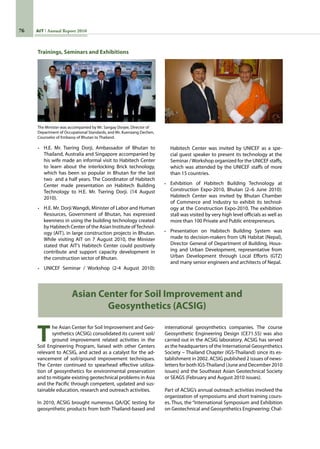
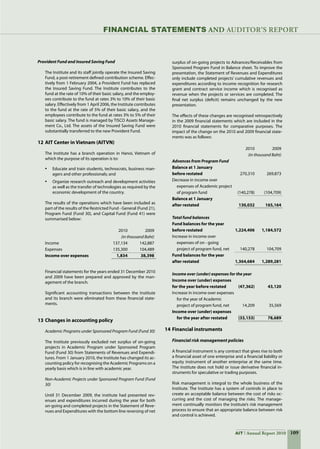
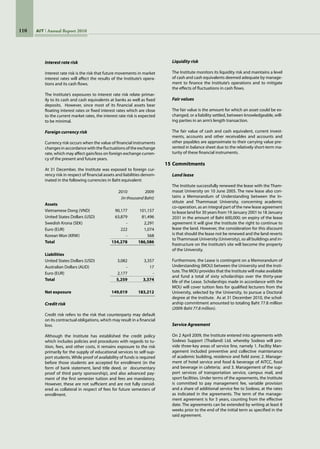
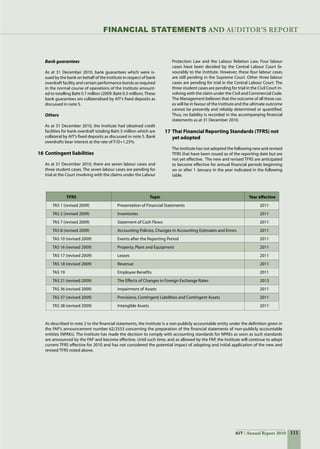
AIT Annual Report 2010
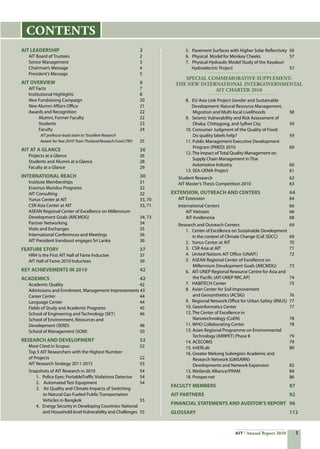
AIT LEADERSHIP	 2
	 AIT Board of Trustees	 2
	 Senior Management	 3
	 Chairman’s Message	 4
	 President’s Message	 5
AIT OVERVIEW	 6
	 AIT Facts	 7
	 Institutional Highlights	 8
	 New Fundraising Campaign	 20
	 New Alumni Affairs Office	 21
	 Awards and Recognition	 22
	           Alumni, Former Faculty	 22
	           Students	 23
	           Faculty	 24
	               AIT professor leads team to “Excellent Research
		 Award for Year 2010” from Thailand Research Fund (TRF)	 25
AIT AT A GLANCE	 26
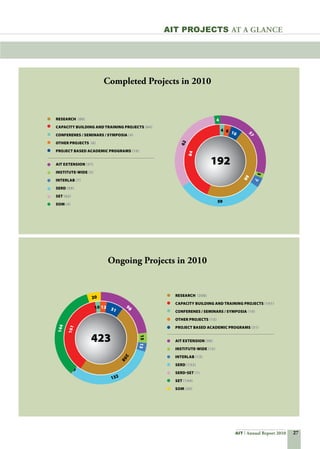
	 Projects at a Glance	 26
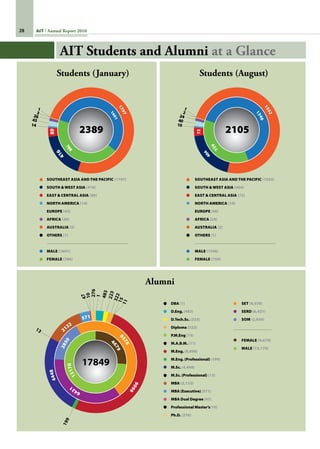
	 Students and Alumni at a Glance	 28
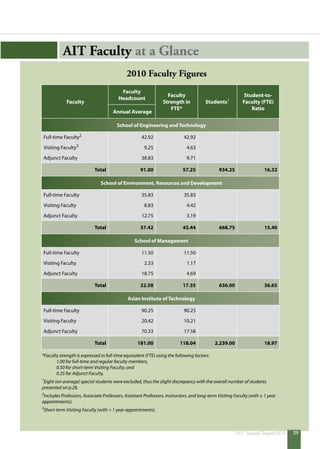
	 Faculty at a Glance	 29
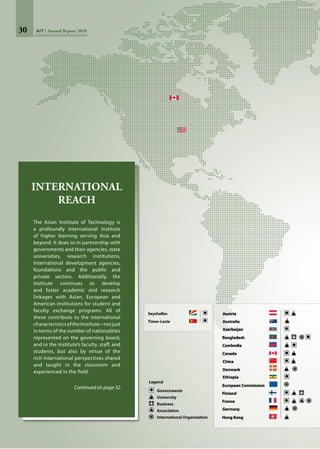
INTERNATIONAL REACH	 30
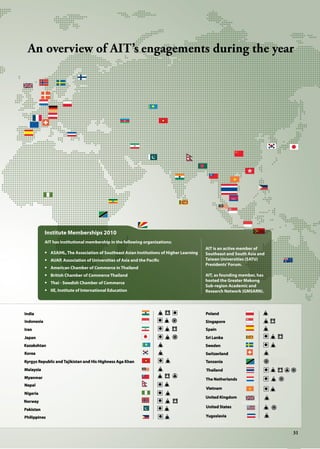
	 Institute Memberships	 31
	 Erasmus Mundus Programs	 32
	 AIT Consulting	 32
	 Yunus Center at AIT	 33, 70
	 CSR Asia Center at AIT	 33, 71
	 ASEAN Regional Center of Excellence on Millennium
	 Development Goals (ARCMDG)	 34, 73
	 Partner Networking	 34
	 Visits and Exchanges	 35
	 International Conferences and Meetings 	 36
	 AIT President Irandoust engages Sri Lanka 	 36
FEATURE STORY	 37
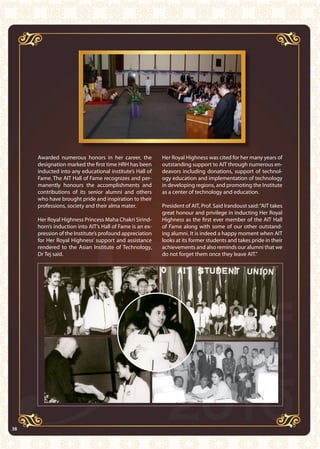
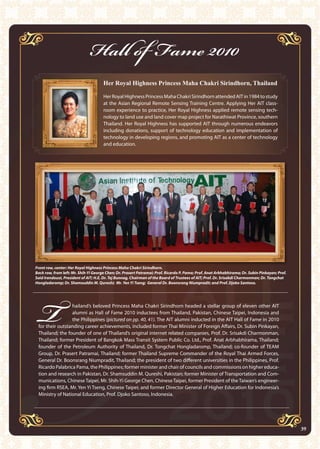
	 HRH is the First AIT Hall of Fame Inductee 	 37
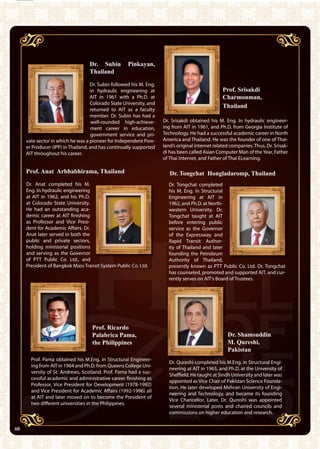
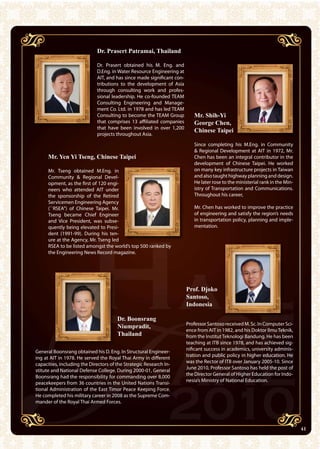
	 AIT Hall of Fame 2010 Inductees 	 39
KEY ACHIEVEMENTS IN 2010	 42
ACADEMICS	 42
	 Academic Quality	 42
	 Admissions and Enrolment, Management Improvements 43
	 Career Center	 44
	 Language Center	 44
	 Fields of Study and Academic Programs	 45
	 School of Engineering and Technology (SET) 	 46
	 School of Environment, Resources and
	 Develepment (SERD)	 48
	 School of Management (SOM)	 50
RESEARCH AND DEVELOPMENT	 52
	 Most Cited in Scopus	 52
	 Top 5 AIT Researchers with the Highest Number-
	 of Projects	 52
	 AIT Research Strategy 2011-2015	 53
	 Snapshots of AIT Research in 2010	 54
	 	 1.   Police Eyes: PortableTraffic Violations Detector	 54
	 	 2.    Automated Test Equipment	 54
	 	 3.    Air Quality and Climate Impacts of Switching
	 	        to Natural Gas-Fueled Public Transportation
  	 	        Vehicles in Bangkok	 55
	 	 4.   Energy Security in Developing Countries: National
	 	        and Household level Vulnerability and Challenges 	55
	 	 5.   Pavement Surfaces with Higher Solar Reflectivity	 56
	 	 6.   Physical  Model for Monkey Cheeks	 57
	 	 7.   Physical Hydraulic Model Study of the Xayaburi
	 	       Hydroelectric Project	 57
SPECIAL COMMEMORATIVE SUPPLEMENT:
THE NEW INTERNATIONAL INTERGOVERNMENTAL
AIT CHARTER 2010
	 	 8.   EU-Asia Link Project Gender and Sustainable
	 	       Development: Natural Resource Management,
	 	        Migration and Multi-local Livelihoods	 58
	 	 9.   Seismic Vulnerability and Risk Assessment of
	 	        Dhaka, Chittagong, and Sylhet City	 59
	 	 10. Consumer Judgment of the Quality of Food:
	 	        Do quality labels help?	 59
	 	 11. Public Management Executive Development
	 	        Program (PMED) 2010	 60
	 	 12. The Impact of Total Quality Management on
	 	        Supply Chain Management in Thai
	 	        Automotive Industry	 60
	 	 13. SEA-UEMA Project	 61
	 Student Research	 62
	 AIT Master’s Thesis Competition 2010	 63
EXTENSION, OUTREACH AND CENTERS	 64
	 AIT Extension	 64
	 International Centers 	 66
	 	 AIT Vietnam	 66
	 	 AIT Inodenesia	 68
	 Research and Outreach Centers	 69
	 	 1.   Center of Excellence on Sustainable Development
	 	        in the context of Climate Change (CoE SDCC)	 69
	 	 2.   Yunus Center at AIT	 70
	 	 3.   CSR Asia at AIT	 71
	 	 4.   United Nations AIT Office (UNAIT)	 72
	 	 5.   ASEAN Regional Center of Excellence on
	 	        Millennium Development Goals (ARCMDG)	 73
	 	 6.   AIT-UNEP Regional Resource Centre for Asia and
	 	        the Pacific (AIT-UNEP RRC.AP)	 74
	 	 7.   HABITECH Center	 75
	 	 8.   Asian Center for Soil Improvement
	     	        and Geosynthetics (ACSIG) 	 76
	 	 9.   Regional Network Office for Urban Safety (RNUS)	 77
	 	 10. Geoinformatics Center	 77
	 	 12. The Center of Excellence in
	 	        Nanotechnology (CoEN) 	 78
	 	 11. WHO Collaborating Center	 78
	 	 13. Asian Regional Programme on Environmental
	 	        Technology (ARRPET) Phase II	 79	
	 	 14. ACECOMS	 79
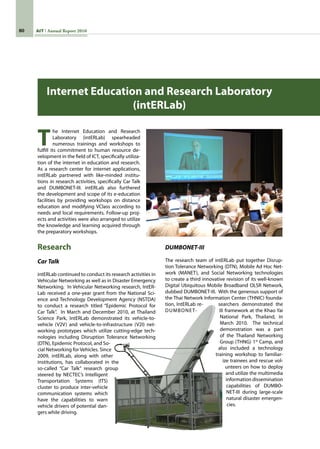
	 	 15. intERLab	 80
	 	 16. Greater Mekong Subregion Academic and
	 	        Research Network (GMSARN):
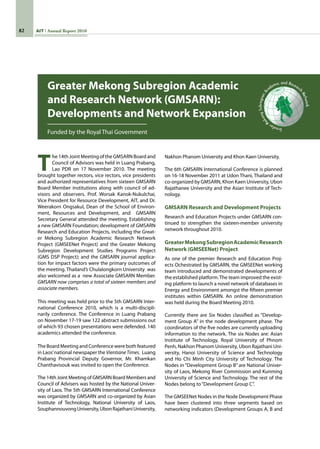
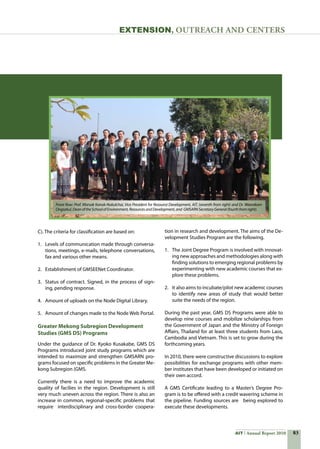
	 	        Developments and Network Expansion 	 82
	 	 13. Wetlands Alliance/PRAM	 84
	 	 18. Prosper.net	 86
FACULTY MEMBERS	 87
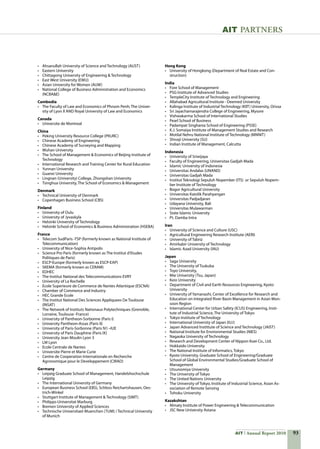
AIT PARTNERS	 92
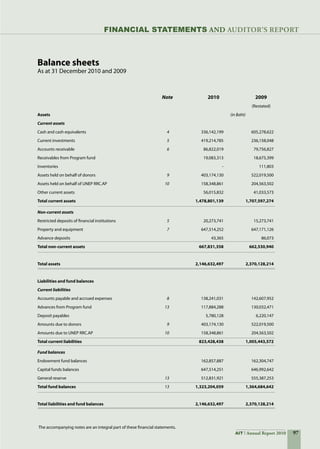
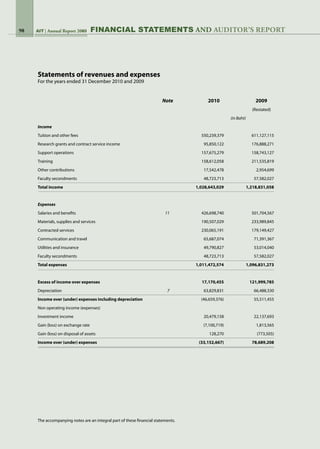
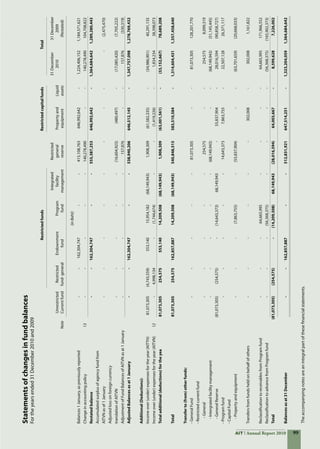
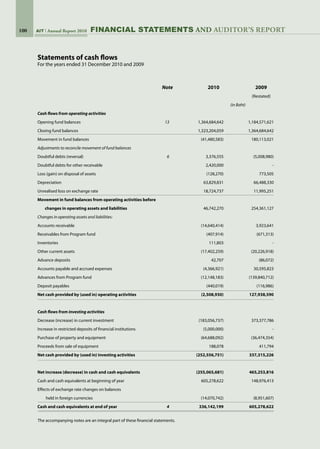
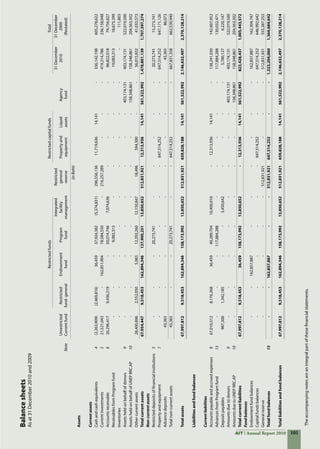
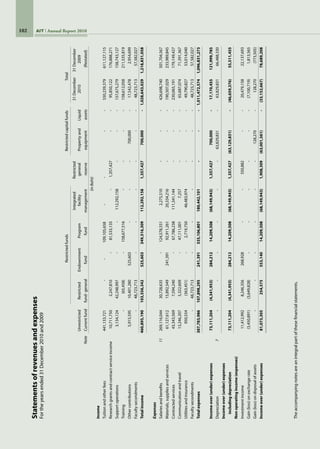
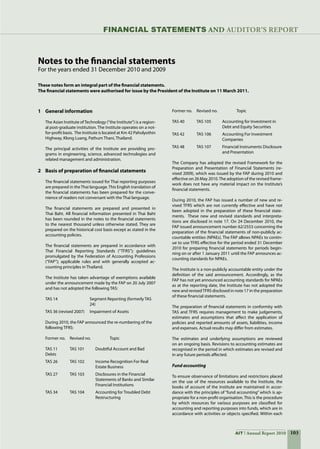
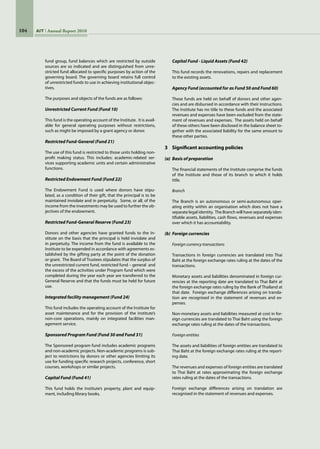
FINANCIAL STATEMENTS AND AUDITOR’S REPORT	 96
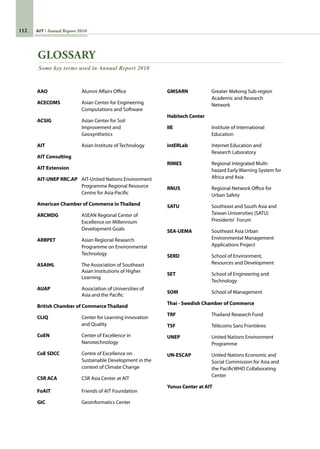
GLOSSARY	 112
CONTENTS
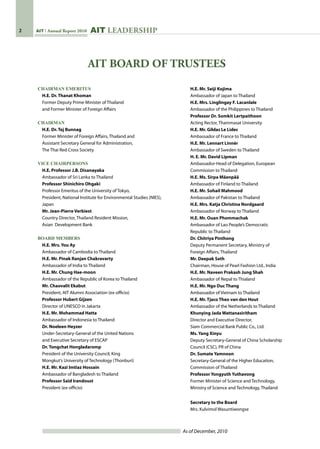
AIT Annual Report 2010 AIT LEADERSHIP
Chairman Emeritus
H.E. Dr. Thanat Khoman				
Former Deputy Prime Minister of Thailand
and Former Minister of Foreign Affairs
Chairman
H.E. Dr. Tej Bunnag				
Former Minister of Foreign Affairs, Thailand and
Assistant Secretary General for Administration,
The Thai Red Cross Society
						
Vice Chairpersons
H.E. Professor J.B. Disanayaka 	
Ambassador of Sri Lanka to Thailand
Professor Shinichiro Ohgaki	
Professor Emeritus of the University of Tokyo,
President, National Institute for Environmental Studies (NIES),
Japan
Mr. Jean-Pierre Verbiest	
Country Director, Thailand Resident Mission,
Asian  Development Bank
Board Members
H.E. Mrs. You Ay			
Ambassador of Cambodia to Thailand
H.E. Mr. Pinak Ranjan Chakravarty			
Ambassador of India to Thailand
H.E. Mr. Chung Hae-moon			
Ambassador of the Republic of Korea to Thailand
Mr. Chaovalit Ekabut 				
President, AIT Alumni Association (ex-officio)
Professor Hubert Gijzen				
Director of UNESCO in Jakarta
H.E. Mr. Mohammad Hatta 	
Ambassador of Indonesia to Thailand
Dr. Noeleen Heyzer 	
Under-Secretary-General of the United Nations
and Executive Secretary of ESCAP
Dr. Tongchat Hongladaromp			
President of the University Council, King
Mongkut’s University of Technology (Thonburi)
H.E. Mr. Kazi Imtiaz Hossain 			
Ambassador of Bangladesh to Thailand
Professor Said Irandoust			
President (ex-officio)
H.E. Mr. Seiji Kojima			
Ambassador of Japan to Thailand
H.E. Mrs. Linglingay F. Lacanlale 			
Ambassador of the Philippines to Thailand
Professor Dr. Somkit Lertpaithoon 		
Acting Rector, Thammasat University
H.E. Mr. Gildas Le Lidec			
Ambassador of France to Thailand
H.E. Mr. Lennart Linnér			
Ambassador of Sweden to Thailand
H. E. Mr. David Lipman 			
Ambassador-Head of Delegation, European
Commission to Thailand
H.E. Ms. Sirpa Mäenpää			
Ambassador of Finland to Thailand
H.E. Mr. Sohail Mahmood			
Ambassador of Pakistan to Thailand
H.E. Mrs. Katja Christina Nordgaard 		
Ambassador of Norway to Thailand
H.E. Mr. Ouan Phommachak		
Ambassador of Lao People’s Democratic
Republic to Thailand
Dr. Chitriya Pinthong		
Deputy Permanent Secretary, Ministry of
Foreign Affairs, Thailand
Mr. Deepak Seth			
Chairman, House of Pearl Fashion Ltd., India
H.E. Mr. Naveen Prakash Jung Shah 		
Ambassador of Nepal to Thialand
H.E. Mr. Ngo Duc Thang			
Ambassador of Vietnam to Thailand
H.E. Mr. Tjaco Theo van den Hout			
Ambassador of the Netherlands to Thailand
Khunying Jada Wattanasiritham			
Director and Executive Director,
Siam Commercial Bank Public Co., Ltd.
Ms. Yang Xinyu			
Deputy Secretary-General of China Scholarship
Council (CSC), PR of China
Dr. Sumate Yamnoon	
Secretary-General of the Higher Education,
Commission of Thailand
Professor Yongyuth Yuthavong	
Former Minister of Science and Technology,
Ministry of Science and Technology, Thailand
Secretary to the Board
Mrs. Kulvimol Wasuntiwongse
As of December, 2010
AIT BOARD OF TRUSTEES
AIT Annual Report 2010
Senior Management 2010
PRESIDENT
•	 Professor Said Irandoust
VICE PRESIDENTS
•	 Professor Joydeep Dutta, Academic Affairs (from 1 June 2010)
•	 Professor Sudip K. Rakshit, Research
•	 Professor Worsak Kanok-Nukulchai, Resource Development
DEANS
•	 Dr Barbara Igel, School of Management
•	 Dr Nitin V. Afzulpurkar, School of Engineering  Technology
•	 Dr Weerakorn Ongsakul, School of Environment, Resources 
	 Development
DIRECTORS
•	 Dr Amrit Bart, AIT Vietnam
•	 Dr Sugimin Pranoto, AIT Indonesia (until 30April 2010)
•	 Mr Nico Barito, AIT Indonesia (interim from 1 May 2010)
•	 Dr Jonathan L. Shaw, AIT Extension
•	 Professor Kanchana Kanchanasut, Internet Education  Research
	 Laboratory (intERLab)
•	 Dr Naveed Anwar, AIT Consulting
•	 Mr Sanjeev Jayasinghe, Fundraising
•	 Professor Jayant K. Routray, ASEAN Regional Center of Excellence on
	 Millennium Development Goals based at AIT (until 31 July 2010)
•	 Dr Sandro Calvani, ASEAN Regional Center of Excellence on Millennium
	 Development Goals based at AIT(from 1 September 2010)
•	 Professor Ajit P. Annachhatre, AIT-United Nations Office at AIT
•	 Mr Borje Wallberg, Yunus Center at AIT (until 31 March 2010)
•	 Dr Riaz Rahman Khan, Yunus Center at AIT (from 7 June 2010)
•	 Ms Leena Wokeck, CSR (Corporate Social Responsibility) Asia Center at AIT
•	 Dr Evangelos Angelos Afendras, Center for Learning Innovation  Quality
	 (until 31 January 2010)
•	 Professor Gabor Louis Hornyak, Center for Learning Innovation  Quality
	 (from 1 November 2010)
•	 Professor Dennes T. Bergado, Unified Programs at AIT (from 15 April 2010)
•	 Dr  Nitin Kumar Tripathi, Academic Quality Assurance and Accreditation at 	
	 AIT (until 1 June 2010)
•	 Mr Nicholas Innes-Taylor, Co-Director for Professional Programs at AIT
•	 Professor Richard J. Welford, Co-Director for Professional Programs at AIT
AIT Annual Report 2010
AIT Annual Report 2010 CHAIRMAN’S MESSAGE
T
he brainchild of one of Thailand’s great statesmen, H.E. Mr. Pote Sara-
sin, and established in 1959 by Royal Decree of His Majesty the King
of Thailand, the Asian Institute of Technology has always been a bold
example of a cosmopolitan approach to higher education in Asia.   
Formorethanahalf-century,AIT’suniqueethoshascontributedtotheachieve-
ment of peaceful integration and sustainable development in the region by
spurring the vast potential of its people with advanced levels of higher learn-
ing.
Honored with the Magsaysay Award in 1989 and the Friendship Order of the
Government of Vietnam in 2006, the Institute has played a significant role in
developing human capacity, thereby contributing to Asia’s rise in the world.
Her Royal Highness Princess Maha Chakri Sirindhorn’s induction into the new
AIT Hall of Fame in 2010 was an expression of the Institute’s profound ap-
preciation for Her Royal Highness’ support rendered to the Asian Institute of
Technology.  Indeed, the permanent induction into the Hall of Fame of eleven
deserving AIT alumni representing Pakistan, The Philippines, Chinese Taipei,
Indonesia and Thailand was a wonderful testament to AIT’s enduring ability to
inspire people to greatness.  
AIT’s historical mission took on added significance in 2010, when the Institute
embarked on a new path with the signing of the landmark Charter of the Asian
Institute of Technology. The re-establishment of AIT as an International Inter-
governmental Institution of higher learning marked the end of one era and the
beginning of a new one.
Signed by representatives of twelve countries and one international organi-
zation at the Ministry of Foreign Affairs of Thailand in Bangkok, the Charter
reaffirmed AIT’s commitment to the continent.  A signature development in
AIT’s history, the AIT Charter of 2010 signaled our intent to respond to today’s
complex realities by positioning AIT at the head of the queue in response to
the challenges facing Asia and beyond in the twenty-first century.
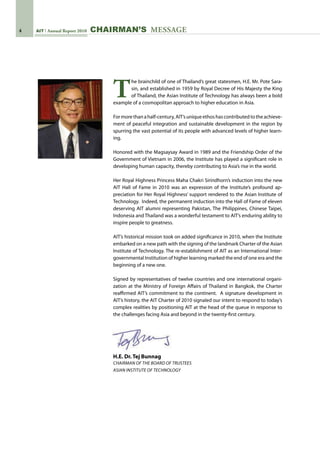
H.E. Dr. Tej Bunnag
Chairman of the Board of Trustees
Asian Institute of Technology
AIT Annual Report 2010
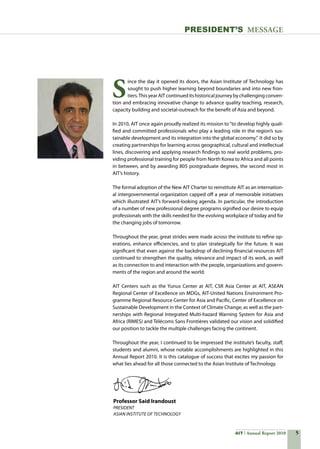
Professor Said Irandoust
PRESIDENT
Asian Institute of Technology
PRESIDENT’s MESSAGE
S
ince the day it opened its doors, the Asian Institute of Technology has
sought to push higher learning beyond boundaries and into new fron-
tiers.Thisyear AITcontinuedits historical journeybychallengingconven-
tion and embracing innovative change to advance quality teaching, research,
capacity building and societal-outreach for the benefit of Asia and beyond.
In 2010, AIT once again proudly realized its mission to“to develop highly quali-
fied and committed professionals who play a leading role in the region’s sus-
tainable development and its integration into the global economy.”  It did so by
creating partnerships for learning across geographical, cultural and intellectual
lines, discovering and applying research findings to real world problems, pro-
viding professional training for people from North Korea to Africa and all points
in between, and by awarding 805 postgraduate degrees, the second most in
AIT’s history.
The formal adoption of the New AIT Charter to reinstitute AIT as an internation-
al intergovernmental organization capped off a year of memorable initiatives
which illustrated AIT’s forward-looking agenda. In particular, the introduction
of a number of new professional degree programs signified our desire to equip
professionals with the skills needed for the evolving workplace of today and for
the changing jobs of tomorrow.
Throughout the year, great strides were made across the institute to refine op-
erations, enhance efficiencies, and to plan strategically for the future. It was
significant that even against the backdrop of declining financial resources AIT
continued to strengthen the quality, relevance and impact of its work, as well
as its connection to and interaction with the people, organizations and govern-
ments of the region and around the world.
AIT Centers such as the Yunus Center at AIT, CSR Asia Center at AIT, ASEAN
Regional Center of Excellence on MDGs, AIT-United Nations Environment Pro-
gramme Regional Resource Center for Asia and Pacific, Center of Excellence on
Sustainable Development in the Context of Climate Change, as well as the part-
nerships with Regional Integrated Multi-hazard Warning System for Asia and
Africa (RIMES) and Télécoms Sans Frontières validated our vision and solidified
our position to tackle the multiple challenges facing the continent.
Throughout the year, I continued to be impressed the institute’s faculty, staff,
students and alumni, whose notable accomplishments are highlighted in this
Annual Report 2010. It is this catalogue of success that excites my passion for
what lies ahead for all those connected to the Asian Institute of Technology.
AIT Annual Report 2010
H
ome to many of the region’s top
experts, the Asian Institute of
Technology (AIT) is one of Asia’s
leading higher learning institutions. Situ-
ated just north of metropolitan Bangkok,
AIT focuses on engineering and technol-
ogy, environmental resources and de-
velopment, management and capacity-
building. More than a national university,
AIT is a unique international intergovern-
mental organization that is regionally fo-
cused, global in outlook and cosmopoli-
tan in character.
Founded in 1959, AIT fosters an ex-
ceptional learning experience in a
multicultural environment that reach-
es beyond boundaries.Today it carries
out its mission … “to develop highly
qualified and committed profession-
als who play a leading role in the re-
gion’s sustainable development and
its integration into the global econo-
my” … by supporting technological
change and sustainable development
through rigorous academics, research,
capacity building and outreach.
	 AIT engages with public and private
sector partners throughout the region
and with some of the top universities
and international organizations in the
world. In addition to its main campus in
Bangkok, Thailand, AIT has established
centers in Vietnam and Indonesia.
	 The main AIT campus in Thailand is
a tremendous mosaic of nationalities,
ethnicities and socioeconomic back-
grounds. Diversity of students, staff
and faculty members is a valued part
of campus life and leads to levels of
AIT OVERVIEW
AIT Annual Report 2010
OVERVIEW
Students: 2,300 from 50+ countries
Faculty: 120+ from 20+ countries   
Alumni: 18,000 from 85 countries
Partners: 330
Schools: 3
Research and Outreach Centers: 15
Research  Outreach Projects: 400	
Fields of Study: 32
Research Staff: 100+
AIT OVERVIEW
cross-cultural engagement and in-
ternational experiences not found
at other university campuses.
	 AIT’s degree programs are pro-
vided by its School of Engineering
and Technology; School of Environ-
ment, Resources and Development;
and School of Management. Stu-
dents benefit from challenging aca-
demic programs and exciting fac-
ulty-student research projects. All
of these combine to make AIT the
choice for talented people who are
intellectually curious, and dedicated
to advancing their lives through an
exceptional higher learning experi-
ence.
	 In addition to offering degree
courses (bachelor, master’s and doc-
toral), AIT offers short courses / train-
ing programs through AIT Extension,
and consultancy services through AIT
Consultancy. AIT also houses a num-
ber of research and outreach centers,
such as the Center of Excellence in
Nanotechnology; ASEAN Regional
Center of Excellence on the Millennium
Development Goals (ARCMDG); Yunus
Center at AIT, established in partnership
with Professor MuhammadYunus, recipi-
ent of the 2006 Nobel Peace Prize; CSR
Asia Center at AIT; and the Centre of Ex-
cellence on Sustainable Development in
the Context of Climate Change (SDCC).
	 AIT is host to the 3RKH - Reduce, Re-
use and Recycle Regional Knowledge
Hub supported by the Asian Develop-
ment Bank (ABD), UNEP and UNESCAP.
AIT also hosts the AIT-UNEP Regional
Resource Centre for Asia and the Pacific
(AIT-UNEP RRC.AP), a joint center with
UNEP; the Regional Integrated Multi-
hazard Early Warning System for Asia
and Africa (RIMES); and the Asia office of
Télécoms Sans Frontières.
	 Through its faculty from more than 20
countries, its student body from over 50
countries and its 18,000 graduate-level
alumni from 85 countries, AIT produces
global citizens rooted in the perspectives
of Asia.  With partners all over the world,
a five-decade-long history of academic
excellence, and an enduring reputation
for responding to emerging regional
and global challenges, AIT is advancing
new understanding and applying prac-
tical solutions across Asia, through its
knowledge hub in Thailand. Respond-
ing to today’s reality with a progressive
New Charter, AIT is positioned as an ideal
place to take on the new challenges of
the new century.
AIT Facts
AIT Annual Report 2010
JANUARY
AIT among founders of
new Amata Science City
AIT was among the founders of the
new “Amata Science City” in Chon
Buri province’s Amata Nakorn In-
dustrial Estate. It joined a number
of leading higher education insti-
tutions and private sector firms in
Thailand in signing a Memoran-
dum of Understanding (MoU) on
7 January 2010. Eight leading Thai-
based universities and institutes
and Amata Corporation Public
Company Limited participated in
the initiative which is supported by
the National Science and Technol-
ogy Development Agency (NSTDA)
in the form of Public-Private Part-
nership (PPP). Dr. Khunying Kalaya
Sophonpanich, Minister of Sci-
ence and Technology, Royal Thai
Government, and Chairman of the
Signing Ceremony described it as
an “historic day” for the scientific,
educational, and industrial sectors
of Thailand.
ARCMDG holds first
advisory board meeting
The first Advisory Board meeting
of ASEAN Regional Center of Excel-
lence on Millennium Development
Goals (ARCMDG) expressed its sat-
isfaction on the progress achieved
by ARCMDG since its establish-
ment. The Board also decided to
further collaboration with the CSR
Asia Center at AIT, Yunus Center at
AIT and AIT’s Center of Excellence
on Sustainable Development in the
Context of Climate Change (SDCC)
to catalyze and help achievements
of MDGs in the ASEAN Region. It
was also decided that the AIT Ex-
tension and the Geoinformatics
Center would be main partners for
implementing different training
programs. Mr. Apichai Sunchin-
dah, Dato’ Dr. Ahamed bin Sipon,
Dr. Donald Tambunan, Dr. Francois
Loriot, Dr. Gothom Arya, Dr. Hanifa
Mezoui, and Ms. Nanako Tsukahara
(represented for Mr. Minar Pimple)
attended the meeting. Prof. Jay-
ant K. Routray, Director of the AR-
CMDG, highlighted the activities
undertaken so far by ARCMDG.
Consultants present their
findings on higher
education
External consultants Dr. Markku
Oksanen and Mr. Niclas Lindgren
presented their interim findings
on the scenario of higher educa-
tion. They stated that student mo-
bility numbers are expected to rise
to 7.2 million by the year 2025 and
half of these students would origi-
nate from China and India. During
a presentation, they revealed that
one-third of the global investment
in higher education is occurring
in Asia, and that China and India
have a pool of 40 million students.
Mr. Niclas Lindgren works as the
Managing Director and Senior
Management Consultant at Cerion
Solutions Limited, and has special
expertise on developing the pub-
lic sector and the higher education
sector, in particular in Scandinavia.
Dr. Markku works for Poyry plc as
a director responsible for business
development in Asia in the envi-
ronment and water engineering
sector.
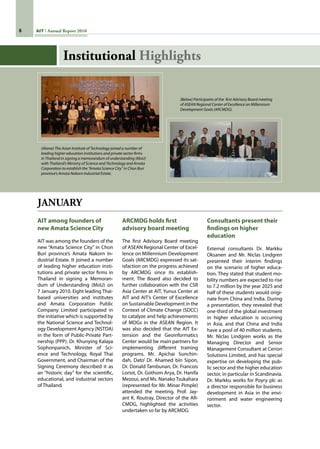
(Above) The Asian Institute of Technology joined a number of
leading higher education institutions and private sector firms
in Thailand in signing a memorandum of understanding (MoU)
with Thailand’s Ministry of Science and Technology and Amata
Corporation to establish the “Amata Science City” in Chon Buri
province’s Amata Nakorn Industrial Estate.
(Below) Participants of the first Advisory Board meeting
of ASEAN Regional Center of Excellence on Millennium
Development Goals (ARCMDG).
Institutional Highlights
AIT Annual Report 2010
FEBRUARY
Indian Ambassador pays
maiden visit to AIT
Ambassador of the Republic of In-
dia to Thailand, H.E. Mr. Pinak Ran-
jan Chakravarty, on his maiden visit
to AIT, reaffirmed Indian support to
the Institute. During an interaction
withseniorAITmanagementaswell
as members of the AIT-India Task
Force, the Ambassador revealed
that during a recent education fair
at Bangkok, almost 60 institutes
from India had participated. He re-
called that during his school days,
many of his classmates were from
Thailand. AIT President Prof. Said
Irandoust briefed the Ambassador
on issues related to AIT’s strategic
direction, apart from issues of out-
sourcing and public-private part-
nership.The Ambassador remarked
that the Indian government was
already outsourcing a significant
number of service operations to
the private sector, since the public
sector was unable to cope with the
volume of services.
AIT demonstrates model of
Monkey Cheek Project
The steering committee for “Mon-
key Cheek Physical Model for Sa-
nam Chai-Mahachai Canal Project:
The King of Thailand’s Initiative,”
expressed full satisfaction at the
demonstration project during a
visit to AIT. Dr. Sumet Tantivejkul,
Executive Chairperson of the ad-
visory committee for the project,
made his remarks work during a
demonstration at the AIT outdoor
laboratory. AIT President Prof. Said
Irandoust remarked that AIT was
proud to be part of a project which
is dear to His Majesty the King of
Thailand. The Monkey Cheek proj-
ect in Thailand’s Mahachai-Sanam-
chai Canals performs the function
of storing flood waters in the upper
areas, while at the same time re-
leasing water into the Gulf of Thai-
land in relation to the tide levels of
the sea by relying on the appropri-
ate use of gravity and pumping sta-
tions.
Germany assures
AIT of support
Germany assured AIT of its support,
while suggesting that new partner-
ship mechanisms should be explored.
H. E. Dr. Hanns Schumacher, Ambassa-
dorofGermanytoThailand,duringhis
visit to AIT, suggested that AIT engage
itself in establishing the ASEAN-Ger-
man University or the Asian-German
University, which could be similar to
the Vietnam-German University that
was established in 2008 at Ho Chi
Minh City, Vietnam. The Ambassador
was particularly interested in AIT’s
involvement in capacity building in
Afghanistan, and advised AIT to get
in touch with the German embassy in
Afghanistan to explore possible part-
nerships. AIT involvement with vari-
ous African countries, namely South
Africa, Ethiopia, Nigeria and Uganda
in the areas of capacity building and
higher learning in science and tech-
nology for development was also
discussed. H.E Dr. Schumacher also
expressed satisfaction at the current
Deutscher Akademischer Austausch
Dienst (DAAD) scholarships for stu-
dents from Cambodia, Laos, Myanmar
and Vietnam to attend AIT.
INSTITUTIONAL HIGHLIGHTS
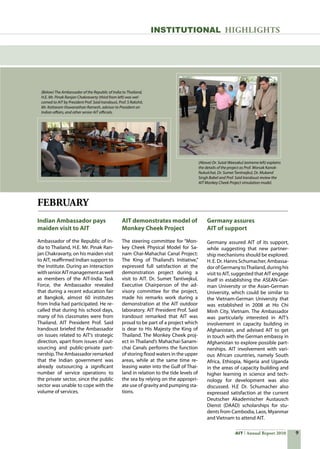
(Below) The Ambassador of the Republic of India to Thailand,
H.E. Mr. Pinak Ranjan Chakravarty (third from left) was wel-
comed to AIT by President Prof. Said Irandoust, Prof. S Rakshit,
Mr. Kottaram Viswanathan Ramesh, advisor to President on
Indian affairs, and other senior AIT officials.
(Above) Dr. Sutat Weesakul (extreme left) explains
the details of the project as Prof. Worsak Kanok-
Nukulchai, Dr. Sumet Tantivejkul, Dr. Mukand
Singh Babel and Prof. Said Irandoust review the
AIT Monkey Cheek Project simulation model.
10 AIT Annual Report 2010
MARCH
CSR Asia Center at AIT
launched
The Corporate Social Responsibility
(CSR) Asia Center at AIT was formally
launched at a grand function orga-
nized at the Foreign Correspondents’
Club ofThailand in Bangkok. AIT Presi-
dent Prof. Said Irandoust signed a for-
mal agreement with Chairman of CSR
Asia, Dr. Richard Welford, for the es-
tablishment of this Center in the  pres-
ence of H.E. Mr. Kasit Piromya, Minister
of Foreign Affairs of Thailand. The Re-
port: “Corporate Social Responsibility
in Thailand” was also released in the
presence of the Foreign Minister of
Thailand. The Center is a joint venture
partnership between the Asian Insti-
tute of Technology (AIT) and CSR Asia.
The new center is situated on the main
AIT campus in Pathumthani, Thailand.
The new Center, which will focus its re-
search, training, and consultancy work
on Thailand and the Greater Mekong
Sub-region, is the first-of-its-kind for
CSR Asia. The tie-up with an institu-
tion of higher learning like AIT brings
the unique opportunity to launch an
Executive Master’s degree in CSR.
EHMF to install Micro
Hydro Solar Hybrid System
The EBARA Hatakeyama Memo-
rial Fund (EHMF), Japan signed an
MoA with AIT for the installation of
a Micro Hydro – Solar Hybrid Sys-
tem at AIT’s Energy Park.  An EHMF
delegation, led by Mr. Shotaro
Kuryu, Managing Executive Officer
for Fluid Machinery and Systems
Company, EBARA Corporation,
visited AIT to sign the agreement.
Micro Hydro – Solar Hybrid System
is a micro hydro generating system
using a standardized agricultural
pump as a turbine. The system will
be installed along with the existing
energy generation system at AIT.
The equipment, and its installation
and operation will be funded by
EHMF.
ADB Vice President
compliments AIT Strategy
2013
Dr. Bindu N. Lohani, Vice President,
Asia Development Bank (ADB)
complimented AIT for its Strategy
2013 by stating that a strategy
helps in clearing what he termed
as “goal congestion” within orga-
nizations. He also appreciated AIT
President Prof. Said Irandoust for
the regular interactions and ex-
change of ideas being organized
at AIT. An AIT alumnus, having
received his Doctoral Degree in
Environmental Engineering (Envi-
ronmental Technology and Man-
agement) from AIT in 1977, Dr. Lo-
hani also delivered an extramural
lecture on campus. He stated that
the shift from the public to the
private sector implies that new
jobs and skills like public-private
partnership (PPP) specialists and
private sector development spe-
cialists will be in demand and re-
place earlier jobs like agricultural
credit specialists and agrono-
mists. He identified risk manage-
ment specialists, climate change
specialists, regional cooperation
specialists, resettlement special-
ists, environmental safeguard
specialists, results management
specialists and webmasters as
emerging jobs.
Institutional Highlights
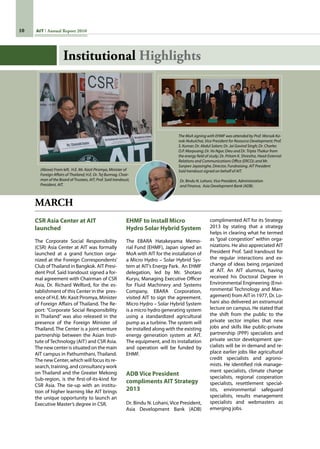
The MoA signing with EHMF was attended by Prof. Worsak Ka-
nok-Nukulchai, Vice President for Resource Development; Prof.
S. Kumar; Dr. Abdul Salam; Dr. Jai Govind Singh; Dr. Charles
O.P. Marpuang; Dr. Vo Ngoc Dieu and Dr. Tripta Thakur from
the energy field of study; Dr. Pritam K. Shrestha, Head-External
Relations and Communications Office (ERCO); and Mr. 	
Sanjeev Jayasinghe, Director, Fundraising. AIT President
Said Irandoust signed on behalf of AIT.
Dr. Bindu N. Lohani, Vice President, Administration
and Finance, Asia Development Bank (ADB).
(Above) From left, H.E. Mr. Kasit Piromya, Minister of
Foreign Affairs of Thailand; H.E. Dr. Tej Bunnag, Chair-
man of the Board of Trustees, AIT; Prof. Said Irandoust,
President, AIT.
11AIT Annual Report 2010
APRIL
Five AIT students
volunteer for Télécoms
Sans Frontières roster
FiveAITstudentsjoinedthevolun-
teer force of Télécoms Sans Fron-
tières (TSF) after completion of
the TSF three-day training sched-
ule. The training included hands-
on sessions on mobile satellite
devices, WiFi, GPS and mapping,
apart from information on admin-
istration, finances and communi-
cations for emergency operations.
The training camp ended with a
simulation exercise. The Asia-Pa-
cific base of TSF is located at AIT‘s
main campus in Thailand. AIT stu-
dents worked with TSF in disaster
relief operations in Manila, which
was affected by Tropical Storm
Ketsana, and at Tuguegarao, Phil-
ippines, which was affected by
Typhoon Parma in October 2009.
They also participated in a relief
operation in Pakistan following
an earthquake that impacted the
country in November 2008.
University Pierre et Marie
Curie interested in AIT
France’s University Pierre et Marie Cu-
rie (UPMC), Paris evinced interest in
collaborating with AIT, particularly in
offering joint courses at the Master’s
level.Dr.GilbertBéréziat,VicePresident
for International Relations of UPMC,
who was accompanied by Dr. Isabelle
Limon-Boulez, Researcher in Natural
Sciences at UPMC, revealed that UPMC
had created 15 International Master’s
and three international Bachelor’s
programs. The offerings are currently
targeted towards European and North
American markets and UPMC is seek-
ing to diversity towards South and
South-East Asia. UPMC is particularly
keen to explore partnerships in the
field of medical imaging and medical
robotics. Receiving the delegates, Prof.
Sudip K. Rakshit, Vice President (Re-
search), remarked that AIT has a very
active mechatronics field of study.
UPMC and AIT could synergize their
energies in the field of medical engi-
neering, he told the delegation while
adding that AIT was already working
with many European institutions and
encouraging mobility among faculty,
students and staff.
AIT Mathivation Center’s
training seminar in
Cambodia
131 teachers and students from
eight provinces in Cambodia par-
ticipated in a “Training Seminar on
Educational and Entrepreneurship
Resourcefulness,” organized at Khe-
marak University in Phnom Penh,
Cambodia by the AIT Mathivation
Center. The seminar followed a re-
quest by Dr. Chan Roath, President
of the Cambodian Mathematical
Society and Director of the Scien-
tific Research Department at the
Cambodian Ministry of Education,
Youth and Sports. Organized by Mr.
Farid Nolen, visiting fellow at AIT, the
seminar was one among many in the
series of workshops organized by
the AIT Mathivation Center. Earlier
a workshop was held for teachers
of Ruamrudee International School
(RIS) on the use of storytelling, meta-
phors, experiential learning and phi-
losophy of life and communication
style as pedagogical tools to make
mathematics and science educa-
tion interesting. A teaching training
workshop was also organized at Sa-
vannakhet University in Lao PDR.
INSTITUTIONAL HIGHLIGHTS
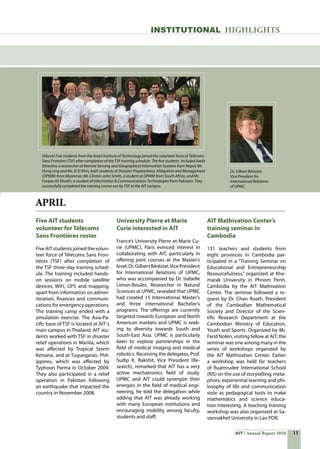
(Above) Five students from the Asian Institute of Technology joined the volunteer force of Télécoms
Sans Frontière (TSF) after completion of the TSF training schedule. The five students included Aadit
Shrestha, a researcher at Remote Sensing and Geographical Information Systems from Nepal; Mr.
Hung Ling and Ms. Ei Ei Khin, both students at Disaster Preparedness, Mitigation and Management
(DPMM) from Myanmar; Mr. Clinton John Smith, a student at DPMM from South Africa, and Mr.
Furqan Ali Shaikh, a student of Information  Communications Technologies from Pakistan. They
successfully completed the training course run by TSF at the AIT campus.
Dr. Gilbert Béréziat,
Vice President for
International Relations
of UPMC.
12 AIT Annual Report 2010
MAY
IROST signs agreement
with AIT on climate change
technologies
The Iranian Research Organization
for Science and Technology (IROST),
along with other partners signed
a contract with AIT on a host on is-
sues including identifying early stage
green technologies, reducing green-
house gas emissions, and conducting
economic assessment of the impact
of climate change. The agreement
was signed by the President of AIT,
Prof. Said Irandoust with Prof. Abbas
Taeb, President, IROST; Dr. Mahmoud
Molanejad, Director, IOR-ARC.RCSTT;
and Mr. Mohammad Panahifar, Gen-
eral Manager, MIM. The contract was
signed in the presence of H.E. Mr Ma-
jid Bizmark, Ambassador of Iran to
Thailand and Mr. Homayoun Rous-
taei Khoshkebijari, Counsellor and
Deputy Head of Mission. H.E. Mr. Ma-
jid Bizmark expressed hope that the
contract with AIT would help bring
researchers from Iran and AIT togeth-
er. The ambassador also remarked
that AIT was a reputed institution in
the region and that it is well accepted
by the Iranian Government.
534 students graduate
Five-hundred and thirty-four stu-
dents received their degrees at the
113th Graduation Ceremony of the
Asian Institute ofTechnology on 26
May 2010. Thirty-one students re-
ceived doctoral degrees while the
others received Master’s degrees.
Delivering the commencement
address during the morning ses-
sion, H.E. Prof. J.B. Disanayaka, Am-
bassador of Sri Lanka to Thailand,
welcomed the students “From the
groves of academe to the world of
reality.” The ambassador defined
graduation as a landmark, turning
point in life. Delivering the com-
mencement address during the
afternoon session, Dr. Prasert Pa-
tramai, Chairman, TEAM group of
companies, remarked that AIT had
provided him “adequate knowl-
edge for the development and use
of technology for solving many
key problems in Asia.” An alumnus
of AIT, Dr. Prasert said AIT alumni
are increasingly occupying key
positions within the Asia-Pacific
region.
Sweden’s Sida optimistic
about continued
partnership
Two senior officials of the Swedish
International Development Coopera-
tion Agency (Sida) paid a fact-finding
visit to AIT and expressed optimism
that existing partnerships between
AIT and Sida should evolve and pros-
per well into the future. Mr. Magnus
Lindell, Assistant Director General,
Head of Operations, Swedish Inter-
national Development Cooperation
Agency (Sida), Stockholm and Prof.
Anders Granlund, Counsellor, Direc-
tor, Swedish Environment Secretariat
in Asia (SENSA), Embassy of Sweden,
Bangkok visited AIT. Mr. Lindell in-
formed that the next phase of Sida-
AIT Cooperation would continue
under the new format of its umbrella
funding principle. “We certainly look
forward to concluding evolving
forms of cooperation with AIT,” Mag-
nus Lindell said, emphasizing ways in
which Sida, through its extensive ar-
ray of global networks, could assist to
attract partners for cooperation with
AIT. AIT’s formal cooperation with
Sida started in 1988.
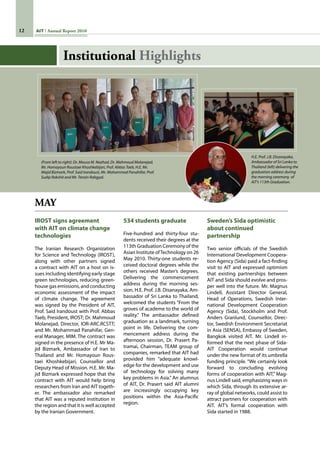
H.E. Prof. J.B. Disanayaka,
Ambassador of Sri Lanka to
Thailand (left) delivering the
graduation address during
the morning ceremony of
AIT’s 113th Graduation.
(From left to right): Dr. Mousa M. Nazhad, Dr. Mahmoud Molanejad,
Mr. Homayoun Roustaei Khoshkebijari, Prof. Abbas Taeb, H.E. Mr.
Majid Bizmark, Prof. Said Irandoust, Mr. Mohammad Panahifar, Prof.
Sudip Rakshit and Mr. Tenzin Rabgyal.
Institutional Highlights
13AIT Annual Report 2010
JUNE
UNDP views AIT as a
‘‘capacity building arm’’
The United Nations Development
Program (UNDP) would like to further
utilize AIT as an“implementing or ca-
pacity building arm” in the region. A
UNDP delegation led by Mr. Nicholas
Rosellini, Deputy Assistant Adminis-
trator and Deputy Regional Director
at the Regional Bureau for Asia and
the Pacific UNDP, evinced keen inter-
est in AIT, particularly in the activities
of ASEAN Regional Center of Excel-
lence for Millennium Development
Goals (ARCMDG). UNDP is working
closely with ARCMDG to establish the
MDG roadmap for the ASEAN region.
Mr. Rosellini was also interested in
the projects implemented under the
Wetland Alliance Program (WAP), Yu-
nus Center at AIT, and AIT Extension.
UNDP’s Asia-Pacific Regional Centre
(APRC) is keen to engage AIT on its
training and outreach programs. AIT
can work with available UNDP data by
converting and archiving it into “case
studies”. UNDP also expressed inter-
est in AIT’s work on“social protection”
and officials said how there could be
synergies in this important area.
US Embassy Thailand,
AIT discuss‘creative
possibilities’
Ms. Cynthia A. Griffin, Commercial
Counselor, Embassy of the United
States of America in Thailand, and
Ms. Jennie Ness, Regional Intellec-
tual Property Officer, US Patent and
Trademark Office, Embassy of the
United States of America in Thai-
land, visited AIT to explore possibili-
ties for collaboration. AIT President
Prof. Said Irandoust welcomed the
delegation and noted how the em-
bassy’s initiatives dovetail with the
aspirations of the Asian Institute of
Technology. Reminding the officials
of America’s instrumental role in the
founding of AIT, and of its significant
impact on the historical develop-
ment of the Institute, the president
enjoined the United States to join
AIT again in full partnership. Ms. Grif-
fin explained that the United States
was working in close partnership
with the Government of Thailand to
assist the country to realize its goal
of achieving a“creative economy.”
CIRAD inks partnerships
with AIT
CIRAD (Centre de coopération
internationale en recherche
agronomique pour le développe-
ment) and AIT, reaffirmed their
partnership by signing a MOU and
two MOA’s. The agreements were
signed by Dr. Jean-Chalres Mail-
lard, Regional Director of CIRAD
for Continental South East Asia,
and Prof. Said Irandoust, Presi-
dent. The two institutions decided
to promote cooperation in joint
research and academic exchanges
focused on sustainable develop-
ment. The agreements stated that
the two partners would jointly
promote education, research and
outreach cooperation by encour-
aging direct contact and coopera-
tion between their departments,
research units and scientists.
INSTITUTIONAL HIGHLIGHTS
Mr. Nicholas Rosellini, Deputy Assistant Administrator
and Deputy Regional Director at the Regional Bureau
for Asia and the Pacific UNDP.
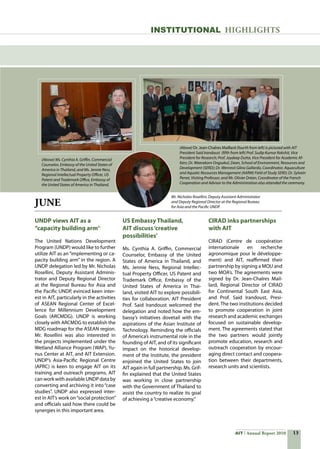
(Above) Dr. Jean-Chalres Maillard (fourth from left) is pictured with AIT
President Said Irandoust (fifth from left) Prof. Sudip Kumar Rakshit, Vice
President for Research; Prof. Joydeep Dutta, Vice President for Academic Af-
fairs; Dr. Weerakorn Ongsakul, Dean, School of Environment, Resources and
Development (SERD); Dr. Wenresti Glino Gallardo, Coordinator, Aquaculture
and Aquatic Resources Management (AARM) Field of Study SERD; Dr. Sylvain
Perret, Visiting Professor, and Mr. Olivier Dréan, Coordinator of the French
Cooperation and Advisor to the Administration also attended the ceremony.
(Above) Ms. Cynthia A. Griffin, Commercial
Counselor, Embassy of the United States of
America in Thailand, and Ms. Jennie Ness,
Regional Intellectual Property Officer, US
Patent and Trademark Office, Embassy of
the United States of America in Thailand.
14 AIT Annual Report 2010
JULY
U.S. Under Secretary Burns
describes AIT as a“world
class”institute
H.E. William J. Burns, Under Sec-
retary for Political Affairs, United
States, described AIT as “world
class.” He stated this while deliver-
ing a talk, “A Renewed U.S.-Thai
Alliance for the 21st Century” at
Chulalongkorn University. While
describing his visit to Bangkok
as “a part of a larger effort by the
Obama administration to enhance
and deepen our engagement in
the Asia-Pacific, and in particular,
in Southeast Asia and with ASEAN,”
the distinguished diplomat made a
special reference to U.S.-Thai Cre-
ative Partnership.  In the context of
U.S.-Thai Creative Partnership, H.E.
Burns stated that “Western Digital’s
work with the world-class Asian
Institute of Technology in Thailand
to develop degree programs in In-
formation Technology is just one
example of the type of cooperation
we want to expand under this Cre-
ative Partnership.”
AIT ties up with Institute of
Scientific Research, Boston
College
AITsignedanMoAwiththeInstitute
of Scientific Research (ISR), Boston
College, USA to forge cooperative
research under the framework of
Scintillation Network Decision Aid
(SCINDA) research network. ISR
and AIT will conduct regional re-
search on geodynamics, real-time
corrections of Global Positioning
System (GPS) signals from solar
extremes, and solar flares in upper
atmosphere. ISR’s SCINDA com-
prises of high-precision GPS Base
station and Very High Frequency
(VHF) receivers. SCINDA involves
over 40 institutions and is a net-
work of ground sensors developed
to generate real-time communica-
tion outage maps and warnings
for satellite communication and
GPS users. It ensures exchange of
ionospheric data recorded by each
institution as a part of collabora-
tive research activities.
Timor Leste needs
strong involvement of
AIT: Minister
Minister of Agriculture and Fish-
eries of Timor Leste, H.E. Mariano
Assanami Sabino, called for strong
involvement of AIT, in a meeting
of the country’s Strategic Program
2020 for Agricultural Growth and
Sustainable Food Security. The
Minister stated this following con-
sultative meetings held after the
two-day national workshop on“Re-
view of Rice Cultivation Systems in
Timor Leste” held in Dili on June
29-30, 2010. The Minister stressed
the need for the presence of AIT at
this meeting to assist in formulat-
ing a five-year plan of activities for
rice intensification. The two-day
national workshop was hosted by
the MAF (Timor Leste) in co-spon-
sorship with German Technical Co-
operation (GTZ), European Union
(EU), and AIT.
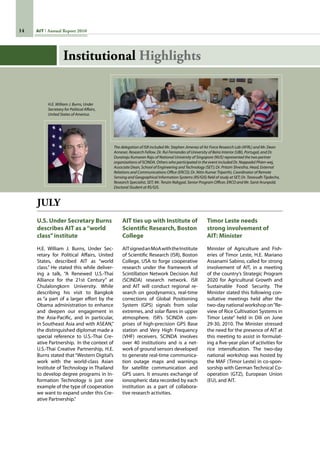
The delegation of ISR included Mr. Stephen Jimenez of Air Force Research Lab (AFRL) and Mr. Dean
Anneser, Research Fellow. Dr. Rui Fernandes of University of Beira Interior (UBI), Portugal, and Dr.
Durairaju Kumaran Raju of National University of Singapore (NUS) represented the two partner
organizations of SCINDA. Others who participated in the event included Dr. Noppadol Phien-wej,
Associate Dean, School of Engineering and Technology (SET); Dr. Pritam Shrestha, Head, External
Relations and Communications Office (ERCO); Dr. Nitin Kumar Triparthi, Coordinator of Remote
Sensing and Geographical Information Systems (RS/GIS) field of study at SET; Dr. Taravudh Tipdecho,
Research Specialist, SET; Mr. Tenzin Rabgyal, Senior Program Officer, ERCO and Mr. Sanit Arunpold,
Doctoral Student at RS/GIS.
H.E. William J. Burns, Under
Secretary for Political Affairs,
United States of America.
Institutional Highlights
15AIT Annual Report 2010
AUGUST
Her Royal Highness
Princess Maha Chakri
Sirindhorn graces AIT
booth at Science Fair
Her Royal Highness Princess Maha
ChakriSirindhorngracedthebooth
set up by AIT at the Science and
Technology Fair organized at the
Bitech Bang–Na Conference Cen-
ter in Bangkok. After inaugurating
the fair, Her Royal Highness visited
the AIT booth where Prof. Athapol
Noonhom, Coordinator, Food En-
gineering and Bioprocess Technol-
ogy field of study presented vari-
ous research projects undertaken
by the School of Environment, Re-
sources and Development (SERD)
and the School of Engineering
and Technology (SET). Among the
projects at the display included
“Production of Instant Rice Us-
ing Combined Microwave-Fluid-
ized Bed Drying” by Ms.Jiraporn
Sripinyowanich, and Mr.Ekkapong
Cheevitsopon. Supervised by Prof.
Athapol Noonhom (SERD), the
project is funded by the Royal Thai
Government.
French Ambassador
signals continued
commitment to AIT
Ambassador of France to Thailand
H.E. Gildas Le Lidec, during his maid-
en visit to the Asian Institute of Tech-
nology (AIT), reaffirmed the com-
mitment of France to sign the new
AIT Charter. The French Delegation,
including Mr. Maurice Siveton, Coun-
selor for Regional Cooperation in
Southeast Asia and his Assistant Ms.
Cécile Farau, toured the AIT campus.
Visiting Faculty, Prof. Noël Crespi,
seconded byTelecom Sud Paris (TSP)
introduced AIT students who had re-
ceived scholarships from France to
pursue a dual degree at TSP. The del-
egation witnessed a demonstration
of the CanalAVIST project at AIT’s in-
tERLab, as well as the demonstration
the virtual dentistry project ‘Haptics’
that has been developed by the
Computer Science and Information
Management field of study in part-
nership with Thammasat University.
A tsunami demonstration was orga-
nized at the Water Engineering and
Management (WEM) field of study
by Dr. Mukand Singh Babel.
Bhutan explores AIT Habi-
tech’s sustainable building
technology
H.E. Mr. Dorji Wangdi, Minister of
Labour and Human Resources,
Government of Bhutan, expressed
keenness in using the building
technology created by AIT’s Habi-
tech Center in large construction
projects in Bhutan. While visiting
AIT, the Minister stated that AIT’s
Habitech Center could positively
contribute to and support capac-
ity development of the construc-
tion sector in Bhutan. The Minister
was accompanied by Mr. Sangay
Dorjee, Director of Department of
Occupational Standards, and Mr.
Kuenzang Dechen, Counsellor of
the Embassy of Bhutan to Thai-
land. Mr. Gyanendra R. Sthapit, Co-
ordinator of the Habitech Center
also met Deputy Prime Minister
and Minister of Works and Human
Settlement of Bhutan, H.E. Yeshey
Jimba, during the “Bhutan Con-
struction Expo 2010” where AIT’s
Habitech Center’s technology was
showcased.
INSTITUTIONAL HIGHLIGHTS
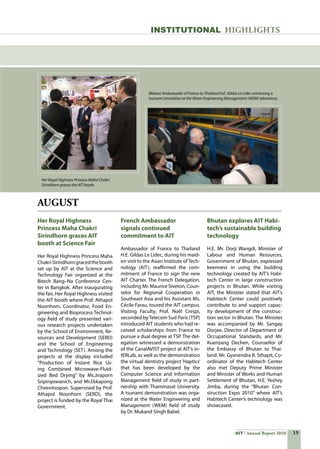
Her Royal Highness Princess Maha Chakri
Sirindhorn graces the AIT booth.
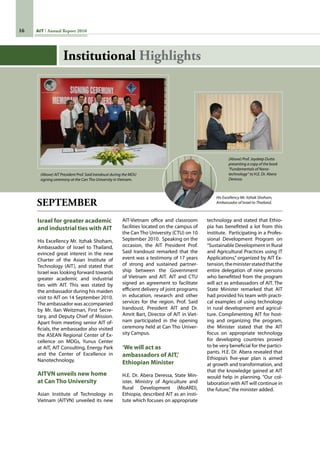
(Below) Ambassador of France to Thailand H.E. Gildas Le Lidec witnessing a
tsunami simulation at the Water Engineering Management (WEM) laboratory.
16 AIT Annual Report 2010
SEPTEMBER
Israel for greater academic
and industrial ties with AIT
His Excellency Mr. Itzhak Shoham,
Ambassador of Israel to Thailand,
evinced great interest in the new
Charter of the Asian Institute of
Technology (AIT), and stated that
Israel was looking forward towards
greater academic and industrial
ties with AIT. This was stated by
the ambassador during his maiden
visit to AIT on 14 September 2010.
The ambassador was accompanied
by Mr. Ilan Weitzman, First Secre-
tary, and Deputy Chief of Mission.
Apart from meeting senior AIT of-
ficials, the ambassador also visited
the ASEAN Regional Center of Ex-
cellence on MDGs, Yunus Center
at AIT, AIT Consulting, Energy Park
and the Center of Excellence in
Nanotechnology.
AITVN unveils new home
at Can Tho University
Asian Institute of Technology in
Vietnam (AITVN) unveiled its new
AIT-Vietnam office and classroom
facilities located on the campus of
the Can Tho University (CTU) on 10
September 2010.  Speaking on the
occasion, the AIT President Prof.
Said Irandoust remarked that the
event was a testimony of 17 years
of strong and sustained partner-
ship between the Government
of Vietnam and AIT. AIT and CTU
signed an agreement to facilitate
efficient delivery of joint programs
in education, research and other
services for the region. Prof. Said
Irandoust, President AIT and Dr.
Amrit Bart, Director of AIT in Viet-
nam participated in the opening
ceremony held at Can Tho Univer-
sity Campus.
‘We will act as
ambassadors of AIT,’
Ethiopian Minister
H.E. Dr. Abera Deressa, State Min-
ister, Ministry of Agriculture and
Rural Development (MoARD),
Ethiopia, described AIT as an insti-
tute which focuses on appropriate
technology and stated that Ethio-
pia has benefitted a lot from this
institute.  Participating in a Profes-
sional Development Program on
“Sustainable Development in Rural
and Agricultural Practices using IT
Applications,” organized by AIT Ex-
tension,theministerstatedthatthe
entire delegation of nine persons
who benefitted from the program
will act as ambassadors of AIT. The
State Minister remarked that AIT
had provided his team with practi-
cal examples of using technology
in rural development and agricul-
ture. Complimenting AIT for host-
ing and organizing the program,
the Minister stated that the AIT
focus on appropriate technology
for developing countries proved
to be very beneficial for the partici-
pants. H.E. Dr. Abera revealed that
Ethiopia’s five-year plan is aimed
at growth and transformation, and
that the knowledge gained at AIT
would help in planning. “Our col-
laboration with AIT will continue in
the future,”the minister added.
His Excellency Mr. Itzhak Shoham,
Ambassador of Israel to Thailand.
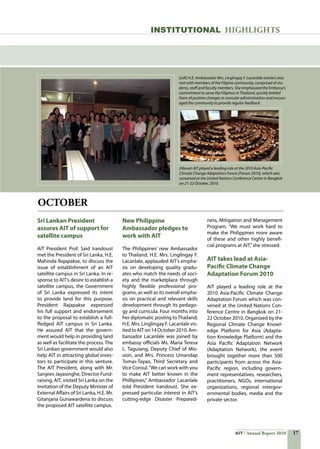
(Above) AIT President Prof. Said Irandoust during the MOU
signing ceremony at the Can Tho University in Vietnam.
(Above) Prof. Joydeep Dutta
presenting a copy of the book
“Fundamentals of Nano-
technology” to H.E. Dr. Abera
Deressa.
Institutional Highlights
17AIT Annual Report 2010
OCTOBER
Sri Lankan President
assures AIT of support for
satellite campus
AIT President Prof. Said Irandoust
met the President of Sri Lanka, H.E.
Mahinda Rajapakse, to discuss the
issue of establishment of an AIT
satellite campus in Sri Lanka. In re-
sponse to AIT’s desire to establish a
satellite campus, the Government
of Sri Lanka expressed its intent
to provide land for this purpose.
President Rajapakse expressed
his full support and endorsement
to the proposal to establish a full-
fledged AIT campus in Sri Lanka.
He assured AIT that the govern-
ment would help in providing land
as well as facilitate the process. The
Sri Lankan government would also
help AIT in attracting global inves-
tors to participate in this venture.
The AIT President, along with Mr.
Sanjeev Jayasinghe, Director Fund-
raising, AIT, visited Sri Lanka on the
invitation of the Deputy Minister of
External Affairs of Sri Lanka, H.E. Mr.
Gitanjana Gunawardena to discuss
the proposed AIT satellite campus.
New Philippine
Ambassador pledges to
work with AIT
The Philippines’ new Ambassador
to Thailand, H.E. Mrs. Linglingay F.
Lacanlale, applauded AIT’s empha-
sis on developing quality gradu-
ates who match the needs of soci-
ety and the marketplace through
highly flexible professional pro-
grams, as well as its overall empha-
sis on practical and relevant skills
development through its pedago-
gy and curricula. Four months into
her diplomatic posting toThailand,
H.E. Mrs. Linglingay F. Lacanlale vis-
itedtoAITon14October2010.Am-
bassador Lacanlale was joined by
embassy officials Ms. Maria Teresa
L. Taguiang, Deputy Chief of Mis-
sion, and Mrs. Princess Umandap
Tomas-Tayao, Third Secretary and
Vice Consul.“We can work with you
to make AIT better known in the
Phillipines,” Ambassador Lacanlale
told President Irandoust. She ex-
pressed particular interest in AIT’s
cutting-edge Disaster Prepared-
ness, Mitigation and Management
Program. “We must work hard to
make the Philippines more aware
of these and other highly benefi-
cial programs at AIT,”she stressed.
AIT takes lead at Asia-
Pacific Climate Change
Adaptation Forum 2010
AIT played a leading role at the
2010 Asia-Pacific Climate Change
Adaptation Forum which was con-
vened at the United Nations Con-
ference Centre in Bangkok on 21-
22 October 2010. Organized by the
Regional Climate Change Knowl-
edge Platform for Asia (Adapta-
tion Knowledge Platform) and the
Asia Pacific Adaptation Network
(Adaptation Network), the event
brought together more than 500
participants from across the Asia-
Pacific region, including govern-
ment representatives, researchers,
practitioners, NGOs, international
organizations, regional intergov-
ernmental bodies, media and the
private sector.
INSTITUTIONAL HIGHLIGHTS
(Left) H.E. Ambassador Mrs. Linglingay F. Lacanlale (center) also
met with members of the Filipino community, comprised of stu-
dents, staff and faculty members. She emphasized the Embassy’s
commitment to serve the Filipinos in Thailand, quickly briefed
them of positive changes in consular administration and encour-
aged the community to provide regular feedback.
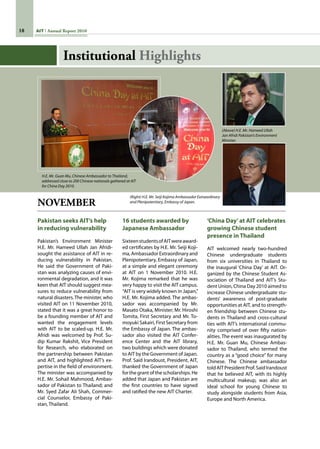
(Above) AIT played a leading role at the 2010 Asia-Pacific
Climate Change Adaptation Forum (Forum 2010), which was
convened at the United Nations Conference Centre in Bangkok
on 21-22 October, 2010.
18 AIT Annual Report 2010
NOVEMBER
Pakistan seeks AIT’s help
in reducing vulnerability
Pakistan’s Environment Minister
H.E. Mr. Hameed Ullah Jan Afridi-
sought the assistance of AIT in re-
ducing vulnerability in Pakistan.
He said the Government of Paki-
stan was analyzing causes of envi-
ronmental degradation, and it was
keen that AIT should suggest mea-
sures to reduce vulnerability from
natural disasters.The minister, who
visited AIT on 11 November 2010,
stated that it was a great honor to
be a founding member of AIT and
wanted the engagement levels
with AIT to be scaled-up. H.E. Mr.
Afridi was welcomed by Prof. Su-
dip Kumar Rakshit, Vice President
for Research, who elaborated on
the partnership between Pakistan
and AIT, and highlighted AIT’s ex-
pertise in the field of environment.
The minister was accompanied by
H.E. Mr. Sohail Mahmood, Ambas-
sador of Pakistan to Thailand; and
Mr. Syed Zafar Ali Shah, Commer-
cial Counselor, Embassy of Paki-
stan, Thailand.
16 students awarded by
Japanese Ambassador
SixteenstudentsofAITwereaward-
ed certificates by H.E. Mr. Seiji Koji-
ma,Ambassador Extraordinary and
Plenipotentiary, Embassy of Japan,
at a simple and elegant ceremony
at AIT on 1 November 2010. H.E.
Mr. Kojima remarked that he was
very happy to visit the AIT campus.
“AIT is very widely known in Japan,”
H.E. Mr. Kojima added. The ambas-
sador was accompanied by Mr.
Masato Otaka, Minister; Mr. Hiroshi
Tomita, First Secretary and Mr. To-
moyuki Sakairi, First Secretary from
the Embassy of Japan. The ambas-
sador also visited the AIT Confer-
ence Center and the AIT library,
two buildings which were donated  
to AIT by the Government of Japan.
Prof. Said Irandoust, President, AIT,
thanked the Government of Japan
for the grant of the scholarships. He
added that Japan and Pakistan are
the first countries to have signed
and ratified the new AIT Charter.
‘China Day’at AIT celebrates
growing Chinese student
presence in Thailand
AIT welcomed nearly two-hundred
Chinese undergraduate students
from six universities in Thailand to
the inaugural ‘China Day’ at AIT. Or-
ganized by the Chinese Student As-
sociation of Thailand and AIT’s Stu-
dent Union, China Day 2010 aimed to
increase Chinese undergraduate stu-
dents’ awareness of post-graduate
opportunities at AIT, and to strength-
en friendship between Chinese stu-
dents in Thailand and cross-cultural
ties with AIT’s international commu-
nity comprised of over fifty nation-
alities. The event was inaugurated by
H.E. Mr. Guan Mu, Chinese Ambas-
sador to Thailand, who termed the
country as a “good choice” for many
Chinese. The Chinese ambassador
toldAITPresidentProf.SaidIrandoust
that he believed AIT, with its highly
multicultural makeup, was also an
ideal school for young Chinese to
study alongside students from Asia,
Europe and North America.
H.E. Mr. Guan Mu, Chinese Ambassador to Thailand,
addressed close to 200 Chinese nationals gathered at AIT
for China Day 2010.
(Right) H.E. Mr. Seiji Kojima Ambassador Extraordinary
and Plenipotentiary, Embassy of Japan.
(Above) H.E. Mr. Hameed Ullah
Jan Afridi Pakistan’s Environment
Minister.
Institutional Highlights
19AIT Annual Report 2010
AIT builds its brand
in Myanmar
With plentiful opportunities existing for
AIT in neighboring Myanmar, AIT Presi-
dent Prof. Said Irandoust led a team of
AIT officials on a three-day promotional
visit to Thailand’s neighbor where they
met with some of the country’s senior
higher education administrators. Presi-
dent Irandoust began the visit on De-
cember 2 by attending the International
Conference on Science and Engineering
(ICSE) 2010 organized by universities
under Myanmar’s Ministry of Science
and Technology (MOST). Prof. Irandoust
delivered an opening address in which
he highlighted the need for modern
universities to change.
‘AIT is a marvelous institute,’
Pakistan Minister
“AIT has been a driving force and had
it not been for its contribution, I would
not be visiting AIT.” This was stated by
H.E. Mr. Muhammad Azam Khan Swati,
Federal Minister for Science and Tech-
nology, Pakistan, during his maiden visit
to AITon8 December2010.TheMinister
described AIT as a“marvelous institute,”
DECEMBER
and Pakistan as a “long haul partner”
of AIT. H.E. Swati stated that Pakistan
was looking forward towards an en-
hanced partnership with AIT, particu-
larly in offering dual degree courses.
The Minister welcomed the proposal
of Prof. Said Irandoust, President, AIT,
to establish an AIT satellite campus
in Pakistan. He proposed students’
and faculty exchanges between AIT
and COMSATS Institute of Informa-
tion Technology. The Minister sought
AIT’s expertise in helping Pakistan
commercialize research and devel-
opment activities. The Minister also
addressed members of the Pakistan
Students Association (PSA).
Eminent Pakistani scientist
conferred honorary degree
at AIT’s 114th Graduation
Two-hundred and twenty students
from 20 countries and three conti-
nents received graduate degrees at
AIT’s 114th Graduation Ceremony, an
occasion which also saw the confer-
ment of the honorary degree of Doc-
tor of Philosophy (Honoris Causa)
on Pakistan’s eminent scientist H.E.
Professor Atta-Ur-Rahman. Mr. David
Hulse, The Ford Foundation Represen-
tative, Jakarta, Indonesia, delivered the
Convocation Address. Vietnamese stu-
dents represented the largest number of
graduates by nationality with 110, while
Thais made up the second largest group
with 61, followed by India and Nepal
.
U.S. State Department Advisor
elaborates on Lower Mekong
Initiative
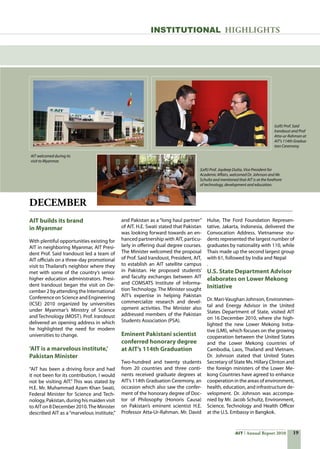
Dr. Mari-Vaughan Johnson, Environmen-
tal and Energy Advisor in the United
States Department of State, visited AIT
on 16 December 2010, where she high-
lighted the new Lower Mekong Initia-
tive (LMI), which focuses on the growing
cooperation between the United States
and the Lower Mekong countries of
Cambodia, Laos, Thailand and Vietnam.
Dr. Johnson stated that United States
Secretary of State Ms. Hillary Clinton and
the foreign ministers of the Lower Me-
kong Countries have agreed to enhance
cooperation in the areas of environment,
health, education, and infrastructure de-
velopment. Dr. Johnson was accompa-
nied by Mr. Jacob Schultz, Environment,
Science, Technology and Health Officer
at the U.S. Embassy in Bangkok.
INSTITUTIONAL HIGHLIGHTS
AIT welcomed during its
visit to Myanmar.
(Left) Prof. Said
Irandoust and Prof
Atta-ur-Rahman at
AIT’s 114th Gradua-
tion Ceremony.
(Left) Prof. Joydeep Dutta, Vice President for
Academic Affairs, welcomed Dr. Johnson and Mr.
Schultz and mentioned that AIT is at the forefront
of technology, development and education.
20 AIT Annual Report 201020 AIT Annual Report 2010
D
uring AIT’s memorable 51st Anniversary
celebration in September 2010, all of those
present witnessed the soft launch of the AIT
Endowment Fund Campaign, which was presided
over by Her Royal Highness Princess Maha Chakri
Sirindhorn who is also an AIT alumna and honorary
faculty member.The event attracted 352 participants
ranging from alumni, former faculty, AIT Board of
Trustee members, faculty and staff, VIP members and
honored guests.
After AIT’s first 50 years, the AIT alumni network has
grown significantly and increasingly has become one
ofAIT’smostvaluableassets.Toshowitsappreciation,
AIT inaugurated its first ever“AIT Hall of Fame”during
the same event. Aside from accepting the invitation
to be the first inductee of the AIT Hall of Fame 2010,
HRH Princess Sirindhorn presented Hall of Fame tro-
phies to 11 other eminent alumni inductees.
“For Creative Global
Leaders of Tomorrow”
The year saw the launch of the first ever fundraising
campaign for the institute.The 7-year Campaign from
2010 – 2016 involves an initial silent phase focused
on internal members. The public phase and latter
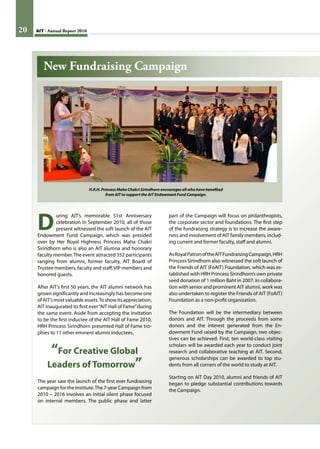
H.R.H. Princess Maha Chakri Sirindhorn encourages all who have benefited
from AIT to support the AIT Endowment Fund Campaign.
part of the Campaign will focus on philanthropists,
the corporate sector and foundations. The first step
of the fundraising strategy is to increase the aware-
ness and involvement of AIT family members, includ-
ing current and former faculty, staff and alumni.
AsRoyalPatronoftheAITFundraisingCampaign,HRH
Princess Sirindhorn also witnessed the soft launch of
the Friends of AIT (FoAIT) Foundation, which was es-
tablished with HRH Princess Sirindhorn’s own private
seed donation of 1 million Baht in 2007. In collabora-
tion with senior and prominent AIT alumni, work was
also undertaken to register the Friends of AIT (FoAIT)
Foundation as a non-profit organization.
The Foundation will be the intermediary between
donors and AIT. Through the proceeds from some
donors and the interest generated from the En-
dowment Fund raised by the Campaign, two objec-
tives can be achieved. First, ten world-class visiting
scholars will be awarded each year to conduct joint
research and collaborative teaching at AIT. Second,
generous scholarships can be awarded to top stu-
dents from all corners of the world to study at AIT.
Starting on AIT Day 2010, alumni and friends of AIT
began to pledge substantial contributions towards
the Campaign.
New Fundraising Campaign
21AIT Annual Report 2010
I
n 2010, the Alumni Affairs Office (AAO) was
established to serve as the main focal point
for individual alumni and the AIT Alumni
Association (AITAA), and to liaise between AIT,
AITAA and its national/regional chapters in a
wide array of programs, including social activi-
ties, continuing education and professional de-
velopment, among others.
The new office will work to increase the effec-
tiveness and regularity of alumni communi-
cations through all possible communications
means, such as website, periodicals and alumni
directory.The office will also actively create part-
nerships between AIT and alumni, and between
alumni in areas of mutual interest.
The AAO will take a role in fostering interaction
between the alumni and current students in the
form of industrial mentorships, internships and
job opportunities. The AIT Alumni Affairs Office
will help in connecting, networking and enrich-
ing AIT alumni and its partners in supporting the
strategic goals of their alma mater.
New AIT Alumni
Affairs Office
launched
INSTITUTIONAL HIGHLIGHTS
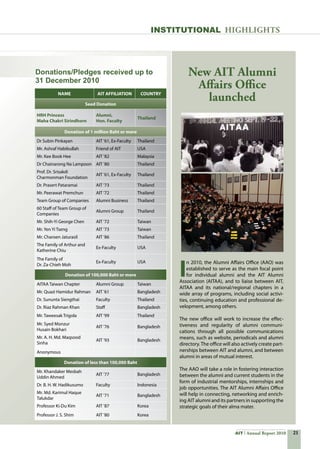
Donations/Pledges received up to
31 December 2010
NAME AIT AFFILIATION COUNTRY
Seed Donation
HRH Princess
Maha Chakri Sirindhorn
Alumni,
Hon. Faculty
Thailand
Donation of 1 million Baht or more
Dr Subin Pinkayan AIT ’61, Ex-Faculty Thailand
Mr. Ashraf Habibullah Friend of AIT USA
Mr. Kee Book Hee AIT ’82 Malaysia
Dr Chainarong Na Lampoon AIT ’80 Thailand
Prof. Dr. Srisakdi
Charmonman Foundation
AIT ’61, Ex-Faculty Thailand
Dr. Prasert Pataramai AIT ’73 Thailand
Mr. Peerawat Premchun AIT ’72 Thailand
Team Group of Companies Alumni Business Thailand
60 Staff of Team Group of
Companies
Alumni Group Thailand
Mr. Shih-Yi George Chen AIT ’72 Taiwan
Mr. Yen Yi Tseng AIT ’73 Taiwan
Mr. Charoen Jaturasil AIT ’86 Thailand
The Family of Arthur and
Katherine Chiu
Ex-Faculty USA
The Family of
Dr. Za-Chieh Moh
Ex-Faculty USA
Donation of 100,000 Baht or more
AITAA Taiwan Chapter Alumni Group Taiwan
Mr. Quazi Hamidur Rahman AIT ’61 Bangladesh
Dr. Sununta Siengthai Faculty Thailand
Dr. Riaz Rahman Khan Staff Bangladesh
Mr. Taweesak Trigola AIT ’99 Thailand
Mr. Syed Monzur
Husain Bokhari
AIT ’76 Bangladesh
Mr. A. H. Md. Maqsood
Sinha
AIT ’93 Bangladesh
Anonymous
Donation of less than 100,000 Baht
Mr. Khandaker Mesbah
Uddin Ahmed
AIT ’77 Bangladesh
Dr. B. H. W. Hadikusumo Faculty Indonesia
Mr. Md. Karimul Haque
Talukdar
AIT ’71 Bangladesh
Professor Ki-Du Kim AIT ’87 Korea
Professor J. S. Shim AIT ’80 Korea
22 AIT Annual Report 2010
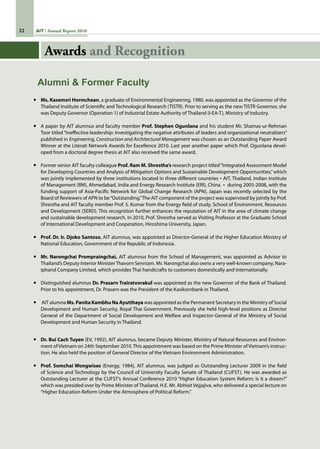
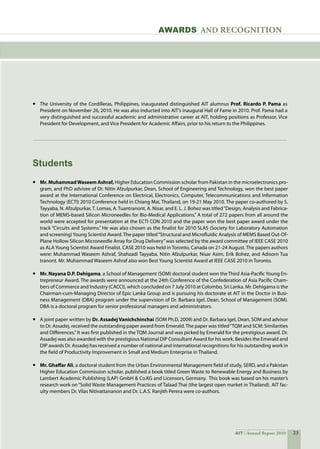
•	 Ms. Kasemsri Hormchean, a graduate of Environmental Engineering, 1980, was appointed as the Governor of the
Thailand Institute of Scientific and Technological Research (TISTR). Prior to serving as the new TISTR Governor, she
was Deputy Governor (Operation 1) of Industrial Estate Authority of Thailand (I-EA-T), Ministry of Industry.
•	 A paper by AIT alumnus and faculty member Prof. Stephen Ogunlana and his student Mr. Shamas-ur-Rehman
Toor titled“Ineffective leadership: Investigating the negative attributes of leaders and organizational neutralizers”
published in Engineering, Construction and Architectural Management was chosen as an Outstanding Paper Award
Winner at the Literati Network Awards for Excellence 2010. Last year another paper which Prof. Ogunlana devel-
oped from a doctoral degree thesis at AIT also received the same award.
•	 Former senior AIT faculty colleague Prof. Ram M. Shrestha’s research project titled“Integrated Assessment Model
for Developing Countries and Analysis of Mitigation Options and Sustainable Development Opportunities,”which
was jointly implemented by three institutions located in three different countries - AIT, Thailand, Indian Institute
of Management (IIM), Ahmedabad, India and Energy Research Institute (ERI), China  -  during 2005-2008, with the
funding support of Asia-Pacific Network for Global Change Research (APN), Japan was recently selected by the
Board of Reviewers of APN to be“Outstanding.”The AIT component of the project was supervised by jointly by Prof.
Shrestha and AIT faculty member Prof. S. Kumar from the Energy field of study, School of Environment, Resources
and Development (SERD). This recognition further enhances the reputation of AIT in the area of climate change
and sustainable development research. In 2010, Prof. Shrestha served as Visiting Professor at the Graduate School
of International Development and Cooperation, Hiroshima University, Japan.
•	 Prof. Dr. Ir. Djoko Santoso, AIT alumnus, was appointed as Director-General of the Higher Education Ministry of
National Education, Government of the Republic of Indonesia.
•	 Mr. Narongchai Prompraingchai, AIT alumnus from the School of Management, was appointed as Advisor to
Thailand’s Deputy Interior MinisterThavorn Senniam. Mr. Narongchai also owns a very well-known company, Nara-
iphand Company Limited, which provides Thai handicrafts to customers domestically and internationally.
•	 Distinguished alumnus Dr. Prasarn Trairatvorakul was appointed as the new Governor of the Bank of Thailand.
Prior to his appointment, Dr. Prasarn was the President of the Kasikornbank in Thailand.
•	 AIT alumna Ms. Panita Kambhu Na Ayutthaya was appointed as the Permanent Secretary in the Ministry of Social
Development and Human Security, Royal Thai Government. Previously she held high-level positions as Director
General of the Department of Social Development and Welfare and Inspector-General of the Ministry of Social
Development and Human Security in Thailand.
•	 Dr. Bui Cach Tuyen (EV, 1992), AIT alumnus, became Deputy Minister, Ministry of Natural Resources and Environ-
ment ofVietnam on 24th September 2010.This appointment was based on the Prime Minister ofVietnam’s instruc-
tion. He also held the position of General Director of the Vietnam Environment Administration.
•	 Prof. Somchai Wongwises (Energy, 1984), AIT alumnus, was judged as Outstanding Lecturer 2009 in the field
of Science and Technology by the Council of University Faculty Senate of Thailand (CUFST). He was awarded as
Outstanding Lecturer at the CUFST’s Annual Conference 2010 “Higher Education System Reform: Is it a dream?”
which was presided over by Prime Minister of Thailand, H.E. Mr. Abhisit Vejjajiva, who delivered a special lecture on
“Higher Education Reform Under the Atmosphere of Political Reform.”
Alumni  Former Faculty
Awards and Recognition
23AIT Annual Report 2010
•	 The University of the Cordilleras, Philippines, inaugurated distinguished AIT alumnus Prof. Ricardo P. Pama as
President on November 26, 2010. He was also inducted into AIT’s inaugural Hall of Fame in 2010. Prof. Pama had a
very distinguished and successful academic and administrative career at AIT, holding positions as Professor, Vice
President for Development, and Vice President for Academic Affairs, prior to his return to the Philippines.
•	 Mr. MuhammadWaseem Ashraf, Higher Education Commission scholar from Pakistan in the microelectronics pro-
gram, and PhD advisee of Dr. Nitin Afzulpurkar, Dean, School of Engineering and Technology, won the best paper
award at the International Conference on Electrical, Electronics, Computer, Telecommunications and Information
Technology (ECTI) 2010 Conference held in Chiang Mai, Thailand, on 19-21 May 2010. The paper co-authored by S.
Tayyaba, N. Afzulpurkar,T. Lomas, A. Tuantranont, A. Nisar, and E. L. J. Bohez was titled“Design, Analysis and Fabrica-
tion of MEMS-based Silicon Microneedles for Bio-Medical Applications.” A total of 272 papers from all around the
world were accepted for presentation at the ECTI CON 2010 and the paper won the best paper award under the
track “Circuits and Systems.” He was also chosen as the finalist for 2010 SLAS (Society for Laboratory Automation
and screening)Young Scientist Award. The paper titled“Structural and Microfluidic Analysis of MEMS Based Out-Of-
Plane Hollow Silicon Microneedle Array for Drug Delivery”was selected by the award committee of IEEE CASE 2010
as ALA Young Scientist Award Finalist. CASE 2010 was held in Toronto, Canada on 21-24 August. The papers authors
were: Muhammad Waseem Ashraf, Shahzadi Tayyaba, Nitin Afzulpurkar, Nisar Asim, Erik Bohez, and Adisorn Tua
tranont. Mr. Muhammad Waseem Ashraf also won Best Young Scientist Award at IEEE CASE 2010 in Toronto.  	   
	
•	 Mr. Nayana D.P. Dehigama, a School of Management (SOM) doctoral student won the Third Asia-Pacific Young En-
trepreneur Award. The awards were announced at the 24th Conference of the Confederation of Asia Pacific Cham-
bers of Commerce and Industry (CACCI), which concluded on 7 July 2010 at Colombo, Sri Lanka. Mr. Dehigama is the
Chairman-cum-Managing Director of Epic Lanka Group and is pursuing his doctorate at AIT in the Doctor in Busi-
ness Management (DBA) program under the supervision of Dr. Barbara Igel, Dean, School of Management (SOM).
DBA is a doctoral program for senior professional managers and administrators.
•	 A joint paper written by Dr. AssadejVanichchinchai (SOM Ph.D, 2009) and Dr. Barbara Igel, Dean, SOM and advisor
to Dr. Assadej, received the outstanding paper award from Emerald.The paper was titled“TQM and SCM: Similarities
and Differences.”It was first published in the TQM Journal and was picked by Emerald for the prestigious award. Dr.
Assadej was also awarded with the prestigious National DIP Consultant Award for his work. Besides the Emerald and
DIP awards Dr. Assadej has received a number of national and international recognitions for his outstanding work in
the field of Productivity Improvement in Small and Medium Enterprise in Thailand.
•	 Mr. Ghaffar Ali, a doctoral student from the Urban Environmental Management field of study, SERD, and a Pakistan
Higher Education Commission scholar, published a book titled Green Waste to Renewable Energy and Business by
Lambert Academic Publishing (LAP) GmbH  Co.KG and Licensors, Germany.  This book was based on his master’s
research work on “Solid Waste Management Practices of Talaad Thai (the largest open market in Thailand). AIT fac-
ulty members Dr. Vilas Nitivattananon and Dr. L.A.S. Ranjith Perera were co-authors.
Students
awards and recognition
24 AIT Annual Report 2010
•	 A paper written by Prof. Jayant K Routray and his doctoral student Md. Mustafa Saroar titled“In-situ adapta-
tion against sea level rise in Bangladesh: does awareness matter?” was awarded “Best Paper“ by the Emerald
Publication Group at a web-based conference on “Climate 2009/KLIMA 2009” held on 2-6 November 2009 at
Hamburg in Germany.  This paper is one of the products of Mr. Saroar’s ongoing doctoral thesis research on
“Adaptation with vulnerability to climate change induced sea level rise in coastal Bangladesh.”
•	 A book by Dr. Ram C. Bhujel, Senior Research Scientist and Affiliated Faculty in the Aquaculture and Aquatic
Resources Management (AARM) field of study, School of Environment, Resources and Development (SERD),
titled“Statistics for Aquaculture”was a the best-selling book in its field.The book was published byWiley-Black-
well.
•	 Dr. Rajendra P. Shrestha, Faculty and Coordinator in the Natural Resources Management field of study, School
of Environment, Resources and Development (SERD), was awarded the Asian Scientific Award by the World As-
sociation of Soil and Water Conservation, for his scientific achievements in his studies on understanding land
and human dimensions in the context of degradation assessment, land use changes, and land management
encompassing the area of soil and water conservation in South and Southeast Asia.
•	 Dr. Nitin Kumar Tripathi, faculty member and Coordinator, Remote Sensing and GIS field of study, School
of Engineering and Technology, was appointed Member of the International Advisory Board, Symposium on
Geoinformatics (ISG) for two years by the Institution of Surveyors, Malaysia.
•	 Dr. Kyung-Ho Park, Assistant Professor, Geotechnical and Geo-environmental Engineering field of study,
School of Engineering and Technology (SET), penned two papers published by Elsevier that were listed in the
top ten cited papers in the journals Tunneling and Underground Space Technology and International Journal
of Rock Mechanics and Mining Sciences.
•	 Prof. Gajendra Singh, former AIT Vice President for Academic Affairs, has been elected as the President of the
Indian Society of Agricultural Engineers (ISAE) for two years (2010-2012).
•	 A paper by Dr. Abha Mishra, a Senior Research Specialist based at the Agriculture System Engineering (ASE)
field of study, SERD, was awarded the best paper award titled Adeli Award for her paper “Studying Rice Root
Plasticity under Varying Water Regimes and Soil Microbial Density Using System of Rice Intensification (SRI)
Water Management Principle”at the First International Conference of Soils and Roots Engineering Relationship
held in Ardebil, Iran, 24-26 June.
•	 Dr. Sangam Shrestha, Assistant Professor,Water Engineering and Management (WEM), School of Engineering
and Technology (SET), co-authored the chapter“Promoting wise use of water: Application of economic instru-
ments”which was published in the IGES White Paper III:“Sustainable Consumption and Production in the Asia-
Pacific Region: Effective Responses in a Resource Constrained World.”This IGES White Paper III was launched at
the ISAP 2010 in Yokohama, Japan.
•	 Prof. Dennes T. Bergado, from the Geotechnical and Geo-environmental Engineering field of study, SET, was
selected as Editor-in-Chief of the Lowland Technology International Journal starting September 2010. This
journal is the official publication of the International Association of Lowland Technology based in Japan. The
journal is published by the Institute of Lowland and Marine Research based at Saga University in Japan.
•	 Dr. Peeyush Soni, Adjunct Faculty in the Agricultural Systems Engineering (ASE) field of study, School of En-
vironment, Resources and Development (SERD), was selected for the prestigious AMA SHIN-NORINSHA AAAE
Young Researcher Award. This award was jointly established by the Shin-Norinsha Co. Ltd. and the Asian Asso-
ciation for Agricultural Engineering (AAAE) in 2004 to recognize and honor young researchers with outstand-
Faculty
Awards and Recognition
25AIT Annual Report 2010
ing contributions to advancement of the Agricultural Engineering profession through teaching and research.  
He received this award during the 11th International Agricultural Engineering Conference, Shanghai, China,
on 16-20 September 2010. The award citation said:“The AMA SHIN-NORINSHA AAAE Young Researcher Award
– 2010 is presented to Dr. Peeyush Soni, in recognition of his outstanding contributions to the advancement of
Agricultural Engineering profession.”
•	 Prof. Joydeep Dutta, Vice President for Academic Affairs and Director of the AIT Center of Excellence on Nan-
otechnology, along with Prof. Louis G. Hornyak, on their Introduction to Nanoscience (see p. 78) textbook
co-authored with Prof. J. Tibbals, H.F. and Prof. Rao, A.K., were cited as one of the leading references for a con-
sultative workshop organized by the Asian and Pacific Centre for Transfer of Technology (APCTT) under the
topic “Innovation in Nanotechnology: An Asia-Pacific Perspective”. The aim of the workshop was to promote
innovation in nanotechnology.
•	 Dr Rajendra P. Shrestha, Associate Professor of Natural Resources Management Field of Study, SERD, pub-
lished a book titled Land Use, Climate Change and Biodiversity Modeling: Perspectives and Applications, which
is expected to be published in March 2011 by IGI-Global.
•	 Prof. Ram M. Shrestha, published a book titled Low Carbon Society Vision 2030 –  Thailand. This publication
is an outcome of research collaboration between AIT; Sirindhorn International Institute of Technology (SIIT),
Thailand; National Institute of Environmental Studies (NIES), Japan; Kyoto University, Japan; and Mizhuo Infor-
mation and Research Institute, Japan. The publication was released on 17-18 November 2010.
awards and recognition
D
r. Pennung Warnitchai, Coordinator of
Structural Engineering, School of Engi-
neering and Technology (SET), led a team
of researchers from six universities and two govern-
ment agencies in Thailand in winning the “Excel-
lent Research Award for Year 2010” from the Thai-
land Research Fund (TRF). Dr. Pennung’s team won
for its“Earthquake Disaster Mitigation”project. The
award for 2010 was presented on 28 January 2011
at a ceremony in Bangkok, Thailand.
“Earthquake Disaster Mitigation” was one of 12
winning projects funded and administered by
the Thailand Research Fund. According to TRF, the
AIT professor leads team to
“Excellent Research Award
for Year 2010” from
Thailand Research Fund (TRF)
twelve winners are all applied research studies of
practical benefit to Thailand.
The “Earthquake Disaster Mitigation” project,
which was initiated by the National Earthquake
Committee and has been supported by TRF since
2002, consists of several sub-projects. Its main ob-
jective is to study, survey, and obtain and develop
useful knowledge that will benefit the country’s
overall earthquake disaster preparedness efforts.
26 AIT Annual Report 2010
Research (66)
Capacity Building and Training Projects (103)
ConferenCes / Seminars / Symposia (2)
Other Projects (3)
ProJect BASED ACADEMIC PrOGRAMS (8)
Initiated Projects in 2010
AIT Extension (81)
Institute-wide (10)
intERLab (4)
SERD (40)
SERD-SET (1)
SET (42)
SOM (4)
40
4 10
AIT Projects at a Glance
Project Numbers and Budget 2005-2010
Project Budget
No. of Ongoing Projests
0
250
500
750
1,000
1,250
1,500
1,750
2,000
2005 2006 2007 2008 2009 2010
997
1,411
1,668
1,902
1,817
1,739
229
386
438 463 458 456
Project Budget is identified in millions (‘000,000) Thai Baht.
27AIT Annual Report 2010
Completed Projects in 2010
Ongoing Projects in 2010
Research (88)
Capacity Building and Training Projects (84)
Conferenes / Seminars / Symposia (4)
Other Projects (6)
ProJect BASED ACADEMIC PrOGRAMS (10)
AIT Extension (57)
Institute-wide (3)
intERLab (7)
SERD (59)
SET (62)
SOM (4)
Research (208)
Capacity Building and Training Projects (161)
Conferenes / Seminars / Symposia (10)
Other Projects (13)
ProJect BASED ACADEMIC PrOGRAMS (31)
AIT Extension (98)
Institute-wide (15)
intERLab (13)
SERD (132)
SERD-SET (1)
SET (144)
SOM (20)
208
161
10 13 31
9
8
1513
144
20
423
1
132
aIT Projects At a Glance
28 AIT Annual Report 2010
Students (January) Students (August)
Southeast Asia and the Pacific (1797)
South  West Asia (416)
East  Central Asia (89)
North America (14)
Europe (43)
Africa (26)
Australia (3)
OTHERS (1)
	
male (1601)
Female (788)
Southeast Asia and the Pacific (1552)
South  West Asia (404)
East  Central Asia (72)
North America (10)
Europe (40)
Africa (24)
Australia (2)
OTHERS (1)
	
male (1346)
Female (759)
Alumni
DBA (1)
D.Eng. (483)
D.Tech.Sc. (223)
Diploma (322)
P.M.Eng (15)
M.A.B.M. (11)
M.Eng. (9,098)
M.Eng. (Professional) (199)
M.Sc. (4,448)
M.Sc. (Professional) (13)
MBA (2,132)
MBA (Executive) (571)
MBA Dual Degree (47)
Professional Master’s(10)
Ph.D. (276)
SET (8,578)
SERD (6,421)
SOM (2,850)
	
Female (4,679)
Male (13,170)
AIT Students and Alumni at a Glance
29AIT Annual Report 2010 29AIT Annual Report 2010 29
AIT Faculty at a Glance
2010 Faculty Figures
AIT Annual Report 2010
			
Faculty
Faculty
Headcount
Faculty
Strength in
FTE*
Students1
Student-to-
Faculty (FTE)
Ratio
Annual Average
School of Engineering and Technology
Full-time Faculty2
42.92 42.92
Visiting Faculty3
  9.25    4.63
Adjunct Faculty 38.83    9.71
Total 91.00 57.25 934.25 16.32
School of Environment, Resources and Development
Full-time Faculty 35.83 35.83
Visiting Faculty   8.83    4.42
Adjunct Faculty 12.75    3.19
Total 57.42 43.44 668.75 15.40
School of Management
Full-time Faculty 11.50 11.50
Visiting Faculty   2.33    1.17
Adjunct Faculty 18.75    4.69
Total 32.58 17.35 636.00 36.65
Asian Institute of Technology
Full-time Faculty 90.25 90.25
Visiting Faculty 20.42 10.21  
Adjunct Faculty 70.33   17.58
Total 181.00 118.04 2,239.00 18.97
*Faculty strength is expressed in full-time equivalent (FTE) using the following factors:
1.00 for full-time and regular faculty members,
0.50 for short-term Visiting Faculty; and
0.25 for Adjunct Faculty.			
1
Eight (on average) special students were excluded, thus the slight discrepancy with the overall number of students
presented on p.28.			
2
Includes Professors, Associate Professors, Assistant Professors, Instructors, and long-term Visiting Faculty (with ≥ 1 year
appointments).
3
Short-term Visiting Faculty (with  1 year appointments).
30 AIT Annual Report 2010 AIT’s REACH
The Asian Institute of Technology is a pro-
foundly international institute of higher
learning serving Asia and beyond. It does so
in partnership with governments and their
agencies, state universities, research institu-
tions, international development agencies,
foundations and the public and private sec-
tors. Additionally, the Institute continues to
develop and foster academic and research
linkages with Asian, European and American
institutions for student and faculty exchange
programs. All of these contribute to the inter-
national characteristics of the Institute – not
just in terms of the number of nationalities
represented on the governing board, and in
the Institute’s faculty, staff, and students, but
also by virtue of the rich international per-
spectives shared and taught in the classroom
and experienced in the field.
In2009,theInstitutecontinueditspartnership
programs with the Royal Thai Government,
the Swedish International Development Co-
operation Agency (Sida), the Government of
Norway (Ministry of Foreign Affairs), the Go-
vernment of Japan, Government of France,
the Netherlands Government, the Canadian
International Development Agency (CIDA),
and the  Austrian Development Agency (ADA).
Please turn to Page 77 for a comprehensive list of AIT partners.
Seychelles
Timor-Leste
30 AIT Annual Report 2010
The Asian Institute of Technology is
a profoundly international institute
of higher learning serving Asia and
beyond. It does so in partnership with
governments and their agencies, state
universities, research institutions,
international development agencies,
foundations and the public and
private sectors. Additionally, the
Institute continues to develop
and foster academic and research
linkages with Asian, European and
American institutions for student and
faculty exchange programs. All of
these contribute to the international
characteristicsoftheInstitute–notjust
in terms of the number of nationalities
represented on the governing board,
and in the Institute’s faculty, staff, and
students, but also by virtue of the
rich international perspectives shared
and taught in the classroom and
experienced in the field.
International
Reach
Continued on page 32.
31AIT Annual Report 2010
Institute Memberships 2010
AIT has institutional membership in the following organizations:
•	 ASAIHL, The Association of Southeast Asian Institutions of Higher Learning
•	 AUAP, Association of Universities of Asia and the Pacific
•	 American Chamber of Commerce in Thailand
•	 British Chamber of Commerce Thailand
•	 Thai - Swedish Chamber of Commerce
•	 IIE, Institute of International Education
AIT is an active member of
Southeast and South Asia and
Taiwan Universities (SATU)
Presidents’Forum.
AIT, as founding member, has
hosted the Greater Mekong
Sub-region Academic and
Research Network (GMSARN).
31
An overview of AIT’s engagements during the year
32 AIT Annual Report 2010
programs which AIT is part of to five. AIT joined the
MAHEVA and EMMA East consortiums. MAHEVA con-
sists of 11 universities from 10 Asian countries and 9
universities from 7 European countries. The project is
coordinated by the Montpellier 2 University, France.
EMMA East (Lot 12) involves 13 East Asian partners
from 5 countries, and 5 European partners from 5 Eu-
ropean countries. The University of Nice-Sophia An-
tipolis, France is the coordinating partner university.
In contrast to the other three consortiums, the recent
two emphasize mobility from Asia to Europe only. AIT
has a vision of becoming a leading global university
centered in Asia, and the linkages with Erasmus Mun-
dus programs have fostered a trajectory of progress
towards realizing this goal. AIT’s education is defined
by its rigor and differentiated by its distinctive relevant
programs tailored to the needs of the region. On the
other hand, students are also able to leverage AIT’s
strong linkages with top foreign universities to do
joint and double degree programs. Entrepreneurially
inclined students may spend a semester or two at part-
ner universities in Europe for exchanges. Student qual-
ity continued to rise and engagement with AIT alumni
was further deepened. A recent study revealed that the
over 17,500 AIT alumni from more than 80 countries
currently reside in 108 countries and territories around
the world. It means that AIT graduates are living highly
international lives and are really world citizens.
AIT Consulting
AIT Consulting was one of several initiatives this year
designed to enhance the application and spread of
AIT’s knowledge and to develop closer links with vari-
ous sectors of society at large. Established in July 2010,
AIT Consulting’s objective is to provide integrated sup-
port to various partners and clients for their develop-
ment needs, and for projects covering the broad areas
of technology, engineering, environment, develop-
ment and management. To meet these objectives,
AIT Consulting utilizes the extensive expertise and
resources available from the various schools, centers
and laboratories within AIT, as well as those drawn
from thousands of highly qualified and experienced
AIT alumni and from hundreds of AIT’s partner insti-
tutions and organizations. The dedicated team of pro-
fessionals at AIT Consulting ensures that the support
and services provided to its clients are well integrated
and delivered with the highest quality within the re-
quired time frame. Since its inception, AIT Consulting
has secured five projects, in Thailand, Philippines and
in Bangladesh. Proposals for several more projects
have also been submitted. AIT Consulting is especially
Additionally, the Institute continues to develop and
foster academic and research linkages with Asian, Eu-
ropean and American institutions for student and fac-
ulty exchange programs. All of these contribute to the
international characteristics of the Institute – not just
in terms of the number of nationalities represented on
the governing board, and in the Institute’s faculty, staff,
and students, but also by virtue of the rich internation-
al perspectives shared and taught in the classroom and
experienced in the field.
One of the institutional highlights of the year was the
signing of the New AIT Charter on 25 August 2010. A
landmark development in the 51-year-history of AIT,
the New Charter makes AIT the first institution of high-
er learning of its kind to be granted international inter-
governmental status. At a formal ceremony held at the
Ministry of Foreign Affairs of Thailand, Bangkok, twelve
governments and one international organization
namely,Thailand, Seychelles, Cambodia, Japan, Sri Lan-
ka, Nepal, Pakistan, Sweden, Timor-Leste, Bangladesh,
the Philippines, India, and the United Nations Develop-
ment Fund for Women (UNIFEM), signed the Charter.
Several other countries have agreed to sign the new
Charter. With the new status, AIT will be able to oper-
ate more effectively and to better serve Thailand, the
region and beyond.  It will also enhance cooperation
with other new partners and stakeholders in higher
learning, research and human resource development.
The year 2010 was a very historic and active year for
AIT. It was one of strengthened partnership programs
with the RoyalThai Government, Swedish International
Development Cooperation Agency (Sida), Government
of Norway (Ministry of Foreign Affairs) and Govern-
ment of Japan. AIT also continued partnerships with
the Government of France, the Netherlands Govern-
ment, the Canadian International Development Agen-
cy (CIDA) and the Austrian Development Agency (ADA).
Through its continued partnerships, AIT was privileged
to enjoy high levels of support, and was fortunate
enough to make significant contributions in furthering
the development agenda of these governments and
government agencies in the region through high level
human resource development programs, as well at the
continuing education level, and through development
and research projects.
Erasmus Mundus Programs
2010 was an exhilarating year for AIT as the Institute
became a member of two additional Erasmus Mundus
consortia, bringing the number of Erasmus Mundus
33AIT Annual Report 2010
INTERNATIONAL REACH
focused on meeting the needs of the science and tech-
nology sector, as well as those of NGOs, development
agencies, the corporate sector and public sector. The
inter-governmental status of AIT is ideally suited for
AIT Consulting to handle projects and issues of both
a regional and international nature. Furthermore, the
international academic and research culture at AIT en-
sures that the output of AIT Consulting’s services and
support is unbiased, independent and objective.
Yunus Center at AIT
During the year 2010 the Yunus Center at AIT focused
on promoting and raising awareness of the ideas and
concepts of social business. It did so through orienta-
tion sessions, brief courses, workshops and meetings.
The Center intends to encourage businesses to set up
a social business lab in the future with the goal of fa-
cilitating actual examples of social businesses. In 2010,
the Center promoted the development and dissemina-
tion of innovative models for poverty reduction under
three main focus areas: education for social business,
action research and knowledge dissemination.
CSR Asia Center at AIT
The CSR Asia Center at AIT was officially launched in
March 2010.The demand for CSR expertise is clear, and
the Center has already contracted research and con-
sulting engagements within the region. Apart from
delivering several one-day trainings, working with
APEC on Public-Private Partnerships for building di-
saster resilience and with a number of companies to
advise on CSR strategy development, the Center also
worked on a research project on the role for business
in climate change adaptation.
The Center also engaged some businesses in the re-
gion and beyond through focus group dialogues and
interviews to better understand current barriers limit-
ing the engagement of the private sector with climate
change adaptation, and to identify innovative business
approaches that create business value while help-
ing economies, societies, and communities adapt to
a changing climate. The results of this project (which
will be completed in early 2011) are expected to pro-
vide a basis for exploring future collaboration oppor-
tunities with the Center on Sustainable Development
in the Context of Climate Change (SDCC) at AIT. The
Center also collaborated with the AIT-United Nations
Environment Programme Regional Resource Center for
Asia and the Pacific (AIT-UNEP RRC.AP) and organized a
side event at the Climate Change Adaptation Platform
Forum in October 2010. It also worked with UNEP to
organize a business roundtable meeting on “Climate
Benefits from Accelerated Phase-out of Ozone Deplet-
ing Substances.” Having established a strong demand
from businesses in Thailand and beyond for executive
education programs in CSR, the Center has engaged
with the AIT’s deans and faculty from the School of
Management (SOM) and the School of Environment,
Resources and Development (SERD) to explore modali-
ties for launching a professional master’s program in
CSR at AIT in collaboration with both SOM and SERD.
The Center believes that this will be a great opportu-
nity for AIT to further strengthen its profile in driving
sustainable development in the region and educating
“creative global leaders for tomorrow”. As the role of
Asian businesses and supply chains in global markets
continues to grow, this will be an opportunity for AIT
to work both with the private sector and with universi-
ties from other parts of the world who are looking for
partners in Asia to collaborate on mainstreaming CSR
through executive education.
The dedicated team
of professionals at AIT
Consulting ensure that
the support and services
provided to its clients
are well integrated and
delivered with the
highest quality.
(Left) Members of the AIT Board of Trust-
ees, including H.E. Dr. Tej Bunnag, Chair-
man, and special dignitaries witnessed
the opening of the AIT Consulting Office.
34 AIT Annual Report 2010
ASEAN Regional Center of
Excellence on Millennium
Development Goals (ARCMDG)
On September 1, Dr. Sandro Calvani joined as Director
of the ASEAN Regional Center of Excellence on Millen-
nium Development Goals (ARCMDG). Prior to joining
ARCMDG, Dr. Calvani served as Director of the United
Nations Interregional Crime and Justice Research In-
stitute (UNICRI), based in
Turin, Italy with programs
in all continents.  Before be-
ing appointed to UNICRI,
Dr. Calvani was the Director
of the United Nations Pro-
gram on Drugs and Crime
(UNODC) Office in Colom-
bia from 2004-2007. Dr. Cal-
vani has significant experi-
ence across a wide range
of social issues, particularly
in the fields of humanitar-
ian aid, conflict resolution,
convergence of emerging threats in human security and
social economy applied to rural development. Some of
the completed activities in 2010 included organizing a
10-day training on“Gender Mainstreaming and Equality
with Focus on MDGs”; participation in the 6th MDG Re-
gional Round Table Conference held in Vietnam; a two-
day workshop on“MDGs Analysis and Operational Indi-
cators for Gender Mainstreaming and Equality”; and first
Advisory Board Meeting of the Center, which took place
on 20 January 2010. Other Center activities included: A
seminar-cum-study tour program on “Project Monitor-
ing and Evaluation with Focus on Poverty Reduction
and MDGs”(Supported by the United Nations Develop-
ment Program (UNDP) of Bangladesh); Capacity Build-
ing for Poverty Reduction Strategies, Government of
India (Phase I), Capacity Building for Poverty Reduction
Strategies, Government of India (Phase II); Training on
“Strategic Planning and Management of Development
Programs/Projects with focus on Poverty Reduction and
MDGs,”“Gender Mainstreaming and Equality with Focus
on MDGs”; participation in the International Conference
on Language, Education and the Millennium Develop-
ment Goals;  presentation of Keynote Address on MDGs
at the ASEAN Integration Ministerial Conference on 19
October 2010, and at the ASEAN-UN MDG Workshop
during December 2010.
Partner Networking
Networking is integral to AIT’s research, outreach and
capacity development activities. AIT complements its
own internal network by reaching out to partner in-
stitutions that share similar objectives. In 2010, AIT
also undertook the development of partnerships that  
strengthened its ties to a number of universities both
in academic programming and in project collaboration.
Through a partnership with UNESCO-IHE and other six
partner institutes, AIT successfully launched a new post-
doctoral fellowship program on Climate Change Adap-
tation in the Mekong River basin (ProACC). The PRoACC
program started with an inception workshop in Delft,
Netherlands 26-29 April 2010. Eight post-docs are work-
ing in this program, two of whom are from AIT. It is ex-
Network-
ing is integral to
AIT’s research,
outreach and
capacity
development
activities.
pected that the eight individual post-doctoral research
projects will be developed in close collaboration with
key stakeholder groups from the Mekong River Basin.
Thus, besides carrying out research, the scientific find-
ings will inform the development and implementation
of better policies in the field of climate change adap-
tation. In addition, the capacity building aspect of this
post-doctoral program was significant, as all post-doc-
toral fellows come from the region and are hosted by
local/regional knowledge institutes.This will strengthen
regional cooperation further. The post-doctoral fellows
will continue to work on related topics in the region af-
ter the program is finished.
Some of the partner institutions of AIT (including those
withwhomAIThasstudentexchange  andordualdegree
programs) are: University of Balochistan (UOB), Pakistan;
Balochistan University of Engineering and Technology
(BUETK), Pakistan; Helsinski University of Technology;
Telecom  Management Sud Paris, France; Seoul Na-
tional University, South Korea; Universitat Politecnica
de Catalunya, Spain; UNU-IAS, Japan; Chubu University,
Japan; University of Tokyo, Japan; Tohoku University,
Japan; Ochanumizu University, Japan; Thammasat Uni-
versity, Thailand; Vishwakarma School of International
Studies (VSIS), Pune, India; National Taiwan University;
Yuan Ze University, Taiwan; Andalas University, Indo-
nesia; University of Gaza-Madah, Indonesia; Stockholm
University, Sweden; University of Boras, Sweden; Inter-
national University of Vietnam; South Asia Institute of
Technology and Management (SAITM), Sri Lanka; Asian
University, Thailand; NSTDA, Thailand;  Chulabhorn Re-
search Institute and Mahidol University, Thailand; Tsin-
35AIT Annual Report 2010
hua University, China; Yunan University, China; Pokhara
University, Nepal; Kathmandu University, Nepal; ITC,
International Institute for Geo-information Science and
Earth Observation – the Netherlands; UNESCO-IHE, the
Netherlands; University of Nice, France; CIRAD, France
(providing faculty secondment); AIT-NCCR North South
Cooperation, Switzerland: AIT and UNESCO Internation-
al Research and Training Centre for Rural Education (IN-
RULED), China; State Bureau of Surveying and Mapping
(SBSM) China European Union; UN organizations such
as UNEP, UNESCO, UNESCAP, and APCTT.
The year 2010 was significant as it marked the begin-
ning of the next fifty years towards AIT’s centennial. AIT
celebrated its 51st Anniversary over a three-day period
during 6-8th September, welcoming back to the cam-
pus its alumni, former senior administrators, former
faculty members, partners and friends of AIT. On Sep-
tember 6, approximately 70 former faculty, alumni and
current faculty and staff members participated at the
Brainstorming Session held on the topic “Implementa-
tion of Satellite Model for AIT”. The discussions covered
key areas of constructing an AIT satellite model engage-
ment, and focused on finding the ways and means to
make this strategy a reality while at the same time main-
taining the quality of education.  There was a general
consensus for AIT to implement the strategy. Her Royal
Highness Princess Maha Chakri Sirindhorn presided
over the main event of the 3-day celebrations on Sep-
tember 7. Her Royal Highness’ presence at the AIT Day
2010 celebrations marked yet another manifestation of
the Royal Patronage which AIT has been fortunate to
receive over the years. It was also a sign of the continu-
ing support given by the Royal Family to this regional
multicultural institution of higher learning, dedicated
to the sustainable development of the region and be-
yond. Members of the AIT Board of Trustees, Executive
Committee, and other dignitaries attended the events
on that day, which included the launch of the 7-year En-
dowment Fund, inauguration of the AIT Hall of Fame,
and viewing of the exhibits of AIT’s Centers of Excel-
lence.
Visits and Exchanges
As has been the case every year,
2010 also saw numerous ex-
changes and visits between AIT
and its existing and prospective
partners. Senior administrators,
faculty members and staff trav-
elled to various countries in rela-
tion to collaborative academic,
research and administrative
activities and to attend confer-
ences. The Institute also received
VIP visitors from various partners,
some of whom were: H.E. Mr. Muhammad Azam Khan
Swati, Minister for Science and Technology, Pakistan;
H.E. Mr. Hameed Ullah Jan Afridi, Minister of Environ-
ment Pakistan; H.E. Mr. Dorji Wangdi, Minister of La-
bour and Human Resources of Bhutan; H.E. Dr. Abera
Deressa, State Minister, Ministry of Agriculture and Ru-
ral Development Ethiopia; Mr. Sher Mohammad Jami
Zada, Deputy Minister of Economy, Islamic Republic of
Afghanistan; Dr. Mari-Vaughan Johnson, Environmental
and Energy Advisor in the United States Department of
State; Dr. Gerard Matheron, President Managing Direc-
tor of CIRAD (Centre de coopération internationale en
recherche agronomique pour le développement);  Mr.
Magnus Lindell, Assistant Director General, Head of
Operations, Swedish International Development Coop-
eration Agency (Sida); Mr. Peter Buri, Deputy Director of
the Southeast Asia and Pacific Eschborn, Germany; Dr.
Joseph Mook, U.S. National Science Foundation (NSF)
Program Manager forThailand, Brunei, Cambodia, Indo-
nesia, Laos, Malaysia, Myanmar, and Philippines based
in Washington D.C. USA; Dr. Mary Zurbuchen, Director
of the Asia and Russia Program for the Ford Founda-
tion IFP; Ms. Krista Slade, Executive Director, Asia Pacific,
CASE (Council of Advancement and Support of Educa-
tion); Ambassador Curtis S. Chin, former US Executive
Director to the Asian Development Bank (ADB); Ms. Ji-
wan Prava Lama, Director General, Department of Food
Technology and Quality Control (DFTQC), Government
of Nepal; Dr. Amani Mohamed Elkhatim Abd Allah, Aca-
demic Coordinator, Public Health Institute, Federal Min-
istry of Health, Sudan; Ms. Cynthia A. Griffin, Commercial
Counselor, Embassy of the United States of America in
Thailand; Mr. Troy Fields, Thailand, Managing Director,
Schlumberger Overseas S.A; Mr. Shotaro Kuryu, Manag-
ing Executive Officer for Fluid Machinery and Systems
Company, EBARA Corporation; Prof. Hamlet Isaxanli
(Isayev), Founder President of Khazar University, Azer-
baijan; Prof. Phung Xuan Nha, President, University of
Economics and Business (UEB),Vietnam; Prof.Yeong-Bin
Yang, President,YunTech University of Science andTech-
nology (YunTech), Taiwan; Prof. Keshar Jung Baral, Vice
Chancellor of Pokhara University, Nepal; Prof. Shamsu-
deen O.O. Amali,Vice Chancellor Nasawara State Univer-
sity (NSUK), Nigeria; Prof. Abbas Taeb, President, IROST
2010 also saw
numerous exchanges
and visits between
AIT and its existing
and prospective
partners from vari-
ous countries.
INTERNATIONAL REACH
(Left) United States govern-
ment and U.S. Embassy, Thai-
land officials visited AIT.
36 AIT Annual Report 2010
Iranian Research Organization for Science and Tech-
nology (IROST). Delegations came and /or went to the
following countries – Afghanistan, Azerbaijan, Bangla-
desh, Belgium, Bhutan, Cambodia, Canada, China, Ethi-
opia, Finland, France, Germany, Greece, Hungary, Japan,
Kazakhstan, India, Indonesia, Iran, Iraq, Israel, Italy, Laos
PDR,Malaysia,Maldives,Myanmar,Nepal,Nigeria,North
Korea, Norway, Pakistan, Portugal, Romania, Singapore,
South Africa, South Korea, Sri Lanka, Sudan, Sweden,
Switzerland,Taiwan,Thailand, the Netherlands, the Phil-
ippines, Timor Leste, UK, USA, Vietnam,  
International Conferences
and Meetings
In 2010 AIT hosted a large number of major interna-
tional conferences, seminars, meetings, and research
workshops. These channels provide AIT with the op-
portunity to disseminate the results of its work. Some
of these events are  noted here: National Workshop on
“Low carbon technology innovation and diffusion in
Thai manufacturing sectors”, January 28; Talk on“Career
Planning and Conflict Resolution”February 3; A presen-
tation on “World Bank Information Resources and The
World Bank Role in Infrastructure Development” Feb-
ruary 9; A presentation “Bridging the Gap” on the inter-
national mobility project funded by Erasmus Mundus,
February 10; Seminar and Art Exhibition on“Illegal, tem-
porary and precarious states of being - migration” Feb-
ruary 15-28; Talk on “Asia 2020: ADB’s Strategic Agenda
and its People Strategy” March 1; Seminars on “Intel-
lectual Property Rights: Imperative in Nanotechnology
Development” March 2 and March 9; “Seventh ICT-Asia
Seminar” March 15-16; Workshop on “Global Naviga-
tion Satellite System (GNSS)”March 15-17;“2nd Training
Seminar on Educational and Entrepreneurial Resource-
fulness” March 27-28; Seminar on “Understanding Mul-
tidisciplinary Design  Optimization for System Design
and Development” March 30; Training on “Energy Effi-
ciency using RETScreen”April 5;  Regional Workshop on
“Understanding the Agricultural Transition in Asia”April
23;  “World Environment Day 2010 Photo Competition”
May 27; World Environment Day 2010 Celebrations,
June 4; Seminar on“The role of education in poverty re-
duction - a case study of PRAM”June 10;  “International
Workshop on Gender, Economic Integration, and Cross-
border Road Infrastructure Development: Poverty and
Mobility in the Context of Asia”June 11-12; Seminar on
“TSV-based 3D IC Research Activities at the GeorgiaTech
Computer-Aided Design (GTCAD) Laboratory” June 18;
Workshop on“Professional Development Needs Assess-
ment (PDNA)” July 6-9; Results-Based Management Fa-
miliarization Workshop  “3rd International Joint Student
Seminar on Civil Infrastructures”July 29; Training course
on “CSR Essentials” August 23; Inception workshop on
“Area-Wide Integrated Pest Management of Fruit Flies in
South and Southeast Asian Countries” September 1-3;
Special lecture on“Geoinformatics for Disaster Manage-
ment” September 10; Seminar on “Biomedical applica-
tions of bacterial cellulose and self-assembled nanogels”
September 10; Seminar on the “Use of social media for
promoting the Institute” September 14; Workshop on
“Interpersonal Skills for Professional Development”Sep-
tember 15; “Nanotechnology Forum at AIT” September
23; Special lecture on “Beyond CMOS Technology and
Evolutionary Architectures”October 12;“The Asia-Pacific
Climate Change Adaptation Forum (Adaptation Forum
2010)” October 21-22; Talk on “Personal Effectiveness
in a Changing World” October 27; “Distance Education
Workshop” October 25-27; Regional Forum “Building
Partnerships for Implementing Renewable Energy and
Energy Efficiency Projects in the Mekong Region” Oc-
tober 26-27; Talk on “NanoSafety: Safety Implication of
NanoSilver” November 1; Lecture, “An overview of me-
dia technologies and the Internet in Asia” November
11-12; Talk on “Optics Industry” November 25; Training
Workshop “Area-Wide Integrated Pest Management of
Fruit Flies in South and SE Asia” December 7-14;  An In-
ternational Conference on“Innovations in Food and Bio-
process Technology”December 7-9; Talk on“Plasmonics
and Metamaterials for Biosensing”December 17.
President Irandoust engages
Sri Lanka
In 2010, AIT President Said Irandoust was the special
Convocation Speaker at Pokhara University in Nepal. In
Nepal, the president held discussions with the Honor-
able Prime Minister of Nepal. During the year AIT Presi-
dent also met with the President of Sri Lanka, H.E. Ma-
hinda Rajapaksa, to discuss the issue of establishment of
an AIT satellite campus in Sri Lanka. President Rajapaksa
expressed his full support and endorsement to the pro-
posal to establish a full-fledged AIT campus in Sri Lanka.
President Rajapaksa assured AIT that Sri Lanka’s govern-
ment would help in providing land as well as facilitate
the process. He said Sri Lanka would also help AIT in at-
tracting global investors to participate in this venture.
INTERNATIONAL REACH
AIT President Prof. Said Irandoust with Sri Lanka President H.E. Mahinda
Rajapaksa (right).
37AIT Annual Report 2010
FEATURE STORY
H er Royal Highness Princess Maha Chakri Sirindhorn of Thailand became the first
ever inductee into the new Hall Of Fame of the Asian Institute of Technology (AIT)
on 7 September 2010 at a glittering AIT Day 2010 ceremony organized to com-
memorate the 51st Anniversary of the Institute.
HRH the Princess was officially inducted by H.E. Dr. Tej Bunnag, former Foreign Minister of Thailand
and Chairman of the Board of Trustees of AIT, (pictured above) who presented HRH the inaugural
AIT Hall of Fame Trophy.
Accepting the honor, HRH Princess Maha Chakri Sirindhorn remarked that she was “honored and
flattered to accept the invitation of the panel of judges, chaired by former AIT President Prof.
Alastair North, to be the first Hall of Fame inductee at the Asian Institute of Technology.”
HRH Princess Maha Chakri Sirindhorn
is the first AIT Hall of Fame Inductee
37
38 AIT Annual Report 2010
Awarded numerous honors in her career, the
designation marked the first time HRH has been
inducted into any educational institute’s Hall of
Fame. The AIT Hall of Fame recognizes and per-
manently honours the accomplishments and
contributions of its senior alumni and others
who have brought pride and inspiration to their
professions, society and their alma mater.
Her Royal Highness Princess Maha Chakri Sirind-
horn’s induction into AIT’s Hall of Fame is an ex-
pression of the Institute’s profound appreciation
for Her Royal Highness’ support and assistance
rendered to the Asian Institute of Technology,
Dr Tej said.
Her Royal Highness was cited for her many years of
outstanding support to AIT through numerous en-
deavors including donations, support of technol-
ogy education and implementation of technology
in developing regions, and promoting the Institute
as a center of technology and education.
President of AIT, Prof. Said Irandoust said:“AIT takes
great honour and privilege in inducting Her Royal
Highness as the first ever member of the AIT Hall
of Fame along with some of our other outstand-
ing alumni. It is indeed a happy moment when AIT
looks at its former students and takes pride in their
achievements and also reminds our alumni that we
do not forget them once they leave AIT.”
38
39AIT Annual Report 2010
Hall of Fame 2010
Her Royal Highness Princess Maha Chakri Sirindhorn, Thailand
HerRoyalHighnessPrincessMahaChakriSirindhornattendedAITin1984tostudy
at the Asian Regional Remote Sensing Training Centre. Applying Her AIT class-
room experience to practice, Her Royal Highness applied remote sensing tech-
nology to land use and land cover map project for Narathiwat Province, southern
Thailand. Her Royal Highness has supported AIT through numerous endeavors
including donations, support of technology education and implementation of
technology in developing regions, and promoting AIT as a center of technology
and education.
T hailand’s beloved Princess Maha Chakri Sirindhorn headed a stellar group of eleven other AIT
alumni as Hall of Fame 2010 inductees from Thailand, Pakistan, Chinese Taipei, Indonesia and
the Philippines (pictured on pp. 40, 41). The AIT alumni inducted in the AIT Hall of Fame in 2010
for their outstanding career achievements, included former Thai Minister of Foreign Affairs, Dr. Subin Pinkayan,
Thailand; the founder of one of Thailand’s original internet related companies, Prof. Dr. Srisakdi Charmonman,
Thailand; former President of Bangkok Mass Transit System Public Co. Ltd., Prof. Anat Arbhabhirama, Thailand;
founder of the Petroleum Authority of Thailand, Dr. Tongchat Hongladaromp, Thailand; co-founder of TEAM
Group, Dr. Prasert Patramai, Thailand; former Thailand Supreme Commander of the Royal Thai Armed Forces,
General Dr. Boonsrang Niumpradit, Thailand; the president of two different universities in the Philippines, Prof.
Ricardo Palabrica Pama, the Philippines; former minister and chair of councils and commissions on higher educa-
tion and research in Pakistan, Dr. Shamsuddin M. Qureshi, Pakistan; former Minister of Transportation and Com-
munications, Chinese Taipei, Mr. Shih-Yi George Chen, Chinese Taipei, former President of the Taiwan’s engineer-
ing firm RSEA, Mr. Yen Yi Tseng, Chinese Taipei; and former Director General of Higher Education for Indonesia’s
Ministry of National Education, Prof. Djoko Santoso, Indonesia.
Front row, center: Her Royal Highness Princess Maha Chakri Sirindhorn.
Back row, from left: Mr. Shih-Yi George Chen; Dr. Prasert Patramai; Prof. Ricardo P. Pama; Prof. Anat Arbhabhirama; Dr. Subin Pinkayan; Prof.
Said Irandoust, President of AIT; H.E. Dr. Tej Bunnag, Chairman of the Board of Trustees of AIT; Prof. Dr. Srisakdi Charmonman; Dr. Tongchat
Hongladaromp; Dr. Shamsuddin M. Qureshi; Mr. Yen Yi Tseng; General Dr. Boonsrang Niumpradit; and Prof. Djoko Santoso.
39
40 AIT Annual Report 2010
Dr. Srisakdi obtained his M. Eng. In hydraulic engineer-
ing from AIT in 1961, and Ph.D. from Georgia Institute of
Technology. He had a successful academic career in North
America and Thailand. He was the founder of one of Thai-
land’s original internet related companies. Thus, Dr. Srisak-
di has been called Asian Computer Man of the Year, Father
of Thai Internet, and Father of Thai ELearning.
Prof. Anat Arbhabhirama, Thailand
Dr. Anat completed his M.
Eng. In hydraulic engineering
at AIT in 1962, and his Ph.D.
at Colorado State University.
He had an outstanding aca-
demic career at AIT finishing
as Professor and Vice Presi-
dent for Academic Affairs. Dr.
Anat later served in both the
public and private sectors,
holding ministerial positions
and serving as the Governor
of PTT Public Co. Ltd., and
President of Bangkok Mass Transit System Public Co. Ltd.
Dr. Tongchat completed
his M. Eng. In Structural
Engineering at AIT in
1962, and Ph.D. at North-
western University. Dr.
Tongchat taught at AIT
before entering public
service as the Governor
of the Expressway and
Rapid Transit Author-
ity of Thailand and later
founding the Petroleum
Authority of Thailand,
presently known as PTT Public Co. Ltd. Dr. Tongchat
has counseled, promoted and supported AIT, and cur-
rently serves on AIT’s Board of Trustees.
Prof. Pama obtained his M.Eng. in Structural Engineer-
ing from AIT in 1964 and Ph.D. from Queens College Uni-
versity of St. Andrews, Scotland. Prof. Pama had a suc-
cessful academic and administrative career finishing as
Professor, Vice President for Development (1978-1992)
and Vice President for Academic Affairs (1992-1996) all
at AIT and later moved on to become the President of
two different universities in the Philippines.
Dr. Qureshi completed his M.Eng. in Structural Engi-
neering at AIT in 1965, and Ph.D. at the University of
Sheffield. He taught at Sindh University and later was
appointed as Vice Chair of Pakistan Science Founda-
tion. He later developed Mehran University of Engi-
neering and Technology, and became its founding
Vice Chancellor. Later, Dr. Qureshi was appointed
several ministerial posts and chaired councils and
commissions on higher education and research.
Dr. Tongchat Hongladaromp, Thailand
Prof. Ricardo
Palabrica Pama,
the Philippines
Prof. Srisakdi
Charmonman,
Thailand
40
Dr. Subin Pinkayan,
Thailand
Dr. Subin followed his M. Eng.
in hydraulic engineering at
AIT in 1961 with a Ph.D. at
Colorado State University, and
returned to AIT as a faculty
member. Dr. Subin has had a
well-rounded high-achieve-
ment career in education,
government service and pri-
vate sector in which he was a pioneer for Independent Pow-
er Producer (IPP) in Thailand, and has continually supported
AIT throughout his career.
Dr. Shamsuddin
M. Qureshi,
Pakistan
41AIT Annual Report 2010
Professor Santoso received M. Sc. In Computer Sci-
ence from AIT in 1982, and his Doktor IlmuTeknik,
from the Institut Teknologi Bandung. He has been
teaching at ITB since 1978, and has achieved sig-
nificant success in academics, university adminis-
tration and public policy in higher education. He
was the Rector of ITB over January 2005-10. Since
June 2010, Professor Santoso has held the post of
the Director General of Higher Education for Indo-
nesia’s Ministry of National Education.
Dr. Prasert Patramai, Thailand
Dr. Prasert obtained his M. Eng. and
D.Eng. in Water Resource Engineering at
AIT, and has since made significant con-
tributions to the development of Asia
through consulting work and profes-
sional leadership. He co-founded TEAM
Consulting Engineering and Manage-
ment Co. Ltd. in 1978 and has led TEAM
Consulting to become the TEAM Group
that comprises 13 affiliated companies
that have been involved in over 1,200
projects throughout Asia.
Mr. Shih-Yi
George Chen,
Chinese Taipei
Since completing his M.Eng. in Community
 Regional Development at AIT in 1972, Mr.
Chen has been an integral contributor in the
development of Chinese Taipei. He worked
on many key infrastructure projects in Taiwan
and also taught highway planning and design.
He later rose to the ministerial rank in the Min-
istry of Transportation and Communications.
Throughout his career,
Mr. Chen has worked to improve the practice
of engineering and satisfy the region’s needs
in transportation policy, planning and imple-
mentation.
Mr. Tseng obtained M.Eng. in
Community  Regional Devel-
opment, as the first of 120 engi-
neers who attended AIT under
the sponsorship of the Retired
Servicemen Engineering Agency
(``RSEA’’) of Chinese Taipei. Mr.
Tseng became Chief Engineer
and Vice President, was subse-
quently being elevated to Presi-
dent (1991-99). During his ten-
ure at the Agency, Mr. Tseng led
RSEA to be listed amongst the world’s top 500 ranked by
the Engineering News Record magazine.
General Boonsrang obtained his D. Eng. In Structural Engineer-
ing at AIT in 1978. He served the Royal Thai Army in different
capacities, including the Directors of the Strategic Research In-
stitute and National Defense College. During 2000-01, General
Boonsrang had the responsibility for commanding over 8,000
peacekeepers from 36 countries in the United Nations Transi-
tional Administration of the East Timor Peace Keeping Force.
He completed his military career in 2008 as the Supreme Com-
mander of the Royal Thai Armed Forces.
Mr. Yen Yi Tseng, Chinese Taipei
Dr. Boonsrang
Niumpradit,
Thailand
Prof. Djoko
Santoso,
Indonesia
41
42 AIT Annual Report 2010
Academics
•	 Student Advisee Distribution
	 In response to complaints received from students
regarding the availability of faculty advisors, a list
of faculty and the number of their advisees as well
as their Program Committee membership were re-
viewed. The statistics on the number of doctoral
students per faculty, which in 2010 was as many as
15 or more. Senior faculty members generally re-
ceived more advisees than junior ones.
	 The issue was brought to the Academic Senate to
allow more faculty colleagues to participate in the
discussion and to come up with ideas on how to
maintain quality and balance in terms of sharing
in the number of student advisees. Immediately
after the review, there was a decrease in the num-
ber of advisees for senior faculty members and an
increase in the number of advisees for junior faculty
members.
•	 Grade Analysis.  A statistical analysis of AIT grades
from 2006 to 2010 was conducted during the year
tovalidatethecontentionthattherehasbeengrade
inflation in some fields and programs of study. A
summary of findings has been provided to the
Academic Senate and feedback was received. The
director of the Center for Learning and Innovation
Quality (CLIQ) undertook a review of this issue.
•	 Reinvigorating the Policies Guiding Profession-
al and Executive Master Programs. A Task Force
on Professional/Executive Master Programs was es-
tablished by the Vice President for Academic Affairs
(VPAA) in August 2010 to formulate policies on AIT
Professional and Executive Programs. A policy and
procedure (PP) on Professor of Practice, which
aims to bring to the Institute highly qualified pro-
fessionals from the industry was finalized by the
Task Force under deliberation in the Academic
Senate. The Task Force is now working on having a
comprehensive Academic Requirements and Pro-
cedures for the Professional/Executive Programs.
•	 MappingofFields/ProgramsofStudyandActual
Degrees of Enrolled Students.  Using the Student
Information System database, a mapping of fields/
programs of study against the preferred and actual
degrees of enrolled students was undertaken in
June 2010. The data was prepared for each School.
Disseminated primarily as a guide in processing
applications, the mapping was initiated to control
variances in the undergraduate backgrounds and
education of incoming students. This was done to
ensure that they have adequate educational foun-
dation to pursue their chosen field/program of
study at AIT.
Academic Quality
KEY ACHIEVEMENTS IN 2010
43AIT Annual Report 2010
Academics
•	 ApplicationProcessing.Thetotalnumberofappli-
cations received in 2010 totaled 2,191. This marks a
slight reduction compared to 2009, when 2,534 ap-
plications were received. AIT issued 1,867 offers in
2010 compared to 1,900 in 2009. Incoming student
enrolment numbered 918 in 2010 as compared to
969 in 2009. A per semester tally of the data is pre-
sented in the table below.
Total Number 	 January	 August 	
(All Locations)	 2010	 2010
	 Semester	 Semester
Applications Received	 426	 1,707
Offers Processed	 283	 1,528
Confirmed Students	 159	 714
Enrolled Students	 135	 707
System to ensure that automatic checks are built
in the invoicing system have begun. Professional
accounting support was discussed with Finance
to ensure that all invoices issued to students and
financial sponsors meet accounting standards.
The administration of scholarship programs under
Agreements or MoUs with AIT’s donor partners was  
also reviewed.
•	 Automation of Academic Records. Soft copies of
grade sheets and academic records from 1979 on-
wards are now archived digitally. Not only did this
free up physical storage, it also eradicated risks of
data loss.
•	 Online Clearance System. They system was de-
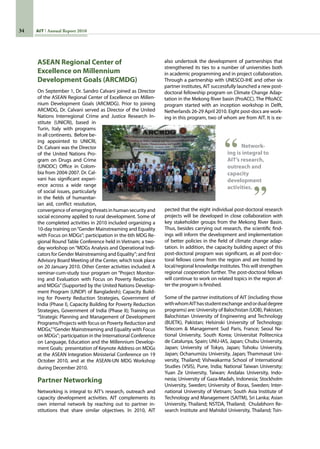
veloped to facilitate the clearance of graduating
students from the different academic and admin-
istrative units of the Institute. It was deployed to
the concerned units for testing and feedbacks have
been received. Its final version will be integrated in
another system – ‘Online Graduation Application’.
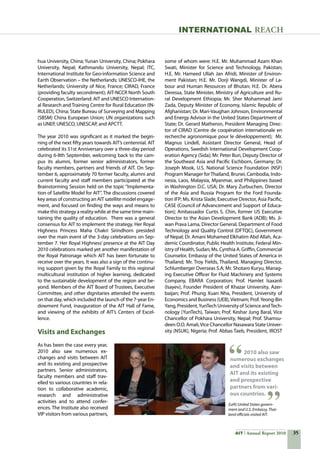
Initial implementation is expected in June 2011.
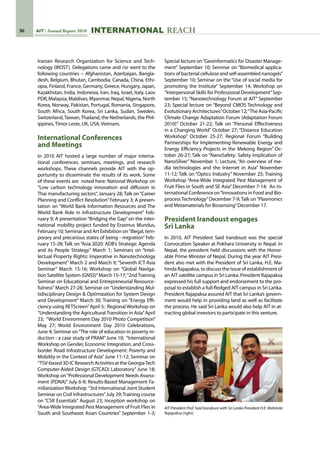
•	 Online Graduation Application System.  The sys-
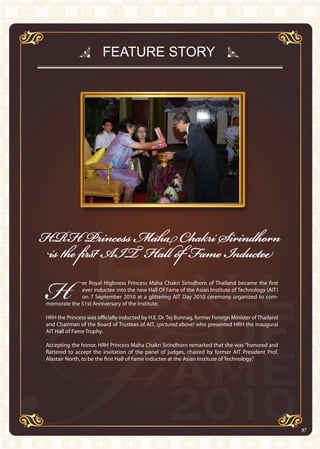
tem was conceived in 2010 to provide students
with complete information on all graduation re-
quirements and activities. The system will enable
automatic checking of a student’s academic re-
cords and will confirm if academic requirements
and English proficiency assessments are met. Only
those who fulfill the requirements would be able
to see the graduation guidelines and fill out online
graduation forms. Moreover, the system will pro-
duce graduation reports required by Registry to fa-
cilitate the graduation of students. The system is its
final stage of development. Initial implementation
is expected in June 2011.
•	 Application Tracking System. A new initiative
was launched by the Vice President for Academic
Affairs in September 2010 to develop a tracking
system for applications. The system is intended to
expedite the processing of applications and offers
with all concerned with AIT admissions – Schools,
Fields of Study, and faculty at large. The system will
employ a mechanism that would enable real-time
status check of applications. The development of
the system was undertaken with Netlink, AIT’s IT
services provider.The system is expected to be fully
operational in time for the August 2011 admission
period.
•	 Enhanced Invoicing Mechanism. Measures were
underway to improve the invoicing of tuition/ reg-
istration fees and monthly accommodation bills of
students. Modifications in the Student Information
Admissions and Enrolment,
Management Improvements
44 AIT Annual Report 2010
Internships are real-world work experiences where stu-
dents take on temporary roles in order to apply aca-
demic knowledge in a work setting, solidify a career
choice, develop professional networks and gain experience
to make one marketable.
In 2010, the Career Center at AIT improved its services by
addinganInternshipDesk.TheDeskOfficerassistsstudents
in every stage of the internship process from planning, to
researching internship options, to outlining the process,
and how to make the most of an internship   experience.
The Career Center now has linkages to more than 100 cor-
porate partners providing internships. Moves have been
undertaken to network directly with federation of indus-
tries and the different chambers of commerce.
With this service, corporate partners are given access to
short term and cost effective talents who can contribute to
strategic initiatives. They are aided in addressing business
challenges through the preparation of case studies; and
given an opportunity to identify talents for future hires. Stu-
dents meanwhile gain first-hand experience in a  particular
industry/ organization; are given ample opportunity to  in-
novate and challenge  ideas  imbibed in classrooms; and
are assisted in being more receptive to market needs.
Career Center
Language Center
While the AIT Language Center’s (LC) services in
2010 included French, German and Thai lan-
guage courses for the AIT community as well as
special workshops for students on writing up their theses
and proposals, the center’s main activities were teaching
academic writing and testing.There were 425 students reg-
istered per semester in English academic writing courses
during 2010. These students attended an average of 25
hours per course and together clocked 19,798 contact
hours over the two semesters.   
Testing has also become a major occupation for the Center:
in 2010 the LC tested 971 applicants using the in-house AIT
English Entry Test; 585 of these were tested at AIT Thailand,
313 in Vietnam, and the rest in 10 different Asian countries.
Added to this, over 1,500 AIT students in 2010 took the AIT
Academic Writing Test toward fulfilling AIT’s graduation re-
quirements.
In May the Language Center welcomed Mr. Tylor Burrows
as a new teacher. Mr. Burrows developed a new course for
doctoral students for which he wrote the course text Writ-
ing Research Articles for Publication. This course went on-
line in December. (The link to this book is at the Language
Center website: click on Writing Services.)
Reaching out to AIT partners, the Language Center also
conducted three Bridging Programs in 2010 – one for the
August intake and two for the Mekong River Commission
Junior Riparian Professionals, which garnered 3 million
baht in tuition.                                   
Students meanwhile gain first-hand experience in a  par-
ticular industry/ organization; are given ample opportunity
to  innovate and challenge  ideas  imbibed in classrooms;
and are assisted in being more receptive to market needs.
45AIT Annual Report 2010
Academics
Civil  Infrastructure Engineering Group
	 •	 Construction, Engineering  Infrastructure
	 	 Management
	 •	 Geotechnical  Geoenvironmental Engineering
	 •	 Structural Engineering  
	 •	 Transportation Engineering
	 •	 Water Engineering  Management
Industrial Systems Engineering Group
	 •	 Industrial  Manufacturing Engineering
	 •	 Mechatronics  
	 •	 Microelectronics
	 •	 Nanotechnology  
Information  Communications Group
	 •	 Computer Science
	 •	 Information Management
	 •	 Remote Sensing  Geographic Information Systems  
	 •	 Telecommunications
Interdisciplinary Programs
	 •	 Offshore Technology  Management
	 •	 Information  Communications Technologies
	 •	 Disaster Preparedness, Mitigation  Management
	 •	 Geosystem Exploration  Petroleum Geoengineering
	 •	 Gender, Transportation and Development
	 •	 Full-time MBA Program with specializations
in Finance, Human Resources Management,                   
Marketing, Technology Management, Entrepre-
neurship, Strategy, Public Management
	 •	 Full-time MBA Specialization: CSR, Sustainable
Business
	 •	 Executive MBA Programs in Bangkok and Vietnam
	 •	 EMBA in Bangkok, EMBA - Human Resources
	 	 Management (EMBA-HRM)
	 •	 Dual Degree Arrangements:
	 	 Two degrees - AIT’s MBA degree and a specialized
degree from some of Europe’s premier business
schools
	 •	 Exchange Program Arrangements with partner
	 	 institutions in Asia or Europe
	 •	 Doctor of Philosophy (PhD) Program
	 •	 Doctor of Business Administration (DBA) Program in
AIT Thailand, Sri Lanka, Vietnam, Taiwan, and India
	 •	 Professional Master’s Program in Technology Man-
agement (PMTM)
	 •	 Professional Master’s Program in CSR
	 •	 Professional Master’s in Energy Business
	 •	 Agricultural Systems  Engineering
	 •	 Aquaculture  Aquatic Resources Management
	 •	 Energy
	 •	 Environmental Engineering  Management
	 •	 Food Engineering  Bioprocess Technology
	 •	 Gender  Development Studies
	 •	 Natural Resources Management
	 •	 Pulp  Paper Technology
	 •	 Regional  Rural Development Planning
	 •	 Urban Environmental Management
Interdisciplinary Programs
	 •	 Agri-Business Management
	 •	 Disaster Preparedness, Mitigation   Management
	 •	 Energy and Environment
	 •	 Energy Business Management
	 •	 Greater Mekong Sub-region
	 	 Development Studies
School of Engineering and
Technology
School of Environment, Resources and
Development
School of Management
FIELDS OF STUDY  ACADEMIC PROGRAMS
	 •	 Civil and Infrastructure Engineering
	 •	 Electronics Engineering
	 •	 Information and Communication
	 	 Engineering
	 •	 Mechatronics	
	 •	 Telecommunications Engineering
UNDERGRADUATE DEGREE
Programs 2010
46 AIT Annual Report 2010
School of Engineering and Technology
T
he School of Engineering and Technology at AIT
develops leaders equipped with experience, and
practice who are devoted to the implementation
and extension of existing technology for the benefit of
humanity. Engineering and technology are vital to ad-
dressing basic human needs, poverty reduction, and
the promotion of secure and sustainable development
in developing countries by bridging the “knowledge
divide” and promoting intercultural dialogue and coop-
eration.
SET’s mission is: “To develop highly qualified engineers
and technologists who play leading roles in promoting
the region’s industrial competitiveness and its integra-
tion into the global economy.”
In 2010, SET initiated new academic partnerships and
collaborated with reputed institutes around the globe.
Apart from academic partnerships, SET’s focus was on
research collaboration and the promotion of the School
in Asia and beyond.
New Academic Programs
•	 Professional Master in Project Management: The
program was launched in 2010 in Can Tho City, Viet-
nam.
•	 Undergraduate Programs in Civil and Infrastructure
Engineering, Computer Science were launched in
2010.
Partnerships and Joint Programs
In 2010, SET signed Memorandum of Agreement (MoA)
with Fore School of Management (FSM), India. Its pur-
pose is to enable cooperation between AIT and FSM to
strengthen the relationship between the two institu-
tions by developing collaboration in various academic,
research, training, and faculty and staff development
activities on areas of mutual interest. The MoA is to con-
duct a two-stage program for the Master’s of Science/
Engineering in Information and Communication Tech-
nology (M.Sc./M.Eng. in Information and Communica-
tion Technology, in which students will come to AIT in
the first stage. The intention of the program is increase
access for students to the benefits of internationalized
higher education by allowing them to experience and
be exposed to the teaching, research and academic life
of both institutions with international curricula taught
by world class faculty and scientists.
A Memorandum of Understanding (MOU) was signed with
the Vietnam Petroleum Institute (VPI) to develop and offer
a one year Professional Master’s program in Geoexploration
and Petroleum Engineering (GEPG). The two institutes will
provide international training, education and research to
Petro Vietnam and other interested parties. They will also
participate in graduate education, short courses and train-
ing as well as joint research and will enhance collaboration
in education and research in oil and gas exploration and
production between the two institutes.
A Memorandum of Understanding (MoU) was signed with
Hong Duc University to establish a comprehensive collabo-
ration in International higher education and research as well
as capacity building between the two institutes. The scope
of the MOU includes undergraduate and graduate educa-
tion, as well as conduct of short courses and training pro-
grams. The two partners shall conduct joint research for the
development of science and technology and submit joint
proposals. A student, faculty and staff exchange program
shall also be facilitated.
A Memorandum of Agreement (MoA) was also signed with
the Institute of Scientific Research (ISR), Boston College,
USA. This MoA will enable AIT and ISR to cooperate in re-
search under the framework of SCINDA research network
with many institutions worldwide. As of now, there are more
than 40 institutions in this network. ISR, Boston College has
established the SCINDA receiving station in the Remote
Sensing and GIS field of study, which includes a high pre-
cision Global Positioning System Base station
and VHF receivers.
In 2010 a Memoran-
dum of Understand-
ing (MoU) was signed
withtheSkydoorPte.,
Limited. The deal is
intended to help cre-
ate the Skydoor en-
vironment to be
used by uni-
versities and
other institutes of
higher learning to en-
hance skills in computer
and digital imaging environ-
ments. The two partners will also
promote creativity in computer and
digital imaging and drive developing
KEY ACHIEVEMENTS IN 2010
47AIT Annual Report 2010
Academics
nations towards a knowledge-based economy. The MoU
includes scope to to create a laboratory to spearhead re-
search in cutting edge computer graphics. Skydoor will
have a presence at AIT, and will be the seat of a number
of activities including running computer and manage-
ment internship programs.
A Memorandum of Understanding (MoU) was signed be-
tween AIT and the Korea Institute of Construction Tech-
nology (KICT), South Korea. It will enable collaboration in
research, development, and consultancy studies as well
as the exchange of scientific and technical knowledge,
and the promotion of programs of mutual benefit such
as exchanges of faculty members and staff, undertaking
collaborative research.
A Memorandum of Agreement (MoA) was signed with
Chiang Mai University (CMU) on Integrated Bachelor and
Master Program in Geoinformatics Engineering.This joint
program is 5-years in duration. Students study the first 3
years at the Chiang Mai University and next 2 years at AIT.
AIT and CMU faculty will jointly teach and guide students
during the final three years of the program.
A Memorandum of Understanding (MoU) was signed
with the Indian Institute of Information Technology Al-
lahabad India for UG and PG.
A Memorandum of Understanding (MoU) was signed
with Epic Lanka Group, Sri Lanka for training Sri Lankan
professionals and to Masters degree in Telecommunica-
tion technology man-
agement, Information
security, Banking Se-
curity and Nanotech-
nology
Positioning and
Branding
In 2010, SET produced
a comprehensive pro-
motions strategy with
clear outputs identi-
fied. A kit consisting of
attractive brochures,
DVD, posters and flash
drive wrist-bands was
developed as stan-
dard promotion mate-
rial. The target coun-
tries for promotions in
2010 were Bhutan, China, India, Indonesia, Myanmar, Ne-
pal, Pakistan, Sri Lanka, Thailand and Vietnam.
In 2010, SET participated in an educational exhibition in
Bhutan and also visited the key government organizations
for possible collaboration. The Department of Adult and
Higher Education (DAHE), Ministry of Education and AIT are
expected to sign MoU and MoA to encourage Bhutanese
students to choose AIT.
In India, SET targeted North-East India and saw an increase
in the number of applications from that part of country. SET
faculty also undertook student recruitment promotions
trips to other parts of India. Throughout the year SET ad-
vertized in Thailand through English and Thai newspapers,
student handbooks and magazines.
Notable Achievements
The final official results received from Thailand Research
Fund concluded that out of the 9 engineering and tech-
nological clusters that AIT participated in, 4 ranked among
the top with an ‘excellent’ rating of 5. From the School of
Engineering and Technology, these were as follows: Civil
and Infrastructure Engineering Group, Information and Com-
munications Group, Industrial Systems Engineering Group.
Excellence and Relevance in Education
Research and Outreach
Gaining International accreditation for the School’s pro-
grams was a top priority activity in 2010. The School began
work on preparing a self-study document. An international
expert panel will be formed in the first semester of 2011 to
evaluate SET’s academic offerings.
Key Results
In 2010, the total number of students in SET was approxi-
mately 966, including Undergraduate students. In 2010, the
total number of students who graduated was 320. In 2010,
SET had 35 full-time faculty members, 56 adjunct faculty
members and 18 seconded visiting faculty members.
SET had approximately 40 sponsored research projects in
2010 and total budget of approximately 83.82 million Thai
Baht. Recovery costs and overhead was approximately 14.8
million Baht. Cost control measures contributed to SET
generating a surplus, after the 40 percent allocation to AIT,
which amounted 20.53 million Baht.
48 AIT Annual Report 2010
T
he School of Environment, Resources and
Development (SERD) responds to the Asian
region’s  needs by mobilizing and enhancing
capacities for socially, economically and environ-
mentally sound development in partnership with
the public and private sectors. Closely aligned to the
wider institutional strategy, SERD ensures that the
ethos of Creativity, Relevance and Connectedness
serves the teaching, learning, research and societal
needs of the region and developing countries.
SERD’s mission is to achieve sustainable develop-
ment, poverty alleviation and livelihoods by adopt-
ing an interdisciplinary approach to teaching and
applied research that integrates new knowledge in
technology and the social sciences.
This year, SERD initiated new academic programs
which included the launch of new degree programs
and partnerships with several universities in the re-
gion. The provision of five scholarships from Thai-
land’s Chulabhorn Research Institute (CRI) to the
Environmental Technology and Management (ETM)
program in August 2010 was a notable example.
Some key academic developments included the fol-
lowing:
New Academic Programs
•	 The Professional Master’s in Environmental Engi-
neering Management (PM-EEM) was launched in
May 2010 in Vietnam.
•	 A Professional Master’s Degree Program in En-
ergy Business Management (PM-EBM) jointly
agreed with SOM and is planned to be launched
in the May 2011 semester.
•	 A Master Degree Program in Climate Change and
Sustainable Development (CCSD) is being devel-
oped and proposed to be launched in August
2011 semester.
Partnerships and Joint Programs
•	 A one-year Professional Master’s in Urban Man-
agement (P-UM), which is a joint-program be-
tween the Asian Institute of Technology (AIT),
AIT Vietnam, and Ho Chi Minh City University of
School of Environment,
Resources and Development
49AIT Annual Report 2010
Architecture (HCMUARC), is planned to be offered
in January 2011.
•	 Agri-business Management (ABM) has partnered
with the Sam Higginbottom Institute of Agriculture,
Technology and Sciences (SHIATS), India, to create
a Unified Bachelor and Master program, which is
planned in May 2011.
•	 An MOU between SERD and Kalinga Institute of
Industrial Technology (KIIT) was signed for collabo-
ration in various academic, research, training and
faculty and staff development activities of mutual  
interest.This began with 46 KIIT students registered
inthe Inter-Semester 2010 and plans to send anoth-
er 60 KIIT students in January 2011. MOU between
AIT and IT-BHU, NIES, NLU, PVP and UCL are drafted
and under process.
•	 MOU initiated with the University of Veterinary and
Animal Sciences; Lahore, Global Master’s in Devel-
opment Practice Programs, Colombia University,
USA.
•	 MOU initiated with the International Centre for Ad-
vanced Research on Global Changes, Vietnam and
Department of Food Science and Quality Control,
Ministry OF Agriculture and Cooperatives, Nepal.
Promotional and branding activities were also a prior-
ity for the School this year, starting with promotional
trips to a number of Thai universities which aimed to
explore further collaborations.Visits to target countries
such as Bhutan, China, Indonesia, Malaysia, Myanmar,
Nepal, Pakistan, Sri Lanka, and Vietnam were taken
during the course of year, reaping several promising
partnerships with state universities.
Key Results
A total of 296 students were enrolled in the January,
Inter-Sem and August 2010 semesters, and 249 SERD
students graduated in May and December 2010. The
school consists of 35 full-time and 28 visiting /adjunct
faculty representing 17 countries. A total of 36 spon-
sored research projects were initiated in January-De-
cember 2010 with a total budget of approximately
Baht 98.93 million (overhead of more than Baht 8.95
million). Cost control measures contributed to the
School generating a surplus of Baht 12.19 million, after
AIT overhead allocation of 40%.
Academics
50 AIT Annual Report 2010
T
he School of Management (SOM) is one of
the Asian region’s leaders in management
education and research. SOM provides ex-
ceptional individuals with a supportive environ-
ment in which they can develop their skills and
aptitudes, helping them to reach their profes-
sional goals and to serve the interests of coun-
tries in the Asia-Pacific region. The School’s core
strength lies in tailoring entrepreneurship and
leadership education to match local needs, and
in expanding Asian entrepreneurship concepts
to other regions.
The academic programs of the School are highly
regarded, winning awards for their internation-
ality and ranking highly in the region. The MBA
program was ranked number 8 in Asia by www.
bestmba.org. The School has continuously di-
versified to match the needs of the market. Be-
sides its academic MBA and PhD programs, the
School also runs highly successful Executive MBA
(EMBA), and Doctor of Business Administration
(DBA) and Professional Masters Programs. The
School is dedicated to producing managers who
can drive their organizations to prosperity and
profitability without compromising ethics and
social responsibility.  
In 2010, the School was comprised of 13 full-time
faculty members and 34 adjunct/visiting faculty
members from 14 countries. With an increas-
ing diversity in its student and faculty bodies,
the School of Management has been able to re-
cruit students from diverse regions of the world.
During the year SOM welcomed 36 exchange
students from Asian and European partners in
France, Spain, Germany, Switzerland, Republic of
Korea, Denmark, India, Pakistan and Lithuania.
SOM continued to build and strengthen its link-
ages with the professions by developing strate-
gic partnerships with both public and private
sectors through its executive development and
research projects. Managers from the corporate
sector were invited as guest speakers to provide
better insight to the SOM students. SOM stu-
dents also undertook field visits to various cor-
porations to see first hand the implementation
business knowledge.
School of Management
51AIT Annual Report 2010
Academics
SOM Introduced New Specialization in
Sustainable Business
Realizing the fact that business as usual is not the
way forward and that a radical rethinking of busi-
ness is necessary, SOM has introduced a new area
of specialization in the MBA program in the field
of Sustainable Business. This new area will cover
issues as to how organizations should rethink
their business strategy in which issues such as
global warming, green house gas emissions and
other environmental and societal issues will im-
pact business greatly.  
New Professional Master’s Programs
SOM is working jointly with other AIT Schools,
Units and AIT Extension to develop new a Profes-
sional Masters program. The new programs are:
•	 Professional Masters in Banking and Finance,
to be launched jointly with AIT Extension.
•	 Professional Masters in Energy Business Man-
agement, Jointly with School of Environment
Resources and Development.
•	 Professional Masters in Corporate Social Re-
sponsibility, Jointly with CSR Asia Center in
AIT .
The Professional Master’s programs are shorter,
1-year duration programs, for professionals seek-
ing to enhance their skills. These programs are
intended for professionals who are looking to ex-
tend their knowledge in a particular field. These
programs are interdisciplinary and draw upon the
rich resources of various AIT units and Schools.
EABIS Golden Project
In 2010, SOM participated in the EABIS Golden
Project. This project aims to be the largest re-
search project in the field of environmental, social
and governance challenges in business. SOM also
partnered with DHL Thailand to research and de-
velop case studies in CSR and Sustainability. SOM
looks to partner with other companies in future
for this project. SOM is also a member of EABIS.
52 AIT Annual Report 2010
Research and Development
A
s it moves into the future, the Asian Institute ofTechnology will need to adjust to rapid and dynamic chang-
es impacting its research and development work.  While the number of research projects and related fund-
ing has nearly doubled since 2005, over the last two years this increase leveled off. This was attributable to
a smaller total number of research faculty and staff, the closing down of some major long-term projects, and to the
changing demands and mode of operation of a number of external funding agencies.
In light of this changing environment, in 2010 AIT began work on its new AIT Research Strategy, which is designed
to last for the next five years. The Strategy will be based on four principles, namely: Research Focus, Research Qual-
ity, Research Collaboration and Research Resource Mobilization. The work plans will use a Results Based Manage-
ment (RBM) approach to guide outcomes, measurable outputs, and key performance indicators. The focus of AIT
research and development falls under the umbrella area of “Sustainable Development in the context of Climate
Change (SDCC)”with five identified thematic areas under its purview.
During the year considerable work was done to identify niche areas of research and development for which AIT  
could be recognized as a global front runner. AIT will create stronger inter-disciplinary teams who are able to
network effectively both within AIT and with external partners. By concentrating on specific areas supported by
a critical mass of expertise, AIT will pursue large research projects that will also contribute to the development of
key campus infrastructure. Through its continued work with public and private sector stakeholders, AIT serves the
region and beyond as a key platform for innovative research and development.
1. 	 On the acceptability of arguments and its fun-
damental role in nonmonotonic reasoning,
logic programming and n-person games (Cit-
ed 549 time(s))
	 1995; Artificial Intelligence; Dung, P.M.
2. 	 Direct solid-liquid separation using hollow fi-
ber membrane in an activated sludge aeration
tank (Cited 261 time(s))
	 1989; Water Science and Technology; Yamamoto,
K., Hiasa, M. , Mahmood, T. , Matsuo, T.
3. 	 Developments in industrially important
thermostable enzymes: A review (Cited 181
time(s))
Research
Top 5 AIT Researchers with the Highest Number of Projects. (Topindividual/groupprincipalinvestigators(PI) for
research, development and training projects)
Name No. of Projects as PI No. of Projects as PI
and Group PI
Kanchana Kanchanasut 48 49
S. Kumar 11 27
Mukand S. Babel 22 25
C. Visvanathan 21 24
Sudip K Rakshit 19 23
Kunnawee Kanitpong 18 22
	 2003; Bioresource Technology; Haki, G.D. , Rak-
shit, S.K.
4. 	 An abstract, argumentation-theoretic ap-
proach to default reasoning (Cited 141
time(s))
	 1997; Artificial Intelligence; Bondarenko, A. ,
Dung, P.M. , Kowalski, R.A. , Toni, F.
5. 	 Membrane separation bioreactors for waste-
water treatment (Cited 136 time(s))
	 2000; Critical Reviews in Environmental Science
and Technology; Visvanathan, C. , Ben Aim, R. ,
Parameshwaran, K.
Most Cited in SCOPUS
KEY ACHIEVEMENTS IN 2010
53AIT Annual Report 2010
AIT Research Strategy 2011-2015
RESEARCH and DEVELOPMENT
D
uring the year, efforts were centered on devel-
oping the AIT’s strategic plan on research. The
new document to be called AIT Research Strat-
egy (2011–2015) sets out the research trajectory of the
Institute for the next five years and beyond, and will
serve as the basis for a concerted research proposal
program and budget.
The AIT Research Strategy will enhance collaborative
research with partners from government agencies,
development agencies, universities, research institu-
tions and the private sector. The Strategy aims to cre-
ate powerful new synergies among the deep pools of
research talent at AIT. It seeks to impart the Institute
with a strong competitive edge, and position it as a sig-
nificant player in Asia.
The Research Strategy hinges on following principles:
research focus; research quality; quality of research
collaboration; and resource mobilization for research.
To achieve internal cohesiveness, as well as to provide
clarity for external stakeholders, individual projects
and activities are further clustered into five thematic
areas: Vulnerability and Disaster Risk Reduction; Water
and Land Resources Management for Sustainable Pro-
duction and Consumption; Urban and Rural Quality of
Life and Sustainabil- ity; Low Carbon
Cleaner Produc-
tion Technolo-
gies and
Man-
agement; and Business and Innovation Models for
a Green Economy. It should be noted that these five
thematic focuses are not mutually exclusive. A major
source of AIT’s comparative advantage is that it takes
a holistic view of the complex processes that affect
people’s lives. Many of the thematic clusters cut across,
or complement, two or more of the other themes,
thereby yielding significant overlap or interaction and
an interconnectedness of problems and solutions. The
thematic research areas aim to stimulate the forma-
tion of teams that merge knowledge, experience and
networks. This approach will allow centralizing some
support functions to research activities, and aims at
diversifying research teams to make better use of the
width of experience at AIT.
On the industrial front, AIT continued with its profes-
sional as well as regular study programs and other col-
laborative research programs, such as those withWest-
ern Digital, Siam Cement Group, Electricity Vietnam,
EVN-Telecom, Nippon Koei Co. Ltd., and Advance Agro
Public Company Limited, amongst many others. The
institute also continued partnerships with the private
sector. Notable examples included: Innotech Sports
Management; Sodexo; Netlink (to provide AIT will all
IT professional services, including the operation and
maintenance of hardware/software required during
the contract period of five years); and Skydoor Pte Lim-
ited (to promote creativity in computer and digital im-
aging and to create a laboratory to spearhead research
in cutting-edge computer graphics).  AIT also signed
agreements for conducting joint academic pro-
grams and research with private academic
institutions, for example, in India and
Sri Lanka. The CSR Asia Center at
AIT also brought a number of
joint activities between AIT
and the private sector
and industry.
53AIT Annual Report 2010
54 AIT Annual Report 2010
In the increasingly competitive hard disk drive indus-
try, all manufacturers need to aggressively develop
their products to survive. Not only must they invest in
research and development of products themeselves;
but also in advanced automation technology to use
the new equipment in manufacturing processes to im-
prove cycle time, productivity and flexibility of the pro-
ductionsystem.AutomatedTestOperation(ATO)found
at the back end area of disk drive manufacturing is one
of the operations that makes use of advanced automa-
tion test equipment and technology to create more ef-
ficiency and effectiveness. ATO is a complex operation
that is difficult for planning, monitoring and forecast-
ing. It cannot quickly manage a production system to
compensate for external demands and internal distur-
bances. The modeling of manufacturing systems can
be used as a representation of complex systems like an
automated test operation. The manufacturing models
are used as a tool for monitoring, forecasting and con-
trolling of a represented system. In this research, soft
computing solutions were developed by using artifi-
cial neural networks, integrating with another artificial
tool to simulate automated test equipment models to
solve the complexity of disk drive test operation.
Automobile accidents incur an extremely heavy toll on
human lives and society.  They also have great impact on
the economy. According to theWorld Bank, the economic
impact of automobile accidents in Thailand is a loss of
morethan200billionbahtper year.Manyaccidents could
be prevented if drivers obeyed traffic regulations. This
research study is designed as a portable system capable
of automatically detecting traffic violations and either
sending a letter to warn the driver, and thereby informing
nearby authorities, or automatically issuing traffic viola-
tion tickets.The system is composed of an embedded sys-
tem,aradarsystem,avideocamerasystem,aGPSsystem,
and aWIFI communication device packaged as a portable
system. The radar system is used to check for speeding
vehicles, while the video processing algorithm is used in
conjunctionwithradarmeasurementtoreducefalseposi-
tive errors in the radar measurement and to detect vehi-
cles crossing lane boundaries. By enhancing our ability to
detect and prevent traffic violations, the proposed system
has the potential of economic benefits through lowered
health care costs and higher productivity by reducing ac-
cident rates.
Portable Traffic Violations Detector
Automated Test Equipment
Dr. Mongkol Ekpanyapong
School of Engineering and Technology
Dr. Nitin Afzulpurkar
School of Engineering and
Technology
POLICE EYES:
O
verall during the period January - December 2010 there were a total of 449 sponsored and contract-
ed projects conducted by the faculty and staff at AIT’s School of Engineering and Technology (SET),
School of Environment, Resources and Development (SERD), School of Management (SOM), as well as
at AIT Extension, IntERLab, and numerous other Institute-wide projects and centers. The total number publica-
tions for the same period stood at 691 from across AIT. The following (below) are brief snapshots of research
conducted at AIT in 2010. Full details of all research conducted at AIT in 2010 can be found in AIT Research An-
nual Report 2010.
Snapshots of AIT Research in 2010
55AIT Annual Report 2010
RESEARCH and DEVELOPMENT
AIT and Silpakorn University cooperated in this project
Both worked with the Royal Thai Government to assess
the multiple impacts of the fuel-switching on air quality,
climate, human health and economic with a particular
focus on switching to Compressed Natural Gas (CNG) in
the public transportation system in the Bangkok Metro-
politan Region (BMR) as a case study.
The study presented two scenarios projected to 2015
and 2025, wherein a switch to using CNG and advanced
vehicle technologies for public transport vehicles in the
BMR was key.These scenarios were compared to current
model (business-as-usual).
Methods included surveying of the situation and
planned programs, emission inventory for air pollutants
and climate-forcing forcers agents for the base year of
2009 and emisison projection projected to 2015 and
2025 through using the International Vehicle Emission
(IVE), and simulation of ambient air quality by a 3D dis-
persion air quality model, the Comprehensive Air Qual-
ity Model with extensions (CAMx).
The potential financial benefits from the emission re-
ductions were preliminarily assessed. A feasibility study
was also implemented using the Certified Emission
Reductions (CERs) based on the Clean Development
Mechanism (CDM) project approach to explore poten-
tial financial benefits from the emission reductions.
Substantial reductions of both air pollutants  (COPM10,
CO, VOC, VOC evaporative, and NOx and PM10) and
climate forcing forcersagents (CO2, N2O, CH4, VOC,
VOC evaporative, NOx, Black Carbon and Organic Car-
bon particles) would be achieved in both scenarios as
compared to the business as usual, which justify the
co-benefits gained from the switch.The results revealed
relatively small reductions in ambient concentrations of
both air pollutants and climate forcing agents. Through
Certified Emission Reductions (CERs) trading, it is also
possible to gain about 2.2  2,158,809 and 2.9  2,882,906  
million US$/year, for years 2015 and 2025 respectively.
A relatively high investment is necessary to support the
switch, such as engine modification and new engine
Air Quality and Climate Impacts of
Switching to Natural Gas-Fueled
Public Transportation Vehicles in
Bangkok
Energy Security in Developing
Countries: National and Household
level vulnerability and challenges
The challenges posed by potential supply disrup-
tions and high price rises of fossil fuels to the economic
growth are common to both developing and developed
countries. Energy security, defined by The World Energy
Assessment Report, as “the continuous availability of
energy in varied forms in sufficient quantities at reason-
able prices” may well reflect developed countries’ per-
spectives, but does not adequately capture the energy
security dimensions faced by developing countries, as
there are several additional dimensions that are unique
to developing countries. The GNESD, through its mem-
ber centers, has been analyzing energy security issues,
both from the national and household sector perspec-
tives, from developing countries’perspectives.
The characteristics - in terms of the nature of energy se-
curity issues of developing countries, vulnerability and
threats at national and at household level, and policies
and measures in these countries to address the energy
security - were the objectives of this research.
As an important dimension of energy security, easy
availability of reasonable amount of clean/modern en-
ergy is considered a basic necessity to reduce poverty
and improve the living standards. (Eg. energy policies of
India and South Africa.)The following factors are mainly
identified behind the vulnerability and the threats to
energy security:
•	 Growingrelianceonimportedenergyasmostcountries
rely on imported energy.Energy price rise could, there-
fore, have a crippling effect on the economy and overall
development for most countries under the study. Also,
countries have initiated several kinds of programs to re-
duce the impact of imported energy, including replace-
ment of petroleum products by biofuels promotion of
renewable energy, and energy efficiency.
•	 Primary energy source diversification. The diversifica-
tion of primary energy supply (Shannon Weiner in-
dex) shows improvements during the recent past in
Thailand, Brazil, Tunisia, India and South Africa, and is
comparable to OECD countries. In electricity genera-
Prof. Nguyen Thi Kim Oanh, Dr.Eng.
School of Environment, Resources and Development
Rattapon Onchang, Dr.Techn.
Department of Environmental Science
Faculty of Science, Silpakorn University
technology, which must be studied further by the Royal
Thai Government. Possible health benefits associated
with the air pollutants reduction could further be ex-
plored in terms of morbidity and mortality reduction of
the population in BMR.
Prof. R. Shreshta, Prof. S. Kumar
School of Environment, Resources and Development
56 AIT Annual Report 2010
tion sector, however, many countries depend to a large
extent on a single source [South Africa (coal  0%], Tu-
nisia (natural gas 88%), Senegal (thermal 90%), Bra-
zil (hydro 70%), Kenya (hydro 50%) and India (coal
50%)].
•	 Energy demand and supply.The energy demand in de-
veloping countries is likely to increase substantially in
the course of their development, and its use is also to
move up the energy ladder. So, the sources of primary
energy used are likely to shift from predominance of
traditional use of biomass to that of modern commer-
cial energy (fossil fuels and modern use of biomass).
Several countries in South America have relatively
abundant energy resources. However, lack of access to
and regional (provincial) disparity of cleaner and con-
venient energy use appears to a large extent due to
inadequate energy policies or policy failures.
•	 Reliance on non-marketed sources of energy. Substan-
tial fraction of the population and industries in the
countries under the study rely on non-marketed sourc-
es of energy (e.g. collected biomass) and this high de-
pendence is likely to continue for a foreseeable future.
The energy supply problem is compounded by the fast
decreasing forest resources in many countries.
•	 Investment in energy sector. Considerable amount of
investment would be required for resource exploration,
infrastructure development (generation, supply and
distribution systems) and supply of modern commer-
cial energy. As investment by government alone would
not be able to fulfill the required investment, several
countries have adopted policies to attract private in-
vestment.
The energy security-related vulnerabilities and threats
in the household sector in the countries under the study
have the following characteristics:
•	 Energy costs: Energy costs form a significant share of
total household expenditure (especially low income
households’) in many developing countries (about
20% in South Africa and Thailand, and up to 40% in
Kenya). Thus any significant rise in energy prices could
have serious adverse effects on the poor families.
•	 Energy access. There also exists big inequity in many
developing countries in terms of access to modern
and safe energy between the poor and rich. Though
access to electricity is very high in some countries
(Thailand, Tunisia, Argentina, Brazil), in others the level
of  electrification is low (in Kenya, access to electricity
in households is about 15%, while only about 8% of
households have access to LPG supply).
•	 Lack of a reliable and sustainable supply of energy im-
pacts the quality of energy services provided to house-
holds. In some countries, the residential sector has the
highest share of the national energy consumption (Ke-
nya at 77%)
•	 Dependency on biomass. Biomass energy use remains
high in most developing countries, especially those in
the low income category. The household sector is the
major user of biomass. In countries where options oth-
er than biomass are either not available or not afford-
able, ensuring sustainable supply of biomass energy
presents a major energy security challenge.
Countries under the study have formulated policies and
initiated measures to address the threats to energy se-
curity through country specific programs. (Eg. promo-
tion of renewables, energy efficiency, private sector in-
vestment, developing regional cooperation, developing
strategic reserves.)
Centers Participating in the Energy Security Study
Africa: The African Energy Policy Research Network/Foun-
dation for Woodstove Dissemination (AFREPREN), Kenya;
EnergyResearchCenter(ERC),SouthAfrica;Mediterranean
Renewable Energy Centre (MEDREC), Tunisia; Environmen-
tal Development Action in the Third World (ENDA-TM),
Senegal.
Asia: Asian Institute of Technology (AIT), Thailand; The En-
ergy and Resources Institute (TERI), India.
South America: Janeiro and CENBIO at the University of
Sao Paolo in conjunction, Brazil; The Institute for Energy
Economics at Bariloche Foundation (FB), Argentina.
The complete reports of each centre and the synthesis
report is available at www.gnesd.org.
Bangkok, like many cities in the world, encounters sig-
nificantly increasing challenges of higher temperatures
Pavement surfaces with
higher solar reflectivity
Dr. Kunnawee Kanitpong
School of Engineering and Technology
57AIT Annual Report 2010
RESEARCH and DEVELOPMENT
The Monkey Cheek project in the MahachaiSanamchai
canals performs the function of storing flood waters in
the upper areas, while at the same time releasing wa-
ter into the Gulf of Thailand in relation to the tide levels
of the sea by relying on the appropriate use of gravity
and pumping stations. The project comprises construc-
Physical Model for Monkey Cheeks
Dr. Sutat Weesakul
School of Engineering and Technology
tion of regulators and pumping station in canals, which
yield considerable benefits without requiring huge
investments. It can be linked with the Monkey Cheek
project in the lower Tha Chin River to form an integrat-
ed system for efficient flood alleviation in Bangkok.
Dr. Sutat Weesakul is Principal Investigator of the proj-
ect. AIT has been rendering its service towards the
study, which is apart of the overall project to be car-
ried out by Hydro and Agro Informatics Institute (HAII)
for the Chaipattana Foundation. H.R.H. Princess Maha
Chakri Sirindhorn is the executive chairperson of the
Chaipattana Foundation.
AIT has been responsible for constructing the physical
model and performing the function of storing flood
water not only in the upper areas, but also in the ponds
donated by local people and the golf course. The main
objective is to provide the appropriate procedure for
operating all regulators and pumping stations so that
they are in harmony with natural conditions.
The Xayaburi Hydroelectric Power Project will be con-
structed across the lower Mekong River mainstream
just upstream of Baan Pak Neun district in the northern
province of Xayaburi, Lao, PDR .
From right to left abutment, the dam construction con-
sists of the following main components and structures:
•	 A navigation system placed at the extreme right
abutment and partially cut into the right bank
slope.
•	 An overflow spillway, equipped with ten (10) radial
gates each 19 m wide and 21 m high, with upstream
and downstream stoplogs and associated cranes.
Physical Hydraulic Model Study of
the Xayaburi Hydroelectric Project
Dr. Sutat Weesakul
School of Engineering and Technology
due to the urban heat island phenomenon. Using tradi-
tional building materials such as asphalts and concrete
for roads and other infrastructure is among the key fac-
tors causing the air temperature in the city to be higher
compared to that in surrounding areas.This is due to the
absorptionofthesolarradiationandhencetheradiation
of excess heat during the day and at night. Increases in
the pavement temperature causes the ambient tem-
perature to rise, which in turn increases energy costs for
air conditioning and damages air quality in the city. One
way to address this problem is to provide pavement sur-
faces with higher solar reflectivity or albedo for roads.
The measurement of albedo over 106 asphalt pavement
sections and 43 concrete pavements sections across
Bangkok Metropolitan Area revealed that the albedo
of both pavement types were quite low, i.e., less than
0.10. This result indicates an opportunity to increase
pavement’s albedo through various surface treatment
methods. Examples of these methods include coating
with grey or tan emulsion sealcoats, resurfacing with
lighter colour chipseals, and overlying with concrete
white-topping.The choice of materials determines albe-
do increase, and materials with lighter shades correlate
to the higher albedo and lower surface temperature.
The lightest available was shown to reduce maximum
surface temperature by 7 to 14 degrees C.
58 AIT Annual Report 2010
•	 An intermediate block that separates the spillway
from the powerhouse complex and houses the pow-
erhouse unloading and erection areas as well as part
of the fish passing facilities.
•	 An intake-powerhouse complex with eight (8) Ka-
plan generating units including all electro-mechani-
cal and hydro-mechanical auxiliary equipment and
systems. The intake-powerhouse complex also in-
cludes eight (8) sand flushing outlets and part of the
fish passing facilities.
•	 A fish ladder facility for upstream fish migration on
the extreme left abutment.
The normal headwater level of the Project is established
at an elevations of 275m, following the criterion to limit
the raising of the water levels at Luang Prabang during
flood conditions to accepatbel levels. The maximum
powerhouse outflow established through economic
optimization is 5,000 m3/s, while the spillway capacity is
designed up to the PMF estimated at 47,500 m3/s.
In order to ascertain the most critical hydraulic aspects
of the Project, a physical hydraulic model study was
commissioned at the AIT Hydraulics Laboratory by the
Project Owner, Ch. Karnchang Public Company Limited
in an agreement dated 15 May 2009. The physical mod-
els were built and investigated following the“Specifica-
tion for the Physical Hydraulic Model Studies of Xaya-
buri HEPP” issued by the Project Engineer, AF-Colenco
Limited on January 2009.
The links between gender, natural resource manage-
ment and migration are becoming more visible in
many regions, particularly regarding their role in fos-
EU-Asia Link Project Gender and
Sustainable Development:
Natural Resource Management,
Migration and Multi-local
Livelihoods
Dr. Bernadette P. Resurreccion
School of Environment, Resources and Development
tering (or undermining) local forms of sustainable de-
velopment. The emerging body of literature on the im-
pacts of internal and international migration processes
highlight the significance of gender and its intersec-
tions with other social structures in natural resource
management and sustainable livelihoods. The expe-
riences of Europe and Southeast Asia provide some
interesting pointers for a comparison of similarities as
well as differences. Policy responses can benefit from
cross-cultural learning, a process which requires bridg-
ing knowledge gaps pertaining to these fields. The key
actors in both these regions, including governments,
practitioners and academics share, an interest in bridg-
ing these gaps of knowledge in the policy field to (a)
ensure gender equitable resource management, (b)
minimise incidences of “distress entry” to migratory
networks leading to exploitation and human rights
abuse, and (c) ensure protected migration practices,
security of livelihoods and sustained forms of local de-
velopment.
The Asia-Link Progect offers an excellent opportunity
to fill the gaps of knowledge through enhancing the
mutual intellectual, social and economic co-operation
between the EU and Southeast Asian regions. The Asia
-Link project aimed to develop a range of collaborative
South-South and North-South activities to strengthen
collective institutional capacity in higher education
involving programme and curriculum development,
training and skills-transfer, and dissemination through
conferences, workshops. To this aim, the Institute of
Social Studies (ISS), the Netherlands, Andalas Uni-
versity, West Sumatra, Indonesia, the Asian Research
Centre for Migration (ARCM) of Chulalongkorn Univer-
sity, Thailand, the Asian Institute of Technology (AIT),
Thailand and Brighton University, the United Kingdom
combined forces.
Collaborative experiences in substantively significant
cross-cutting fields of these 5 partners enriched the
quality of the programme. They will jointly provide
valuable expertise for future guidance in the following
specific areas:
1)	 The focus of the Asian-European network of aca-
demic institutions will be on the enhancement of
human resources in higher education to improve
activities in policy research, advice and training on
gender, natural resource management, migration
and security of livelihoods;
2)	 The collaboration addresses the intersections be-
tween the following policy fields: gender and natu-
ral resource management, gender and migration,
gender and sustainable livelihoods;
3)	 Commitment and support from the partner aca-
59AIT Annual Report 2010
RESEARCH and DEVELOPMENT
Consumers commonly have a problem with correctly
assessing the quality of food produce. Recent food
scares have lessened the confidence of consumers in
guessing food quality by visually inspecting, touching
and smelling food produce at open air “wet” markets.
Yet, consumers can either rely on their own ability
to identify quality and select the best quality or best
quality-price relationship or they can trust others, in
particular the retailer, the brand or a third party that
certifies or endorses the product. These indirect or ex-
trinsic quality cues become more important. In Thai-
land, there are now a seemingly myriad quality labels
from different labeling authorities and organizations.
Do they convince consumers about the food quality?
On behalf of the UNFAO, we studied consumer qual-
ity judgments using a decision-based method called
conjoint measurement. The rational for this method
is that it is assumed that respondents are not able to
realistically estimate how important each attribute is
demic institutions will bridge the existing knowl-
edge gaps and enhance the role of higher educa-
tion in policy research, training and advice.
The activities in this project are as follows:
1)	 An exchange student program involving the 5 part-
ner universities.
2)	 Workshops held in various partner universities and
an international conference in the Hague.
3)  Joint publications and extended networks beyond
the project period.
At the Asian Institute of Technology:
1)	 3 Ph.D students were sent to the University of Brigh-
ton, UK, Institute of Social Studies, the Netherlands
and Andalas University, Sumatra, Indonesia for 2-3
months;
2)	 1 MSc student was sent to ARCM, Chulalongkorn
University;
3)	 One migration workshop was held in November
2010;
4)	 Five post graduate students were received from 3
partner universities (Andalas University, University
of Brighton, Institute of Social Studies).
This project is a part of the Comprehensive Disaster
Management Program of the Government of Bangla-
desh, which was funded by UNDP, DFID, and the Euro-
pean Commission.  
The implementation of program activities was carried
out by an international consulting team consisting of
Asian Disaster Preparedness Center, Asian Institute of
Technology (AIT), National Society of Earthquake Tech-
nology of Nepal, Oyo International Corporation, and
several leading academic institutions of Bangladesh.  
Seismic Vulnerability and Risk
Assessment of Dhaka,
Chittagong, and Sylhet City
Dr. Pennung Warnitchai
School of Engineering and Technology
Consumer Judgment of the Quality
of Food: Do quality labels help?
Dr. Rian Beise-Zee
School of Management
AIT was responsible for the seismic vulnerability and
risk assessment of three major cities—Dhaka, Chit-
tagong, and Sylhet.  In this project, detailed informa-
tion about buildings, essential facilities, population,
lifelines, and transportation networks were first col-
lected and acquired from several sources, and field sur-
veys of more than 20,000 buildings were carried out.  
Based on these collected data, a comprehensive set of
GIS maps describing the existing conditions of these
cities were then developed.  The seismic vulnerability
of more than 40 representative building types was also
determined through the use of advanced numerical
analyses.  Potential economic and social losses in the
three cities from various possible earthquake scenar-
ios were finally estimated using a GIS-based software
package named “HAZUS”.  The obtained results were
used for developing a national contingency plan for
earthquake disaster management of Bangladesh.
60 AIT Annual Report 2010
The PMED Program has been commissioned to AIT by
the Ministry of Interior (with the Damrong Rajanupab
Research and Development Institute as the co-host)
since 2009. This is a capacity building program for
the high-level personnel (i.e., Vice Governors or PC 9
Public Management Executive
Development Program (PMED) 2010
Dr. Sununta Siengthai
School of Management
The automotive industry in Thailand continues to grow
at a fast pace. Thailand has the biggest automobile as-
sembly base in the region. Due to this fact Thailand is
known as“the Detroit of Asia”. The automotive industry
is vital for the Thai economy and hence there is need to
continuously improve its process.
In this growing automotive sector ofThailand, Dr. Barba-
The Impact of Total Quality
Management on Supply Chain
Management in Thai Automotive
Industry
Dr. Barbara Igel
School of Management
for them. Instead, just like real life they are asked to
make judgments for product bundles which implicitly
require trade-off decisions. Conjoint measurement as-
sumes that each product evaluated by a consumer can
be represented by an additive combination of separate
utilities existing for the individual attribute levels.
The most important conclusion of this study is certain-
ly that retail exerts a strong impact on the perception
of food quality. We see a clear generational shift. While
older consumers put considerable trust in wet markets
and trust their own abilities to evaluate the quality of
food more. Most likely, younger people are more aware
of chemical contamination of food and replay more on
the quality commitment of brands of food producers
and mass retailers.
The generational shift is heading towards modern
trade such as supermarkets. We also see, albeit on a
much lower level, brands as more and more important
trust agents. In contrast, quality certificates are on av-
erage not a substitute for the trust in retail and brands.
Only a small segment of the market notices certificates
and associates certificates with quality. At best, certifi-
cates are complementary, perceived as a modern ele-
ment of food together with brands and supermarkets.
In this sense they have a limited capacity to offset low
trust in the food supply chain. Instead they strengthen
and reinforce the perception of modernization of the
food supply chain.
and higher) of the Ministry.  There are 3 main groups
of subjects: (1) strategic management for competitive
advantage of the nation, (2) natural resources, culture
and tourism, and (3) agenda for good governance.  The
Program also requires the participants to conduct one
practicum project to enhance their understanding and
problem-solving skills.  
In 2010, there were altogether 31 participants of which
5 participants reported on strategic management is-
sues; 11 reported on natural resources management;
and 15 reported on Agenda for good governance.  
Findings from the individual studies revealed that no
matter which areas of issues the Vice Governors are
faced with in terms of administrative dilemmas,  the
necessary conditions to achieve higher levels of effec-
tiveness of provincial administrative goal performance
includedthefollowing:(1)clearvisionandmissionwith
action plans aligned and key performance indicators to
monitor the implementation process; (2) participative
management; (3) social capital building; (4) develop-
ing the community or provincial society’s readiness for
change; (5) ensuring the integrated performance and
developing teamwork of all parties concerned by the
provincial governor; (6) the local government being
strengthened.
61AIT Annual Report 2010
RESEARCH and DEVELOPMENT
SEA-UEMA Project
Prof. A. T. M Nurul Amin, Dr. Ranjit Perera,
Dr. Edsel Sajor, Dr. Vilas Nitivattanon,
Dr.NowaratCoowanitwong,Dr.KyokoKusakabe
TheSoutheastAsiaUrbanEnvironmentalManagement
Applications (SEA-UEMA) Project was a signature part-
nership between AIT and the Canadian International
Development Agency (CIDA). The CAN$ 9.48 million
CIDA-funded project lasted from 1 August 2003 – 31
August 2010 and implemented work in 8 countries in
Southeast Asia. The project improved implementation
and sharing of sound urban environmental manage-
ment policies and practices in the three key urban en-
vironmental sub-sectors of water and sanitation, solid
waste, and air pollution.
Key Results
Gender equality was one of the crosscutting themes
of the project.  During the period of 2003-2008, the
project implemented activities under five compo-
nents, namely: Graduate Education, Alumni Demon-
stration Project, UEM Sub-Sector Network and Profes-
sional Support Program, Joint Action Research, and
Application of Research Results and Lessons Learned
towards achieving 4 outcomes and 4 output results.
During the extension period (2009-2010), the project
implemented activities under four core areas, namely:
Flagship Projects, Policy Advocacy, Learning Networks
and Training, and Graduate Education toward achiev-
ing 2 outcomes and 5 output results. Gender equality
remained as one of the cross-cutting themes.
In total, the SEA-UEMA Project implemented the fol-
lowing during the whole implementation period
(2003-2010): thirty-one (31) Alumni Demonstration
Projects; twenty-six (26) Joint Action Research; four (4)
Policy Advocacy; five (5) Pilot Projects; and five (5) Flag-
ship Projects. The project also established 7 Country
Nodes in Cambodia, Indonesia, Lao PDR, Philippines,
and southern Vietnam and northern and central parts
of Vietnam. The project provided 110 scholarships in
Southeast Asian countries for students to pursue, PhD,
masters, diploma and certificate level programs at AIT.
The project trained 1636 specialists, researchers, and
practitioners in various professional training courses
and gender trainings.The project established 352 part-
nerships with different partners from 8 countries dur-
ing implementation of its activities.  
A total of 849 UEM experts, researchers, city manag-
ers and practitioners became Regional UEM network
members, and a total of 21 UEM policies were put in
the action agenda of relevant government agencies.
Gender equality was integrated into most activities of
the SEA-UEMA Project including planning, implemen-
tation, evaluation, and reporting.
The project recorded lessons learned, unexpected
results, problems and challenges experienced over
the period of project implementation and how over-
come those. All project results were disseminated
through dissemination meetings, websites, e-blogs,
and through the distribution of publications. The proj-
ect published numerous publications including case
studies, monographs, policy briefs and proceedings
of meetings, conferences and policy dialogues and fo-
rums. The SEA-UEMA Project also implemented a sus-
tainability strategy to sustain the project beyond the
project tenure.
Through the implementation of the SEA-UEMA Proj-
ect, AIT made a significant contribution to improving
urban environments in Southeast Asia, and it remains
committed to supporting environmental improve-
ments in the region.
ra Igel, Associate Professor and Dean of School of Man-
agement along with Dr. Assadej Vanichchinchai, PhD
graduate of SOM, AIT, did a research to investigate the
relationships among total quality management practic-
es (TQMP), supply chain management practices (SCMP)
and firm’s supply performance (FSP). During research,
based on an extensive literature review, measurement
instruments for SCMP, TQMP and FSP were developed
and verified by experts, pilot test and various statistical
techniques to ensure reliability and validity in structural
equation modeling constructs.The hypothesized model
was tested through a path analysis and qualitative case
studies of two large first-tier automotive suppliers were
conducted to obtain more in-depth information.The re-
sults showed the set of SCMP, TQMP and FSP measures
are reliable and valid forThailand’s automotive industry.
And TQMP not only has a direct and significant positive
impact on SCMP and on FSP, but also has a indirect and
significant positive impact on FSP through SCMP.
62 AIT Annual Report 2010
STUDENT RESEARCH
SCHOOL/Field of 	 DOCTORAL		 TOTAL
Study (FoS)	 STUDENTS’	 MASTER’S LEVEL RESEARCH	 MASTER’S
	 DISSERTATIONS		 STUDENTS’
			 RESEARCH
			
		 Thesis	 Research	 Projects	 Internships
			 Studies		
	
SET		 23	 187	 59	 64	 7	 317
CS/IM	 6	 13	 10	 	 	 23
CEIM	 3	 17	 	 42	 	 59
GTE	 	 15	 13	 	 	 28
IME	 2	 13	 	 22	 	 35
MEC/MES	 2	 17	 2	 	 	 19
RS/GIS	 	 10	 	 	 	 10
STE	 2	 25	 	 	 	 25
TC		 3	 15	 8	 	 	 23
TRE	 2	 8	 10	 	 	 18
WEM	 3	 23	 1	 	 	 24
ICT	 	 17	 15	 	 	 32
OTM	 	 14	 	 	 7	 21
SERD		 44	 193	 12	 2	 0	 207
ASE	 2	 11	 	 	 	 11
AARM	 5	 15	 1	 	 	 16
E	 	 4	 32	 2	 	 	 34
EEM	 7	 26	 	 	 	 26
FEBT	 3	 32	 2	 	 	 34
GDS	 2	 15	 1	 	 	 16
NRM	 9	 15	 1	 	 	 16
PPT	 1	 10	 	 2	 	 12
RRDP	 7	 9	 3	 	 	 12
UEM	 4	 23	 	 	 	 23
ABM	 	 5	 2	 	 	 7
DPMM	 	 6	 	 	 	 6
GTD	 	 5	 1	 	 	 6
SOM		 9		 29	 122		 151
TOTAL	 76	 391	 101	 188	 7	 687
SET	 School of Engineering and
Technology
CS/IM	 Computer Science/                  
Information Management
CEIM	 Construction, Engineering and
Infrastructure Management
GTE	 Geotechnical and Earth        
Resources Engineering
IME	 Industrial and Manufacturing
Engineering
MEC/MES	 Mechatronics/ Mechatronics
RSGIS	 Remote Sensing and           
Geographic Information
Systems
STE	 Structural Engineering
TC	 Telecommunications
TRE	 Transportation Engineering
WEM	 Water Engineering and 	
	Management
ICT	 Information and
	 Communications  Technologies
OTM	 Offshore Technology and
Management
SERD	 School of Environment,
Resources and Development
ASE	 Agricultural Systems and
Engineering
AARM	 Aquaculture and Aquatic
Resources Management
E	 Energy
EEM	 Environmental Engineering
	 and Management
FEBT	 Food Engineering and
	 Bioprocess Technology
GDS	 Gender and Development
Studies
NRM	 Natural Resources Management
PPT	 Pulp and Paper Technology
RRDP	 Regional and Rural
	 Development Planning
UEM	 Urban Environmental
	 Management
ABM	 Agri-Business Management
DPMM	 Disaster Preparedness,
	 Mitigation and Management
GTD	 Greater Mekong Sub-region
	 Development Studies
SOM	 School of Management
A total of 76 Doctoral dissertations were completed at AIT in 2010. The total number of Master’s level student researches
stood at 680, the breakdown of which is indicated in the table below.
63AIT Annual Report 2010
AIT Master’s Thesis Competition 2010
RESEARCH and DEVELOPMENT
Ms. Kaushalya C. Wijekoon
“High Rate Thermophilic Anaerobic
Membrane Bioreactor for Wastewater
Treatment”
T
he 5th AIT Master’s Thesis Competition was held on 17 May 2010. There were seven
competition categories (see below) and students with excellent grades in their the-
sis were nominated to represent their respective field of study. Presentations were
judged according to relevance; originality; scientific/society contribution; general knowl-
edge of the field; future potential for innovation; and presentation skills.  A total of 55 stu-
dents participated in the competition.There were 19 judges from industry, developmental
agencies, international organizations, and universities.  
The winners of the respective categories were the following:
Category Name / Title of Presentation Advisor
Resources Prof. Sudip K. Rakshit
Mr. Yadhu Nath Guragain
“New pretreatment methods for
lignocellulosic residue for second
generation bioethanol production”
Ms. May Phyo Aung
“Development of Post-Tensioned
Precast Concrete Building Systems for
Seismic Resistance”
Dr. Pennung Warnitchai
ICT
Ms. Sraddha Adhikari
“Content Discovery Using People
Social Pattern in Peer-to-Peer Networks”
Dr. Teerapat
Sanguankotchakorn
Development
Ms. Duangsamorn Jatupornpimol
“State Response to Intimate Partner
Violence in Thailand”
Dr. Philippe Doneys
Information Systems
Mr. Sarayut Amornwongpeeti
“A Fourth-Order Cascaded Multi-Bit
Delta-Sigma Modulator with Interstage
Feedback Paths”
Dr. Mongkol
Eakpanyapong
Management
Mr. Pongthep Vichaikul
“Degree of Family ownership and the firm
performance, A study of listed company
in Thailand”
Dr. Sundar Venkatesh
Energy/Environment Prof. C. Visvanathan
Civil Engineering
64 AIT Annual Report 2010
AIT Extension
A
s the continuing professional educa-
tion center of AIT, AIT Extension has
continued to enhance solid partner-
ships through the delivery of short courses for
various capacity-building programs and initi-
ating long-term initiatives with state govern-
ments and other sectors. In 2010, AIT Extension
hosted 80 specialized capacity-building cours-
es customized to the professional development
needs of individuals and organizations from
the Asian region and beyond. The office also
charted new areas of expertise that contribute
to capacity development across the region.
AIT Extension delivered on its commitment to
buildingstrongpartnershipsintheAsianregion
through its presence in the new AIT Centers
in various countries and its renewed partner-
ships with state governments and ministries.
The CSR Asia Center at AIT, a collaboration with
Hong Kong-based CSR Asia, started activities in
January 2010. AIT Extension also worked close-
ly with the Yunus Center in its inception phase.
In 2010, the AIT Extension Center in Nepal was
formalized with the establishment of its new
office in Kathmandu.To create a direct link with
sub-national level institutions, the partnership
with the State Government of Karnataka in In-
dia saw the launch of a multi-year collaboration
between AIT Extension and the Health Depart-
ment of Karnataka State to implement capacity
building programs in Hospital Management to
be held in Thailand.
The year 2010 witnessed an increase in the
number of participants to
AIT’s custom-
ized train-
ing programs for state governments and ministe-
rial level institutions across the region.The second
phase of the Punjab Resource Management Pro-
gram (PRMP), which is administered by the Gov-
ernment of the Punjab, was launched with up to
200 participants identified to undertake courses
funded through PRMP. The Faculty Training Pro-
gram of the Higher Education Commission of Pak-
istan was confirmed, with up to 100 participants
scheduled to attend one of three three-week
courses each year from 2011.
AIT Extension, in partnership with the United Na-
tions Development Programme (UNDP) and Nepal
Administrative Staff College, carried out the Lead-
ership Development Program for the Ministry of
Peace and Reconstruction of Nepal to enhance
leadership skills in realizing change towards sus-
tainable peace in the country. This 3-country
training program was conducted in Nepal, Thai-
land and Aceh for up to 50 government officers
and local peace building committee members.
For four consecutive months in 2010, AIT Exten-
sion assisted in the capacity-building program for
staff of the Ministry of Municipalities and Public
Works of Iraq. This training program, funded by
UNICEF, was conducted in AIT with study visits to
different provinces and institutions in Thailand.
Around 120 participants were chosen to under-
take this program that focused on performance-
based management in manpower planning, man-
agement of training centers and implementation
of training programs.
The year 2010 also witnessed the expansion of
the AIT Extension’s boundaries beyond training to
include institutional advisory services.
This new initiative brought
in a new area of expertise for
the office with the implemen-
tation of the Professional De-
velopment Needs Assessment
(PDNA) for key project officers
of IFAD projects across 4 coun-
tries in Asia: Cambodia, India,
Lao PDR and Vietnam. The
PDNA assessed the levels of
EXTENSION, OUTREACH AND CENTERS
65AIT Annual Report 2010
(Aboveandright)Participants
from Democratic People’s Re-
public of Korea (DPRK) attend
training program organized
by AIT Extension in close col-
laboration with United Na-
tions Economic and Social
Commission for Asia and the
Pacific (UN-ESCAP).
project management capacity of key project staff
and identified gaps where capacity building inter-
ventions may be carried out. AIT Extension also
conducted a series of Training Needs Assessments
for the Management and Professional Develop-
ment Department of Pakistan that led to programs
on institutional development for various govern-
ment agencies in the country.
Initiated by the Development Management Unit of
AIT Extension, theTeaching Case Bank project with
the Institute of Microfinance (InM), Bangladesh,
was launched to promote the use of the teaching
case method for microfinance and related devel-
opment pedagogy. This groundbreaking project is
also aimed at building a case bank of high quality
teaching cases for AIT and InM and creating a co-
hort of teaching case writers across the region.
North Korea: Project Appraisal
and Feasibility Study for
Road Projects
As part of its commitment to the growing the
reach of AIT in capacity development for the
Asian region and beyond, AIT Extension conduct-
ed a Professional Development Course on Project
Appraisal and Feasibility Study for Road Projects
for the Ministry of Land and Marine Transport
and the State Academy of Sciences, Government
of the Democratic People’s Republic of Korea
(DPRK). This course was initiated at the request of
the United Nations Economic and Social Commis-
sion for Asia and the Pacific (UNESCAP) to address
the gaps and capacity requirements of officers to
undertake project appraisal and feasibility studies
for road development projects in North Korea.
Fourteen key officers – unit heads, division chiefs,
director-generals, deputy directors, consultants
and researchers –  attended the five-week course,
which equipped them with skills on project for-
mulation, identification of costs and gains, finan-
cial and economic tools on project appraisal and
decision-making. The training also allowed par-
ticipants to link their appraisals with Environmen-
tal Impact Assessment reports to ensure sound
environmental management in their projects. It
also introduced them to bottom-up systems of
decision-making that is participatory and trans-
parent.
All training materials were translated into Korean
to ensure that the contents of the training mod-
ules were understandable to the participants. All
lectures by internal resource persons and external
consultants were done with the help of an inter-
preter. Although there were some communica-
tion gaps, this did not discourage participants
from sharing their views and experiences on road
construction with the resource persons and staff
of the various road projects they visited in Thai-
land.
The training course was part of the financial as-
sistance of UNESCAP to the Democratic People’s
Republic of North Korea. It was the first course
conducted by AIT Extension for North Korea.
66 AIT Annual Report 2010
Internationality
Engagement with international and regional institu-
tions interested in or based in Vietnam is critical to
growing the AIT brand and to its growth as a leading
international institution of higher learning. This year,
AIT Vietnam (AITVN) engaged in a number of group
discussions, seminars, workshops and conferences
which linked and developed programs with various
public and private sector institutions including em-
bassies (Belgium, U.S., Switzerland, Netherlands and
Sweden); EU platforms; Asian Development Bank; UN
organizations (FAO, UNDP); and private companies
(Intel, V-CEM, EVN). AITVN’s participation at national,
regional and international-level workshops led to in-
teractions with SAEMEO-RETRAC, US-Vietnam Uni-
versities, Sustainability Science, ISF and Management
Learning and reputable universities including Salz-
burg University- Austria, Clermont Graduate School
of Management-France, and the Graduate Institute of
Geneva-Switzerland.   
Excellence and Relevance in Education
Research and Outreach
When asked what brings them to cooperate with AIT-
VN, organizations and individuals who partner with
AIT in training, education and research answered first
that it was because of overall quality. Second, third
and fourth responses were internationality, relevance
and affordability, respectively.
Although AITVN previously did not have its own aca-
demic programs, it added value to School-led pro-
grams by providing high-quality services that facili-
tated operation of all academic programs. However,
current plans include developing AITVN’s own aca-
demic programs in selected areas.  
In 2010, AITVN participated in the IEC/ADRC/AIT Sen-
ate to present new programs on: Information Manage-
ment in Finance and Banking;
Aqua-business;andProfession-
al Master’s Program on Disas-
ter Resiliency and Hospitality
Management. At the moment,
these programs are in demand
and no other organizations are
providing such programs in
Vietnam.  
In collaboration with AIT Ex-
tension, AITVN is developing
AITVN as one of the country’s
training certification nodes for providing trainings  of
trainers (ToT). The goal is to develop AITVN as a high
quality training program certification hub. To do so, it
has started to build its own institutional capacity and
will be conducting ToT for its own staff starting with
1) training of facilitators; 2) trainings of trainers and; 3)
training of certifiers. The first in-house training of AIT-
VN staff was scheduled for mid-April, 2011.
Positioning and Branding
Branding and positioning is particularly important for
AITVN in terms of increasing awareness of its work in
the country. This was achieved this year with increased
recognition and increased visibility, despite the chal-
lenges in communicating the brand at a national
level. AITVN was known as a “Center of AIT” implying
a small and minor component of AIT. However, given
its broad scope and expanding operations, the deci-
sion was made to change the name from“AIT Center in
Vietnam-AITCV” to simply “AIT in Vietnam-AITVN.” This
change did, however, create some confusion amongst
partners and even staff. Therefore, strong efforts were
made to clarify AITVN’s position and brand. AITVN’s
branding strategy involved attention to visual brand
representation at its offices, on vehicles and through
its website, stationary and curriculum. Improving its
image and increasing name recognition was also car-
ried out through a regular newsletter, expert seminars,
newspaper advertising, and public ceremonies.
Development and Resources Management
Developing, expanding and managing resources in-
cluded: identification of new partners and the main-
tenance of valued partners; care and management of
personnel of AITVN; and improved administrative effi-
ciency. Last year AITVN identified an investor, potential
location, and proceeded in the process of developing
macro-plan, including the business plan.  
AITVN Retreat: AIT in Vietnam  
held a successful two-day re-
treat in Danang from January
9 - 10 that was attended by
43 staff members. Through
dialogues and discussions,
progress was made on: 1)
2016 Strategic Framework
for AITVN and; 2) Perfor-
mance-based Evaluation and
Incentive System. Since AIT
in Vietnam program offices
are dispersed throughout the
AIT Vietnam
67AIT Annual Report 2010
country in Hanoi, Ho Chi Minh City, Cantho, Danang
and Vung Tao, this was an important opportunity for
many staff members to meet each other for the first
time and to socialize in AIT and experience its work cul-
ture.  The retreat completed a strengths, opportunities,
weaknesses and threats (SWOT) stakeholder analysis
and generated ideas for a 5-year strategy for AITVN.  
As Vietnam continues to experience rapid economic
growth (7% in 2009 despite the recent global econom-
ic crisis) there is a high demand for a knowledge-savvy
workforce, especially in the education and training
sector. Highly qualified staff need to be nurtured and
re-trained in order to stay relevant and competitive in
the current environment. The implementation of per-
formance-based evaluation and incentive system was
an important mechanism for retaining excellent per-
formers, The Director of AIT Extension was also invited
to participate in this dialogue and made an important  
contribution to harmonizing the system of the main
AIT campus and AITVN.
Because of the strategic decision to focus more of its
development efforts in the heart of the Mekong re-
gion, AITVN was invited by the People’s Committee
and the University of Cantho, Can Tho City.  Ministry of
Education and Training (International Office) to open
an office there. The aim is to create visibility of AITVN
activities through a series of workshops, promotional
seminars and personal visits to local private and gov-
ernment officials. Moreover, AITVN’s presence in Can-
tho is seen as important part their own development
strategy. A large number of AIT’s alumni in Vietnam are
based in this region, so the move there can increase
AIT visibility.
At the invitation of the People’s Committee (PC) of Can-
tho, AITVN cooperated with the Department of Home
Affairs (DOHA) - which is responsible for HR develop-
ment for the PC - to assess management capacity of
those in management and leadership roles. A total of
32 departments and branches participated in this ef-
fort and one of the outcomes was a prioritized list of
capacity development training programs (long-term
and short-term). Using the outcome of this assess-
ment, DOHA is designing a short-medium term capac-
ity development proposal for the PC’s approval.  The
role of AITVN has been to provide assessment exper-
tise (instrument design, and data analysis) and pres-
ent the outcomes to the relevant departments. This
outcome provided to the People’s Committee with an
important decision-making tool for human resource
capacity improvement of its management staff. More-
over, it helped AIT to better understand overall knowl-
edge and skill gaps among decision-makers of the
PC. This will inform work in designing curriculum and
programs that are designed and delivered in a relevant
and timely fashion.   
INternational centers
AITVN Facts (2010)
•	 Current main offices in: Hanoi (headquarters),
Ho Chi Minh City (CMARD collaboration) and
Cantho (CTU collaboration)
•	 Small program offices: Dong Nai, and Vung Tao
•	 Total number of staff: 63 (90% Women)
•	 Personnel cost: 498,384 or 14.3% of total cost
AIT academic programs offered (in co-
operation with Schools):
• 	 Environmental Engineering and Management
(EEM)
• 	 Executive Management of Business Administra-
tion (eMBA)
• 	 International Executive Master’s in Business
Management (ieMBA)
• 	 Doctorate of Business Administration (DBA)
• 	 Project Management in Construction (PM-PMC)
• 	 Professional Master’s in Geo Exploration and Pe-
troleum Geo-engineering (PM-GPG)
• 	 Professional Master’s in Geotechnical Engineer-
ing and Management (PM-GEM)
• 	 Professional Master’s in Industrial Engineering
and Management (PM-IEM)
Areas of Professional short-course
training offered:
• 	 Environment and Development (EDS)
• 	 Business and Management (MBS)
• 	 Educational Management (EMS)
• 	 Industrial Technology  Information Manage-
ment (ITIMS)
Total Number of Professional short-course
trainings completed in 2010: 112
EDS 	 23
MBS	 50
EMS 	 20
TIMS	 19
68 AIT Annual Report 2010 INternational centers
2010 was an important year for the former AIT Center
in Indonesia (AIT-CI).  Along with the establishment of
the New Charter of AIT, the 3-year collaboration be-
tween Asian Institute of Technology and the Ministry
of Public Works of Indonesia for AIT-CI came to an end
as of December 201. This is to be followed by the of-
ficial expiration by June 2011.
However, in respond to Indonesia’s vast demand for
quality education with a strong international brand,
AIT-CI decided to welcome 2011 with establishment
of “AIT-Indonesia”: a self-sufficient campus, which will
serve both domestic and international students.
Despitethechallengeinidentifyingitsnewbodymem-
bers (which invites the participation of the Ministry of
National Education and the Ministry of Agriculture and
Ministry of Public Works of Indonesia), AIT in Indone-
sia will focus on setting up as a legal entity. This is in-
tended to allow AIT in Indonesia to be registered and
operate under the applicable law of the country and
accredited to conduct higher education at all levels.
Guided by the existing rules and regulations of Indo-
nesia, AIT’s interim director in charge of the start up
of AIT-Indonesia has identified a reliable partnership
with Universitas Jenderal Ahmad Yani (UNJANI), which
is an independent university belonging to the highly
regarded Kartika Eka Paksi foundation.
The collaboration will be registered under the brand
of AIT-Indonesia. The Memorandum of Understanding
between AIT and UNJANI has been underway and will
be finalized by early 2011.
Prior to the establishment of the AIT-Indonesia, an in-
terim secretariat of AIT-Indonesia was established at
UNJANI main campus in Cimahi,West Java.The interim
secretariat of AIT-Indonesia will, in due course, launch
a series of training workshops for the local govern-
ments of Indonesia and a management course for pri-
vate sector actors. The activities for professional learn-
ing will be hosted in Jakarta while the common group
trainings will be held at Kota Baru Parahyangan; a city
with educational insight nominated to AIT-Indonesia’s
headquarters.
Accomplishments in 2010
During the year AIT-CI facilitated a visit by del-
egates of the Government of Nepal to Banda
Aceh. The program, which was jointly conduct-
ed with AIT-Extension, provided the Nepalese
government with insights on AIT’s impact in the
reconstruction efforts in Aceh, and AIT’s modali-
ties for working closely with Ministry of Peace
and Reconstruction of The Kingdom of Nepal.
To assist the public transportation sector, AIT-CI
successfully conducted a training workshop on
Road Management for the Directorate General
of Land Transportation, followed by a compara-
tive study visit to Bangkok. Another similar train-
ing was conducted on inland waterways trans-
portation management.
AIT-CI also took an active role at the annual edu-
cation exhibition in Indonesia, which provided a
promotional opportunity for the center to share
its proficiency with prospective students and
other educational stakeholders.
AIT Indonesia
69AIT Annual Report 2010
Research and Outreach CenTERS
T
he Centre of Excellence on
Sustainable Development
in the Context of Climate
Change (CoE SDCC) was established
in September 2009 to support the
AIT’s vision of responding to global
climate change challenges through
concerted trans-disciplinary efforts
leading towards a more sustainable
society.
Sustainable development has always
been central to AIT’s research and de-
velopmentefforts.AIT’sStrategicPlan
2013 reflects this fact, and empha-
sizes the consolidation of research
efforts to create a research niche that
will harness the Institute’s range of
networks, experiences and expertise. The goal of CoE
SDCC is to consolidate the Institute’s research work
and broaden its networks and partnerships by provid-
ing a platform to discuss and launch shared initiatives.
It works to pool resources to effectively address issues
and challenges in sustainable development and cli-
mate change in Asia and beyond.
In 2010, CoE SDCC collaborated in the joint AIT- French
Network Initiative targeting young researchers to
work on new collaborative projects based on the gen-
eral theme of “Sustainable development and climate
change”with a focus on the development of the ASEAN
region using multidisciplinary approaches.
In a significant development, CoE SDCC was engaged
by the UNEP Risoe Centre (URC), Denmark, as the Re-
gional Center for its Technology Needs Assessment
(TNA) project in Asia, which is being funded by Global
Environment Facility (GEF) as a part of its worldwide
effort to support 35 to 45 countries within the frame-
work of the UNFCCC.  As a regional center, CoE SDCC
serves as the focal point for technical support and ca-
pacity building for 14 participant countries in Asia and
Eastern Europe.
CoE SDCC was involved in a key project on “Thailand’s
Institutional and Policy Landscape on Climate Change
Mitigation”. The project aims to provide an assessment
of the gaps existing between the need for effective im-
plementation of National Strategy on Climate Change
prepared by Royal Thai Government and existing sup-
port from all UN agencies, the government’s own plans,
and support from other international non-governmen-
tal agencies. UNEP, as the Secretariat for the JointTeam
on Climate Change, engaged AIT to conduct a thor-
ough research study, map the role of stakeholders, and
help UN agencies to fill in these gaps.
CoE SDCC intends to be involved in the SYKE-funded
project on “Policy Learning in Mekong countries-Ne-
pal.” CoE SDCC provides core support to develop the
AIT Research Strategy 2011 – 2015 under the broader
umbrella of sustainable development in the context of
climate change with focus on the following:
Five thematic areas:
•	 Vulnerability and Disaster Reduction
•	 Water and Land Resources Management for
Sustainable Production and Consumption
•	Urban and Rural Quality of Life and Sustainability
•	Low Carbon and Cleaner Production Technologies
and Management
•	 Business and Innovation Models for A Green
Economy
Center of Excellence on Sustainable Development
in the context of Climate Change (CoE SDCC)
70 AIT Annual Report 2010
T
he Yunus Center at AIT is the
result of a collaborative effort
between Nobel Laureate Pro-
fessorYunus and the Asian Institute of
Technology. The Center aims to con-
tribute to poverty alleviation through
the promotion and raising awareness
of the ideas and concepts of social
business. In the first half of the 2010,
the Center was run by two Interim Di-
rectors in succession, while arrange-
ments were made to hire a full time
Director. A full time director, Dr. Riaz
Khan, took over in the second half of
the year.
Workshops
The Yunus Center at AIT promoted social business at
various venues. The Center made a presentation at a
conference on ‘Building Partnerships for Implementing
Renewable Energy and Energy Efficiency Projects in the
Mekong Region (EEP Mekong)’ in Vientiane, Lao PDR.  
The Center was nominated as a panelist at a session
on social business at the ‘Regional Social Enterprise
Knowledge  Partnership Symposium: Social Enterprise
for a Sustainable Future in Asia’ in Bangkok. The Center
also attended the Global Social Business Summit 2010
in Wolfsburg, Germany, and The Danone Community
meetinginFrance.  AttheinvitationoftheCEOofHSBC,
the Center made a presentation on social business. At
the end of the year, the Center was invited to be an ob-
server at the Thailand National Health Assembly.
Student Researchers
The Center hosted three students from Sweden,
Ms. Michaela Wahlberg and Ms. Cecilia Sauma, from
Södertörn University College, and Mr. Alan Zabihi from
Chalmers University. They worked on issues related to
social development. Mr. Audu Idi Guga, a doctoral stu-
dent at AIT, in cooperation with the Center, carried out
a pilot study on the possibility of growing mushroom
on rice straw as an income generating activity for farm-
ers in Vietnam.
Outreach
An important part of the Center’s activities is to net-
work with other organizations that are involved in
social development activities. Therefore, in 2010 the
Center had discussions with Asoka, Betagro Corpora-
tion, Changefusion, Duang Prateep Foundation, British
Council, Schneider Electric, National Health Commis-
sion, Thammasat Business School, PDA, and Datacon-
sult. The Center visited projects in Laos, Bangladesh
and Thailand. In Bangladesh, social businesses visited
included those of Grameen Danone and Grameen GC
Eye Care hospital.  The Center also visited the social
venture operations of Betagro Corporation in Lop Buri,
Thailand. Among the activities presented was a village
development bank, an ideal school kitchen initiative
and improved cassava plantation. The Center visited
the Klong Toey area of Bangkok to see the activities
of the Duang Prateep Foundation. The Duang Prateep
Foundation works with the urban poor in Klong Toey
and has been active in primary education, and special
needs education. The Center was an observer at the
consultative process on health issues carried out by
the National Health Commission in Prae Province in
Thailand.
Yunus Center at AIT
71AIT Annual Report 2010
Research and Outreach CenTERS
T
he CSR Asia Center at
AIT(CSRACA)isajoint
venture partnership
between the Asian Institute
ofTechnology (AIT) and CSR
Asia, the leading provider
of information, training,
research and consultancy
services on sustainable de-
velopment practices and
corporate social responsi-
bility (CSR) in Asia. It brings
together the strengths of
the two founding organiza-
tions in pursuit of its vision of a dynamic, competitive
business environment in Asia, in which the private sec-
tor is equipped to develop and implement innovative
solutions for the challenging issues of sustainable de-
velopment in a strategic and effective manner.
The CSR Asia Center at AIT was established in 2009 and
started its operations with the hire of a full-time direc-
tor in January 2010. The mission of the CSR Asia Center
at AIT is to advance the development and implementa-
tion of effective and innovative sustainability solutions
and CSR strategies for and by business; and to facilitate
the development of supportive framework conditions
for corporate social responsibility (CSR) and sustain-
able development.
Key activities in 2010:
Four one-day training courses
•	 Building Partnerships with Business for Develop-
ment: To support development agencies (Interna-
tional Organisations, NGOs, and government agen-
cies) to be better prepared to work with companies
on partnerships for sustainable development.
•	 Investing for Impact: On approaches, lessons
learned, case studies, and engaging employees in
the whole process while the second part focused
on monitoring and evaluation and measuring.
•	 CSR Essentials: A highly practical course to get
participants started on CSR. After examining the
emerging CSR agenda it outlined core issues and
practical tools for effective implementation of CSR.
•	 ISO 26000: Designed to help companies integrate
the guidance into their management systems and
operations by examining the necessary systems
and structures, performance reviews and commu-
nication required.
Inaddition,theCSRACA
conducted a number
of consultancy projects
supporting companies
in the development of
CSR strategies and poli-
cies, including bench-
marking, gap analysis,
stakeholder engage-
ment, and workshops.
Tracking the needs and
aspirations of stake-
holders and the private
sector, the Center conducted research work on issues
linked to the role of the private sector in sustainable
development: From general research on CSR practices
in Thailand, to a larger research and engagement proj-
ect funded by the Swedish International Development
Cooperation Agency (Sida) on harnessing the innova-
tive capacity of the private sector for climate change
adaptation in South and Southeast Asia.
The CSRACA collaborated with UNEP to organize an In-
dustry Roundtable in the margins of the 22nd Meeting
of the Parties to the Montreal Protocol in Bangkok.
It was engaged with outreach and network building
activities with businesses and their stakeholders in
Thailand, the Mekong region, and beyond. It sought
to explore linkages and collaboration opportunities
with organizations and networks in the field to maxi-
mize impact towards its mission. And it contributed to
various events and meetings in its pursuit to further
knowledge development about strategic approaches
to CSR and the generation of capacity for sustainable
business practices and partnerships with business for
development.
As CSR is only slowly being integrated into the curricu-
la of MBAs and other management and development
qualifications in Asia and globally, many executives
tasked with a CSR portfolio do not have formal train-
ing and specialised expertise to deliver on meaningful
CSR programmes linked to core business strategies. A
key focus for the Center was the development of a Pro-
fessional Master’s Degree program in CSR. In partner-
ship with CSR Asia, delivered through AIT’s School of
Management, and coordinated by the CSRACA, AIT is
pioneering a flexible executive style professional Mas-
ter’s degree in CSR to respond to this capacity gap. The
first of the eight intensive modules that comprise the
taught part of the program will be delivered at AIT in
September 2011.
CSR Asia Center
at AIT
72 AIT Annual Report 2010
T
he United Nations AIT Office (UNAIT) success-
fully developed and established contacts with
several UN agencies in 2010. These activities
included collaborative projects, training programs,
student exchanges and workshops. With UNESCO-IHE
Delft, The Netherlands, a double degree program on
environmental technologies for sustainable develop-
ment (DD-ETSuD) was successfully established, and
students are expected to enroll in the program start-
ing from August 2011. The dual Master’s degree pro-
gram on Urban Water Engineering and Management
(UWEM) continued to attract students for the third
consecutive year. Furthermore, an Erasmus Mundus
Doctoral program on Environmental Technologies
for Contaminated Solids, Soils and Sediments (ETe-
CoS3) funded by the European Union has also been
established and was in its second year of operation.
Two Master’s students from AIT secured scholarships
from the ETeCOS3 program for conducting research
at UNESCO-IHE Delft, The Netherlands and Università
degil Studi di Cassino, Italy.
IIn 2010, the UNAIT Office also held a workshop on
Management of Heavy Metal Discharges from aban-
doned coal mines and coal ash dumpsites. Research-
ers and policy experts from France, Philippines, and
Thailand participated in the workshop. Two research
projects are in progress with funding from UPaRF and
SDCC/AIT-France network. Several projects are un-
der consideration for funding including applications
for USAID, GEO. Several initiatives with UN agencies
were also undertaken by AIT faculty including: the
4th Batch of E-learning Program on Integrated Wa-
ter Resource Management, funded by UNU-INWEH
and participants; the Regional Water Virtual Learning
Center (WVLC), part of the ProSPER.Net Joint Project
on Integrating Sustainability in Business School Cur-
ricula, UNU-IAS, under the guidance of Education for
Sustainable Development (EfSD) Programme of the
UNU-IAS, which is the Secretariat of the Promotion of
Sustainability in Postgraduate Education and Research
Network (ProSPER.NET), and the E-learning Course on
Renewable Energy and Energy Policy funded by UNES-
CO, Jakarta. In order to further streamline the coopera-
tion between AIT and UNEP, both mutually agreed to
establish a Deputy Director position.
United Nations AIT Office (UNAIT)
73AIT Annual Report 2010
F
ollowing its creation in 2008, ARCMDG focused on
the growing demand for training on good practices
to accelerate the attainment of MDGs in Asia and
elsewhere and convened several training courses and
study visits for field and government officials, in particular
on MDG Goal No. 1, eradication of extreme poverty and
hunger; MDG Goal No. 3, gender equality and women’s
empowerment; MDG Goal No. 7, environmental sustain-
ability; and Goal No 8, global partnership for develop-
ment.
Later, numerous partners contributed their views on op-
portunities for cooperation with ARCMDG. During the
years consultation took place with 240 people from UN
bodies, universities, government offices, NGOs, press,
private sector, and embassies. The review process high-
lighted the fact that AIT implements outstanding applied
research activities through its Research and Outreach
Centers and its Schools. It was therefore suggested that
AIT should develop a concise concept note on its work
plan to contribute to the attainment of MDGs, and it
should conduct a donors’ forum to consult with partners
on such a work plan. A new international magazine on de-
velopment policies was suggested to facilitate knowledge
management and information sharing among develop-
ment practitioners. ARCMDG would initiate such new ac-
tivities in early 2011.
ARCMDG was also encouraged to strengthen its facilita-
tion role for international policy-making on MDGs. In
2010, ARCMDG officials attended major conferences on
MDGs policy making, at which AIT’s contributions were
invited.
“Localizing MDGs, empowering
people, putting goals into actions”
Highlights
•	 Italian Dr. Sandro Calvani became Director of the ASEAN
Regional Center of Excellence on Millennium Development
Goals (MDGs) at AIT on 1 September 2010. Dr. Calvani joined
AIT after 30 years of international public service with inter-
national NGOs and UN programmes as a senior manager, di-
rector and director general at various duty stations on four
continents (1980 -2010).
•	 ASEAN Third Initiative for ASEAN Integration Development
Cooperation Forum (IDCF-3): Building Strategic Partnerships
towards Narrowing the Development Gap in CLMV on 19 Oc-
tober 2010, in Jakarta where he delivered a keynote speech
on MDGs policies in the region. At the conference, ARCMDG
was invited to become a member of the working group to
prepare such an ASEAN MDG report to be published for the
first time in September 2011.
•	 The “Regional Workshop towards the ASEAN Statistical Re-
port on the Millennium Development Goals” was attended
by national MDGs authorities from ASEAN.The workshop was
organized with the assistance of the EU-ASEAN Statistical Ca-
pacity Building (EASCAB) Programme.
•	 Over 400 participants gathered in Bangkok for a “Language,
Education and the Millennium Development Goals (MDGs)”
conference co-organized and sponsored by the ARCMDG.
H.E. Abhisit Vejjajiva, Prime Minister of Thailand, inaugurated
the event which featured keynote speaker Professor Suzanne
Romaine from Oxford University. Prof. J.K. Routray of ARCMDG
represented AIT as a member of the Conference Steering
Committee and was coordinator of the track 4 activities on
“Language and Sustainable Development”, which was largely
the responsibility of AIT faculty members. The sub-themes of
this track were Language and Achievements of Development
Goals (Moderator Dr. M. M. Ahmad, AIT); Tradition, Ethnicity
and Culture (Moderator Dr. Raquel Castilo); Empowerment of
Indigenous Communities (Moderator Dr. Ellen A Herda); Sus-
tainable Development (Moderator Dr. Jonathan Shaw, AIT);
Linguistic and Cultural Considerations (Moderator Matthew,
Laszewski, AIT); and Education and Training for Sustainable
Development (Moderator Prof. J. K. Routray, AIT).
•	 TheARCMDGDirectorattendedthe“InternationalConference
on Security and Solidarity in Europe,” in Olbia. He addressed
the participants on the subject of migration and MDGs.
•	 From 29 November - 2 December, the ARCMDG Director
participated in the “World Economic Forum Summit on the
Global Agenda” in Dubai as a guest of the UAE Government
and had meetings with executives of the African Develop-
ment Bank, OPIC (US Government Agency which supports
private sector investment in developing countries), Global
Governance Solutions, Millennium Promise, the MIT Sense-
able Laboratory, JICA and PAHO to consult on possibilities for
cooperation with ARCMDG and other AIT initiatives.
•	 On 8 December, upon the invitation of UNDP, ARCMDG par-
ticipated in a UN Brainstorming Meeting on the proposed
subjects for the UN Human Development Report in 2010.
•	 In the last quarter of 2010, ARCMDG obtained UNDP and
ASEAN agreement and support to organize a major consul-
tation of UN and ASEAN senior officials on “The Road Map
towards the Attainment of MDGs”, which was scheduled for
January 2011.
ASEAN Regional Center of Excellence on
Millenium Development Goals (ARCMDG)
74 AIT Annual Report 2010
I
n its first 20 years, the Regional Resource Centre for
Asia and the Pacific (RRC.AP) has undertaken dra-
matic changes in its working panorama. Emerging
from a narrow focus on geographical information sys-
tems and remote sensing to assist countries in South-
east Asia, the Global Resource Information Database
(GRID-Bangkok) facility that was established by United
Nations Environment Programme (UNEP) Assessment
Division, has evolved into a broadly focused technical
Centre that serves countries in Asia and the Pacific.
RRC.AP responds to the region’s needs for capacity
building in science, assessment, policy tools, emerg-
ing environmental issues, knowledge and information
dissemination, and pilot projects for demonstration
and replication. RRC.AP is structured into four major
components corresponding to the type of support
that they provide: Regional, Network, Knowledge and
Institutional.
2010 Highlights
Asia-Pacific Climate Change Adaptation Forum:
Over 550 policymakers, scientists, development ex-
perts, and representatives from Asia-Pacific govern-
ments and bilateral and multilateral donors gathered
in Bangkok on 21-22 October 2010 for the Asia-Pacific
Climate Change Adaptation Forum 2010. The first day
focused on general approaches and large-scale fi-
nancing of climate change adaptation, while the sec-
ond day concentrated
on details concerning
adaptation governance,
mainstreaming adapta-
tion into development
planning, and the impor-
tance of effective knowl-
edge management. The
participants debated on
critical issues on how to
best approach climate
change adaptation and
how to integrate adapta-
tion into development.
 
World Environment Day:
The theme for World En-
vironment Day 2010 was
“Many Species. One Plan-
et. One Future.” On this
occasion, AIT-UNEP RRC.
AP, together with several partners/sponsors, carried
out various activities to raise and enhance awareness
of pressing environmental issues, including preventing
biodiversity loss in support of the International Year of
Biodiversity in 2010. A video message from Mr. Achim
Steiner, UNEP Executive Director, highlighted the event
held at the AIT Conference Center on 4 June.
11th Annual Meeting of the Collaborative Action Net-
work (CAN): The CAN held its 11th Annual Meeting
on 20 October 2010. AIT-UNEP RRC.AP’s CAN partners
and donors from Central Asia, South Asia, Southeast
Asia, Northeast Asia, and The Pacific, as well as other
international relevant organizations and experts were
present. The meeting followed-up on the 10th CAN
Annual Meeting and discussed strategic partnerships
and initiatives with regards to atmospheric resources.
Regional contributions to the upcoming Rio+20 Earth
Summit were also explored.
Twelfth Session of the Intergovernmental Meeting
on Acid Deposition Monitoring Network in East Asia
(EANET): The Intergovernmental Meeting (IG12) on the
Acid Deposition Monitoring Network in East Asia held
its Twelfth Session in Niigata, Japan on 23- 24 Novem-
ber 2010. The session approved Decision 1/IG12 which
adopted the “Instrument for Strengthening the Acid
Deposition Monitoring Network in East Asia (EANET)”
and decided on the operational date of the instru-
ment.
AIT-UNEP Regional Resource Centre for Asia
and the Pacific (AIT-UNEP RRC.AP)
75AIT Annual Report 2010
Research and Outreach CenTERS
Projects Completed
•	 Knowledge City Police Sub-Station: This project consists of the con-
struction of Police sub-station located just outside of Asian Institute
of Technology, Pathumthani Thailand. This Police substation will
be serving 3 institutions Asian Institute of Technology, Thammasat
University of Rangsit and National Science Park. Habitech Center de-
signed and constructed using interlocking brick technology devel-
oped at its center.
•	 Construction of Primary Schools in Myanmar: This project consists of
the construction of 5 Primary schools in 5 remote villages of Delta
areas in Myanmar.This project is supported by Oxfam-Novib and im-
plemented by Sitagu Buddhist Missionary Center, Myanmar. The in-
terlocking-bricks technology developed by Habitech Center of SET,
AIT was used to construct the schools. Habitech Center provided
technical support by providing equipments to produce interlocking
bricks and conducted Trainings on Production and Effective Con-
struction with Interlocking bricks on sites.
•	 Child-Friendly Primary Schools for Cyclone Nurgis victim Children of
Myanmar: With the partnership with UNICEF Myanmar, Habitech
Center, as a consultant, played a vital role to build Child Friendly
Primary Schools in 35 remote villages of Delta areas in Ayeyarwady
and Yangon Division of Myanmar. The interlocking-bricks technol-
ogy developed by Habitech Center of SET, AIT was used to construct
the schools Habitech Center provided equipments to produce soil-
cement interlocking bricks and conducted trainings on “Production
of Interlocking Bricks” and “Effective Construction with Interlocking
Bricks” on sites. A total of 10 Primary Schools built in the first phase
(2009) and 25 Primary Schools built in the second phase (Jan-June
2010).
Habitech Center
H
abitech is a research and development center established in 1989 in the Human Settlement Development
Program of AIT. Habitech’s ultimate goal is to seek alternative technical and environmental solutions in the
development of human settlements.
Technology Transfer
•	 Technology Transfer to Myanmar: In order to construct child-friendly schools in remote Cyclone Nargis affected
areas of Delta, Myanmar, Habitech Center has supplied through its Myanmar Center, Manual Brick Presses and
Hydraulic Brick Presses to UNICEF Myanmar. Result of this technology transfer, a total of 45 Child friendly Pri-
mary Schools were built.
•	 Technology Transfer to Bhutan: For last 2 and half years, Habitech Center has provided more than 25 private
entrepreneurs with Manual Brick Presses, Micro-concrete Roofing Tiles workstations, Hydraulic Testing Presses
and paddle mixers and one concrete mixer. Since interlocking soil-cement bricks are getting very popular in
Bhutan, more and more entrepreneurs are coming forward. So, Habitech Bhutan Center is already established
in Bhutan.
•	 Technology Transfer to Bangladesh:With the successful implementation of the construction of Primary schools in
Myanmar, UNICEF Bangladesh also requested for the supply of Manual Brick Presses and Hydraulic brick Presses
to construct Primary Schools in Bangladesh. So far, equipments are already provided to UNICEF Bangladesh, but
the implementation work is still pending.
Knowledge City, Pathumthai, Thailand  
Police Sub-Station
Primary school in Myanmar
Primary Schools for Cyclone Nargis victims in
Myanmar
76 AIT Annual Report 2010
T
he Asian Center for Soil Improvement and Geo-
synthetics (ACSIG) consolidated its current soil/
ground improvement related activities in the
Soil Engineering Program, liaised with other Centers
relevant to ACSIG, and acted as a catalyst for the ad-
vancement of soil/ground improvement techniques.
The Center continued to spearhead effective utiliza-
tion of geosynthetics for environmental preservation
and to mitigate existing geotechnical problems in Asia
and the Pacific through competent, updated and sus-
tainable education, research and outreach activities.
In 2010, ACSIG brought numerous QA/QC testing for
geosynthetic products from both Thailand-based and
Asian Center for Soil Improvement and
Geosynthetics (ACSIG)
Trainings, Seminars and Exhibitions
The Minister was accompanied by Mr. Sangay Dorjee, Director of
Department of Occupational Standards, and Mr. Kuenzang Dechen,
Counselor of Embassy of Bhutan to Thailand.
•	 H.E. Mr. Tsering Dorji, Ambassador of Bhutan to
Thailand, Australia and Singapore accompanied by
his wife made an informal visit to Habitech Center
to learn about the interlocking Brick technology,
which has been so popular in Bhutan for the last  
two  and a half years. The Coordinator of Habitech
Center made presentation on Habitech Building
Technology to H.E. Mr. Tsering Dorji. (14 August
2010).
•	 H.E. Mr. Dorji Wangdi, Minister of Labor and Human
Resources, Government of Bhutan, has expressed
keenness in using the building technology created
by Habitech Center of the Asian Institute ofTechnol-
ogy (AIT), in large construction projects in Bhutan.
While visiting AIT on 7 August 2010, the Minister
stated that AIT’s Habitech Center could positively
contribute and support capacity development in
the construction sector of Bhutan.
•	 UNICEF Seminar / Workshop (2-4 August 2010):
Habitech Center was invited by UNICEF as a spe-
cial guest speaker to present its technology at the
Seminar /Workshop organized for the UNICEF staffs,
which was attended by the UNICEF staffs of more
than 15 countries.
•	 Exhibition of Habitech Building Technology at
Construction Expo-2010, Bhutan (2–6 June 2010):
Habitech Center was invited by Bhutan Chamber
of Commerce and Industry to exhibit its technol-
ogy at the Construction Expo-2010. The exhibition
stall was visited by very high level officials as well as
more than 100 Private and Public entrepreneurs.
•	 Presentation on Habitech Building System was
made to decision-makers from UN Habitat (Nepal),
Director General of Department of Building, Hous-
ing and Urban Development, representative from
Urban Development through Local Efforts (GTZ)
and many senior engineers and architects of Nepal.
international geosynthetics companies. The course
Geosynthetic Engineering Design (CE71.55) was also
carried out in the ACSIG laboratory. ACSIG has served
as the headquarters of the International Geosynthetics
Society – Thailand Chapter (IGS-Thailand) since its es-
tablishment in 2002. ACSIG published 2 issues of news-
letters for both IGS-Thailand (June and December 2010
issues) and the Southeast Asian Geotechnical Society
or SEAGS (February and August 2010 issues).
Part of ACSIG’s annual outreach activities involved the
organization of symposiums and short training cours-
es. Thus, the “International Symposium and Exhibition
on Geotechnical and Geosynthetics Engineering: Chal-
77AIT Annual Report 2010
Research and Outreach CenTERS
T
he Regional Network Office for Urban Safety
(RNUS) is a collaborative center jointly operated
by the School of Engineering and Technology
(SET), AIT, and the International Center for Urban Safe-
ty Engineering (ICUS), Institute of Industrial Science,
University of Tokyo. RNUS was founded in 2002 to pro-
mote research and educational activities for improving
urban safety and disaster prevention in Asian countries
by promoting collaborative research with various or-
ganizations in areas of urban safety engineering.
In 2010, RNUS organized two big seminars on geo-
spatial technologies for environment and disaster
management and the water resources management
as follows: On 27th November 2010, a half day sympo-
sium on the “Forefront and Challenges of Geospatial
Regional Network Office for Urban Safety (RNUS)
I
n 2010, the Geoinformatics Center (GIC) of AIT
formally began operating as the Project Manager
(under the auspices of the International Charter for
Emergency Satellite Observations and Rapid Satellite
Data Analysis) to provide critical support in response
and post-disaster recovery operations. GIC took re-
sponsibility as the Project Manager for work concern-
ing the Sumatra tsunami in Indonesia in October,
2010.
This year the Geoinformatics Center successfully im-
plemented the ASEAN Cooperation Project on Utiliza-
tion of Satellite Images for Disaster Risk Reduction in
Thailand, Lao PDR, Cambodia, Philippines and Myan-
mar. This project is aimed at capacity building in pro-
cessing and utilization of satellite data in disaster man-
agement in the respective countries. The project was
implemented in collaboration with the Asian Disaster
Reduction Center (ADRC), Japan. The Geoinformatics
Center also took up nine small-scale projects, called
“mini-projects”, in Bhutan, Indonesia, Lao PDR, Nepal,
Sri Lanka, Thailand and Vietnam. The main objective
Geoinformatics Center
His Excellency Senior Minister of Cambodia, Im Chhun Lim, at-
tended the seminar in Phnom Penh organized under the ASEAN
Cooperation Project in Phnom Penh.
lenges and Opportunities on Climate Change” was
held on 7 to -8 December 2010, immediately followed
by the one-day short course on “Geosynthetics Appli-
cations and Case Histories”on 9 December 2010. Both
activities were held in Bangkok, Thailand. The Sympo-
sium attracted 115 participants who included guests,
speakers, session chairs, sponsors and exhibitors. A
total of 17 international and domestic (Thailand) com-
panies sponsored the event, which included 13 ex-
hibitors. The Symposium proceedings were comprised
of 41 papers. 48 participants registered for the Short
Course.
Technologies for Environmental and Disaster Manage-
ment in Southeast Asia” was held in Bangkok which
attracted 8 distinguished speakers, from both Japan
and Thailand. Approximately 140 participants joined
the symposium: 40% from universities; 40% from gov-
ernments; and 20% from the private sector and other
sectors.
On 29th January 2011, half day symposium on the
“Forefront and Challenges of Water Resources Man-
agement in Southeast Asia” took place in Bangkok.  
This event saw 6 distinguished speakers, fromThailand
and the United States in the field of water resources
management from both the academic field and gov-
ernment. The event attracted more than two hundred
applicants.
of the project was to build individual and institutional
capacities in applications of remote sensing and GIS.
Disasters, as well as environment and climate change
related issues in the above mentioned countries, were
addresses through the project with sponsorship from
the Japan Aerospace Exploration Agency (JAXA), Ja-
pan.
78 AIT Annual Report 2010
T
he Center of Excellence In Nanotechnology
(CoEN), supported jointly by the National
Nanotechnology Center (NANOTEC) of the
National Science and Technology Development
Agency (NSTDA)  of Thailand and the Asian Institute
of Technology (AIT), is located on the AIT campus in
the Outreach Building. The CoEN was established on
25 May 2006 and its state-of-the-art laboratory was
officially inaugurated on the 8 September 2009. The
graduate program in nanotechnology at AIT was
launched in August 2009 and is designed to push
forward knowledge-based industries of the 21st
century.
Current research activities at the CoEN focus on dye-
sensitized solar cells, piezotronic devices, gas sensors,
bio-diagnostic tools, environmental mitigation
through visible light photocatalysis, self-organization
of nanoparticles, and layer-by-layer growth from
colloidal particles, amongst others. The center’s
researchers carry out cutting-edge cross-disciplinary
research.
Key results
Twenty peer reviewed journal and international
conference papers were published in 2010.
Fundamentals of Nanotechnology a publication co-
authored by our Visiting Professor Gabor L. Hornyak
fromColoradoSchoolofMinesandProf.  JoydeepDutta,
Director of CoEN, was acclaimed as one of the world’s
Outstanding Academic Titles for 2009 by “Choice:
Current Reviews for Academic Libraries”, a publication
of the Association of College and Research Libraries,
The Center of Excellence In
Nanotechnology (CoEN)
and a Division of the American Library Association.
The Center of Excellence in Nanotechnology organized
many events in 2010. On 23 September 2010 a
Nanotechnology forum was organized at AIT. Prof.
Sirirurg Songsivilai (Executive Director, NANOTEC);
Dr. Meyya Meyyappan, Chief Scientist for Exploration
Technology, NASA Ames Research Center, USA; Prof.
Heinrich Hofmann, Director, The ERU Surface Coating
and Particle Engineering (SPERU), Swiss Federal
Institute of Technology, Lausanne, Switzerland;
Prof. Joydeep Dutta, Vice President for Academic
Affairs (AIT), and Prof. Gabor (Louis) Hornyak of AIT
participated in this forum. The Center of Excellence in
Nanotechnology was actively involved in designing
and conceptualizing the Nanotechnology Pavilion at
the National Science and Technology Fair 2010 held
in August 2010 at Bangkok International Trade and
Exhibition Center (BITEC), Bang-na, Bangkok.
T
he Center continued its operation to perform
basic and applied research on community (ru-
ral, peri-urban and urban) drinking water sup-
ply, waste disposal, wastewater use, water resources
development, soil and air pollution in relation to hu-
man health. Activities include research on health im-
pact assessment, health risk assessment and environ-
mental management for health risk reduction and to
provide technical guidance and consulting to WHO, its
WHO Collaborating Center
Member States and development partners. The Center
continued to educate and train engineers, scientists
and health professionals in the field of environmen-
tal health, related to drinking water supply and waste
disposal, water management and wastewater use,
and other related areas. Work on introduction of Wa-
ter Safety Plans into the AIT curricula was also carried
throughout 2010.
HRH Princess Maha Chakri Sirindhorn receives a copy of Fundamentals
inNanotechnology at the National Science andTechnology Fair 2010.
79AIT Annual Report 2010
Research and Outreach CenTERS
Asian Regional Programme on Environmental
Technology (ARRPET) Phase II
T
he Swedish International Development Cooper-
ation Agency (Sida)-funded project on Asian Re-
gional Programme on Environmental Technolo-
gy (ARRPET) Phase II concluded on 31 December 2010.  
The ARRPET project was a networking-type, research
project coordinated by the Asian Institute of Technol-
ogy. The project successfully established a network
of researchers from 18 national research institutions
from 8 Asian countries such as China, India, Indonesia,
Malaysia, Philippines, Sri Lanka, Thailand and Vietnam.
The project yielded substantial capacity building of the
researchers involved, as evidenced by over 500 publi-
cations in international refereed journals and confer-
ences and numerous popular articles. The project held
over 100 seminars, training programs, conferences
and workshops for researchers and policy experts for
establishing policy initiatives for environmental pres-
Asian Center for Engineering Computations and
Software (ACECOMS)
I
n 2010, the Asian Center for Engineering
ComputationsandSoftware(ACECOMS)conducted
a wide range of activities including seminars,
workshops, and research and consulting projects, as
well as working on software development.
Several new projects were initiated and completed
in various countries including Thailand, Philippines
and Bangladesh, in collaboration with reputable local
engineering companies. Projects ranged from damage
investigations to new structural designs of buildings
for earthquake resistance.
ervation. Links with industry were also established
through pilot-scale investigations on the processes
developed through ARRPET research. Several spin-off
projects and activities were also established. Further
details of ARRPET research activities can be found on
project website, http://www.arrpet.ait.ac.th.
The project was coordinated by Prof. Ajit P. Annachha-
tre and dealt with environmental issues in Asia such as
Wastewater Treatment and Management (Principal In-
vestigator: Prof. Ajit P. Annachhatre); Solid Waste Land-
fill Management in Asia (Principal Investigator: Prof. C.
Visvanathan); Improving Air Quality in Asian Developing
Countries (Principal Investigator: Prof. Nguyen Thi Kim
Oanh); and Industrial and Hazardous Waste Treatment
and Management (Principal Investigator: Prof. Ajit P. An-
nachhatre).
ACECOMS conducted trainings and seminars in
several countries including Myanmar, Philippines,
Pakistan, Sri Lanka and Thailand. Participants ranged
from professional engineers and public officials to
academics. ACECOMS also organized the 3rd Asia
Conference on Earthquake Engineering (ACEE) 2010
jointly with the Association of Structural Engineers of
the Philippines, Inc. (ASEP), at Bangkok. Thailand.
80 AIT Annual Report 2010
T
he Internet Education and Research
Laboratory (intERLab) spearheaded
numerous trainings and workshops to
fulfill its commitment to human resource de-
velopment in the field of ICT, specifically utiliza-
tion of the internet in education and research.
As a research center for internet applications,
intERLab partnered with like-minded institu-
tions in research activities, specifically Car Talk
and DUMBONET-III. intERLab also furthered
the development and scope of its e-education
facilities by providing workshops on distance
education and modifying VClass according to
needs and local requirements. Follow-up proj-
ects and activities were also arranged to utilize
the knowledge and learning acquired through
the preparatory workshops.
Research
Car Talk
intERLab continued to conduct its research activities in
Vehicular Networking as well as in Disaster Emergency
Networking.  In Vehicular Networking research, IntER-
Lab received a one-year grant from the National Sci-
ence and Technology Development Agency (NSTDA)
to conduct a research titled “Epidemic Protocol for
Car Talk”.  In March and December 2010, at Thailand
Science Park, IntERLab demonstrated its vehicle-to-
vehicle (V2V) and vehicle-to-infrastructure (V2I) net-
working prototypes which utilize cutting-edge tech-
nologies including Disruption Tolerance Networking
(DTN), Epidemic Protocol, and So-
cial Networking for Vehicles. Since
2009, intERLab, along with other
institutions, has collaborated in the
so-called “Car Talk” research group
steered by NECTEC’s Intelligent
Transportation Systems (ITS)
cluster to produce inter-vehicle
communication systems which
have the capabilities to warn
vehicle drivers of potential dan-
gers while driving.
Internet Education and Research Laboratory
(intERLab)
DUMBONET-III
The research team of intERLab put together Disrup-
tion Tolerance Networking (DTN), Mobile Ad Hoc Net-
work (MANET), and Social Networking technologies
to create a third innovative revision of its well-known
Digital Ubiquitous Mobile Broadband OLSR Network,
dubbed DUMBONET-III.  With the generous support of
the Thai Network Information Center (THNIC) founda-
tion, IntERLab re- searchers demonstrated the
DUMBONET- III framework at the Khao Yai
National Park, Thailand, in
March 2010.   The technical
demonstration was a part
of the Thailand Networking
Group (THNG) 1st
Camp, and
also included a technology   
training workshop to familiar-
ize trainees and rescue vol-
unteers on how to deploy
and utilize the multimedia
information dissemination
capabilities of DUMBO-
NET-III during large-scale
natural disaster emergen-
cies.
81AIT Annual Report 2010
e-education
UniChannel Project
UniChannel is a cost-effective e-learning platform
designed and implemented by intERLab to enable
large-scale sharing and archiving of teaching and
learning resources among Thai universities and
institutes of education, through the National Re-
search and Education Network (NREN) infrastructure
namely UniNet. Using ordinary computer hardware,
together with intERLab’s own distance learning appli-
cation know asVClass,theplatformprovidesalow-cost
system setup without compromising on performance
and flexibility.  Shared content such as video lectures
can be delivered in real-time and schedule-mode us-
ing two popular high definition video formats: DVTS
and H.264 on both IPV4 and IPV6 technology.
Telemedicine
A telemedicine workshop titled“Strengthening efforts
of Tele-medicine by deployment of CanalAVIST Appli-
cation among TEIN3 Communities“, was organized by
intERLab to explore the major hindrances for strength-
eningtele-medicineande-healthinitiativesintheAsia-
Pacific region. The workshop was jointly hosted by Ne-
pal Research and Education Network (NREN) and Asian
Institute of Technology (AIT) and was broadcasted to
all TEIN3 members. Remote participants from seven
member countries were able to receive high-defini-
tion video presentations of medical teleconsultations
between Kathmandu Model Hospital in Nepal and Pra-
mongkut Hospital in Thailand via CanalAVIST delivery
platform. The workshop clearly demonstrated the use
of CanalAVIST as a key application to enable regional
collaboration on telemedicine, which could lead to the
sustainable development of learning environments for
research and education in the e-health area.
Distance Education Workshop
intERLab organized a three-day workshop on Dis-
tance Education (DE) that provided a comprehensive
overview of distance learning concepts and technolo-
gies. Experts in the field of DE were both invited and
remotely joined the workshop to provide up-to-date
information on existing and future technologies in DE.
Participants from five different countries were given an
opportunity to work on intERLab’s own distance learn-
ing application through VClass training sessions.
Trainings
intERLab trainings provided technical information
and updated knowledge to its participants in the Asia
Pacific region. intERLab maintained collaboration with
its partners in order to bring in experts from technical
fields and provide up-to-date information in various
workshop topics. Among its partners areTrans-Eurasia
Information Network 3 (TEIN3) Project, Delivery of Ad-
vanced Network Technology to Europe (DANTE), Net-
work Startup Resource Center (NSRC) - University of
Oregon, Asia Pacific Advanced Network Japan (APAN-
JP), Thai Network Information Center (THNIC), CISCO
Systems, China Education and Research Network
(CERNET), TOT Public Company Limited Thailand, and
Asia Pacific Network Information Center (APNIC).
Workshops were held on timely topics of necessity to
TEIN3 network members such as: Internet Resources
Management,IPv6,MPLSNetworkDesignandDeploy-
ment, Distance Education, and Multicast Hands-On. As
part of its growing ICT human resource development
objective, in December 2010 intERLab partnered with
the Royal University of Bhutan to hold a 10-day work-
shop for its technical team through a hands-on work-
shop VoIP: Asterisk and Analog PBX Integration.
82 AIT Annual Report 2010
T
he 14th Joint Meeting of the GMSARN Board and
Council of Advisors was held in Luang Prabang,
Lao PDR on 17 November 2010. The meeting
brought together rectors, vice rectors, vice presidents
and authorized representatives from sixteen GMSARN
Board Member institutions along with council of ad-
visors and observers. Prof. Worsak Kanok-Nukulchai,
Vice President for Resource Development, AIT, and Dr.
Weerakorn Ongsakul, Dean of the School of Environ-
ment, Resources and Development, and   GMSARN
Secretary General attended the meeting. Establishing
a new GMSARN Foundation; development of GMSARN
Research and Education Projects, including the Great-
er Mekong Subregion Academic Research Network
Project (GMSEENet Project) and the Greater Mekong
Subregion Development Studies Programs Project
(GMS DSP Project); and the GMSARN journal applica-
tion for impact factors were the primary outcomes of
the meeting. Thailand’s Chulalongkorn University  was
also welcomed as a  new Associate GMSARN Member.
GMSARN now comprises a total of sixteen members and
associate members.
This meeting was held prior to the 5th GMSARN Inter-
national Conference 2010, which is a multi-discipli-
narily conference. The Conference in Luang Prabang
on November 17-19 saw 122 abstract submissions out
of which 93 chosen presentations were defended. 140
academics attended the conference.
The Board Meeting and Conference were both featured
in Laos’national newspaper the Vientiane Times.  Luang
Prabang Provincial Deputy Governor, Mr. Khamkan
Chanthavisouk was invited to open the Conference.
The 14th Joint Meeting of GMSARN Board Members and
Council of Advisers was hosted by the National Univer-
sity of Laos. The 5th GMSARN International Conference
was organized by GMSARN and co-organized by Asian
Institute of Technology, National University of Laos,
SouphannouvongUniversity,UbonRajathaniUniversity,
Greater Mekong Subregion Academic
and Research Network (GMSARN):
Developments and Network Expansion
Funded by the Royal Thai Government
Nakhon Phanom University and Khon Kaen University.
The 6th GMSARN International Conference is planned
on 16-18 November 2011 at Udon Thani, Thailand and
co-organized by GMSARN, Khon Kaen University, Ubon
Rajathanee University and the Asian Institute of Tech-
nology.
GMSARN Research and Development Projects
Research and Education Projects under GMSARN con-
tinued to strengthen the sixteen-member university
network throughout 2010.
GreaterMekongSubregionAcademicResearch
Network (GMSEENet) Project
As one of the premier Research and Education Proj-
ects Ochestrated by GMSARN, the GMSEENet working
team introduced and demonstrated developments of
the established platform.The team improved the exist-
ing platform to launch a novel network of databases in  
Energy and Environment amongst the fifteen premier
institutes within GMSARN. An online demonstration
was held during the Board Meeting 2010.
Currently there are Six Nodes classified as “Develop-
ment Group A” in the node development phase. The
coordinators of the five nodes are currently uploading
information to the network. The six Nodes are: Asian
Institute of Technology, Royal University of Phnom
Penh, Nakhon Phanom University, Ubon Rajathani Uni-
versity, Hanoi University of Science and Technology
and Ho Chi Minh City University of Technology. The
Nodes in “Development Group B” are National Univer-
sity of Laos, Mekong River Commission and Kunming
University of Science and Technology. The rest of the
Nodes belong to“Development Group C”.
The GMSEENet Nodes in the Node Development Phase
have been clustered into three segments based on
networking indicators (Development Groups A, B and
GreaterM
ekongSubregionAc
ademic and Researc
h
Network
83AIT Annual Report 2010
Extension, Outreach and Centers
C). The criteria for classification are based on:
1.	 Levels of communication made through conversa-
tions, meetings, e-mails, telephone conversations,
fax and various other means.
2.	 Establishment of GMSEENet Coordinator.
3.	 Status of contract. Signed, in the process of sign-
ing, pending response.
4.	 Amount of uploads on the Node Digital Library.
5.	 Amount of changes made to the Node Web Portal.
Greater Mekong Subregion Development
Studies (GMS DS) Programs
Under the guidance of Dr. Kyoko Kusakabe, GMS DS
Programs introduced joint study programs which are  
intended to maximize and strengthen GMSARN pro-
grams focused on specific problems in the Greater Me-
kong Subregion (GMS.
Currently there is a need to improve the academic
quality of facilies in the region. Development is still
very much uneven across the region. There is also an
increase in common, regional-specific problems that
require   interdisciplinary and cross-border coopera-
tion in research and development. The aims of the De-
velopment Studies Program are the following.
1.	 The Joint Degree Program is involved with innovat-
ing new approaches and methodologies along with
finding solutions to emerging regional problems by
experimenting with new academic courses that ex-
plore these problems.
2.	 It also aims to incubate/pilot new academic courses
to identify new areas of study that would better
suite the needs of the region.
During the past year, GMS DS Programs were able to
develop nine courses and mobilize scholarships from
the Government of Japan and the Ministry of Foreign
Affairs, Thailand for at least three students from Laos,
Cambodia and Vietnam. This is set to grow during the
forthcoming years.
In 2010, there were constructive discussions to explore
possibilities for exchange programs with other mem-
ber institutes that have been developed or initiated on
their own accord.
A GMS Certificate leading to a Master’s Degree Pro-
gram is to be offered with a credit wavering scheme in
the pipeline. Funding sources are   being explored to
execute these developments.
Front Row: Prof. Worsak Kanok-Nukulchai, Vice President for Resource Development, AIT, (seventh from right) and Dr. Weerakorn
Ongsakul,DeanoftheSchoolofEnvironment,ResourcesandDevelopment,and GMSARNSecretaryGeneral(fourthfromright).
84 AIT Annual Report 2010
The Wetlands Alliance 2010
T
his year the Wetlands Alliance deepened its en-
gagement in the Mekong River region. The Al-
liance has over 45 partners, and AIT, together
with the three other regional partners - CORIN-Asia,
WorldFish and WWF - supported local partners in
coastal and inland areas in Cambodia, Lao PDR, Thai-
land and Vietnam. The Alliance Secretariat, which is
hosted by AIT, oversaw a budget of US$ 2 million dur-
ing 2010.
Since the inception of the Alliance, students have
been encouraged to develop research topics with lo-
cal partners and communities which address research-
able issues of relevance to those communities. Over
the years a number of students from the region (pri-
marily from AIT) and beyond, such as Europe, have
undertaken research within the Alliance framework.
In 2010, a total of 9 students (all from AIT) undertook
Masters and PhD research for their dissertations.
Through the research support the Alliance provides,
AIT students are encouraged to view their thesis re-
search as something that goes beyond the written
thesis report that will be catalogued in the institute’s
library. They are encouraged to directly engage with
Alliance local partners to address issues of concern of
Alliance beneficiaries and to make their research re-
sults valuable and usable to these local communities.
An example was“An Assessment of Vulnerability  Ad-
aptation of a Fishing Community to the lowest water
level in Mekong River in StungTreng Ramsar Site, Cam-
bodia,” which is an ongoing research that contributes
to the assessment of local communities’ capacities to
adapt to climate change.
Another area of AIT’s engagement with Alliance part-
ners was in the development of sustainable financing
strategies and mechanisms for improving access to
financial capital for small, household and community-
level business development.
In order to succeed, one of the challenges is to bring
a change of attitudes to its partners. For Alliance part-
ners, just as many other aid organizations, giving has
been the main approach to lift people out of poverty,
while more market-oriented approaches, such as lend-
ing, are viewed with a certain degree of resistance and
skepticism. This is a change that the Alliance cannot
force, but is encouraging through dialogue and con-
sultations to establish a mutual understanding. AIT is
doingthisbyemphasizingthatactivitiesshouldalways
aim for social and economic sustainability. Through its
involvement, AIT encourages activities that reduce de-
pendencies and seeks to avoid Alliance partners be-
coming permanent distributors of aid. In other words,
instead of giving fish to communities, the Alliance
provides training on how to use fishing gear, and then
lends them the money to buy it. AIT accompanies local
partners in the process of building sustainable com-
munities and has conducted a series of consultations
with regional and local partners in Cambodia,Vietnam
and Thailand.
Poverty Reduction and Agricultural Management
(PRAM)
During 2010, the professional Bachelor degree in Pov-
erty Reduction and Agricultural Management (PRAM),
an in-service training programme supported by AIT
together with Thai and Lao partners, saw 34 students
undertake over 100 projects that address poverty in
85AIT Annual Report 2010
remote villages in Lao PDR.
In October, members of ProSPER.Net participated in a
workshop in Savannakhet, Lao PDR, which aimed to
identifymechanismstoimprovepostgraduatecurricu-
la among ProSPER.Net members so that curricula can
be influenced and guided by the agenda and needs
of the region’s poorer groups. A follow up is planned
which will focus on documenting the PRAM process
for wider dissemination.
In November, AIT President Prof. Said Irandoust visited
one of the villages where PRAM students undertook
projects (Lamtuay Tangway, Lao PDR) to see how edu-
cationalsuccessisnotonlymeasuredbywrittenexams,
but by the students’ability to actually reduce poverty.
The enthused students talked about their projects and
the success they were having in directly helping some
very poor people, and showed how education can
motive people and accelerate development directly.
Examples included simple aquaculture techniques
which provided a poor family with much needed ad-
ditional protein and a combined animal vaccination
and micro-biogas project providing improved animal
health and cheap energy. This unique and innovative
approach to education has now sparked interest in
other countries, such as Cambodia, Philippines, Ma-
laysia, Vietnam, Myanmar and Thailand.
In Laos, much focus is on the Technical Service Center
(TSC), and the PRAM has made a real impact in de-
veloping the functionality and sustainability of these
Centers nationwide. In discussions with H.E. Sittaheng
Rasaphone, Minister for Agriculture and Forestry
(MAF), Lao PDR, it was agreed that AIT and MAF would
cooperate to secure funding for expanding the PRAM
in Laos, initially focusing on ensuring 200 graduates
for the TSCs in the poorest regions of Southern Laos.
More information about the Wetlands Alliance can be
found at www.wetlandsalliance.org and details about
PRAM at www.pramlaos.org.
(Below) A group interview
on how communities cope
with their livelihood strate-
gies to changing environ-
mental conditions. (Left)
The AIT team provides feed-
back on enhancing back-
yard fish farming.
86 AIT Annual Report 2010
Social Business and Global Compact
Teaching Resources
ProSPER.Net Business Schools Joint Project on Integration of Social
Business and UN Global Compact Principles in Business Education
A
IT continued to be the lead partner along with
Yonsei University, South Korea,   University
Sains Malaysia, Malaysia, and  Universitas Gad-
jah Madah, Indonesia in the development of ProSPER.
Net (Promotion of Sustainability in Postgraduate Edu-
cation and Research); a post-graduate sustainability-
related teaching curriculum initiative sponsored by
Japan’s Ministry of Environment via the United Nations
University Institute of Advanced Studies.
In what was only the second year of the program, the
university partners were key contributors in research-
ing and publishing eleven social business cases. The
teaching cases ranged from indigenous businesses
topics, including an online craft business in Indonesia,
a biotic coffee farming initiative in Laos and a biscuit
manufacturer in South Korea, to corporate social busi-
ness activities of Hewlett Packard in China, Pepsico in
the Philippines and DHL Supply-Chain in Thailand. This
was subsequently enhanced by a complementary con-
tribution from the AIT School of Management, where-
by Dr. Alan Marshall and Dr. David Ferguson provided
each case with teaching notes and presentation slides
for use by the expanding twenty-one affiliate member
base and others as open source materials in their post-
graduate business teaching curriculum. The CSR Asia
Center at AIT was also commissioned to provide four
additional, short UN Global Compact cases containing
corresponding curriculum outlines and teaching aid
packs for use in classroom environments. This year’s
activities were pulled together in a small symposium
of the partners conducted at AIT in April 2010.
AIT’s School of Management intends to develop on
this success and take the principal investigator lead
role in 2011, with an emphasis on facilitating an even
broader participation of the growing membership
base towards developing more cases around climate
change and biodiversity. Piloting experiential learning,
and supporting a teaching experience training and
development workshop format to further enable the
embedding of sustainability themes within business
teaching curriculums across Asia, are also planned.
(Top left) Manufactured products by a Social Business Case in South Korea – “We CAN Cookies.” (Bottom left) Local arts and crafts
sold through one of the Social Business Cases in Malaysia - “EVELYN.” (Right) Socially and ecologically responsible coffee bean farm-
ing in a Social Business Case from Laos – “Bolaven Farms.”
Promotion of Sustainability in Postgraduate Education and Research
87AIT Annual Report 2010
EMERITUS PROFESSORS
A.S. Balasubramaniam	
B.Sc., Ceylon Univ., Sri Lanka; Ph.D.,
Cambridge Univ., U.K.
Peter Edwards	
B.Sc., Liverpool Univ., U.K.; Ph.D., Univ.
of Texas, U.S.A.
John Hugh Jones	
B.S., M.S., Univ. of California , U.S.A.
Pisidhi Karasudhi	
B.Eng., Chulalongkorn Univ.; 	M.Eng.,
Chulalongkorn-SEATO Graduate
School of Engineering, Thailand; Ph.D.,
Northwestern Univ., U.S.A.
The Institute is deeply grateful
that Her Royal Highness Princess
Maha Chakri Sirindhorn has seen
fit to share her expertise and ex-
perience with faculty, staff and
students, as an Honorary Faculty
Member.  In this singular position,
Her Royal Highness is associated
with the Remote Sensing and Geo-
graphic Information Systems Field
of Study.
HONORARY
FACULTY
FULL-TIME FACULTY
Nitin V. Afzulpurkar	
B.Eng., Univ. of Poona, India; Ph.D.,
Univ. of Canterbury, New Zealand
Associate Professor, Mechatronics and
Microelectronics Fields of Study and
Dean, School of Engineering and Tech-
nology and Director, Undergraduate
Programs	
Mokbul Morshed Ahmad	
B.Sc, M.Sc., Dhaka Univ., Bangladesh;
M.Sc., AIT, Thailand; Ph.D., Univ. of
Durham, U.K.
Associate Professor, Regional  Rural
Development Planning Field of Study
and Associate Dean for Academic Af-
fairs, School of Environment, Resourc-
es and Development
Kazi Mohiuddin Ahmed	
M.Sc., Inst. of Communications, Lenin-
grad, USSR;  Ph.D., Univ. of Newcastle,
Australia
Professor, Telecommunications Field
of Study
Anil Kumar Anal	
Doctor of Veterinary Medicine, Univ. of
Agriculture, Pakistan; M.Sc, Ph.D, AIT,
Thailand;
Assistant Professor, Food Engineer-
ing  Bioprocess Technology Field
of Study and Associate Dean for Re-
search  Outreach, School of Environ-
ment, Resources  Development
Ajit P. Annachhatre	
B.Tech., Ph.D., Indian Inst. of Tech.,
Kanpur, India
Professor, Environmental Engineering
 Management Field of Study and
Director, AIT-United Nations Office
Mukand S. Babel	
B.Eng., Rajasthan Agr. Univ., India;
M.Eng., D.Eng., AIT, Thailand
Associate Professor and Coordinator,
Water Engineering  Management
Field of Study
Yuosre F. Badir	
B.Sc.,Univ. of Garyounis, Libya;
M.Sc.,Univ. of Putra Malaysia, Malaysia;
M.Sc., Swiss Federal Inst. of Tech.,
Switzerland	
Assistant Professor, School of Manage-
ment
Rian Beise-Zee	
Dipl., Wirtschaftsingenieurwesen;
Ph.D., Technical Univ. of Berlin, Ger-
many
Associate Professor and Coordinator,  
Ph.D. Program School of Management
FACULTY MEMBERS
88 AIT Annual Report 2010
Dennes T. Bergado	
B.S.C.E., Mindanao State Univ., Philip-
pines; M.Eng., AIT, Thailand
Ph.D., Utah State Univ., U.S.A.
Professor, Geotechnical  Geoenviron-
mental Engineering Field of Study and
Director, Unified Programs
Shashank Bharti	
B.Sc.,Vikram University,India; Post
Graduate Diploma, Indian Institute
of Technology, India; Ph.D., Technical
University of Lodz, Poland
Visiting Faculty, Pulp  Paper Technol-
ogy Field of Study
Erik L. J. Bohez	
B.Eng., High Tech. Inst. St. Antonius,
Ghent, Belgium M.Eng., State Univ. of
Ghent, Belgium
Associate Professor, Industrial Engi-
neering  Management, and Design
 Manufacturing Engineering Fields
of Study
Chotchai Charoenngam	
B.Eng., King Mongkut’s Inst. of Tech.,
Thonburi, Thailand; M.S., Univ. of Kan-
sas; Ph.D., Univ. of Texas, U.S.A.
Associate Professor, Construction,
Engineering  Infrastructure Manage-
ment Field of Study
Gregory L.F. Chiu	
B.S.C.E., University of Washington,
Washington, USA, M.Sc., Columbia
University, New York, U.S.A.; Ph.D.,
Stanford University, California, U.S.A.
Visiting Associate Professor and
Coordinator,  Offshore Technology 
Management Field of Study
Roberto Clemente	
B.S.A.E., Univ. of the Philippines at Los
Baños, Philippines; M.S., AIT, Thailand;  
Ph.D., McGill Univ., Canada
Associate Professor, Water Engineering
 Management Field of Study
Supasith Chonglerttham	
B.Eng., Chulalongkorn Univ., Thailand;
MBA Finance, Tulane University, U.S.A.;
Ph.D., University of Hawaii, Manoa,
U.S.A.
Senior Instructor, School of Manage-
ment
Roland Cochard	
B.S.(Hons.), James Cook Univ. of North
Queensland, Australia; Post Graduate
Certificate, Univ. of Neuchatel, Swit-
zerland; Ph.D, Institute of Geobotany,
Federal Institute of Technology,
Switzerland
Assistant Professor and Coordinator,
Natural Resources Management Field
of Study
Matthew M. Dailey	
B.S., M.S., North Carolina State Univ.,U.
S.A.; Ph.D., Univ. of California, U.S.A.
Assistant Professor,  Coordinator,
Computer Science and Information
Management Fields of Study and Co-
ordinator, Undergraduate Program
Nicholas J. Dimmitt	
B.A., M.A., San Francisco State Univ.,
U.S.A.;  Ph.D., Univ. of Southern Califor-
nia, U.S.A.
Assistant Professor,  School of Man-
agement
Coordinator, EMBA-Bangkok   he has
been teaching during the first months
of the semester, I think he can still be
included in this list
Philippe Doneys	
B.A., Univ. of Toronto, Canada; M.A.,
Univ. of London, England;  Ph.D.,
Institut d’Etudes Politiques de Paris,
France
Assistant Professor,  Gender  Devel-
opment Studies Field of Study
Raphael Duboz	
M.A.; University of Marseille, France;
M.A. University of Paris 6, France;  
Ph.D., University of Littoral Cote
d’Opale, France
Visiting Assistant Professor Computer
Science  Information Management
Fields of Study
Phan Minh Dung	
M.Sc., Ph.D., Univ. of Tech., Dresden,
Germany
Professor, Computer Science and
Information Management Fields of
Study
Joydeep Dutta	
B.Sc., St. Edmund’s College, India;
M.Sc., North Eastern Hill Univ., India;
Ph.D., IACS, Calcutta Univ., India
Professor, Microelectronics Field of
Study and Vice President for Academic
Affairs
Vatcharaporn Esichaikul	
B.Acc., Chulalongkorn Univ., Thailand;
M.B.A., Oklahoma State Univ.,U.S.A.;
Ph.D., Kent State Univ., U.S.A. Associate
Professor, Information Management
Field of Study
Mongkol Ekpanyapong	
B.Eng.,Chulalongkorn University ,Thai-
land; M.Eng., AIT, Thailand; M.Sc, Ph.D,
Georgia Institute of Technology, U.S.A.
Assistant Professor, Mechatronics 
Microelectronics Field of Study
Wenresti G. Gallardo	
B.S., M.S., Univ. of Philippines; M.S.,
Ph.D., Nagasaki Univ., Japan Associate
Professor and Coordinator, Aquacul-
ture  Aquatic Resources Manage-
ment Field of Study
Pham Huy Giao	
Dipl. Ing. (MSc), Bucharest University,
Romania; M.Eng. and D.Eng., Asian
Institute of Technology, Thailand
Assistant Professor and Coordinator,
Geotechnical and Geoenvironmental
Engineering Field of Study
Arun Kumar Gopalaswamy 	
B.Com., M.Com., Bangalore, India;
Ph.D., Indian Institute of Science, India
Visiting Associate Professor, School of
Management
Sumanta Guha	
B.Sc., M.Sc., Univ. of Calcutta, India;
Ph.D., Indian Statistical Inst., India;
M.S., Ph.D., Univ. of Michigan, U.S.A.
Associate Professor, Computer Science
and Information Management Fields
of Study
89AIT Annual Report 2010
FACULTY MEMBERS
B. Harimurti W. Hadikusumo	
B.Eng., Univ. of Diponegoro, Indonesia;
M.Eng., AIT; Ph.D., Univ. of Hong Kong
Associate Professor and Coordinator,
Construction, Engineering  Infrastruc-
ture Management Field of Study and
Associate Dean for Promotion, School
of Engineering and Technology
Kiyoshi Honda	
B.Agr., D.Eng., Tokyo Univ., Japan
Associate Professor, Remote Sensing 
Geographic Information Systems Field
of Study
Barbara Igel	
B.A., M.A., Technical Univ., Berlin; Ph.D.,
Freie Univ., Berlin, Germany
Associate Professor and Dean, School of
Management
Said Irandoust	
M.Sc., Ph.D., Chalmers Univ. of Tech.,
Sweden
Professor, Environmental Engineering 
Management; Energy; and Pulp  Paper
Technology Fields of Study, and	
President, Asian Institute of Technology
Nazrul Islam	
B.Sc.Eng., BUET, Bangladesh; M.Eng.,
D.Eng., AIT, Thailand
Visiting Professor, School of Manage-
ment
Paul Janecek	
B.S.E.E., U.S. Military Academy; M.Sc.,
Univ. of London, U.K.;  Ph.D., Swiss Fed-
eral Inst. of Tech., Switzerland
Assistant Professor, Computer Science 
Information Management
Juthathip Jongwanich	
B.A., M.A., Thammasat Univ., Thailand;
Ph.D., The Australian National Univer-
sity, Australia
Assistant Professor, School of Manage-
ment
Damien Jourdain             	
B.Eng., M.Sc., Ecole Nationale Su-
perieure Agronomique de Montpellier;
Ph.D., Montpellier I University, France
Visiting Assistant Professor, Joint
appointment with the School of
Engineering  Technology, and School
of Environment, Resources  Develop-
ment
Voratas Kachitvichyanukul	
B.S., Nat’l. Taiwan Univ.; M.Eng., AIT,
Thailand;  Ph.D., Purdue Univ., Indiana,
U.S.A.
Professor, Industrial Engineering 
Management, and Design  Manufac-
turing Engineering Fields of Study
Yoshikazu Kamiya	
B.Eng,Yokohama National Univ., Japan;
M.Sc, Ph.D., University of Tokyo, Japan
Visiting Faculty, Remote Sensing 
Geographic Information Systems Field
of Study
Kanchana Kanchanasut	
B.Sc., Univ. of Queensland, Austra-
lia; M.Sc., Ph.D., Univ. of Melbourne,
Australia
Chair Professor, Thai Network Informa-
tion Center, Computer Science Field
of Study
Kunnawee Kanitpong	
B.S., Chulalongkorn Univ., Thailand;
M.S., Univ. of Maryland at College
Park, U.S.A.; Ph.D., Univ. of Wisconsin-
Madison, U.S.A.
Assistant Professor and Coordinator,
Transportation Engineering Field of
Study
Worsak Kanok Nukulchai	
B.Eng., Chulalongkorn Univ., Thailand;
M.Eng., AIT, Thailand;
Ph.D., Univ. of California (Berkeley),
U.S.A. Vice President for Resource and
Development
Kare Helge Karstensen	
M.Sc., University of Oslo; MBA, Heriott
Watt Univ. UK;  Ph.D. Norwegian Univ.
of Science  Technology, Trondheim,
Norway
Visiting Faculty, Environmental Engi-
neering  Management Field of Study
	
Akiyuki Kawasaki	
B.S., Ph.D., Yokohama National Univer-
sity, Japan
Visiting Faculty, Water Engineering 
Management Field of Study
Do Ba Khang	
M.Sc., Eotvos Lorand Univ., Hungary;
M.Sc., D.Tech.Sc., AIT, Thailand
Associate Professor and Coordinator,
EMBA-Vietnam , School of Manage-
ment
Pisut Koomsap	
B.Eng., Thammasat Univ., Thailand;
M.Sc., Univ. of Louisville, U.S.A.; Ph.D.,
Pennsylvania State Univ., U.S.A.
Assistant Professor, Industrial  Manu-
facturing Engineering Field of Study
Thammarat Koottatep	
B.Eng., Chiangmai Univ.; M.Eng.,
D.Eng., AIT, Thailand
Assistant Professor, Environmental
Engineering  Management Field of
Study
Donyaprueth Krairit	
B.S., Thammasat Univ., Thailand; M.S.,
Univ. of Colorado at Boulder,U.S.A.;
Ph.D., Massachusetts Inst. of Tech.,
Cambridge, U.S.A.
Associate Professor and Coordinator,
MBA Program, School of Management
Sivanappan Kumar	
B.E., Univ. of Madras, India; M.Eng., AIT,
Thailand; Ph.D., Inst. Nat’l. Polytech-
nique, Toulouse, France Professor and
Coordinator, Energy Field of Study
Kyoko Kusakabe	
B.A., Sophia Univ., Tokyo, Japan; M.Sc.,
Ph.D., AIT, Thailand Associate Professor
and Coordinator, Gender  Develop-
ment Studies Field of Study
Huynh Trung Luong	
B.Eng., Ho Chi Minh City Univ. of Tech.,
Vietnam; M.Eng., D.Eng., AIT, Thailand
Associate Professor, Industrial Engi-
neering  Management Field of Study
90 AIT Annual Report 2010
Charles O. P. Marpuang	
B.Eng., Bandung Institute of Technol-
ogy, Indonesia; M.Sc., Bogor Agricul-
tural University, Indonesia; Ph.D., AIT,
Thailand
Visiting Faculty, Energy Field of Study
Brahmanand Mohanty	
B.Sc.,S.A.I.C.E., India; M.Sc., AIT, Thai-
land; Ph.D., Institut National Polytech-
nique of Toulouse, France
Visiting Faculty, Energy Field of Study
Masahiko Nagai	
B.Sc., St. Cloud State University, U.S.A.;
M.Sc, Asian Institute of Technology,
Thailand; Ph.D., The University of
Tokyo, Japan
Visiting Faculty, Remote Sensing 
Geographic Information Systems
Field of Study and Associate Director,
Geoinformatics Center
Mousa M. Nazhad	
B.Sc., Univ. of Tehran, Iran; M.Sc., Univ.
of Concordia Montreal; Ph.D., Univ. of
British Columbia, Vancouver, Canada
Associate Professor and Coordina-
tor, Pulp  Paper Technology Field of
Study he is still our faculty
Vilas Nitivattananon	
B.Eng., Chulalongkorn Univ.; M.A.,
Thammasat Univ.; M.Eng., AIT, Thai-
land; Ph.D., Univ. of Pittsburgh, U.S.A.
Assistant Professor and Coordinator,
Urban Environmental Management
Field of Study
Athapol Noomhorm	
B.Sc., Kasetsart Univ., Thailand; M.Eng.,
Lamar Univ., Texas; Ph.D., Louisiana
State Univ., U.S.A.
Professor and Coordinator, Food
Engineering  Bioprocess Technology
Field of Study
Nguyen Thi Kim Oanh	
Dip.Eng., Odessa Hydrometeorology
Inst., Ukraine; M.Eng., D.Eng., AIT,
Thailand
Professor, Environmental Engineering
 Management Field of Study
Weerakorn Ongsakul	
B.Eng., Chulalongkorn Univ., Thailand;
M.S., Ph.D., Texas AM Univ., U.S.A.
Associate Professor, Energy Field of
Study and Dean, School of Environ-
ment, Resources  Development
Kyung-Ho Park	
B.Eng., M.Eng., Korea Univ.; D.Eng.,
SUNY at Buffalo, U.S.A.
Assistant Professor, Geotechnical 
Geoenvironmental Engineering Field
of Study
Soo-Hoon Park	
B.Eng., M.Eng.,Seoul National Univer-
sity; M.Arch., UCLA, California, U.S.A.;
Ph.D., University of Sydney, Australia
Visiting Associate Professor, Urban
Environmental Management Field of
Study
Preeda Parkpian	
B.Sc., Kasetsart Univ., Thailand; M.Sc.,
Mississippi State Univ.; Ph.D., Texas
AM Univ., U.S.A.
Associate Professor, Environmental
Engineering  Management Field of
Study
Manukid Parnichkun	
B.Eng., Chulalongkorn Univ., Thailand;
M.Eng., Ph.D., Univ. of Tokyo, Japan
Associate Professor, Mechatronics
Field of Study and Coordinator, Indus-
trial Systems Engineering currently
FoS Coordinator
L.A.S. Ranjith Perera	
B.Sc., M.Sc., Univ. of Moratuwa, Sri
Lanka; M.Sc., Ph.D., AIT, Thailand
Associate  Professor, Urban Environ-
mental Management Field of Study
Sylvain Roger Perret	
M.S.,Univ. of Montpellier III, France;
DSc, Ecole Polytechnique de Lorraine,
Nancy, France; Ph.D., University of
Montpellier III, France
Visiting Associate Professor, Joint
appointment with the School of
Engineering  Technology, and School
of Environment, Resources  Develop-
ment
Noppadol Phien-wej	
B.Eng., Chulalongkorn Univ.,Thailand;
M.S., Ph.D., Illinois at Urbana Cham-
paign, U.S.A.
Associate Professor, Geotechnical
and Geoenvironmental Engineering
Field of Study and Associate Dean
for Infrastructure  Academic Quality
Assurance, School of Engineering and
Technology
Soparth Pongquan	
B.Sc., Chiang Mai Univ.; M.Sc., AIT,
Thailand; D.Sc., Univ. of Wageningen,
The Netherlands
Associate Professor, Regional  Rural
Development Planning Field of Study
R.M.A.P. Rajatheva	
B.Sc., Moratuwa Univ., Sri Lanka; M.Sc.,
Ph.D., Univ. of Manitoba, Canada
Associate Professor, Telecommunica-
tions Field of Study and Associate
Dean for Undergraduate Program,
School of Engineering and Technology
Sudip Kumar Rakshit	
B.Sc., Loyola College; B.Tech., Jadavpur
Univ., India; M.Tech, Ph.D., Indian Inst.
of Tech., India
Professor, Food Engineering  Biopro-
cess Technology Field of Study and
Vice President for Research
Bernadette Resurreccion	
B.Sc., Assumption College, Philippines;
M.A., Ph.D., Inst. of Social Studies, The
Hague, The Netherlands
Associate Professor, Gender  Devel-
opment Studies Field of Study
Jayant K. Routray	
B.Sc.(Hons.)., M.Sc., Ph.D., Utkal Univ.;
M.R.P., Indian Inst. of Tech., India
Professor, Regional  Rural Develop-
ment Planning Field of Study and
Co-coordinator, Disaster Preparation,
Mitigation and Management Program
Poompat Saengudomlert	
B.S.E., Princeton Univ.; M.S., Ph.D., Mas-
sachusetts Inst. of Tech., U.S.A.
Assistant Professor and Coordinator,
Telecommunications Field of Study
91AIT Annual Report 2010
FACULTY MEMBERS
Edsel Sajor	
B.Sc., Univ. of the Philippines; M.A.,
Ph.D., ISS, The Hague, The Netherlands
Associate Professor, Urban Environ-
mental Management Field of Study
P. Abdul Salam	
BSc. Eng.(Hons),Univ. of Peradeniya, Sri
Lanka; M.Eng.,D.Eng., AIT, Thailand
Assistant Professor, Energy Field of
Study
Teerapat Sanguankotchakorn	
B. Eng., Chulalongkorn Univ., Thailand;
M.Eng., D.Eng., Tokyo Institute of Tech-
nology, Japan
Associate Professor, Telecommunica-
tions Field of Study
Oleg V. Shipin	
M.Sc., Univ. of Saratov; D.Sc., Inst. of
Biochemistry and Physiology, Russia
Associate Professor and Coordinator,
Environmental Engineering  Manage-
ment Field of Study
Ganesh P. Shivakoti	
B.S., M.S., Udaipur Univ., India; Ph.D.,
Michigan State Univ., U.S.A.
Professor, Agricultural Systems 
Engineering, and Natural Resources
Management Fields of Study
Rajendra Prasad Shrestha	
B.Sc., Haryana Agricultural Univ., India;
M.Sc., D.Tech.Sc., AIT, Thailand
Associate Professor, Natural Resources
Management Field of Study
Sangam Shrestha	
M.Sc.,Tribhuvan University, Nepal;
M.Sc., AIT, Thailand; Ph.D., Univ. of
Yamanashi, Japan
Assistant Professor, Water Engineering
 Management Field of Study
Jai Govind Singh	
B.Eng., Motilal Nehru National Institute
of Technology, India; M.Tech.; Ph.D,	
Indian Institute of Technology, India
Assistant Professor, Energy Field of
Study
Sununta Siengthai	
B.A., Chulalongkorn Univ., Thailand;
M.A., Ph.D., Univ. of Illinois, USA
Associate Professor and Coordinator,
EMBA-HRM, School of Management 	
Peeyush Soni	
B.Eng., College of Technology  En-
gineering, India; M.Eng., Ph.D., Asian  
Institute of Technology, Thailand
Senior Instructor, Agricultural Systems
and Engineering Field of Study and
Coordinator, Agribusiness Manage-
ment
Vatcharapol Sukhotu	
B.Eng., Kasetsart University, Thailand;
M.Eng., University of Houston, Texas,
U.S.A., Ph.D., Texas AM University,
College Station, Texas, U.S.A.	Assistant
Professor, School of Management
Marc Souris	
M.Sc.,Universite Pierre et Marie Curie,
France; Ph.D., Universite de la Ro-
chelle, France
Visiting Professor, Remote Sensing 
Geographic Information Systems Field
of Study
Mario T. Tabucanon	
B.S.E.E., B.S.M.E., Cebu Inst. of Tech.,
Philippines; M.Eng., D.Eng., AIT, Thai-
land
Professor, Industrial Engineering 
Management Field of Study
Punchet Thammarak	
B.Eng., Chulalongkorn University,
Thailand; Ph.D, The University of Texas,  
Austin, U.S.A.
Senior Instructor, Structural Engineer-
ing Field of Study
Gopal B. Thapa	
B.Sc., Tribhuvan Univ., Nepal; M.Sc.,
D.Tech.Sc., AIT, Thailand
Professor and Coordinator, Regional
 Rural Development Planning Field
of Study
Nitin Kumar Tripathi	
B.Tech., Regional Eng. College, India;
M.Tech., IIT.; Ph.D., IIT., Kanpur, India
Associate Professor and Coordinator,
Remote Sensing  Geographic Infor-
mation Systems Field of Study
Chettiyappan Visvanathan	
B.Tech., IIT, Madras, India; M.Eng., AIT,
Thailand; D.Eng., Inst. Nat’l. Polytech.,
Toulouse, France
Professor, Environmental Engineering
 Management Field of Study
Pennung Warnitchai	
B.Eng., Chulalongkorn Univ., Thailand;
M.Eng., Ph.D., Tokyo Univ., Japan
Associate Professor and Coordinator,  
Structural  Engineering Field of Study
and Co-coordinator, Disaster Prepara-
tion, Mitigation and Management
Program
Winai Wongsurawat	
Ph.D., Managerial Economics  Strat-
egy, Kellogg School of Management,
Northwestern University, U.S.A.; B.A.S.,
Economics  Mathematical Compu-
tational Sciences, Stanford University,
U.S.A.
Assistant Professor, School of Manage-
ment
Vilas Wuwongse	
B.Eng., M.Eng., D.Eng., Tokyo Inst. of
Tech., Japan
Professor, Computer Science Field of
Study
Amararatne Yakupitiyage  	
B.Sc., Univ. of Kelaniya, Sri Lanka;
M.Sc., AIT, Thailand;
Ph.D., Univ. of Stirling, Scotland
Associate Professor, Aquaculture 
Aquatic Resources Management Field
of Study
92 AIT Annual Report 2010
•	 Commission on Science and Technology for Sustainable Devel-
opment (COMSATS)
•	 The Higher Education Commission, Pakistan
Philippines
•	 Government of Philippines
•	 Department of Science and Technology (DOST), Philippines
Seychelles
•	 Government of Seychelles
Sri Lanka
•	 Government of Sri Lanka
•	 Ministry of Housing and Common Amenities, Sri Lanka
•	 The Urban Development Authority (UDA), Sri Lanka
Sweden
•	 Government of Sweden
•	 Swedish International Development Agency
Thailand
•	 Government of Thailand
•	 National Institute of Metrology
•	 Software Park Thailand, Technology Management Center, Na-
tional Science and Technology Development Agency
•	 National Nanotechnology Center (NANOTEC), National Science
and Technology Development Agency (NSTDA)
•	 National Science Museum
•	 Office of the Non-Formal and Informal Education
•	 Sirindhorn International Environmental Park Foundation under
the Patronage of HRH Princess Maha Chakri Sirindhorn
•	 Electricity Generating Authority of Thailand                                       
•	 The Pollution Control Department, Thailand and The Swiss Na-
tional Centre of Competence in Research North-South Switzer-
land
•	 National Electronics and Computer Technology Center (NECTEC),
National Science and Technology Development Agency (NSTDA)
•	 Commission on Higher Education (The Ministry of University
Affairs of Thailand)
•	 Software Industry Promotion Agency (SIPA)
•	 Environmental Research and Training Center (ERTC)
Timor-Leste
•	 Government of Timor-Leste
Vietnam
•	 The Ministry of Education and Training, Government of Vietnam
•	 Department of Home Affairs, Can Tho City
•	 Ho Chi Minh City Project 300
•	 Petrovietnam
•	 Electricity of Vietnam
	 UNIVERSITIES
Australia
•	 The International Centre of Excellence in Water Resources Man-
agement (ICE WaRM)
•	 Royal Melbourne Institute of Technology
•	 Deakin University, Geelong, Victoria
Austria
•	 Centre for Geoinformatics, University of Salzburg, Salzburg
Bangladesh
•	 Darul Ihsan University
•	 American International University  
•	 Institute of Water Modelling
•	 Independent University
•	 BRAC University
•	 ASA University Bangladesh (ASAUB)
•	 Southeast University (SEU)
	 GOVERNMENTS
Austria
•	 Austrian Development Agency (ADA)
Azerbaijan
•	 Ministry of Communication and Information Technologies (MICT)
of the Republic of Azerbaijan
Bangladesh
•	 Government of Bagladesh
China
•	 Department of International Cooperation and Exchanges, Minis-
try of Education
•	 State Bureau of Surveying and Mapping of China (SBSM), China
Cambodia
•	 Government of Cambodia
Ethiopia
•	 Ministry of Agriculture and Rural Development, Ethiopia
Finland
•	 The Ministry of Foreign Affairs
France
•	 Ministry of Foreign and European Affairs
India
•	 Government of India
Indonesia
•	 Government of Indonesia
•	 Office of the Deputy Chairman of Facilities and Infrastructure,
Ministry National Development Planning/National Development
Planning Agency (BAPPENAS), Republic of Indonesia
•	 The Ministry of Public Works, Republic of Indonesia
Iran
•	 Iranian Research Organisation for Science and Technology
(IROST), Iran
•	 The Iranian Space Agency (ISA), Ministry of Communication and
Information Technology, Iran
Japan
•	 Government of Japan
•	 Japan Aerospace Exploration Agency (JAXA)
•	 The National Space Development Agency
Korea
•	 Korea International Cooperation Agency (KOICA)
Lao PDR
•	 The Mekong River Commission
•	 Ministry of Education, The Government of Lao People’s Demo-
cratic Republic
Nepal
•	 Government of Nepal
•	 National Centre for Educational Development (NCED), Ministry of
Education, Government of Nepal
•	 Department of Food Technology and Quality Control (DFTQC),
Nepal
•	 Government of the Punjab, Nepal
The Netherlands
•	 The Minister for Development Cooperation of the Kingdom of
the Netherlands
Norway
•	 The Norwegian Ministry of Foreign Affairs
Pakistan
•	 Government of Pakistan
As an independent and autonomous institute with international status, AIT partners
with public and private sector partners throughout the region and with some of the top
universities and international organizations around the world.
parTners In 2010
93AIT Annual Report 2010
•	 Ahsanullah University of Science and Technology (AUST)
•	 Eastern University
•	 Chittagong University of Engineering  Technology
•	 East West University (EWU)
•	 Asian University for Women (AUW)
•	 National College of Business Administration and Economics
(NCBAE)
Cambodia
•	 The Faculty of Law and Economics of Phnom Penh; The Univer-
sity of Lyon II AND Royal University of Law and Economics
Canada
•	 Universite de Montreal
China
•	 Peking University Resource College (PKURC)
•	 Chinese Academy of Engineering
•	 Chinese Academy of Surveying and Mapping
•	 Wuhan University
•	 The School of Management  Economics of Beijing Institute of
Technology
•	 International Research and Training Center for Rural Education
•	 Yunnan University
•	 Guanxi University
•	 Lingnan (University) College, Zhongshan University
•	 Tsinghua University, The School of Economics  Management
Denmark
•	 Technical University of Denmark
•	 Copenhagen Business School (CBS)
Finland
•	 University of Oulu
•	 University of Jyvaskyla
•	 Helsinki University of Technology
•	 Helsinki School of Economics  Business Administration (HSEBA)
France
•	 Telecom SudParis -TSP (formerly known as National Institute of
Telecommunication)
•	 University of Nice-Sophia Antipolis
•	 Science Pro Paris (formerly known as The Institut d’Etudes
	 Politiques de Paris)
•	 ESCP-Europe (formerly known as ESCP-EAP)
•	 SKEMA (formerly known as CERAM)
•	 EDHEC
•	 The Institut National des Telecommunications EVRY
•	 University of La Rochelle
•	 Ecole Superieure de Commerce de Nantes Atlantique (ESCNA)
•	 Chamber of Commerce and Industry
•	 HEC Grande Ecole
•	 The Institut National Des Sciences Appliquees De Toulouse
(INSAT)
•	 The Network of Instituts Nationaux Polytechniques (Grenoble,
Lorraine, Toulouse -France)
•	 University of Pantheon-Sorbonne (Paris I)
•	 University Pantheon-Assas (Paris II)
•	 University of Paris-Sorbonne (Paris IV) –IUE
•	 University of Paris Dauphine (Paris IX)
•	 University Jean Moulin Lyon 3
•	 LM Lyon
•	 Ecole Centrale de Nantes
•	 Universite Pierre et Marie Curie
•	 Centre de Cooperation Internationale en Recherche
Agronomique pour le Developpement (CIRAD)
Germany
•	 Leipzig Graduate School of Management, Handelshochschule
Leipzig
•	 The International University of Germany
•	 European Business School (EBS), Schloss Reichartshausen, Oes-
trich-Winkel
•	 Stuttgart Institute of Management  Technology (SIMT)
•	 Philipps-Universitat Marburg
•	 Bremen University of Applied Sciences
•	 Technische Universitaet Muenchen (TUM) / Technical University
of Munich
Hong Kong
•	 University of Hongkong (Department of Real Estate and Con-
struction)
India
•	 Fore School of Management
•	 PSG Institute of Advanced Studies
•	 TempleCity Institute of Technology and Engineering
•	 Allahabad Agricultural Institute - Deemed University
•	 Kalinga Institute of Industrial Technology (KIIT) University, Orissa
•	 Sri Jayachamarajendra College of Engineering, Mysore
•	 Vishwakarma School of International Studies
•	 Pearl School of Business
•	 Padampat Singhania School of Engineering (PSSE)
•	 K.J. Somaiya Institute of Management Studies and Research
•	 Motilal Nehru National Institute of Technology (MNNIT)
•	 Shivaji University (SU)
•	 Indian Institute of Management, Calcutta
Indonesia
•	 University of Sriwijaya
•	 Faculty of Engineering, Universitas Gadjah Mada
•	 Islamic University of Indonesia
•	 Universitas Andalas (UNAND)
•	 Universitas Gadjah Mada
•	 Institut Teknologi Sepuluh Nopember (ITS)  or Sepuluh Nopem-
ber Institute of Technology
•	 Bogor Agricultural University
•	 Universitas Katolik Parahyangan
•	 Universitas Padjadjaran
•	 Udayana University, Bali
•	 Universitas Mulawarman
•	 State Islamic University
•	 Pt. Damba Intra
Iran
•	 University of Science and Culture (USC)
•	 Agricultural Engineering Research Institute (AERI)
•	 University of Tabriz
•	 Amirkabir University of Technology
•	 Islamic Azad University (IAU)
Japan
•	 Saga University
•	 The University of Tsukuba
•	 Toyo University,
•	 Mie University (Tsu, Japan)
•	 Keio University
•	 Department of Civil and Earth Resources Engineering, Kyoto
University
•	 University of Yamanashi, Center of Excellence for Research and
Education on Integrated River Basin Management in Asian Mon-
soon Region
•	 International Center for Urban Safety (ICUS) Engineering, Insti-
tute of Industrial Science, The University of Tokyo
•	 Tokyo Institute of Technology
•	 International University of Japan (IUJ)
•	 Japan Advanced Instittute of Science and Technology (JAIST)
•	 National Institute for Environmental Studies (NIES)
•	 Nagaoka University of Technology
•	 Research and Development Center of Nippon Koei Co., Ltd.
•	 Hokkaido University
•	 The National Institute of Informatics, Tokyo
•	 Kyoto University, Graduate School of Engineering/Graduate
School of Global Environmental Studies/Graduate School of
Management
•	 Utsunomiya University
•	 The University of Tokyo
•	 The United Nations University
•	 The University of Tokyo, Institute of Industrial Science, Asian As-
sociation of Remote Sensing
•	 Tohoku University
Kazakshtan
•	 Almaty Institute of Power Engineering  Telecommunication
•	 JSC New University Astana
AIT PARTNERS
94 AIT Annual Report 2010
Korea
•	 Korea Institute of Science and Technology
•	 Korea Institute of Science and Technology, International RD
Academy
•	 1] SK Construction  Engineering Co., Ltd. 2] Korea Infrastructure
Safety  Technology Corporation  3] Konkuk University
•	 Kumoh National University of Technology
•	 Pukyong National University
•	 Korea Institute of Construction Technology
•	 The Highway Research Division and Advanced Transport Re-
search Division of the Korea Institute of Construction Technology
•	 Korea University
•	 Korea Institute of Geoscience and Mineral Resources
•	 Yeungnam University
•	 Korea University of Science and Technology
•	 Seoul National University
•	 Hanyang University
•	 Korea Advanced Institute of Science and Technology
•	 Korea Institute of Science and Technology
•	 Institute of Energy Systems and Climate Change (IECC), The Ajou
University
Kyrgyz Republic and Tajikistan and His Highness Aga Khan
•	 University of  Central Asia (UCA)
London
•	 University of East London
Malaysia
•	 Universiti Putra Malaysia
Myanmar
•	 Yangon Technological University, Myanmar
•	 Mandalay Technological University, Myanmar
Nepal
•	 National Banking Training Institute
•	 South Asian Institute of Management
•	 Pokhara University
•	 Nepal Academy of Science and Technology
•	 Kathmandu University
•	 Purbanchal University
•	 Nepal Administrative Staff College (NASC)
•	 Local Development Training Academy (LDTA)
Nigeria
•	 Federal University of Technology, Akure
Norway
•	 Norwegian University of Life Sciences
•	 Norwegian University of Science and Technology
Pakistan
•	 Lahore College for Women University
•	 Mehran University of Engineering and Technology, Jamshoro
(MUET)
•	 University of Engineering  Technology, Lahore (UET)
•	 NED University of Engineering and Technology, Karachi
•	 Sukkur Institute of Business Administration (SIBA)
•	 University of Engineering  Technology, Taxila (UET)
•	 National University of Sciences  Technology, Islamabad (NUST)
•	 The University of Faisalabad (TUF)
•	 Balochistan University of Engineering and Technology, Khuzdar
(BUETK)
Philippines
•	 Asian Institute of Management
•	 Mindanao Polytechnic State College
Poland
Singapore
Spain
•	 Universitat Politecnica de Catalunya
•	 Poznań University of Economics
•	 Escuela de Alta Direccion y Administracion (EADA), Barcelona
Sri Lanka
•	 University of Vocational Technology
•	 South Asian Institute of Technology and Management
•	 Sabaragamuwa University
•	 Rajarata University
•	 International College of Business and Technology (ICBT), a mem-
ber of Ceylinco Consolidated
Sweden
•	 University of Boras
•	 KTH, Kungliga Tekniska hogskolan
•	 Chalmers University of Technology
•	 The University of Kalmar
•	 Linköping University
Switzerland
•	 University of Applied Sciences Eastern Switzerland
•	 National Centre of Competence in Research North-South (NCCR
N-S), Center for Development and Environment, University of
Berne Steigerhubelstrasses 3
•	 Swiss Federal Institute of Technology Zurich (ETH Zurich) and
Asian Disaster Preparedness Center (ADPC)
Thailand
•	 Kasetsart University, Faculty of Forestry
•	 Chiang Mai University
•	 Ruamrudee International School
•	 Chulabhorn Research Institute and Mahidol University
•	 Pathumthani Province and Educational and Research institutions
in Pathumthani Province
•	 Rangsit University
•	 Chulabhorn Research Institute
•	 Asian University (AU)
•	 Srinakharinwirot University - Software Industry Promotion
Agency
•	 Srinakharinwirot University - Institute for the Promotion of Teach-
ing Science and Technology
•	 Naresuan University
•	 Faculty of Engineering, Chulalongkorn University
•	 Chulachomklao Royal Military Academy
•	 Thammasat University
United States of America
•	 Robert Morris University
•	 Oregon State University (OSU)
•	 Department of Agricultural Economics, Kansas State University,
Kansas
•	 University of Rhode Island, The Coastal Resources Center
•	 Institute for Scientific Research (ISR), Boston College
Vietnam
•	 Hong Duc University
•	 Hanoi University of Agriculture
•	 International University
•	 University of Transport and Communications
•	 Vietnam National University
•	 Nong Lam University
•	 University of Economics and Business
•	 FPT University
•	 Hanoi University of Technology
•	 Hanoi University of Agriculture
•	 Hue University of Agriculture and Forestry
•	 Vietnam Petroleum Institute
•	 Danang University of Technology (DUT)
•	 FPT University
Yugoslavia
•	 University of Novi Sad, Faculty of Technical Sciences, Serbia
95AIT Annual Report 2010
Sri Lanka
•	 Epic Lanka Group
Thailand
•	 The AIT Alumni Association
•	 Total EP Thailand (TEPT) and Total Professors Association (TPA)
USA
•	 Southern States Energy Board (SSEB)       
	 INTERNATIONAL ORGANIZATIONS
Bangladesh
•	 Yunus Center
France
•	 Télécoms Sans Frontiéres (TSF)
Germany
•	 Katholischer Akademischer Auslander-Dienst (KAAD)
Indonesia
•	 ASEAN Foundation
•	 ASEAN Center for Energy (ACE)
•	 UN Partnership Research Fund - OWATER Project
Japan
•	 Institute for Global Environmental Strategies (IGES)
Maldives
•	 The Regional Integrated Multi-Hazard Early Warning System for
Africa and Asia (RIMES)
Nepal
•	 International Centre for Integrated Mountain Development
(ICIMOD)
The Netherlands
•	 The UNESCO-IHE Institute for Water Education
•	 Gender and Water Alliance (GWA)
Sri Lanka
•	 United Nations Development Programme, Regional Centre in
Colombo
Tanzania
•	 The Global Horticulture Initiative (GlobalHort)
Thailand
•	 Asia-Pacific Association of Agricultural Research Institutions
(APAARI)
•	 Habitat for Humanity Thailand
•	 The Asian and Pacific Centre for Transfer of Technology (APCTT),
ESCAP
•	 United Nations Environment Programme Regional Resource
Centre for Asia and the Pacific (UNEP RRC.AP)
•	 United Nations Economic and Social Commission for Asia and
the Pacific (UNESCAP)
•	 Asian Disaster Preparedness Center (ADPC)
•	 Coordinating Committee for Geoscience Programmes in East and
Southeast Asia
•	 Thai Network Information Center Foundation
•	 Coastal Resources Institute Foundation (CORIN-Asia)
United Nations
•	 The United Nations Development Fund for Women (UNIFEM)
United States of America
•	 International Fellowships Fund, Inc.
•	 International Bank for Reconstruction and Development (World
Bank Group)
•	 Asian Development Bank
•	 The Bridge Fund(TBF)
	 PRIVATE SECTOR
Bangladesh
•	 Institute of Microfinance
•	 Bangladesh Bank
•	 Design Planning and Management Consultants Ltd. (DPM)
Finland
•	 Metso Paper, Inc.
Hong Kong
•	 CSR Asia Ltd.
India
•	 Speck Systems Ltd., Hyderabad
•	 GIS Development Private Limited, Noida
•	 Modi International Studies, Indore
•	 Global Reach
•	 United Group of Institutions
Iran
•	 Research and Consulting Company of Shakhes-Sazan
Japan
•	 Ebara Hatakeyama Memorial Fund
Myanmar
•	 Myanma Computer Company Ltd.
•	 Water, Research and Training Center (WRTC)
•	 United Network - Management and Business Center (UN-MBC)
Nepal
•	 NEC Consultants (Private) Limited
Norway
•	 Norwegian Electricity and Vietnam Electricity (EVN)
Singapore
•	 Skydoor Pte Ltd
•	 LifeWay Holdings Pte Ltd
Sri Lanka
•	 Sri Lanka Land Reclamation  Development Corporation, Sri
Lanka
•	 Ceylinco Education Group
•	 Sri Lankan Airlines Limited
Thailand
•	 The Siam Cement Public Company Limited
•	 Western Digital (WD) (Thailand) Co., Ltd.
•	 Thai Carbon Black PCL
•	 Total Gas  Power
•	 Donaldson (Thailand) Ltd.
•	 IBM, Thailand
•	 Global Siam Gate Company Limited (GSG)
•	 Buildersmart Public Co., Ltd.
•	 Schlumberger Overseas S.A.
•	 Amata Corporation Public Company Limited
•	 Commerce Siam Institute
•	 Sodexo Support Services (Thailand) Ltd.
•	 Innotech Golf Co., Ltd.
•	 Siam City Bank Public Company Ltd.
Vietnam
•	 Portcoast Consultant Corporation
	 ASSOCIATIONS
Europe
•	 EM Euro Asia (Erasmus Mundus)
Myanmar
•	 Myanmar Engineering Society (MES)
Nepal
•	 Nepal Education Foundation - Consortium of Colleges (NEF-CCN)
•	 National Information Technology Institute (NITI)
•	 Nepal Airlines Corporation
AIT PARTNERS
96 AIT Annual Report 2010
To the Board of Trustees of Asian Institute of Technology
I have audited the accompanying balance sheets of Asian Institute of Technology as at 31 De-
cember 2010 and 2009, and the related statements of revenues and expenses, changes in fund
balances and cash flows for the years then ended. These financial statements are the respon-
sibility of the Organization’s management. My responsibility is to express an opinion on these
financial statements based on my audits.
I conducted my audits in accordance with generally accepted auditing standards. Those stan-
dards require that I plan and perform the audit to obtain reasonable assurance about whether
the financial statements are free of material misstatement.  An audit includes examining, on a
test basis, evidence supporting the amounts and disclosures in the financial statements.  An
audit also includes assessing the accounting principles used and significant estimates made by
management, as well as evaluating the overall financial statement presentation.  I believe that
my audits provide a reasonable basis for my opinion.
In my opinion, the financial statements referred to above present fairly, in all material respects,
the financial position of Asian Institute ofTechnology as at 31 December 2010 and 2009, and the
revenues and expenses, the changes in fund balances and cash flows for the years then ended, in
accordance with generally accepted accounting principles appropriate for non-profit organiza-
tion as set out in Note 2 to the financial statements.
(Bongkot Amsageam)
Certified Public Accountant
Registration No. 3684
KPMG Phoomchai Audit Ltd. Bangkok
11 March 2011
Audit Report of
Certified Public Accountant
FinanciaL STATEMENTS AND auditor’s report
97AIT Annual Report 2010
Balance sheets	 	 	 	
As at 31 December 2010 and 2009	 	 	 	
	 	 	 	
	
	 Note	 2010	 2009
	 	 	 (Restated)
Assets	 	 	 (in Baht)	 	
Current assets	
Cash and cash equivalents	 4	 336,142,199 	 605,278,622
Current investments	 5	 419,214,785 	 236,158,048
Accounts receivable	 6	 86,822,019 	 79,756,827
Receivables from Program fund	 	 19,083,313 	 18,675,399
Inventories	 	 -	 111,803
Assets held on behalf of donors	 9	 403,174,130 	 522,019,500
Assets held on behalf of UNEP RRC.AP	 10	 158,348,861 	 204,563,502
Other current assets	 	 56,015,832 	 41,033,573
Total current assets		 1,478,801,139 	 1,707,597,274
Non-current assets	 	 	 	
Restricted deposits of financial institutions	 5	 20,273,741 	 15,273,741
Property and equipment	 7	 647,514,252 	 647,171,126
Advance deposits	 	 43,365 	 86,073
Total non-current assets		 667,831,358 	 662,530,940
	 	 	 	
Total assets		 2,146,632,497 	 2,370,128,214
	 	 	 	
Liabilities and fund balances				
Current liabilities	 	 	 	
Accounts payable and accrued expenses	 8	 138,241,031 	 142,607,952
Advances from Program fund	 13	 117,884,288 	 130,032,471
Deposit payables	 	 5,780,128 	 6,220,147
Amounts due to donors	 9	 403,174,130 	 522,019,500
Amounts due to UNEP RRC.AP	 10	 158,348,861 	 204,563,502
Total current liabilities		 823,428,438 	 1,005,443,572
Fund balances	 	 	 	
Endowment fund balances	 	 162,857,887 	 162,304,747
Capital funds balances	 	 647,514,251 	 646,992,642
General reserve	 13	 512,831,921 	 555,387,253
Total fund balances	 13	 1,323,204,059 	 1,364,684,642
Total liabilities and fund balances		 2,146,632,497 	 2,370,128,214
The accompanying notes are an integral part of these financial statements.
FinanciaL STATEMENTS AND auditor’s report
98 AIT Annual Report 2010AIT | Annual Report 2009
	 Note	 2010	 2009
	 	 	 (Restated)
			 (in Baht)		
Income					
Tuition and other fees 	 	 550,239,379 	 611,127,115
Research grants and contract service income	 	 95,850,122 	 176,888,271
Support operations	 	 157,675,279 	 158,743,127
Training 	 	 158,612,058 	 211,535,819
Other contributions	 	 17,542,478 	 2,954,699
Faculty secondments	 	 48,723,713 	 57,582,027
Total income		 1,028,643,029 	 1,218,831,058
	 	
Expenses					
Salaries and benefits	 11	 426,698,740 	 501,704,567
Materials, supplies and services	 	 190,507,029 	 233,989,845
Contracted services	 	 230,065,191 	 179,149,427
Communication and travel	 	 65,687,074 	 71,391,367
Utilities and insurance	 	 49,790,827 	 53,014,040
Faculty secondments	 	 48,723,713 	 57,582,027
Total expenses 		 1,011,472,574 	 1,096,831,273
	 	 	 	 	
Excess of income over expenses		 17,170,455 	 121,999,785
Depreciation                        	 7	 63,829,831 	 66,488,330
Income over (under) expenses including depreciation	 	 (46,659,376)	 55,511,455
Non operating income (expenses)	 	 	 	 	
Investment income	 	 20,479,158 	 22,137,693
Gain (loss) on exchange rate	 	 (7,100,719)	 1,813,565
Gain (loss) on disposal of assets	 	 128,270 	 (773,505)
Income over (under) expenses		 (33,152,667)	 78,689,208
Statements of revenues and expenses	 	 	
For the years ended 31 December 2010 and 2009
The accompanying notes are an integral part of these financial statements.
FinanciaL STATEMENTS AND auditor’s report
99AIT Annual Report 2010 99AIT Annual Report 2010
Statementsofchangesinfundbalances		
Fortheyearsended31December2010and2009
Theaccompanyingnotesareanintegralpartofthesefinancialstatements.
		Restrictedfunds	Restrictedcapitalfunds	Total	
	
			                                			Integrated	Restricted			31December	31December
			Unrestricted	Restricted	Endownment	Program	facility	general	Propertyand	Liquid	2010	2009
		Note	Currentfund	fund-general	fund	fund	management	reserve	equipment	assets		(Restated)
						
						(inBaht)				
Balances1January,aspreviouslyreported		-	-	162,304,747	-	-	415,108,763	646,992,642	-	1,224,406,152	1,184,571,621
Changeinaccountingpolicy	13	-	-	-	-	-	140,278,490	-	-	140,278,490	104,708,822
Restatedbalance		-	-	162,304,747	-	-	555,387,253	646,992,642	-	1,364,684,642	1,289,280,443
Accumulatedsurplusofagencyfundfrom
AITVNasof1January		-	-	-	-	-	-	-	-	-	(2,475,470)
Adjustedlossonforeigncurrency
translationofAITVN		-	-	-	-	-	(16,604,923)	(480,497)	-	(17,085,420)	(7,705,222)
AdjustmentofFundBalancesofAITVNasat1January		-	-	-	-	-	157,876	-	-	157,876	(330,319)
AdjustedBalancesasat1January		-	-	162,304,747	-	-	538,940,206	646,512,145	-	1,347,757,098	1,278,769,432
													
Additional(Deductions):												
Incomeover(under)expensesfortheyear(AITTH)		81,073,305	(4,743,559)	553,140	15,954,182	(68,149,943)	1,908,309	(61,582,335)	-	(34,986,901)	40,291,135
Incomeover(under)expensesfortheyear(AITVN)	12	-	4,998,134	-	(1,744,674)	-	-	(1,419,226)	-	1,834,234	38,398,073
Totaladditional(deductions)fortheyea		81,073,305	254,575	553,140	14,209,508	(68,149,943)	1,908,309	(63,001,561)	-	(33,152,667)	78,689,208
													
Total		81,073,305	254,575	162,857,887	14,209,508	(68,149,943)	540,848,515	583,510,584	-	1,314,604,431	1,357,458,640
													
Transferto(from)otherfunds:												
-GeneralFund		-	-	-	-	-	81,073,305	-	-	81,073,305	128,201,770
-Restrictedcurrentfund												
	-General		-	-	-	-	-	254,575	-	-	254,575	8,099,319
	-Intergratedfacilitymanagement		-	-	-	-	-	(68,149,943)	-	-	(68,149,943)	(51,145,445)
	-GeneralReserve		(81,073,305)	(254,575)	-	(14,643,373)	68,149,943	-	55,837,904	-	28,016,594	(90,858,727)
-Programfund		-	-	-	-	-	14,643,373	7,863,755	-	22,507,128	26,371,117
-CapitalFund												
	-Propertyandequipment		-	-	-	(7,863,755)	-	(55,837,904)	-	-	(63,701,659)	(20,668,033)
													
Transfersfromfundsheldonbehalfofothers		-	-	-	-	-	-	302,008	-	302,008	1,161,822
													
ReclassificationtoreceivablesfromProgramfund		-	-	-	64,665,995	-	-	-	-	64,665,995	171,966,552
ReclassificationtoadvancefromProgramfund		-	-	-	(56,368,375)	-	-	-	-	(56,368,375)	(165,902,373)
Total		(81,073,305)	(254,575)	-	(14,209,508)	68,149,943	(28,016,594)	64,003,667	-	8,599,628	7,226,002
													
Balancesasat31December		-	-	162,857,887	-	-	512,831,921	647,514,251	-	1,323,204,059	1,364,684,642
100 AIT Annual Report 2010
	 Note	 2010	 2009
	 	 	 (Restated)
			 (in Baht)		
Cash flows from operating activities					
Opening fund balances	 13	 1,364,684,642 	 1,184,571,621
Closing fund balances	 	 1,323,204,059 	 1,364,684,642
Movement in fund balances	 	 (41,480,583)	 180,113,021
Adjustments to reconcile movement of fund balances	 	 	 	 	
Doubtful debts (reversal)	 6	 3,376,555 	 (5,008,980)
Doubtful debts for other receivable	 	 2,420,000 	 -
Loss (gain) on disposal of assets	 	 (128,270)	 773,505
Depreciation	 	 63,829,831 	 66,488,330
Unrealised loss on exchange rate	 	 18,724,737 	 11,995,251
Movement in fund balances from operating activities before					
	 changes in operating assets and liabilities	 	 46,742,270 	 254,361,127
Changes in operating assets and liabilities:	 	 	 	 	
Accounts receivable 	 	 (14,640,414)	 3,923,641
Receivables from Program fund	 	 (407,914)	 (671,313)
Inventories	 	 111,803 	 -
Other current assets	 	 (17,402,259)	 (20,226,918)
Advance deposits	 	 42,707 	 (86,072)
Accounts payable and accrued expenses	 	 (4,366,921)	 30,595,823
Advances from Program fund	 	 (12,148,183)	 (139,840,712)
Deposit payables	 	 (440,019)	 (116,986)
Net cash provided by (used in) operating activities		 (2,508,930)	 127,938,590
	 	 	 	 	
Cash flows from investing activities	 	 	 	 	
Decrease (increase) in current investment	 	 (183,056,737)	 373,377,786
Increase in restricted deposits of financial institutions	 	 (5,000,000)	 -
Purchase of property and equipment	 	 (64,688,092)	 (36,474,354)
Proceeds from sale of equipment	 	 188,078 	 411,794
Net cash provided by (used in) investing activities		 (252,556,751)	 337,315,226
	 	 	
Net increase (decrease) in cash and cash equivalents		 (255,065,681)	 465,253,816
Cash and cash equivalents at beginning of year	 	 605,278,622 	 148,976,413
Effects of exchange rate changes on balances	 	 	 	 	
	 held in foreign currencies	 	 (14,070,742)	 (8,951,607)
Cash and cash equivalents at end of year	 4	 336,142,199 	 605,278,622
Statements of cash flows	 	 	
For the years ended 31 December 2010 and 2009
The accompanying notes are an integral part of these financial statements.
FinanciaL STATEMENTS AND auditor’s report
101AIT Annual Report 2010 101AIT Annual Report 2010
Balancesheets			
Asat31December2010and2009
		Restrictedfunds	Restrictedcapitalfunds	Total		
		                                				Integrated	Restricted				31December	31December
			Unrestricted	Restricted	Endownment	Program	facility	general	Propertyand	Liquid	Agency	2010	2009
		Note	Currentfund	fund-general	fund	fund	management	reserve	equipment	assets	fund		(Restated)
								(inBaht)							
Assets														
						
Currentassets														
Cashandcashequivalents	4	(2,263,909)	(2,469,816)	36,459	37,924,382	(5,374,831)	296,556,136	11,719,636	14,141	-	336,142,198	605,278,622
Currentinvestments	5	21,521,043	-	162,851,904	18,584,550	-	216,257,289	-	-	-	419,214,786	236,158,048
Accountsreceivable	6	20,296,417	9,436,219	-	50,014,746	7,074,636	-	-	-	-	86,822,018	79,756,827
ReceivablesfromProgramfund		-	-	-	9,083,313	-	-	-	-	-	19,083,313	18,675,399
Inventories		-	-	-	-	-	-	-	-	-	-	111,803
Assetsheldonbehalfofdonors	9	-	-	-	-	-	-	-	-	403,174,131	403,174,131	522,019,500
AssetsheldonbehalfofUNEPRRC.AP	10	-	-	-	-	-	-	-	-	158,348,861	158,348,861	204,563,502
Othercurrentassets		28,400,896	2,552,050	5,983	12,293,260	12,150,847	18,496	594,300	-	-	56,015,832	41,033,573
Totalcurrentassets		67,954,447	9,518,453	162,894,346	137,900,251	13,850,652	512,831,921	12,313,936	14,141	561,522,992	1,478,801,139	1,707,597,274
Non-currentassets														
Restricteddepositsoffinancialinstitutions	5	-	-	-	20,273,741	-	-	-	-	-	20,273,741	15,273,741
Propertyandequipment	7	-	-	-	-	-	-	647,514,252	-	-	647,514,252	647,171,126
Advancedeposits		43,365	-	-	-	-	-	-	-	-	43,365	86,073
Totalnon-currentassets		43,365	-	-	20,273,741	-	-	647,514,252	-	-	667,831,358	662,530,940
						
Totalassets		67,997,812	9,518,453	162,894,346	158,173,992	13,850,652	512,831,921	659,828,188	14,141	561,522,992	2,146,632,497	2,370,128,214
						
Liabilitiesandfundbalances		   												
					
Currentliabilities														
Accountspayableandaccruedexpenses	8	67,010,512	8,176,268	36,459	40,289,704	10,400,010	-	12,313,936	14,141	-	138,241,030	142,607,952
AdvancesfromProgramfund	13	-	-	-	117,884,288	-	-	-	-	-	117,884,288	130,032,471
Depositpayables		987,300	1,342,185	-	-	3,450,642	-	-	-	-	5,780,127	6,220,147
Amountsduetodonors	9	-	-	-	-	-	-	-	-	403,174,131	403,174,131	522,019,500
AmountsduetoUNEPRRC.AP	10	-	-	-	-	-	-	-	-	158,348,861	158,348,861	204,563,502
Totalcurrentliabilities		67,997,812	9,518,453	36,459	158,173,992	13,850,652	-	12,313,936	14,141	561,522,992	823,428,437	1,005,443,572
Fundbalances														
Endowmentfundbalances		-	-	162,857,887	-	-	-	-	-	-	162,857,887	162,304,747
Capitalfundsbalances		-	-	-	-	-	-	647,514,252	-	-	647,514,252	646,992,642
Generalreserve		-	-	-	-	-	512,831,921	-	-	-	512,831,921	555,387,253
Totalfundbalances	13	-	-	162,857,887	-	-	512,831,921	647,514,252	-	-	1,323,204,060	1,364,684,642
						
Totalliabilitiesandfundbalances		67,997,812	9,518,453	162,894,346	158,173,992	13,850,652	512,831,921	659,828,188	14,141	561,522,992	2,146,632,497	2,370,128,214
															
					
Theaccompanyingnotesareanintegralpartofthesefinancialstatements.
102 AIT Annual Report 2010
Statementsofrevenuesandexpenses			
Fortheyearsended31December2010and2009
		Restrictedfunds	Restrictedcapitalfunds	Total		
		                                				Integrated	Restricted			31December	31December
			Unrestricted	Restricted	Endownment	Program	facility	general	Propertyand	Liquid	2010	2009
		Note	Currentfund	fund-general	fund	fund	management	reserve	equipment	assets		(Restated)
								(inBaht)					
Income												
Tuitionandotherfees		441,133,721	-	-	109,105,658	-	-	-	-	550,239,379	611,127,115
Researchgrantsandcontractserviceincome		10,711,750	2,247,810	-	81,533,135	-	1,357,427	-	-	95,850,122	176,888,271
Supportoperations		3,134,124	42,248,997	-	-	112,292,158	-	-	-	157,675,279	158,743,127
Training		-	(65,458)	-	158,677,516	-	-	-	-	158,612,058	211,535,819
Othercontributions		5,915,595	10,401,280	525,603	-	-	-	700,000	-	17,542,478	2,954,699
Facultysecondments		-	48,723,713	-	-	-	-	-	-	48,723,713	57,582,027
Totalincome		460,895,190	103,556,342	525,603	349,316,309	112,292,158	1,357,427	700,000	-	1,028,643,029	1,218,831,058
	
Expenses												
Salariesandbenefits	11	269,116,044	30,728,635	-	124,578,551	2,275,510	-	-	-	426,698,740	501,704,567
Materials,suppliesandservices		61,127,612	15,892,549	241,391	92,911,261	20,334,216	-	-	-	190,507,029	233,989,845
Contractedservices		43,343,569	7,594,240	-	67,786,238	111,341,144	-	-	-	230,065,191	179,149,427
Communicationandtravel		13,246,207	5,322,609	-	47,111,001	7,257	-	-	-	65,687,074	71,391,367
Utilitiesandinsurance		950,554	(363,451)	-	2,719,750	46,483,974	-	-	-	49,790,827	53,014,040
Facultysecondments		-	48,723,713	-	-	-	-	-	-	48,723,713	57,582,027
Totalexpenses		387,783,986	107,898,295	241,391	335,106,801	180,442,101	-	-	-	1,011,472,574	1,096,831,273
	
Incomeover(under)expenses		73,111,204	(4,341,953)	284,212	14,209,508	(68,149,943)	1,357,427	700,000	-	17,170,455	121,999,785
Depreciation                        	7	-	-	-	-	-	-	63,829,831	-	63,829,831	66,488,330
Incomeover(under)expenses												
	includingdepreciation		73,111,204	(4,341,953)	284,212	14,209,508	(68,149,943)	1,357,427	(63,129,831)	-	(46,659,376)	55,511,455
Nonoperatingincome(expenses)												
Investmentincome		11,412,992	8,246,356	268,928	-	-	550,882	-	-	20,479,158	22,137,693
Gain(loss)onexchangerate		(3,450,891)	(3,649,828)	-	-	-	-	-	-	(7,100,719)	1,813,565
Gain(loss)ondisposalofassets		-	-	-	-	-	-	128,270	-	128,270	(773,505)
Incomeover(under)expenses		81,073,305	254,575	553,140	14,209,508	(68,149,943)	1,908,309	(63,001,561)	-	(33,152,667)	78,689,208
													
							
Theaccompanyingnotesareanintegralpartofthesefinancialstatements.
103AIT Annual Report 2010
Notes to the financial statements
For the years ended 31 December 2010 and 2009
1	 General information
	 The Asian Institute ofTechnology (“the Institute”) is a region-
al post-graduate institution. The Institute operates on a not-
for-profit basis.  The Institute is located at Km 42 Paholyothin
Highway, Klong Luang, Pathum Thani, Thailand.
	
	 The principal activities of the Institute are providing pro-
grams in engineering, science, advanced technologies and
related management and administration.
2	 Basis of preparation of financial statements
	 The financial statements issued for Thai reporting purposes
are prepared in theThai language.This English translation of
the financial statements has been prepared for the conve-
nience of readers not conversant with the Thai language.
	
	 The financial statements are prepared and presented in
Thai Baht. All financial information presented in Thai Baht
has been rounded in the notes to the financial statements
to the nearest thousand unless otherwise stated. They are
prepared on the historical cost basis except as stated in the
accounting policies.
	 The financial statements are prepared in accordance with
Thai Financial Reporting Standards (“TFRS”); guidelines
promulgated by the Federation of Accounting Professions
(“FAP”); applicable rules and with generally accepted ac-
counting principles in Thailand.
	 The Institute has taken advantage of exemptions available
under the announcement made by the FAP on 20 July 2007
and has not adopted the following TAS:  
	 TAS 14	 Segment Reporting (formerly TAS 	
	 	 24)
	 TAS 36 (revised 2007)	 Impairment of Assets
During 2010, the FAP announced the re-numbering of the
following TFRS:
Former no.	 Revised no.	 Topic
	 	
TAS 11	 TAS 101	 Doubtful Account and Bad
Debts
TAS 26	 TAS 102 	 Income Recognition For Real 		
	 	 Estate Business
TAS 27	 TAS 103 	 Disclosures in the Financial
	 	 Statements of Banks and Similar    
	 	 Financial Institutions
TAS 34	 TAS 104 	 Accounting for Troubled Debt
	 	 Restructuring
 
Former no.	 Revised no.	 Topic
	 	
TAS 40	 TAS 105	 Accounting for Investment in 		
	 	 Debt and Equity Securities
TAS 42	 TAS 106 	 Accounting For Investment
	 	 Companies
TAS 48	 TAS 107 	 Financial Instruments Disclosure
	 	 and Presentation
The Company has adopted the revised Framework for the
Preparation and Presentation of Financial Statements (re-
vised 2009), which was issued by the FAP during 2010 and
effective on 26 May 2010.The adoption of the revised frame-
work does not have any material impact on the Institute’s
financial statements.
During 2010, the FAP has issued a number of new and re-
vised TFRS which are not currently effective and have not
been adopted in the preparation of these financial state-
ments.  These new and revised standards and interpreta-
tions are disclosed in note 17. On 24 December 2010, the
FAP issued announcement number 62/2553 concerning the
preparation of the financial statements of non-publicly ac-
countable entities (NPAEs). The FAP allows NPAEs to contin-
ue to use TFRS effective for the period ended 31 December
2010 for preparing financial statements for periods begin-
ning on or after 1 January 2011 until the FAP announces ac-
counting standards for NPAEs.
The Institute is a non-publicly accountable entity under the
definition of the said announcement. Accordingly, as the
FAP has not yet announced accounting standards for NPAEs
as at the reporting date, the Institute has not adopted the
new and revisedTFRS disclosed in note 17 in the preparation
of these financial statements.
The preparation of financial statements in conformity with
TAS and TFRS requires management to make judgements,
estimates and assumptions that affect the application of
policies and reported amounts of assets, liabilities, income
and expenses. Actual results may differ from estimates.
The estimates and underlying assumptions are reviewed
on an ongoing basis. Revisions to accounting estimates are
recognised in the period in which estimates are revised and
in any future periods affected.  
Fund accounting
To ensure observance of limitations and restrictions placed
on the use of the resources available to the Institute, the
books of account of the Institute are maintained in accor-
dance with the principles of “fund accounting” which is ap-
propriate for a non-profit organisation. This is the procedure
by which resources for various purposes are classified for
accounting and reporting purposes into funds, which are in
accordance with activities or objects specified. Within each
These notes form an integral part of the financial statements.
The financial statements were authorised for issue by the President of the Institute on 11 March 2011.
FinanciaL STATEMENTS AND auditor’s report
104 AIT Annual Report 2010
fund group, fund balances which are restricted by outside
sources are so indicated and are distinguished from unre-
stricted fund allocated to specific purposes by action of the
governing board. The governing board retains full control
of unrestricted funds to use in achieving institutional objec-
tives.
The purposes and objects of the funds are as follows:
Unrestricted Current Fund (Fund 10)
This fund is the operating account of the Institute.  It is avail-
able for general operating purposes without restrictions,
such as might be imposed by a grant agency or donor.
Restricted Fund-General (Fund 21)
The use of this fund is restricted to those units holding non-
profit making status. This includes: academic-related ser-
vices supporting academic units and certain administrative
functions.
Restricted Endowment Fund (Fund 22)
The Endowment Fund is used where donors have stipu-
lated, as a condition of their gift, that the principal is to be
maintained inviolate and in perpetuity.  Some, or all, of the
income from the investments may be used to further the ob-
jectives of the endowment.
Restricted Fund-General Reserve (Fund 23)
Donors and other agencies have granted funds to the In-
stitute on the basis that the principal is held inviolate and
in perpetuity. The income from the fund is available to the
Institute to be expended in accordance with agreements es-
tablished by the gifting party at the point of the donation
or grant.  The Board of Trustees stipulates that the surplus of
the unrestricted current fund, restricted fund – general  and
the excess of the activities under Program fund which were
completed during the year each year are transferred to the
General Reserve and that the funds must be held for future
use.
Integrated facility management (Fund 24)
This fund includes the operating account of the Institute for
asset maintenance and for the provision of the Institute’s
non-core operations, mainly on integrated facilities man-
agement service.
Sponsored Program Fund (Fund 30 and Fund 31)
The Sponsored program fund includes academic programs
and non-academic projects. Non-academic programs is sub-
ject to restrictions by donors or other agencies limiting its
use for funding specific research projects, conference, short
courses, workshops or similar projects.
Capital Fund (Fund 41)
This fund holds the Institute’s property, plant and equip-
ment, including library books.
Capital Fund - Liquid Assets (Fund 42)
This fund records the renovations, repairs and replacement
to the existing assets.
Agency Fund (accounted for as Fund 50 and Fund 60)
These funds are held on behalf of donors and other agen-
cies and are disbursed in accordance with their instructions.  
The Institute has no title to these funds and the associated
revenues and expenses have been excluded from the state-
ment of revenues and expenses.  The assets held on behalf
of these others have been disclosed in the balance sheet to-
gether with the associated liability for the same amount to
these other parties.
3	 Significant accounting policies
(a)	 Basis of preparation
The financial statements of the Institute comprise the funds
of the Institute and those of its branch to which it holds
title.
Branch
The Branch is an autonomous or semi-autonomous oper-
ating entity within an organisation which does not have a
separate legal identity.  The Branch will have separately iden-
tifiable assets, liabilities, cash flows, revenues and expenses
over which it has accountability.
(b)	 Foreign currencies
Foreign currency transactions
Transactions in foreign currencies are translated into Thai
Baht at the foreign exchange rates ruling at the dates of the
transactions.
Monetary assets and liabilities denominated in foreign cur-
rencies at the reporting date are translated to Thai Baht at
the foreign exchange rates ruling by the Bank of Thailand at
that date.  Foreign exchange differences arising on transla-
tion are recognised in the statement of revenues and ex-
penses.
Non-monetary assets and liabilities measured at cost in for-
eign currencies are translated to Thai Baht using the foreign
exchange rates ruling at the dates of the transactions.
Foreign entities
The assets and liabilities of foreign entities are translated to
Thai Baht at the foreign exchange rates ruling at the report-
ing date.
The revenues and expenses of foreign entities are translated
to Thai Baht at rates approximating the foreign exchange
rates ruling at the dates of the transactions.
Foreign exchange differences arising on translation are
recognised in the statement of revenues and expenses.
105AIT Annual Report 2010
(c)	 Cash and cash equivalents
Cash and cash equivalents comprise cash balances, call de-
posits and highly liquid short-term investments.
(d)	 Accounts and other receivables
Accounts and other receivables are stated at their invoice
value less allowance for doubtful accounts.
The allowance for doubtful accounts is assessed primarily
on analysis of payment histories and future expectations
of customer payments. Allowances made are based on his-
torical written-off patterns. Bad debts are written off when
incurred.
e)	 Inventories
Inventories are stated at the lower of cost and net realisable
value.
Cost is calculated using the first in first out principle and
comprises all costs of purchase and other costs incurred in
bringing the inventories to their present location and condi-
tion.
Net realisable value is the estimated selling price in the or-
dinary course of business less the estimated costs necessary
to make the sale.
An allowance is made for all deteriorated, damaged, obso-
lete and slow-moving inventories.
(f)	 Property and equipment
Owned assets
Property and equipment are stated at cost less accumulated
depreciation and impairment losses.
Donated assets are stated at fair value at the time of do-
nation, deemed cost. Subsequently they are stated at the
deemed cost less accumulated depreciation.
Depreciation
Depreciation is charged to the statement of revenues and
expenses on a straight-line basis over the estimated useful
lives of each part of an item of assets. The estimated useful
lives are as follows:
Campus development	 10 	 years
Buildings	 40 	 years
Furniture and equipment	 5, 10 	 years
Transportation equipment	 8 	 years
Library assets	 6 	 years
No depreciation is provided on assets under construction.
(g)	 Impairment
The carrying amounts of the Institute’s assets are reviewed
at each reporting date to determine whether there is any
indication of impairment. If any such indication exists, the
assets’ recoverable amounts are estimated. An impairment
loss is recognised if the carrying amount of an asset exceeds
its recoverable amount.The impairment loss is recognised in
the statement of income unless it reverses a previous revalu-
ation credited to equity, in which case it is charged to equity.  
Adoption of this accounting policy does not constitute full
compliance with all the requirements of TAS 36: Impairment
of Assets.
(h)	 Payables
Payables are stated at cost.
(i)	 Employee benefit
Defined contribution plans
Obligations for contributions to the Social Securities Fund,
Provident Fund and Insured Saving Fund are recognised as
expenses in the statement of revenues and expenses as in-
curred.
(j)	 Provisions
A provision is recognised in the balance sheet when the
Institute has a present legal or constructive obligation as
a result of a past event, and it is probable that an outflow
of economic benefits will be required to settle the obliga-
tion and a reliable estimate can be made of the amount of
the obligation. If the effect is material, provisions are deter-
mined by discounting the expected future cash flows at a
pre-tax rate that reflects current market assessments of the
time value of money and, where appropriate, the risks spe-
cific to the liability.
(k)	 Revenue
Revenue received for the provision of goods and services are
recognised in the period in which the goods are provided or
the services rendered.
Tuition and other fees
Tuition and other fees are recognised on an accrual basis.
Research Grant and Contract service income
Research grant and contract service income received from
Donors/Sponsors under Sponsored Program Fund (Fund 30)
is recognised when service are rendered and projects are
completed.
Support operations
Support operations are recognised as services are provided.
Donations
Due to the absence of any obligation on the donor to make
the donation and the uncertain nature of the timing of re-
ceipt, donations have to be recognised on a cash basis.
Contribution in kind (Faculty secondments)
These represent services donated to the Institute in the form
of a secondment of faculty or staff and where the value is
estimated based on the approved Institute professional sal-
ary scale. The amounts are recognised as revenues and ex-
penses in the restricted general fund.
FinanciaL STATEMENTS AND auditor’s report
106 AIT Annual Report 2010
Investment income
Investment income is recognised on an accrual basis.
(l)	 Expenses
Operating leases
Payments made under operating leases are recognised in
the statement of income on a straight line basis over the
term of the lease. Contingent rentals are charged to the
statement of revenues and expenses for the accounting pe-
riod in which they are incurred.
(m)	Income tax
No income tax provision is made in the financial statements
as the Institute is exempt from payment of income tax in ac-
cordance with the notification issued in the Royal Gazette
dated 25 October, 2510 B.E. (1967).
Except for services rendered by the Conference Center, the
Institute has been exempted from Value Added Tax (VAT),
under Section 4(4) of the Royal Decree issued under the Rev-
enue Code governing exemption from Value Added Tax (No.
239), B.E. 2534 which was additionally amended under the
Royal Decree (No. 254) B.E. 2535.
4	 Cash and cash equivalents
	 2010	 2009
	 (in thousand Baht)
Bank accounts	 195,685	 199,824
Fixed deposits with maturity
	 three months or less	 140,457	 405,455
Cash and cash equivalents	 336,142	 605,279
The currency denomination of cash and cash equivalents as
at 31 December was as follows:
	 2010	 2009
	 (in thousand Baht)
Thai Baht (THB)	 261,434	 530,182
United States Dollars (USD)	 16,094	 21,950
Vietnamese Dong (VND)	 58,614	 53,147
Total	 336,142	 605,279
5	 Current investments
	 2010	 2009
	 (in thousand Baht)
Fixed deposits with maturity
	 more than three months	 439,489	 251,432
Less  Deposits pledged as collateral	 (20,274)	 (15,274)
Net	 419,215	 236,158
As at 31 December 2010, fixed deposits of Baht 20.27 mil-
lion (2009: Baht 15.27 million) were pledged as collateral for
bank overdraft and outstanding letters of guarantee issued
by the same bank (see note 14).
The currency denomination of fixed deposits as at 31 De-
cember was as follows:
	 2010	 2009
	 (in thousand Baht)
Thai Baht (THB)	 402,223	 107,108
United States Dollars (USD)	 5,703	 6,314
Vietnamese Dong (VND)	 31,563	 48,010
Total	 439,489	 251,432
6	 Accounts receivable
	 2010	 2009
	 (in thousand Baht)
Tuition and other fees	 59,252	 56,282
Others	 47,847	 40,375
	 107,099	 96,657
Less allowance for doubtful
accounts	 (20,277)	 (16,900)
Net	 86,822	 79,757
	 	 	
Reversal of doubtful debts
	 expenses for the year	 (3,377)	 (5,009)
Aging analyses for accounts receivable were as follows:
	 2010	 2009
	 (in thousand Baht)
Current	 31,571	 36,336
Overdue:	 	 	
Less than 3 months	 15,850	 11,341
	 3-6 months	 20,953	 13,977
	 6-12 months	 5,840	 19,376
	 Over 12 months	 32,885	 15,627
	 	 107,099	 96,657
Less allowance for doubtful
	 accounts	 (20,277)	 (16,900)
Net		 86,822	 79,757
The currency denomination of accounts receivable as at 31
December was as follows:
	 	 2010	 2009
	 (in thousand Baht)
Thai Baht (THB)	 64,795	 39,492
United States Dollars (USD)	 42,082	 53,232
Swedish Krona (SEK)	 -	 2,291
Euro (EUR)	 222	 1,074
Korean Won (KRW)	 -	 568
Total	 107,099	 96,657
107AIT Annual Report 2010
FinanciaL STATEMENTS AND auditor’s report
	 	 	 	 	 Furniture	 	 Assets	 	 	
	 	 Campus	 	 and	 Transportation	 Library	 under	
	 	 development	 Buildings	 equipment	 equipment	 assets	 construction	 Total
	 	 (in thousand Baht)
Cost	 	 	 	 	 	 	
At 1 January 2009	 51,105	 1,143,812	 880,421	 17,987	 266,959	 149	 2,360,433
Additions	 580	 2,517	 20,704	 133	 7,056	 5,484	 36,474
Disposals	 -	 -	 (471)	 (3,195)	 -	 -	 (3,666)
Transfers	 -	 -	 (695)	 695	 -	 -	 -
At 31 December 2009
	 and 1 January 2010	 51,685	 1,146,329	 899,959	 15,620	 274,015	 5,633	 2,393,241
Additions	 3,492	 377	 40,365	 197	 7,122	 13,135	 64,688
Disposals	 -	 -	 (12,850)	 (348)	 -	 -	 (13,198)
Foreign currency translation	 -	 (200)	 (657)	 (154)	 -	 -	 (1,011)
At 31 December 2010	 55,177	 1,146,506	 926,817	 15,315	 281,137	 18,768	 2,443,720
	 	 	 	 	 	 	 	 		
Accumulated Depreciation	 	 	 	 	 	 	 		
	 At 1 January 2009	 44,566	 567,057	 815,203	 10,964	 244,273	 -	 1,682,063
Depreciation charge for the year	 1,244	 28,824	 26,481	 1,453	 8,486	 -	 66,488
Disposals	 -	 -	 (446)	 (2,035)	 -	 -	 (2,481)
Transfers	 -	 66	 (1,120)	 1,054	 -	 -	 -
At 31 December 2009 									
and 1 January 2010	 45,810	 595,947	 840,118	 11,436	 252,759	 -	 1,746,070
Depreciation charge for the year	 1,193	 29,055	 24,152	 1,482	 7,948	 -	 63,830
Disposals	 -	 -	 (12,790)	 (348)	 -	 -	 (13,138)
Foreign currency translation	 -	 (108)	 198	 (646)	 -	 -	 (556)
At 31 December 2010	 47,003	 624,894	 851,678	 11,924	 260,707	 -	 1,796,206
	 	 	 	 	 	 	 	 	
Net book value	 	 	 	 	 	 	 		
At 1 January 2009	 6,539	 576,755	 65,218	 7,023	 22,686	 149	 678,370
At 31 December 2009
	 and 1 January 2010	 5,875	 550,382	 59,841	 4,184	 21,256	 5,633	 647,171
At 31 December 2010	 8,174	 521,612	 75,139	 3,391	 20,430	 18,768	 647,514
7	 Property and equipment
The gross amount of fully depreciated property and equipment that was still in use as at 31 December 2010 amounted
to Baht 1,073.94 million (2009:  Baht 1,027.35 million).
108 AIT Annual Report 2010
8	 Accounts payable and accrued expenses
	 	 2010	 2009
	 (in thousand Baht)
Owing to suppliers	 41,866	 19,814
Provision for insured saving fund tax	 9,365	 10,526
Advance from students	 25,368	 23,142
Withholding tax payable	 8,199	 7,119
Accrued expenses	 9,700	 13,799
Payables to staff	 17,028	 30,286
Advance received from donors	 782	 1,051
Others	 25,933	 36,871
Total	 138,241	 142,608
The currency denomination of accounts payable and ac-
crued expenses as at 31 December was as follows:
	 	 2010	 2009
	 (in thousand Baht)
Thai Baht (THB)	 132,982	 139,234
United States Dollars (USD)	 3,082	 3,357
Australian Dollars (AUD)	 -	 17
Euro (EUR)	 2,177	 -
Total	 138,241	 142,608
9	 Assets held on behalf of, and amounts due to, 	
	 donors
The agency fund represents amounts held on behalf of do-
nors and other agencies and are disbursed in accordance
with their instructions. The Institute has no title to these
funds or the associated revenues and expenses.  The fund
balances as at 31 December 2010 and 2009 and revenues
and expenses for the years then ended were as follows:
	 	 2010	 2009
	 (in thousand Baht)
Funds received from donors	 348,417	 511,434
Application of funds	 	 	
- Salaries and other benefits	 7,563	 5,376
- Scholarships	 408,108	 441,278
- Contracted services	 56,685	 64,831
- Communication, travel and
   utility expenses	 4,828	 7,844
Total funds applied	 477,184	 519,329
	 	 	
Income under expenses
for the year	 (128,767)	 (7,895)
	 	 	
Assets held on behalf of donors	 	 	
Cash and deposits at
financial institutions	 142,081	 309,480
Fixed deposits	 259,805	 211,277
Accounts receivable and
other current assets	 1,288	 1,263
Total assets held on behalf
of donors	 403,174	 522,020
 
	 	 2010	 2009
	 (in thousand Baht)
	 	 	
Balance at 1 January:	 	 	
	 Amounts due to donors	 501,177	 510,586
	 Amounts due to donors - AITVN	 2,827	 2,475
Deficit for the year	 (128,767)	 (7,895)
Transfers to other funds	 (302)	 (1,162)
Foreign currency translation	 (424)	 -
Balance at 31 December	 374,511	 504,004
	 	 	
Liabilities	 28,663	 18,016
	 	 	
Total amounts due to donors	 403,174	 522,020
10	Assets held on behalf of, and amounts due to, 	
	 UNEP RRC.AP
	 	 2010	 2009
	 (in thousand Baht)
Funds received from UNEP RRC.AP	 100,233	 184,305
Total funds applied	 142,460	 95,203
Income over (under) expenses
for the year	 (42,227)	 89,102
	 	 	
Assets held on behalf of UNEP RRC.AP 	 	 	
Cash and deposits at financial
institutions	 151,813	 198,407
Accounts receivable	 4,110	 3,992
Property and equipment 	 2,426	 2,165
Total assets held on behalf of
UNEP RRC.AP	 158,349	 204,564
	 	 	
Amounts due to UNEP RRC.AP	 	 	
Balance at 1 January	 183,877	 94,775
Income over (under) expenses
for the year	 (42,227)	 89,102
Balance at 31 December	 141,650	 183,877
	 	 	
Liabilities	 16,699	 20,687
	 	 	
Total amounts due to
UNEP RRC.AP	 158,349	 204,564
11	Employee benefit expenses
	 	 2010	 2009
	 	 	 (Restated)
	 (in thousand Baht)
Wages and salaries	 391,047	 455,887
Contribution to provident fund
and insured saving fund	 15,293	 16,270
Merit expenses	 6,477	 11,444
Personal income tax of employees	 5,982	 9,513
Social security costs	 5,018	 4,679
Other costs	 2,882	 3,912
Total	 426,699	 501,705
109AIT Annual Report 2010
FinanciaL STATEMENTS AND auditor’s report
Provident Fund and Insured Saving Fund
The Institute and its staff jointly operate the Insured Saving
Fund, a post-retirement defined contribution scheme. Effec-
tively from 1 February 2004, a Provident Fund has replaced
the Insured Saving Fund. The Institute contributes to the
fund at the rate of 10% of their basic salary, and the employ-
ees contribute to the fund at rates 3% to 10% of their basic
salary. Effectively from 1 April 2006, the Institute contributes
to the fund at the rate of 5% of their basic salary, and the
employees contribute to the fund at rates 3% to 5% of their
basic salary. The fund is managed by TISCO Assets Manage-
ment Co., Ltd. The assets of the Insured Saving Fund were
substantially transferred to the new Provident Fund.
12	AIT Center in Vietnam (AITVN)
The Institute has a branch operation in Hanoi, Vietnam of
which the purpose of its operation is to:
•	 Educate and train students, technocrats, business man-
agers and other professionals; and
•	 Organize research outreach and development activities
as well as the transfer of technologies as required by the
economic development of the country.
The results of the operations which have been included as
part of the results of the Restricted Fund - General (Fund 21),
Program Fund (Fund 30), and Capital Fund (Fund 41) were
summarised below:
	 	 2010	 2009
	 (in thousand Baht)
Income	 137,134	 142,887
Expenses	 135,300	 104,489
Income over expenses	 1,834	 38,398
	 	 	
Financial statements for the years ended 31 December 2010
and 2009 have been prepared and approved by the man-
agement of the branch.
Significant accounting transactions between the Institute
and its branch were eliminated from these financial state-
ments.
         
13	Changes in accounting policy
Academic Programs under Sponsored Program Fund (Fund 30)
The Institute previously excluded net surplus of on-going
projects in Academic Program under Sponsored Program
Fund (Fund 30) from Statements of Revenues and Expendi-
tures. From 1 January 2010, the Institute has changed its ac-
counting policy for recognising the Academic Programs on a
yearly basis which is in line with academic year.
Non-Academic Projects under Sponsored Program Fund (Fund
30)
Until 31 December 2009, the institute had presented rev-
enues and expenditures incurred during the year for both
on-going and completed projects in the Statement of Reve-
nues and Expenditures with the bottom line reversing of net
surplus of on-going projects to Advances/Receivables from
Sponsored Program Fund in Balance sheet. To improve the
presentation, the Statement of Revenues and Expenditures
only include completed projects’ cumulative revenues and
expenditures according to income recognition for research
grant and contract service income which is recognised as
revenue when the projects or services are completed. The
final net surplus (deficit) remains unchanged by the new
presentation.
The effects of these changes are recognised retrospectively
in the 2009 financial statements which are included in the
2010 financial statements for comparative purposes. The
impact of the change on the 2010 and 2009 financial state-
ments was as follows:
	 	 2010	 2009
	 (in thousand Baht)
Advances from Program Fund
Balance at 1 January
before restated	 270,310	 269,873
Decrease in income over
	 expenses of Academic project
	 of program fund	 (140,278)	 (104,709)
Balance at 1 January
after restated	 130,032	 165,164
	 	 	
Total fund balances	 	 	
Fund balances for the year
before restated	 1,224,406	 1,184,572
Increase in income over
	 expenses of on - going
	 project of program fund, net	 140,278	 104,709
Fund balances for the year
after restated	 1,364,684	 1,289,281
	 	 	
Income over (under) expenses for the year	 	 	
Income over (under) expenses
for the year before restated	 (47,362)	 43,120
Increase in income over expenses
	 for the year of Academic
	 project of program fund, net	 14,209	 35,569
Income over (under) expenses
	 for the year after restated	 (33,153)	 78,689
	 	 	
14	Financial instruments
Financial risk management policies
A financial instrument is any contract that gives rise to both
a financial asset of one enterprise and a financial liability or
equity instrument of another enterprise at the same time.
The Institute does not hold or issue derivative financial in-
struments for speculative or trading purposes.
Risk management is integral to the whole business of the
Institute. The Institute has a system of controls in place to
create an acceptable balance between the cost of risks oc-
curring and the cost of managing the risks. The manage-
ment continually monitors the Institute’s risk management
process to ensure that an appropriate balance between risk
and control is achieved.
110 AIT Annual Report 2010
Interest rate risk
Interest rate risk is the risk that future movements in market
interest rates will affect the results of the Institute’s opera-
tions and its cash flows.
The Institute’s exposures to interest rate risk relate primar-
ily to its cash and cash equivalents at banks as well as fixed
deposits.   However, since most of its financial assets bear
floating interest rates or fixed interest rates which are close
to the current market rates, the interest rate risk is expected
to be minimal.
Foreign currency risk
Currency risk occurs when the value of financial instruments
changes in accordance with the fluctuations of the exchange
rate, which may affect gain/loss on foreign exchange curren-
cy of the present and future years.
At 31 December, the Institute was exposed to foreign cur-
rency risk in respect of financial assets and liabilities denom-
inated in the following currencies in Baht equivalent:
	 	 2010	 2009
	 (in thousand Baht)
Assets	
Vietnamese Dong (VND)	 90,177	 101,157
United States Dollars (USD)	 63,879	 81,496
Swedish Krona (SEK)	 -	 2,291
Euro (EUR)	 222	 1,074
Korean Won (KRW)	 -	 568
Total	 154,278	 186,586
	 	 	
Liabilities	 	 	
United States Dollars (USD)	 3,082	 3,357
Australian Dollars (AUD)	 -	 17
Euro (EUR)	 2,177	 -
Total	 5,259	 3,374
	 	 	
Net exposure	 149,019	 183,212
Credit risk
Credit risk refers to the risk that counterparty may default
on its contractual obligations, which may result in a financial
loss.
Although the Institute has established the credit policy
which includes policies and procedures with regards to tu-
ition, fees, and other costs, it remains exposure to the risk
primarily for the supply of educational services to self-sup-
port students. While proof of availability of funds is required
before those students are accepted for enrollment (in the
form of bank statement, land title deed, or  documentary
proof of third party sponsorship), and also advanced pay-
ment of the first semester tuition and fees are mandatory.
However, these are not sufficient and are not fully consid-
ered as collateral in respect of fees for future semesters of
enrollment.
Liquidity risk
The Institute monitors its liquidity risk and maintains a level
of cash and cash equivalents deemed adequate by manage-
ment to finance the Institute’s operations and to mitigate
the effects of fluctuations in cash flows.
Fair values
The fair value is the amount for which an asset could be ex-
changed, or a liability settled, between knowledgeable, will-
ing parties in an arm’s length transaction.
The fair value of cash and cash equivalent, current invest-
ments, accounts and other receivables and accounts and
other payables are approximate to their carrying value pre-
sented in balance sheet due to the relatively short-term ma-
turity of these financial instruments.
15	Commitments
Land lease
The Institute successfully renewed the lease with the Tham-
masat University on 10 June 2005. The new lease also con-
tains a Memorandum of Understanding between the In-
stitute and Thammasat University, concerning academic
co-operation, as an integral part of the new lease agreement
to lease land for 30 years from 19 January 2001 to 18 January
2031 in the amount of Baht 600,000; on expiry of the lease
agreement it will give the Institute the right to continue to
lease the land. However, the consideration for this discount
is that should the lease not be renewed and the land reverts
toThammasat University (University), so all buildings and in-
frastructure on the Institute’s site will become the property
of the University.
Furthermore, the Lease is contingent on a Memorandum of
Understanding (MOU) between the University and the Insti-
tute.The MOU provides that the Institute will make available
and fund a total of sixty scholarships over the thirty-year
life of the Lease. Scholarships made in accordance with the
MOU will cover tuition fees for qualified lecturers from the
University, selected by the University, to pursue a Doctoral
degree at the Institute.  As at 31 December 2010, the schol-
arship commitment amounted to totaling Baht 77.8 million
(2009: Baht 77.8 million).
 
Service Agreement
On 2 April 2009, the Institute entered into agreements with
Sodexo Support (Thailand) Ltd. whereby Sodexo will pro-
vide three-key areas of service line, namely 1. Facility Man-
agement included preventive and collective maintenance
of academic building, residence and field zone; 2. Manage-
ment of hotel service and food  beverage of AITCC, food
and beverage in cafeteria;  and 3. Management of the sup-
port services of transportation service, campus mail, and
sport facilities. Under terms of the agreements, the Institute
is committed to pay management fee, variable provision
and a share of additional service fee to Sodexo, at the rates
as indicated in the agreements. The term of the manage-
ment agreement is for 5 years, counting from the effective
date. The agreements can be extended by writing at least 8
weeks prior to the end of the initial term as specified in the
said agreement.
111AIT Annual Report 2010
FinanciaL STATEMENTS AND auditor’s report
Bank guarantees
As at 31 December 2010, bank guarantees which were is-
sued by the bank on behalf of the Institute in respect of bank
overdraft facility and certain performance bonds as required
in the normal course of operations of the Institute amount-
ed to totalling Baht 0.7 million (2009: Baht 0.3 million).These
bank guarantees are collateralised by AIT’s fixed deposits as
discussed in note 5.  
Others
As at 31 December 2010, the Institute had obtained credit
facilities for bank overdraft totaling Baht 5 million which are
collateral by AIT’s fixed deposits as discussed in note 5. Bank
overdrafts bear interest at the rate of F/D+1.25%.
	 	
16	Contingent liabilities
As at 31 December 2010, there are seven labour cases and
three student cases. The seven labour cases are pending for
trial at the Court involving with the claims under the Labour
Protection Law and the Labour Relation Law. Four labour
cases have been decided by the Central Labour Court fa-
vourably to the Institute. However, these four labour cases
are still pending in the Supreme Court. Other three labour
cases are pending for trial in the Central Labour Court. The
three student cases are pending for trial in the Civil Court in-
volving with the claim under the Civil and Commercial Code.
The Management believes that the outcome of all these cas-
es will be in favour of the Institute and the ultimate outcome
cannot be presently and reliably determined or quantified.
Thus, no liability is recorded in the accompanying financial
statements as at 31 December 2010.
17	Thai Financial Reporting Standards (TFRS) not
	 yet adopted
The Institute has not adopted the following new and revised
TFRS that have been issued as of the reporting date but are
not yet effective.  The new and revised TFRS are anticipated
to become effective for annual financial periods beginning
on or after 1 January in the year indicated in the following
table.
	 TFRS	 Topic	 Year effective
TAS 1 (revised 2009)	 Presentation of Financial Statements 	 2011
TAS 2 (revised 2009)	 Inventories 	 2011
TAS 7 (revised 2009)	 Statement of Cash Flows 	 2011
TAS 8 (revised 2009)	 Accounting Policies, Changes in Accounting Estimates and Errors 	 2011
TAS 10 (revised 2009)	 Events after the Reporting Period	 2011
TAS 16 (revised 2009)	 Property, Plant and Equipment 	 2011
TAS 17 (revised 2009)	 Leases 	 2011
TAS 18 (revised 2009)	 Revenue	 2011
TAS 19	 Employee Benefits	 2011
TAS 21 (revised 2009)	 The Effects of Changes in Foreign Exchange Rates 	 2013
TAS 36 (revised 2009)	 Impairment of Assets	 2011
TAS 37 (revised 2009)	 Provisions, Contingent Liabilities and Contingent Assets 	 2011
TAS 38 (revised 2009)	 Intangible Assets 	 2011
As described in note 2 to the financial statements, the Institute is a non-publicly accountable entity under the definition given in
the FAP’s announcement number 62/2553 concerning the preparation of the financial statements of non-publicly accountable
entities (NPAEs). The Institute has made the decision to comply with accounting standards for NPAEs as soon as such standards
are announced by the FAP and become effective. Until such time, and as allowed by the FAP, the Institute will continue to adopt
current TFRS effective for 2010 and has not considered the potential impact of adopting and initial application of the new and
revised TFRS noted above.
112 AIT Annual Report 2010
Some key terms used in Annual Report 2010
Glossary
AAO                       	 Alumni Affairs Office
ACECOMS 	 Asian Center for Engineering
Computations and Software
ACSIG 	 Asian Center for Soil
Improvement and
Geosynthetics
AIT	 Asian Institute of Technology
AIT Consulting
AIT Extension
AIT-UNEP RRC.AP 	 AIT-United Nations Environment
Programme Regional Resource
Centre for Asia-Pacific
American Chamber of Commerce in Thailand
ARCMDG 	 ASEAN Regional Center of
Excellence on Millennium
Development Goals
ARRPET 	 Asian Regional Research
Programme on Environmental
Technology
ASAIHL 	 The Association of Southeast
Asian Institutions of Higher
Learning
AUAP	 Association of Universities of
Asia and the Pacific
British Chamber of Commerce Thailand
CLIQ 	 Center for Learning Innovation
and Quality
CoEN 	 Center of Excellence in
Nanotechnology
CoE SDCC 	 Centre of Excellence on
Sustainable Development in the
context of Climate Change
CSR ACA 	 CSR Asia Center at AIT
FoAIT                            Friends of AIT Foundation
GIC 	 Geoinformatics Center
GMSARN 	 Greater Mekong Sub-region
Academic and Research
Network
Habitech Center 			
IIE	 Institute of International
Education
intERLab 	 Internet Education and
Research Laboratory
RIMES 	 Regional Integrated Multi-
hazard Early Warning System for
Africa and Asia
RNUS 	 Regional Network Office for
Urban Safety
SATU                             Southeast and South Asia and
Taiwan Universities (SATU)
Presidents’  Forum
SEA-UEMA 	 Southeast Asia Urban
Environmental Management
Applications Project
SERD 	 School of Environment,
Resources and Development
SET	 School of Engineering and
Technology
SOM 	 School of Management
Thai - Swedish Chamber of Commerce
TRF 	 Thailand Research Fund
TSF 	 Télécoms Sans Frontières
UNEP	 United Nations Environment
Programme
UN-ESCAP	 United Nations Economic and
Social Commission for Asia and
the PacificWHO Collaborating
Center
Yunus Center at AIT
AIT Annual report 2010

AIT Annual report 2010

  • 2.
    AIT Annual Report2010 AIT LEADERSHIP 2 AIT Board of Trustees 2 Senior Management 3 Chairman’s Message 4 President’s Message 5 AIT OVERVIEW 6 AIT Facts 7 Institutional Highlights 8 New Fundraising Campaign 20 New Alumni Affairs Office 21 Awards and Recognition 22 Alumni, Former Faculty 22 Students 23 Faculty 24 AIT professor leads team to “Excellent Research Award for Year 2010” from Thailand Research Fund (TRF) 25 AIT AT A GLANCE 26 Projects at a Glance 26 Students and Alumni at a Glance 28 Faculty at a Glance 29 INTERNATIONAL REACH 30 Institute Memberships 31 Erasmus Mundus Programs 32 AIT Consulting 32 Yunus Center at AIT 33, 70 CSR Asia Center at AIT 33, 71 ASEAN Regional Center of Excellence on Millennium Development Goals (ARCMDG) 34, 73 Partner Networking 34 Visits and Exchanges 35 International Conferences and Meetings 36 AIT President Irandoust engages Sri Lanka 36 FEATURE STORY 37 HRH is the First AIT Hall of Fame Inductee 37 AIT Hall of Fame 2010 Inductees 39 KEY ACHIEVEMENTS IN 2010 42 ACADEMICS 42 Academic Quality 42 Admissions and Enrolment, Management Improvements 43 Career Center 44 Language Center 44 Fields of Study and Academic Programs 45 School of Engineering and Technology (SET) 46 School of Environment, Resources and Develepment (SERD) 48 School of Management (SOM) 50 RESEARCH AND DEVELOPMENT 52 Most Cited in Scopus 52 Top 5 AIT Researchers with the Highest Number- of Projects 52 AIT Research Strategy 2011-2015 53 Snapshots of AIT Research in 2010 54 1. Police Eyes: PortableTraffic Violations Detector 54 2. Automated Test Equipment 54 3. Air Quality and Climate Impacts of Switching to Natural Gas-Fueled Public Transportation Vehicles in Bangkok 55 4. Energy Security in Developing Countries: National and Household level Vulnerability and Challenges 55 5. Pavement Surfaces with Higher Solar Reflectivity 56 6. Physical Model for Monkey Cheeks 57 7. Physical Hydraulic Model Study of the Xayaburi Hydroelectric Project 57 SPECIAL COMMEMORATIVE SUPPLEMENT: THE NEW INTERNATIONAL INTERGOVERNMENTAL AIT CHARTER 2010 8. EU-Asia Link Project Gender and Sustainable Development: Natural Resource Management, Migration and Multi-local Livelihoods 58 9. Seismic Vulnerability and Risk Assessment of Dhaka, Chittagong, and Sylhet City 59 10. Consumer Judgment of the Quality of Food: Do quality labels help? 59 11. Public Management Executive Development Program (PMED) 2010 60 12. The Impact of Total Quality Management on Supply Chain Management in Thai Automotive Industry 60 13. SEA-UEMA Project 61 Student Research 62 AIT Master’s Thesis Competition 2010 63 EXTENSION, OUTREACH AND CENTERS 64 AIT Extension 64 International Centers 66 AIT Vietnam 66 AIT Inodenesia 68 Research and Outreach Centers 69 1. Center of Excellence on Sustainable Development in the context of Climate Change (CoE SDCC) 69 2. Yunus Center at AIT 70 3. CSR Asia at AIT 71 4. United Nations AIT Office (UNAIT) 72 5. ASEAN Regional Center of Excellence on Millennium Development Goals (ARCMDG) 73 6. AIT-UNEP Regional Resource Centre for Asia and the Pacific (AIT-UNEP RRC.AP) 74 7. HABITECH Center 75 8. Asian Center for Soil Improvement and Geosynthetics (ACSIG) 76 9. Regional Network Office for Urban Safety (RNUS) 77 10. Geoinformatics Center 77 12. The Center of Excellence in Nanotechnology (CoEN) 78 11. WHO Collaborating Center 78 13. Asian Regional Programme on Environmental Technology (ARRPET) Phase II 79 14. ACECOMS 79 15. intERLab 80 16. Greater Mekong Subregion Academic and Research Network (GMSARN): Developments and Network Expansion 82 13. Wetlands Alliance/PRAM 84 18. Prosper.net 86 FACULTY MEMBERS 87 AIT PARTNERS 92 FINANCIAL STATEMENTS AND AUDITOR’S REPORT 96 GLOSSARY 112 CONTENTS
  • 3.
    AIT Annual Report2010 AIT LEADERSHIP Chairman Emeritus H.E. Dr. Thanat Khoman Former Deputy Prime Minister of Thailand and Former Minister of Foreign Affairs Chairman H.E. Dr. Tej Bunnag Former Minister of Foreign Affairs, Thailand and Assistant Secretary General for Administration, The Thai Red Cross Society Vice Chairpersons H.E. Professor J.B. Disanayaka Ambassador of Sri Lanka to Thailand Professor Shinichiro Ohgaki Professor Emeritus of the University of Tokyo, President, National Institute for Environmental Studies (NIES), Japan Mr. Jean-Pierre Verbiest Country Director, Thailand Resident Mission, Asian Development Bank Board Members H.E. Mrs. You Ay Ambassador of Cambodia to Thailand H.E. Mr. Pinak Ranjan Chakravarty Ambassador of India to Thailand H.E. Mr. Chung Hae-moon Ambassador of the Republic of Korea to Thailand Mr. Chaovalit Ekabut President, AIT Alumni Association (ex-officio) Professor Hubert Gijzen Director of UNESCO in Jakarta H.E. Mr. Mohammad Hatta Ambassador of Indonesia to Thailand Dr. Noeleen Heyzer Under-Secretary-General of the United Nations and Executive Secretary of ESCAP Dr. Tongchat Hongladaromp President of the University Council, King Mongkut’s University of Technology (Thonburi) H.E. Mr. Kazi Imtiaz Hossain Ambassador of Bangladesh to Thailand Professor Said Irandoust President (ex-officio) H.E. Mr. Seiji Kojima Ambassador of Japan to Thailand H.E. Mrs. Linglingay F. Lacanlale Ambassador of the Philippines to Thailand Professor Dr. Somkit Lertpaithoon Acting Rector, Thammasat University H.E. Mr. Gildas Le Lidec Ambassador of France to Thailand H.E. Mr. Lennart Linnér Ambassador of Sweden to Thailand H. E. Mr. David Lipman Ambassador-Head of Delegation, European Commission to Thailand H.E. Ms. Sirpa Mäenpää Ambassador of Finland to Thailand H.E. Mr. Sohail Mahmood Ambassador of Pakistan to Thailand H.E. Mrs. Katja Christina Nordgaard Ambassador of Norway to Thailand H.E. Mr. Ouan Phommachak Ambassador of Lao People’s Democratic Republic to Thailand Dr. Chitriya Pinthong Deputy Permanent Secretary, Ministry of Foreign Affairs, Thailand Mr. Deepak Seth Chairman, House of Pearl Fashion Ltd., India H.E. Mr. Naveen Prakash Jung Shah Ambassador of Nepal to Thialand H.E. Mr. Ngo Duc Thang Ambassador of Vietnam to Thailand H.E. Mr. Tjaco Theo van den Hout Ambassador of the Netherlands to Thailand Khunying Jada Wattanasiritham Director and Executive Director, Siam Commercial Bank Public Co., Ltd. Ms. Yang Xinyu Deputy Secretary-General of China Scholarship Council (CSC), PR of China Dr. Sumate Yamnoon Secretary-General of the Higher Education, Commission of Thailand Professor Yongyuth Yuthavong Former Minister of Science and Technology, Ministry of Science and Technology, Thailand Secretary to the Board Mrs. Kulvimol Wasuntiwongse As of December, 2010 AIT BOARD OF TRUSTEES
  • 4.
    AIT Annual Report2010 Senior Management 2010 PRESIDENT • Professor Said Irandoust VICE PRESIDENTS • Professor Joydeep Dutta, Academic Affairs (from 1 June 2010) • Professor Sudip K. Rakshit, Research • Professor Worsak Kanok-Nukulchai, Resource Development DEANS • Dr Barbara Igel, School of Management • Dr Nitin V. Afzulpurkar, School of Engineering Technology • Dr Weerakorn Ongsakul, School of Environment, Resources Development DIRECTORS • Dr Amrit Bart, AIT Vietnam • Dr Sugimin Pranoto, AIT Indonesia (until 30April 2010) • Mr Nico Barito, AIT Indonesia (interim from 1 May 2010) • Dr Jonathan L. Shaw, AIT Extension • Professor Kanchana Kanchanasut, Internet Education Research Laboratory (intERLab) • Dr Naveed Anwar, AIT Consulting • Mr Sanjeev Jayasinghe, Fundraising • Professor Jayant K. Routray, ASEAN Regional Center of Excellence on Millennium Development Goals based at AIT (until 31 July 2010) • Dr Sandro Calvani, ASEAN Regional Center of Excellence on Millennium Development Goals based at AIT(from 1 September 2010) • Professor Ajit P. Annachhatre, AIT-United Nations Office at AIT • Mr Borje Wallberg, Yunus Center at AIT (until 31 March 2010) • Dr Riaz Rahman Khan, Yunus Center at AIT (from 7 June 2010) • Ms Leena Wokeck, CSR (Corporate Social Responsibility) Asia Center at AIT • Dr Evangelos Angelos Afendras, Center for Learning Innovation Quality (until 31 January 2010) • Professor Gabor Louis Hornyak, Center for Learning Innovation Quality (from 1 November 2010) • Professor Dennes T. Bergado, Unified Programs at AIT (from 15 April 2010) • Dr Nitin Kumar Tripathi, Academic Quality Assurance and Accreditation at AIT (until 1 June 2010) • Mr Nicholas Innes-Taylor, Co-Director for Professional Programs at AIT • Professor Richard J. Welford, Co-Director for Professional Programs at AIT AIT Annual Report 2010
  • 5.
    AIT Annual Report2010 CHAIRMAN’S MESSAGE T he brainchild of one of Thailand’s great statesmen, H.E. Mr. Pote Sara- sin, and established in 1959 by Royal Decree of His Majesty the King of Thailand, the Asian Institute of Technology has always been a bold example of a cosmopolitan approach to higher education in Asia. Formorethanahalf-century,AIT’suniqueethoshascontributedtotheachieve- ment of peaceful integration and sustainable development in the region by spurring the vast potential of its people with advanced levels of higher learn- ing. Honored with the Magsaysay Award in 1989 and the Friendship Order of the Government of Vietnam in 2006, the Institute has played a significant role in developing human capacity, thereby contributing to Asia’s rise in the world. Her Royal Highness Princess Maha Chakri Sirindhorn’s induction into the new AIT Hall of Fame in 2010 was an expression of the Institute’s profound ap- preciation for Her Royal Highness’ support rendered to the Asian Institute of Technology. Indeed, the permanent induction into the Hall of Fame of eleven deserving AIT alumni representing Pakistan, The Philippines, Chinese Taipei, Indonesia and Thailand was a wonderful testament to AIT’s enduring ability to inspire people to greatness. AIT’s historical mission took on added significance in 2010, when the Institute embarked on a new path with the signing of the landmark Charter of the Asian Institute of Technology. The re-establishment of AIT as an International Inter- governmental Institution of higher learning marked the end of one era and the beginning of a new one. Signed by representatives of twelve countries and one international organi- zation at the Ministry of Foreign Affairs of Thailand in Bangkok, the Charter reaffirmed AIT’s commitment to the continent. A signature development in AIT’s history, the AIT Charter of 2010 signaled our intent to respond to today’s complex realities by positioning AIT at the head of the queue in response to the challenges facing Asia and beyond in the twenty-first century. H.E. Dr. Tej Bunnag Chairman of the Board of Trustees Asian Institute of Technology
  • 6.
    AIT Annual Report2010 Professor Said Irandoust PRESIDENT Asian Institute of Technology PRESIDENT’s MESSAGE S ince the day it opened its doors, the Asian Institute of Technology has sought to push higher learning beyond boundaries and into new fron- tiers.Thisyear AITcontinuedits historical journeybychallengingconven- tion and embracing innovative change to advance quality teaching, research, capacity building and societal-outreach for the benefit of Asia and beyond. In 2010, AIT once again proudly realized its mission to“to develop highly quali- fied and committed professionals who play a leading role in the region’s sus- tainable development and its integration into the global economy.” It did so by creating partnerships for learning across geographical, cultural and intellectual lines, discovering and applying research findings to real world problems, pro- viding professional training for people from North Korea to Africa and all points in between, and by awarding 805 postgraduate degrees, the second most in AIT’s history. The formal adoption of the New AIT Charter to reinstitute AIT as an internation- al intergovernmental organization capped off a year of memorable initiatives which illustrated AIT’s forward-looking agenda. In particular, the introduction of a number of new professional degree programs signified our desire to equip professionals with the skills needed for the evolving workplace of today and for the changing jobs of tomorrow. Throughout the year, great strides were made across the institute to refine op- erations, enhance efficiencies, and to plan strategically for the future. It was significant that even against the backdrop of declining financial resources AIT continued to strengthen the quality, relevance and impact of its work, as well as its connection to and interaction with the people, organizations and govern- ments of the region and around the world. AIT Centers such as the Yunus Center at AIT, CSR Asia Center at AIT, ASEAN Regional Center of Excellence on MDGs, AIT-United Nations Environment Pro- gramme Regional Resource Center for Asia and Pacific, Center of Excellence on Sustainable Development in the Context of Climate Change, as well as the part- nerships with Regional Integrated Multi-hazard Warning System for Asia and Africa (RIMES) and Télécoms Sans Frontières validated our vision and solidified our position to tackle the multiple challenges facing the continent. Throughout the year, I continued to be impressed the institute’s faculty, staff, students and alumni, whose notable accomplishments are highlighted in this Annual Report 2010. It is this catalogue of success that excites my passion for what lies ahead for all those connected to the Asian Institute of Technology.
  • 7.
    AIT Annual Report2010 H ome to many of the region’s top experts, the Asian Institute of Technology (AIT) is one of Asia’s leading higher learning institutions. Situ- ated just north of metropolitan Bangkok, AIT focuses on engineering and technol- ogy, environmental resources and de- velopment, management and capacity- building. More than a national university, AIT is a unique international intergovern- mental organization that is regionally fo- cused, global in outlook and cosmopoli- tan in character. Founded in 1959, AIT fosters an ex- ceptional learning experience in a multicultural environment that reach- es beyond boundaries.Today it carries out its mission … “to develop highly qualified and committed profession- als who play a leading role in the re- gion’s sustainable development and its integration into the global econo- my” … by supporting technological change and sustainable development through rigorous academics, research, capacity building and outreach. AIT engages with public and private sector partners throughout the region and with some of the top universities and international organizations in the world. In addition to its main campus in Bangkok, Thailand, AIT has established centers in Vietnam and Indonesia. The main AIT campus in Thailand is a tremendous mosaic of nationalities, ethnicities and socioeconomic back- grounds. Diversity of students, staff and faculty members is a valued part of campus life and leads to levels of AIT OVERVIEW
  • 8.
    AIT Annual Report2010 OVERVIEW Students: 2,300 from 50+ countries Faculty: 120+ from 20+ countries Alumni: 18,000 from 85 countries Partners: 330 Schools: 3 Research and Outreach Centers: 15 Research Outreach Projects: 400 Fields of Study: 32 Research Staff: 100+ AIT OVERVIEW cross-cultural engagement and in- ternational experiences not found at other university campuses. AIT’s degree programs are pro- vided by its School of Engineering and Technology; School of Environ- ment, Resources and Development; and School of Management. Stu- dents benefit from challenging aca- demic programs and exciting fac- ulty-student research projects. All of these combine to make AIT the choice for talented people who are intellectually curious, and dedicated to advancing their lives through an exceptional higher learning experi- ence. In addition to offering degree courses (bachelor, master’s and doc- toral), AIT offers short courses / train- ing programs through AIT Extension, and consultancy services through AIT Consultancy. AIT also houses a num- ber of research and outreach centers, such as the Center of Excellence in Nanotechnology; ASEAN Regional Center of Excellence on the Millennium Development Goals (ARCMDG); Yunus Center at AIT, established in partnership with Professor MuhammadYunus, recipi- ent of the 2006 Nobel Peace Prize; CSR Asia Center at AIT; and the Centre of Ex- cellence on Sustainable Development in the Context of Climate Change (SDCC). AIT is host to the 3RKH - Reduce, Re- use and Recycle Regional Knowledge Hub supported by the Asian Develop- ment Bank (ABD), UNEP and UNESCAP. AIT also hosts the AIT-UNEP Regional Resource Centre for Asia and the Pacific (AIT-UNEP RRC.AP), a joint center with UNEP; the Regional Integrated Multi- hazard Early Warning System for Asia and Africa (RIMES); and the Asia office of Télécoms Sans Frontières. Through its faculty from more than 20 countries, its student body from over 50 countries and its 18,000 graduate-level alumni from 85 countries, AIT produces global citizens rooted in the perspectives of Asia. With partners all over the world, a five-decade-long history of academic excellence, and an enduring reputation for responding to emerging regional and global challenges, AIT is advancing new understanding and applying prac- tical solutions across Asia, through its knowledge hub in Thailand. Respond- ing to today’s reality with a progressive New Charter, AIT is positioned as an ideal place to take on the new challenges of the new century. AIT Facts
  • 9.
    AIT Annual Report2010 JANUARY AIT among founders of new Amata Science City AIT was among the founders of the new “Amata Science City” in Chon Buri province’s Amata Nakorn In- dustrial Estate. It joined a number of leading higher education insti- tutions and private sector firms in Thailand in signing a Memoran- dum of Understanding (MoU) on 7 January 2010. Eight leading Thai- based universities and institutes and Amata Corporation Public Company Limited participated in the initiative which is supported by the National Science and Technol- ogy Development Agency (NSTDA) in the form of Public-Private Part- nership (PPP). Dr. Khunying Kalaya Sophonpanich, Minister of Sci- ence and Technology, Royal Thai Government, and Chairman of the Signing Ceremony described it as an “historic day” for the scientific, educational, and industrial sectors of Thailand. ARCMDG holds first advisory board meeting The first Advisory Board meeting of ASEAN Regional Center of Excel- lence on Millennium Development Goals (ARCMDG) expressed its sat- isfaction on the progress achieved by ARCMDG since its establish- ment. The Board also decided to further collaboration with the CSR Asia Center at AIT, Yunus Center at AIT and AIT’s Center of Excellence on Sustainable Development in the Context of Climate Change (SDCC) to catalyze and help achievements of MDGs in the ASEAN Region. It was also decided that the AIT Ex- tension and the Geoinformatics Center would be main partners for implementing different training programs. Mr. Apichai Sunchin- dah, Dato’ Dr. Ahamed bin Sipon, Dr. Donald Tambunan, Dr. Francois Loriot, Dr. Gothom Arya, Dr. Hanifa Mezoui, and Ms. Nanako Tsukahara (represented for Mr. Minar Pimple) attended the meeting. Prof. Jay- ant K. Routray, Director of the AR- CMDG, highlighted the activities undertaken so far by ARCMDG. Consultants present their findings on higher education External consultants Dr. Markku Oksanen and Mr. Niclas Lindgren presented their interim findings on the scenario of higher educa- tion. They stated that student mo- bility numbers are expected to rise to 7.2 million by the year 2025 and half of these students would origi- nate from China and India. During a presentation, they revealed that one-third of the global investment in higher education is occurring in Asia, and that China and India have a pool of 40 million students. Mr. Niclas Lindgren works as the Managing Director and Senior Management Consultant at Cerion Solutions Limited, and has special expertise on developing the pub- lic sector and the higher education sector, in particular in Scandinavia. Dr. Markku works for Poyry plc as a director responsible for business development in Asia in the envi- ronment and water engineering sector. (Above) The Asian Institute of Technology joined a number of leading higher education institutions and private sector firms in Thailand in signing a memorandum of understanding (MoU) with Thailand’s Ministry of Science and Technology and Amata Corporation to establish the “Amata Science City” in Chon Buri province’s Amata Nakorn Industrial Estate. (Below) Participants of the first Advisory Board meeting of ASEAN Regional Center of Excellence on Millennium Development Goals (ARCMDG). Institutional Highlights
  • 10.
    AIT Annual Report2010 FEBRUARY Indian Ambassador pays maiden visit to AIT Ambassador of the Republic of In- dia to Thailand, H.E. Mr. Pinak Ran- jan Chakravarty, on his maiden visit to AIT, reaffirmed Indian support to the Institute. During an interaction withseniorAITmanagementaswell as members of the AIT-India Task Force, the Ambassador revealed that during a recent education fair at Bangkok, almost 60 institutes from India had participated. He re- called that during his school days, many of his classmates were from Thailand. AIT President Prof. Said Irandoust briefed the Ambassador on issues related to AIT’s strategic direction, apart from issues of out- sourcing and public-private part- nership.The Ambassador remarked that the Indian government was already outsourcing a significant number of service operations to the private sector, since the public sector was unable to cope with the volume of services. AIT demonstrates model of Monkey Cheek Project The steering committee for “Mon- key Cheek Physical Model for Sa- nam Chai-Mahachai Canal Project: The King of Thailand’s Initiative,” expressed full satisfaction at the demonstration project during a visit to AIT. Dr. Sumet Tantivejkul, Executive Chairperson of the ad- visory committee for the project, made his remarks work during a demonstration at the AIT outdoor laboratory. AIT President Prof. Said Irandoust remarked that AIT was proud to be part of a project which is dear to His Majesty the King of Thailand. The Monkey Cheek proj- ect in Thailand’s Mahachai-Sanam- chai Canals performs the function of storing flood waters in the upper areas, while at the same time re- leasing water into the Gulf of Thai- land in relation to the tide levels of the sea by relying on the appropri- ate use of gravity and pumping sta- tions. Germany assures AIT of support Germany assured AIT of its support, while suggesting that new partner- ship mechanisms should be explored. H. E. Dr. Hanns Schumacher, Ambassa- dorofGermanytoThailand,duringhis visit to AIT, suggested that AIT engage itself in establishing the ASEAN-Ger- man University or the Asian-German University, which could be similar to the Vietnam-German University that was established in 2008 at Ho Chi Minh City, Vietnam. The Ambassador was particularly interested in AIT’s involvement in capacity building in Afghanistan, and advised AIT to get in touch with the German embassy in Afghanistan to explore possible part- nerships. AIT involvement with vari- ous African countries, namely South Africa, Ethiopia, Nigeria and Uganda in the areas of capacity building and higher learning in science and tech- nology for development was also discussed. H.E Dr. Schumacher also expressed satisfaction at the current Deutscher Akademischer Austausch Dienst (DAAD) scholarships for stu- dents from Cambodia, Laos, Myanmar and Vietnam to attend AIT. INSTITUTIONAL HIGHLIGHTS (Below) The Ambassador of the Republic of India to Thailand, H.E. Mr. Pinak Ranjan Chakravarty (third from left) was wel- comed to AIT by President Prof. Said Irandoust, Prof. S Rakshit, Mr. Kottaram Viswanathan Ramesh, advisor to President on Indian affairs, and other senior AIT officials. (Above) Dr. Sutat Weesakul (extreme left) explains the details of the project as Prof. Worsak Kanok- Nukulchai, Dr. Sumet Tantivejkul, Dr. Mukand Singh Babel and Prof. Said Irandoust review the AIT Monkey Cheek Project simulation model.
  • 11.
    10 AIT AnnualReport 2010 MARCH CSR Asia Center at AIT launched The Corporate Social Responsibility (CSR) Asia Center at AIT was formally launched at a grand function orga- nized at the Foreign Correspondents’ Club ofThailand in Bangkok. AIT Presi- dent Prof. Said Irandoust signed a for- mal agreement with Chairman of CSR Asia, Dr. Richard Welford, for the es- tablishment of this Center in the pres- ence of H.E. Mr. Kasit Piromya, Minister of Foreign Affairs of Thailand. The Re- port: “Corporate Social Responsibility in Thailand” was also released in the presence of the Foreign Minister of Thailand. The Center is a joint venture partnership between the Asian Insti- tute of Technology (AIT) and CSR Asia. The new center is situated on the main AIT campus in Pathumthani, Thailand. The new Center, which will focus its re- search, training, and consultancy work on Thailand and the Greater Mekong Sub-region, is the first-of-its-kind for CSR Asia. The tie-up with an institu- tion of higher learning like AIT brings the unique opportunity to launch an Executive Master’s degree in CSR. EHMF to install Micro Hydro Solar Hybrid System The EBARA Hatakeyama Memo- rial Fund (EHMF), Japan signed an MoA with AIT for the installation of a Micro Hydro – Solar Hybrid Sys- tem at AIT’s Energy Park. An EHMF delegation, led by Mr. Shotaro Kuryu, Managing Executive Officer for Fluid Machinery and Systems Company, EBARA Corporation, visited AIT to sign the agreement. Micro Hydro – Solar Hybrid System is a micro hydro generating system using a standardized agricultural pump as a turbine. The system will be installed along with the existing energy generation system at AIT. The equipment, and its installation and operation will be funded by EHMF. ADB Vice President compliments AIT Strategy 2013 Dr. Bindu N. Lohani, Vice President, Asia Development Bank (ADB) complimented AIT for its Strategy 2013 by stating that a strategy helps in clearing what he termed as “goal congestion” within orga- nizations. He also appreciated AIT President Prof. Said Irandoust for the regular interactions and ex- change of ideas being organized at AIT. An AIT alumnus, having received his Doctoral Degree in Environmental Engineering (Envi- ronmental Technology and Man- agement) from AIT in 1977, Dr. Lo- hani also delivered an extramural lecture on campus. He stated that the shift from the public to the private sector implies that new jobs and skills like public-private partnership (PPP) specialists and private sector development spe- cialists will be in demand and re- place earlier jobs like agricultural credit specialists and agrono- mists. He identified risk manage- ment specialists, climate change specialists, regional cooperation specialists, resettlement special- ists, environmental safeguard specialists, results management specialists and webmasters as emerging jobs. Institutional Highlights The MoA signing with EHMF was attended by Prof. Worsak Ka- nok-Nukulchai, Vice President for Resource Development; Prof. S. Kumar; Dr. Abdul Salam; Dr. Jai Govind Singh; Dr. Charles O.P. Marpuang; Dr. Vo Ngoc Dieu and Dr. Tripta Thakur from the energy field of study; Dr. Pritam K. Shrestha, Head-External Relations and Communications Office (ERCO); and Mr. Sanjeev Jayasinghe, Director, Fundraising. AIT President Said Irandoust signed on behalf of AIT. Dr. Bindu N. Lohani, Vice President, Administration and Finance, Asia Development Bank (ADB). (Above) From left, H.E. Mr. Kasit Piromya, Minister of Foreign Affairs of Thailand; H.E. Dr. Tej Bunnag, Chair- man of the Board of Trustees, AIT; Prof. Said Irandoust, President, AIT.
  • 12.
    11AIT Annual Report2010 APRIL Five AIT students volunteer for Télécoms Sans Frontières roster FiveAITstudentsjoinedthevolun- teer force of Télécoms Sans Fron- tières (TSF) after completion of the TSF three-day training sched- ule. The training included hands- on sessions on mobile satellite devices, WiFi, GPS and mapping, apart from information on admin- istration, finances and communi- cations for emergency operations. The training camp ended with a simulation exercise. The Asia-Pa- cific base of TSF is located at AIT‘s main campus in Thailand. AIT stu- dents worked with TSF in disaster relief operations in Manila, which was affected by Tropical Storm Ketsana, and at Tuguegarao, Phil- ippines, which was affected by Typhoon Parma in October 2009. They also participated in a relief operation in Pakistan following an earthquake that impacted the country in November 2008. University Pierre et Marie Curie interested in AIT France’s University Pierre et Marie Cu- rie (UPMC), Paris evinced interest in collaborating with AIT, particularly in offering joint courses at the Master’s level.Dr.GilbertBéréziat,VicePresident for International Relations of UPMC, who was accompanied by Dr. Isabelle Limon-Boulez, Researcher in Natural Sciences at UPMC, revealed that UPMC had created 15 International Master’s and three international Bachelor’s programs. The offerings are currently targeted towards European and North American markets and UPMC is seek- ing to diversity towards South and South-East Asia. UPMC is particularly keen to explore partnerships in the field of medical imaging and medical robotics. Receiving the delegates, Prof. Sudip K. Rakshit, Vice President (Re- search), remarked that AIT has a very active mechatronics field of study. UPMC and AIT could synergize their energies in the field of medical engi- neering, he told the delegation while adding that AIT was already working with many European institutions and encouraging mobility among faculty, students and staff. AIT Mathivation Center’s training seminar in Cambodia 131 teachers and students from eight provinces in Cambodia par- ticipated in a “Training Seminar on Educational and Entrepreneurship Resourcefulness,” organized at Khe- marak University in Phnom Penh, Cambodia by the AIT Mathivation Center. The seminar followed a re- quest by Dr. Chan Roath, President of the Cambodian Mathematical Society and Director of the Scien- tific Research Department at the Cambodian Ministry of Education, Youth and Sports. Organized by Mr. Farid Nolen, visiting fellow at AIT, the seminar was one among many in the series of workshops organized by the AIT Mathivation Center. Earlier a workshop was held for teachers of Ruamrudee International School (RIS) on the use of storytelling, meta- phors, experiential learning and phi- losophy of life and communication style as pedagogical tools to make mathematics and science educa- tion interesting. A teaching training workshop was also organized at Sa- vannakhet University in Lao PDR. INSTITUTIONAL HIGHLIGHTS (Above) Five students from the Asian Institute of Technology joined the volunteer force of Télécoms Sans Frontière (TSF) after completion of the TSF training schedule. The five students included Aadit Shrestha, a researcher at Remote Sensing and Geographical Information Systems from Nepal; Mr. Hung Ling and Ms. Ei Ei Khin, both students at Disaster Preparedness, Mitigation and Management (DPMM) from Myanmar; Mr. Clinton John Smith, a student at DPMM from South Africa, and Mr. Furqan Ali Shaikh, a student of Information Communications Technologies from Pakistan. They successfully completed the training course run by TSF at the AIT campus. Dr. Gilbert Béréziat, Vice President for International Relations of UPMC.
  • 13.
    12 AIT AnnualReport 2010 MAY IROST signs agreement with AIT on climate change technologies The Iranian Research Organization for Science and Technology (IROST), along with other partners signed a contract with AIT on a host on is- sues including identifying early stage green technologies, reducing green- house gas emissions, and conducting economic assessment of the impact of climate change. The agreement was signed by the President of AIT, Prof. Said Irandoust with Prof. Abbas Taeb, President, IROST; Dr. Mahmoud Molanejad, Director, IOR-ARC.RCSTT; and Mr. Mohammad Panahifar, Gen- eral Manager, MIM. The contract was signed in the presence of H.E. Mr Ma- jid Bizmark, Ambassador of Iran to Thailand and Mr. Homayoun Rous- taei Khoshkebijari, Counsellor and Deputy Head of Mission. H.E. Mr. Ma- jid Bizmark expressed hope that the contract with AIT would help bring researchers from Iran and AIT togeth- er. The ambassador also remarked that AIT was a reputed institution in the region and that it is well accepted by the Iranian Government. 534 students graduate Five-hundred and thirty-four stu- dents received their degrees at the 113th Graduation Ceremony of the Asian Institute ofTechnology on 26 May 2010. Thirty-one students re- ceived doctoral degrees while the others received Master’s degrees. Delivering the commencement address during the morning ses- sion, H.E. Prof. J.B. Disanayaka, Am- bassador of Sri Lanka to Thailand, welcomed the students “From the groves of academe to the world of reality.” The ambassador defined graduation as a landmark, turning point in life. Delivering the com- mencement address during the afternoon session, Dr. Prasert Pa- tramai, Chairman, TEAM group of companies, remarked that AIT had provided him “adequate knowl- edge for the development and use of technology for solving many key problems in Asia.” An alumnus of AIT, Dr. Prasert said AIT alumni are increasingly occupying key positions within the Asia-Pacific region. Sweden’s Sida optimistic about continued partnership Two senior officials of the Swedish International Development Coopera- tion Agency (Sida) paid a fact-finding visit to AIT and expressed optimism that existing partnerships between AIT and Sida should evolve and pros- per well into the future. Mr. Magnus Lindell, Assistant Director General, Head of Operations, Swedish Inter- national Development Cooperation Agency (Sida), Stockholm and Prof. Anders Granlund, Counsellor, Direc- tor, Swedish Environment Secretariat in Asia (SENSA), Embassy of Sweden, Bangkok visited AIT. Mr. Lindell in- formed that the next phase of Sida- AIT Cooperation would continue under the new format of its umbrella funding principle. “We certainly look forward to concluding evolving forms of cooperation with AIT,” Mag- nus Lindell said, emphasizing ways in which Sida, through its extensive ar- ray of global networks, could assist to attract partners for cooperation with AIT. AIT’s formal cooperation with Sida started in 1988. H.E. Prof. J.B. Disanayaka, Ambassador of Sri Lanka to Thailand (left) delivering the graduation address during the morning ceremony of AIT’s 113th Graduation. (From left to right): Dr. Mousa M. Nazhad, Dr. Mahmoud Molanejad, Mr. Homayoun Roustaei Khoshkebijari, Prof. Abbas Taeb, H.E. Mr. Majid Bizmark, Prof. Said Irandoust, Mr. Mohammad Panahifar, Prof. Sudip Rakshit and Mr. Tenzin Rabgyal. Institutional Highlights
  • 14.
    13AIT Annual Report2010 JUNE UNDP views AIT as a ‘‘capacity building arm’’ The United Nations Development Program (UNDP) would like to further utilize AIT as an“implementing or ca- pacity building arm” in the region. A UNDP delegation led by Mr. Nicholas Rosellini, Deputy Assistant Adminis- trator and Deputy Regional Director at the Regional Bureau for Asia and the Pacific UNDP, evinced keen inter- est in AIT, particularly in the activities of ASEAN Regional Center of Excel- lence for Millennium Development Goals (ARCMDG). UNDP is working closely with ARCMDG to establish the MDG roadmap for the ASEAN region. Mr. Rosellini was also interested in the projects implemented under the Wetland Alliance Program (WAP), Yu- nus Center at AIT, and AIT Extension. UNDP’s Asia-Pacific Regional Centre (APRC) is keen to engage AIT on its training and outreach programs. AIT can work with available UNDP data by converting and archiving it into “case studies”. UNDP also expressed inter- est in AIT’s work on“social protection” and officials said how there could be synergies in this important area. US Embassy Thailand, AIT discuss‘creative possibilities’ Ms. Cynthia A. Griffin, Commercial Counselor, Embassy of the United States of America in Thailand, and Ms. Jennie Ness, Regional Intellec- tual Property Officer, US Patent and Trademark Office, Embassy of the United States of America in Thai- land, visited AIT to explore possibili- ties for collaboration. AIT President Prof. Said Irandoust welcomed the delegation and noted how the em- bassy’s initiatives dovetail with the aspirations of the Asian Institute of Technology. Reminding the officials of America’s instrumental role in the founding of AIT, and of its significant impact on the historical develop- ment of the Institute, the president enjoined the United States to join AIT again in full partnership. Ms. Grif- fin explained that the United States was working in close partnership with the Government of Thailand to assist the country to realize its goal of achieving a“creative economy.” CIRAD inks partnerships with AIT CIRAD (Centre de coopération internationale en recherche agronomique pour le développe- ment) and AIT, reaffirmed their partnership by signing a MOU and two MOA’s. The agreements were signed by Dr. Jean-Chalres Mail- lard, Regional Director of CIRAD for Continental South East Asia, and Prof. Said Irandoust, Presi- dent. The two institutions decided to promote cooperation in joint research and academic exchanges focused on sustainable develop- ment. The agreements stated that the two partners would jointly promote education, research and outreach cooperation by encour- aging direct contact and coopera- tion between their departments, research units and scientists. INSTITUTIONAL HIGHLIGHTS Mr. Nicholas Rosellini, Deputy Assistant Administrator and Deputy Regional Director at the Regional Bureau for Asia and the Pacific UNDP. (Above) Dr. Jean-Chalres Maillard (fourth from left) is pictured with AIT President Said Irandoust (fifth from left) Prof. Sudip Kumar Rakshit, Vice President for Research; Prof. Joydeep Dutta, Vice President for Academic Af- fairs; Dr. Weerakorn Ongsakul, Dean, School of Environment, Resources and Development (SERD); Dr. Wenresti Glino Gallardo, Coordinator, Aquaculture and Aquatic Resources Management (AARM) Field of Study SERD; Dr. Sylvain Perret, Visiting Professor, and Mr. Olivier Dréan, Coordinator of the French Cooperation and Advisor to the Administration also attended the ceremony. (Above) Ms. Cynthia A. Griffin, Commercial Counselor, Embassy of the United States of America in Thailand, and Ms. Jennie Ness, Regional Intellectual Property Officer, US Patent and Trademark Office, Embassy of the United States of America in Thailand.
  • 15.
    14 AIT AnnualReport 2010 JULY U.S. Under Secretary Burns describes AIT as a“world class”institute H.E. William J. Burns, Under Sec- retary for Political Affairs, United States, described AIT as “world class.” He stated this while deliver- ing a talk, “A Renewed U.S.-Thai Alliance for the 21st Century” at Chulalongkorn University. While describing his visit to Bangkok as “a part of a larger effort by the Obama administration to enhance and deepen our engagement in the Asia-Pacific, and in particular, in Southeast Asia and with ASEAN,” the distinguished diplomat made a special reference to U.S.-Thai Cre- ative Partnership. In the context of U.S.-Thai Creative Partnership, H.E. Burns stated that “Western Digital’s work with the world-class Asian Institute of Technology in Thailand to develop degree programs in In- formation Technology is just one example of the type of cooperation we want to expand under this Cre- ative Partnership.” AIT ties up with Institute of Scientific Research, Boston College AITsignedanMoAwiththeInstitute of Scientific Research (ISR), Boston College, USA to forge cooperative research under the framework of Scintillation Network Decision Aid (SCINDA) research network. ISR and AIT will conduct regional re- search on geodynamics, real-time corrections of Global Positioning System (GPS) signals from solar extremes, and solar flares in upper atmosphere. ISR’s SCINDA com- prises of high-precision GPS Base station and Very High Frequency (VHF) receivers. SCINDA involves over 40 institutions and is a net- work of ground sensors developed to generate real-time communica- tion outage maps and warnings for satellite communication and GPS users. It ensures exchange of ionospheric data recorded by each institution as a part of collabora- tive research activities. Timor Leste needs strong involvement of AIT: Minister Minister of Agriculture and Fish- eries of Timor Leste, H.E. Mariano Assanami Sabino, called for strong involvement of AIT, in a meeting of the country’s Strategic Program 2020 for Agricultural Growth and Sustainable Food Security. The Minister stated this following con- sultative meetings held after the two-day national workshop on“Re- view of Rice Cultivation Systems in Timor Leste” held in Dili on June 29-30, 2010. The Minister stressed the need for the presence of AIT at this meeting to assist in formulat- ing a five-year plan of activities for rice intensification. The two-day national workshop was hosted by the MAF (Timor Leste) in co-spon- sorship with German Technical Co- operation (GTZ), European Union (EU), and AIT. The delegation of ISR included Mr. Stephen Jimenez of Air Force Research Lab (AFRL) and Mr. Dean Anneser, Research Fellow. Dr. Rui Fernandes of University of Beira Interior (UBI), Portugal, and Dr. Durairaju Kumaran Raju of National University of Singapore (NUS) represented the two partner organizations of SCINDA. Others who participated in the event included Dr. Noppadol Phien-wej, Associate Dean, School of Engineering and Technology (SET); Dr. Pritam Shrestha, Head, External Relations and Communications Office (ERCO); Dr. Nitin Kumar Triparthi, Coordinator of Remote Sensing and Geographical Information Systems (RS/GIS) field of study at SET; Dr. Taravudh Tipdecho, Research Specialist, SET; Mr. Tenzin Rabgyal, Senior Program Officer, ERCO and Mr. Sanit Arunpold, Doctoral Student at RS/GIS. H.E. William J. Burns, Under Secretary for Political Affairs, United States of America. Institutional Highlights
  • 16.
    15AIT Annual Report2010 AUGUST Her Royal Highness Princess Maha Chakri Sirindhorn graces AIT booth at Science Fair Her Royal Highness Princess Maha ChakriSirindhorngracedthebooth set up by AIT at the Science and Technology Fair organized at the Bitech Bang–Na Conference Cen- ter in Bangkok. After inaugurating the fair, Her Royal Highness visited the AIT booth where Prof. Athapol Noonhom, Coordinator, Food En- gineering and Bioprocess Technol- ogy field of study presented vari- ous research projects undertaken by the School of Environment, Re- sources and Development (SERD) and the School of Engineering and Technology (SET). Among the projects at the display included “Production of Instant Rice Us- ing Combined Microwave-Fluid- ized Bed Drying” by Ms.Jiraporn Sripinyowanich, and Mr.Ekkapong Cheevitsopon. Supervised by Prof. Athapol Noonhom (SERD), the project is funded by the Royal Thai Government. French Ambassador signals continued commitment to AIT Ambassador of France to Thailand H.E. Gildas Le Lidec, during his maid- en visit to the Asian Institute of Tech- nology (AIT), reaffirmed the com- mitment of France to sign the new AIT Charter. The French Delegation, including Mr. Maurice Siveton, Coun- selor for Regional Cooperation in Southeast Asia and his Assistant Ms. Cécile Farau, toured the AIT campus. Visiting Faculty, Prof. Noël Crespi, seconded byTelecom Sud Paris (TSP) introduced AIT students who had re- ceived scholarships from France to pursue a dual degree at TSP. The del- egation witnessed a demonstration of the CanalAVIST project at AIT’s in- tERLab, as well as the demonstration the virtual dentistry project ‘Haptics’ that has been developed by the Computer Science and Information Management field of study in part- nership with Thammasat University. A tsunami demonstration was orga- nized at the Water Engineering and Management (WEM) field of study by Dr. Mukand Singh Babel. Bhutan explores AIT Habi- tech’s sustainable building technology H.E. Mr. Dorji Wangdi, Minister of Labour and Human Resources, Government of Bhutan, expressed keenness in using the building technology created by AIT’s Habi- tech Center in large construction projects in Bhutan. While visiting AIT, the Minister stated that AIT’s Habitech Center could positively contribute to and support capac- ity development of the construc- tion sector in Bhutan. The Minister was accompanied by Mr. Sangay Dorjee, Director of Department of Occupational Standards, and Mr. Kuenzang Dechen, Counsellor of the Embassy of Bhutan to Thai- land. Mr. Gyanendra R. Sthapit, Co- ordinator of the Habitech Center also met Deputy Prime Minister and Minister of Works and Human Settlement of Bhutan, H.E. Yeshey Jimba, during the “Bhutan Con- struction Expo 2010” where AIT’s Habitech Center’s technology was showcased. INSTITUTIONAL HIGHLIGHTS Her Royal Highness Princess Maha Chakri Sirindhorn graces the AIT booth. (Below) Ambassador of France to Thailand H.E. Gildas Le Lidec witnessing a tsunami simulation at the Water Engineering Management (WEM) laboratory.
  • 17.
    16 AIT AnnualReport 2010 SEPTEMBER Israel for greater academic and industrial ties with AIT His Excellency Mr. Itzhak Shoham, Ambassador of Israel to Thailand, evinced great interest in the new Charter of the Asian Institute of Technology (AIT), and stated that Israel was looking forward towards greater academic and industrial ties with AIT. This was stated by the ambassador during his maiden visit to AIT on 14 September 2010. The ambassador was accompanied by Mr. Ilan Weitzman, First Secre- tary, and Deputy Chief of Mission. Apart from meeting senior AIT of- ficials, the ambassador also visited the ASEAN Regional Center of Ex- cellence on MDGs, Yunus Center at AIT, AIT Consulting, Energy Park and the Center of Excellence in Nanotechnology. AITVN unveils new home at Can Tho University Asian Institute of Technology in Vietnam (AITVN) unveiled its new AIT-Vietnam office and classroom facilities located on the campus of the Can Tho University (CTU) on 10 September 2010. Speaking on the occasion, the AIT President Prof. Said Irandoust remarked that the event was a testimony of 17 years of strong and sustained partner- ship between the Government of Vietnam and AIT. AIT and CTU signed an agreement to facilitate efficient delivery of joint programs in education, research and other services for the region. Prof. Said Irandoust, President AIT and Dr. Amrit Bart, Director of AIT in Viet- nam participated in the opening ceremony held at Can Tho Univer- sity Campus. ‘We will act as ambassadors of AIT,’ Ethiopian Minister H.E. Dr. Abera Deressa, State Min- ister, Ministry of Agriculture and Rural Development (MoARD), Ethiopia, described AIT as an insti- tute which focuses on appropriate technology and stated that Ethio- pia has benefitted a lot from this institute. Participating in a Profes- sional Development Program on “Sustainable Development in Rural and Agricultural Practices using IT Applications,” organized by AIT Ex- tension,theministerstatedthatthe entire delegation of nine persons who benefitted from the program will act as ambassadors of AIT. The State Minister remarked that AIT had provided his team with practi- cal examples of using technology in rural development and agricul- ture. Complimenting AIT for host- ing and organizing the program, the Minister stated that the AIT focus on appropriate technology for developing countries proved to be very beneficial for the partici- pants. H.E. Dr. Abera revealed that Ethiopia’s five-year plan is aimed at growth and transformation, and that the knowledge gained at AIT would help in planning. “Our col- laboration with AIT will continue in the future,”the minister added. His Excellency Mr. Itzhak Shoham, Ambassador of Israel to Thailand. (Above) AIT President Prof. Said Irandoust during the MOU signing ceremony at the Can Tho University in Vietnam. (Above) Prof. Joydeep Dutta presenting a copy of the book “Fundamentals of Nano- technology” to H.E. Dr. Abera Deressa. Institutional Highlights
  • 18.
    17AIT Annual Report2010 OCTOBER Sri Lankan President assures AIT of support for satellite campus AIT President Prof. Said Irandoust met the President of Sri Lanka, H.E. Mahinda Rajapakse, to discuss the issue of establishment of an AIT satellite campus in Sri Lanka. In re- sponse to AIT’s desire to establish a satellite campus, the Government of Sri Lanka expressed its intent to provide land for this purpose. President Rajapakse expressed his full support and endorsement to the proposal to establish a full- fledged AIT campus in Sri Lanka. He assured AIT that the govern- ment would help in providing land as well as facilitate the process. The Sri Lankan government would also help AIT in attracting global inves- tors to participate in this venture. The AIT President, along with Mr. Sanjeev Jayasinghe, Director Fund- raising, AIT, visited Sri Lanka on the invitation of the Deputy Minister of External Affairs of Sri Lanka, H.E. Mr. Gitanjana Gunawardena to discuss the proposed AIT satellite campus. New Philippine Ambassador pledges to work with AIT The Philippines’ new Ambassador to Thailand, H.E. Mrs. Linglingay F. Lacanlale, applauded AIT’s empha- sis on developing quality gradu- ates who match the needs of soci- ety and the marketplace through highly flexible professional pro- grams, as well as its overall empha- sis on practical and relevant skills development through its pedago- gy and curricula. Four months into her diplomatic posting toThailand, H.E. Mrs. Linglingay F. Lacanlale vis- itedtoAITon14October2010.Am- bassador Lacanlale was joined by embassy officials Ms. Maria Teresa L. Taguiang, Deputy Chief of Mis- sion, and Mrs. Princess Umandap Tomas-Tayao, Third Secretary and Vice Consul.“We can work with you to make AIT better known in the Phillipines,” Ambassador Lacanlale told President Irandoust. She ex- pressed particular interest in AIT’s cutting-edge Disaster Prepared- ness, Mitigation and Management Program. “We must work hard to make the Philippines more aware of these and other highly benefi- cial programs at AIT,”she stressed. AIT takes lead at Asia- Pacific Climate Change Adaptation Forum 2010 AIT played a leading role at the 2010 Asia-Pacific Climate Change Adaptation Forum which was con- vened at the United Nations Con- ference Centre in Bangkok on 21- 22 October 2010. Organized by the Regional Climate Change Knowl- edge Platform for Asia (Adapta- tion Knowledge Platform) and the Asia Pacific Adaptation Network (Adaptation Network), the event brought together more than 500 participants from across the Asia- Pacific region, including govern- ment representatives, researchers, practitioners, NGOs, international organizations, regional intergov- ernmental bodies, media and the private sector. INSTITUTIONAL HIGHLIGHTS (Left) H.E. Ambassador Mrs. Linglingay F. Lacanlale (center) also met with members of the Filipino community, comprised of stu- dents, staff and faculty members. She emphasized the Embassy’s commitment to serve the Filipinos in Thailand, quickly briefed them of positive changes in consular administration and encour- aged the community to provide regular feedback. (Above) AIT played a leading role at the 2010 Asia-Pacific Climate Change Adaptation Forum (Forum 2010), which was convened at the United Nations Conference Centre in Bangkok on 21-22 October, 2010.
  • 19.
    18 AIT AnnualReport 2010 NOVEMBER Pakistan seeks AIT’s help in reducing vulnerability Pakistan’s Environment Minister H.E. Mr. Hameed Ullah Jan Afridi- sought the assistance of AIT in re- ducing vulnerability in Pakistan. He said the Government of Paki- stan was analyzing causes of envi- ronmental degradation, and it was keen that AIT should suggest mea- sures to reduce vulnerability from natural disasters.The minister, who visited AIT on 11 November 2010, stated that it was a great honor to be a founding member of AIT and wanted the engagement levels with AIT to be scaled-up. H.E. Mr. Afridi was welcomed by Prof. Su- dip Kumar Rakshit, Vice President for Research, who elaborated on the partnership between Pakistan and AIT, and highlighted AIT’s ex- pertise in the field of environment. The minister was accompanied by H.E. Mr. Sohail Mahmood, Ambas- sador of Pakistan to Thailand; and Mr. Syed Zafar Ali Shah, Commer- cial Counselor, Embassy of Paki- stan, Thailand. 16 students awarded by Japanese Ambassador SixteenstudentsofAITwereaward- ed certificates by H.E. Mr. Seiji Koji- ma,Ambassador Extraordinary and Plenipotentiary, Embassy of Japan, at a simple and elegant ceremony at AIT on 1 November 2010. H.E. Mr. Kojima remarked that he was very happy to visit the AIT campus. “AIT is very widely known in Japan,” H.E. Mr. Kojima added. The ambas- sador was accompanied by Mr. Masato Otaka, Minister; Mr. Hiroshi Tomita, First Secretary and Mr. To- moyuki Sakairi, First Secretary from the Embassy of Japan. The ambas- sador also visited the AIT Confer- ence Center and the AIT library, two buildings which were donated to AIT by the Government of Japan. Prof. Said Irandoust, President, AIT, thanked the Government of Japan for the grant of the scholarships. He added that Japan and Pakistan are the first countries to have signed and ratified the new AIT Charter. ‘China Day’at AIT celebrates growing Chinese student presence in Thailand AIT welcomed nearly two-hundred Chinese undergraduate students from six universities in Thailand to the inaugural ‘China Day’ at AIT. Or- ganized by the Chinese Student As- sociation of Thailand and AIT’s Stu- dent Union, China Day 2010 aimed to increase Chinese undergraduate stu- dents’ awareness of post-graduate opportunities at AIT, and to strength- en friendship between Chinese stu- dents in Thailand and cross-cultural ties with AIT’s international commu- nity comprised of over fifty nation- alities. The event was inaugurated by H.E. Mr. Guan Mu, Chinese Ambas- sador to Thailand, who termed the country as a “good choice” for many Chinese. The Chinese ambassador toldAITPresidentProf.SaidIrandoust that he believed AIT, with its highly multicultural makeup, was also an ideal school for young Chinese to study alongside students from Asia, Europe and North America. H.E. Mr. Guan Mu, Chinese Ambassador to Thailand, addressed close to 200 Chinese nationals gathered at AIT for China Day 2010. (Right) H.E. Mr. Seiji Kojima Ambassador Extraordinary and Plenipotentiary, Embassy of Japan. (Above) H.E. Mr. Hameed Ullah Jan Afridi Pakistan’s Environment Minister. Institutional Highlights
  • 20.
    19AIT Annual Report2010 AIT builds its brand in Myanmar With plentiful opportunities existing for AIT in neighboring Myanmar, AIT Presi- dent Prof. Said Irandoust led a team of AIT officials on a three-day promotional visit to Thailand’s neighbor where they met with some of the country’s senior higher education administrators. Presi- dent Irandoust began the visit on De- cember 2 by attending the International Conference on Science and Engineering (ICSE) 2010 organized by universities under Myanmar’s Ministry of Science and Technology (MOST). Prof. Irandoust delivered an opening address in which he highlighted the need for modern universities to change. ‘AIT is a marvelous institute,’ Pakistan Minister “AIT has been a driving force and had it not been for its contribution, I would not be visiting AIT.” This was stated by H.E. Mr. Muhammad Azam Khan Swati, Federal Minister for Science and Tech- nology, Pakistan, during his maiden visit to AITon8 December2010.TheMinister described AIT as a“marvelous institute,” DECEMBER and Pakistan as a “long haul partner” of AIT. H.E. Swati stated that Pakistan was looking forward towards an en- hanced partnership with AIT, particu- larly in offering dual degree courses. The Minister welcomed the proposal of Prof. Said Irandoust, President, AIT, to establish an AIT satellite campus in Pakistan. He proposed students’ and faculty exchanges between AIT and COMSATS Institute of Informa- tion Technology. The Minister sought AIT’s expertise in helping Pakistan commercialize research and devel- opment activities. The Minister also addressed members of the Pakistan Students Association (PSA). Eminent Pakistani scientist conferred honorary degree at AIT’s 114th Graduation Two-hundred and twenty students from 20 countries and three conti- nents received graduate degrees at AIT’s 114th Graduation Ceremony, an occasion which also saw the confer- ment of the honorary degree of Doc- tor of Philosophy (Honoris Causa) on Pakistan’s eminent scientist H.E. Professor Atta-Ur-Rahman. Mr. David Hulse, The Ford Foundation Represen- tative, Jakarta, Indonesia, delivered the Convocation Address. Vietnamese stu- dents represented the largest number of graduates by nationality with 110, while Thais made up the second largest group with 61, followed by India and Nepal . U.S. State Department Advisor elaborates on Lower Mekong Initiative Dr. Mari-Vaughan Johnson, Environmen- tal and Energy Advisor in the United States Department of State, visited AIT on 16 December 2010, where she high- lighted the new Lower Mekong Initia- tive (LMI), which focuses on the growing cooperation between the United States and the Lower Mekong countries of Cambodia, Laos, Thailand and Vietnam. Dr. Johnson stated that United States Secretary of State Ms. Hillary Clinton and the foreign ministers of the Lower Me- kong Countries have agreed to enhance cooperation in the areas of environment, health, education, and infrastructure de- velopment. Dr. Johnson was accompa- nied by Mr. Jacob Schultz, Environment, Science, Technology and Health Officer at the U.S. Embassy in Bangkok. INSTITUTIONAL HIGHLIGHTS AIT welcomed during its visit to Myanmar. (Left) Prof. Said Irandoust and Prof Atta-ur-Rahman at AIT’s 114th Gradua- tion Ceremony. (Left) Prof. Joydeep Dutta, Vice President for Academic Affairs, welcomed Dr. Johnson and Mr. Schultz and mentioned that AIT is at the forefront of technology, development and education.
  • 21.
    20 AIT AnnualReport 201020 AIT Annual Report 2010 D uring AIT’s memorable 51st Anniversary celebration in September 2010, all of those present witnessed the soft launch of the AIT Endowment Fund Campaign, which was presided over by Her Royal Highness Princess Maha Chakri Sirindhorn who is also an AIT alumna and honorary faculty member.The event attracted 352 participants ranging from alumni, former faculty, AIT Board of Trustee members, faculty and staff, VIP members and honored guests. After AIT’s first 50 years, the AIT alumni network has grown significantly and increasingly has become one ofAIT’smostvaluableassets.Toshowitsappreciation, AIT inaugurated its first ever“AIT Hall of Fame”during the same event. Aside from accepting the invitation to be the first inductee of the AIT Hall of Fame 2010, HRH Princess Sirindhorn presented Hall of Fame tro- phies to 11 other eminent alumni inductees. “For Creative Global Leaders of Tomorrow” The year saw the launch of the first ever fundraising campaign for the institute.The 7-year Campaign from 2010 – 2016 involves an initial silent phase focused on internal members. The public phase and latter H.R.H. Princess Maha Chakri Sirindhorn encourages all who have benefited from AIT to support the AIT Endowment Fund Campaign. part of the Campaign will focus on philanthropists, the corporate sector and foundations. The first step of the fundraising strategy is to increase the aware- ness and involvement of AIT family members, includ- ing current and former faculty, staff and alumni. AsRoyalPatronoftheAITFundraisingCampaign,HRH Princess Sirindhorn also witnessed the soft launch of the Friends of AIT (FoAIT) Foundation, which was es- tablished with HRH Princess Sirindhorn’s own private seed donation of 1 million Baht in 2007. In collabora- tion with senior and prominent AIT alumni, work was also undertaken to register the Friends of AIT (FoAIT) Foundation as a non-profit organization. The Foundation will be the intermediary between donors and AIT. Through the proceeds from some donors and the interest generated from the En- dowment Fund raised by the Campaign, two objec- tives can be achieved. First, ten world-class visiting scholars will be awarded each year to conduct joint research and collaborative teaching at AIT. Second, generous scholarships can be awarded to top stu- dents from all corners of the world to study at AIT. Starting on AIT Day 2010, alumni and friends of AIT began to pledge substantial contributions towards the Campaign. New Fundraising Campaign
  • 22.
    21AIT Annual Report2010 I n 2010, the Alumni Affairs Office (AAO) was established to serve as the main focal point for individual alumni and the AIT Alumni Association (AITAA), and to liaise between AIT, AITAA and its national/regional chapters in a wide array of programs, including social activi- ties, continuing education and professional de- velopment, among others. The new office will work to increase the effec- tiveness and regularity of alumni communi- cations through all possible communications means, such as website, periodicals and alumni directory.The office will also actively create part- nerships between AIT and alumni, and between alumni in areas of mutual interest. The AAO will take a role in fostering interaction between the alumni and current students in the form of industrial mentorships, internships and job opportunities. The AIT Alumni Affairs Office will help in connecting, networking and enrich- ing AIT alumni and its partners in supporting the strategic goals of their alma mater. New AIT Alumni Affairs Office launched INSTITUTIONAL HIGHLIGHTS Donations/Pledges received up to 31 December 2010 NAME AIT AFFILIATION COUNTRY Seed Donation HRH Princess Maha Chakri Sirindhorn Alumni, Hon. Faculty Thailand Donation of 1 million Baht or more Dr Subin Pinkayan AIT ’61, Ex-Faculty Thailand Mr. Ashraf Habibullah Friend of AIT USA Mr. Kee Book Hee AIT ’82 Malaysia Dr Chainarong Na Lampoon AIT ’80 Thailand Prof. Dr. Srisakdi Charmonman Foundation AIT ’61, Ex-Faculty Thailand Dr. Prasert Pataramai AIT ’73 Thailand Mr. Peerawat Premchun AIT ’72 Thailand Team Group of Companies Alumni Business Thailand 60 Staff of Team Group of Companies Alumni Group Thailand Mr. Shih-Yi George Chen AIT ’72 Taiwan Mr. Yen Yi Tseng AIT ’73 Taiwan Mr. Charoen Jaturasil AIT ’86 Thailand The Family of Arthur and Katherine Chiu Ex-Faculty USA The Family of Dr. Za-Chieh Moh Ex-Faculty USA Donation of 100,000 Baht or more AITAA Taiwan Chapter Alumni Group Taiwan Mr. Quazi Hamidur Rahman AIT ’61 Bangladesh Dr. Sununta Siengthai Faculty Thailand Dr. Riaz Rahman Khan Staff Bangladesh Mr. Taweesak Trigola AIT ’99 Thailand Mr. Syed Monzur Husain Bokhari AIT ’76 Bangladesh Mr. A. H. Md. Maqsood Sinha AIT ’93 Bangladesh Anonymous Donation of less than 100,000 Baht Mr. Khandaker Mesbah Uddin Ahmed AIT ’77 Bangladesh Dr. B. H. W. Hadikusumo Faculty Indonesia Mr. Md. Karimul Haque Talukdar AIT ’71 Bangladesh Professor Ki-Du Kim AIT ’87 Korea Professor J. S. Shim AIT ’80 Korea
  • 23.
    22 AIT AnnualReport 2010 • Ms. Kasemsri Hormchean, a graduate of Environmental Engineering, 1980, was appointed as the Governor of the Thailand Institute of Scientific and Technological Research (TISTR). Prior to serving as the new TISTR Governor, she was Deputy Governor (Operation 1) of Industrial Estate Authority of Thailand (I-EA-T), Ministry of Industry. • A paper by AIT alumnus and faculty member Prof. Stephen Ogunlana and his student Mr. Shamas-ur-Rehman Toor titled“Ineffective leadership: Investigating the negative attributes of leaders and organizational neutralizers” published in Engineering, Construction and Architectural Management was chosen as an Outstanding Paper Award Winner at the Literati Network Awards for Excellence 2010. Last year another paper which Prof. Ogunlana devel- oped from a doctoral degree thesis at AIT also received the same award. • Former senior AIT faculty colleague Prof. Ram M. Shrestha’s research project titled“Integrated Assessment Model for Developing Countries and Analysis of Mitigation Options and Sustainable Development Opportunities,”which was jointly implemented by three institutions located in three different countries - AIT, Thailand, Indian Institute of Management (IIM), Ahmedabad, India and Energy Research Institute (ERI), China - during 2005-2008, with the funding support of Asia-Pacific Network for Global Change Research (APN), Japan was recently selected by the Board of Reviewers of APN to be“Outstanding.”The AIT component of the project was supervised by jointly by Prof. Shrestha and AIT faculty member Prof. S. Kumar from the Energy field of study, School of Environment, Resources and Development (SERD). This recognition further enhances the reputation of AIT in the area of climate change and sustainable development research. In 2010, Prof. Shrestha served as Visiting Professor at the Graduate School of International Development and Cooperation, Hiroshima University, Japan. • Prof. Dr. Ir. Djoko Santoso, AIT alumnus, was appointed as Director-General of the Higher Education Ministry of National Education, Government of the Republic of Indonesia. • Mr. Narongchai Prompraingchai, AIT alumnus from the School of Management, was appointed as Advisor to Thailand’s Deputy Interior MinisterThavorn Senniam. Mr. Narongchai also owns a very well-known company, Nara- iphand Company Limited, which provides Thai handicrafts to customers domestically and internationally. • Distinguished alumnus Dr. Prasarn Trairatvorakul was appointed as the new Governor of the Bank of Thailand. Prior to his appointment, Dr. Prasarn was the President of the Kasikornbank in Thailand. • AIT alumna Ms. Panita Kambhu Na Ayutthaya was appointed as the Permanent Secretary in the Ministry of Social Development and Human Security, Royal Thai Government. Previously she held high-level positions as Director General of the Department of Social Development and Welfare and Inspector-General of the Ministry of Social Development and Human Security in Thailand. • Dr. Bui Cach Tuyen (EV, 1992), AIT alumnus, became Deputy Minister, Ministry of Natural Resources and Environ- ment ofVietnam on 24th September 2010.This appointment was based on the Prime Minister ofVietnam’s instruc- tion. He also held the position of General Director of the Vietnam Environment Administration. • Prof. Somchai Wongwises (Energy, 1984), AIT alumnus, was judged as Outstanding Lecturer 2009 in the field of Science and Technology by the Council of University Faculty Senate of Thailand (CUFST). He was awarded as Outstanding Lecturer at the CUFST’s Annual Conference 2010 “Higher Education System Reform: Is it a dream?” which was presided over by Prime Minister of Thailand, H.E. Mr. Abhisit Vejjajiva, who delivered a special lecture on “Higher Education Reform Under the Atmosphere of Political Reform.” Alumni Former Faculty Awards and Recognition
  • 24.
    23AIT Annual Report2010 • The University of the Cordilleras, Philippines, inaugurated distinguished AIT alumnus Prof. Ricardo P. Pama as President on November 26, 2010. He was also inducted into AIT’s inaugural Hall of Fame in 2010. Prof. Pama had a very distinguished and successful academic and administrative career at AIT, holding positions as Professor, Vice President for Development, and Vice President for Academic Affairs, prior to his return to the Philippines. • Mr. MuhammadWaseem Ashraf, Higher Education Commission scholar from Pakistan in the microelectronics pro- gram, and PhD advisee of Dr. Nitin Afzulpurkar, Dean, School of Engineering and Technology, won the best paper award at the International Conference on Electrical, Electronics, Computer, Telecommunications and Information Technology (ECTI) 2010 Conference held in Chiang Mai, Thailand, on 19-21 May 2010. The paper co-authored by S. Tayyaba, N. Afzulpurkar,T. Lomas, A. Tuantranont, A. Nisar, and E. L. J. Bohez was titled“Design, Analysis and Fabrica- tion of MEMS-based Silicon Microneedles for Bio-Medical Applications.” A total of 272 papers from all around the world were accepted for presentation at the ECTI CON 2010 and the paper won the best paper award under the track “Circuits and Systems.” He was also chosen as the finalist for 2010 SLAS (Society for Laboratory Automation and screening)Young Scientist Award. The paper titled“Structural and Microfluidic Analysis of MEMS Based Out-Of- Plane Hollow Silicon Microneedle Array for Drug Delivery”was selected by the award committee of IEEE CASE 2010 as ALA Young Scientist Award Finalist. CASE 2010 was held in Toronto, Canada on 21-24 August. The papers authors were: Muhammad Waseem Ashraf, Shahzadi Tayyaba, Nitin Afzulpurkar, Nisar Asim, Erik Bohez, and Adisorn Tua tranont. Mr. Muhammad Waseem Ashraf also won Best Young Scientist Award at IEEE CASE 2010 in Toronto. • Mr. Nayana D.P. Dehigama, a School of Management (SOM) doctoral student won the Third Asia-Pacific Young En- trepreneur Award. The awards were announced at the 24th Conference of the Confederation of Asia Pacific Cham- bers of Commerce and Industry (CACCI), which concluded on 7 July 2010 at Colombo, Sri Lanka. Mr. Dehigama is the Chairman-cum-Managing Director of Epic Lanka Group and is pursuing his doctorate at AIT in the Doctor in Busi- ness Management (DBA) program under the supervision of Dr. Barbara Igel, Dean, School of Management (SOM). DBA is a doctoral program for senior professional managers and administrators. • A joint paper written by Dr. AssadejVanichchinchai (SOM Ph.D, 2009) and Dr. Barbara Igel, Dean, SOM and advisor to Dr. Assadej, received the outstanding paper award from Emerald.The paper was titled“TQM and SCM: Similarities and Differences.”It was first published in the TQM Journal and was picked by Emerald for the prestigious award. Dr. Assadej was also awarded with the prestigious National DIP Consultant Award for his work. Besides the Emerald and DIP awards Dr. Assadej has received a number of national and international recognitions for his outstanding work in the field of Productivity Improvement in Small and Medium Enterprise in Thailand. • Mr. Ghaffar Ali, a doctoral student from the Urban Environmental Management field of study, SERD, and a Pakistan Higher Education Commission scholar, published a book titled Green Waste to Renewable Energy and Business by Lambert Academic Publishing (LAP) GmbH Co.KG and Licensors, Germany. This book was based on his master’s research work on “Solid Waste Management Practices of Talaad Thai (the largest open market in Thailand). AIT fac- ulty members Dr. Vilas Nitivattananon and Dr. L.A.S. Ranjith Perera were co-authors. Students awards and recognition
  • 25.
    24 AIT AnnualReport 2010 • A paper written by Prof. Jayant K Routray and his doctoral student Md. Mustafa Saroar titled“In-situ adapta- tion against sea level rise in Bangladesh: does awareness matter?” was awarded “Best Paper“ by the Emerald Publication Group at a web-based conference on “Climate 2009/KLIMA 2009” held on 2-6 November 2009 at Hamburg in Germany. This paper is one of the products of Mr. Saroar’s ongoing doctoral thesis research on “Adaptation with vulnerability to climate change induced sea level rise in coastal Bangladesh.” • A book by Dr. Ram C. Bhujel, Senior Research Scientist and Affiliated Faculty in the Aquaculture and Aquatic Resources Management (AARM) field of study, School of Environment, Resources and Development (SERD), titled“Statistics for Aquaculture”was a the best-selling book in its field.The book was published byWiley-Black- well. • Dr. Rajendra P. Shrestha, Faculty and Coordinator in the Natural Resources Management field of study, School of Environment, Resources and Development (SERD), was awarded the Asian Scientific Award by the World As- sociation of Soil and Water Conservation, for his scientific achievements in his studies on understanding land and human dimensions in the context of degradation assessment, land use changes, and land management encompassing the area of soil and water conservation in South and Southeast Asia. • Dr. Nitin Kumar Tripathi, faculty member and Coordinator, Remote Sensing and GIS field of study, School of Engineering and Technology, was appointed Member of the International Advisory Board, Symposium on Geoinformatics (ISG) for two years by the Institution of Surveyors, Malaysia. • Dr. Kyung-Ho Park, Assistant Professor, Geotechnical and Geo-environmental Engineering field of study, School of Engineering and Technology (SET), penned two papers published by Elsevier that were listed in the top ten cited papers in the journals Tunneling and Underground Space Technology and International Journal of Rock Mechanics and Mining Sciences. • Prof. Gajendra Singh, former AIT Vice President for Academic Affairs, has been elected as the President of the Indian Society of Agricultural Engineers (ISAE) for two years (2010-2012). • A paper by Dr. Abha Mishra, a Senior Research Specialist based at the Agriculture System Engineering (ASE) field of study, SERD, was awarded the best paper award titled Adeli Award for her paper “Studying Rice Root Plasticity under Varying Water Regimes and Soil Microbial Density Using System of Rice Intensification (SRI) Water Management Principle”at the First International Conference of Soils and Roots Engineering Relationship held in Ardebil, Iran, 24-26 June. • Dr. Sangam Shrestha, Assistant Professor,Water Engineering and Management (WEM), School of Engineering and Technology (SET), co-authored the chapter“Promoting wise use of water: Application of economic instru- ments”which was published in the IGES White Paper III:“Sustainable Consumption and Production in the Asia- Pacific Region: Effective Responses in a Resource Constrained World.”This IGES White Paper III was launched at the ISAP 2010 in Yokohama, Japan. • Prof. Dennes T. Bergado, from the Geotechnical and Geo-environmental Engineering field of study, SET, was selected as Editor-in-Chief of the Lowland Technology International Journal starting September 2010. This journal is the official publication of the International Association of Lowland Technology based in Japan. The journal is published by the Institute of Lowland and Marine Research based at Saga University in Japan. • Dr. Peeyush Soni, Adjunct Faculty in the Agricultural Systems Engineering (ASE) field of study, School of En- vironment, Resources and Development (SERD), was selected for the prestigious AMA SHIN-NORINSHA AAAE Young Researcher Award. This award was jointly established by the Shin-Norinsha Co. Ltd. and the Asian Asso- ciation for Agricultural Engineering (AAAE) in 2004 to recognize and honor young researchers with outstand- Faculty Awards and Recognition
  • 26.
    25AIT Annual Report2010 ing contributions to advancement of the Agricultural Engineering profession through teaching and research. He received this award during the 11th International Agricultural Engineering Conference, Shanghai, China, on 16-20 September 2010. The award citation said:“The AMA SHIN-NORINSHA AAAE Young Researcher Award – 2010 is presented to Dr. Peeyush Soni, in recognition of his outstanding contributions to the advancement of Agricultural Engineering profession.” • Prof. Joydeep Dutta, Vice President for Academic Affairs and Director of the AIT Center of Excellence on Nan- otechnology, along with Prof. Louis G. Hornyak, on their Introduction to Nanoscience (see p. 78) textbook co-authored with Prof. J. Tibbals, H.F. and Prof. Rao, A.K., were cited as one of the leading references for a con- sultative workshop organized by the Asian and Pacific Centre for Transfer of Technology (APCTT) under the topic “Innovation in Nanotechnology: An Asia-Pacific Perspective”. The aim of the workshop was to promote innovation in nanotechnology. • Dr Rajendra P. Shrestha, Associate Professor of Natural Resources Management Field of Study, SERD, pub- lished a book titled Land Use, Climate Change and Biodiversity Modeling: Perspectives and Applications, which is expected to be published in March 2011 by IGI-Global. • Prof. Ram M. Shrestha, published a book titled Low Carbon Society Vision 2030 – Thailand. This publication is an outcome of research collaboration between AIT; Sirindhorn International Institute of Technology (SIIT), Thailand; National Institute of Environmental Studies (NIES), Japan; Kyoto University, Japan; and Mizhuo Infor- mation and Research Institute, Japan. The publication was released on 17-18 November 2010. awards and recognition D r. Pennung Warnitchai, Coordinator of Structural Engineering, School of Engi- neering and Technology (SET), led a team of researchers from six universities and two govern- ment agencies in Thailand in winning the “Excel- lent Research Award for Year 2010” from the Thai- land Research Fund (TRF). Dr. Pennung’s team won for its“Earthquake Disaster Mitigation”project. The award for 2010 was presented on 28 January 2011 at a ceremony in Bangkok, Thailand. “Earthquake Disaster Mitigation” was one of 12 winning projects funded and administered by the Thailand Research Fund. According to TRF, the AIT professor leads team to “Excellent Research Award for Year 2010” from Thailand Research Fund (TRF) twelve winners are all applied research studies of practical benefit to Thailand. The “Earthquake Disaster Mitigation” project, which was initiated by the National Earthquake Committee and has been supported by TRF since 2002, consists of several sub-projects. Its main ob- jective is to study, survey, and obtain and develop useful knowledge that will benefit the country’s overall earthquake disaster preparedness efforts.
  • 27.
    26 AIT AnnualReport 2010 Research (66) Capacity Building and Training Projects (103) ConferenCes / Seminars / Symposia (2) Other Projects (3) ProJect BASED ACADEMIC PrOGRAMS (8) Initiated Projects in 2010 AIT Extension (81) Institute-wide (10) intERLab (4) SERD (40) SERD-SET (1) SET (42) SOM (4) 40 4 10 AIT Projects at a Glance Project Numbers and Budget 2005-2010 Project Budget No. of Ongoing Projests 0 250 500 750 1,000 1,250 1,500 1,750 2,000 2005 2006 2007 2008 2009 2010 997 1,411 1,668 1,902 1,817 1,739 229 386 438 463 458 456 Project Budget is identified in millions (‘000,000) Thai Baht.
  • 28.
    27AIT Annual Report2010 Completed Projects in 2010 Ongoing Projects in 2010 Research (88) Capacity Building and Training Projects (84) Conferenes / Seminars / Symposia (4) Other Projects (6) ProJect BASED ACADEMIC PrOGRAMS (10) AIT Extension (57) Institute-wide (3) intERLab (7) SERD (59) SET (62) SOM (4) Research (208) Capacity Building and Training Projects (161) Conferenes / Seminars / Symposia (10) Other Projects (13) ProJect BASED ACADEMIC PrOGRAMS (31) AIT Extension (98) Institute-wide (15) intERLab (13) SERD (132) SERD-SET (1) SET (144) SOM (20) 208 161 10 13 31 9 8 1513 144 20 423 1 132 aIT Projects At a Glance
  • 29.
    28 AIT AnnualReport 2010 Students (January) Students (August) Southeast Asia and the Pacific (1797) South West Asia (416) East Central Asia (89) North America (14) Europe (43) Africa (26) Australia (3) OTHERS (1) male (1601) Female (788) Southeast Asia and the Pacific (1552) South West Asia (404) East Central Asia (72) North America (10) Europe (40) Africa (24) Australia (2) OTHERS (1) male (1346) Female (759) Alumni DBA (1) D.Eng. (483) D.Tech.Sc. (223) Diploma (322) P.M.Eng (15) M.A.B.M. (11) M.Eng. (9,098) M.Eng. (Professional) (199) M.Sc. (4,448) M.Sc. (Professional) (13) MBA (2,132) MBA (Executive) (571) MBA Dual Degree (47) Professional Master’s(10) Ph.D. (276) SET (8,578) SERD (6,421) SOM (2,850) Female (4,679) Male (13,170) AIT Students and Alumni at a Glance
  • 30.
    29AIT Annual Report2010 29AIT Annual Report 2010 29 AIT Faculty at a Glance 2010 Faculty Figures AIT Annual Report 2010 Faculty Faculty Headcount Faculty Strength in FTE* Students1 Student-to- Faculty (FTE) Ratio Annual Average School of Engineering and Technology Full-time Faculty2 42.92 42.92 Visiting Faculty3 9.25 4.63 Adjunct Faculty 38.83 9.71 Total 91.00 57.25 934.25 16.32 School of Environment, Resources and Development Full-time Faculty 35.83 35.83 Visiting Faculty 8.83 4.42 Adjunct Faculty 12.75 3.19 Total 57.42 43.44 668.75 15.40 School of Management Full-time Faculty 11.50 11.50 Visiting Faculty 2.33 1.17 Adjunct Faculty 18.75 4.69 Total 32.58 17.35 636.00 36.65 Asian Institute of Technology Full-time Faculty 90.25 90.25 Visiting Faculty 20.42 10.21 Adjunct Faculty 70.33 17.58 Total 181.00 118.04 2,239.00 18.97 *Faculty strength is expressed in full-time equivalent (FTE) using the following factors: 1.00 for full-time and regular faculty members, 0.50 for short-term Visiting Faculty; and 0.25 for Adjunct Faculty. 1 Eight (on average) special students were excluded, thus the slight discrepancy with the overall number of students presented on p.28. 2 Includes Professors, Associate Professors, Assistant Professors, Instructors, and long-term Visiting Faculty (with ≥ 1 year appointments). 3 Short-term Visiting Faculty (with 1 year appointments).
  • 31.
    30 AIT AnnualReport 2010 AIT’s REACH The Asian Institute of Technology is a pro- foundly international institute of higher learning serving Asia and beyond. It does so in partnership with governments and their agencies, state universities, research institu- tions, international development agencies, foundations and the public and private sec- tors. Additionally, the Institute continues to develop and foster academic and research linkages with Asian, European and American institutions for student and faculty exchange programs. All of these contribute to the inter- national characteristics of the Institute – not just in terms of the number of nationalities represented on the governing board, and in the Institute’s faculty, staff, and students, but also by virtue of the rich international per- spectives shared and taught in the classroom and experienced in the field. In2009,theInstitutecontinueditspartnership programs with the Royal Thai Government, the Swedish International Development Co- operation Agency (Sida), the Government of Norway (Ministry of Foreign Affairs), the Go- vernment of Japan, Government of France, the Netherlands Government, the Canadian International Development Agency (CIDA), and the Austrian Development Agency (ADA). Please turn to Page 77 for a comprehensive list of AIT partners. Seychelles Timor-Leste 30 AIT Annual Report 2010 The Asian Institute of Technology is a profoundly international institute of higher learning serving Asia and beyond. It does so in partnership with governments and their agencies, state universities, research institutions, international development agencies, foundations and the public and private sectors. Additionally, the Institute continues to develop and foster academic and research linkages with Asian, European and American institutions for student and faculty exchange programs. All of these contribute to the international characteristicsoftheInstitute–notjust in terms of the number of nationalities represented on the governing board, and in the Institute’s faculty, staff, and students, but also by virtue of the rich international perspectives shared and taught in the classroom and experienced in the field. International Reach Continued on page 32.
  • 32.
    31AIT Annual Report2010 Institute Memberships 2010 AIT has institutional membership in the following organizations: • ASAIHL, The Association of Southeast Asian Institutions of Higher Learning • AUAP, Association of Universities of Asia and the Pacific • American Chamber of Commerce in Thailand • British Chamber of Commerce Thailand • Thai - Swedish Chamber of Commerce • IIE, Institute of International Education AIT is an active member of Southeast and South Asia and Taiwan Universities (SATU) Presidents’Forum. AIT, as founding member, has hosted the Greater Mekong Sub-region Academic and Research Network (GMSARN). 31 An overview of AIT’s engagements during the year
  • 33.
    32 AIT AnnualReport 2010 programs which AIT is part of to five. AIT joined the MAHEVA and EMMA East consortiums. MAHEVA con- sists of 11 universities from 10 Asian countries and 9 universities from 7 European countries. The project is coordinated by the Montpellier 2 University, France. EMMA East (Lot 12) involves 13 East Asian partners from 5 countries, and 5 European partners from 5 Eu- ropean countries. The University of Nice-Sophia An- tipolis, France is the coordinating partner university. In contrast to the other three consortiums, the recent two emphasize mobility from Asia to Europe only. AIT has a vision of becoming a leading global university centered in Asia, and the linkages with Erasmus Mun- dus programs have fostered a trajectory of progress towards realizing this goal. AIT’s education is defined by its rigor and differentiated by its distinctive relevant programs tailored to the needs of the region. On the other hand, students are also able to leverage AIT’s strong linkages with top foreign universities to do joint and double degree programs. Entrepreneurially inclined students may spend a semester or two at part- ner universities in Europe for exchanges. Student qual- ity continued to rise and engagement with AIT alumni was further deepened. A recent study revealed that the over 17,500 AIT alumni from more than 80 countries currently reside in 108 countries and territories around the world. It means that AIT graduates are living highly international lives and are really world citizens. AIT Consulting AIT Consulting was one of several initiatives this year designed to enhance the application and spread of AIT’s knowledge and to develop closer links with vari- ous sectors of society at large. Established in July 2010, AIT Consulting’s objective is to provide integrated sup- port to various partners and clients for their develop- ment needs, and for projects covering the broad areas of technology, engineering, environment, develop- ment and management. To meet these objectives, AIT Consulting utilizes the extensive expertise and resources available from the various schools, centers and laboratories within AIT, as well as those drawn from thousands of highly qualified and experienced AIT alumni and from hundreds of AIT’s partner insti- tutions and organizations. The dedicated team of pro- fessionals at AIT Consulting ensures that the support and services provided to its clients are well integrated and delivered with the highest quality within the re- quired time frame. Since its inception, AIT Consulting has secured five projects, in Thailand, Philippines and in Bangladesh. Proposals for several more projects have also been submitted. AIT Consulting is especially Additionally, the Institute continues to develop and foster academic and research linkages with Asian, Eu- ropean and American institutions for student and fac- ulty exchange programs. All of these contribute to the international characteristics of the Institute – not just in terms of the number of nationalities represented on the governing board, and in the Institute’s faculty, staff, and students, but also by virtue of the rich internation- al perspectives shared and taught in the classroom and experienced in the field. One of the institutional highlights of the year was the signing of the New AIT Charter on 25 August 2010. A landmark development in the 51-year-history of AIT, the New Charter makes AIT the first institution of high- er learning of its kind to be granted international inter- governmental status. At a formal ceremony held at the Ministry of Foreign Affairs of Thailand, Bangkok, twelve governments and one international organization namely,Thailand, Seychelles, Cambodia, Japan, Sri Lan- ka, Nepal, Pakistan, Sweden, Timor-Leste, Bangladesh, the Philippines, India, and the United Nations Develop- ment Fund for Women (UNIFEM), signed the Charter. Several other countries have agreed to sign the new Charter. With the new status, AIT will be able to oper- ate more effectively and to better serve Thailand, the region and beyond. It will also enhance cooperation with other new partners and stakeholders in higher learning, research and human resource development. The year 2010 was a very historic and active year for AIT. It was one of strengthened partnership programs with the RoyalThai Government, Swedish International Development Cooperation Agency (Sida), Government of Norway (Ministry of Foreign Affairs) and Govern- ment of Japan. AIT also continued partnerships with the Government of France, the Netherlands Govern- ment, the Canadian International Development Agen- cy (CIDA) and the Austrian Development Agency (ADA). Through its continued partnerships, AIT was privileged to enjoy high levels of support, and was fortunate enough to make significant contributions in furthering the development agenda of these governments and government agencies in the region through high level human resource development programs, as well at the continuing education level, and through development and research projects. Erasmus Mundus Programs 2010 was an exhilarating year for AIT as the Institute became a member of two additional Erasmus Mundus consortia, bringing the number of Erasmus Mundus
  • 34.
    33AIT Annual Report2010 INTERNATIONAL REACH focused on meeting the needs of the science and tech- nology sector, as well as those of NGOs, development agencies, the corporate sector and public sector. The inter-governmental status of AIT is ideally suited for AIT Consulting to handle projects and issues of both a regional and international nature. Furthermore, the international academic and research culture at AIT en- sures that the output of AIT Consulting’s services and support is unbiased, independent and objective. Yunus Center at AIT During the year 2010 the Yunus Center at AIT focused on promoting and raising awareness of the ideas and concepts of social business. It did so through orienta- tion sessions, brief courses, workshops and meetings. The Center intends to encourage businesses to set up a social business lab in the future with the goal of fa- cilitating actual examples of social businesses. In 2010, the Center promoted the development and dissemina- tion of innovative models for poverty reduction under three main focus areas: education for social business, action research and knowledge dissemination. CSR Asia Center at AIT The CSR Asia Center at AIT was officially launched in March 2010.The demand for CSR expertise is clear, and the Center has already contracted research and con- sulting engagements within the region. Apart from delivering several one-day trainings, working with APEC on Public-Private Partnerships for building di- saster resilience and with a number of companies to advise on CSR strategy development, the Center also worked on a research project on the role for business in climate change adaptation. The Center also engaged some businesses in the re- gion and beyond through focus group dialogues and interviews to better understand current barriers limit- ing the engagement of the private sector with climate change adaptation, and to identify innovative business approaches that create business value while help- ing economies, societies, and communities adapt to a changing climate. The results of this project (which will be completed in early 2011) are expected to pro- vide a basis for exploring future collaboration oppor- tunities with the Center on Sustainable Development in the Context of Climate Change (SDCC) at AIT. The Center also collaborated with the AIT-United Nations Environment Programme Regional Resource Center for Asia and the Pacific (AIT-UNEP RRC.AP) and organized a side event at the Climate Change Adaptation Platform Forum in October 2010. It also worked with UNEP to organize a business roundtable meeting on “Climate Benefits from Accelerated Phase-out of Ozone Deplet- ing Substances.” Having established a strong demand from businesses in Thailand and beyond for executive education programs in CSR, the Center has engaged with the AIT’s deans and faculty from the School of Management (SOM) and the School of Environment, Resources and Development (SERD) to explore modali- ties for launching a professional master’s program in CSR at AIT in collaboration with both SOM and SERD. The Center believes that this will be a great opportu- nity for AIT to further strengthen its profile in driving sustainable development in the region and educating “creative global leaders for tomorrow”. As the role of Asian businesses and supply chains in global markets continues to grow, this will be an opportunity for AIT to work both with the private sector and with universi- ties from other parts of the world who are looking for partners in Asia to collaborate on mainstreaming CSR through executive education. The dedicated team of professionals at AIT Consulting ensure that the support and services provided to its clients are well integrated and delivered with the highest quality. (Left) Members of the AIT Board of Trust- ees, including H.E. Dr. Tej Bunnag, Chair- man, and special dignitaries witnessed the opening of the AIT Consulting Office.
  • 35.
    34 AIT AnnualReport 2010 ASEAN Regional Center of Excellence on Millennium Development Goals (ARCMDG) On September 1, Dr. Sandro Calvani joined as Director of the ASEAN Regional Center of Excellence on Millen- nium Development Goals (ARCMDG). Prior to joining ARCMDG, Dr. Calvani served as Director of the United Nations Interregional Crime and Justice Research In- stitute (UNICRI), based in Turin, Italy with programs in all continents. Before be- ing appointed to UNICRI, Dr. Calvani was the Director of the United Nations Pro- gram on Drugs and Crime (UNODC) Office in Colom- bia from 2004-2007. Dr. Cal- vani has significant experi- ence across a wide range of social issues, particularly in the fields of humanitar- ian aid, conflict resolution, convergence of emerging threats in human security and social economy applied to rural development. Some of the completed activities in 2010 included organizing a 10-day training on“Gender Mainstreaming and Equality with Focus on MDGs”; participation in the 6th MDG Re- gional Round Table Conference held in Vietnam; a two- day workshop on“MDGs Analysis and Operational Indi- cators for Gender Mainstreaming and Equality”; and first Advisory Board Meeting of the Center, which took place on 20 January 2010. Other Center activities included: A seminar-cum-study tour program on “Project Monitor- ing and Evaluation with Focus on Poverty Reduction and MDGs”(Supported by the United Nations Develop- ment Program (UNDP) of Bangladesh); Capacity Build- ing for Poverty Reduction Strategies, Government of India (Phase I), Capacity Building for Poverty Reduction Strategies, Government of India (Phase II); Training on “Strategic Planning and Management of Development Programs/Projects with focus on Poverty Reduction and MDGs,”“Gender Mainstreaming and Equality with Focus on MDGs”; participation in the International Conference on Language, Education and the Millennium Develop- ment Goals; presentation of Keynote Address on MDGs at the ASEAN Integration Ministerial Conference on 19 October 2010, and at the ASEAN-UN MDG Workshop during December 2010. Partner Networking Networking is integral to AIT’s research, outreach and capacity development activities. AIT complements its own internal network by reaching out to partner in- stitutions that share similar objectives. In 2010, AIT also undertook the development of partnerships that strengthened its ties to a number of universities both in academic programming and in project collaboration. Through a partnership with UNESCO-IHE and other six partner institutes, AIT successfully launched a new post- doctoral fellowship program on Climate Change Adap- tation in the Mekong River basin (ProACC). The PRoACC program started with an inception workshop in Delft, Netherlands 26-29 April 2010. Eight post-docs are work- ing in this program, two of whom are from AIT. It is ex- Network- ing is integral to AIT’s research, outreach and capacity development activities. pected that the eight individual post-doctoral research projects will be developed in close collaboration with key stakeholder groups from the Mekong River Basin. Thus, besides carrying out research, the scientific find- ings will inform the development and implementation of better policies in the field of climate change adap- tation. In addition, the capacity building aspect of this post-doctoral program was significant, as all post-doc- toral fellows come from the region and are hosted by local/regional knowledge institutes.This will strengthen regional cooperation further. The post-doctoral fellows will continue to work on related topics in the region af- ter the program is finished. Some of the partner institutions of AIT (including those withwhomAIThasstudentexchange andordualdegree programs) are: University of Balochistan (UOB), Pakistan; Balochistan University of Engineering and Technology (BUETK), Pakistan; Helsinski University of Technology; Telecom Management Sud Paris, France; Seoul Na- tional University, South Korea; Universitat Politecnica de Catalunya, Spain; UNU-IAS, Japan; Chubu University, Japan; University of Tokyo, Japan; Tohoku University, Japan; Ochanumizu University, Japan; Thammasat Uni- versity, Thailand; Vishwakarma School of International Studies (VSIS), Pune, India; National Taiwan University; Yuan Ze University, Taiwan; Andalas University, Indo- nesia; University of Gaza-Madah, Indonesia; Stockholm University, Sweden; University of Boras, Sweden; Inter- national University of Vietnam; South Asia Institute of Technology and Management (SAITM), Sri Lanka; Asian University, Thailand; NSTDA, Thailand; Chulabhorn Re- search Institute and Mahidol University, Thailand; Tsin-
  • 36.
    35AIT Annual Report2010 hua University, China; Yunan University, China; Pokhara University, Nepal; Kathmandu University, Nepal; ITC, International Institute for Geo-information Science and Earth Observation – the Netherlands; UNESCO-IHE, the Netherlands; University of Nice, France; CIRAD, France (providing faculty secondment); AIT-NCCR North South Cooperation, Switzerland: AIT and UNESCO Internation- al Research and Training Centre for Rural Education (IN- RULED), China; State Bureau of Surveying and Mapping (SBSM) China European Union; UN organizations such as UNEP, UNESCO, UNESCAP, and APCTT. The year 2010 was significant as it marked the begin- ning of the next fifty years towards AIT’s centennial. AIT celebrated its 51st Anniversary over a three-day period during 6-8th September, welcoming back to the cam- pus its alumni, former senior administrators, former faculty members, partners and friends of AIT. On Sep- tember 6, approximately 70 former faculty, alumni and current faculty and staff members participated at the Brainstorming Session held on the topic “Implementa- tion of Satellite Model for AIT”. The discussions covered key areas of constructing an AIT satellite model engage- ment, and focused on finding the ways and means to make this strategy a reality while at the same time main- taining the quality of education. There was a general consensus for AIT to implement the strategy. Her Royal Highness Princess Maha Chakri Sirindhorn presided over the main event of the 3-day celebrations on Sep- tember 7. Her Royal Highness’ presence at the AIT Day 2010 celebrations marked yet another manifestation of the Royal Patronage which AIT has been fortunate to receive over the years. It was also a sign of the continu- ing support given by the Royal Family to this regional multicultural institution of higher learning, dedicated to the sustainable development of the region and be- yond. Members of the AIT Board of Trustees, Executive Committee, and other dignitaries attended the events on that day, which included the launch of the 7-year En- dowment Fund, inauguration of the AIT Hall of Fame, and viewing of the exhibits of AIT’s Centers of Excel- lence. Visits and Exchanges As has been the case every year, 2010 also saw numerous ex- changes and visits between AIT and its existing and prospective partners. Senior administrators, faculty members and staff trav- elled to various countries in rela- tion to collaborative academic, research and administrative activities and to attend confer- ences. The Institute also received VIP visitors from various partners, some of whom were: H.E. Mr. Muhammad Azam Khan Swati, Minister for Science and Technology, Pakistan; H.E. Mr. Hameed Ullah Jan Afridi, Minister of Environ- ment Pakistan; H.E. Mr. Dorji Wangdi, Minister of La- bour and Human Resources of Bhutan; H.E. Dr. Abera Deressa, State Minister, Ministry of Agriculture and Ru- ral Development Ethiopia; Mr. Sher Mohammad Jami Zada, Deputy Minister of Economy, Islamic Republic of Afghanistan; Dr. Mari-Vaughan Johnson, Environmental and Energy Advisor in the United States Department of State; Dr. Gerard Matheron, President Managing Direc- tor of CIRAD (Centre de coopération internationale en recherche agronomique pour le développement); Mr. Magnus Lindell, Assistant Director General, Head of Operations, Swedish International Development Coop- eration Agency (Sida); Mr. Peter Buri, Deputy Director of the Southeast Asia and Pacific Eschborn, Germany; Dr. Joseph Mook, U.S. National Science Foundation (NSF) Program Manager forThailand, Brunei, Cambodia, Indo- nesia, Laos, Malaysia, Myanmar, and Philippines based in Washington D.C. USA; Dr. Mary Zurbuchen, Director of the Asia and Russia Program for the Ford Founda- tion IFP; Ms. Krista Slade, Executive Director, Asia Pacific, CASE (Council of Advancement and Support of Educa- tion); Ambassador Curtis S. Chin, former US Executive Director to the Asian Development Bank (ADB); Ms. Ji- wan Prava Lama, Director General, Department of Food Technology and Quality Control (DFTQC), Government of Nepal; Dr. Amani Mohamed Elkhatim Abd Allah, Aca- demic Coordinator, Public Health Institute, Federal Min- istry of Health, Sudan; Ms. Cynthia A. Griffin, Commercial Counselor, Embassy of the United States of America in Thailand; Mr. Troy Fields, Thailand, Managing Director, Schlumberger Overseas S.A; Mr. Shotaro Kuryu, Manag- ing Executive Officer for Fluid Machinery and Systems Company, EBARA Corporation; Prof. Hamlet Isaxanli (Isayev), Founder President of Khazar University, Azer- baijan; Prof. Phung Xuan Nha, President, University of Economics and Business (UEB),Vietnam; Prof.Yeong-Bin Yang, President,YunTech University of Science andTech- nology (YunTech), Taiwan; Prof. Keshar Jung Baral, Vice Chancellor of Pokhara University, Nepal; Prof. Shamsu- deen O.O. Amali,Vice Chancellor Nasawara State Univer- sity (NSUK), Nigeria; Prof. Abbas Taeb, President, IROST 2010 also saw numerous exchanges and visits between AIT and its existing and prospective partners from vari- ous countries. INTERNATIONAL REACH (Left) United States govern- ment and U.S. Embassy, Thai- land officials visited AIT.
  • 37.
    36 AIT AnnualReport 2010 Iranian Research Organization for Science and Tech- nology (IROST). Delegations came and /or went to the following countries – Afghanistan, Azerbaijan, Bangla- desh, Belgium, Bhutan, Cambodia, Canada, China, Ethi- opia, Finland, France, Germany, Greece, Hungary, Japan, Kazakhstan, India, Indonesia, Iran, Iraq, Israel, Italy, Laos PDR,Malaysia,Maldives,Myanmar,Nepal,Nigeria,North Korea, Norway, Pakistan, Portugal, Romania, Singapore, South Africa, South Korea, Sri Lanka, Sudan, Sweden, Switzerland,Taiwan,Thailand, the Netherlands, the Phil- ippines, Timor Leste, UK, USA, Vietnam, International Conferences and Meetings In 2010 AIT hosted a large number of major interna- tional conferences, seminars, meetings, and research workshops. These channels provide AIT with the op- portunity to disseminate the results of its work. Some of these events are noted here: National Workshop on “Low carbon technology innovation and diffusion in Thai manufacturing sectors”, January 28; Talk on“Career Planning and Conflict Resolution”February 3; A presen- tation on “World Bank Information Resources and The World Bank Role in Infrastructure Development” Feb- ruary 9; A presentation “Bridging the Gap” on the inter- national mobility project funded by Erasmus Mundus, February 10; Seminar and Art Exhibition on“Illegal, tem- porary and precarious states of being - migration” Feb- ruary 15-28; Talk on “Asia 2020: ADB’s Strategic Agenda and its People Strategy” March 1; Seminars on “Intel- lectual Property Rights: Imperative in Nanotechnology Development” March 2 and March 9; “Seventh ICT-Asia Seminar” March 15-16; Workshop on “Global Naviga- tion Satellite System (GNSS)”March 15-17;“2nd Training Seminar on Educational and Entrepreneurial Resource- fulness” March 27-28; Seminar on “Understanding Mul- tidisciplinary Design Optimization for System Design and Development” March 30; Training on “Energy Effi- ciency using RETScreen”April 5; Regional Workshop on “Understanding the Agricultural Transition in Asia”April 23; “World Environment Day 2010 Photo Competition” May 27; World Environment Day 2010 Celebrations, June 4; Seminar on“The role of education in poverty re- duction - a case study of PRAM”June 10; “International Workshop on Gender, Economic Integration, and Cross- border Road Infrastructure Development: Poverty and Mobility in the Context of Asia”June 11-12; Seminar on “TSV-based 3D IC Research Activities at the GeorgiaTech Computer-Aided Design (GTCAD) Laboratory” June 18; Workshop on“Professional Development Needs Assess- ment (PDNA)” July 6-9; Results-Based Management Fa- miliarization Workshop “3rd International Joint Student Seminar on Civil Infrastructures”July 29; Training course on “CSR Essentials” August 23; Inception workshop on “Area-Wide Integrated Pest Management of Fruit Flies in South and Southeast Asian Countries” September 1-3; Special lecture on“Geoinformatics for Disaster Manage- ment” September 10; Seminar on “Biomedical applica- tions of bacterial cellulose and self-assembled nanogels” September 10; Seminar on the “Use of social media for promoting the Institute” September 14; Workshop on “Interpersonal Skills for Professional Development”Sep- tember 15; “Nanotechnology Forum at AIT” September 23; Special lecture on “Beyond CMOS Technology and Evolutionary Architectures”October 12;“The Asia-Pacific Climate Change Adaptation Forum (Adaptation Forum 2010)” October 21-22; Talk on “Personal Effectiveness in a Changing World” October 27; “Distance Education Workshop” October 25-27; Regional Forum “Building Partnerships for Implementing Renewable Energy and Energy Efficiency Projects in the Mekong Region” Oc- tober 26-27; Talk on “NanoSafety: Safety Implication of NanoSilver” November 1; Lecture, “An overview of me- dia technologies and the Internet in Asia” November 11-12; Talk on “Optics Industry” November 25; Training Workshop “Area-Wide Integrated Pest Management of Fruit Flies in South and SE Asia” December 7-14; An In- ternational Conference on“Innovations in Food and Bio- process Technology”December 7-9; Talk on“Plasmonics and Metamaterials for Biosensing”December 17. President Irandoust engages Sri Lanka In 2010, AIT President Said Irandoust was the special Convocation Speaker at Pokhara University in Nepal. In Nepal, the president held discussions with the Honor- able Prime Minister of Nepal. During the year AIT Presi- dent also met with the President of Sri Lanka, H.E. Ma- hinda Rajapaksa, to discuss the issue of establishment of an AIT satellite campus in Sri Lanka. President Rajapaksa expressed his full support and endorsement to the pro- posal to establish a full-fledged AIT campus in Sri Lanka. President Rajapaksa assured AIT that Sri Lanka’s govern- ment would help in providing land as well as facilitate the process. He said Sri Lanka would also help AIT in at- tracting global investors to participate in this venture. INTERNATIONAL REACH AIT President Prof. Said Irandoust with Sri Lanka President H.E. Mahinda Rajapaksa (right).
  • 38.
    37AIT Annual Report2010 FEATURE STORY H er Royal Highness Princess Maha Chakri Sirindhorn of Thailand became the first ever inductee into the new Hall Of Fame of the Asian Institute of Technology (AIT) on 7 September 2010 at a glittering AIT Day 2010 ceremony organized to com- memorate the 51st Anniversary of the Institute. HRH the Princess was officially inducted by H.E. Dr. Tej Bunnag, former Foreign Minister of Thailand and Chairman of the Board of Trustees of AIT, (pictured above) who presented HRH the inaugural AIT Hall of Fame Trophy. Accepting the honor, HRH Princess Maha Chakri Sirindhorn remarked that she was “honored and flattered to accept the invitation of the panel of judges, chaired by former AIT President Prof. Alastair North, to be the first Hall of Fame inductee at the Asian Institute of Technology.” HRH Princess Maha Chakri Sirindhorn is the first AIT Hall of Fame Inductee 37
  • 39.
    38 AIT AnnualReport 2010 Awarded numerous honors in her career, the designation marked the first time HRH has been inducted into any educational institute’s Hall of Fame. The AIT Hall of Fame recognizes and per- manently honours the accomplishments and contributions of its senior alumni and others who have brought pride and inspiration to their professions, society and their alma mater. Her Royal Highness Princess Maha Chakri Sirind- horn’s induction into AIT’s Hall of Fame is an ex- pression of the Institute’s profound appreciation for Her Royal Highness’ support and assistance rendered to the Asian Institute of Technology, Dr Tej said. Her Royal Highness was cited for her many years of outstanding support to AIT through numerous en- deavors including donations, support of technol- ogy education and implementation of technology in developing regions, and promoting the Institute as a center of technology and education. President of AIT, Prof. Said Irandoust said:“AIT takes great honour and privilege in inducting Her Royal Highness as the first ever member of the AIT Hall of Fame along with some of our other outstand- ing alumni. It is indeed a happy moment when AIT looks at its former students and takes pride in their achievements and also reminds our alumni that we do not forget them once they leave AIT.” 38
  • 40.
    39AIT Annual Report2010 Hall of Fame 2010 Her Royal Highness Princess Maha Chakri Sirindhorn, Thailand HerRoyalHighnessPrincessMahaChakriSirindhornattendedAITin1984tostudy at the Asian Regional Remote Sensing Training Centre. Applying Her AIT class- room experience to practice, Her Royal Highness applied remote sensing tech- nology to land use and land cover map project for Narathiwat Province, southern Thailand. Her Royal Highness has supported AIT through numerous endeavors including donations, support of technology education and implementation of technology in developing regions, and promoting AIT as a center of technology and education. T hailand’s beloved Princess Maha Chakri Sirindhorn headed a stellar group of eleven other AIT alumni as Hall of Fame 2010 inductees from Thailand, Pakistan, Chinese Taipei, Indonesia and the Philippines (pictured on pp. 40, 41). The AIT alumni inducted in the AIT Hall of Fame in 2010 for their outstanding career achievements, included former Thai Minister of Foreign Affairs, Dr. Subin Pinkayan, Thailand; the founder of one of Thailand’s original internet related companies, Prof. Dr. Srisakdi Charmonman, Thailand; former President of Bangkok Mass Transit System Public Co. Ltd., Prof. Anat Arbhabhirama, Thailand; founder of the Petroleum Authority of Thailand, Dr. Tongchat Hongladaromp, Thailand; co-founder of TEAM Group, Dr. Prasert Patramai, Thailand; former Thailand Supreme Commander of the Royal Thai Armed Forces, General Dr. Boonsrang Niumpradit, Thailand; the president of two different universities in the Philippines, Prof. Ricardo Palabrica Pama, the Philippines; former minister and chair of councils and commissions on higher educa- tion and research in Pakistan, Dr. Shamsuddin M. Qureshi, Pakistan; former Minister of Transportation and Com- munications, Chinese Taipei, Mr. Shih-Yi George Chen, Chinese Taipei, former President of the Taiwan’s engineer- ing firm RSEA, Mr. Yen Yi Tseng, Chinese Taipei; and former Director General of Higher Education for Indonesia’s Ministry of National Education, Prof. Djoko Santoso, Indonesia. Front row, center: Her Royal Highness Princess Maha Chakri Sirindhorn. Back row, from left: Mr. Shih-Yi George Chen; Dr. Prasert Patramai; Prof. Ricardo P. Pama; Prof. Anat Arbhabhirama; Dr. Subin Pinkayan; Prof. Said Irandoust, President of AIT; H.E. Dr. Tej Bunnag, Chairman of the Board of Trustees of AIT; Prof. Dr. Srisakdi Charmonman; Dr. Tongchat Hongladaromp; Dr. Shamsuddin M. Qureshi; Mr. Yen Yi Tseng; General Dr. Boonsrang Niumpradit; and Prof. Djoko Santoso. 39
  • 41.
    40 AIT AnnualReport 2010 Dr. Srisakdi obtained his M. Eng. In hydraulic engineer- ing from AIT in 1961, and Ph.D. from Georgia Institute of Technology. He had a successful academic career in North America and Thailand. He was the founder of one of Thai- land’s original internet related companies. Thus, Dr. Srisak- di has been called Asian Computer Man of the Year, Father of Thai Internet, and Father of Thai ELearning. Prof. Anat Arbhabhirama, Thailand Dr. Anat completed his M. Eng. In hydraulic engineering at AIT in 1962, and his Ph.D. at Colorado State University. He had an outstanding aca- demic career at AIT finishing as Professor and Vice Presi- dent for Academic Affairs. Dr. Anat later served in both the public and private sectors, holding ministerial positions and serving as the Governor of PTT Public Co. Ltd., and President of Bangkok Mass Transit System Public Co. Ltd. Dr. Tongchat completed his M. Eng. In Structural Engineering at AIT in 1962, and Ph.D. at North- western University. Dr. Tongchat taught at AIT before entering public service as the Governor of the Expressway and Rapid Transit Author- ity of Thailand and later founding the Petroleum Authority of Thailand, presently known as PTT Public Co. Ltd. Dr. Tongchat has counseled, promoted and supported AIT, and cur- rently serves on AIT’s Board of Trustees. Prof. Pama obtained his M.Eng. in Structural Engineer- ing from AIT in 1964 and Ph.D. from Queens College Uni- versity of St. Andrews, Scotland. Prof. Pama had a suc- cessful academic and administrative career finishing as Professor, Vice President for Development (1978-1992) and Vice President for Academic Affairs (1992-1996) all at AIT and later moved on to become the President of two different universities in the Philippines. Dr. Qureshi completed his M.Eng. in Structural Engi- neering at AIT in 1965, and Ph.D. at the University of Sheffield. He taught at Sindh University and later was appointed as Vice Chair of Pakistan Science Founda- tion. He later developed Mehran University of Engi- neering and Technology, and became its founding Vice Chancellor. Later, Dr. Qureshi was appointed several ministerial posts and chaired councils and commissions on higher education and research. Dr. Tongchat Hongladaromp, Thailand Prof. Ricardo Palabrica Pama, the Philippines Prof. Srisakdi Charmonman, Thailand 40 Dr. Subin Pinkayan, Thailand Dr. Subin followed his M. Eng. in hydraulic engineering at AIT in 1961 with a Ph.D. at Colorado State University, and returned to AIT as a faculty member. Dr. Subin has had a well-rounded high-achieve- ment career in education, government service and pri- vate sector in which he was a pioneer for Independent Pow- er Producer (IPP) in Thailand, and has continually supported AIT throughout his career. Dr. Shamsuddin M. Qureshi, Pakistan
  • 42.
    41AIT Annual Report2010 Professor Santoso received M. Sc. In Computer Sci- ence from AIT in 1982, and his Doktor IlmuTeknik, from the Institut Teknologi Bandung. He has been teaching at ITB since 1978, and has achieved sig- nificant success in academics, university adminis- tration and public policy in higher education. He was the Rector of ITB over January 2005-10. Since June 2010, Professor Santoso has held the post of the Director General of Higher Education for Indo- nesia’s Ministry of National Education. Dr. Prasert Patramai, Thailand Dr. Prasert obtained his M. Eng. and D.Eng. in Water Resource Engineering at AIT, and has since made significant con- tributions to the development of Asia through consulting work and profes- sional leadership. He co-founded TEAM Consulting Engineering and Manage- ment Co. Ltd. in 1978 and has led TEAM Consulting to become the TEAM Group that comprises 13 affiliated companies that have been involved in over 1,200 projects throughout Asia. Mr. Shih-Yi George Chen, Chinese Taipei Since completing his M.Eng. in Community Regional Development at AIT in 1972, Mr. Chen has been an integral contributor in the development of Chinese Taipei. He worked on many key infrastructure projects in Taiwan and also taught highway planning and design. He later rose to the ministerial rank in the Min- istry of Transportation and Communications. Throughout his career, Mr. Chen has worked to improve the practice of engineering and satisfy the region’s needs in transportation policy, planning and imple- mentation. Mr. Tseng obtained M.Eng. in Community Regional Devel- opment, as the first of 120 engi- neers who attended AIT under the sponsorship of the Retired Servicemen Engineering Agency (``RSEA’’) of Chinese Taipei. Mr. Tseng became Chief Engineer and Vice President, was subse- quently being elevated to Presi- dent (1991-99). During his ten- ure at the Agency, Mr. Tseng led RSEA to be listed amongst the world’s top 500 ranked by the Engineering News Record magazine. General Boonsrang obtained his D. Eng. In Structural Engineer- ing at AIT in 1978. He served the Royal Thai Army in different capacities, including the Directors of the Strategic Research In- stitute and National Defense College. During 2000-01, General Boonsrang had the responsibility for commanding over 8,000 peacekeepers from 36 countries in the United Nations Transi- tional Administration of the East Timor Peace Keeping Force. He completed his military career in 2008 as the Supreme Com- mander of the Royal Thai Armed Forces. Mr. Yen Yi Tseng, Chinese Taipei Dr. Boonsrang Niumpradit, Thailand Prof. Djoko Santoso, Indonesia 41
  • 43.
    42 AIT AnnualReport 2010 Academics • Student Advisee Distribution In response to complaints received from students regarding the availability of faculty advisors, a list of faculty and the number of their advisees as well as their Program Committee membership were re- viewed. The statistics on the number of doctoral students per faculty, which in 2010 was as many as 15 or more. Senior faculty members generally re- ceived more advisees than junior ones. The issue was brought to the Academic Senate to allow more faculty colleagues to participate in the discussion and to come up with ideas on how to maintain quality and balance in terms of sharing in the number of student advisees. Immediately after the review, there was a decrease in the num- ber of advisees for senior faculty members and an increase in the number of advisees for junior faculty members. • Grade Analysis. A statistical analysis of AIT grades from 2006 to 2010 was conducted during the year tovalidatethecontentionthattherehasbeengrade inflation in some fields and programs of study. A summary of findings has been provided to the Academic Senate and feedback was received. The director of the Center for Learning and Innovation Quality (CLIQ) undertook a review of this issue. • Reinvigorating the Policies Guiding Profession- al and Executive Master Programs. A Task Force on Professional/Executive Master Programs was es- tablished by the Vice President for Academic Affairs (VPAA) in August 2010 to formulate policies on AIT Professional and Executive Programs. A policy and procedure (PP) on Professor of Practice, which aims to bring to the Institute highly qualified pro- fessionals from the industry was finalized by the Task Force under deliberation in the Academic Senate. The Task Force is now working on having a comprehensive Academic Requirements and Pro- cedures for the Professional/Executive Programs. • MappingofFields/ProgramsofStudyandActual Degrees of Enrolled Students. Using the Student Information System database, a mapping of fields/ programs of study against the preferred and actual degrees of enrolled students was undertaken in June 2010. The data was prepared for each School. Disseminated primarily as a guide in processing applications, the mapping was initiated to control variances in the undergraduate backgrounds and education of incoming students. This was done to ensure that they have adequate educational foun- dation to pursue their chosen field/program of study at AIT. Academic Quality KEY ACHIEVEMENTS IN 2010
  • 44.
    43AIT Annual Report2010 Academics • ApplicationProcessing.Thetotalnumberofappli- cations received in 2010 totaled 2,191. This marks a slight reduction compared to 2009, when 2,534 ap- plications were received. AIT issued 1,867 offers in 2010 compared to 1,900 in 2009. Incoming student enrolment numbered 918 in 2010 as compared to 969 in 2009. A per semester tally of the data is pre- sented in the table below. Total Number January August (All Locations) 2010 2010 Semester Semester Applications Received 426 1,707 Offers Processed 283 1,528 Confirmed Students 159 714 Enrolled Students 135 707 System to ensure that automatic checks are built in the invoicing system have begun. Professional accounting support was discussed with Finance to ensure that all invoices issued to students and financial sponsors meet accounting standards. The administration of scholarship programs under Agreements or MoUs with AIT’s donor partners was also reviewed. • Automation of Academic Records. Soft copies of grade sheets and academic records from 1979 on- wards are now archived digitally. Not only did this free up physical storage, it also eradicated risks of data loss. • Online Clearance System. They system was de- veloped to facilitate the clearance of graduating students from the different academic and admin- istrative units of the Institute. It was deployed to the concerned units for testing and feedbacks have been received. Its final version will be integrated in another system – ‘Online Graduation Application’. Initial implementation is expected in June 2011. • Online Graduation Application System. The sys- tem was conceived in 2010 to provide students with complete information on all graduation re- quirements and activities. The system will enable automatic checking of a student’s academic re- cords and will confirm if academic requirements and English proficiency assessments are met. Only those who fulfill the requirements would be able to see the graduation guidelines and fill out online graduation forms. Moreover, the system will pro- duce graduation reports required by Registry to fa- cilitate the graduation of students. The system is its final stage of development. Initial implementation is expected in June 2011. • Application Tracking System. A new initiative was launched by the Vice President for Academic Affairs in September 2010 to develop a tracking system for applications. The system is intended to expedite the processing of applications and offers with all concerned with AIT admissions – Schools, Fields of Study, and faculty at large. The system will employ a mechanism that would enable real-time status check of applications. The development of the system was undertaken with Netlink, AIT’s IT services provider.The system is expected to be fully operational in time for the August 2011 admission period. • Enhanced Invoicing Mechanism. Measures were underway to improve the invoicing of tuition/ reg- istration fees and monthly accommodation bills of students. Modifications in the Student Information Admissions and Enrolment, Management Improvements
  • 45.
    44 AIT AnnualReport 2010 Internships are real-world work experiences where stu- dents take on temporary roles in order to apply aca- demic knowledge in a work setting, solidify a career choice, develop professional networks and gain experience to make one marketable. In 2010, the Career Center at AIT improved its services by addinganInternshipDesk.TheDeskOfficerassistsstudents in every stage of the internship process from planning, to researching internship options, to outlining the process, and how to make the most of an internship experience. The Career Center now has linkages to more than 100 cor- porate partners providing internships. Moves have been undertaken to network directly with federation of indus- tries and the different chambers of commerce. With this service, corporate partners are given access to short term and cost effective talents who can contribute to strategic initiatives. They are aided in addressing business challenges through the preparation of case studies; and given an opportunity to identify talents for future hires. Stu- dents meanwhile gain first-hand experience in a particular industry/ organization; are given ample opportunity to in- novate and challenge ideas imbibed in classrooms; and are assisted in being more receptive to market needs. Career Center Language Center While the AIT Language Center’s (LC) services in 2010 included French, German and Thai lan- guage courses for the AIT community as well as special workshops for students on writing up their theses and proposals, the center’s main activities were teaching academic writing and testing.There were 425 students reg- istered per semester in English academic writing courses during 2010. These students attended an average of 25 hours per course and together clocked 19,798 contact hours over the two semesters. Testing has also become a major occupation for the Center: in 2010 the LC tested 971 applicants using the in-house AIT English Entry Test; 585 of these were tested at AIT Thailand, 313 in Vietnam, and the rest in 10 different Asian countries. Added to this, over 1,500 AIT students in 2010 took the AIT Academic Writing Test toward fulfilling AIT’s graduation re- quirements. In May the Language Center welcomed Mr. Tylor Burrows as a new teacher. Mr. Burrows developed a new course for doctoral students for which he wrote the course text Writ- ing Research Articles for Publication. This course went on- line in December. (The link to this book is at the Language Center website: click on Writing Services.) Reaching out to AIT partners, the Language Center also conducted three Bridging Programs in 2010 – one for the August intake and two for the Mekong River Commission Junior Riparian Professionals, which garnered 3 million baht in tuition. Students meanwhile gain first-hand experience in a par- ticular industry/ organization; are given ample opportunity to innovate and challenge ideas imbibed in classrooms; and are assisted in being more receptive to market needs.
  • 46.
    45AIT Annual Report2010 Academics Civil Infrastructure Engineering Group • Construction, Engineering Infrastructure Management • Geotechnical Geoenvironmental Engineering • Structural Engineering • Transportation Engineering • Water Engineering Management Industrial Systems Engineering Group • Industrial Manufacturing Engineering • Mechatronics • Microelectronics • Nanotechnology Information Communications Group • Computer Science • Information Management • Remote Sensing Geographic Information Systems • Telecommunications Interdisciplinary Programs • Offshore Technology Management • Information Communications Technologies • Disaster Preparedness, Mitigation Management • Geosystem Exploration Petroleum Geoengineering • Gender, Transportation and Development • Full-time MBA Program with specializations in Finance, Human Resources Management, Marketing, Technology Management, Entrepre- neurship, Strategy, Public Management • Full-time MBA Specialization: CSR, Sustainable Business • Executive MBA Programs in Bangkok and Vietnam • EMBA in Bangkok, EMBA - Human Resources Management (EMBA-HRM) • Dual Degree Arrangements: Two degrees - AIT’s MBA degree and a specialized degree from some of Europe’s premier business schools • Exchange Program Arrangements with partner institutions in Asia or Europe • Doctor of Philosophy (PhD) Program • Doctor of Business Administration (DBA) Program in AIT Thailand, Sri Lanka, Vietnam, Taiwan, and India • Professional Master’s Program in Technology Man- agement (PMTM) • Professional Master’s Program in CSR • Professional Master’s in Energy Business • Agricultural Systems Engineering • Aquaculture Aquatic Resources Management • Energy • Environmental Engineering Management • Food Engineering Bioprocess Technology • Gender Development Studies • Natural Resources Management • Pulp Paper Technology • Regional Rural Development Planning • Urban Environmental Management Interdisciplinary Programs • Agri-Business Management • Disaster Preparedness, Mitigation Management • Energy and Environment • Energy Business Management • Greater Mekong Sub-region Development Studies School of Engineering and Technology School of Environment, Resources and Development School of Management FIELDS OF STUDY ACADEMIC PROGRAMS • Civil and Infrastructure Engineering • Electronics Engineering • Information and Communication Engineering • Mechatronics • Telecommunications Engineering UNDERGRADUATE DEGREE Programs 2010
  • 47.
    46 AIT AnnualReport 2010 School of Engineering and Technology T he School of Engineering and Technology at AIT develops leaders equipped with experience, and practice who are devoted to the implementation and extension of existing technology for the benefit of humanity. Engineering and technology are vital to ad- dressing basic human needs, poverty reduction, and the promotion of secure and sustainable development in developing countries by bridging the “knowledge divide” and promoting intercultural dialogue and coop- eration. SET’s mission is: “To develop highly qualified engineers and technologists who play leading roles in promoting the region’s industrial competitiveness and its integra- tion into the global economy.” In 2010, SET initiated new academic partnerships and collaborated with reputed institutes around the globe. Apart from academic partnerships, SET’s focus was on research collaboration and the promotion of the School in Asia and beyond. New Academic Programs • Professional Master in Project Management: The program was launched in 2010 in Can Tho City, Viet- nam. • Undergraduate Programs in Civil and Infrastructure Engineering, Computer Science were launched in 2010. Partnerships and Joint Programs In 2010, SET signed Memorandum of Agreement (MoA) with Fore School of Management (FSM), India. Its pur- pose is to enable cooperation between AIT and FSM to strengthen the relationship between the two institu- tions by developing collaboration in various academic, research, training, and faculty and staff development activities on areas of mutual interest. The MoA is to con- duct a two-stage program for the Master’s of Science/ Engineering in Information and Communication Tech- nology (M.Sc./M.Eng. in Information and Communica- tion Technology, in which students will come to AIT in the first stage. The intention of the program is increase access for students to the benefits of internationalized higher education by allowing them to experience and be exposed to the teaching, research and academic life of both institutions with international curricula taught by world class faculty and scientists. A Memorandum of Understanding (MOU) was signed with the Vietnam Petroleum Institute (VPI) to develop and offer a one year Professional Master’s program in Geoexploration and Petroleum Engineering (GEPG). The two institutes will provide international training, education and research to Petro Vietnam and other interested parties. They will also participate in graduate education, short courses and train- ing as well as joint research and will enhance collaboration in education and research in oil and gas exploration and production between the two institutes. A Memorandum of Understanding (MoU) was signed with Hong Duc University to establish a comprehensive collabo- ration in International higher education and research as well as capacity building between the two institutes. The scope of the MOU includes undergraduate and graduate educa- tion, as well as conduct of short courses and training pro- grams. The two partners shall conduct joint research for the development of science and technology and submit joint proposals. A student, faculty and staff exchange program shall also be facilitated. A Memorandum of Agreement (MoA) was also signed with the Institute of Scientific Research (ISR), Boston College, USA. This MoA will enable AIT and ISR to cooperate in re- search under the framework of SCINDA research network with many institutions worldwide. As of now, there are more than 40 institutions in this network. ISR, Boston College has established the SCINDA receiving station in the Remote Sensing and GIS field of study, which includes a high pre- cision Global Positioning System Base station and VHF receivers. In 2010 a Memoran- dum of Understand- ing (MoU) was signed withtheSkydoorPte., Limited. The deal is intended to help cre- ate the Skydoor en- vironment to be used by uni- versities and other institutes of higher learning to en- hance skills in computer and digital imaging environ- ments. The two partners will also promote creativity in computer and digital imaging and drive developing KEY ACHIEVEMENTS IN 2010
  • 48.
    47AIT Annual Report2010 Academics nations towards a knowledge-based economy. The MoU includes scope to to create a laboratory to spearhead re- search in cutting edge computer graphics. Skydoor will have a presence at AIT, and will be the seat of a number of activities including running computer and manage- ment internship programs. A Memorandum of Understanding (MoU) was signed be- tween AIT and the Korea Institute of Construction Tech- nology (KICT), South Korea. It will enable collaboration in research, development, and consultancy studies as well as the exchange of scientific and technical knowledge, and the promotion of programs of mutual benefit such as exchanges of faculty members and staff, undertaking collaborative research. A Memorandum of Agreement (MoA) was signed with Chiang Mai University (CMU) on Integrated Bachelor and Master Program in Geoinformatics Engineering.This joint program is 5-years in duration. Students study the first 3 years at the Chiang Mai University and next 2 years at AIT. AIT and CMU faculty will jointly teach and guide students during the final three years of the program. A Memorandum of Understanding (MoU) was signed with the Indian Institute of Information Technology Al- lahabad India for UG and PG. A Memorandum of Understanding (MoU) was signed with Epic Lanka Group, Sri Lanka for training Sri Lankan professionals and to Masters degree in Telecommunica- tion technology man- agement, Information security, Banking Se- curity and Nanotech- nology Positioning and Branding In 2010, SET produced a comprehensive pro- motions strategy with clear outputs identi- fied. A kit consisting of attractive brochures, DVD, posters and flash drive wrist-bands was developed as stan- dard promotion mate- rial. The target coun- tries for promotions in 2010 were Bhutan, China, India, Indonesia, Myanmar, Ne- pal, Pakistan, Sri Lanka, Thailand and Vietnam. In 2010, SET participated in an educational exhibition in Bhutan and also visited the key government organizations for possible collaboration. The Department of Adult and Higher Education (DAHE), Ministry of Education and AIT are expected to sign MoU and MoA to encourage Bhutanese students to choose AIT. In India, SET targeted North-East India and saw an increase in the number of applications from that part of country. SET faculty also undertook student recruitment promotions trips to other parts of India. Throughout the year SET ad- vertized in Thailand through English and Thai newspapers, student handbooks and magazines. Notable Achievements The final official results received from Thailand Research Fund concluded that out of the 9 engineering and tech- nological clusters that AIT participated in, 4 ranked among the top with an ‘excellent’ rating of 5. From the School of Engineering and Technology, these were as follows: Civil and Infrastructure Engineering Group, Information and Com- munications Group, Industrial Systems Engineering Group. Excellence and Relevance in Education Research and Outreach Gaining International accreditation for the School’s pro- grams was a top priority activity in 2010. The School began work on preparing a self-study document. An international expert panel will be formed in the first semester of 2011 to evaluate SET’s academic offerings. Key Results In 2010, the total number of students in SET was approxi- mately 966, including Undergraduate students. In 2010, the total number of students who graduated was 320. In 2010, SET had 35 full-time faculty members, 56 adjunct faculty members and 18 seconded visiting faculty members. SET had approximately 40 sponsored research projects in 2010 and total budget of approximately 83.82 million Thai Baht. Recovery costs and overhead was approximately 14.8 million Baht. Cost control measures contributed to SET generating a surplus, after the 40 percent allocation to AIT, which amounted 20.53 million Baht.
  • 49.
    48 AIT AnnualReport 2010 T he School of Environment, Resources and Development (SERD) responds to the Asian region’s needs by mobilizing and enhancing capacities for socially, economically and environ- mentally sound development in partnership with the public and private sectors. Closely aligned to the wider institutional strategy, SERD ensures that the ethos of Creativity, Relevance and Connectedness serves the teaching, learning, research and societal needs of the region and developing countries. SERD’s mission is to achieve sustainable develop- ment, poverty alleviation and livelihoods by adopt- ing an interdisciplinary approach to teaching and applied research that integrates new knowledge in technology and the social sciences. This year, SERD initiated new academic programs which included the launch of new degree programs and partnerships with several universities in the re- gion. The provision of five scholarships from Thai- land’s Chulabhorn Research Institute (CRI) to the Environmental Technology and Management (ETM) program in August 2010 was a notable example. Some key academic developments included the fol- lowing: New Academic Programs • The Professional Master’s in Environmental Engi- neering Management (PM-EEM) was launched in May 2010 in Vietnam. • A Professional Master’s Degree Program in En- ergy Business Management (PM-EBM) jointly agreed with SOM and is planned to be launched in the May 2011 semester. • A Master Degree Program in Climate Change and Sustainable Development (CCSD) is being devel- oped and proposed to be launched in August 2011 semester. Partnerships and Joint Programs • A one-year Professional Master’s in Urban Man- agement (P-UM), which is a joint-program be- tween the Asian Institute of Technology (AIT), AIT Vietnam, and Ho Chi Minh City University of School of Environment, Resources and Development
  • 50.
    49AIT Annual Report2010 Architecture (HCMUARC), is planned to be offered in January 2011. • Agri-business Management (ABM) has partnered with the Sam Higginbottom Institute of Agriculture, Technology and Sciences (SHIATS), India, to create a Unified Bachelor and Master program, which is planned in May 2011. • An MOU between SERD and Kalinga Institute of Industrial Technology (KIIT) was signed for collabo- ration in various academic, research, training and faculty and staff development activities of mutual interest.This began with 46 KIIT students registered inthe Inter-Semester 2010 and plans to send anoth- er 60 KIIT students in January 2011. MOU between AIT and IT-BHU, NIES, NLU, PVP and UCL are drafted and under process. • MOU initiated with the University of Veterinary and Animal Sciences; Lahore, Global Master’s in Devel- opment Practice Programs, Colombia University, USA. • MOU initiated with the International Centre for Ad- vanced Research on Global Changes, Vietnam and Department of Food Science and Quality Control, Ministry OF Agriculture and Cooperatives, Nepal. Promotional and branding activities were also a prior- ity for the School this year, starting with promotional trips to a number of Thai universities which aimed to explore further collaborations.Visits to target countries such as Bhutan, China, Indonesia, Malaysia, Myanmar, Nepal, Pakistan, Sri Lanka, and Vietnam were taken during the course of year, reaping several promising partnerships with state universities. Key Results A total of 296 students were enrolled in the January, Inter-Sem and August 2010 semesters, and 249 SERD students graduated in May and December 2010. The school consists of 35 full-time and 28 visiting /adjunct faculty representing 17 countries. A total of 36 spon- sored research projects were initiated in January-De- cember 2010 with a total budget of approximately Baht 98.93 million (overhead of more than Baht 8.95 million). Cost control measures contributed to the School generating a surplus of Baht 12.19 million, after AIT overhead allocation of 40%. Academics
  • 51.
    50 AIT AnnualReport 2010 T he School of Management (SOM) is one of the Asian region’s leaders in management education and research. SOM provides ex- ceptional individuals with a supportive environ- ment in which they can develop their skills and aptitudes, helping them to reach their profes- sional goals and to serve the interests of coun- tries in the Asia-Pacific region. The School’s core strength lies in tailoring entrepreneurship and leadership education to match local needs, and in expanding Asian entrepreneurship concepts to other regions. The academic programs of the School are highly regarded, winning awards for their internation- ality and ranking highly in the region. The MBA program was ranked number 8 in Asia by www. bestmba.org. The School has continuously di- versified to match the needs of the market. Be- sides its academic MBA and PhD programs, the School also runs highly successful Executive MBA (EMBA), and Doctor of Business Administration (DBA) and Professional Masters Programs. The School is dedicated to producing managers who can drive their organizations to prosperity and profitability without compromising ethics and social responsibility. In 2010, the School was comprised of 13 full-time faculty members and 34 adjunct/visiting faculty members from 14 countries. With an increas- ing diversity in its student and faculty bodies, the School of Management has been able to re- cruit students from diverse regions of the world. During the year SOM welcomed 36 exchange students from Asian and European partners in France, Spain, Germany, Switzerland, Republic of Korea, Denmark, India, Pakistan and Lithuania. SOM continued to build and strengthen its link- ages with the professions by developing strate- gic partnerships with both public and private sectors through its executive development and research projects. Managers from the corporate sector were invited as guest speakers to provide better insight to the SOM students. SOM stu- dents also undertook field visits to various cor- porations to see first hand the implementation business knowledge. School of Management
  • 52.
    51AIT Annual Report2010 Academics SOM Introduced New Specialization in Sustainable Business Realizing the fact that business as usual is not the way forward and that a radical rethinking of busi- ness is necessary, SOM has introduced a new area of specialization in the MBA program in the field of Sustainable Business. This new area will cover issues as to how organizations should rethink their business strategy in which issues such as global warming, green house gas emissions and other environmental and societal issues will im- pact business greatly. New Professional Master’s Programs SOM is working jointly with other AIT Schools, Units and AIT Extension to develop new a Profes- sional Masters program. The new programs are: • Professional Masters in Banking and Finance, to be launched jointly with AIT Extension. • Professional Masters in Energy Business Man- agement, Jointly with School of Environment Resources and Development. • Professional Masters in Corporate Social Re- sponsibility, Jointly with CSR Asia Center in AIT . The Professional Master’s programs are shorter, 1-year duration programs, for professionals seek- ing to enhance their skills. These programs are intended for professionals who are looking to ex- tend their knowledge in a particular field. These programs are interdisciplinary and draw upon the rich resources of various AIT units and Schools. EABIS Golden Project In 2010, SOM participated in the EABIS Golden Project. This project aims to be the largest re- search project in the field of environmental, social and governance challenges in business. SOM also partnered with DHL Thailand to research and de- velop case studies in CSR and Sustainability. SOM looks to partner with other companies in future for this project. SOM is also a member of EABIS.
  • 53.
    52 AIT AnnualReport 2010 Research and Development A s it moves into the future, the Asian Institute ofTechnology will need to adjust to rapid and dynamic chang- es impacting its research and development work. While the number of research projects and related fund- ing has nearly doubled since 2005, over the last two years this increase leveled off. This was attributable to a smaller total number of research faculty and staff, the closing down of some major long-term projects, and to the changing demands and mode of operation of a number of external funding agencies. In light of this changing environment, in 2010 AIT began work on its new AIT Research Strategy, which is designed to last for the next five years. The Strategy will be based on four principles, namely: Research Focus, Research Qual- ity, Research Collaboration and Research Resource Mobilization. The work plans will use a Results Based Manage- ment (RBM) approach to guide outcomes, measurable outputs, and key performance indicators. The focus of AIT research and development falls under the umbrella area of “Sustainable Development in the context of Climate Change (SDCC)”with five identified thematic areas under its purview. During the year considerable work was done to identify niche areas of research and development for which AIT could be recognized as a global front runner. AIT will create stronger inter-disciplinary teams who are able to network effectively both within AIT and with external partners. By concentrating on specific areas supported by a critical mass of expertise, AIT will pursue large research projects that will also contribute to the development of key campus infrastructure. Through its continued work with public and private sector stakeholders, AIT serves the region and beyond as a key platform for innovative research and development. 1. On the acceptability of arguments and its fun- damental role in nonmonotonic reasoning, logic programming and n-person games (Cit- ed 549 time(s)) 1995; Artificial Intelligence; Dung, P.M. 2. Direct solid-liquid separation using hollow fi- ber membrane in an activated sludge aeration tank (Cited 261 time(s)) 1989; Water Science and Technology; Yamamoto, K., Hiasa, M. , Mahmood, T. , Matsuo, T. 3. Developments in industrially important thermostable enzymes: A review (Cited 181 time(s)) Research Top 5 AIT Researchers with the Highest Number of Projects. (Topindividual/groupprincipalinvestigators(PI) for research, development and training projects) Name No. of Projects as PI No. of Projects as PI and Group PI Kanchana Kanchanasut 48 49 S. Kumar 11 27 Mukand S. Babel 22 25 C. Visvanathan 21 24 Sudip K Rakshit 19 23 Kunnawee Kanitpong 18 22 2003; Bioresource Technology; Haki, G.D. , Rak- shit, S.K. 4. An abstract, argumentation-theoretic ap- proach to default reasoning (Cited 141 time(s)) 1997; Artificial Intelligence; Bondarenko, A. , Dung, P.M. , Kowalski, R.A. , Toni, F. 5. Membrane separation bioreactors for waste- water treatment (Cited 136 time(s)) 2000; Critical Reviews in Environmental Science and Technology; Visvanathan, C. , Ben Aim, R. , Parameshwaran, K. Most Cited in SCOPUS KEY ACHIEVEMENTS IN 2010
  • 54.
    53AIT Annual Report2010 AIT Research Strategy 2011-2015 RESEARCH and DEVELOPMENT D uring the year, efforts were centered on devel- oping the AIT’s strategic plan on research. The new document to be called AIT Research Strat- egy (2011–2015) sets out the research trajectory of the Institute for the next five years and beyond, and will serve as the basis for a concerted research proposal program and budget. The AIT Research Strategy will enhance collaborative research with partners from government agencies, development agencies, universities, research institu- tions and the private sector. The Strategy aims to cre- ate powerful new synergies among the deep pools of research talent at AIT. It seeks to impart the Institute with a strong competitive edge, and position it as a sig- nificant player in Asia. The Research Strategy hinges on following principles: research focus; research quality; quality of research collaboration; and resource mobilization for research. To achieve internal cohesiveness, as well as to provide clarity for external stakeholders, individual projects and activities are further clustered into five thematic areas: Vulnerability and Disaster Risk Reduction; Water and Land Resources Management for Sustainable Pro- duction and Consumption; Urban and Rural Quality of Life and Sustainabil- ity; Low Carbon Cleaner Produc- tion Technolo- gies and Man- agement; and Business and Innovation Models for a Green Economy. It should be noted that these five thematic focuses are not mutually exclusive. A major source of AIT’s comparative advantage is that it takes a holistic view of the complex processes that affect people’s lives. Many of the thematic clusters cut across, or complement, two or more of the other themes, thereby yielding significant overlap or interaction and an interconnectedness of problems and solutions. The thematic research areas aim to stimulate the forma- tion of teams that merge knowledge, experience and networks. This approach will allow centralizing some support functions to research activities, and aims at diversifying research teams to make better use of the width of experience at AIT. On the industrial front, AIT continued with its profes- sional as well as regular study programs and other col- laborative research programs, such as those withWest- ern Digital, Siam Cement Group, Electricity Vietnam, EVN-Telecom, Nippon Koei Co. Ltd., and Advance Agro Public Company Limited, amongst many others. The institute also continued partnerships with the private sector. Notable examples included: Innotech Sports Management; Sodexo; Netlink (to provide AIT will all IT professional services, including the operation and maintenance of hardware/software required during the contract period of five years); and Skydoor Pte Lim- ited (to promote creativity in computer and digital im- aging and to create a laboratory to spearhead research in cutting-edge computer graphics). AIT also signed agreements for conducting joint academic pro- grams and research with private academic institutions, for example, in India and Sri Lanka. The CSR Asia Center at AIT also brought a number of joint activities between AIT and the private sector and industry. 53AIT Annual Report 2010
  • 55.
    54 AIT AnnualReport 2010 In the increasingly competitive hard disk drive indus- try, all manufacturers need to aggressively develop their products to survive. Not only must they invest in research and development of products themeselves; but also in advanced automation technology to use the new equipment in manufacturing processes to im- prove cycle time, productivity and flexibility of the pro- ductionsystem.AutomatedTestOperation(ATO)found at the back end area of disk drive manufacturing is one of the operations that makes use of advanced automa- tion test equipment and technology to create more ef- ficiency and effectiveness. ATO is a complex operation that is difficult for planning, monitoring and forecast- ing. It cannot quickly manage a production system to compensate for external demands and internal distur- bances. The modeling of manufacturing systems can be used as a representation of complex systems like an automated test operation. The manufacturing models are used as a tool for monitoring, forecasting and con- trolling of a represented system. In this research, soft computing solutions were developed by using artifi- cial neural networks, integrating with another artificial tool to simulate automated test equipment models to solve the complexity of disk drive test operation. Automobile accidents incur an extremely heavy toll on human lives and society. They also have great impact on the economy. According to theWorld Bank, the economic impact of automobile accidents in Thailand is a loss of morethan200billionbahtper year.Manyaccidents could be prevented if drivers obeyed traffic regulations. This research study is designed as a portable system capable of automatically detecting traffic violations and either sending a letter to warn the driver, and thereby informing nearby authorities, or automatically issuing traffic viola- tion tickets.The system is composed of an embedded sys- tem,aradarsystem,avideocamerasystem,aGPSsystem, and aWIFI communication device packaged as a portable system. The radar system is used to check for speeding vehicles, while the video processing algorithm is used in conjunctionwithradarmeasurementtoreducefalseposi- tive errors in the radar measurement and to detect vehi- cles crossing lane boundaries. By enhancing our ability to detect and prevent traffic violations, the proposed system has the potential of economic benefits through lowered health care costs and higher productivity by reducing ac- cident rates. Portable Traffic Violations Detector Automated Test Equipment Dr. Mongkol Ekpanyapong School of Engineering and Technology Dr. Nitin Afzulpurkar School of Engineering and Technology POLICE EYES: O verall during the period January - December 2010 there were a total of 449 sponsored and contract- ed projects conducted by the faculty and staff at AIT’s School of Engineering and Technology (SET), School of Environment, Resources and Development (SERD), School of Management (SOM), as well as at AIT Extension, IntERLab, and numerous other Institute-wide projects and centers. The total number publica- tions for the same period stood at 691 from across AIT. The following (below) are brief snapshots of research conducted at AIT in 2010. Full details of all research conducted at AIT in 2010 can be found in AIT Research An- nual Report 2010. Snapshots of AIT Research in 2010
  • 56.
    55AIT Annual Report2010 RESEARCH and DEVELOPMENT AIT and Silpakorn University cooperated in this project Both worked with the Royal Thai Government to assess the multiple impacts of the fuel-switching on air quality, climate, human health and economic with a particular focus on switching to Compressed Natural Gas (CNG) in the public transportation system in the Bangkok Metro- politan Region (BMR) as a case study. The study presented two scenarios projected to 2015 and 2025, wherein a switch to using CNG and advanced vehicle technologies for public transport vehicles in the BMR was key.These scenarios were compared to current model (business-as-usual). Methods included surveying of the situation and planned programs, emission inventory for air pollutants and climate-forcing forcers agents for the base year of 2009 and emisison projection projected to 2015 and 2025 through using the International Vehicle Emission (IVE), and simulation of ambient air quality by a 3D dis- persion air quality model, the Comprehensive Air Qual- ity Model with extensions (CAMx). The potential financial benefits from the emission re- ductions were preliminarily assessed. A feasibility study was also implemented using the Certified Emission Reductions (CERs) based on the Clean Development Mechanism (CDM) project approach to explore poten- tial financial benefits from the emission reductions. Substantial reductions of both air pollutants (COPM10, CO, VOC, VOC evaporative, and NOx and PM10) and climate forcing forcersagents (CO2, N2O, CH4, VOC, VOC evaporative, NOx, Black Carbon and Organic Car- bon particles) would be achieved in both scenarios as compared to the business as usual, which justify the co-benefits gained from the switch.The results revealed relatively small reductions in ambient concentrations of both air pollutants and climate forcing agents. Through Certified Emission Reductions (CERs) trading, it is also possible to gain about 2.2 2,158,809 and 2.9 2,882,906 million US$/year, for years 2015 and 2025 respectively. A relatively high investment is necessary to support the switch, such as engine modification and new engine Air Quality and Climate Impacts of Switching to Natural Gas-Fueled Public Transportation Vehicles in Bangkok Energy Security in Developing Countries: National and Household level vulnerability and challenges The challenges posed by potential supply disrup- tions and high price rises of fossil fuels to the economic growth are common to both developing and developed countries. Energy security, defined by The World Energy Assessment Report, as “the continuous availability of energy in varied forms in sufficient quantities at reason- able prices” may well reflect developed countries’ per- spectives, but does not adequately capture the energy security dimensions faced by developing countries, as there are several additional dimensions that are unique to developing countries. The GNESD, through its mem- ber centers, has been analyzing energy security issues, both from the national and household sector perspec- tives, from developing countries’perspectives. The characteristics - in terms of the nature of energy se- curity issues of developing countries, vulnerability and threats at national and at household level, and policies and measures in these countries to address the energy security - were the objectives of this research. As an important dimension of energy security, easy availability of reasonable amount of clean/modern en- ergy is considered a basic necessity to reduce poverty and improve the living standards. (Eg. energy policies of India and South Africa.)The following factors are mainly identified behind the vulnerability and the threats to energy security: • Growingrelianceonimportedenergyasmostcountries rely on imported energy.Energy price rise could, there- fore, have a crippling effect on the economy and overall development for most countries under the study. Also, countries have initiated several kinds of programs to re- duce the impact of imported energy, including replace- ment of petroleum products by biofuels promotion of renewable energy, and energy efficiency. • Primary energy source diversification. The diversifica- tion of primary energy supply (Shannon Weiner in- dex) shows improvements during the recent past in Thailand, Brazil, Tunisia, India and South Africa, and is comparable to OECD countries. In electricity genera- Prof. Nguyen Thi Kim Oanh, Dr.Eng. School of Environment, Resources and Development Rattapon Onchang, Dr.Techn. Department of Environmental Science Faculty of Science, Silpakorn University technology, which must be studied further by the Royal Thai Government. Possible health benefits associated with the air pollutants reduction could further be ex- plored in terms of morbidity and mortality reduction of the population in BMR. Prof. R. Shreshta, Prof. S. Kumar School of Environment, Resources and Development
  • 57.
    56 AIT AnnualReport 2010 tion sector, however, many countries depend to a large extent on a single source [South Africa (coal 0%], Tu- nisia (natural gas 88%), Senegal (thermal 90%), Bra- zil (hydro 70%), Kenya (hydro 50%) and India (coal 50%)]. • Energy demand and supply.The energy demand in de- veloping countries is likely to increase substantially in the course of their development, and its use is also to move up the energy ladder. So, the sources of primary energy used are likely to shift from predominance of traditional use of biomass to that of modern commer- cial energy (fossil fuels and modern use of biomass). Several countries in South America have relatively abundant energy resources. However, lack of access to and regional (provincial) disparity of cleaner and con- venient energy use appears to a large extent due to inadequate energy policies or policy failures. • Reliance on non-marketed sources of energy. Substan- tial fraction of the population and industries in the countries under the study rely on non-marketed sourc- es of energy (e.g. collected biomass) and this high de- pendence is likely to continue for a foreseeable future. The energy supply problem is compounded by the fast decreasing forest resources in many countries. • Investment in energy sector. Considerable amount of investment would be required for resource exploration, infrastructure development (generation, supply and distribution systems) and supply of modern commer- cial energy. As investment by government alone would not be able to fulfill the required investment, several countries have adopted policies to attract private in- vestment. The energy security-related vulnerabilities and threats in the household sector in the countries under the study have the following characteristics: • Energy costs: Energy costs form a significant share of total household expenditure (especially low income households’) in many developing countries (about 20% in South Africa and Thailand, and up to 40% in Kenya). Thus any significant rise in energy prices could have serious adverse effects on the poor families. • Energy access. There also exists big inequity in many developing countries in terms of access to modern and safe energy between the poor and rich. Though access to electricity is very high in some countries (Thailand, Tunisia, Argentina, Brazil), in others the level of electrification is low (in Kenya, access to electricity in households is about 15%, while only about 8% of households have access to LPG supply). • Lack of a reliable and sustainable supply of energy im- pacts the quality of energy services provided to house- holds. In some countries, the residential sector has the highest share of the national energy consumption (Ke- nya at 77%) • Dependency on biomass. Biomass energy use remains high in most developing countries, especially those in the low income category. The household sector is the major user of biomass. In countries where options oth- er than biomass are either not available or not afford- able, ensuring sustainable supply of biomass energy presents a major energy security challenge. Countries under the study have formulated policies and initiated measures to address the threats to energy se- curity through country specific programs. (Eg. promo- tion of renewables, energy efficiency, private sector in- vestment, developing regional cooperation, developing strategic reserves.) Centers Participating in the Energy Security Study Africa: The African Energy Policy Research Network/Foun- dation for Woodstove Dissemination (AFREPREN), Kenya; EnergyResearchCenter(ERC),SouthAfrica;Mediterranean Renewable Energy Centre (MEDREC), Tunisia; Environmen- tal Development Action in the Third World (ENDA-TM), Senegal. Asia: Asian Institute of Technology (AIT), Thailand; The En- ergy and Resources Institute (TERI), India. South America: Janeiro and CENBIO at the University of Sao Paolo in conjunction, Brazil; The Institute for Energy Economics at Bariloche Foundation (FB), Argentina. The complete reports of each centre and the synthesis report is available at www.gnesd.org. Bangkok, like many cities in the world, encounters sig- nificantly increasing challenges of higher temperatures Pavement surfaces with higher solar reflectivity Dr. Kunnawee Kanitpong School of Engineering and Technology
  • 58.
    57AIT Annual Report2010 RESEARCH and DEVELOPMENT The Monkey Cheek project in the MahachaiSanamchai canals performs the function of storing flood waters in the upper areas, while at the same time releasing wa- ter into the Gulf of Thailand in relation to the tide levels of the sea by relying on the appropriate use of gravity and pumping stations. The project comprises construc- Physical Model for Monkey Cheeks Dr. Sutat Weesakul School of Engineering and Technology tion of regulators and pumping station in canals, which yield considerable benefits without requiring huge investments. It can be linked with the Monkey Cheek project in the lower Tha Chin River to form an integrat- ed system for efficient flood alleviation in Bangkok. Dr. Sutat Weesakul is Principal Investigator of the proj- ect. AIT has been rendering its service towards the study, which is apart of the overall project to be car- ried out by Hydro and Agro Informatics Institute (HAII) for the Chaipattana Foundation. H.R.H. Princess Maha Chakri Sirindhorn is the executive chairperson of the Chaipattana Foundation. AIT has been responsible for constructing the physical model and performing the function of storing flood water not only in the upper areas, but also in the ponds donated by local people and the golf course. The main objective is to provide the appropriate procedure for operating all regulators and pumping stations so that they are in harmony with natural conditions. The Xayaburi Hydroelectric Power Project will be con- structed across the lower Mekong River mainstream just upstream of Baan Pak Neun district in the northern province of Xayaburi, Lao, PDR . From right to left abutment, the dam construction con- sists of the following main components and structures: • A navigation system placed at the extreme right abutment and partially cut into the right bank slope. • An overflow spillway, equipped with ten (10) radial gates each 19 m wide and 21 m high, with upstream and downstream stoplogs and associated cranes. Physical Hydraulic Model Study of the Xayaburi Hydroelectric Project Dr. Sutat Weesakul School of Engineering and Technology due to the urban heat island phenomenon. Using tradi- tional building materials such as asphalts and concrete for roads and other infrastructure is among the key fac- tors causing the air temperature in the city to be higher compared to that in surrounding areas.This is due to the absorptionofthesolarradiationandhencetheradiation of excess heat during the day and at night. Increases in the pavement temperature causes the ambient tem- perature to rise, which in turn increases energy costs for air conditioning and damages air quality in the city. One way to address this problem is to provide pavement sur- faces with higher solar reflectivity or albedo for roads. The measurement of albedo over 106 asphalt pavement sections and 43 concrete pavements sections across Bangkok Metropolitan Area revealed that the albedo of both pavement types were quite low, i.e., less than 0.10. This result indicates an opportunity to increase pavement’s albedo through various surface treatment methods. Examples of these methods include coating with grey or tan emulsion sealcoats, resurfacing with lighter colour chipseals, and overlying with concrete white-topping.The choice of materials determines albe- do increase, and materials with lighter shades correlate to the higher albedo and lower surface temperature. The lightest available was shown to reduce maximum surface temperature by 7 to 14 degrees C.
  • 59.
    58 AIT AnnualReport 2010 • An intermediate block that separates the spillway from the powerhouse complex and houses the pow- erhouse unloading and erection areas as well as part of the fish passing facilities. • An intake-powerhouse complex with eight (8) Ka- plan generating units including all electro-mechani- cal and hydro-mechanical auxiliary equipment and systems. The intake-powerhouse complex also in- cludes eight (8) sand flushing outlets and part of the fish passing facilities. • A fish ladder facility for upstream fish migration on the extreme left abutment. The normal headwater level of the Project is established at an elevations of 275m, following the criterion to limit the raising of the water levels at Luang Prabang during flood conditions to accepatbel levels. The maximum powerhouse outflow established through economic optimization is 5,000 m3/s, while the spillway capacity is designed up to the PMF estimated at 47,500 m3/s. In order to ascertain the most critical hydraulic aspects of the Project, a physical hydraulic model study was commissioned at the AIT Hydraulics Laboratory by the Project Owner, Ch. Karnchang Public Company Limited in an agreement dated 15 May 2009. The physical mod- els were built and investigated following the“Specifica- tion for the Physical Hydraulic Model Studies of Xaya- buri HEPP” issued by the Project Engineer, AF-Colenco Limited on January 2009. The links between gender, natural resource manage- ment and migration are becoming more visible in many regions, particularly regarding their role in fos- EU-Asia Link Project Gender and Sustainable Development: Natural Resource Management, Migration and Multi-local Livelihoods Dr. Bernadette P. Resurreccion School of Environment, Resources and Development tering (or undermining) local forms of sustainable de- velopment. The emerging body of literature on the im- pacts of internal and international migration processes highlight the significance of gender and its intersec- tions with other social structures in natural resource management and sustainable livelihoods. The expe- riences of Europe and Southeast Asia provide some interesting pointers for a comparison of similarities as well as differences. Policy responses can benefit from cross-cultural learning, a process which requires bridg- ing knowledge gaps pertaining to these fields. The key actors in both these regions, including governments, practitioners and academics share, an interest in bridg- ing these gaps of knowledge in the policy field to (a) ensure gender equitable resource management, (b) minimise incidences of “distress entry” to migratory networks leading to exploitation and human rights abuse, and (c) ensure protected migration practices, security of livelihoods and sustained forms of local de- velopment. The Asia-Link Progect offers an excellent opportunity to fill the gaps of knowledge through enhancing the mutual intellectual, social and economic co-operation between the EU and Southeast Asian regions. The Asia -Link project aimed to develop a range of collaborative South-South and North-South activities to strengthen collective institutional capacity in higher education involving programme and curriculum development, training and skills-transfer, and dissemination through conferences, workshops. To this aim, the Institute of Social Studies (ISS), the Netherlands, Andalas Uni- versity, West Sumatra, Indonesia, the Asian Research Centre for Migration (ARCM) of Chulalongkorn Univer- sity, Thailand, the Asian Institute of Technology (AIT), Thailand and Brighton University, the United Kingdom combined forces. Collaborative experiences in substantively significant cross-cutting fields of these 5 partners enriched the quality of the programme. They will jointly provide valuable expertise for future guidance in the following specific areas: 1) The focus of the Asian-European network of aca- demic institutions will be on the enhancement of human resources in higher education to improve activities in policy research, advice and training on gender, natural resource management, migration and security of livelihoods; 2) The collaboration addresses the intersections be- tween the following policy fields: gender and natu- ral resource management, gender and migration, gender and sustainable livelihoods; 3) Commitment and support from the partner aca-
  • 60.
    59AIT Annual Report2010 RESEARCH and DEVELOPMENT Consumers commonly have a problem with correctly assessing the quality of food produce. Recent food scares have lessened the confidence of consumers in guessing food quality by visually inspecting, touching and smelling food produce at open air “wet” markets. Yet, consumers can either rely on their own ability to identify quality and select the best quality or best quality-price relationship or they can trust others, in particular the retailer, the brand or a third party that certifies or endorses the product. These indirect or ex- trinsic quality cues become more important. In Thai- land, there are now a seemingly myriad quality labels from different labeling authorities and organizations. Do they convince consumers about the food quality? On behalf of the UNFAO, we studied consumer qual- ity judgments using a decision-based method called conjoint measurement. The rational for this method is that it is assumed that respondents are not able to realistically estimate how important each attribute is demic institutions will bridge the existing knowl- edge gaps and enhance the role of higher educa- tion in policy research, training and advice. The activities in this project are as follows: 1) An exchange student program involving the 5 part- ner universities. 2) Workshops held in various partner universities and an international conference in the Hague. 3) Joint publications and extended networks beyond the project period. At the Asian Institute of Technology: 1) 3 Ph.D students were sent to the University of Brigh- ton, UK, Institute of Social Studies, the Netherlands and Andalas University, Sumatra, Indonesia for 2-3 months; 2) 1 MSc student was sent to ARCM, Chulalongkorn University; 3) One migration workshop was held in November 2010; 4) Five post graduate students were received from 3 partner universities (Andalas University, University of Brighton, Institute of Social Studies). This project is a part of the Comprehensive Disaster Management Program of the Government of Bangla- desh, which was funded by UNDP, DFID, and the Euro- pean Commission. The implementation of program activities was carried out by an international consulting team consisting of Asian Disaster Preparedness Center, Asian Institute of Technology (AIT), National Society of Earthquake Tech- nology of Nepal, Oyo International Corporation, and several leading academic institutions of Bangladesh. Seismic Vulnerability and Risk Assessment of Dhaka, Chittagong, and Sylhet City Dr. Pennung Warnitchai School of Engineering and Technology Consumer Judgment of the Quality of Food: Do quality labels help? Dr. Rian Beise-Zee School of Management AIT was responsible for the seismic vulnerability and risk assessment of three major cities—Dhaka, Chit- tagong, and Sylhet. In this project, detailed informa- tion about buildings, essential facilities, population, lifelines, and transportation networks were first col- lected and acquired from several sources, and field sur- veys of more than 20,000 buildings were carried out. Based on these collected data, a comprehensive set of GIS maps describing the existing conditions of these cities were then developed. The seismic vulnerability of more than 40 representative building types was also determined through the use of advanced numerical analyses. Potential economic and social losses in the three cities from various possible earthquake scenar- ios were finally estimated using a GIS-based software package named “HAZUS”. The obtained results were used for developing a national contingency plan for earthquake disaster management of Bangladesh.
  • 61.
    60 AIT AnnualReport 2010 The PMED Program has been commissioned to AIT by the Ministry of Interior (with the Damrong Rajanupab Research and Development Institute as the co-host) since 2009. This is a capacity building program for the high-level personnel (i.e., Vice Governors or PC 9 Public Management Executive Development Program (PMED) 2010 Dr. Sununta Siengthai School of Management The automotive industry in Thailand continues to grow at a fast pace. Thailand has the biggest automobile as- sembly base in the region. Due to this fact Thailand is known as“the Detroit of Asia”. The automotive industry is vital for the Thai economy and hence there is need to continuously improve its process. In this growing automotive sector ofThailand, Dr. Barba- The Impact of Total Quality Management on Supply Chain Management in Thai Automotive Industry Dr. Barbara Igel School of Management for them. Instead, just like real life they are asked to make judgments for product bundles which implicitly require trade-off decisions. Conjoint measurement as- sumes that each product evaluated by a consumer can be represented by an additive combination of separate utilities existing for the individual attribute levels. The most important conclusion of this study is certain- ly that retail exerts a strong impact on the perception of food quality. We see a clear generational shift. While older consumers put considerable trust in wet markets and trust their own abilities to evaluate the quality of food more. Most likely, younger people are more aware of chemical contamination of food and replay more on the quality commitment of brands of food producers and mass retailers. The generational shift is heading towards modern trade such as supermarkets. We also see, albeit on a much lower level, brands as more and more important trust agents. In contrast, quality certificates are on av- erage not a substitute for the trust in retail and brands. Only a small segment of the market notices certificates and associates certificates with quality. At best, certifi- cates are complementary, perceived as a modern ele- ment of food together with brands and supermarkets. In this sense they have a limited capacity to offset low trust in the food supply chain. Instead they strengthen and reinforce the perception of modernization of the food supply chain. and higher) of the Ministry. There are 3 main groups of subjects: (1) strategic management for competitive advantage of the nation, (2) natural resources, culture and tourism, and (3) agenda for good governance. The Program also requires the participants to conduct one practicum project to enhance their understanding and problem-solving skills. In 2010, there were altogether 31 participants of which 5 participants reported on strategic management is- sues; 11 reported on natural resources management; and 15 reported on Agenda for good governance. Findings from the individual studies revealed that no matter which areas of issues the Vice Governors are faced with in terms of administrative dilemmas, the necessary conditions to achieve higher levels of effec- tiveness of provincial administrative goal performance includedthefollowing:(1)clearvisionandmissionwith action plans aligned and key performance indicators to monitor the implementation process; (2) participative management; (3) social capital building; (4) develop- ing the community or provincial society’s readiness for change; (5) ensuring the integrated performance and developing teamwork of all parties concerned by the provincial governor; (6) the local government being strengthened.
  • 62.
    61AIT Annual Report2010 RESEARCH and DEVELOPMENT SEA-UEMA Project Prof. A. T. M Nurul Amin, Dr. Ranjit Perera, Dr. Edsel Sajor, Dr. Vilas Nitivattanon, Dr.NowaratCoowanitwong,Dr.KyokoKusakabe TheSoutheastAsiaUrbanEnvironmentalManagement Applications (SEA-UEMA) Project was a signature part- nership between AIT and the Canadian International Development Agency (CIDA). The CAN$ 9.48 million CIDA-funded project lasted from 1 August 2003 – 31 August 2010 and implemented work in 8 countries in Southeast Asia. The project improved implementation and sharing of sound urban environmental manage- ment policies and practices in the three key urban en- vironmental sub-sectors of water and sanitation, solid waste, and air pollution. Key Results Gender equality was one of the crosscutting themes of the project. During the period of 2003-2008, the project implemented activities under five compo- nents, namely: Graduate Education, Alumni Demon- stration Project, UEM Sub-Sector Network and Profes- sional Support Program, Joint Action Research, and Application of Research Results and Lessons Learned towards achieving 4 outcomes and 4 output results. During the extension period (2009-2010), the project implemented activities under four core areas, namely: Flagship Projects, Policy Advocacy, Learning Networks and Training, and Graduate Education toward achiev- ing 2 outcomes and 5 output results. Gender equality remained as one of the cross-cutting themes. In total, the SEA-UEMA Project implemented the fol- lowing during the whole implementation period (2003-2010): thirty-one (31) Alumni Demonstration Projects; twenty-six (26) Joint Action Research; four (4) Policy Advocacy; five (5) Pilot Projects; and five (5) Flag- ship Projects. The project also established 7 Country Nodes in Cambodia, Indonesia, Lao PDR, Philippines, and southern Vietnam and northern and central parts of Vietnam. The project provided 110 scholarships in Southeast Asian countries for students to pursue, PhD, masters, diploma and certificate level programs at AIT. The project trained 1636 specialists, researchers, and practitioners in various professional training courses and gender trainings.The project established 352 part- nerships with different partners from 8 countries dur- ing implementation of its activities. A total of 849 UEM experts, researchers, city manag- ers and practitioners became Regional UEM network members, and a total of 21 UEM policies were put in the action agenda of relevant government agencies. Gender equality was integrated into most activities of the SEA-UEMA Project including planning, implemen- tation, evaluation, and reporting. The project recorded lessons learned, unexpected results, problems and challenges experienced over the period of project implementation and how over- come those. All project results were disseminated through dissemination meetings, websites, e-blogs, and through the distribution of publications. The proj- ect published numerous publications including case studies, monographs, policy briefs and proceedings of meetings, conferences and policy dialogues and fo- rums. The SEA-UEMA Project also implemented a sus- tainability strategy to sustain the project beyond the project tenure. Through the implementation of the SEA-UEMA Proj- ect, AIT made a significant contribution to improving urban environments in Southeast Asia, and it remains committed to supporting environmental improve- ments in the region. ra Igel, Associate Professor and Dean of School of Man- agement along with Dr. Assadej Vanichchinchai, PhD graduate of SOM, AIT, did a research to investigate the relationships among total quality management practic- es (TQMP), supply chain management practices (SCMP) and firm’s supply performance (FSP). During research, based on an extensive literature review, measurement instruments for SCMP, TQMP and FSP were developed and verified by experts, pilot test and various statistical techniques to ensure reliability and validity in structural equation modeling constructs.The hypothesized model was tested through a path analysis and qualitative case studies of two large first-tier automotive suppliers were conducted to obtain more in-depth information.The re- sults showed the set of SCMP, TQMP and FSP measures are reliable and valid forThailand’s automotive industry. And TQMP not only has a direct and significant positive impact on SCMP and on FSP, but also has a indirect and significant positive impact on FSP through SCMP.
  • 63.
    62 AIT AnnualReport 2010 STUDENT RESEARCH SCHOOL/Field of DOCTORAL TOTAL Study (FoS) STUDENTS’ MASTER’S LEVEL RESEARCH MASTER’S DISSERTATIONS STUDENTS’ RESEARCH Thesis Research Projects Internships Studies SET 23 187 59 64 7 317 CS/IM 6 13 10 23 CEIM 3 17 42 59 GTE 15 13 28 IME 2 13 22 35 MEC/MES 2 17 2 19 RS/GIS 10 10 STE 2 25 25 TC 3 15 8 23 TRE 2 8 10 18 WEM 3 23 1 24 ICT 17 15 32 OTM 14 7 21 SERD 44 193 12 2 0 207 ASE 2 11 11 AARM 5 15 1 16 E 4 32 2 34 EEM 7 26 26 FEBT 3 32 2 34 GDS 2 15 1 16 NRM 9 15 1 16 PPT 1 10 2 12 RRDP 7 9 3 12 UEM 4 23 23 ABM 5 2 7 DPMM 6 6 GTD 5 1 6 SOM 9 29 122 151 TOTAL 76 391 101 188 7 687 SET School of Engineering and Technology CS/IM Computer Science/ Information Management CEIM Construction, Engineering and Infrastructure Management GTE Geotechnical and Earth Resources Engineering IME Industrial and Manufacturing Engineering MEC/MES Mechatronics/ Mechatronics RSGIS Remote Sensing and Geographic Information Systems STE Structural Engineering TC Telecommunications TRE Transportation Engineering WEM Water Engineering and Management ICT Information and Communications Technologies OTM Offshore Technology and Management SERD School of Environment, Resources and Development ASE Agricultural Systems and Engineering AARM Aquaculture and Aquatic Resources Management E Energy EEM Environmental Engineering and Management FEBT Food Engineering and Bioprocess Technology GDS Gender and Development Studies NRM Natural Resources Management PPT Pulp and Paper Technology RRDP Regional and Rural Development Planning UEM Urban Environmental Management ABM Agri-Business Management DPMM Disaster Preparedness, Mitigation and Management GTD Greater Mekong Sub-region Development Studies SOM School of Management A total of 76 Doctoral dissertations were completed at AIT in 2010. The total number of Master’s level student researches stood at 680, the breakdown of which is indicated in the table below.
  • 64.
    63AIT Annual Report2010 AIT Master’s Thesis Competition 2010 RESEARCH and DEVELOPMENT Ms. Kaushalya C. Wijekoon “High Rate Thermophilic Anaerobic Membrane Bioreactor for Wastewater Treatment” T he 5th AIT Master’s Thesis Competition was held on 17 May 2010. There were seven competition categories (see below) and students with excellent grades in their the- sis were nominated to represent their respective field of study. Presentations were judged according to relevance; originality; scientific/society contribution; general knowl- edge of the field; future potential for innovation; and presentation skills. A total of 55 stu- dents participated in the competition.There were 19 judges from industry, developmental agencies, international organizations, and universities. The winners of the respective categories were the following: Category Name / Title of Presentation Advisor Resources Prof. Sudip K. Rakshit Mr. Yadhu Nath Guragain “New pretreatment methods for lignocellulosic residue for second generation bioethanol production” Ms. May Phyo Aung “Development of Post-Tensioned Precast Concrete Building Systems for Seismic Resistance” Dr. Pennung Warnitchai ICT Ms. Sraddha Adhikari “Content Discovery Using People Social Pattern in Peer-to-Peer Networks” Dr. Teerapat Sanguankotchakorn Development Ms. Duangsamorn Jatupornpimol “State Response to Intimate Partner Violence in Thailand” Dr. Philippe Doneys Information Systems Mr. Sarayut Amornwongpeeti “A Fourth-Order Cascaded Multi-Bit Delta-Sigma Modulator with Interstage Feedback Paths” Dr. Mongkol Eakpanyapong Management Mr. Pongthep Vichaikul “Degree of Family ownership and the firm performance, A study of listed company in Thailand” Dr. Sundar Venkatesh Energy/Environment Prof. C. Visvanathan Civil Engineering
  • 65.
    64 AIT AnnualReport 2010 AIT Extension A s the continuing professional educa- tion center of AIT, AIT Extension has continued to enhance solid partner- ships through the delivery of short courses for various capacity-building programs and initi- ating long-term initiatives with state govern- ments and other sectors. In 2010, AIT Extension hosted 80 specialized capacity-building cours- es customized to the professional development needs of individuals and organizations from the Asian region and beyond. The office also charted new areas of expertise that contribute to capacity development across the region. AIT Extension delivered on its commitment to buildingstrongpartnershipsintheAsianregion through its presence in the new AIT Centers in various countries and its renewed partner- ships with state governments and ministries. The CSR Asia Center at AIT, a collaboration with Hong Kong-based CSR Asia, started activities in January 2010. AIT Extension also worked close- ly with the Yunus Center in its inception phase. In 2010, the AIT Extension Center in Nepal was formalized with the establishment of its new office in Kathmandu.To create a direct link with sub-national level institutions, the partnership with the State Government of Karnataka in In- dia saw the launch of a multi-year collaboration between AIT Extension and the Health Depart- ment of Karnataka State to implement capacity building programs in Hospital Management to be held in Thailand. The year 2010 witnessed an increase in the number of participants to AIT’s custom- ized train- ing programs for state governments and ministe- rial level institutions across the region.The second phase of the Punjab Resource Management Pro- gram (PRMP), which is administered by the Gov- ernment of the Punjab, was launched with up to 200 participants identified to undertake courses funded through PRMP. The Faculty Training Pro- gram of the Higher Education Commission of Pak- istan was confirmed, with up to 100 participants scheduled to attend one of three three-week courses each year from 2011. AIT Extension, in partnership with the United Na- tions Development Programme (UNDP) and Nepal Administrative Staff College, carried out the Lead- ership Development Program for the Ministry of Peace and Reconstruction of Nepal to enhance leadership skills in realizing change towards sus- tainable peace in the country. This 3-country training program was conducted in Nepal, Thai- land and Aceh for up to 50 government officers and local peace building committee members. For four consecutive months in 2010, AIT Exten- sion assisted in the capacity-building program for staff of the Ministry of Municipalities and Public Works of Iraq. This training program, funded by UNICEF, was conducted in AIT with study visits to different provinces and institutions in Thailand. Around 120 participants were chosen to under- take this program that focused on performance- based management in manpower planning, man- agement of training centers and implementation of training programs. The year 2010 also witnessed the expansion of the AIT Extension’s boundaries beyond training to include institutional advisory services. This new initiative brought in a new area of expertise for the office with the implemen- tation of the Professional De- velopment Needs Assessment (PDNA) for key project officers of IFAD projects across 4 coun- tries in Asia: Cambodia, India, Lao PDR and Vietnam. The PDNA assessed the levels of EXTENSION, OUTREACH AND CENTERS
  • 66.
    65AIT Annual Report2010 (Aboveandright)Participants from Democratic People’s Re- public of Korea (DPRK) attend training program organized by AIT Extension in close col- laboration with United Na- tions Economic and Social Commission for Asia and the Pacific (UN-ESCAP). project management capacity of key project staff and identified gaps where capacity building inter- ventions may be carried out. AIT Extension also conducted a series of Training Needs Assessments for the Management and Professional Develop- ment Department of Pakistan that led to programs on institutional development for various govern- ment agencies in the country. Initiated by the Development Management Unit of AIT Extension, theTeaching Case Bank project with the Institute of Microfinance (InM), Bangladesh, was launched to promote the use of the teaching case method for microfinance and related devel- opment pedagogy. This groundbreaking project is also aimed at building a case bank of high quality teaching cases for AIT and InM and creating a co- hort of teaching case writers across the region. North Korea: Project Appraisal and Feasibility Study for Road Projects As part of its commitment to the growing the reach of AIT in capacity development for the Asian region and beyond, AIT Extension conduct- ed a Professional Development Course on Project Appraisal and Feasibility Study for Road Projects for the Ministry of Land and Marine Transport and the State Academy of Sciences, Government of the Democratic People’s Republic of Korea (DPRK). This course was initiated at the request of the United Nations Economic and Social Commis- sion for Asia and the Pacific (UNESCAP) to address the gaps and capacity requirements of officers to undertake project appraisal and feasibility studies for road development projects in North Korea. Fourteen key officers – unit heads, division chiefs, director-generals, deputy directors, consultants and researchers – attended the five-week course, which equipped them with skills on project for- mulation, identification of costs and gains, finan- cial and economic tools on project appraisal and decision-making. The training also allowed par- ticipants to link their appraisals with Environmen- tal Impact Assessment reports to ensure sound environmental management in their projects. It also introduced them to bottom-up systems of decision-making that is participatory and trans- parent. All training materials were translated into Korean to ensure that the contents of the training mod- ules were understandable to the participants. All lectures by internal resource persons and external consultants were done with the help of an inter- preter. Although there were some communica- tion gaps, this did not discourage participants from sharing their views and experiences on road construction with the resource persons and staff of the various road projects they visited in Thai- land. The training course was part of the financial as- sistance of UNESCAP to the Democratic People’s Republic of North Korea. It was the first course conducted by AIT Extension for North Korea.
  • 67.
    66 AIT AnnualReport 2010 Internationality Engagement with international and regional institu- tions interested in or based in Vietnam is critical to growing the AIT brand and to its growth as a leading international institution of higher learning. This year, AIT Vietnam (AITVN) engaged in a number of group discussions, seminars, workshops and conferences which linked and developed programs with various public and private sector institutions including em- bassies (Belgium, U.S., Switzerland, Netherlands and Sweden); EU platforms; Asian Development Bank; UN organizations (FAO, UNDP); and private companies (Intel, V-CEM, EVN). AITVN’s participation at national, regional and international-level workshops led to in- teractions with SAEMEO-RETRAC, US-Vietnam Uni- versities, Sustainability Science, ISF and Management Learning and reputable universities including Salz- burg University- Austria, Clermont Graduate School of Management-France, and the Graduate Institute of Geneva-Switzerland. Excellence and Relevance in Education Research and Outreach When asked what brings them to cooperate with AIT- VN, organizations and individuals who partner with AIT in training, education and research answered first that it was because of overall quality. Second, third and fourth responses were internationality, relevance and affordability, respectively. Although AITVN previously did not have its own aca- demic programs, it added value to School-led pro- grams by providing high-quality services that facili- tated operation of all academic programs. However, current plans include developing AITVN’s own aca- demic programs in selected areas. In 2010, AITVN participated in the IEC/ADRC/AIT Sen- ate to present new programs on: Information Manage- ment in Finance and Banking; Aqua-business;andProfession- al Master’s Program on Disas- ter Resiliency and Hospitality Management. At the moment, these programs are in demand and no other organizations are providing such programs in Vietnam. In collaboration with AIT Ex- tension, AITVN is developing AITVN as one of the country’s training certification nodes for providing trainings of trainers (ToT). The goal is to develop AITVN as a high quality training program certification hub. To do so, it has started to build its own institutional capacity and will be conducting ToT for its own staff starting with 1) training of facilitators; 2) trainings of trainers and; 3) training of certifiers. The first in-house training of AIT- VN staff was scheduled for mid-April, 2011. Positioning and Branding Branding and positioning is particularly important for AITVN in terms of increasing awareness of its work in the country. This was achieved this year with increased recognition and increased visibility, despite the chal- lenges in communicating the brand at a national level. AITVN was known as a “Center of AIT” implying a small and minor component of AIT. However, given its broad scope and expanding operations, the deci- sion was made to change the name from“AIT Center in Vietnam-AITCV” to simply “AIT in Vietnam-AITVN.” This change did, however, create some confusion amongst partners and even staff. Therefore, strong efforts were made to clarify AITVN’s position and brand. AITVN’s branding strategy involved attention to visual brand representation at its offices, on vehicles and through its website, stationary and curriculum. Improving its image and increasing name recognition was also car- ried out through a regular newsletter, expert seminars, newspaper advertising, and public ceremonies. Development and Resources Management Developing, expanding and managing resources in- cluded: identification of new partners and the main- tenance of valued partners; care and management of personnel of AITVN; and improved administrative effi- ciency. Last year AITVN identified an investor, potential location, and proceeded in the process of developing macro-plan, including the business plan. AITVN Retreat: AIT in Vietnam held a successful two-day re- treat in Danang from January 9 - 10 that was attended by 43 staff members. Through dialogues and discussions, progress was made on: 1) 2016 Strategic Framework for AITVN and; 2) Perfor- mance-based Evaluation and Incentive System. Since AIT in Vietnam program offices are dispersed throughout the AIT Vietnam
  • 68.
    67AIT Annual Report2010 country in Hanoi, Ho Chi Minh City, Cantho, Danang and Vung Tao, this was an important opportunity for many staff members to meet each other for the first time and to socialize in AIT and experience its work cul- ture. The retreat completed a strengths, opportunities, weaknesses and threats (SWOT) stakeholder analysis and generated ideas for a 5-year strategy for AITVN. As Vietnam continues to experience rapid economic growth (7% in 2009 despite the recent global econom- ic crisis) there is a high demand for a knowledge-savvy workforce, especially in the education and training sector. Highly qualified staff need to be nurtured and re-trained in order to stay relevant and competitive in the current environment. The implementation of per- formance-based evaluation and incentive system was an important mechanism for retaining excellent per- formers, The Director of AIT Extension was also invited to participate in this dialogue and made an important contribution to harmonizing the system of the main AIT campus and AITVN. Because of the strategic decision to focus more of its development efforts in the heart of the Mekong re- gion, AITVN was invited by the People’s Committee and the University of Cantho, Can Tho City. Ministry of Education and Training (International Office) to open an office there. The aim is to create visibility of AITVN activities through a series of workshops, promotional seminars and personal visits to local private and gov- ernment officials. Moreover, AITVN’s presence in Can- tho is seen as important part their own development strategy. A large number of AIT’s alumni in Vietnam are based in this region, so the move there can increase AIT visibility. At the invitation of the People’s Committee (PC) of Can- tho, AITVN cooperated with the Department of Home Affairs (DOHA) - which is responsible for HR develop- ment for the PC - to assess management capacity of those in management and leadership roles. A total of 32 departments and branches participated in this ef- fort and one of the outcomes was a prioritized list of capacity development training programs (long-term and short-term). Using the outcome of this assess- ment, DOHA is designing a short-medium term capac- ity development proposal for the PC’s approval. The role of AITVN has been to provide assessment exper- tise (instrument design, and data analysis) and pres- ent the outcomes to the relevant departments. This outcome provided to the People’s Committee with an important decision-making tool for human resource capacity improvement of its management staff. More- over, it helped AIT to better understand overall knowl- edge and skill gaps among decision-makers of the PC. This will inform work in designing curriculum and programs that are designed and delivered in a relevant and timely fashion. INternational centers AITVN Facts (2010) • Current main offices in: Hanoi (headquarters), Ho Chi Minh City (CMARD collaboration) and Cantho (CTU collaboration) • Small program offices: Dong Nai, and Vung Tao • Total number of staff: 63 (90% Women) • Personnel cost: 498,384 or 14.3% of total cost AIT academic programs offered (in co- operation with Schools): • Environmental Engineering and Management (EEM) • Executive Management of Business Administra- tion (eMBA) • International Executive Master’s in Business Management (ieMBA) • Doctorate of Business Administration (DBA) • Project Management in Construction (PM-PMC) • Professional Master’s in Geo Exploration and Pe- troleum Geo-engineering (PM-GPG) • Professional Master’s in Geotechnical Engineer- ing and Management (PM-GEM) • Professional Master’s in Industrial Engineering and Management (PM-IEM) Areas of Professional short-course training offered: • Environment and Development (EDS) • Business and Management (MBS) • Educational Management (EMS) • Industrial Technology Information Manage- ment (ITIMS) Total Number of Professional short-course trainings completed in 2010: 112 EDS 23 MBS 50 EMS 20 TIMS 19
  • 69.
    68 AIT AnnualReport 2010 INternational centers 2010 was an important year for the former AIT Center in Indonesia (AIT-CI). Along with the establishment of the New Charter of AIT, the 3-year collaboration be- tween Asian Institute of Technology and the Ministry of Public Works of Indonesia for AIT-CI came to an end as of December 201. This is to be followed by the of- ficial expiration by June 2011. However, in respond to Indonesia’s vast demand for quality education with a strong international brand, AIT-CI decided to welcome 2011 with establishment of “AIT-Indonesia”: a self-sufficient campus, which will serve both domestic and international students. Despitethechallengeinidentifyingitsnewbodymem- bers (which invites the participation of the Ministry of National Education and the Ministry of Agriculture and Ministry of Public Works of Indonesia), AIT in Indone- sia will focus on setting up as a legal entity. This is in- tended to allow AIT in Indonesia to be registered and operate under the applicable law of the country and accredited to conduct higher education at all levels. Guided by the existing rules and regulations of Indo- nesia, AIT’s interim director in charge of the start up of AIT-Indonesia has identified a reliable partnership with Universitas Jenderal Ahmad Yani (UNJANI), which is an independent university belonging to the highly regarded Kartika Eka Paksi foundation. The collaboration will be registered under the brand of AIT-Indonesia. The Memorandum of Understanding between AIT and UNJANI has been underway and will be finalized by early 2011. Prior to the establishment of the AIT-Indonesia, an in- terim secretariat of AIT-Indonesia was established at UNJANI main campus in Cimahi,West Java.The interim secretariat of AIT-Indonesia will, in due course, launch a series of training workshops for the local govern- ments of Indonesia and a management course for pri- vate sector actors. The activities for professional learn- ing will be hosted in Jakarta while the common group trainings will be held at Kota Baru Parahyangan; a city with educational insight nominated to AIT-Indonesia’s headquarters. Accomplishments in 2010 During the year AIT-CI facilitated a visit by del- egates of the Government of Nepal to Banda Aceh. The program, which was jointly conduct- ed with AIT-Extension, provided the Nepalese government with insights on AIT’s impact in the reconstruction efforts in Aceh, and AIT’s modali- ties for working closely with Ministry of Peace and Reconstruction of The Kingdom of Nepal. To assist the public transportation sector, AIT-CI successfully conducted a training workshop on Road Management for the Directorate General of Land Transportation, followed by a compara- tive study visit to Bangkok. Another similar train- ing was conducted on inland waterways trans- portation management. AIT-CI also took an active role at the annual edu- cation exhibition in Indonesia, which provided a promotional opportunity for the center to share its proficiency with prospective students and other educational stakeholders. AIT Indonesia
  • 70.
    69AIT Annual Report2010 Research and Outreach CenTERS T he Centre of Excellence on Sustainable Development in the Context of Climate Change (CoE SDCC) was established in September 2009 to support the AIT’s vision of responding to global climate change challenges through concerted trans-disciplinary efforts leading towards a more sustainable society. Sustainable development has always been central to AIT’s research and de- velopmentefforts.AIT’sStrategicPlan 2013 reflects this fact, and empha- sizes the consolidation of research efforts to create a research niche that will harness the Institute’s range of networks, experiences and expertise. The goal of CoE SDCC is to consolidate the Institute’s research work and broaden its networks and partnerships by provid- ing a platform to discuss and launch shared initiatives. It works to pool resources to effectively address issues and challenges in sustainable development and cli- mate change in Asia and beyond. In 2010, CoE SDCC collaborated in the joint AIT- French Network Initiative targeting young researchers to work on new collaborative projects based on the gen- eral theme of “Sustainable development and climate change”with a focus on the development of the ASEAN region using multidisciplinary approaches. In a significant development, CoE SDCC was engaged by the UNEP Risoe Centre (URC), Denmark, as the Re- gional Center for its Technology Needs Assessment (TNA) project in Asia, which is being funded by Global Environment Facility (GEF) as a part of its worldwide effort to support 35 to 45 countries within the frame- work of the UNFCCC. As a regional center, CoE SDCC serves as the focal point for technical support and ca- pacity building for 14 participant countries in Asia and Eastern Europe. CoE SDCC was involved in a key project on “Thailand’s Institutional and Policy Landscape on Climate Change Mitigation”. The project aims to provide an assessment of the gaps existing between the need for effective im- plementation of National Strategy on Climate Change prepared by Royal Thai Government and existing sup- port from all UN agencies, the government’s own plans, and support from other international non-governmen- tal agencies. UNEP, as the Secretariat for the JointTeam on Climate Change, engaged AIT to conduct a thor- ough research study, map the role of stakeholders, and help UN agencies to fill in these gaps. CoE SDCC intends to be involved in the SYKE-funded project on “Policy Learning in Mekong countries-Ne- pal.” CoE SDCC provides core support to develop the AIT Research Strategy 2011 – 2015 under the broader umbrella of sustainable development in the context of climate change with focus on the following: Five thematic areas: • Vulnerability and Disaster Reduction • Water and Land Resources Management for Sustainable Production and Consumption • Urban and Rural Quality of Life and Sustainability • Low Carbon and Cleaner Production Technologies and Management • Business and Innovation Models for A Green Economy Center of Excellence on Sustainable Development in the context of Climate Change (CoE SDCC)
  • 71.
    70 AIT AnnualReport 2010 T he Yunus Center at AIT is the result of a collaborative effort between Nobel Laureate Pro- fessorYunus and the Asian Institute of Technology. The Center aims to con- tribute to poverty alleviation through the promotion and raising awareness of the ideas and concepts of social business. In the first half of the 2010, the Center was run by two Interim Di- rectors in succession, while arrange- ments were made to hire a full time Director. A full time director, Dr. Riaz Khan, took over in the second half of the year. Workshops The Yunus Center at AIT promoted social business at various venues. The Center made a presentation at a conference on ‘Building Partnerships for Implementing Renewable Energy and Energy Efficiency Projects in the Mekong Region (EEP Mekong)’ in Vientiane, Lao PDR. The Center was nominated as a panelist at a session on social business at the ‘Regional Social Enterprise Knowledge Partnership Symposium: Social Enterprise for a Sustainable Future in Asia’ in Bangkok. The Center also attended the Global Social Business Summit 2010 in Wolfsburg, Germany, and The Danone Community meetinginFrance. AttheinvitationoftheCEOofHSBC, the Center made a presentation on social business. At the end of the year, the Center was invited to be an ob- server at the Thailand National Health Assembly. Student Researchers The Center hosted three students from Sweden, Ms. Michaela Wahlberg and Ms. Cecilia Sauma, from Södertörn University College, and Mr. Alan Zabihi from Chalmers University. They worked on issues related to social development. Mr. Audu Idi Guga, a doctoral stu- dent at AIT, in cooperation with the Center, carried out a pilot study on the possibility of growing mushroom on rice straw as an income generating activity for farm- ers in Vietnam. Outreach An important part of the Center’s activities is to net- work with other organizations that are involved in social development activities. Therefore, in 2010 the Center had discussions with Asoka, Betagro Corpora- tion, Changefusion, Duang Prateep Foundation, British Council, Schneider Electric, National Health Commis- sion, Thammasat Business School, PDA, and Datacon- sult. The Center visited projects in Laos, Bangladesh and Thailand. In Bangladesh, social businesses visited included those of Grameen Danone and Grameen GC Eye Care hospital. The Center also visited the social venture operations of Betagro Corporation in Lop Buri, Thailand. Among the activities presented was a village development bank, an ideal school kitchen initiative and improved cassava plantation. The Center visited the Klong Toey area of Bangkok to see the activities of the Duang Prateep Foundation. The Duang Prateep Foundation works with the urban poor in Klong Toey and has been active in primary education, and special needs education. The Center was an observer at the consultative process on health issues carried out by the National Health Commission in Prae Province in Thailand. Yunus Center at AIT
  • 72.
    71AIT Annual Report2010 Research and Outreach CenTERS T he CSR Asia Center at AIT(CSRACA)isajoint venture partnership between the Asian Institute ofTechnology (AIT) and CSR Asia, the leading provider of information, training, research and consultancy services on sustainable de- velopment practices and corporate social responsi- bility (CSR) in Asia. It brings together the strengths of the two founding organiza- tions in pursuit of its vision of a dynamic, competitive business environment in Asia, in which the private sec- tor is equipped to develop and implement innovative solutions for the challenging issues of sustainable de- velopment in a strategic and effective manner. The CSR Asia Center at AIT was established in 2009 and started its operations with the hire of a full-time direc- tor in January 2010. The mission of the CSR Asia Center at AIT is to advance the development and implementa- tion of effective and innovative sustainability solutions and CSR strategies for and by business; and to facilitate the development of supportive framework conditions for corporate social responsibility (CSR) and sustain- able development. Key activities in 2010: Four one-day training courses • Building Partnerships with Business for Develop- ment: To support development agencies (Interna- tional Organisations, NGOs, and government agen- cies) to be better prepared to work with companies on partnerships for sustainable development. • Investing for Impact: On approaches, lessons learned, case studies, and engaging employees in the whole process while the second part focused on monitoring and evaluation and measuring. • CSR Essentials: A highly practical course to get participants started on CSR. After examining the emerging CSR agenda it outlined core issues and practical tools for effective implementation of CSR. • ISO 26000: Designed to help companies integrate the guidance into their management systems and operations by examining the necessary systems and structures, performance reviews and commu- nication required. Inaddition,theCSRACA conducted a number of consultancy projects supporting companies in the development of CSR strategies and poli- cies, including bench- marking, gap analysis, stakeholder engage- ment, and workshops. Tracking the needs and aspirations of stake- holders and the private sector, the Center conducted research work on issues linked to the role of the private sector in sustainable development: From general research on CSR practices in Thailand, to a larger research and engagement proj- ect funded by the Swedish International Development Cooperation Agency (Sida) on harnessing the innova- tive capacity of the private sector for climate change adaptation in South and Southeast Asia. The CSRACA collaborated with UNEP to organize an In- dustry Roundtable in the margins of the 22nd Meeting of the Parties to the Montreal Protocol in Bangkok. It was engaged with outreach and network building activities with businesses and their stakeholders in Thailand, the Mekong region, and beyond. It sought to explore linkages and collaboration opportunities with organizations and networks in the field to maxi- mize impact towards its mission. And it contributed to various events and meetings in its pursuit to further knowledge development about strategic approaches to CSR and the generation of capacity for sustainable business practices and partnerships with business for development. As CSR is only slowly being integrated into the curricu- la of MBAs and other management and development qualifications in Asia and globally, many executives tasked with a CSR portfolio do not have formal train- ing and specialised expertise to deliver on meaningful CSR programmes linked to core business strategies. A key focus for the Center was the development of a Pro- fessional Master’s Degree program in CSR. In partner- ship with CSR Asia, delivered through AIT’s School of Management, and coordinated by the CSRACA, AIT is pioneering a flexible executive style professional Mas- ter’s degree in CSR to respond to this capacity gap. The first of the eight intensive modules that comprise the taught part of the program will be delivered at AIT in September 2011. CSR Asia Center at AIT
  • 73.
    72 AIT AnnualReport 2010 T he United Nations AIT Office (UNAIT) success- fully developed and established contacts with several UN agencies in 2010. These activities included collaborative projects, training programs, student exchanges and workshops. With UNESCO-IHE Delft, The Netherlands, a double degree program on environmental technologies for sustainable develop- ment (DD-ETSuD) was successfully established, and students are expected to enroll in the program start- ing from August 2011. The dual Master’s degree pro- gram on Urban Water Engineering and Management (UWEM) continued to attract students for the third consecutive year. Furthermore, an Erasmus Mundus Doctoral program on Environmental Technologies for Contaminated Solids, Soils and Sediments (ETe- CoS3) funded by the European Union has also been established and was in its second year of operation. Two Master’s students from AIT secured scholarships from the ETeCOS3 program for conducting research at UNESCO-IHE Delft, The Netherlands and Università degil Studi di Cassino, Italy. IIn 2010, the UNAIT Office also held a workshop on Management of Heavy Metal Discharges from aban- doned coal mines and coal ash dumpsites. Research- ers and policy experts from France, Philippines, and Thailand participated in the workshop. Two research projects are in progress with funding from UPaRF and SDCC/AIT-France network. Several projects are un- der consideration for funding including applications for USAID, GEO. Several initiatives with UN agencies were also undertaken by AIT faculty including: the 4th Batch of E-learning Program on Integrated Wa- ter Resource Management, funded by UNU-INWEH and participants; the Regional Water Virtual Learning Center (WVLC), part of the ProSPER.Net Joint Project on Integrating Sustainability in Business School Cur- ricula, UNU-IAS, under the guidance of Education for Sustainable Development (EfSD) Programme of the UNU-IAS, which is the Secretariat of the Promotion of Sustainability in Postgraduate Education and Research Network (ProSPER.NET), and the E-learning Course on Renewable Energy and Energy Policy funded by UNES- CO, Jakarta. In order to further streamline the coopera- tion between AIT and UNEP, both mutually agreed to establish a Deputy Director position. United Nations AIT Office (UNAIT)
  • 74.
    73AIT Annual Report2010 F ollowing its creation in 2008, ARCMDG focused on the growing demand for training on good practices to accelerate the attainment of MDGs in Asia and elsewhere and convened several training courses and study visits for field and government officials, in particular on MDG Goal No. 1, eradication of extreme poverty and hunger; MDG Goal No. 3, gender equality and women’s empowerment; MDG Goal No. 7, environmental sustain- ability; and Goal No 8, global partnership for develop- ment. Later, numerous partners contributed their views on op- portunities for cooperation with ARCMDG. During the years consultation took place with 240 people from UN bodies, universities, government offices, NGOs, press, private sector, and embassies. The review process high- lighted the fact that AIT implements outstanding applied research activities through its Research and Outreach Centers and its Schools. It was therefore suggested that AIT should develop a concise concept note on its work plan to contribute to the attainment of MDGs, and it should conduct a donors’ forum to consult with partners on such a work plan. A new international magazine on de- velopment policies was suggested to facilitate knowledge management and information sharing among develop- ment practitioners. ARCMDG would initiate such new ac- tivities in early 2011. ARCMDG was also encouraged to strengthen its facilita- tion role for international policy-making on MDGs. In 2010, ARCMDG officials attended major conferences on MDGs policy making, at which AIT’s contributions were invited. “Localizing MDGs, empowering people, putting goals into actions” Highlights • Italian Dr. Sandro Calvani became Director of the ASEAN Regional Center of Excellence on Millennium Development Goals (MDGs) at AIT on 1 September 2010. Dr. Calvani joined AIT after 30 years of international public service with inter- national NGOs and UN programmes as a senior manager, di- rector and director general at various duty stations on four continents (1980 -2010). • ASEAN Third Initiative for ASEAN Integration Development Cooperation Forum (IDCF-3): Building Strategic Partnerships towards Narrowing the Development Gap in CLMV on 19 Oc- tober 2010, in Jakarta where he delivered a keynote speech on MDGs policies in the region. At the conference, ARCMDG was invited to become a member of the working group to prepare such an ASEAN MDG report to be published for the first time in September 2011. • The “Regional Workshop towards the ASEAN Statistical Re- port on the Millennium Development Goals” was attended by national MDGs authorities from ASEAN.The workshop was organized with the assistance of the EU-ASEAN Statistical Ca- pacity Building (EASCAB) Programme. • Over 400 participants gathered in Bangkok for a “Language, Education and the Millennium Development Goals (MDGs)” conference co-organized and sponsored by the ARCMDG. H.E. Abhisit Vejjajiva, Prime Minister of Thailand, inaugurated the event which featured keynote speaker Professor Suzanne Romaine from Oxford University. Prof. J.K. Routray of ARCMDG represented AIT as a member of the Conference Steering Committee and was coordinator of the track 4 activities on “Language and Sustainable Development”, which was largely the responsibility of AIT faculty members. The sub-themes of this track were Language and Achievements of Development Goals (Moderator Dr. M. M. Ahmad, AIT); Tradition, Ethnicity and Culture (Moderator Dr. Raquel Castilo); Empowerment of Indigenous Communities (Moderator Dr. Ellen A Herda); Sus- tainable Development (Moderator Dr. Jonathan Shaw, AIT); Linguistic and Cultural Considerations (Moderator Matthew, Laszewski, AIT); and Education and Training for Sustainable Development (Moderator Prof. J. K. Routray, AIT). • TheARCMDGDirectorattendedthe“InternationalConference on Security and Solidarity in Europe,” in Olbia. He addressed the participants on the subject of migration and MDGs. • From 29 November - 2 December, the ARCMDG Director participated in the “World Economic Forum Summit on the Global Agenda” in Dubai as a guest of the UAE Government and had meetings with executives of the African Develop- ment Bank, OPIC (US Government Agency which supports private sector investment in developing countries), Global Governance Solutions, Millennium Promise, the MIT Sense- able Laboratory, JICA and PAHO to consult on possibilities for cooperation with ARCMDG and other AIT initiatives. • On 8 December, upon the invitation of UNDP, ARCMDG par- ticipated in a UN Brainstorming Meeting on the proposed subjects for the UN Human Development Report in 2010. • In the last quarter of 2010, ARCMDG obtained UNDP and ASEAN agreement and support to organize a major consul- tation of UN and ASEAN senior officials on “The Road Map towards the Attainment of MDGs”, which was scheduled for January 2011. ASEAN Regional Center of Excellence on Millenium Development Goals (ARCMDG)
  • 75.
    74 AIT AnnualReport 2010 I n its first 20 years, the Regional Resource Centre for Asia and the Pacific (RRC.AP) has undertaken dra- matic changes in its working panorama. Emerging from a narrow focus on geographical information sys- tems and remote sensing to assist countries in South- east Asia, the Global Resource Information Database (GRID-Bangkok) facility that was established by United Nations Environment Programme (UNEP) Assessment Division, has evolved into a broadly focused technical Centre that serves countries in Asia and the Pacific. RRC.AP responds to the region’s needs for capacity building in science, assessment, policy tools, emerg- ing environmental issues, knowledge and information dissemination, and pilot projects for demonstration and replication. RRC.AP is structured into four major components corresponding to the type of support that they provide: Regional, Network, Knowledge and Institutional. 2010 Highlights Asia-Pacific Climate Change Adaptation Forum: Over 550 policymakers, scientists, development ex- perts, and representatives from Asia-Pacific govern- ments and bilateral and multilateral donors gathered in Bangkok on 21-22 October 2010 for the Asia-Pacific Climate Change Adaptation Forum 2010. The first day focused on general approaches and large-scale fi- nancing of climate change adaptation, while the sec- ond day concentrated on details concerning adaptation governance, mainstreaming adapta- tion into development planning, and the impor- tance of effective knowl- edge management. The participants debated on critical issues on how to best approach climate change adaptation and how to integrate adapta- tion into development.   World Environment Day: The theme for World En- vironment Day 2010 was “Many Species. One Plan- et. One Future.” On this occasion, AIT-UNEP RRC. AP, together with several partners/sponsors, carried out various activities to raise and enhance awareness of pressing environmental issues, including preventing biodiversity loss in support of the International Year of Biodiversity in 2010. A video message from Mr. Achim Steiner, UNEP Executive Director, highlighted the event held at the AIT Conference Center on 4 June. 11th Annual Meeting of the Collaborative Action Net- work (CAN): The CAN held its 11th Annual Meeting on 20 October 2010. AIT-UNEP RRC.AP’s CAN partners and donors from Central Asia, South Asia, Southeast Asia, Northeast Asia, and The Pacific, as well as other international relevant organizations and experts were present. The meeting followed-up on the 10th CAN Annual Meeting and discussed strategic partnerships and initiatives with regards to atmospheric resources. Regional contributions to the upcoming Rio+20 Earth Summit were also explored. Twelfth Session of the Intergovernmental Meeting on Acid Deposition Monitoring Network in East Asia (EANET): The Intergovernmental Meeting (IG12) on the Acid Deposition Monitoring Network in East Asia held its Twelfth Session in Niigata, Japan on 23- 24 Novem- ber 2010. The session approved Decision 1/IG12 which adopted the “Instrument for Strengthening the Acid Deposition Monitoring Network in East Asia (EANET)” and decided on the operational date of the instru- ment. AIT-UNEP Regional Resource Centre for Asia and the Pacific (AIT-UNEP RRC.AP)
  • 76.
    75AIT Annual Report2010 Research and Outreach CenTERS Projects Completed • Knowledge City Police Sub-Station: This project consists of the con- struction of Police sub-station located just outside of Asian Institute of Technology, Pathumthani Thailand. This Police substation will be serving 3 institutions Asian Institute of Technology, Thammasat University of Rangsit and National Science Park. Habitech Center de- signed and constructed using interlocking brick technology devel- oped at its center. • Construction of Primary Schools in Myanmar: This project consists of the construction of 5 Primary schools in 5 remote villages of Delta areas in Myanmar.This project is supported by Oxfam-Novib and im- plemented by Sitagu Buddhist Missionary Center, Myanmar. The in- terlocking-bricks technology developed by Habitech Center of SET, AIT was used to construct the schools. Habitech Center provided technical support by providing equipments to produce interlocking bricks and conducted Trainings on Production and Effective Con- struction with Interlocking bricks on sites. • Child-Friendly Primary Schools for Cyclone Nurgis victim Children of Myanmar: With the partnership with UNICEF Myanmar, Habitech Center, as a consultant, played a vital role to build Child Friendly Primary Schools in 35 remote villages of Delta areas in Ayeyarwady and Yangon Division of Myanmar. The interlocking-bricks technol- ogy developed by Habitech Center of SET, AIT was used to construct the schools Habitech Center provided equipments to produce soil- cement interlocking bricks and conducted trainings on “Production of Interlocking Bricks” and “Effective Construction with Interlocking Bricks” on sites. A total of 10 Primary Schools built in the first phase (2009) and 25 Primary Schools built in the second phase (Jan-June 2010). Habitech Center H abitech is a research and development center established in 1989 in the Human Settlement Development Program of AIT. Habitech’s ultimate goal is to seek alternative technical and environmental solutions in the development of human settlements. Technology Transfer • Technology Transfer to Myanmar: In order to construct child-friendly schools in remote Cyclone Nargis affected areas of Delta, Myanmar, Habitech Center has supplied through its Myanmar Center, Manual Brick Presses and Hydraulic Brick Presses to UNICEF Myanmar. Result of this technology transfer, a total of 45 Child friendly Pri- mary Schools were built. • Technology Transfer to Bhutan: For last 2 and half years, Habitech Center has provided more than 25 private entrepreneurs with Manual Brick Presses, Micro-concrete Roofing Tiles workstations, Hydraulic Testing Presses and paddle mixers and one concrete mixer. Since interlocking soil-cement bricks are getting very popular in Bhutan, more and more entrepreneurs are coming forward. So, Habitech Bhutan Center is already established in Bhutan. • Technology Transfer to Bangladesh:With the successful implementation of the construction of Primary schools in Myanmar, UNICEF Bangladesh also requested for the supply of Manual Brick Presses and Hydraulic brick Presses to construct Primary Schools in Bangladesh. So far, equipments are already provided to UNICEF Bangladesh, but the implementation work is still pending. Knowledge City, Pathumthai, Thailand Police Sub-Station Primary school in Myanmar Primary Schools for Cyclone Nargis victims in Myanmar
  • 77.
    76 AIT AnnualReport 2010 T he Asian Center for Soil Improvement and Geo- synthetics (ACSIG) consolidated its current soil/ ground improvement related activities in the Soil Engineering Program, liaised with other Centers relevant to ACSIG, and acted as a catalyst for the ad- vancement of soil/ground improvement techniques. The Center continued to spearhead effective utiliza- tion of geosynthetics for environmental preservation and to mitigate existing geotechnical problems in Asia and the Pacific through competent, updated and sus- tainable education, research and outreach activities. In 2010, ACSIG brought numerous QA/QC testing for geosynthetic products from both Thailand-based and Asian Center for Soil Improvement and Geosynthetics (ACSIG) Trainings, Seminars and Exhibitions The Minister was accompanied by Mr. Sangay Dorjee, Director of Department of Occupational Standards, and Mr. Kuenzang Dechen, Counselor of Embassy of Bhutan to Thailand. • H.E. Mr. Tsering Dorji, Ambassador of Bhutan to Thailand, Australia and Singapore accompanied by his wife made an informal visit to Habitech Center to learn about the interlocking Brick technology, which has been so popular in Bhutan for the last two and a half years. The Coordinator of Habitech Center made presentation on Habitech Building Technology to H.E. Mr. Tsering Dorji. (14 August 2010). • H.E. Mr. Dorji Wangdi, Minister of Labor and Human Resources, Government of Bhutan, has expressed keenness in using the building technology created by Habitech Center of the Asian Institute ofTechnol- ogy (AIT), in large construction projects in Bhutan. While visiting AIT on 7 August 2010, the Minister stated that AIT’s Habitech Center could positively contribute and support capacity development in the construction sector of Bhutan. • UNICEF Seminar / Workshop (2-4 August 2010): Habitech Center was invited by UNICEF as a spe- cial guest speaker to present its technology at the Seminar /Workshop organized for the UNICEF staffs, which was attended by the UNICEF staffs of more than 15 countries. • Exhibition of Habitech Building Technology at Construction Expo-2010, Bhutan (2–6 June 2010): Habitech Center was invited by Bhutan Chamber of Commerce and Industry to exhibit its technol- ogy at the Construction Expo-2010. The exhibition stall was visited by very high level officials as well as more than 100 Private and Public entrepreneurs. • Presentation on Habitech Building System was made to decision-makers from UN Habitat (Nepal), Director General of Department of Building, Hous- ing and Urban Development, representative from Urban Development through Local Efforts (GTZ) and many senior engineers and architects of Nepal. international geosynthetics companies. The course Geosynthetic Engineering Design (CE71.55) was also carried out in the ACSIG laboratory. ACSIG has served as the headquarters of the International Geosynthetics Society – Thailand Chapter (IGS-Thailand) since its es- tablishment in 2002. ACSIG published 2 issues of news- letters for both IGS-Thailand (June and December 2010 issues) and the Southeast Asian Geotechnical Society or SEAGS (February and August 2010 issues). Part of ACSIG’s annual outreach activities involved the organization of symposiums and short training cours- es. Thus, the “International Symposium and Exhibition on Geotechnical and Geosynthetics Engineering: Chal-
  • 78.
    77AIT Annual Report2010 Research and Outreach CenTERS T he Regional Network Office for Urban Safety (RNUS) is a collaborative center jointly operated by the School of Engineering and Technology (SET), AIT, and the International Center for Urban Safe- ty Engineering (ICUS), Institute of Industrial Science, University of Tokyo. RNUS was founded in 2002 to pro- mote research and educational activities for improving urban safety and disaster prevention in Asian countries by promoting collaborative research with various or- ganizations in areas of urban safety engineering. In 2010, RNUS organized two big seminars on geo- spatial technologies for environment and disaster management and the water resources management as follows: On 27th November 2010, a half day sympo- sium on the “Forefront and Challenges of Geospatial Regional Network Office for Urban Safety (RNUS) I n 2010, the Geoinformatics Center (GIC) of AIT formally began operating as the Project Manager (under the auspices of the International Charter for Emergency Satellite Observations and Rapid Satellite Data Analysis) to provide critical support in response and post-disaster recovery operations. GIC took re- sponsibility as the Project Manager for work concern- ing the Sumatra tsunami in Indonesia in October, 2010. This year the Geoinformatics Center successfully im- plemented the ASEAN Cooperation Project on Utiliza- tion of Satellite Images for Disaster Risk Reduction in Thailand, Lao PDR, Cambodia, Philippines and Myan- mar. This project is aimed at capacity building in pro- cessing and utilization of satellite data in disaster man- agement in the respective countries. The project was implemented in collaboration with the Asian Disaster Reduction Center (ADRC), Japan. The Geoinformatics Center also took up nine small-scale projects, called “mini-projects”, in Bhutan, Indonesia, Lao PDR, Nepal, Sri Lanka, Thailand and Vietnam. The main objective Geoinformatics Center His Excellency Senior Minister of Cambodia, Im Chhun Lim, at- tended the seminar in Phnom Penh organized under the ASEAN Cooperation Project in Phnom Penh. lenges and Opportunities on Climate Change” was held on 7 to -8 December 2010, immediately followed by the one-day short course on “Geosynthetics Appli- cations and Case Histories”on 9 December 2010. Both activities were held in Bangkok, Thailand. The Sympo- sium attracted 115 participants who included guests, speakers, session chairs, sponsors and exhibitors. A total of 17 international and domestic (Thailand) com- panies sponsored the event, which included 13 ex- hibitors. The Symposium proceedings were comprised of 41 papers. 48 participants registered for the Short Course. Technologies for Environmental and Disaster Manage- ment in Southeast Asia” was held in Bangkok which attracted 8 distinguished speakers, from both Japan and Thailand. Approximately 140 participants joined the symposium: 40% from universities; 40% from gov- ernments; and 20% from the private sector and other sectors. On 29th January 2011, half day symposium on the “Forefront and Challenges of Water Resources Man- agement in Southeast Asia” took place in Bangkok. This event saw 6 distinguished speakers, fromThailand and the United States in the field of water resources management from both the academic field and gov- ernment. The event attracted more than two hundred applicants. of the project was to build individual and institutional capacities in applications of remote sensing and GIS. Disasters, as well as environment and climate change related issues in the above mentioned countries, were addresses through the project with sponsorship from the Japan Aerospace Exploration Agency (JAXA), Ja- pan.
  • 79.
    78 AIT AnnualReport 2010 T he Center of Excellence In Nanotechnology (CoEN), supported jointly by the National Nanotechnology Center (NANOTEC) of the National Science and Technology Development Agency (NSTDA) of Thailand and the Asian Institute of Technology (AIT), is located on the AIT campus in the Outreach Building. The CoEN was established on 25 May 2006 and its state-of-the-art laboratory was officially inaugurated on the 8 September 2009. The graduate program in nanotechnology at AIT was launched in August 2009 and is designed to push forward knowledge-based industries of the 21st century. Current research activities at the CoEN focus on dye- sensitized solar cells, piezotronic devices, gas sensors, bio-diagnostic tools, environmental mitigation through visible light photocatalysis, self-organization of nanoparticles, and layer-by-layer growth from colloidal particles, amongst others. The center’s researchers carry out cutting-edge cross-disciplinary research. Key results Twenty peer reviewed journal and international conference papers were published in 2010. Fundamentals of Nanotechnology a publication co- authored by our Visiting Professor Gabor L. Hornyak fromColoradoSchoolofMinesandProf. JoydeepDutta, Director of CoEN, was acclaimed as one of the world’s Outstanding Academic Titles for 2009 by “Choice: Current Reviews for Academic Libraries”, a publication of the Association of College and Research Libraries, The Center of Excellence In Nanotechnology (CoEN) and a Division of the American Library Association. The Center of Excellence in Nanotechnology organized many events in 2010. On 23 September 2010 a Nanotechnology forum was organized at AIT. Prof. Sirirurg Songsivilai (Executive Director, NANOTEC); Dr. Meyya Meyyappan, Chief Scientist for Exploration Technology, NASA Ames Research Center, USA; Prof. Heinrich Hofmann, Director, The ERU Surface Coating and Particle Engineering (SPERU), Swiss Federal Institute of Technology, Lausanne, Switzerland; Prof. Joydeep Dutta, Vice President for Academic Affairs (AIT), and Prof. Gabor (Louis) Hornyak of AIT participated in this forum. The Center of Excellence in Nanotechnology was actively involved in designing and conceptualizing the Nanotechnology Pavilion at the National Science and Technology Fair 2010 held in August 2010 at Bangkok International Trade and Exhibition Center (BITEC), Bang-na, Bangkok. T he Center continued its operation to perform basic and applied research on community (ru- ral, peri-urban and urban) drinking water sup- ply, waste disposal, wastewater use, water resources development, soil and air pollution in relation to hu- man health. Activities include research on health im- pact assessment, health risk assessment and environ- mental management for health risk reduction and to provide technical guidance and consulting to WHO, its WHO Collaborating Center Member States and development partners. The Center continued to educate and train engineers, scientists and health professionals in the field of environmen- tal health, related to drinking water supply and waste disposal, water management and wastewater use, and other related areas. Work on introduction of Wa- ter Safety Plans into the AIT curricula was also carried throughout 2010. HRH Princess Maha Chakri Sirindhorn receives a copy of Fundamentals inNanotechnology at the National Science andTechnology Fair 2010.
  • 80.
    79AIT Annual Report2010 Research and Outreach CenTERS Asian Regional Programme on Environmental Technology (ARRPET) Phase II T he Swedish International Development Cooper- ation Agency (Sida)-funded project on Asian Re- gional Programme on Environmental Technolo- gy (ARRPET) Phase II concluded on 31 December 2010. The ARRPET project was a networking-type, research project coordinated by the Asian Institute of Technol- ogy. The project successfully established a network of researchers from 18 national research institutions from 8 Asian countries such as China, India, Indonesia, Malaysia, Philippines, Sri Lanka, Thailand and Vietnam. The project yielded substantial capacity building of the researchers involved, as evidenced by over 500 publi- cations in international refereed journals and confer- ences and numerous popular articles. The project held over 100 seminars, training programs, conferences and workshops for researchers and policy experts for establishing policy initiatives for environmental pres- Asian Center for Engineering Computations and Software (ACECOMS) I n 2010, the Asian Center for Engineering ComputationsandSoftware(ACECOMS)conducted a wide range of activities including seminars, workshops, and research and consulting projects, as well as working on software development. Several new projects were initiated and completed in various countries including Thailand, Philippines and Bangladesh, in collaboration with reputable local engineering companies. Projects ranged from damage investigations to new structural designs of buildings for earthquake resistance. ervation. Links with industry were also established through pilot-scale investigations on the processes developed through ARRPET research. Several spin-off projects and activities were also established. Further details of ARRPET research activities can be found on project website, http://www.arrpet.ait.ac.th. The project was coordinated by Prof. Ajit P. Annachha- tre and dealt with environmental issues in Asia such as Wastewater Treatment and Management (Principal In- vestigator: Prof. Ajit P. Annachhatre); Solid Waste Land- fill Management in Asia (Principal Investigator: Prof. C. Visvanathan); Improving Air Quality in Asian Developing Countries (Principal Investigator: Prof. Nguyen Thi Kim Oanh); and Industrial and Hazardous Waste Treatment and Management (Principal Investigator: Prof. Ajit P. An- nachhatre). ACECOMS conducted trainings and seminars in several countries including Myanmar, Philippines, Pakistan, Sri Lanka and Thailand. Participants ranged from professional engineers and public officials to academics. ACECOMS also organized the 3rd Asia Conference on Earthquake Engineering (ACEE) 2010 jointly with the Association of Structural Engineers of the Philippines, Inc. (ASEP), at Bangkok. Thailand.
  • 81.
    80 AIT AnnualReport 2010 T he Internet Education and Research Laboratory (intERLab) spearheaded numerous trainings and workshops to fulfill its commitment to human resource de- velopment in the field of ICT, specifically utiliza- tion of the internet in education and research. As a research center for internet applications, intERLab partnered with like-minded institu- tions in research activities, specifically Car Talk and DUMBONET-III. intERLab also furthered the development and scope of its e-education facilities by providing workshops on distance education and modifying VClass according to needs and local requirements. Follow-up proj- ects and activities were also arranged to utilize the knowledge and learning acquired through the preparatory workshops. Research Car Talk intERLab continued to conduct its research activities in Vehicular Networking as well as in Disaster Emergency Networking. In Vehicular Networking research, IntER- Lab received a one-year grant from the National Sci- ence and Technology Development Agency (NSTDA) to conduct a research titled “Epidemic Protocol for Car Talk”. In March and December 2010, at Thailand Science Park, IntERLab demonstrated its vehicle-to- vehicle (V2V) and vehicle-to-infrastructure (V2I) net- working prototypes which utilize cutting-edge tech- nologies including Disruption Tolerance Networking (DTN), Epidemic Protocol, and So- cial Networking for Vehicles. Since 2009, intERLab, along with other institutions, has collaborated in the so-called “Car Talk” research group steered by NECTEC’s Intelligent Transportation Systems (ITS) cluster to produce inter-vehicle communication systems which have the capabilities to warn vehicle drivers of potential dan- gers while driving. Internet Education and Research Laboratory (intERLab) DUMBONET-III The research team of intERLab put together Disrup- tion Tolerance Networking (DTN), Mobile Ad Hoc Net- work (MANET), and Social Networking technologies to create a third innovative revision of its well-known Digital Ubiquitous Mobile Broadband OLSR Network, dubbed DUMBONET-III. With the generous support of the Thai Network Information Center (THNIC) founda- tion, IntERLab re- searchers demonstrated the DUMBONET- III framework at the Khao Yai National Park, Thailand, in March 2010. The technical demonstration was a part of the Thailand Networking Group (THNG) 1st Camp, and also included a technology training workshop to familiar- ize trainees and rescue vol- unteers on how to deploy and utilize the multimedia information dissemination capabilities of DUMBO- NET-III during large-scale natural disaster emergen- cies.
  • 82.
    81AIT Annual Report2010 e-education UniChannel Project UniChannel is a cost-effective e-learning platform designed and implemented by intERLab to enable large-scale sharing and archiving of teaching and learning resources among Thai universities and institutes of education, through the National Re- search and Education Network (NREN) infrastructure namely UniNet. Using ordinary computer hardware, together with intERLab’s own distance learning appli- cation know asVClass,theplatformprovidesalow-cost system setup without compromising on performance and flexibility. Shared content such as video lectures can be delivered in real-time and schedule-mode us- ing two popular high definition video formats: DVTS and H.264 on both IPV4 and IPV6 technology. Telemedicine A telemedicine workshop titled“Strengthening efforts of Tele-medicine by deployment of CanalAVIST Appli- cation among TEIN3 Communities“, was organized by intERLab to explore the major hindrances for strength- eningtele-medicineande-healthinitiativesintheAsia- Pacific region. The workshop was jointly hosted by Ne- pal Research and Education Network (NREN) and Asian Institute of Technology (AIT) and was broadcasted to all TEIN3 members. Remote participants from seven member countries were able to receive high-defini- tion video presentations of medical teleconsultations between Kathmandu Model Hospital in Nepal and Pra- mongkut Hospital in Thailand via CanalAVIST delivery platform. The workshop clearly demonstrated the use of CanalAVIST as a key application to enable regional collaboration on telemedicine, which could lead to the sustainable development of learning environments for research and education in the e-health area. Distance Education Workshop intERLab organized a three-day workshop on Dis- tance Education (DE) that provided a comprehensive overview of distance learning concepts and technolo- gies. Experts in the field of DE were both invited and remotely joined the workshop to provide up-to-date information on existing and future technologies in DE. Participants from five different countries were given an opportunity to work on intERLab’s own distance learn- ing application through VClass training sessions. Trainings intERLab trainings provided technical information and updated knowledge to its participants in the Asia Pacific region. intERLab maintained collaboration with its partners in order to bring in experts from technical fields and provide up-to-date information in various workshop topics. Among its partners areTrans-Eurasia Information Network 3 (TEIN3) Project, Delivery of Ad- vanced Network Technology to Europe (DANTE), Net- work Startup Resource Center (NSRC) - University of Oregon, Asia Pacific Advanced Network Japan (APAN- JP), Thai Network Information Center (THNIC), CISCO Systems, China Education and Research Network (CERNET), TOT Public Company Limited Thailand, and Asia Pacific Network Information Center (APNIC). Workshops were held on timely topics of necessity to TEIN3 network members such as: Internet Resources Management,IPv6,MPLSNetworkDesignandDeploy- ment, Distance Education, and Multicast Hands-On. As part of its growing ICT human resource development objective, in December 2010 intERLab partnered with the Royal University of Bhutan to hold a 10-day work- shop for its technical team through a hands-on work- shop VoIP: Asterisk and Analog PBX Integration.
  • 83.
    82 AIT AnnualReport 2010 T he 14th Joint Meeting of the GMSARN Board and Council of Advisors was held in Luang Prabang, Lao PDR on 17 November 2010. The meeting brought together rectors, vice rectors, vice presidents and authorized representatives from sixteen GMSARN Board Member institutions along with council of ad- visors and observers. Prof. Worsak Kanok-Nukulchai, Vice President for Resource Development, AIT, and Dr. Weerakorn Ongsakul, Dean of the School of Environ- ment, Resources and Development, and GMSARN Secretary General attended the meeting. Establishing a new GMSARN Foundation; development of GMSARN Research and Education Projects, including the Great- er Mekong Subregion Academic Research Network Project (GMSEENet Project) and the Greater Mekong Subregion Development Studies Programs Project (GMS DSP Project); and the GMSARN journal applica- tion for impact factors were the primary outcomes of the meeting. Thailand’s Chulalongkorn University was also welcomed as a new Associate GMSARN Member. GMSARN now comprises a total of sixteen members and associate members. This meeting was held prior to the 5th GMSARN Inter- national Conference 2010, which is a multi-discipli- narily conference. The Conference in Luang Prabang on November 17-19 saw 122 abstract submissions out of which 93 chosen presentations were defended. 140 academics attended the conference. The Board Meeting and Conference were both featured in Laos’national newspaper the Vientiane Times. Luang Prabang Provincial Deputy Governor, Mr. Khamkan Chanthavisouk was invited to open the Conference. The 14th Joint Meeting of GMSARN Board Members and Council of Advisers was hosted by the National Univer- sity of Laos. The 5th GMSARN International Conference was organized by GMSARN and co-organized by Asian Institute of Technology, National University of Laos, SouphannouvongUniversity,UbonRajathaniUniversity, Greater Mekong Subregion Academic and Research Network (GMSARN): Developments and Network Expansion Funded by the Royal Thai Government Nakhon Phanom University and Khon Kaen University. The 6th GMSARN International Conference is planned on 16-18 November 2011 at Udon Thani, Thailand and co-organized by GMSARN, Khon Kaen University, Ubon Rajathanee University and the Asian Institute of Tech- nology. GMSARN Research and Development Projects Research and Education Projects under GMSARN con- tinued to strengthen the sixteen-member university network throughout 2010. GreaterMekongSubregionAcademicResearch Network (GMSEENet) Project As one of the premier Research and Education Proj- ects Ochestrated by GMSARN, the GMSEENet working team introduced and demonstrated developments of the established platform.The team improved the exist- ing platform to launch a novel network of databases in Energy and Environment amongst the fifteen premier institutes within GMSARN. An online demonstration was held during the Board Meeting 2010. Currently there are Six Nodes classified as “Develop- ment Group A” in the node development phase. The coordinators of the five nodes are currently uploading information to the network. The six Nodes are: Asian Institute of Technology, Royal University of Phnom Penh, Nakhon Phanom University, Ubon Rajathani Uni- versity, Hanoi University of Science and Technology and Ho Chi Minh City University of Technology. The Nodes in “Development Group B” are National Univer- sity of Laos, Mekong River Commission and Kunming University of Science and Technology. The rest of the Nodes belong to“Development Group C”. The GMSEENet Nodes in the Node Development Phase have been clustered into three segments based on networking indicators (Development Groups A, B and GreaterM ekongSubregionAc ademic and Researc h Network
  • 84.
    83AIT Annual Report2010 Extension, Outreach and Centers C). The criteria for classification are based on: 1. Levels of communication made through conversa- tions, meetings, e-mails, telephone conversations, fax and various other means. 2. Establishment of GMSEENet Coordinator. 3. Status of contract. Signed, in the process of sign- ing, pending response. 4. Amount of uploads on the Node Digital Library. 5. Amount of changes made to the Node Web Portal. Greater Mekong Subregion Development Studies (GMS DS) Programs Under the guidance of Dr. Kyoko Kusakabe, GMS DS Programs introduced joint study programs which are intended to maximize and strengthen GMSARN pro- grams focused on specific problems in the Greater Me- kong Subregion (GMS. Currently there is a need to improve the academic quality of facilies in the region. Development is still very much uneven across the region. There is also an increase in common, regional-specific problems that require interdisciplinary and cross-border coopera- tion in research and development. The aims of the De- velopment Studies Program are the following. 1. The Joint Degree Program is involved with innovat- ing new approaches and methodologies along with finding solutions to emerging regional problems by experimenting with new academic courses that ex- plore these problems. 2. It also aims to incubate/pilot new academic courses to identify new areas of study that would better suite the needs of the region. During the past year, GMS DS Programs were able to develop nine courses and mobilize scholarships from the Government of Japan and the Ministry of Foreign Affairs, Thailand for at least three students from Laos, Cambodia and Vietnam. This is set to grow during the forthcoming years. In 2010, there were constructive discussions to explore possibilities for exchange programs with other mem- ber institutes that have been developed or initiated on their own accord. A GMS Certificate leading to a Master’s Degree Pro- gram is to be offered with a credit wavering scheme in the pipeline. Funding sources are being explored to execute these developments. Front Row: Prof. Worsak Kanok-Nukulchai, Vice President for Resource Development, AIT, (seventh from right) and Dr. Weerakorn Ongsakul,DeanoftheSchoolofEnvironment,ResourcesandDevelopment,and GMSARNSecretaryGeneral(fourthfromright).
  • 85.
    84 AIT AnnualReport 2010 The Wetlands Alliance 2010 T his year the Wetlands Alliance deepened its en- gagement in the Mekong River region. The Al- liance has over 45 partners, and AIT, together with the three other regional partners - CORIN-Asia, WorldFish and WWF - supported local partners in coastal and inland areas in Cambodia, Lao PDR, Thai- land and Vietnam. The Alliance Secretariat, which is hosted by AIT, oversaw a budget of US$ 2 million dur- ing 2010. Since the inception of the Alliance, students have been encouraged to develop research topics with lo- cal partners and communities which address research- able issues of relevance to those communities. Over the years a number of students from the region (pri- marily from AIT) and beyond, such as Europe, have undertaken research within the Alliance framework. In 2010, a total of 9 students (all from AIT) undertook Masters and PhD research for their dissertations. Through the research support the Alliance provides, AIT students are encouraged to view their thesis re- search as something that goes beyond the written thesis report that will be catalogued in the institute’s library. They are encouraged to directly engage with Alliance local partners to address issues of concern of Alliance beneficiaries and to make their research re- sults valuable and usable to these local communities. An example was“An Assessment of Vulnerability Ad- aptation of a Fishing Community to the lowest water level in Mekong River in StungTreng Ramsar Site, Cam- bodia,” which is an ongoing research that contributes to the assessment of local communities’ capacities to adapt to climate change. Another area of AIT’s engagement with Alliance part- ners was in the development of sustainable financing strategies and mechanisms for improving access to financial capital for small, household and community- level business development. In order to succeed, one of the challenges is to bring a change of attitudes to its partners. For Alliance part- ners, just as many other aid organizations, giving has been the main approach to lift people out of poverty, while more market-oriented approaches, such as lend- ing, are viewed with a certain degree of resistance and skepticism. This is a change that the Alliance cannot force, but is encouraging through dialogue and con- sultations to establish a mutual understanding. AIT is doingthisbyemphasizingthatactivitiesshouldalways aim for social and economic sustainability. Through its involvement, AIT encourages activities that reduce de- pendencies and seeks to avoid Alliance partners be- coming permanent distributors of aid. In other words, instead of giving fish to communities, the Alliance provides training on how to use fishing gear, and then lends them the money to buy it. AIT accompanies local partners in the process of building sustainable com- munities and has conducted a series of consultations with regional and local partners in Cambodia,Vietnam and Thailand. Poverty Reduction and Agricultural Management (PRAM) During 2010, the professional Bachelor degree in Pov- erty Reduction and Agricultural Management (PRAM), an in-service training programme supported by AIT together with Thai and Lao partners, saw 34 students undertake over 100 projects that address poverty in
  • 86.
    85AIT Annual Report2010 remote villages in Lao PDR. In October, members of ProSPER.Net participated in a workshop in Savannakhet, Lao PDR, which aimed to identifymechanismstoimprovepostgraduatecurricu- la among ProSPER.Net members so that curricula can be influenced and guided by the agenda and needs of the region’s poorer groups. A follow up is planned which will focus on documenting the PRAM process for wider dissemination. In November, AIT President Prof. Said Irandoust visited one of the villages where PRAM students undertook projects (Lamtuay Tangway, Lao PDR) to see how edu- cationalsuccessisnotonlymeasuredbywrittenexams, but by the students’ability to actually reduce poverty. The enthused students talked about their projects and the success they were having in directly helping some very poor people, and showed how education can motive people and accelerate development directly. Examples included simple aquaculture techniques which provided a poor family with much needed ad- ditional protein and a combined animal vaccination and micro-biogas project providing improved animal health and cheap energy. This unique and innovative approach to education has now sparked interest in other countries, such as Cambodia, Philippines, Ma- laysia, Vietnam, Myanmar and Thailand. In Laos, much focus is on the Technical Service Center (TSC), and the PRAM has made a real impact in de- veloping the functionality and sustainability of these Centers nationwide. In discussions with H.E. Sittaheng Rasaphone, Minister for Agriculture and Forestry (MAF), Lao PDR, it was agreed that AIT and MAF would cooperate to secure funding for expanding the PRAM in Laos, initially focusing on ensuring 200 graduates for the TSCs in the poorest regions of Southern Laos. More information about the Wetlands Alliance can be found at www.wetlandsalliance.org and details about PRAM at www.pramlaos.org. (Below) A group interview on how communities cope with their livelihood strate- gies to changing environ- mental conditions. (Left) The AIT team provides feed- back on enhancing back- yard fish farming.
  • 87.
    86 AIT AnnualReport 2010 Social Business and Global Compact Teaching Resources ProSPER.Net Business Schools Joint Project on Integration of Social Business and UN Global Compact Principles in Business Education A IT continued to be the lead partner along with Yonsei University, South Korea, University Sains Malaysia, Malaysia, and Universitas Gad- jah Madah, Indonesia in the development of ProSPER. Net (Promotion of Sustainability in Postgraduate Edu- cation and Research); a post-graduate sustainability- related teaching curriculum initiative sponsored by Japan’s Ministry of Environment via the United Nations University Institute of Advanced Studies. In what was only the second year of the program, the university partners were key contributors in research- ing and publishing eleven social business cases. The teaching cases ranged from indigenous businesses topics, including an online craft business in Indonesia, a biotic coffee farming initiative in Laos and a biscuit manufacturer in South Korea, to corporate social busi- ness activities of Hewlett Packard in China, Pepsico in the Philippines and DHL Supply-Chain in Thailand. This was subsequently enhanced by a complementary con- tribution from the AIT School of Management, where- by Dr. Alan Marshall and Dr. David Ferguson provided each case with teaching notes and presentation slides for use by the expanding twenty-one affiliate member base and others as open source materials in their post- graduate business teaching curriculum. The CSR Asia Center at AIT was also commissioned to provide four additional, short UN Global Compact cases containing corresponding curriculum outlines and teaching aid packs for use in classroom environments. This year’s activities were pulled together in a small symposium of the partners conducted at AIT in April 2010. AIT’s School of Management intends to develop on this success and take the principal investigator lead role in 2011, with an emphasis on facilitating an even broader participation of the growing membership base towards developing more cases around climate change and biodiversity. Piloting experiential learning, and supporting a teaching experience training and development workshop format to further enable the embedding of sustainability themes within business teaching curriculums across Asia, are also planned. (Top left) Manufactured products by a Social Business Case in South Korea – “We CAN Cookies.” (Bottom left) Local arts and crafts sold through one of the Social Business Cases in Malaysia - “EVELYN.” (Right) Socially and ecologically responsible coffee bean farm- ing in a Social Business Case from Laos – “Bolaven Farms.” Promotion of Sustainability in Postgraduate Education and Research
  • 88.
    87AIT Annual Report2010 EMERITUS PROFESSORS A.S. Balasubramaniam B.Sc., Ceylon Univ., Sri Lanka; Ph.D., Cambridge Univ., U.K. Peter Edwards B.Sc., Liverpool Univ., U.K.; Ph.D., Univ. of Texas, U.S.A. John Hugh Jones B.S., M.S., Univ. of California , U.S.A. Pisidhi Karasudhi B.Eng., Chulalongkorn Univ.; M.Eng., Chulalongkorn-SEATO Graduate School of Engineering, Thailand; Ph.D., Northwestern Univ., U.S.A. The Institute is deeply grateful that Her Royal Highness Princess Maha Chakri Sirindhorn has seen fit to share her expertise and ex- perience with faculty, staff and students, as an Honorary Faculty Member. In this singular position, Her Royal Highness is associated with the Remote Sensing and Geo- graphic Information Systems Field of Study. HONORARY FACULTY FULL-TIME FACULTY Nitin V. Afzulpurkar B.Eng., Univ. of Poona, India; Ph.D., Univ. of Canterbury, New Zealand Associate Professor, Mechatronics and Microelectronics Fields of Study and Dean, School of Engineering and Tech- nology and Director, Undergraduate Programs Mokbul Morshed Ahmad B.Sc, M.Sc., Dhaka Univ., Bangladesh; M.Sc., AIT, Thailand; Ph.D., Univ. of Durham, U.K. Associate Professor, Regional Rural Development Planning Field of Study and Associate Dean for Academic Af- fairs, School of Environment, Resourc- es and Development Kazi Mohiuddin Ahmed M.Sc., Inst. of Communications, Lenin- grad, USSR; Ph.D., Univ. of Newcastle, Australia Professor, Telecommunications Field of Study Anil Kumar Anal Doctor of Veterinary Medicine, Univ. of Agriculture, Pakistan; M.Sc, Ph.D, AIT, Thailand; Assistant Professor, Food Engineer- ing Bioprocess Technology Field of Study and Associate Dean for Re- search Outreach, School of Environ- ment, Resources Development Ajit P. Annachhatre B.Tech., Ph.D., Indian Inst. of Tech., Kanpur, India Professor, Environmental Engineering Management Field of Study and Director, AIT-United Nations Office Mukand S. Babel B.Eng., Rajasthan Agr. Univ., India; M.Eng., D.Eng., AIT, Thailand Associate Professor and Coordinator, Water Engineering Management Field of Study Yuosre F. Badir B.Sc.,Univ. of Garyounis, Libya; M.Sc.,Univ. of Putra Malaysia, Malaysia; M.Sc., Swiss Federal Inst. of Tech., Switzerland Assistant Professor, School of Manage- ment Rian Beise-Zee Dipl., Wirtschaftsingenieurwesen; Ph.D., Technical Univ. of Berlin, Ger- many Associate Professor and Coordinator, Ph.D. Program School of Management FACULTY MEMBERS
  • 89.
    88 AIT AnnualReport 2010 Dennes T. Bergado B.S.C.E., Mindanao State Univ., Philip- pines; M.Eng., AIT, Thailand Ph.D., Utah State Univ., U.S.A. Professor, Geotechnical Geoenviron- mental Engineering Field of Study and Director, Unified Programs Shashank Bharti B.Sc.,Vikram University,India; Post Graduate Diploma, Indian Institute of Technology, India; Ph.D., Technical University of Lodz, Poland Visiting Faculty, Pulp Paper Technol- ogy Field of Study Erik L. J. Bohez B.Eng., High Tech. Inst. St. Antonius, Ghent, Belgium M.Eng., State Univ. of Ghent, Belgium Associate Professor, Industrial Engi- neering Management, and Design Manufacturing Engineering Fields of Study Chotchai Charoenngam B.Eng., King Mongkut’s Inst. of Tech., Thonburi, Thailand; M.S., Univ. of Kan- sas; Ph.D., Univ. of Texas, U.S.A. Associate Professor, Construction, Engineering Infrastructure Manage- ment Field of Study Gregory L.F. Chiu B.S.C.E., University of Washington, Washington, USA, M.Sc., Columbia University, New York, U.S.A.; Ph.D., Stanford University, California, U.S.A. Visiting Associate Professor and Coordinator, Offshore Technology Management Field of Study Roberto Clemente B.S.A.E., Univ. of the Philippines at Los Baños, Philippines; M.S., AIT, Thailand; Ph.D., McGill Univ., Canada Associate Professor, Water Engineering Management Field of Study Supasith Chonglerttham B.Eng., Chulalongkorn Univ., Thailand; MBA Finance, Tulane University, U.S.A.; Ph.D., University of Hawaii, Manoa, U.S.A. Senior Instructor, School of Manage- ment Roland Cochard B.S.(Hons.), James Cook Univ. of North Queensland, Australia; Post Graduate Certificate, Univ. of Neuchatel, Swit- zerland; Ph.D, Institute of Geobotany, Federal Institute of Technology, Switzerland Assistant Professor and Coordinator, Natural Resources Management Field of Study Matthew M. Dailey B.S., M.S., North Carolina State Univ.,U. S.A.; Ph.D., Univ. of California, U.S.A. Assistant Professor, Coordinator, Computer Science and Information Management Fields of Study and Co- ordinator, Undergraduate Program Nicholas J. Dimmitt B.A., M.A., San Francisco State Univ., U.S.A.; Ph.D., Univ. of Southern Califor- nia, U.S.A. Assistant Professor, School of Man- agement Coordinator, EMBA-Bangkok he has been teaching during the first months of the semester, I think he can still be included in this list Philippe Doneys B.A., Univ. of Toronto, Canada; M.A., Univ. of London, England; Ph.D., Institut d’Etudes Politiques de Paris, France Assistant Professor, Gender Devel- opment Studies Field of Study Raphael Duboz M.A.; University of Marseille, France; M.A. University of Paris 6, France; Ph.D., University of Littoral Cote d’Opale, France Visiting Assistant Professor Computer Science Information Management Fields of Study Phan Minh Dung M.Sc., Ph.D., Univ. of Tech., Dresden, Germany Professor, Computer Science and Information Management Fields of Study Joydeep Dutta B.Sc., St. Edmund’s College, India; M.Sc., North Eastern Hill Univ., India; Ph.D., IACS, Calcutta Univ., India Professor, Microelectronics Field of Study and Vice President for Academic Affairs Vatcharaporn Esichaikul B.Acc., Chulalongkorn Univ., Thailand; M.B.A., Oklahoma State Univ.,U.S.A.; Ph.D., Kent State Univ., U.S.A. Associate Professor, Information Management Field of Study Mongkol Ekpanyapong B.Eng.,Chulalongkorn University ,Thai- land; M.Eng., AIT, Thailand; M.Sc, Ph.D, Georgia Institute of Technology, U.S.A. Assistant Professor, Mechatronics Microelectronics Field of Study Wenresti G. Gallardo B.S., M.S., Univ. of Philippines; M.S., Ph.D., Nagasaki Univ., Japan Associate Professor and Coordinator, Aquacul- ture Aquatic Resources Manage- ment Field of Study Pham Huy Giao Dipl. Ing. (MSc), Bucharest University, Romania; M.Eng. and D.Eng., Asian Institute of Technology, Thailand Assistant Professor and Coordinator, Geotechnical and Geoenvironmental Engineering Field of Study Arun Kumar Gopalaswamy B.Com., M.Com., Bangalore, India; Ph.D., Indian Institute of Science, India Visiting Associate Professor, School of Management Sumanta Guha B.Sc., M.Sc., Univ. of Calcutta, India; Ph.D., Indian Statistical Inst., India; M.S., Ph.D., Univ. of Michigan, U.S.A. Associate Professor, Computer Science and Information Management Fields of Study
  • 90.
    89AIT Annual Report2010 FACULTY MEMBERS B. Harimurti W. Hadikusumo B.Eng., Univ. of Diponegoro, Indonesia; M.Eng., AIT; Ph.D., Univ. of Hong Kong Associate Professor and Coordinator, Construction, Engineering Infrastruc- ture Management Field of Study and Associate Dean for Promotion, School of Engineering and Technology Kiyoshi Honda B.Agr., D.Eng., Tokyo Univ., Japan Associate Professor, Remote Sensing Geographic Information Systems Field of Study Barbara Igel B.A., M.A., Technical Univ., Berlin; Ph.D., Freie Univ., Berlin, Germany Associate Professor and Dean, School of Management Said Irandoust M.Sc., Ph.D., Chalmers Univ. of Tech., Sweden Professor, Environmental Engineering Management; Energy; and Pulp Paper Technology Fields of Study, and President, Asian Institute of Technology Nazrul Islam B.Sc.Eng., BUET, Bangladesh; M.Eng., D.Eng., AIT, Thailand Visiting Professor, School of Manage- ment Paul Janecek B.S.E.E., U.S. Military Academy; M.Sc., Univ. of London, U.K.; Ph.D., Swiss Fed- eral Inst. of Tech., Switzerland Assistant Professor, Computer Science Information Management Juthathip Jongwanich B.A., M.A., Thammasat Univ., Thailand; Ph.D., The Australian National Univer- sity, Australia Assistant Professor, School of Manage- ment Damien Jourdain B.Eng., M.Sc., Ecole Nationale Su- perieure Agronomique de Montpellier; Ph.D., Montpellier I University, France Visiting Assistant Professor, Joint appointment with the School of Engineering Technology, and School of Environment, Resources Develop- ment Voratas Kachitvichyanukul B.S., Nat’l. Taiwan Univ.; M.Eng., AIT, Thailand; Ph.D., Purdue Univ., Indiana, U.S.A. Professor, Industrial Engineering Management, and Design Manufac- turing Engineering Fields of Study Yoshikazu Kamiya B.Eng,Yokohama National Univ., Japan; M.Sc, Ph.D., University of Tokyo, Japan Visiting Faculty, Remote Sensing Geographic Information Systems Field of Study Kanchana Kanchanasut B.Sc., Univ. of Queensland, Austra- lia; M.Sc., Ph.D., Univ. of Melbourne, Australia Chair Professor, Thai Network Informa- tion Center, Computer Science Field of Study Kunnawee Kanitpong B.S., Chulalongkorn Univ., Thailand; M.S., Univ. of Maryland at College Park, U.S.A.; Ph.D., Univ. of Wisconsin- Madison, U.S.A. Assistant Professor and Coordinator, Transportation Engineering Field of Study Worsak Kanok Nukulchai B.Eng., Chulalongkorn Univ., Thailand; M.Eng., AIT, Thailand; Ph.D., Univ. of California (Berkeley), U.S.A. Vice President for Resource and Development Kare Helge Karstensen M.Sc., University of Oslo; MBA, Heriott Watt Univ. UK; Ph.D. Norwegian Univ. of Science Technology, Trondheim, Norway Visiting Faculty, Environmental Engi- neering Management Field of Study Akiyuki Kawasaki B.S., Ph.D., Yokohama National Univer- sity, Japan Visiting Faculty, Water Engineering Management Field of Study Do Ba Khang M.Sc., Eotvos Lorand Univ., Hungary; M.Sc., D.Tech.Sc., AIT, Thailand Associate Professor and Coordinator, EMBA-Vietnam , School of Manage- ment Pisut Koomsap B.Eng., Thammasat Univ., Thailand; M.Sc., Univ. of Louisville, U.S.A.; Ph.D., Pennsylvania State Univ., U.S.A. Assistant Professor, Industrial Manu- facturing Engineering Field of Study Thammarat Koottatep B.Eng., Chiangmai Univ.; M.Eng., D.Eng., AIT, Thailand Assistant Professor, Environmental Engineering Management Field of Study Donyaprueth Krairit B.S., Thammasat Univ., Thailand; M.S., Univ. of Colorado at Boulder,U.S.A.; Ph.D., Massachusetts Inst. of Tech., Cambridge, U.S.A. Associate Professor and Coordinator, MBA Program, School of Management Sivanappan Kumar B.E., Univ. of Madras, India; M.Eng., AIT, Thailand; Ph.D., Inst. Nat’l. Polytech- nique, Toulouse, France Professor and Coordinator, Energy Field of Study Kyoko Kusakabe B.A., Sophia Univ., Tokyo, Japan; M.Sc., Ph.D., AIT, Thailand Associate Professor and Coordinator, Gender Develop- ment Studies Field of Study Huynh Trung Luong B.Eng., Ho Chi Minh City Univ. of Tech., Vietnam; M.Eng., D.Eng., AIT, Thailand Associate Professor, Industrial Engi- neering Management Field of Study
  • 91.
    90 AIT AnnualReport 2010 Charles O. P. Marpuang B.Eng., Bandung Institute of Technol- ogy, Indonesia; M.Sc., Bogor Agricul- tural University, Indonesia; Ph.D., AIT, Thailand Visiting Faculty, Energy Field of Study Brahmanand Mohanty B.Sc.,S.A.I.C.E., India; M.Sc., AIT, Thai- land; Ph.D., Institut National Polytech- nique of Toulouse, France Visiting Faculty, Energy Field of Study Masahiko Nagai B.Sc., St. Cloud State University, U.S.A.; M.Sc, Asian Institute of Technology, Thailand; Ph.D., The University of Tokyo, Japan Visiting Faculty, Remote Sensing Geographic Information Systems Field of Study and Associate Director, Geoinformatics Center Mousa M. Nazhad B.Sc., Univ. of Tehran, Iran; M.Sc., Univ. of Concordia Montreal; Ph.D., Univ. of British Columbia, Vancouver, Canada Associate Professor and Coordina- tor, Pulp Paper Technology Field of Study he is still our faculty Vilas Nitivattananon B.Eng., Chulalongkorn Univ.; M.A., Thammasat Univ.; M.Eng., AIT, Thai- land; Ph.D., Univ. of Pittsburgh, U.S.A. Assistant Professor and Coordinator, Urban Environmental Management Field of Study Athapol Noomhorm B.Sc., Kasetsart Univ., Thailand; M.Eng., Lamar Univ., Texas; Ph.D., Louisiana State Univ., U.S.A. Professor and Coordinator, Food Engineering Bioprocess Technology Field of Study Nguyen Thi Kim Oanh Dip.Eng., Odessa Hydrometeorology Inst., Ukraine; M.Eng., D.Eng., AIT, Thailand Professor, Environmental Engineering Management Field of Study Weerakorn Ongsakul B.Eng., Chulalongkorn Univ., Thailand; M.S., Ph.D., Texas AM Univ., U.S.A. Associate Professor, Energy Field of Study and Dean, School of Environ- ment, Resources Development Kyung-Ho Park B.Eng., M.Eng., Korea Univ.; D.Eng., SUNY at Buffalo, U.S.A. Assistant Professor, Geotechnical Geoenvironmental Engineering Field of Study Soo-Hoon Park B.Eng., M.Eng.,Seoul National Univer- sity; M.Arch., UCLA, California, U.S.A.; Ph.D., University of Sydney, Australia Visiting Associate Professor, Urban Environmental Management Field of Study Preeda Parkpian B.Sc., Kasetsart Univ., Thailand; M.Sc., Mississippi State Univ.; Ph.D., Texas AM Univ., U.S.A. Associate Professor, Environmental Engineering Management Field of Study Manukid Parnichkun B.Eng., Chulalongkorn Univ., Thailand; M.Eng., Ph.D., Univ. of Tokyo, Japan Associate Professor, Mechatronics Field of Study and Coordinator, Indus- trial Systems Engineering currently FoS Coordinator L.A.S. Ranjith Perera B.Sc., M.Sc., Univ. of Moratuwa, Sri Lanka; M.Sc., Ph.D., AIT, Thailand Associate Professor, Urban Environ- mental Management Field of Study Sylvain Roger Perret M.S.,Univ. of Montpellier III, France; DSc, Ecole Polytechnique de Lorraine, Nancy, France; Ph.D., University of Montpellier III, France Visiting Associate Professor, Joint appointment with the School of Engineering Technology, and School of Environment, Resources Develop- ment Noppadol Phien-wej B.Eng., Chulalongkorn Univ.,Thailand; M.S., Ph.D., Illinois at Urbana Cham- paign, U.S.A. Associate Professor, Geotechnical and Geoenvironmental Engineering Field of Study and Associate Dean for Infrastructure Academic Quality Assurance, School of Engineering and Technology Soparth Pongquan B.Sc., Chiang Mai Univ.; M.Sc., AIT, Thailand; D.Sc., Univ. of Wageningen, The Netherlands Associate Professor, Regional Rural Development Planning Field of Study R.M.A.P. Rajatheva B.Sc., Moratuwa Univ., Sri Lanka; M.Sc., Ph.D., Univ. of Manitoba, Canada Associate Professor, Telecommunica- tions Field of Study and Associate Dean for Undergraduate Program, School of Engineering and Technology Sudip Kumar Rakshit B.Sc., Loyola College; B.Tech., Jadavpur Univ., India; M.Tech, Ph.D., Indian Inst. of Tech., India Professor, Food Engineering Biopro- cess Technology Field of Study and Vice President for Research Bernadette Resurreccion B.Sc., Assumption College, Philippines; M.A., Ph.D., Inst. of Social Studies, The Hague, The Netherlands Associate Professor, Gender Devel- opment Studies Field of Study Jayant K. Routray B.Sc.(Hons.)., M.Sc., Ph.D., Utkal Univ.; M.R.P., Indian Inst. of Tech., India Professor, Regional Rural Develop- ment Planning Field of Study and Co-coordinator, Disaster Preparation, Mitigation and Management Program Poompat Saengudomlert B.S.E., Princeton Univ.; M.S., Ph.D., Mas- sachusetts Inst. of Tech., U.S.A. Assistant Professor and Coordinator, Telecommunications Field of Study
  • 92.
    91AIT Annual Report2010 FACULTY MEMBERS Edsel Sajor B.Sc., Univ. of the Philippines; M.A., Ph.D., ISS, The Hague, The Netherlands Associate Professor, Urban Environ- mental Management Field of Study P. Abdul Salam BSc. Eng.(Hons),Univ. of Peradeniya, Sri Lanka; M.Eng.,D.Eng., AIT, Thailand Assistant Professor, Energy Field of Study Teerapat Sanguankotchakorn B. Eng., Chulalongkorn Univ., Thailand; M.Eng., D.Eng., Tokyo Institute of Tech- nology, Japan Associate Professor, Telecommunica- tions Field of Study Oleg V. Shipin M.Sc., Univ. of Saratov; D.Sc., Inst. of Biochemistry and Physiology, Russia Associate Professor and Coordinator, Environmental Engineering Manage- ment Field of Study Ganesh P. Shivakoti B.S., M.S., Udaipur Univ., India; Ph.D., Michigan State Univ., U.S.A. Professor, Agricultural Systems Engineering, and Natural Resources Management Fields of Study Rajendra Prasad Shrestha B.Sc., Haryana Agricultural Univ., India; M.Sc., D.Tech.Sc., AIT, Thailand Associate Professor, Natural Resources Management Field of Study Sangam Shrestha M.Sc.,Tribhuvan University, Nepal; M.Sc., AIT, Thailand; Ph.D., Univ. of Yamanashi, Japan Assistant Professor, Water Engineering Management Field of Study Jai Govind Singh B.Eng., Motilal Nehru National Institute of Technology, India; M.Tech.; Ph.D, Indian Institute of Technology, India Assistant Professor, Energy Field of Study Sununta Siengthai B.A., Chulalongkorn Univ., Thailand; M.A., Ph.D., Univ. of Illinois, USA Associate Professor and Coordinator, EMBA-HRM, School of Management Peeyush Soni B.Eng., College of Technology En- gineering, India; M.Eng., Ph.D., Asian Institute of Technology, Thailand Senior Instructor, Agricultural Systems and Engineering Field of Study and Coordinator, Agribusiness Manage- ment Vatcharapol Sukhotu B.Eng., Kasetsart University, Thailand; M.Eng., University of Houston, Texas, U.S.A., Ph.D., Texas AM University, College Station, Texas, U.S.A. Assistant Professor, School of Management Marc Souris M.Sc.,Universite Pierre et Marie Curie, France; Ph.D., Universite de la Ro- chelle, France Visiting Professor, Remote Sensing Geographic Information Systems Field of Study Mario T. Tabucanon B.S.E.E., B.S.M.E., Cebu Inst. of Tech., Philippines; M.Eng., D.Eng., AIT, Thai- land Professor, Industrial Engineering Management Field of Study Punchet Thammarak B.Eng., Chulalongkorn University, Thailand; Ph.D, The University of Texas, Austin, U.S.A. Senior Instructor, Structural Engineer- ing Field of Study Gopal B. Thapa B.Sc., Tribhuvan Univ., Nepal; M.Sc., D.Tech.Sc., AIT, Thailand Professor and Coordinator, Regional Rural Development Planning Field of Study Nitin Kumar Tripathi B.Tech., Regional Eng. College, India; M.Tech., IIT.; Ph.D., IIT., Kanpur, India Associate Professor and Coordinator, Remote Sensing Geographic Infor- mation Systems Field of Study Chettiyappan Visvanathan B.Tech., IIT, Madras, India; M.Eng., AIT, Thailand; D.Eng., Inst. Nat’l. Polytech., Toulouse, France Professor, Environmental Engineering Management Field of Study Pennung Warnitchai B.Eng., Chulalongkorn Univ., Thailand; M.Eng., Ph.D., Tokyo Univ., Japan Associate Professor and Coordinator, Structural Engineering Field of Study and Co-coordinator, Disaster Prepara- tion, Mitigation and Management Program Winai Wongsurawat Ph.D., Managerial Economics Strat- egy, Kellogg School of Management, Northwestern University, U.S.A.; B.A.S., Economics Mathematical Compu- tational Sciences, Stanford University, U.S.A. Assistant Professor, School of Manage- ment Vilas Wuwongse B.Eng., M.Eng., D.Eng., Tokyo Inst. of Tech., Japan Professor, Computer Science Field of Study Amararatne Yakupitiyage B.Sc., Univ. of Kelaniya, Sri Lanka; M.Sc., AIT, Thailand; Ph.D., Univ. of Stirling, Scotland Associate Professor, Aquaculture Aquatic Resources Management Field of Study
  • 93.
    92 AIT AnnualReport 2010 • Commission on Science and Technology for Sustainable Devel- opment (COMSATS) • The Higher Education Commission, Pakistan Philippines • Government of Philippines • Department of Science and Technology (DOST), Philippines Seychelles • Government of Seychelles Sri Lanka • Government of Sri Lanka • Ministry of Housing and Common Amenities, Sri Lanka • The Urban Development Authority (UDA), Sri Lanka Sweden • Government of Sweden • Swedish International Development Agency Thailand • Government of Thailand • National Institute of Metrology • Software Park Thailand, Technology Management Center, Na- tional Science and Technology Development Agency • National Nanotechnology Center (NANOTEC), National Science and Technology Development Agency (NSTDA) • National Science Museum • Office of the Non-Formal and Informal Education • Sirindhorn International Environmental Park Foundation under the Patronage of HRH Princess Maha Chakri Sirindhorn • Electricity Generating Authority of Thailand • The Pollution Control Department, Thailand and The Swiss Na- tional Centre of Competence in Research North-South Switzer- land • National Electronics and Computer Technology Center (NECTEC), National Science and Technology Development Agency (NSTDA) • Commission on Higher Education (The Ministry of University Affairs of Thailand) • Software Industry Promotion Agency (SIPA) • Environmental Research and Training Center (ERTC) Timor-Leste • Government of Timor-Leste Vietnam • The Ministry of Education and Training, Government of Vietnam • Department of Home Affairs, Can Tho City • Ho Chi Minh City Project 300 • Petrovietnam • Electricity of Vietnam UNIVERSITIES Australia • The International Centre of Excellence in Water Resources Man- agement (ICE WaRM) • Royal Melbourne Institute of Technology • Deakin University, Geelong, Victoria Austria • Centre for Geoinformatics, University of Salzburg, Salzburg Bangladesh • Darul Ihsan University • American International University • Institute of Water Modelling • Independent University • BRAC University • ASA University Bangladesh (ASAUB) • Southeast University (SEU) GOVERNMENTS Austria • Austrian Development Agency (ADA) Azerbaijan • Ministry of Communication and Information Technologies (MICT) of the Republic of Azerbaijan Bangladesh • Government of Bagladesh China • Department of International Cooperation and Exchanges, Minis- try of Education • State Bureau of Surveying and Mapping of China (SBSM), China Cambodia • Government of Cambodia Ethiopia • Ministry of Agriculture and Rural Development, Ethiopia Finland • The Ministry of Foreign Affairs France • Ministry of Foreign and European Affairs India • Government of India Indonesia • Government of Indonesia • Office of the Deputy Chairman of Facilities and Infrastructure, Ministry National Development Planning/National Development Planning Agency (BAPPENAS), Republic of Indonesia • The Ministry of Public Works, Republic of Indonesia Iran • Iranian Research Organisation for Science and Technology (IROST), Iran • The Iranian Space Agency (ISA), Ministry of Communication and Information Technology, Iran Japan • Government of Japan • Japan Aerospace Exploration Agency (JAXA) • The National Space Development Agency Korea • Korea International Cooperation Agency (KOICA) Lao PDR • The Mekong River Commission • Ministry of Education, The Government of Lao People’s Demo- cratic Republic Nepal • Government of Nepal • National Centre for Educational Development (NCED), Ministry of Education, Government of Nepal • Department of Food Technology and Quality Control (DFTQC), Nepal • Government of the Punjab, Nepal The Netherlands • The Minister for Development Cooperation of the Kingdom of the Netherlands Norway • The Norwegian Ministry of Foreign Affairs Pakistan • Government of Pakistan As an independent and autonomous institute with international status, AIT partners with public and private sector partners throughout the region and with some of the top universities and international organizations around the world. parTners In 2010
  • 94.
    93AIT Annual Report2010 • Ahsanullah University of Science and Technology (AUST) • Eastern University • Chittagong University of Engineering Technology • East West University (EWU) • Asian University for Women (AUW) • National College of Business Administration and Economics (NCBAE) Cambodia • The Faculty of Law and Economics of Phnom Penh; The Univer- sity of Lyon II AND Royal University of Law and Economics Canada • Universite de Montreal China • Peking University Resource College (PKURC) • Chinese Academy of Engineering • Chinese Academy of Surveying and Mapping • Wuhan University • The School of Management Economics of Beijing Institute of Technology • International Research and Training Center for Rural Education • Yunnan University • Guanxi University • Lingnan (University) College, Zhongshan University • Tsinghua University, The School of Economics Management Denmark • Technical University of Denmark • Copenhagen Business School (CBS) Finland • University of Oulu • University of Jyvaskyla • Helsinki University of Technology • Helsinki School of Economics Business Administration (HSEBA) France • Telecom SudParis -TSP (formerly known as National Institute of Telecommunication) • University of Nice-Sophia Antipolis • Science Pro Paris (formerly known as The Institut d’Etudes Politiques de Paris) • ESCP-Europe (formerly known as ESCP-EAP) • SKEMA (formerly known as CERAM) • EDHEC • The Institut National des Telecommunications EVRY • University of La Rochelle • Ecole Superieure de Commerce de Nantes Atlantique (ESCNA) • Chamber of Commerce and Industry • HEC Grande Ecole • The Institut National Des Sciences Appliquees De Toulouse (INSAT) • The Network of Instituts Nationaux Polytechniques (Grenoble, Lorraine, Toulouse -France) • University of Pantheon-Sorbonne (Paris I) • University Pantheon-Assas (Paris II) • University of Paris-Sorbonne (Paris IV) –IUE • University of Paris Dauphine (Paris IX) • University Jean Moulin Lyon 3 • LM Lyon • Ecole Centrale de Nantes • Universite Pierre et Marie Curie • Centre de Cooperation Internationale en Recherche Agronomique pour le Developpement (CIRAD) Germany • Leipzig Graduate School of Management, Handelshochschule Leipzig • The International University of Germany • European Business School (EBS), Schloss Reichartshausen, Oes- trich-Winkel • Stuttgart Institute of Management Technology (SIMT) • Philipps-Universitat Marburg • Bremen University of Applied Sciences • Technische Universitaet Muenchen (TUM) / Technical University of Munich Hong Kong • University of Hongkong (Department of Real Estate and Con- struction) India • Fore School of Management • PSG Institute of Advanced Studies • TempleCity Institute of Technology and Engineering • Allahabad Agricultural Institute - Deemed University • Kalinga Institute of Industrial Technology (KIIT) University, Orissa • Sri Jayachamarajendra College of Engineering, Mysore • Vishwakarma School of International Studies • Pearl School of Business • Padampat Singhania School of Engineering (PSSE) • K.J. Somaiya Institute of Management Studies and Research • Motilal Nehru National Institute of Technology (MNNIT) • Shivaji University (SU) • Indian Institute of Management, Calcutta Indonesia • University of Sriwijaya • Faculty of Engineering, Universitas Gadjah Mada • Islamic University of Indonesia • Universitas Andalas (UNAND) • Universitas Gadjah Mada • Institut Teknologi Sepuluh Nopember (ITS) or Sepuluh Nopem- ber Institute of Technology • Bogor Agricultural University • Universitas Katolik Parahyangan • Universitas Padjadjaran • Udayana University, Bali • Universitas Mulawarman • State Islamic University • Pt. Damba Intra Iran • University of Science and Culture (USC) • Agricultural Engineering Research Institute (AERI) • University of Tabriz • Amirkabir University of Technology • Islamic Azad University (IAU) Japan • Saga University • The University of Tsukuba • Toyo University, • Mie University (Tsu, Japan) • Keio University • Department of Civil and Earth Resources Engineering, Kyoto University • University of Yamanashi, Center of Excellence for Research and Education on Integrated River Basin Management in Asian Mon- soon Region • International Center for Urban Safety (ICUS) Engineering, Insti- tute of Industrial Science, The University of Tokyo • Tokyo Institute of Technology • International University of Japan (IUJ) • Japan Advanced Instittute of Science and Technology (JAIST) • National Institute for Environmental Studies (NIES) • Nagaoka University of Technology • Research and Development Center of Nippon Koei Co., Ltd. • Hokkaido University • The National Institute of Informatics, Tokyo • Kyoto University, Graduate School of Engineering/Graduate School of Global Environmental Studies/Graduate School of Management • Utsunomiya University • The University of Tokyo • The United Nations University • The University of Tokyo, Institute of Industrial Science, Asian As- sociation of Remote Sensing • Tohoku University Kazakshtan • Almaty Institute of Power Engineering Telecommunication • JSC New University Astana AIT PARTNERS
  • 95.
    94 AIT AnnualReport 2010 Korea • Korea Institute of Science and Technology • Korea Institute of Science and Technology, International RD Academy • 1] SK Construction Engineering Co., Ltd. 2] Korea Infrastructure Safety Technology Corporation 3] Konkuk University • Kumoh National University of Technology • Pukyong National University • Korea Institute of Construction Technology • The Highway Research Division and Advanced Transport Re- search Division of the Korea Institute of Construction Technology • Korea University • Korea Institute of Geoscience and Mineral Resources • Yeungnam University • Korea University of Science and Technology • Seoul National University • Hanyang University • Korea Advanced Institute of Science and Technology • Korea Institute of Science and Technology • Institute of Energy Systems and Climate Change (IECC), The Ajou University Kyrgyz Republic and Tajikistan and His Highness Aga Khan • University of Central Asia (UCA) London • University of East London Malaysia • Universiti Putra Malaysia Myanmar • Yangon Technological University, Myanmar • Mandalay Technological University, Myanmar Nepal • National Banking Training Institute • South Asian Institute of Management • Pokhara University • Nepal Academy of Science and Technology • Kathmandu University • Purbanchal University • Nepal Administrative Staff College (NASC) • Local Development Training Academy (LDTA) Nigeria • Federal University of Technology, Akure Norway • Norwegian University of Life Sciences • Norwegian University of Science and Technology Pakistan • Lahore College for Women University • Mehran University of Engineering and Technology, Jamshoro (MUET) • University of Engineering Technology, Lahore (UET) • NED University of Engineering and Technology, Karachi • Sukkur Institute of Business Administration (SIBA) • University of Engineering Technology, Taxila (UET) • National University of Sciences Technology, Islamabad (NUST) • The University of Faisalabad (TUF) • Balochistan University of Engineering and Technology, Khuzdar (BUETK) Philippines • Asian Institute of Management • Mindanao Polytechnic State College Poland Singapore Spain • Universitat Politecnica de Catalunya • Poznań University of Economics • Escuela de Alta Direccion y Administracion (EADA), Barcelona Sri Lanka • University of Vocational Technology • South Asian Institute of Technology and Management • Sabaragamuwa University • Rajarata University • International College of Business and Technology (ICBT), a mem- ber of Ceylinco Consolidated Sweden • University of Boras • KTH, Kungliga Tekniska hogskolan • Chalmers University of Technology • The University of Kalmar • Linköping University Switzerland • University of Applied Sciences Eastern Switzerland • National Centre of Competence in Research North-South (NCCR N-S), Center for Development and Environment, University of Berne Steigerhubelstrasses 3 • Swiss Federal Institute of Technology Zurich (ETH Zurich) and Asian Disaster Preparedness Center (ADPC) Thailand • Kasetsart University, Faculty of Forestry • Chiang Mai University • Ruamrudee International School • Chulabhorn Research Institute and Mahidol University • Pathumthani Province and Educational and Research institutions in Pathumthani Province • Rangsit University • Chulabhorn Research Institute • Asian University (AU) • Srinakharinwirot University - Software Industry Promotion Agency • Srinakharinwirot University - Institute for the Promotion of Teach- ing Science and Technology • Naresuan University • Faculty of Engineering, Chulalongkorn University • Chulachomklao Royal Military Academy • Thammasat University United States of America • Robert Morris University • Oregon State University (OSU) • Department of Agricultural Economics, Kansas State University, Kansas • University of Rhode Island, The Coastal Resources Center • Institute for Scientific Research (ISR), Boston College Vietnam • Hong Duc University • Hanoi University of Agriculture • International University • University of Transport and Communications • Vietnam National University • Nong Lam University • University of Economics and Business • FPT University • Hanoi University of Technology • Hanoi University of Agriculture • Hue University of Agriculture and Forestry • Vietnam Petroleum Institute • Danang University of Technology (DUT) • FPT University Yugoslavia • University of Novi Sad, Faculty of Technical Sciences, Serbia
  • 96.
    95AIT Annual Report2010 Sri Lanka • Epic Lanka Group Thailand • The AIT Alumni Association • Total EP Thailand (TEPT) and Total Professors Association (TPA) USA • Southern States Energy Board (SSEB) INTERNATIONAL ORGANIZATIONS Bangladesh • Yunus Center France • Télécoms Sans Frontiéres (TSF) Germany • Katholischer Akademischer Auslander-Dienst (KAAD) Indonesia • ASEAN Foundation • ASEAN Center for Energy (ACE) • UN Partnership Research Fund - OWATER Project Japan • Institute for Global Environmental Strategies (IGES) Maldives • The Regional Integrated Multi-Hazard Early Warning System for Africa and Asia (RIMES) Nepal • International Centre for Integrated Mountain Development (ICIMOD) The Netherlands • The UNESCO-IHE Institute for Water Education • Gender and Water Alliance (GWA) Sri Lanka • United Nations Development Programme, Regional Centre in Colombo Tanzania • The Global Horticulture Initiative (GlobalHort) Thailand • Asia-Pacific Association of Agricultural Research Institutions (APAARI) • Habitat for Humanity Thailand • The Asian and Pacific Centre for Transfer of Technology (APCTT), ESCAP • United Nations Environment Programme Regional Resource Centre for Asia and the Pacific (UNEP RRC.AP) • United Nations Economic and Social Commission for Asia and the Pacific (UNESCAP) • Asian Disaster Preparedness Center (ADPC) • Coordinating Committee for Geoscience Programmes in East and Southeast Asia • Thai Network Information Center Foundation • Coastal Resources Institute Foundation (CORIN-Asia) United Nations • The United Nations Development Fund for Women (UNIFEM) United States of America • International Fellowships Fund, Inc. • International Bank for Reconstruction and Development (World Bank Group) • Asian Development Bank • The Bridge Fund(TBF) PRIVATE SECTOR Bangladesh • Institute of Microfinance • Bangladesh Bank • Design Planning and Management Consultants Ltd. (DPM) Finland • Metso Paper, Inc. Hong Kong • CSR Asia Ltd. India • Speck Systems Ltd., Hyderabad • GIS Development Private Limited, Noida • Modi International Studies, Indore • Global Reach • United Group of Institutions Iran • Research and Consulting Company of Shakhes-Sazan Japan • Ebara Hatakeyama Memorial Fund Myanmar • Myanma Computer Company Ltd. • Water, Research and Training Center (WRTC) • United Network - Management and Business Center (UN-MBC) Nepal • NEC Consultants (Private) Limited Norway • Norwegian Electricity and Vietnam Electricity (EVN) Singapore • Skydoor Pte Ltd • LifeWay Holdings Pte Ltd Sri Lanka • Sri Lanka Land Reclamation Development Corporation, Sri Lanka • Ceylinco Education Group • Sri Lankan Airlines Limited Thailand • The Siam Cement Public Company Limited • Western Digital (WD) (Thailand) Co., Ltd. • Thai Carbon Black PCL • Total Gas Power • Donaldson (Thailand) Ltd. • IBM, Thailand • Global Siam Gate Company Limited (GSG) • Buildersmart Public Co., Ltd. • Schlumberger Overseas S.A. • Amata Corporation Public Company Limited • Commerce Siam Institute • Sodexo Support Services (Thailand) Ltd. • Innotech Golf Co., Ltd. • Siam City Bank Public Company Ltd. Vietnam • Portcoast Consultant Corporation ASSOCIATIONS Europe • EM Euro Asia (Erasmus Mundus) Myanmar • Myanmar Engineering Society (MES) Nepal • Nepal Education Foundation - Consortium of Colleges (NEF-CCN) • National Information Technology Institute (NITI) • Nepal Airlines Corporation AIT PARTNERS
  • 97.
    96 AIT AnnualReport 2010 To the Board of Trustees of Asian Institute of Technology I have audited the accompanying balance sheets of Asian Institute of Technology as at 31 De- cember 2010 and 2009, and the related statements of revenues and expenses, changes in fund balances and cash flows for the years then ended. These financial statements are the respon- sibility of the Organization’s management. My responsibility is to express an opinion on these financial statements based on my audits. I conducted my audits in accordance with generally accepted auditing standards. Those stan- dards require that I plan and perform the audit to obtain reasonable assurance about whether the financial statements are free of material misstatement. An audit includes examining, on a test basis, evidence supporting the amounts and disclosures in the financial statements. An audit also includes assessing the accounting principles used and significant estimates made by management, as well as evaluating the overall financial statement presentation. I believe that my audits provide a reasonable basis for my opinion. In my opinion, the financial statements referred to above present fairly, in all material respects, the financial position of Asian Institute ofTechnology as at 31 December 2010 and 2009, and the revenues and expenses, the changes in fund balances and cash flows for the years then ended, in accordance with generally accepted accounting principles appropriate for non-profit organiza- tion as set out in Note 2 to the financial statements. (Bongkot Amsageam) Certified Public Accountant Registration No. 3684 KPMG Phoomchai Audit Ltd. Bangkok 11 March 2011 Audit Report of Certified Public Accountant FinanciaL STATEMENTS AND auditor’s report
  • 98.
    97AIT Annual Report2010 Balance sheets As at 31 December 2010 and 2009 Note 2010 2009 (Restated) Assets (in Baht) Current assets Cash and cash equivalents 4 336,142,199 605,278,622 Current investments 5 419,214,785 236,158,048 Accounts receivable 6 86,822,019 79,756,827 Receivables from Program fund 19,083,313 18,675,399 Inventories - 111,803 Assets held on behalf of donors 9 403,174,130 522,019,500 Assets held on behalf of UNEP RRC.AP 10 158,348,861 204,563,502 Other current assets 56,015,832 41,033,573 Total current assets 1,478,801,139 1,707,597,274 Non-current assets Restricted deposits of financial institutions 5 20,273,741 15,273,741 Property and equipment 7 647,514,252 647,171,126 Advance deposits 43,365 86,073 Total non-current assets 667,831,358 662,530,940 Total assets 2,146,632,497 2,370,128,214 Liabilities and fund balances Current liabilities Accounts payable and accrued expenses 8 138,241,031 142,607,952 Advances from Program fund 13 117,884,288 130,032,471 Deposit payables 5,780,128 6,220,147 Amounts due to donors 9 403,174,130 522,019,500 Amounts due to UNEP RRC.AP 10 158,348,861 204,563,502 Total current liabilities 823,428,438 1,005,443,572 Fund balances Endowment fund balances 162,857,887 162,304,747 Capital funds balances 647,514,251 646,992,642 General reserve 13 512,831,921 555,387,253 Total fund balances 13 1,323,204,059 1,364,684,642 Total liabilities and fund balances 2,146,632,497 2,370,128,214 The accompanying notes are an integral part of these financial statements. FinanciaL STATEMENTS AND auditor’s report
  • 99.
    98 AIT AnnualReport 2010AIT | Annual Report 2009 Note 2010 2009 (Restated) (in Baht) Income Tuition and other fees 550,239,379 611,127,115 Research grants and contract service income 95,850,122 176,888,271 Support operations 157,675,279 158,743,127 Training 158,612,058 211,535,819 Other contributions 17,542,478 2,954,699 Faculty secondments 48,723,713 57,582,027 Total income 1,028,643,029 1,218,831,058 Expenses Salaries and benefits 11 426,698,740 501,704,567 Materials, supplies and services 190,507,029 233,989,845 Contracted services 230,065,191 179,149,427 Communication and travel 65,687,074 71,391,367 Utilities and insurance 49,790,827 53,014,040 Faculty secondments 48,723,713 57,582,027 Total expenses 1,011,472,574 1,096,831,273 Excess of income over expenses 17,170,455 121,999,785 Depreciation 7 63,829,831 66,488,330 Income over (under) expenses including depreciation (46,659,376) 55,511,455 Non operating income (expenses) Investment income 20,479,158 22,137,693 Gain (loss) on exchange rate (7,100,719) 1,813,565 Gain (loss) on disposal of assets 128,270 (773,505) Income over (under) expenses (33,152,667) 78,689,208 Statements of revenues and expenses For the years ended 31 December 2010 and 2009 The accompanying notes are an integral part of these financial statements. FinanciaL STATEMENTS AND auditor’s report
  • 100.
    99AIT Annual Report2010 99AIT Annual Report 2010 Statementsofchangesinfundbalances Fortheyearsended31December2010and2009 Theaccompanyingnotesareanintegralpartofthesefinancialstatements. Restrictedfunds Restrictedcapitalfunds Total Integrated Restricted 31December 31December Unrestricted Restricted Endownment Program facility general Propertyand Liquid 2010 2009 Note Currentfund fund-general fund fund management reserve equipment assets (Restated) (inBaht) Balances1January,aspreviouslyreported - - 162,304,747 - - 415,108,763 646,992,642 - 1,224,406,152 1,184,571,621 Changeinaccountingpolicy 13 - - - - - 140,278,490 - - 140,278,490 104,708,822 Restatedbalance - - 162,304,747 - - 555,387,253 646,992,642 - 1,364,684,642 1,289,280,443 Accumulatedsurplusofagencyfundfrom AITVNasof1January - - - - - - - - - (2,475,470) Adjustedlossonforeigncurrency translationofAITVN - - - - - (16,604,923) (480,497) - (17,085,420) (7,705,222) AdjustmentofFundBalancesofAITVNasat1January - - - - - 157,876 - - 157,876 (330,319) AdjustedBalancesasat1January - - 162,304,747 - - 538,940,206 646,512,145 - 1,347,757,098 1,278,769,432 Additional(Deductions): Incomeover(under)expensesfortheyear(AITTH) 81,073,305 (4,743,559) 553,140 15,954,182 (68,149,943) 1,908,309 (61,582,335) - (34,986,901) 40,291,135 Incomeover(under)expensesfortheyear(AITVN) 12 - 4,998,134 - (1,744,674) - - (1,419,226) - 1,834,234 38,398,073 Totaladditional(deductions)fortheyea 81,073,305 254,575 553,140 14,209,508 (68,149,943) 1,908,309 (63,001,561) - (33,152,667) 78,689,208 Total 81,073,305 254,575 162,857,887 14,209,508 (68,149,943) 540,848,515 583,510,584 - 1,314,604,431 1,357,458,640 Transferto(from)otherfunds: -GeneralFund - - - - - 81,073,305 - - 81,073,305 128,201,770 -Restrictedcurrentfund -General - - - - - 254,575 - - 254,575 8,099,319 -Intergratedfacilitymanagement - - - - - (68,149,943) - - (68,149,943) (51,145,445) -GeneralReserve (81,073,305) (254,575) - (14,643,373) 68,149,943 - 55,837,904 - 28,016,594 (90,858,727) -Programfund - - - - - 14,643,373 7,863,755 - 22,507,128 26,371,117 -CapitalFund -Propertyandequipment - - - (7,863,755) - (55,837,904) - - (63,701,659) (20,668,033) Transfersfromfundsheldonbehalfofothers - - - - - - 302,008 - 302,008 1,161,822 ReclassificationtoreceivablesfromProgramfund - - - 64,665,995 - - - - 64,665,995 171,966,552 ReclassificationtoadvancefromProgramfund - - - (56,368,375) - - - - (56,368,375) (165,902,373) Total (81,073,305) (254,575) - (14,209,508) 68,149,943 (28,016,594) 64,003,667 - 8,599,628 7,226,002 Balancesasat31December - - 162,857,887 - - 512,831,921 647,514,251 - 1,323,204,059 1,364,684,642
  • 101.
    100 AIT AnnualReport 2010 Note 2010 2009 (Restated) (in Baht) Cash flows from operating activities Opening fund balances 13 1,364,684,642 1,184,571,621 Closing fund balances 1,323,204,059 1,364,684,642 Movement in fund balances (41,480,583) 180,113,021 Adjustments to reconcile movement of fund balances Doubtful debts (reversal) 6 3,376,555 (5,008,980) Doubtful debts for other receivable 2,420,000 - Loss (gain) on disposal of assets (128,270) 773,505 Depreciation 63,829,831 66,488,330 Unrealised loss on exchange rate 18,724,737 11,995,251 Movement in fund balances from operating activities before changes in operating assets and liabilities 46,742,270 254,361,127 Changes in operating assets and liabilities: Accounts receivable (14,640,414) 3,923,641 Receivables from Program fund (407,914) (671,313) Inventories 111,803 - Other current assets (17,402,259) (20,226,918) Advance deposits 42,707 (86,072) Accounts payable and accrued expenses (4,366,921) 30,595,823 Advances from Program fund (12,148,183) (139,840,712) Deposit payables (440,019) (116,986) Net cash provided by (used in) operating activities (2,508,930) 127,938,590 Cash flows from investing activities Decrease (increase) in current investment (183,056,737) 373,377,786 Increase in restricted deposits of financial institutions (5,000,000) - Purchase of property and equipment (64,688,092) (36,474,354) Proceeds from sale of equipment 188,078 411,794 Net cash provided by (used in) investing activities (252,556,751) 337,315,226 Net increase (decrease) in cash and cash equivalents (255,065,681) 465,253,816 Cash and cash equivalents at beginning of year 605,278,622 148,976,413 Effects of exchange rate changes on balances held in foreign currencies (14,070,742) (8,951,607) Cash and cash equivalents at end of year 4 336,142,199 605,278,622 Statements of cash flows For the years ended 31 December 2010 and 2009 The accompanying notes are an integral part of these financial statements. FinanciaL STATEMENTS AND auditor’s report
  • 102.
    101AIT Annual Report2010 101AIT Annual Report 2010 Balancesheets Asat31December2010and2009 Restrictedfunds Restrictedcapitalfunds Total Integrated Restricted 31December 31December Unrestricted Restricted Endownment Program facility general Propertyand Liquid Agency 2010 2009 Note Currentfund fund-general fund fund management reserve equipment assets fund (Restated) (inBaht) Assets Currentassets Cashandcashequivalents 4 (2,263,909) (2,469,816) 36,459 37,924,382 (5,374,831) 296,556,136 11,719,636 14,141 - 336,142,198 605,278,622 Currentinvestments 5 21,521,043 - 162,851,904 18,584,550 - 216,257,289 - - - 419,214,786 236,158,048 Accountsreceivable 6 20,296,417 9,436,219 - 50,014,746 7,074,636 - - - - 86,822,018 79,756,827 ReceivablesfromProgramfund - - - 9,083,313 - - - - - 19,083,313 18,675,399 Inventories - - - - - - - - - - 111,803 Assetsheldonbehalfofdonors 9 - - - - - - - - 403,174,131 403,174,131 522,019,500 AssetsheldonbehalfofUNEPRRC.AP 10 - - - - - - - - 158,348,861 158,348,861 204,563,502 Othercurrentassets 28,400,896 2,552,050 5,983 12,293,260 12,150,847 18,496 594,300 - - 56,015,832 41,033,573 Totalcurrentassets 67,954,447 9,518,453 162,894,346 137,900,251 13,850,652 512,831,921 12,313,936 14,141 561,522,992 1,478,801,139 1,707,597,274 Non-currentassets Restricteddepositsoffinancialinstitutions 5 - - - 20,273,741 - - - - - 20,273,741 15,273,741 Propertyandequipment 7 - - - - - - 647,514,252 - - 647,514,252 647,171,126 Advancedeposits 43,365 - - - - - - - - 43,365 86,073 Totalnon-currentassets 43,365 - - 20,273,741 - - 647,514,252 - - 667,831,358 662,530,940 Totalassets 67,997,812 9,518,453 162,894,346 158,173,992 13,850,652 512,831,921 659,828,188 14,141 561,522,992 2,146,632,497 2,370,128,214 Liabilitiesandfundbalances Currentliabilities Accountspayableandaccruedexpenses 8 67,010,512 8,176,268 36,459 40,289,704 10,400,010 - 12,313,936 14,141 - 138,241,030 142,607,952 AdvancesfromProgramfund 13 - - - 117,884,288 - - - - - 117,884,288 130,032,471 Depositpayables 987,300 1,342,185 - - 3,450,642 - - - - 5,780,127 6,220,147 Amountsduetodonors 9 - - - - - - - - 403,174,131 403,174,131 522,019,500 AmountsduetoUNEPRRC.AP 10 - - - - - - - - 158,348,861 158,348,861 204,563,502 Totalcurrentliabilities 67,997,812 9,518,453 36,459 158,173,992 13,850,652 - 12,313,936 14,141 561,522,992 823,428,437 1,005,443,572 Fundbalances Endowmentfundbalances - - 162,857,887 - - - - - - 162,857,887 162,304,747 Capitalfundsbalances - - - - - - 647,514,252 - - 647,514,252 646,992,642 Generalreserve - - - - - 512,831,921 - - - 512,831,921 555,387,253 Totalfundbalances 13 - - 162,857,887 - - 512,831,921 647,514,252 - - 1,323,204,060 1,364,684,642 Totalliabilitiesandfundbalances 67,997,812 9,518,453 162,894,346 158,173,992 13,850,652 512,831,921 659,828,188 14,141 561,522,992 2,146,632,497 2,370,128,214 Theaccompanyingnotesareanintegralpartofthesefinancialstatements.
  • 103.
    102 AIT AnnualReport 2010 Statementsofrevenuesandexpenses Fortheyearsended31December2010and2009 Restrictedfunds Restrictedcapitalfunds Total Integrated Restricted 31December 31December Unrestricted Restricted Endownment Program facility general Propertyand Liquid 2010 2009 Note Currentfund fund-general fund fund management reserve equipment assets (Restated) (inBaht) Income Tuitionandotherfees 441,133,721 - - 109,105,658 - - - - 550,239,379 611,127,115 Researchgrantsandcontractserviceincome 10,711,750 2,247,810 - 81,533,135 - 1,357,427 - - 95,850,122 176,888,271 Supportoperations 3,134,124 42,248,997 - - 112,292,158 - - - 157,675,279 158,743,127 Training - (65,458) - 158,677,516 - - - - 158,612,058 211,535,819 Othercontributions 5,915,595 10,401,280 525,603 - - - 700,000 - 17,542,478 2,954,699 Facultysecondments - 48,723,713 - - - - - - 48,723,713 57,582,027 Totalincome 460,895,190 103,556,342 525,603 349,316,309 112,292,158 1,357,427 700,000 - 1,028,643,029 1,218,831,058 Expenses Salariesandbenefits 11 269,116,044 30,728,635 - 124,578,551 2,275,510 - - - 426,698,740 501,704,567 Materials,suppliesandservices 61,127,612 15,892,549 241,391 92,911,261 20,334,216 - - - 190,507,029 233,989,845 Contractedservices 43,343,569 7,594,240 - 67,786,238 111,341,144 - - - 230,065,191 179,149,427 Communicationandtravel 13,246,207 5,322,609 - 47,111,001 7,257 - - - 65,687,074 71,391,367 Utilitiesandinsurance 950,554 (363,451) - 2,719,750 46,483,974 - - - 49,790,827 53,014,040 Facultysecondments - 48,723,713 - - - - - - 48,723,713 57,582,027 Totalexpenses 387,783,986 107,898,295 241,391 335,106,801 180,442,101 - - - 1,011,472,574 1,096,831,273 Incomeover(under)expenses 73,111,204 (4,341,953) 284,212 14,209,508 (68,149,943) 1,357,427 700,000 - 17,170,455 121,999,785 Depreciation 7 - - - - - - 63,829,831 - 63,829,831 66,488,330 Incomeover(under)expenses includingdepreciation 73,111,204 (4,341,953) 284,212 14,209,508 (68,149,943) 1,357,427 (63,129,831) - (46,659,376) 55,511,455 Nonoperatingincome(expenses) Investmentincome 11,412,992 8,246,356 268,928 - - 550,882 - - 20,479,158 22,137,693 Gain(loss)onexchangerate (3,450,891) (3,649,828) - - - - - - (7,100,719) 1,813,565 Gain(loss)ondisposalofassets - - - - - - 128,270 - 128,270 (773,505) Incomeover(under)expenses 81,073,305 254,575 553,140 14,209,508 (68,149,943) 1,908,309 (63,001,561) - (33,152,667) 78,689,208 Theaccompanyingnotesareanintegralpartofthesefinancialstatements.
  • 104.
    103AIT Annual Report2010 Notes to the financial statements For the years ended 31 December 2010 and 2009 1 General information The Asian Institute ofTechnology (“the Institute”) is a region- al post-graduate institution. The Institute operates on a not- for-profit basis. The Institute is located at Km 42 Paholyothin Highway, Klong Luang, Pathum Thani, Thailand. The principal activities of the Institute are providing pro- grams in engineering, science, advanced technologies and related management and administration. 2 Basis of preparation of financial statements The financial statements issued for Thai reporting purposes are prepared in theThai language.This English translation of the financial statements has been prepared for the conve- nience of readers not conversant with the Thai language. The financial statements are prepared and presented in Thai Baht. All financial information presented in Thai Baht has been rounded in the notes to the financial statements to the nearest thousand unless otherwise stated. They are prepared on the historical cost basis except as stated in the accounting policies. The financial statements are prepared in accordance with Thai Financial Reporting Standards (“TFRS”); guidelines promulgated by the Federation of Accounting Professions (“FAP”); applicable rules and with generally accepted ac- counting principles in Thailand. The Institute has taken advantage of exemptions available under the announcement made by the FAP on 20 July 2007 and has not adopted the following TAS: TAS 14 Segment Reporting (formerly TAS 24) TAS 36 (revised 2007) Impairment of Assets During 2010, the FAP announced the re-numbering of the following TFRS: Former no. Revised no. Topic TAS 11 TAS 101 Doubtful Account and Bad Debts TAS 26 TAS 102 Income Recognition For Real Estate Business TAS 27 TAS 103 Disclosures in the Financial Statements of Banks and Similar Financial Institutions TAS 34 TAS 104 Accounting for Troubled Debt Restructuring   Former no. Revised no. Topic TAS 40 TAS 105 Accounting for Investment in Debt and Equity Securities TAS 42 TAS 106 Accounting For Investment Companies TAS 48 TAS 107 Financial Instruments Disclosure and Presentation The Company has adopted the revised Framework for the Preparation and Presentation of Financial Statements (re- vised 2009), which was issued by the FAP during 2010 and effective on 26 May 2010.The adoption of the revised frame- work does not have any material impact on the Institute’s financial statements. During 2010, the FAP has issued a number of new and re- vised TFRS which are not currently effective and have not been adopted in the preparation of these financial state- ments. These new and revised standards and interpreta- tions are disclosed in note 17. On 24 December 2010, the FAP issued announcement number 62/2553 concerning the preparation of the financial statements of non-publicly ac- countable entities (NPAEs). The FAP allows NPAEs to contin- ue to use TFRS effective for the period ended 31 December 2010 for preparing financial statements for periods begin- ning on or after 1 January 2011 until the FAP announces ac- counting standards for NPAEs. The Institute is a non-publicly accountable entity under the definition of the said announcement. Accordingly, as the FAP has not yet announced accounting standards for NPAEs as at the reporting date, the Institute has not adopted the new and revisedTFRS disclosed in note 17 in the preparation of these financial statements. The preparation of financial statements in conformity with TAS and TFRS requires management to make judgements, estimates and assumptions that affect the application of policies and reported amounts of assets, liabilities, income and expenses. Actual results may differ from estimates. The estimates and underlying assumptions are reviewed on an ongoing basis. Revisions to accounting estimates are recognised in the period in which estimates are revised and in any future periods affected. Fund accounting To ensure observance of limitations and restrictions placed on the use of the resources available to the Institute, the books of account of the Institute are maintained in accor- dance with the principles of “fund accounting” which is ap- propriate for a non-profit organisation. This is the procedure by which resources for various purposes are classified for accounting and reporting purposes into funds, which are in accordance with activities or objects specified. Within each These notes form an integral part of the financial statements. The financial statements were authorised for issue by the President of the Institute on 11 March 2011. FinanciaL STATEMENTS AND auditor’s report
  • 105.
    104 AIT AnnualReport 2010 fund group, fund balances which are restricted by outside sources are so indicated and are distinguished from unre- stricted fund allocated to specific purposes by action of the governing board. The governing board retains full control of unrestricted funds to use in achieving institutional objec- tives. The purposes and objects of the funds are as follows: Unrestricted Current Fund (Fund 10) This fund is the operating account of the Institute. It is avail- able for general operating purposes without restrictions, such as might be imposed by a grant agency or donor. Restricted Fund-General (Fund 21) The use of this fund is restricted to those units holding non- profit making status. This includes: academic-related ser- vices supporting academic units and certain administrative functions. Restricted Endowment Fund (Fund 22) The Endowment Fund is used where donors have stipu- lated, as a condition of their gift, that the principal is to be maintained inviolate and in perpetuity. Some, or all, of the income from the investments may be used to further the ob- jectives of the endowment. Restricted Fund-General Reserve (Fund 23) Donors and other agencies have granted funds to the In- stitute on the basis that the principal is held inviolate and in perpetuity. The income from the fund is available to the Institute to be expended in accordance with agreements es- tablished by the gifting party at the point of the donation or grant. The Board of Trustees stipulates that the surplus of the unrestricted current fund, restricted fund – general and the excess of the activities under Program fund which were completed during the year each year are transferred to the General Reserve and that the funds must be held for future use. Integrated facility management (Fund 24) This fund includes the operating account of the Institute for asset maintenance and for the provision of the Institute’s non-core operations, mainly on integrated facilities man- agement service. Sponsored Program Fund (Fund 30 and Fund 31) The Sponsored program fund includes academic programs and non-academic projects. Non-academic programs is sub- ject to restrictions by donors or other agencies limiting its use for funding specific research projects, conference, short courses, workshops or similar projects. Capital Fund (Fund 41) This fund holds the Institute’s property, plant and equip- ment, including library books. Capital Fund - Liquid Assets (Fund 42) This fund records the renovations, repairs and replacement to the existing assets. Agency Fund (accounted for as Fund 50 and Fund 60) These funds are held on behalf of donors and other agen- cies and are disbursed in accordance with their instructions. The Institute has no title to these funds and the associated revenues and expenses have been excluded from the state- ment of revenues and expenses. The assets held on behalf of these others have been disclosed in the balance sheet to- gether with the associated liability for the same amount to these other parties. 3 Significant accounting policies (a) Basis of preparation The financial statements of the Institute comprise the funds of the Institute and those of its branch to which it holds title. Branch The Branch is an autonomous or semi-autonomous oper- ating entity within an organisation which does not have a separate legal identity. The Branch will have separately iden- tifiable assets, liabilities, cash flows, revenues and expenses over which it has accountability. (b) Foreign currencies Foreign currency transactions Transactions in foreign currencies are translated into Thai Baht at the foreign exchange rates ruling at the dates of the transactions. Monetary assets and liabilities denominated in foreign cur- rencies at the reporting date are translated to Thai Baht at the foreign exchange rates ruling by the Bank of Thailand at that date. Foreign exchange differences arising on transla- tion are recognised in the statement of revenues and ex- penses. Non-monetary assets and liabilities measured at cost in for- eign currencies are translated to Thai Baht using the foreign exchange rates ruling at the dates of the transactions. Foreign entities The assets and liabilities of foreign entities are translated to Thai Baht at the foreign exchange rates ruling at the report- ing date. The revenues and expenses of foreign entities are translated to Thai Baht at rates approximating the foreign exchange rates ruling at the dates of the transactions. Foreign exchange differences arising on translation are recognised in the statement of revenues and expenses.
  • 106.
    105AIT Annual Report2010 (c) Cash and cash equivalents Cash and cash equivalents comprise cash balances, call de- posits and highly liquid short-term investments. (d) Accounts and other receivables Accounts and other receivables are stated at their invoice value less allowance for doubtful accounts. The allowance for doubtful accounts is assessed primarily on analysis of payment histories and future expectations of customer payments. Allowances made are based on his- torical written-off patterns. Bad debts are written off when incurred. e) Inventories Inventories are stated at the lower of cost and net realisable value. Cost is calculated using the first in first out principle and comprises all costs of purchase and other costs incurred in bringing the inventories to their present location and condi- tion. Net realisable value is the estimated selling price in the or- dinary course of business less the estimated costs necessary to make the sale. An allowance is made for all deteriorated, damaged, obso- lete and slow-moving inventories. (f) Property and equipment Owned assets Property and equipment are stated at cost less accumulated depreciation and impairment losses. Donated assets are stated at fair value at the time of do- nation, deemed cost. Subsequently they are stated at the deemed cost less accumulated depreciation. Depreciation Depreciation is charged to the statement of revenues and expenses on a straight-line basis over the estimated useful lives of each part of an item of assets. The estimated useful lives are as follows: Campus development 10 years Buildings 40 years Furniture and equipment 5, 10 years Transportation equipment 8 years Library assets 6 years No depreciation is provided on assets under construction. (g) Impairment The carrying amounts of the Institute’s assets are reviewed at each reporting date to determine whether there is any indication of impairment. If any such indication exists, the assets’ recoverable amounts are estimated. An impairment loss is recognised if the carrying amount of an asset exceeds its recoverable amount.The impairment loss is recognised in the statement of income unless it reverses a previous revalu- ation credited to equity, in which case it is charged to equity. Adoption of this accounting policy does not constitute full compliance with all the requirements of TAS 36: Impairment of Assets. (h) Payables Payables are stated at cost. (i) Employee benefit Defined contribution plans Obligations for contributions to the Social Securities Fund, Provident Fund and Insured Saving Fund are recognised as expenses in the statement of revenues and expenses as in- curred. (j) Provisions A provision is recognised in the balance sheet when the Institute has a present legal or constructive obligation as a result of a past event, and it is probable that an outflow of economic benefits will be required to settle the obliga- tion and a reliable estimate can be made of the amount of the obligation. If the effect is material, provisions are deter- mined by discounting the expected future cash flows at a pre-tax rate that reflects current market assessments of the time value of money and, where appropriate, the risks spe- cific to the liability. (k) Revenue Revenue received for the provision of goods and services are recognised in the period in which the goods are provided or the services rendered. Tuition and other fees Tuition and other fees are recognised on an accrual basis. Research Grant and Contract service income Research grant and contract service income received from Donors/Sponsors under Sponsored Program Fund (Fund 30) is recognised when service are rendered and projects are completed. Support operations Support operations are recognised as services are provided. Donations Due to the absence of any obligation on the donor to make the donation and the uncertain nature of the timing of re- ceipt, donations have to be recognised on a cash basis. Contribution in kind (Faculty secondments) These represent services donated to the Institute in the form of a secondment of faculty or staff and where the value is estimated based on the approved Institute professional sal- ary scale. The amounts are recognised as revenues and ex- penses in the restricted general fund. FinanciaL STATEMENTS AND auditor’s report
  • 107.
    106 AIT AnnualReport 2010 Investment income Investment income is recognised on an accrual basis. (l) Expenses Operating leases Payments made under operating leases are recognised in the statement of income on a straight line basis over the term of the lease. Contingent rentals are charged to the statement of revenues and expenses for the accounting pe- riod in which they are incurred. (m) Income tax No income tax provision is made in the financial statements as the Institute is exempt from payment of income tax in ac- cordance with the notification issued in the Royal Gazette dated 25 October, 2510 B.E. (1967). Except for services rendered by the Conference Center, the Institute has been exempted from Value Added Tax (VAT), under Section 4(4) of the Royal Decree issued under the Rev- enue Code governing exemption from Value Added Tax (No. 239), B.E. 2534 which was additionally amended under the Royal Decree (No. 254) B.E. 2535. 4 Cash and cash equivalents 2010 2009 (in thousand Baht) Bank accounts 195,685 199,824 Fixed deposits with maturity three months or less 140,457 405,455 Cash and cash equivalents 336,142 605,279 The currency denomination of cash and cash equivalents as at 31 December was as follows: 2010 2009 (in thousand Baht) Thai Baht (THB) 261,434 530,182 United States Dollars (USD) 16,094 21,950 Vietnamese Dong (VND) 58,614 53,147 Total 336,142 605,279 5 Current investments 2010 2009 (in thousand Baht) Fixed deposits with maturity more than three months 439,489 251,432 Less Deposits pledged as collateral (20,274) (15,274) Net 419,215 236,158 As at 31 December 2010, fixed deposits of Baht 20.27 mil- lion (2009: Baht 15.27 million) were pledged as collateral for bank overdraft and outstanding letters of guarantee issued by the same bank (see note 14). The currency denomination of fixed deposits as at 31 De- cember was as follows: 2010 2009 (in thousand Baht) Thai Baht (THB) 402,223 107,108 United States Dollars (USD) 5,703 6,314 Vietnamese Dong (VND) 31,563 48,010 Total 439,489 251,432 6 Accounts receivable 2010 2009 (in thousand Baht) Tuition and other fees 59,252 56,282 Others 47,847 40,375 107,099 96,657 Less allowance for doubtful accounts (20,277) (16,900) Net 86,822 79,757 Reversal of doubtful debts expenses for the year (3,377) (5,009) Aging analyses for accounts receivable were as follows: 2010 2009 (in thousand Baht) Current 31,571 36,336 Overdue: Less than 3 months 15,850 11,341 3-6 months 20,953 13,977 6-12 months 5,840 19,376 Over 12 months 32,885 15,627 107,099 96,657 Less allowance for doubtful accounts (20,277) (16,900) Net 86,822 79,757 The currency denomination of accounts receivable as at 31 December was as follows: 2010 2009 (in thousand Baht) Thai Baht (THB) 64,795 39,492 United States Dollars (USD) 42,082 53,232 Swedish Krona (SEK) - 2,291 Euro (EUR) 222 1,074 Korean Won (KRW) - 568 Total 107,099 96,657
  • 108.
    107AIT Annual Report2010 FinanciaL STATEMENTS AND auditor’s report Furniture Assets Campus and Transportation Library under development Buildings equipment equipment assets construction Total (in thousand Baht) Cost At 1 January 2009 51,105 1,143,812 880,421 17,987 266,959 149 2,360,433 Additions 580 2,517 20,704 133 7,056 5,484 36,474 Disposals - - (471) (3,195) - - (3,666) Transfers - - (695) 695 - - - At 31 December 2009 and 1 January 2010 51,685 1,146,329 899,959 15,620 274,015 5,633 2,393,241 Additions 3,492 377 40,365 197 7,122 13,135 64,688 Disposals - - (12,850) (348) - - (13,198) Foreign currency translation - (200) (657) (154) - - (1,011) At 31 December 2010 55,177 1,146,506 926,817 15,315 281,137 18,768 2,443,720 Accumulated Depreciation At 1 January 2009 44,566 567,057 815,203 10,964 244,273 - 1,682,063 Depreciation charge for the year 1,244 28,824 26,481 1,453 8,486 - 66,488 Disposals - - (446) (2,035) - - (2,481) Transfers - 66 (1,120) 1,054 - - - At 31 December 2009 and 1 January 2010 45,810 595,947 840,118 11,436 252,759 - 1,746,070 Depreciation charge for the year 1,193 29,055 24,152 1,482 7,948 - 63,830 Disposals - - (12,790) (348) - - (13,138) Foreign currency translation - (108) 198 (646) - - (556) At 31 December 2010 47,003 624,894 851,678 11,924 260,707 - 1,796,206 Net book value At 1 January 2009 6,539 576,755 65,218 7,023 22,686 149 678,370 At 31 December 2009 and 1 January 2010 5,875 550,382 59,841 4,184 21,256 5,633 647,171 At 31 December 2010 8,174 521,612 75,139 3,391 20,430 18,768 647,514 7 Property and equipment The gross amount of fully depreciated property and equipment that was still in use as at 31 December 2010 amounted to Baht 1,073.94 million (2009: Baht 1,027.35 million).
  • 109.
    108 AIT AnnualReport 2010 8 Accounts payable and accrued expenses 2010 2009 (in thousand Baht) Owing to suppliers 41,866 19,814 Provision for insured saving fund tax 9,365 10,526 Advance from students 25,368 23,142 Withholding tax payable 8,199 7,119 Accrued expenses 9,700 13,799 Payables to staff 17,028 30,286 Advance received from donors 782 1,051 Others 25,933 36,871 Total 138,241 142,608 The currency denomination of accounts payable and ac- crued expenses as at 31 December was as follows: 2010 2009 (in thousand Baht) Thai Baht (THB) 132,982 139,234 United States Dollars (USD) 3,082 3,357 Australian Dollars (AUD) - 17 Euro (EUR) 2,177 - Total 138,241 142,608 9 Assets held on behalf of, and amounts due to, donors The agency fund represents amounts held on behalf of do- nors and other agencies and are disbursed in accordance with their instructions. The Institute has no title to these funds or the associated revenues and expenses. The fund balances as at 31 December 2010 and 2009 and revenues and expenses for the years then ended were as follows: 2010 2009 (in thousand Baht) Funds received from donors 348,417 511,434 Application of funds - Salaries and other benefits 7,563 5,376 - Scholarships 408,108 441,278 - Contracted services 56,685 64,831 - Communication, travel and utility expenses 4,828 7,844 Total funds applied 477,184 519,329 Income under expenses for the year (128,767) (7,895) Assets held on behalf of donors Cash and deposits at financial institutions 142,081 309,480 Fixed deposits 259,805 211,277 Accounts receivable and other current assets 1,288 1,263 Total assets held on behalf of donors 403,174 522,020   2010 2009 (in thousand Baht) Balance at 1 January: Amounts due to donors 501,177 510,586 Amounts due to donors - AITVN 2,827 2,475 Deficit for the year (128,767) (7,895) Transfers to other funds (302) (1,162) Foreign currency translation (424) - Balance at 31 December 374,511 504,004 Liabilities 28,663 18,016 Total amounts due to donors 403,174 522,020 10 Assets held on behalf of, and amounts due to, UNEP RRC.AP 2010 2009 (in thousand Baht) Funds received from UNEP RRC.AP 100,233 184,305 Total funds applied 142,460 95,203 Income over (under) expenses for the year (42,227) 89,102 Assets held on behalf of UNEP RRC.AP Cash and deposits at financial institutions 151,813 198,407 Accounts receivable 4,110 3,992 Property and equipment 2,426 2,165 Total assets held on behalf of UNEP RRC.AP 158,349 204,564 Amounts due to UNEP RRC.AP Balance at 1 January 183,877 94,775 Income over (under) expenses for the year (42,227) 89,102 Balance at 31 December 141,650 183,877 Liabilities 16,699 20,687 Total amounts due to UNEP RRC.AP 158,349 204,564 11 Employee benefit expenses 2010 2009 (Restated) (in thousand Baht) Wages and salaries 391,047 455,887 Contribution to provident fund and insured saving fund 15,293 16,270 Merit expenses 6,477 11,444 Personal income tax of employees 5,982 9,513 Social security costs 5,018 4,679 Other costs 2,882 3,912 Total 426,699 501,705
  • 110.
    109AIT Annual Report2010 FinanciaL STATEMENTS AND auditor’s report Provident Fund and Insured Saving Fund The Institute and its staff jointly operate the Insured Saving Fund, a post-retirement defined contribution scheme. Effec- tively from 1 February 2004, a Provident Fund has replaced the Insured Saving Fund. The Institute contributes to the fund at the rate of 10% of their basic salary, and the employ- ees contribute to the fund at rates 3% to 10% of their basic salary. Effectively from 1 April 2006, the Institute contributes to the fund at the rate of 5% of their basic salary, and the employees contribute to the fund at rates 3% to 5% of their basic salary. The fund is managed by TISCO Assets Manage- ment Co., Ltd. The assets of the Insured Saving Fund were substantially transferred to the new Provident Fund. 12 AIT Center in Vietnam (AITVN) The Institute has a branch operation in Hanoi, Vietnam of which the purpose of its operation is to: • Educate and train students, technocrats, business man- agers and other professionals; and • Organize research outreach and development activities as well as the transfer of technologies as required by the economic development of the country. The results of the operations which have been included as part of the results of the Restricted Fund - General (Fund 21), Program Fund (Fund 30), and Capital Fund (Fund 41) were summarised below: 2010 2009 (in thousand Baht) Income 137,134 142,887 Expenses 135,300 104,489 Income over expenses 1,834 38,398 Financial statements for the years ended 31 December 2010 and 2009 have been prepared and approved by the man- agement of the branch. Significant accounting transactions between the Institute and its branch were eliminated from these financial state- ments. 13 Changes in accounting policy Academic Programs under Sponsored Program Fund (Fund 30) The Institute previously excluded net surplus of on-going projects in Academic Program under Sponsored Program Fund (Fund 30) from Statements of Revenues and Expendi- tures. From 1 January 2010, the Institute has changed its ac- counting policy for recognising the Academic Programs on a yearly basis which is in line with academic year. Non-Academic Projects under Sponsored Program Fund (Fund 30) Until 31 December 2009, the institute had presented rev- enues and expenditures incurred during the year for both on-going and completed projects in the Statement of Reve- nues and Expenditures with the bottom line reversing of net surplus of on-going projects to Advances/Receivables from Sponsored Program Fund in Balance sheet. To improve the presentation, the Statement of Revenues and Expenditures only include completed projects’ cumulative revenues and expenditures according to income recognition for research grant and contract service income which is recognised as revenue when the projects or services are completed. The final net surplus (deficit) remains unchanged by the new presentation. The effects of these changes are recognised retrospectively in the 2009 financial statements which are included in the 2010 financial statements for comparative purposes. The impact of the change on the 2010 and 2009 financial state- ments was as follows: 2010 2009 (in thousand Baht) Advances from Program Fund Balance at 1 January before restated 270,310 269,873 Decrease in income over expenses of Academic project of program fund (140,278) (104,709) Balance at 1 January after restated 130,032 165,164 Total fund balances Fund balances for the year before restated 1,224,406 1,184,572 Increase in income over expenses of on - going project of program fund, net 140,278 104,709 Fund balances for the year after restated 1,364,684 1,289,281 Income over (under) expenses for the year Income over (under) expenses for the year before restated (47,362) 43,120 Increase in income over expenses for the year of Academic project of program fund, net 14,209 35,569 Income over (under) expenses for the year after restated (33,153) 78,689 14 Financial instruments Financial risk management policies A financial instrument is any contract that gives rise to both a financial asset of one enterprise and a financial liability or equity instrument of another enterprise at the same time. The Institute does not hold or issue derivative financial in- struments for speculative or trading purposes. Risk management is integral to the whole business of the Institute. The Institute has a system of controls in place to create an acceptable balance between the cost of risks oc- curring and the cost of managing the risks. The manage- ment continually monitors the Institute’s risk management process to ensure that an appropriate balance between risk and control is achieved.
  • 111.
    110 AIT AnnualReport 2010 Interest rate risk Interest rate risk is the risk that future movements in market interest rates will affect the results of the Institute’s opera- tions and its cash flows. The Institute’s exposures to interest rate risk relate primar- ily to its cash and cash equivalents at banks as well as fixed deposits. However, since most of its financial assets bear floating interest rates or fixed interest rates which are close to the current market rates, the interest rate risk is expected to be minimal. Foreign currency risk Currency risk occurs when the value of financial instruments changes in accordance with the fluctuations of the exchange rate, which may affect gain/loss on foreign exchange curren- cy of the present and future years. At 31 December, the Institute was exposed to foreign cur- rency risk in respect of financial assets and liabilities denom- inated in the following currencies in Baht equivalent: 2010 2009 (in thousand Baht) Assets Vietnamese Dong (VND) 90,177 101,157 United States Dollars (USD) 63,879 81,496 Swedish Krona (SEK) - 2,291 Euro (EUR) 222 1,074 Korean Won (KRW) - 568 Total 154,278 186,586 Liabilities United States Dollars (USD) 3,082 3,357 Australian Dollars (AUD) - 17 Euro (EUR) 2,177 - Total 5,259 3,374 Net exposure 149,019 183,212 Credit risk Credit risk refers to the risk that counterparty may default on its contractual obligations, which may result in a financial loss. Although the Institute has established the credit policy which includes policies and procedures with regards to tu- ition, fees, and other costs, it remains exposure to the risk primarily for the supply of educational services to self-sup- port students. While proof of availability of funds is required before those students are accepted for enrollment (in the form of bank statement, land title deed, or documentary proof of third party sponsorship), and also advanced pay- ment of the first semester tuition and fees are mandatory. However, these are not sufficient and are not fully consid- ered as collateral in respect of fees for future semesters of enrollment. Liquidity risk The Institute monitors its liquidity risk and maintains a level of cash and cash equivalents deemed adequate by manage- ment to finance the Institute’s operations and to mitigate the effects of fluctuations in cash flows. Fair values The fair value is the amount for which an asset could be ex- changed, or a liability settled, between knowledgeable, will- ing parties in an arm’s length transaction. The fair value of cash and cash equivalent, current invest- ments, accounts and other receivables and accounts and other payables are approximate to their carrying value pre- sented in balance sheet due to the relatively short-term ma- turity of these financial instruments. 15 Commitments Land lease The Institute successfully renewed the lease with the Tham- masat University on 10 June 2005. The new lease also con- tains a Memorandum of Understanding between the In- stitute and Thammasat University, concerning academic co-operation, as an integral part of the new lease agreement to lease land for 30 years from 19 January 2001 to 18 January 2031 in the amount of Baht 600,000; on expiry of the lease agreement it will give the Institute the right to continue to lease the land. However, the consideration for this discount is that should the lease not be renewed and the land reverts toThammasat University (University), so all buildings and in- frastructure on the Institute’s site will become the property of the University. Furthermore, the Lease is contingent on a Memorandum of Understanding (MOU) between the University and the Insti- tute.The MOU provides that the Institute will make available and fund a total of sixty scholarships over the thirty-year life of the Lease. Scholarships made in accordance with the MOU will cover tuition fees for qualified lecturers from the University, selected by the University, to pursue a Doctoral degree at the Institute. As at 31 December 2010, the schol- arship commitment amounted to totaling Baht 77.8 million (2009: Baht 77.8 million).   Service Agreement On 2 April 2009, the Institute entered into agreements with Sodexo Support (Thailand) Ltd. whereby Sodexo will pro- vide three-key areas of service line, namely 1. Facility Man- agement included preventive and collective maintenance of academic building, residence and field zone; 2. Manage- ment of hotel service and food beverage of AITCC, food and beverage in cafeteria; and 3. Management of the sup- port services of transportation service, campus mail, and sport facilities. Under terms of the agreements, the Institute is committed to pay management fee, variable provision and a share of additional service fee to Sodexo, at the rates as indicated in the agreements. The term of the manage- ment agreement is for 5 years, counting from the effective date. The agreements can be extended by writing at least 8 weeks prior to the end of the initial term as specified in the said agreement.
  • 112.
    111AIT Annual Report2010 FinanciaL STATEMENTS AND auditor’s report Bank guarantees As at 31 December 2010, bank guarantees which were is- sued by the bank on behalf of the Institute in respect of bank overdraft facility and certain performance bonds as required in the normal course of operations of the Institute amount- ed to totalling Baht 0.7 million (2009: Baht 0.3 million).These bank guarantees are collateralised by AIT’s fixed deposits as discussed in note 5. Others As at 31 December 2010, the Institute had obtained credit facilities for bank overdraft totaling Baht 5 million which are collateral by AIT’s fixed deposits as discussed in note 5. Bank overdrafts bear interest at the rate of F/D+1.25%. 16 Contingent liabilities As at 31 December 2010, there are seven labour cases and three student cases. The seven labour cases are pending for trial at the Court involving with the claims under the Labour Protection Law and the Labour Relation Law. Four labour cases have been decided by the Central Labour Court fa- vourably to the Institute. However, these four labour cases are still pending in the Supreme Court. Other three labour cases are pending for trial in the Central Labour Court. The three student cases are pending for trial in the Civil Court in- volving with the claim under the Civil and Commercial Code. The Management believes that the outcome of all these cas- es will be in favour of the Institute and the ultimate outcome cannot be presently and reliably determined or quantified. Thus, no liability is recorded in the accompanying financial statements as at 31 December 2010. 17 Thai Financial Reporting Standards (TFRS) not yet adopted The Institute has not adopted the following new and revised TFRS that have been issued as of the reporting date but are not yet effective. The new and revised TFRS are anticipated to become effective for annual financial periods beginning on or after 1 January in the year indicated in the following table. TFRS Topic Year effective TAS 1 (revised 2009) Presentation of Financial Statements 2011 TAS 2 (revised 2009) Inventories 2011 TAS 7 (revised 2009) Statement of Cash Flows 2011 TAS 8 (revised 2009) Accounting Policies, Changes in Accounting Estimates and Errors 2011 TAS 10 (revised 2009) Events after the Reporting Period 2011 TAS 16 (revised 2009) Property, Plant and Equipment 2011 TAS 17 (revised 2009) Leases 2011 TAS 18 (revised 2009) Revenue 2011 TAS 19 Employee Benefits 2011 TAS 21 (revised 2009) The Effects of Changes in Foreign Exchange Rates 2013 TAS 36 (revised 2009) Impairment of Assets 2011 TAS 37 (revised 2009) Provisions, Contingent Liabilities and Contingent Assets 2011 TAS 38 (revised 2009) Intangible Assets 2011 As described in note 2 to the financial statements, the Institute is a non-publicly accountable entity under the definition given in the FAP’s announcement number 62/2553 concerning the preparation of the financial statements of non-publicly accountable entities (NPAEs). The Institute has made the decision to comply with accounting standards for NPAEs as soon as such standards are announced by the FAP and become effective. Until such time, and as allowed by the FAP, the Institute will continue to adopt current TFRS effective for 2010 and has not considered the potential impact of adopting and initial application of the new and revised TFRS noted above.
  • 113.
    112 AIT AnnualReport 2010 Some key terms used in Annual Report 2010 Glossary AAO Alumni Affairs Office ACECOMS Asian Center for Engineering Computations and Software ACSIG Asian Center for Soil Improvement and Geosynthetics AIT Asian Institute of Technology AIT Consulting AIT Extension AIT-UNEP RRC.AP AIT-United Nations Environment Programme Regional Resource Centre for Asia-Pacific American Chamber of Commerce in Thailand ARCMDG ASEAN Regional Center of Excellence on Millennium Development Goals ARRPET Asian Regional Research Programme on Environmental Technology ASAIHL The Association of Southeast Asian Institutions of Higher Learning AUAP Association of Universities of Asia and the Pacific British Chamber of Commerce Thailand CLIQ Center for Learning Innovation and Quality CoEN Center of Excellence in Nanotechnology CoE SDCC Centre of Excellence on Sustainable Development in the context of Climate Change CSR ACA CSR Asia Center at AIT FoAIT Friends of AIT Foundation GIC Geoinformatics Center GMSARN Greater Mekong Sub-region Academic and Research Network Habitech Center IIE Institute of International Education intERLab Internet Education and Research Laboratory RIMES Regional Integrated Multi- hazard Early Warning System for Africa and Asia RNUS Regional Network Office for Urban Safety SATU Southeast and South Asia and Taiwan Universities (SATU) Presidents’ Forum SEA-UEMA Southeast Asia Urban Environmental Management Applications Project SERD School of Environment, Resources and Development SET School of Engineering and Technology SOM School of Management Thai - Swedish Chamber of Commerce TRF Thailand Research Fund TSF Télécoms Sans Frontières UNEP United Nations Environment Programme UN-ESCAP United Nations Economic and Social Commission for Asia and the PacificWHO Collaborating Center Yunus Center at AIT