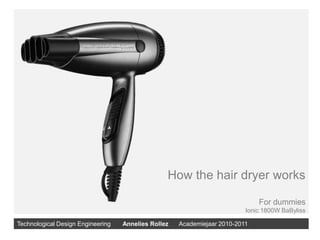
How the hair dryer worksFor dummiesIonic 1800W BaBylissTechnological Design Engineering       Annelies Rollez      Academiejaar 2010-2011
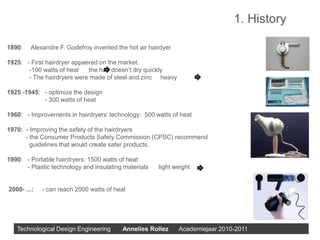
1. History1890:     Alexandre F. Godefroy invented the hot air hairdyer1925:   - First hairdryer appaered on the market.             -100 watts of heat      the hair doesn’t dry quickly             - The hairdryers were made of steel and zinc     heavy 1925 -1945:   - optimize the design                       - 300 watts of heat1960:   - Improvements in hairdryers’ technology:  500 watts of heat1970:  - Improving the safety of the hairdryers           - the Consumer Products Safety Commission (CPSC) recommend              guidelines that would create safer products.1990:   - Portable hairdryers: 1500 watts of heat            - Plastic technology and insulating materials      light weight2000- ...:     - can reach 2000 watts of heatTechnological Design Engineering       Annelies Rollez      Academiejaar 2010-2011
2. DisassemblyHeating-element with wrapped filaments Elements to have no filth  into the fanAir shaftFan and motorThe housingTechnological Design Engineering       Annelies Rollez      Academiejaar 2010-2011
Technological Design Engineering       Annelies Rollez      Academiejaar 2010-2011
3. Working hair dryerHair dryer     2 superior parts : 1. Heating-element 			            2. Fan driven by a little motorWhen you put the plug into the plug-socket    the electric current flow through the hair dryer2. Wrapped filaments of the heating element     provided with that current     					           warm up3. Current also will also drive the motor, which will next drive the fan4. The fan sucks air into the hair dryer     air passes the filaments     air takes 								up the warmth5. Heated air leaves the hair dryer and dries the hair because it accelerate     the evaporation of the water on the hair. Heat air raises the temperature of     the air around the hair.Technological Design Engineering       Annelies Rollez      Academiejaar 2010-2011
Technological Design Engineering       Annelies Rollez      Academiejaar 2010-2011
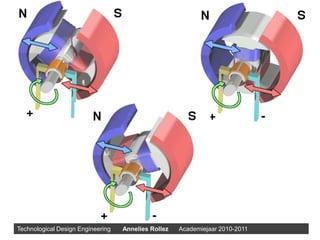
4. How each part works4.1. The motor4.1.1. Direct current motorElectromagnetism and magnets    important For the motors’ working processThe principle of the working of the motor: Contradictory poles attract each other
 Identical poles reject each other              a rotating movement Technological Design Engineering       Annelies Rollez      Academiejaar 2010-2011
Technological Design Engineering       Annelies Rollez      Academiejaar 2010-2011
4.1.2. DC motor vs AC motorDC motors may be better for some very small applications             costs less Smaller
 Lighter
 AC motors are rugged and reliable
 AC motors can operate at higher speeds
 AC motors are available in larger power ratings
 For larger applicationsTechnological Design Engineering       Annelies Rollez      Academiejaar 2010-2011
4.1.3. AC-DC converterBy means of diodes			A diode conducts the current just in one directionIn this hair dryer: AC-DC converter = bridge rectifier				consist of 4 diodesCurrent always flows in only one direction through the resistor.Alternating currentDirect currentTechnological Design Engineering       Annelies Rollez      Academiejaar 2010-2011
4.2. The switchesTo control the heatTo control  the air speedTechnological Design Engineering       Annelies Rollez      Academiejaar 2010-2011
4.3. The heating elementNichrome wire aroundisolating       elements of micaThe air that goes through the fan and passes the elements of the heating Element much colder than the Temperature of the nichrome wires.Because of that, the air will absorb the warmth of the heating element.the heat is dependent from the wattage of the hair dryer.Wattage         electric current through the nichrome wire          resistor Temperature Technological Design Engineering       Annelies Rollez      Academiejaar 2010-2011
4.4. The fanThe air flow will be generated by the fanThe electric motor: electric energyAn air flowThrough the vent holes    Protected with an gauze, which protects the hair dryer against dustTechnological Design Engineering       Annelies Rollez      Academiejaar 2010-2011
4.5. Safety features4.5.1.  Safety sensor- When the fan is broken, the hair dryer can be overheated. To Protect the hair dryer against it, the hair dryer will be supplied with a safety sensor.So when the temperature gets to high, the hair dryer will stop working.When the hair dryer is totally cooling down, then they can use it again. When the vents become clogged with hair of dust, the hair dryer becomes earlier overheated and so will stop working.Technological Design Engineering       Annelies Rollez      Academiejaar 2010-2011
4.5.2.  Safety cut off switchDryers contain a safety cut off switch that prevents the temperature of the drier from exceeding 60°C. Switch is a bimetallic strip made of a sheet composed of 2 different metals. Both sheets expand when heated, but each at different ratesWhen the temperature    inside the hair dryer     the sheets heat up and bendsWhen it reaches a certain point, it trips a switch that cuts off power to the hair dryer  Technological Design Engineering       Annelies Rollez      Academiejaar 2010-2011
4.5.3.  Thermal fuseThermal fuse included in the heating elementWhen the temperature or the current were excessively high       thermal fuse will blow and break Technological Design Engineering       Annelies Rollez      Academiejaar 2010-2011
4.5.4. Ground Fault Circuit interrupter (GFCI)Is used to prevent accidental electrocutionby comparing the electrical going out through the black wire against that coming back through the white wire. If the difference is more than .005 amp, the system will be shut off.Technological Design Engineering       Annelies Rollez      Academiejaar 2010-2011
4.5.5. InsulationThis is a sheet that’s around the heating element and that prevents the exterior  of the hair dryer from getting hot.Technological Design Engineering       Annelies Rollez      Academiejaar 2010-2011

Annelies rollez Presentation

  • 1.
    How the hairdryer worksFor dummiesIonic 1800W BaBylissTechnological Design Engineering Annelies Rollez Academiejaar 2010-2011
  • 2.
    1. History1890: Alexandre F. Godefroy invented the hot air hairdyer1925: - First hairdryer appaered on the market. -100 watts of heat the hair doesn’t dry quickly - The hairdryers were made of steel and zinc heavy 1925 -1945: - optimize the design - 300 watts of heat1960: - Improvements in hairdryers’ technology: 500 watts of heat1970: - Improving the safety of the hairdryers - the Consumer Products Safety Commission (CPSC) recommend guidelines that would create safer products.1990: - Portable hairdryers: 1500 watts of heat - Plastic technology and insulating materials light weight2000- ...: - can reach 2000 watts of heatTechnological Design Engineering Annelies Rollez Academiejaar 2010-2011
  • 3.
    2. DisassemblyHeating-element withwrapped filaments Elements to have no filth into the fanAir shaftFan and motorThe housingTechnological Design Engineering Annelies Rollez Academiejaar 2010-2011
  • 4.
    Technological Design Engineering Annelies Rollez Academiejaar 2010-2011
  • 5.
    3. Working hairdryerHair dryer 2 superior parts : 1. Heating-element 2. Fan driven by a little motorWhen you put the plug into the plug-socket the electric current flow through the hair dryer2. Wrapped filaments of the heating element provided with that current warm up3. Current also will also drive the motor, which will next drive the fan4. The fan sucks air into the hair dryer air passes the filaments air takes up the warmth5. Heated air leaves the hair dryer and dries the hair because it accelerate the evaporation of the water on the hair. Heat air raises the temperature of the air around the hair.Technological Design Engineering Annelies Rollez Academiejaar 2010-2011
  • 6.
    Technological Design Engineering Annelies Rollez Academiejaar 2010-2011
  • 7.
    Technological Design Engineering Annelies Rollez Academiejaar 2010-2011
  • 8.
    Technological Design Engineering Annelies Rollez Academiejaar 2010-2011
  • 9.
    4. How eachpart works4.1. The motor4.1.1. Direct current motorElectromagnetism and magnets important For the motors’ working processThe principle of the working of the motor: Contradictory poles attract each other
  • 10.
    Identical polesreject each other a rotating movement Technological Design Engineering Annelies Rollez Academiejaar 2010-2011
  • 11.
    Technological Design Engineering Annelies Rollez Academiejaar 2010-2011
  • 12.
    Technological Design Engineering Annelies Rollez Academiejaar 2010-2011
  • 13.
    4.1.2. DC motorvs AC motorDC motors may be better for some very small applications costs less Smaller
  • 14.
  • 15.
    AC motorsare rugged and reliable
  • 16.
    AC motorscan operate at higher speeds
  • 17.
    AC motorsare available in larger power ratings
  • 18.
    For largerapplicationsTechnological Design Engineering Annelies Rollez Academiejaar 2010-2011
  • 19.
    4.1.3. AC-DC converterBymeans of diodes A diode conducts the current just in one directionIn this hair dryer: AC-DC converter = bridge rectifier consist of 4 diodesCurrent always flows in only one direction through the resistor.Alternating currentDirect currentTechnological Design Engineering Annelies Rollez Academiejaar 2010-2011
  • 20.
    4.2. The switchesTocontrol the heatTo control the air speedTechnological Design Engineering Annelies Rollez Academiejaar 2010-2011
  • 21.
    4.3. The heatingelementNichrome wire aroundisolating elements of micaThe air that goes through the fan and passes the elements of the heating Element much colder than the Temperature of the nichrome wires.Because of that, the air will absorb the warmth of the heating element.the heat is dependent from the wattage of the hair dryer.Wattage electric current through the nichrome wire resistor Temperature Technological Design Engineering Annelies Rollez Academiejaar 2010-2011
  • 22.
    4.4. The fanTheair flow will be generated by the fanThe electric motor: electric energyAn air flowThrough the vent holes Protected with an gauze, which protects the hair dryer against dustTechnological Design Engineering Annelies Rollez Academiejaar 2010-2011
  • 23.
    4.5. Safety features4.5.1. Safety sensor- When the fan is broken, the hair dryer can be overheated. To Protect the hair dryer against it, the hair dryer will be supplied with a safety sensor.So when the temperature gets to high, the hair dryer will stop working.When the hair dryer is totally cooling down, then they can use it again. When the vents become clogged with hair of dust, the hair dryer becomes earlier overheated and so will stop working.Technological Design Engineering Annelies Rollez Academiejaar 2010-2011
  • 24.
    4.5.2. Safetycut off switchDryers contain a safety cut off switch that prevents the temperature of the drier from exceeding 60°C. Switch is a bimetallic strip made of a sheet composed of 2 different metals. Both sheets expand when heated, but each at different ratesWhen the temperature inside the hair dryer the sheets heat up and bendsWhen it reaches a certain point, it trips a switch that cuts off power to the hair dryer Technological Design Engineering Annelies Rollez Academiejaar 2010-2011
  • 25.
    4.5.3. ThermalfuseThermal fuse included in the heating elementWhen the temperature or the current were excessively high thermal fuse will blow and break Technological Design Engineering Annelies Rollez Academiejaar 2010-2011
  • 26.
    4.5.4. Ground FaultCircuit interrupter (GFCI)Is used to prevent accidental electrocutionby comparing the electrical going out through the black wire against that coming back through the white wire. If the difference is more than .005 amp, the system will be shut off.Technological Design Engineering Annelies Rollez Academiejaar 2010-2011
  • 27.
    4.5.5. InsulationThis isa sheet that’s around the heating element and that prevents the exterior of the hair dryer from getting hot.Technological Design Engineering Annelies Rollez Academiejaar 2010-2011