Animal communication
Lions
Worked by: Kandalintseva D.,
Kondulevich A.
Checked by: A. A. Novikova
Novosibirsk, 2012
Gymnasium № 9
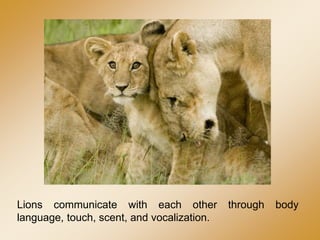
Lions communicate with each other through body
language, touch, scent, and vocalization.
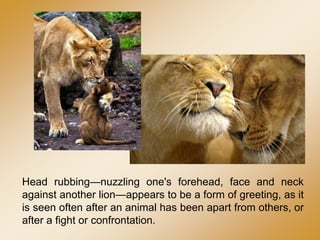
Head rubbing—nuzzling one's forehead, face and neck
against another lion—appears to be a form of greeting, as it
is seen often after an animal has been apart from others, or
after a fight or confrontation.
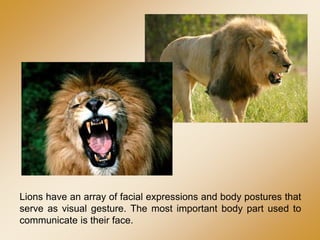
Lions have an array of facial expressions and body postures that
serve as visual gesture. The most important body part used to
communicate is their face.
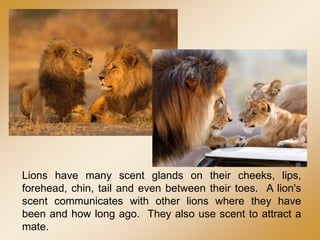
Lions have many scent glands on their cheeks, lips,
forehead, chin, tail and even between their toes. A lion's
scent communicates with other lions where they have
been and how long ago. They also use scent to attract a
mate.
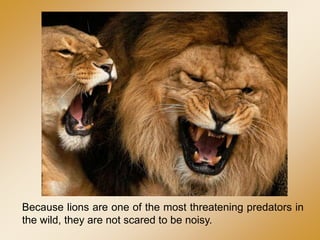
Because lions are one of the most threatening predators in
the wild, they are not scared to be noisy.
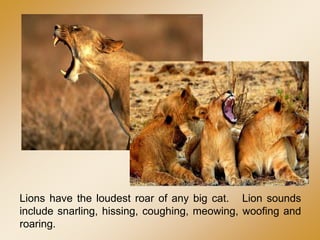
Lions have the loudest roar of any big cat. Lion sounds
include snarling, hissing, coughing, meowing, woofing and
roaring.
The list of the literature
• http://library.thinkquest.org/05aug/01006/lions.htm
• http://acp.eugraph.com/catdog/index.html
• http://en.wikipedia.org/wiki/Lion#Behaviour

Animal communication lions

  • 1.
    Animal communication Lions Worked by:Kandalintseva D., Kondulevich A. Checked by: A. A. Novikova Novosibirsk, 2012 Gymnasium № 9
  • 2.
    Lions communicate witheach other through body language, touch, scent, and vocalization.
  • 3.
    Head rubbing—nuzzling one'sforehead, face and neck against another lion—appears to be a form of greeting, as it is seen often after an animal has been apart from others, or after a fight or confrontation.
  • 4.
    Lions have anarray of facial expressions and body postures that serve as visual gesture. The most important body part used to communicate is their face.
  • 5.
    Lions have manyscent glands on their cheeks, lips, forehead, chin, tail and even between their toes. A lion's scent communicates with other lions where they have been and how long ago. They also use scent to attract a mate.
  • 6.
    Because lions areone of the most threatening predators in the wild, they are not scared to be noisy.
  • 7.
    Lions have theloudest roar of any big cat. Lion sounds include snarling, hissing, coughing, meowing, woofing and roaring.
  • 8.
    The list ofthe literature • http://library.thinkquest.org/05aug/01006/lions.htm • http://acp.eugraph.com/catdog/index.html • http://en.wikipedia.org/wiki/Lion#Behaviour