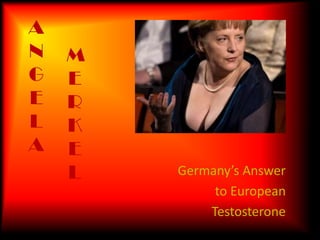
ANGELAMERKELGermany’s Answer to European Testosterone
Interesting Fact!!!Angela Merkel is the first female chancellor of Germany.
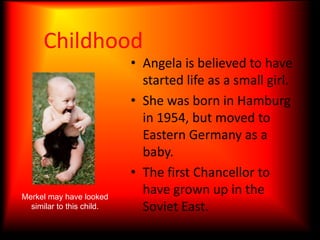
ChildhoodAngela is believed to have started life as a small girl.She was born in Hamburg in 1954, but moved to Eastern Germany as a baby.The first Chancellor to have grown up in the Soviet East.Merkel may have looked similar to this child.
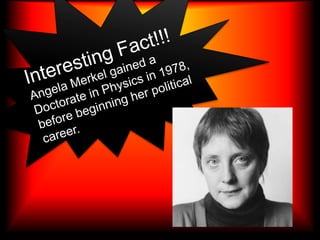
Interesting Fact!!!Angela Merkel gained a Doctorate in Physics in 1978, before beginning her political career.
First Attempt At European Integration: Unification Begins At Home
Unification Begins At HomeMerkel was involved in the East German democratic movement from its early beginnings.Deputy Spokesperson for the first democratically elected government in East Germany following the fall of the Berlin Wall.Represented her local constituency in the first unified German government, in 1990.
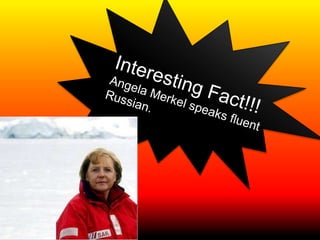
Interesting Fact!!!Angela Merkel speaks fluent Russian.
Government Ahoy!In 1994, Merkel became the youngest cabinet minister in Helmut Kohl’s government, responsible for Women and Youth, and then Environment and Nuclear Safety.
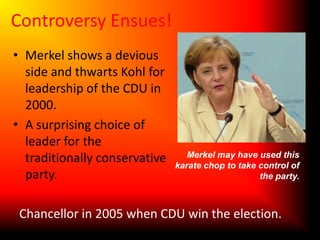
Controversy Ensues!Merkel shows a devious side and thwarts Kohl for leadership of the CDU in 2000.A surprising choice of leader for the traditionally conservative party.Merkel may have used this karate chop to take control of the party.Chancellor in 2005 when CDU win the election.
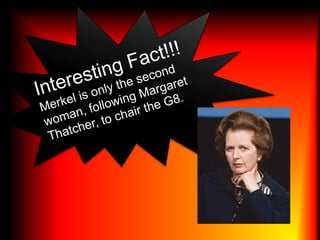
Interesting Fact!!!Merkel is only the second woman, following Margaret Thatcher, to chair the G8.
Wider European IntegrationMerkel and the Lisbon Treaty
Wider European IntegrationMerkel’s government was in charge when Germany took over the rotating EU presidency in 2007.Sick of all this fuss about a constitution being dragged out, so set a deadline of mid-2009 for a Treaty to be implemented.Message we can take from this?Germans = Efficiency
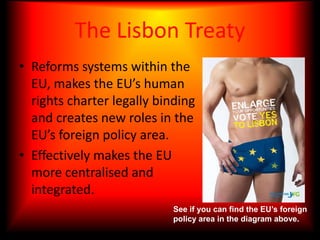
The Lisbon TreatyReforms systems within the EU, makes the EU’s human rights charter legally binding and creates new roles in the EU’s foreign policy area.Effectively makes the EU more centralised and integrated.See if you can find the EU’s foreign policy area in the diagram above.
The Lisbon TreatyAmends other treaties, such as Maastrict (1992) and Rome (1957).
Came into force December 1, 2009, once Ireland had agreed.Merkel And The TreatyIn 2006, even before the Lisbon Treaty, Merkel was given the Vision for Europe Award.Merkel’s insistence at having a deadline and lobbying of member states ensured that the Treaty was finally signed, once Ireland agreed, in 2009.Merkel was recognised for her work on the Lisbon Treaty by being awarded the Charlemagne Prize in 2008.
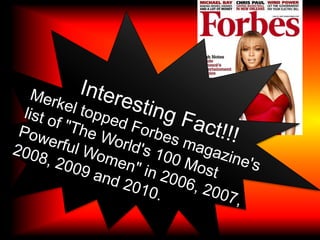
Interesting Fact!!!Merkel topped Forbes magazine's list of "The World's 100 Most Powerful Women" in 2006, 2007, 2008, 2009 and 2010.
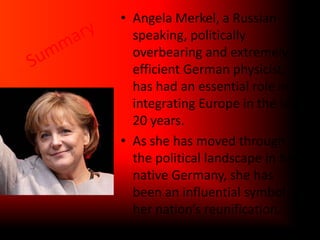
Angela Merkel, a Russian-speaking, politically overbearing and extremely efficient German physicist, has had an essential role in integrating Europe in the last 20 years.As she has moved through the political landscape in her native Germany, she has been an influential symbol of her nation’s reunification.Summary
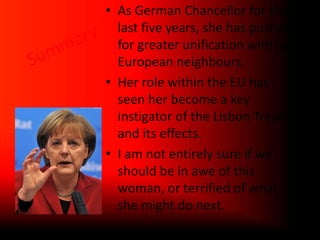
As German Chancellor for the last five years, she has pushed for greater unification with her European neighbours.

Angela Merkel

  • 1.
  • 2.
    Interesting Fact!!!Angela Merkelis the first female chancellor of Germany.
  • 3.
    ChildhoodAngela is believedto have started life as a small girl.She was born in Hamburg in 1954, but moved to Eastern Germany as a baby.The first Chancellor to have grown up in the Soviet East.Merkel may have looked similar to this child.
  • 4.
    Interesting Fact!!!Angela Merkelgained a Doctorate in Physics in 1978, before beginning her political career.
  • 5.
    First Attempt AtEuropean Integration: Unification Begins At Home
  • 6.
    Unification Begins AtHomeMerkel was involved in the East German democratic movement from its early beginnings.Deputy Spokesperson for the first democratically elected government in East Germany following the fall of the Berlin Wall.Represented her local constituency in the first unified German government, in 1990.
  • 7.
    Interesting Fact!!!Angela Merkelspeaks fluent Russian.
  • 8.
    Government Ahoy!In 1994,Merkel became the youngest cabinet minister in Helmut Kohl’s government, responsible for Women and Youth, and then Environment and Nuclear Safety.
  • 9.
    Controversy Ensues!Merkel showsa devious side and thwarts Kohl for leadership of the CDU in 2000.A surprising choice of leader for the traditionally conservative party.Merkel may have used this karate chop to take control of the party.Chancellor in 2005 when CDU win the election.
  • 10.
    Interesting Fact!!!Merkel isonly the second woman, following Margaret Thatcher, to chair the G8.
  • 11.
  • 12.
    Wider European IntegrationMerkel’sgovernment was in charge when Germany took over the rotating EU presidency in 2007.Sick of all this fuss about a constitution being dragged out, so set a deadline of mid-2009 for a Treaty to be implemented.Message we can take from this?Germans = Efficiency
  • 13.
    The Lisbon TreatyReformssystems within the EU, makes the EU’s human rights charter legally binding and creates new roles in the EU’s foreign policy area.Effectively makes the EU more centralised and integrated.See if you can find the EU’s foreign policy area in the diagram above.
  • 14.
    The Lisbon TreatyAmendsother treaties, such as Maastrict (1992) and Rome (1957).
  • 15.
    Came into forceDecember 1, 2009, once Ireland had agreed.Merkel And The TreatyIn 2006, even before the Lisbon Treaty, Merkel was given the Vision for Europe Award.Merkel’s insistence at having a deadline and lobbying of member states ensured that the Treaty was finally signed, once Ireland agreed, in 2009.Merkel was recognised for her work on the Lisbon Treaty by being awarded the Charlemagne Prize in 2008.
  • 16.
    Interesting Fact!!!Merkel toppedForbes magazine's list of "The World's 100 Most Powerful Women" in 2006, 2007, 2008, 2009 and 2010.
  • 17.
    Angela Merkel, aRussian-speaking, politically overbearing and extremely efficient German physicist, has had an essential role in integrating Europe in the last 20 years.As she has moved through the political landscape in her native Germany, she has been an influential symbol of her nation’s reunification.Summary
  • 18.
    As German Chancellorfor the last five years, she has pushed for greater unification with her European neighbours.