Natural Gas 101: Covering the Basics
ANGA – Think About Energy Summit
Tuesday, Oct. 29, 2013 – Denver
Alan Harrison, Vice President Drilling Operations
2
The New Renaissance for an Underappreciated Resource
Unlocking our Natural Gas Resources
ANGA – Think About Energy Summit | Oct. 29, 2013
The Shale Gas Revolution: Vision and Persistence
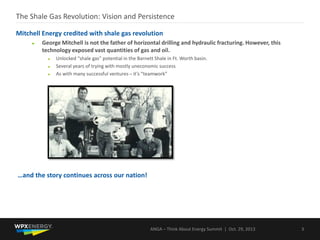
Mitchell Energy credited with shale gas revolution
► George Mitchell is not the father of horizontal drilling and hydraulic fracturing. However, this
technology exposed vast quantities of gas and oil.
► Unlocked “shale gas” potential in the Barnett Shale in Ft. Worth basin.
► Several years of trying with mostly uneconomic success
► As with many successful ventures ̶ it’s “teamwork”
…and the story continues across our nation!
3ANGA – Think About Energy Summit | Oct. 29, 2013
An Abundance Beneath Our Feet
ANGA – Think About Energy Summit | Oct. 29, 2013 4
5
Origin of Natural Gas
ANGA – Think About Energy Summit | Oct. 29, 2013
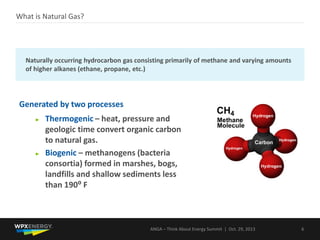
What is Natural Gas?
6
Generated by two processes
► Thermogenic – heat, pressure and
geologic time convert organic carbon
to natural gas.
► Biogenic – methanogens (bacteria
consortia) formed in marshes, bogs,
landfills and shallow sediments less
than 190⁰ F
Naturally occurring hydrocarbon gas consisting primarily of methane and varying amounts
of higher alkanes (ethane, propane, etc.)
ANGA – Think About Energy Summit | Oct. 29, 2013
A Long Time in the Making!
Period of
Oil and Gas
Formations
*MYA = Millions of Years Ago
7ANGA – Think About Energy Summit | Oct. 29, 2013
Late Cretaceous Paleogeography (75 Ma)
Piceance
Basin
DJ Basin
75 Million Years Ago…
8ANGA – Think About Energy Summit | Oct. 29, 2013
Fossil Fuels – What are these?
9
They are actually the preserved
remnants of micro-organisms
and plant debris.
• Plankton
• Algae
• Grasses, trees, plants, etc.
Heat and Pressure
Coal - Low heat and pressure
Oil - Moderate heat and
pressure
Gas - High heat and pressure
ANGA – Think About Energy Summit | Oct. 29, 2013
Where Does Oil and Gas Accumulate in the Earth?
10
Limestone
Fossil fuels found in
sedimentary basins
Source rock subject to heat
and pressure
Overburden squeezes oil and
gas into porous rocks
If trap exists, an accumulation
(reservoir) is formed
ANGA – Think About Energy Summit | Oct. 29, 2013
Natural Gas Processed Prior to Utilization
11
From the field to the burner tip
ANGA – Think About Energy Summit | Oct. 29, 2013
12
How we Find and Develop
Our Natural Gas Resources
ANGA – Think About Energy Summit | Oct. 29, 2013
3 Main Ingredients for Economic Successes
1. Hydrocarbon Rich Basin Accumulation
2. Technology
3. Commodity Price
13
A vast accumulation of hydrocarbons known
to exist over a large areal extent and/or thick
vertical section, which typically exhibits lower
geologic and/or commercial risk with a
repeatable distribution of recoveries (per well)
than compared to conventional type plays.
Definition of Resource Play:
ANGA – Think About Energy Summit | Oct. 29, 2013
1. Hydrocarbon Rich Basin Accumulation
2. Technology
3. Commodity Price
The Exploration Model
GEOLOGY
FIND ECONOMIC OIL & GAS
LAND GEOPHYSICS
EXPLORATION
14ANGA – Think About Energy Summit | Oct. 29, 2013
Geophysics: Energy at Surface = Subsurface Geology
Most common methods
► 2D - viewed as a profile
or slice through the
earth
► 3D - record multiple
lines simultaneously
for 3-dimensional view
15ANGA – Think About Energy Summit | Oct. 29, 2013
Geologists Spend Lots of Time Studying Rocks
16ANGA – Think About Energy Summit | Oct. 29, 2013
17
Responsible Development through
Technology, Innovation and
Environmental Stewardship
ANGA – Think About Energy Summit | Oct. 29, 2013
Modern Rig Designs Providing Many Benefits
Multi-well Pad Drilling 100% Natural Gas
Minimize Disturbance
• Multiple wells from single well pad
• Less trucking and moving of materials
• Shift to LNG and natural gas for fuel
• Improved safety features
WPX Energy – Piceance Basin
18ANGA – Think About Energy Summit | Oct. 29, 2013
Drill Depths
6000’-9000’
1500’- 3000’ of gas
saturated Williams Fork
Formation
Multi-well
Drilling Pads
Small,
Discontinuous
Sand Bodies
10-Acre Well
Spacing
Gas Saturated
Zone
Multi-well Pads and Directional Drilling Minimize Impacts
19ANGA – Think About Energy Summit | Oct. 29, 2013
Horizontal Drilling Dominating Shale Plays
Horizontal Solution
► Homogenous continuous reservoir
► Single layer source – low permeability
(i.e. shale)
► Objective – contact more rock
► Fewer surface locations needed
► Lateral sections greater than 2 miles
20
Common terms used to describe horizontal wells
ANGA – Think About Energy Summit | Oct. 29, 2013
How Do We Get Hydrocarbons to Surface?
► Holes (perforations) shot
through casing to allow O&G
to enter the wellbore.
► Sand and water pumped
downhole to create fractures
in the reservoir.
► Fractures are kept open
by sand.
► Allows O&G easier flow
to the wellbore.
21ANGA – Think About Energy Summit | Oct. 29, 2013
Hydraulic Fracturing… It’s Safe!
More than 1,000,000 hydraulic fracturing stimulations within the U.S. without
compromising fresh groundwater.
22ANGA – Think About Energy Summit | Oct. 29, 2013
Other Things to Know About Hydraulic Fracturing
Often times misrepresented and
misunderstood by public
► Not new, and not part of drilling
process
► First HF in 1947
► No cases of ground water
contamination from fracturing
► Utilizes less than .1% of CO water use
COGCC rules and regulations most
comprehensive among states
► Prevention and Protective
► Wellbore construction and integrity
► Chemical disclosure
► Baseline water sampling (pre and post)
► Emission reductions
23ANGA – Think About Energy Summit | Oct. 29, 2013
24
Now that we have covered the “Upstream” portion
…Let’s Think About the rest of the Natural Gas Story.
ANGA – Think About Energy Summit | Oct. 29, 2013
Life Cycle of Natural Gas
25ANGA – Think About Energy Summit | Oct. 29, 2013
Outlook for Production Growth
ANGA – Think About Energy Summit | Oct. 29, 2013 26
Majority
of growth
from PA
and TX
At current production rates we have 100+ years of natural gas resources remaining
Unconventional Gas Accelerating Production Growth
27ANGA – Think About Energy Summit | Oct. 29, 2013
Where is Natural Gas Used?
28
33
32
31
3
41
3
75
20
Percent of Sources Percent of Sectors
ANGA – Think About Energy Summit | Oct. 29, 2013
Primary energy consuption by Source and Sector, 2011 (quadrillion BTU)
Petroleum
(36%)
Natural Gas
(26%)
Coal
(20%)
Renewable Energy
(9%)
Nuclear Electric Power
(8%)
Source
Transportation
(28%)
Industrial
(21%)
Residential &
Commercial
(11%)
Electric Power
(40%)
Sector
Demand Will Grow Across All Sectors
29ANGA – Think About Energy Summit | Oct. 29, 2013
Key Users of Electricity from Natural Gas
30ANGA – Think About Energy Summit | Oct. 29, 2013
What is the Natural Gas Resurgence Impact Nationwide?
31ANGA – Think About Energy Summit | Oct. 29, 2013
32
What’s Happening in Colorado!
ANGA – Think About Energy Summit | Oct. 29, 2013
The Bigger Economic Driver
► Shale exploitation not limited to natural gas
► Oil production is currently the biggest driver
33
Source: Colorado Oil and Gas Conservation Commission
ANGA – Think About Energy Summit | Oct. 29, 2013
Active Colorado Oil and Gas Wells by County
34
Source: Colorado Oil and Gas Conservation Commission
ANGA – Think About Energy Summit | Oct. 29, 2013
Natural Gas Resurgence ‒ Impact to Colorado
35ANGA – Think About Energy Summit | Oct. 29, 2013
36
Multiple Opportunities in the Transportation Sector
ANGA – Think About Energy Summit | Oct. 29, 2013
Natural Gas Solutions
Compressed Natural Gas (CNG)
► Source: Pipeline
► Compressed to 3,600 psi
► Focused on light- and medium-duty vehicles, but has heavy duty
capability
► Ideal for return-to-base fleets or fleets that require fast filling
► Time-fill and fast-fill capability/stored in pressurized tanks
Liquefied Natural Gas (LNG)
► Source: Liquefaction plant
► Converted to liquid form for ease of storage and transport
(cooled to -260° F and 40 psi)
► Ideal for medium- to heavy-duty fleets
► Fast-fill/stored in tanks (similar to diesel size)
37ANGA – Think About Energy Summit | Oct. 29, 2013
CNG – Already Cheaper Alternative
Jan. 27, 2013 article at
www.owegopennysaver.com
Owego, N.Y.
38ANGA – Think About Energy Summit | Oct. 29, 2013
Commercially Available CNG Fleets
CNG Vehicles
► CNG-powered vehicles produce almost half of the emissions
federal guidelines allow, making Waste Management’s hauling
vehicles among the cleanest fleets of heavy-duty trucks in the
United States. Waste Management of Orange County operates
54 CNG trucks.
Operating the Orange County fleet of clean-burning trucks is equivalent
to taking more than 4,000 vehicles off the road each day!
39
For each diesel truck replaced is an equal annual reduction
of 8,000 gallons of diesel and 22 metric tons of greenhouse gases.
ANGA – Think About Energy Summit | Oct. 29, 2013
Detroit, We Want CNG Vehicles!
40ANGA – Think About Energy Summit | Oct. 29, 2013
Thank You.
41ANGA – Think About Energy Summit | Oct. 29, 2013

ANGA_ThinkAboutEnergySummit

  • 1.
    Natural Gas 101:Covering the Basics ANGA – Think About Energy Summit Tuesday, Oct. 29, 2013 – Denver Alan Harrison, Vice President Drilling Operations
  • 2.
    2 The New Renaissancefor an Underappreciated Resource Unlocking our Natural Gas Resources ANGA – Think About Energy Summit | Oct. 29, 2013
  • 3.
    The Shale GasRevolution: Vision and Persistence Mitchell Energy credited with shale gas revolution ► George Mitchell is not the father of horizontal drilling and hydraulic fracturing. However, this technology exposed vast quantities of gas and oil. ► Unlocked “shale gas” potential in the Barnett Shale in Ft. Worth basin. ► Several years of trying with mostly uneconomic success ► As with many successful ventures ̶ it’s “teamwork” …and the story continues across our nation! 3ANGA – Think About Energy Summit | Oct. 29, 2013
  • 4.
    An Abundance BeneathOur Feet ANGA – Think About Energy Summit | Oct. 29, 2013 4
  • 5.
    5 Origin of NaturalGas ANGA – Think About Energy Summit | Oct. 29, 2013
  • 6.
    What is NaturalGas? 6 Generated by two processes ► Thermogenic – heat, pressure and geologic time convert organic carbon to natural gas. ► Biogenic – methanogens (bacteria consortia) formed in marshes, bogs, landfills and shallow sediments less than 190⁰ F Naturally occurring hydrocarbon gas consisting primarily of methane and varying amounts of higher alkanes (ethane, propane, etc.) ANGA – Think About Energy Summit | Oct. 29, 2013
  • 7.
    A Long Timein the Making! Period of Oil and Gas Formations *MYA = Millions of Years Ago 7ANGA – Think About Energy Summit | Oct. 29, 2013
  • 8.
    Late Cretaceous Paleogeography(75 Ma) Piceance Basin DJ Basin 75 Million Years Ago… 8ANGA – Think About Energy Summit | Oct. 29, 2013
  • 9.
    Fossil Fuels –What are these? 9 They are actually the preserved remnants of micro-organisms and plant debris. • Plankton • Algae • Grasses, trees, plants, etc. Heat and Pressure Coal - Low heat and pressure Oil - Moderate heat and pressure Gas - High heat and pressure ANGA – Think About Energy Summit | Oct. 29, 2013
  • 10.
    Where Does Oiland Gas Accumulate in the Earth? 10 Limestone Fossil fuels found in sedimentary basins Source rock subject to heat and pressure Overburden squeezes oil and gas into porous rocks If trap exists, an accumulation (reservoir) is formed ANGA – Think About Energy Summit | Oct. 29, 2013
  • 11.
    Natural Gas ProcessedPrior to Utilization 11 From the field to the burner tip ANGA – Think About Energy Summit | Oct. 29, 2013
  • 12.
    12 How we Findand Develop Our Natural Gas Resources ANGA – Think About Energy Summit | Oct. 29, 2013
  • 13.
    3 Main Ingredientsfor Economic Successes 1. Hydrocarbon Rich Basin Accumulation 2. Technology 3. Commodity Price 13 A vast accumulation of hydrocarbons known to exist over a large areal extent and/or thick vertical section, which typically exhibits lower geologic and/or commercial risk with a repeatable distribution of recoveries (per well) than compared to conventional type plays. Definition of Resource Play: ANGA – Think About Energy Summit | Oct. 29, 2013 1. Hydrocarbon Rich Basin Accumulation 2. Technology 3. Commodity Price
  • 14.
    The Exploration Model GEOLOGY FINDECONOMIC OIL & GAS LAND GEOPHYSICS EXPLORATION 14ANGA – Think About Energy Summit | Oct. 29, 2013
  • 15.
    Geophysics: Energy atSurface = Subsurface Geology Most common methods ► 2D - viewed as a profile or slice through the earth ► 3D - record multiple lines simultaneously for 3-dimensional view 15ANGA – Think About Energy Summit | Oct. 29, 2013
  • 16.
    Geologists Spend Lotsof Time Studying Rocks 16ANGA – Think About Energy Summit | Oct. 29, 2013
  • 17.
    17 Responsible Development through Technology,Innovation and Environmental Stewardship ANGA – Think About Energy Summit | Oct. 29, 2013
  • 18.
    Modern Rig DesignsProviding Many Benefits Multi-well Pad Drilling 100% Natural Gas Minimize Disturbance • Multiple wells from single well pad • Less trucking and moving of materials • Shift to LNG and natural gas for fuel • Improved safety features WPX Energy – Piceance Basin 18ANGA – Think About Energy Summit | Oct. 29, 2013
  • 19.
    Drill Depths 6000’-9000’ 1500’- 3000’of gas saturated Williams Fork Formation Multi-well Drilling Pads Small, Discontinuous Sand Bodies 10-Acre Well Spacing Gas Saturated Zone Multi-well Pads and Directional Drilling Minimize Impacts 19ANGA – Think About Energy Summit | Oct. 29, 2013
  • 20.
    Horizontal Drilling DominatingShale Plays Horizontal Solution ► Homogenous continuous reservoir ► Single layer source – low permeability (i.e. shale) ► Objective – contact more rock ► Fewer surface locations needed ► Lateral sections greater than 2 miles 20 Common terms used to describe horizontal wells ANGA – Think About Energy Summit | Oct. 29, 2013
  • 21.
    How Do WeGet Hydrocarbons to Surface? ► Holes (perforations) shot through casing to allow O&G to enter the wellbore. ► Sand and water pumped downhole to create fractures in the reservoir. ► Fractures are kept open by sand. ► Allows O&G easier flow to the wellbore. 21ANGA – Think About Energy Summit | Oct. 29, 2013
  • 22.
    Hydraulic Fracturing… It’sSafe! More than 1,000,000 hydraulic fracturing stimulations within the U.S. without compromising fresh groundwater. 22ANGA – Think About Energy Summit | Oct. 29, 2013
  • 23.
    Other Things toKnow About Hydraulic Fracturing Often times misrepresented and misunderstood by public ► Not new, and not part of drilling process ► First HF in 1947 ► No cases of ground water contamination from fracturing ► Utilizes less than .1% of CO water use COGCC rules and regulations most comprehensive among states ► Prevention and Protective ► Wellbore construction and integrity ► Chemical disclosure ► Baseline water sampling (pre and post) ► Emission reductions 23ANGA – Think About Energy Summit | Oct. 29, 2013
  • 24.
    24 Now that wehave covered the “Upstream” portion …Let’s Think About the rest of the Natural Gas Story. ANGA – Think About Energy Summit | Oct. 29, 2013
  • 25.
    Life Cycle ofNatural Gas 25ANGA – Think About Energy Summit | Oct. 29, 2013
  • 26.
    Outlook for ProductionGrowth ANGA – Think About Energy Summit | Oct. 29, 2013 26 Majority of growth from PA and TX At current production rates we have 100+ years of natural gas resources remaining
  • 27.
    Unconventional Gas AcceleratingProduction Growth 27ANGA – Think About Energy Summit | Oct. 29, 2013
  • 28.
    Where is NaturalGas Used? 28 33 32 31 3 41 3 75 20 Percent of Sources Percent of Sectors ANGA – Think About Energy Summit | Oct. 29, 2013 Primary energy consuption by Source and Sector, 2011 (quadrillion BTU) Petroleum (36%) Natural Gas (26%) Coal (20%) Renewable Energy (9%) Nuclear Electric Power (8%) Source Transportation (28%) Industrial (21%) Residential & Commercial (11%) Electric Power (40%) Sector
  • 29.
    Demand Will GrowAcross All Sectors 29ANGA – Think About Energy Summit | Oct. 29, 2013
  • 30.
    Key Users ofElectricity from Natural Gas 30ANGA – Think About Energy Summit | Oct. 29, 2013
  • 31.
    What is theNatural Gas Resurgence Impact Nationwide? 31ANGA – Think About Energy Summit | Oct. 29, 2013
  • 32.
    32 What’s Happening inColorado! ANGA – Think About Energy Summit | Oct. 29, 2013
  • 33.
    The Bigger EconomicDriver ► Shale exploitation not limited to natural gas ► Oil production is currently the biggest driver 33 Source: Colorado Oil and Gas Conservation Commission ANGA – Think About Energy Summit | Oct. 29, 2013
  • 34.
    Active Colorado Oiland Gas Wells by County 34 Source: Colorado Oil and Gas Conservation Commission ANGA – Think About Energy Summit | Oct. 29, 2013
  • 35.
    Natural Gas Resurgence‒ Impact to Colorado 35ANGA – Think About Energy Summit | Oct. 29, 2013
  • 36.
    36 Multiple Opportunities inthe Transportation Sector ANGA – Think About Energy Summit | Oct. 29, 2013
  • 37.
    Natural Gas Solutions CompressedNatural Gas (CNG) ► Source: Pipeline ► Compressed to 3,600 psi ► Focused on light- and medium-duty vehicles, but has heavy duty capability ► Ideal for return-to-base fleets or fleets that require fast filling ► Time-fill and fast-fill capability/stored in pressurized tanks Liquefied Natural Gas (LNG) ► Source: Liquefaction plant ► Converted to liquid form for ease of storage and transport (cooled to -260° F and 40 psi) ► Ideal for medium- to heavy-duty fleets ► Fast-fill/stored in tanks (similar to diesel size) 37ANGA – Think About Energy Summit | Oct. 29, 2013
  • 38.
    CNG – AlreadyCheaper Alternative Jan. 27, 2013 article at www.owegopennysaver.com Owego, N.Y. 38ANGA – Think About Energy Summit | Oct. 29, 2013
  • 39.
    Commercially Available CNGFleets CNG Vehicles ► CNG-powered vehicles produce almost half of the emissions federal guidelines allow, making Waste Management’s hauling vehicles among the cleanest fleets of heavy-duty trucks in the United States. Waste Management of Orange County operates 54 CNG trucks. Operating the Orange County fleet of clean-burning trucks is equivalent to taking more than 4,000 vehicles off the road each day! 39 For each diesel truck replaced is an equal annual reduction of 8,000 gallons of diesel and 22 metric tons of greenhouse gases. ANGA – Think About Energy Summit | Oct. 29, 2013
  • 40.
    Detroit, We WantCNG Vehicles! 40ANGA – Think About Energy Summit | Oct. 29, 2013
  • 41.
    Thank You. 41ANGA –Think About Energy Summit | Oct. 29, 2013