Android geolocation using
      GSM network
  « Where was Waldroid? »

           Renaud Lifchitz
           renaud.lifchitz+27c3@gmail.com


           #27c3
           27-30 December 2010, Berlin
Speaker's bio
●   French computer security engineer
●   Main activities:
        –   Penetration testing&security audits
        –   Security trainings
        –   Security research
●   Main interests:
        –   Security of protocols (authentication,
             cryptography, information leakage, zero-
             knowledge proofs...)
        –   Number theory (integer factorization,
             primality tests, elliptic curves)
      #27c3 – 27-30 December 2010 – Berlin
      “Android geolocation using GSM network”           2
      Renaud Lifchitz
Why Android?


#27c3 – 27-30 December 2010 – Berlin
“Android geolocation using GSM network”   3
Renaud Lifchitz
Why Android?
●   Why not?
●   In just 2 years, 300,000 Android phones
    activated each day
    (Andy Rubin, Google, 2010/12/09)
●   Android sales overtake iPhone in the
    U.S. since summer
●   Because hacking on Android is sooooo
    cool (Linux kernel ☺)

      #27c3 – 27-30 December 2010 – Berlin
      “Android geolocation using GSM network”   4
      Renaud Lifchitz
Why Android?


#27c3 – 27-30 December 2010 – Berlin
“Android geolocation using GSM network”   5
Renaud Lifchitz
Geolocation: different approaches


#27c3 – 27-30 December 2010 – Berlin
“Android geolocation using GSM network”   6
Renaud Lifchitz
GPS

●   Pros:
        –   Very accurate

●   Cons:
        –   Phone needs a built-in GPS
        –   User must switch it on
        –   Doesn't work inside buildings nor
             underground

      #27c3 – 27-30 December 2010 – Berlin
      “Android geolocation using GSM network”   7
      Renaud Lifchitz
Wi-Fi

●   Pros:
        –   Works inside buildings

●   Cons:
        –   Phone needs built-in Wi-Fi
        –   User must switch it on
        –   Less accurate than GPS
        –   Needs access points
      #27c3 – 27-30 December 2010 – Berlin
      “Android geolocation using GSM network”   8
      Renaud Lifchitz
GSM location

●   Pros:
        –   No need for built-in GPS or Wi-Fi
        –   Can be done from the network side

●   Cons:
        –   Medium accuracy
        –   Needs GSM coverage

      #27c3 – 27-30 December 2010 – Berlin
      “Android geolocation using GSM network”   9
      Renaud Lifchitz
Cell location resolution

●   Every GSM cell (BTS) is identified
    by 4 numbers:
        –   MCC: Mobile Country Code
        –   MNC: Mobile Network Code
        –   LAC: Location Area Code
        –   CID: Cell ID


 (MCC: 262, MNC: 01) = T-Mobile                ®
                                                    Deutschland
      #27c3 – 27-30 December 2010 – Berlin
      “Android geolocation using GSM network”                     10
      Renaud Lifchitz
Cell location resolution
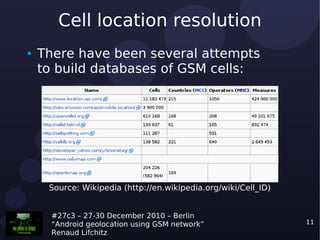
●   There have been several attempts
    to build databases of GSM cells:


     Source: Wikipedia (http://en.wikipedia.org/wiki/Cell_ID)


      #27c3 – 27-30 December 2010 – Berlin
      “Android geolocation using GSM network”                   11
      Renaud Lifchitz
Cell location resolution
         ●                          Why not use Google fantastic
                                    indexing power?
         ●                          Huge and continuously updated database
                                    thanks to:
                                                       Google cars
Licensed under theCC Attribution-Share
Flickr photo by PhyreWorX

  Alike 2.0 Generic license


                                                                     &


                                                                  Android phones

                                         #27c3 – 27-30 December 2010 – Berlin
                                         “Android geolocation using GSM network”   12
                                         Renaud Lifchitz
Cell location resolution
●   Google API? Quite confidential...

●   Reverse-engineer:
       –   What is used when you run Android Google
            Maps without GPS nor Wi-Fi
       –   What is used by Google Gears plugin when
            you do a Google local search in your
            browser


        #27c3 – 27-30 December 2010 – Berlin
        “Android geolocation using GSM network”       13
        Renaud Lifchitz
Cell location resolution
●   Android Google Maps internals:
       –   tcpdump ARM compilation
       –   Proprietary binary protocol
       –   HTTP POSTed to
            http://www.google.com/glm/mmap
       –   See “Poor Man's GPS” by Dhaval Motghare
            for reference:
            http://www.orangeapple.org/?p=82
       –   Buggy...


       #27c3 – 27-30 December 2010 – Berlin
       “Android geolocation using GSM network”       14
       Renaud Lifchitz
Cell location resolution
●   Google Gears internals:
       –   Sniff Firefox plugin network traffic
       –   See it's simple JSON!
       –   Some (confidential!) reference here:
            http://code.google.com/p/gears/wiki/GeolocationAPI
       –   “Officially deprecated” but updated and
            works a lot better than previous binary
            protocol


       #27c3 – 27-30 December 2010 – Berlin
       “Android geolocation using GSM network”                   15
       Renaud Lifchitz
Cell location resolution
POST /loc/json HTTP/1.1
Accept­Charset: utf­8
Accept­Encoding: plain
Cache­Control: no­cache
Connection: close
Content­Length: 242
Content­Type: application/json
Host: www.google.com

 {"radio_type": "gsm", "address_language": "fr_FR", 
"host": "maps.google.com", "version": "1.1.0", 
"cell_towers": [{"mobile_network_code": 1, "cell_id": 
32755, "mobile_country_code": 208, "location_area_code": 
24832}], "request_address": true}

      Google Gears GSM Geolocation API full query

       #27c3 – 27-30 December 2010 – Berlin
       “Android geolocation using GSM network”              16
       Renaud Lifchitz
Cell location resolution
 {"location":
{"latitude":48.886363,"longitude":2.246213,"address":
{"country":"France","country_code":"FR","region":"Ile­de­
France","county":"Hauts­de­
Seine","city":"Puteaux","street":"Rue Paul 
Lafargue","street_number":"16","postal_code":"92800"},"acc
uracy":500.0},"access_token":"2:1dxrwvFk6ejLzSpv:BDHb9oizx
wm0bwsb"}

      Google Gears GSM Geolocation API response body
  ●   Interesting details:
          –   Latitude&longitude
          –   Full human-readable address (including street number,
                street name, zip code, city, region and country!)
          –   Accuracy (in meters) → cell coverage?
        #27c3 – 27-30 December 2010 – Berlin
        “Android geolocation using GSM network”                       17
        Renaud Lifchitz
Cell location resolution
●   Going further: mapping the GSM network
    using sniffing with a SDR (Software Defined
    Radio) or an old phone (Nokia 3310)
●   USRP 1 from Ettus Research LLC:


      #27c3 – 27-30 December 2010 – Berlin
      “Android geolocation using GSM network”     18
      Renaud Lifchitz
Cell location resolution
●   Use excellent AirProbe project:
     https://svn.berlin.ccc.de/projects/airprobe/


1   Scan with GnuRadio
2   Demodulate with AirProbe
3   Decode with Wireshark


      #27c3 – 27-30 December 2010 – Berlin
      “Android geolocation using GSM network”       19
      Renaud Lifchitz
Cell location resolution
$ tshark ­V gsm_a.cell_ci ­r out1.xml | grep ­A2 'Cell CI'
    Cell CI: 0x3198 (12696)
    Location Area Identification ­ LAC (0x1005)
        Mobile Country Code (MCC): 208, Mobile Network Code (MNC): 10
­­
    Cell CI: 0x31fe (12798)
    Location Area Identification ­ LAC (0x1005)
        Mobile Country Code (MCC): 208, Mobile Network Code (MNC): 10
­­
    Cell CI: 0x3806 (14342)
    Location Area Identification ­ LAC (0x044c)
        Mobile Country Code (MCC): 208, Mobile Network Code (MNC): 10
­­
    Cell CI: 0xe0ba (57530)
    Location Area Identification ­ LAC (0x044c)
        Mobile Country Code (MCC): 208, Mobile Network Code (MNC): 10

         Cell ID extraction from a demodulated capture
        #27c3 – 27-30 December 2010 – Berlin
        “Android geolocation using GSM network”                         20
        Renaud Lifchitz
Cell location resolution
●   Result!:


    GSM mapping 1 square kilometre of Paris from my bed ☺
       #27c3 – 27-30 December 2010 – Berlin
       “Android geolocation using GSM network”              21
       Renaud Lifchitz
Attack vectors


#27c3 – 27-30 December 2010 – Berlin
“Android geolocation using GSM network”   22
Renaud Lifchitz
Attack basics

●   Android uses a specific logging facility
●   Enabled by default
●   3 or 4 different logs
●   Circular memory buffers
●   Handled by character device files
●   Built-in logcat tool to manipulate
    the logs

      #27c3 – 27-30 December 2010 – Berlin
      “Android geolocation using GSM network”   23
      Renaud Lifchitz
Attack basics
# ls ­l /dev/log
crw­rw­­w­    1 root     log        10,  36 Dec 25 15:15 system
crw­rw­­w­    1 root     log        10,  37 Dec 25 15:15 radio
crw­rw­­w­    1 root     log        10,  39 Dec 25 15:15 main
crw­rw­­w­    1 root     log        10,  38 Dec 25 15:15 events
 
# cd /dev/log ; for f in *; do logcat ­b $f ­g; done
 /dev/log/events: ring buffer is 256Kb (255Kb consumed), max entry is 4096b, max 
payload is 4076b
 /dev/log/main: ring buffer is 64Kb (63Kb consumed), max entry is 4096b, max 
payload is 4076b
 /dev/log/radio: ring buffer is 64Kb (14Kb consumed), max entry is 4096b, max 
payload is 4076b
 /dev/log/system: ring buffer is 64Kb (6Kb consumed), max entry is 4096b, max 
payload is 4076b

                      Playing with logging facility

         #27c3 – 27-30 December 2010 – Berlin
         “Android geolocation using GSM network”                                 24
         Renaud Lifchitz
Attack basics
# hexdump ­C radio | head
00000000  4e 00 00 00 73 01 00 00  95 01 00 00 8c 3f 17 4d  |N...s........?.M|
00000010  81 31 51 12 03 47 53 4d  00 5b 47 73 6d 44 61 74  |.1Q..GSM.[GsmDat|
00000020  61 43 6f 6e 6e 65 63 74  69 6f 6e 2d 31 5d 20 44  |aConnection­1] D|
00000030  63 49 6e 61 63 74 69 76  65 53 74 61 74 65 3a 20  |cInactiveState: |
00000040  73 65 74 45 6e 74 65 72  4e 6f 74 69 63 61 74 69  |setEnterNoticati|
00000050  6f 6e 50 61 72 61 6d 73  20 63 70 2c 63 61 75 73  |onParams cp,caus|
00000060  65 00 47 00 fa d3 73 01  00 00 95 01 00 00 8c 3f  |e.G...s........?|
00000070  17 4d 81 31 51 12 03 47  53 4d 00 5b 47 73 6d 44  |.M.1Q..GSM.[GsmD|
00000080  61 74 61 43 6f 6e 6e 65  63 74 69 6f 6e 2d 31 5d  |ataConnection­1]|
00000090  20 44 63 41 63 74 69 76  65 53 74 61 74 65 3a 20  | DcActiveState: |


                     Playing with logging facility

        #27c3 – 27-30 December 2010 – Berlin
        “Android geolocation using GSM network”                                  25
        Renaud Lifchitz
$ logcat ­v time ­b radio ­d ­s RILJ:D
 12­26 14:53:25.147 D/RILJ    (  371): [3114]> QUERY_NETWORK_SELECTION_MODE
 12­26 14:53:25.157 D/RILJ    (  371): [3111]< OPERATOR {Orange F, Orange F, 20801}
 12­26 14:53:25.177 D/RILJ    (  371): [3112]< GPRS_REGISTRATION_STATE {1, null, null, 
9}
 12­26 14:53:25.197 D/RILJ    (  371): [3113]< REGISTRATION_STATE {1, 0403, 00061E10, 
9, null, null, null, null, null, null, null, null, null, null}
 12­26 14:53:25.207 D/RILJ    (  371): [3114]< QUERY_NETWORK_SELECTION_MODE {0}
 12­26 14:53:25.247 D/RILJ    (  371): [3115]> REQUEST_GET_NEIGHBORING_CELL_IDS
 12­26 14:53:25.257 D/RILJ    (  371): [3115]< REQUEST_GET_NEIGHBORING_CELL_IDS  
 12­26 14:53:27.427 D/RILJ    (  371): [UNSL]< UNSOL_RESPONSE_NETWORK_STATE_CHANGED
 12­26 14:53:27.427 D/RILJ    (  371): [3116]> OPERATOR
 12­26 14:53:27.427 D/RILJ    (  371): [3117]> GPRS_REGISTRATION_STATE
 12­26 14:53:27.427 D/RILJ    (  371): [3118]> REGISTRATION_STATE
 12­26 14:53:27.427 D/RILJ    (  371): [3119]> QUERY_NETWORK_SELECTION_MODE
 12­26 14:53:27.437 D/RILJ    (  371): [3116]< OPERATOR {Orange F, Orange F, 20801}
 12­26 14:53:27.457 D/RILJ    (  371): [3117]< GPRS_REGISTRATION_STATE {1, null, null, 
9}
 12­26 14:53:27.477 D/RILJ    (  371): [3118]< REGISTRATION_STATE {1, 0403, 00061E00, 
9, null, null, null, null, null, null, null, null, null, null} 

 History of user's visited MCCs+MNCs, LACs, CIDs in radio logs
          #27c3 – 27-30 December 2010 – Berlin
          “Android geolocation using GSM network”                                     26
          Renaud Lifchitz
Attack basics
●   Attack scenario:
        –   Collect history of visited GSM cells on
             the victim's side (no prior access
             needed)
        –   Send them to the attacker
        –   Resolve them into latitude&longitude

●   Attack range:
        –   Local (i.e. physical attack)
        –   Remote (here remote means using a
             local vulnerability!)
      #27c3 – 27-30 December 2010 – Berlin
      “Android geolocation using GSM network”         27
      Renaud Lifchitz
Physical attack
●   Connect the victim's phone to
    the attacker computer via USB
●   Requires:
        –   Physical access to the victim's phone
             for a few seconds
●   Works even if the victim's phone is
    locked! (using USB debugging function)


      #27c3 – 27-30 December 2010 – Berlin
      “Android geolocation using GSM network”       28
      Renaud Lifchitz
Remote attack
●   Remotely spy the victim
●   Malware application who abuse
    either:
        –   User trust
        –   Android security model
●   Requires:
        –   A bit of social engineering
             (or not ☺)


      #27c3 – 27-30 December 2010 – Berlin
      “Android geolocation using GSM network”   29
      Renaud Lifchitz
Remote attack
●   Android permissions model:
     Dalvik (java) sandbox
●   Permissions: android.permission.*
●   What can a user fear?
        –   Dangerous combination of 2
             permissions:
                ACCESS_COARSE_LOCATION
                or ACCESS_FINE_LOCATION

                          + INTERNET

      #27c3 – 27-30 December 2010 – Berlin
      “Android geolocation using GSM network”   30
      Renaud Lifchitz
Remote attack
     st
●
    1 attack - Use both permissions:
          –   Internet permission is needed for free
                ad-sponsored applications
          –   Official geolocation permission is
               needed for location-aware
               applications

                most users won't care!


      #27c3 – 27-30 December 2010 – Berlin
      “Android geolocation using GSM network”          31
      Renaud Lifchitz
Remote attack
●   2nd attack – Use the radio logs:
        –   Instead of using Android geolocation
             API, read radio logs (READ_LOGS
             permission) to collect Cell Ids
        –   Write results into the system log
             (no permission needed!)
        –   Voluntarily crash the application when
             needed (no permission needed!)
        –   If the user reports the crash, system log
               is sent to the developer using the
               integrated Google Feedback client ☺
      #27c3 – 27-30 December 2010 – Berlin
      “Android geolocation using GSM network”           32
      Renaud Lifchitz
Remote attack


#27c3 – 27-30 December 2010 – Berlin
“Android geolocation using GSM network”   33
Renaud Lifchitz
Remote attack

                                      Google Feedback
                                           client


#27c3 – 27-30 December 2010 – Berlin
“Android geolocation using GSM network”                 34
Renaud Lifchitz
Remote attack
                                      User reports


#27c3 – 27-30 December 2010 – Berlin
“Android geolocation using GSM network”              35
Renaud Lifchitz
Remote attack
     rd
●
    3 attack - Use Android NDK to
    completely bypass permissions model:
          –   Native Development Kit allows
               developer to call native functions
               (C/C++ code) from their applications
               (similar to JNI)
          –   Works outside the Dalvik sandbox...
●   Arbitrary file access, code execution,
    network access... ☺

      #27c3 – 27-30 December 2010 – Berlin
      “Android geolocation using GSM network”         36
      Renaud Lifchitz
La
                 Remote attack
                                                   st
                                                      m
                                                  ide inu
                                                      a! te
●   4th attack – Man-in-The-Middle
    attack during application download
    over Wi-Fi:
        –   The new Android Market&Android
             Download Manager send application
             name, description, permissions then
             content in plaintext HTTP
        –   It should be possible to change
              application description, permissions
              and/or content using active MiTM and
              install any malware application! ☺

      #27c3 – 27-30 December 2010 – Berlin
      “Android geolocation using GSM network”                 37
      Renaud Lifchitz
Remote attack
 GET /market/download/Download?
assetId=9177147809749553200&userId=XXXXXXXXXXXXXX&deviceId=YYYYYYYYYYYYYYYYYYY 
HTTP/1.1
 Cookie: MarketDA=ZZZZZZZZZZZZZZZZZZZZZZ
 Host: android.clients.google.com
 Connection: Keep­Alive
 User­Agent: AndroidDownloadManager

 HTTP/1.0 200 OK
 ETag: ­1625044586
 Content­Type: application/vnd.android.package­archive
 Content­Length: 498162
 Content­Disposition: inline
 Date: Sun, 28 Dec 2010 17:50:13 GMT
 Expires: Sun, 28 Dec 2010 17:50:13 GMT
 Cache­Control: private, max­age=0
 X­Content­Type­Options: nosniff
 X­Frame­Options: SAMEORIGIN
 X­XSS­Protection: 1; mode=block
 Server: GSE
 X­Cache: MISS from proxy
 Via: 1.0 proxy (proxy)
 Connection: keep­alive

 PK.........N.<­...............res/anim/animation_none.xml....].;n.1.E.q.IG."

                       An Android market download
          #27c3 – 27-30 December 2010 – Berlin
          “Android geolocation using GSM network”                                 38
          Renaud Lifchitz
Spying users...


#27c3 – 27-30 December 2010 – Berlin
“Android geolocation using GSM network”   39
Renaud Lifchitz
Getting more than location
●   Much more interesting information in
    the different logs:
        –   Phone calls (numbers&duration)
        –   SMS (PDU format)

●   Combination of information:
        –   Where did phone calls take place?
        –   Where were SMS sent/received?
        –   Recovery of deleted SMS, call history...
      #27c3 – 27-30 December 2010 – Berlin
      “Android geolocation using GSM network”          40
      Renaud Lifchitz
Getting more than location
●   History length?
        –   It depends on log filling
                ●   If user has moved quickly: a few hours
                ●   If not: nearly a whole day

●   Logs size can be changed...


      #27c3 – 27-30 December 2010 – Berlin
      “Android geolocation using GSM network”                41
      Renaud Lifchitz
Getting more than location


 Complete geolocation, calls and SMS
                 history tracking!

  (nearly or no permission needed...)


   #27c3 – 27-30 December 2010 – Berlin
   “Android geolocation using GSM network”   42
   Renaud Lifchitz
How to protect yourself?


#27c3 – 27-30 December 2010 – Berlin
“Android geolocation using GSM network”   43
Renaud Lifchitz
How to protect yourself?
●   Carefully look at applications using NDK
    (apk archives embedding .so files)
●   Don't install any application requiring READ_LOGS
    permission
●   Don't submit bug reports (or at least choose not to
    include system logs with submission)
●   Reduce logcat buffer size
    (seems tricky: logcat ­r / logcat ­n)
●   Often clear your logcat
    (logcat ­b radio ­c)
●   Disable radio logs (seems tricky too!)

      #27c3 – 27-30 December 2010 – Berlin
      “Android geolocation using GSM network”             44
      Renaud Lifchitz
Tool demo


#27c3 – 27-30 December 2010 – Berlin
“Android geolocation using GSM network”   45
Renaud Lifchitz
Tool demo


Dumping and viewing a user's past location history
 #27c3 – 27-30 December 2010 – Berlin
 “Android geolocation using GSM network”             46
 Renaud Lifchitz
Licensed under the CC Attribution-NonCommercial 2.5 Generic license
                                          Comic by http://xkcd.com
               That's all folks!

     Hope you enjoyed the talk!
#27c3 – 27-30 December 2010 – Berlin
“Android geolocation using GSM network”                                                                                                47
Renaud Lifchitz
Any questions?

     Many thanks for attending!


#27c3 – 27-30 December 2010 – Berlin
“Android geolocation using GSM network”   48
Renaud Lifchitz

Android geolocation using GSM network